Spencer’s Egypt Powerpoint by:Spencer Jackson
Egypt!!!
Writing and Hieroglyphics The ancient Egyptians believed that it was important to record and communicate information about religion and government. Thus, they invented written scripts that could be used to record this information.  The most famous of all ancient Egyptian scripts is  hieroglyphic .  Hieroglyphic writing was a form of writing used by the ancient Egyptians. The individual characters are called 'hieroglyphs'  However, throughout three thousand years of ancient Egyptian civilization, at least three other  scripts  were used for different purposes.  Using these scripts,  scribes  were able to preserve the beliefs, history and ideas of ancient Egypt in temple and tomb walls and on  papyrus  scrolls.
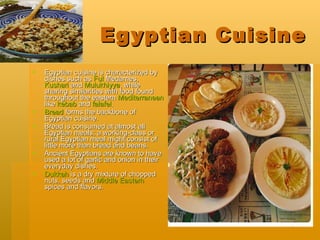
Egyptian Cuisine Egyptian cuisine is characterized by dishes such as  Ful   Medames ,  Kushari  and  Mulukhiyya , while sharing similarities with food found throughout the eastern  Mediterranean  like  kebab  and  falafel .  Bread  forms the backbone of Egyptian cuisine.  Bread is consumed at almost all Egyptian meals; a working-class or rural Egyptian meal might consist of little more than bread and beans.  Ancient Egyptians are known to have used a lot of garlic and onion in their everyday dishes.  Dukkah  is a dry mixture of chopped nuts, seeds and  Middle Eastern  spices and flavors.
Egyptian Holidays There are a set of  national holidays  celebrated by the entire population.  Since  Islam  is the state religion, the Islamic holidays are observed by all Egyptians.  Christian  holidays are not national holidays (except eastern  Christmas ), however the  Christians  are permitted to observe these holidays.  April 25 Sinai Liberation Day - Celebrates the withdrawal of  Israeli  troops from the  Sinai peninsula March 21 Mother's Day  - Celebrates all mothers October 24 Suez Day / Popular Resistance Day - Celebrates the resistance of local citizens in Suez during the  October War .
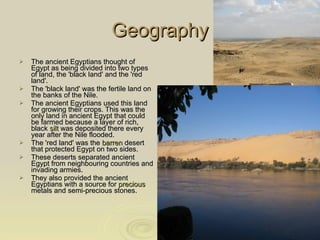
Geography The ancient Egyptians thought of Egypt as being divided into two types of land, the 'black land' and the 'red land'.  The 'black land' was the fertile land on the banks of the Nile.  The ancient Egyptians used this land for growing their crops. This was the only land in ancient Egypt that could be farmed because a layer of rich, black  silt  was deposited there every year after the Nile flooded.  The 'red land' was the  barren  desert that protected Egypt on two sides.  These deserts separated ancient Egypt from neighbouring countries and invading armies.  They also provided the ancient Egyptians with a source for  precious  metals and semi-precious stones.
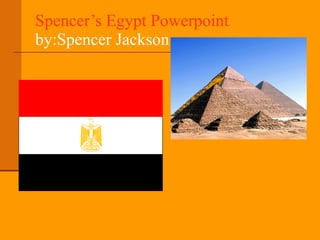
Egyptian Architecture Probably the most famous structure in all of Egypt, the Pyramids are still on of the worlds best architectural achievement, even though they were built many centuries ago. These structures can be as tall as 482 feet (147 m) high. The Pyramid towers over many other famous landmarks, including the Statue of Liberty.  The first true pyramid was build at saqqara for the king Zoser. It was called a step pyramid because of its step shape. The later pyramids were smooth sided, like the Great Pyramid at Giza, built for the king Khufu about 4,500 years ago.  Scattered throughout Egypt, you may see some large brown columns. These structures are made of granite and they all have some hieroglyphics on it. You may see some sort of design on the top of the columns.  Also scattered throughout Egypt are stone figures. These figures could look like a tiger, a king, and eagle, or maybe even a mixture of both.  Perhaps the best know stone figure of them all is the Sphinx. It is a figure of a kings head who is wearing the striped headcloth (nemes). His body is that of a lion.
Egyptian Traditional Dress Egypt had a range of traditional costumes.  The farmers (fellahin) basically wear gallibayas  In the cities the upper classes adopted the clothes of their conquerors - Ottoman Turks from 1500s, and later European from 1798.  To the south the  Nubians  have their own distinctive costume and across the desert  the Bedouin  also have a separate style of clothing.  Peasant women would wear a gallebaya outdoors but in the city gallibaya tended to be worn only indoors. For public wear a woman would wear a wide woman's dress called a tob sebleh.  The woman's kaftan was called a yelek
Egyptian History The  history of Egypt  is the longest continuous history, as a unified state, of any country in the world. The need to have a single authority to manage the waters of the Nile led to the creation of the world's first  state   in  Egypt  in about  3000 BC .  The  history of  Persian  Egypt  is divided into three era: an initial period of  Achaemenid   Persian  occupation when Egypt became a  satrapy , followed by an interval of independence; a second period of occupation, again under the Achaemenids; and a final occupation by the  Sassanid Empire , immediately before the  Arab invasion  of 639  CE .  The last  pharaoh  of the  Twenty-Sixth dynasty ,  Psamtik  III , was defeated by  Cambyses II of Persia  in the battle of  Pelusium  in the eastern  Nile  delta in  525 BC ,  Egypt  was then joined with  Cyprus  and  Phoenicia  in the sixth  satrapy  of the  Achaemenid  Empire .  Cambyses  led three unsuccessful military campaigns in  Africa : against  Carthage , the oases of the Western Desert, and Nubia. He remained in Egypt until 522 BC and died on the way back to Persia.
In Conclusion….. I think Egypt is a verrry interesting country.  I think it would be great to visit Egypt.  I would love to see the famous pyramids in Egypt.  I would love to try different Egyptian foods.  Egypt is a very culturally diverse and rich country!  P.S. – I got basically all my information from wikipedia.com

Spencer’s Egypt Powerpoint

  • 1.
    Spencer’s Egypt Powerpointby:Spencer Jackson
  • 2.
  • 3.
    Writing and HieroglyphicsThe ancient Egyptians believed that it was important to record and communicate information about religion and government. Thus, they invented written scripts that could be used to record this information. The most famous of all ancient Egyptian scripts is hieroglyphic . Hieroglyphic writing was a form of writing used by the ancient Egyptians. The individual characters are called 'hieroglyphs' However, throughout three thousand years of ancient Egyptian civilization, at least three other scripts were used for different purposes. Using these scripts, scribes were able to preserve the beliefs, history and ideas of ancient Egypt in temple and tomb walls and on papyrus scrolls.
  • 4.
    Egyptian Cuisine Egyptiancuisine is characterized by dishes such as Ful Medames , Kushari and Mulukhiyya , while sharing similarities with food found throughout the eastern Mediterranean like kebab and falafel . Bread forms the backbone of Egyptian cuisine. Bread is consumed at almost all Egyptian meals; a working-class or rural Egyptian meal might consist of little more than bread and beans. Ancient Egyptians are known to have used a lot of garlic and onion in their everyday dishes. Dukkah is a dry mixture of chopped nuts, seeds and Middle Eastern spices and flavors.
  • 5.
    Egyptian Holidays Thereare a set of national holidays celebrated by the entire population. Since Islam is the state religion, the Islamic holidays are observed by all Egyptians. Christian holidays are not national holidays (except eastern Christmas ), however the Christians are permitted to observe these holidays. April 25 Sinai Liberation Day - Celebrates the withdrawal of Israeli troops from the Sinai peninsula March 21 Mother's Day - Celebrates all mothers October 24 Suez Day / Popular Resistance Day - Celebrates the resistance of local citizens in Suez during the October War .
  • 6.
    Geography The ancientEgyptians thought of Egypt as being divided into two types of land, the 'black land' and the 'red land'. The 'black land' was the fertile land on the banks of the Nile. The ancient Egyptians used this land for growing their crops. This was the only land in ancient Egypt that could be farmed because a layer of rich, black silt was deposited there every year after the Nile flooded. The 'red land' was the barren desert that protected Egypt on two sides. These deserts separated ancient Egypt from neighbouring countries and invading armies. They also provided the ancient Egyptians with a source for precious metals and semi-precious stones.
  • 7.
    Egyptian Architecture Probablythe most famous structure in all of Egypt, the Pyramids are still on of the worlds best architectural achievement, even though they were built many centuries ago. These structures can be as tall as 482 feet (147 m) high. The Pyramid towers over many other famous landmarks, including the Statue of Liberty. The first true pyramid was build at saqqara for the king Zoser. It was called a step pyramid because of its step shape. The later pyramids were smooth sided, like the Great Pyramid at Giza, built for the king Khufu about 4,500 years ago. Scattered throughout Egypt, you may see some large brown columns. These structures are made of granite and they all have some hieroglyphics on it. You may see some sort of design on the top of the columns. Also scattered throughout Egypt are stone figures. These figures could look like a tiger, a king, and eagle, or maybe even a mixture of both. Perhaps the best know stone figure of them all is the Sphinx. It is a figure of a kings head who is wearing the striped headcloth (nemes). His body is that of a lion.
  • 8.
    Egyptian Traditional DressEgypt had a range of traditional costumes. The farmers (fellahin) basically wear gallibayas In the cities the upper classes adopted the clothes of their conquerors - Ottoman Turks from 1500s, and later European from 1798. To the south the Nubians have their own distinctive costume and across the desert the Bedouin also have a separate style of clothing. Peasant women would wear a gallebaya outdoors but in the city gallibaya tended to be worn only indoors. For public wear a woman would wear a wide woman's dress called a tob sebleh. The woman's kaftan was called a yelek
  • 9.
    Egyptian History The history of Egypt is the longest continuous history, as a unified state, of any country in the world. The need to have a single authority to manage the waters of the Nile led to the creation of the world's first state in Egypt in about 3000 BC . The history of Persian Egypt is divided into three era: an initial period of Achaemenid Persian occupation when Egypt became a satrapy , followed by an interval of independence; a second period of occupation, again under the Achaemenids; and a final occupation by the Sassanid Empire , immediately before the Arab invasion of 639 CE . The last pharaoh of the Twenty-Sixth dynasty , Psamtik III , was defeated by Cambyses II of Persia in the battle of Pelusium in the eastern Nile delta in 525 BC , Egypt was then joined with Cyprus and Phoenicia in the sixth satrapy of the Achaemenid Empire . Cambyses led three unsuccessful military campaigns in Africa : against Carthage , the oases of the Western Desert, and Nubia. He remained in Egypt until 522 BC and died on the way back to Persia.
  • 10.
    In Conclusion….. Ithink Egypt is a verrry interesting country. I think it would be great to visit Egypt. I would love to see the famous pyramids in Egypt. I would love to try different Egyptian foods. Egypt is a very culturally diverse and rich country! P.S. – I got basically all my information from wikipedia.com