Effective Community Engagement


                Michael Johnny, York University
           Manager, Knowledge Mobilization Unit
Overview

1. Introductions – Objectives and Biases
2. Assumptions
3. Intersections with KMb
4. Successful Collaborative Efforts
5. Intersections with Industry Liaison
6. Indigenous Communities
7. Questions - Discussion


                                           2
3
Problem Statement

Community-university engagement is not a new term,
nor are the processes new. However, there are
increasing interests from stakeholders in academic
research to see findings from research be utilized for
the benefits of Canadians, and people around the
world. This is changing the nature of scholarship for
many academic researchers.


                                                         4
Working to Eradicate Bullying: Deb Pepler

Bullying is a relationship problem that
may carry through adolescence and
into adulthood in the form of
aggression, sexual harassment, dating
aggression, and substance use.
Working on the determinants
interventions and treatments for bullies
and victims of bullying, Deb Pepler
works with researchers, governments
and NGOs to enhance awareness,
build research capacity, assess
bullying problems and promote
evidence-based programs and
effective policies across Canada.


                                            5
6
Definitions – Knowledge Mobilization


          WHAT IS KNOWLEDGE MOBILIZATION


   Knowledge Mobilization is about ensuring that all
   citizens benefit publicly from funded research. It can
   take many forms, but the essential objective is to allow
   research knowledge to flow both from within the
   academic world, and between academic researchers
   and the wider community


              http://www.sshrc-crsh.gc.ca/society-societe/community-communitie/index-eng.aspx


                                                                                                7
Definitions – Knowledge Transfer and Exchange


  Knowledge Transfer and Exchange is collaborative
  problem solving between researchers and decision
  makers


                    Canadian Health Services Research Foundation


                                                                   8
Definitions – Knowledge Translation


   Knowledge Translation (KT) is defined as a dynamic
   and iterative process that includes synthesis,
   dissemination, exchange and ethically sound
   application of knowledge to improve the health of
   Canadians, provide more effective health services and
   products and strengthen the health care system.


                        Canadian Institutes of Health Research


                                                                 9
Definitions – Knowledge Mobilization


   Knowledge Mobilization (KMb) is a suite of services that
   enhances the two-way connection between researchers
   and community stakeholders so that research and
   evidence can inform decisions about public policy and
   professional practice.

   KMb encompasses methods of knowledge transfer,
   translation, and exchange but extends these concepts
   to include the co-production of knowledge.

                     York University’s Definition of Knowledge Mobilization


                                                                              10
KMb-related Assumptions (linked to engagement)


  1. KMb is a social process. There is action and
     activity.
  2. Co-production of knowledge is the most effective
     form of KMb.
  3. Impact is measured at the level of the end user.


                                                        11
Co-production in the world of KMb

                          Knowledge Mobilization

 Research        Producer                             User
 Summaries                                                        Research
                  Push             Exchange            Pull       Translation
 Research                            (KE)
                   (KT)                                (KT)       Help Desk
 Translation
 Help Desk


                                 co-production


                 partnerships                        CBR

       Research Partnerships    Research Forums   Community Based Besearch
                KMb Interns        KM in AM
                Social Media

                                                                          12
Portugal Cove, NL


                    13
Partnerships for KMb throughout the Research Cycle


                                           Plan              Consultation
 Wikis, blogs                                                Partnerships
 Web site                                                    Research forum
 Town hall
 Theatre
 Posters
                                      public policy
 Policy brief   Disseminate                                Execute
                                  professional practice
 PSA
 Practice                                                       Populations
 guideline                                                      Clinical practice
 Popular press                                                  Intervention
 Social                                                         studies
 Marketing                                                      Internships
                                         Evaluate
                                                                Researcher
                                                                exchange
                 Surveys, case studies, expert panelists
                                                                               14
More Assumptions

“There is value in research partnerships in solving
community problems, building capacity, generating new
ideas, expanding research agendas and managing new
skills and technologies”


Learning from SSHRC Funded Partnerships, University of Victoria, Centre for Public Sector Studies,
May 2012, Dr. Budd Hall and Crystal Tremblay


                                                                                                     15
Findings and Experiences of Successful Collaborative Efforts


  1. From Community Perspectives

  2. From University Perspectives

  3. Overarching Findings

  4. Conditions for Success

  5. York Industry Liaison

  6. Indigenous Communities

                                                               16
Community Perspectives

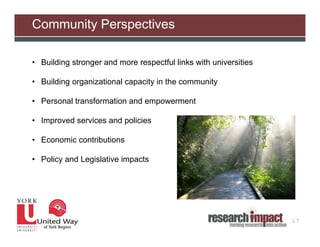
• Building stronger and more respectful links with universities

• Building organizational capacity in the community

• Personal transformation and empowerment

• Improved services and policies

• Economic contributions

• Policy and Legislative impacts


                                                                  17
University Perspectives

•   Student training and research fellowships

•   Career development

•   Better receptivity to community partners and more inter-university
    linkages


                                                                         18
Other Findings

• New “architecture of knowledge” – new phase of engaged
  scholarship
• New appreciation of place
• More dynamic and relevant curriculum
• Recognition of roles of regional, sectorial and national
  research alliances and networks
• Bringing new resources to our community in need
• Partnerships can create a ‘new normal’ way of working
• Knowledge cultures are different in communities and the
  university
• Increasing recognition of partnership as a measure of
  academic excellence


                                                             19
Conditions for Success – part 1

•   Governance – structure based on consensus making
•   MoU and Partnership Agreements
•   Values – mutual respect and trust
•   Range of partnership options
•   Participatory research approaches


                                                       20
Conditions for Success – part 2

•   Equal balance of power
•   Sharing resources
•   Understanding the research process
•   Time for relationship building
•   Strong leadership


                                         21
Grand Canyon, AZ


                   22
Industry Liaison at York


Industry Liaison Manager
         Cheryl Giblon – ext 55753

        cgiblon@yorku.ca


                                     23
Indigenous Communities


A unique framework for engagement

•   Capacity building
•   Economic development
•   Language and cultural revitalization
•   Valuing traditional knowledge
•   Reciprocal, trusting relationships
•   Be present. Practice meaningful consultation
•   Relevant KMb practices


                                                   24
Resources

• Learning from SSHRC Funded Partnerships, University of Victoria,
  Centre for Public Sector Studies, May 2012, Dr. Budd Hall and Crystal
  Tremblay

• York KMb Unit, Industry Liaison Office, York TD Centre for Community
  Engagement (http://cec.info.yorku.ca/)

• Campus Community Partnership for Health
   • http://www.communityengagedscholarship.info/

• Institute for Community Engaged Scholarship
    • http://www.theresearchshop.ca/

• http://cescholarship.ca/


                                                                          25
Community Engagement, Research and KMb

 Things I Think I Know

 • Like KMb, success in community engagement can be
   facilitated by relationships – get to know leaders in your
   field within your community. Get to know these
   people…and let them get to know you!

 • Values – truth, honesty, respect, integrity.

 • Recognition for CES is lagging, but there are ways to link
   engagement to academic T&P.


                                                                26
Summary – Michael’s Ideas

       What the heck is knowledge mobilization?
       - collaborative, relational, purposeful


    Respect the clash of cultures…make time for effective
    engagement…expand the project planning cycle


                       “Go slow in order to go far and fast”


               Knowledge is Power
               Sharing is Power


                                                               27
Michael Johnny
mjohnny@yorku.ca
http://www.researchimpact.ca

Effective Community engagement

  • 1.
    Effective Community Engagement Michael Johnny, York University Manager, Knowledge Mobilization Unit
  • 2.
    Overview 1. Introductions –Objectives and Biases 2. Assumptions 3. Intersections with KMb 4. Successful Collaborative Efforts 5. Intersections with Industry Liaison 6. Indigenous Communities 7. Questions - Discussion 2
  • 3.
  • 4.
    Problem Statement Community-university engagementis not a new term, nor are the processes new. However, there are increasing interests from stakeholders in academic research to see findings from research be utilized for the benefits of Canadians, and people around the world. This is changing the nature of scholarship for many academic researchers. 4
  • 5.
    Working to EradicateBullying: Deb Pepler Bullying is a relationship problem that may carry through adolescence and into adulthood in the form of aggression, sexual harassment, dating aggression, and substance use. Working on the determinants interventions and treatments for bullies and victims of bullying, Deb Pepler works with researchers, governments and NGOs to enhance awareness, build research capacity, assess bullying problems and promote evidence-based programs and effective policies across Canada. 5
  • 6.
  • 7.
    Definitions – KnowledgeMobilization WHAT IS KNOWLEDGE MOBILIZATION Knowledge Mobilization is about ensuring that all citizens benefit publicly from funded research. It can take many forms, but the essential objective is to allow research knowledge to flow both from within the academic world, and between academic researchers and the wider community http://www.sshrc-crsh.gc.ca/society-societe/community-communitie/index-eng.aspx 7
  • 8.
    Definitions – KnowledgeTransfer and Exchange Knowledge Transfer and Exchange is collaborative problem solving between researchers and decision makers Canadian Health Services Research Foundation 8
  • 9.
    Definitions – KnowledgeTranslation Knowledge Translation (KT) is defined as a dynamic and iterative process that includes synthesis, dissemination, exchange and ethically sound application of knowledge to improve the health of Canadians, provide more effective health services and products and strengthen the health care system. Canadian Institutes of Health Research 9
  • 10.
    Definitions – KnowledgeMobilization Knowledge Mobilization (KMb) is a suite of services that enhances the two-way connection between researchers and community stakeholders so that research and evidence can inform decisions about public policy and professional practice. KMb encompasses methods of knowledge transfer, translation, and exchange but extends these concepts to include the co-production of knowledge. York University’s Definition of Knowledge Mobilization 10
  • 11.
    KMb-related Assumptions (linkedto engagement) 1. KMb is a social process. There is action and activity. 2. Co-production of knowledge is the most effective form of KMb. 3. Impact is measured at the level of the end user. 11
  • 12.
    Co-production in theworld of KMb Knowledge Mobilization Research Producer User Summaries Research Push Exchange Pull Translation Research (KE) (KT) (KT) Help Desk Translation Help Desk co-production partnerships CBR Research Partnerships Research Forums Community Based Besearch KMb Interns KM in AM Social Media 12
  • 13.
  • 14.
    Partnerships for KMbthroughout the Research Cycle Plan Consultation Wikis, blogs Partnerships Web site Research forum Town hall Theatre Posters public policy Policy brief Disseminate Execute professional practice PSA Practice Populations guideline Clinical practice Popular press Intervention Social studies Marketing Internships Evaluate Researcher exchange Surveys, case studies, expert panelists 14
  • 15.
    More Assumptions “There isvalue in research partnerships in solving community problems, building capacity, generating new ideas, expanding research agendas and managing new skills and technologies” Learning from SSHRC Funded Partnerships, University of Victoria, Centre for Public Sector Studies, May 2012, Dr. Budd Hall and Crystal Tremblay 15
  • 16.
    Findings and Experiencesof Successful Collaborative Efforts 1. From Community Perspectives 2. From University Perspectives 3. Overarching Findings 4. Conditions for Success 5. York Industry Liaison 6. Indigenous Communities 16
  • 17.
    Community Perspectives • Buildingstronger and more respectful links with universities • Building organizational capacity in the community • Personal transformation and empowerment • Improved services and policies • Economic contributions • Policy and Legislative impacts 17
  • 18.
    University Perspectives • Student training and research fellowships • Career development • Better receptivity to community partners and more inter-university linkages 18
  • 19.
    Other Findings • New“architecture of knowledge” – new phase of engaged scholarship • New appreciation of place • More dynamic and relevant curriculum • Recognition of roles of regional, sectorial and national research alliances and networks • Bringing new resources to our community in need • Partnerships can create a ‘new normal’ way of working • Knowledge cultures are different in communities and the university • Increasing recognition of partnership as a measure of academic excellence 19
  • 20.
    Conditions for Success– part 1 • Governance – structure based on consensus making • MoU and Partnership Agreements • Values – mutual respect and trust • Range of partnership options • Participatory research approaches 20
  • 21.
    Conditions for Success– part 2 • Equal balance of power • Sharing resources • Understanding the research process • Time for relationship building • Strong leadership 21
  • 22.
  • 23.
    Industry Liaison atYork Industry Liaison Manager Cheryl Giblon – ext 55753 cgiblon@yorku.ca 23
  • 24.
    Indigenous Communities A uniqueframework for engagement • Capacity building • Economic development • Language and cultural revitalization • Valuing traditional knowledge • Reciprocal, trusting relationships • Be present. Practice meaningful consultation • Relevant KMb practices 24
  • 25.
    Resources • Learning fromSSHRC Funded Partnerships, University of Victoria, Centre for Public Sector Studies, May 2012, Dr. Budd Hall and Crystal Tremblay • York KMb Unit, Industry Liaison Office, York TD Centre for Community Engagement (http://cec.info.yorku.ca/) • Campus Community Partnership for Health • http://www.communityengagedscholarship.info/ • Institute for Community Engaged Scholarship • http://www.theresearchshop.ca/ • http://cescholarship.ca/ 25
  • 26.
    Community Engagement, Researchand KMb Things I Think I Know • Like KMb, success in community engagement can be facilitated by relationships – get to know leaders in your field within your community. Get to know these people…and let them get to know you! • Values – truth, honesty, respect, integrity. • Recognition for CES is lagging, but there are ways to link engagement to academic T&P. 26
  • 27.
    Summary – Michael’sIdeas What the heck is knowledge mobilization? - collaborative, relational, purposeful Respect the clash of cultures…make time for effective engagement…expand the project planning cycle “Go slow in order to go far and fast” Knowledge is Power Sharing is Power 27
  • 28.