The Three Bridges to the Third Sector   2D Bridging the Gap Conference Panel Razia Shariff  Third Sector Research Centre Alex Murdock   London South Bank University Karl Wilding   National Council  for Voluntary Organisations .
Introduction Knowledge exchange increasingly being seen as key component in creating  research that has social, economic and political impact Impact key priority for ESRC, REF and government funding Third sector (civil society) key impact pathway for social impact Knowledge exchange a two way process, valuing different types of knowledge from the practitioner, policy maker and researcher Panel Session Three bridges being presented here from an academic, policy maker / practitioner and knowledge exchange perspective. (25 mins) Followed by Q & A  and panel discussion on the reflections and learnings of using the different approaches in practice (35 mins)
Third Sector Research Centre Aim  To make a difference in policy,  practice & academia Academic Knowledge developed Practitioner Community able to access & use research knowledge to enhance their work  Economic and social impact of sector evidenced and strengthened Policy, funding and decision making informed through an accessible evidence base
TSRC Approach To bridge gaps and build understanding between research, decision making, policy making and practice To ensure that the experience and knowledge of policy and decision makers, practitioners and funders informs our research To make knowledge available in meaningful and accessible ways so that it can be used by policy and decision makers, practitioners and funders To ensure we reach those isolated from existing research knowledge flows
Reference Groups 1.  Review of Literature 2.  Identify Research Streams 3. Establish engagement mechanisms 4. Ensure ongoing participation 5. Knowledge exchange & feedback 6. Promote and publicise   7. Identify new areas of research  Third Sector  Stakeholders Decision makers and policy implementers Funders & Commissioners Non academic researchers Academic Researchers Practitioners   Media and Publicists Local and national policy makers  Advisory Board TSRC
Tools, Methods and Skills Producing accessible published research Building contacts and expanding reach Managing a website and developing links Designing publicity materials and marketing Media relations and press work Events management and workshop facilitation Monitoring, evaluating and refining approach to ensure cover the diversity and depth of the sector Developing strong, trusting and long term relationships with key stakeholders
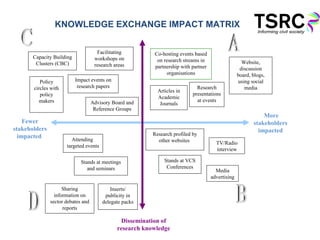
KNOWLEDGE EXCHANGE IMPACT MATRIX More stakeholders  impacted  Fewer stakeholders impacted  Media advertising Stands at VCS Conferences Inserts/ publicity in delegate packs Website, discussion board, blogs, using social media Research presentations at events Sharing information on sector debates and reports Research profiled by other websites  Advisory Board and Reference Groups Co-hosting events based on research streams in partnership with partner organisations Articles in Academic Journals A B C D Dissemination of research knowledge Impact events on research papers Policy circles with policy makers Stands at meetings and seminars Facilitating workshops on research areas Capacity Building Clusters (CBC) Attending  targeted events TV/Radio interview
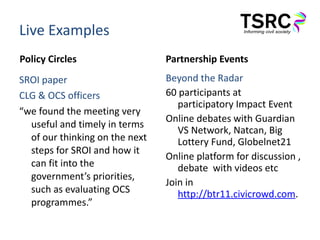
Live Examples Policy Circles SROI paper CLG & OCS officers “ we found the meeting very useful and timely in terms of our thinking on the next steps for SROI and how it can fit into the government’s priorities, such as evaluating OCS programmes.”  Partnership Events Beyond the Radar 60 participants at  participatory Impact Event  Online debates with Guardian VS Network, Natcan, Big Lottery Fund, Globelnet21 Online platform for discussion , debate  with videos etc Join in  http://btr11.civicrowd.com .
Reflections Knowledge Exchange should not be an add on or supplementary after research has been undertaken but integrated into the research process Need to consider resource implications of ongoing interactions and implementing research findings Need to establish building blocks by raising research profile and creating strong relationships Cumulative effect of more meaningful intense knowledge exchange more likely to have a long term impact
WHAT IS KNOWLEDGE TRANSFER  “ the transfer or imparting of knowledge from one source to another such that the recipient benefits”. (Burns and Paton 2005:50).  Knowledge Transfer in the UK academic context  has been around since 1975  in the form of Teaching Company Schemes which subsequently came to be labelled as Knowledge Transfer Partnerships in 2003  (Brown and Chisholm, 2008)
Importance of tacit knowledge “ that which is non-verbalized or even non-verbalisable, intuitive, and/or unarticulated. the knowledge inside the head of the university researcher including such things as skills related to using the knowledge, know-how related to adapting the knowledge, understanding of variations from ‘official’ processes, unwritten rules of thumb for implementing or troubleshooting and how to look at data or unstated theoretical connections”  (Sherwood and Butts 2004:6)
Knowledge Transfer Partnership Very well established Tripartite relationship – organisation/university/government Organisation can be from any sector ( ie Health and Local Government as well as SME or Third Sector Requires detailed project planning Application assessed by business case methodology
KNOWLEDGE TRANSFER PARTNERSHIPS IN SE Knowledge Transfer Partnerships involve collaborative research where typically smaller social enterprises put in one third and the Government (ESRC/OCS) will pay two thirds.  This can allow a social enterprise to triple any research funding it has.  The annual cost for an organisation of a 2 year KTP is about £20,000- £35,000 depending on the size of the organisation.  The work undertaken needs to show a monetarised return on the investment ( The application has to make a justified business case)
… ..on KTPs During the 2008-9 year there were 964 Partnerships and 1021 Associate places in the KTP portfolio with an aspiration to increase numbers further .  Over the years and decades it has been in operation, the KTP model has gained an enviable reputation for delivering high-quality innovation to UK companies through its three-way knowledge-transfer interactions between firms, universities and skilled graduates.’ (Howlett  2010:5)
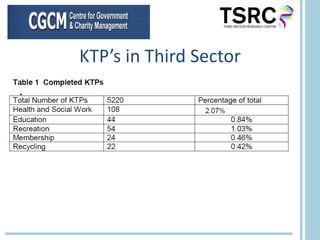
KTP’s in Third Sector .
Nature of Knowledge Transfer Partnerships Though the majority are in Health and Social Care they are found across a range of categories These include architecture, technology and engineering They are un or underreported in academic literature  The findings and content etc. are not usually embargoed ( unlike some private company KTP’s) There is an accessible database:-  www.ktponline.org.uk
KTP Project with RNIB Two year project from 2010 to 2012 Project Conducted primary social impact research on RNIB Social Firms Developed an RNIB-employment specific social impact framework to gather evidence Identified best practice in Social Firms Informed RNIB strategy in Social Firm development Created a business case for further RNIB Social Firm development
Voucher: Short scoping project with South Bank Mosaics An organisation with a good product and excellent record of social impact However a lack of awareness of market and no current marketing plan Academic addressed the need to market awareness and developed marketing plan
Placement with Brent Homeless User Group Academic going  out Learned about the operation of a social enterprise Carried out a project to assess relevance of personalisation Influenced development of organisational strategy Practitioner coming in Joined with third sector students and academics Developed knowledge and competence in marketing for nfp sector Was able to bring these skills back to organisation
Other projects using lateral thinking to get win -win  research at a fraction of the ‘commercial cost Emmaus International Global social enterprise requiring evaluation across 5 continents and in three languages Use of Skype and multi-lingual students Cost 14 K Euro Estimate of  full  commercial cost £ 60 K  Cook Inlet Tribal Council (Alaska) Evaluation of social enterprise development with Native Alaskans Client ‘spare’ Air Miles for travel Academic time not charged 2 weeks basic hotel accommodation paid by client Estimate of full commercial cost about  £8-10  K
Should policy makers and practitioners engage with academic researchers? A VCS perspective
What is ‘distinctive’ about the VCS? Large number of small entities Multiple industries, interests Researches the social agenda, not just R&D Poor coverage in official statistics Research poorly resourced?
The sector’s research capacity is (in general) weak Few evidence reviews Limited time-series data Theoretical development poor Ltd centralised knowledge-base (Non-) Professional development Evidence>Policy>Campaigns Networks & brokerage
KT challenges Research funder, user, consumer, abuser Fairly weak links with academia, professional institutes Dispersed sole-traders Dispersed evidence base
VCS perspectives I hear… Academic research is… Jargon-laden/badly written Inaccessible Inevitably after the event Irrelevant VCOs are used as bid candy Academics ‘helicopter in’ I think these are wrong.
Opportunities (In no particular order) Never assume everyone knows everything Understand the web changes everything: format, content, engagement, speed… Emerging trends: infographics, narratives Assume nobody reads anything Reporting: perpetual beta
Implications for KT practice Understand your/our USP in the market of ideas and how we collaborate Help each other to understand (challenge?) the policy environment Recognise policy windows Don’t be hierarchical about knowledge
Understand – and accept – that simplicity is not a corruption of your work Work together on media work to build relationships with key journalists Different team roles: researchers, writers, reporters Seminars: engagement before and after, but maybe think about structure/length Think about what partnership & engagement really means and  act on this. Implications for KT practice
What are the benefits and opportunities of each approach? Panel Q & A What are the disadvantages to overcome/challenges ?
Razia Shariff  Head, Knowledge Exchange Team Third Sector Research Centre  Email:  [email_address]   Alex Murdock  Head of CGCM, London South Bank University Email:  [email_address]   Karl Wilding  Head of Policy, Research and Foresight, National Council for Voluntary Organisations Email:  [email_address]

ESRC Knowledge Brokerage conference: the third sector

  • 1.
    The Three Bridgesto the Third Sector 2D Bridging the Gap Conference Panel Razia Shariff Third Sector Research Centre Alex Murdock London South Bank University Karl Wilding National Council for Voluntary Organisations .
  • 2.
    Introduction Knowledge exchangeincreasingly being seen as key component in creating research that has social, economic and political impact Impact key priority for ESRC, REF and government funding Third sector (civil society) key impact pathway for social impact Knowledge exchange a two way process, valuing different types of knowledge from the practitioner, policy maker and researcher Panel Session Three bridges being presented here from an academic, policy maker / practitioner and knowledge exchange perspective. (25 mins) Followed by Q & A and panel discussion on the reflections and learnings of using the different approaches in practice (35 mins)
  • 3.
    Third Sector ResearchCentre Aim To make a difference in policy, practice & academia Academic Knowledge developed Practitioner Community able to access & use research knowledge to enhance their work Economic and social impact of sector evidenced and strengthened Policy, funding and decision making informed through an accessible evidence base
  • 4.
    TSRC Approach Tobridge gaps and build understanding between research, decision making, policy making and practice To ensure that the experience and knowledge of policy and decision makers, practitioners and funders informs our research To make knowledge available in meaningful and accessible ways so that it can be used by policy and decision makers, practitioners and funders To ensure we reach those isolated from existing research knowledge flows
  • 5.
    Reference Groups 1. Review of Literature 2. Identify Research Streams 3. Establish engagement mechanisms 4. Ensure ongoing participation 5. Knowledge exchange & feedback 6. Promote and publicise 7. Identify new areas of research Third Sector Stakeholders Decision makers and policy implementers Funders & Commissioners Non academic researchers Academic Researchers Practitioners Media and Publicists Local and national policy makers Advisory Board TSRC
  • 6.
    Tools, Methods andSkills Producing accessible published research Building contacts and expanding reach Managing a website and developing links Designing publicity materials and marketing Media relations and press work Events management and workshop facilitation Monitoring, evaluating and refining approach to ensure cover the diversity and depth of the sector Developing strong, trusting and long term relationships with key stakeholders
  • 7.
    KNOWLEDGE EXCHANGE IMPACTMATRIX More stakeholders impacted Fewer stakeholders impacted Media advertising Stands at VCS Conferences Inserts/ publicity in delegate packs Website, discussion board, blogs, using social media Research presentations at events Sharing information on sector debates and reports Research profiled by other websites Advisory Board and Reference Groups Co-hosting events based on research streams in partnership with partner organisations Articles in Academic Journals A B C D Dissemination of research knowledge Impact events on research papers Policy circles with policy makers Stands at meetings and seminars Facilitating workshops on research areas Capacity Building Clusters (CBC) Attending targeted events TV/Radio interview
  • 8.
    Live Examples PolicyCircles SROI paper CLG & OCS officers “ we found the meeting very useful and timely in terms of our thinking on the next steps for SROI and how it can fit into the government’s priorities, such as evaluating OCS programmes.” Partnership Events Beyond the Radar 60 participants at participatory Impact Event Online debates with Guardian VS Network, Natcan, Big Lottery Fund, Globelnet21 Online platform for discussion , debate with videos etc Join in http://btr11.civicrowd.com .
  • 9.
    Reflections Knowledge Exchangeshould not be an add on or supplementary after research has been undertaken but integrated into the research process Need to consider resource implications of ongoing interactions and implementing research findings Need to establish building blocks by raising research profile and creating strong relationships Cumulative effect of more meaningful intense knowledge exchange more likely to have a long term impact
  • 10.
    WHAT IS KNOWLEDGETRANSFER “ the transfer or imparting of knowledge from one source to another such that the recipient benefits”. (Burns and Paton 2005:50). Knowledge Transfer in the UK academic context has been around since 1975 in the form of Teaching Company Schemes which subsequently came to be labelled as Knowledge Transfer Partnerships in 2003 (Brown and Chisholm, 2008)
  • 11.
    Importance of tacitknowledge “ that which is non-verbalized or even non-verbalisable, intuitive, and/or unarticulated. the knowledge inside the head of the university researcher including such things as skills related to using the knowledge, know-how related to adapting the knowledge, understanding of variations from ‘official’ processes, unwritten rules of thumb for implementing or troubleshooting and how to look at data or unstated theoretical connections” (Sherwood and Butts 2004:6)
  • 12.
    Knowledge Transfer PartnershipVery well established Tripartite relationship – organisation/university/government Organisation can be from any sector ( ie Health and Local Government as well as SME or Third Sector Requires detailed project planning Application assessed by business case methodology
  • 13.
    KNOWLEDGE TRANSFER PARTNERSHIPSIN SE Knowledge Transfer Partnerships involve collaborative research where typically smaller social enterprises put in one third and the Government (ESRC/OCS) will pay two thirds. This can allow a social enterprise to triple any research funding it has. The annual cost for an organisation of a 2 year KTP is about £20,000- £35,000 depending on the size of the organisation. The work undertaken needs to show a monetarised return on the investment ( The application has to make a justified business case)
  • 14.
    … ..on KTPsDuring the 2008-9 year there were 964 Partnerships and 1021 Associate places in the KTP portfolio with an aspiration to increase numbers further . Over the years and decades it has been in operation, the KTP model has gained an enviable reputation for delivering high-quality innovation to UK companies through its three-way knowledge-transfer interactions between firms, universities and skilled graduates.’ (Howlett 2010:5)
  • 15.
  • 16.
    Nature of KnowledgeTransfer Partnerships Though the majority are in Health and Social Care they are found across a range of categories These include architecture, technology and engineering They are un or underreported in academic literature The findings and content etc. are not usually embargoed ( unlike some private company KTP’s) There is an accessible database:- www.ktponline.org.uk
  • 17.
    KTP Project withRNIB Two year project from 2010 to 2012 Project Conducted primary social impact research on RNIB Social Firms Developed an RNIB-employment specific social impact framework to gather evidence Identified best practice in Social Firms Informed RNIB strategy in Social Firm development Created a business case for further RNIB Social Firm development
  • 18.
    Voucher: Short scopingproject with South Bank Mosaics An organisation with a good product and excellent record of social impact However a lack of awareness of market and no current marketing plan Academic addressed the need to market awareness and developed marketing plan
  • 19.
    Placement with BrentHomeless User Group Academic going out Learned about the operation of a social enterprise Carried out a project to assess relevance of personalisation Influenced development of organisational strategy Practitioner coming in Joined with third sector students and academics Developed knowledge and competence in marketing for nfp sector Was able to bring these skills back to organisation
  • 20.
    Other projects usinglateral thinking to get win -win research at a fraction of the ‘commercial cost Emmaus International Global social enterprise requiring evaluation across 5 continents and in three languages Use of Skype and multi-lingual students Cost 14 K Euro Estimate of full commercial cost £ 60 K Cook Inlet Tribal Council (Alaska) Evaluation of social enterprise development with Native Alaskans Client ‘spare’ Air Miles for travel Academic time not charged 2 weeks basic hotel accommodation paid by client Estimate of full commercial cost about £8-10 K
  • 21.
    Should policy makersand practitioners engage with academic researchers? A VCS perspective
  • 22.
    What is ‘distinctive’about the VCS? Large number of small entities Multiple industries, interests Researches the social agenda, not just R&D Poor coverage in official statistics Research poorly resourced?
  • 23.
    The sector’s researchcapacity is (in general) weak Few evidence reviews Limited time-series data Theoretical development poor Ltd centralised knowledge-base (Non-) Professional development Evidence>Policy>Campaigns Networks & brokerage
  • 24.
    KT challenges Researchfunder, user, consumer, abuser Fairly weak links with academia, professional institutes Dispersed sole-traders Dispersed evidence base
  • 25.
    VCS perspectives Ihear… Academic research is… Jargon-laden/badly written Inaccessible Inevitably after the event Irrelevant VCOs are used as bid candy Academics ‘helicopter in’ I think these are wrong.
  • 26.
    Opportunities (In noparticular order) Never assume everyone knows everything Understand the web changes everything: format, content, engagement, speed… Emerging trends: infographics, narratives Assume nobody reads anything Reporting: perpetual beta
  • 27.
    Implications for KTpractice Understand your/our USP in the market of ideas and how we collaborate Help each other to understand (challenge?) the policy environment Recognise policy windows Don’t be hierarchical about knowledge
  • 28.
    Understand – andaccept – that simplicity is not a corruption of your work Work together on media work to build relationships with key journalists Different team roles: researchers, writers, reporters Seminars: engagement before and after, but maybe think about structure/length Think about what partnership & engagement really means and act on this. Implications for KT practice
  • 29.
    What are thebenefits and opportunities of each approach? Panel Q & A What are the disadvantages to overcome/challenges ?
  • 30.
    Razia Shariff Head, Knowledge Exchange Team Third Sector Research Centre Email: [email_address] Alex Murdock Head of CGCM, London South Bank University Email: [email_address] Karl Wilding Head of Policy, Research and Foresight, National Council for Voluntary Organisations Email: [email_address]