FEBRUARY 15, 2012


The Promise and Perils of Supporting and
Evaluating Network Formation and
Development
A Leadership Learning Community Webinar

Kim Ammann Howard, BTW informing change
Melanie Moore, See Change
Claire Reinelt, Leadership Learning Community
Objectives

    • Better understanding of some of the opportunities and
     challenges of network formation and development

    • Questions to ask and strategies to use for evaluating
     network formation and development


1
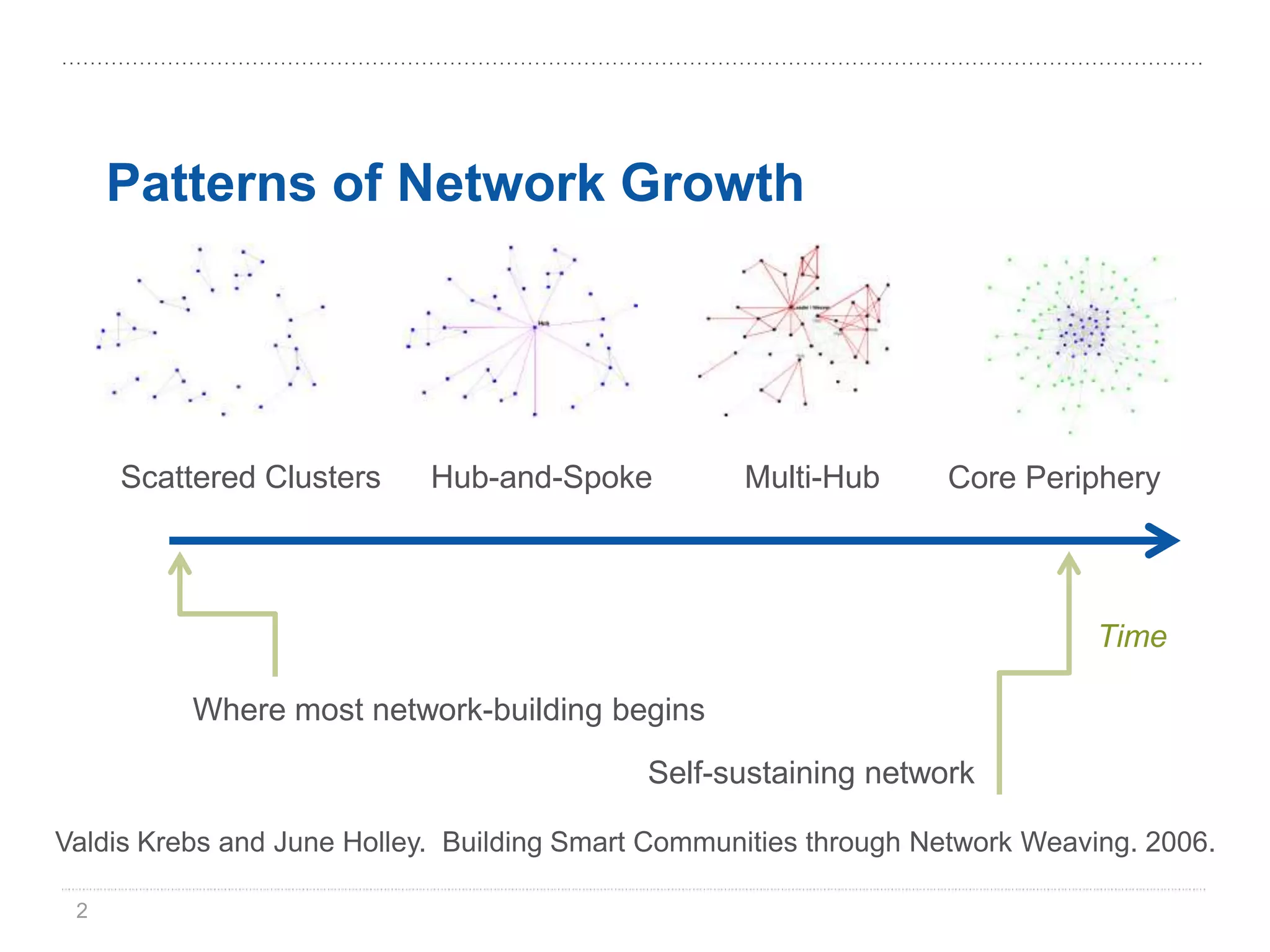
Patterns of Network Growth


     Scattered Clusters     Hub-and-Spoke          Multi-Hub      Core Periphery


                                                                              Time

          Where most network-building begins
                                            Self-sustaining network

Valdis Krebs and June Holley. Building Smart Communities through Network Weaving. 2006.

 2
Networks for Collective
Action


                          5
Do Networks Lead to Collective Action?

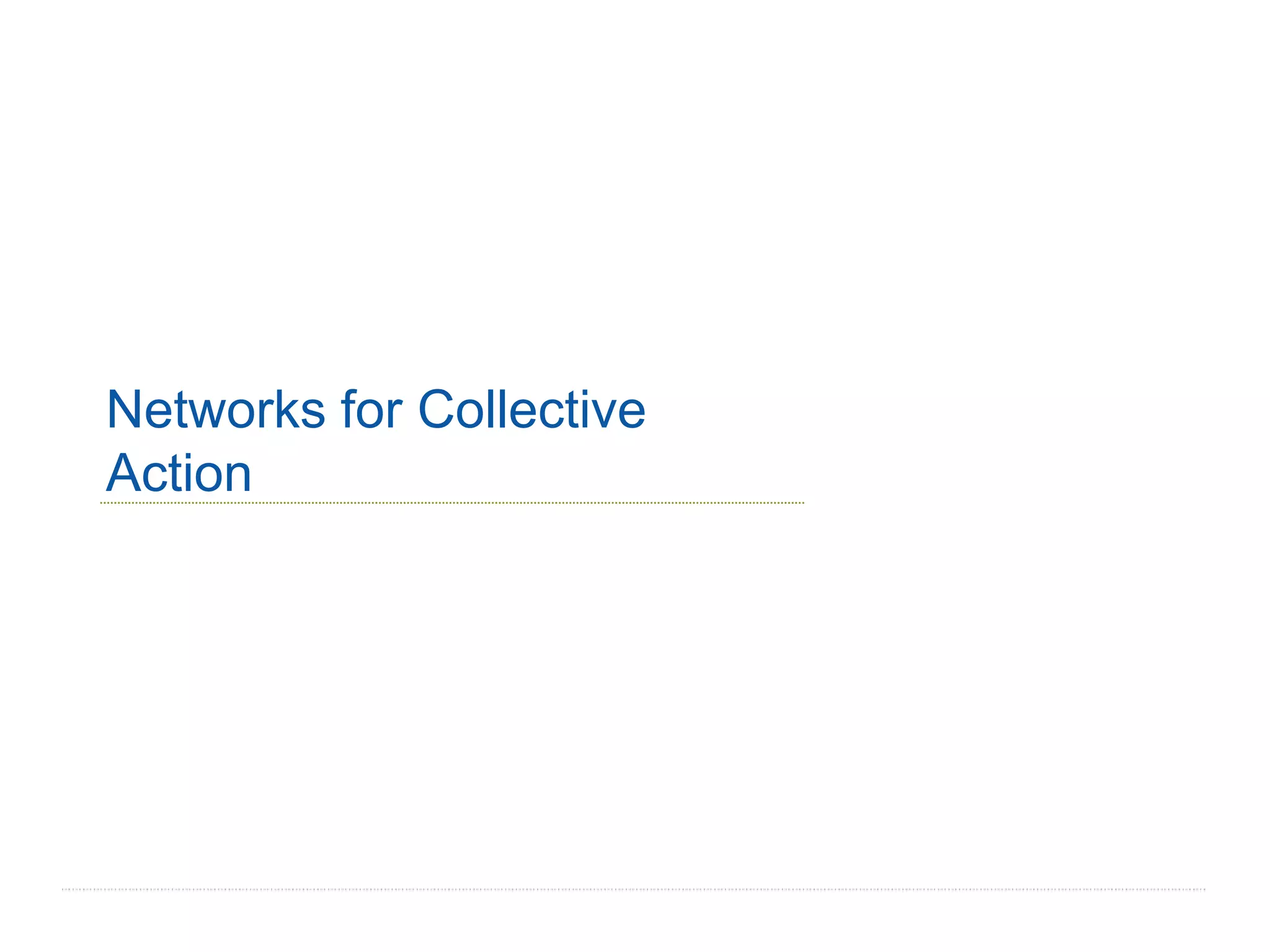
    • Assumption: Linking organizations with similar visions and missions will
      amplify their effectiveness

    • For example:

       • Building a citywide racial justice agenda

       • Broadening constituency of
         environmental movement in state


3
What Gets in the Way of Collective Action?

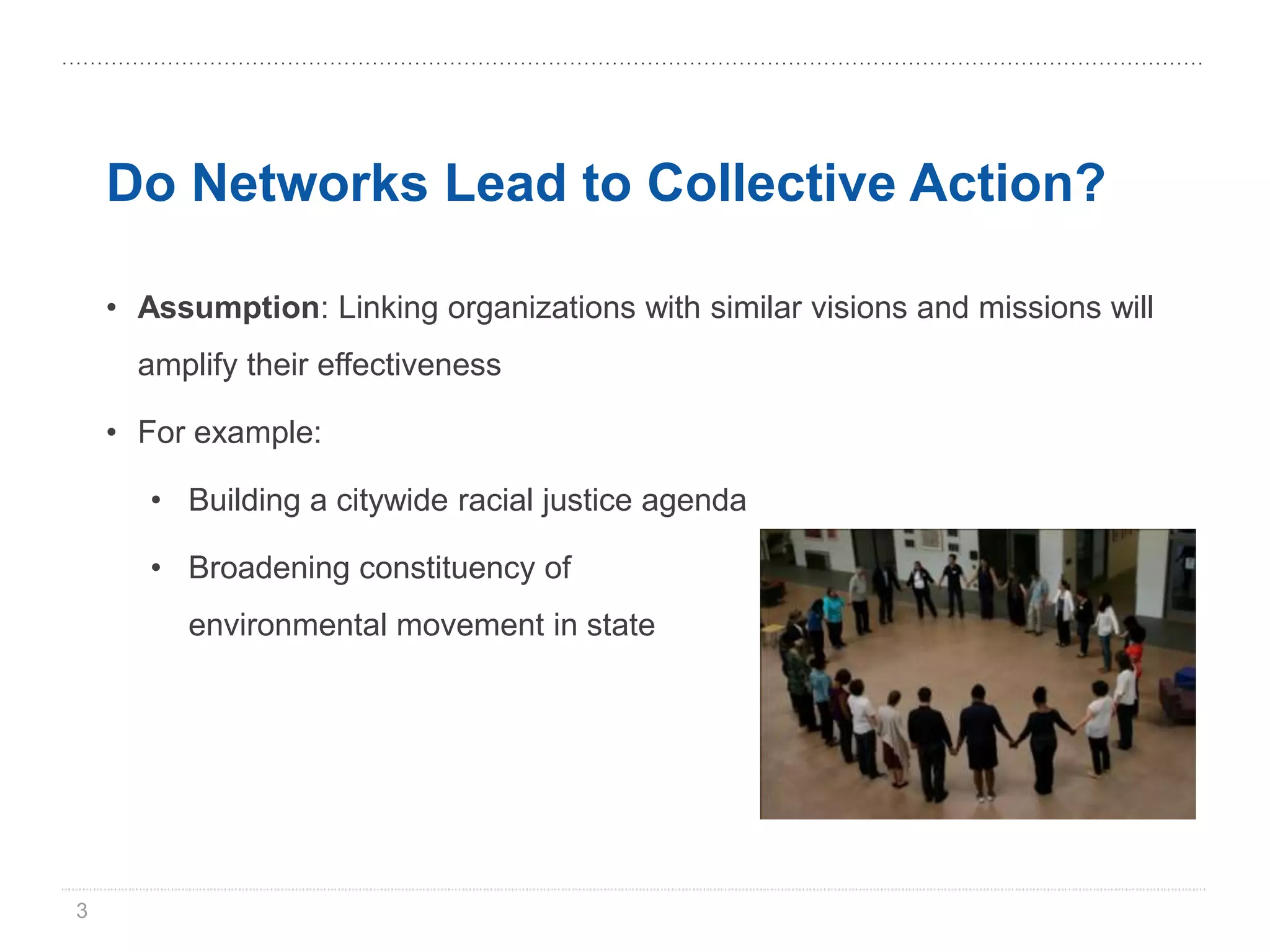
    • Lack of clarity about purpose of
      network—What do you want us to do?

    • Lack of capacity for collaboration and
      uneven capacity across network
      members

    • Lack of a sense of urgency to work at
      a collective level


4
What Supports Collective Action?
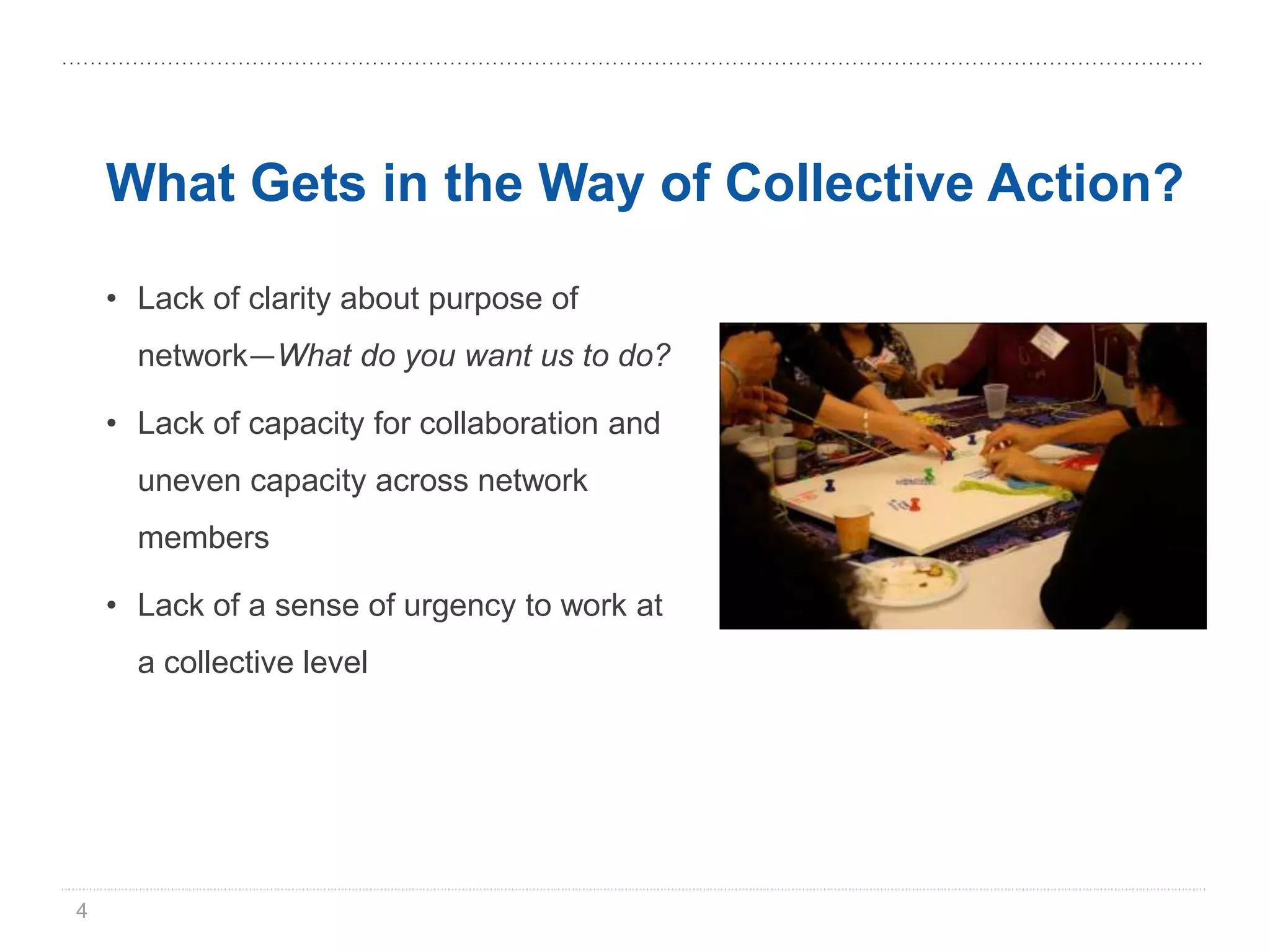
    • Network management is essential—someone needs to have the big
      picture in mind

    • Other strategies complement network action, such as commissioned
      research, communications and leveraging relationships

    • Trust/relationship building is facilitative, but not always

      essential

    • Political moments—the spark that ignites

      collective action


5
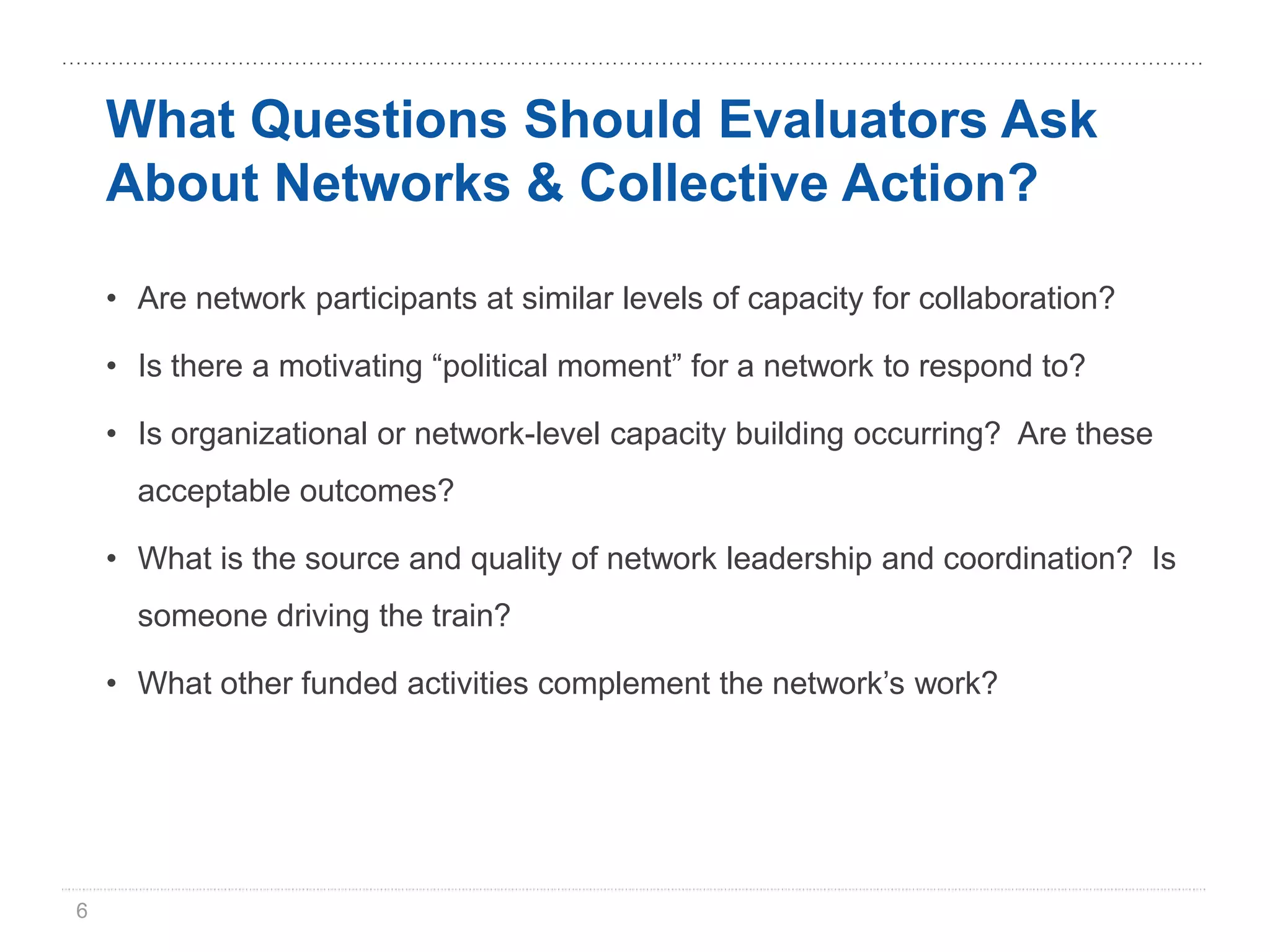
What Questions Should Evaluators Ask
    About Networks & Collective Action?

    • Are network participants at similar levels of capacity for collaboration?

    • Is there a motivating “political moment” for a network to respond to?

    • Is organizational or network-level capacity building occurring? Are these
      acceptable outcomes?

    • What is the source and quality of network leadership and coordination? Is
      someone driving the train?

    • What other funded activities complement the network’s work?


6
Networks to Promote
Community Health


                      10
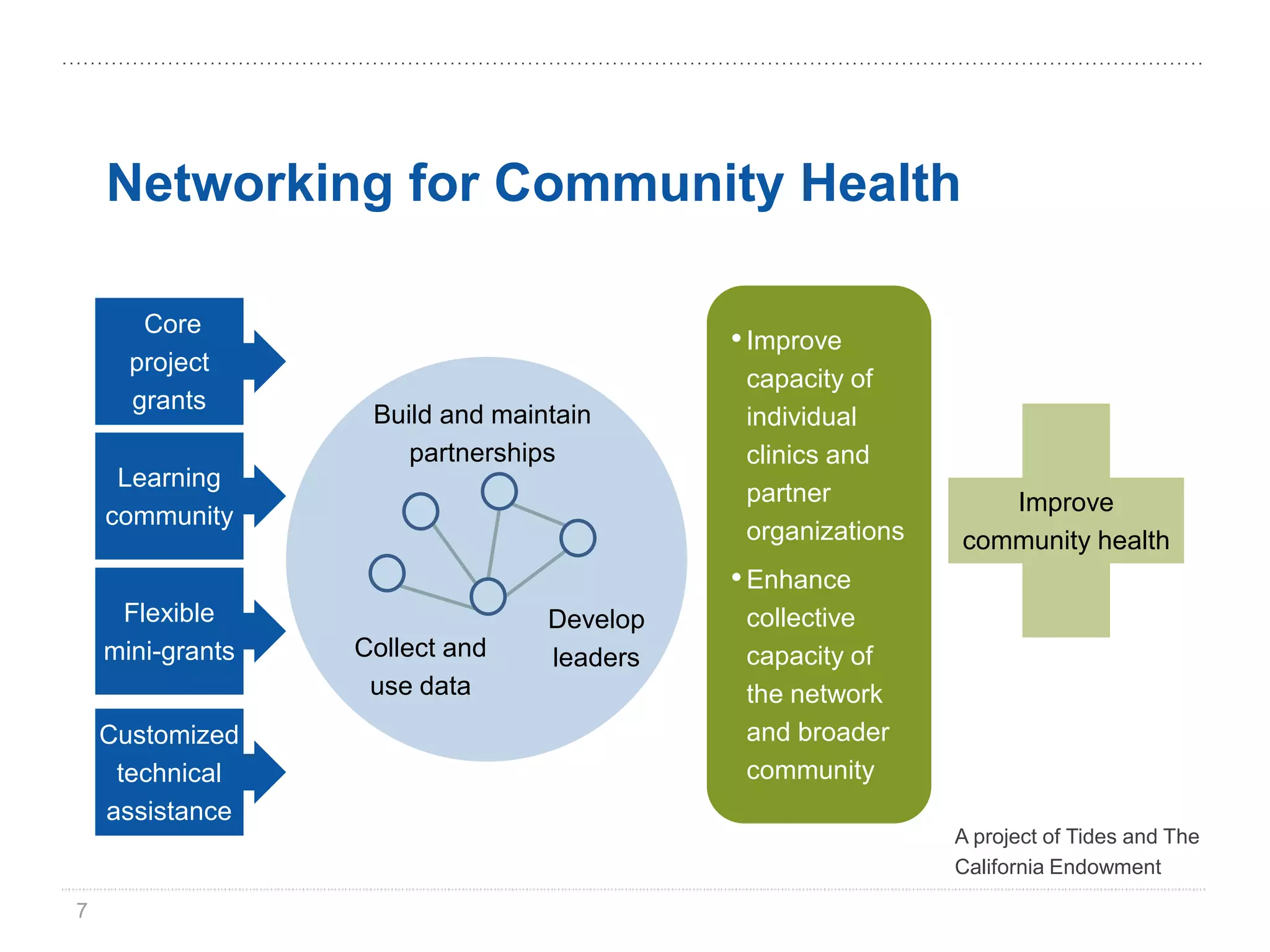
Networking for Community Health

       Core
                                           • Improve
      project
                                            capacity of
      grants
                   Build and maintain       individual
                      partnerships          clinics and
     Learning
                                            partner            Improve
    community
                                            organizations   community health
                                           • Enhance
     Flexible                    Develop    collective
    mini-grants   Collect and    leaders    capacity of
                   use data                 the network
    Customized                              and broader
     technical                              community
    assistance
                                                            A project of Tides and The
                                                            California Endowment

7
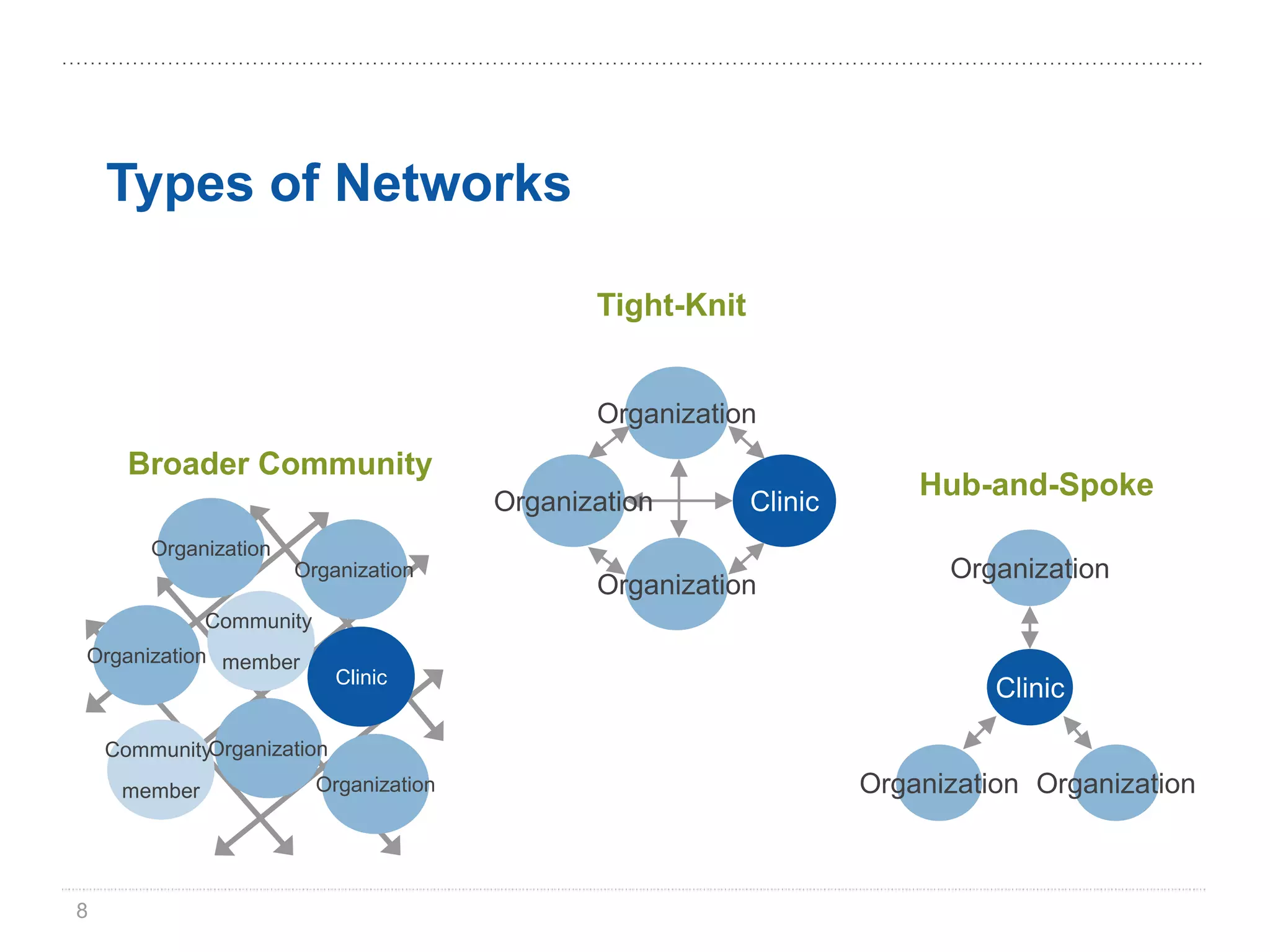
Types of Networks

                                                Tight-Knit


                                                Organization
      Broader Community
                                         Organization        Clinic
                                                                          Hub-and-Spoke
        Organization
                       Organization                                         Organization
                                                Organization
              Community
Organization member
                            Clinic
                                                                                Clinic

    CommunityOrganization
     member               Organization                                Organization Organization


8
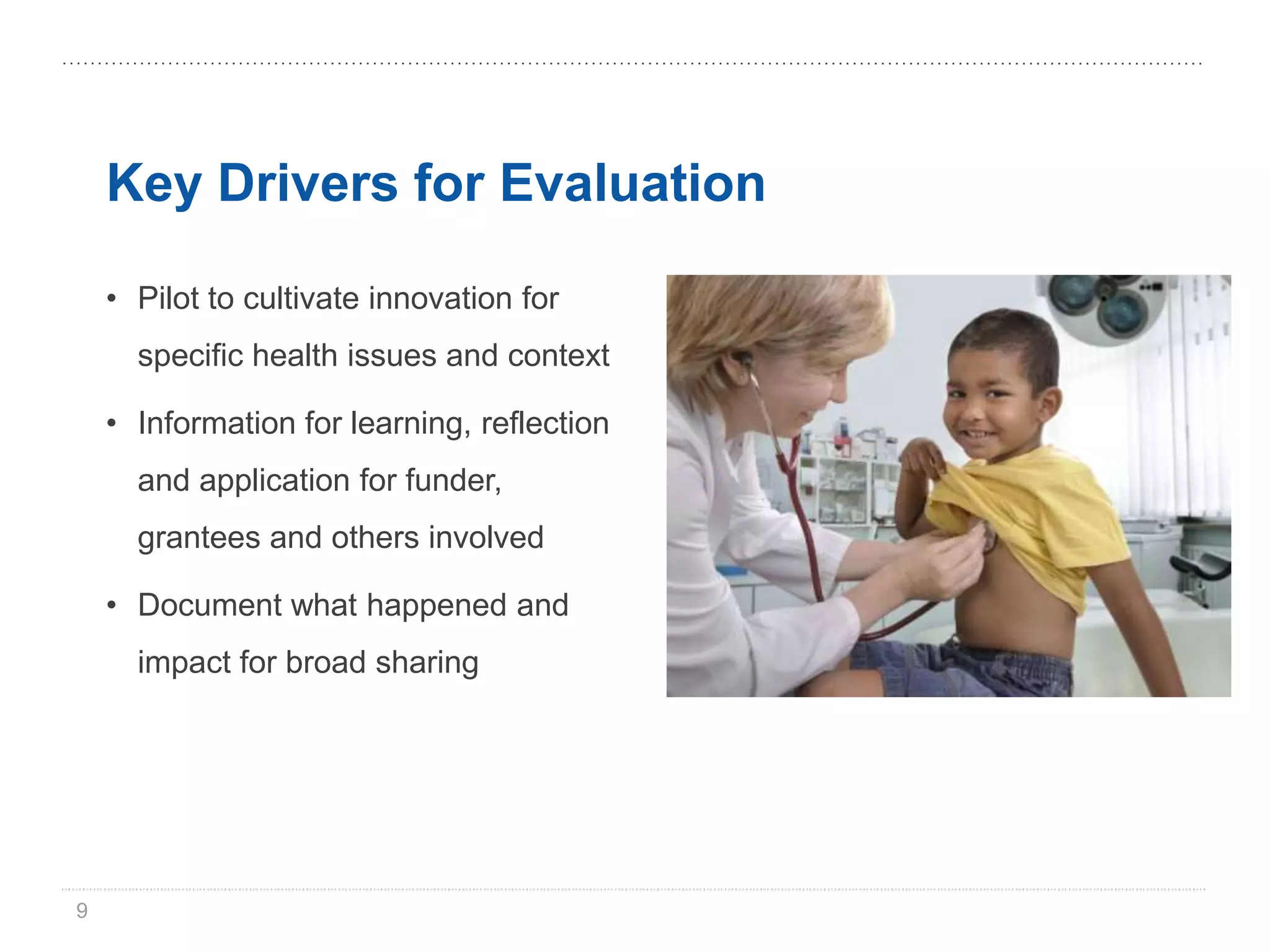
Key Drivers for Evaluation

    • Pilot to cultivate innovation for
      specific health issues and context

    • Information for learning, reflection
      and application for funder,
      grantees and others involved

    • Document what happened and
      impact for broad sharing


9
Evaluating Networks

     • Complex, dynamic and porous nature of networks

     • Similarities and differences among network projects

     • Networks as part of a greater whole

     • Networks as a strategy and impact

     • Different ways of knowing and telling


10
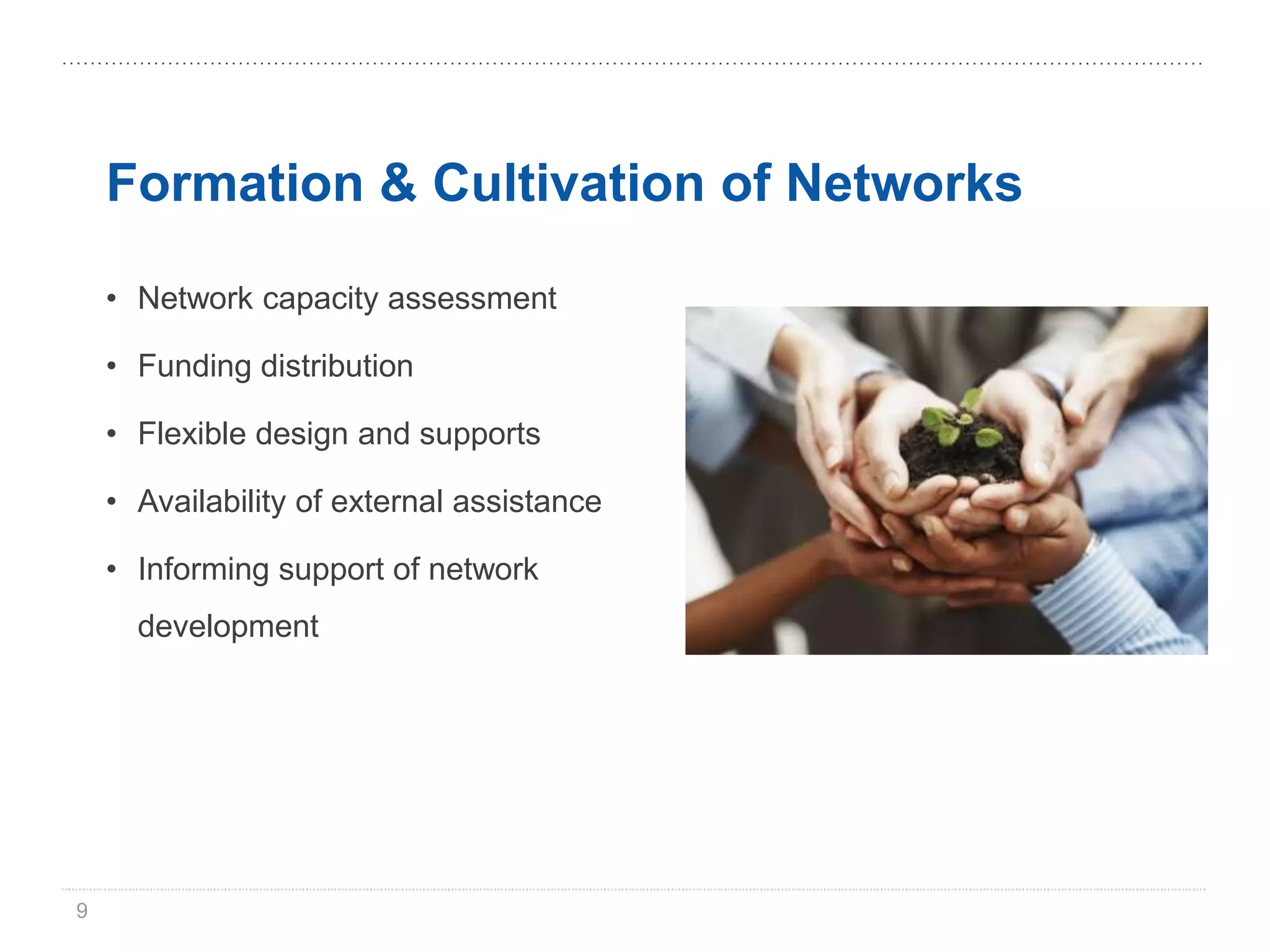
Formation & Cultivation of Networks

    • Network capacity assessment

    • Funding distribution

    • Flexible design and supports

    • Availability of external assistance

    • Informing support of network
      development


9
Designing for Network
Emergence


                        16
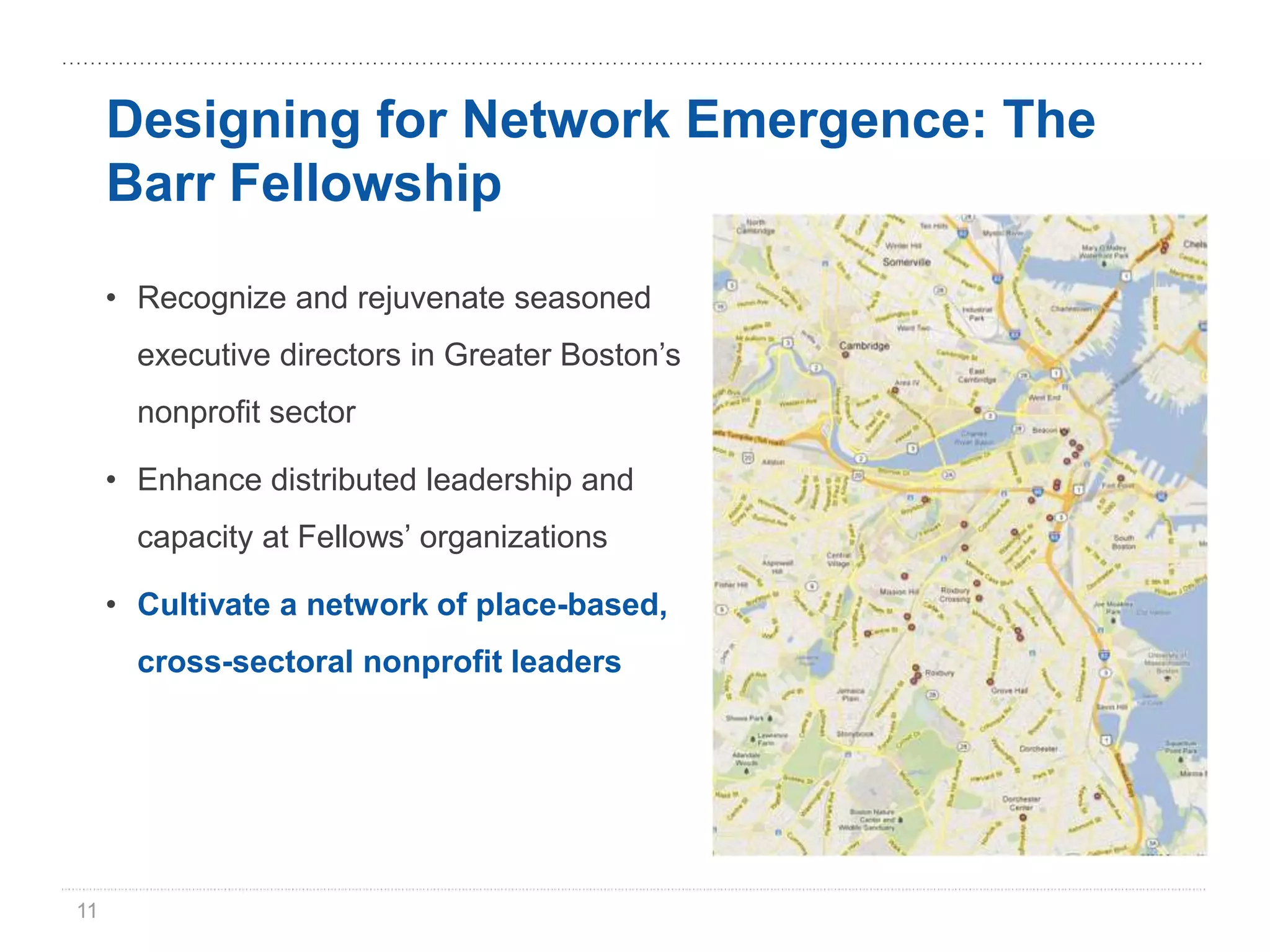
Designing for Network Emergence: The
     Barr Fellowship

     • Recognize and rejuvenate seasoned
       executive directors in Greater Boston’s
       nonprofit sector

     • Enhance distributed leadership and
       capacity at Fellows’ organizations

     • Cultivate a network of place-based,
       cross-sectoral nonprofit leaders


11
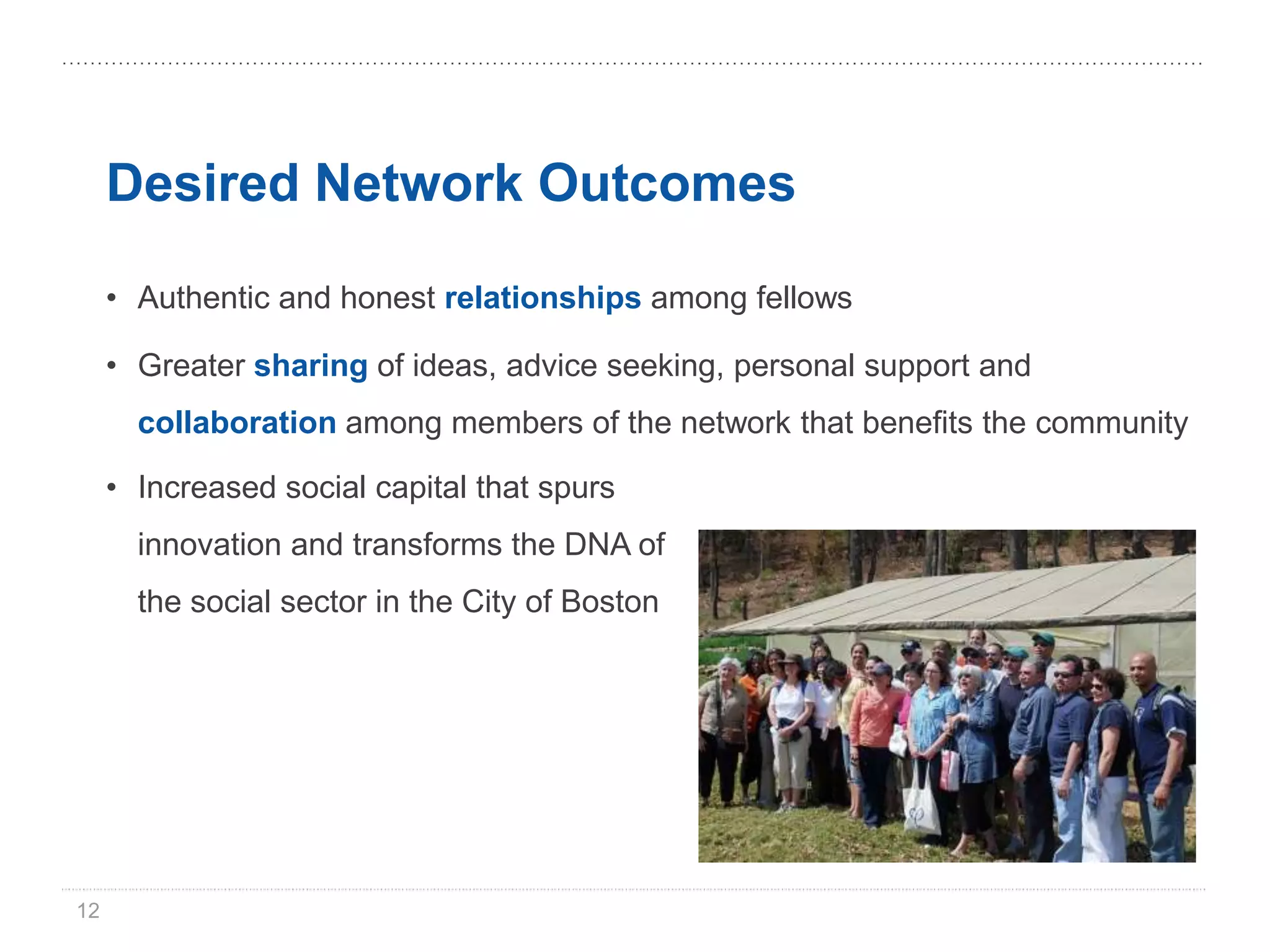
Desired Network Outcomes

     • Authentic and honest relationships among fellows

     • Greater sharing of ideas, advice seeking, personal support and
       collaboration among members of the network that benefits the community

     • Increased social capital that spurs
       innovation and transforms the DNA of
       the social sector in the City of Boston


12
”The Barr Fellowship Network has taken 5–6
years (understandably) to bear fruit and
create the scale of projects and the level of
collaboration to have real impact for lots of
people. We’ve done some one-off things
together on a limited scale affecting hundreds
of people, now we are starting to do things
that are affecting thousands of people….The
scale of the network, and the time and money
invested in it are the key points. The hypothesis
is that it takes time, consistency, and a real
commitment to make this a potent network
that produces results for large numbers of
people. That does not happen overnight.”
16
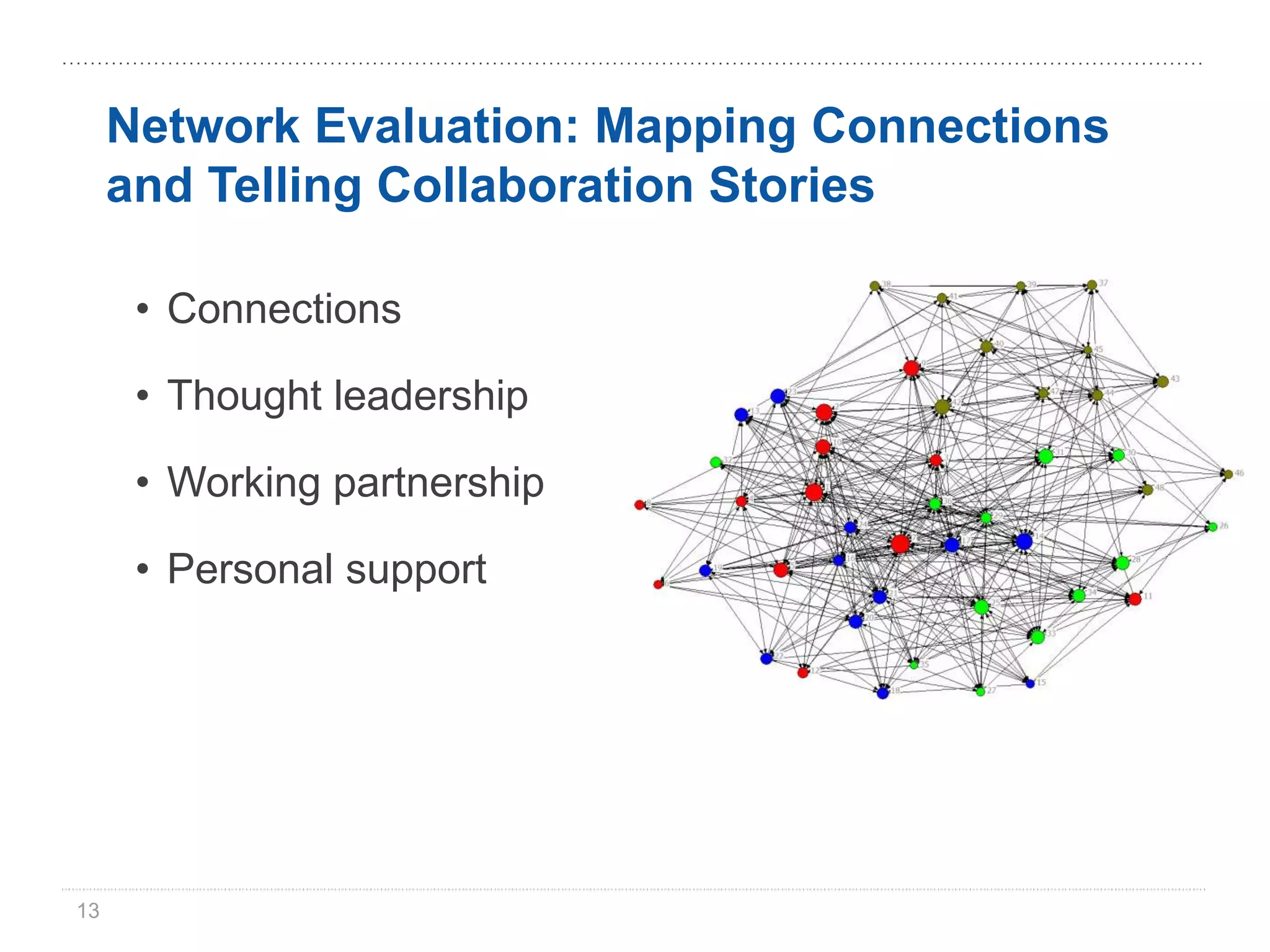
Network Evaluation: Mapping Connections
     and Telling Collaboration Stories

      • Connections

      • Thought leadership

      • Working partnership

      • Personal support


13
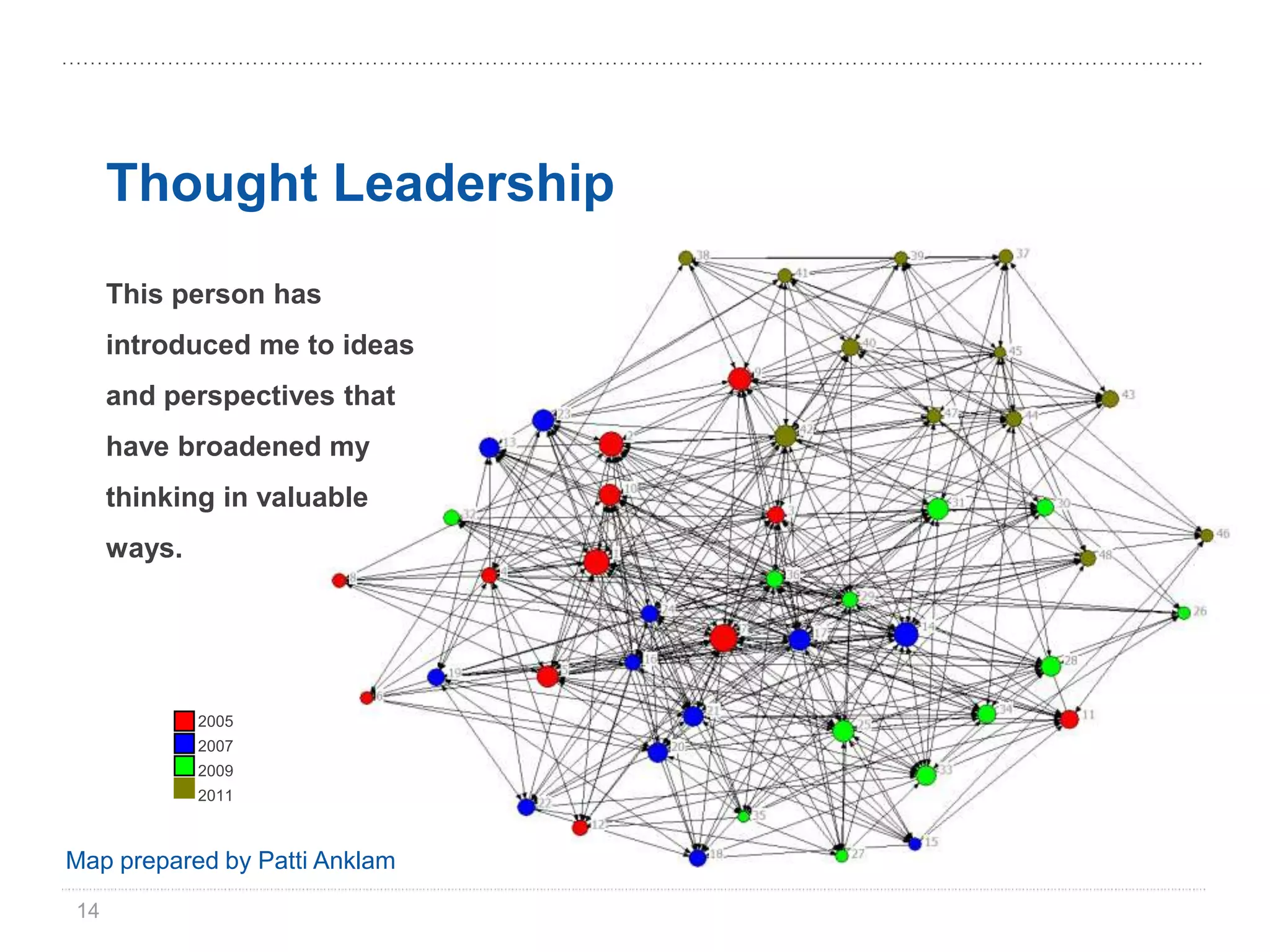
Thought Leadership
     This person has
     introduced me to ideas
     and perspectives that
     have broadened my
     thinking in valuable
     ways.


             2005
             2007
             2009
             2011


Map prepared by Patti Anklam
14
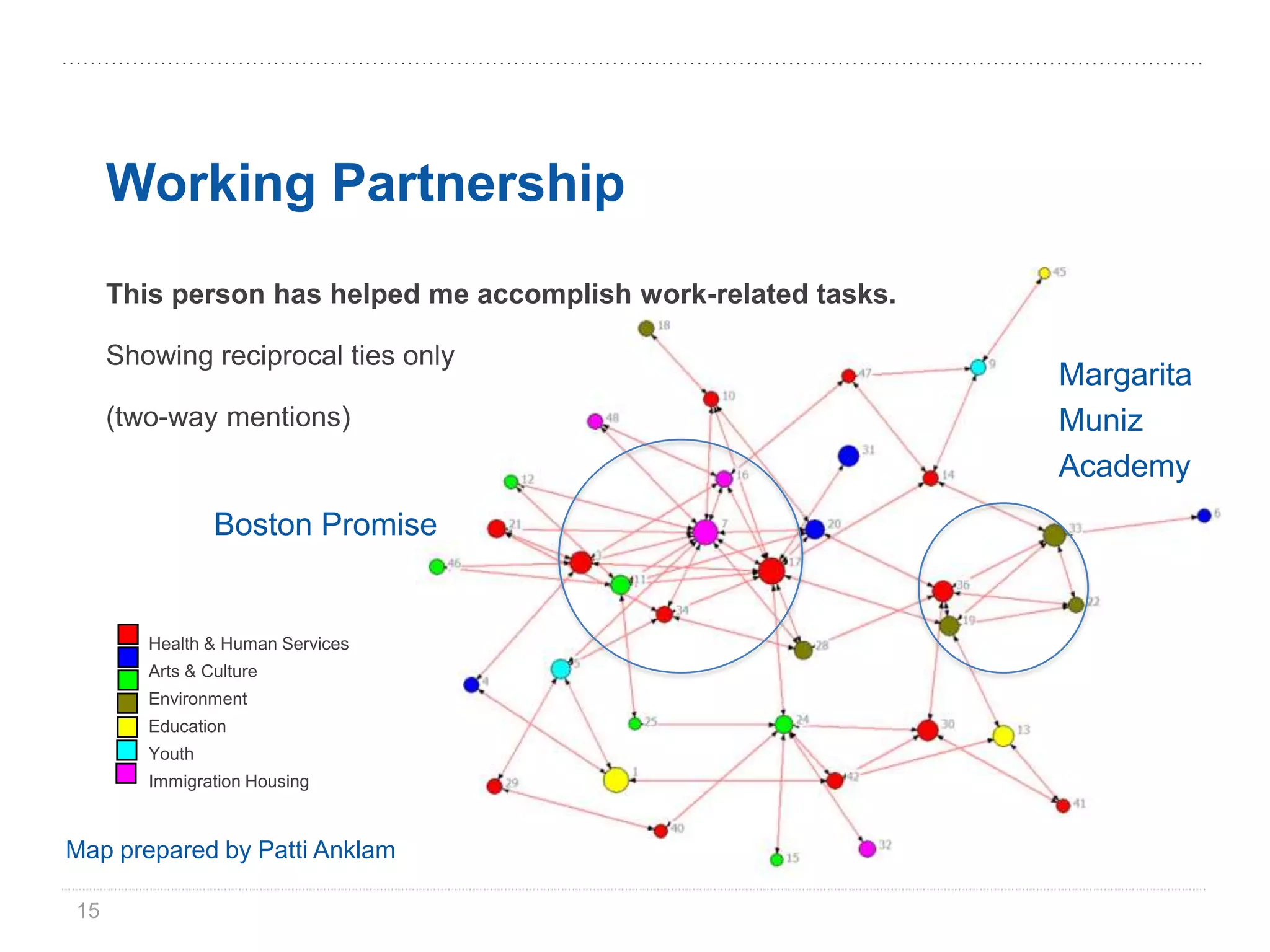
Working Partnership
     This person has helped me accomplish work-related tasks.

     Showing reciprocal ties only
                                                                Margarita
     (two-way mentions)                                         Muniz
                                                                Academy
                Boston Promise


        Health & Human Services
        Arts & Culture
        Environment
        Education
        Youth
        Immigration Housing


Map prepared by Patti Anklam

15
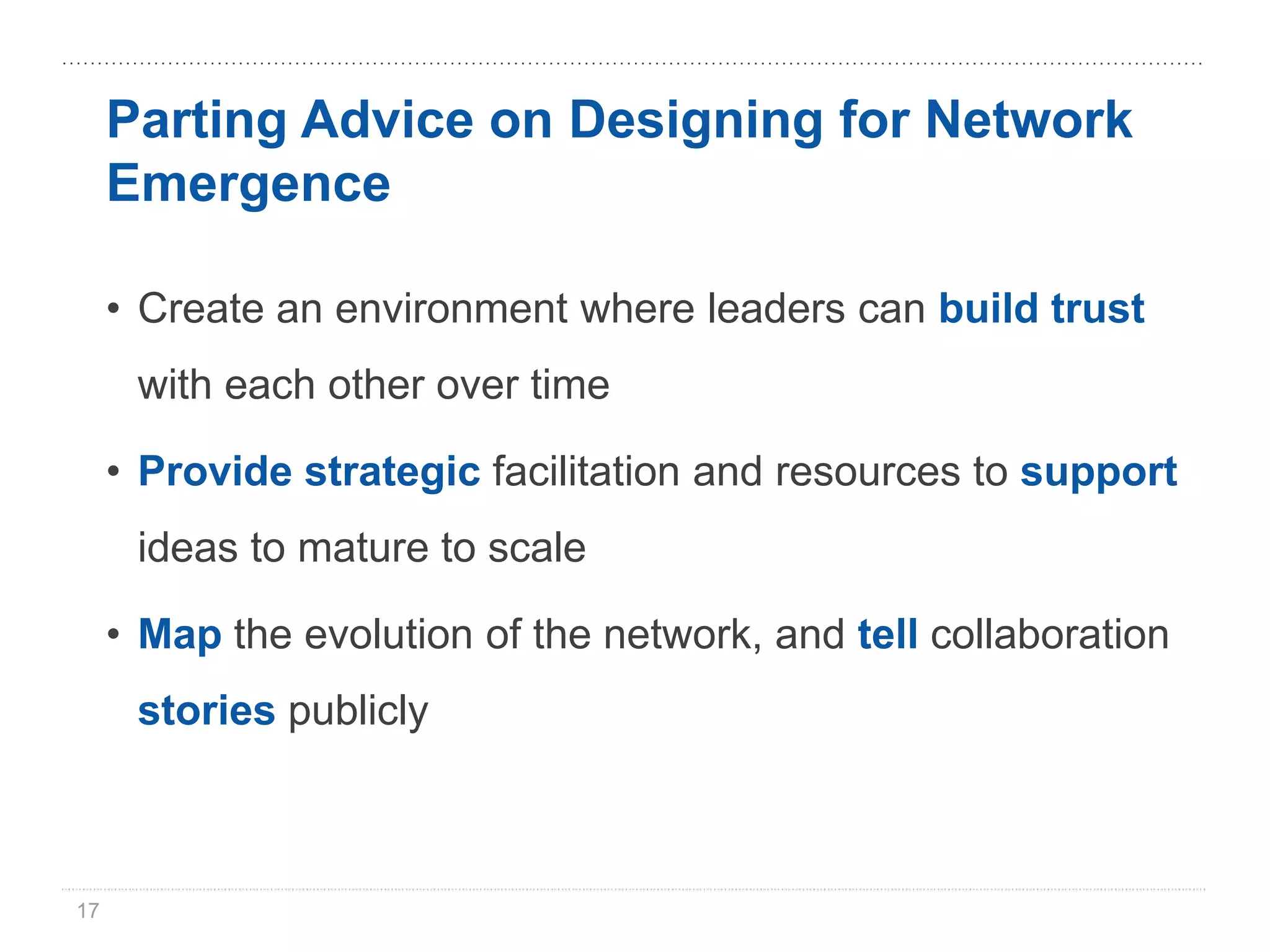
Parting Advice on Designing for Network
     Emergence

     • Create an environment where leaders can build trust
      with each other over time

     • Provide strategic facilitation and resources to support
      ideas to mature to scale

     • Map the evolution of the network, and tell collaboration
      stories publicly


17
Network Evaluation Resources
     •   Next Generation Network Evaluation: Scans the current field of network monitoring and evaluation with
         the goal of identifying where progress has been made and where further work is still needed.
         Innovations for Scaling Impact and Keystone Accountability, June 2010.
         http://www.scalingimpact.net/files/IDRC_Network_IPARL_Paper_Final_0.pdf

     •   Network Health Scorecard: Developed by Madeline Taylor and Peter Plastrik, focuses on key aspects
         of any network: purpose, performance, operations, and capacity. It's designed for group use—network
         members answer each question and then discuss their answers—or on your own http://bit.ly/zFoMCU

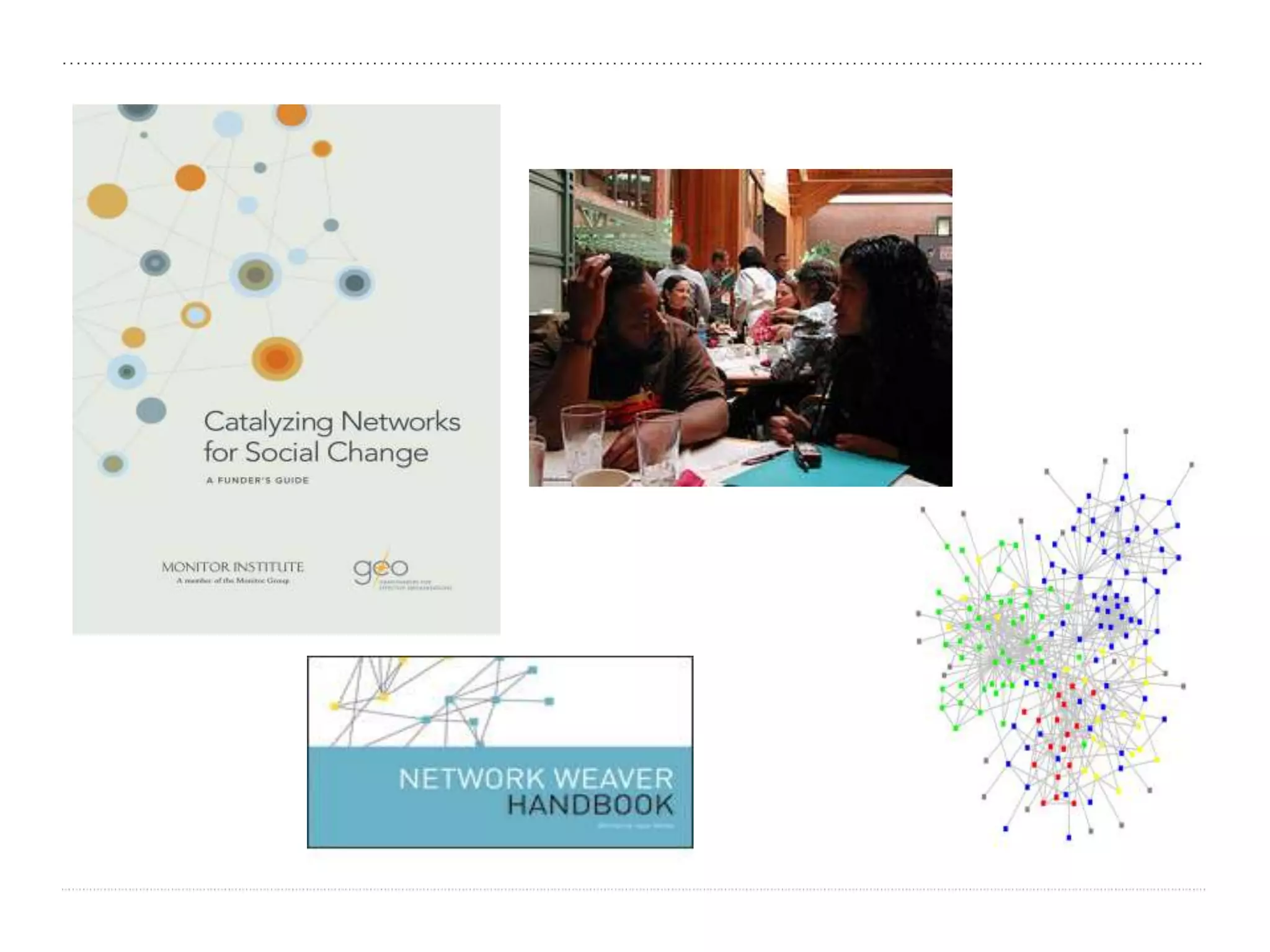
     •   June Holley, Network Weavers Handbook. Practical guide with hundreds of practical tools for building
         strong networks, including the network weavers checklist http://www.networkweaver.com/

     •   Network Effectiveness - Diagnostic and Development Tool: This is a tool for assessing the health of a
         network and is intended for use by individuals working within or through social change networks. It was
         developed by the Monitor Institute. http://www.slideshare.net/workingwikily/healthy-networks-diagnostic


19
Network Evaluation Resources (cont’d)
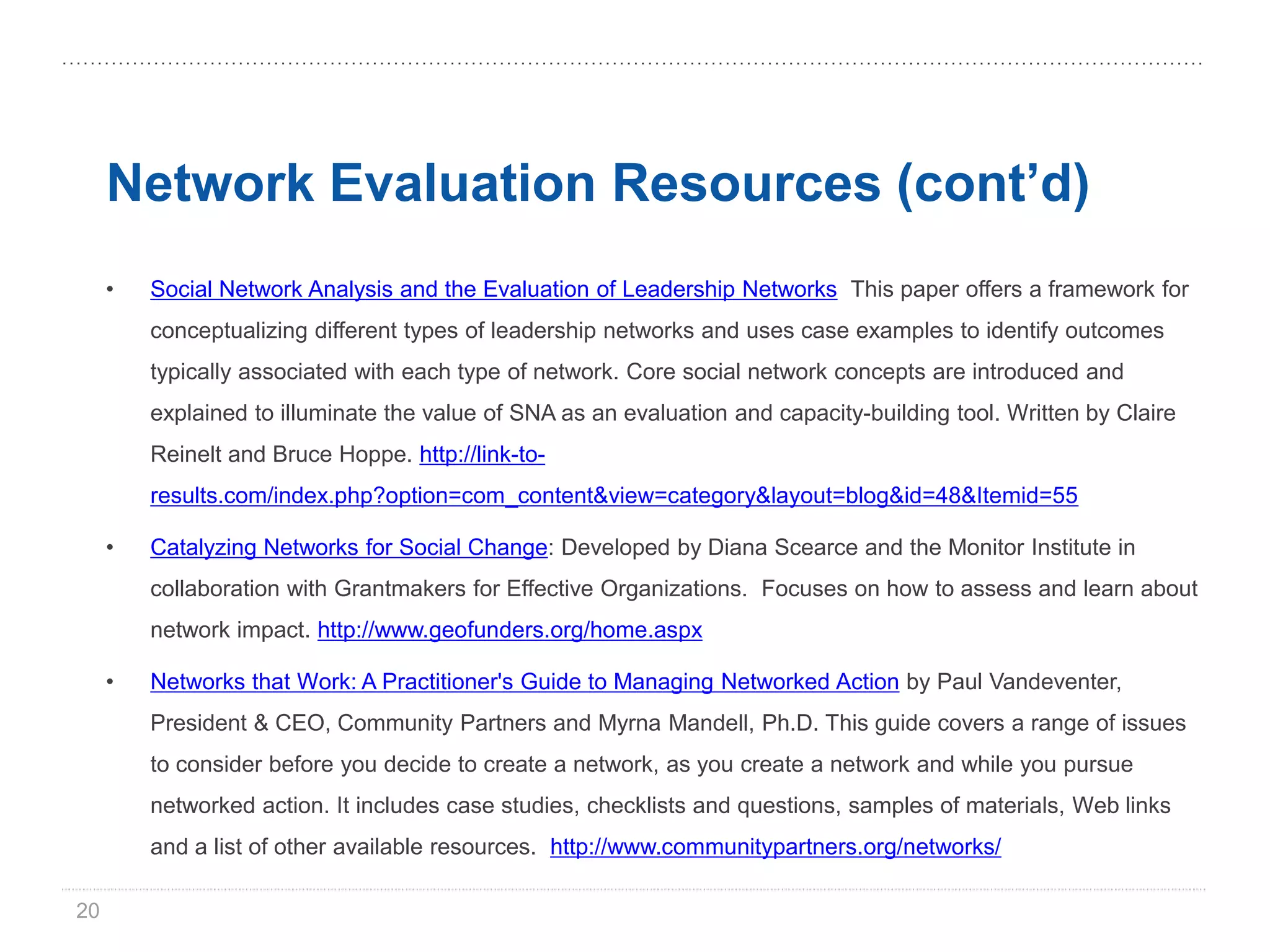
     •   Social Network Analysis and the Evaluation of Leadership Networks This paper offers a framework for
         conceptualizing different types of leadership networks and uses case examples to identify outcomes
         typically associated with each type of network. Core social network concepts are introduced and
         explained to illuminate the value of SNA as an evaluation and capacity-building tool. Written by Claire
         Reinelt and Bruce Hoppe. http://link-to-
         results.com/index.php?option=com_content&view=category&layout=blog&id=48&Itemid=55

     •   Catalyzing Networks for Social Change: Developed by Diana Scearce and the Monitor Institute in
         collaboration with Grantmakers for Effective Organizations. Focuses on how to assess and learn about
         network impact. http://www.geofunders.org/home.aspx

     •   Networks that Work: A Practitioner's Guide to Managing Networked Action by Paul Vandeventer,
         President & CEO, Community Partners and Myrna Mandell, Ph.D. This guide covers a range of issues
         to consider before you decide to create a network, as you create a network and while you pursue
         networked action. It includes case studies, checklists and questions, samples of materials, Web links
         and a list of other available resources. http://www.communitypartners.org/networks/

20
Contact Information

         Kim Ammann Howard, BTW informing change

         510.665.6100 | kahoward@btw.informingchange.com

         Melanie Moore, See Change

         415.558.8662 | melanie@seechangeevaluation.com
         Claire Reinelt, Leadership Learning Community

         781.863.0435 | claire@leadershiplearning.org


18

LLC Webinar on Networks 2.14.2012

  • 1.
    FEBRUARY 15, 2012 ThePromise and Perils of Supporting and Evaluating Network Formation and Development A Leadership Learning Community Webinar Kim Ammann Howard, BTW informing change Melanie Moore, See Change Claire Reinelt, Leadership Learning Community
  • 2.
    Objectives • Better understanding of some of the opportunities and challenges of network formation and development • Questions to ask and strategies to use for evaluating network formation and development 1
  • 4.
    Patterns of NetworkGrowth Scattered Clusters Hub-and-Spoke Multi-Hub Core Periphery Time Where most network-building begins Self-sustaining network Valdis Krebs and June Holley. Building Smart Communities through Network Weaving. 2006. 2
  • 5.
  • 6.
    Do Networks Leadto Collective Action? • Assumption: Linking organizations with similar visions and missions will amplify their effectiveness • For example: • Building a citywide racial justice agenda • Broadening constituency of environmental movement in state 3
  • 7.
    What Gets inthe Way of Collective Action? • Lack of clarity about purpose of network—What do you want us to do? • Lack of capacity for collaboration and uneven capacity across network members • Lack of a sense of urgency to work at a collective level 4
  • 8.
    What Supports CollectiveAction? • Network management is essential—someone needs to have the big picture in mind • Other strategies complement network action, such as commissioned research, communications and leveraging relationships • Trust/relationship building is facilitative, but not always essential • Political moments—the spark that ignites collective action 5
  • 9.
    What Questions ShouldEvaluators Ask About Networks & Collective Action? • Are network participants at similar levels of capacity for collaboration? • Is there a motivating “political moment” for a network to respond to? • Is organizational or network-level capacity building occurring? Are these acceptable outcomes? • What is the source and quality of network leadership and coordination? Is someone driving the train? • What other funded activities complement the network’s work? 6
  • 10.
  • 11.
    Networking for CommunityHealth Core • Improve project capacity of grants Build and maintain individual partnerships clinics and Learning partner Improve community organizations community health • Enhance Flexible Develop collective mini-grants Collect and leaders capacity of use data the network Customized and broader technical community assistance A project of Tides and The California Endowment 7
  • 12.
    Types of Networks Tight-Knit Organization Broader Community Organization Clinic Hub-and-Spoke Organization Organization Organization Organization Community Organization member Clinic Clinic CommunityOrganization member Organization Organization Organization 8
  • 13.
    Key Drivers forEvaluation • Pilot to cultivate innovation for specific health issues and context • Information for learning, reflection and application for funder, grantees and others involved • Document what happened and impact for broad sharing 9
  • 14.
    Evaluating Networks • Complex, dynamic and porous nature of networks • Similarities and differences among network projects • Networks as part of a greater whole • Networks as a strategy and impact • Different ways of knowing and telling 10
  • 15.
    Formation & Cultivationof Networks • Network capacity assessment • Funding distribution • Flexible design and supports • Availability of external assistance • Informing support of network development 9
  • 16.
  • 17.
    Designing for NetworkEmergence: The Barr Fellowship • Recognize and rejuvenate seasoned executive directors in Greater Boston’s nonprofit sector • Enhance distributed leadership and capacity at Fellows’ organizations • Cultivate a network of place-based, cross-sectoral nonprofit leaders 11
  • 18.
    Desired Network Outcomes • Authentic and honest relationships among fellows • Greater sharing of ideas, advice seeking, personal support and collaboration among members of the network that benefits the community • Increased social capital that spurs innovation and transforms the DNA of the social sector in the City of Boston 12
  • 19.
    ”The Barr FellowshipNetwork has taken 5–6 years (understandably) to bear fruit and create the scale of projects and the level of collaboration to have real impact for lots of people. We’ve done some one-off things together on a limited scale affecting hundreds of people, now we are starting to do things that are affecting thousands of people….The scale of the network, and the time and money invested in it are the key points. The hypothesis is that it takes time, consistency, and a real commitment to make this a potent network that produces results for large numbers of people. That does not happen overnight.” 16
  • 20.
    Network Evaluation: MappingConnections and Telling Collaboration Stories • Connections • Thought leadership • Working partnership • Personal support 13
  • 21.
    Thought Leadership This person has introduced me to ideas and perspectives that have broadened my thinking in valuable ways. 2005 2007 2009 2011 Map prepared by Patti Anklam 14
  • 22.
    Working Partnership This person has helped me accomplish work-related tasks. Showing reciprocal ties only Margarita (two-way mentions) Muniz Academy Boston Promise Health & Human Services Arts & Culture Environment Education Youth Immigration Housing Map prepared by Patti Anklam 15
  • 23.
    Parting Advice onDesigning for Network Emergence • Create an environment where leaders can build trust with each other over time • Provide strategic facilitation and resources to support ideas to mature to scale • Map the evolution of the network, and tell collaboration stories publicly 17
  • 24.
    Network Evaluation Resources • Next Generation Network Evaluation: Scans the current field of network monitoring and evaluation with the goal of identifying where progress has been made and where further work is still needed. Innovations for Scaling Impact and Keystone Accountability, June 2010. http://www.scalingimpact.net/files/IDRC_Network_IPARL_Paper_Final_0.pdf • Network Health Scorecard: Developed by Madeline Taylor and Peter Plastrik, focuses on key aspects of any network: purpose, performance, operations, and capacity. It's designed for group use—network members answer each question and then discuss their answers—or on your own http://bit.ly/zFoMCU • June Holley, Network Weavers Handbook. Practical guide with hundreds of practical tools for building strong networks, including the network weavers checklist http://www.networkweaver.com/ • Network Effectiveness - Diagnostic and Development Tool: This is a tool for assessing the health of a network and is intended for use by individuals working within or through social change networks. It was developed by the Monitor Institute. http://www.slideshare.net/workingwikily/healthy-networks-diagnostic 19
  • 25.
    Network Evaluation Resources(cont’d) • Social Network Analysis and the Evaluation of Leadership Networks This paper offers a framework for conceptualizing different types of leadership networks and uses case examples to identify outcomes typically associated with each type of network. Core social network concepts are introduced and explained to illuminate the value of SNA as an evaluation and capacity-building tool. Written by Claire Reinelt and Bruce Hoppe. http://link-to- results.com/index.php?option=com_content&view=category&layout=blog&id=48&Itemid=55 • Catalyzing Networks for Social Change: Developed by Diana Scearce and the Monitor Institute in collaboration with Grantmakers for Effective Organizations. Focuses on how to assess and learn about network impact. http://www.geofunders.org/home.aspx • Networks that Work: A Practitioner's Guide to Managing Networked Action by Paul Vandeventer, President & CEO, Community Partners and Myrna Mandell, Ph.D. This guide covers a range of issues to consider before you decide to create a network, as you create a network and while you pursue networked action. It includes case studies, checklists and questions, samples of materials, Web links and a list of other available resources. http://www.communitypartners.org/networks/ 20
  • 26.
    Contact Information Kim Ammann Howard, BTW informing change 510.665.6100 | kahoward@btw.informingchange.com Melanie Moore, See Change 415.558.8662 | melanie@seechangeevaluation.com Claire Reinelt, Leadership Learning Community 781.863.0435 | claire@leadershiplearning.org 18

Editor's Notes

  • #3 Melanie introduces the webinar
  • #18 Every other year since 2005, twelve executive directors have received a surprise phone call from the Barr Foundation inviting them to become Barr Fellows. The Fellowship includes a three-month sabbatical, group travel to the global south, executive coaching, two retreats annually for three years, and the opportunity to join a diverse network of peers.These leaders come from around the city. They are from the neighborhoods and from downtown. They are from all different races, genders, age and subsectors of the nonprofit ecosystem (like education, health, housing, arts, environment, youth). They span the City building bridges across a history of race and turf issues, and a high concentration of nonprofits. As a result leaders didn’t trust each other. With the support of Interaction Institute for Social Change, these leaders are finding themselves in a conversation with each other that they never before imagined. Using circle methodologies and empowering questions, they deepen their relationships, and build trust across divides that have torn at the fabric of the City before.  
  • #19 The Network now numbers forty-sevenFellows. Over the past seven years, fellows have formed authentic and honest relationships with each other across differences of race, gender, age, and nonprofit subsector. The more trust and social capital they have built the more easily it is to seek each other out for ideas, advice, support and collaboration. Investing in” slow” social capital, as Pat Brandes, the Foundation director says is beginning to pay off. that are built the relationships, the as personal relationships have evolved within and across the first four cohorts, turf-bound competition has given way to what the Boston Globe calls “a web of collaboration rippling through the nonprofit community with increasing effect.” The creation of deep, personal connections of trust, respect, and care for each other is far and away the Fellowship’s currency for social change. When the moment ripens for that change to happen, the network activates to bring about a better Boston. In the parlance of network theory, the “quality of the ties” really matters.
  • #21 Connections: This person has introduced me to people or resources that have helped me do my work Thought leadership: This person has introduced me to ideas and perspectives that have broadened my thinking in valuable ways Working partnership: This person has helped me advance my work Personal support: I have turned to this person for support in a personal situation (work-related or otherwise)
  • #22 Here is the thought leadership map. There are four cohorts of 12 in the network, characterized by the four colors in the map. The red and the blue are the earliest cohorts and they are introducing each other to new ideas, perspectives, and ways of thinking across cohort boundaries. Green is increasingly sharing with red and blue, and gold, the newest cohort is still learning mostly from each other. Why is this important? Because the development of Innovative solutions starts with sharing and connecting diverse ideas and perspectives.
  • #23 We are also looking at where the strongest working partnerships are among clusters in the network. I have circled two clusters that are working closely together. The maps validate, and raise questions about “twosies” and smaller clusters that may be working together. Barr provides strategic support to working clusters when they reach critical momentum. This has taken the form of an interim principal for the Academy so that it could seek approval from the Boston School Committee and launch operations a year before accepting students, and facilitation assistance to build a broad nonprofit network of support for the Boston Promise Neighborhood initiative. The working partnership map provides a relational view of collaboration across the network. Many questions can be asked: Where are their clusters and what are they doing together? Where is there collaboration across sectors, across classes? What are the stories of Where are there triangles that can be closed? Mossik and John have the highest number of reciprocal ties. That means they have strong relationships many fellows in the network. Both Mossik and John are actively engaged in Boston Promise, and other education initiatives.Meg and Vanessa also have quite a few reciprocal ties. Notice the kite pattern in the upper right, this is the core group that is working on the Margarita Muniz AcademyNotice what happens to Claudio, fewer reciprocal ties…raises a question, more than provides an answer [point out the importance of not over-interpreting one map]
  • #24 Be sure to know how to facilitate diverse groups, to acknowledge power dynamics and create opportunities for deep sharing and exchange.Beware of having an agenda to get to a particular outcome; be sure not to put money in too soon.Be sure to look beyond the Barr network to identify and acknowledge other key roles in the network who are not Barr Fellows. Always the danger of being too insular.