HUMAN RESOURCE MANAGEMENT SUBMITTED TO :  Prof. Sukhada Waknis TOPIC : CHANGE MANAGEMENT DATE : 09-03-09
GROUP MEMBERS PRADNYA BHALERAO  C-03 ROHAN JADHAV C-16 RAKESH LALWANI C-19 RASHMIKA PATIL   C-27 PRACHI PITALE C-29 SATISH RAJPAL C-30 CHAITALI SWAMI   C-36 PRATIKSHA RANE   C-42 JAYASHREE PRABHU C-43
 
Introduction Dynamic World Frequent changes Human Efforts required
" Change" is: to give a different position, course, or direction to to make a shift from one to another to undergo a modification of to undergo transformation, transition or substitution
"Manage" is : to handle or direct with a degree of skill or address to exercise executive, administrative and supervisory direction of
CHANGE MANAGEMENT Change Management is a structured process that will cause proposed changes to be reviewed for technical and business readiness in a consistent manner that can be relaxed or tightened to adjust to business needs and experiences.
 
Managing change Understanding the potential effects of a change Each possible reaction be anticipated and managed
Challenges of Changes Involves new procedures Leadership - changing the running of an organization from a command and control nature of management to the nurturing and motivational nature of leadership. Focus - making business choices to bring alignment and focus to the organization.
Commitment - creating commitment to the future of the enterprise throughout the organization. Resistance- Resistance is a complex entity that directly affects the outcomes of change, both positively and negatively.
FORCES FOR CHANGE
 
Digital Convergence
 
 
Challenging emotions should be greater than positive emotions. Change only happens when each person makes a decision to implement the change. Confidence of getting tough any where. Principles of Change
Twelve Principles of Change 4.  Truth" is more important during periods of change and uncertainty than a’ good news’ 5.  People who work are capable of doing much more than they are doing.  6.  The intrinsic rewards of a project are often more important than the material rewards and recognition.  Contd…
Contd … 7.  Don’t force change on anyone 8.  The change process must be linked to business and performance goals 9.  The change process involves both organizational and personal participation
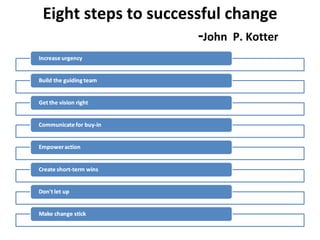
Eight steps to successful change   - John  P. Kotter
Increase urgency  - inspire people to move, make objectives real and relevant.  Build the guiding team  - get the right people in place with the right emotional commitment, and the right mix of skills and levels. Get the vision right  - get the team to establish a simple vision and strategy, focus on emotional and creative aspects necessary to drive service and efficiency. Communicate for buy-in  - Involve as many people as possible, communicate the essentials, simply, and to appeal and respond to people's needs. De-clutter communications - make technology work for you rather than against.
Empower action  - Remove obstacles, enable constructive feedback and lots of support from leaders - reward and recognise progress and achievements. Create short-term wins  - Set aims that are easy to achieve - in bite-size chunks. Manageable numbers of initiatives. Finish current stages before starting new ones. Don't let up  - Foster and encourage determination and persistence - ongoing change - encourage ongoing progress reporting - highlight achieved and future milestones. Make change stick  - Reinforce the value of successful change via recruitment, promotion, new change leaders. Weave change into culture.
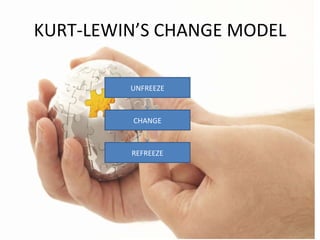
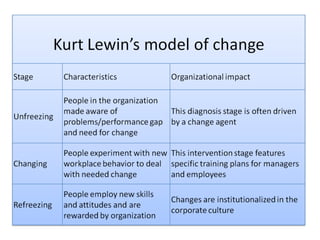
KURT-LEWIN’S CHANGE MODEL UNFREEZE CHANGE REFREEZE
 
Industrial Credit and Investment Corporation of India
Background Since the mid 1980s- ICICI diversified into areas like merchant banking and retailing  In 1987- ICICI co-promoted India's first credit rating agency, Credit Rating and Information Services of India Limited (CRISIL), to rate debt obligations of Indian companies. In 1988- promoted India's first venture capital company –to provide venture capital for indigenous technology oriented ventures In the 1990s- diversified into different forms of asset financing like financing for non-project activities,etc
In 1991- ICICI and the UTI set up India's first screen-based securities market In 1992- tied up with J P Morgan of the US to form an investment banking company In 1990s-, took over ITC Classic, Anagram Finance and merged the Shipping Credit Investment Corporation of India (SCICI) with itself to develop retail business ICICI also entered the insurance business with Prudential plc of UK.  ICICI known for its quick responsiveness to the changing circumstances
Objectives of ICICI Bank assist in creation, expansion and modernization of enterprises encourage and promote the participation of private capital, both internal and external take up the ownership of industrial investment expand the investment markets.
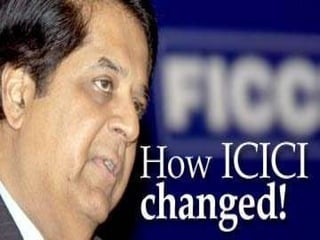
Major Change In May 1996, K.V. Kamath replaced Narayan Vaghul, CEO of India's leading financial services company ICICI
 
Kamath identified the main problem as the company's ignorance regarding the nuances of lending practices in newly opened sectors like infrastructure. The change program was initiated within the organization Organization changed - from a development bank1 mode to that of a market-driven financial conglomerate.
Organization Divided In Groups Infrastructure group (IIG)  Oil & gas group (O&G)  Planning and treasury department (PTD) Structured products group (SPG)
Effects of change A majority of the work along with a lot of good talent shifted to the corporate center An ex-employee remarked, "The way to get noticed inside ICICI after 1996 has been to attach yourself to people who were heading these departments These groups were seen as the thrust areas and if you worked in the zones it was difficult to be noticed
Change-resistance at ICICI Some of the people who thought did not fit in this set-up were quick to leave the organization.
Operations focus on customers  ICICI set up three new departments, 1) Major client group (MCG) A staff of about 30-40 people Handled top 100 customers of ICICI
2) Growth client group (GCG)  A staff of about 60 people Looked after the needs of mid-size companies 3) Personal finance group
Result of these changes Complaints  against these changes put in continued and ICICI was blamed for not putting in adequate systems in place to develop the right people. The feedback process - was also questioned In many cases the appraisal scores were same but the bonus amount was not
Imparting New Skills to Existing Employees Training programmes and seminars were conducted  Overseas training programmes. Introduced a two-year Graduates' Management Training Programme (GMTP)
ICICI also reviewed the compensation structure in place . Two types of remuneration were considered  A contract basis which would attract risk-takers.  A tenure-based compensation which would be appealing to employees who wanted security.
Results  By 2000, ICICI had emerged as the second largest financial institution in India with assets worth Rs 582 billion. The company had eight subsidiaries providing various financial services.
Five S Implementation.. Five S is one of the basic tenets of lean Manufacturing. It originated in Japan as a work-environment enhancing measure, but the Japanese believe this visually-oriented exercise is useful not just for improving the physical environment, but also for improving Total Quality Management (TQM) processes
Five S are…. seiri  (sorting out) seiton  (systematic arrangement) seiso  (spic-n-span) seiketsu  (standardise) and shitsuke  (self-discipline)
In the first step (sorting out), individual owners sort their belongings into needs and wants.  This is followed by making a systematic layout of the workplace, specifying the storage areas and deciding where to put each item, right from files and documents down to the stapler and pins. The third phase (spic-n-span) monitors whether the earlier steps (S1 and S 2). Next is to standardise the policies and rules. Finally, it is self-discipline that is required to sustain Five S
Outcomes.. Best advantage is that Five S could be easily followed by everybody  from the "peon to the president. ICICI company claims to had saved Rs 7.5 crore. Five S had contributed generously, making up 50 per cent of the savings. The lower rung employees boast of tracing documents in record time just 30 seconds.
By 2000, it had half a million retail bank account holders. That number skyrocketed in the next few years; and it had 10 million retail bank account holders by 2004. ICICI Bank claims to be the number one credit card company in the country with 2.5 million cards issued in less than five years.  Emptying out filing cabinets and drawers and retaining only what was absolutely essential due to which freed about 10 per cent storage space.
In December 2000, ICICI Bank was merged with Bank of Madura (BoM) ICICI Bank was nearly three times the size of BoM Staff Strength:  ICICI - 1,400  BOM - 2,500 The working culture at ICICI and BoM were quite different
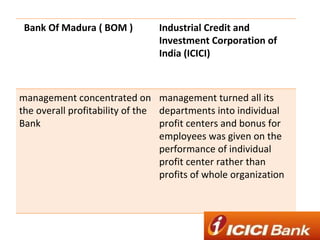
Bank Of Madura ( BOM ) Industrial Credit and Investment Corporation of India (ICICI) management concentrated on the overall profitability of the Bank management turned all its departments into individual profit centers and bonus for employees was given on the performance of individual profit center rather than profits of whole organization
CHANGE The company appointed consultants Hewitt Associates to help in working out a uniform compensation and work culture and to take care of any change management problems.
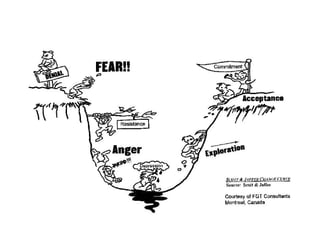
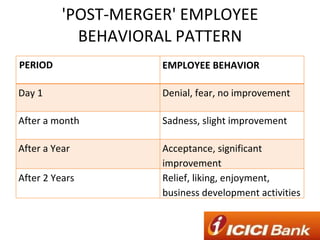
'POST-MERGER' EMPLOYEE BEHAVIORAL PATTERN PERIOD EMPLOYEE BEHAVIOR Day 1 Denial, fear, no improvement After a month Sadness, slight improvement After a Year Acceptance, significant improvement After 2 Years Relief, liking, enjoyment, business development activities
MANAGING HR DURING THE ICICI-BoM MERGER Areas Of HR Integration Focussed On : Employee communication Cultural integration Organization structuring Performance management Training Employee relations
By June 2001, the process of integration between ICICI and BoM was started. According to a news report,  "The win-win situation created by….HR initiatives have resulted in high level of morale among all sections of the employees from the erstwhile BoM."
CHANGE MANAGEMENT AT GODREJ
NEED FOR CHANGE Indian economy opened to global competition Godrej group was in a Quandary No exposure to competition or new technology Entered into two alliances P&G GE
NEED FOR CHANGE Entire distribution of Godrej transferred to P&G 1995-Break-up of the joint venture between Godrej & P&G Post breakup Godrej devoid of distribution system Rebuilding exercise 1995-TQM
CHANGE Switch from a family-run business to a professionally managed company  Changed the earlier model of management hierarchy  Adopted a participative management model team spirit  employee improvement programmes.
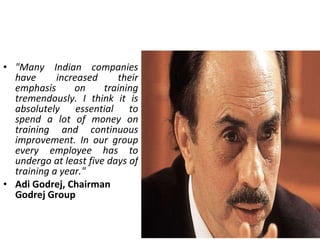
"Many Indian companies have increased their emphasis on training tremendously. I think it is absolutely essential to spend a lot of money on training and continuous improvement. In our group every employee has to undergo at least five days of training a year." Adi Godrej, Chairman Godrej Group
TQM 1995-TQM Awareness programmes conducted for all employees  Objective Driving force  Maximize quality and minimize costs.  Total employee involvement, total waste elimination and total quality control
KAIZEN Japanese technique of continuous improvement  Increase in employee involvement and morale.  Significant savings  Flexible
360-Degree Evaluation Assessment  Unbiased feedback to the employee Self development
Economic Value Added Training (EVA) 2001-Introduction of EVA Extensive training program for managerial and officer levels Training regarding decision making of investments and trade-offs between the income statement and the balance sheet. Stern  Stewart, New York based management consultancy
GALLOP- Godrej Accelerated Learning Leadership and Orientation Programme  2002 -structured and organised induction-training programme  Objective –to nurture the new recruits into leaders and dynamic performers The trainees were rotated in four departments other than their primary department including a compulsory sales stint.  Mandatory rotation helped the trainees to get a hands-on experience to understand the market
Spark -  Train The Trainers  2002-purpose was to equip the managers to become successful coaches GIL, in association with a Delhi-based HR consultant, conducted several workshops to mould the managers into coaches
E-Gyan 2002 -E-Gyan was the e-learning initiative  Transform traditional training methods of workshops and sharpen the intellect of the employees by self- learning initiatives
Structural changes within HR policies The HR divisions have suddenly become more buoyant & are looking forward to the participation of new joinees Encouragement of more participation of new joinees in the decision making process.  ‘ Bedhadak bolo’
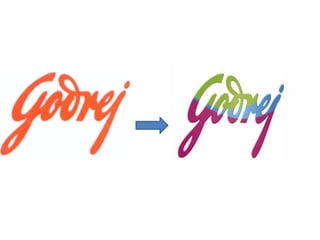
Switching from a family-run business to a professionally managed company, the management has once again embarked on a new exercise to change the outlook of the company. Godrej changed its existing logo and came out with a new logo. A completely  new corporate campaign was designed to convey this new look to the outside world.
 
RESULT Awarded ‘The Best Employer 2007-08’ by global human resources management and outsourcing company, Hewitt Associates. Following EVA implementation,  operating performance has improved significantly All the businesses improved their performance
Change, Diversification & Development in ITC
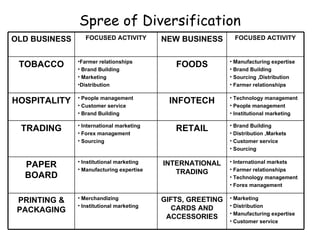
Spree of Diversification OLD BUSINESS FOCUSED ACTIVITY NEW BUSINESS FOCUSED ACTIVITY TOBACCO Farmer relationships  Brand Building Marketing Distribution FOODS Manufacturing expertise Brand Building Sourcing ,Distribution Farmer relationships HOSPITALITY People management Customer service Brand Building INFOTECH Technology management People management Institutional marketing TRADING International marketing Forex management Sourcing RETAIL Brand Building Distribution ,Markets Customer service Sourcing PAPER BOARD Institutional marketing Manufacturing expertise INTERNATIONAL TRADING International markets Farmer relationships Technology management Forex management PRINTING & PACKAGING Merchandizing Institutional marketing GIFTS, GREETING CARDS AND ACCESSORIES Marketing Distribution Manufacturing expertise Customer service
CONCLUSION
BIBLIOGRAPHY & WIBLIOGRAPHY www.google.com www.imcrindia.com www.wikipedia.com www.change.godrej.com BUSINESS WORLD , 2002 Organisational Theory, Design, and Change - BY Gareth Jones
e-banking

Change Management in the organization

  • 1.
    HUMAN RESOURCE MANAGEMENTSUBMITTED TO : Prof. Sukhada Waknis TOPIC : CHANGE MANAGEMENT DATE : 09-03-09
  • 2.
    GROUP MEMBERS PRADNYABHALERAO C-03 ROHAN JADHAV C-16 RAKESH LALWANI C-19 RASHMIKA PATIL C-27 PRACHI PITALE C-29 SATISH RAJPAL C-30 CHAITALI SWAMI C-36 PRATIKSHA RANE C-42 JAYASHREE PRABHU C-43
  • 3.
  • 4.
    Introduction Dynamic WorldFrequent changes Human Efforts required
  • 5.
    " Change" is:to give a different position, course, or direction to to make a shift from one to another to undergo a modification of to undergo transformation, transition or substitution
  • 6.
    "Manage" is :to handle or direct with a degree of skill or address to exercise executive, administrative and supervisory direction of
  • 7.
    CHANGE MANAGEMENT ChangeManagement is a structured process that will cause proposed changes to be reviewed for technical and business readiness in a consistent manner that can be relaxed or tightened to adjust to business needs and experiences.
  • 8.
  • 9.
    Managing change Understandingthe potential effects of a change Each possible reaction be anticipated and managed
  • 10.
    Challenges of ChangesInvolves new procedures Leadership - changing the running of an organization from a command and control nature of management to the nurturing and motivational nature of leadership. Focus - making business choices to bring alignment and focus to the organization.
  • 11.
    Commitment - creatingcommitment to the future of the enterprise throughout the organization. Resistance- Resistance is a complex entity that directly affects the outcomes of change, both positively and negatively.
  • 12.
  • 13.
  • 14.
  • 15.
  • 16.
  • 17.
    Challenging emotions shouldbe greater than positive emotions. Change only happens when each person makes a decision to implement the change. Confidence of getting tough any where. Principles of Change
  • 18.
    Twelve Principles ofChange 4. Truth" is more important during periods of change and uncertainty than a’ good news’ 5. People who work are capable of doing much more than they are doing. 6. The intrinsic rewards of a project are often more important than the material rewards and recognition. Contd…
  • 19.
    Contd … 7. Don’t force change on anyone 8. The change process must be linked to business and performance goals 9. The change process involves both organizational and personal participation
  • 20.
    Eight steps tosuccessful change - John P. Kotter
  • 21.
    Increase urgency - inspire people to move, make objectives real and relevant. Build the guiding team - get the right people in place with the right emotional commitment, and the right mix of skills and levels. Get the vision right - get the team to establish a simple vision and strategy, focus on emotional and creative aspects necessary to drive service and efficiency. Communicate for buy-in - Involve as many people as possible, communicate the essentials, simply, and to appeal and respond to people's needs. De-clutter communications - make technology work for you rather than against.
  • 22.
    Empower action - Remove obstacles, enable constructive feedback and lots of support from leaders - reward and recognise progress and achievements. Create short-term wins - Set aims that are easy to achieve - in bite-size chunks. Manageable numbers of initiatives. Finish current stages before starting new ones. Don't let up - Foster and encourage determination and persistence - ongoing change - encourage ongoing progress reporting - highlight achieved and future milestones. Make change stick - Reinforce the value of successful change via recruitment, promotion, new change leaders. Weave change into culture.
  • 23.
    KURT-LEWIN’S CHANGE MODELUNFREEZE CHANGE REFREEZE
  • 24.
  • 25.
    Industrial Credit andInvestment Corporation of India
  • 26.
    Background Since themid 1980s- ICICI diversified into areas like merchant banking and retailing In 1987- ICICI co-promoted India's first credit rating agency, Credit Rating and Information Services of India Limited (CRISIL), to rate debt obligations of Indian companies. In 1988- promoted India's first venture capital company –to provide venture capital for indigenous technology oriented ventures In the 1990s- diversified into different forms of asset financing like financing for non-project activities,etc
  • 27.
    In 1991- ICICIand the UTI set up India's first screen-based securities market In 1992- tied up with J P Morgan of the US to form an investment banking company In 1990s-, took over ITC Classic, Anagram Finance and merged the Shipping Credit Investment Corporation of India (SCICI) with itself to develop retail business ICICI also entered the insurance business with Prudential plc of UK. ICICI known for its quick responsiveness to the changing circumstances
  • 28.
    Objectives of ICICIBank assist in creation, expansion and modernization of enterprises encourage and promote the participation of private capital, both internal and external take up the ownership of industrial investment expand the investment markets.
  • 29.
    Major Change InMay 1996, K.V. Kamath replaced Narayan Vaghul, CEO of India's leading financial services company ICICI
  • 30.
  • 31.
    Kamath identified themain problem as the company's ignorance regarding the nuances of lending practices in newly opened sectors like infrastructure. The change program was initiated within the organization Organization changed - from a development bank1 mode to that of a market-driven financial conglomerate.
  • 32.
    Organization Divided InGroups Infrastructure group (IIG) Oil & gas group (O&G) Planning and treasury department (PTD) Structured products group (SPG)
  • 33.
    Effects of changeA majority of the work along with a lot of good talent shifted to the corporate center An ex-employee remarked, "The way to get noticed inside ICICI after 1996 has been to attach yourself to people who were heading these departments These groups were seen as the thrust areas and if you worked in the zones it was difficult to be noticed
  • 34.
    Change-resistance at ICICISome of the people who thought did not fit in this set-up were quick to leave the organization.
  • 35.
    Operations focus oncustomers ICICI set up three new departments, 1) Major client group (MCG) A staff of about 30-40 people Handled top 100 customers of ICICI
  • 36.
    2) Growth clientgroup (GCG) A staff of about 60 people Looked after the needs of mid-size companies 3) Personal finance group
  • 37.
    Result of thesechanges Complaints against these changes put in continued and ICICI was blamed for not putting in adequate systems in place to develop the right people. The feedback process - was also questioned In many cases the appraisal scores were same but the bonus amount was not
  • 38.
    Imparting New Skillsto Existing Employees Training programmes and seminars were conducted Overseas training programmes. Introduced a two-year Graduates' Management Training Programme (GMTP)
  • 39.
    ICICI also reviewedthe compensation structure in place . Two types of remuneration were considered A contract basis which would attract risk-takers. A tenure-based compensation which would be appealing to employees who wanted security.
  • 40.
    Results By2000, ICICI had emerged as the second largest financial institution in India with assets worth Rs 582 billion. The company had eight subsidiaries providing various financial services.
  • 41.
    Five S Implementation..Five S is one of the basic tenets of lean Manufacturing. It originated in Japan as a work-environment enhancing measure, but the Japanese believe this visually-oriented exercise is useful not just for improving the physical environment, but also for improving Total Quality Management (TQM) processes
  • 42.
    Five S are….seiri (sorting out) seiton (systematic arrangement) seiso (spic-n-span) seiketsu (standardise) and shitsuke (self-discipline)
  • 43.
    In the firststep (sorting out), individual owners sort their belongings into needs and wants. This is followed by making a systematic layout of the workplace, specifying the storage areas and deciding where to put each item, right from files and documents down to the stapler and pins. The third phase (spic-n-span) monitors whether the earlier steps (S1 and S 2). Next is to standardise the policies and rules. Finally, it is self-discipline that is required to sustain Five S
  • 44.
    Outcomes.. Best advantageis that Five S could be easily followed by everybody from the "peon to the president. ICICI company claims to had saved Rs 7.5 crore. Five S had contributed generously, making up 50 per cent of the savings. The lower rung employees boast of tracing documents in record time just 30 seconds.
  • 45.
    By 2000, ithad half a million retail bank account holders. That number skyrocketed in the next few years; and it had 10 million retail bank account holders by 2004. ICICI Bank claims to be the number one credit card company in the country with 2.5 million cards issued in less than five years. Emptying out filing cabinets and drawers and retaining only what was absolutely essential due to which freed about 10 per cent storage space.
  • 46.
    In December 2000,ICICI Bank was merged with Bank of Madura (BoM) ICICI Bank was nearly three times the size of BoM Staff Strength: ICICI - 1,400 BOM - 2,500 The working culture at ICICI and BoM were quite different
  • 47.
    Bank Of Madura( BOM ) Industrial Credit and Investment Corporation of India (ICICI) management concentrated on the overall profitability of the Bank management turned all its departments into individual profit centers and bonus for employees was given on the performance of individual profit center rather than profits of whole organization
  • 48.
    CHANGE The companyappointed consultants Hewitt Associates to help in working out a uniform compensation and work culture and to take care of any change management problems.
  • 49.
    'POST-MERGER' EMPLOYEE BEHAVIORALPATTERN PERIOD EMPLOYEE BEHAVIOR Day 1 Denial, fear, no improvement After a month Sadness, slight improvement After a Year Acceptance, significant improvement After 2 Years Relief, liking, enjoyment, business development activities
  • 50.
    MANAGING HR DURINGTHE ICICI-BoM MERGER Areas Of HR Integration Focussed On : Employee communication Cultural integration Organization structuring Performance management Training Employee relations
  • 51.
    By June 2001,the process of integration between ICICI and BoM was started. According to a news report, "The win-win situation created by….HR initiatives have resulted in high level of morale among all sections of the employees from the erstwhile BoM."
  • 52.
  • 53.
    NEED FOR CHANGEIndian economy opened to global competition Godrej group was in a Quandary No exposure to competition or new technology Entered into two alliances P&G GE
  • 54.
    NEED FOR CHANGEEntire distribution of Godrej transferred to P&G 1995-Break-up of the joint venture between Godrej & P&G Post breakup Godrej devoid of distribution system Rebuilding exercise 1995-TQM
  • 55.
    CHANGE Switch froma family-run business to a professionally managed company Changed the earlier model of management hierarchy Adopted a participative management model team spirit employee improvement programmes.
  • 56.
    "Many Indian companieshave increased their emphasis on training tremendously. I think it is absolutely essential to spend a lot of money on training and continuous improvement. In our group every employee has to undergo at least five days of training a year." Adi Godrej, Chairman Godrej Group
  • 57.
    TQM 1995-TQM Awarenessprogrammes conducted for all employees Objective Driving force Maximize quality and minimize costs. Total employee involvement, total waste elimination and total quality control
  • 58.
    KAIZEN Japanese techniqueof continuous improvement Increase in employee involvement and morale. Significant savings Flexible
  • 59.
    360-Degree Evaluation Assessment Unbiased feedback to the employee Self development
  • 60.
    Economic Value AddedTraining (EVA) 2001-Introduction of EVA Extensive training program for managerial and officer levels Training regarding decision making of investments and trade-offs between the income statement and the balance sheet. Stern Stewart, New York based management consultancy
  • 61.
    GALLOP- Godrej AcceleratedLearning Leadership and Orientation Programme 2002 -structured and organised induction-training programme Objective –to nurture the new recruits into leaders and dynamic performers The trainees were rotated in four departments other than their primary department including a compulsory sales stint. Mandatory rotation helped the trainees to get a hands-on experience to understand the market
  • 62.
    Spark - Train The Trainers 2002-purpose was to equip the managers to become successful coaches GIL, in association with a Delhi-based HR consultant, conducted several workshops to mould the managers into coaches
  • 63.
    E-Gyan 2002 -E-Gyanwas the e-learning initiative Transform traditional training methods of workshops and sharpen the intellect of the employees by self- learning initiatives
  • 64.
    Structural changes withinHR policies The HR divisions have suddenly become more buoyant & are looking forward to the participation of new joinees Encouragement of more participation of new joinees in the decision making process. ‘ Bedhadak bolo’
  • 65.
    Switching from afamily-run business to a professionally managed company, the management has once again embarked on a new exercise to change the outlook of the company. Godrej changed its existing logo and came out with a new logo. A completely new corporate campaign was designed to convey this new look to the outside world.
  • 66.
  • 67.
    RESULT Awarded ‘TheBest Employer 2007-08’ by global human resources management and outsourcing company, Hewitt Associates. Following EVA implementation, operating performance has improved significantly All the businesses improved their performance
  • 68.
    Change, Diversification &Development in ITC
  • 69.
    Spree of DiversificationOLD BUSINESS FOCUSED ACTIVITY NEW BUSINESS FOCUSED ACTIVITY TOBACCO Farmer relationships Brand Building Marketing Distribution FOODS Manufacturing expertise Brand Building Sourcing ,Distribution Farmer relationships HOSPITALITY People management Customer service Brand Building INFOTECH Technology management People management Institutional marketing TRADING International marketing Forex management Sourcing RETAIL Brand Building Distribution ,Markets Customer service Sourcing PAPER BOARD Institutional marketing Manufacturing expertise INTERNATIONAL TRADING International markets Farmer relationships Technology management Forex management PRINTING & PACKAGING Merchandizing Institutional marketing GIFTS, GREETING CARDS AND ACCESSORIES Marketing Distribution Manufacturing expertise Customer service
  • 70.
  • 71.
    BIBLIOGRAPHY & WIBLIOGRAPHYwww.google.com www.imcrindia.com www.wikipedia.com www.change.godrej.com BUSINESS WORLD , 2002 Organisational Theory, Design, and Change - BY Gareth Jones
  • 72.

Editor's Notes