ACCircuits
WHAT IS ALTERNATING CURRENT (A.C.)?
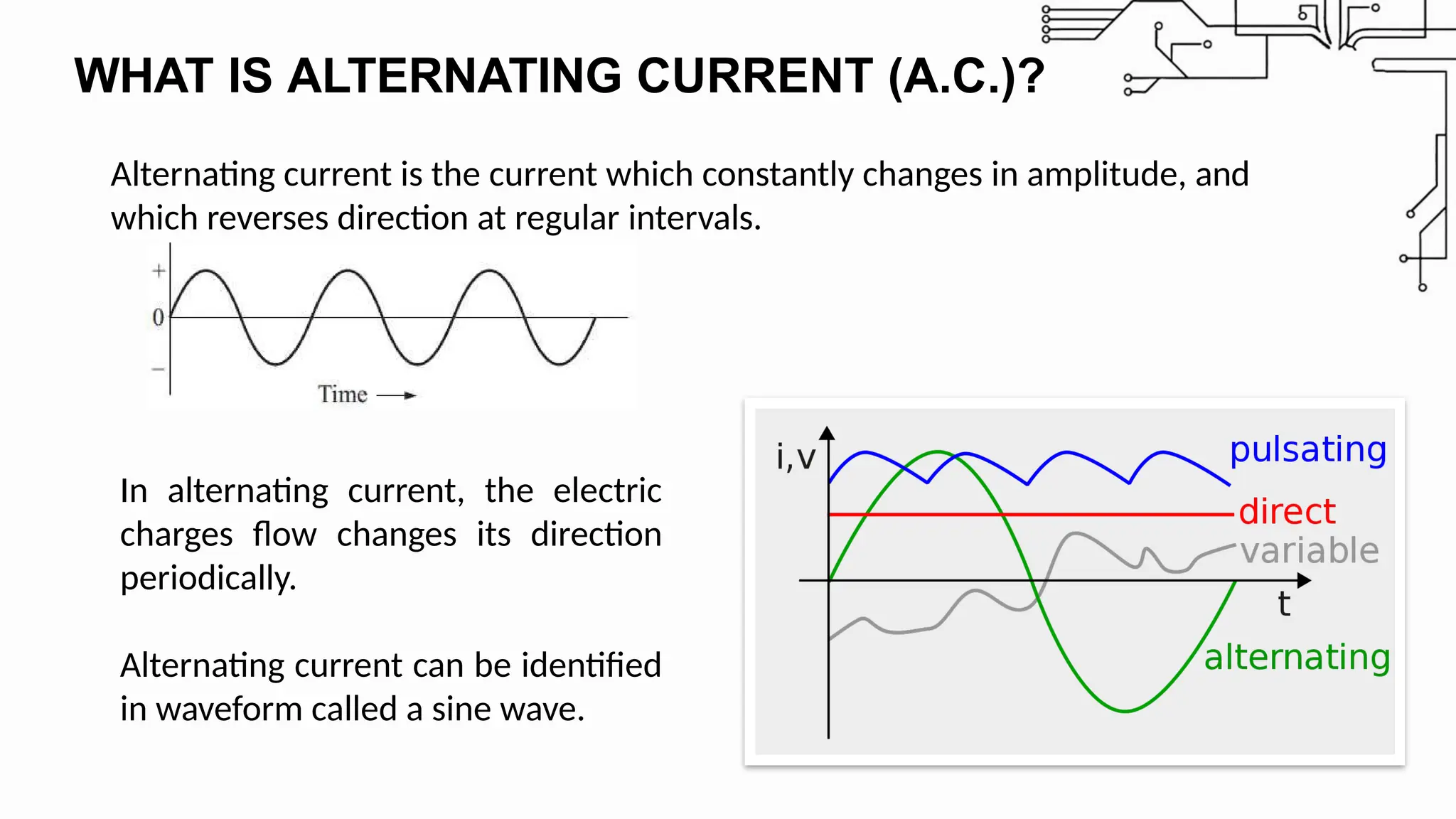
Alternating current is the current which constantly changes in amplitude, and
which reverses direction at regular intervals.
In alternating current, the electric
charges flow changes its direction
periodically.
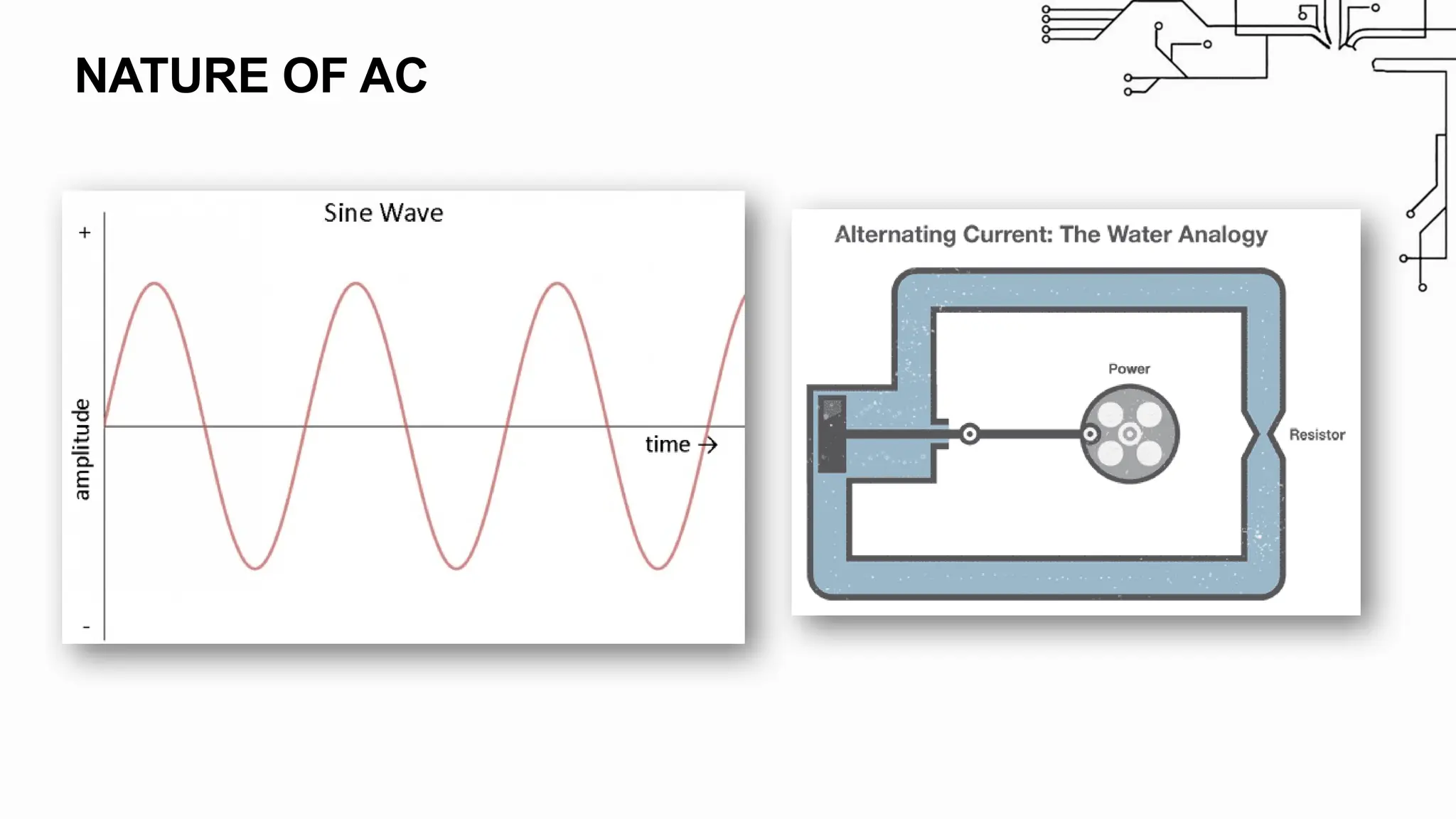
Alternating current can be identified
in waveform called a sine wave.
NATURE OF AC
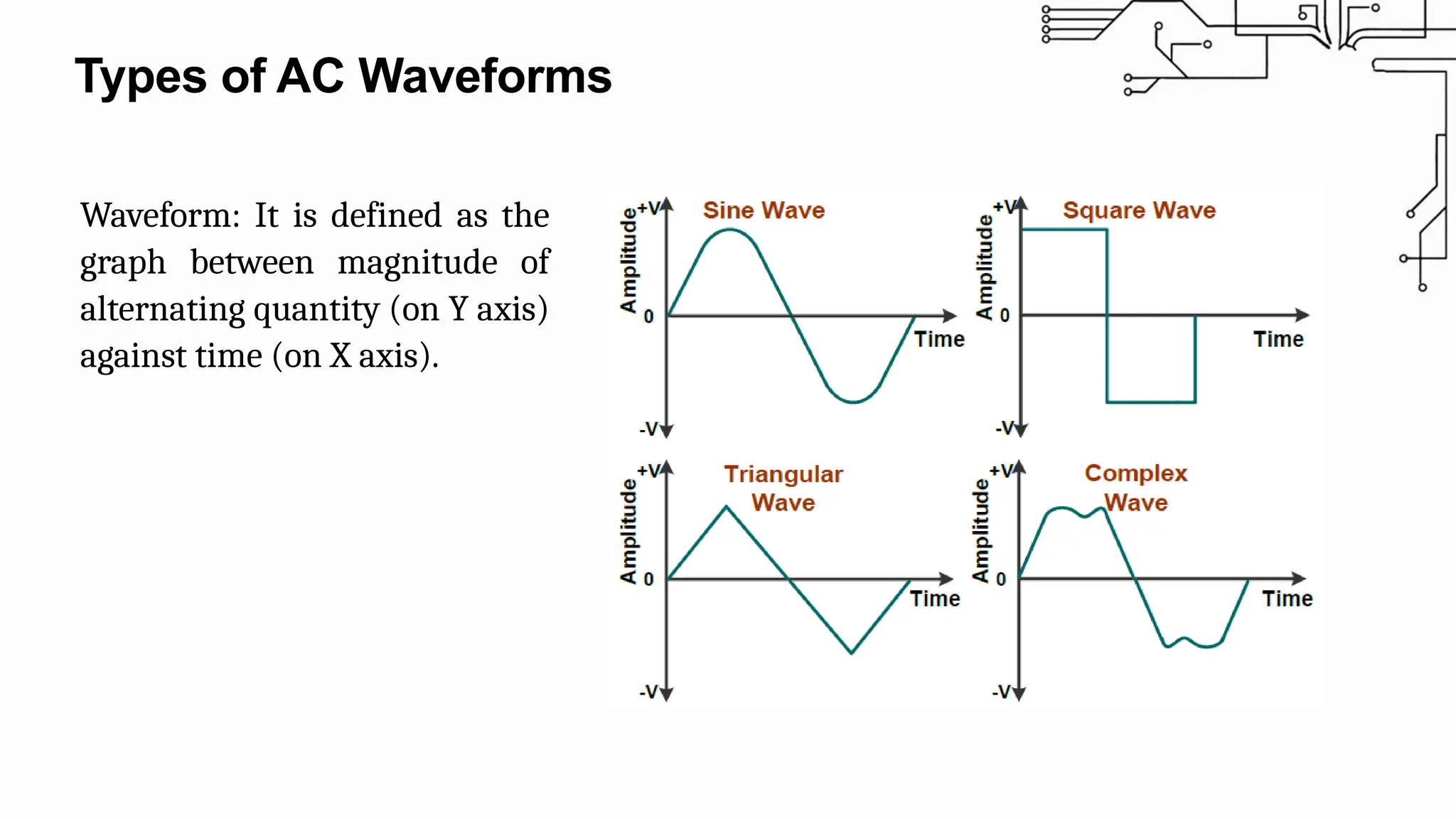
Types of AC Waveforms
Waveform: It is defined as the
graph between magnitude of
alternating quantity (on Y axis)
against time (on X axis).
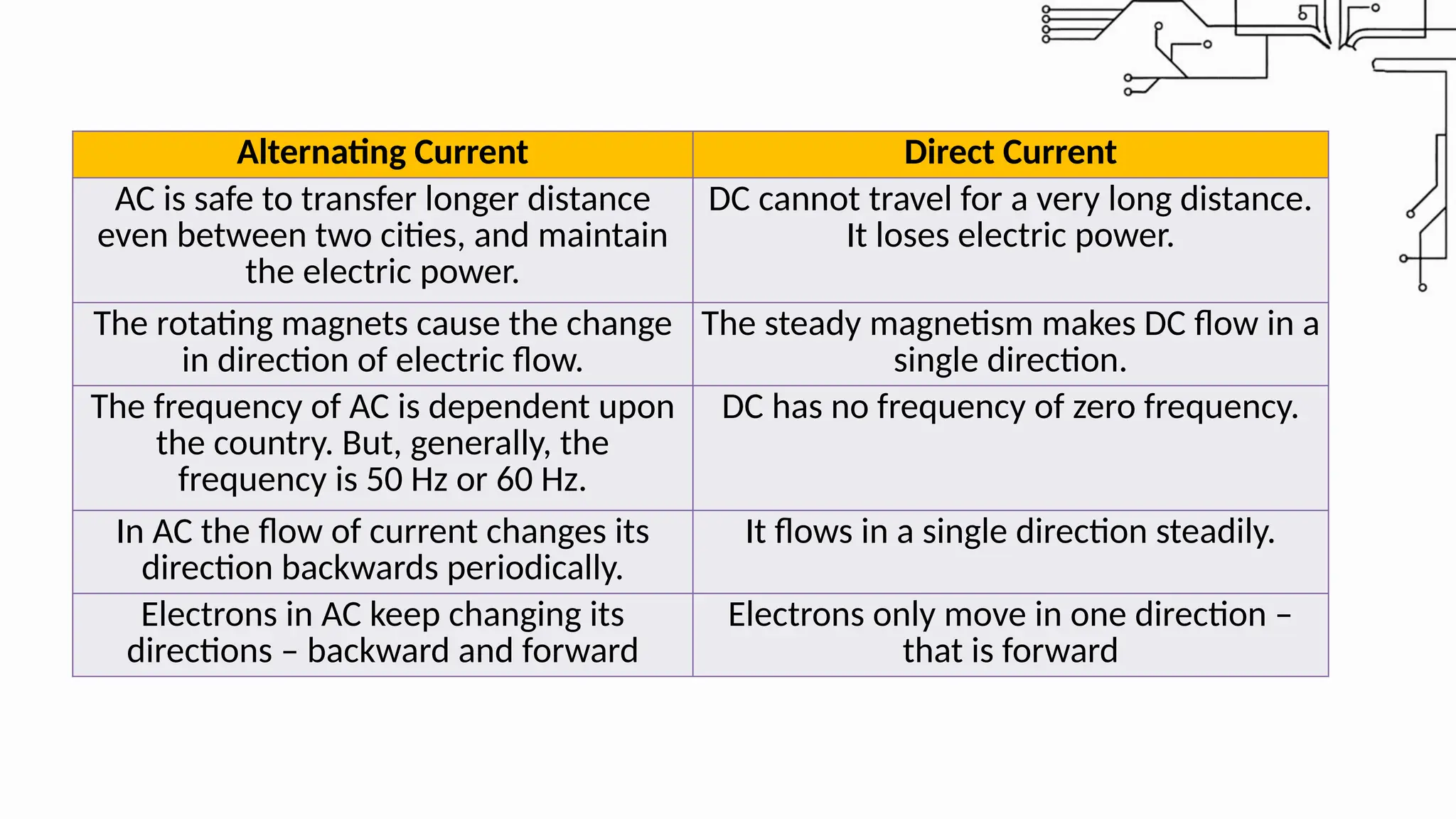
Alternating Current Direct Current
AC is safe to transfer longer distance
even between two cities, and maintain
the electric power.
DC cannot travel for a very long distance.
It loses electric power.
The rotating magnets cause the change
in direction of electric flow.
The steady magnetism makes DC flow in a
single direction.
The frequency of AC is dependent upon
the country. But, generally, the
frequency is 50 Hz or 60 Hz.
DC has no frequency of zero frequency.
In AC the flow of current changes its
direction backwards periodically.
It flows in a single direction steadily.
Electrons in AC keep changing its
directions – backward and forward
Electrons only move in one direction –
that is forward
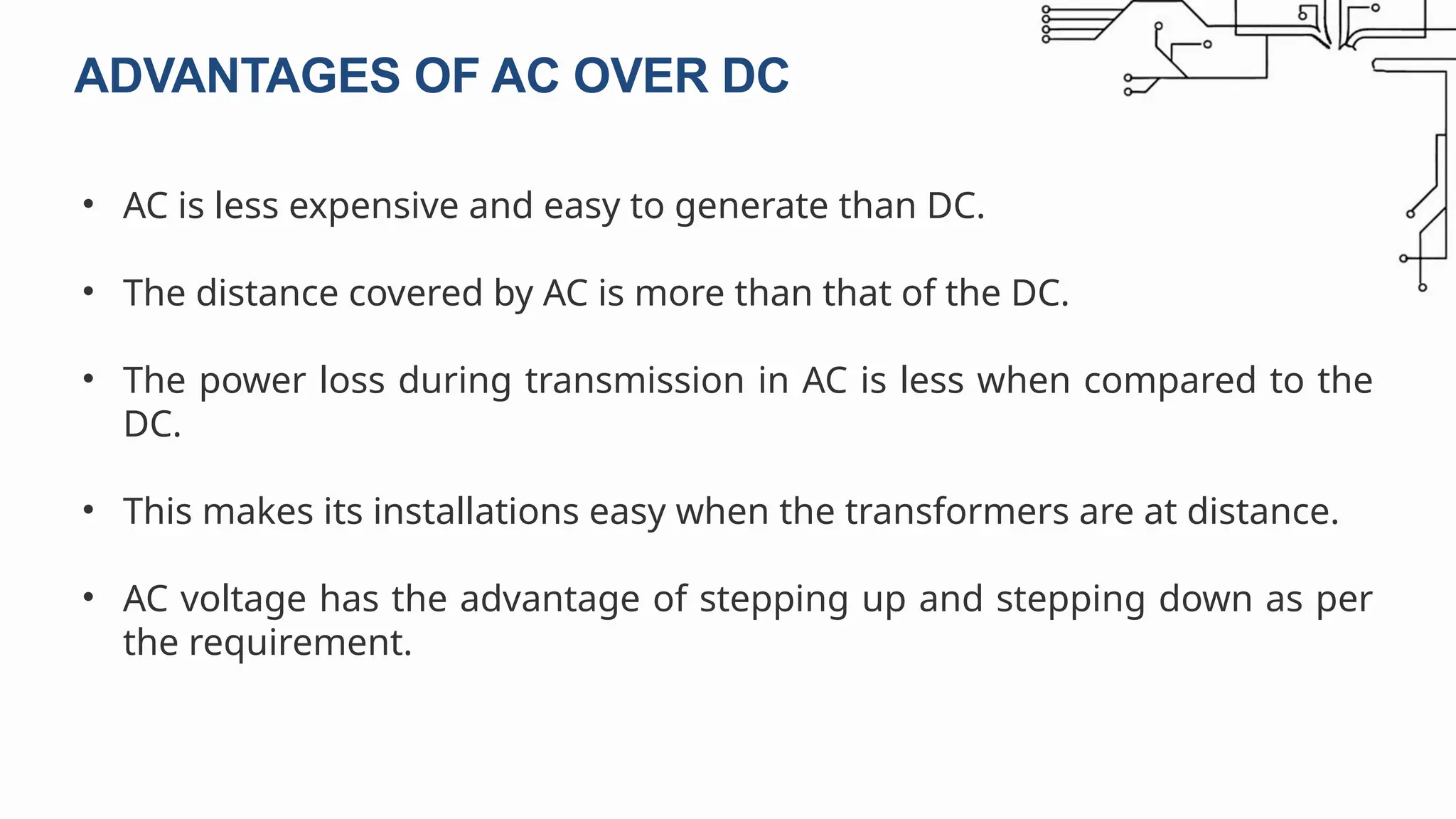
• AC is less expensive and easy to generate than DC.
• The distance covered by AC is more than that of the DC.
• The power loss during transmission in AC is less when compared to the
DC.
• This makes its installations easy when the transformers are at distance.
• AC voltage has the advantage of stepping up and stepping down as per
the requirement.
ADVANTAGES OF AC OVER DC
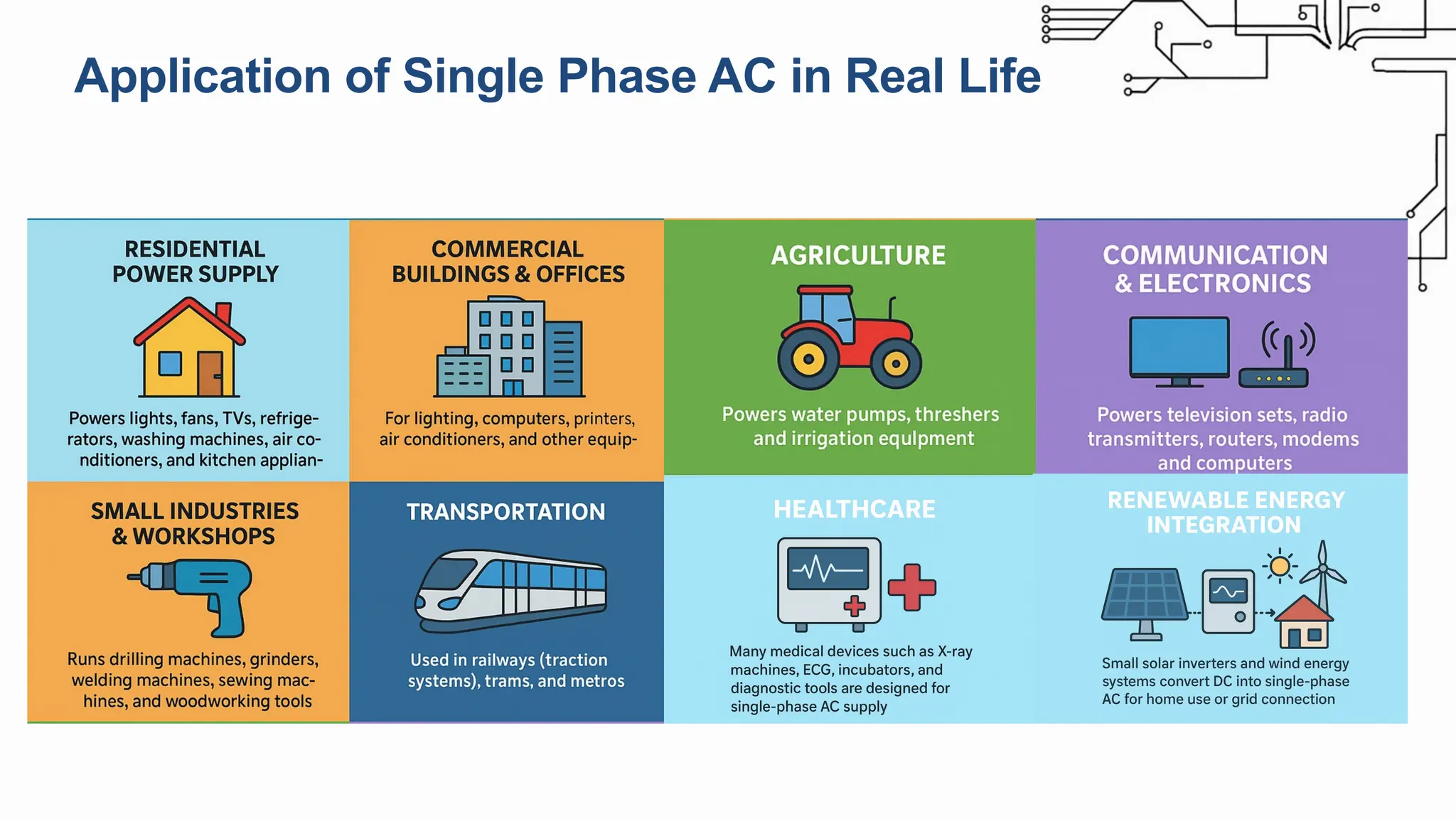
Application of Single Phase AC in Real Life
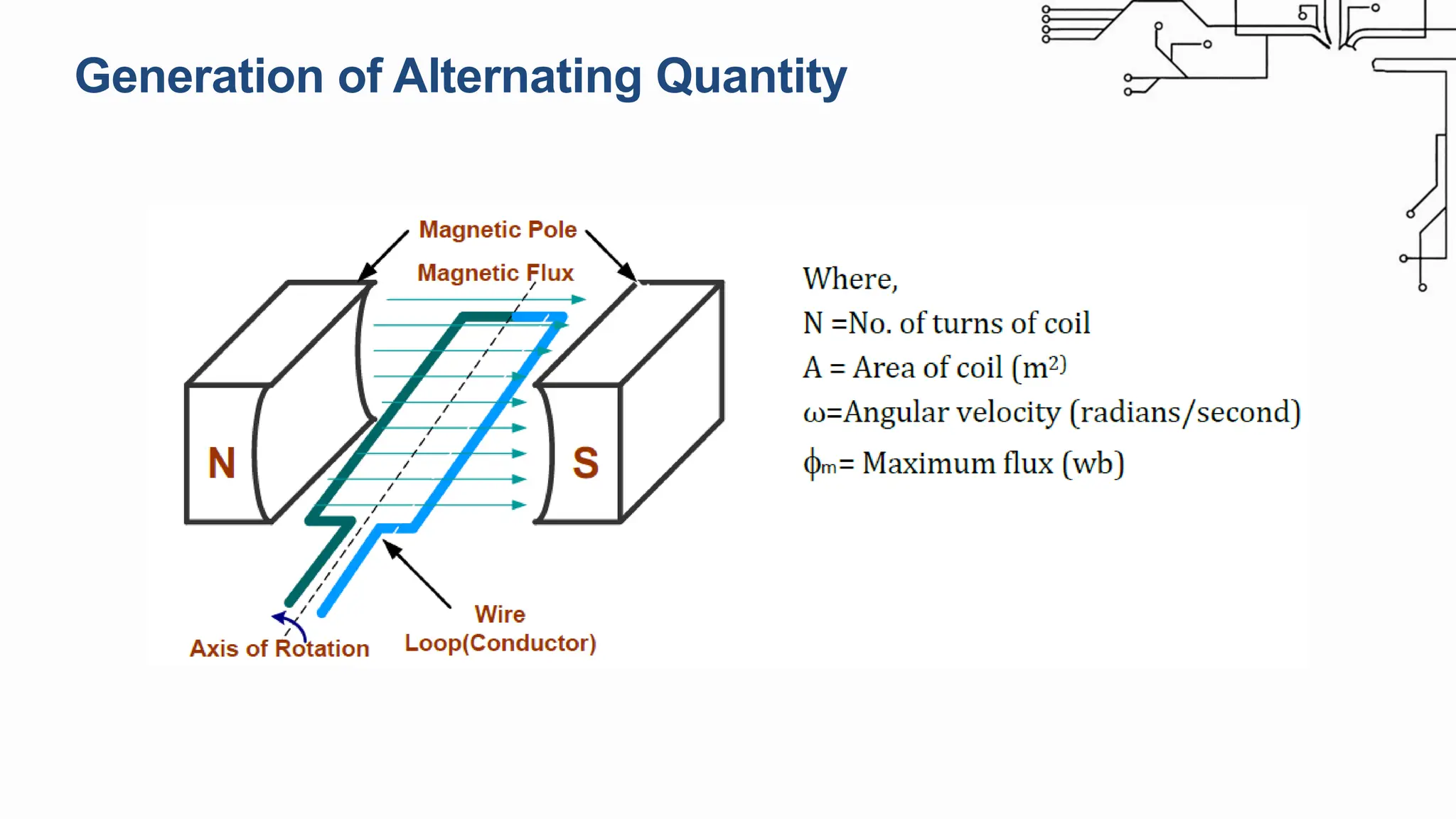
Generation of Alternating Quantity
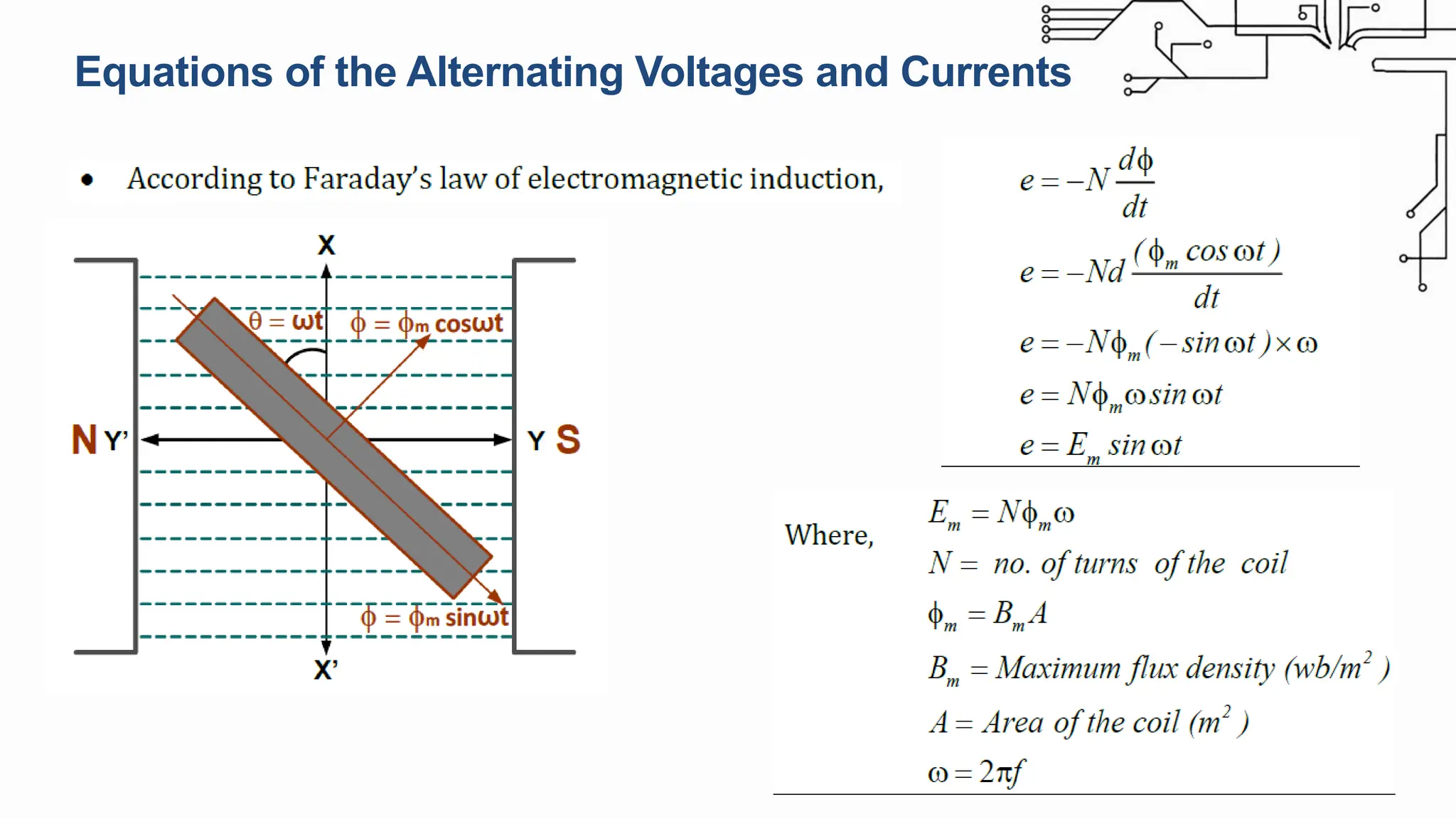
Equations of the Alternating Voltages and Currents
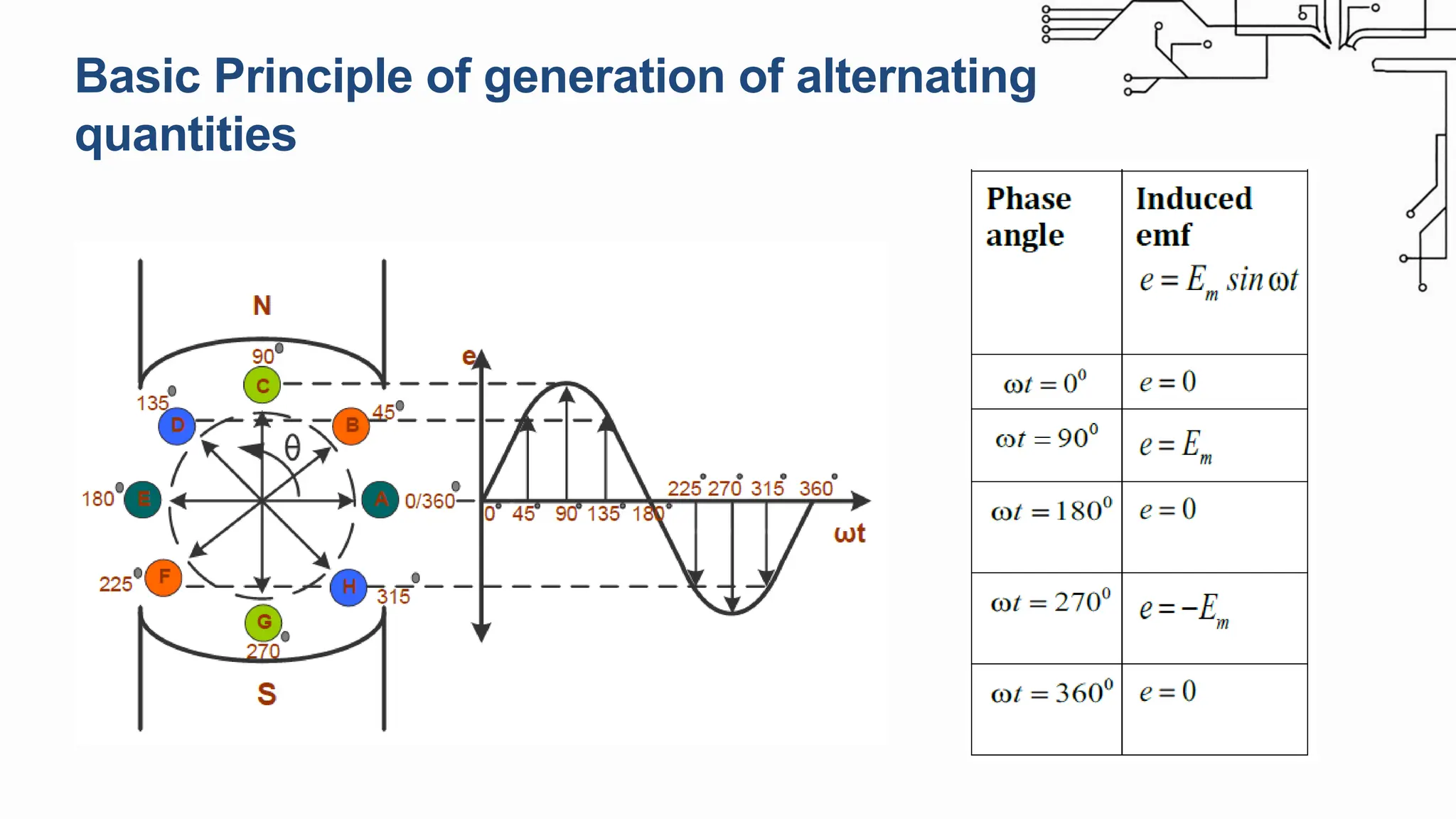
Basic Principle of generation of alternating
quantities
Alternating Current (ac) Fundamentals: Definitions
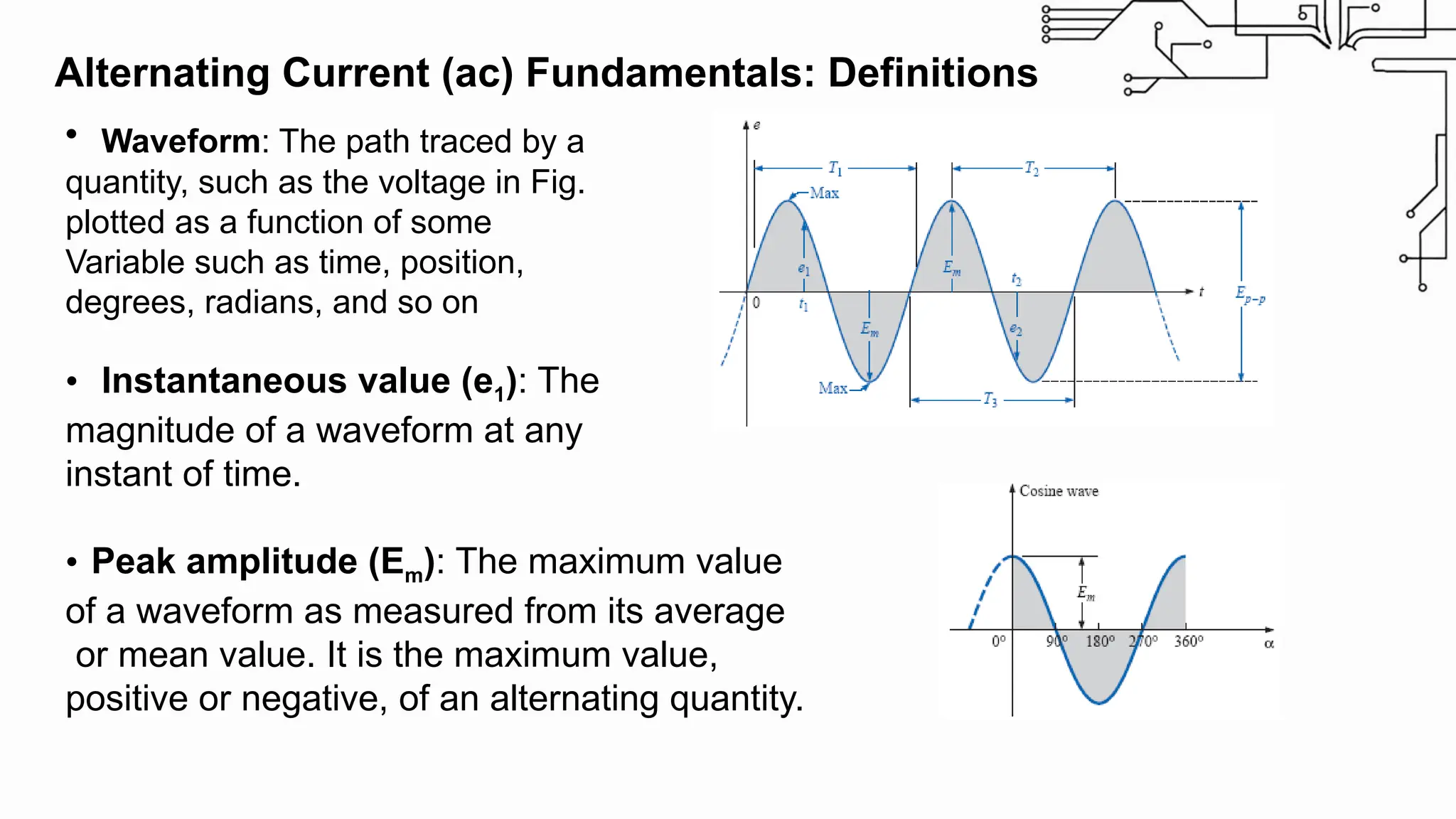
• Waveform: The path traced by a
quantity, such as the voltage in Fig.
plotted as a function of some
Variable such as time, position,
degrees, radians, and so on
• Instantaneous value (e1): The
magnitude of a waveform at any
instant of time.
• Peak amplitude (Em): The maximum value
of a waveform as measured from its average
or mean value. It is the maximum value,
positive or negative, of an alternating quantity.
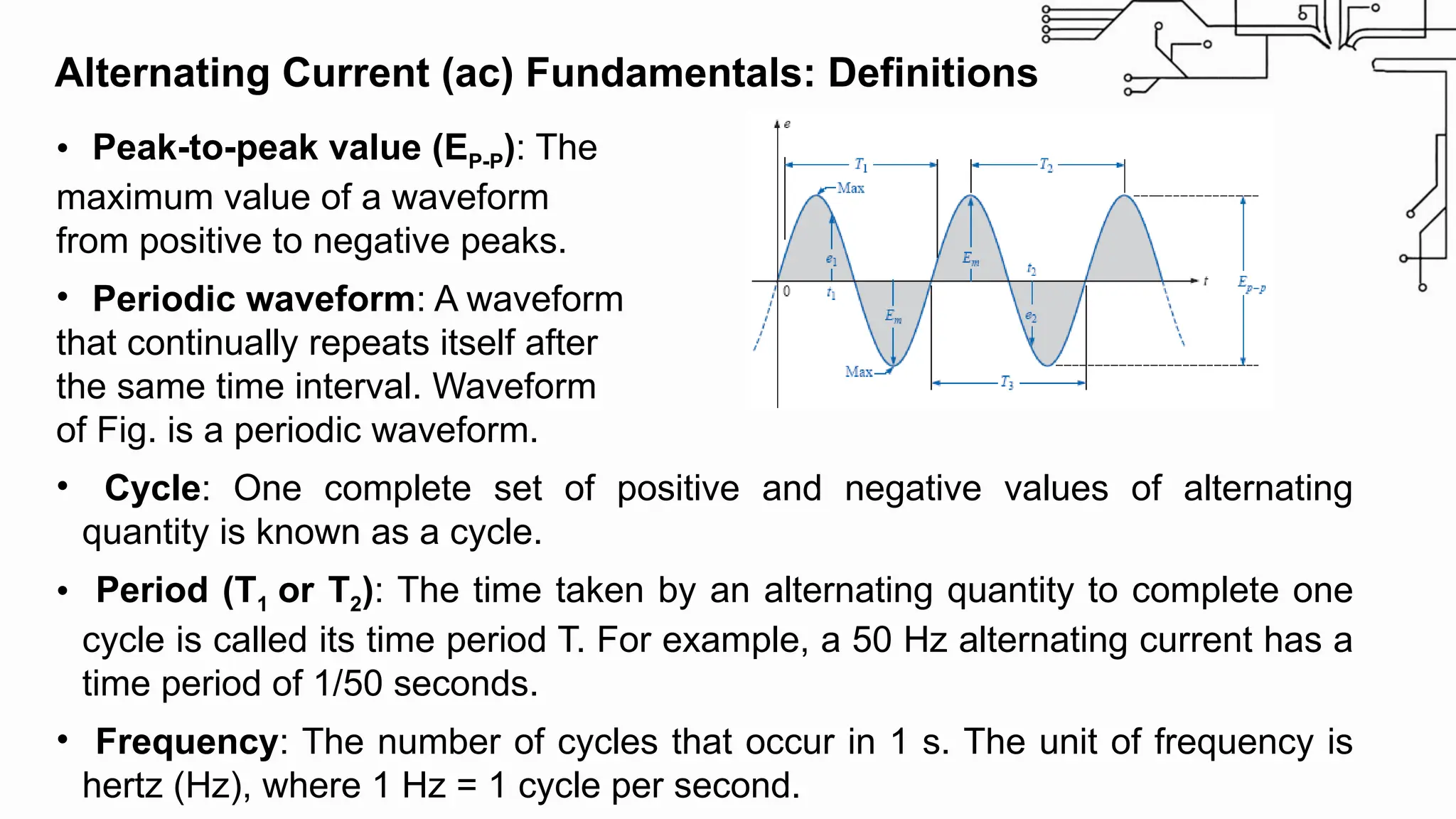
• Peak-to-peak value (EP-P): The
maximum value of a waveform
from positive to negative peaks.
• Periodic waveform: A waveform
that continually repeats itself after
the same time interval. Waveform
of Fig. is a periodic waveform.
• Cycle: One complete set of positive and negative values of alternating
quantity is known as a cycle.
• Period (T1 or T2): The time taken by an alternating quantity to complete one
cycle is called its time period T. For example, a 50 Hz alternating current has a
time period of 1/50 seconds.
• Frequency: The number of cycles that occur in 1 s. The unit of frequency is
hertz (Hz), where 1 Hz = 1 cycle per second.
Alternating Current (ac) Fundamentals: Definitions
General form of ac current or voltage
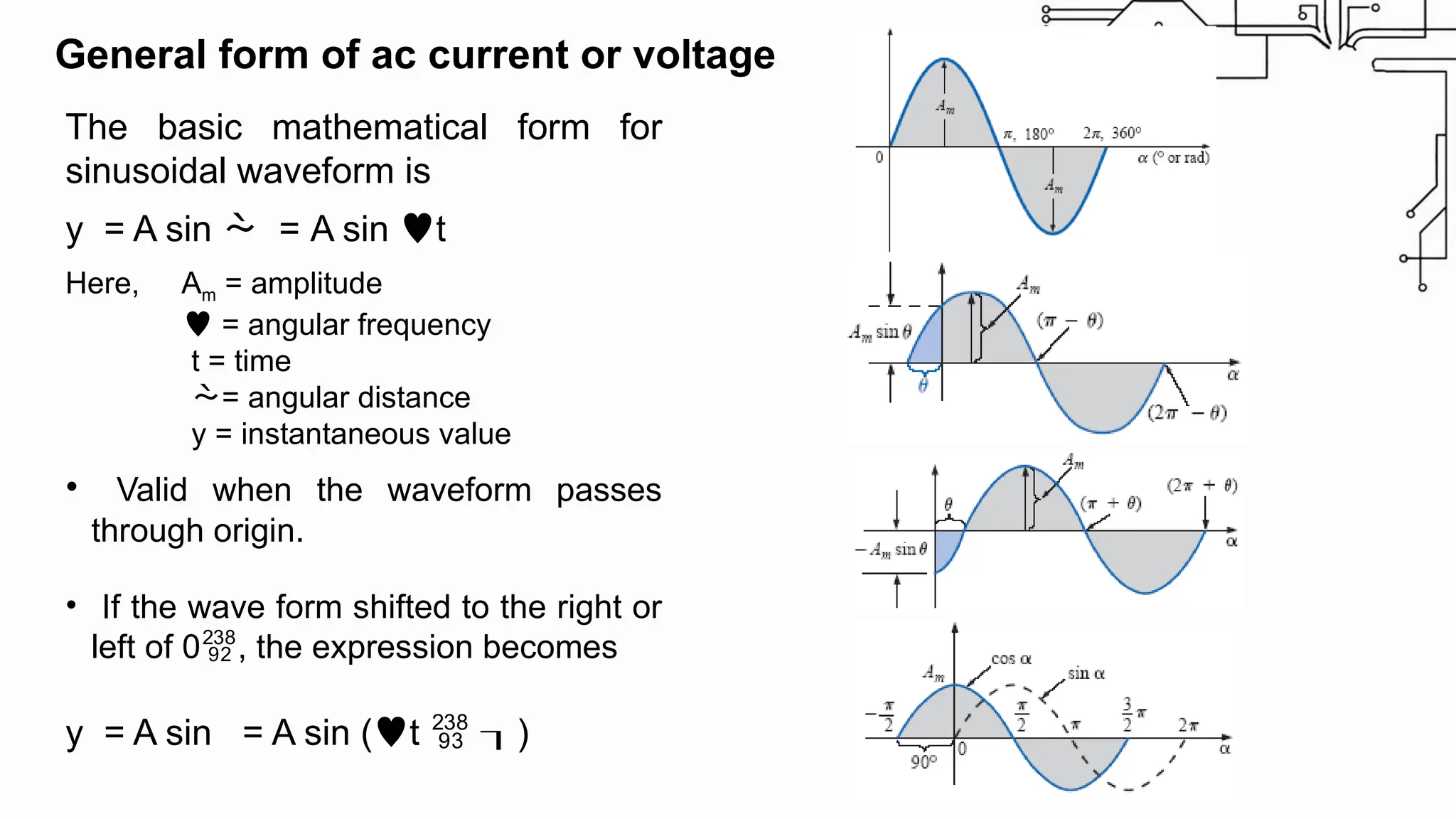
The basic mathematical form for
sinusoidal waveform is
y = A sin  = A sin t
Here, Am = amplitude
 = angular frequency
t = time
= angular distance
y = instantaneous value
• Valid when the waveform passes
through origin.
• If the wave form shifted to the right or
left of 0, the expression becomes
y = A sin = A sin (t  )
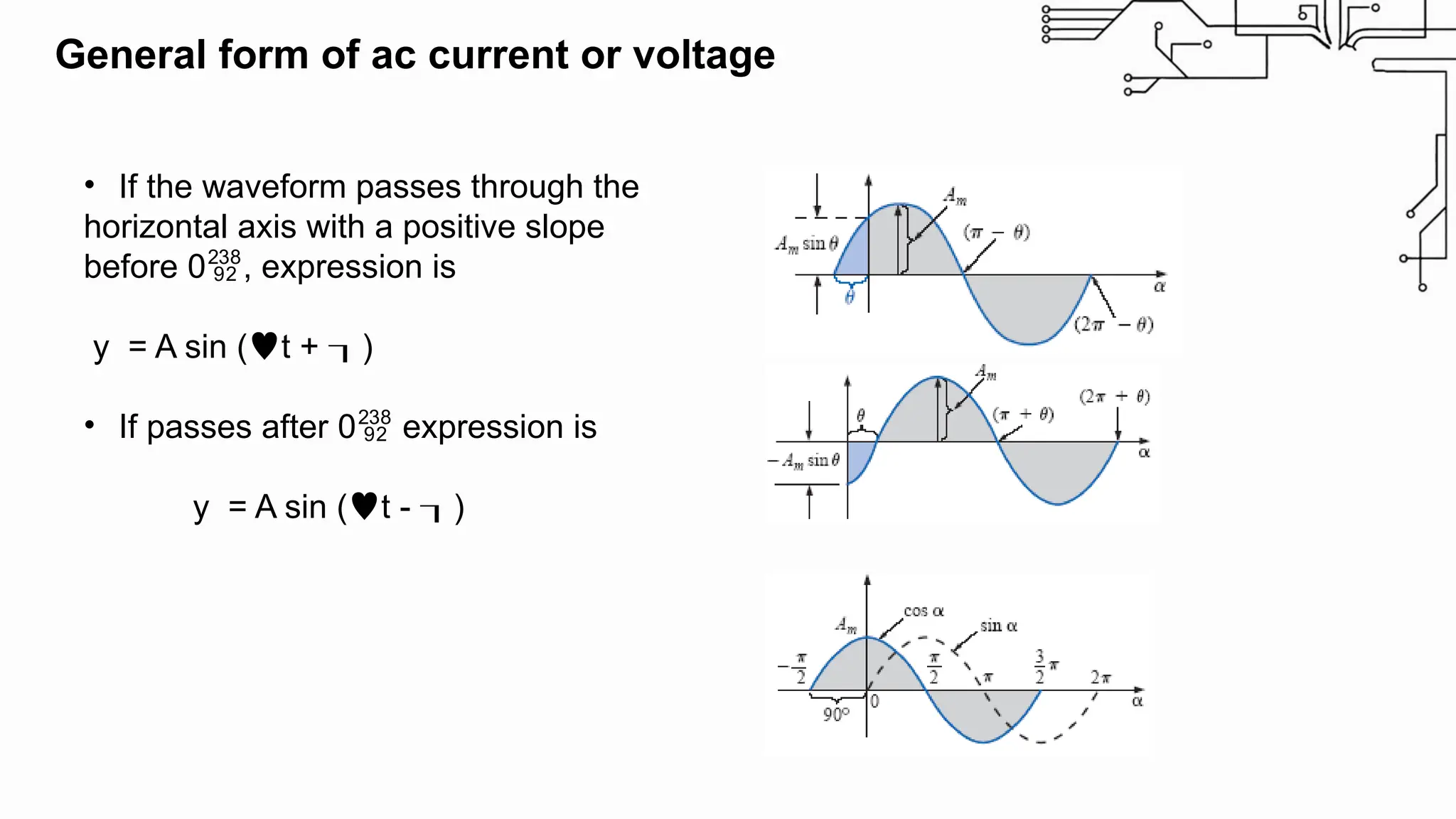
• If the waveform passes through the
horizontal axis with a positive slope
before 0, expression is
y = A sin (t + )
• If passes after 0 expression is
y = A sin (t - )
General form of ac current or voltage
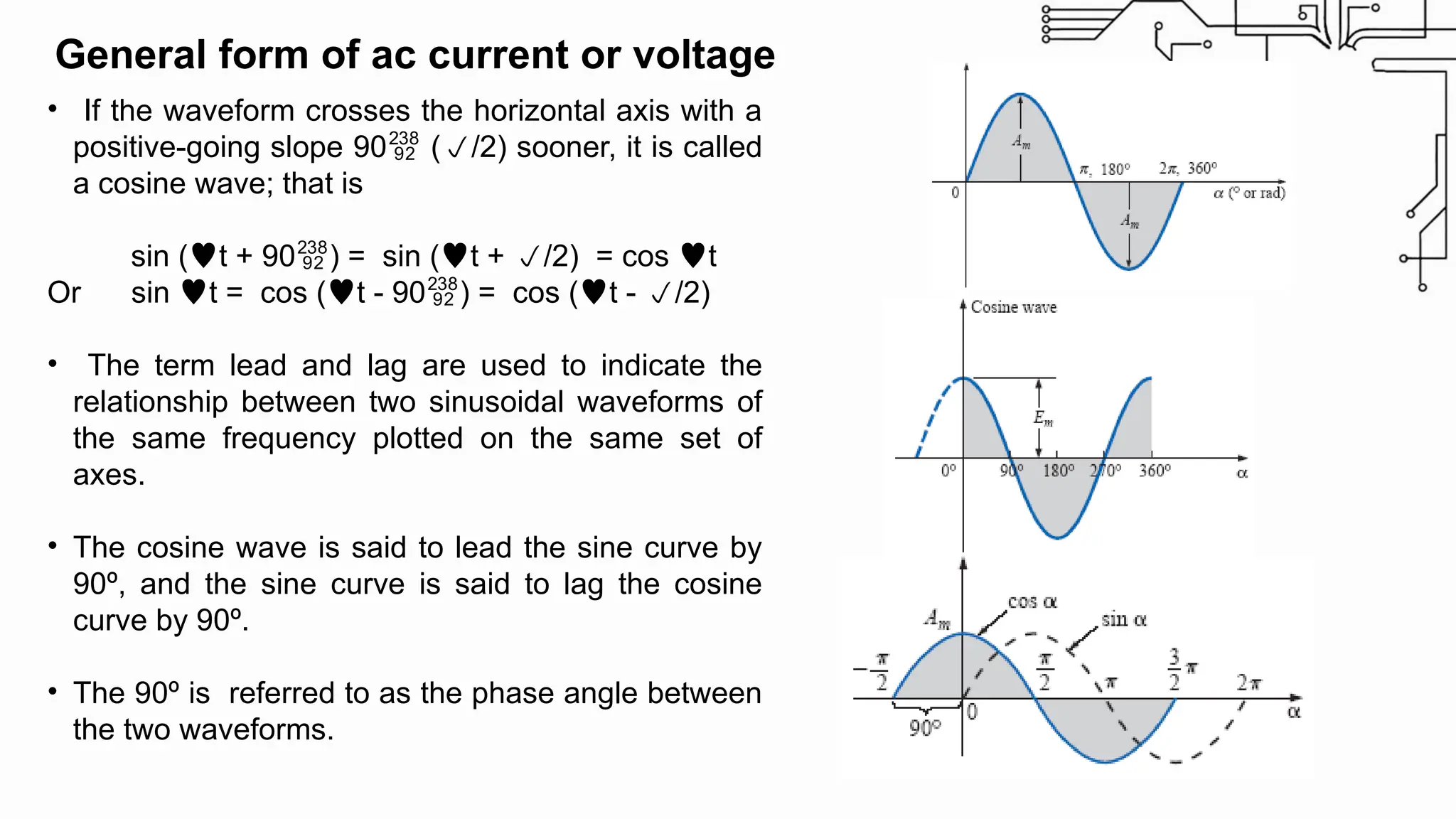
• If the waveform crosses the horizontal axis with a
positive-going slope 90 (/2) sooner, it is called
a cosine wave; that is
sin (t + 90) = sin (t + /2) = cos t
Or sin t = cos (t - 90) = cos (t - /2)
• The term lead and lag are used to indicate the
relationship between two sinusoidal waveforms of
the same frequency plotted on the same set of
axes.
• The cosine wave is said to lead the sine curve by
90º, and the sine curve is said to lag the cosine
curve by 90º.
• The 90º is referred to as the phase angle between
the two waveforms.
General form of ac current or voltage
Phase and Phase Difference
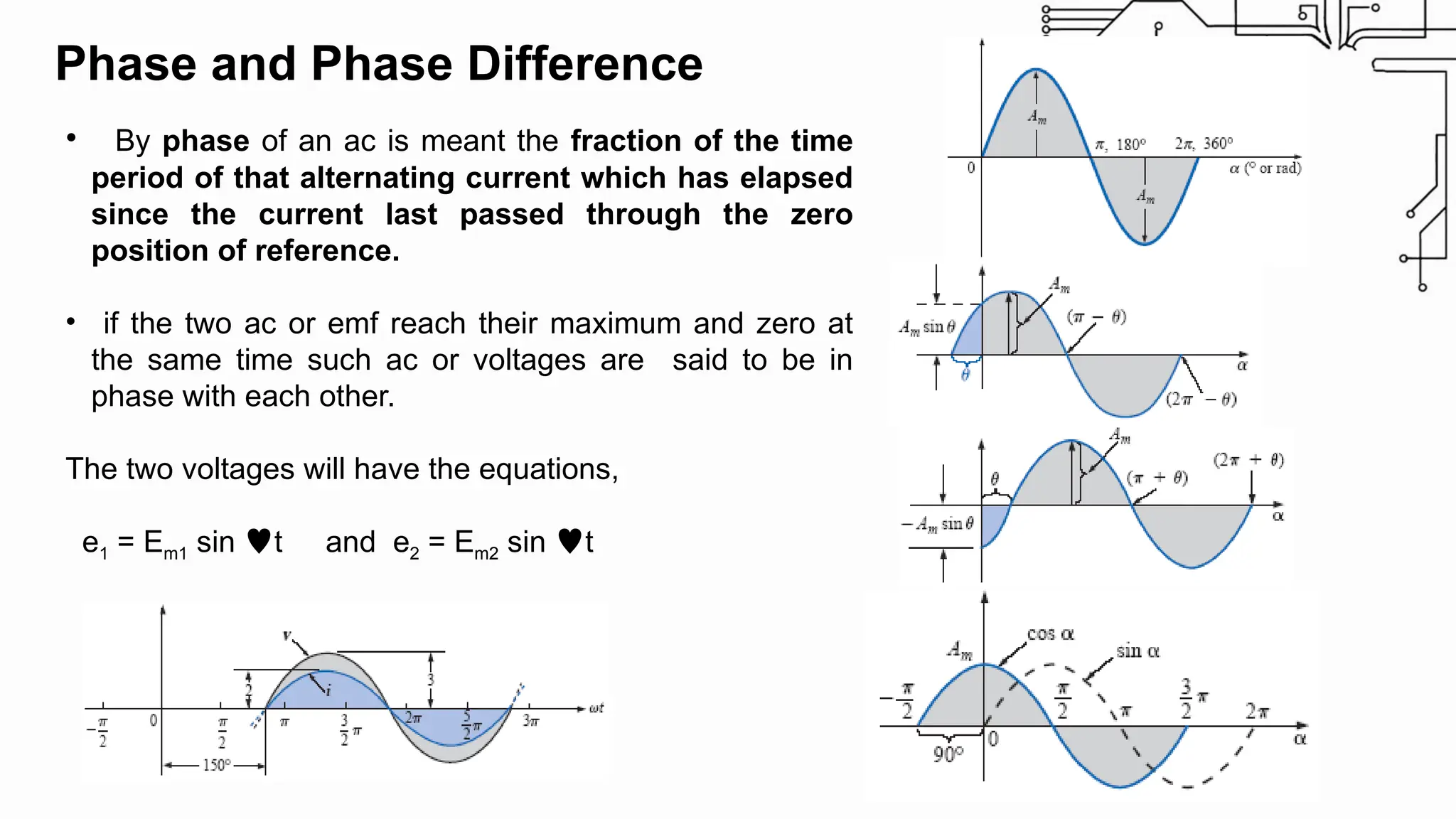
• By phase of an ac is meant the fraction of the time
period of that alternating current which has elapsed
since the current last passed through the zero
position of reference.
• if the two ac or emf reach their maximum and zero at
the same time such ac or voltages are said to be in
phase with each other.
The two voltages will have the equations,
e1 = Em1 sin t and e2 = Em2 sin t
Phase and Phase Difference
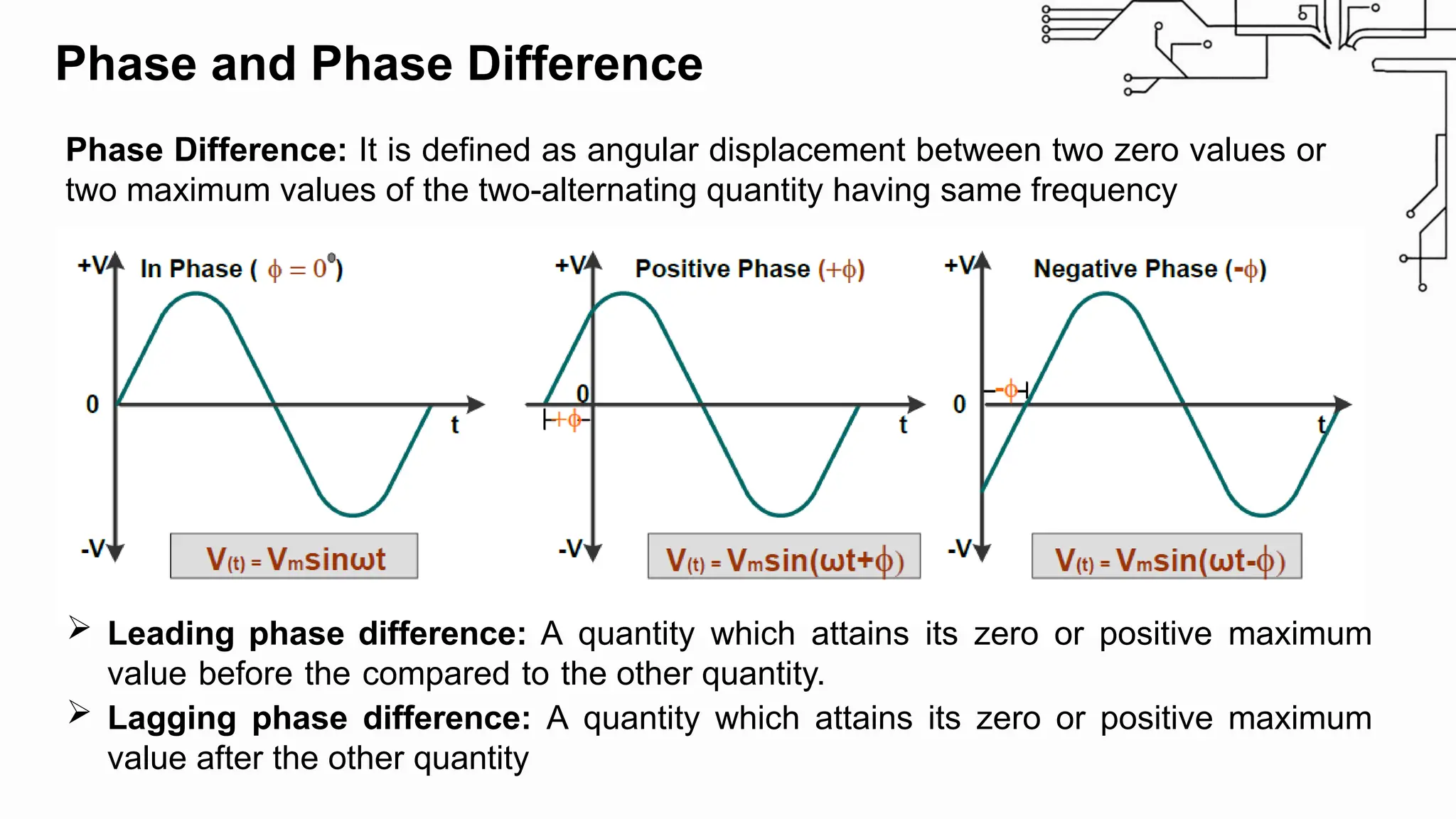
Phase Difference: It is defined as angular displacement between two zero values or
two maximum values of the two-alternating quantity having same frequency
 Leading phase difference: A quantity which attains its zero or positive maximum
value before the compared to the other quantity.
 Lagging phase difference: A quantity which attains its zero or positive maximum
value after the other quantity
Average value & RMS value
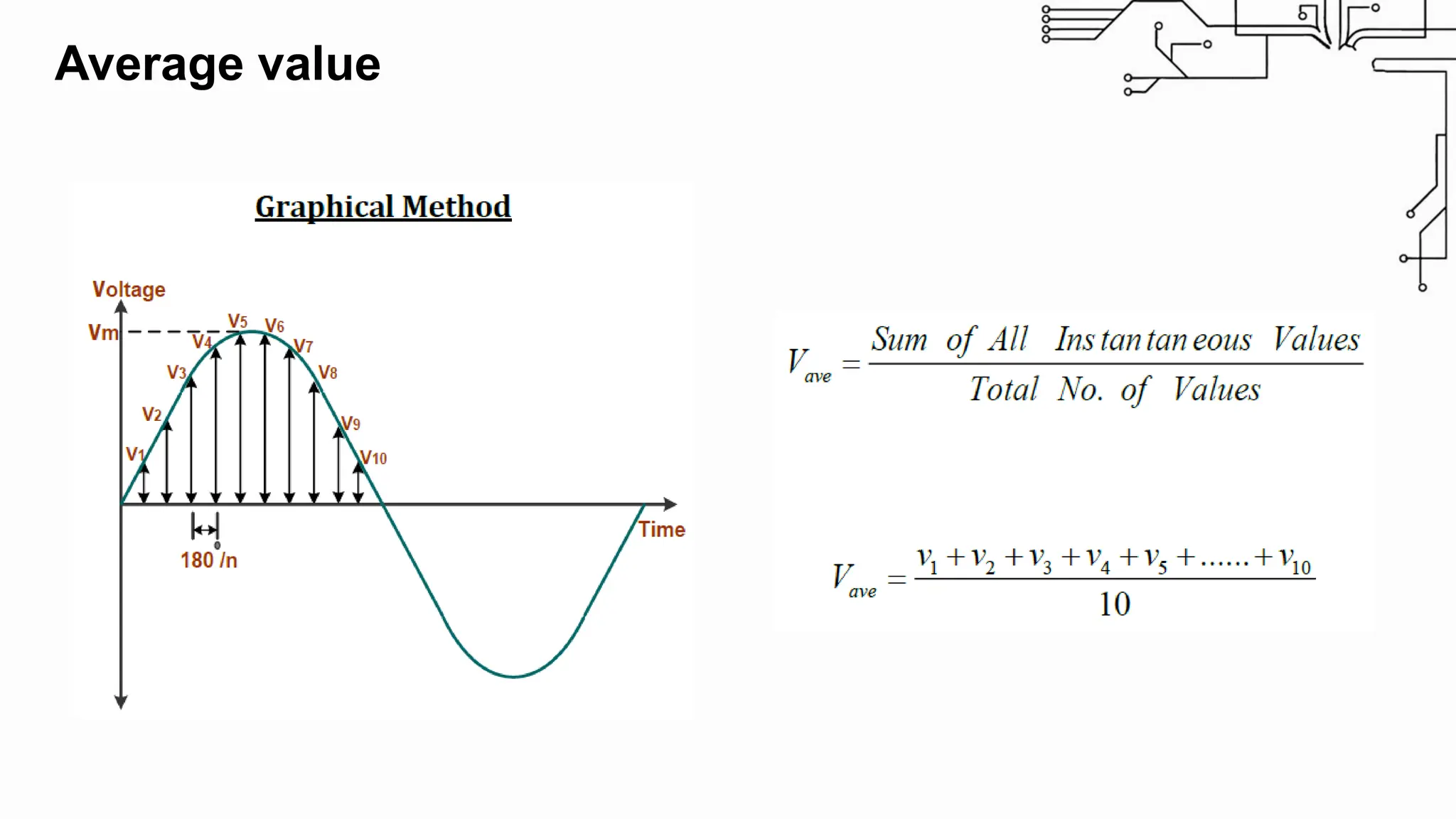
Average value
• It is defined as the average of all instantaneous value of alternating
quantities over a half cycle.
• e.g. Vavg = Average value of voltage, Iavg = Average value of current
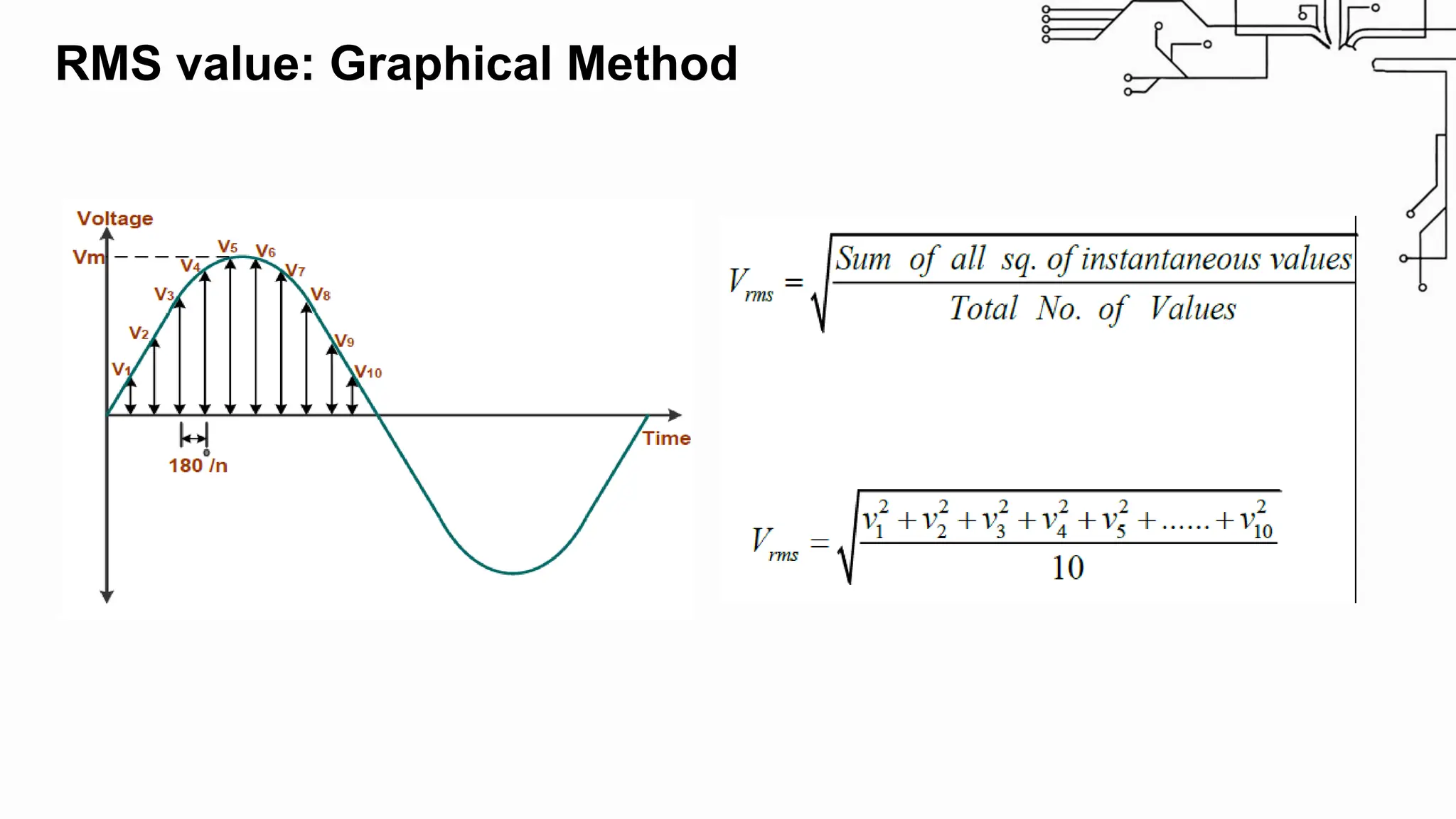
RMS value
• It is the equivalent dc current which when flowing through a given circuit for
a given time produces same amount of heat as produced by an alternating
current when flowing through the same circuit for the same time.
• Also known as the effective value of alternating current or voltage
• e.g. Vrms =Root Mean Square value of voltage, Irms = Root Mean Square
value of current
Average value
Average value
RMS value: Graphical Method
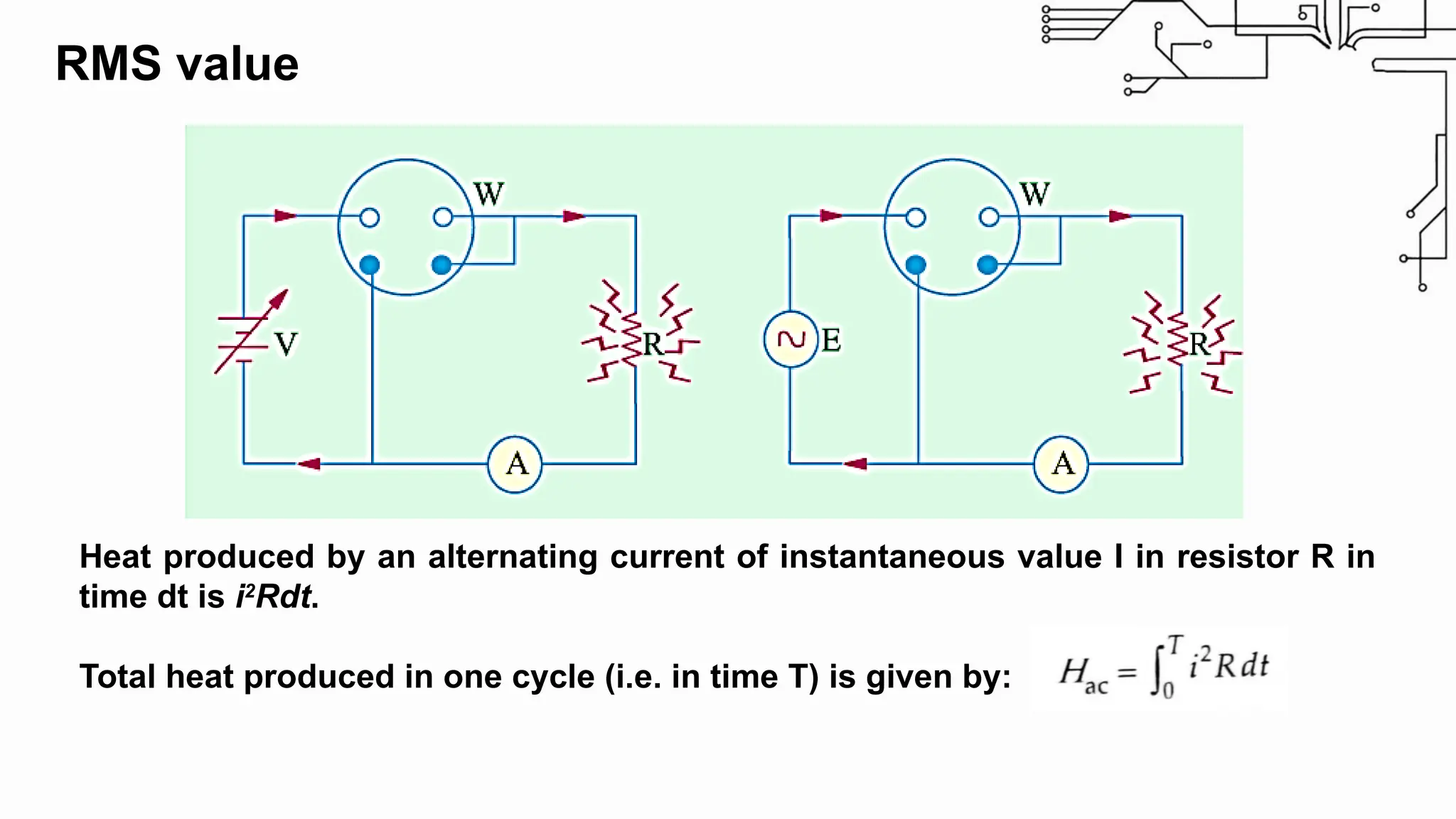
RMS value
Heat produced by an alternating current of instantaneous value I in resistor R in
time dt is i2
Rdt.
Total heat produced in one cycle (i.e. in time T) is given by:
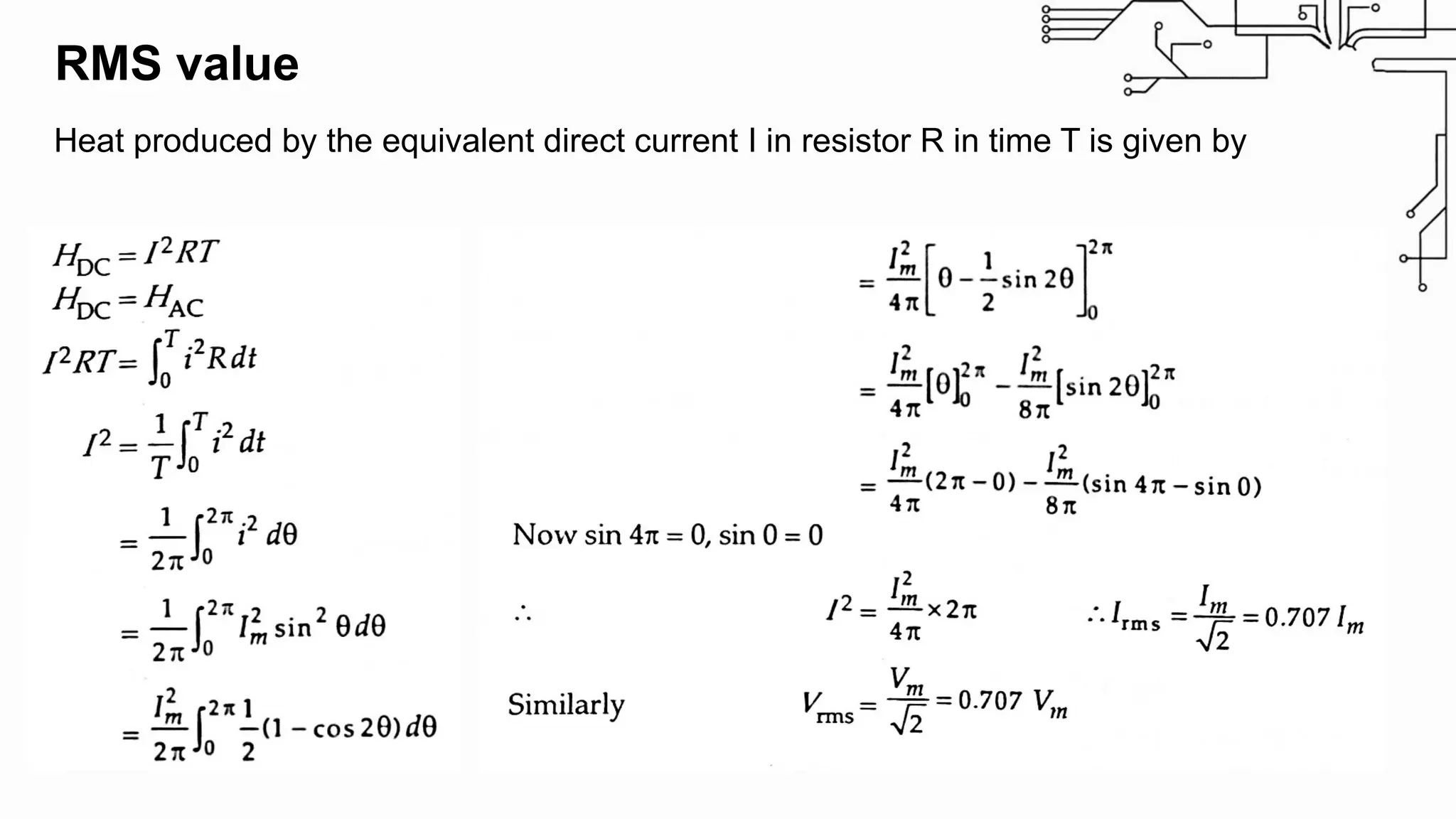
RMS value
Heat produced by the equivalent direct current I in resistor R in time T is given by
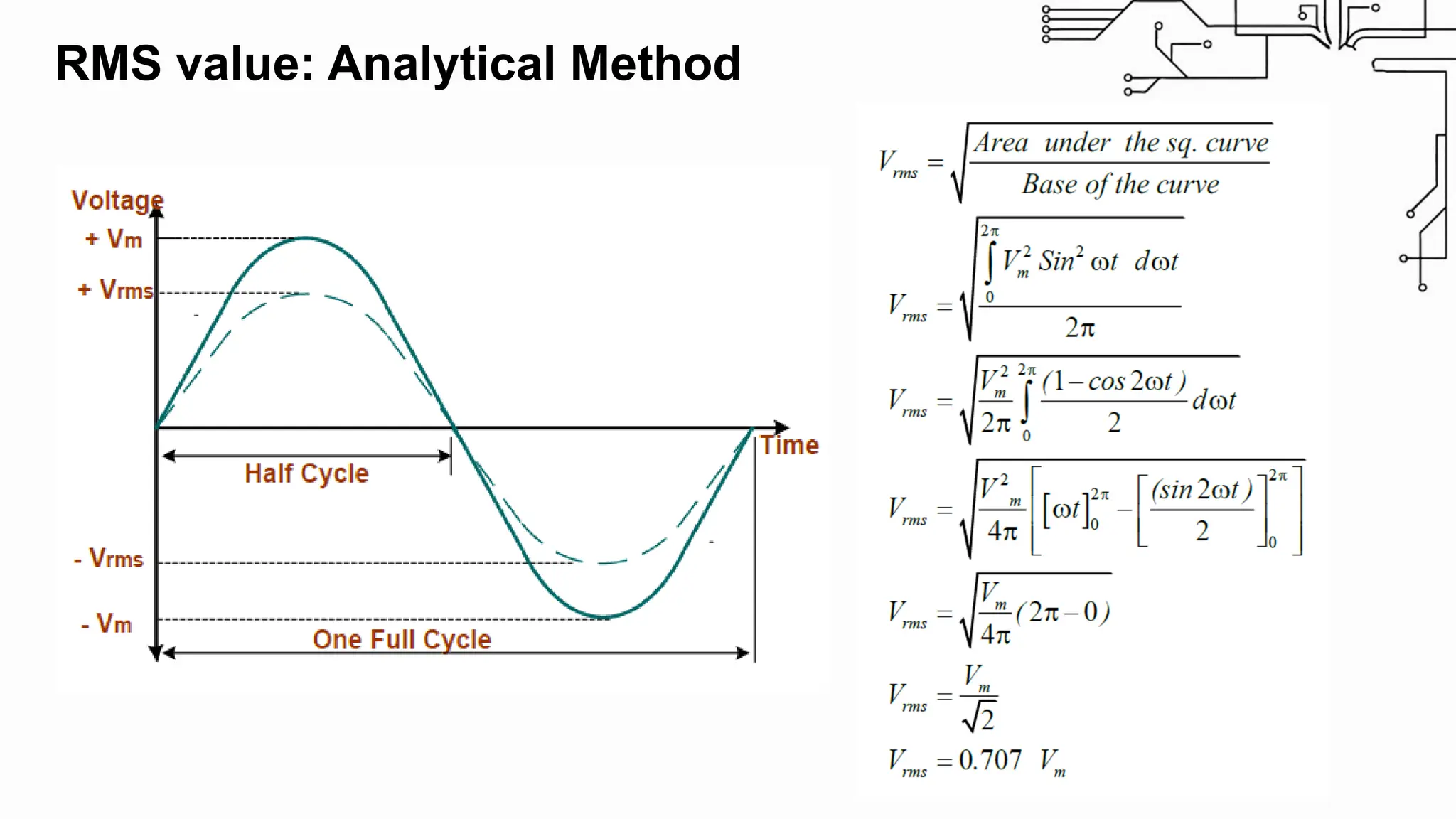
RMS value: Analytical Method
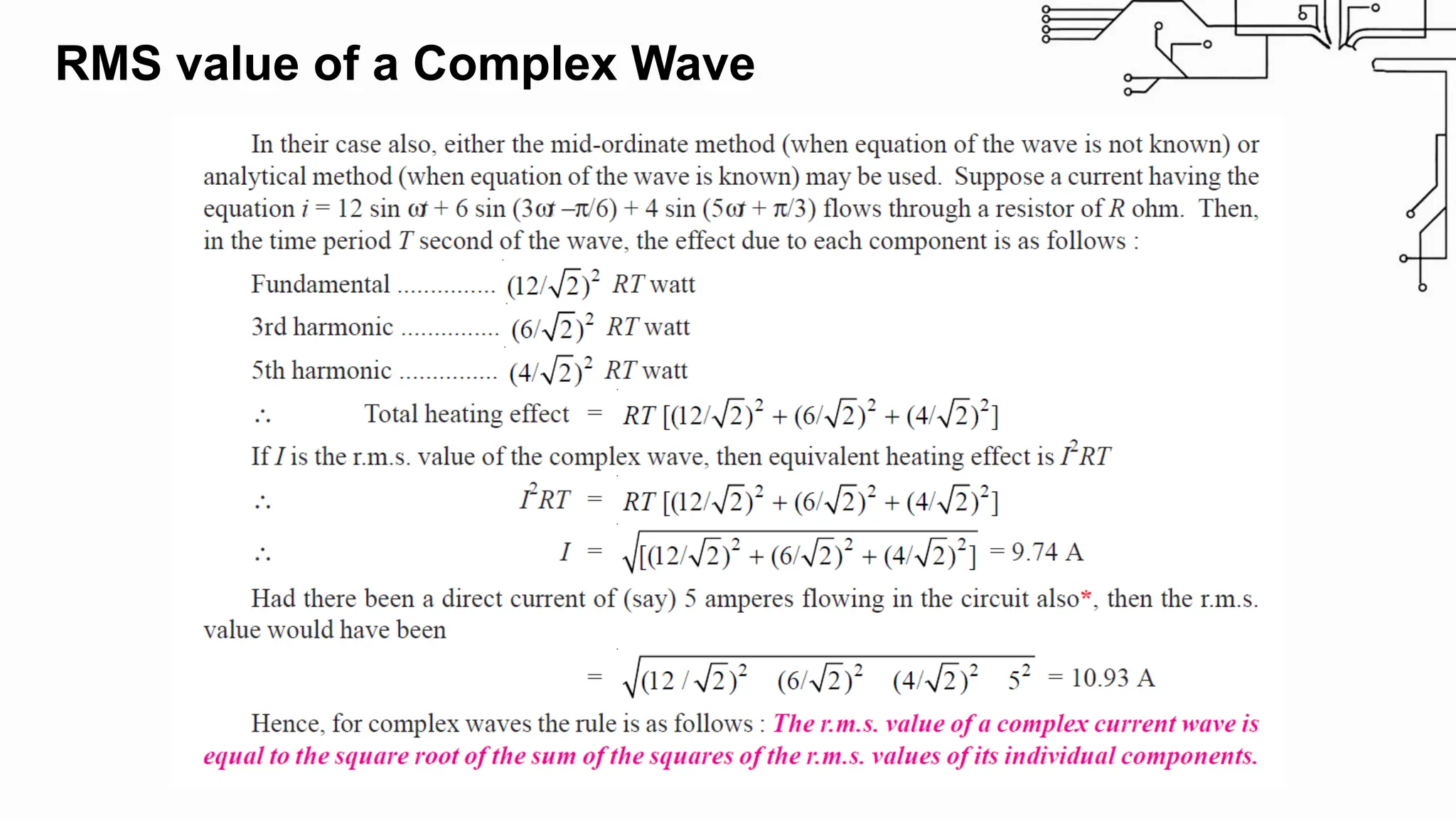
RMS value of a Complex Wave
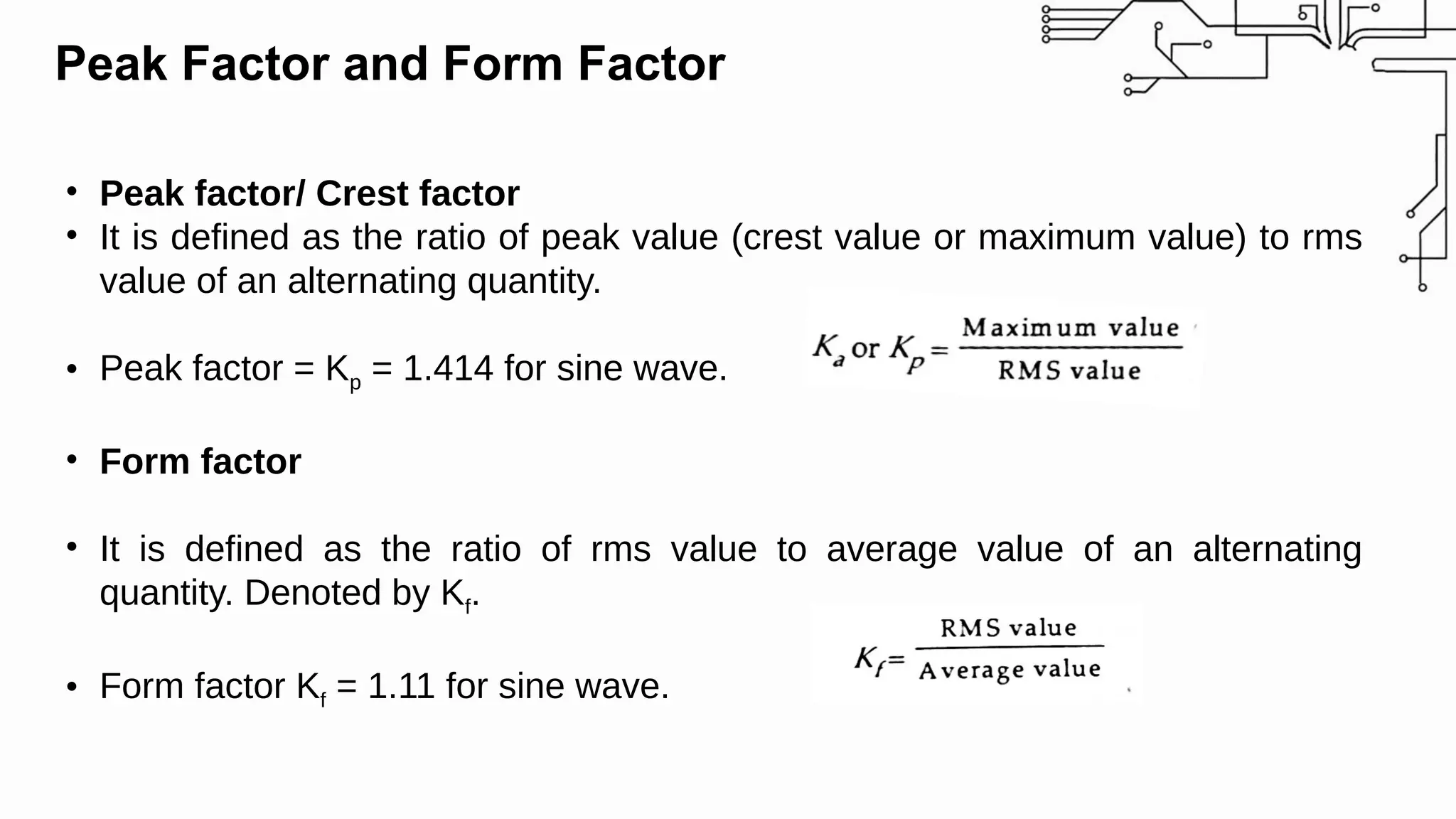
Peak Factor and Form Factor
• Peak factor/ Crest factor
• It is defined as the ratio of peak value (crest value or maximum value) to rms
value of an alternating quantity.
• Peak factor = Kp = 1.414 for sine wave.
• Form factor
• It is defined as the ratio of rms value to average value of an alternating
quantity. Denoted by Kf.
• Form factor Kf = 1.11 for sine wave.
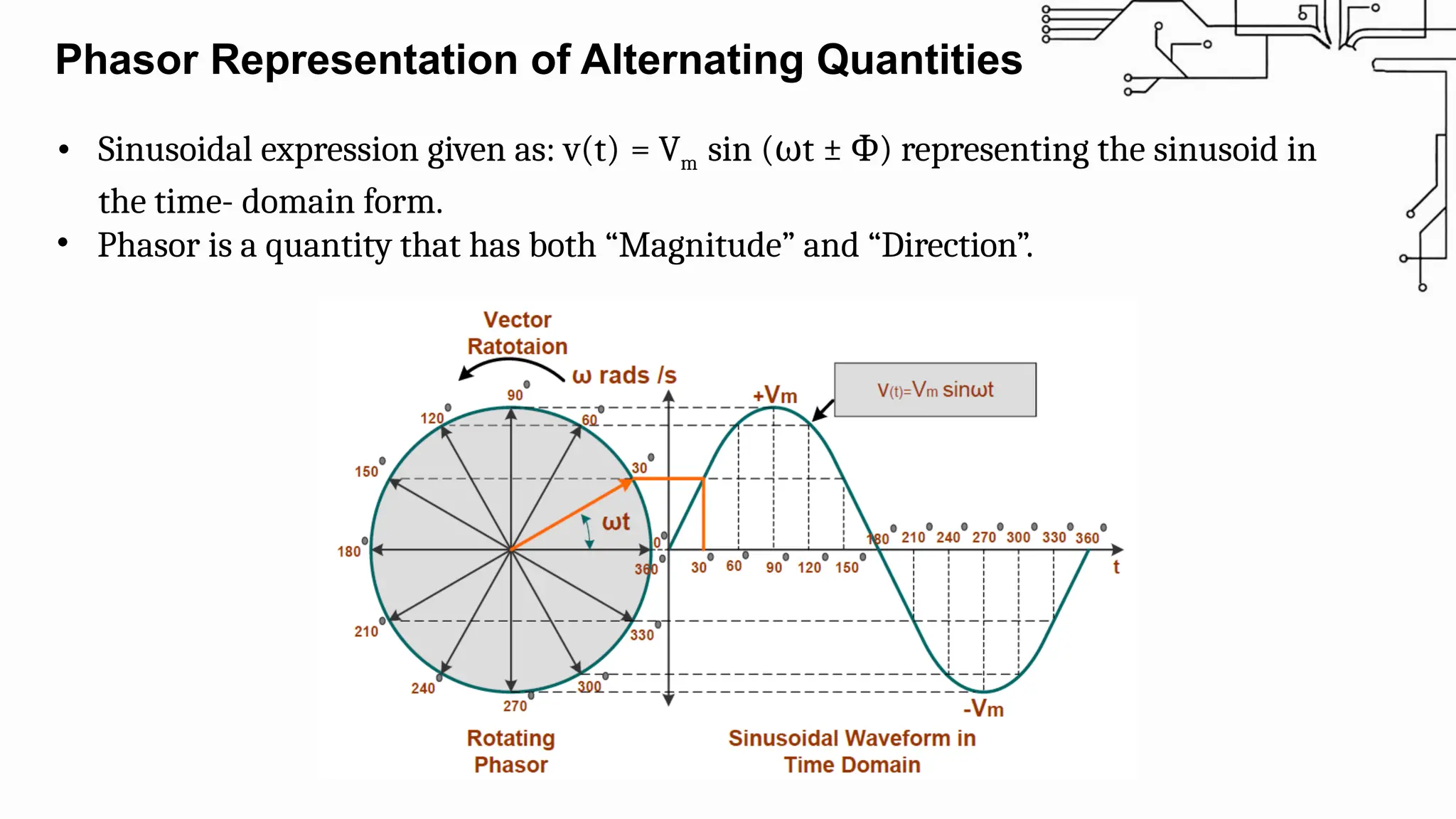
Phasor Representation of Alternating Quantities
• Sinusoidal expression given as: v(t) = Vm sin ( t ± ) representing the sinusoid in
ω Φ
the time- domain form.
• Phasor is a quantity that has both “Magnitude” and “Direction”.
Phasor Representation of Alternating Quantities
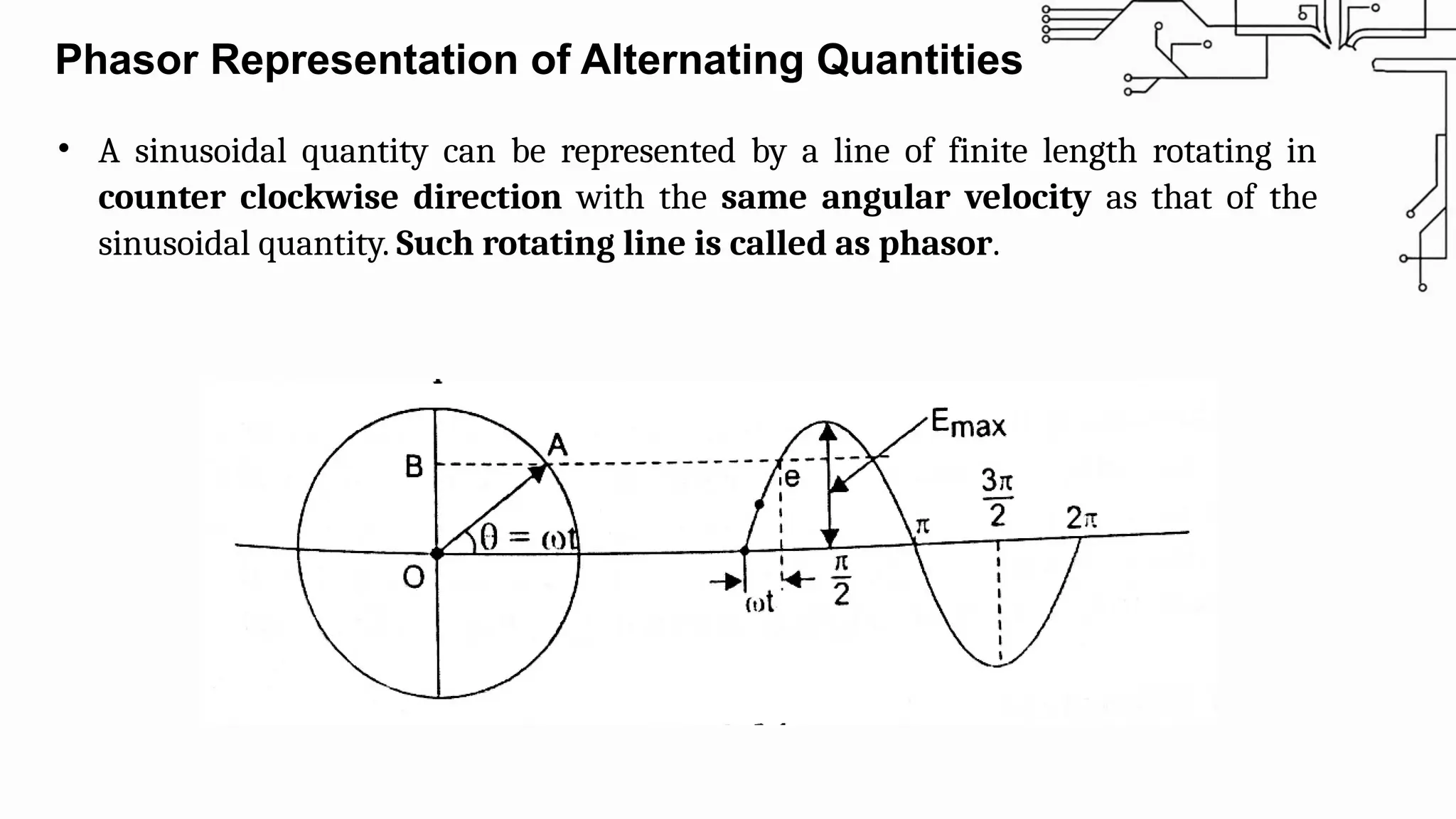
• A sinusoidal quantity can be represented by a line of finite length rotating in
counter clockwise direction with the same angular velocity as that of the
sinusoidal quantity. Such rotating line is called as phasor.
Phase Difference
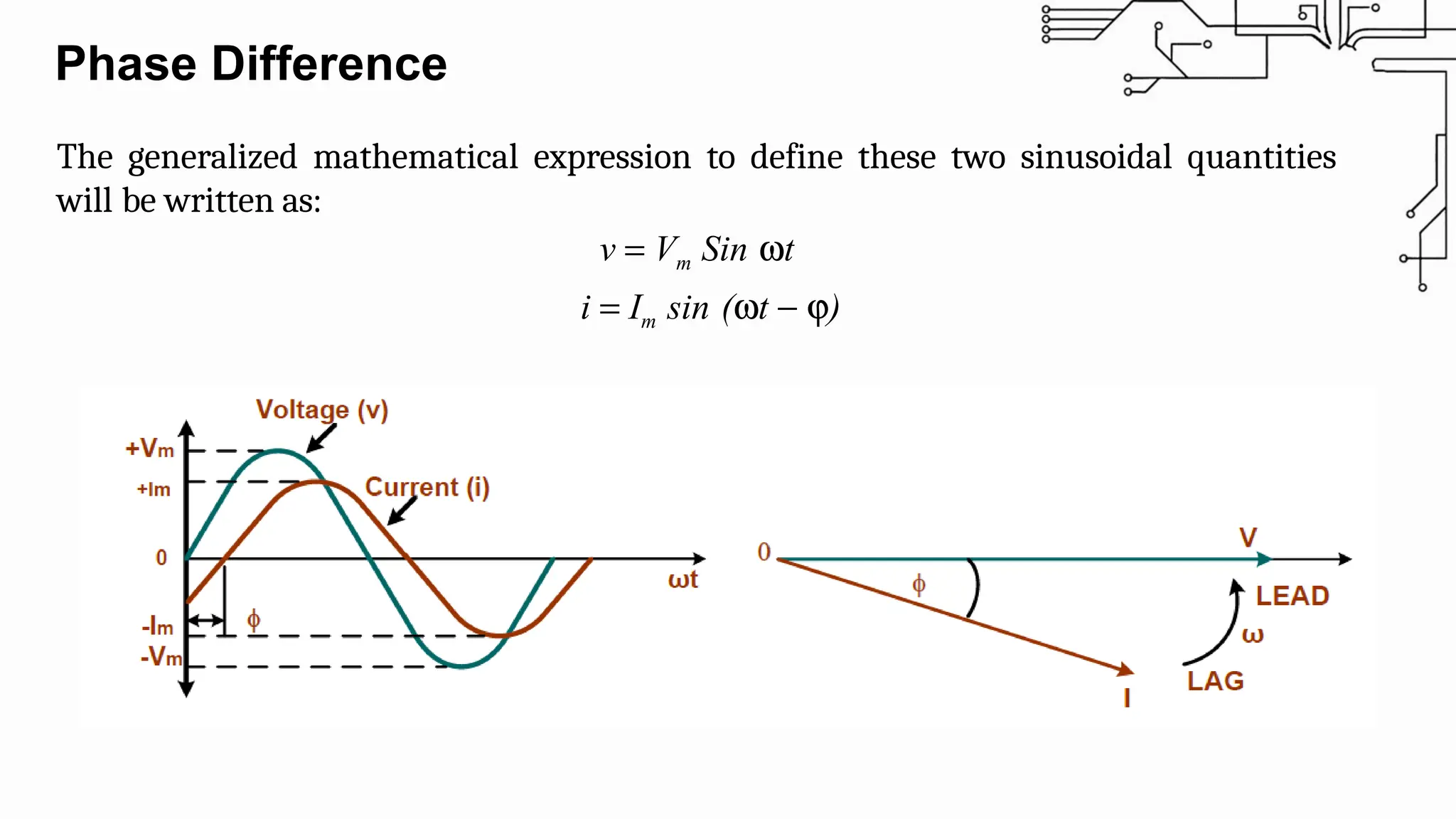
The generalized mathematical expression to define these two sinusoidal quantities
will be written as:
v = Vm Sin wt
i = Im sin (wt - j)
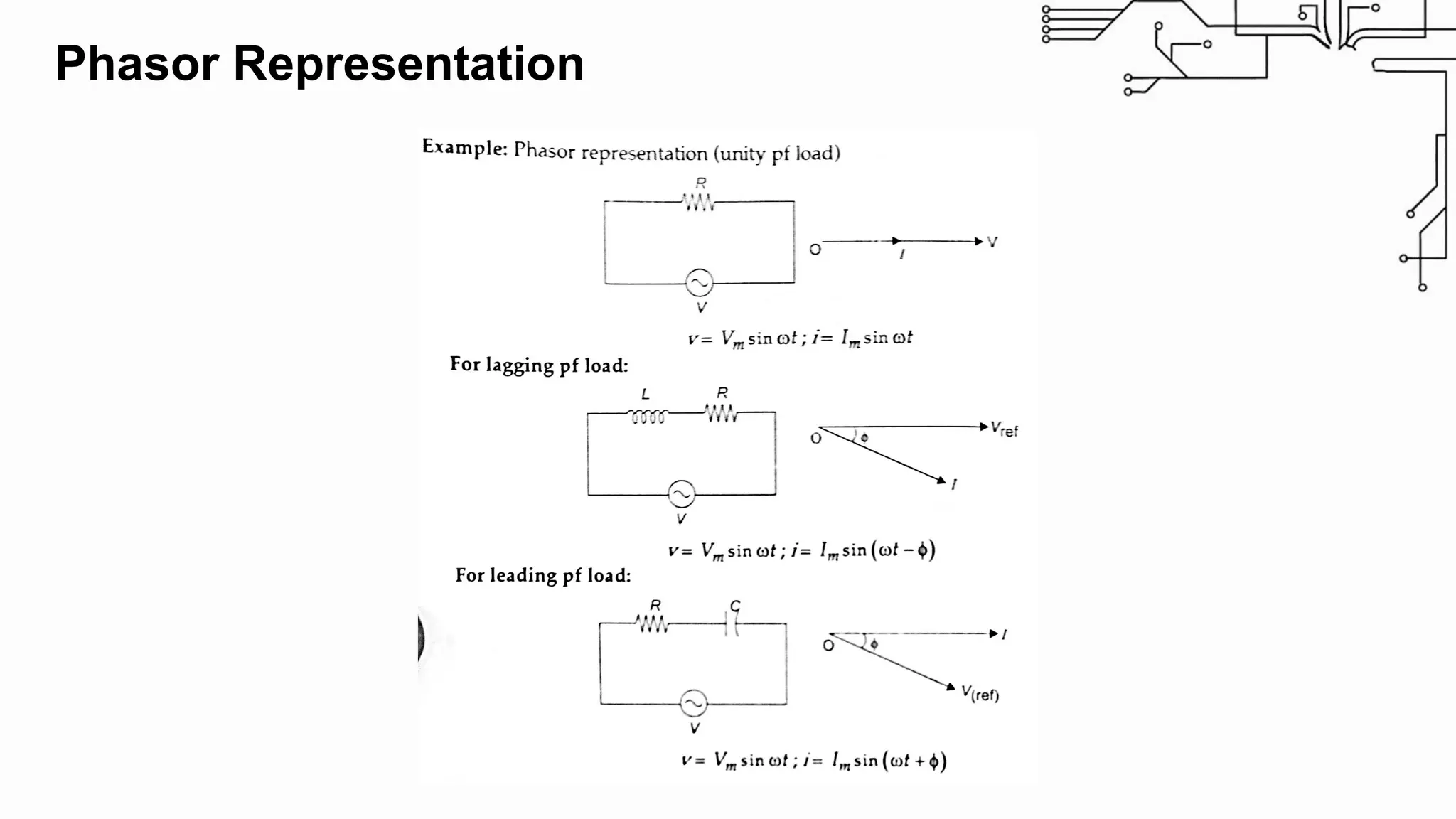
Phasor Representation
Purely Resistive Circuit
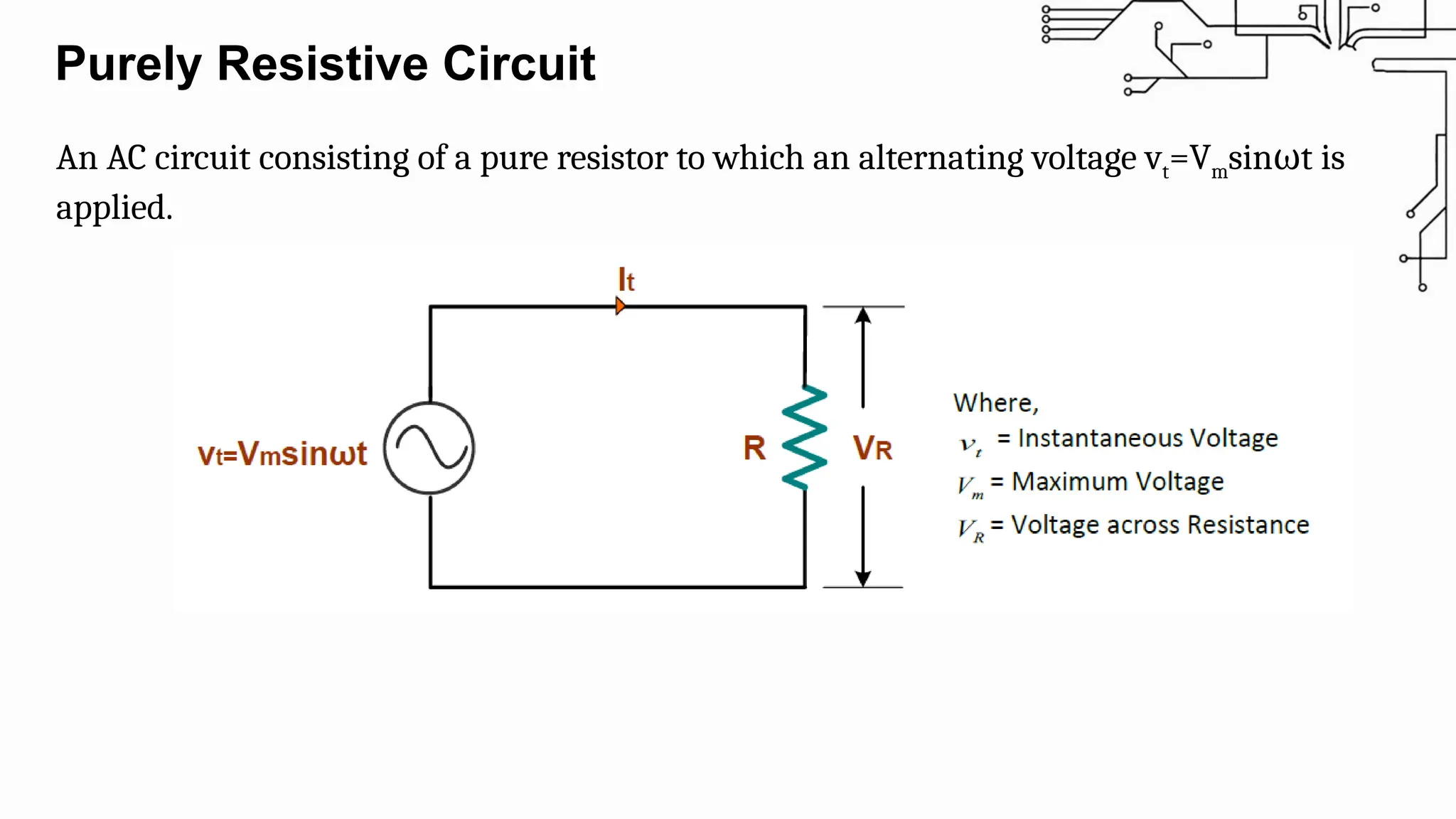
An AC circuit consisting of a pure resistor to which an alternating voltage vt=Vmsin t is
ω
applied.
Thank
you

Basics of AC Circuits for BTech First Year in Electrical Engineering

  • 1.
  • 2.
    WHAT IS ALTERNATINGCURRENT (A.C.)? Alternating current is the current which constantly changes in amplitude, and which reverses direction at regular intervals. In alternating current, the electric charges flow changes its direction periodically. Alternating current can be identified in waveform called a sine wave.
  • 3.
  • 4.
    Types of ACWaveforms Waveform: It is defined as the graph between magnitude of alternating quantity (on Y axis) against time (on X axis).
  • 5.
    Alternating Current DirectCurrent AC is safe to transfer longer distance even between two cities, and maintain the electric power. DC cannot travel for a very long distance. It loses electric power. The rotating magnets cause the change in direction of electric flow. The steady magnetism makes DC flow in a single direction. The frequency of AC is dependent upon the country. But, generally, the frequency is 50 Hz or 60 Hz. DC has no frequency of zero frequency. In AC the flow of current changes its direction backwards periodically. It flows in a single direction steadily. Electrons in AC keep changing its directions – backward and forward Electrons only move in one direction – that is forward
  • 6.
    • AC isless expensive and easy to generate than DC. • The distance covered by AC is more than that of the DC. • The power loss during transmission in AC is less when compared to the DC. • This makes its installations easy when the transformers are at distance. • AC voltage has the advantage of stepping up and stepping down as per the requirement. ADVANTAGES OF AC OVER DC
  • 7.
    Application of SinglePhase AC in Real Life
  • 8.
  • 9.
    Equations of theAlternating Voltages and Currents
  • 10.
    Basic Principle ofgeneration of alternating quantities
  • 11.
    Alternating Current (ac)Fundamentals: Definitions • Waveform: The path traced by a quantity, such as the voltage in Fig. plotted as a function of some Variable such as time, position, degrees, radians, and so on • Instantaneous value (e1): The magnitude of a waveform at any instant of time. • Peak amplitude (Em): The maximum value of a waveform as measured from its average or mean value. It is the maximum value, positive or negative, of an alternating quantity.
  • 12.
    • Peak-to-peak value(EP-P): The maximum value of a waveform from positive to negative peaks. • Periodic waveform: A waveform that continually repeats itself after the same time interval. Waveform of Fig. is a periodic waveform. • Cycle: One complete set of positive and negative values of alternating quantity is known as a cycle. • Period (T1 or T2): The time taken by an alternating quantity to complete one cycle is called its time period T. For example, a 50 Hz alternating current has a time period of 1/50 seconds. • Frequency: The number of cycles that occur in 1 s. The unit of frequency is hertz (Hz), where 1 Hz = 1 cycle per second. Alternating Current (ac) Fundamentals: Definitions
  • 13.
    General form ofac current or voltage The basic mathematical form for sinusoidal waveform is y = A sin  = A sin t Here, Am = amplitude  = angular frequency t = time = angular distance y = instantaneous value • Valid when the waveform passes through origin. • If the wave form shifted to the right or left of 0, the expression becomes y = A sin = A sin (t  )
  • 14.
    • If thewaveform passes through the horizontal axis with a positive slope before 0, expression is y = A sin (t + ) • If passes after 0 expression is y = A sin (t - ) General form of ac current or voltage
  • 15.
    • If thewaveform crosses the horizontal axis with a positive-going slope 90 (/2) sooner, it is called a cosine wave; that is sin (t + 90) = sin (t + /2) = cos t Or sin t = cos (t - 90) = cos (t - /2) • The term lead and lag are used to indicate the relationship between two sinusoidal waveforms of the same frequency plotted on the same set of axes. • The cosine wave is said to lead the sine curve by 90º, and the sine curve is said to lag the cosine curve by 90º. • The 90º is referred to as the phase angle between the two waveforms. General form of ac current or voltage
  • 16.
    Phase and PhaseDifference • By phase of an ac is meant the fraction of the time period of that alternating current which has elapsed since the current last passed through the zero position of reference. • if the two ac or emf reach their maximum and zero at the same time such ac or voltages are said to be in phase with each other. The two voltages will have the equations, e1 = Em1 sin t and e2 = Em2 sin t
  • 17.
    Phase and PhaseDifference Phase Difference: It is defined as angular displacement between two zero values or two maximum values of the two-alternating quantity having same frequency  Leading phase difference: A quantity which attains its zero or positive maximum value before the compared to the other quantity.  Lagging phase difference: A quantity which attains its zero or positive maximum value after the other quantity
  • 18.
    Average value &RMS value Average value • It is defined as the average of all instantaneous value of alternating quantities over a half cycle. • e.g. Vavg = Average value of voltage, Iavg = Average value of current RMS value • It is the equivalent dc current which when flowing through a given circuit for a given time produces same amount of heat as produced by an alternating current when flowing through the same circuit for the same time. • Also known as the effective value of alternating current or voltage • e.g. Vrms =Root Mean Square value of voltage, Irms = Root Mean Square value of current
  • 19.
  • 20.
  • 21.
  • 22.
    RMS value Heat producedby an alternating current of instantaneous value I in resistor R in time dt is i2 Rdt. Total heat produced in one cycle (i.e. in time T) is given by:
  • 23.
    RMS value Heat producedby the equivalent direct current I in resistor R in time T is given by
  • 24.
  • 25.
    RMS value ofa Complex Wave
  • 26.
    Peak Factor andForm Factor • Peak factor/ Crest factor • It is defined as the ratio of peak value (crest value or maximum value) to rms value of an alternating quantity. • Peak factor = Kp = 1.414 for sine wave. • Form factor • It is defined as the ratio of rms value to average value of an alternating quantity. Denoted by Kf. • Form factor Kf = 1.11 for sine wave.
  • 27.
    Phasor Representation ofAlternating Quantities • Sinusoidal expression given as: v(t) = Vm sin ( t ± ) representing the sinusoid in ω Φ the time- domain form. • Phasor is a quantity that has both “Magnitude” and “Direction”.
  • 28.
    Phasor Representation ofAlternating Quantities • A sinusoidal quantity can be represented by a line of finite length rotating in counter clockwise direction with the same angular velocity as that of the sinusoidal quantity. Such rotating line is called as phasor.
  • 29.
    Phase Difference The generalizedmathematical expression to define these two sinusoidal quantities will be written as: v = Vm Sin wt i = Im sin (wt - j)
  • 30.
  • 31.
    Purely Resistive Circuit AnAC circuit consisting of a pure resistor to which an alternating voltage vt=Vmsin t is ω applied.
  • 32.