PHYSICAL
FACILITIES
MANAGEMENT
AND
TITLING OF SCHOOL
SITES
The School
Site
I. Requirements:
1. Location/Environment - provides an environment conducive
to learning
- far from cockpits, malls, gambling
dens, cinema houses, beer and
videoke joints, jails, industrial
establishments, military quarters,
public markets, slaughterhouses, or
garbage dumps.
2. Accessibility - easily accessible to the greatest
number of pupils/students.
3. Topography - level and should have no irregular
boundaries.
4. Soil Condition - agricultural land with sandy loam
5. Size
a. Non-central school with one(1) or two (2)
classes only and no grade IV- 0.5 hectare
b. Central school with six(6) classes and non
central school with three to four (3-4) classes-
1.0 hectare
c. Schools with seven to nine (7-9) classes-2.0
hectares
d. Schools with more than (12) classes – 4.0
hectares
Minimum (Elementary School)
Alternatives:
For Rural Areas
a. central school with six (6) classes and non central
school with three to four (3-4) classes – 0.5 hectare
b. schools with seven to ten (7-10) classes – 1.5 hectare
c. schools with more than ten (10) classes – 2.0 hectares
For Urban Areas
a. central school with six (6) classes and non-central
school with six to ten (6-10) classes - 0.5 hectare
b. schools with eleven to twenty (11-20) classes-
0.75 hectare
c. schools with more than 20 classes - 1.0 hectare
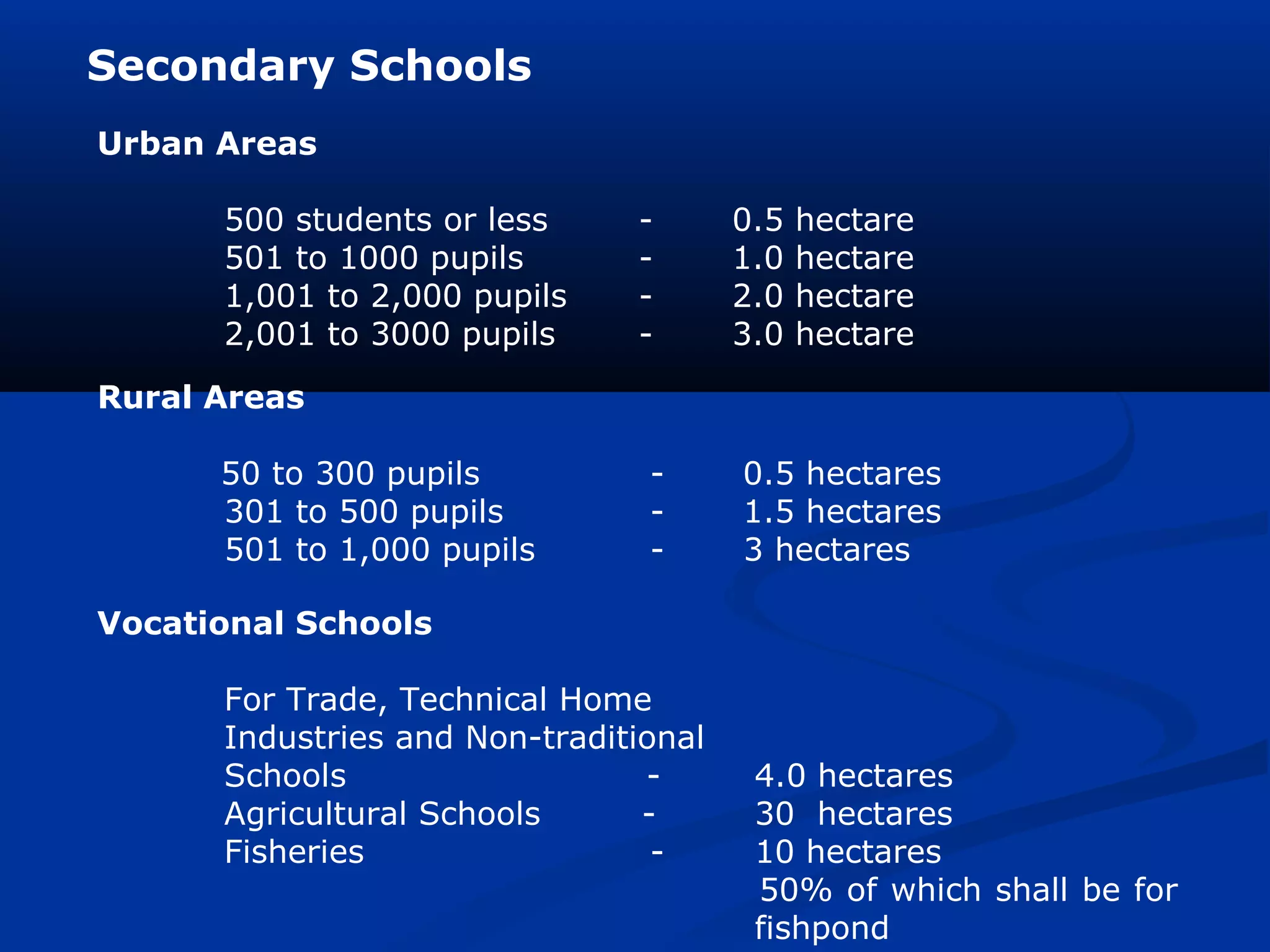
Secondary Schools
Urban Areas
500 students or less - 0.5 hectare
501 to 1000 pupils - 1.0 hectare
1,001 to 2,000 pupils - 2.0 hectare
2,001 to 3000 pupils - 3.0 hectare
Vocational Schools
For Trade, Technical Home
Industries and Non-traditional
Schools - 4.0 hectares
Agricultural Schools - 30 hectares
Fisheries - 10 hectares
50% of which shall be for
fishpond
Rural Areas
50 to 300 pupils - 0.5 hectares
301 to 500 pupils - 1.5 hectares
501 to 1,000 pupils - 3 hectares
II. Modes of Acquisition
1. Purchase - direct purchase from the legal owner who
voluntarily sells it on an agreed price.
Source of Funds:
a. Capital Outlays of the Department
b. Local School Board Fund
c. Appropriations by the LGU
a.1 If a school site is purchased using the Capital
Outlays of the DepEd, the Deed of Sale should be executed
in favor of the Republic of the Philippines, Department of
Education.
Authority to purchase should be sought from the
President of the Philippines, except when the funds are
appropriated components of the school budget, in which
case the DepEd grants the authority.
2. Procedure
a. Preparation of a resolution by an appraisal committee
b. Passage of a resolution by the Local School Board or
the Council/Provincial Board authorizing the purchase
of the lot.
c. Consultation with the Provincial/City Fiscal as to the
legality and validity of the purchase.
d. Negotiation and perfecting the purchase.
e. Certification of the treasurer or DepEd Accountant
as to the availability of funds
h. Registration with the Register of Deeds
i. Expenses for the execution and registration of the
sale is borne by the seller, unless there is a
stipulation to the contrary
g. Filing of an indemnity bond by the seller if the land is
not registered.
f. Execution of the Deed of Sale
3. Donation/Usufruct - may either be simple, conditional,
intervivos or mortis causa.
a. Simple donation – a person disposes gratuitously a piece
of land in favor of the municipality, city,
province, or the Republic of the
Philippines.
b. Conditional Donation - imposes a condition such as “that
the land should be used only for education”
c. Intervivos - takes effect during the lifetime of the donor
d. Mortis Causa - takes effect only after the donor’s death
- should conform to the formalities required
of a last will
In both cases, the donation must be accepted during the lifetime
of the donor, otherwise it is not considered perfected.
e. Donation is made through a public document and
acceptance maybe made in a separate public document.
f. Regional Director or Schools Division Superintendent may
accept the donation in behalf of the Republic of the Philippines.
Local Chief Executive may accept the donation in behalf of the
province, city or municipality.
g. Procedure
g.1 Execution of a Deed of Donation
g.2 Acceptance of the donation by the donee
g.3 Acknowledgement in writing by the donor
g.4 Issuance of the opinion of the Fiscal as to the validity
of the Deed of Donation
g.5 Registration with the Registry of Deeds
4. Expropriation - the act of taking land for public use by right of
eminent domain
eminent domain - the right or power of the state to take private
property for public use usually at an
adequate compensation.
a. Prerequisites
a.1 LGU to establish the suitability of the property
to be acquired for the use intended
a.2 Offer to buy and Contract of Sale
a.3 Conference for the purpose of reaching an
agreement on the selling price
a.4 Contract of sale
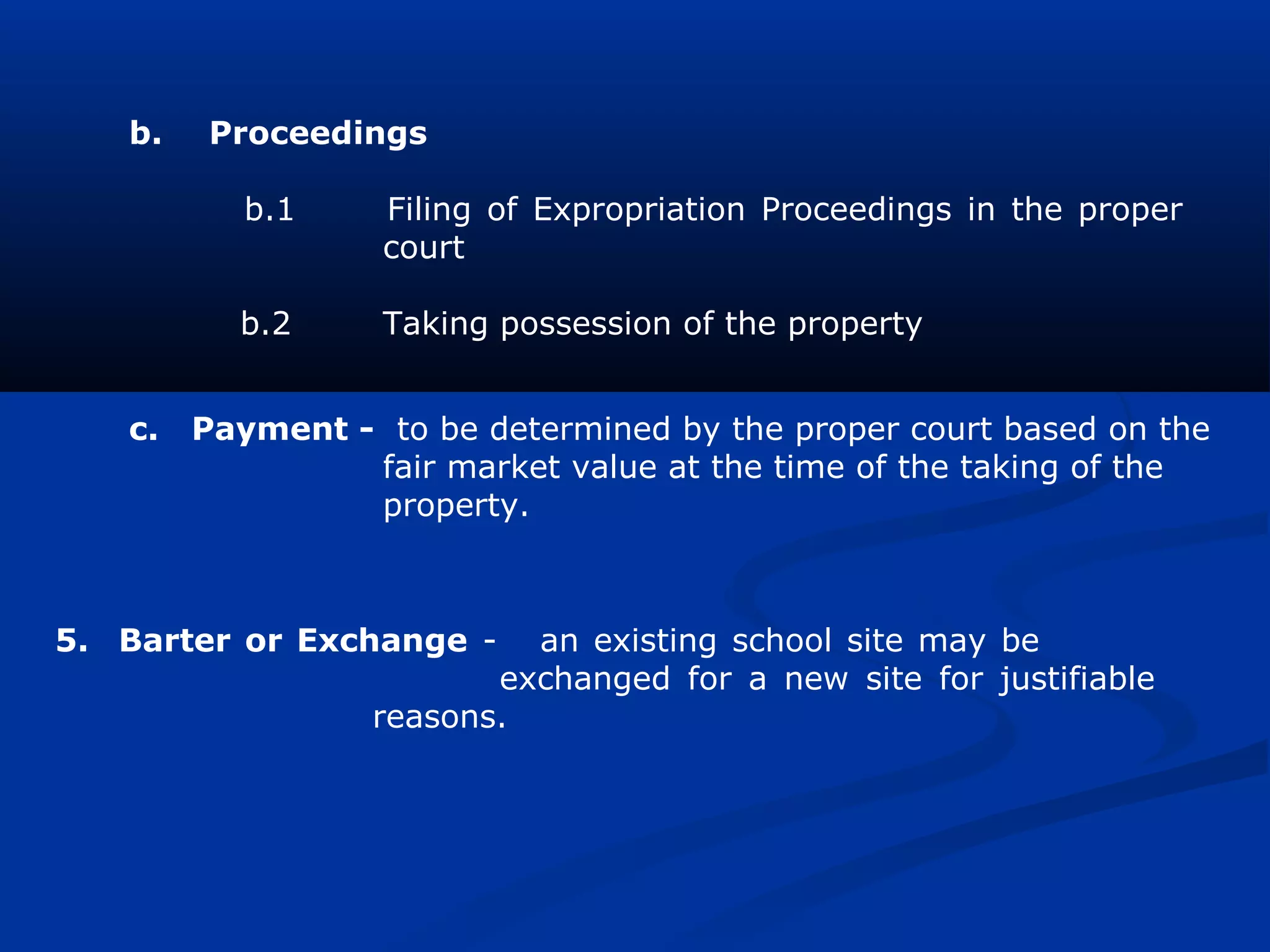
b. Proceedings
b.1 Filing of Expropriation Proceedings in the proper
court
b.2 Taking possession of the property
c. Payment - to be determined by the proper court based on the
fair market value at the time of the taking of the
property.
5. Barter or Exchange - an existing school site may be
exchanged for a new site for justifiable
reasons.
c. Sketches of the sites
Requirements:
a. Resolution by the Sangguniang
Panlalawigan/Panlungsod/Bayan
b. Statement of agreement from the owner of the lot
d. Information as to how the lots were required
e. Deed of Exchange
f. Written Opinion of the Fiscal
g. Approval of the DepEd
h. Registration with the Registry of Deeds
6. Presidential Proclamation - public land may be reserved for
school purposes by proclamation of the President of
the Philippines.
Requirements:
a. Resolution by the Sangguniang Panlalawigan / Panlungsod /
Bayan
b. Certification as to the availability of funds for the survey of the
land
c. Certification by the Schools Division Superintendent as to
suitability of the land for school purposes
d. Report showing the average attendance in the school during
the previous school year, the area of the land sought to be
reserved, and a school site development plan.
e. The documents should be forwarded to the President through
the Regional Director and DepEd for approval.
7. Gratuitous Conveyance
- real property belonging to thegovernment,
when needed for school purposes may be
conveyed by way of gift, sale, lease or
exchange.
Procedure:
a. Survey of the land
b. Filing of application
c. Initial Hearing
d. Transmittal of documents to
the land Registration
Commission
e. Publication of Notice
f. Service notice by the Sheriff.
g. Filing of answer on opposition
III. Perfection of Title - a deed should be registered with the Register
of Deeds.
h. Hearing of the case by the court
i. Promulgation of Judgment
j. Issuance of decree
k. Entry of the decree of registration
l. Sending of a copy to the Register of
Deeds
m. Transcription of the decree of
registration
IV External Areas in the School
1. Agriculture area - traditionally known as the school garden
2. Playground area - needed for physical education
3. Circulation area - intended to facilitate movement within the
school site
4. School fence - to secure the school against stay animals
and against squatters
5. School gate - main entrance on the front side of the
school
6. Flagpole - to display the Philippine National Flag
7. Signboard - to indicate the name location of the school
building

Acquisition of school sites

  • 1.
  • 2.
  • 3.
    I. Requirements: 1. Location/Environment- provides an environment conducive to learning - far from cockpits, malls, gambling dens, cinema houses, beer and videoke joints, jails, industrial establishments, military quarters, public markets, slaughterhouses, or garbage dumps. 2. Accessibility - easily accessible to the greatest number of pupils/students. 3. Topography - level and should have no irregular boundaries. 4. Soil Condition - agricultural land with sandy loam
  • 4.
    5. Size a. Non-centralschool with one(1) or two (2) classes only and no grade IV- 0.5 hectare b. Central school with six(6) classes and non central school with three to four (3-4) classes- 1.0 hectare c. Schools with seven to nine (7-9) classes-2.0 hectares d. Schools with more than (12) classes – 4.0 hectares Minimum (Elementary School)
  • 5.
    Alternatives: For Rural Areas a.central school with six (6) classes and non central school with three to four (3-4) classes – 0.5 hectare b. schools with seven to ten (7-10) classes – 1.5 hectare c. schools with more than ten (10) classes – 2.0 hectares For Urban Areas a. central school with six (6) classes and non-central school with six to ten (6-10) classes - 0.5 hectare b. schools with eleven to twenty (11-20) classes- 0.75 hectare c. schools with more than 20 classes - 1.0 hectare
  • 6.
    Secondary Schools Urban Areas 500students or less - 0.5 hectare 501 to 1000 pupils - 1.0 hectare 1,001 to 2,000 pupils - 2.0 hectare 2,001 to 3000 pupils - 3.0 hectare Vocational Schools For Trade, Technical Home Industries and Non-traditional Schools - 4.0 hectares Agricultural Schools - 30 hectares Fisheries - 10 hectares 50% of which shall be for fishpond Rural Areas 50 to 300 pupils - 0.5 hectares 301 to 500 pupils - 1.5 hectares 501 to 1,000 pupils - 3 hectares
  • 7.
    II. Modes ofAcquisition 1. Purchase - direct purchase from the legal owner who voluntarily sells it on an agreed price. Source of Funds: a. Capital Outlays of the Department b. Local School Board Fund c. Appropriations by the LGU a.1 If a school site is purchased using the Capital Outlays of the DepEd, the Deed of Sale should be executed in favor of the Republic of the Philippines, Department of Education. Authority to purchase should be sought from the President of the Philippines, except when the funds are appropriated components of the school budget, in which case the DepEd grants the authority.
  • 8.
    2. Procedure a. Preparationof a resolution by an appraisal committee b. Passage of a resolution by the Local School Board or the Council/Provincial Board authorizing the purchase of the lot. c. Consultation with the Provincial/City Fiscal as to the legality and validity of the purchase. d. Negotiation and perfecting the purchase. e. Certification of the treasurer or DepEd Accountant as to the availability of funds
  • 9.
    h. Registration withthe Register of Deeds i. Expenses for the execution and registration of the sale is borne by the seller, unless there is a stipulation to the contrary g. Filing of an indemnity bond by the seller if the land is not registered. f. Execution of the Deed of Sale
  • 10.
    3. Donation/Usufruct -may either be simple, conditional, intervivos or mortis causa. a. Simple donation – a person disposes gratuitously a piece of land in favor of the municipality, city, province, or the Republic of the Philippines. b. Conditional Donation - imposes a condition such as “that the land should be used only for education” c. Intervivos - takes effect during the lifetime of the donor d. Mortis Causa - takes effect only after the donor’s death - should conform to the formalities required of a last will In both cases, the donation must be accepted during the lifetime of the donor, otherwise it is not considered perfected.
  • 11.
    e. Donation ismade through a public document and acceptance maybe made in a separate public document. f. Regional Director or Schools Division Superintendent may accept the donation in behalf of the Republic of the Philippines. Local Chief Executive may accept the donation in behalf of the province, city or municipality. g. Procedure g.1 Execution of a Deed of Donation g.2 Acceptance of the donation by the donee g.3 Acknowledgement in writing by the donor g.4 Issuance of the opinion of the Fiscal as to the validity of the Deed of Donation g.5 Registration with the Registry of Deeds
  • 12.
    4. Expropriation -the act of taking land for public use by right of eminent domain eminent domain - the right or power of the state to take private property for public use usually at an adequate compensation. a. Prerequisites a.1 LGU to establish the suitability of the property to be acquired for the use intended a.2 Offer to buy and Contract of Sale a.3 Conference for the purpose of reaching an agreement on the selling price a.4 Contract of sale
  • 13.
    b. Proceedings b.1 Filingof Expropriation Proceedings in the proper court b.2 Taking possession of the property c. Payment - to be determined by the proper court based on the fair market value at the time of the taking of the property. 5. Barter or Exchange - an existing school site may be exchanged for a new site for justifiable reasons.
  • 14.
    c. Sketches ofthe sites Requirements: a. Resolution by the Sangguniang Panlalawigan/Panlungsod/Bayan b. Statement of agreement from the owner of the lot d. Information as to how the lots were required e. Deed of Exchange f. Written Opinion of the Fiscal g. Approval of the DepEd h. Registration with the Registry of Deeds
  • 15.
    6. Presidential Proclamation- public land may be reserved for school purposes by proclamation of the President of the Philippines. Requirements: a. Resolution by the Sangguniang Panlalawigan / Panlungsod / Bayan b. Certification as to the availability of funds for the survey of the land c. Certification by the Schools Division Superintendent as to suitability of the land for school purposes d. Report showing the average attendance in the school during the previous school year, the area of the land sought to be reserved, and a school site development plan. e. The documents should be forwarded to the President through the Regional Director and DepEd for approval.
  • 16.
    7. Gratuitous Conveyance -real property belonging to thegovernment, when needed for school purposes may be conveyed by way of gift, sale, lease or exchange.
  • 17.
    Procedure: a. Survey ofthe land b. Filing of application c. Initial Hearing d. Transmittal of documents to the land Registration Commission e. Publication of Notice f. Service notice by the Sheriff. g. Filing of answer on opposition III. Perfection of Title - a deed should be registered with the Register of Deeds. h. Hearing of the case by the court i. Promulgation of Judgment j. Issuance of decree k. Entry of the decree of registration l. Sending of a copy to the Register of Deeds m. Transcription of the decree of registration
  • 18.
    IV External Areasin the School 1. Agriculture area - traditionally known as the school garden 2. Playground area - needed for physical education 3. Circulation area - intended to facilitate movement within the school site 4. School fence - to secure the school against stay animals and against squatters 5. School gate - main entrance on the front side of the school 6. Flagpole - to display the Philippine National Flag 7. Signboard - to indicate the name location of the school building

Editor's Notes

  • #3 The School Site
  • #7 Rural Areas 50 to 300 pupils0.5 hectares 301 to 500 pupils1.5 hectares 501 to 1,000 pupils3 hectares
  • #14 5. Barter or Exchange - an existing