TEACHING NEW
LITERACY IN A DIGITAL
ENVIRONMENT
ICT Teaching-and-
learning for new teacher
INTRODUCTION
• the first revolution came with the invention of language;
• the second revolution came in the fifteenth century with
the advent of printing;
• the third revolution came only during the last decades of
the 20th century, Information Technology or IT came with
computers and peripheral devices such as printers, floppy
disks and digital cameras.
• Information and Communication Technology or ICT is the
term used for high technologies for information and
communication, including computers, mobile games, the
Internet and the World Wide Web.
THE MEANING OF DIGITAL
TEACHING-AND-LEARNING
 The advent of ICT appears to have created a big problem in our
schools today.
The problem is the rapidly growing gap between the young
people in the classroom and the adult teachers who teach them.
Educators have yet to fully admit that the digital environment
affecting our new learners today is radically different from that
experienced by them when they themselves were learners.
Most of our teachers who lived in an age of widening mass
communication have been schooled by textbooks and mass media
as their main sources of information and knowledge.
DISCOVERIN
G THE
DIGITAL
WORLD
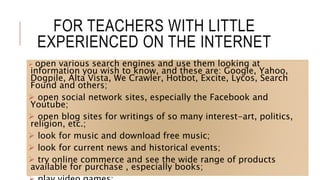
FOR TEACHERS WITH LITTLE
EXPERIENCED ON THE INTERNET
 open various search engines and use them looking at
information you wish to know, and these are: Google, Yahoo,
Dogpile, Alta Vista, We Crawler, Hotbot, Excite, Lycos, Search
Found and others;
 open social network sites, especially the Facebook and
Youtube;
 open blog sites for writings of so many interest-art, politics,
religion, etc.;
 look for music and download free music;
 look for current news and historical events;
 try online commerce and see the wide range of products
available for purchase , especially books;
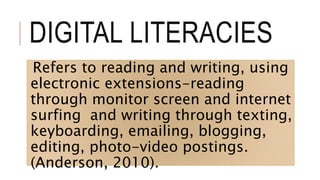
DIGITAL LITERACIES
Refers to reading and writing, using
electronic extensions-reading
through monitor screen and internet
surfing and writing through texting,
keyboarding, emailing, blogging,
editing, photo-video postings.
(Anderson, 2010).
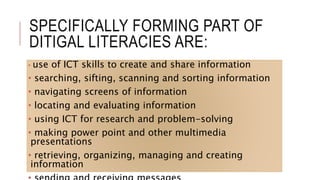
SPECIFICALLY FORMING PART OF
DITIGAL LITERACIES ARE:
• use of ICT skills to create and share information
• searching, sifting, scanning and sorting information
• navigating screens of information
• locating and evaluating information
• using ICT for research and problem-solving
• making power point and other multimedia
presentations
• retrieving, organizing, managing and creating
information
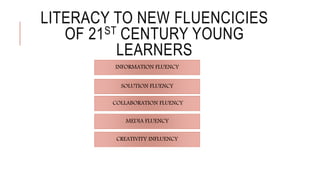
LITERACY TO NEW FLUENCICIES
OF 21ST CENTURY YOUNG
LEARNERS
INFORMATION FLUENCY
SOLUTION FLUENCY
COLLABORATION FLUENCY
MEDIA FLUENCY
CREATIVITY INFLUENCY
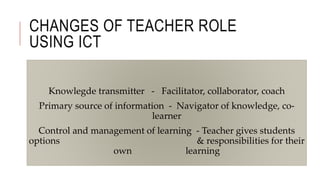
CHANGES OF TEACHER ROLE
USING ICT
Knowlegde transmitter - Facilitator, collaborator, coach
Primary source of information - Navigator of knowledge, co-
learner
Control and management of learning - Teacher gives students
options & responsibilities for their
own learning
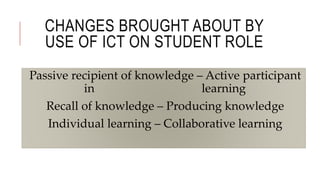
CHANGES BROUGHT ABOUT BY
USE OF ICT ON STUDENT ROLE
Passive recipient of knowledge – Active participant
in learning
Recall of knowledge – Producing knowledge
Individual learning – Collaborative learning
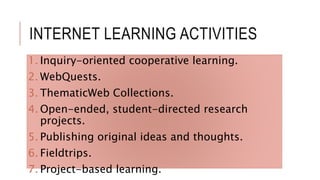
INTERNET LEARNING ACTIVITIES
1. Inquiry-oriented cooperative learning.
2. WebQuests.
3. ThematicWeb Collections.
4. Open-ended, student-directed research
projects.
5. Publishing original ideas and thoughts.
6. Fieldtrips.
7. Project-based learning.
AMONG THE KEY FEATURES OF
EFFECTIVE PROJECTS ARE:
1. Use of essential skills and tools, including
technology;
2. Specific outcomes that solve problems,
explain issues, presents information gathered
through investigation, research and
reasoning.
3. Multiple products needing feedback and
experiential opportunities; performance
based assessments

Teaching new literacy in a digital environment

  • 1.
    TEACHING NEW LITERACY INA DIGITAL ENVIRONMENT ICT Teaching-and- learning for new teacher
  • 2.
    INTRODUCTION • the firstrevolution came with the invention of language; • the second revolution came in the fifteenth century with the advent of printing; • the third revolution came only during the last decades of the 20th century, Information Technology or IT came with computers and peripheral devices such as printers, floppy disks and digital cameras. • Information and Communication Technology or ICT is the term used for high technologies for information and communication, including computers, mobile games, the Internet and the World Wide Web.
  • 3.
    THE MEANING OFDIGITAL TEACHING-AND-LEARNING  The advent of ICT appears to have created a big problem in our schools today. The problem is the rapidly growing gap between the young people in the classroom and the adult teachers who teach them. Educators have yet to fully admit that the digital environment affecting our new learners today is radically different from that experienced by them when they themselves were learners. Most of our teachers who lived in an age of widening mass communication have been schooled by textbooks and mass media as their main sources of information and knowledge.
  • 4.
  • 5.
    FOR TEACHERS WITHLITTLE EXPERIENCED ON THE INTERNET  open various search engines and use them looking at information you wish to know, and these are: Google, Yahoo, Dogpile, Alta Vista, We Crawler, Hotbot, Excite, Lycos, Search Found and others;  open social network sites, especially the Facebook and Youtube;  open blog sites for writings of so many interest-art, politics, religion, etc.;  look for music and download free music;  look for current news and historical events;  try online commerce and see the wide range of products available for purchase , especially books;
  • 6.
    DIGITAL LITERACIES Refers toreading and writing, using electronic extensions-reading through monitor screen and internet surfing and writing through texting, keyboarding, emailing, blogging, editing, photo-video postings. (Anderson, 2010).
  • 7.
    SPECIFICALLY FORMING PARTOF DITIGAL LITERACIES ARE: • use of ICT skills to create and share information • searching, sifting, scanning and sorting information • navigating screens of information • locating and evaluating information • using ICT for research and problem-solving • making power point and other multimedia presentations • retrieving, organizing, managing and creating information
  • 8.
    LITERACY TO NEWFLUENCICIES OF 21ST CENTURY YOUNG LEARNERS INFORMATION FLUENCY SOLUTION FLUENCY COLLABORATION FLUENCY MEDIA FLUENCY CREATIVITY INFLUENCY
  • 9.
    CHANGES OF TEACHERROLE USING ICT Knowlegde transmitter - Facilitator, collaborator, coach Primary source of information - Navigator of knowledge, co- learner Control and management of learning - Teacher gives students options & responsibilities for their own learning
  • 10.
    CHANGES BROUGHT ABOUTBY USE OF ICT ON STUDENT ROLE Passive recipient of knowledge – Active participant in learning Recall of knowledge – Producing knowledge Individual learning – Collaborative learning
  • 11.
    INTERNET LEARNING ACTIVITIES 1.Inquiry-oriented cooperative learning. 2. WebQuests. 3. ThematicWeb Collections. 4. Open-ended, student-directed research projects. 5. Publishing original ideas and thoughts. 6. Fieldtrips. 7. Project-based learning.
  • 12.
    AMONG THE KEYFEATURES OF EFFECTIVE PROJECTS ARE: 1. Use of essential skills and tools, including technology; 2. Specific outcomes that solve problems, explain issues, presents information gathered through investigation, research and reasoning. 3. Multiple products needing feedback and experiential opportunities; performance based assessments