+


               The American Education System
                             21 December 2011
         Ariana Tobin: Fulbright English Fellow
    Danielle Montagne: English Language Fellow
+ Objective:

During today’s lecture, we will discuss:
   The American Public School System (K-12)
        [A Brief] History of Education in America

        The goals/learning objectives of Public Schools in America

        Traditional Structure/Variations in Public School Structures

        American Public Elementary, Middle and High School

        Teacher/Student Case Studies

   Alternative Education Options (K-12)

   Contemporary Social Issues in k-12 Education

   Follow up Discussion Questions & Student Questions
+
    Warm Up Questions…
The American Public School System
   What do you know about the American Education system?

   Are there any stereotypes about American education or American
    students that you know of?

   How/where have you learned information about the American School
    system?

   How do you think American school system differs from the
    Belorussian School system?

   How do you think the American School system is similar to the
    Belorussia School system?
+
    The American Public School
    System (K-12)
History of the American Public School System
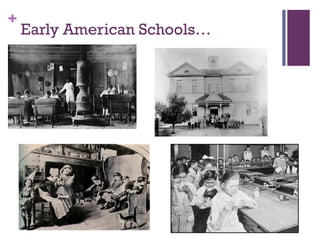
   The first American schools in the thirteen original colonies opened in
    the 17th century.
         Established for wealthy families who could afford to send their
          children to school.

   One room school houses would often serve primary, middle and high
    school age students.

   For most families, literacy and mathematics education was done in the
    homes—often by mothers –during America’s early history.

   Education for women, African Americans and non-English speaking
    immigrants was limited or outlawed until the 20th century.
+ History of the American Public School System
 After the American Revolution, an emphasis was put on
    education:
        Especially true in the northern states, which rapidly
         established public schools.

   By the year 1870, all states had free public elementary schools.

   Private academies flourished in the towns across the country, but
    rural areas (where most people lived) had few schools before the
    1880s.

   By 1900, the US population had one of the highest literacy in the
    world.

   Education seen as necessary for developing intelligent American
    citizens capable in participating in all social and political realms of
    life.
+
    Early American Schools…
+
Modern goals of the American Public School System
   Education is often seen as a means to deliver equality to all
    American citizens.

   K-12 Education is compulsory for all American children.

   Education is mainly provided by the public sector and funded by
    the federal, state and local governments.

   School curricula, funding, teaching, employment, and other policies
    are set through locally elected school boards who have control over
    a specified school district.

   The modern goals of the American education system is to develop:
        A well-rounded individual prepared with

          critical thinking skills

          problem solving skills

          creativity when approaching real life situations.
+
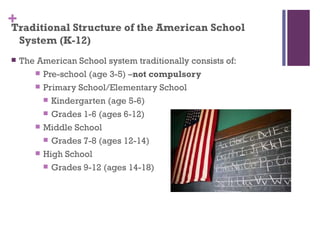
Traditional Structure of the American School
    System (K-12)
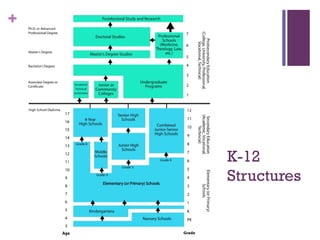
   The American School system traditionally consists of:
        Pre-school (age 3-5) –not compulsory

        Primary School/Elementary School

          Kindergarten (age 5-6)

          Grades 1-6 (ages 6-12)

        Middle School

          Grades 7-8 (ages 12-14)

        High School

          Grades 9-12 (ages 14-18)
+


    K-12
    Structures
+American Primary/Elementary Schools
   Public Elementary School teachers instruct between 20-30 students
      of diverse learning needs.

   A typical classroom will include children with a range of learning needs
    or abilities, from those identified as having special needs (special education) to
    students non-native English speakers (ESL students).

   Each local school district gives each teacher a book to give to the students for
    each subject, and brief overviews of what the teacher are expected to teach.

   Learning standards are identified for all areas of a curriculum by individual
    States, including those for mathematics, social studies, science, physical
    development, the fine arts, and reading.

   Elementary School teachers are trained with emphases on human cognitive and
    psychological development and the principles of curriculum development and
    instruction.

   Teachers typically earn either a Bachelors or Masters Degree in Early Childhood
    and Elementary Education.
           Certification standards for teachers are determined by individual states.
+
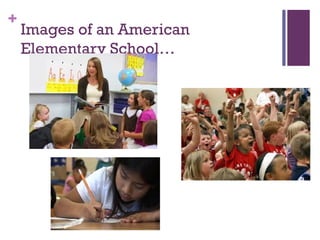
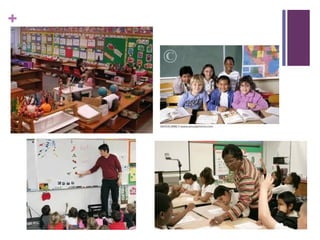
    Images of an American
    Elementary School…
+
+ Case Study: Typical Day of American Primary
    School Teacher
   A typical teacher works 8 hours, 5 days a week, at the same
    school. [September-June]
         Federal Holidays and Summer Vacations off from work.

   Primary school teachers traditionally teach the same group of students
    (20-30 students) for the full day.

   Courses include: Reading, Writing, Mathematics, Science, Social Studies.

   Teachers often have one (40-45 minute) break or “preparation period”
    during the day.
         Students receive classes from a different teacher—Music, Art, Gym
          (sports), Drama, Chorus, etc.

   Teachers must have one lunch break (40-45 minute) during the day.

   Many teachers stay after school to participate in extracurricular
    activities for students or provide additional teaching time.
+Case Study: Typical Day of American Primary
    School Student
   School begins in early September through the end of June.

   Most students arrive to school by a big yellow school bus.

   Students generally attend all classes in the same classroom with the same
    group of [diverse] students.

   Students are taught strategies of working independently, in groups and in
    partners during the school day.

   Students usually have “recess” during the school day and often spend time
    on a playground with their friends.

   Being sent to the “principals office” is seen as a major punishment.

   Elementary school students are sent home with 30 minutes to 1 ½ hours of
    homework each night (depending on grade level).

   Extracurricular activities are popular for older elementary school
+
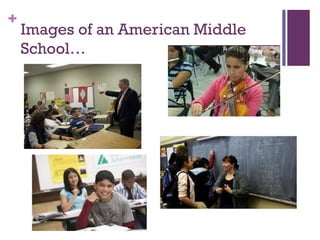
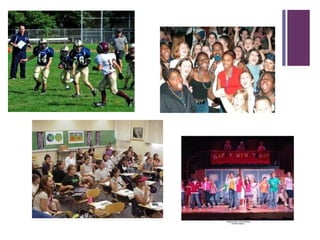
American Secondary Schools: Middle School
   Middle School include the grade levels intermediate between
    elementary school and senior high school.

   "Middle school" usually includes seventh and eighth grades

   "Junior high" typically includes seventh through ninth grade.

   At this time, students are given more independence:
         Having different teachers for each subjects.

         Taking on more independent homework assignments and
           projects.
         Moving to different classrooms for different subjects

         being allowed to choose some of their class subjects
           (electives).
+
    Images of an American Middle
    School…
+
+
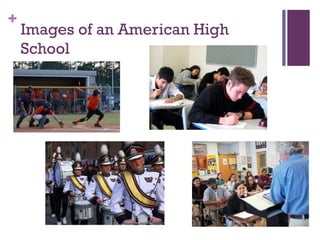
American Secondary Schools: Senior High School
   Senior High School is a school attended after middle school/
    junior high school.

   The term “High school” is often used instead of senior high school

   High school usually runs either from 9th through 12th grade.

   The students in these grades are commonly referred to as:
        freshmen (grade 9)

        sophomores (grade 10)

        juniors (grade 11)

        seniors (grade 12).

   students take a broad variety of classes without special emphasis
    in any particular subject
+
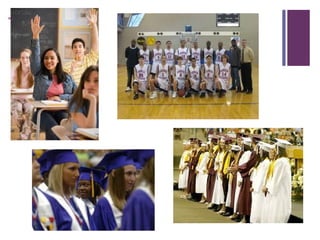
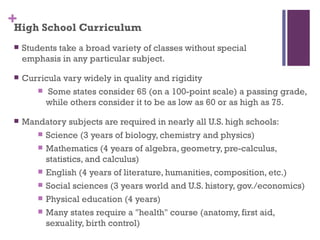
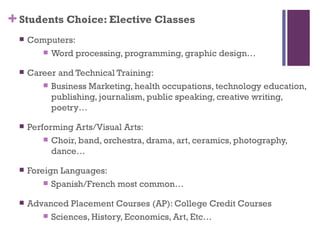
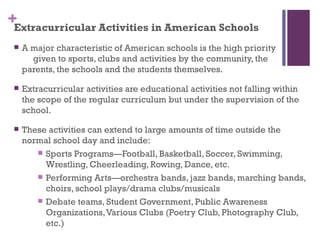
    Images of an American High
    School
+
+High School Curriculum
    Students take a broad variety of classes without special
     emphasis in any particular subject.

    Curricula vary widely in quality and rigidity
         Some states consider 65 (on a 100-point scale) a passing grade,
          while others consider it to be as low as 60 or as high as 75.

    Mandatory subjects are required in nearly all U.S. high schools:
         Science (3 years of biology, chemistry and physics)

         Mathematics (4 years of algebra, geometry, pre-calculus,
          statistics, and calculus)
         English (4 years of literature, humanities, composition, etc.)

         Social sciences (3 years world and U.S. history, gov./economics)

         Physical education (4 years)

         Many states require a "health" course (anatomy, first aid,
          sexuality, birth control)
+ Students Choice: Elective Classes
     Computers:
          Word processing, programming, graphic design…

     Career and Technical Training:
          Business Marketing, health occupations, technology education,
           publishing, journalism, public speaking, creative writing,
           poetry…

     Performing Arts/Visual Arts:
           Choir, band, orchestra, drama, art, ceramics, photography,
            dance…

     Foreign Languages:
           Spanish/French most common…

     Advanced Placement Courses (AP): College Credit Courses
          Sciences, History, Economics, Art, Etc…
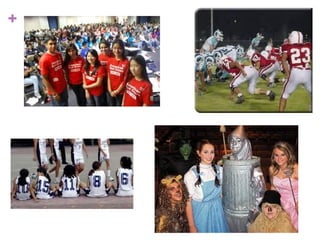
+Extracurricular Activities in American Schools
    A major characteristic of American schools is the high priority
       given to sports, clubs and activities by the community, the
     parents, the schools and the students themselves.

    Extracurricular activities are educational activities not falling within
     the scope of the regular curriculum but under the supervision of the
     school.

    These activities can extend to large amounts of time outside the
     normal school day and include:
         Sports Programs—Football, Basketball, Soccer, Swimming,
          Wrestling, Cheerleading, Rowing, Dance, etc.
         Performing Arts—orchestra bands, jazz bands, marching bands,
          choirs, school plays/drama clubs/musicals
         Debate teams, Student Government, Public Awareness
          Organizations, Various Clubs (Poetry Club, Photography Club,
          etc.)
+
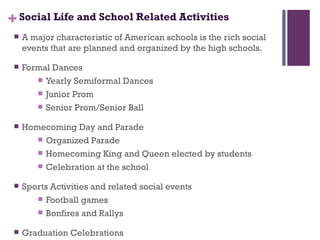
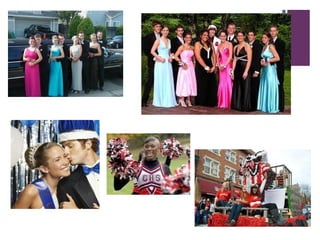
+ Social Life and School Related Activities
    A major characteristic of American schools is the rich social
     events that are planned and organized by the high schools.

    Formal Dances
         Yearly Semiformal Dances

         Junior Prom

         Senior Prom/Senior Ball

    Homecoming Day and Parade
         Organized Parade

         Homecoming King and Queen elected by students

         Celebration at the school

    Sports Activities and related social events
         Football games

         Bonfires and Rallys

    Graduation Celebrations
+
+ Study: Typical Day of American High School
Case
    Teacher
   A typical teacher works 8 hours, 5 days a week, at the same
    school. [September-June]
         Federal Holidays and Summer Vacations off from work.

   High school teachers teach the same subject to:
        6 groups of students (45-50 minute classes) each day OR

        3 groups of students (90 minutes) every other day

   Teaching specialty depends on teaching degree

   Teachers often have one “preparation period” (45 minutes) during the
    day.

   Teachers must have one lunch break (40-45 minute) during the day.

   Many teachers stay after school to participate in extracurricular
    activities for students or provide additional teaching time.
Case Study: Typical Day of American High School
+ Student
   School begins in early September through the end of June

   Some student arrive to school by school bus; many others drive.

   Students attend 4-8 classes each school day.

   Students must remain at school for the entire day—leaving for
    lunch is not allowed.

   Students are taught strategies of working independently, in groups
    and in partners during the school day.

   Students usually have “study hall” during the school day and to
    prepare for classes, study for exams or meet with teachers.

   High school students are sent home with 2 to 3 hours of homework
    each night (depending on grade/skill level).

   Many students stay after school to participate in sports, clubs and
    other extracurricular activities.
+
    Alternative forms of Education
   Home schooling
        In 2007, approximately 1.5 million children were home ]
            schooled: 2.9% of all children.
        Often associated with religious groups.

   Private Schools/Private Academies
         Funded solely by student tuition.

         Offer more specialized courses.

   Parochial School
         Run by church organizations.

         Funded by student tuition and petitioner contributions.

   Charter School
        Funded by both private funds and public funds.

        Stricter control over enrollment—controversial.
+ Modern Social Issues in American
  Education
Educational issues in the United States center on curriculum,
 funding, and control.

   Funding
        U.S. is tied for first place with Switzerland for annual spending per
         student: two countries spending more than $11,000 USD
        U.S. public schools lag behind the schools of other developed
         countries in the areas of reading, math, and science.
        No Child Left Behind Act– George W. Bush : Gives government
         the right to withhold funding if it believes a school, district, or even
         a state is improving standardized test scores.

   Tracking
         Dividing students into learning groups based on classifications of
          “above average”, “average” or “below average”
         Separating ESL students and Special Education students from
          mainstream classrooms.
+
    Modern Social Issues in American
    Education
   English in the Classroom
        Questions on how to best accommodate for non-English
          speaking students and parent interest in foreign language
          instruction.
        ESL programs vs. Bilingual programs

        Dual Language Programs

   Nationwide Education Content and Education Quality
         Different content, grade systems and quality across the nation

         Textbook Review and Adoption

         Evolution in Kansas

   Violence and Drug Use
         Preventing violence and drug abuse in schools

         Education regarding violence, sex and drug abuse
+
    Questions or Comments?
   Please ask me any questions about today’s lecture topic, my
    personal background or any other question you might have.

Contact Information
   Danielle Marie Montagne
        Email: d.m.montagne@gmail.com
        Please feel free to contact me anytime with any questions, assistance
         or guidance you need in any class.

American education system

  • 1.
    + The American Education System 21 December 2011 Ariana Tobin: Fulbright English Fellow Danielle Montagne: English Language Fellow
  • 2.
    + Objective: During today’slecture, we will discuss:  The American Public School System (K-12)  [A Brief] History of Education in America  The goals/learning objectives of Public Schools in America  Traditional Structure/Variations in Public School Structures  American Public Elementary, Middle and High School  Teacher/Student Case Studies  Alternative Education Options (K-12)  Contemporary Social Issues in k-12 Education  Follow up Discussion Questions & Student Questions
  • 3.
    + Warm Up Questions… The American Public School System  What do you know about the American Education system?  Are there any stereotypes about American education or American students that you know of?  How/where have you learned information about the American School system?  How do you think American school system differs from the Belorussian School system?  How do you think the American School system is similar to the Belorussia School system?
  • 4.
    + The American Public School System (K-12) History of the American Public School System  The first American schools in the thirteen original colonies opened in the 17th century.  Established for wealthy families who could afford to send their children to school.  One room school houses would often serve primary, middle and high school age students.  For most families, literacy and mathematics education was done in the homes—often by mothers –during America’s early history.  Education for women, African Americans and non-English speaking immigrants was limited or outlawed until the 20th century.
  • 5.
    + History ofthe American Public School System  After the American Revolution, an emphasis was put on education:  Especially true in the northern states, which rapidly established public schools.  By the year 1870, all states had free public elementary schools.  Private academies flourished in the towns across the country, but rural areas (where most people lived) had few schools before the 1880s.  By 1900, the US population had one of the highest literacy in the world.  Education seen as necessary for developing intelligent American citizens capable in participating in all social and political realms of life.
  • 6.
    + Early American Schools…
  • 7.
    + Modern goals ofthe American Public School System  Education is often seen as a means to deliver equality to all American citizens.  K-12 Education is compulsory for all American children.  Education is mainly provided by the public sector and funded by the federal, state and local governments.  School curricula, funding, teaching, employment, and other policies are set through locally elected school boards who have control over a specified school district.  The modern goals of the American education system is to develop:  A well-rounded individual prepared with  critical thinking skills  problem solving skills  creativity when approaching real life situations.
  • 8.
    + Traditional Structure ofthe American School System (K-12)  The American School system traditionally consists of:  Pre-school (age 3-5) –not compulsory  Primary School/Elementary School  Kindergarten (age 5-6)  Grades 1-6 (ages 6-12)  Middle School  Grades 7-8 (ages 12-14)  High School  Grades 9-12 (ages 14-18)
  • 9.
    + K-12 Structures
  • 10.
    +American Primary/Elementary Schools  Public Elementary School teachers instruct between 20-30 students of diverse learning needs.  A typical classroom will include children with a range of learning needs or abilities, from those identified as having special needs (special education) to students non-native English speakers (ESL students).  Each local school district gives each teacher a book to give to the students for each subject, and brief overviews of what the teacher are expected to teach.  Learning standards are identified for all areas of a curriculum by individual States, including those for mathematics, social studies, science, physical development, the fine arts, and reading.  Elementary School teachers are trained with emphases on human cognitive and psychological development and the principles of curriculum development and instruction.  Teachers typically earn either a Bachelors or Masters Degree in Early Childhood and Elementary Education.  Certification standards for teachers are determined by individual states.
  • 11.
    + Images of an American Elementary School…
  • 12.
  • 13.
    + Case Study:Typical Day of American Primary School Teacher  A typical teacher works 8 hours, 5 days a week, at the same school. [September-June]  Federal Holidays and Summer Vacations off from work.  Primary school teachers traditionally teach the same group of students (20-30 students) for the full day.  Courses include: Reading, Writing, Mathematics, Science, Social Studies.  Teachers often have one (40-45 minute) break or “preparation period” during the day.  Students receive classes from a different teacher—Music, Art, Gym (sports), Drama, Chorus, etc.  Teachers must have one lunch break (40-45 minute) during the day.  Many teachers stay after school to participate in extracurricular activities for students or provide additional teaching time.
  • 14.
    +Case Study: TypicalDay of American Primary School Student  School begins in early September through the end of June.  Most students arrive to school by a big yellow school bus.  Students generally attend all classes in the same classroom with the same group of [diverse] students.  Students are taught strategies of working independently, in groups and in partners during the school day.  Students usually have “recess” during the school day and often spend time on a playground with their friends.  Being sent to the “principals office” is seen as a major punishment.  Elementary school students are sent home with 30 minutes to 1 ½ hours of homework each night (depending on grade level).  Extracurricular activities are popular for older elementary school
  • 15.
    + American Secondary Schools:Middle School  Middle School include the grade levels intermediate between elementary school and senior high school.  "Middle school" usually includes seventh and eighth grades  "Junior high" typically includes seventh through ninth grade.  At this time, students are given more independence:  Having different teachers for each subjects.  Taking on more independent homework assignments and projects.  Moving to different classrooms for different subjects  being allowed to choose some of their class subjects (electives).
  • 16.
    + Images of an American Middle School…
  • 17.
  • 18.
    + American Secondary Schools:Senior High School  Senior High School is a school attended after middle school/ junior high school.  The term “High school” is often used instead of senior high school  High school usually runs either from 9th through 12th grade.  The students in these grades are commonly referred to as:  freshmen (grade 9)  sophomores (grade 10)  juniors (grade 11)  seniors (grade 12).  students take a broad variety of classes without special emphasis in any particular subject
  • 19.
    + Images of an American High School
  • 20.
  • 21.
    +High School Curriculum  Students take a broad variety of classes without special emphasis in any particular subject.  Curricula vary widely in quality and rigidity  Some states consider 65 (on a 100-point scale) a passing grade, while others consider it to be as low as 60 or as high as 75.  Mandatory subjects are required in nearly all U.S. high schools:  Science (3 years of biology, chemistry and physics)  Mathematics (4 years of algebra, geometry, pre-calculus, statistics, and calculus)  English (4 years of literature, humanities, composition, etc.)  Social sciences (3 years world and U.S. history, gov./economics)  Physical education (4 years)  Many states require a "health" course (anatomy, first aid, sexuality, birth control)
  • 22.
    + Students Choice:Elective Classes  Computers:  Word processing, programming, graphic design…  Career and Technical Training:  Business Marketing, health occupations, technology education, publishing, journalism, public speaking, creative writing, poetry…  Performing Arts/Visual Arts:  Choir, band, orchestra, drama, art, ceramics, photography, dance…  Foreign Languages:  Spanish/French most common…  Advanced Placement Courses (AP): College Credit Courses  Sciences, History, Economics, Art, Etc…
  • 23.
    +Extracurricular Activities inAmerican Schools  A major characteristic of American schools is the high priority given to sports, clubs and activities by the community, the parents, the schools and the students themselves.  Extracurricular activities are educational activities not falling within the scope of the regular curriculum but under the supervision of the school.  These activities can extend to large amounts of time outside the normal school day and include:  Sports Programs—Football, Basketball, Soccer, Swimming, Wrestling, Cheerleading, Rowing, Dance, etc.  Performing Arts—orchestra bands, jazz bands, marching bands, choirs, school plays/drama clubs/musicals  Debate teams, Student Government, Public Awareness Organizations, Various Clubs (Poetry Club, Photography Club, etc.)
  • 24.
  • 25.
    + Social Lifeand School Related Activities  A major characteristic of American schools is the rich social events that are planned and organized by the high schools.  Formal Dances  Yearly Semiformal Dances  Junior Prom  Senior Prom/Senior Ball  Homecoming Day and Parade  Organized Parade  Homecoming King and Queen elected by students  Celebration at the school  Sports Activities and related social events  Football games  Bonfires and Rallys  Graduation Celebrations
  • 26.
  • 27.
    + Study: TypicalDay of American High School Case Teacher  A typical teacher works 8 hours, 5 days a week, at the same school. [September-June]  Federal Holidays and Summer Vacations off from work.  High school teachers teach the same subject to:  6 groups of students (45-50 minute classes) each day OR  3 groups of students (90 minutes) every other day  Teaching specialty depends on teaching degree  Teachers often have one “preparation period” (45 minutes) during the day.  Teachers must have one lunch break (40-45 minute) during the day.  Many teachers stay after school to participate in extracurricular activities for students or provide additional teaching time.
  • 28.
    Case Study: TypicalDay of American High School + Student  School begins in early September through the end of June  Some student arrive to school by school bus; many others drive.  Students attend 4-8 classes each school day.  Students must remain at school for the entire day—leaving for lunch is not allowed.  Students are taught strategies of working independently, in groups and in partners during the school day.  Students usually have “study hall” during the school day and to prepare for classes, study for exams or meet with teachers.  High school students are sent home with 2 to 3 hours of homework each night (depending on grade/skill level).  Many students stay after school to participate in sports, clubs and other extracurricular activities.
  • 29.
    + Alternative forms of Education  Home schooling  In 2007, approximately 1.5 million children were home ] schooled: 2.9% of all children.  Often associated with religious groups.  Private Schools/Private Academies  Funded solely by student tuition.  Offer more specialized courses.  Parochial School  Run by church organizations.  Funded by student tuition and petitioner contributions.  Charter School  Funded by both private funds and public funds.  Stricter control over enrollment—controversial.
  • 30.
    + Modern SocialIssues in American Education Educational issues in the United States center on curriculum, funding, and control.  Funding  U.S. is tied for first place with Switzerland for annual spending per student: two countries spending more than $11,000 USD  U.S. public schools lag behind the schools of other developed countries in the areas of reading, math, and science.  No Child Left Behind Act– George W. Bush : Gives government the right to withhold funding if it believes a school, district, or even a state is improving standardized test scores.  Tracking  Dividing students into learning groups based on classifications of “above average”, “average” or “below average”  Separating ESL students and Special Education students from mainstream classrooms.
  • 31.
    + Modern Social Issues in American Education  English in the Classroom  Questions on how to best accommodate for non-English speaking students and parent interest in foreign language instruction.  ESL programs vs. Bilingual programs  Dual Language Programs  Nationwide Education Content and Education Quality  Different content, grade systems and quality across the nation  Textbook Review and Adoption  Evolution in Kansas  Violence and Drug Use  Preventing violence and drug abuse in schools  Education regarding violence, sex and drug abuse
  • 32.
    + Questions or Comments?  Please ask me any questions about today’s lecture topic, my personal background or any other question you might have. Contact Information  Danielle Marie Montagne  Email: d.m.montagne@gmail.com  Please feel free to contact me anytime with any questions, assistance or guidance you need in any class.