Education
in Greece
Maria
Papadopoulou
Three levels
Primary
Secondary
Tertiary
(with an additional
post secondary level
providing vocational
training)
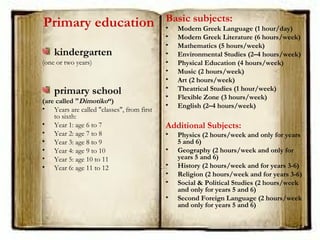
Primary education
kindergarten
(one or two years)
primary school
(are called "Dimotiko“)
• Years are called "classes", from first
to sixth:
• Year 1: age 6 to 7
• Year 2: age 7 to 8
• Year 3: age 8 to 9
• Year 4: age 9 to 10
• Year 5: age 10 to 11
• Year 6: age 11 to 12
Basic subjects:
• Modern Greek Language (1 hour/day)
• Modern Greek Literature (6 hours/week)
• Mathematics (5 hours/week)
• Environmental Studies (2–4 hours/week)
• Physical Education (4 hours/week)
• Music (2 hours/week)
• Art (2 hours/week)
• Theatrical Studies (1 hour/week)
• Flexible Zone (3 hours/week)
• English (2–4 hours/week)
Additional Subjects:
• Physics (2 hours/week and only for years
5 and 6)
• Geography (2 hours/week and only for
years 5 and 6)
• History (2 hours/week and for years 3-6)
• Religion (2 hours/week and for years 3-6)
• Social & Political Studies (2 hours/week
and only for years 5 and 6)
• Second Foreign Language (2 hours/week
and only for years 5 and 6)
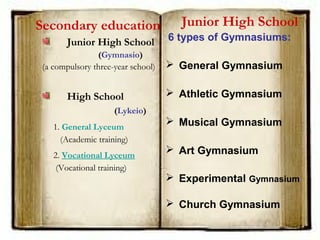
Secondary education
Junior High School
(Gymnasio)
(a compulsory three-year school)
High School
(Lykeio)
1. General Lyceum 
(Academic training)
2. Vocational Lyceum
(Vocational training)
Junior High School
6 types of Gymnasiums:
 General Gymnasium
 Athletic Gymnasium
 Musical Gymnasium
 Art Gymnasium
 Experimental Gymnasium
 Church Gymnasium
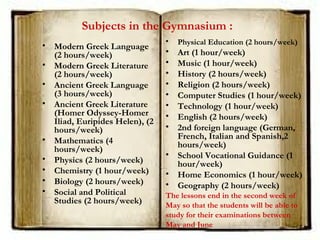
Subjects in the Gymnasium :
• Modern Greek Language
(2 hours/week)
• Modern Greek Literature
(2 hours/week)
• Ancient Greek Language
(3 hours/week)
• Ancient Greek Literature
(Homer Odyssey-Homer
Iliad, Euripides Helen), (2
hours/week)
• Mathematics (4
hours/week)
• Physics (2 hours/week)
• Chemistry (1 hour/week)
• Biology (2 hours/week)
• Social and Political
Studies (2 hours/week)
• Physical Education (2 hours/week)
• Art (1 hour/week)
• Music (1 hour/week)
• History (2 hours/week)
• Religion (2 hours/week)
• Computer Studies (1 hour/week)
• Technology (1 hour/week)
• English (2 hours/week)
• 2nd foreign language (German,
French, Italian and Spanish,2
hours/week)
• School Vocational Guidance (1
hour/week)
• Home Economics (1 hour/week)
• Geography (2 hours/week)
The lessons end in the second week of
May so that the students will be able to
study for their examinations between
May and June
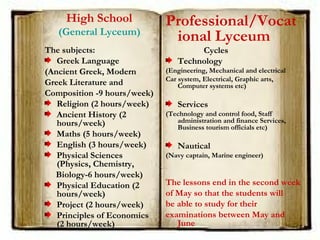
High School
(General Lyceum) 
The subjects:
Greek Language
(Ancient Greek, Modern
Greek Literature and
Composition -9 hours/week)
Religion (2 hours/week)
Ancient History (2
hours/week)
Maths (5 hours/week)
English (3 hours/week)
Physical Sciences
(Physics, Chemistry,
Biology-6 hours/week)
Physical Education (2
hours/week)
Project (2 hours/week)
Principles of Economics
(2 hours/week)
Professional/Vocat
ional Lyceum
Cycles
Technology
(Engineering, Mechanical and electrical
Car system, Electrical, Graphic arts,
Computer systems etc)
Services
(Technology and control food, Staff
administration and finance Services,
Business tourism officials etc)
Nautical
(Navy captain, Marine engineer)
The lessons end in the second week
of May so that the students will
be able to study for their
examinations between May and
June
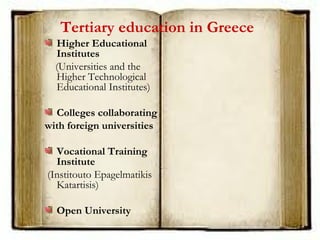
Tertiary education in Greece
Higher Educational
Institutes
(Universities and the
Higher Technological
Educational Institutes)
Colleges collaborating
with foreign universities
Vocational Training
Institute
(Institouto Epagelmatikis
Katartisis)
Open University
Additional…
All levels are overseen by the
Ministry of Education and
Religious Affairs. The Ministry
exercises centralised control over
state schools, by prescribing the
curriculum, appointing staff and
controlling funding.
the supervisory role of the
Ministry is exercised through
Regional Directorates of Primary
and Secondary Education.
Tertiary institutions are
nominally autonomous
There are public and
private dimotika (primary
education), gymnasia (middle
school; secondary
education), lykeia (high school;
secondary education). Some of
them are for foreigners, usually
children of British or American
families. For example see 
American Community Schools.
There are also a number of
private colleges and universities
operating alongside the state
education and providing
supplementary tuition. These
parallel schools (Greek:
 φροντιστήριο, frontistirio
(singular)) provide foreign
language tuition, supplementary
lessons for weak students as well
as exam preparation courses for
the competitive 
Panhellenic national examinations
.
Enrollment to the next tier of
compulsory education,
the Gymnasium, is automatic
The students have summer
vacation (3 months), Christmas
vacation (2 weeks) and Easter
vacation (2 weeks)
Education in greece

Education in greece

  • 1.
  • 2.
    Three levels Primary Secondary Tertiary (with anadditional post secondary level providing vocational training)
  • 4.
    Primary education kindergarten (one ortwo years) primary school (are called "Dimotiko“) • Years are called "classes", from first to sixth: • Year 1: age 6 to 7 • Year 2: age 7 to 8 • Year 3: age 8 to 9 • Year 4: age 9 to 10 • Year 5: age 10 to 11 • Year 6: age 11 to 12 Basic subjects: • Modern Greek Language (1 hour/day) • Modern Greek Literature (6 hours/week) • Mathematics (5 hours/week) • Environmental Studies (2–4 hours/week) • Physical Education (4 hours/week) • Music (2 hours/week) • Art (2 hours/week) • Theatrical Studies (1 hour/week) • Flexible Zone (3 hours/week) • English (2–4 hours/week) Additional Subjects: • Physics (2 hours/week and only for years 5 and 6) • Geography (2 hours/week and only for years 5 and 6) • History (2 hours/week and for years 3-6) • Religion (2 hours/week and for years 3-6) • Social & Political Studies (2 hours/week and only for years 5 and 6) • Second Foreign Language (2 hours/week and only for years 5 and 6)
  • 5.
    Secondary education Junior HighSchool (Gymnasio) (a compulsory three-year school) High School (Lykeio) 1. General Lyceum  (Academic training) 2. Vocational Lyceum (Vocational training) Junior High School 6 types of Gymnasiums:  General Gymnasium  Athletic Gymnasium  Musical Gymnasium  Art Gymnasium  Experimental Gymnasium  Church Gymnasium
  • 6.
    Subjects in theGymnasium : • Modern Greek Language (2 hours/week) • Modern Greek Literature (2 hours/week) • Ancient Greek Language (3 hours/week) • Ancient Greek Literature (Homer Odyssey-Homer Iliad, Euripides Helen), (2 hours/week) • Mathematics (4 hours/week) • Physics (2 hours/week) • Chemistry (1 hour/week) • Biology (2 hours/week) • Social and Political Studies (2 hours/week) • Physical Education (2 hours/week) • Art (1 hour/week) • Music (1 hour/week) • History (2 hours/week) • Religion (2 hours/week) • Computer Studies (1 hour/week) • Technology (1 hour/week) • English (2 hours/week) • 2nd foreign language (German, French, Italian and Spanish,2 hours/week) • School Vocational Guidance (1 hour/week) • Home Economics (1 hour/week) • Geography (2 hours/week) The lessons end in the second week of May so that the students will be able to study for their examinations between May and June
  • 7.
    High School (General Lyceum)  Thesubjects: Greek Language (Ancient Greek, Modern Greek Literature and Composition -9 hours/week) Religion (2 hours/week) Ancient History (2 hours/week) Maths (5 hours/week) English (3 hours/week) Physical Sciences (Physics, Chemistry, Biology-6 hours/week) Physical Education (2 hours/week) Project (2 hours/week) Principles of Economics (2 hours/week) Professional/Vocat ional Lyceum Cycles Technology (Engineering, Mechanical and electrical Car system, Electrical, Graphic arts, Computer systems etc) Services (Technology and control food, Staff administration and finance Services, Business tourism officials etc) Nautical (Navy captain, Marine engineer) The lessons end in the second week of May so that the students will be able to study for their examinations between May and June
  • 8.
    Tertiary education inGreece Higher Educational Institutes (Universities and the Higher Technological Educational Institutes) Colleges collaborating with foreign universities Vocational Training Institute (Institouto Epagelmatikis Katartisis) Open University
  • 9.
    Additional… All levels areoverseen by the Ministry of Education and Religious Affairs. The Ministry exercises centralised control over state schools, by prescribing the curriculum, appointing staff and controlling funding. the supervisory role of the Ministry is exercised through Regional Directorates of Primary and Secondary Education. Tertiary institutions are nominally autonomous There are public and private dimotika (primary education), gymnasia (middle school; secondary education), lykeia (high school; secondary education). Some of them are for foreigners, usually children of British or American families. For example see  American Community Schools. There are also a number of private colleges and universities operating alongside the state education and providing supplementary tuition. These parallel schools (Greek:  φροντιστήριο, frontistirio (singular)) provide foreign language tuition, supplementary lessons for weak students as well as exam preparation courses for the competitive  Panhellenic national examinations . Enrollment to the next tier of compulsory education, the Gymnasium, is automatic The students have summer vacation (3 months), Christmas vacation (2 weeks) and Easter vacation (2 weeks)