MULTICULTURAL EDUCATION:
Need of The Hour For National Integrity
BY
Dr.ANJAIAH MOTHUKURI, Asst.Professor
University Central library
DRAVIDIAN UNIVERSITY
KUPPAM-517 426
9908694950
anjaiahlib@gmail.com
Date of the National Seminar: 21.03.2017
INTRODUCTION
• Multicultural education is a progressive approach for
transforming education based on educational equality
and social justice.
• The components required in educating a multicultural
education are content integrations, prejudice
reduction, empowering school culture and social
culture.
• These all relate and all require attention as they relate
to the efforts of conflict resolution in today’s world.
• What kids learn in their classroom environments when
it comes to interactions with those who are different
from them translates into how well they will manage
life in the global marketplace.
INTRODUCTION
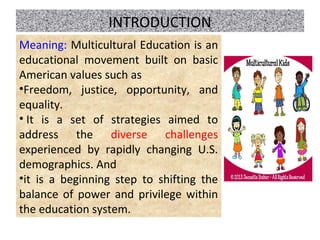
Meaning: Multicultural Education is an
educational movement built on basic
American values such as
•Freedom, justice, opportunity, and
equality.
• It is a set of strategies aimed to
address the diverse challenges
experienced by rapidly changing U.S.
demographics. And
•it is a beginning step to shifting the
balance of power and privilege within
the education system.
VERY POPULAR DEFINITIONS
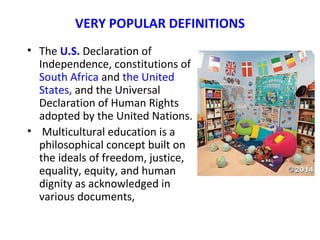
• The U.S. Declaration of
Independence, constitutions of
South Africa and the United
States, and the Universal
Declaration of Human Rights
adopted by the United Nations.
• Multicultural education is a
philosophical concept built on
the ideals of freedom, justice,
equality, equity, and human
dignity as acknowledged in
various documents,
SCHOOL CURRICULUM-ITS Importance
• Multicultural education is a process that permeates all
aspects of school practices, policies and organization as a
means to ensure the highest levels of academic
achievement for all students.
• It helps students develop a positive self-concept by
providing knowledge about the histories, cultures, and
contributions of diverse groups.
• It prepares all students to work actively toward structural
equality in organizations and institutions by providing the
knowledge, dispositions, and skills for the redistribution of
power and income among diverse groups.
• Thus, school curriculum must directly address issues of
racism, sexism, classism, linguisism, ageism, heterosexism,
religious intolerance, and xenophobia..
•
ROLE OF THE EDUCATORS IN A CLASS ROOM
* Educators who use the Social
Reconstructionist approach to
--- Multicultural Education go a step
further to teach students about
oppression and discrimination.
* Students learn about their roles as
social change agents so that they
may participate in the generation
of a more equitable society.
The TEACHER As A Knowledge Constructer
• Knowledge construction is the recognition that all
knowledge is socially constructed, created in the
minds of human beings to explain their
experience and thus, can be challenged. Ideas
that shape society do change.
• As such, knowledge construction is a primary
aspect of multicultural education because before
teachers can effectively teach multiculturally,
they must reconstruct their world views.
• Equity pedagogy is involved when teachers alter
their teaching methods to accommodate the
various cultural differences of diverse students to
stimulate academic achievement.
Knowledge Construction….
• Prejudice reduction concerns changing the
students' attitudes towards differences of
race and ethnicity.
• Prejudice reduction can also include teaching
tolerance about religion, physical and mental
abilities, and sexual preference.
• An empowering school culture is the
dimension of multicultural education that
enables the other four dimensions.
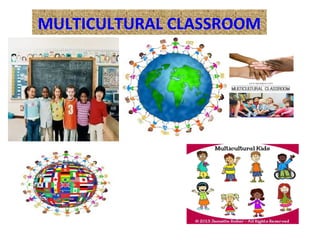
MULTICULTURAL CLASSROOM
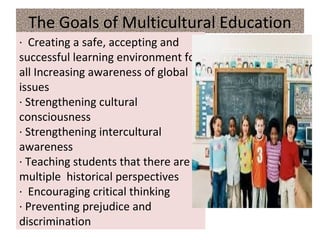
The Goals of Multicultural Education
· Creating a safe, accepting and
successful learning environment for
all Increasing awareness of global
issues
· Strengthening cultural
consciousness
· Strengthening intercultural
awareness
· Teaching students that there are
multiple historical perspectives
· Encouraging critical thinking
· Preventing prejudice and
discrimination
Hands-On Websites Kids Love
In USA,
* Creative Thinking and
Multiple Intelligences
•the School Education is
providing with ICT which is
very much useful to
understand easily to the
children.
•Here is a gold mine of edu-
websites that every teacher
should check out.
Iknowthat.com – High energy, engaging games in math,
Language Arts, Science, Social Studies, The Arts, and thinking
games all to be found here either by subject or grade level.
Into the Book - a reading comprehension resource for K-4
students and teachers. We focus on eight research-based
strategies: Using Prior Knowledge, Making Connections,
Questioning, Visualizing, Inferring, Summarizing, Evaluating
and Synthesizing. Your class can watch our engaging 15-minute
videos, and try the online interactive activities.
Behind the Lesson- provides teachers with information and
teaching resources for each strategy.
Watch 10-minute professional development videos, and
explore the Web site for lesson plans, video and audio clips,
downloads, and more.
Math Baseball - FunBrain.com, an award-winning
interactive learning and "edutainment Web site" links K-
8 children, parents, and teachers together with its fun
math baseball game that you can play by yourself or
with friends. It gives you a choice of math problems and
the level you want to practice. Click on the Games icon
for other games available through their site, some going
up to grade 12, age seventeen.
SOURCE: techhub.com
The way the mind and body function has a
tremendous effect on how students learn.
Assignments & Multiculturalism.
• If used cleverly, classroom assignments can provide a primary
window into a student’s cultural beliefs.
• Writing assignments can play a significant role in gathering
information about student thought patterns and tendencies.
• Interviews with family members, assignments asking
students to write about learning experiences that occur
outside of school, and assignments involving family stories
and traditions all can play a significant role in unearthing
information about a students’ cultural heritage.
• Students’ parents can often be solicited as sources of useful
personal information and visiting the neighborhoods where
diverse students live can help give educators an idea about
the level of social support present and the types of challenges
that the student might face outside of the classroom.
Advantages of
Multicultural Education
According to the National Association for Multicultural Education
(NAME), Multicultural education:
• Helps students develop positive self-image.
• Offers students an equitable educational
opportunity.
• Allows multiple perspectives and ways of
thinking.
• Combats stereotypes and prejudicial behavior.
• Teaches students to critique society in the
interest of social justice.
CONCLUSION
• The nation is enriched by the ethnic, cultural, and
language diversity among its citizens and within its
schools. However, whenever diverse groups interact,
intergroup tension, stereotypes, and institutionalized
discrimination develop.
• Schools must find ways to respect the diversity of
their students as well as help to create a unified
nation-state to which all of the nation's citizens have
allegiance.
• We hope these design principles will help educational
policy makers and practitioners realize this elusive and
difficult but essential goal of a democratic and
pluralistic society.
SUGGESSTIONS
• Most of the educational institutions are not prepared
to implement multicultural education in their
classrooms.
• Multicultural education requires a staff that is not only
diverse, but also culturally competent.
• Educators must be aware, responsive and embracing
of the diverse beliefs, perspectives and experiences.
• They must also be willing and ready to address issues
of controversy.
• These issues include, but are not limited to, racism,
sexism, religious intolerance, classism, ageism, etc.
• The Governments should be evolve constructive
educational policies to ACHIVE MULTICULTURALISM
WHICH NEEDS ESSENTIALLY TO UNITE THE NATION
MULTICULTURAL EDUCATION:

MULTICULTURAL EDUCATION:

  • 1.
    MULTICULTURAL EDUCATION: Need ofThe Hour For National Integrity BY Dr.ANJAIAH MOTHUKURI, Asst.Professor University Central library DRAVIDIAN UNIVERSITY KUPPAM-517 426 9908694950 anjaiahlib@gmail.com Date of the National Seminar: 21.03.2017
  • 3.
    INTRODUCTION • Multicultural educationis a progressive approach for transforming education based on educational equality and social justice. • The components required in educating a multicultural education are content integrations, prejudice reduction, empowering school culture and social culture. • These all relate and all require attention as they relate to the efforts of conflict resolution in today’s world. • What kids learn in their classroom environments when it comes to interactions with those who are different from them translates into how well they will manage life in the global marketplace.
  • 4.
    INTRODUCTION Meaning: Multicultural Educationis an educational movement built on basic American values such as •Freedom, justice, opportunity, and equality. • It is a set of strategies aimed to address the diverse challenges experienced by rapidly changing U.S. demographics. And •it is a beginning step to shifting the balance of power and privilege within the education system.
  • 5.
    VERY POPULAR DEFINITIONS •The U.S. Declaration of Independence, constitutions of South Africa and the United States, and the Universal Declaration of Human Rights adopted by the United Nations. • Multicultural education is a philosophical concept built on the ideals of freedom, justice, equality, equity, and human dignity as acknowledged in various documents,
  • 6.
    SCHOOL CURRICULUM-ITS Importance •Multicultural education is a process that permeates all aspects of school practices, policies and organization as a means to ensure the highest levels of academic achievement for all students. • It helps students develop a positive self-concept by providing knowledge about the histories, cultures, and contributions of diverse groups. • It prepares all students to work actively toward structural equality in organizations and institutions by providing the knowledge, dispositions, and skills for the redistribution of power and income among diverse groups. • Thus, school curriculum must directly address issues of racism, sexism, classism, linguisism, ageism, heterosexism, religious intolerance, and xenophobia.. •
  • 7.
    ROLE OF THEEDUCATORS IN A CLASS ROOM * Educators who use the Social Reconstructionist approach to --- Multicultural Education go a step further to teach students about oppression and discrimination. * Students learn about their roles as social change agents so that they may participate in the generation of a more equitable society.
  • 8.
    The TEACHER AsA Knowledge Constructer • Knowledge construction is the recognition that all knowledge is socially constructed, created in the minds of human beings to explain their experience and thus, can be challenged. Ideas that shape society do change. • As such, knowledge construction is a primary aspect of multicultural education because before teachers can effectively teach multiculturally, they must reconstruct their world views. • Equity pedagogy is involved when teachers alter their teaching methods to accommodate the various cultural differences of diverse students to stimulate academic achievement.
  • 9.
    Knowledge Construction…. • Prejudicereduction concerns changing the students' attitudes towards differences of race and ethnicity. • Prejudice reduction can also include teaching tolerance about religion, physical and mental abilities, and sexual preference. • An empowering school culture is the dimension of multicultural education that enables the other four dimensions.
  • 10.
  • 11.
    The Goals ofMulticultural Education · Creating a safe, accepting and successful learning environment for all Increasing awareness of global issues · Strengthening cultural consciousness · Strengthening intercultural awareness · Teaching students that there are multiple historical perspectives · Encouraging critical thinking · Preventing prejudice and discrimination
  • 12.
    Hands-On Websites KidsLove In USA, * Creative Thinking and Multiple Intelligences •the School Education is providing with ICT which is very much useful to understand easily to the children. •Here is a gold mine of edu- websites that every teacher should check out.
  • 13.
    Iknowthat.com – Highenergy, engaging games in math, Language Arts, Science, Social Studies, The Arts, and thinking games all to be found here either by subject or grade level. Into the Book - a reading comprehension resource for K-4 students and teachers. We focus on eight research-based strategies: Using Prior Knowledge, Making Connections, Questioning, Visualizing, Inferring, Summarizing, Evaluating and Synthesizing. Your class can watch our engaging 15-minute videos, and try the online interactive activities. Behind the Lesson- provides teachers with information and teaching resources for each strategy. Watch 10-minute professional development videos, and explore the Web site for lesson plans, video and audio clips, downloads, and more.
  • 14.
    Math Baseball -FunBrain.com, an award-winning interactive learning and "edutainment Web site" links K- 8 children, parents, and teachers together with its fun math baseball game that you can play by yourself or with friends. It gives you a choice of math problems and the level you want to practice. Click on the Games icon for other games available through their site, some going up to grade 12, age seventeen. SOURCE: techhub.com The way the mind and body function has a tremendous effect on how students learn.
  • 15.
    Assignments & Multiculturalism. •If used cleverly, classroom assignments can provide a primary window into a student’s cultural beliefs. • Writing assignments can play a significant role in gathering information about student thought patterns and tendencies. • Interviews with family members, assignments asking students to write about learning experiences that occur outside of school, and assignments involving family stories and traditions all can play a significant role in unearthing information about a students’ cultural heritage. • Students’ parents can often be solicited as sources of useful personal information and visiting the neighborhoods where diverse students live can help give educators an idea about the level of social support present and the types of challenges that the student might face outside of the classroom.
  • 16.
    Advantages of Multicultural Education Accordingto the National Association for Multicultural Education (NAME), Multicultural education: • Helps students develop positive self-image. • Offers students an equitable educational opportunity. • Allows multiple perspectives and ways of thinking. • Combats stereotypes and prejudicial behavior. • Teaches students to critique society in the interest of social justice.
  • 17.
    CONCLUSION • The nationis enriched by the ethnic, cultural, and language diversity among its citizens and within its schools. However, whenever diverse groups interact, intergroup tension, stereotypes, and institutionalized discrimination develop. • Schools must find ways to respect the diversity of their students as well as help to create a unified nation-state to which all of the nation's citizens have allegiance. • We hope these design principles will help educational policy makers and practitioners realize this elusive and difficult but essential goal of a democratic and pluralistic society.
  • 18.
    SUGGESSTIONS • Most ofthe educational institutions are not prepared to implement multicultural education in their classrooms. • Multicultural education requires a staff that is not only diverse, but also culturally competent. • Educators must be aware, responsive and embracing of the diverse beliefs, perspectives and experiences. • They must also be willing and ready to address issues of controversy. • These issues include, but are not limited to, racism, sexism, religious intolerance, classism, ageism, etc. • The Governments should be evolve constructive educational policies to ACHIVE MULTICULTURALISM WHICH NEEDS ESSENTIALLY TO UNITE THE NATION