By Anoixi State Junior High School
 Education in Greece is compulsory for all
children 6-15 years old, it includes Primary
(Dimotiko) and Lower Secondary/Junior high
School (Gymnasio) Education.
 The school life of the students, however, can
start from the age of 2.5 years (pre-school
education) in institutions (private and public)
kindergartens (Vrefonipiakoi Paidikoi
Stathmi). In some kindergartens there are also
nursery classes which operate along with the
kindergartens.
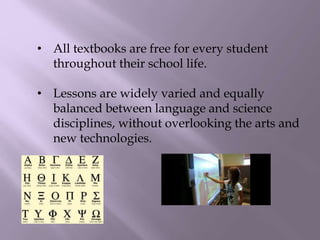
• All textbooks are free for every student
throughout their school life.
• Lessons are widely varied and equally
balanced between language and science
disciplines, without overlooking the arts and
new technologies.
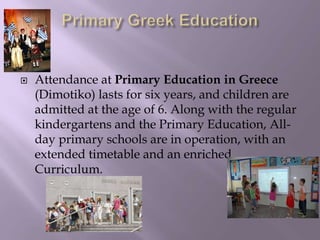
 Attendance at Primary Education in Greece
(Dimotiko) lasts for six years, and children are
admitted at the age of 6. Along with the regular
kindergartens and the Primary Education, All-
day primary schools are in operation, with an
extended timetable and an enriched
Curriculum.
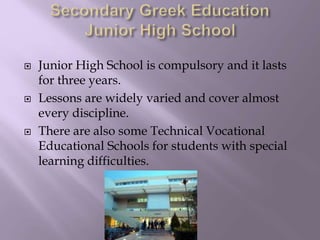
 Junior High School is compulsory and it lasts
for three years.
 Lessons are widely varied and cover almost
every discipline.
 There are also some Technical Vocational
Educational Schools for students with special
learning difficulties.
 Post-compulsory Secondary Education in
Greece, according to the reform of 1997,
consists of two school types: Unified Upper
Secondary Schools/Senior High Schools
( Eniaia Lykeia) and the Technical Vocational
Educational Schools (EPAL). The duration of
studies in Eniaia Lykeia is three years and
two years (a' level) or three years (b' level) in
the Technical Vocational Educational
Schools. Mutual student transfer from one
type of school to the other is possible.
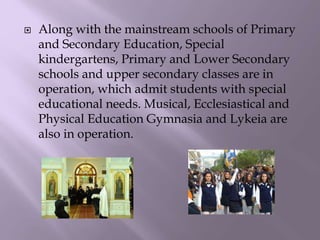
 Along with the mainstream schools of Primary
and Secondary Education, Special
kindergartens, Primary and Lower Secondary
schools and upper secondary classes are in
operation, which admit students with special
educational needs. Musical, Ecclesiastical and
Physical Education Gymnasia and Lykeia are
also in operation.
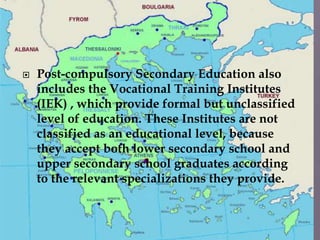
 Post-compulsory Secondary Education also
includes the Vocational Training Institutes
(IEK) , which provide formal but unclassified
level of education. These Institutes are not
classified as an educational level, because
they accept both lower secondary school and
upper secondary school graduates according
to the relevant specializations they provide.
 Public higher education in Greece is divided
into Universities and Technological Education
Institutes (TEI). Students are admitted to these
Institutes according to their performance at
national level examinations taking place at the
second and third grade of Lykeio.
Additionally, students are admitted to the
Greek Open University upon the completion
of the 22 year of age by drawing lots.
THANK YOU!!!

The greek educational system

  • 1.
    By Anoixi StateJunior High School
  • 2.
     Education inGreece is compulsory for all children 6-15 years old, it includes Primary (Dimotiko) and Lower Secondary/Junior high School (Gymnasio) Education.  The school life of the students, however, can start from the age of 2.5 years (pre-school education) in institutions (private and public) kindergartens (Vrefonipiakoi Paidikoi Stathmi). In some kindergartens there are also nursery classes which operate along with the kindergartens.
  • 3.
    • All textbooksare free for every student throughout their school life. • Lessons are widely varied and equally balanced between language and science disciplines, without overlooking the arts and new technologies.
  • 4.
     Attendance atPrimary Education in Greece (Dimotiko) lasts for six years, and children are admitted at the age of 6. Along with the regular kindergartens and the Primary Education, All- day primary schools are in operation, with an extended timetable and an enriched Curriculum.
  • 5.
     Junior HighSchool is compulsory and it lasts for three years.  Lessons are widely varied and cover almost every discipline.  There are also some Technical Vocational Educational Schools for students with special learning difficulties.
  • 6.
     Post-compulsory SecondaryEducation in Greece, according to the reform of 1997, consists of two school types: Unified Upper Secondary Schools/Senior High Schools ( Eniaia Lykeia) and the Technical Vocational Educational Schools (EPAL). The duration of studies in Eniaia Lykeia is three years and two years (a' level) or three years (b' level) in the Technical Vocational Educational Schools. Mutual student transfer from one type of school to the other is possible.
  • 7.
     Along withthe mainstream schools of Primary and Secondary Education, Special kindergartens, Primary and Lower Secondary schools and upper secondary classes are in operation, which admit students with special educational needs. Musical, Ecclesiastical and Physical Education Gymnasia and Lykeia are also in operation.
  • 8.
     Post-compulsory SecondaryEducation also includes the Vocational Training Institutes (IEK) , which provide formal but unclassified level of education. These Institutes are not classified as an educational level, because they accept both lower secondary school and upper secondary school graduates according to the relevant specializations they provide.
  • 9.
     Public highereducation in Greece is divided into Universities and Technological Education Institutes (TEI). Students are admitted to these Institutes according to their performance at national level examinations taking place at the second and third grade of Lykeio. Additionally, students are admitted to the Greek Open University upon the completion of the 22 year of age by drawing lots.
  • 10.