ALLAMA IQBAL O P E N
UNIVERSITY, ISLAMABAD
ON L I N E WORKSHOP
ORGANIZATIONAL STRUCTURE
OF
SECONDARY EDUCATION
C C 8624 -B.Ed.
Presented by:
Ahsan Ullah Baloch
Mphil Education
2
Organizational
Structure
Of
Secondary
Education
ORGANIZATIONAL STRUC TURE
O F SE C ONDARY EDUCATION
3
Objective
1. To Differentiate educational scenario before and after 18th
amendment.
2. To differentiate role of Director Public Instruction schools and
Colleges.
3. To know the curriculum development process and textbook
development.
By:
Ch.
M.Ashraf
https://www.slideshare.net/RizwanDuhdra
Scenario before 18th Amendment
1. Federal Ministry of Education (FMoE) responsible for
formulating education policy
2. Ministry played role in coordination
3. Education was at the concurrent list.
4
ORGANIZATIONAL STRUC TURE
O F SE C ONDARY EDUCATION
Scenario before 18th Amendment (Continued)
4. Key role of FMoE as described in rule of business 1973 was
1. Formulation of national education policy
2. Collection of vital statistics
3. Diagnose system & performance issue
4. Development of physical & financial norms
5. Implement and monitor PSDP
6. Authority of finalization of curriculum and books rested
with FMoE. 5
ORGANIZATIONAL STRUC TURE
O F SE C ONDARY EDUCATION
Scenario before 18th Amendment (Continued)
1. University Grant Commission (1976) looked after higher
education named as HEC in 2002.
2. National Institute of Science and Technical Education (NISTE)
regulated technical education in Pakistan.
3. IBCC (1976) was established to promote uniformity across the
country under FMoE
4. The provincial department of education was headed by
Minister of education, secretary and provincial directorate. 6
ORGANIZATIONAL STRUC TURE
O F SE C ONDARY EDUCATION
ScenarioAfter 18th Amendment
1. 18th amendment to the 1973 constitution revised the power
distribution between center and provinces.
2. Legislative and executive jurisdiction has shifted from center
to provinces
7
ORGANIZATIONAL STRUC TURE
O F SE C ONDARY EDUCATION
ScenarioAfter 18th Amendment(Continued)
3. Following are the major changes
a. Introduction of article 15-A
b. Removal of concurrent list which resulted in the legislative
and executive shift of curriculum, syllabi, planning, policy,
center of excellence, standard of education and Islamic
education to provinces.
c. New entries in federal legislative list in the mandate of
Council of Common Interest like regulatory authorities
established under federal law.
8
ORGANIZATIONAL STRUC TURE
O F SE C ONDARY EDUCATION
ScenarioAfter 18th Amendment (Continued)
standard in institution of higher and technical education and
interprovincial matters and coordination
d. Omission of 6th and 7th schedule, 6th schedule authorize
president to take over private school and colleges (article
268(a) and 7th schedule (article 270(a)) were amended. The
Statue ofAgha Khan University, National College of Textile
Engineering and Lahore University of Management Science
can now be changed as ordinary legislation.
9
ORGANIZATIONAL STRUC TURE
O F SE C ONDARY EDUCATION
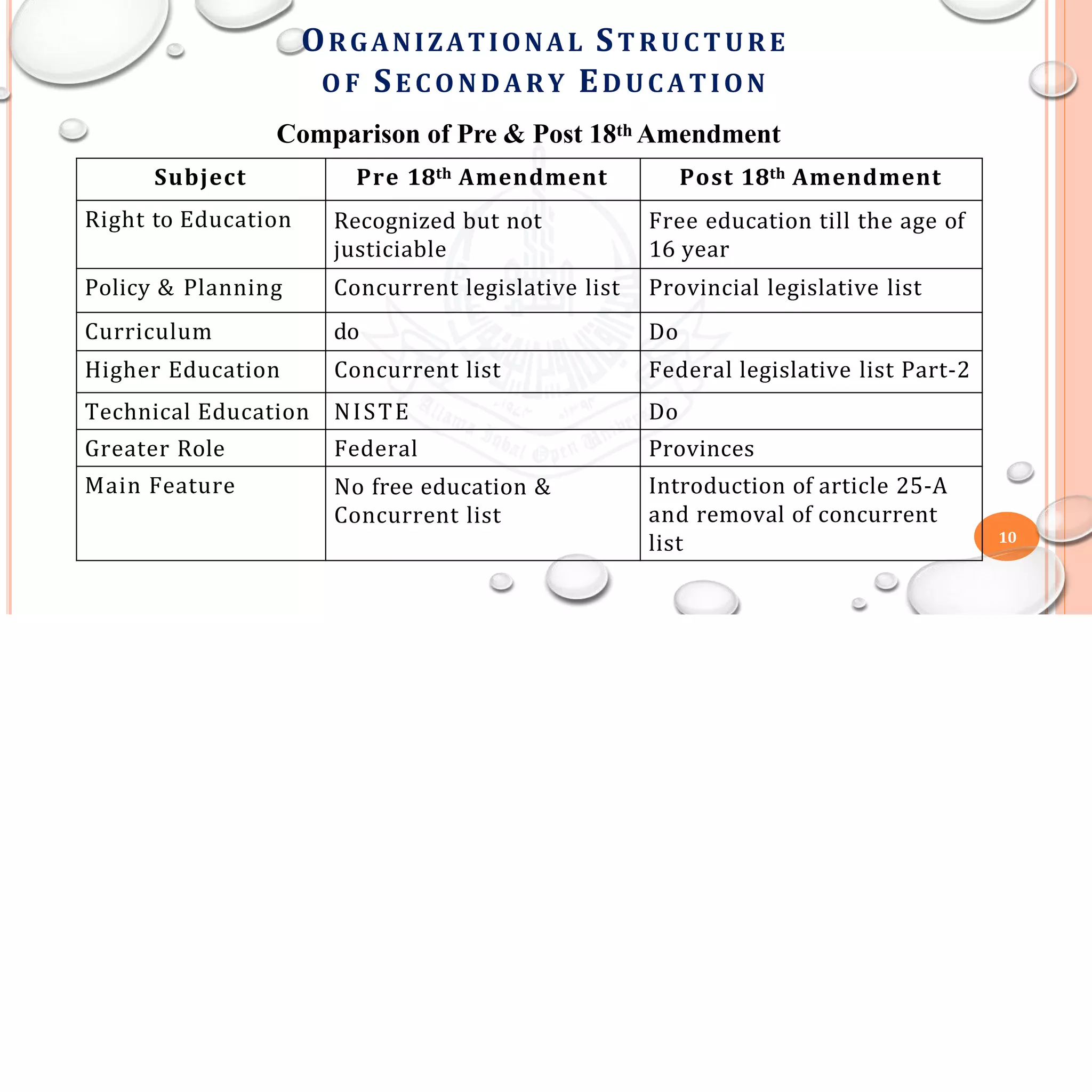
Subject Pre 18th Amendment Post 18th Amendment
Right to Education Recognized but not
justiciable
Free education till the age of
16 year
Policy & Planning Concurrent legislative list Provincial legislative list
Curriculum do Do
Higher Education Concurrent list Federal legislative list Part-2
Technical Education NISTE Do
Greater Role Federal Provinces
Main Feature No free education &
Concurrent list
Introduction of article 25-A
and removal of concurrent
list 10
Comparison of Pre & Post 18th Amendment
ORGANIZATIONAL STRUC TURE
O F SE C ONDARY EDUCATION
11
This chair was eliminated in
Musharaf’s tenure and schools
were given under District Govt.
ORGANIZATIONAL STRUC TURE
O F SE C ONDARY EDUCATION
Education Secretariat
Secretary (Schools)
DPI (E.E)
Divisional (Directors)
D.E. (SE)
DPI (S.E)
D.E.O’s (S.E)
Dy. D.E.O(HQ) All Heads of High & Higher
Sec. Schools (M&F)
District Govt.
12
DEO(EE/M)
ORGANIZATIONAL STRUC TURE
O F SE C ONDARY EDUCATION
Other EDO’s
Dy. DEO(HQ) All Heads of High & Higher
Sec. Schools (M&F)
Other EDO’s
EDO(Health)
DEO
(Literacy)
DEO (SE)
EDO(Edu)
DCO
DEO (EE/F)
District Govt. From J a n 2017
Now divisional directors are also appointed.
13
DEO (EE/M)
ORGANIZATIONAL STRUC TURE
O F SE C ONDARY EDUCATION
Other CEO’s
Dy. DEO(HQ) All Heads of High & Higher
Sec. Schools (M&F)
Other CEO’s
CEO (Health)
DEO (SE)
CEO(Edu)
D.C.
DEO (EE/F)
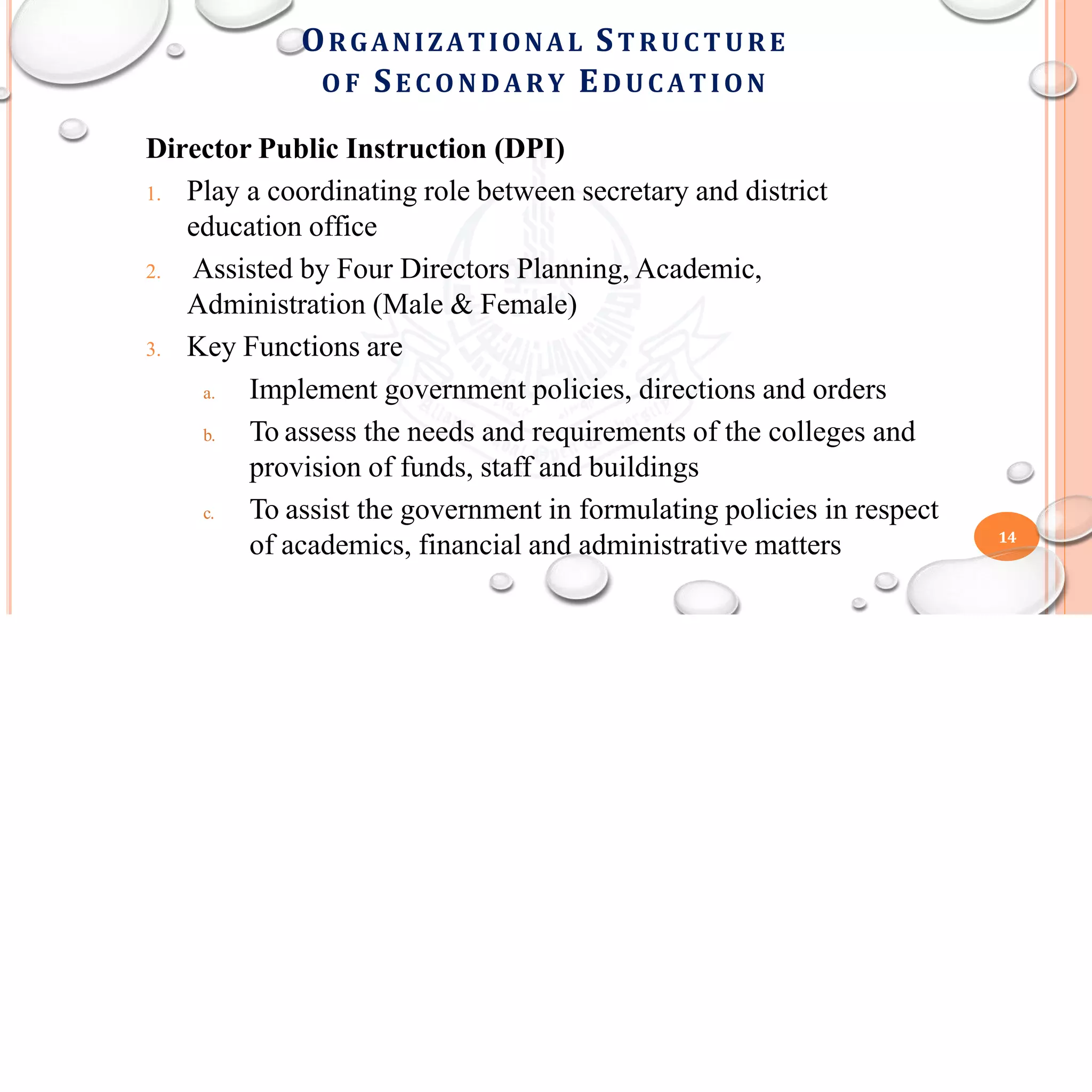
Director Public Instruction (DPI)
1. Play a coordinating role between secretary and district
education office
2. Assisted by Four Directors Planning, Academic,
Administration (Male & Female)
3. Key Functions are
a. Implement government policies, directions and orders
b. To assess the needs and requirements of the colleges and
provision of funds, staff and buildings
c. To assist the government in formulating policies in respect
of academics, financial and administrative matters 14
ORGANIZATIONAL STRUC TURE
O F SE C ONDARY EDUCATION
Director Public Instruction (DPI) (Continue)
d. To act as coordinator between the government and other agencies
including the Director /District Education Officers Colleges
e. Maintenance of the career record of teaching staff of colleges (BPS
17, 18, 19 &20) and preparation of their promotion.
f. Administer inter, degree and post-graduate colleges
g. Arrangements for teacher training
h. Registration of private colleges
i. Conduct of inquiries
15
ORGANIZATIONAL STRUC TURE
O F SE C ONDARY EDUCATION
Director Public Instruction (DPI) (Continue)
j. Settlement of audit paras
k. Technical and administrative inspection of colleges
l. Inter-district transfers of teaching and non-teaching staff up to BPS 19
m. Sanction of Leave up to maximum of 365 days up to BPS 20, except
ex-Pakistan leave
16
ORGANIZATIONAL STRUC TURE
O F SE C ONDARY EDUCATION
1
7
ORGANIZATIONAL STRUC TURE
O F SECONDARY EDUCATION
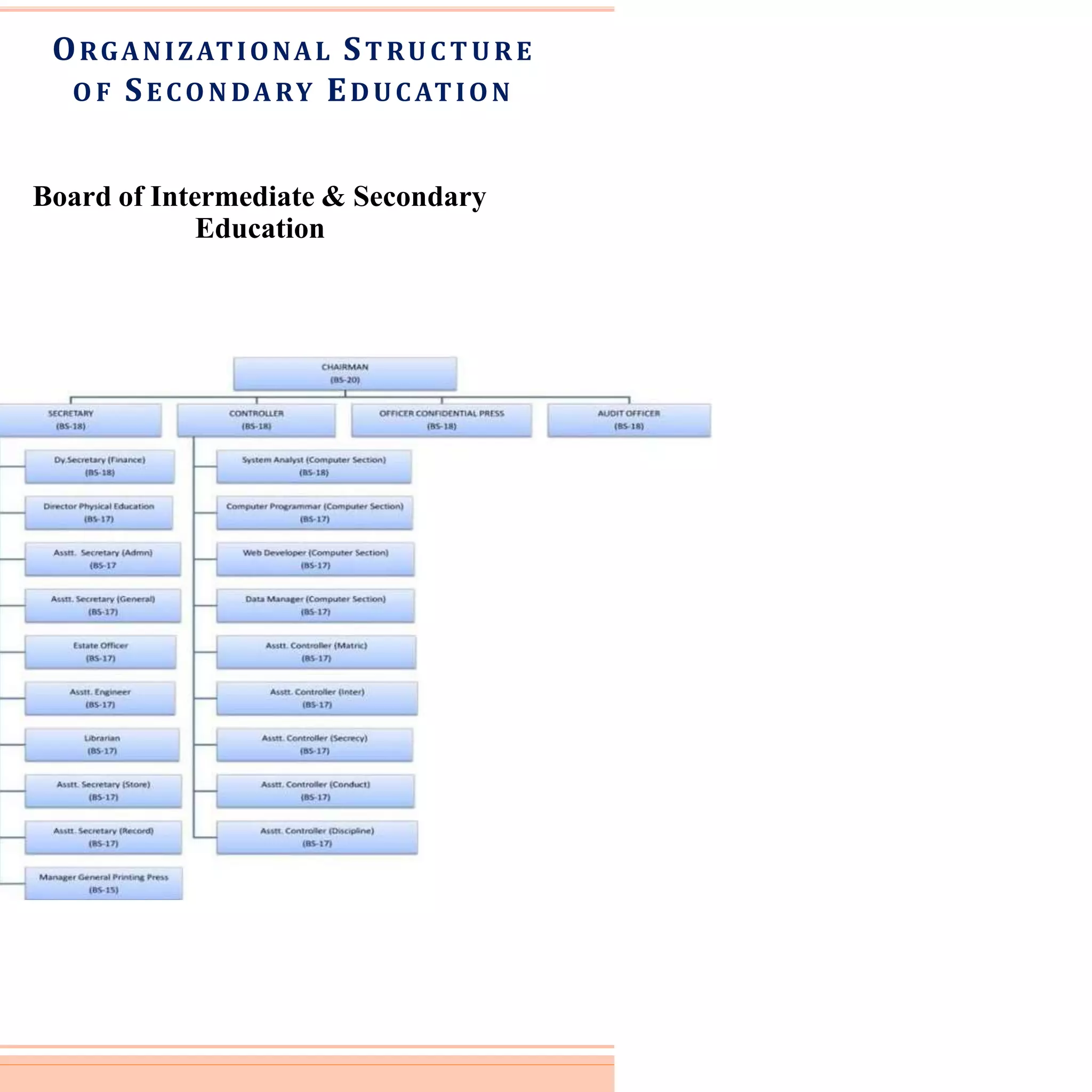
Board of Intermediate & Secondary
Education
ORGANIZATIONAL ST RUC T URE
O F SE C ONDARY EDUCATION
Educational Directorate (Cantt. & Garrison)
18
ORGANIZATIONAL STRUC TURE
O F SE C ONDARY EDUCATION
National Bureau of Curriculum & Textbook
19
By:
Ch.
M.Ashraf
https://www.slideshare.net/RizwanDuhdra
ORGANIZATIONAL STRUC TURE
O F SE C ONDARY EDUCATION
National Bureau of Curriculum & Textbook
20
2
1
 Public Sector
 Private Sector
 Madrisah Sector
TYPES O F SC H O O L S IN PAKISTAN
22
2
3
PU BLIC S EC TO R S C H O O LS
IN
PAKISTAN
PU BL I C SECT O R S C H O O L S IN PAKISTAN
24
 Under Federal Govt.
 Under Provincial Govt.
 Beacon House School System
 The Educators
 The City School
 Allied Schools
 Dar e Arqam school
PRIVATE S EC T OR OF S C H O O L S IN PAKISTAN
25
 Agha Khan Board
Beacon House School System
2
6
History and Introduction
 Origin established (Les Anges Montessori Academy) 1975.
 First Beacon house Public School in Lahore in Nov, 1975.
Located throughout 30 cities in Pakistan.
 Provides preschool, primary, secondary education and
preparation General Certificate of Education (GCE) and local
Secondary School Certificate (SSC) examinations.
 Student strength is nearing 35,000 with Student Teacher
ratio (STR) 1/15
 Around 274,000 fulltime students in eight countries. 27
BE A C O N HO U S E SC H O O L SYSTEM
Certificate of Professional Studies in Education
Aim: Foundation course of professional studies for teacher
development
Objectives:
• Understanding the role of teacher.
• Issues involved in managing learning.
• Theory & practice for management of learning in education.
• Competency to manage learning in the classroom.
• Linkage of reflection and analysis for effective learning.
• Willingness to develop current practices for more effective
learning.
28
BE A C O N HO U S E SC H O O L SYSTEM
29
BE A C O N HO U S E SC H O O L SYSTEM
Beaconhouse School System
Professional Development Program
Need Based Courses
Induction Courses
Foundation Courses
Curriculum Development Courses
Subject Specific Training
Behavior Management Courses
Need Based training
Heads Management Courses
Information Communication Tech.
Courses
Career Guidance Training
Award Bearing Programs
Certificate in professional
Education
Post Graduate Certificate
MCD
Professional Development Pathway
Induction course for teachers with less than one year’s
experience
 Five-day foundation course, with induction course with Early
Years, Primary, and Secondary.
 Teachers can apply for the Certificate in Professional
Education (CPEd) offered by University College Plymouth St.
Mark & St. John.
 Classes for this 120 credit course held on 15 days for seven 30
BE A C O N HO U S E SC H O O L SYSTEM
months.
Professional Development Pathway (continue)
 Classes are taught by teachers accredited by the University.
 After finishing the CPEd, interested in becoming teacher-
trainers enroll in the two-year Post Graduate Certificate
(PGCert) in training offered through University College
Plymouth St. Mark & St. John.
 Teachers who pass the PGCert with a distinction are given a
scholarship to enroll for their MEd at Leeds Metropolitan
University.
BE A C O N HO U S E SC H O O L SYSTEM
31
BE A C O N HO U S E SC H O O L SYSTEM
Professional Development Pathway
Induction course
Foundation Course
Certificate in Professional
Edu.
P.G. Certificate (Training)
Masters 32
3
3
 Established in 2002
 Now has 800 + campuses in over 225+ cities
 Student strength exceeding 175,000+.
This makes The Educators outreach the largest
compared to any other private school in the world.
 Concordia College under the umbrella of the Beaconhouse
Group
 World class education:
 Innovative & Technology
THE EDUCATORS
34
3
5
• Established in Karachi in 1978.
• Rigorous academic and administrative standards
• 185 schools in 52 cities with over 126,000 students in 458
owned and franchised schools.
• Uniform implementation of the curriculum for efficient
transfer from one school to another within the system.
THE CITY SC H O O L
36
Curriculum & Academic Philosophy
• The knowledge and skills-based curriculum derived from the
U K national curriculum
• The curriculum having student-centered approach.
• Provides more than 120 courses for teachers and pupils.
• Selection of teachers based on their experience as curriculum
developers and syllabus writers.
• Promotion and encouragement of cocurricular activities
THE CITY SC H O O L
37
MADRISAH SE C T O R IN PAKISTAN
48
There were almost 150 at the time of Pakistan's independence
in 1947.
Now, there are some 32,000 madrassas attended by some 2.5
million students, according to Azmat Abbas, author of
Madrassah Mirage: A Contemporary History of Islamic Schools
in Pakistan.
Other estimates range as high as more than 60,000 madrassas.
4
MADRISAH SE C T O R IN PAKISTAN
9
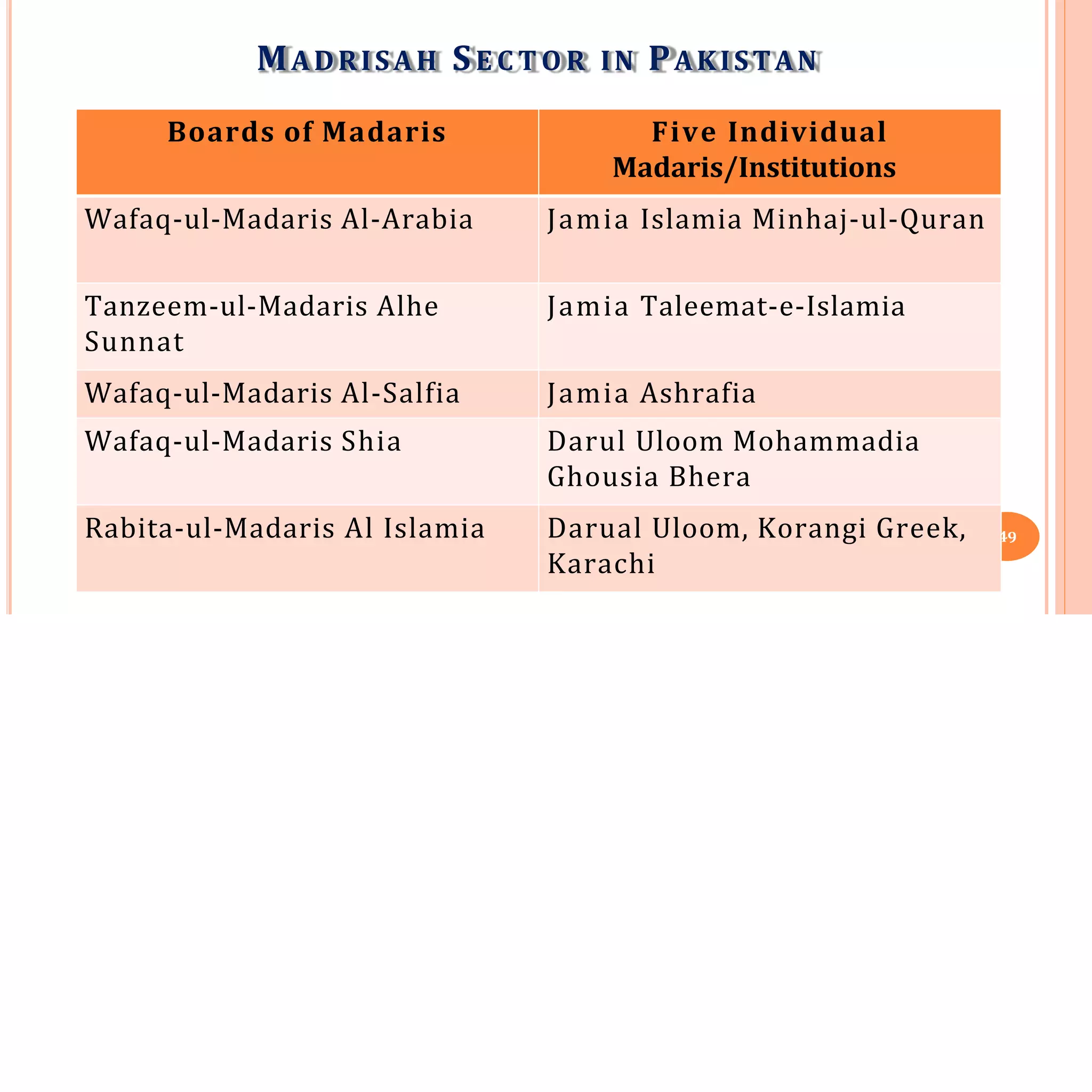
Boards of Madaris Five Individual
Madaris/Institutions
Wafaq-ul-Madaris Al-Arabia Jamia Islamia Minhaj-ul-Quran
Tanzeem-ul-Madaris Alhe
Sunnat
Jamia Taleemat-e-Islamia
Wafaq-ul-Madaris Al-Salfia Jamia Ashrafia
Wafaq-ul-Madaris Shia Darul Uloom Mohammadia
Ghousia Bhera
Rabita-ul-Madaris Al Islamia Darual Uloom, Korangi Greek,
Karachi
50
MADRISAH SE C T O R IN PAKISTAN
 Shahadatul Almiya: 2-year of study
Approved mode of education for recognition of Final Deeni
Sanad is as under:
involving 8-year of study is
 Middle School Certificate
entrance requirement for:
 Shahadatul Sanvia Aama: 2-year of study
 Shahadatul Sanvia Khasa: 2-year of study
 Shahadatul Alia: 2-year of study
MADRISAH SE C T O R IN PAKISTAN
41
Approved mode of studies for Minhaj-Ul-Quran, Lahore and
Darul Uloom Mohammadia Ghousia Bhera, District Sargodha
is as under:
 Matric
 Intermediate
 Bachelor
 Shahadatul Almiya
2-year of study
2-year of study
2-year of study
2-year of study
MADRISAH SE C T O R IN PAKISTAN
42
Inter Board Committee of Chairmen (IBCC) is an
authorized body to determine equivalence of qualification up to
Intermediate/12-year schooling/other than Final Sanad
“Shahadatul Almiya”.
5
3
HUMAN DE VE LOPME NT AND LE A R N I N G
THEORIES RE GARDING INTELLECTUAL DEVELOPMENT
54

Organizational Structure Of Secondary Education-8624

  • 1.
    ALLAMA IQBAL OP E N UNIVERSITY, ISLAMABAD ON L I N E WORKSHOP ORGANIZATIONAL STRUCTURE OF SECONDARY EDUCATION C C 8624 -B.Ed. Presented by: Ahsan Ullah Baloch Mphil Education
  • 2.
  • 3.
    ORGANIZATIONAL STRUC TURE OF SE C ONDARY EDUCATION 3 Objective 1. To Differentiate educational scenario before and after 18th amendment. 2. To differentiate role of Director Public Instruction schools and Colleges. 3. To know the curriculum development process and textbook development. By: Ch. M.Ashraf https://www.slideshare.net/RizwanDuhdra
  • 4.
    Scenario before 18thAmendment 1. Federal Ministry of Education (FMoE) responsible for formulating education policy 2. Ministry played role in coordination 3. Education was at the concurrent list. 4 ORGANIZATIONAL STRUC TURE O F SE C ONDARY EDUCATION
  • 5.
    Scenario before 18thAmendment (Continued) 4. Key role of FMoE as described in rule of business 1973 was 1. Formulation of national education policy 2. Collection of vital statistics 3. Diagnose system & performance issue 4. Development of physical & financial norms 5. Implement and monitor PSDP 6. Authority of finalization of curriculum and books rested with FMoE. 5 ORGANIZATIONAL STRUC TURE O F SE C ONDARY EDUCATION
  • 6.
    Scenario before 18thAmendment (Continued) 1. University Grant Commission (1976) looked after higher education named as HEC in 2002. 2. National Institute of Science and Technical Education (NISTE) regulated technical education in Pakistan. 3. IBCC (1976) was established to promote uniformity across the country under FMoE 4. The provincial department of education was headed by Minister of education, secretary and provincial directorate. 6 ORGANIZATIONAL STRUC TURE O F SE C ONDARY EDUCATION
  • 7.
    ScenarioAfter 18th Amendment 1.18th amendment to the 1973 constitution revised the power distribution between center and provinces. 2. Legislative and executive jurisdiction has shifted from center to provinces 7 ORGANIZATIONAL STRUC TURE O F SE C ONDARY EDUCATION
  • 8.
    ScenarioAfter 18th Amendment(Continued) 3.Following are the major changes a. Introduction of article 15-A b. Removal of concurrent list which resulted in the legislative and executive shift of curriculum, syllabi, planning, policy, center of excellence, standard of education and Islamic education to provinces. c. New entries in federal legislative list in the mandate of Council of Common Interest like regulatory authorities established under federal law. 8 ORGANIZATIONAL STRUC TURE O F SE C ONDARY EDUCATION
  • 9.
    ScenarioAfter 18th Amendment(Continued) standard in institution of higher and technical education and interprovincial matters and coordination d. Omission of 6th and 7th schedule, 6th schedule authorize president to take over private school and colleges (article 268(a) and 7th schedule (article 270(a)) were amended. The Statue ofAgha Khan University, National College of Textile Engineering and Lahore University of Management Science can now be changed as ordinary legislation. 9 ORGANIZATIONAL STRUC TURE O F SE C ONDARY EDUCATION
  • 10.
    Subject Pre 18thAmendment Post 18th Amendment Right to Education Recognized but not justiciable Free education till the age of 16 year Policy & Planning Concurrent legislative list Provincial legislative list Curriculum do Do Higher Education Concurrent list Federal legislative list Part-2 Technical Education NISTE Do Greater Role Federal Provinces Main Feature No free education & Concurrent list Introduction of article 25-A and removal of concurrent list 10 Comparison of Pre & Post 18th Amendment ORGANIZATIONAL STRUC TURE O F SE C ONDARY EDUCATION
  • 11.
    11 This chair waseliminated in Musharaf’s tenure and schools were given under District Govt. ORGANIZATIONAL STRUC TURE O F SE C ONDARY EDUCATION Education Secretariat Secretary (Schools) DPI (E.E) Divisional (Directors) D.E. (SE) DPI (S.E) D.E.O’s (S.E) Dy. D.E.O(HQ) All Heads of High & Higher Sec. Schools (M&F)
  • 12.
    District Govt. 12 DEO(EE/M) ORGANIZATIONAL STRUCTURE O F SE C ONDARY EDUCATION Other EDO’s Dy. DEO(HQ) All Heads of High & Higher Sec. Schools (M&F) Other EDO’s EDO(Health) DEO (Literacy) DEO (SE) EDO(Edu) DCO DEO (EE/F)
  • 13.
    District Govt. FromJ a n 2017 Now divisional directors are also appointed. 13 DEO (EE/M) ORGANIZATIONAL STRUC TURE O F SE C ONDARY EDUCATION Other CEO’s Dy. DEO(HQ) All Heads of High & Higher Sec. Schools (M&F) Other CEO’s CEO (Health) DEO (SE) CEO(Edu) D.C. DEO (EE/F)
  • 14.
    Director Public Instruction(DPI) 1. Play a coordinating role between secretary and district education office 2. Assisted by Four Directors Planning, Academic, Administration (Male & Female) 3. Key Functions are a. Implement government policies, directions and orders b. To assess the needs and requirements of the colleges and provision of funds, staff and buildings c. To assist the government in formulating policies in respect of academics, financial and administrative matters 14 ORGANIZATIONAL STRUC TURE O F SE C ONDARY EDUCATION
  • 15.
    Director Public Instruction(DPI) (Continue) d. To act as coordinator between the government and other agencies including the Director /District Education Officers Colleges e. Maintenance of the career record of teaching staff of colleges (BPS 17, 18, 19 &20) and preparation of their promotion. f. Administer inter, degree and post-graduate colleges g. Arrangements for teacher training h. Registration of private colleges i. Conduct of inquiries 15 ORGANIZATIONAL STRUC TURE O F SE C ONDARY EDUCATION
  • 16.
    Director Public Instruction(DPI) (Continue) j. Settlement of audit paras k. Technical and administrative inspection of colleges l. Inter-district transfers of teaching and non-teaching staff up to BPS 19 m. Sanction of Leave up to maximum of 365 days up to BPS 20, except ex-Pakistan leave 16 ORGANIZATIONAL STRUC TURE O F SE C ONDARY EDUCATION
  • 17.
    1 7 ORGANIZATIONAL STRUC TURE OF SECONDARY EDUCATION Board of Intermediate & Secondary Education
  • 18.
    ORGANIZATIONAL ST RUCT URE O F SE C ONDARY EDUCATION Educational Directorate (Cantt. & Garrison) 18
  • 19.
    ORGANIZATIONAL STRUC TURE OF SE C ONDARY EDUCATION National Bureau of Curriculum & Textbook 19
  • 20.
    By: Ch. M.Ashraf https://www.slideshare.net/RizwanDuhdra ORGANIZATIONAL STRUC TURE OF SE C ONDARY EDUCATION National Bureau of Curriculum & Textbook 20
  • 21.
  • 22.
     Public Sector Private Sector  Madrisah Sector TYPES O F SC H O O L S IN PAKISTAN 22
  • 23.
    2 3 PU BLIC SEC TO R S C H O O LS IN PAKISTAN
  • 24.
    PU BL IC SECT O R S C H O O L S IN PAKISTAN 24  Under Federal Govt.  Under Provincial Govt.
  • 25.
     Beacon HouseSchool System  The Educators  The City School  Allied Schools  Dar e Arqam school PRIVATE S EC T OR OF S C H O O L S IN PAKISTAN 25  Agha Khan Board
  • 26.
  • 27.
    History and Introduction Origin established (Les Anges Montessori Academy) 1975.  First Beacon house Public School in Lahore in Nov, 1975. Located throughout 30 cities in Pakistan.  Provides preschool, primary, secondary education and preparation General Certificate of Education (GCE) and local Secondary School Certificate (SSC) examinations.  Student strength is nearing 35,000 with Student Teacher ratio (STR) 1/15  Around 274,000 fulltime students in eight countries. 27 BE A C O N HO U S E SC H O O L SYSTEM
  • 28.
    Certificate of ProfessionalStudies in Education Aim: Foundation course of professional studies for teacher development Objectives: • Understanding the role of teacher. • Issues involved in managing learning. • Theory & practice for management of learning in education. • Competency to manage learning in the classroom. • Linkage of reflection and analysis for effective learning. • Willingness to develop current practices for more effective learning. 28 BE A C O N HO U S E SC H O O L SYSTEM
  • 29.
    29 BE A CO N HO U S E SC H O O L SYSTEM Beaconhouse School System Professional Development Program Need Based Courses Induction Courses Foundation Courses Curriculum Development Courses Subject Specific Training Behavior Management Courses Need Based training Heads Management Courses Information Communication Tech. Courses Career Guidance Training Award Bearing Programs Certificate in professional Education Post Graduate Certificate MCD
  • 30.
    Professional Development Pathway Inductioncourse for teachers with less than one year’s experience  Five-day foundation course, with induction course with Early Years, Primary, and Secondary.  Teachers can apply for the Certificate in Professional Education (CPEd) offered by University College Plymouth St. Mark & St. John.  Classes for this 120 credit course held on 15 days for seven 30 BE A C O N HO U S E SC H O O L SYSTEM months.
  • 31.
    Professional Development Pathway(continue)  Classes are taught by teachers accredited by the University.  After finishing the CPEd, interested in becoming teacher- trainers enroll in the two-year Post Graduate Certificate (PGCert) in training offered through University College Plymouth St. Mark & St. John.  Teachers who pass the PGCert with a distinction are given a scholarship to enroll for their MEd at Leeds Metropolitan University. BE A C O N HO U S E SC H O O L SYSTEM 31
  • 32.
    BE A CO N HO U S E SC H O O L SYSTEM Professional Development Pathway Induction course Foundation Course Certificate in Professional Edu. P.G. Certificate (Training) Masters 32
  • 33.
  • 34.
     Established in2002  Now has 800 + campuses in over 225+ cities  Student strength exceeding 175,000+. This makes The Educators outreach the largest compared to any other private school in the world.  Concordia College under the umbrella of the Beaconhouse Group  World class education:  Innovative & Technology THE EDUCATORS 34
  • 35.
  • 36.
    • Established inKarachi in 1978. • Rigorous academic and administrative standards • 185 schools in 52 cities with over 126,000 students in 458 owned and franchised schools. • Uniform implementation of the curriculum for efficient transfer from one school to another within the system. THE CITY SC H O O L 36
  • 37.
    Curriculum & AcademicPhilosophy • The knowledge and skills-based curriculum derived from the U K national curriculum • The curriculum having student-centered approach. • Provides more than 120 courses for teachers and pupils. • Selection of teachers based on their experience as curriculum developers and syllabus writers. • Promotion and encouragement of cocurricular activities THE CITY SC H O O L 37
  • 38.
    MADRISAH SE CT O R IN PAKISTAN 48 There were almost 150 at the time of Pakistan's independence in 1947. Now, there are some 32,000 madrassas attended by some 2.5 million students, according to Azmat Abbas, author of Madrassah Mirage: A Contemporary History of Islamic Schools in Pakistan. Other estimates range as high as more than 60,000 madrassas.
  • 39.
    4 MADRISAH SE CT O R IN PAKISTAN 9 Boards of Madaris Five Individual Madaris/Institutions Wafaq-ul-Madaris Al-Arabia Jamia Islamia Minhaj-ul-Quran Tanzeem-ul-Madaris Alhe Sunnat Jamia Taleemat-e-Islamia Wafaq-ul-Madaris Al-Salfia Jamia Ashrafia Wafaq-ul-Madaris Shia Darul Uloom Mohammadia Ghousia Bhera Rabita-ul-Madaris Al Islamia Darual Uloom, Korangi Greek, Karachi
  • 40.
    50 MADRISAH SE CT O R IN PAKISTAN  Shahadatul Almiya: 2-year of study Approved mode of education for recognition of Final Deeni Sanad is as under: involving 8-year of study is  Middle School Certificate entrance requirement for:  Shahadatul Sanvia Aama: 2-year of study  Shahadatul Sanvia Khasa: 2-year of study  Shahadatul Alia: 2-year of study
  • 41.
    MADRISAH SE CT O R IN PAKISTAN 41 Approved mode of studies for Minhaj-Ul-Quran, Lahore and Darul Uloom Mohammadia Ghousia Bhera, District Sargodha is as under:  Matric  Intermediate  Bachelor  Shahadatul Almiya 2-year of study 2-year of study 2-year of study 2-year of study
  • 42.
    MADRISAH SE CT O R IN PAKISTAN 42 Inter Board Committee of Chairmen (IBCC) is an authorized body to determine equivalence of qualification up to Intermediate/12-year schooling/other than Final Sanad “Shahadatul Almiya”.
  • 43.
  • 44.
    HUMAN DE VELOPME NT AND LE A R N I N G THEORIES RE GARDING INTELLECTUAL DEVELOPMENT 54