Professional networks - new opportunities
for learners and educators
Social network sites can be defined as web-
based services that allow individuals to:
(1)construct a public or semi-public profile within a bounded system
(2)view and traverse their list of connections and those made by others within the
system
(3) articulate a list of other users with whom they share a connection .
CONTINUE
 Personal Learning Networks, or PLNs, have been around forever.
Originally, they were your family and friends, maybe other educators
you worked with, but as the internet and web 2.0 tools have become
nearly ubiquitous, PLNs can include tons of different communities –
social networking sites like Facebook, blogs, Twitter, wikis, social
bookmarking tools, LinkedIn
CONTINUE
 and so many more. Basically, anyone that you interact with is
apart of your PLN, whether they are social contacts, professional
peers, or experts in their field. Most of the ‗learning‘ takes place on-
line now, because it is simple to find and connect with others with
similar interests from around the world.
- NEW OPPORTUNITIES FOR
LEARNERS AND SOCIAL-ORIENTED
APPLICATIONS AND PROFESSIONAL
NETWORKS EDUCATION
 A learning network is a group of persons
 who create, share, support and study
 learning resources (―units of learning‖)
 in a specific knowledge domain.
BUILDING PLE ON START
PAGES
• PLEs building laid the foundations of some main ideas:
(1)learning is an ongoing process and tools to support this
learning are needed
(2)the role of the individual in self-organizing learning is
important
(3)learning can take place in different contexts and situations and
cannot be provided by a single learning provider.
SOCIAL-ORIENTED APPLICATIONS AND
PROFESSIONAL NETWORKS - NEW
OPPORTUNITIES FOR LEARNERS AND
EDUCATORS
 Because of their possibilities for:
 data, information and ―knowledge fusion‖
 enhancing accessibility, productivity and
 innovative solutions
 research too
providing
 forming groups of personal and
 professional interests
 To be successful at knowledge creation, analysis and dissemination, learners
need from network inter-personal
 and inter-group interactions
BUILDING PLE ON START
PAGES
 PLEs are systems that help learners take control of and manage
their own learning.
 This includes providing support for learners to set their own
learning goals, manage their learning;
 managing both content and process;
 communicate with others in the process of learning and thereby
achieve learning goals.
FORMING LEARNING NETWORK FOR
COMPETENCE DEVELOPMENT
 network of the course Internet Technologies is to:
(1)provide sustainable value to students, not only during the courses
but also after its finishing
 stimulate them to contribute their knowledge, insights and
experiences on a continuous basic Forming the learning
PROFESSIONAL NETWORK
ORGANIZING
 Professional Network Organizing
 Professional Personal Learning Environment
 Add tools/services
 Connect to data, information, knowledge
 Create artifacts
 lPersonal Learning Network
 Connect to peers, educators, family and friends
 Share thoughts, ideas, resources, artifacts
Professional Learning Network
•Collaborate
•Connect to
professionals
and experts
via
professional
organizations
and networks
•ContributE.
USA
DOMINANT
 Number of networks
 Diversity of networks
 Business models
Attracting VC
 Pharmacy participation
ONLINE LEARNING
• Has been around since 1995 or so
• Really grew with the World Wide Web
• Has advanced tremendously
Many positive developments in the
last few years worth sharing.
THE LEARNING
NETWORK
• The e-Portfolio lives in the intersection between the worlds for
education, work, and home
• A model for e-Portfolio as a learner-managed construct
• Key requirement is easy-to-use tools and hosting services*
• *E.g. the ―e-Portfolio-as-blog‖ approach
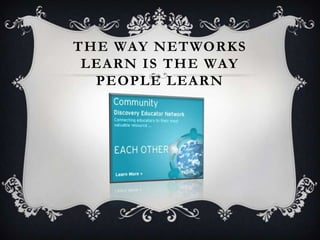
THE WAY NETWORKS
LEARN IS THE WAY
PEOPLE LEARN
WAYS THAT EDUCATORS
ARE USING THEIR PLNS
 - Professional development – learn from content-area specialists
 - Locate resources for your classroom, such as free websites and
software
 - Get lesson plan ideas from master teachers
 - Learn about new technology and how to integrate it into your
teaching
 - Find collaborative solutions
 - Find interesting links to education news
NEW TOOLS
OTHER TOOLS FOR PLN
BUT A NETWORK ISN’T
JUST FOLLOWING
You have to CONTRIBUTE!
CONTINUE
 This post describes how educators can develop a personal learning
network that supports meaningful and relevant learning. The MOOC,
Education Technology & Media, is used here as a working example of
how to develop a PLN.
 ―My Personal Learning Network is the key to keeping me up-to-date
with all the changes that are happening in education and how technology
can best support and engage today‘s students.‖ Brian Metcalfe: teacher,
blogger at lifelonglearners.com
PLN VERSUS PLE
 The personal learning network can be a rich source of learning that fosters
connections that become part of our professional development as the quotation at the
beginning of the post from Metcalfe describes. Yet building a PLN takes time, energy and
purposeful actions, which is why I find it helpful to delineate the two concepts. A PLE
can be created independently, building and collecting content sources from the Web,
including creating content through blogs, podcasts, Slide shares, etc. A natural extension
of one‘s PLE is the development of relationships with individuals that emerge from the
process of building the PLE, which is how the PLN develops. When connections from a
PLN are engaged, knowledge creation becomes interdependent
CONCLUSION
 Developing a PLN does require a commitment of time and energy,
but the rewards are abundant. Not only does interacting within a
virtual space satisfy the need for social interaction and connection, it
also can be the method of professional development, personal
satisfaction, relevance, adaptability, and most importantly—may allow
us the opportunity to make a difference.

Luyanda proff

  • 1.
    Professional networks -new opportunities for learners and educators Social network sites can be defined as web- based services that allow individuals to: (1)construct a public or semi-public profile within a bounded system (2)view and traverse their list of connections and those made by others within the system (3) articulate a list of other users with whom they share a connection .
  • 2.
    CONTINUE  Personal LearningNetworks, or PLNs, have been around forever. Originally, they were your family and friends, maybe other educators you worked with, but as the internet and web 2.0 tools have become nearly ubiquitous, PLNs can include tons of different communities – social networking sites like Facebook, blogs, Twitter, wikis, social bookmarking tools, LinkedIn
  • 3.
    CONTINUE  and somany more. Basically, anyone that you interact with is apart of your PLN, whether they are social contacts, professional peers, or experts in their field. Most of the ‗learning‘ takes place on- line now, because it is simple to find and connect with others with similar interests from around the world.
  • 4.
    - NEW OPPORTUNITIESFOR LEARNERS AND SOCIAL-ORIENTED APPLICATIONS AND PROFESSIONAL NETWORKS EDUCATION  A learning network is a group of persons  who create, share, support and study  learning resources (―units of learning‖)  in a specific knowledge domain.
  • 5.
    BUILDING PLE ONSTART BUILDING PLE ON START PAGES • PLEs building laid the foundations of some main ideas: (1)learning is an ongoing process and tools to support this learning are needed (2)the role of the individual in self-organizing learning is important (3)learning can take place in different contexts and situations and cannot be provided by a single learning provider.
  • 6.
    SOCIAL-ORIENTED APPLICATIONS AND PROFESSIONALNETWORKS - NEW OPPORTUNITIES FOR LEARNERS AND EDUCATORS  Because of their possibilities for:  data, information and ―knowledge fusion‖  enhancing accessibility, productivity and  innovative solutions  research too providing  forming groups of personal and  professional interests  To be successful at knowledge creation, analysis and dissemination, learners need from network inter-personal  and inter-group interactions
  • 7.
    BUILDING PLE ONSTART PAGES  PLEs are systems that help learners take control of and manage their own learning.  This includes providing support for learners to set their own learning goals, manage their learning;  managing both content and process;  communicate with others in the process of learning and thereby achieve learning goals.
  • 8.
    FORMING LEARNING NETWORKFOR COMPETENCE DEVELOPMENT  network of the course Internet Technologies is to: (1)provide sustainable value to students, not only during the courses but also after its finishing  stimulate them to contribute their knowledge, insights and experiences on a continuous basic Forming the learning
  • 9.
    PROFESSIONAL NETWORK ORGANIZING  ProfessionalNetwork Organizing  Professional Personal Learning Environment  Add tools/services  Connect to data, information, knowledge  Create artifacts  lPersonal Learning Network  Connect to peers, educators, family and friends  Share thoughts, ideas, resources, artifacts
  • 10.
    Professional Learning Network •Collaborate •Connectto professionals and experts via professional organizations and networks •ContributE.
  • 11.
    USA DOMINANT  Number ofnetworks  Diversity of networks  Business models Attracting VC  Pharmacy participation
  • 12.
    ONLINE LEARNING • Hasbeen around since 1995 or so • Really grew with the World Wide Web • Has advanced tremendously Many positive developments in the last few years worth sharing.
  • 13.
    THE LEARNING NETWORK • Thee-Portfolio lives in the intersection between the worlds for education, work, and home • A model for e-Portfolio as a learner-managed construct • Key requirement is easy-to-use tools and hosting services* • *E.g. the ―e-Portfolio-as-blog‖ approach
  • 14.
    THE WAY NETWORKS LEARNIS THE WAY PEOPLE LEARN
  • 15.
    WAYS THAT EDUCATORS AREUSING THEIR PLNS  - Professional development – learn from content-area specialists  - Locate resources for your classroom, such as free websites and software  - Get lesson plan ideas from master teachers  - Learn about new technology and how to integrate it into your teaching  - Find collaborative solutions  - Find interesting links to education news
  • 16.
  • 17.
  • 18.
    BUT A NETWORKISN’T JUST FOLLOWING You have to CONTRIBUTE!
  • 19.
    CONTINUE  This postdescribes how educators can develop a personal learning network that supports meaningful and relevant learning. The MOOC, Education Technology & Media, is used here as a working example of how to develop a PLN.  ―My Personal Learning Network is the key to keeping me up-to-date with all the changes that are happening in education and how technology can best support and engage today‘s students.‖ Brian Metcalfe: teacher, blogger at lifelonglearners.com
  • 20.
    PLN VERSUS PLE The personal learning network can be a rich source of learning that fosters connections that become part of our professional development as the quotation at the beginning of the post from Metcalfe describes. Yet building a PLN takes time, energy and purposeful actions, which is why I find it helpful to delineate the two concepts. A PLE can be created independently, building and collecting content sources from the Web, including creating content through blogs, podcasts, Slide shares, etc. A natural extension of one‘s PLE is the development of relationships with individuals that emerge from the process of building the PLE, which is how the PLN develops. When connections from a PLN are engaged, knowledge creation becomes interdependent
  • 21.
    CONCLUSION  Developing aPLN does require a commitment of time and energy, but the rewards are abundant. Not only does interacting within a virtual space satisfy the need for social interaction and connection, it also can be the method of professional development, personal satisfaction, relevance, adaptability, and most importantly—may allow us the opportunity to make a difference.