RICARTE S. BORJA JR., EdD
LESSON 5:
CURRICULUM DEVELOPMENT:
PROCESSES AND
MODELS
CURRICULUM DEVELOPMENT:
PROCESSES AND MODELS
• In curriculum development, there are always changes
that occur that are intended for improvement. To do
this, there are models presented to us from well-
known curricularists like Ralph Tyler, Hilda Taba,
Galen Saylor and William Alexander which would help
clarify the process of curriculum development. There
are many other models, but let us use the three for
this lesson.
CURRICULUM DEVELOPMENT
PROCESS
• Curriculum development is a dynamic process involving many
different people and procedures. Development connotes
changes which is systematic. A change for the better means
alteration, modification or improvement of existing condition.
To produce positive changes, development should be
purposeful, planned and progressive. Usually it is linear and
follows a logical step-by-step fashion involving the following
phases: curriculum planning, curriculum design, curriculum
implementation and curriculum evaluation. Generally, most
models involve four phases.
FOUR
PHASES
CURRICULUM DEVELOPMENT
PROCESS MODELS
Ralph Tyler
Model: Four
Basic Principles
Hilda Taba Model:
Grassroots
Approach
Galen Saylor and
William
Alexander
Curriculum Model
Curriculum Development Process Models
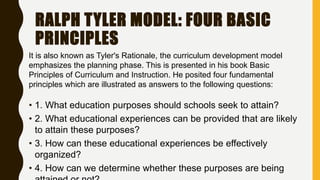
RALPH TYLER MODEL: FOUR BASIC
PRINCIPLES
It is also known as Tyler's Rationale, the curriculum development model
emphasizes the planning phase. This is presented in his book Basic
Principles of Curriculum and Instruction. He posited four fundamental
principles which are illustrated as answers to the following questions:
• 1. What education purposes should schools seek to attain?
• 2. What educational experiences can be provided that are likely
to attain these purposes?
• 3. How can these educational experiences be effectively
organized?
• 4. How can we determine whether these purposes are being
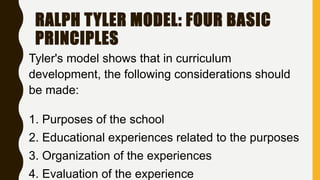
RALPH TYLER MODEL: FOUR BASIC
PRINCIPLES
Tyler's model shows that in curriculum
development, the following considerations should
be made:
1. Purposes of the school
2. Educational experiences related to the purposes
3. Organization of the experiences
4. Evaluation of the experience
HILDA TABA MODEL: GRASSROOTS
APPROACH
•Hilda Taba improved on Tyler's model. She
believed that teachers should participate in
developing a curriculum. As a grassroots
approach, Taba begins from the bottom,
rather than from the top as what Tyler
proposed.
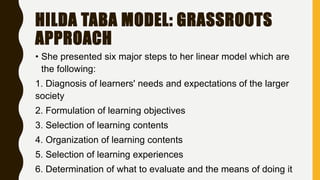
HILDA TABA MODEL: GRASSROOTS
APPROACH
• She presented six major steps to her linear model which are
the following:
1. Diagnosis of learners' needs and expectations of the larger
society
2. Formulation of learning objectives
3. Selection of learning contents
4. Organization of learning contents
5. Selection of learning experiences
6. Determination of what to evaluate and the means of doing it
GALEN SAYLOR AND WILLIAM
ALEXANDER CURRICULUM MODEL
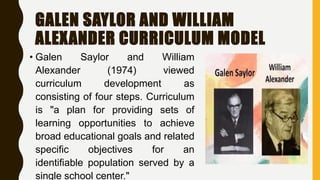
• Galen Saylor and William
Alexander (1974) viewed
curriculum development as
consisting of four steps. Curriculum
is "a plan for providing sets of
learning opportunities to achieve
broad educational goals and related
specific objectives for an
identifiable population served by a
single school center."
GALEN SAYLOR AND WILLIAM
ALEXANDER CURRICULUM MODEL
1. Goals, Objectives and Domains.
Curriculum planners begin by
specifying the major educational
goals and specific objectives they
wish to accomplish. Each major goal
represents a curriculum domain:
personal development, human
relations, continued learning skills
and specialization. The goals,
objectives and domains are
identified and chosen based on
research findings, accreditation
GALEN SAYLOR AND WILLIAM
ALEXANDER CURRICULUM MODEL
2. Curriculum Designing.
Designing a curriculum follows after
appropriate learning opportunities
are determined and how each
opportunity is provided. Will the
curriculum be designed along the
lines of academic disciplines, or
according to student needs and
interests or along themes? These
are some of the questions that need
to be answered at this stage of the
development process
GALEN SAYLOR AND WILLIAM
ALEXANDER CURRICULUM MODEL
3.Curriculum Implementation.
A designed curriculum is now
ready for implementation.
Teachers then prepare
instructional plans where
instructional objectives are
specified and appropriate
teaching methods and
strategies are utilized to achieve
the desired learning outcomes
GALEN SAYLOR AND WILLIAM
ALEXANDER CURRICULUM MODEL
4. Evaluation. The last step of the
curriculum model is evaluation. A
comprehensive evaluation using a variety
of evaluation techniques is
recommended. It should involve the total
educational programme of the school and
the curriculum plan, the effectiveness of
instruction and the achievement of
students. Through the evaluation process,
curriculum planners and developers can
determine whether or not the goals of the
school and the objectives of instruction
have been met.
LESSON 6: FOUNDATIONS OF
CURRICULUM
1. PHILOSOPHICAL FOUNDATION
Educators, teachers,
educational planners and
policy makers must have a
philosophy or strong belief
about education and
schooling and the kind of
curriculum in the teachers'
classrooms or learning
environment.
1. PHILOSOPHICAL FOUNDATION
Questions
in
curriculum
Philosophy
What are schools for?
What subjects are
important?
How should students
learn?
What methods should
be used?
What outcomes should
be achieved? Why?
1. PHILOSOPHICAL FOUNDATION
The various activities in school are
influenced in one way or another
philosophy. John Dewey influenced the use
of "learning by doing", he is a pragmatist.
To an essentialist, the focus is on the
fundamentals of reading, writing, and
arithmetic, the essential subjects in the
curriculum.
PHILOSOPHIES IN EDUCATION as presented
by ORNSTEIN AND HUNKINS 2004.
A. PERENNIALISM
-- Plato, Aristotle or Thomas Aquinas
• Aim: To educate the rational person; cultivate intellect
• Role: Teachers assist students to think with reason
(critical thinking: HOTS)
• Focus: Classical subjects, literary analysis
Curriculum is enduring
• Trends: Use of great books (Bible, Koran, Classics)
and Liberal Arts
B. ESSENTIALISM- WILLIAM BAGLEY
(1974-1946)
• Aim: To promote intellectual growth of learners to
become competent
• Role: Teachers are sole authorities in the subject
area.
• Focus: Essential skills of the 3Rs; essential subjects
• Trends: Back to basics, Excellence in education,
cultural literacy.
C. PROGRESSIVISM- JOHN DEWEY
(1859-1952)
• Aim: Promote democratic social living
• Role: Teacher leads for growth and development of
lifelong learners.
• Focus: Interdisciplinary subjects. Learner centered.
Outcomes-based
• Trends: Equal opportunities for all, Contextualized
curriculum, Humanistic education
D. RECONSTRUCTIONISM- THEODORE
BRAMELD (1904-1987)
• Aim: To improve and reconstruct society. Education
for change
• Role: Teacher acts as agent of change and reforms
• Focus: Present and future educational landscape
• Trends: School and curricular reform, Global
education, Collaboration and Convergence.
• Standards and Competencies
2. HISTORICAL FOUNDATIONS
• Where is curriculum development coming from? The
historical foundations will show to us the chronological
development along a time line. Reading materials
would tell us that curriculum development started
when Franklin Bobbit (1876-1956) wrote the book
"The Curriculum." Let us see how each one
contributed to curriculum development during his own
time. Here are eight among the many whom we
consider to have great contributions.
HISTORICAL FOUNDATIONS
PERSONS CONTRIBUTIONS/THEORIES AND PRINCIPLES
Franklin Bobbit (1876-1956)  He started the curriculum development movement.
 Curriculum as a science that emphasizes students’ needs.
 Curriculum prepares learners for adult life.
 Objectives and activities should group together when tasks are clarified.
Werret Charters (1875-1952)  Like Bobbit, he posited that curriculum is science and emphasizes students' needs.
 Objectives and activities should match. Subject matter or content relates to
objectives.
William Kilpartick (1875-1952)  Curricula are purposeful activities which are child centered.
 The purpose of the curriculum is child development and growth. He introduced this
project method where teacher and student plan the activities.
 Curriculum develops social relationships and small group instruction.
Harold Rugg (1886-1960)  Curriculum should develop the whole child. It is child-centered.
 With the statement of objectives and related learning activities, curriculum should
produce outcomes.
 He emphasized social studies and suggested that the teacher plans curriculum in
advance.
HISTORICAL FOUNDATIONS
PERSONS CONTRIBUTIONS/THEORIES AND PRINCIPLES
Hollis Caswell (1901-1989)  Curriculum is organized around social functions of themes, organized knowledge and
learner's interest.
 Curriculum, instruction and learning are interrelated.
 Curriculum is a set of experiences. Subject matter is developed around social functions
and learners' interests.
Ralph Tyler (1902-1994)  Curriculum is a science and an extension of school's philosophy. It is based on students'
needs and interest.
 Curriculum is always related to instruction. Subject matter is organized in terms of
knowledge, skills and values.
 The process emphasizes problem solving. Curriculum aims to educate generalists and
not specialists.
Hilda Taba (1902-1967)  She contributed to the theoretical and pedagogical foundations of concepts development
and critical thinking in social studies curriculum.
 She helped lay the foundation for diverse student population.
Peter Oliva (1992-2012)  He described curriculum change as a cooperative endeavor.
 Teachers and curriculum specialist constitute the professional core of planners.
 Significant improvement is achieved through group activity.
3. PSYCHOLOGICAL FOUNDATION OF
CURRICULUM
Psychology provides a basis to understand the teaching and
learning process. It unifies elements of the learning process.
Questions which can be addressed by psychological
foundations of education are: How should curriculum be
organized to enhance learning? What is the optimal level of
students' participation in learning the various contents of the
curriculum? In this module, we shall consider three groups
of learning theories: behaviorism or association theories;
cognitive-information processing theories and humanistic
theories (Ornstein & Hunkins, 2004).
1. ASSOCIATION AND BEHAVIORISM
PERSONS CONTRIBUTIONS THEORIES AND PRINCIPLES
Ivan Pavlov (1849-
1936)
 He is the father of the classical conditioning theory, the S-R
theory.
 The key to learning is early years of life is to train them what you
want them to become.
 S-R Theory is a foundation of learning practice called
indoctrination.
Edward Thorndike
(1874-1949)
 He championed the connectionism theory.
 He proposed the three laws of learning:
-Law of readiness
-Law of exercise
-Law of effect
 Specific stimulus has specific response.
Robert Gagne (1916-
2002)
 He proposed the hierarchical learning theory Learning follows a
hierarchy.
2. COGNITIVE INFORMATION
PROCESSING THEORY
PERSONS CONTRIBUTIONS/THEORIES AND PRINCIPLES
Jean Piaget
(1896-1980)
Theories of Jean Piaget
 Cognitive development has stages from birth to maturity.
 Sensorimotor stage (0-2), preoperational stage (2-7), concrete operations stage
(7-11) and formal operations (11- onwards).
Keys to learning
 Assimilation (incorporation of new experience)
 Accommodation (learning modification and adaptation)
 Equilibration (balance between previous and later learning)
Lev Vygotsky
(1896-1934)
Theories of Lev Vygotsky
 Cultural transmission and development stage. Children could, as a result of their
interaction with society, actually perform certain cognitive actions prior to
arriving at developmental stage.
 Learning precedes development.
 Sociocultural development theory.
Keys to Learning
 Pedagogy creates learning processes that lead to development.
 The child is an active agent in his or her educational process.
2. COGNITIVE INFORMATION
PROCESSING THEORY
PERSONS CONTRIBUTIONS/THEORIES AND PRINCIPLES
Howard Gardner Gardner's multiple intelligences
 Humans have several different ways of processing
information and these ways are relatively independent
of one another
 There are eight intelligences: linguistic, logico-
mathematical, musical, spatial, bodily/kinesthetic,
interpersonal, intrapersonal, and naturalistic
Daniel Goleman Emotion contains the power to affect action.
 He called this Emotional Quotient.
3. HUMANISTIC PSYCHOLOGY
PERSONS/SYMBOLS CONTRIBUTIONS THEORIES AND PRINCIPLES
Gestalt • Gestalt Theory
-Learning is explained in terms of "wholeness of the problem
-Human beings do not respond to isolated stimuli but to an organization or
pattern of stimuli.
• Keys to learning
-Learning is complex and abstract
-Learners analyze the problem, discriminate between essential and
nonessential data, and perceive relationships.
-Learners will perceive something in relation to the whole. What how they
perceive is related to their previous experiences
Abraham
Maslow (1908-
1970)
 He advanced the Self-Actualization Theory.
 Classic theory of human needs
 A child whose basic needs are not met will not be interested in acquiring
knowledge of the world.
 He put importance to human emotions, based on love and trust.
Key to learning
 Produce a healthy and happy learner who can accomplish, grow and
actualize his or her human self.
3. HUMANISTIC PSYCHOLOGY
PERSONS/SYMBOLS CONTRIBUTIONS THEORIES AND PRINCIPLES
Carl Rogers
(1902-1987)
Nondirective and therapeutic learning
 He established counselling procedures and
methods for facilitating learning.
 Children's perceptions, which are highly
individualistic, influence their learning and
behaviour in class.
Key to learning
 Curriculum is concerned with process, not
product; personal needs, not subject matter,
psychological meaning, not cognitive scores.
4. SOCIAL FOUNDATIONS OF
CURRICULUM
PERSONS/SYMBOLS CONTRIBUTIONS/THEORIES AND PRINCIPLES
Schools and
Society
 Society as a source of change
 Schools as agents of change
 Knowledge as an agent of change
Emile Durkheim
(1858-1917)
 Influence of society and social context in education
 Things that surround individuals can change, develop their
behavior.
 Considered two fundamental elements which are schools and
civil society
Alvin Toffler  Wrote the book Future Shock
 Believed that knowledge should prepare students for the future
Suggested that in the future, parents might have the resources to
teach prescribed curriculum from home as a result of technology,
not in spite of it. (Home Schooling)
 Foresaw schools and students worked creatively, collaboratively,
and independent of their age
OTHER THEORISTS
Paolo Freire
1921-1997
 Education as a means of shaping the person and society through critical
reflections and "conscientization"
 Teachers use questioning and problem posing approach to raise students
consciousness
 Emphasis on questioning problem posing and critical thinking
 Major book: Pedagogy of the Oppressed, 1968
John Goodlad
1920-2014
 Curriculum organized around needs of society and the students
 Reduce student conformity in classroom
 Constant need for school improvement
 Emphasis on active learning and critical thinking
 Involvement of students in planning curriculum content and instructional
activities
 Need to align content with standards
 Major book: A Place Called Schools, 1984; What Are Schools For? 1989
William Pinar
1947-
 Broaden the conception of curriculum to enrich the practice
 Understand the nature of the educational experience
 Curriculum involves multiple disciplines
 Curriculum should be studied from a historical, racial, gendered,
phenomenological, postmodern, theological and international
perspectives.
YO U R T U R N T O
A S K Q U E S T I O N S

PART-II-LfefffefefefeESSON-5-LESSON-6.pptx

  • 1.
  • 2.
  • 3.
    CURRICULUM DEVELOPMENT: PROCESSES ANDMODELS • In curriculum development, there are always changes that occur that are intended for improvement. To do this, there are models presented to us from well- known curricularists like Ralph Tyler, Hilda Taba, Galen Saylor and William Alexander which would help clarify the process of curriculum development. There are many other models, but let us use the three for this lesson.
  • 4.
    CURRICULUM DEVELOPMENT PROCESS • Curriculumdevelopment is a dynamic process involving many different people and procedures. Development connotes changes which is systematic. A change for the better means alteration, modification or improvement of existing condition. To produce positive changes, development should be purposeful, planned and progressive. Usually it is linear and follows a logical step-by-step fashion involving the following phases: curriculum planning, curriculum design, curriculum implementation and curriculum evaluation. Generally, most models involve four phases.
  • 5.
  • 6.
    CURRICULUM DEVELOPMENT PROCESS MODELS RalphTyler Model: Four Basic Principles Hilda Taba Model: Grassroots Approach Galen Saylor and William Alexander Curriculum Model Curriculum Development Process Models
  • 7.
    RALPH TYLER MODEL:FOUR BASIC PRINCIPLES It is also known as Tyler's Rationale, the curriculum development model emphasizes the planning phase. This is presented in his book Basic Principles of Curriculum and Instruction. He posited four fundamental principles which are illustrated as answers to the following questions: • 1. What education purposes should schools seek to attain? • 2. What educational experiences can be provided that are likely to attain these purposes? • 3. How can these educational experiences be effectively organized? • 4. How can we determine whether these purposes are being
  • 8.
    RALPH TYLER MODEL:FOUR BASIC PRINCIPLES Tyler's model shows that in curriculum development, the following considerations should be made: 1. Purposes of the school 2. Educational experiences related to the purposes 3. Organization of the experiences 4. Evaluation of the experience
  • 9.
    HILDA TABA MODEL:GRASSROOTS APPROACH •Hilda Taba improved on Tyler's model. She believed that teachers should participate in developing a curriculum. As a grassroots approach, Taba begins from the bottom, rather than from the top as what Tyler proposed.
  • 10.
    HILDA TABA MODEL:GRASSROOTS APPROACH • She presented six major steps to her linear model which are the following: 1. Diagnosis of learners' needs and expectations of the larger society 2. Formulation of learning objectives 3. Selection of learning contents 4. Organization of learning contents 5. Selection of learning experiences 6. Determination of what to evaluate and the means of doing it
  • 11.
    GALEN SAYLOR ANDWILLIAM ALEXANDER CURRICULUM MODEL • Galen Saylor and William Alexander (1974) viewed curriculum development as consisting of four steps. Curriculum is "a plan for providing sets of learning opportunities to achieve broad educational goals and related specific objectives for an identifiable population served by a single school center."
  • 12.
    GALEN SAYLOR ANDWILLIAM ALEXANDER CURRICULUM MODEL 1. Goals, Objectives and Domains. Curriculum planners begin by specifying the major educational goals and specific objectives they wish to accomplish. Each major goal represents a curriculum domain: personal development, human relations, continued learning skills and specialization. The goals, objectives and domains are identified and chosen based on research findings, accreditation
  • 13.
    GALEN SAYLOR ANDWILLIAM ALEXANDER CURRICULUM MODEL 2. Curriculum Designing. Designing a curriculum follows after appropriate learning opportunities are determined and how each opportunity is provided. Will the curriculum be designed along the lines of academic disciplines, or according to student needs and interests or along themes? These are some of the questions that need to be answered at this stage of the development process
  • 14.
    GALEN SAYLOR ANDWILLIAM ALEXANDER CURRICULUM MODEL 3.Curriculum Implementation. A designed curriculum is now ready for implementation. Teachers then prepare instructional plans where instructional objectives are specified and appropriate teaching methods and strategies are utilized to achieve the desired learning outcomes
  • 15.
    GALEN SAYLOR ANDWILLIAM ALEXANDER CURRICULUM MODEL 4. Evaluation. The last step of the curriculum model is evaluation. A comprehensive evaluation using a variety of evaluation techniques is recommended. It should involve the total educational programme of the school and the curriculum plan, the effectiveness of instruction and the achievement of students. Through the evaluation process, curriculum planners and developers can determine whether or not the goals of the school and the objectives of instruction have been met.
  • 16.
    LESSON 6: FOUNDATIONSOF CURRICULUM
  • 17.
    1. PHILOSOPHICAL FOUNDATION Educators,teachers, educational planners and policy makers must have a philosophy or strong belief about education and schooling and the kind of curriculum in the teachers' classrooms or learning environment.
  • 18.
    1. PHILOSOPHICAL FOUNDATION Questions in curriculum Philosophy Whatare schools for? What subjects are important? How should students learn? What methods should be used? What outcomes should be achieved? Why?
  • 19.
    1. PHILOSOPHICAL FOUNDATION Thevarious activities in school are influenced in one way or another philosophy. John Dewey influenced the use of "learning by doing", he is a pragmatist. To an essentialist, the focus is on the fundamentals of reading, writing, and arithmetic, the essential subjects in the curriculum.
  • 20.
    PHILOSOPHIES IN EDUCATIONas presented by ORNSTEIN AND HUNKINS 2004.
  • 21.
    A. PERENNIALISM -- Plato,Aristotle or Thomas Aquinas • Aim: To educate the rational person; cultivate intellect • Role: Teachers assist students to think with reason (critical thinking: HOTS) • Focus: Classical subjects, literary analysis Curriculum is enduring • Trends: Use of great books (Bible, Koran, Classics) and Liberal Arts
  • 22.
    B. ESSENTIALISM- WILLIAMBAGLEY (1974-1946) • Aim: To promote intellectual growth of learners to become competent • Role: Teachers are sole authorities in the subject area. • Focus: Essential skills of the 3Rs; essential subjects • Trends: Back to basics, Excellence in education, cultural literacy.
  • 23.
    C. PROGRESSIVISM- JOHNDEWEY (1859-1952) • Aim: Promote democratic social living • Role: Teacher leads for growth and development of lifelong learners. • Focus: Interdisciplinary subjects. Learner centered. Outcomes-based • Trends: Equal opportunities for all, Contextualized curriculum, Humanistic education
  • 24.
    D. RECONSTRUCTIONISM- THEODORE BRAMELD(1904-1987) • Aim: To improve and reconstruct society. Education for change • Role: Teacher acts as agent of change and reforms • Focus: Present and future educational landscape • Trends: School and curricular reform, Global education, Collaboration and Convergence. • Standards and Competencies
  • 25.
    2. HISTORICAL FOUNDATIONS •Where is curriculum development coming from? The historical foundations will show to us the chronological development along a time line. Reading materials would tell us that curriculum development started when Franklin Bobbit (1876-1956) wrote the book "The Curriculum." Let us see how each one contributed to curriculum development during his own time. Here are eight among the many whom we consider to have great contributions.
  • 26.
    HISTORICAL FOUNDATIONS PERSONS CONTRIBUTIONS/THEORIESAND PRINCIPLES Franklin Bobbit (1876-1956)  He started the curriculum development movement.  Curriculum as a science that emphasizes students’ needs.  Curriculum prepares learners for adult life.  Objectives and activities should group together when tasks are clarified. Werret Charters (1875-1952)  Like Bobbit, he posited that curriculum is science and emphasizes students' needs.  Objectives and activities should match. Subject matter or content relates to objectives. William Kilpartick (1875-1952)  Curricula are purposeful activities which are child centered.  The purpose of the curriculum is child development and growth. He introduced this project method where teacher and student plan the activities.  Curriculum develops social relationships and small group instruction. Harold Rugg (1886-1960)  Curriculum should develop the whole child. It is child-centered.  With the statement of objectives and related learning activities, curriculum should produce outcomes.  He emphasized social studies and suggested that the teacher plans curriculum in advance.
  • 27.
    HISTORICAL FOUNDATIONS PERSONS CONTRIBUTIONS/THEORIESAND PRINCIPLES Hollis Caswell (1901-1989)  Curriculum is organized around social functions of themes, organized knowledge and learner's interest.  Curriculum, instruction and learning are interrelated.  Curriculum is a set of experiences. Subject matter is developed around social functions and learners' interests. Ralph Tyler (1902-1994)  Curriculum is a science and an extension of school's philosophy. It is based on students' needs and interest.  Curriculum is always related to instruction. Subject matter is organized in terms of knowledge, skills and values.  The process emphasizes problem solving. Curriculum aims to educate generalists and not specialists. Hilda Taba (1902-1967)  She contributed to the theoretical and pedagogical foundations of concepts development and critical thinking in social studies curriculum.  She helped lay the foundation for diverse student population. Peter Oliva (1992-2012)  He described curriculum change as a cooperative endeavor.  Teachers and curriculum specialist constitute the professional core of planners.  Significant improvement is achieved through group activity.
  • 28.
    3. PSYCHOLOGICAL FOUNDATIONOF CURRICULUM Psychology provides a basis to understand the teaching and learning process. It unifies elements of the learning process. Questions which can be addressed by psychological foundations of education are: How should curriculum be organized to enhance learning? What is the optimal level of students' participation in learning the various contents of the curriculum? In this module, we shall consider three groups of learning theories: behaviorism or association theories; cognitive-information processing theories and humanistic theories (Ornstein & Hunkins, 2004).
  • 29.
    1. ASSOCIATION ANDBEHAVIORISM PERSONS CONTRIBUTIONS THEORIES AND PRINCIPLES Ivan Pavlov (1849- 1936)  He is the father of the classical conditioning theory, the S-R theory.  The key to learning is early years of life is to train them what you want them to become.  S-R Theory is a foundation of learning practice called indoctrination. Edward Thorndike (1874-1949)  He championed the connectionism theory.  He proposed the three laws of learning: -Law of readiness -Law of exercise -Law of effect  Specific stimulus has specific response. Robert Gagne (1916- 2002)  He proposed the hierarchical learning theory Learning follows a hierarchy.
  • 30.
    2. COGNITIVE INFORMATION PROCESSINGTHEORY PERSONS CONTRIBUTIONS/THEORIES AND PRINCIPLES Jean Piaget (1896-1980) Theories of Jean Piaget  Cognitive development has stages from birth to maturity.  Sensorimotor stage (0-2), preoperational stage (2-7), concrete operations stage (7-11) and formal operations (11- onwards). Keys to learning  Assimilation (incorporation of new experience)  Accommodation (learning modification and adaptation)  Equilibration (balance between previous and later learning) Lev Vygotsky (1896-1934) Theories of Lev Vygotsky  Cultural transmission and development stage. Children could, as a result of their interaction with society, actually perform certain cognitive actions prior to arriving at developmental stage.  Learning precedes development.  Sociocultural development theory. Keys to Learning  Pedagogy creates learning processes that lead to development.  The child is an active agent in his or her educational process.
  • 31.
    2. COGNITIVE INFORMATION PROCESSINGTHEORY PERSONS CONTRIBUTIONS/THEORIES AND PRINCIPLES Howard Gardner Gardner's multiple intelligences  Humans have several different ways of processing information and these ways are relatively independent of one another  There are eight intelligences: linguistic, logico- mathematical, musical, spatial, bodily/kinesthetic, interpersonal, intrapersonal, and naturalistic Daniel Goleman Emotion contains the power to affect action.  He called this Emotional Quotient.
  • 32.
    3. HUMANISTIC PSYCHOLOGY PERSONS/SYMBOLSCONTRIBUTIONS THEORIES AND PRINCIPLES Gestalt • Gestalt Theory -Learning is explained in terms of "wholeness of the problem -Human beings do not respond to isolated stimuli but to an organization or pattern of stimuli. • Keys to learning -Learning is complex and abstract -Learners analyze the problem, discriminate between essential and nonessential data, and perceive relationships. -Learners will perceive something in relation to the whole. What how they perceive is related to their previous experiences Abraham Maslow (1908- 1970)  He advanced the Self-Actualization Theory.  Classic theory of human needs  A child whose basic needs are not met will not be interested in acquiring knowledge of the world.  He put importance to human emotions, based on love and trust. Key to learning  Produce a healthy and happy learner who can accomplish, grow and actualize his or her human self.
  • 33.
    3. HUMANISTIC PSYCHOLOGY PERSONS/SYMBOLSCONTRIBUTIONS THEORIES AND PRINCIPLES Carl Rogers (1902-1987) Nondirective and therapeutic learning  He established counselling procedures and methods for facilitating learning.  Children's perceptions, which are highly individualistic, influence their learning and behaviour in class. Key to learning  Curriculum is concerned with process, not product; personal needs, not subject matter, psychological meaning, not cognitive scores.
  • 34.
    4. SOCIAL FOUNDATIONSOF CURRICULUM PERSONS/SYMBOLS CONTRIBUTIONS/THEORIES AND PRINCIPLES Schools and Society  Society as a source of change  Schools as agents of change  Knowledge as an agent of change Emile Durkheim (1858-1917)  Influence of society and social context in education  Things that surround individuals can change, develop their behavior.  Considered two fundamental elements which are schools and civil society Alvin Toffler  Wrote the book Future Shock  Believed that knowledge should prepare students for the future Suggested that in the future, parents might have the resources to teach prescribed curriculum from home as a result of technology, not in spite of it. (Home Schooling)  Foresaw schools and students worked creatively, collaboratively, and independent of their age
  • 35.
    OTHER THEORISTS Paolo Freire 1921-1997 Education as a means of shaping the person and society through critical reflections and "conscientization"  Teachers use questioning and problem posing approach to raise students consciousness  Emphasis on questioning problem posing and critical thinking  Major book: Pedagogy of the Oppressed, 1968 John Goodlad 1920-2014  Curriculum organized around needs of society and the students  Reduce student conformity in classroom  Constant need for school improvement  Emphasis on active learning and critical thinking  Involvement of students in planning curriculum content and instructional activities  Need to align content with standards  Major book: A Place Called Schools, 1984; What Are Schools For? 1989 William Pinar 1947-  Broaden the conception of curriculum to enrich the practice  Understand the nature of the educational experience  Curriculum involves multiple disciplines  Curriculum should be studied from a historical, racial, gendered, phenomenological, postmodern, theological and international perspectives.
  • 36.
    YO U RT U R N T O A S K Q U E S T I O N S