Technology in the
Constructivist Learning
Environment
Learning Objectives:
• Explain fully the concept of a learning
environment.
• Discuss and put in context the various
constructivist learning principles.
• Create a technology-supported
constructivist learning environment.
Introduction
Today, all of us are aware that the
traditional picture of the teacher, the
classroom, and the school is gradually, if
not totally phasing out due to emergence
of learning paradigms and the influx of
technology in the learning environment.
Is the school or the
classroom the only
learning environment?
What
is
Learning Environment?
• it refers to the diverse physical locations,
contexts, and cultures in which students
learn.
• the term also encompasses the culture of a school or
class– its presiding ethos and characteristics,
including how individuals interact with and treat one
another as well as the ways which teachers may organize
an educational setting to facilitate learning (The Learning
Environment, 2013)
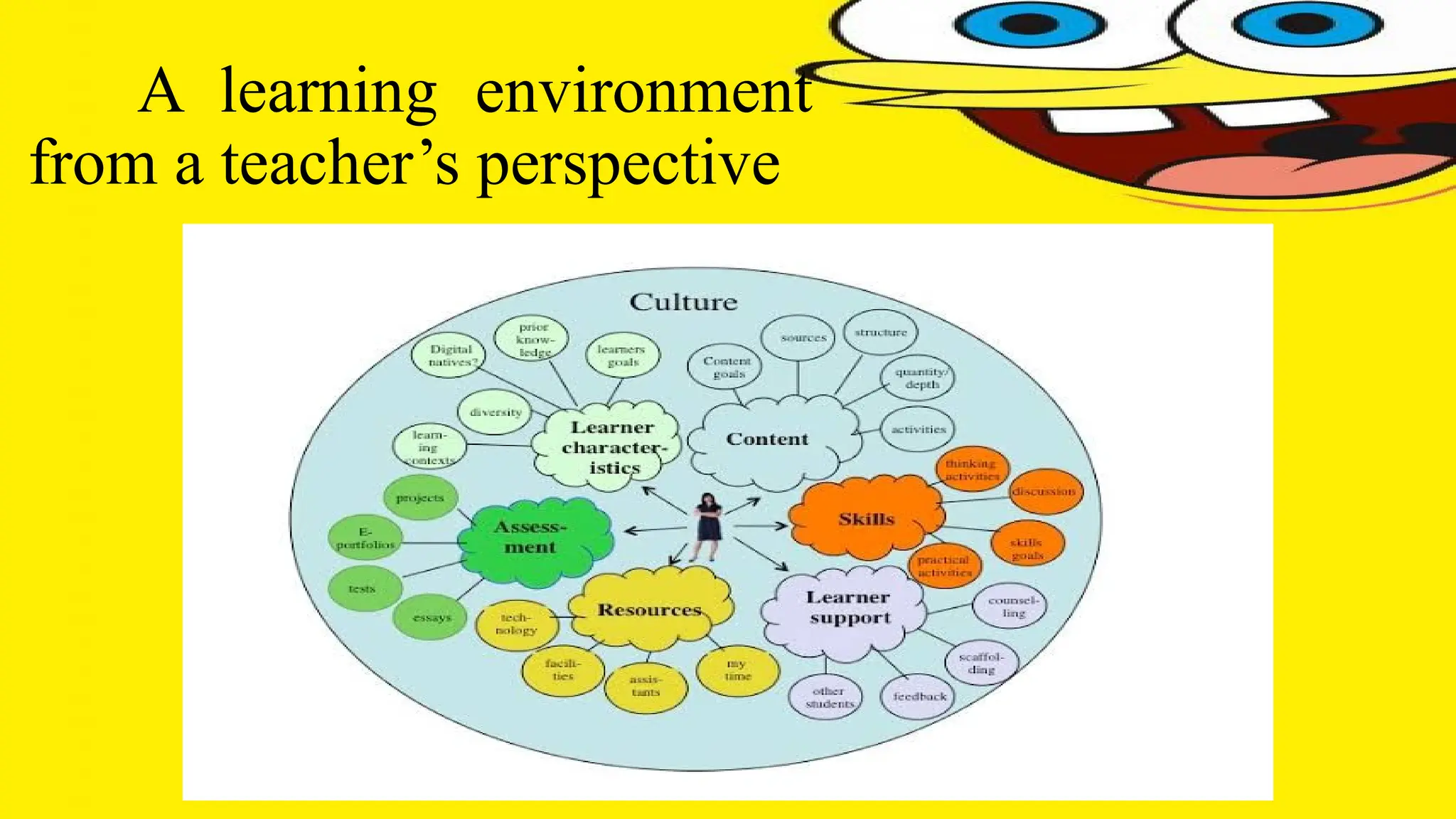
Learning environment is more than
just its physical components. It
involves teaching and learning goals,
learners’ characteristics, activities that
facilitate learning assessment strategies
and the culture in the learning
environment (Bates, 2014)
A learning environment
from a teacher’s perspective
Constructivist Learning
Environment
•Jerome Bruner developed the theory
of constructivism.
• his constructivist theory was
influenced by the earlier theoretical
research of Lev Vygotsky, and Jean
Piaget.
• the term constructivist is rooted from the
theory of constructivism.
•Bruner’s constructivist framework supports
the belief that learners construct new ideas and
concepts based on their existing knowledge.
He presented the idea that children could be
active problem solvers and are capable of
exploring more difficult subjects of
instruction.
• Today constructivism is the latest catchword in the academic
arena. It is not actually new as a learning principle, however,
this is oftentimes misunderstood and seldom practiced in the
classroom. In a nutshell, the theory of constructivism states
that knowledge is constructed not transmitted, that the
construction of knowledge is based on experience; that
learning is a social dialogical process; and therefore, through
dialogues and conversation learning takes place.
Basic Constructivist Principles
• Learning is an active process. It requires learners
to be engaged in the learning activities that will
enable them to construct their own knowledge and
understanding.
• People learn to learn as they learn. The act of
learning involves constructing meaning and systems
of meaning. Every meaning we construct enable us
to give meaning to other related senses and
perceptions that follow similar pattern.
• Construction of meaning is cognitive. It takes place in the
mind. While physical activities and hands-on experience
may be necessary for learning, however, it may not be
sufficient. Teachers need to design learning activities that
will involve both the mind and the hands. This is what
Dewey calls reflective activity.
•Learning involves language. Research studies have
emphasized the influence of language in learning
particularly the role of talk in the classroom. Some people
even talk to themselves while learning.
• Learning is a social activity. Learning is highly associated with the
degree of connection and interaction we make with others. Through
dialogues and conversations with others make us learn.
• Learning is contextual. We do not learn isolated facts and theories but
rather we learn in relationship to other things we know, what we
believe, our prejudices, and our fears. We cannot separate our learning
from our lives.
• Knowledge is needed in order to learn. We can’t assimilate new
knowledge without having some structure developed from previous
knowledge to build on.
• Learning is not instantaneous. It takes time. In learning we usually
recall ideas, reflect and try on them and eventually use them. And
when we ponder on these cluster of thoughts and ideas, we are
actually engaging in meaning making and, therefore, this takes
time.
• Motivation is a key component in learning. In any act of learning,
motivation plays a crucial role. Teachers understand that the source
of motivation may be intrinsic or extrinsic. Motivation here includes
an understanding of ways in which the new knowledge may be
used.
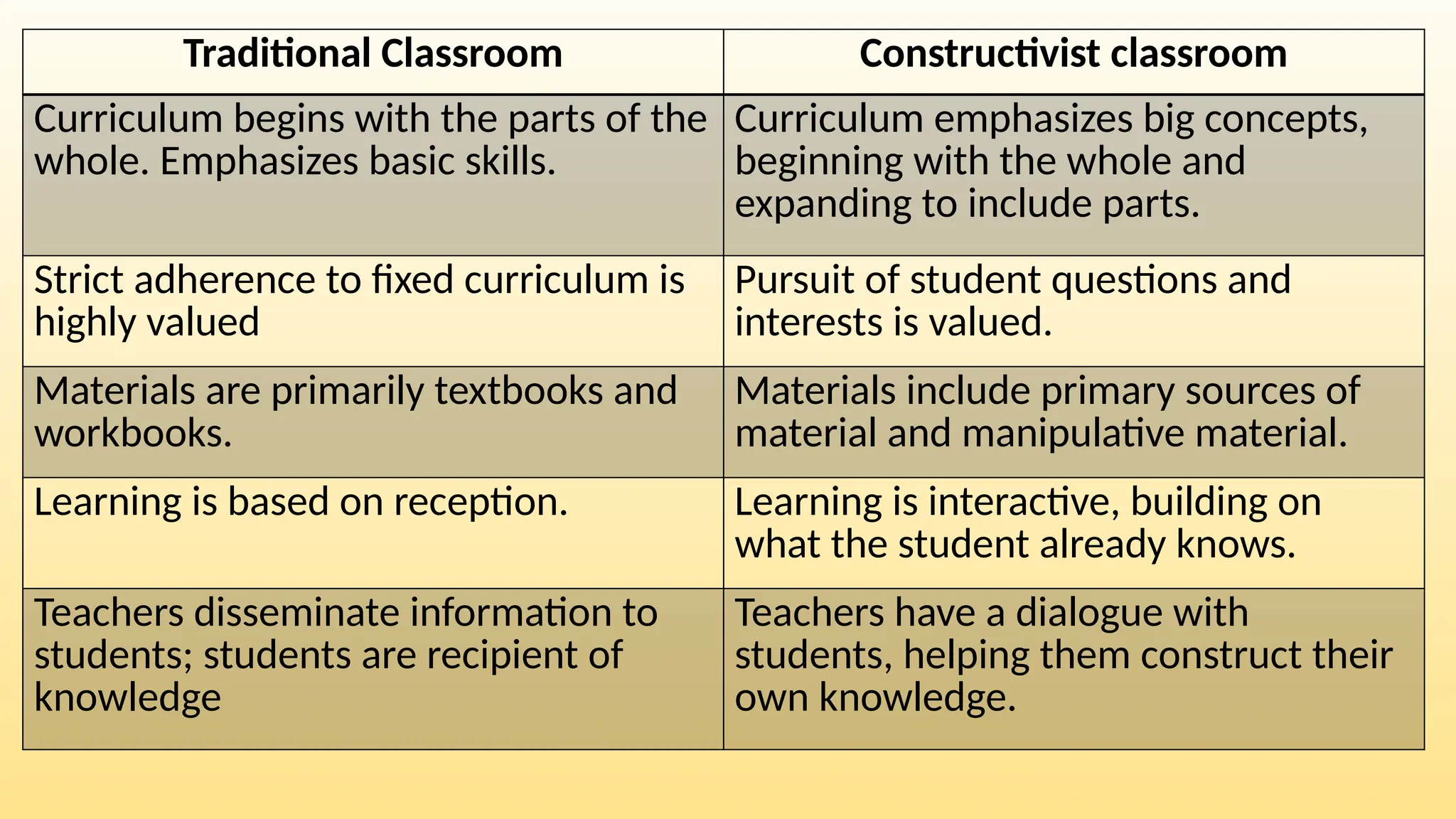
Traditional Classroom Constructivist classroom
Curriculum begins with the parts of the
whole. Emphasizes basic skills.
Curriculum emphasizes big concepts,
beginning with the whole and
expanding to include parts.
Strict adherence to fixed curriculum is
highly valued
Pursuit of student questions and
interests is valued.
Materials are primarily textbooks and
workbooks.
Materials include primary sources of
material and manipulative material.
Learning is based on reception. Learning is interactive, building on
what the student already knows.
Teachers disseminate information to
students; students are recipient of
knowledge
Teachers have a dialogue with
students, helping them construct their
own knowledge.
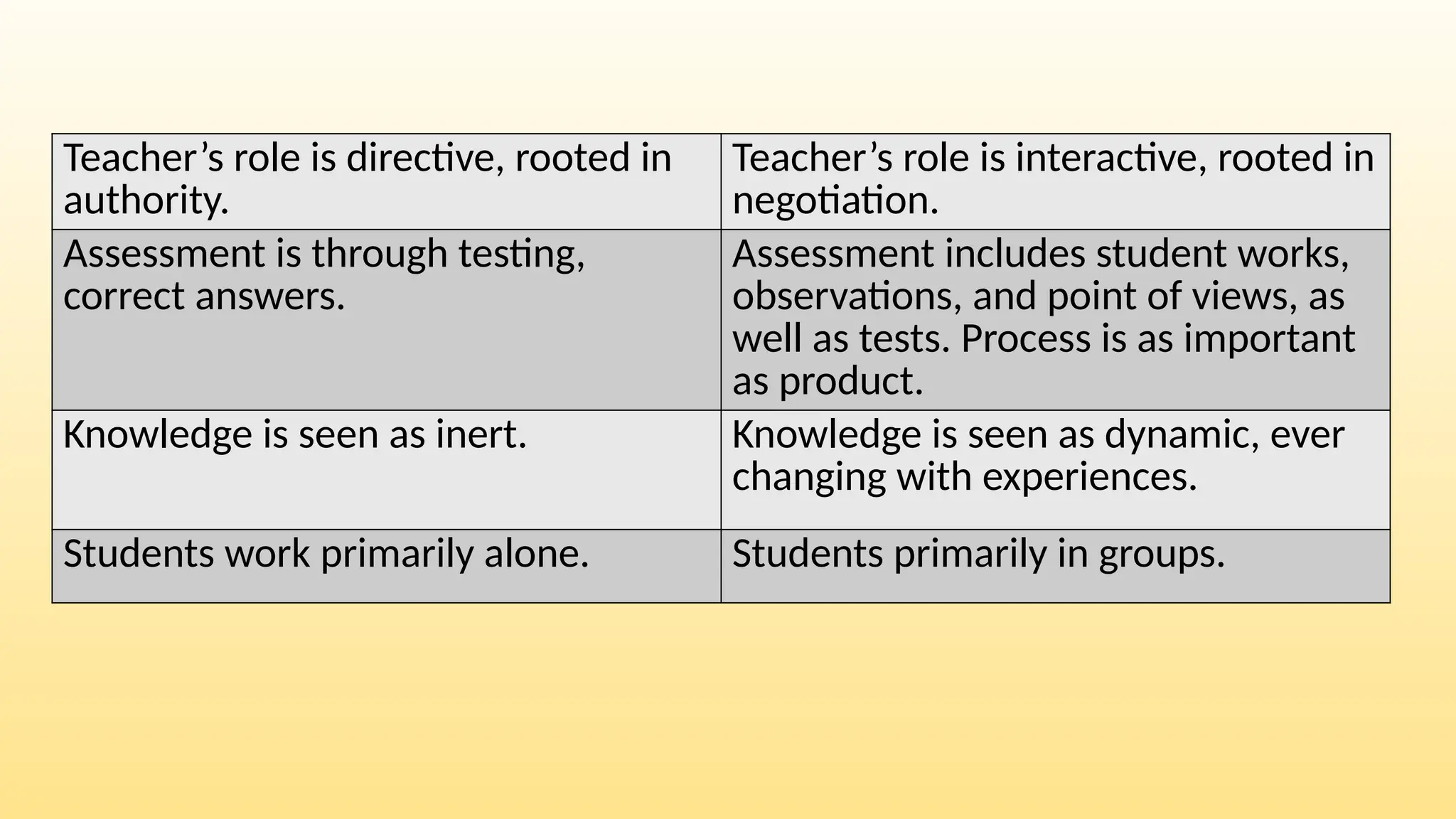
Teacher’s role is directive, rooted in
authority.
Teacher’s role is interactive, rooted in
negotiation.
Assessment is through testing,
correct answers.
Assessment includes student works,
observations, and point of views, as
well as tests. Process is as important
as product.
Knowledge is seen as inert. Knowledge is seen as dynamic, ever
changing with experiences.
Students work primarily alone. Students primarily in groups.
Technology in the Constructivist
Learning Enviroment
• The use of technology in the learning environment has been
highly associated with the application of the constructivist
learning principles.
• Today’s instructional technologies have the features and
capabilities to support learning. The emergence and the
widespread use of social media and other online apps support the
constructivist principle that learning is a social activity that
involves interaction between and among learners, with teachers
and others.
Teacher’s role in Constructivist
learning environment
• An expert learner who can guide students into
adopting cognitive strategies such as self-testing,
articulating understanding, asking probing questions,
and reflection.
• An organizer of information around big ideas
that engage the student’s interest, to assist students
in developing new insights, and to connect them with
their previous learning.
• Designer of learner-centered learning
activities that will encourage the students to ask
their own questions, carry out their
experiments, make their own analogies, and
come to their own conclusions.
• A guide, a coach, and a mentor in the
process of constructing knowledge.
Thank You!

Technology-in-Constructivist-Learning-Environment.pptx

  • 2.
  • 3.
    Learning Objectives: • Explainfully the concept of a learning environment. • Discuss and put in context the various constructivist learning principles. • Create a technology-supported constructivist learning environment.
  • 4.
    Introduction Today, all ofus are aware that the traditional picture of the teacher, the classroom, and the school is gradually, if not totally phasing out due to emergence of learning paradigms and the influx of technology in the learning environment.
  • 5.
    Is the schoolor the classroom the only learning environment?
  • 6.
  • 7.
    • it refersto the diverse physical locations, contexts, and cultures in which students learn. • the term also encompasses the culture of a school or class– its presiding ethos and characteristics, including how individuals interact with and treat one another as well as the ways which teachers may organize an educational setting to facilitate learning (The Learning Environment, 2013)
  • 8.
    Learning environment ismore than just its physical components. It involves teaching and learning goals, learners’ characteristics, activities that facilitate learning assessment strategies and the culture in the learning environment (Bates, 2014)
  • 9.
    A learning environment froma teacher’s perspective
  • 10.
  • 11.
    •Jerome Bruner developedthe theory of constructivism. • his constructivist theory was influenced by the earlier theoretical research of Lev Vygotsky, and Jean Piaget. • the term constructivist is rooted from the theory of constructivism.
  • 12.
    •Bruner’s constructivist frameworksupports the belief that learners construct new ideas and concepts based on their existing knowledge. He presented the idea that children could be active problem solvers and are capable of exploring more difficult subjects of instruction.
  • 13.
    • Today constructivismis the latest catchword in the academic arena. It is not actually new as a learning principle, however, this is oftentimes misunderstood and seldom practiced in the classroom. In a nutshell, the theory of constructivism states that knowledge is constructed not transmitted, that the construction of knowledge is based on experience; that learning is a social dialogical process; and therefore, through dialogues and conversation learning takes place.
  • 14.
  • 15.
    • Learning isan active process. It requires learners to be engaged in the learning activities that will enable them to construct their own knowledge and understanding. • People learn to learn as they learn. The act of learning involves constructing meaning and systems of meaning. Every meaning we construct enable us to give meaning to other related senses and perceptions that follow similar pattern.
  • 16.
    • Construction ofmeaning is cognitive. It takes place in the mind. While physical activities and hands-on experience may be necessary for learning, however, it may not be sufficient. Teachers need to design learning activities that will involve both the mind and the hands. This is what Dewey calls reflective activity. •Learning involves language. Research studies have emphasized the influence of language in learning particularly the role of talk in the classroom. Some people even talk to themselves while learning.
  • 17.
    • Learning isa social activity. Learning is highly associated with the degree of connection and interaction we make with others. Through dialogues and conversations with others make us learn. • Learning is contextual. We do not learn isolated facts and theories but rather we learn in relationship to other things we know, what we believe, our prejudices, and our fears. We cannot separate our learning from our lives. • Knowledge is needed in order to learn. We can’t assimilate new knowledge without having some structure developed from previous knowledge to build on.
  • 18.
    • Learning isnot instantaneous. It takes time. In learning we usually recall ideas, reflect and try on them and eventually use them. And when we ponder on these cluster of thoughts and ideas, we are actually engaging in meaning making and, therefore, this takes time. • Motivation is a key component in learning. In any act of learning, motivation plays a crucial role. Teachers understand that the source of motivation may be intrinsic or extrinsic. Motivation here includes an understanding of ways in which the new knowledge may be used.
  • 19.
    Traditional Classroom Constructivistclassroom Curriculum begins with the parts of the whole. Emphasizes basic skills. Curriculum emphasizes big concepts, beginning with the whole and expanding to include parts. Strict adherence to fixed curriculum is highly valued Pursuit of student questions and interests is valued. Materials are primarily textbooks and workbooks. Materials include primary sources of material and manipulative material. Learning is based on reception. Learning is interactive, building on what the student already knows. Teachers disseminate information to students; students are recipient of knowledge Teachers have a dialogue with students, helping them construct their own knowledge.
  • 20.
    Teacher’s role isdirective, rooted in authority. Teacher’s role is interactive, rooted in negotiation. Assessment is through testing, correct answers. Assessment includes student works, observations, and point of views, as well as tests. Process is as important as product. Knowledge is seen as inert. Knowledge is seen as dynamic, ever changing with experiences. Students work primarily alone. Students primarily in groups.
  • 21.
    Technology in theConstructivist Learning Enviroment
  • 22.
    • The useof technology in the learning environment has been highly associated with the application of the constructivist learning principles. • Today’s instructional technologies have the features and capabilities to support learning. The emergence and the widespread use of social media and other online apps support the constructivist principle that learning is a social activity that involves interaction between and among learners, with teachers and others.
  • 23.
    Teacher’s role inConstructivist learning environment
  • 24.
    • An expertlearner who can guide students into adopting cognitive strategies such as self-testing, articulating understanding, asking probing questions, and reflection. • An organizer of information around big ideas that engage the student’s interest, to assist students in developing new insights, and to connect them with their previous learning.
  • 25.
    • Designer oflearner-centered learning activities that will encourage the students to ask their own questions, carry out their experiments, make their own analogies, and come to their own conclusions. • A guide, a coach, and a mentor in the process of constructing knowledge.
  • 26.