Towards Architectural Synthesis of
Systems-of-Systems
Marcelo Benites Gonçalves (ICMC-Brazil)
Flavio Oquendo (IRISA-France),
and Elisa Yumi Nakagawa (ICMC-Brazil)
WDES, September 23 , 2015 – Belo Horizonte, Brazil
Program
•Introduction
•SASI: a method to support architectural
synthesis of System-of-Systems
•Observational study
•Perspectives of Research
•Conclusions
2
3
INTRODUCTION
System-of-Systems (SoS)
A class of systems resulted from the interaction
among independent systems that cooperate
delivering emergent functionalities and
accomplishing a global mission.
• Operational Independence
• Managerial Independence
• Distribution
• Emergent Behavior
• Evolutionary Development
4
SoS Software Architectures
A structure (or a set of structures) of the SoS:
• Constituent Systems (CSs), their externally
visible properties, and the relationships
among them
• Encompasses concepts, properties,
specifications, and design decisions
• Essential to promote the success and quality
of SoS
5
Motivation
Architectural construction is a non-trivial
activity, even more for complex scenarios of
SoS:
• Several stakeholders, organizations, and interests
• CSs developed and managed by independent
sources
• How to enable the collaboration of
heterogeneous CSs
• The design of such architectures is currently
performed with ad-hoc processes
6
7
SASI: A METHOD TO ARCHITECTURAL
SYNTHESIS OF SYSTEM-OF-SYSTEMS
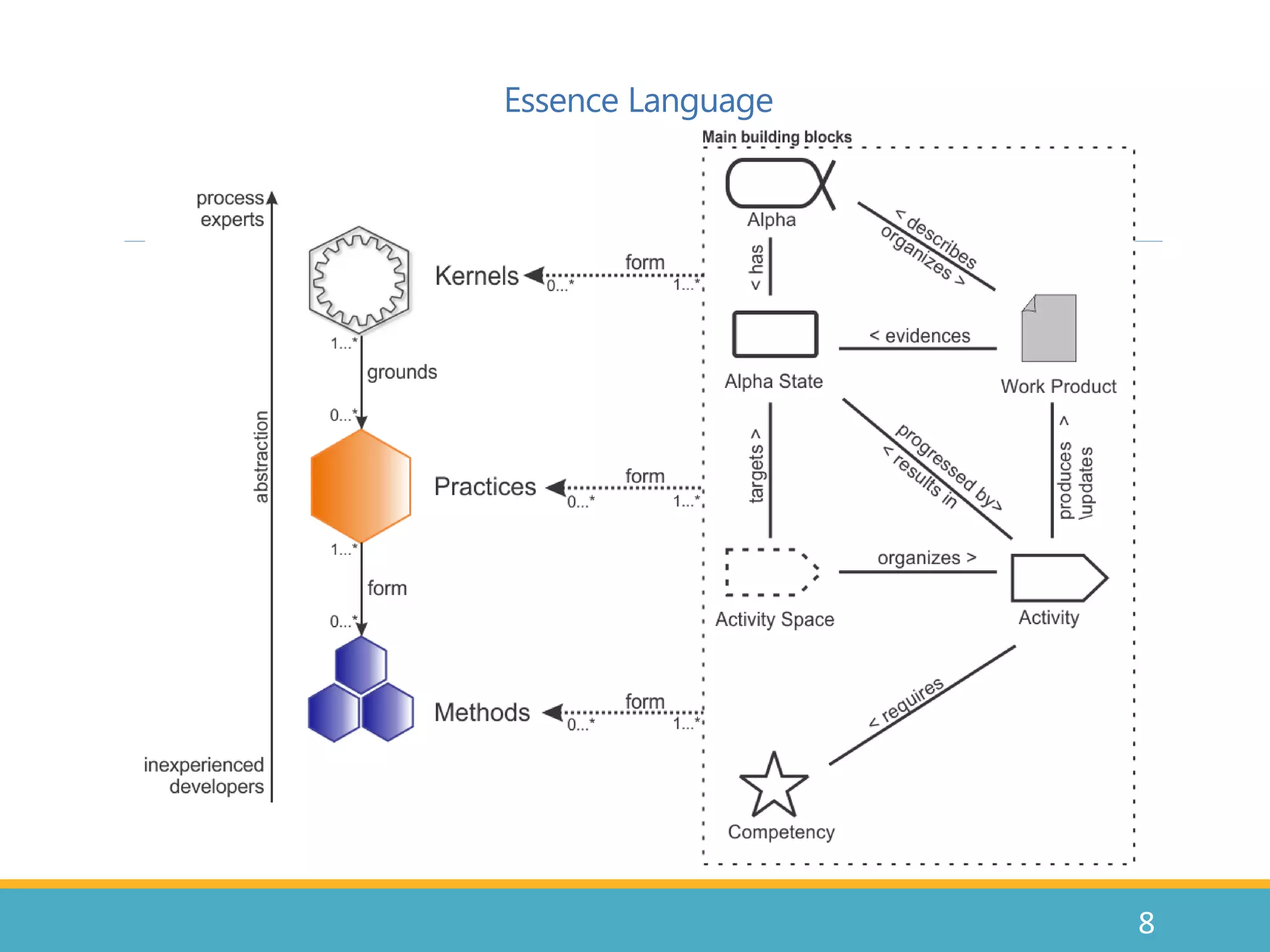
Essence Language
8
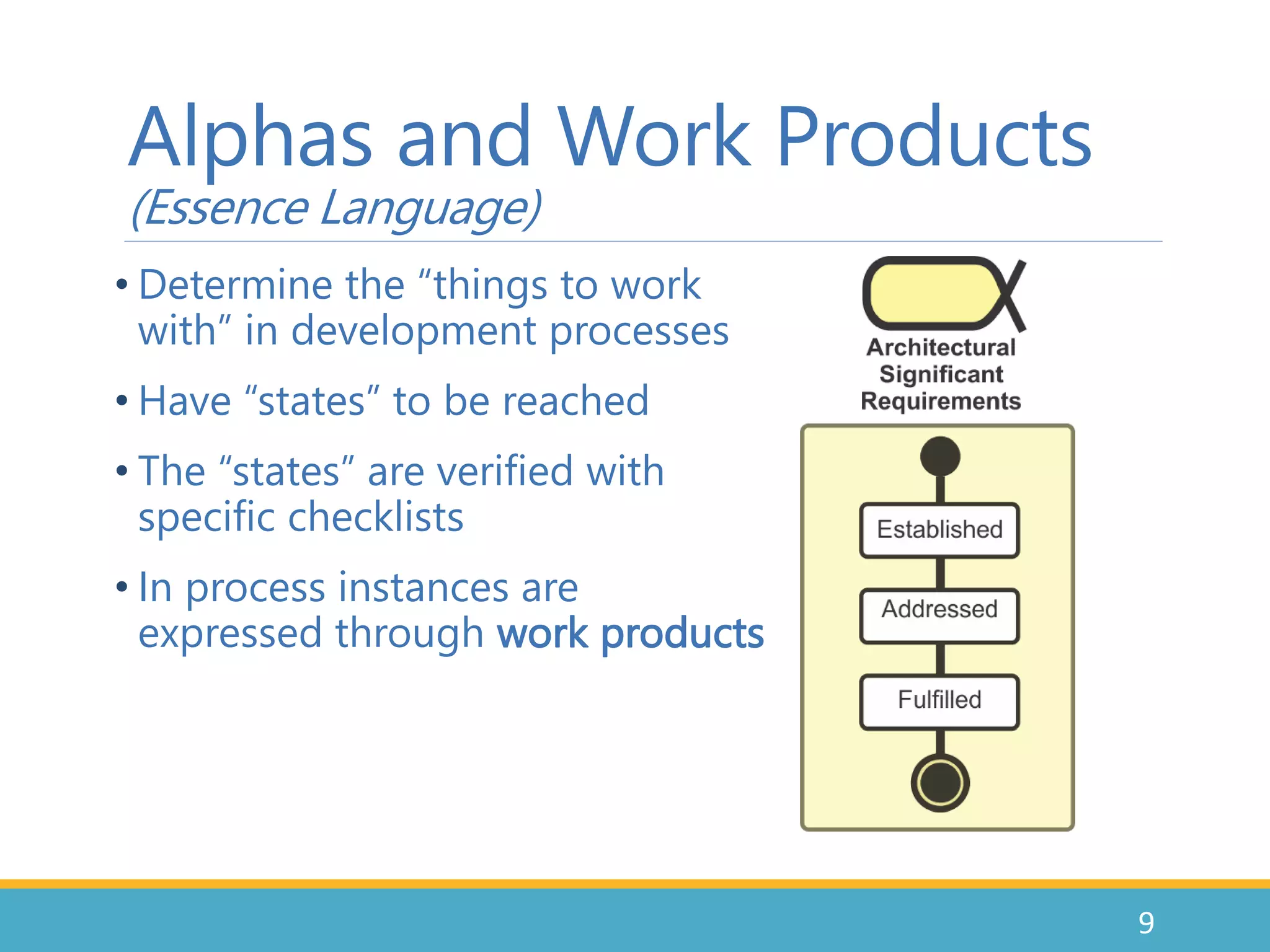
Alphas and Work Products
(Essence Language)
• Determine the “things to work
with” in development processes
• Have “states” to be reached
• The “states” are verified with
specific checklists
• In process instances are
expressed through work products
9
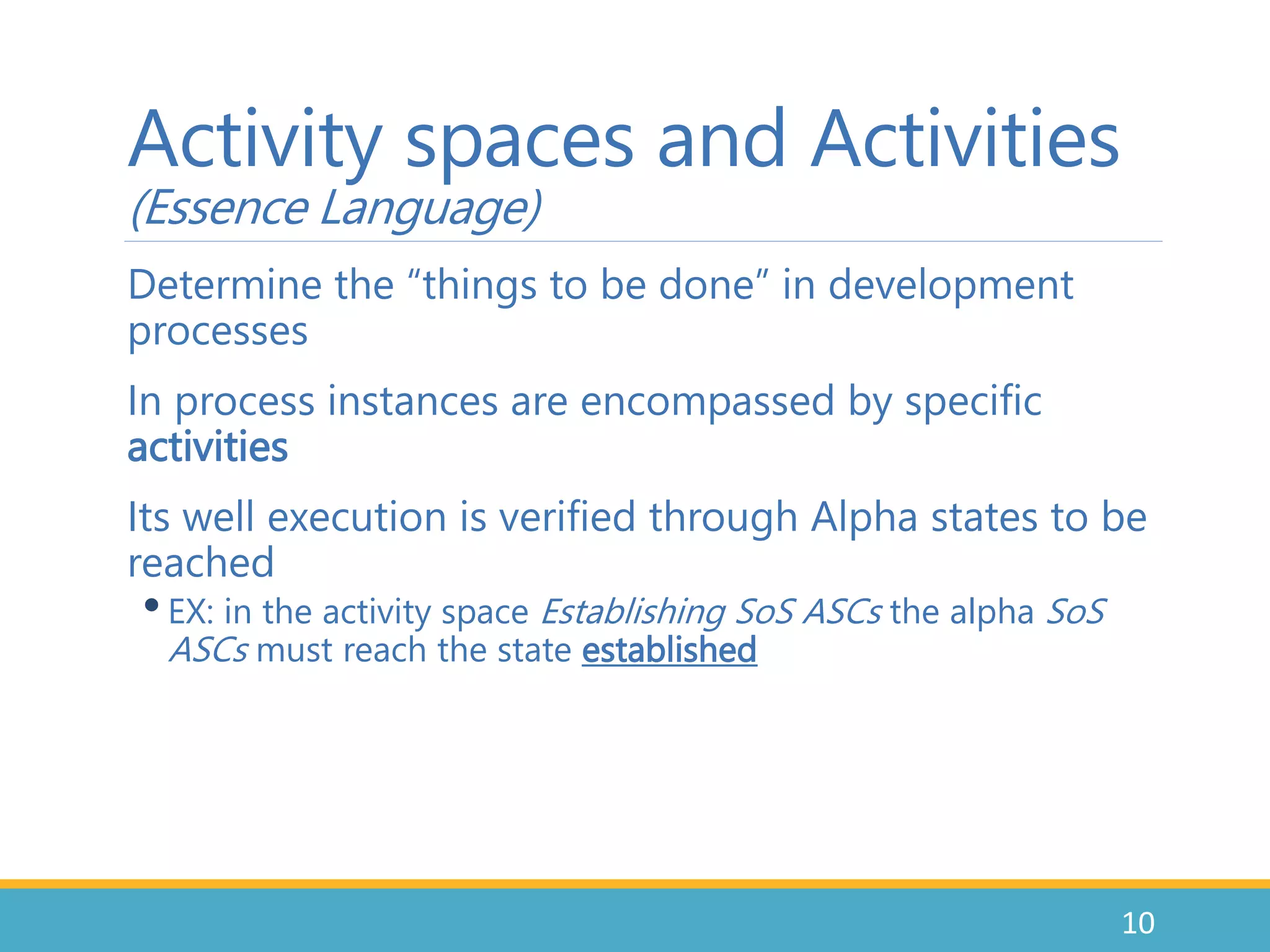
Determine the “things to be done” in development
processes
In process instances are encompassed by specific
activities
Its well execution is verified through Alpha states to be
reached
•EX: in the activity space Establishing SoS ASCs the alpha SoS
ASCs must reach the state established
10
Activity spaces and Activities
(Essence Language)
Proposal
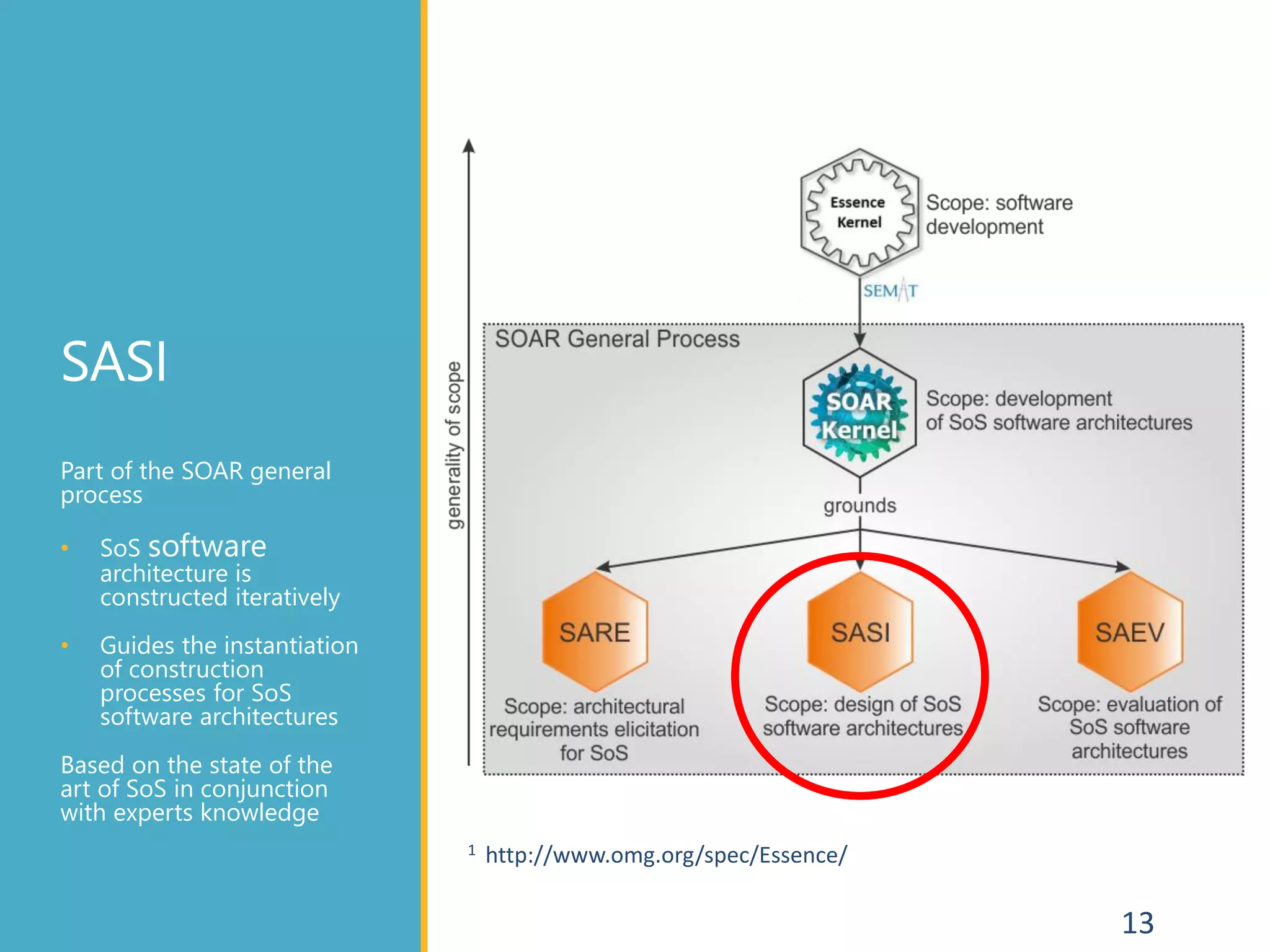
SASI: ``SoS Architectural Synthesis“
• A method for establishing and managing of architectural
decisions when constructing SoS software architectures
• Provides specific activities and work products grounded
on the alphas and activity spaces provided by the SOAR
Kernel 1
• It is part of the SOAR general process for constructing
SoS software architectures
• Represented by using Essence Language
• A general process to construct SoS software architectures
• For Acknowledged SoS
• A sub-category in which goals, management, resources, and
authority are recognized while the CSs retain their independent
management.
11
1 Gonçalves, M. B., Oquendo, F., and Nakagawa, E. Y. (2015). A meta-process to constructSoS software architectures.
In: Proceedings of the 30th ACM/SIGAPP Symposium onApplied Computing, pages 1411–1416, New York, NY, USA.
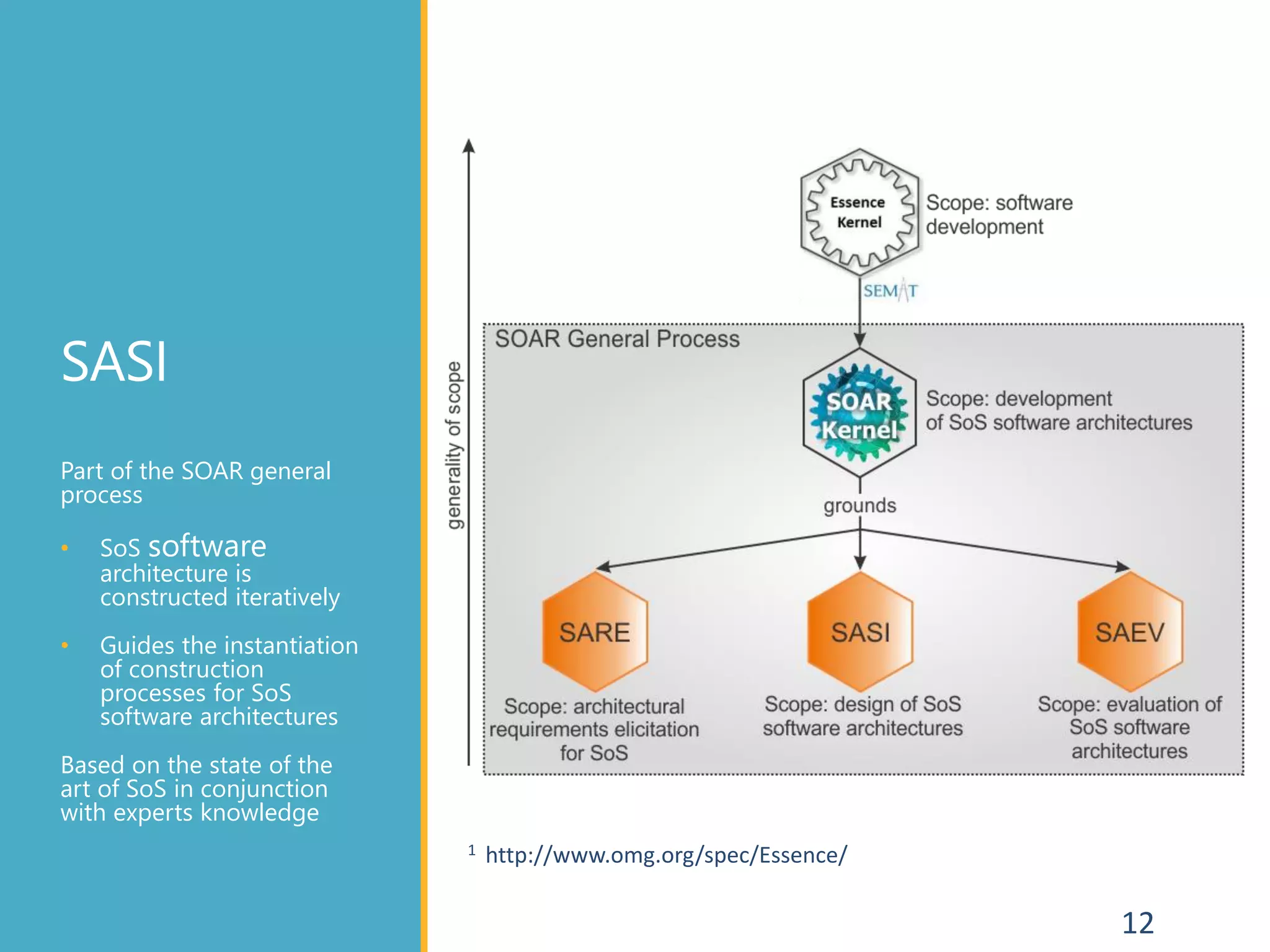
SASI
Part of the SOAR general
process
• SoS software
architecture is
constructed iteratively
• Guides the instantiation
of construction
processes for SoS
software architectures
Based on the state of the
art of SoS in conjunction
with experts knowledge
12
1 http://www.omg.org/spec/Essence/
SASI
Part of the SOAR general
process
• SoS software
architecture is
constructed iteratively
• Guides the instantiation
of construction
processes for SoS
software architectures
Based on the state of the
art of SoS in conjunction
with experts knowledge
13
1 http://www.omg.org/spec/Essence/
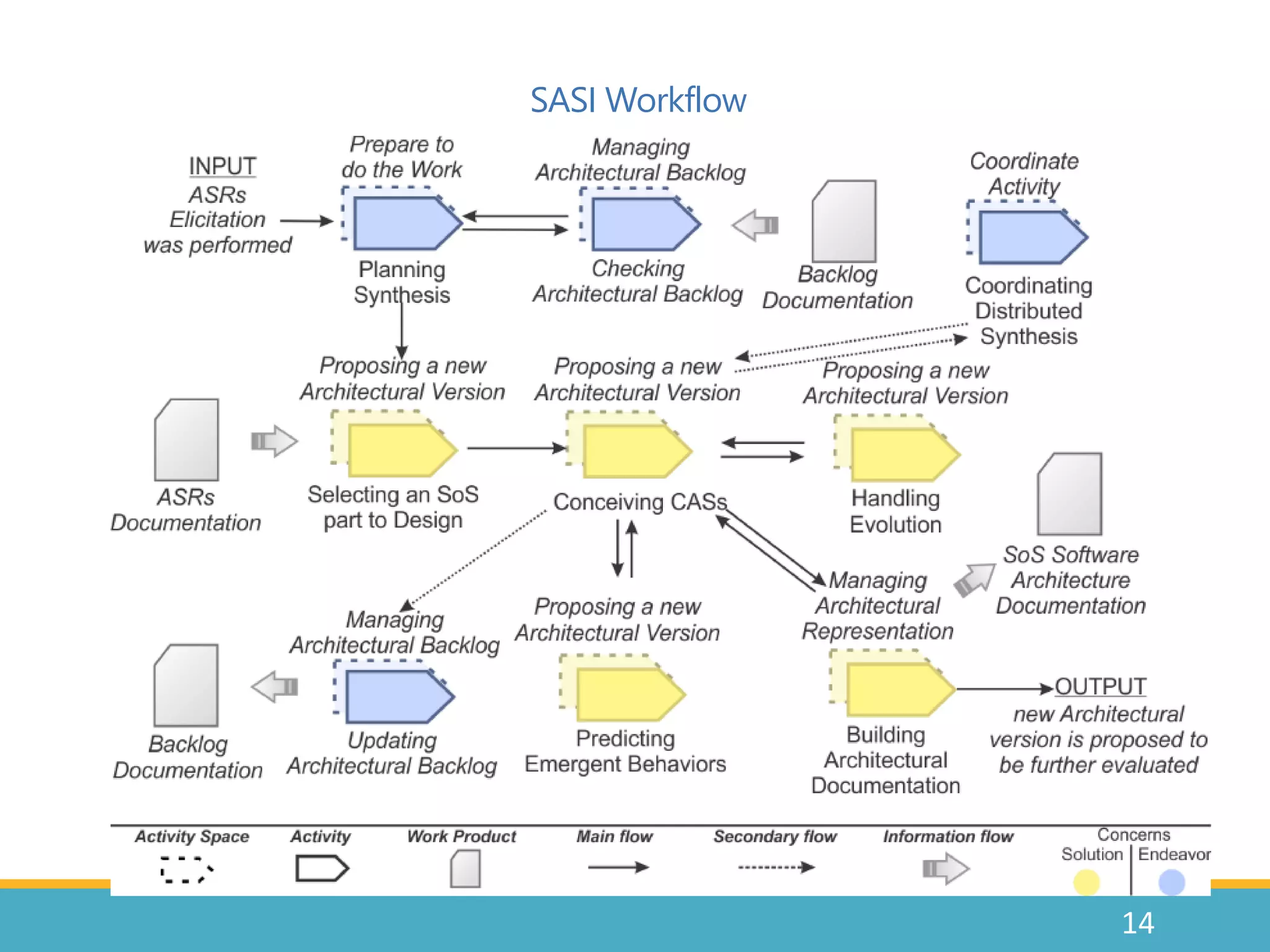
SASI Workflow
14
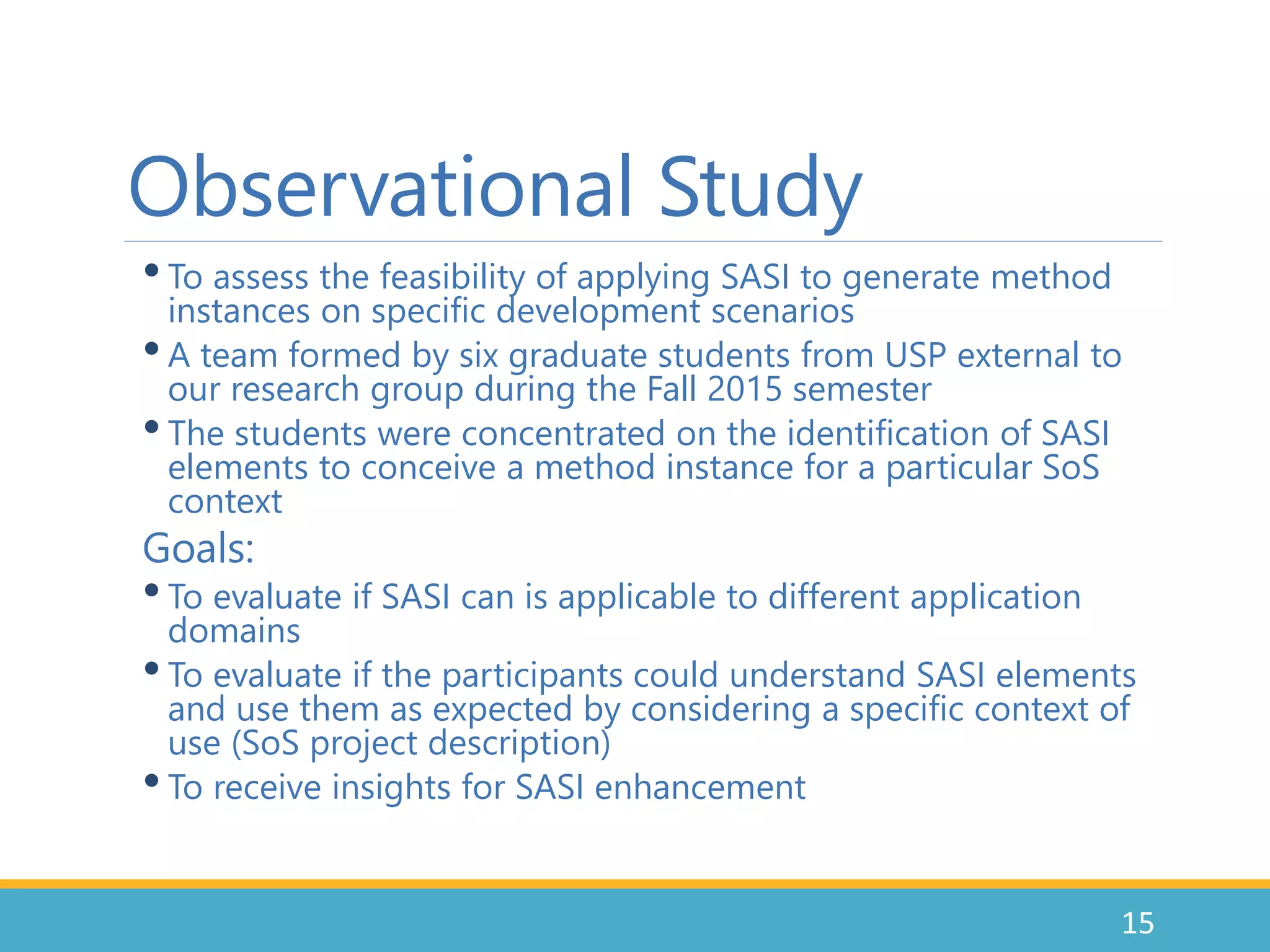
Observational Study
•To assess the feasibility of applying SASI to generate method
instances on specific development scenarios
•A team formed by six graduate students from USP external to
our research group during the Fall 2015 semester
•The students were concentrated on the identification of SASI
elements to conceive a method instance for a particular SoS
context
Goals:
•To evaluate if SASI can is applicable to different application
domains
•To evaluate if the participants could understand SASI elements
and use them as expected by considering a specific context of
use (SoS project description)
•To receive insights for SASI enhancement
15
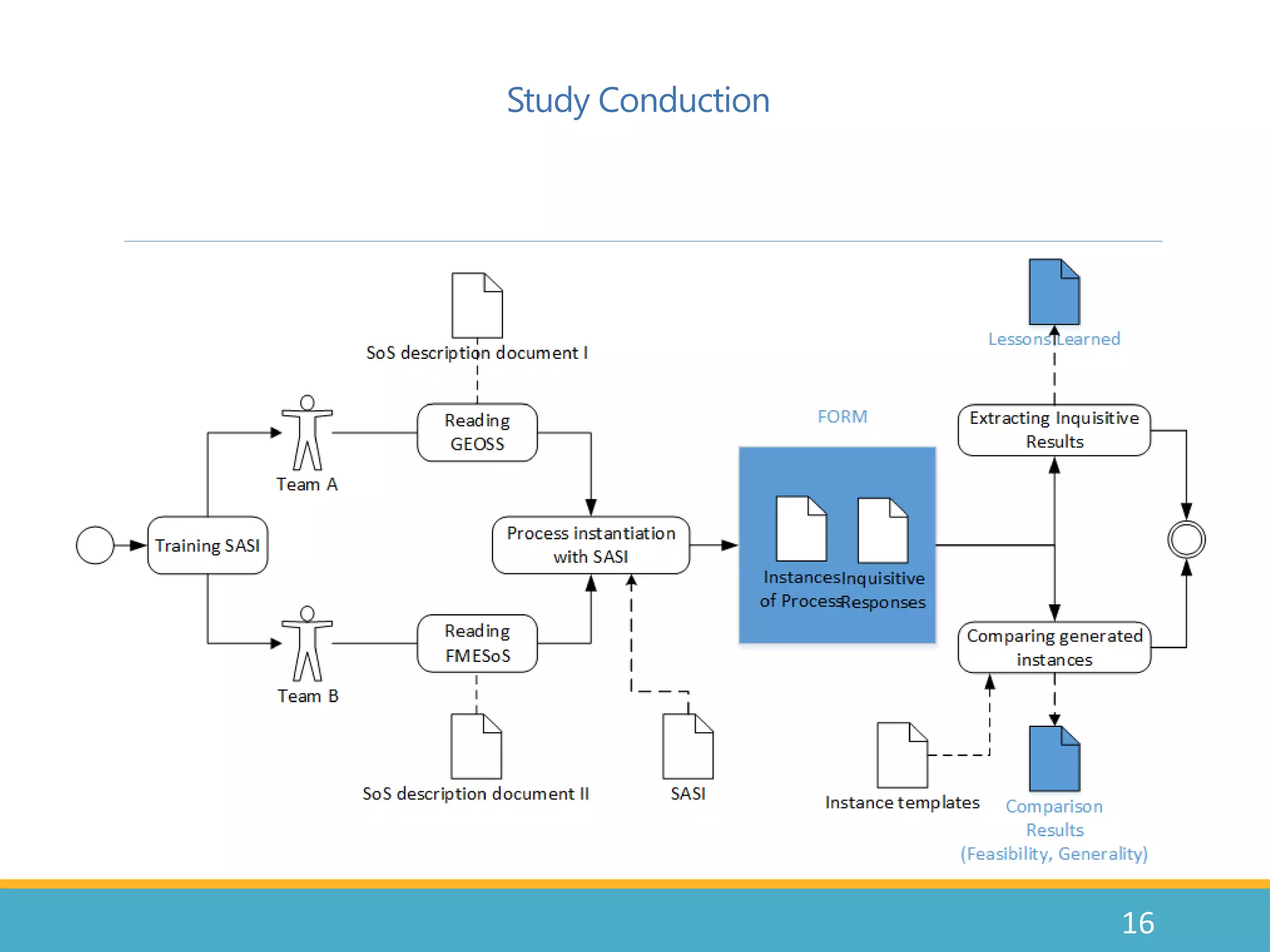
Study Conduction
16
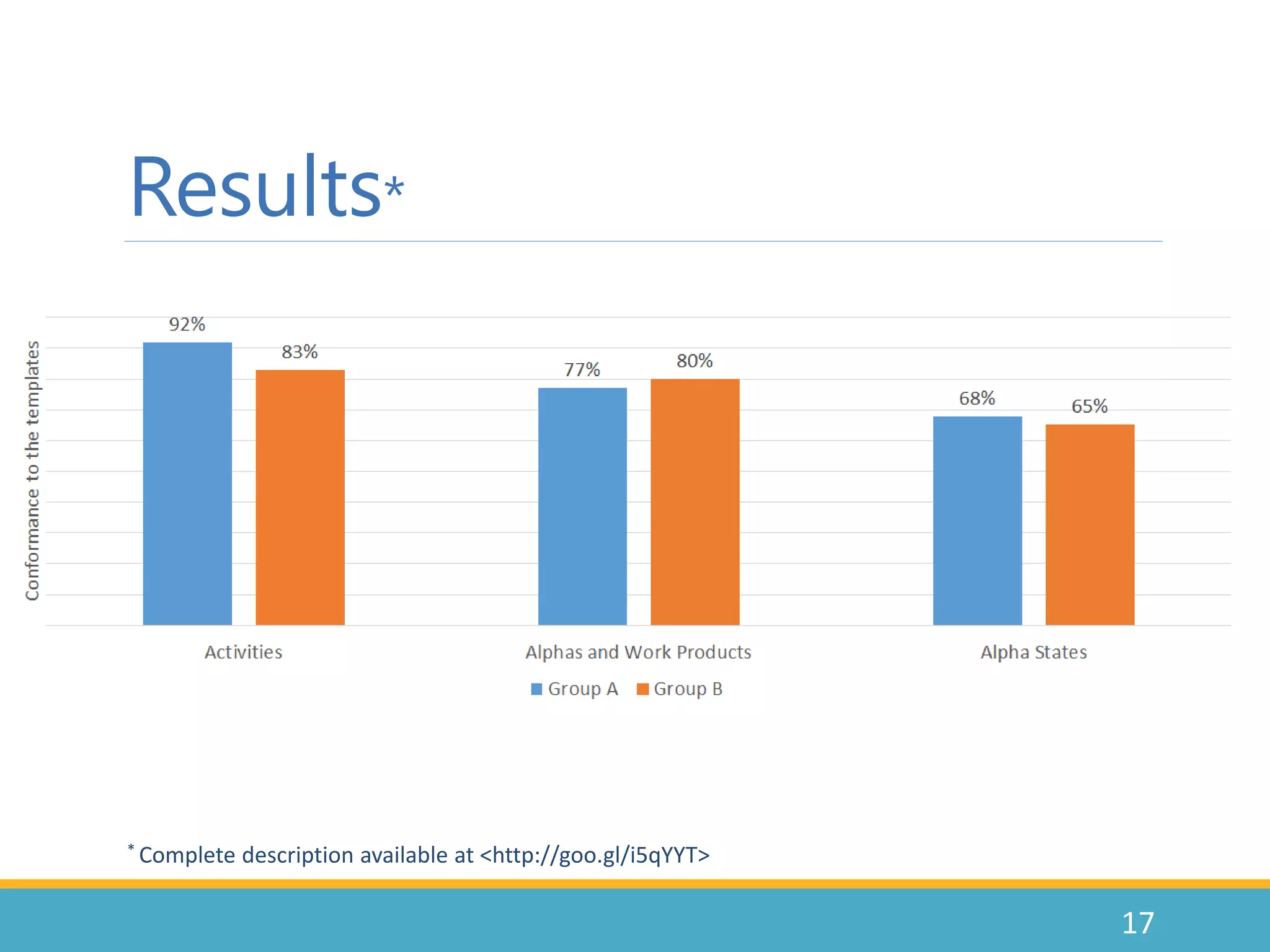
Results*
17
* Complete description available at <http://goo.gl/i5qYYT>
18
PERSPECTIVES OF RESEARCH
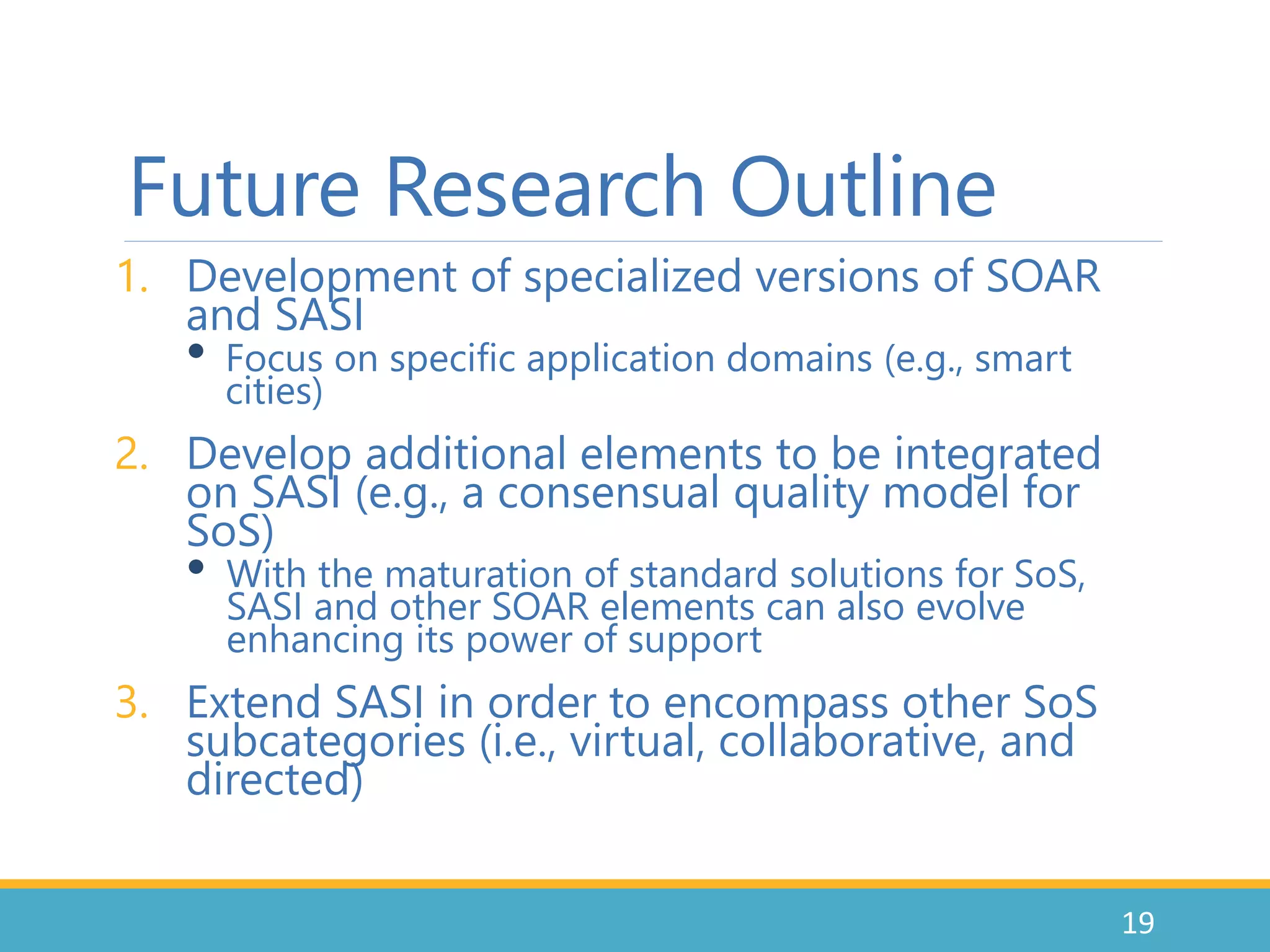
Future Research Outline
1. Development of specialized versions of SOAR
and SASI
• Focus on specific application domains (e.g., smart
cities)
2. Develop additional elements to be integrated
on SASI (e.g., a consensual quality model for
SoS)
• With the maturation of standard solutions for SoS,
SASI and other SOAR elements can also evolve
enhancing its power of support
3. Extend SASI in order to encompass other SoS
subcategories (i.e., virtual, collaborative, and
directed)
19
Conclusions
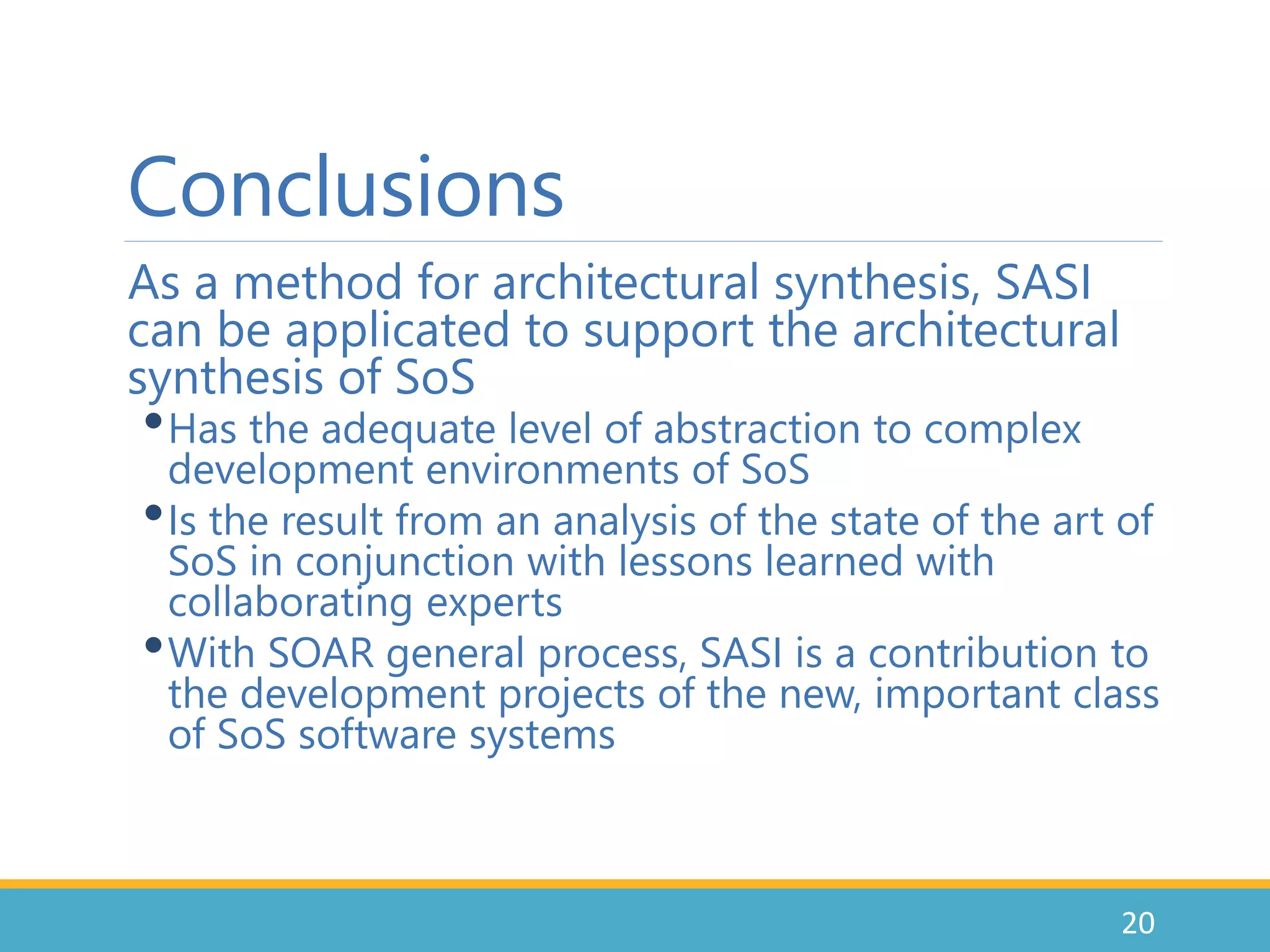
As a method for architectural synthesis, SASI
can be applicated to support the architectural
synthesis of SoS
•Has the adequate level of abstraction to complex
development environments of SoS
•Is the result from an analysis of the state of the art of
SoS in conjunction with lessons learned with
collaborating experts
•With SOAR general process, SASI is a contribution to
the development projects of the new, important class
of SoS software systems
20
Towards Architectural Synthesis of
Systems-of-Systems
Marcelo Benites Gonçalves (ICMC-Brazil)
Flavio Oquendo (IRISA-France),
and Elisa Yumi Nakagawa (ICMC-Brazil)
WDES, September 23 , 2015 – Belo Horizonte, Brazil

WDES 2015 paper: Towards Architectural Synthesis of Systems-of-Systems

  • 1.
    Towards Architectural Synthesisof Systems-of-Systems Marcelo Benites Gonçalves (ICMC-Brazil) Flavio Oquendo (IRISA-France), and Elisa Yumi Nakagawa (ICMC-Brazil) WDES, September 23 , 2015 – Belo Horizonte, Brazil
  • 2.
    Program •Introduction •SASI: a methodto support architectural synthesis of System-of-Systems •Observational study •Perspectives of Research •Conclusions 2
  • 3.
  • 4.
    System-of-Systems (SoS) A classof systems resulted from the interaction among independent systems that cooperate delivering emergent functionalities and accomplishing a global mission. • Operational Independence • Managerial Independence • Distribution • Emergent Behavior • Evolutionary Development 4
  • 5.
    SoS Software Architectures Astructure (or a set of structures) of the SoS: • Constituent Systems (CSs), their externally visible properties, and the relationships among them • Encompasses concepts, properties, specifications, and design decisions • Essential to promote the success and quality of SoS 5
  • 6.
    Motivation Architectural construction isa non-trivial activity, even more for complex scenarios of SoS: • Several stakeholders, organizations, and interests • CSs developed and managed by independent sources • How to enable the collaboration of heterogeneous CSs • The design of such architectures is currently performed with ad-hoc processes 6
  • 7.
    7 SASI: A METHODTO ARCHITECTURAL SYNTHESIS OF SYSTEM-OF-SYSTEMS
  • 8.
  • 9.
    Alphas and WorkProducts (Essence Language) • Determine the “things to work with” in development processes • Have “states” to be reached • The “states” are verified with specific checklists • In process instances are expressed through work products 9
  • 10.
    Determine the “thingsto be done” in development processes In process instances are encompassed by specific activities Its well execution is verified through Alpha states to be reached •EX: in the activity space Establishing SoS ASCs the alpha SoS ASCs must reach the state established 10 Activity spaces and Activities (Essence Language)
  • 11.
    Proposal SASI: ``SoS ArchitecturalSynthesis“ • A method for establishing and managing of architectural decisions when constructing SoS software architectures • Provides specific activities and work products grounded on the alphas and activity spaces provided by the SOAR Kernel 1 • It is part of the SOAR general process for constructing SoS software architectures • Represented by using Essence Language • A general process to construct SoS software architectures • For Acknowledged SoS • A sub-category in which goals, management, resources, and authority are recognized while the CSs retain their independent management. 11 1 Gonçalves, M. B., Oquendo, F., and Nakagawa, E. Y. (2015). A meta-process to constructSoS software architectures. In: Proceedings of the 30th ACM/SIGAPP Symposium onApplied Computing, pages 1411–1416, New York, NY, USA.
  • 12.
    SASI Part of theSOAR general process • SoS software architecture is constructed iteratively • Guides the instantiation of construction processes for SoS software architectures Based on the state of the art of SoS in conjunction with experts knowledge 12 1 http://www.omg.org/spec/Essence/
  • 13.
    SASI Part of theSOAR general process • SoS software architecture is constructed iteratively • Guides the instantiation of construction processes for SoS software architectures Based on the state of the art of SoS in conjunction with experts knowledge 13 1 http://www.omg.org/spec/Essence/
  • 14.
  • 15.
    Observational Study •To assessthe feasibility of applying SASI to generate method instances on specific development scenarios •A team formed by six graduate students from USP external to our research group during the Fall 2015 semester •The students were concentrated on the identification of SASI elements to conceive a method instance for a particular SoS context Goals: •To evaluate if SASI can is applicable to different application domains •To evaluate if the participants could understand SASI elements and use them as expected by considering a specific context of use (SoS project description) •To receive insights for SASI enhancement 15
  • 16.
  • 17.
    Results* 17 * Complete descriptionavailable at <http://goo.gl/i5qYYT>
  • 18.
  • 19.
    Future Research Outline 1.Development of specialized versions of SOAR and SASI • Focus on specific application domains (e.g., smart cities) 2. Develop additional elements to be integrated on SASI (e.g., a consensual quality model for SoS) • With the maturation of standard solutions for SoS, SASI and other SOAR elements can also evolve enhancing its power of support 3. Extend SASI in order to encompass other SoS subcategories (i.e., virtual, collaborative, and directed) 19
  • 20.
    Conclusions As a methodfor architectural synthesis, SASI can be applicated to support the architectural synthesis of SoS •Has the adequate level of abstraction to complex development environments of SoS •Is the result from an analysis of the state of the art of SoS in conjunction with lessons learned with collaborating experts •With SOAR general process, SASI is a contribution to the development projects of the new, important class of SoS software systems 20
  • 21.
    Towards Architectural Synthesisof Systems-of-Systems Marcelo Benites Gonçalves (ICMC-Brazil) Flavio Oquendo (IRISA-France), and Elisa Yumi Nakagawa (ICMC-Brazil) WDES, September 23 , 2015 – Belo Horizonte, Brazil