Open Access: Trends and opportunities from
 the publisher’s perspective

 Caroline Sutton
 Board Member, OASPA
 Co-founder, Co-Action Publishing
Scientific Publishing in Natural History Institutions, sponsored by the European Distributed
Institute of Taxonomy (EDIT), 22-23 June, Bratislava, Slovak Republic


                                         www.oaspa.org
OASPA - Background
•Recognized needs
•Founding
Background
   OA publishers lacked a voice in public debates about
    scholarly communications and Open Access
   Open Access had become an established part of the
    publishing landscape, it was time to address practical
    issues
   Need to develop uniform standards and best practices
   Need to bring together the Open Access publishing
    community
   Need to share information and work collectively
   OASPA represents both professional publishing
    organizations as well as scholar publishers and
    welcomes other organizations whose work supports OA
    publishing.
Established October 2008 by:

   BioMed Central
   Co-Action Publishing
   Copernicus Publications
   Hindawi Publishing Corporation
   Journal of Medical Internet Research (Gunther Solomon)
   Medical Education Online (David Solomon)
   Public Library of Science (PLoS)
   SAGE Publications
   SPARC Europe
   Utrecht University Library (Igitur)
OASPA Mission
To support and represent the interests of Open Access (OA)
  journal publishers globally in all scientific, technical, and
  scholarly disciplines.

To accomplish this mission, the association will:
 Exchange information

 Set standards

 Advance models

 Advocate for OA publishing

 Educate

 Promote innovation
Membership Criteria
   Clearly identifiable ownership structure
   Business address
   Complaint policy
   Clear publication charge policy (if any)
   Regular content being published
   Peer review/editorial control
   Comply with the OASPA Professional Code of Conduct
   Adhere to a common definition of Open Access
    publishing
Definition of Open Access
OASPA definition of OA
   No subscription or license required to access the
    electronic edition of the journal

   Licensing agreement that allows free use and re-use
    (downloading, sharing, printing copies, use of tables
    and figures, possibility for text-mining, etc.) at least
    for non-commercial/scholarly purposes.
OPEN ACCESS = Free Access + Re-use
Changing metaphors
              Knowledge as ”paper”


      Knowledge as ”product” and ”property”
                Created by scientists
               Owned by publishers
               Archived by libraries


 -- John Wilbanks, Science Commons, presentation at
                   IATUL, June 2007
New Metaphors
                Knowledge = NETWORK


              Knowledge = infrastructure


”A better reflection of the reality of knowledge”

  -- John Wilbanks, Science Commons, presentation at IATUL, June 2007
”A social network
diagram”, Screenshot
taken by Darwin
Peacock, accessed
through Wikimedia;
distributed under a CCL
3.0.
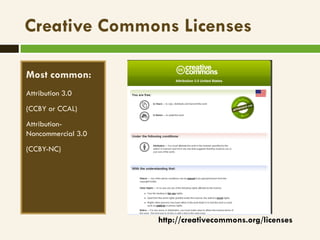
Creative Commons Licenses

Most common:
Attribution 3.0
(CCBY or CCAL)
Attribution-
Noncommercial 3.0
(CCBY-NC)


                    http://creativecommons.org/licenses
Copyright Notice
Authors contributing to Global Health Action agree to publish
their articles under the Creative Commons Attribution-
NonCommercial 3.0 Unported license, allowing third parties
to share their work (copy, distribute, transmit) and to adapt
it, under the condition that the authors are given credit,
that the work is not used for commercial purposes, and that
in the event of reuse or distribution, the terms of this license
are made clear.

Authors retain copyright of their work, with first publication
rights granted to Co-Action Publishing. However, authors are
required to transfer copyrights associated with commercial
use to the Publisher. Revenues from commercial sales are
used to keep down the publication fees. Moreover, a major
portion of the profits generated from commercial sales is
placed in a fund to cover publication fees for researchers
from developing nations and, in some cases, for young
researchers.
Trends affecting publishing
•   Shifts in how we measure impact
Measuring impact
of research output


Different levels of granularity for different
  purposes
   Research groups / institutions - to know who to
    fund
   Individual researchers - to know who to promote

   Individual articles - to know what to read


  * Slide borrowed from slides prepared by Mark Patterson, PLoS
How do we measure impact?


     We judge the worth of a paper on
    the basis of the impact factor of the
     journal in which it was published.

         Recommended reading:
         Adler, R., Ewing, J. Taylor, P. Citation statistics. A report from the
         International Mathematical Union.
         http://www.mathunion.org/publications/report/citationstatistics/
         Browman, H. I., Stergiou, K.I.Ethics in Science and Environmental
         Politics, Theme Section. The Use and misuse of bibliometric indices in
         evaluating scholarly performance., Vol. 8, no. 8
         http://www.int-res.com/abstracts/esep/v8/n1/


  * Slide borrowed from Mark Patterson, PLoS & adapted.
OA and Impact Factor
   Many OA journals are new
   Many still do not have an impact factor
   Other OA journals have achieved very high impact
    factors
   Research has investigated whether there is an ”OA
    advantage” with mixed results
   OA content reaches audiences beyond the research
    community, who do not cite the journals.
Measuring Impact

GOOGLE SCHOLAR
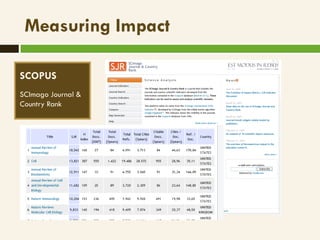
Measuring Impact

SCOPUS
SCImago Journal &
Country Rank
Measuring impact

BioMed Central
”Unofficial
                  divide the number of times articles
Impact Factor”   published years 1 and 2 were cited in
                                 year 3,
                  based on a search of the Science
                    Citation Index database, by the
                   number of articles published in the
                   previous two years (years 1 & 2).
If the impact factor is how we have
defined impact because of the tools
available to us, how CAN we measure
impact today? What tools are available?
WWW/Wikiworld


                *Reproduced from Wikemedia under the
                conditions of the GNU General Public License
                Exquisite-network.png
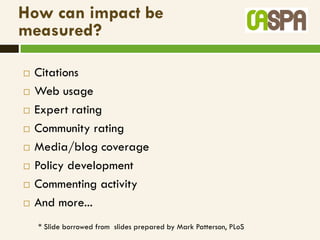
How can impact be
measured?

   Citations
   Web usage
   Expert rating
   Community rating
   Media/blog coverage
   Policy development
   Commenting activity
   And more...
    * Slide borrowed from slides prepared by Mark Patterson, PLoS
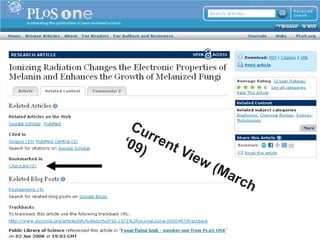
Measuring Impact

                  Article-level metrics
    PLoS          •Usage data
                  •Page views
 Article-level    •Citations from Scopus
Metrics Project   •Citations from CrossRef
                  •Social networking links
                  •Press coverage
                  •Comments
                  •User ratings

                  Not an alternative metric : ”Our idea is to
                  throw up a bunch of metrics and see what
                  people use.” (Binfield in The Scientist)
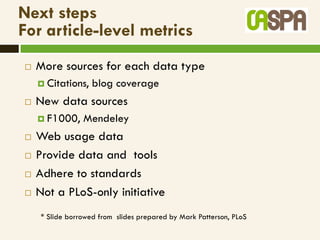
Next steps
For article-level metrics
   More sources for each data type
     Citations,   blog coverage
   New data sources
     F1000,    Mendeley
   Web usage data
   Provide data and tools
   Adhere to standards
   Not a PLoS-only initiative
    * Slide borrowed from slides prepared by Mark Patterson, PLoS
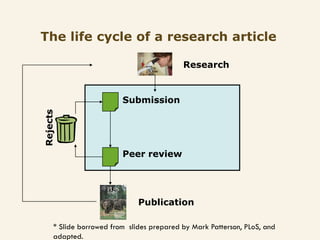
The life cycle of a research article

                                            Research


                          Submission
Rejects


                          Peer review


                               Publication

      * Slide borrowed from slides prepared by Mark Patterson, PLoS, and
      adapted.
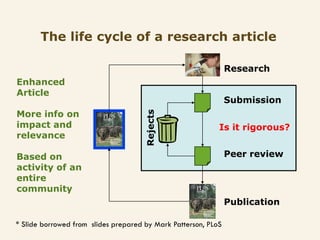
The life cycle of a research article

                                                                Research
Enhanced
Article
                                                                Submission
More info on


                                      Rejects
impact and                                                  Is it rigorous?
relevance

Based on                                                        Peer review
activity of an
entire
community
                                                                Publication

* Slide borrowed from slides prepared by Mark Patterson, PLoS
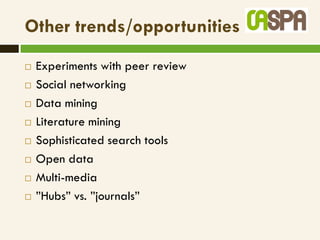
Other trends/opportunities
   Experiments with peer review
   Social networking
   Data mining
   Literature mining
   Sophisticated search tools
   Open data
   Multi-media
   ”Hubs” vs. ”journals”
Thank you!

Open Access: Trends and opportunities from the publisher's perspective

  • 1.
    Open Access: Trendsand opportunities from the publisher’s perspective Caroline Sutton Board Member, OASPA Co-founder, Co-Action Publishing Scientific Publishing in Natural History Institutions, sponsored by the European Distributed Institute of Taxonomy (EDIT), 22-23 June, Bratislava, Slovak Republic www.oaspa.org
  • 2.
  • 3.
    Background  OA publishers lacked a voice in public debates about scholarly communications and Open Access  Open Access had become an established part of the publishing landscape, it was time to address practical issues  Need to develop uniform standards and best practices  Need to bring together the Open Access publishing community  Need to share information and work collectively  OASPA represents both professional publishing organizations as well as scholar publishers and welcomes other organizations whose work supports OA publishing.
  • 4.
    Established October 2008by:  BioMed Central  Co-Action Publishing  Copernicus Publications  Hindawi Publishing Corporation  Journal of Medical Internet Research (Gunther Solomon)  Medical Education Online (David Solomon)  Public Library of Science (PLoS)  SAGE Publications  SPARC Europe  Utrecht University Library (Igitur)
  • 5.
    OASPA Mission To supportand represent the interests of Open Access (OA) journal publishers globally in all scientific, technical, and scholarly disciplines. To accomplish this mission, the association will:  Exchange information  Set standards  Advance models  Advocate for OA publishing  Educate  Promote innovation
  • 6.
    Membership Criteria  Clearly identifiable ownership structure  Business address  Complaint policy  Clear publication charge policy (if any)  Regular content being published  Peer review/editorial control  Comply with the OASPA Professional Code of Conduct  Adhere to a common definition of Open Access publishing
  • 7.
  • 8.
    OASPA definition ofOA  No subscription or license required to access the electronic edition of the journal  Licensing agreement that allows free use and re-use (downloading, sharing, printing copies, use of tables and figures, possibility for text-mining, etc.) at least for non-commercial/scholarly purposes.
  • 9.
    OPEN ACCESS =Free Access + Re-use
  • 10.
    Changing metaphors Knowledge as ”paper” Knowledge as ”product” and ”property” Created by scientists Owned by publishers Archived by libraries -- John Wilbanks, Science Commons, presentation at IATUL, June 2007
  • 11.
    New Metaphors Knowledge = NETWORK Knowledge = infrastructure ”A better reflection of the reality of knowledge” -- John Wilbanks, Science Commons, presentation at IATUL, June 2007
  • 12.
    ”A social network diagram”,Screenshot taken by Darwin Peacock, accessed through Wikimedia; distributed under a CCL 3.0.
  • 15.
    Creative Commons Licenses Mostcommon: Attribution 3.0 (CCBY or CCAL) Attribution- Noncommercial 3.0 (CCBY-NC) http://creativecommons.org/licenses
  • 16.
    Copyright Notice Authors contributingto Global Health Action agree to publish their articles under the Creative Commons Attribution- NonCommercial 3.0 Unported license, allowing third parties to share their work (copy, distribute, transmit) and to adapt it, under the condition that the authors are given credit, that the work is not used for commercial purposes, and that in the event of reuse or distribution, the terms of this license are made clear. Authors retain copyright of their work, with first publication rights granted to Co-Action Publishing. However, authors are required to transfer copyrights associated with commercial use to the Publisher. Revenues from commercial sales are used to keep down the publication fees. Moreover, a major portion of the profits generated from commercial sales is placed in a fund to cover publication fees for researchers from developing nations and, in some cases, for young researchers.
  • 18.
    Trends affecting publishing • Shifts in how we measure impact
  • 19.
    Measuring impact of researchoutput Different levels of granularity for different purposes  Research groups / institutions - to know who to fund  Individual researchers - to know who to promote  Individual articles - to know what to read * Slide borrowed from slides prepared by Mark Patterson, PLoS
  • 20.
    How do wemeasure impact? We judge the worth of a paper on the basis of the impact factor of the journal in which it was published. Recommended reading: Adler, R., Ewing, J. Taylor, P. Citation statistics. A report from the International Mathematical Union. http://www.mathunion.org/publications/report/citationstatistics/ Browman, H. I., Stergiou, K.I.Ethics in Science and Environmental Politics, Theme Section. The Use and misuse of bibliometric indices in evaluating scholarly performance., Vol. 8, no. 8 http://www.int-res.com/abstracts/esep/v8/n1/ * Slide borrowed from Mark Patterson, PLoS & adapted.
  • 21.
    OA and ImpactFactor  Many OA journals are new  Many still do not have an impact factor  Other OA journals have achieved very high impact factors  Research has investigated whether there is an ”OA advantage” with mixed results  OA content reaches audiences beyond the research community, who do not cite the journals.
  • 22.
  • 23.
  • 24.
    Measuring impact BioMed Central ”Unofficial divide the number of times articles Impact Factor” published years 1 and 2 were cited in year 3, based on a search of the Science Citation Index database, by the number of articles published in the previous two years (years 1 & 2).
  • 25.
    If the impactfactor is how we have defined impact because of the tools available to us, how CAN we measure impact today? What tools are available?
  • 26.
    WWW/Wikiworld *Reproduced from Wikemedia under the conditions of the GNU General Public License Exquisite-network.png
  • 27.
    How can impactbe measured?  Citations  Web usage  Expert rating  Community rating  Media/blog coverage  Policy development  Commenting activity  And more... * Slide borrowed from slides prepared by Mark Patterson, PLoS
  • 28.
    Measuring Impact Article-level metrics PLoS •Usage data •Page views Article-level •Citations from Scopus Metrics Project •Citations from CrossRef •Social networking links •Press coverage •Comments •User ratings Not an alternative metric : ”Our idea is to throw up a bunch of metrics and see what people use.” (Binfield in The Scientist)
  • 31.
    Next steps For article-levelmetrics  More sources for each data type  Citations, blog coverage  New data sources  F1000, Mendeley  Web usage data  Provide data and tools  Adhere to standards  Not a PLoS-only initiative * Slide borrowed from slides prepared by Mark Patterson, PLoS
  • 32.
    The life cycleof a research article Research Submission Rejects Peer review Publication * Slide borrowed from slides prepared by Mark Patterson, PLoS, and adapted.
  • 33.
    The life cycleof a research article Research Enhanced Article Submission More info on Rejects impact and Is it rigorous? relevance Based on Peer review activity of an entire community Publication * Slide borrowed from slides prepared by Mark Patterson, PLoS
  • 37.
    Other trends/opportunities  Experiments with peer review  Social networking  Data mining  Literature mining  Sophisticated search tools  Open data  Multi-media  ”Hubs” vs. ”journals”
  • 38.