Part 1: Setting the scene 
Part 2: Trends in Journal Publishing 
Part 3: Where to publish & What to look for? 
Part 4: Hosting Scholarly Journals 
Part 5: Journal, Article & Author Profile 
Scholarly Journals 
Ina Smith 
HERS-SA Academy Workshop 
8 September 2014
Scholarly Journals Part 1 
Setting the scene 
Ina Smith 
HERS-SA Academy Workshop 
8 September 2014
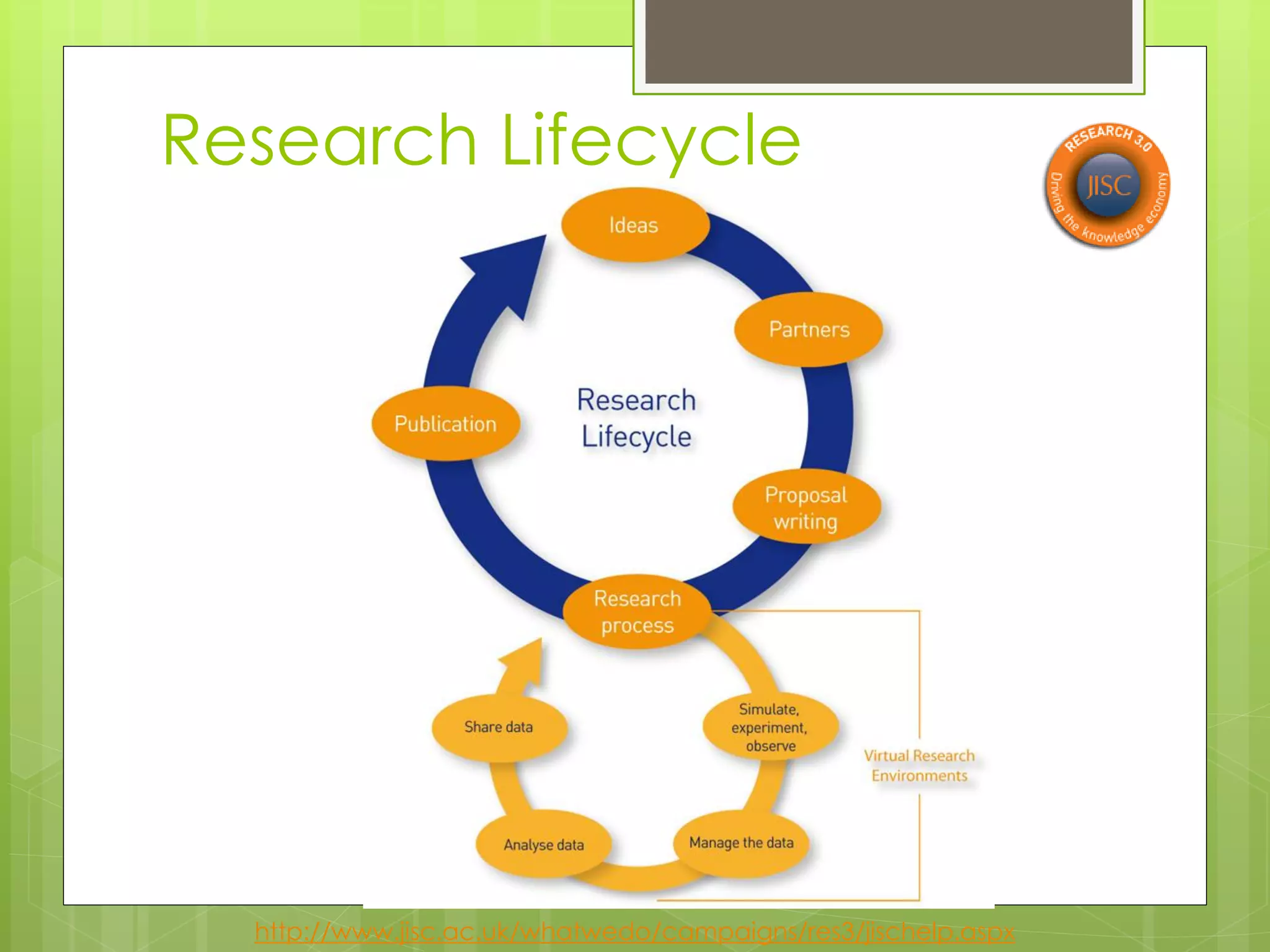
Rationale behind Research 
Investigate/explore a problem (challenge) 
Report on findings 
Report on solutions to problems (challenges) 
Action by governments, World Health Organization, etc.
A Research Problem is … 
“a statement about an area of concern, a condition to be improved, a difficulty to be eliminated, or a troubling question that exists in scholarly literature, in theory, or in practice that points to the need for meaningful understanding and deliberate investigation.” 
Univ. of Southern California Libraries
http://www.jisc.ac.uk/whatwedo/campaigns/res3/jischelp.aspx 
Research Lifecycle
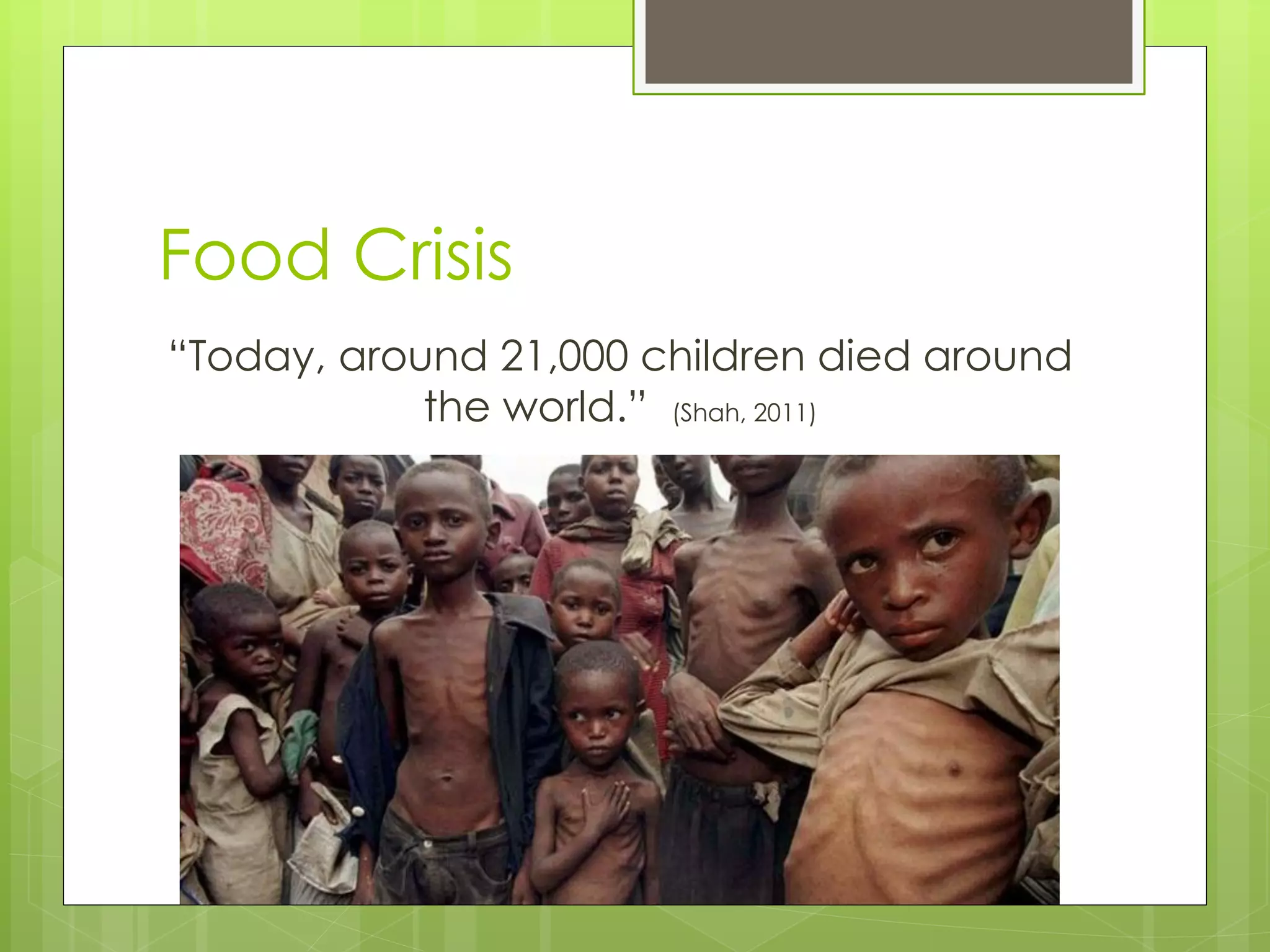
Food Crisis 
“Today, around 21,000 children died around the world.” (Shah, 2011)
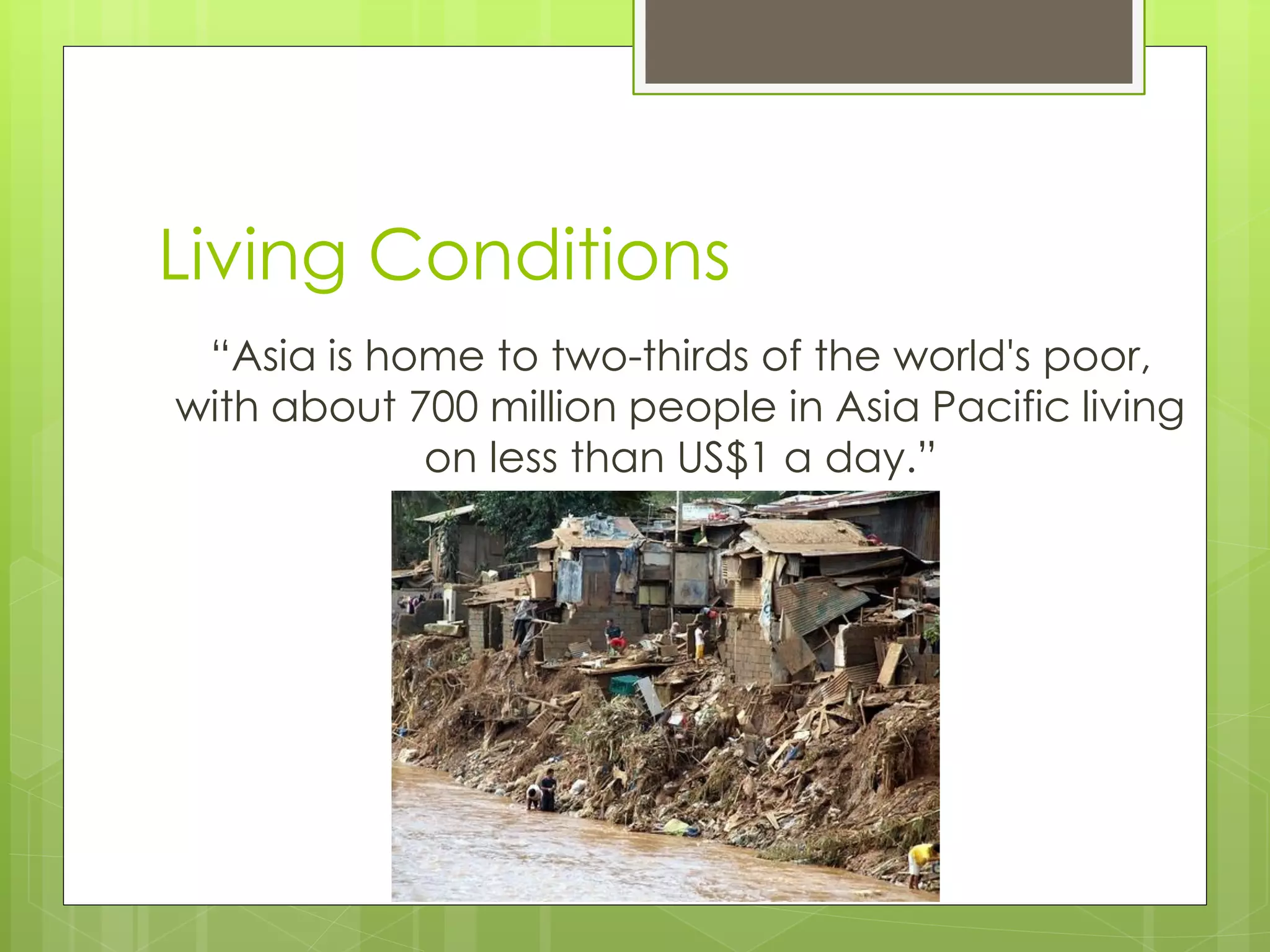
Living Conditions 
“Asia is home to two-thirds of the world's poor, with about 700 million people in Asia Pacific living on less than US$1 a day.”
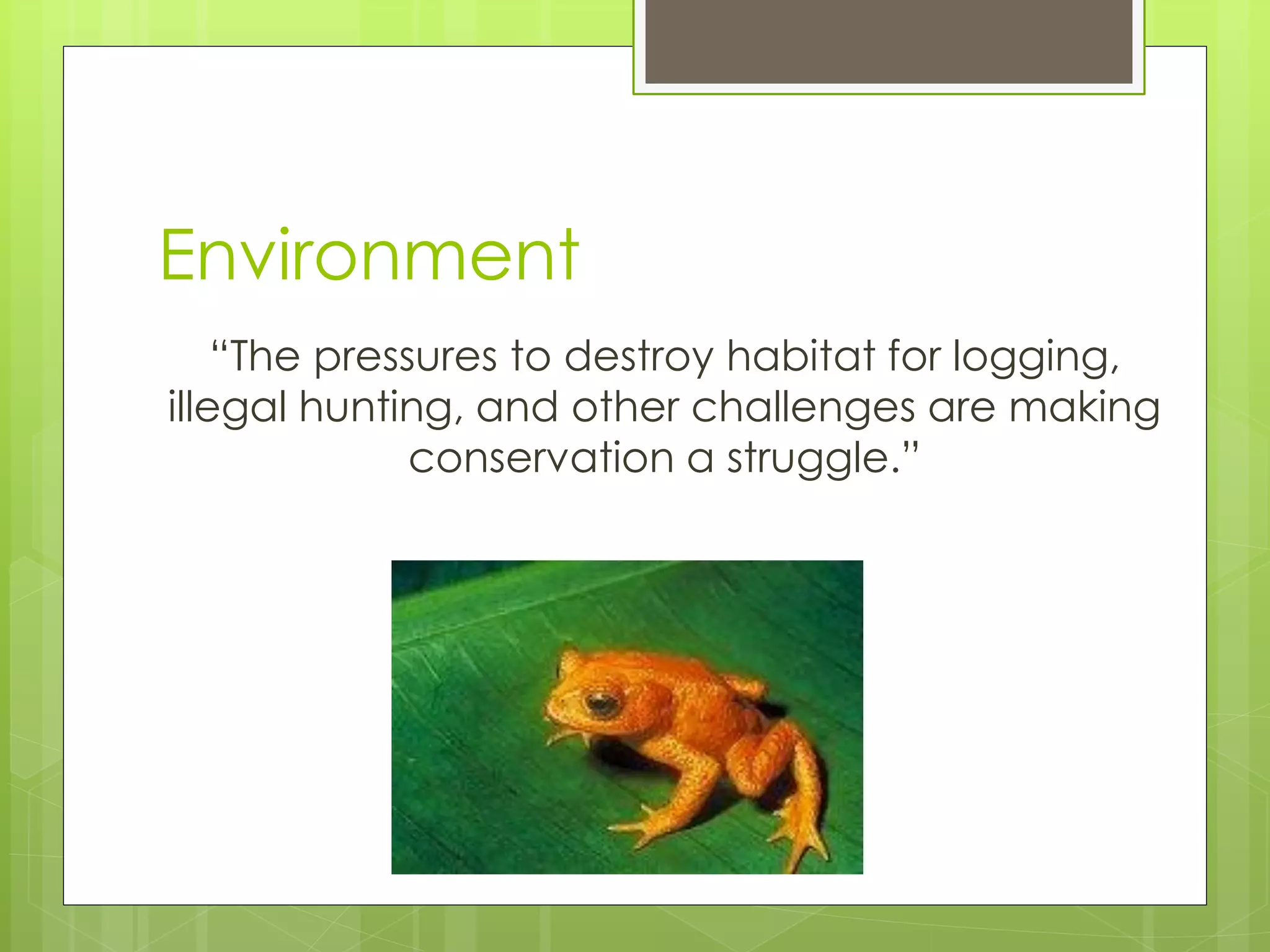
Environment 
“The pressures to destroy habitat for logging, illegal hunting, and other challenges are making conservation a struggle.”
Tobacco 
“Poverty, world hunger - by diverting prime land away from food production, damages the environment and reduces economic productivity.”
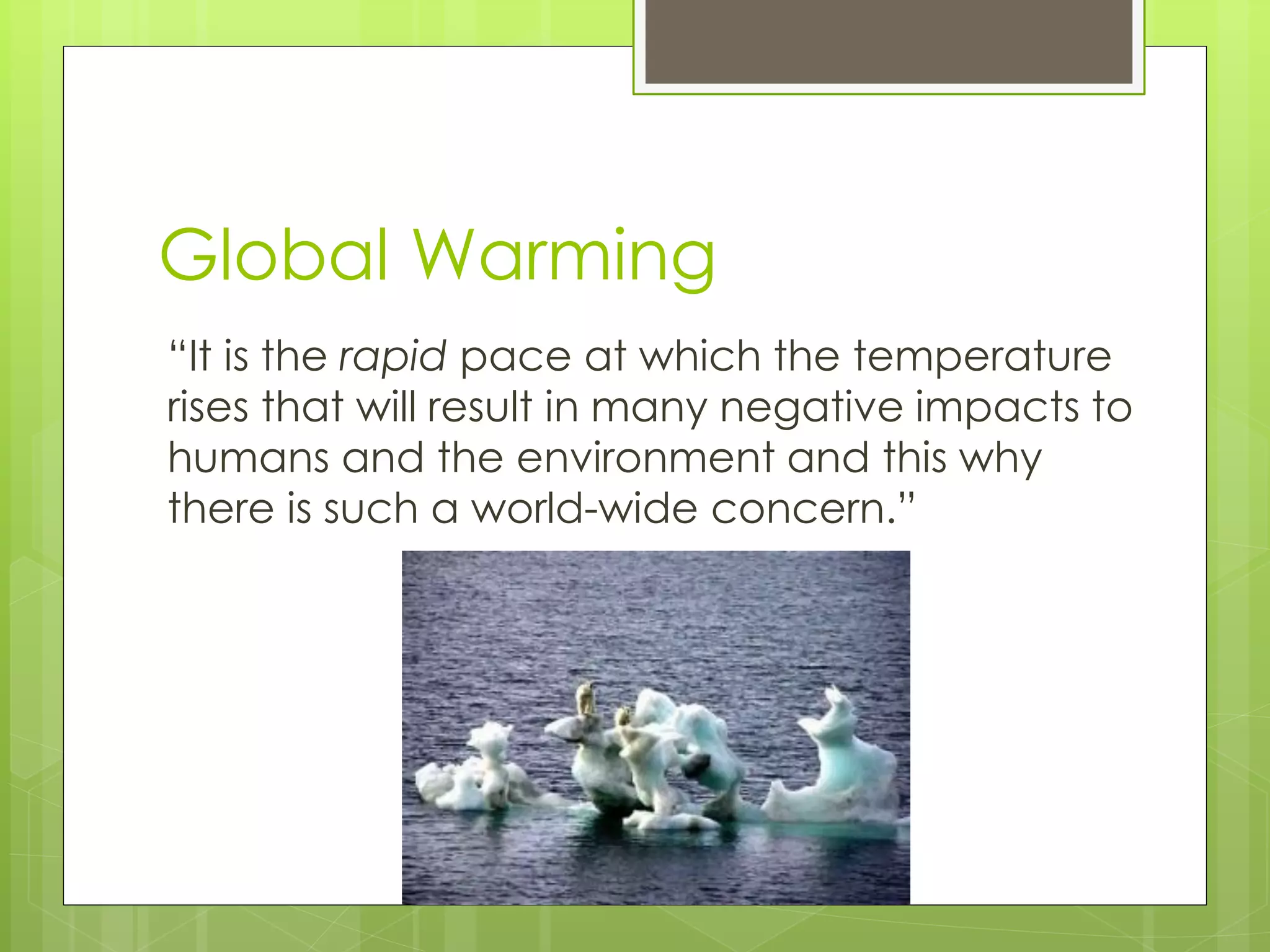
Global Warming 
“It is the rapid pace at which the temperature rises that will result in many negative impacts to humans and the environment and this why there is such a world-wide concern.”
Tell us more about your interest in research …
Academic Publishing 
Thesis (Masters & Doctoral) 
Academic (scholarly/scientific) journal 
Conference proceedings 
Books & Chapters in books
Academic Journals 
Peer-reviewed periodical in which scholarship relating to a particular academic discipline is published 
Serve as forums for the introduction and presentation for scrutiny of new research, and the critique of existing research
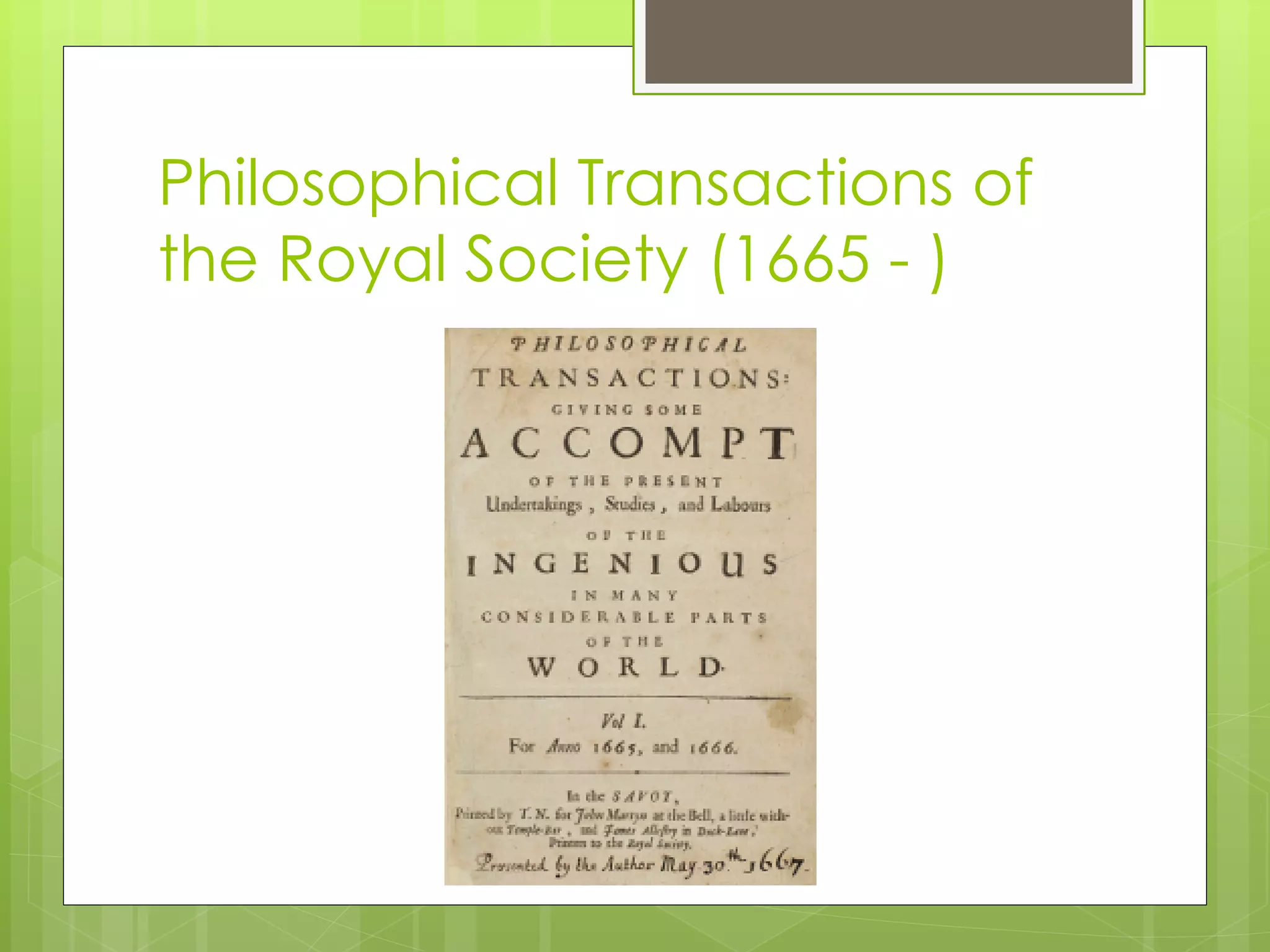
Philosophical Transactions of the Royal Society (1665 - )
Peer-review Process 
Instituted by Nature in 1967 
Process of subjecting an author’s scholarly work, research or ideas to the scrutiny of others who are experts in the same field, before the paper is published in a journal 
Recommendation: Accepted, revisions requested, rejected
Traditional vs E-journals 
Before & after the Internet 
Traditional: paper, manual workflow, slow publication, slow dissemination 
E-journals: online, electronic workflow, fast review fast publication, fast dissemination – costs came down 
Resulted in Open Access movement – more on OA journals later …
Business Models 
Subscription Access (author & reader pay) 
Article-Processing Charges (APC’s) (author pays) – also paid for by institutional OA funds – policy issues 
Open Access (author pays) – cost much lower than APC’s
Workflow 
Author 
Editor 
Reviewers (Peer-review) 
Proofreader 
Copyeditor 
Layout Editor 
Editor published issue
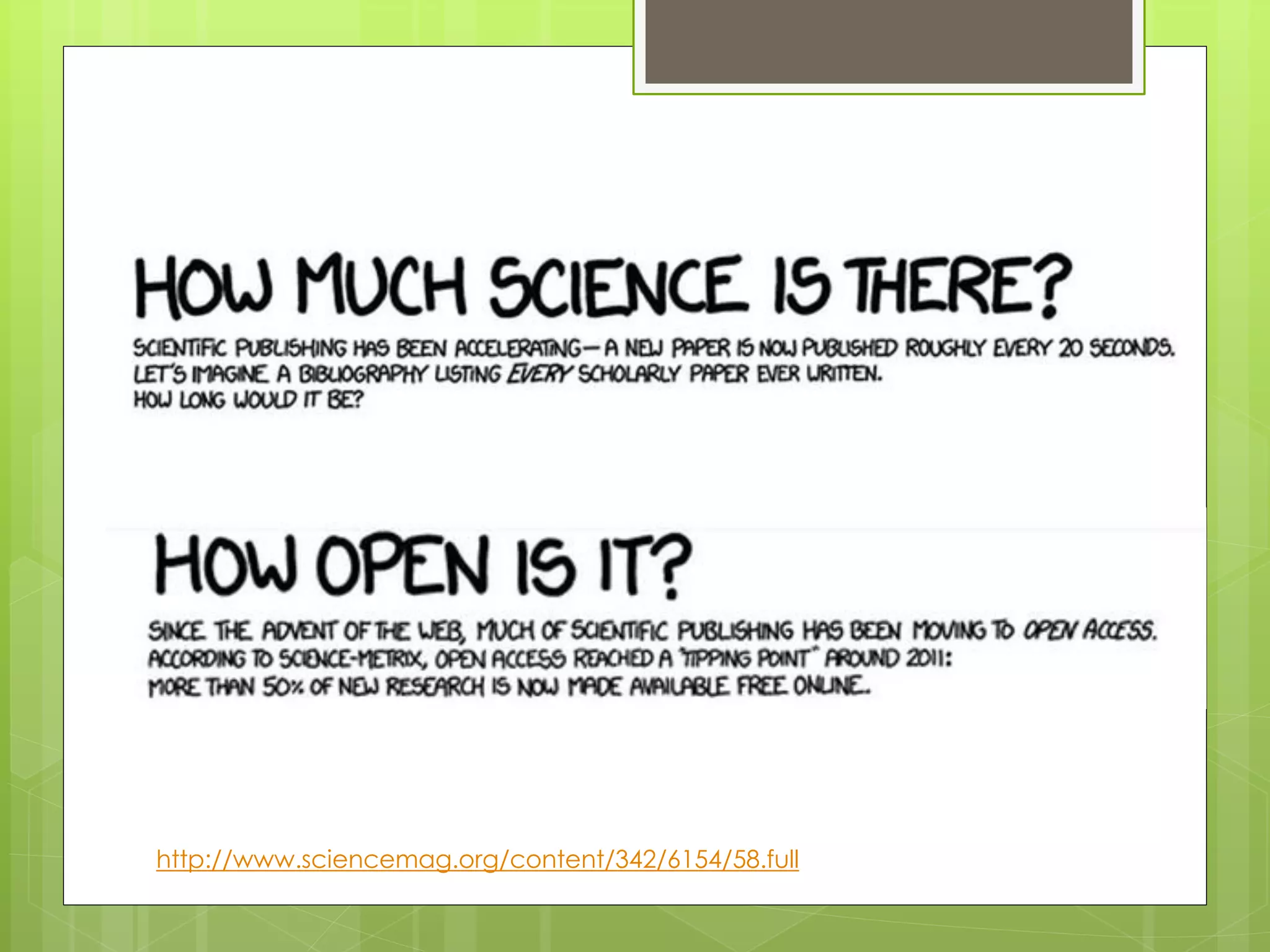
http://www.sciencemag.org/content/342/6154/58.full
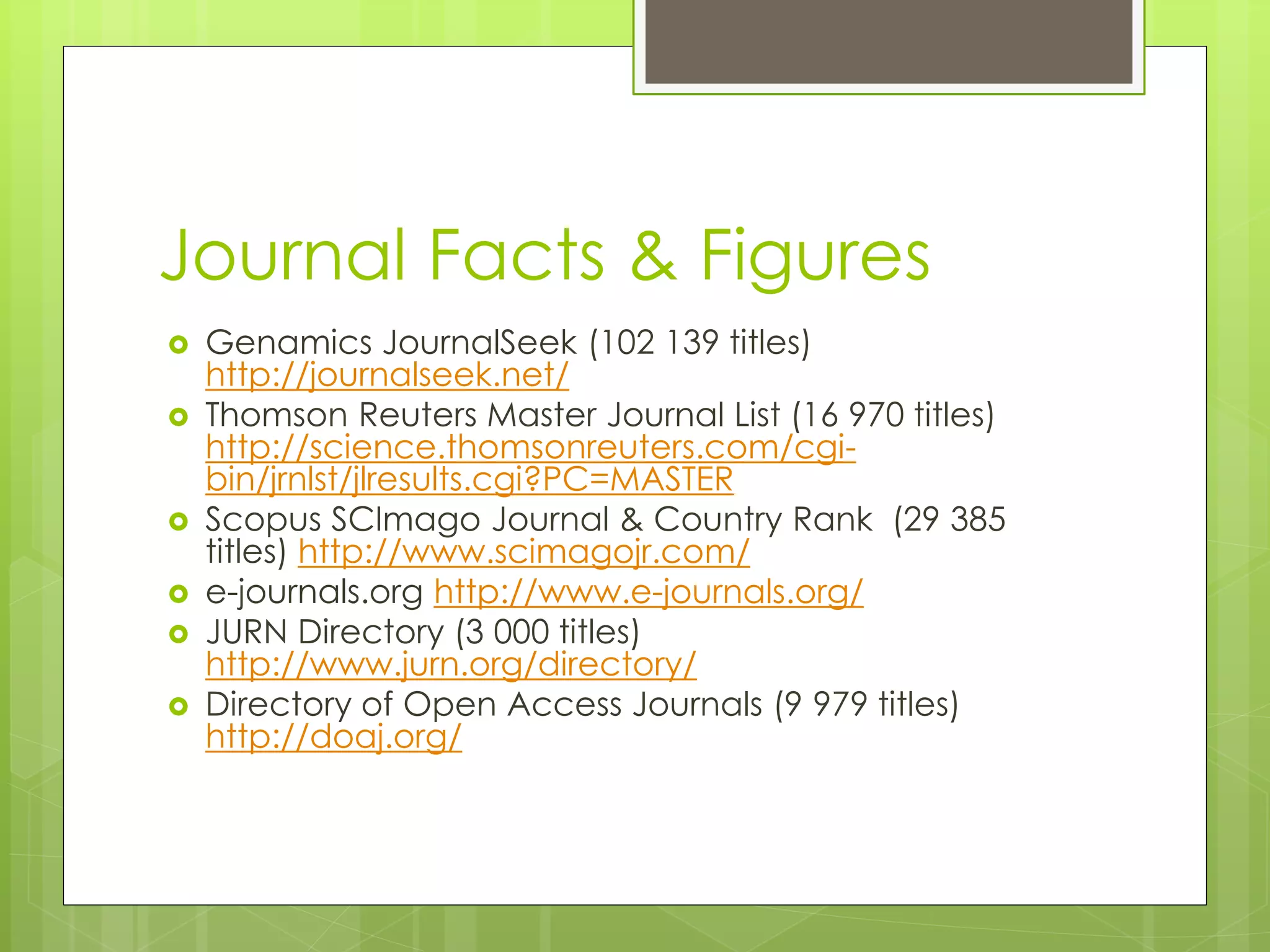
Journal Facts & Figures 
Genamics JournalSeek (102 139 titles) http://journalseek.net/ 
Thomson Reuters Master Journal List (16 970 titles) http://science.thomsonreuters.com/cgi- bin/jrnlst/jlresults.cgi?PC=MASTER 
Scopus SCImago Journal & Country Rank (29 385 titles) http://www.scimagojr.com/ 
e-journals.org http://www.e-journals.org/ 
JURN Directory (3 000 titles) http://www.jurn.org/directory/ 
Directory of Open Access Journals (9 979 titles) http://doaj.org/
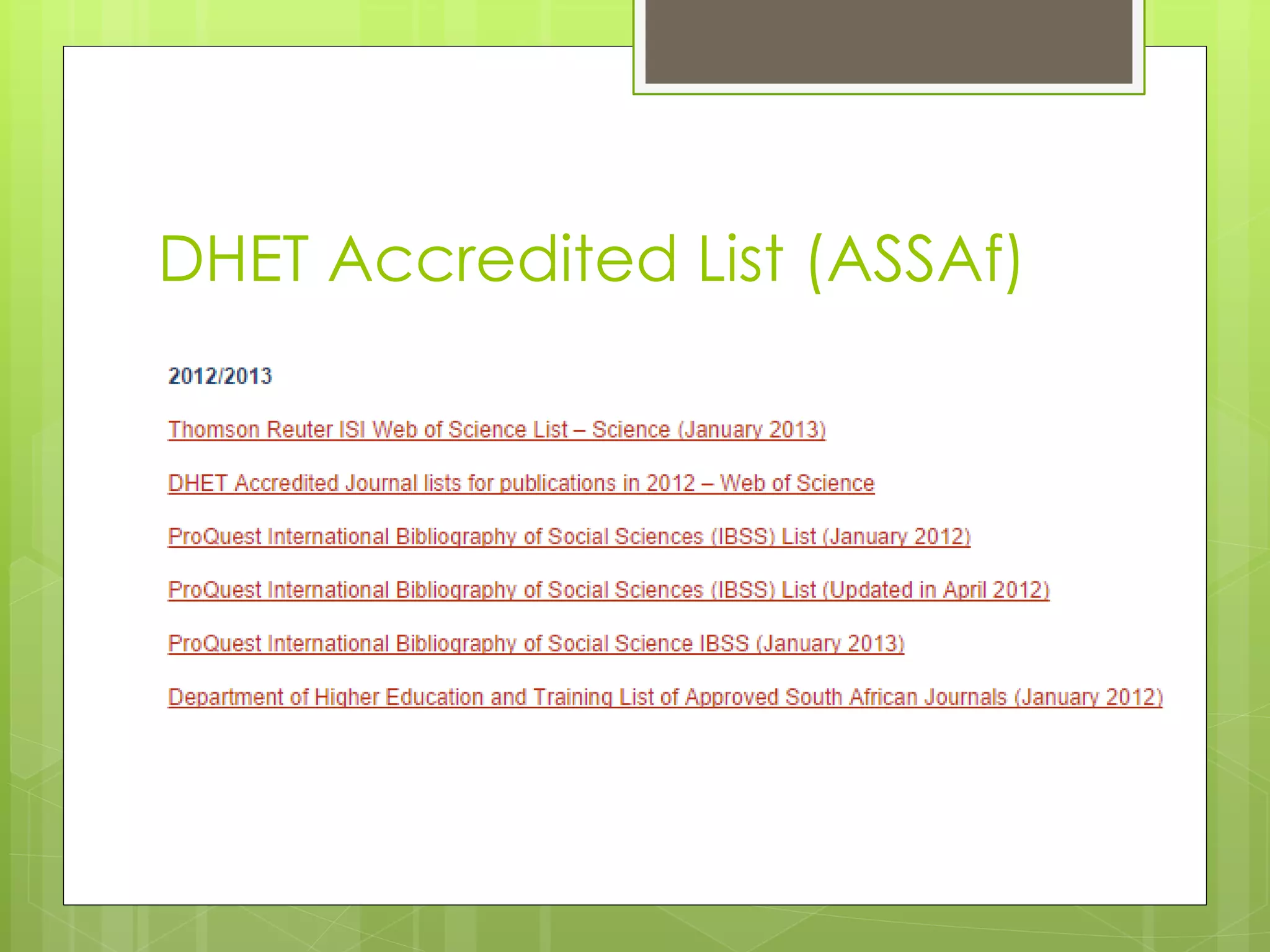
DHET Accredited List (ASSAf)
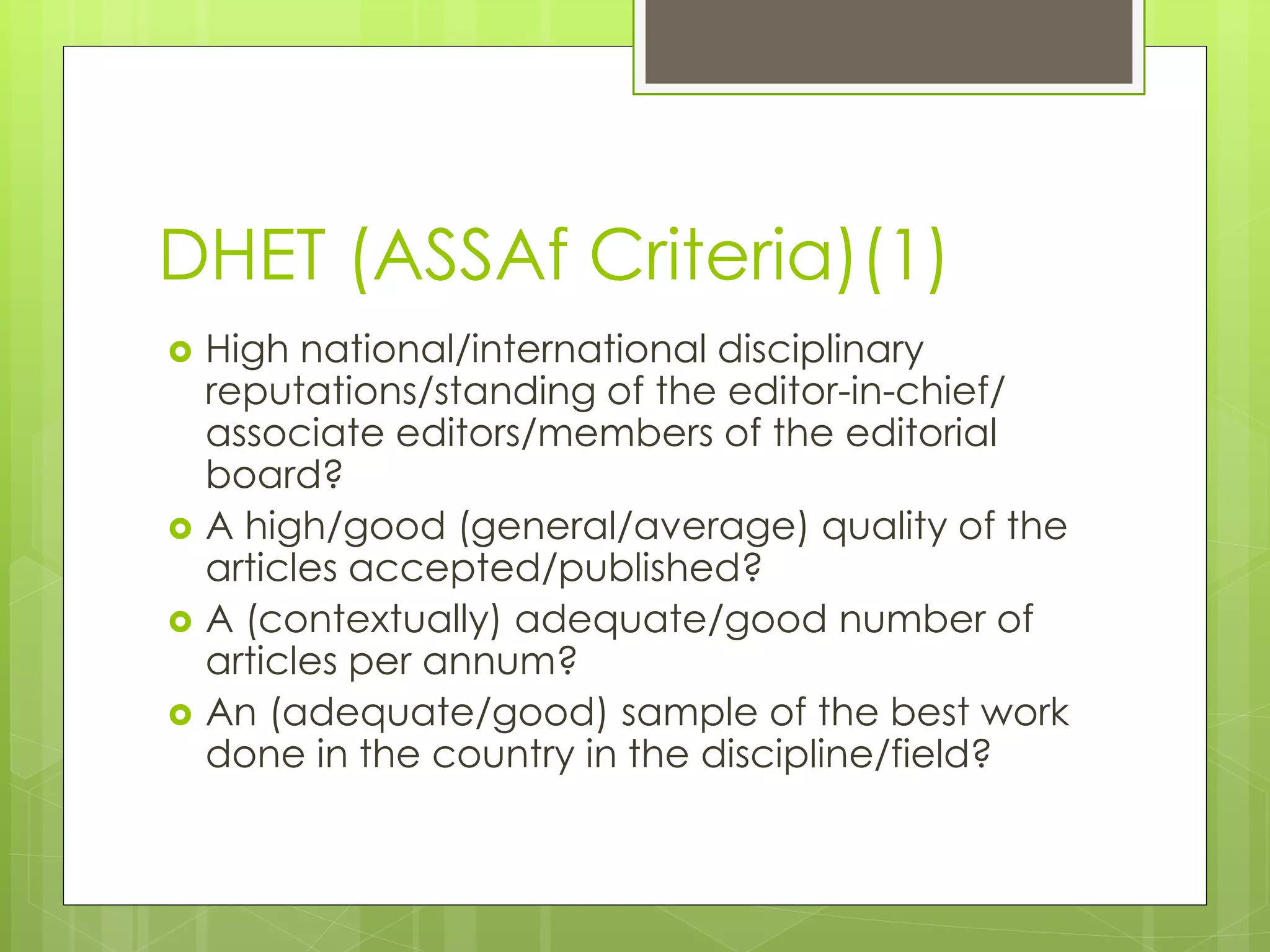
DHET (ASSAf Criteria)(1) 
High national/international disciplinary reputations/standing of the editor-in-chief/ associate editors/members of the editorial board? 
A high/good (general/average) quality of the articles accepted/published? 
A (contextually) adequate/good number of articles per annum? 
An (adequate/good) sample of the best work done in the country in the discipline/field?
DHET (ASSAf Criteria)(2) 
A focus on local/regional kinds of materials/problems? 
Publication of articles by authors from across the country, and internationally? 
Useful additional scholarly features like editorials, topical reviews, book reviews, scholarly correspondence, etc? 
Proper (English-language) abstracts for all articles?
DHET (ASSAf Criteria)(3) 
Suitable publication of errata? 
Good citation practice? 
Suitability as a general on-going stimulus for local graduate students/young staff in the discipline concerned? 
Some kind of comparability with leading international journals in the field 
DHET recommendations
Determine the impact factor for a journal (Journal Citation Reports)
Scholarly Journals Part 2 
Trends in Journal Publishing 
Ina Smith 
HERS-SA Academy Workshop 
8 September 2014
Open Access Journals 
“Open access journals are scholarly journals 
that are available online to the reader 

without financial, legal, or technical barriers 
other than those inseparable from gaining 
access to the internet itself.“ 
Source: http://www.soros.org/openaccess/read.shtml 
1
Benefits of OA 
E-workflow, all activities & versions recorded 
Reduced costs for all 
Post peer-reviewed by all (comments) – transparent 
Increase in impact– used, read, cited more 
Accelerates the pace of research, discovery, innovation 
All can benefit – democratic right - research should be open, so that all can work together and avoid disaster (see challenges)
Directory of OA Journals 
http://doaj.org/
Early OA Initiatives 
arXiv.org (1991) http://arxiv.org/ 
Journal of Medical Internet Research (1999) http://www.jmir.org/ 
BioMed Central (2000 - ) publishes 250 titles 
Berlin Declaration on Open Access to Knowledge in the Sciences and Humanities http://openaccess.mpg.de/319790/Signatories
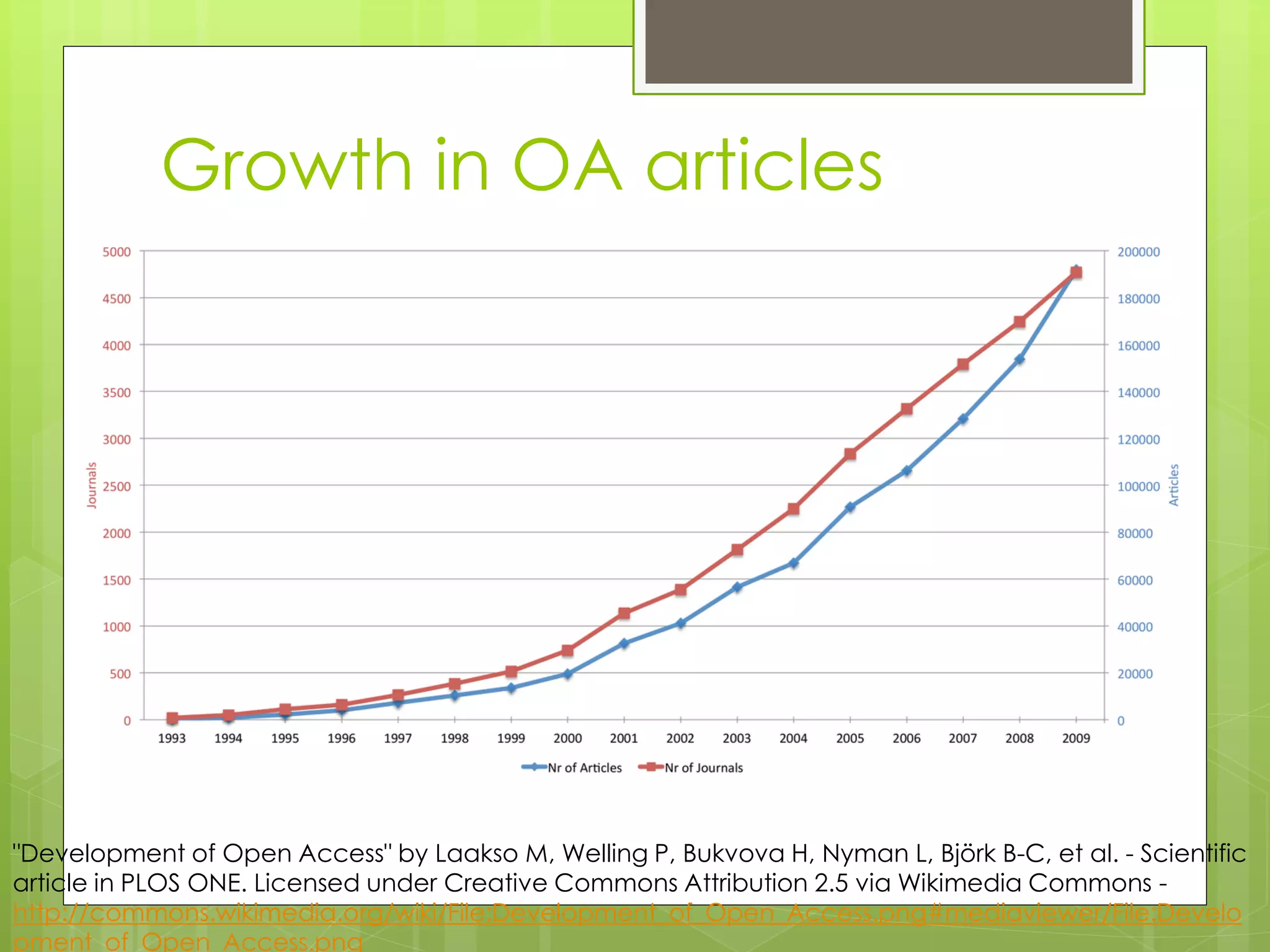
Growth in OA articles 
"Development of Open Access" by Laakso M, Welling P, Bukvova H, Nyman L, Björk B-C, et al. - Scientific article in PLOS ONE. Licensed under Creative Commons Attribution 2.5 via Wikimedia Commons - http://commons.wikimedia.org/wiki/File:Development_of_Open_Access.png#mediaviewer/File:Development_of_Open_Access.png
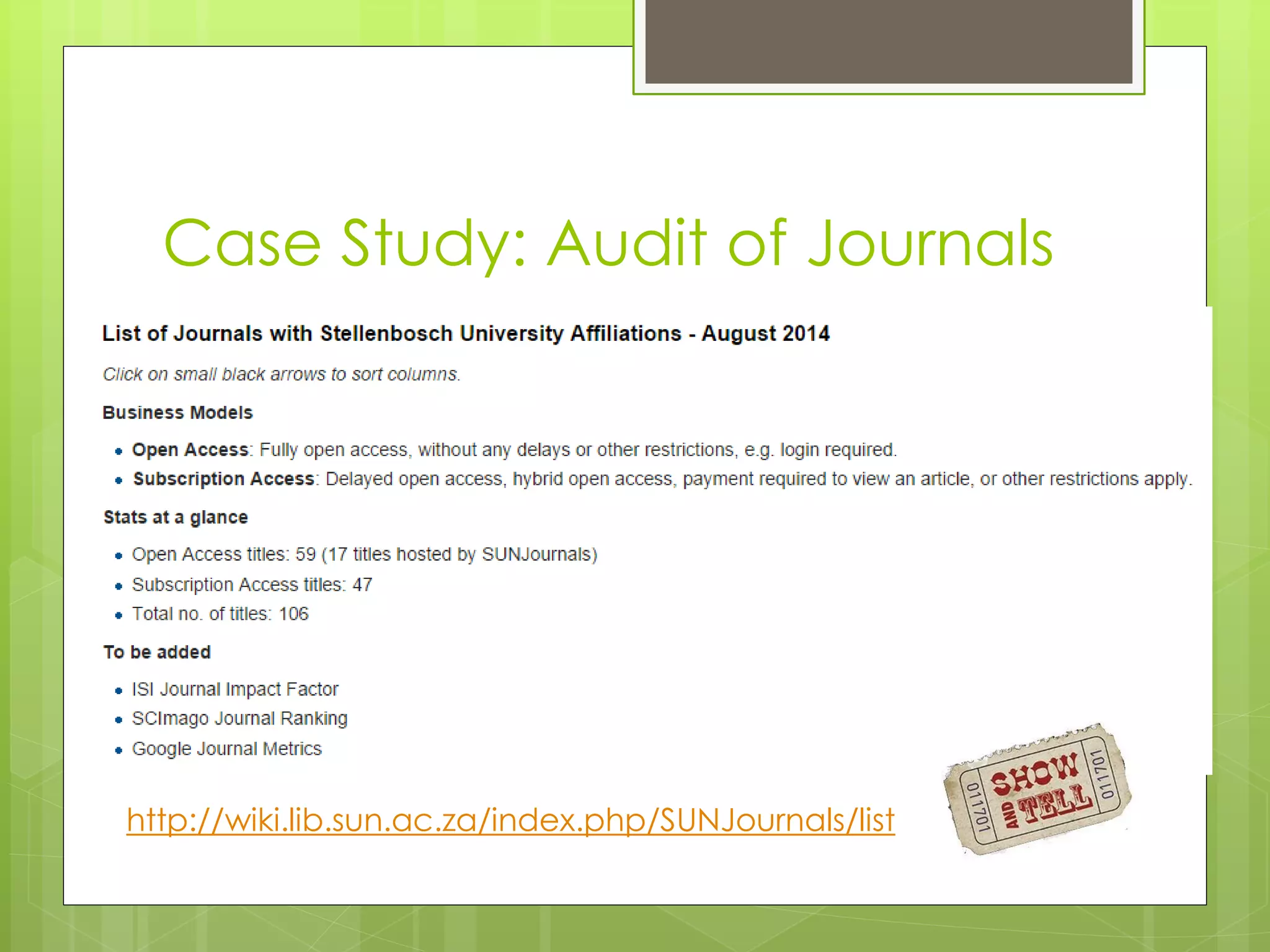
http://wiki.lib.sun.ac.za/index.php/SUNJournals/list 
Case Study: Audit of Journals
Crowd-sourced peer-review 
“The problem with peer-review today is that there is so much research being produced that there are not enough experts with enough time to peer-review it all.” 
Stevan Harnad http://blogs.lse.ac.uk/impactofsocialsciences/2014/08/21/crowd-sourced- peer-review-substitute-or-supplement/#author 
2
Peer-reviewed Scientific Video Journal 
http://www.jove.com 
3
EarlyCite (Emerald) 
http://www.emeraldgrouppublishing.com/ authors/writing/earlycite.htm 
Researchers can access peer-reviewed journal articles prior to official publication 
4
Article of the Future (Elsevier) 
http://youtu.be/1dXkmgkYuEg 
5
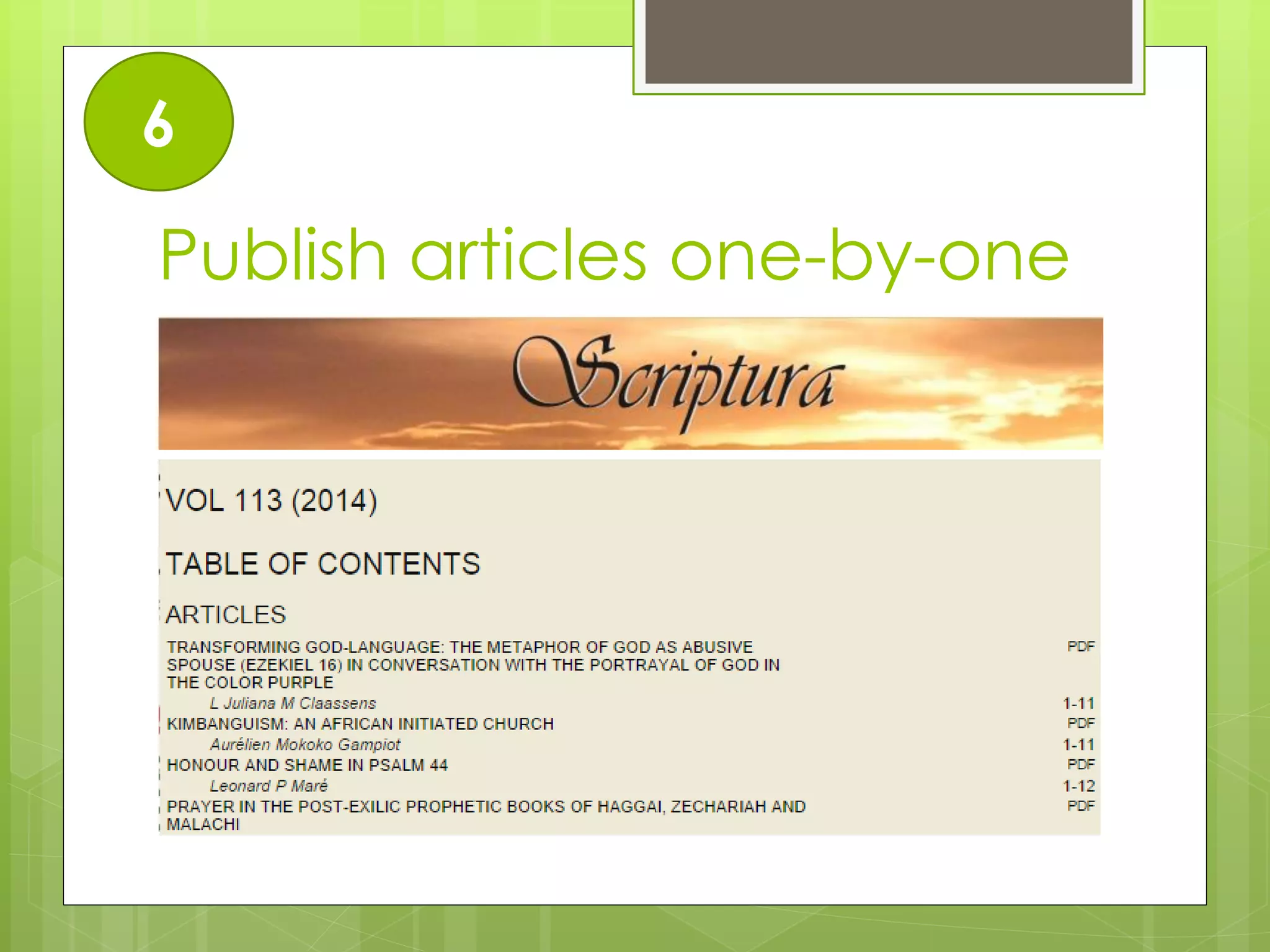
Publish articles one-by-one 
6
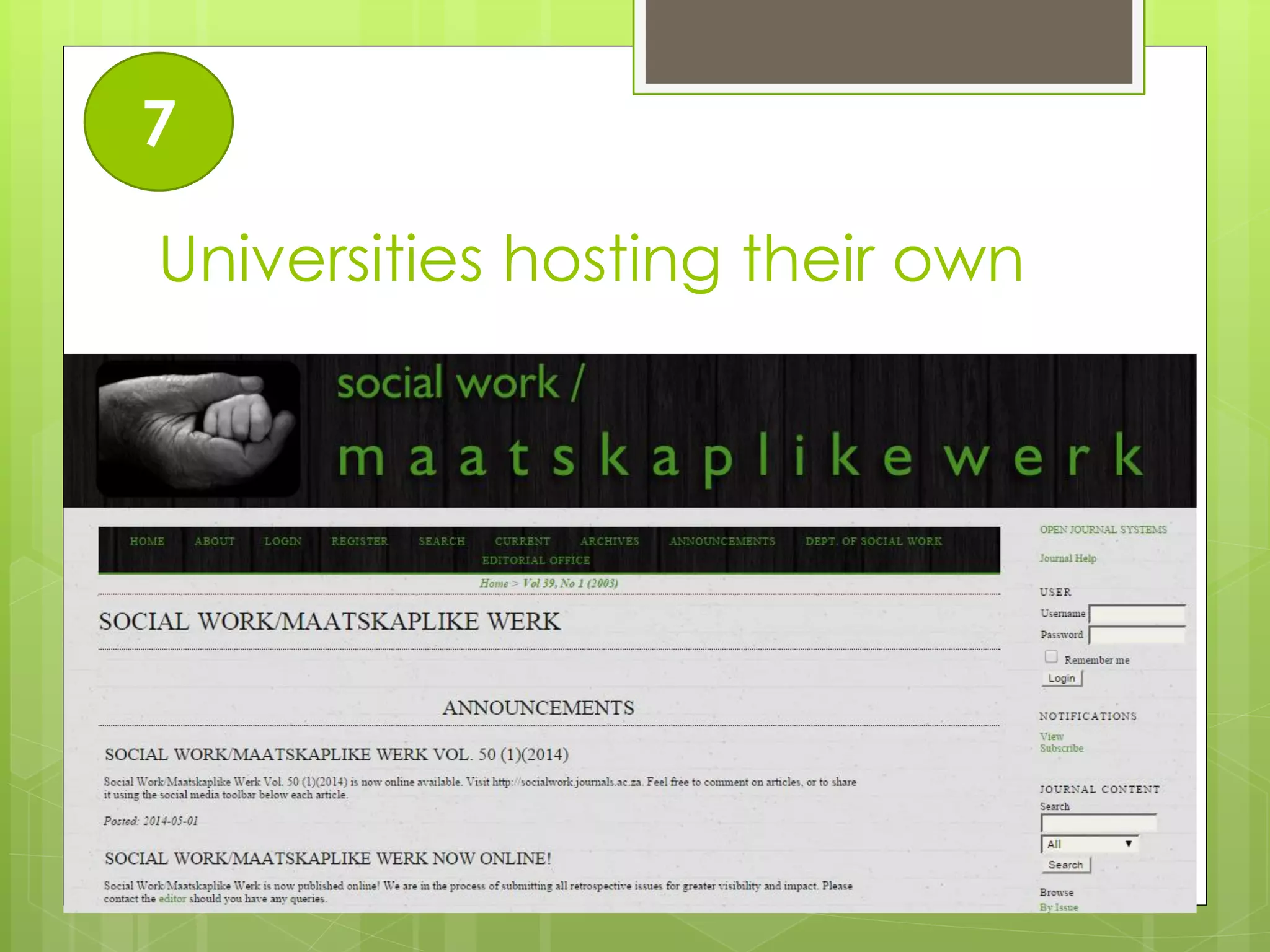
Universities hosting their own 
7
2nd copy on Institutional Repository 
8 
http://www.sherpa.ac.uk/romeo
Scholarly Journals Part 3 
Where to Publish & What to look for 
Ina Smith 
HERS-SA Academy Workshop 
8 September 2014
Web page with proper URL 
Look & feel – professional 
Proper English & language 
Proper referencing 
Valid eISSN assigned by ISSN International Centre 
Established history of responsible reporting 
High Quality Journal (1)
High Quality Journal (2) 
Good quality articles detailing well performed research 
Contact details (incl. admin e-mail) 
Editorial Team 
Editorial Board (international & academic affiliations) 
Advisory Board
High Quality Journal (3) 
Scope and Focus 
Peer Review Process (must be an exhaustive double blind peer review process) 
Publication Frequency 
Open Access Policy – registered with SHERPA RoMEO 
Digital preservation policy 
Registered with DOAJ
High Quality Journal (4) 
Publication ethics and malpractice statement incl. plagiarism detection policy 
Viper http://www.scanmyessay.com/viper- plagiarism-scanner.php 
PlagTracker http://www.plagtracker.com/ 
iThenticate http://www.ithenticate.com/ 
Copyediting & layout editing 
Author Guidelines 
About the Publisher
Previously published issues (Archive) 
Copyright policy (under the Creative Commons Licensing policies) 
Journal history 
Indexing 
DOI prefix & doi for each article 
Registered with DOAJ 
High Quality Journal (5)
Scholarly Journals Part 4 
Hosting scholarly journals 
Ina Smith 
HERS-SA Academy Workshop 
8 September 2014
“Universities and researchers are coming under increasing pressure to demonstrate the wider impact that their funded research 
has beyond the end of the research project.” 
Manchester Univ. eScholar Blog (2012)
Small Journals 
“So, the smallest open access journal has a potentially larger audience than even the most popular pay walled journal because the work can reach anyone in the world with access to the Internet. When you couple this massive potential audience with the permission to republish and reuse via an open license, authors can maximize the impact of their work beyond the reach of any closed journal.” - Peter Suber 
Source: World Bank Live Event Report: Open Access Policy and Development 2012, http://creativecommons.org/weblog/entry/32839
Possible Stakeholders 
Vice-rector: Research 
Research Office & IT 
Intellectual Property Office 
Individual Journals (SU editors) 
Printer (SUNMedia) 
Library 
Open Scholarship Office (SUNJournals) 
Faculty Librarians 
Cataloguers
Typical Role (1) 
Understand the research process 
Promote OA 
eCollection building 
Disseminate & facilitate access to information 
Hosting of journal using OJS 
Software upgrades 
Training & support
Typical Role (2) 
Acquisition of eISSN 
Assigning metadata for indexing 
Register with harvesters, search engines, directories (DOAJ) 
Digital Object Identifier (doi) & submission of doi’s 
Journal domain name e.g. http://sajie.journals.ac.za/
Typical Role (3) 
Digital preservation & content archiving 
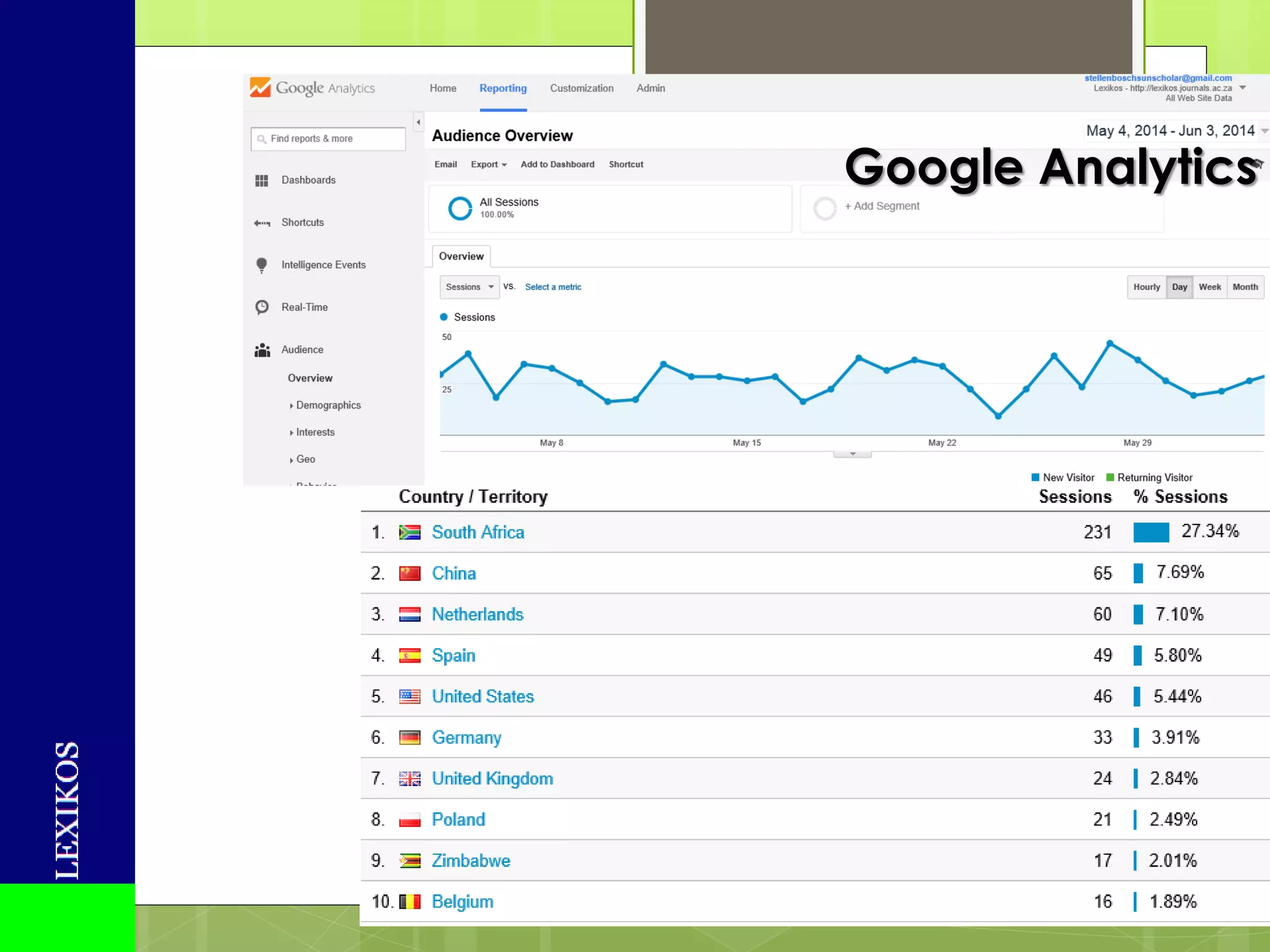
Google Analytics 
Creative Commons Licensing 
Open Access policy 
Register policy with SHERPA RoMEO 
Gmail (admin) account for journal 
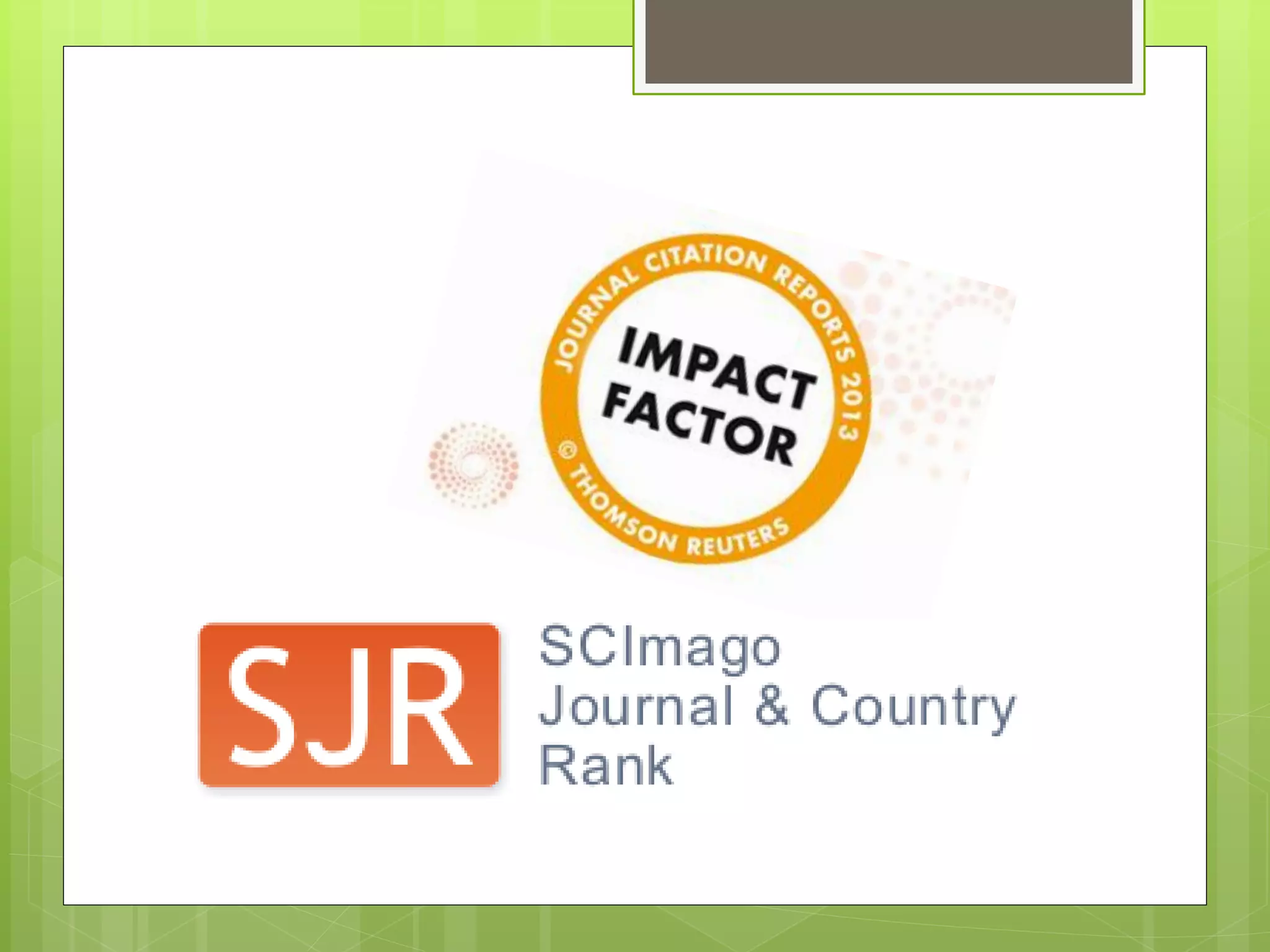
Assist with application of journal impact factor – Thomson Reuters & SciMAGO 
Advisory role – what makes a trusted journal
Journal Software 
OJS (PKP) 
ScholarOne (Thomson Reuters) 
SciELO 
Etc.
http://sajie.journals.ac.za
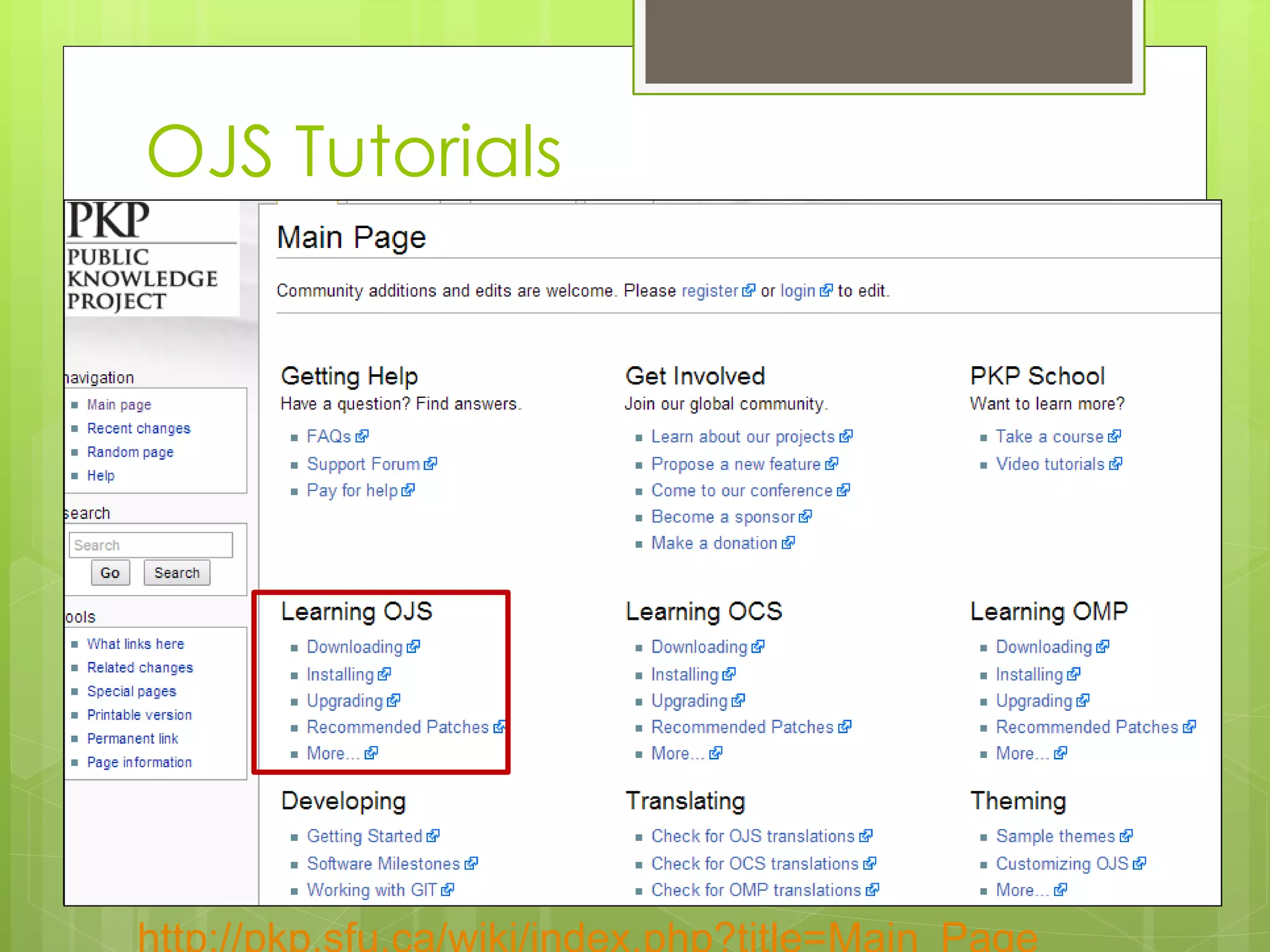
http://pkp.sfu.ca/wiki/index.php?title=Main_Page 
OJS Tutorials
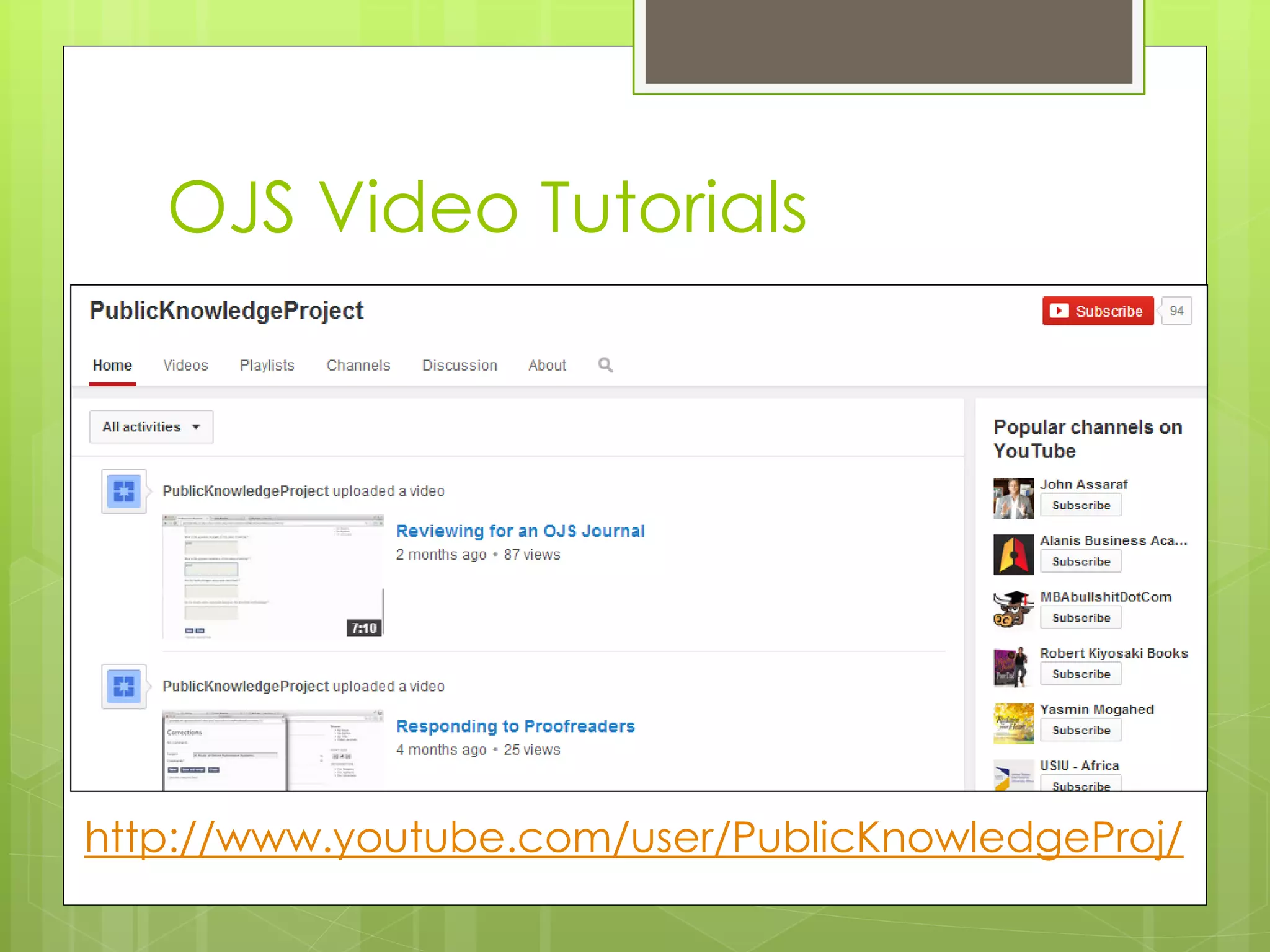
http://www.youtube.com/user/PublicKnowledgeProj/ 
OJS Video Tutorials
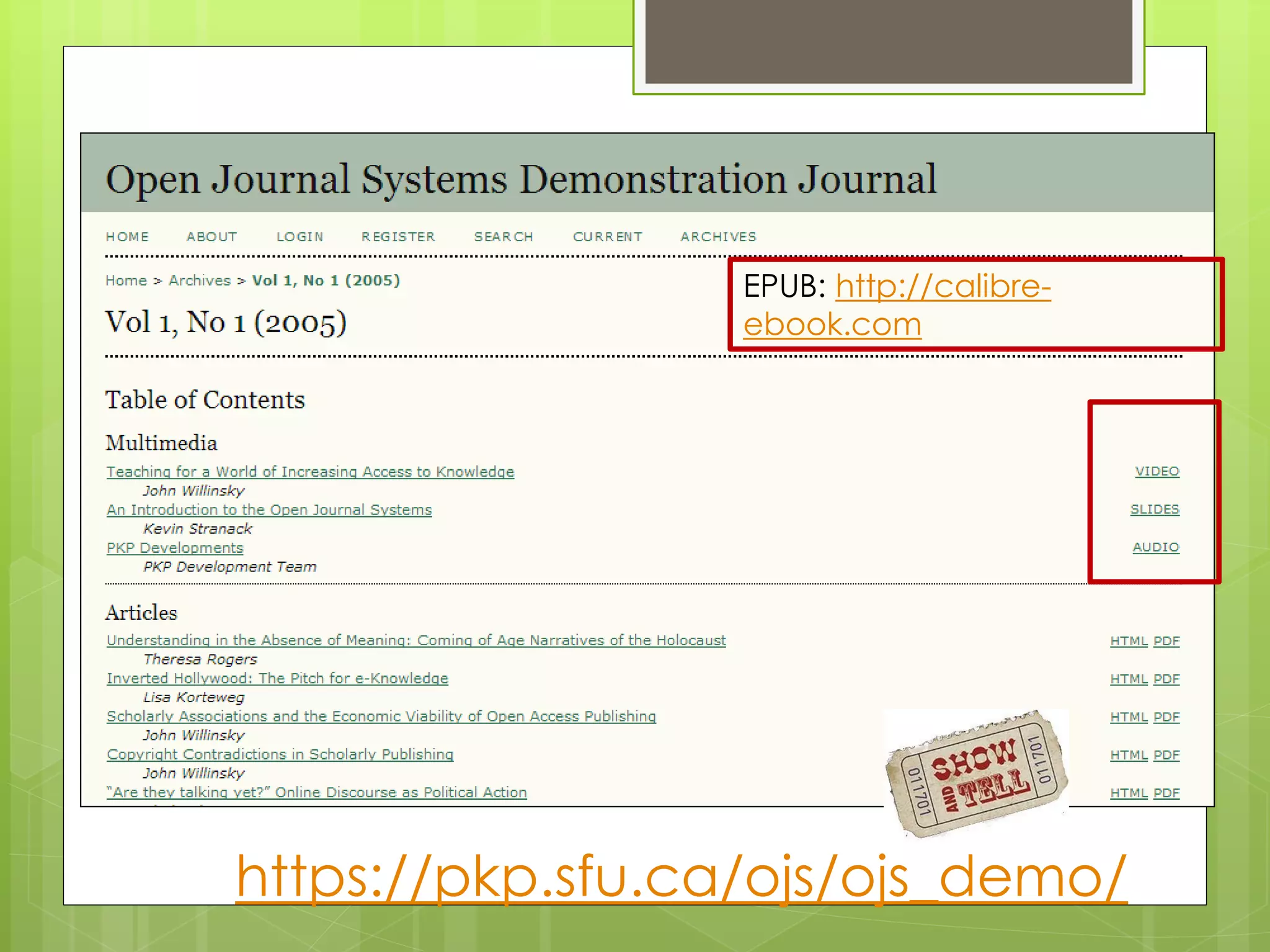
https://pkp.sfu.ca/ojs/ojs_demo/ 
EPUB: http://calibre- ebook.com
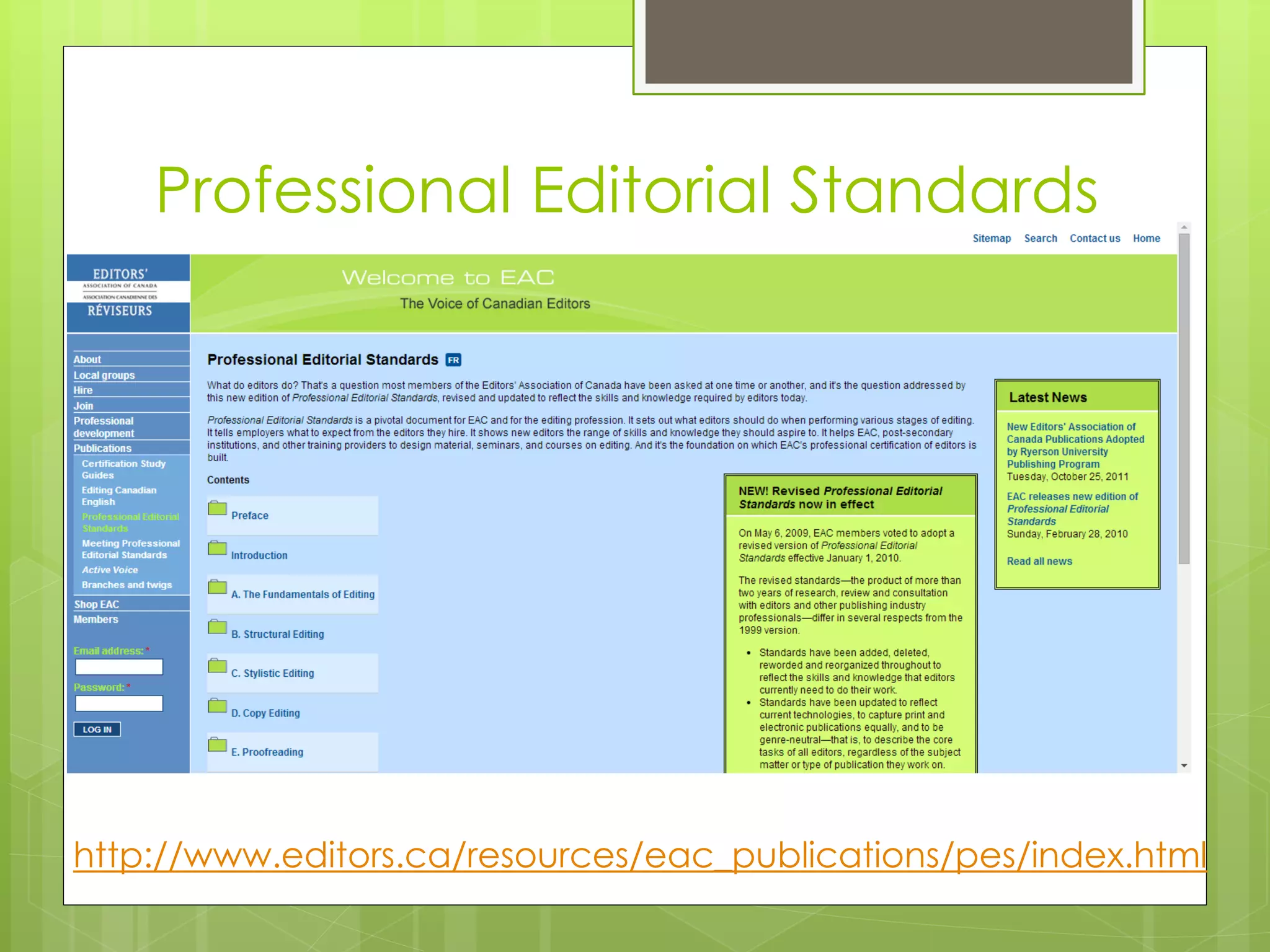
http://www.editors.ca/resources/eac_publications/pes/index.html 
Professional Editorial Standards
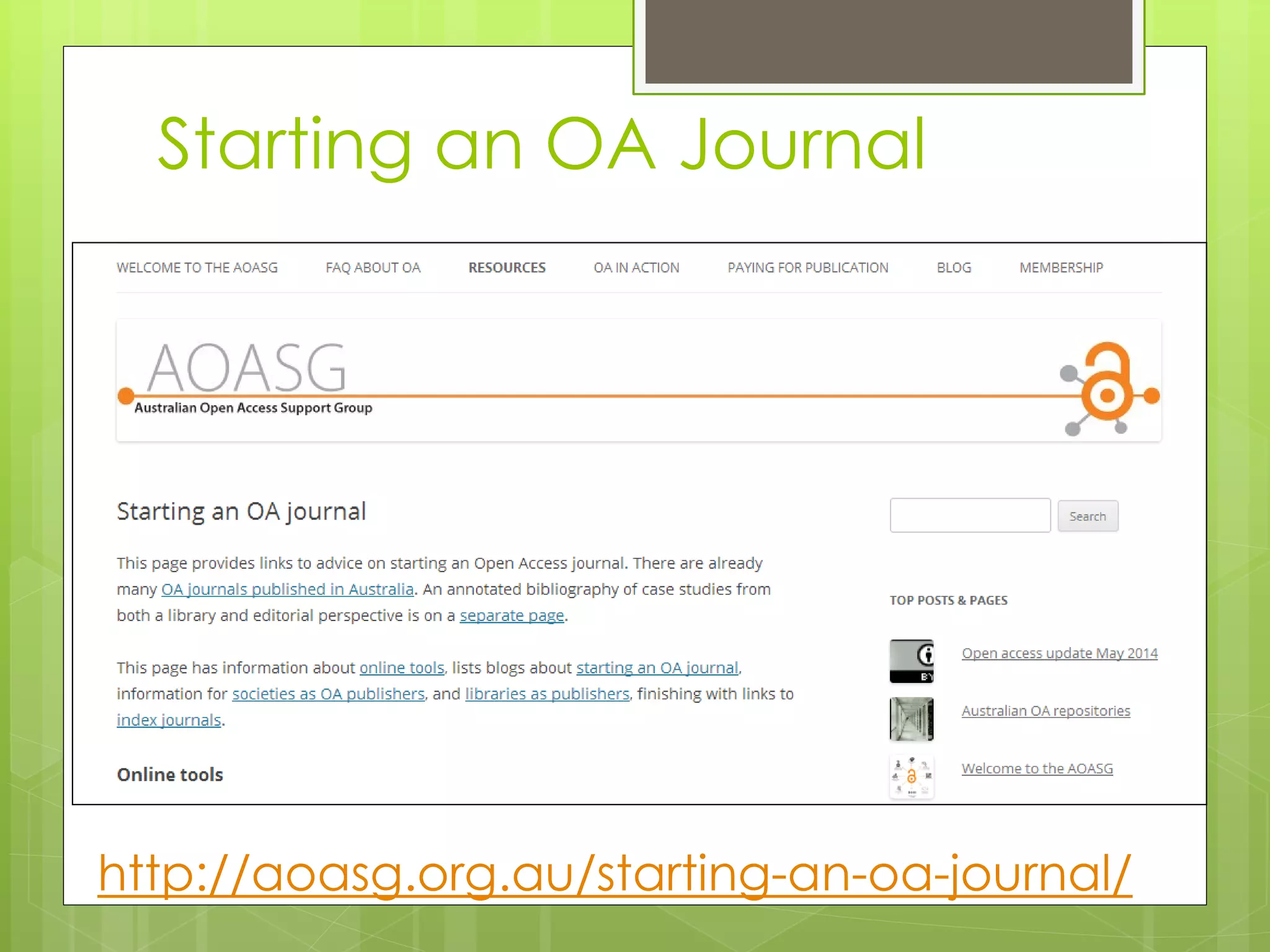
http://aoasg.org.au/starting-an-oa-journal/ 
Starting an OA Journal
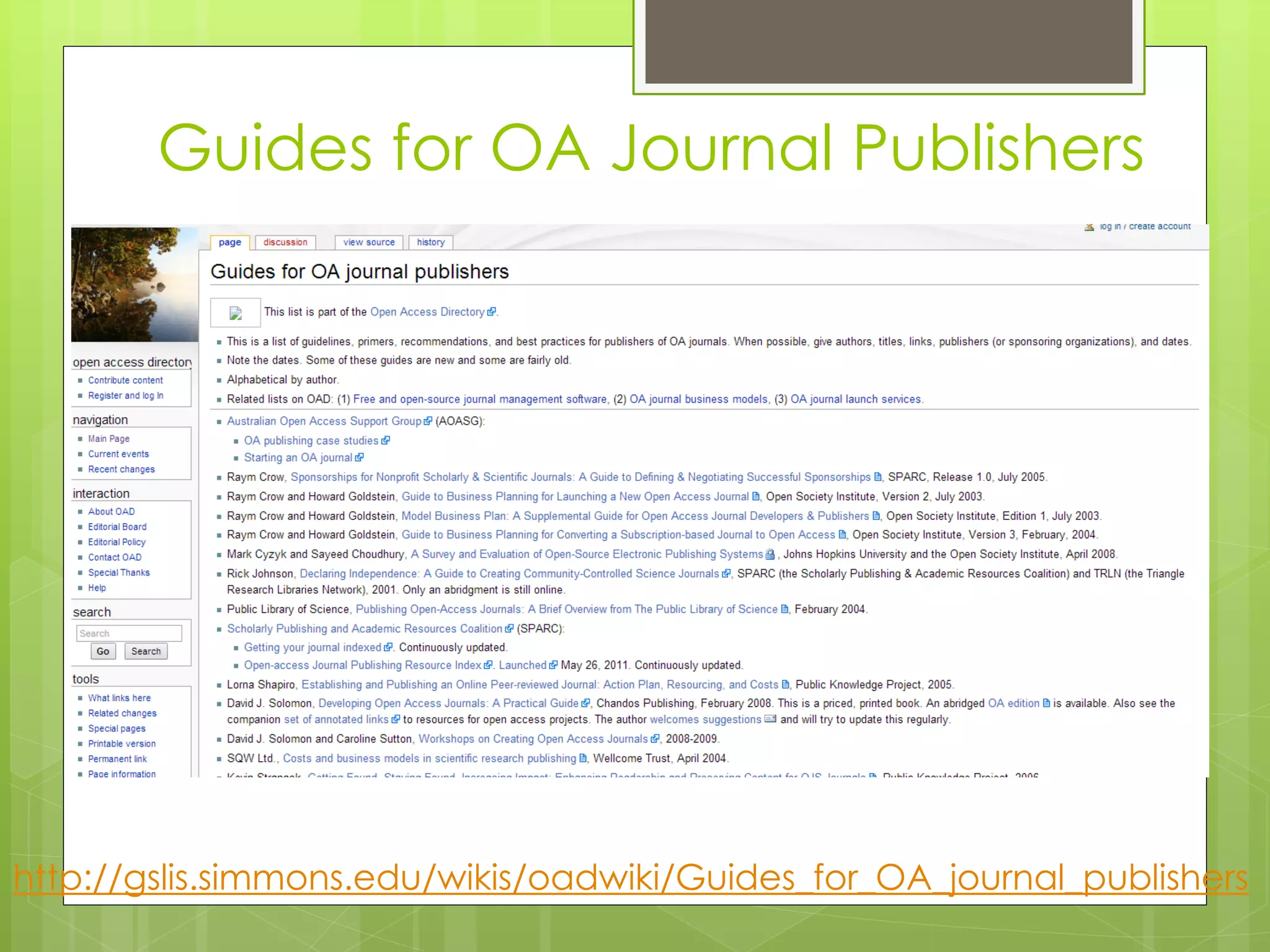
http://gslis.simmons.edu/wikis/oadwiki/Guides_for_OA_journal_publishers 
Guides for OA Journal Publishers
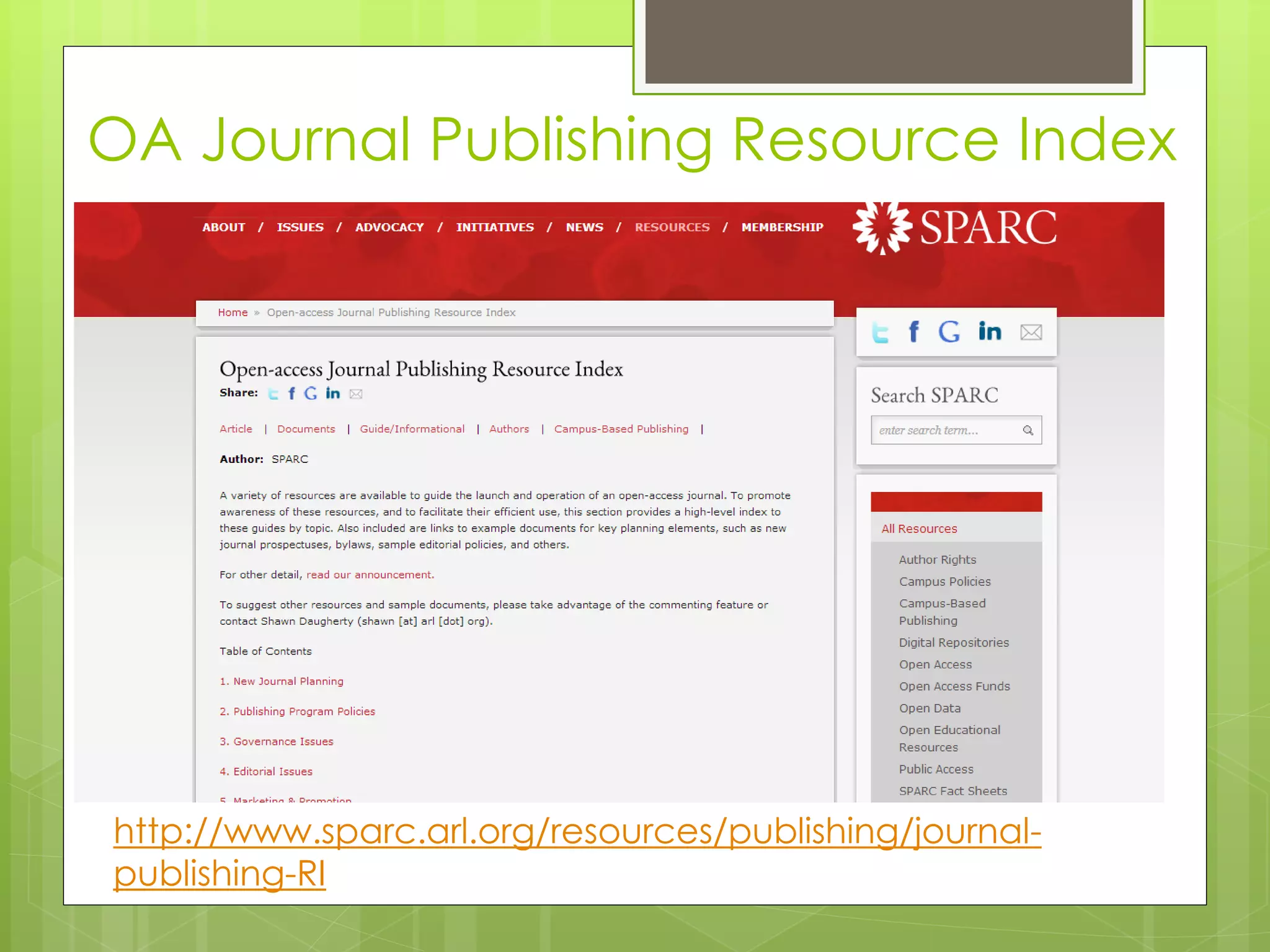
http://www.sparc.arl.org/resources/publishing/journal- publishing-RI 
OA Journal Publishing Resource Index
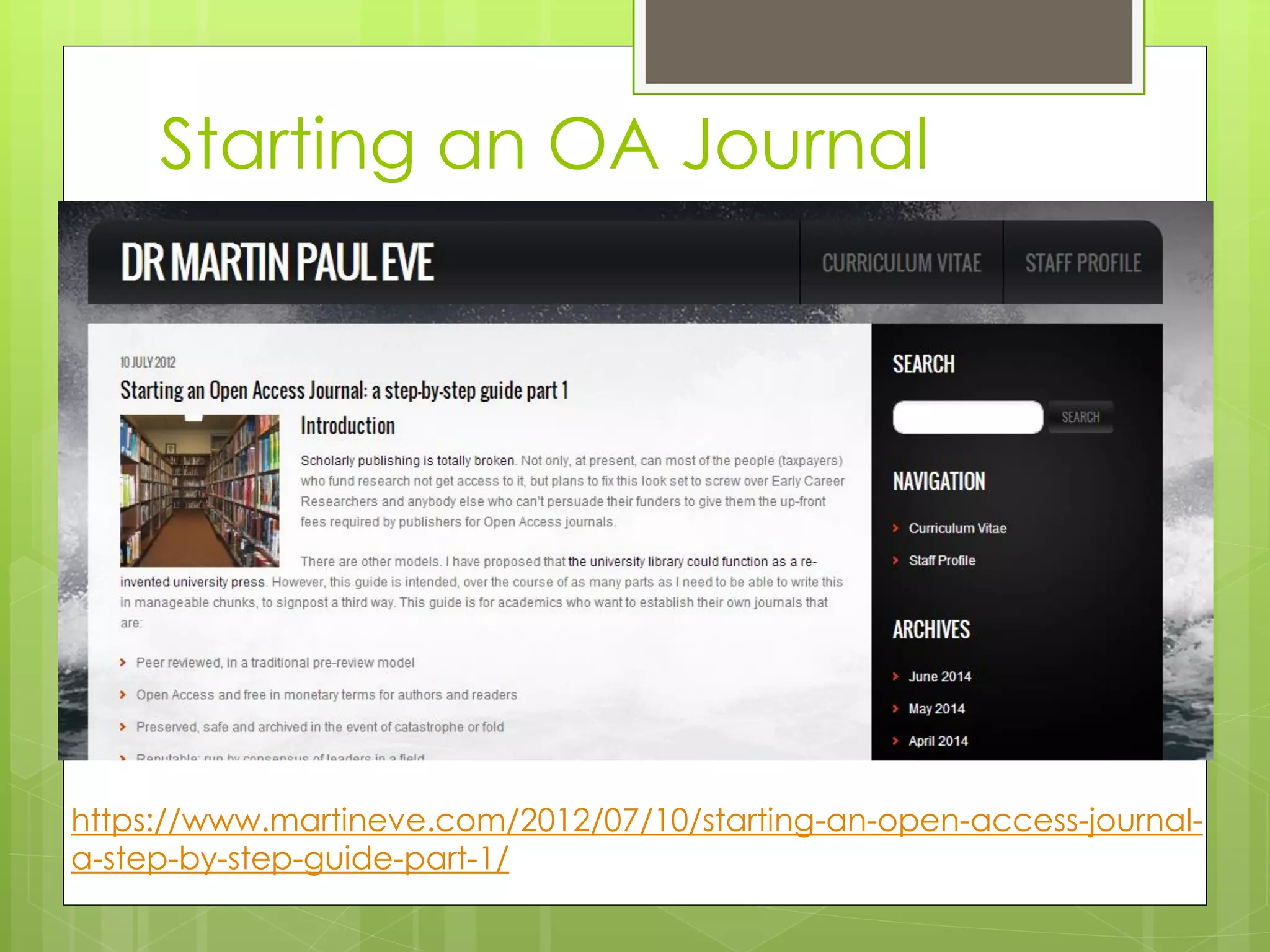
https://www.martineve.com/2012/07/10/starting-an-open-access-journal- a-step-by-step-guide-part-1/ 
Starting an OA Journal
2011 - 2014 
15 Active OA journal titles; 5 new in 2014 
9 006 articles in 15 titles 
993 319 downloads for 15 titles 
Case Study: SUNJournals
African Public Procurement Law Journal 
Trends in Nursing 
Social Work 
Missionalia 
African Journal of Business Ethics 
New Titles 2014
Increase in usage and visibility 
Increase in submission of papers 
Reduced costs with minimal expenses (profit) 
Since going online
Potential, possible, or probable predatory scholarly open-access publishers 
http://scholarlyoa.com/publishers/ 
Beall’s List
From traditional to OA online 
Starting a new journal 
Future issues - online, open access 
Future issues & retrospective issues – online, open access 
Approaches
Scholarly Journals Part 5 
Journal, Article & Author Profile 
Ina Smith 
HERS-SA Academy Workshop 
8 September 2014
Marketing Journals 
Open Source Software, Setup, Google Scholar Site Map, URL’s, Metadata – international standards 
Promote journal 
Journal Level Metrics 
Promote individual articles 
Article Level Metrics 
Promote individual researchers 
Author Level Metrics
 
Source: http://www.infotechlead.com/2013/07/11/social-media-concerns-of-smbs- 13196
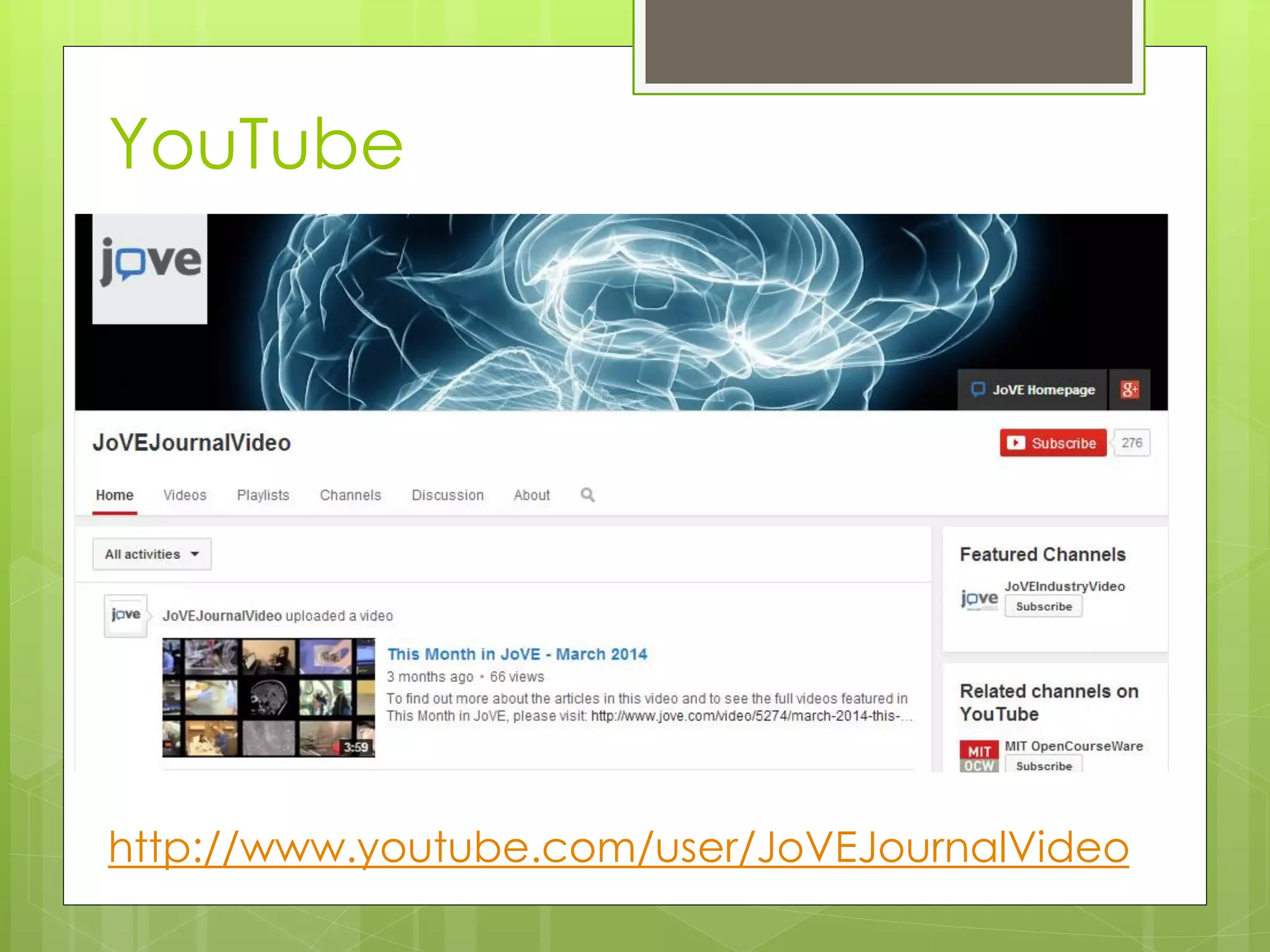
http://www.youtube.com/user/JoVEJournalVideo 
YouTube
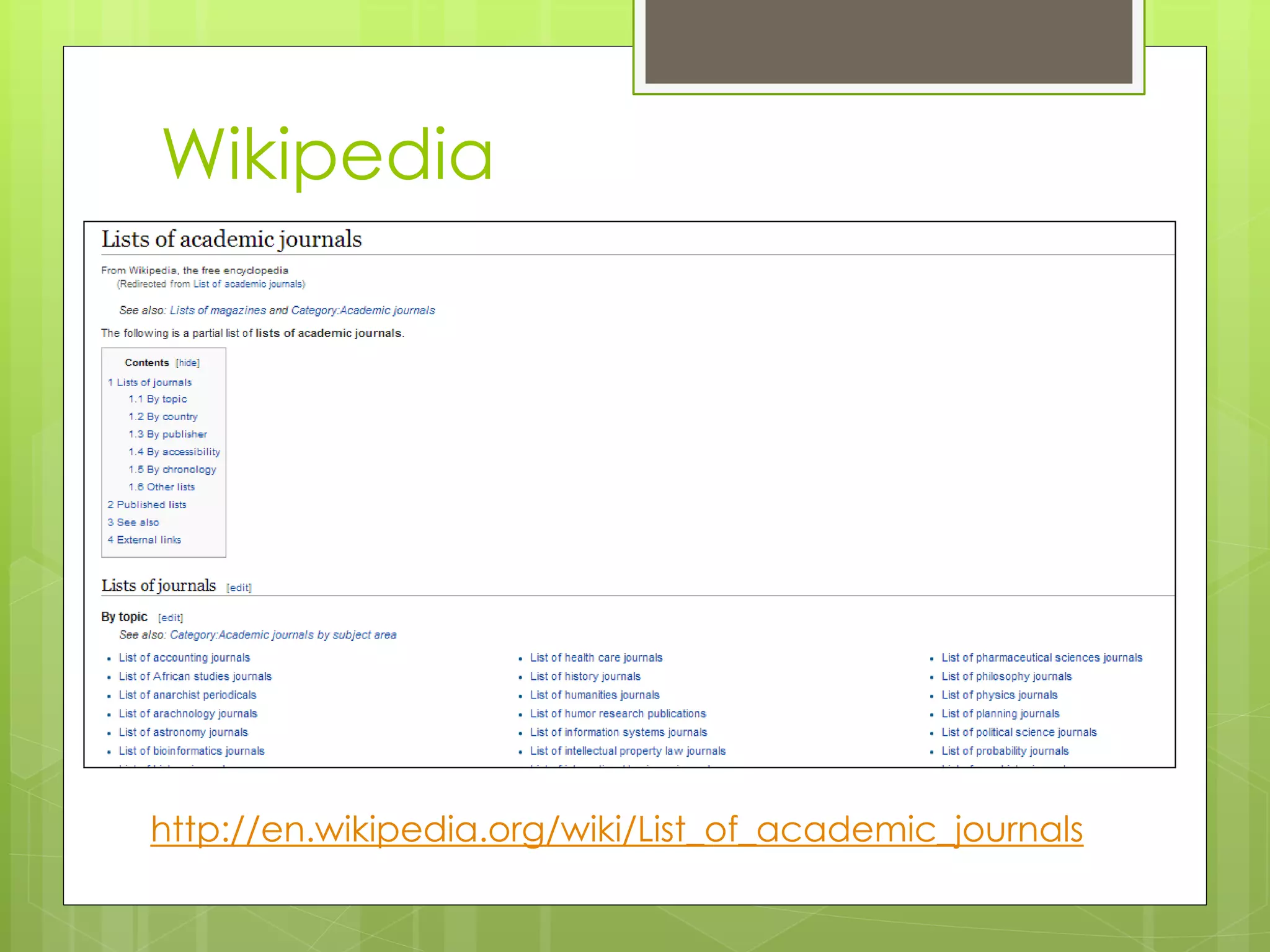
http://en.wikipedia.org/wiki/List_of_academic_journals 
Wikipedia
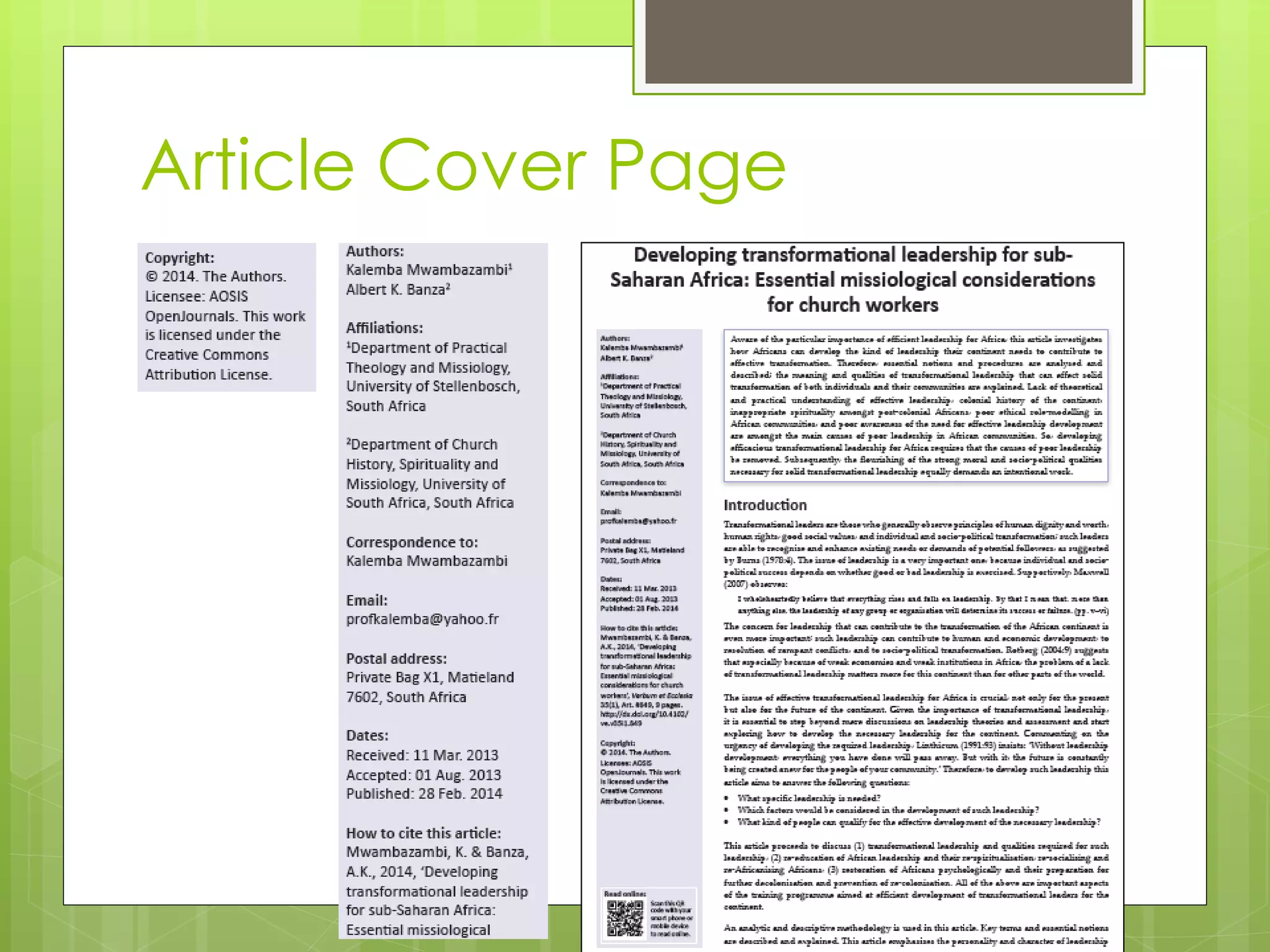
Article Cover Page
Measuring Impact
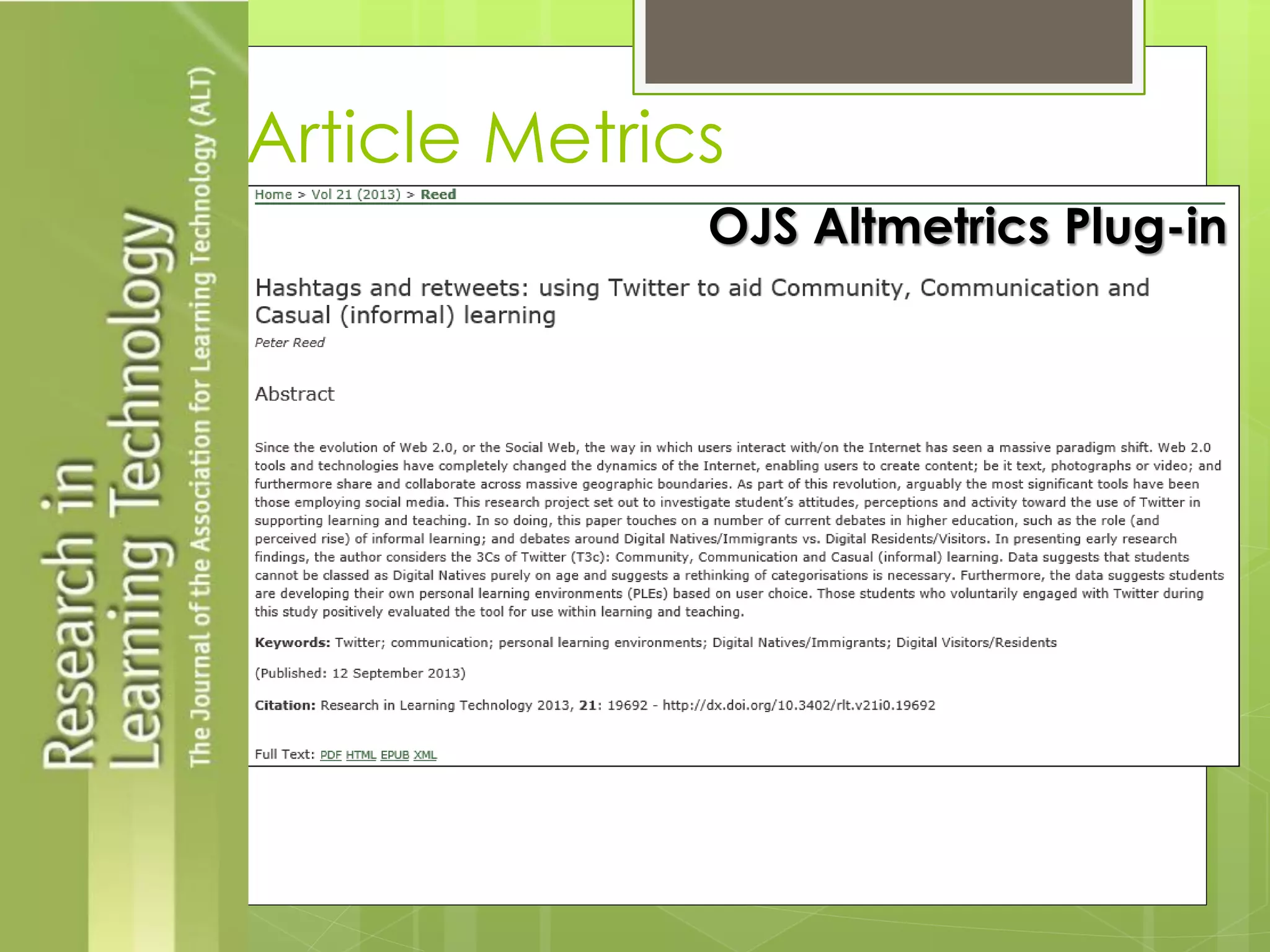
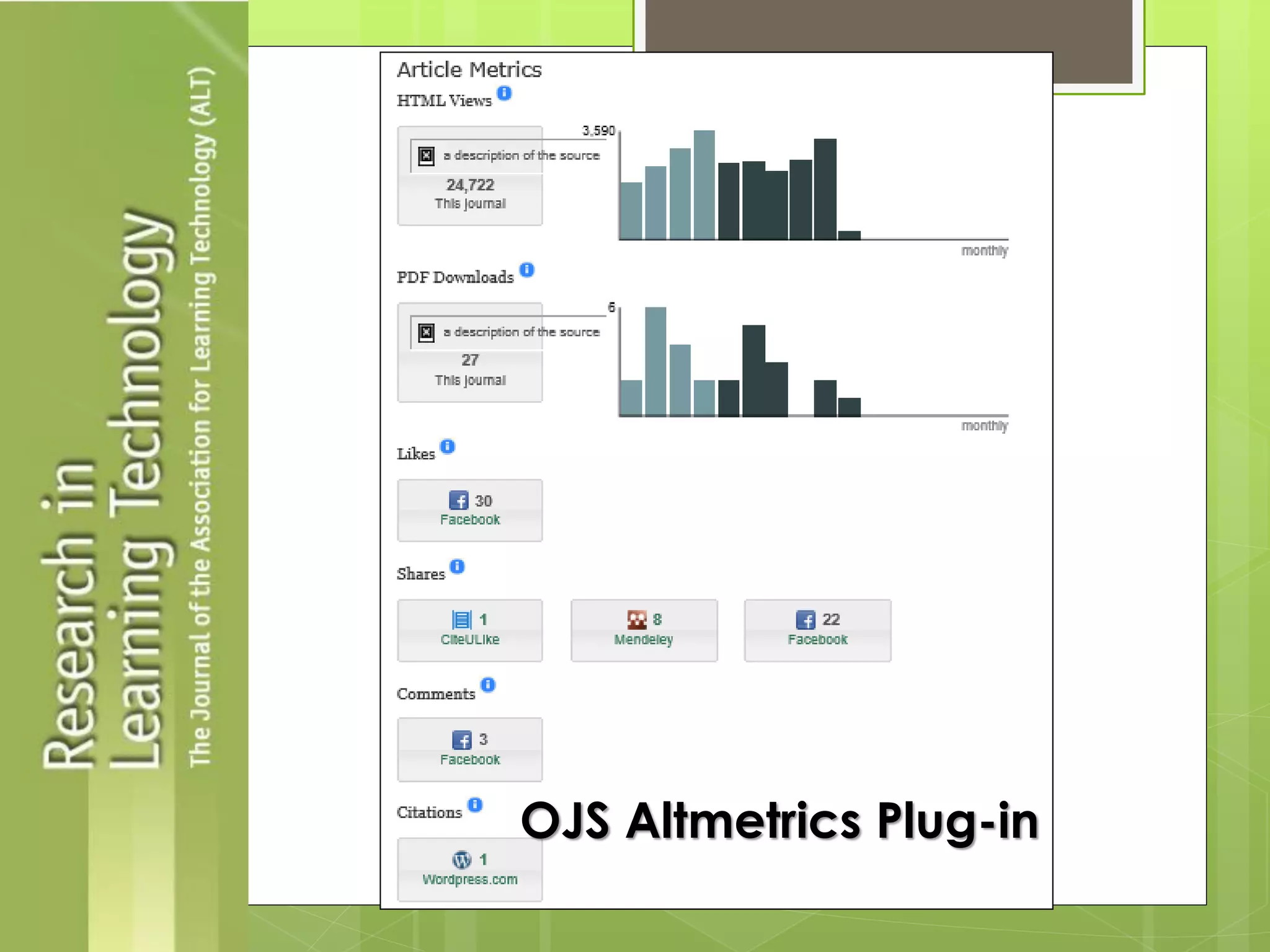
Article Metrics 
OJS Altmetrics Plug-in
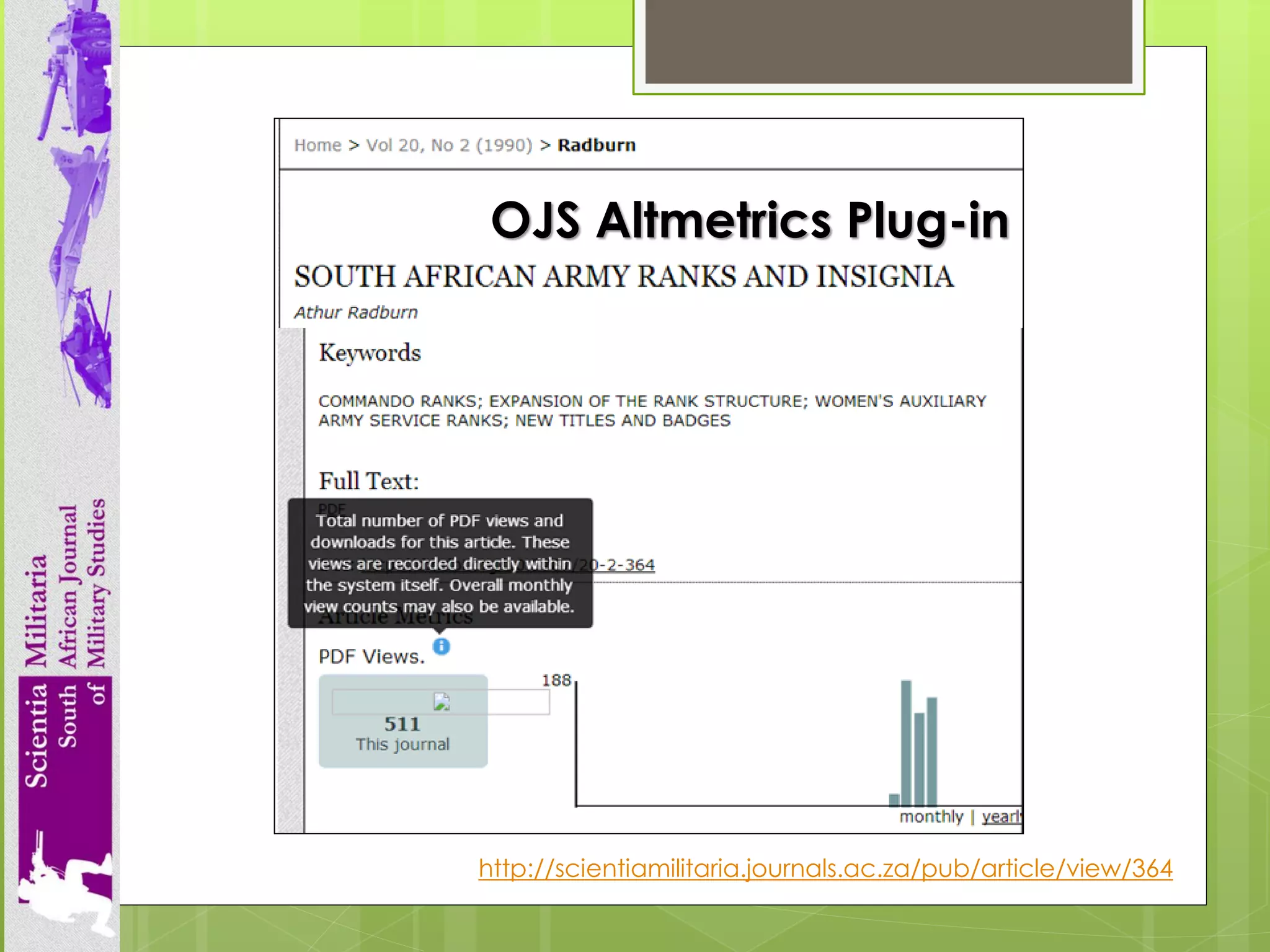
http://scientiamilitaria.journals.ac.za/pub/article/view/364 
OJS Altmetrics Plug-in
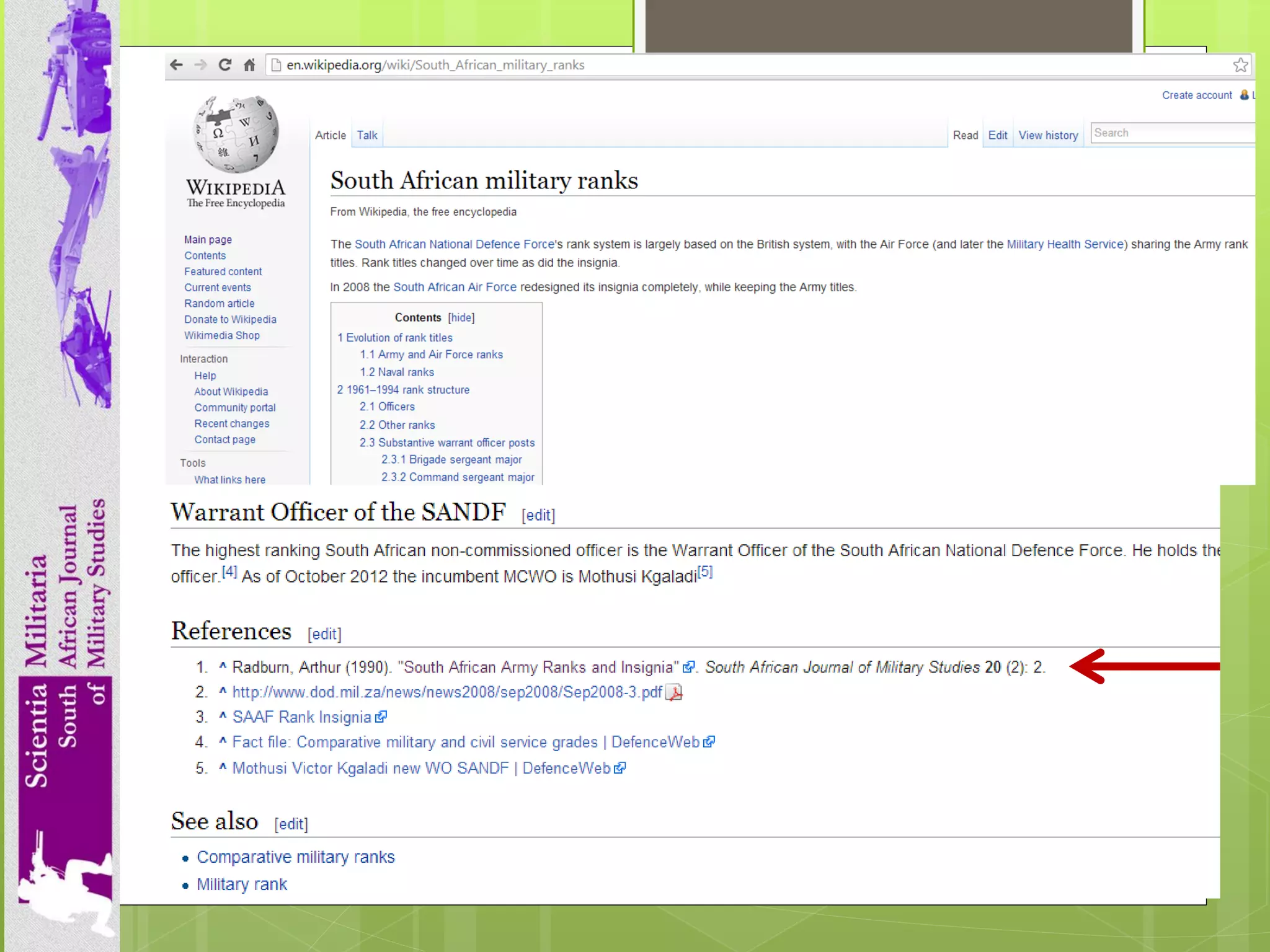
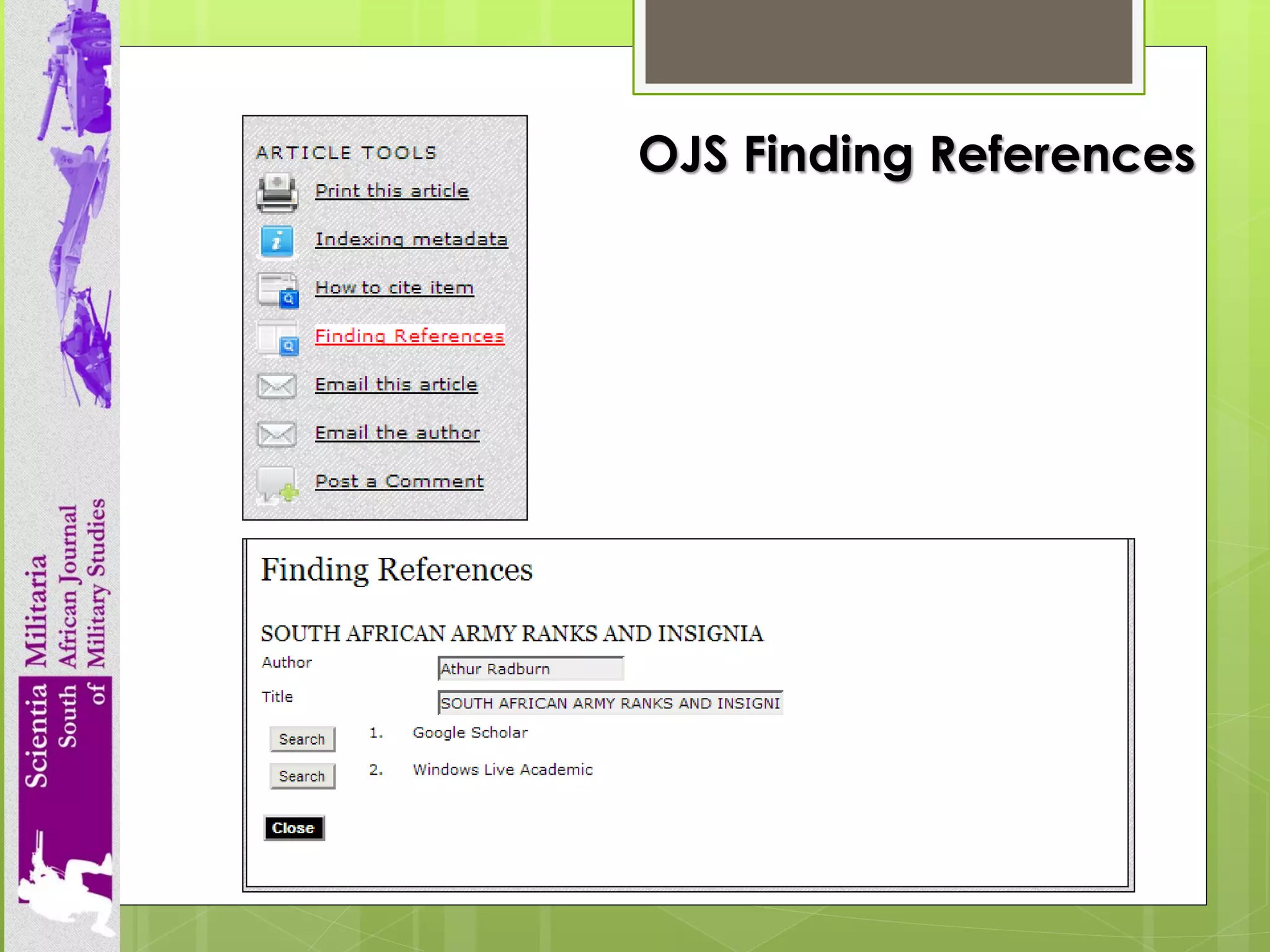
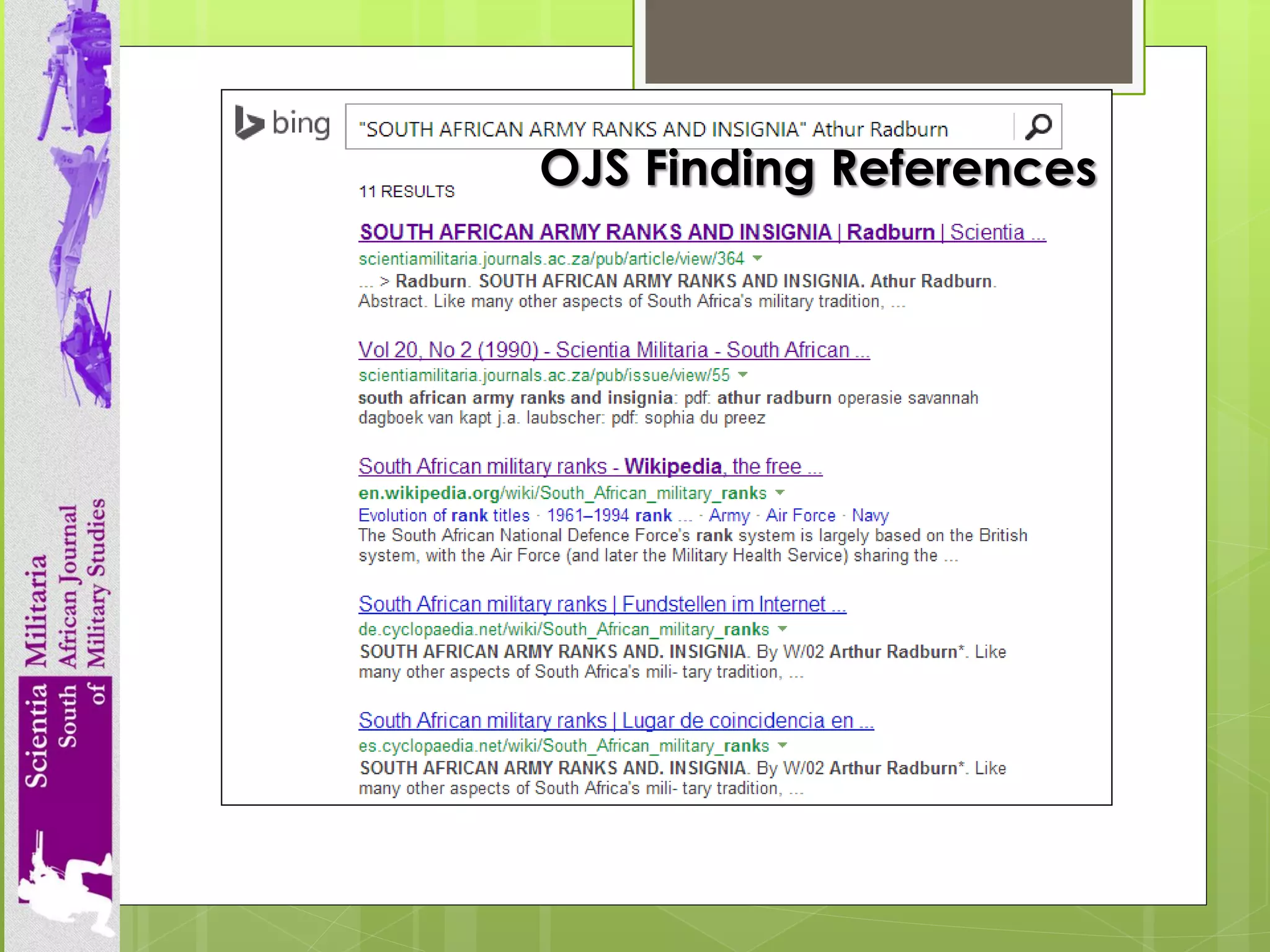
OJS Finding References
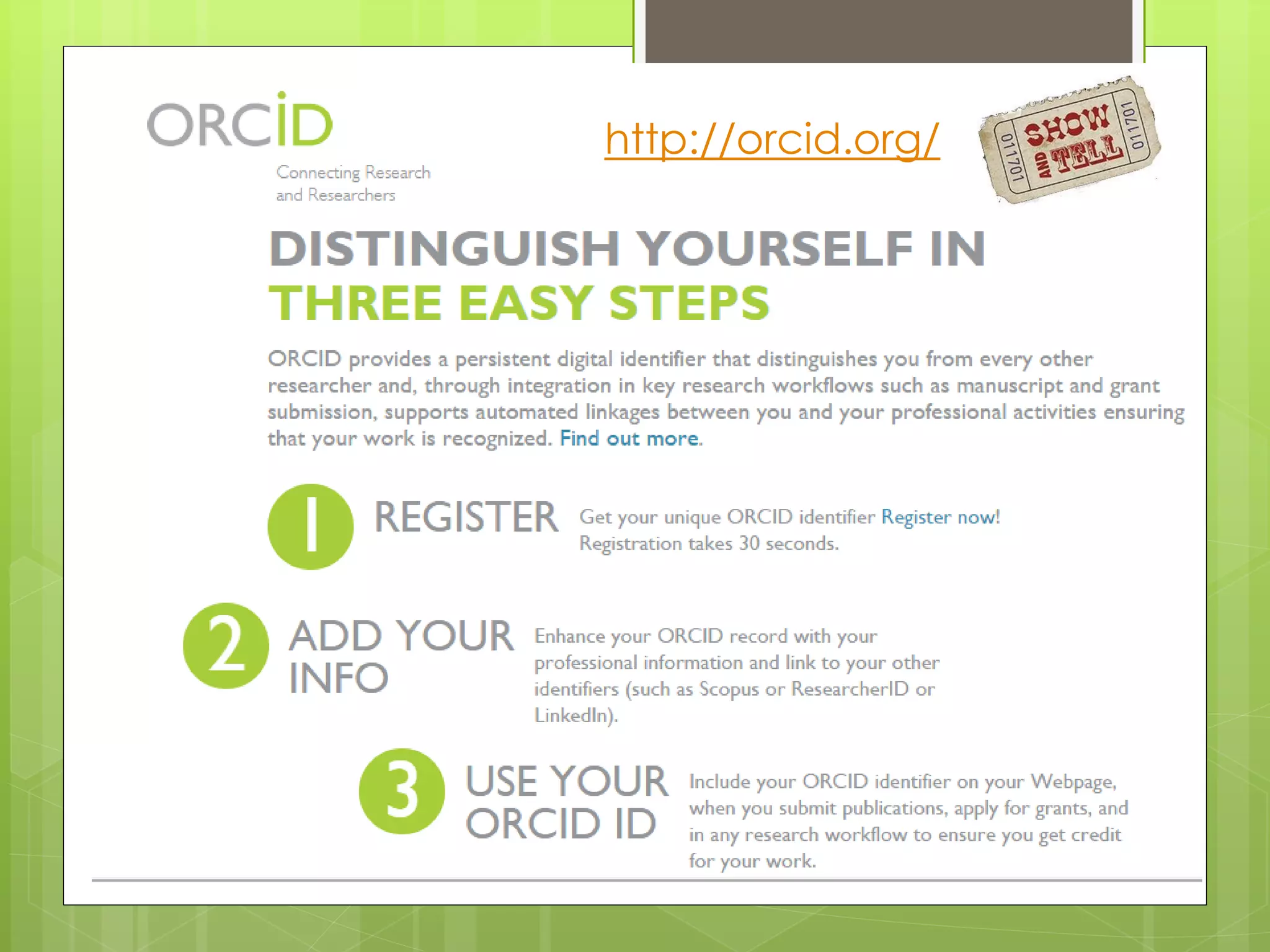
http://orcid.org/ 
http://orcid.org/
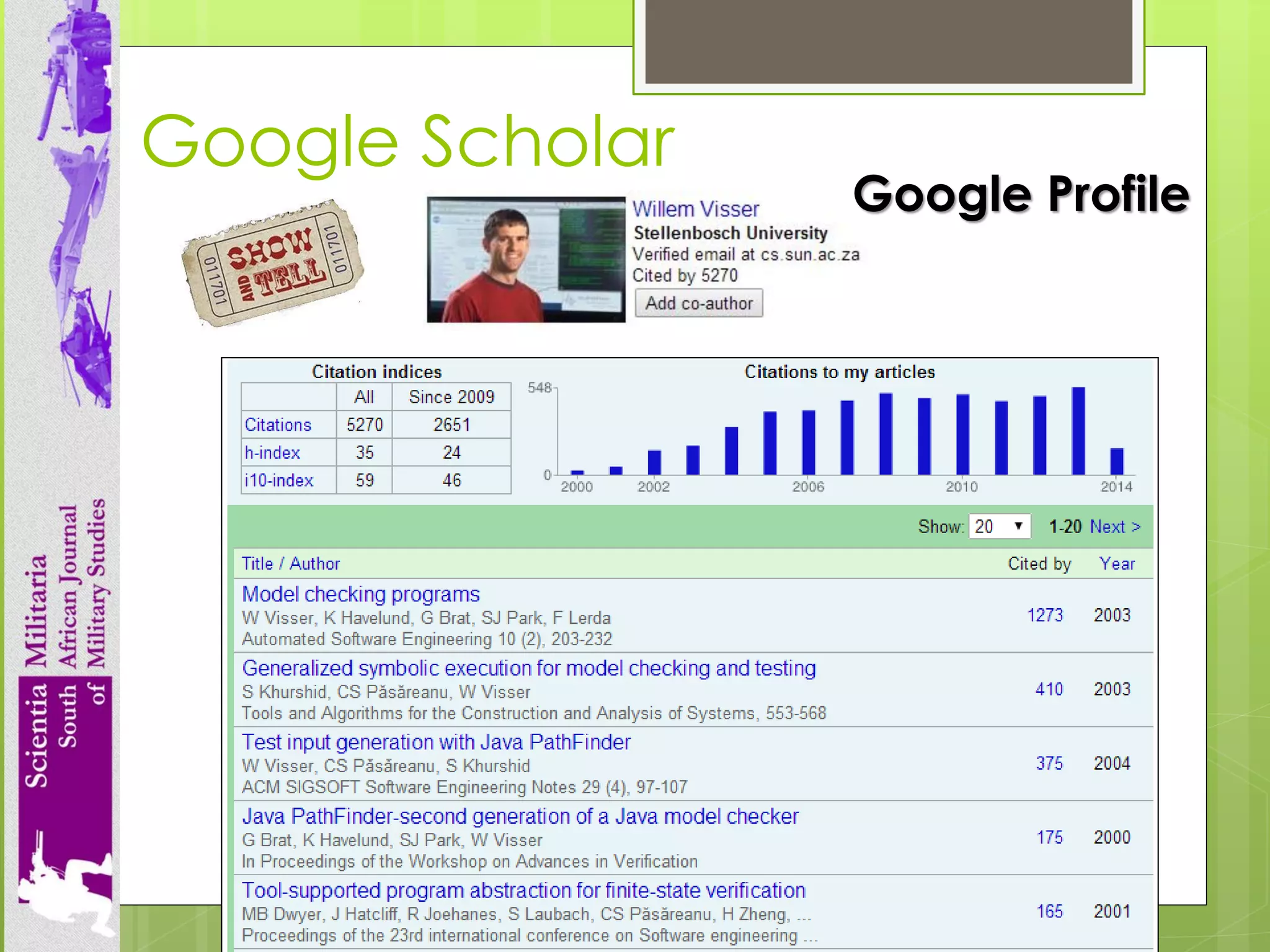
Google Scholar 
Google Profile
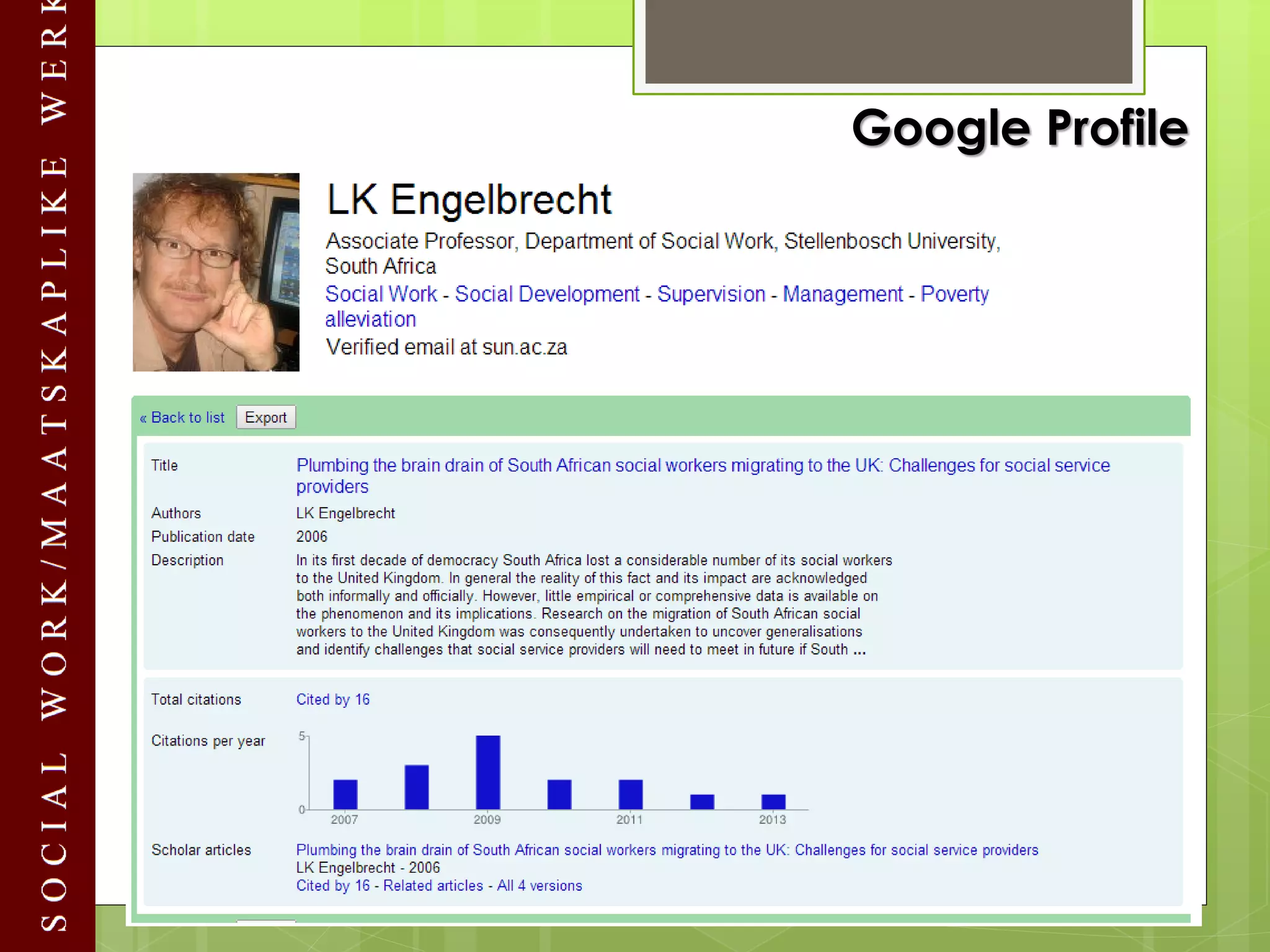
Google Profile
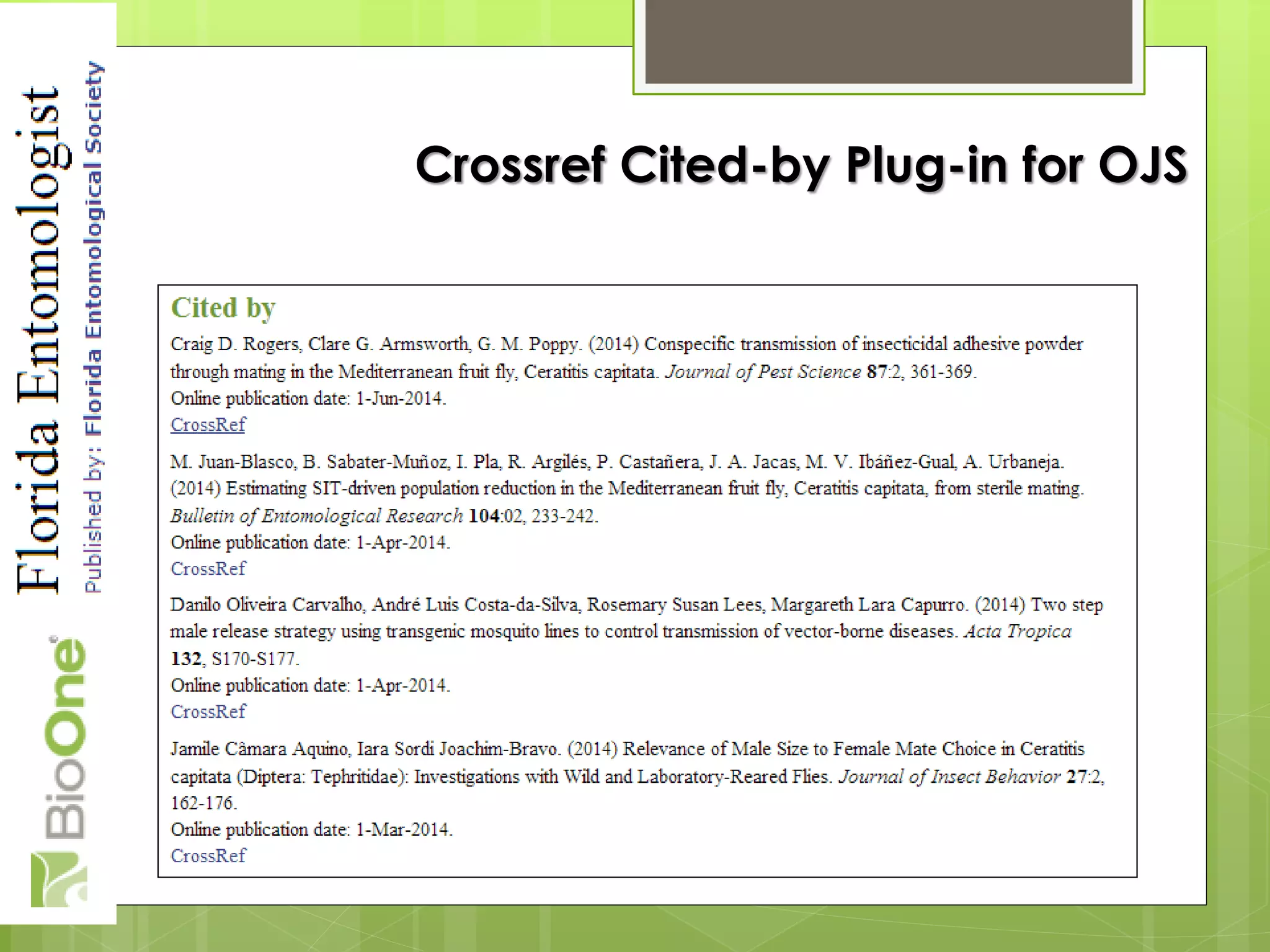
Crossref Cited-by Plug-in for OJS
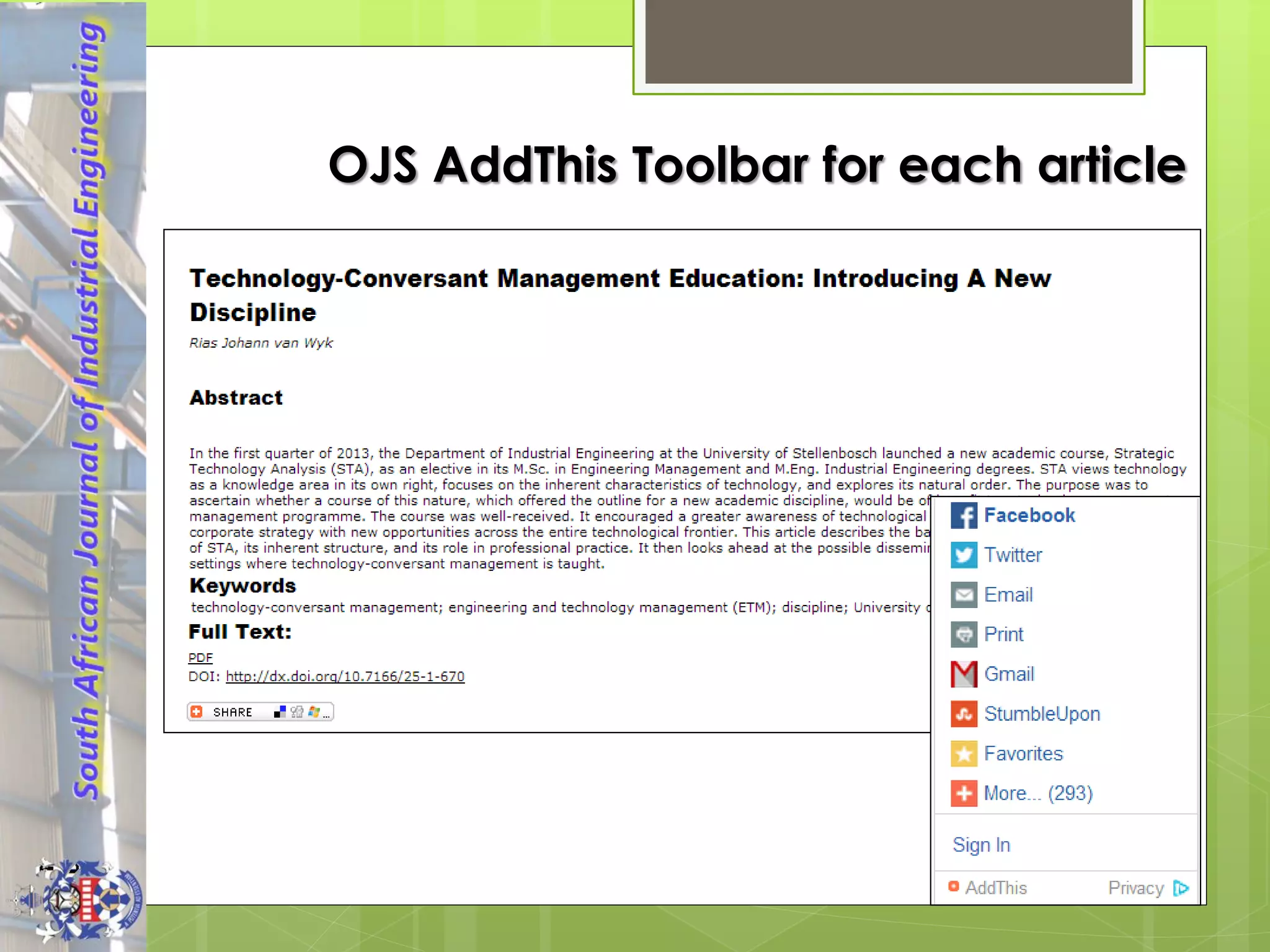
OJS AddThis Toolbar for each article
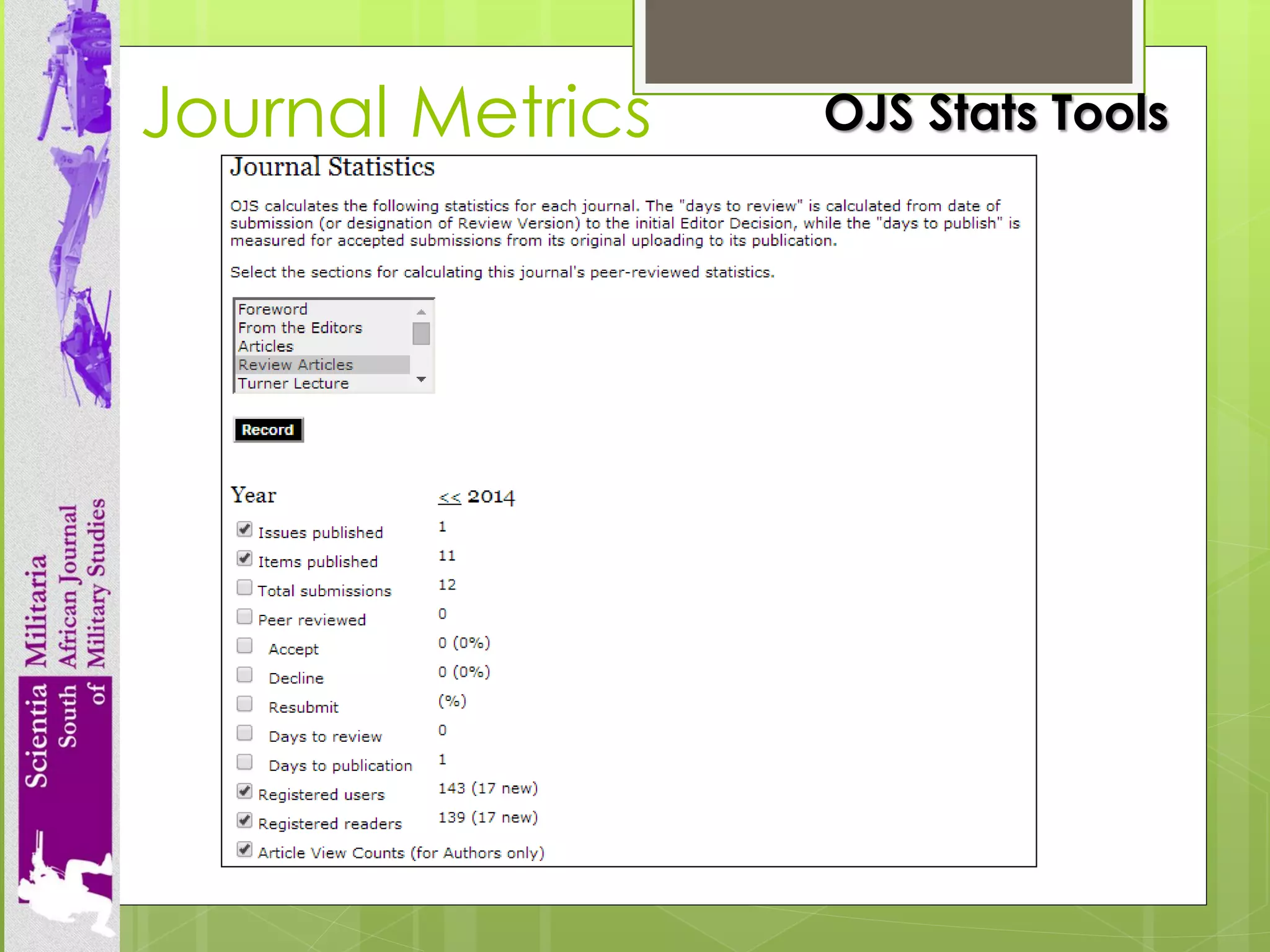
Journal Metrics 
OJS Stats Tools
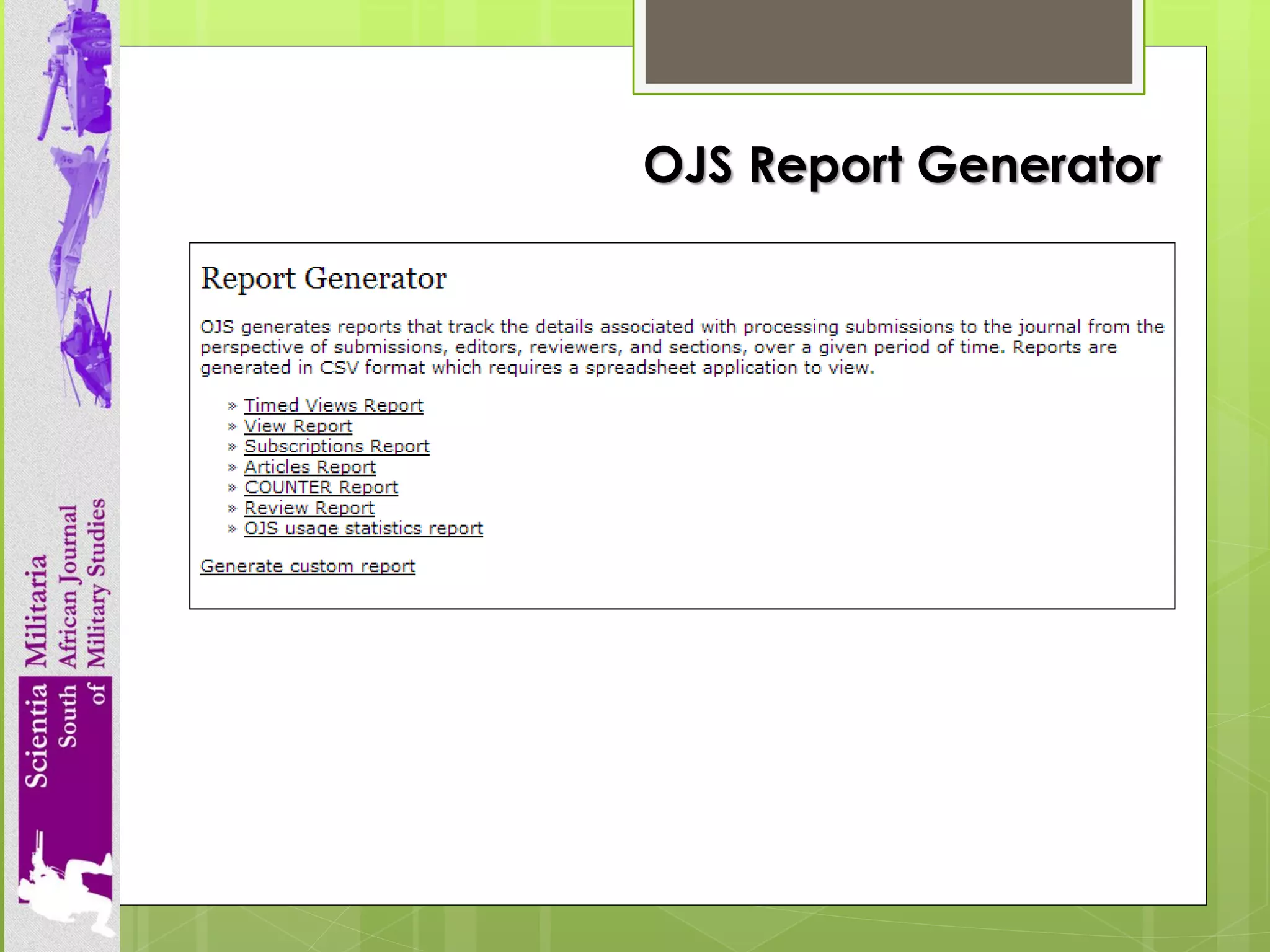
OJS Report Generator
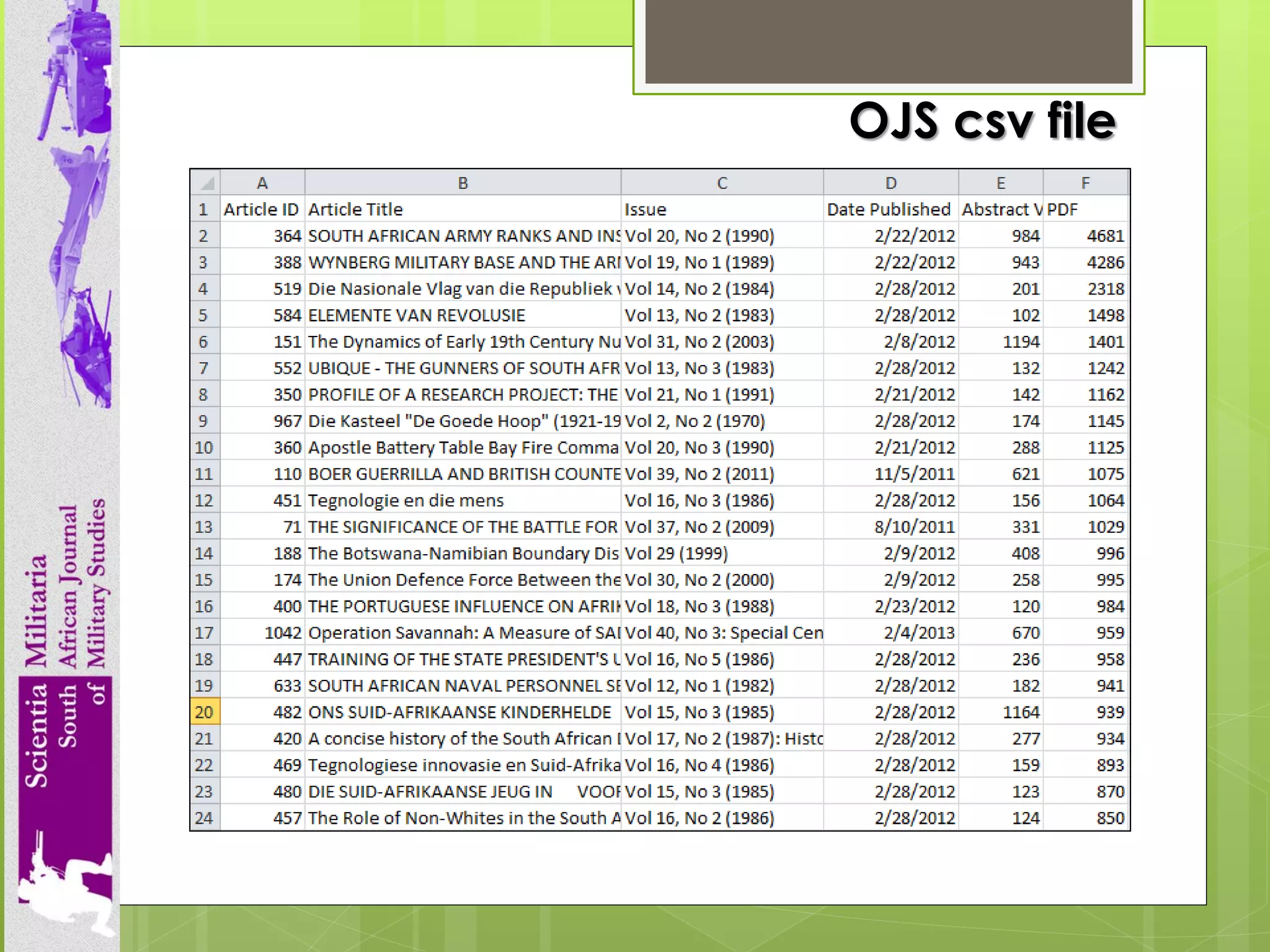
OJS csv file
Google Analytics
ISI: See http://wokinfo.com/essays/journal-selection-process/ and http://ip-science.thomsonreuters.com/info/journalsubmission/ 
IBSS: See http://www.proquest.co.uk/assets/downloads /products/ibss_editorialpoliciesprinciples.pdf Contact: Rebecca.ursell@proquest.co.uk 
Scopus:http://www.elsevier.com/online-tools/scopus/content- overview#content-policy-and-selection 
South Africa 
SCiELO: See http://www.scielo.org.za/avaliacao/avaliacao_en.htm Contact: scielo@assaf.org.za 
Dept. of Higher Education and Training
Note on Academic Integrity (1) 
Researchers should teake ownership of their academic identity & integrity on the web – be pro-active, e.g.: 
Create a Google Profile (Google Scholar & Google Citations) 
Create an ORCID ID 
Setup alerts and know who cites your work and in which context it is used
Note on Academic Integrity (2) 
Assign good quality metadata to OA research so that Google will return quality research at the top of Google listing 
Conduct Google searches for your own research/name, and see where it has been mentioned 
Know what is being researched in your field 
Take action if needed
Scholarly Journals Part 6 
The Future 
Ina Smith 
HERS-SA Academy Workshop 
8 September 2014
Interdisciplinary research will lead to a different approach than publishing in a specific journal title – also made possible by Internet? 
Referencing technique?
Thank you! inacsmith@gmail.com ina@assaf.org 
Attribution-NonCommercial-ShareAlike 4.0 International 
ismith@sun.ac.za

HERS SA Academy 8 September 2014: Workshop on Scholarly Journals

  • 1.
    Part 1: Settingthe scene Part 2: Trends in Journal Publishing Part 3: Where to publish & What to look for? Part 4: Hosting Scholarly Journals Part 5: Journal, Article & Author Profile Scholarly Journals Ina Smith HERS-SA Academy Workshop 8 September 2014
  • 2.
    Scholarly Journals Part1 Setting the scene Ina Smith HERS-SA Academy Workshop 8 September 2014
  • 3.
    Rationale behind Research Investigate/explore a problem (challenge) Report on findings Report on solutions to problems (challenges) Action by governments, World Health Organization, etc.
  • 4.
    A Research Problemis … “a statement about an area of concern, a condition to be improved, a difficulty to be eliminated, or a troubling question that exists in scholarly literature, in theory, or in practice that points to the need for meaningful understanding and deliberate investigation.” Univ. of Southern California Libraries
  • 5.
  • 6.
    Food Crisis “Today,around 21,000 children died around the world.” (Shah, 2011)
  • 7.
    Living Conditions “Asiais home to two-thirds of the world's poor, with about 700 million people in Asia Pacific living on less than US$1 a day.”
  • 8.
    Environment “The pressuresto destroy habitat for logging, illegal hunting, and other challenges are making conservation a struggle.”
  • 9.
    Tobacco “Poverty, worldhunger - by diverting prime land away from food production, damages the environment and reduces economic productivity.”
  • 10.
    Global Warming “Itis the rapid pace at which the temperature rises that will result in many negative impacts to humans and the environment and this why there is such a world-wide concern.”
  • 11.
    Tell us moreabout your interest in research …
  • 12.
    Academic Publishing Thesis(Masters & Doctoral) Academic (scholarly/scientific) journal Conference proceedings Books & Chapters in books
  • 13.
    Academic Journals Peer-reviewedperiodical in which scholarship relating to a particular academic discipline is published Serve as forums for the introduction and presentation for scrutiny of new research, and the critique of existing research
  • 14.
    Philosophical Transactions ofthe Royal Society (1665 - )
  • 15.
    Peer-review Process Institutedby Nature in 1967 Process of subjecting an author’s scholarly work, research or ideas to the scrutiny of others who are experts in the same field, before the paper is published in a journal Recommendation: Accepted, revisions requested, rejected
  • 16.
    Traditional vs E-journals Before & after the Internet Traditional: paper, manual workflow, slow publication, slow dissemination E-journals: online, electronic workflow, fast review fast publication, fast dissemination – costs came down Resulted in Open Access movement – more on OA journals later …
  • 17.
    Business Models SubscriptionAccess (author & reader pay) Article-Processing Charges (APC’s) (author pays) – also paid for by institutional OA funds – policy issues Open Access (author pays) – cost much lower than APC’s
  • 18.
    Workflow Author Editor Reviewers (Peer-review) Proofreader Copyeditor Layout Editor Editor published issue
  • 19.
  • 20.
    Journal Facts &Figures Genamics JournalSeek (102 139 titles) http://journalseek.net/ Thomson Reuters Master Journal List (16 970 titles) http://science.thomsonreuters.com/cgi- bin/jrnlst/jlresults.cgi?PC=MASTER Scopus SCImago Journal & Country Rank (29 385 titles) http://www.scimagojr.com/ e-journals.org http://www.e-journals.org/ JURN Directory (3 000 titles) http://www.jurn.org/directory/ Directory of Open Access Journals (9 979 titles) http://doaj.org/
  • 21.
  • 22.
    DHET (ASSAf Criteria)(1) High national/international disciplinary reputations/standing of the editor-in-chief/ associate editors/members of the editorial board? A high/good (general/average) quality of the articles accepted/published? A (contextually) adequate/good number of articles per annum? An (adequate/good) sample of the best work done in the country in the discipline/field?
  • 23.
    DHET (ASSAf Criteria)(2) A focus on local/regional kinds of materials/problems? Publication of articles by authors from across the country, and internationally? Useful additional scholarly features like editorials, topical reviews, book reviews, scholarly correspondence, etc? Proper (English-language) abstracts for all articles?
  • 24.
    DHET (ASSAf Criteria)(3) Suitable publication of errata? Good citation practice? Suitability as a general on-going stimulus for local graduate students/young staff in the discipline concerned? Some kind of comparability with leading international journals in the field DHET recommendations
  • 25.
    Determine the impactfactor for a journal (Journal Citation Reports)
  • 26.
    Scholarly Journals Part2 Trends in Journal Publishing Ina Smith HERS-SA Academy Workshop 8 September 2014
  • 27.
    Open Access Journals “Open access journals are scholarly journals that are available online to the reader without financial, legal, or technical barriers other than those inseparable from gaining access to the internet itself.“ Source: http://www.soros.org/openaccess/read.shtml 1
  • 28.
    Benefits of OA E-workflow, all activities & versions recorded Reduced costs for all Post peer-reviewed by all (comments) – transparent Increase in impact– used, read, cited more Accelerates the pace of research, discovery, innovation All can benefit – democratic right - research should be open, so that all can work together and avoid disaster (see challenges)
  • 29.
    Directory of OAJournals http://doaj.org/
  • 30.
    Early OA Initiatives arXiv.org (1991) http://arxiv.org/ Journal of Medical Internet Research (1999) http://www.jmir.org/ BioMed Central (2000 - ) publishes 250 titles Berlin Declaration on Open Access to Knowledge in the Sciences and Humanities http://openaccess.mpg.de/319790/Signatories
  • 31.
    Growth in OAarticles "Development of Open Access" by Laakso M, Welling P, Bukvova H, Nyman L, Björk B-C, et al. - Scientific article in PLOS ONE. Licensed under Creative Commons Attribution 2.5 via Wikimedia Commons - http://commons.wikimedia.org/wiki/File:Development_of_Open_Access.png#mediaviewer/File:Development_of_Open_Access.png
  • 32.
  • 33.
    Crowd-sourced peer-review “Theproblem with peer-review today is that there is so much research being produced that there are not enough experts with enough time to peer-review it all.” Stevan Harnad http://blogs.lse.ac.uk/impactofsocialsciences/2014/08/21/crowd-sourced- peer-review-substitute-or-supplement/#author 2
  • 34.
    Peer-reviewed Scientific VideoJournal http://www.jove.com 3
  • 35.
    EarlyCite (Emerald) http://www.emeraldgrouppublishing.com/authors/writing/earlycite.htm Researchers can access peer-reviewed journal articles prior to official publication 4
  • 36.
    Article of theFuture (Elsevier) http://youtu.be/1dXkmgkYuEg 5
  • 37.
  • 38.
  • 39.
    2nd copy onInstitutional Repository 8 http://www.sherpa.ac.uk/romeo
  • 40.
    Scholarly Journals Part3 Where to Publish & What to look for Ina Smith HERS-SA Academy Workshop 8 September 2014
  • 41.
    Web page withproper URL Look & feel – professional Proper English & language Proper referencing Valid eISSN assigned by ISSN International Centre Established history of responsible reporting High Quality Journal (1)
  • 42.
    High Quality Journal(2) Good quality articles detailing well performed research Contact details (incl. admin e-mail) Editorial Team Editorial Board (international & academic affiliations) Advisory Board
  • 43.
    High Quality Journal(3) Scope and Focus Peer Review Process (must be an exhaustive double blind peer review process) Publication Frequency Open Access Policy – registered with SHERPA RoMEO Digital preservation policy Registered with DOAJ
  • 44.
    High Quality Journal(4) Publication ethics and malpractice statement incl. plagiarism detection policy Viper http://www.scanmyessay.com/viper- plagiarism-scanner.php PlagTracker http://www.plagtracker.com/ iThenticate http://www.ithenticate.com/ Copyediting & layout editing Author Guidelines About the Publisher
  • 45.
    Previously published issues(Archive) Copyright policy (under the Creative Commons Licensing policies) Journal history Indexing DOI prefix & doi for each article Registered with DOAJ High Quality Journal (5)
  • 46.
    Scholarly Journals Part4 Hosting scholarly journals Ina Smith HERS-SA Academy Workshop 8 September 2014
  • 47.
    “Universities and researchersare coming under increasing pressure to demonstrate the wider impact that their funded research has beyond the end of the research project.” Manchester Univ. eScholar Blog (2012)
  • 48.
    Small Journals “So,the smallest open access journal has a potentially larger audience than even the most popular pay walled journal because the work can reach anyone in the world with access to the Internet. When you couple this massive potential audience with the permission to republish and reuse via an open license, authors can maximize the impact of their work beyond the reach of any closed journal.” - Peter Suber Source: World Bank Live Event Report: Open Access Policy and Development 2012, http://creativecommons.org/weblog/entry/32839
  • 49.
    Possible Stakeholders Vice-rector:Research Research Office & IT Intellectual Property Office Individual Journals (SU editors) Printer (SUNMedia) Library Open Scholarship Office (SUNJournals) Faculty Librarians Cataloguers
  • 50.
    Typical Role (1) Understand the research process Promote OA eCollection building Disseminate & facilitate access to information Hosting of journal using OJS Software upgrades Training & support
  • 51.
    Typical Role (2) Acquisition of eISSN Assigning metadata for indexing Register with harvesters, search engines, directories (DOAJ) Digital Object Identifier (doi) & submission of doi’s Journal domain name e.g. http://sajie.journals.ac.za/
  • 52.
    Typical Role (3) Digital preservation & content archiving Google Analytics Creative Commons Licensing Open Access policy Register policy with SHERPA RoMEO Gmail (admin) account for journal Assist with application of journal impact factor – Thomson Reuters & SciMAGO Advisory role – what makes a trusted journal
  • 53.
    Journal Software OJS(PKP) ScholarOne (Thomson Reuters) SciELO Etc.
  • 54.
  • 55.
  • 56.
  • 57.
  • 58.
  • 59.
  • 60.
  • 61.
  • 62.
  • 63.
    2011 - 2014 15 Active OA journal titles; 5 new in 2014 9 006 articles in 15 titles 993 319 downloads for 15 titles Case Study: SUNJournals
  • 64.
    African Public ProcurementLaw Journal Trends in Nursing Social Work Missionalia African Journal of Business Ethics New Titles 2014
  • 65.
    Increase in usageand visibility Increase in submission of papers Reduced costs with minimal expenses (profit) Since going online
  • 66.
    Potential, possible, orprobable predatory scholarly open-access publishers http://scholarlyoa.com/publishers/ Beall’s List
  • 67.
    From traditional toOA online Starting a new journal Future issues - online, open access Future issues & retrospective issues – online, open access Approaches
  • 68.
    Scholarly Journals Part5 Journal, Article & Author Profile Ina Smith HERS-SA Academy Workshop 8 September 2014
  • 69.
    Marketing Journals OpenSource Software, Setup, Google Scholar Site Map, URL’s, Metadata – international standards Promote journal Journal Level Metrics Promote individual articles Article Level Metrics Promote individual researchers Author Level Metrics
  • 70.
  • 71.
  • 72.
  • 73.
  • 75.
  • 76.
    Article Metrics OJSAltmetrics Plug-in
  • 77.
  • 78.
  • 79.
  • 80.
  • 81.
  • 82.
  • 83.
  • 84.
  • 85.
    OJS AddThis Toolbarfor each article
  • 86.
  • 87.
  • 88.
  • 89.
  • 91.
    ISI: See http://wokinfo.com/essays/journal-selection-process/and http://ip-science.thomsonreuters.com/info/journalsubmission/ IBSS: See http://www.proquest.co.uk/assets/downloads /products/ibss_editorialpoliciesprinciples.pdf Contact: Rebecca.ursell@proquest.co.uk Scopus:http://www.elsevier.com/online-tools/scopus/content- overview#content-policy-and-selection South Africa SCiELO: See http://www.scielo.org.za/avaliacao/avaliacao_en.htm Contact: scielo@assaf.org.za Dept. of Higher Education and Training
  • 92.
    Note on AcademicIntegrity (1) Researchers should teake ownership of their academic identity & integrity on the web – be pro-active, e.g.: Create a Google Profile (Google Scholar & Google Citations) Create an ORCID ID Setup alerts and know who cites your work and in which context it is used
  • 93.
    Note on AcademicIntegrity (2) Assign good quality metadata to OA research so that Google will return quality research at the top of Google listing Conduct Google searches for your own research/name, and see where it has been mentioned Know what is being researched in your field Take action if needed
  • 94.
    Scholarly Journals Part6 The Future Ina Smith HERS-SA Academy Workshop 8 September 2014
  • 95.
    Interdisciplinary research willlead to a different approach than publishing in a specific journal title – also made possible by Internet? Referencing technique?
  • 96.
    Thank you! inacsmith@gmail.comina@assaf.org Attribution-NonCommercial-ShareAlike 4.0 International ismith@sun.ac.za