



Altmetrics:
How librarians can
support researchers
in improving their impact
1
Fondazione IRCCS San Matteo di Pavia
Center for Scientific Documentation-
Dott.ssa Valeria Scotti
Today we are going to talk about:
2
 Bibliometrics;
 Alternative metrics or Altmetrics;
 Altmetrics Tools;
 Altmetrics application for:
 Researchers
 Funders and Research Evaluator
 Institution
 Patients
 Librarians
 Our trial and other correlations;
 Conclusion.
Introduction
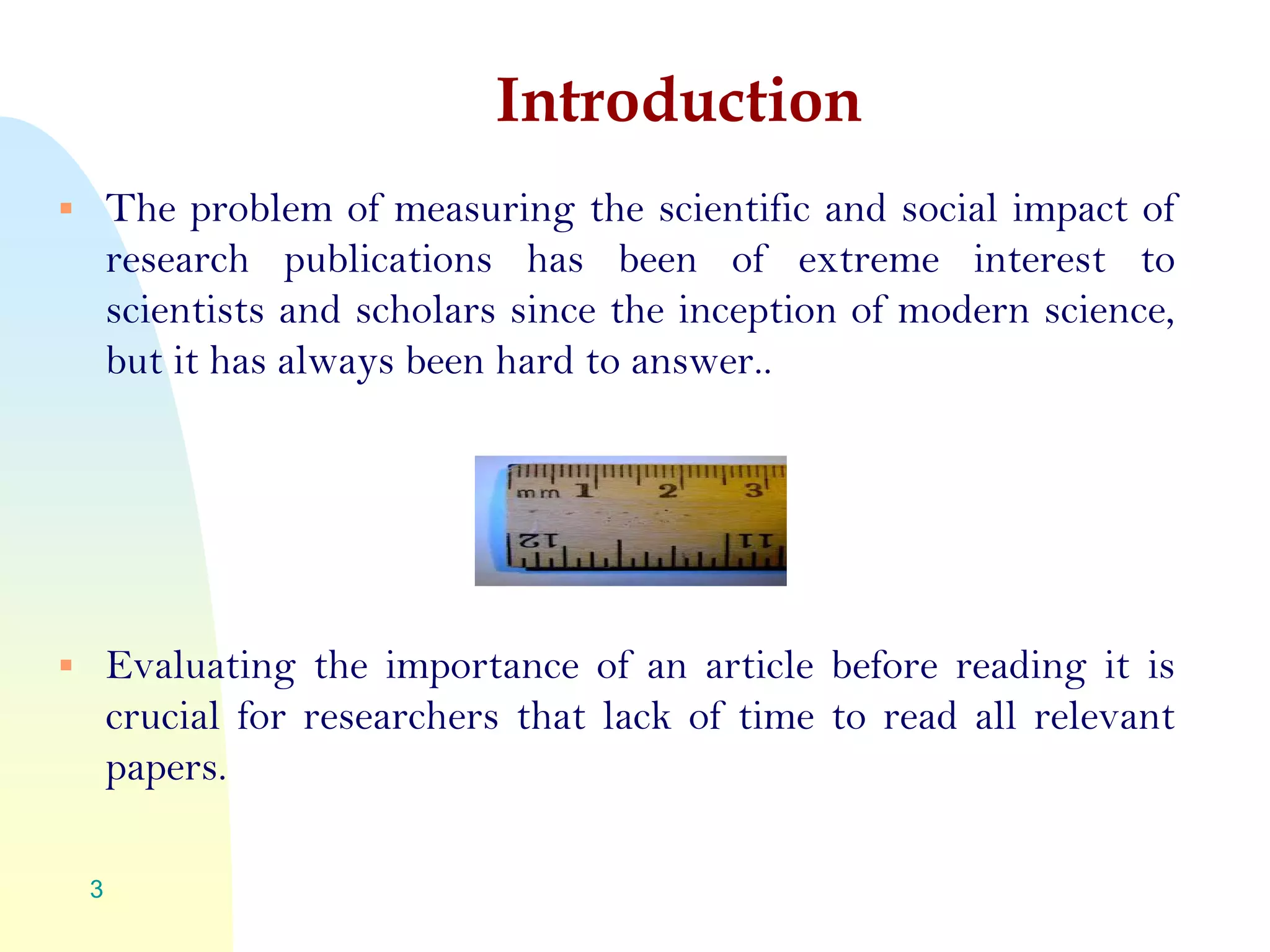
 The problem of measuring the scientific and social impact of
research publications has been of extreme interest to
scientists and scholars since the inception of modern science,
but it has always been hard to answer..
 Evaluating the importance of an article before reading it is
crucial for researchers that lack of time to read all relevant
papers.
3
Methodology
There are two main methodologies for the evaluation of academic
research output quality:
 Qualitative: Peer review
 Quantitative: Metrics
 Why is measuring research quality important?
4
Peer review
 A group of expert scholars, working in the same scientific area (peers) that
evaluate submitted research works and academics’ performance, and assess
scientific journals in a particular field.
 Peer review can be used as an objective and reliable evaluation measure and is
seen by many as the “gold standard”
 However:
o It is (extremely) time consuming as well as expensive;
o Experts can genuinely disagree (referees);
o It is surrounded with mysticism and may create an elite club which can be
difficult to enter.
5
Bibliometrics
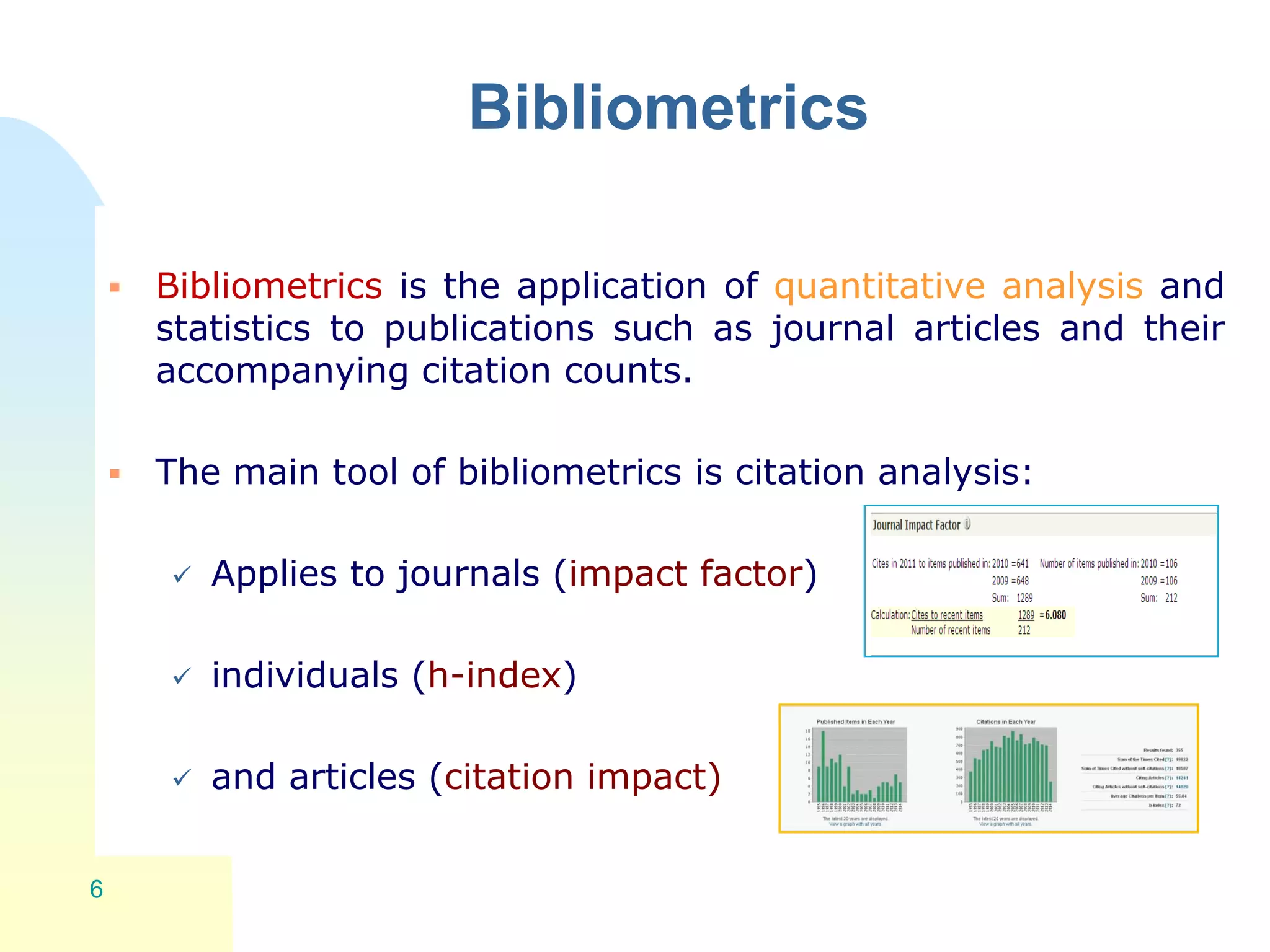
 Bibliometrics is the application of quantitative analysis and
statistics to publications such as journal articles and their
accompanying citation counts.
 The main tool of bibliometrics is citation analysis:
 Applies to journals (impact factor)
 individuals (h-index)
 and articles (citation impact)
6
..the mantra for researchers
7
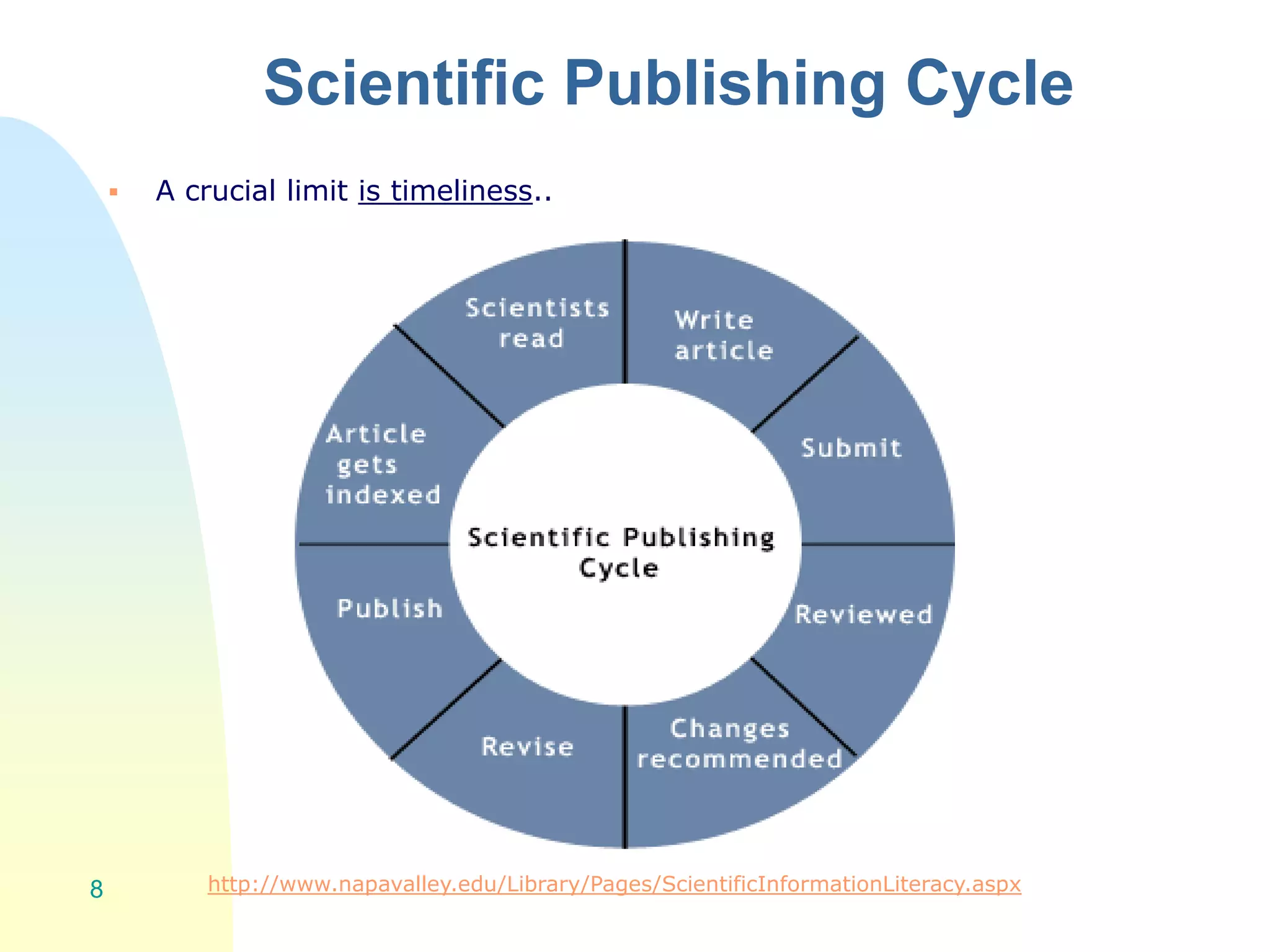
Scientific Publishing Cycle
 A crucial limit is timeliness..
8 http://www.napavalley.edu/Library/Pages/ScientificInformationLiteracy.aspx
Traditional Indicators limits
 Not all journals are indexed in the Journals Citation Reports, a
new edition of which is updated once a year;
 The inability to compare journals belong to different subject as
subject fields citations varies widely based on discipline ;
 The auto-citations (an author who quotes himself) and the real
"exchange of courtesies" ;
 Peer Review: it is time consuming and expensive;
 Young researchers are disadvantaged since they have published
less articles than senior researchers;
9
Web 2.0
 The development of tools even more Web 2.0
oriented has profoundly changed the scientific
communication process
 Web 2.0 = 2nd generation web services
 And the Library became:
 Library 2.0= is a real-time library
10
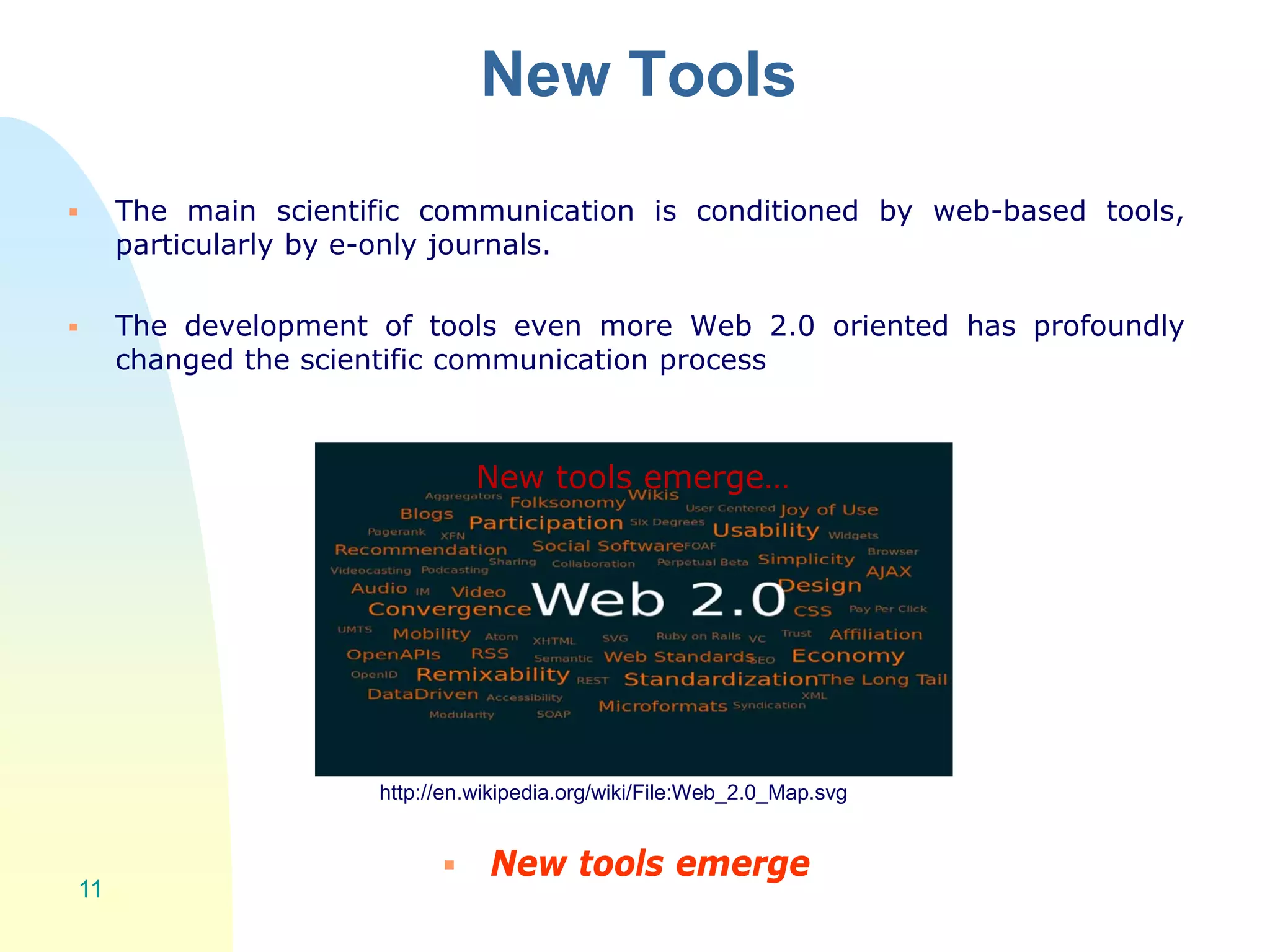
New Tools
 The main scientific communication is conditioned by web-based tools,
particularly by e-only journals.
 The development of tools even more Web 2.0 oriented has profoundly
changed the scientific communication process
 New tools emerge
11
New tools emerge…
http://en.wikipedia.org/wiki/File:Web_2.0_Map.svg
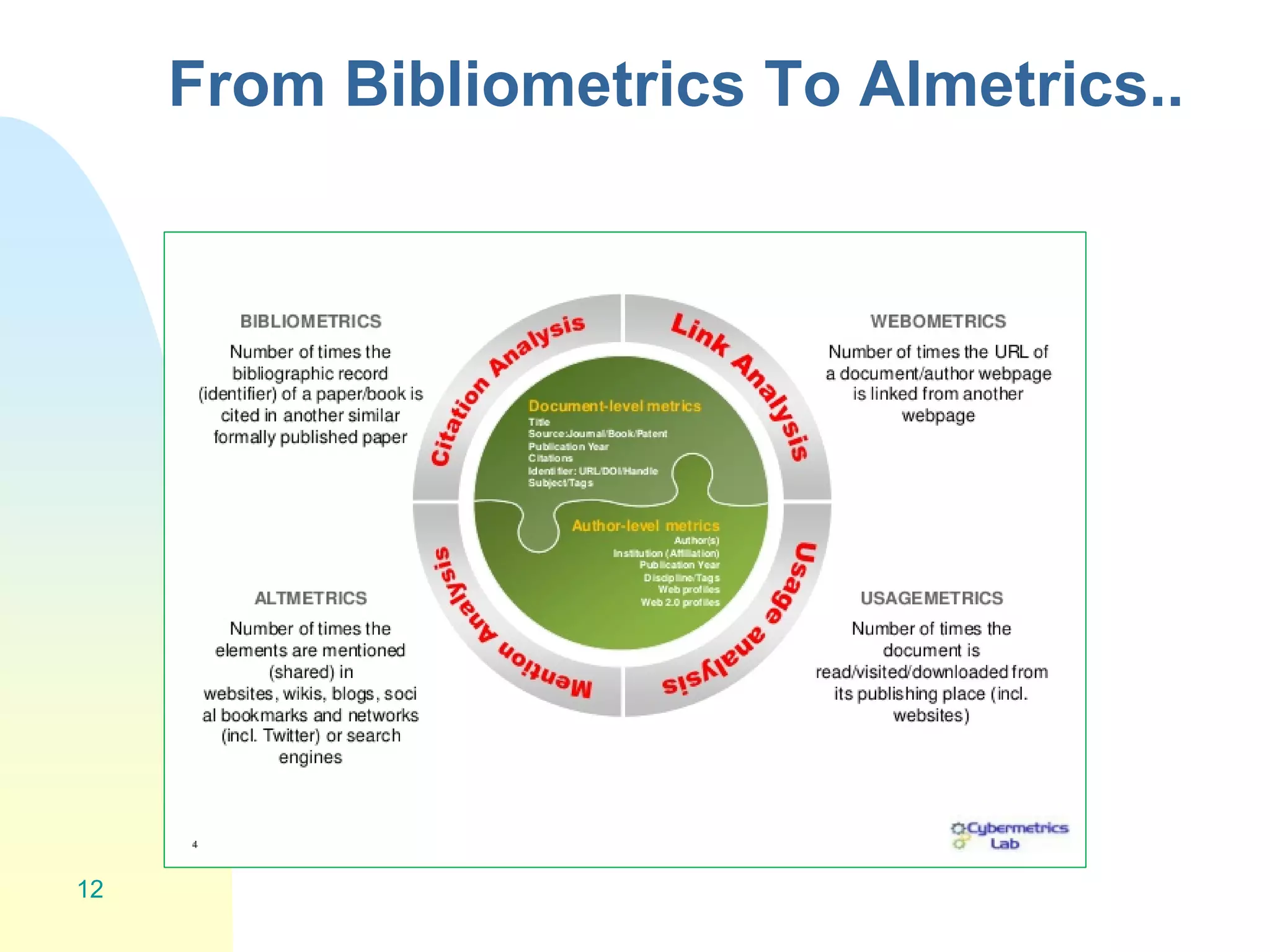
From Bibliometrics To Almetrics..
12
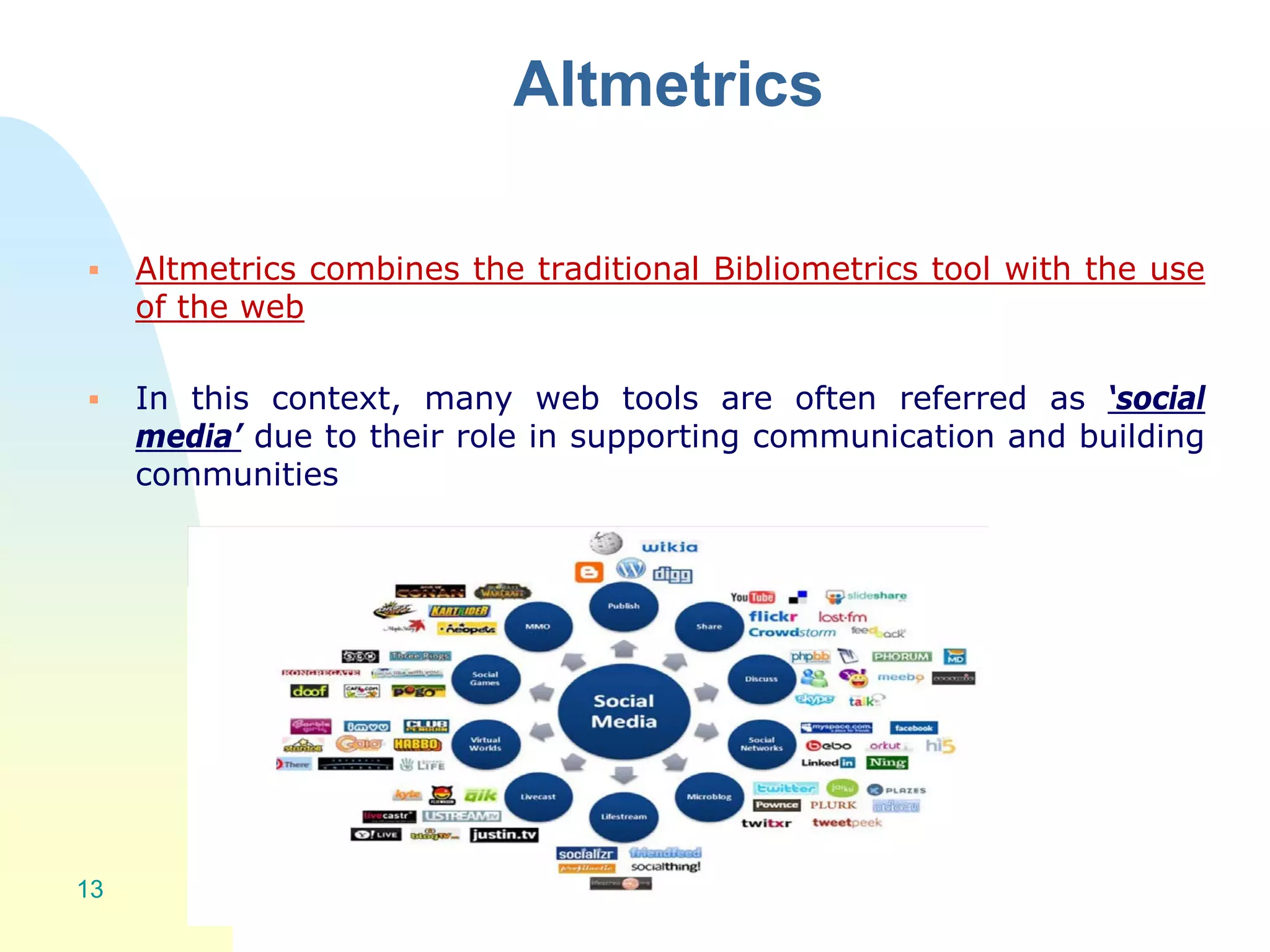
Altmetrics
 Altmetrics combines the traditional Bibliometrics tool with the use
of the web
 In this context, many web tools are often referred as ‘social
media’ due to their role in supporting communication and building
communities
13
14
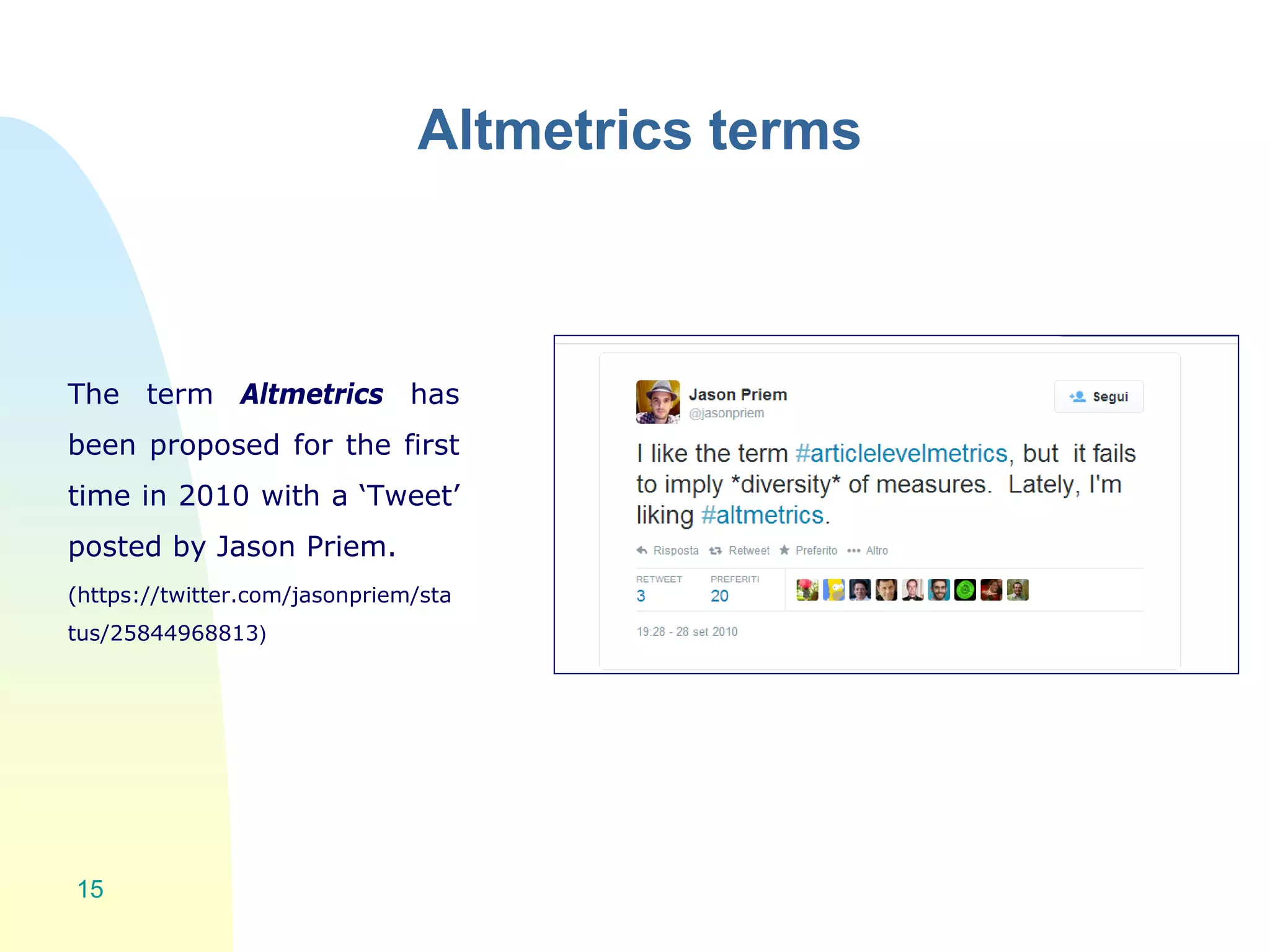
Altmetrics terms
The term Altmetrics has
been proposed for the first
time in 2010 with a ‘Tweet’
posted by Jason Priem.
(https://twitter.com/jasonpriem/sta
tus/25844968813)
15
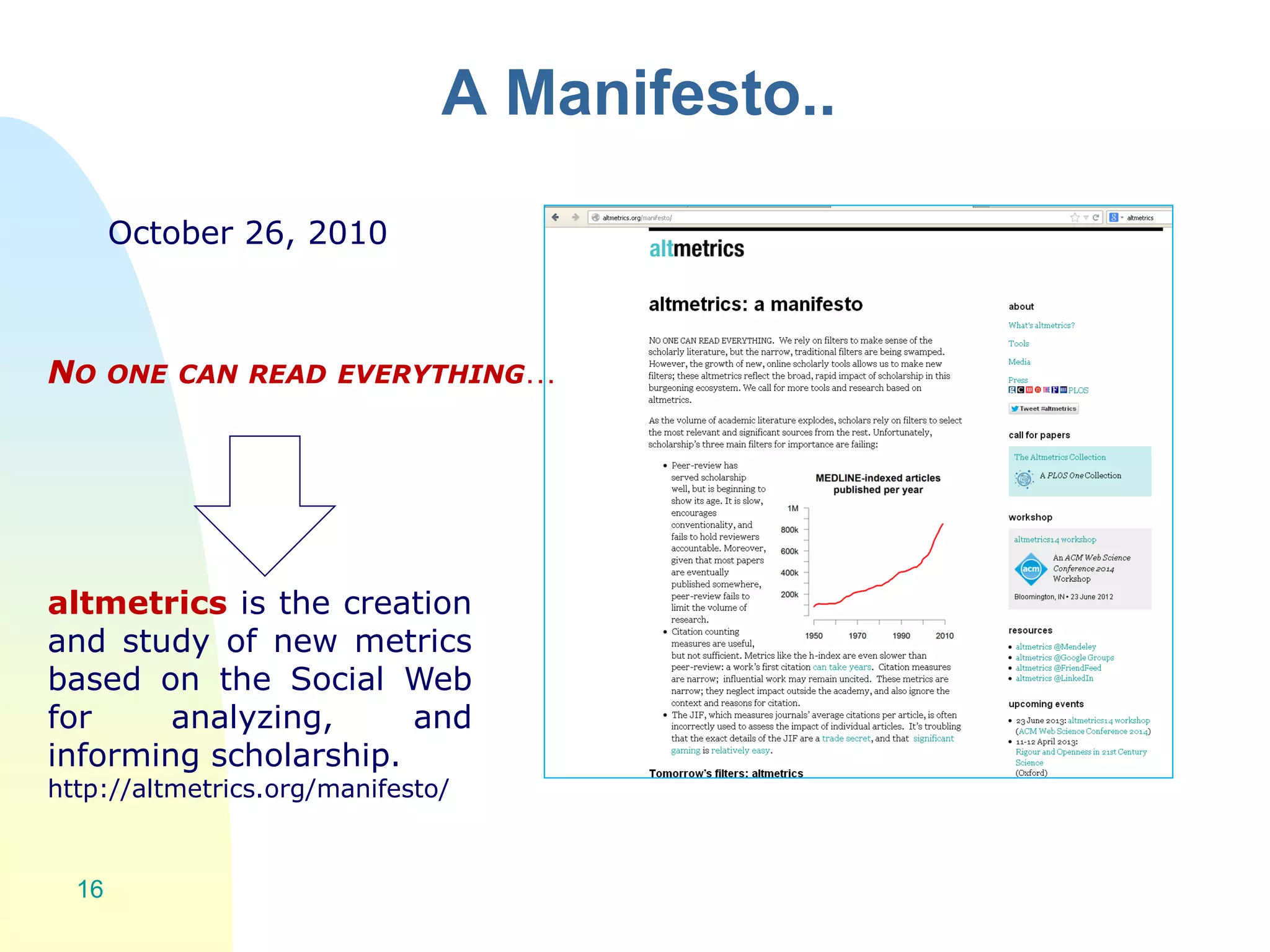
A Manifesto..
16
NO ONE CAN READ EVERYTHING…
altmetrics is the creation
and study of new metrics
based on the Social Web
for analyzing, and
informing scholarship.
http://altmetrics.org/manifesto/
October 26, 2010
Why new metrics?
 Peer review: often slow and inefficient;
 Citations: only considers who write the paper;
 Impact factor: easily manipulated.
The work of researchers has shifted to the web where you can:
 Counting downloads
 Read the tweets and comments on Facebook, Google +,
 Post a video on You Tube
All these tracks measuring the Impact on the scientific community.
17
D O R A (Declaration on
Research Assessment)
18
General Recommendation:
1. Do not use journal-based metrics,
such as Journal Impact Factors, as a
surrogate measure of the quality of
individual research articles, to
assess an individual scientist’s
contributions, or in hiring,
promotion, or funding decisions.
7. Make available a range of article-
level metrics to encourage a shift
toward assessment based on the
scientific content of an article rather
than publication metrics of the
journal in which it was published.
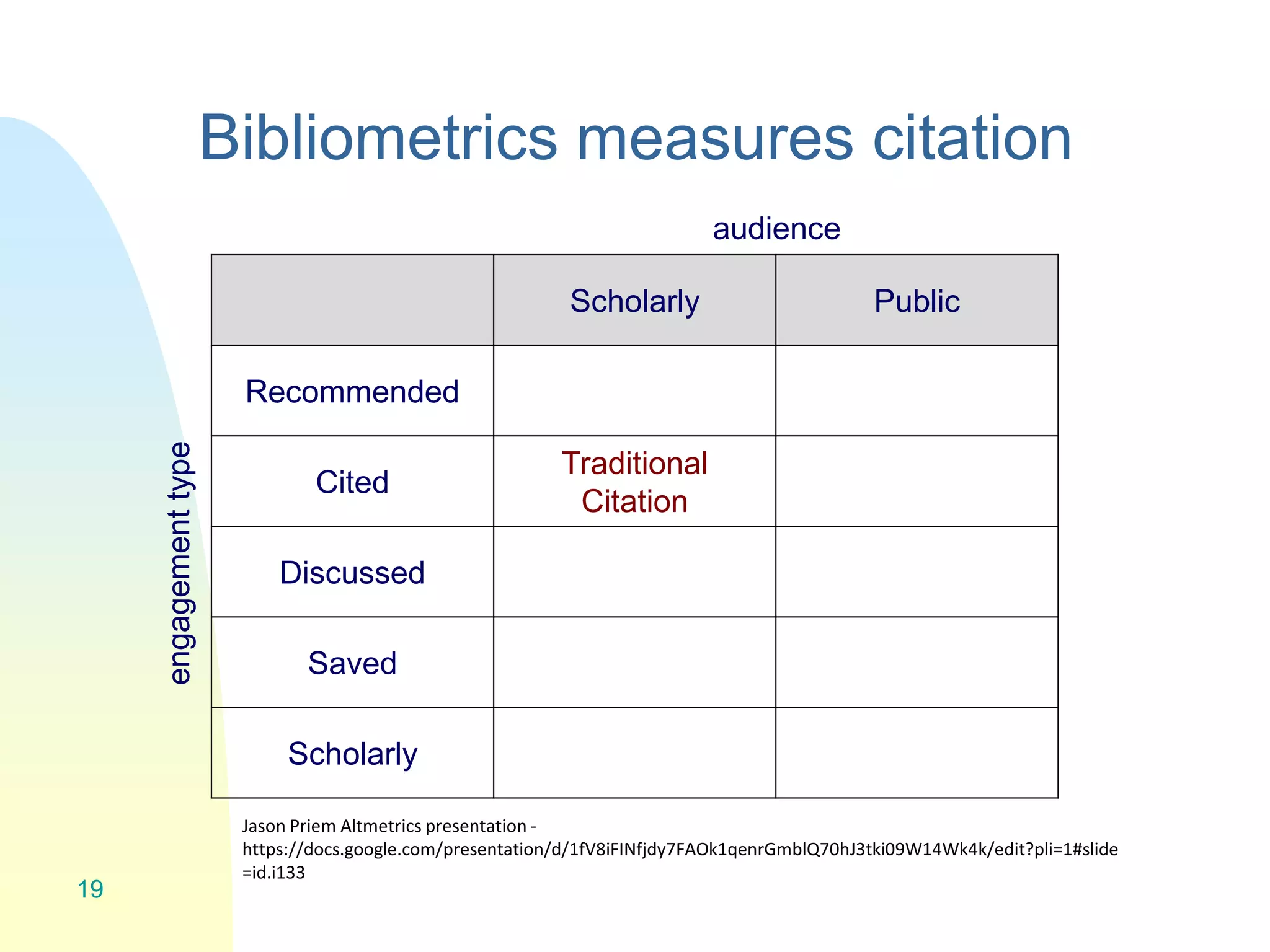
Bibliometrics measures citation
Scholarly Public
Recommended
Cited
Traditional
Citation
Discussed
Saved
Scholarly
engagementtype
audience
Jason Priem Altmetrics presentation -
https://docs.google.com/presentation/d/1fV8iFINfjdy7FAOk1qenrGmblQ70hJ3tki09W14Wk4k/edit?pli=1#slide
=id.i133
19
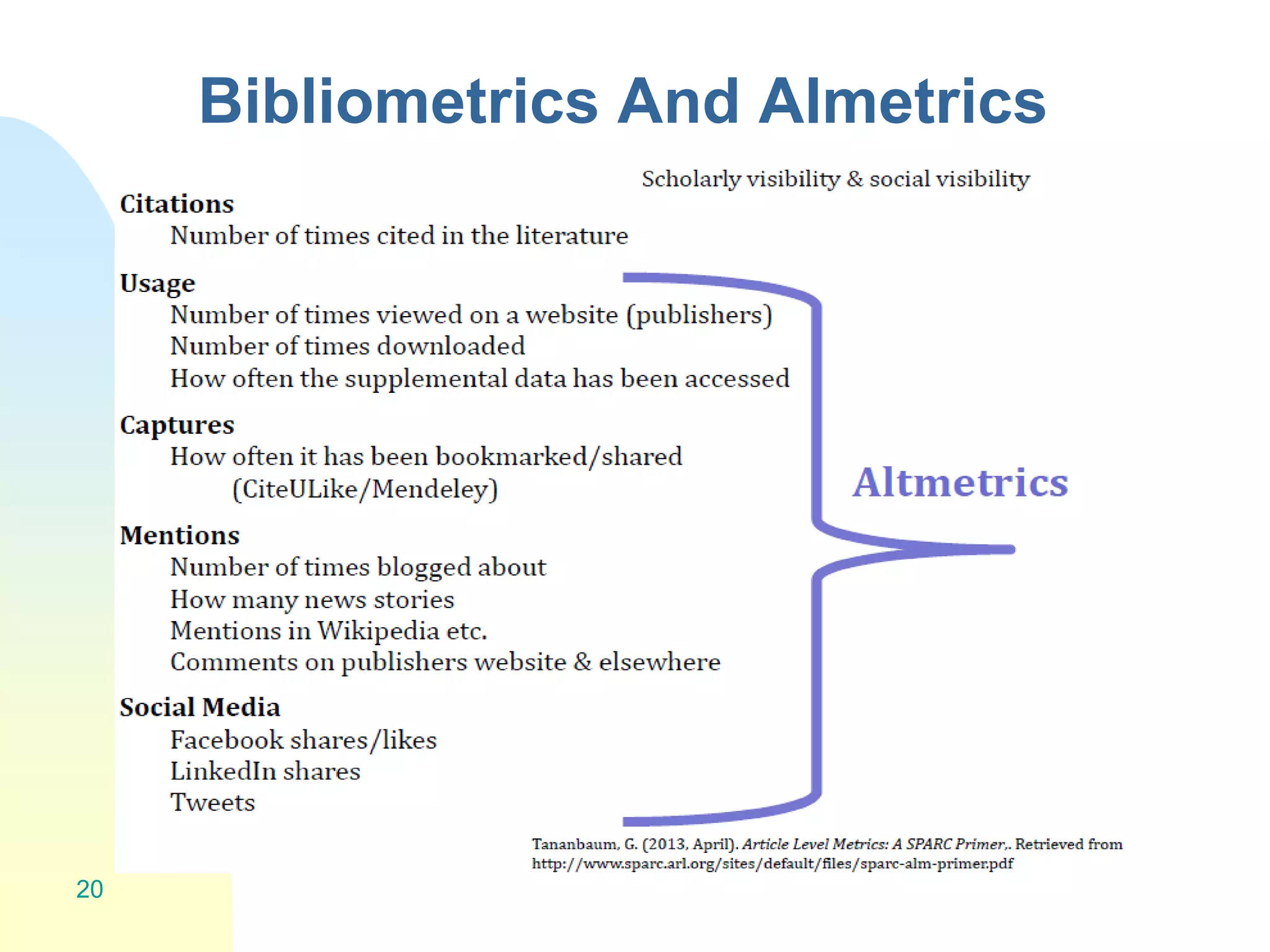
Bibliometrics And Almetrics
20
IMPACT
21
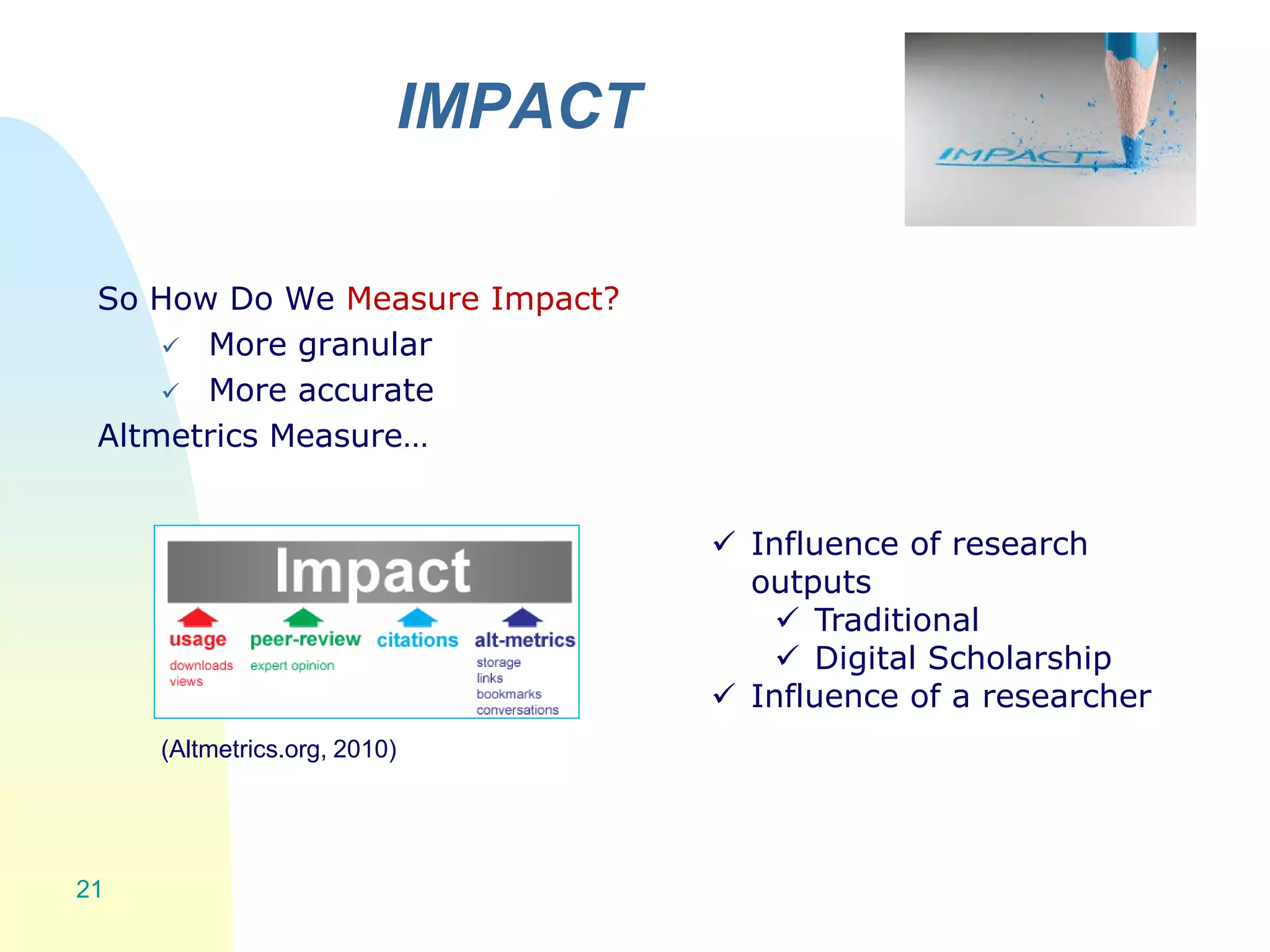
So How Do We Measure Impact?
 More granular
 More accurate
Altmetrics Measure…
(Altmetrics.org, 2010)
 Influence of research
outputs
 Traditional
 Digital Scholarship
 Influence of a researcher
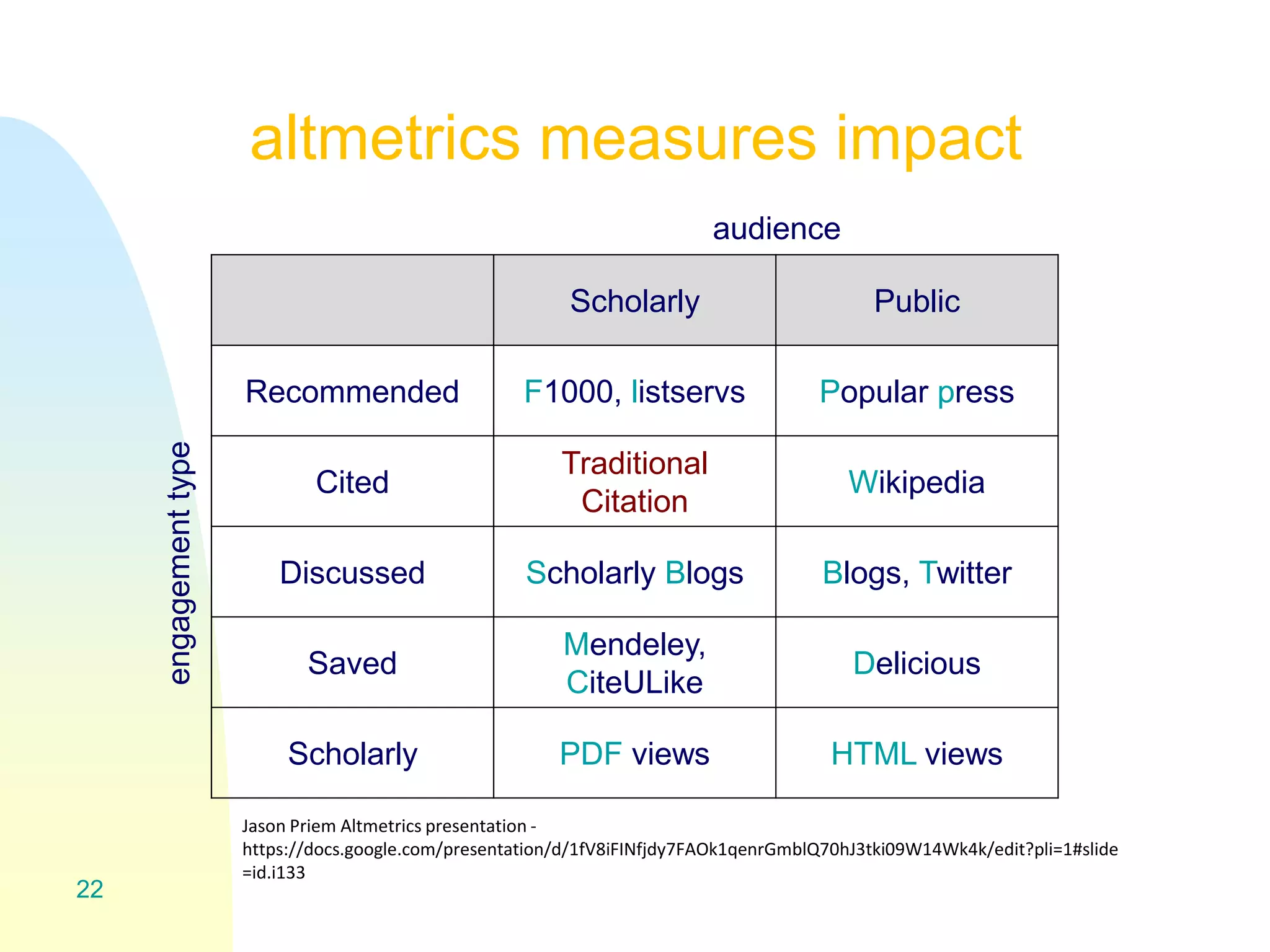
altmetrics measures impact
Scholarly Public
Recommended F1000, listservs Popular press
Cited
Traditional
Citation
Wikipedia
Discussed Scholarly Blogs Blogs, Twitter
Saved
Mendeley,
CiteULike
Delicious
Scholarly PDF views HTML views
audience
engagementtype
Jason Priem Altmetrics presentation -
https://docs.google.com/presentation/d/1fV8iFINfjdy7FAOk1qenrGmblQ70hJ3tki09W14Wk4k/edit?pli=1#slide
=id.i133
22
Variety of Research
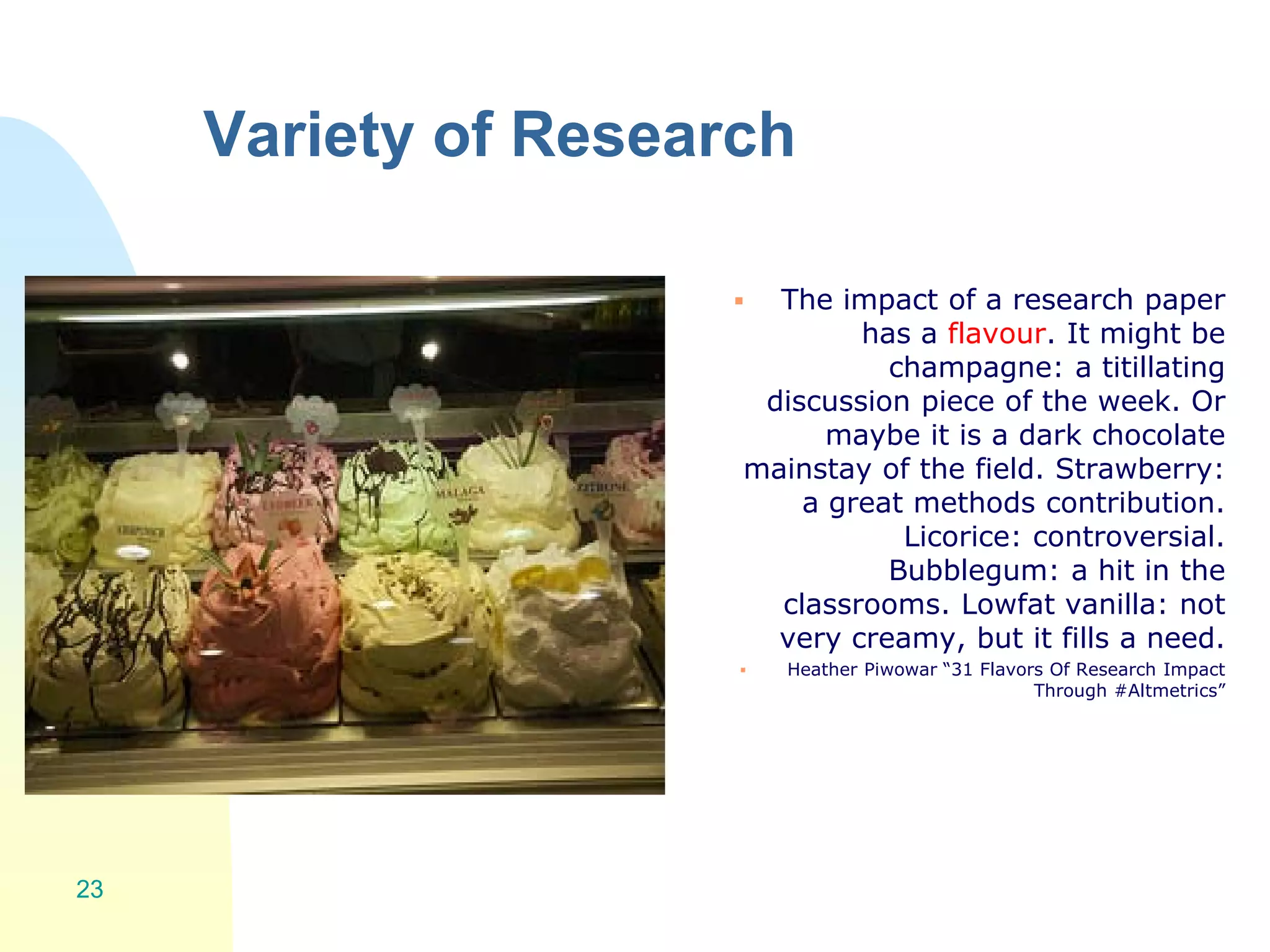
 The impact of a research paper
has a flavour. It might be
champagne: a titillating
discussion piece of the week. Or
maybe it is a dark chocolate
mainstay of the field. Strawberry:
a great methods contribution.
Licorice: controversial.
Bubblegum: a hit in the
classrooms. Lowfat vanilla: not
very creamy, but it fills a need.
 Heather Piwowar “31 Flavors Of Research Impact
Through #Altmetrics”
23
What are “altmetrics”?
 “Alternative Metrics”
 new ways of measuring different, non-traditional forms of impact,
potentially of non-traditional outputs.
 “alternative to only using citations”, not “alternative to citations”.
 complementary to traditional citation-based analysis.
24
Altmetrics in Pills
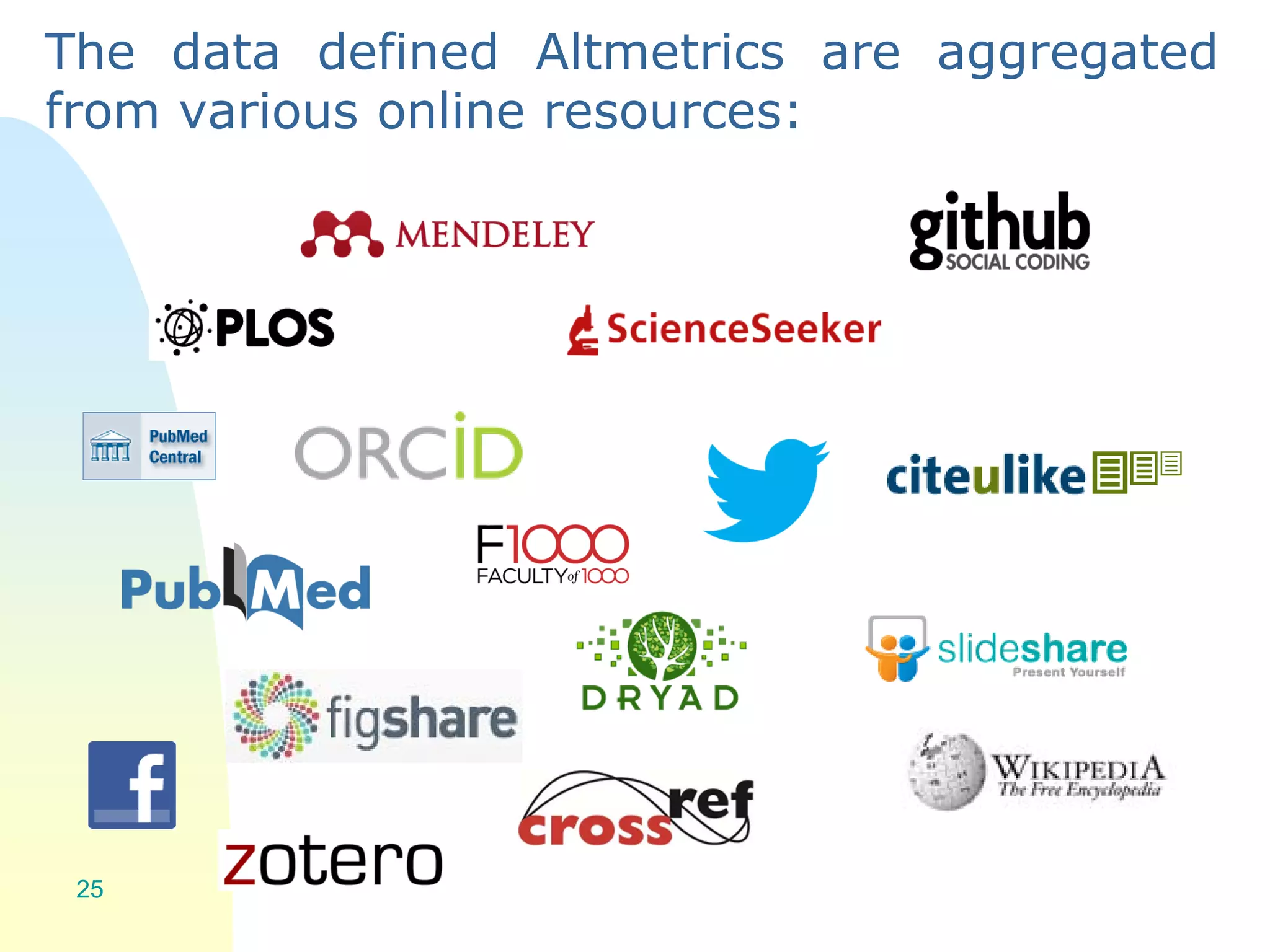
The data defined Altmetrics are aggregated
from various online resources:
25
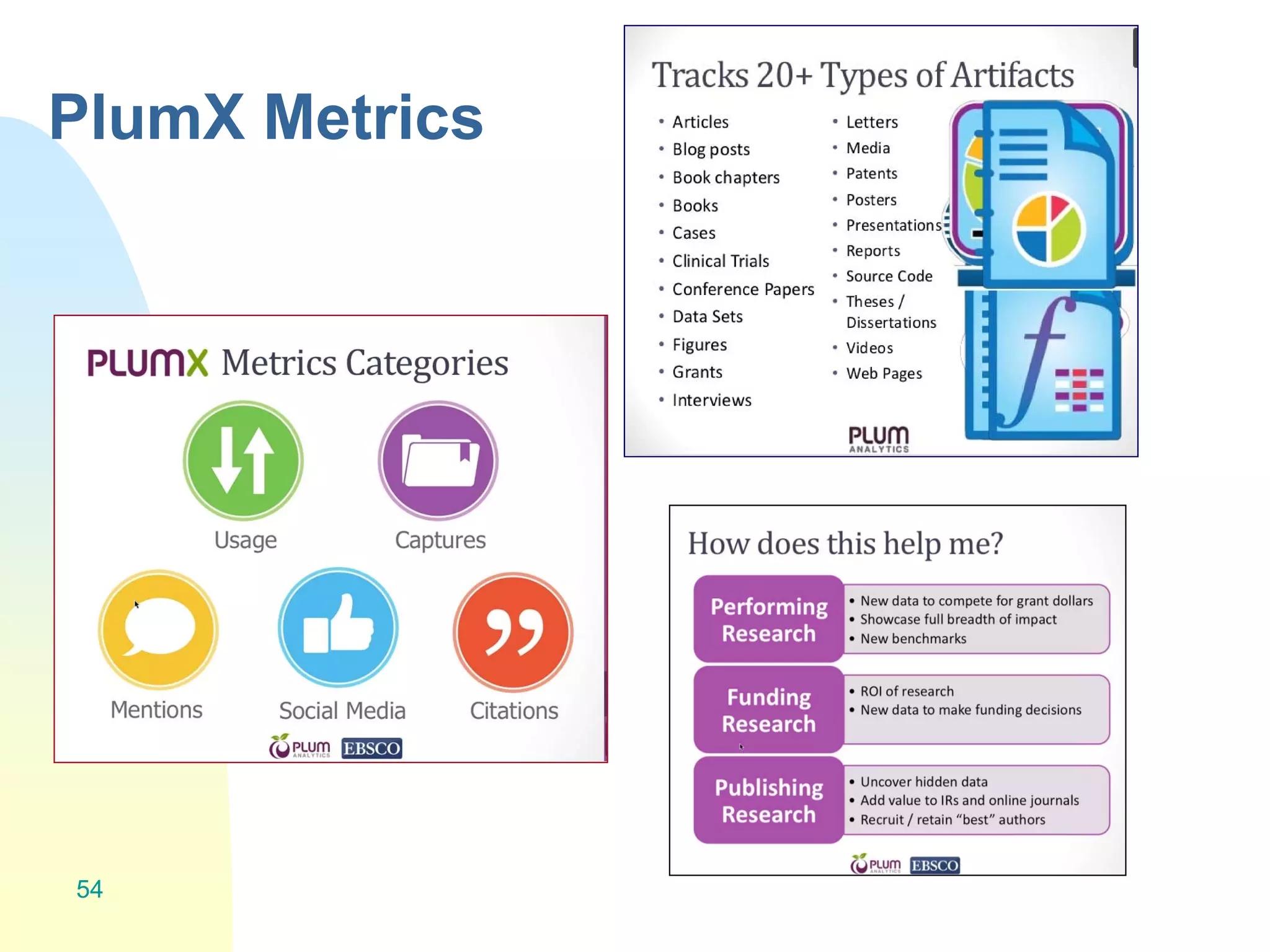
Altmetrics sources can be categorized
 Usage
 HTML views, PDF/XML downloads (various sources – journal, PubMed Central,
FigShare, Dryad, etc.)
 Captures
 CiteULike bookmarks, Mendeley readers/groups, Delicio.us
 Mentions
 Blog posts, news stories, Wikipedia articles, comments, reviews
 Social Media
 Tweets, Google+, Facebook likes, shares, ratings
 Citations
 Web of Science, Scopus, CrossRef, Pubmed Central, Microsoft Academic Search
26
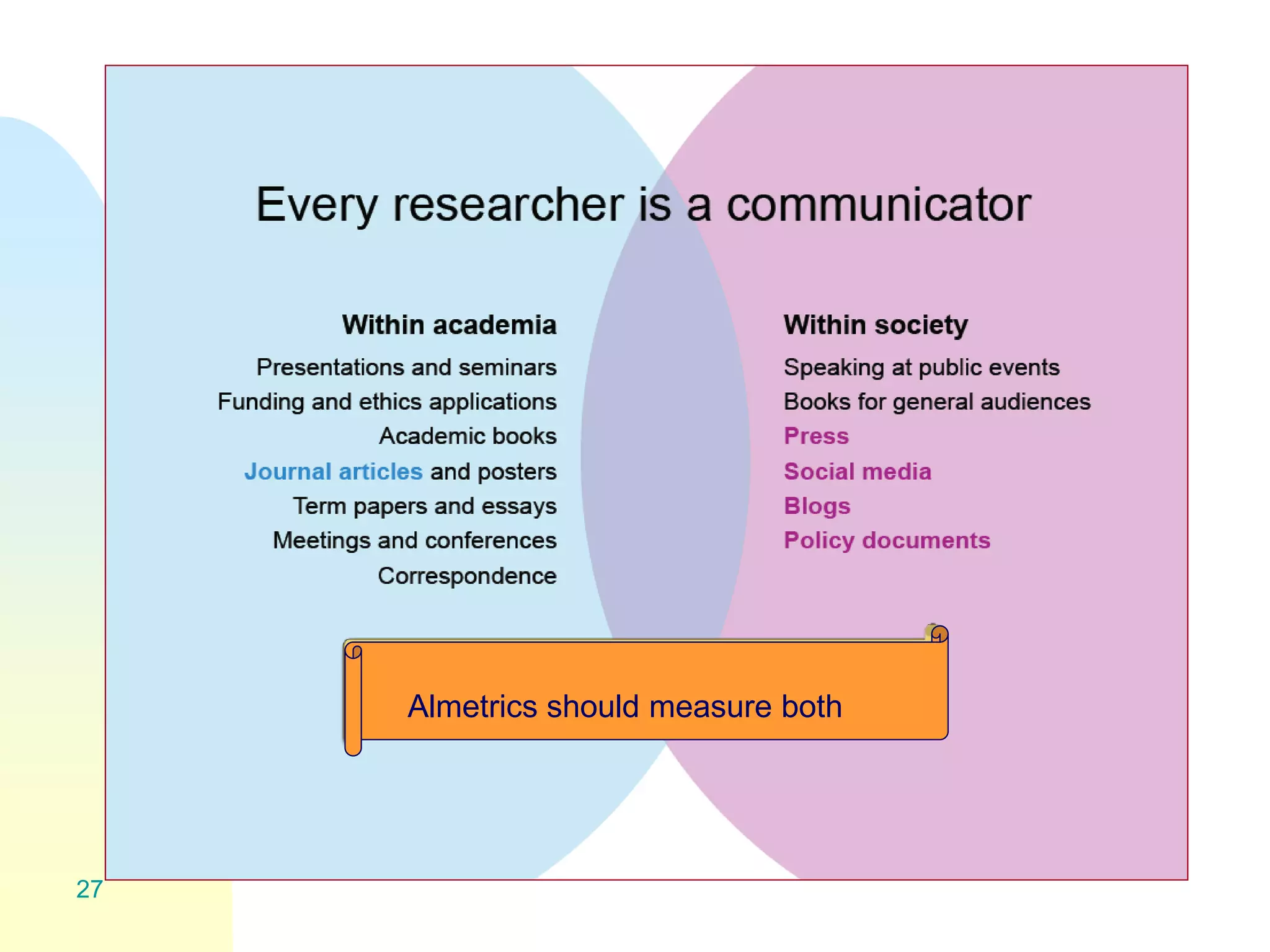
27
Almetrics should measure both
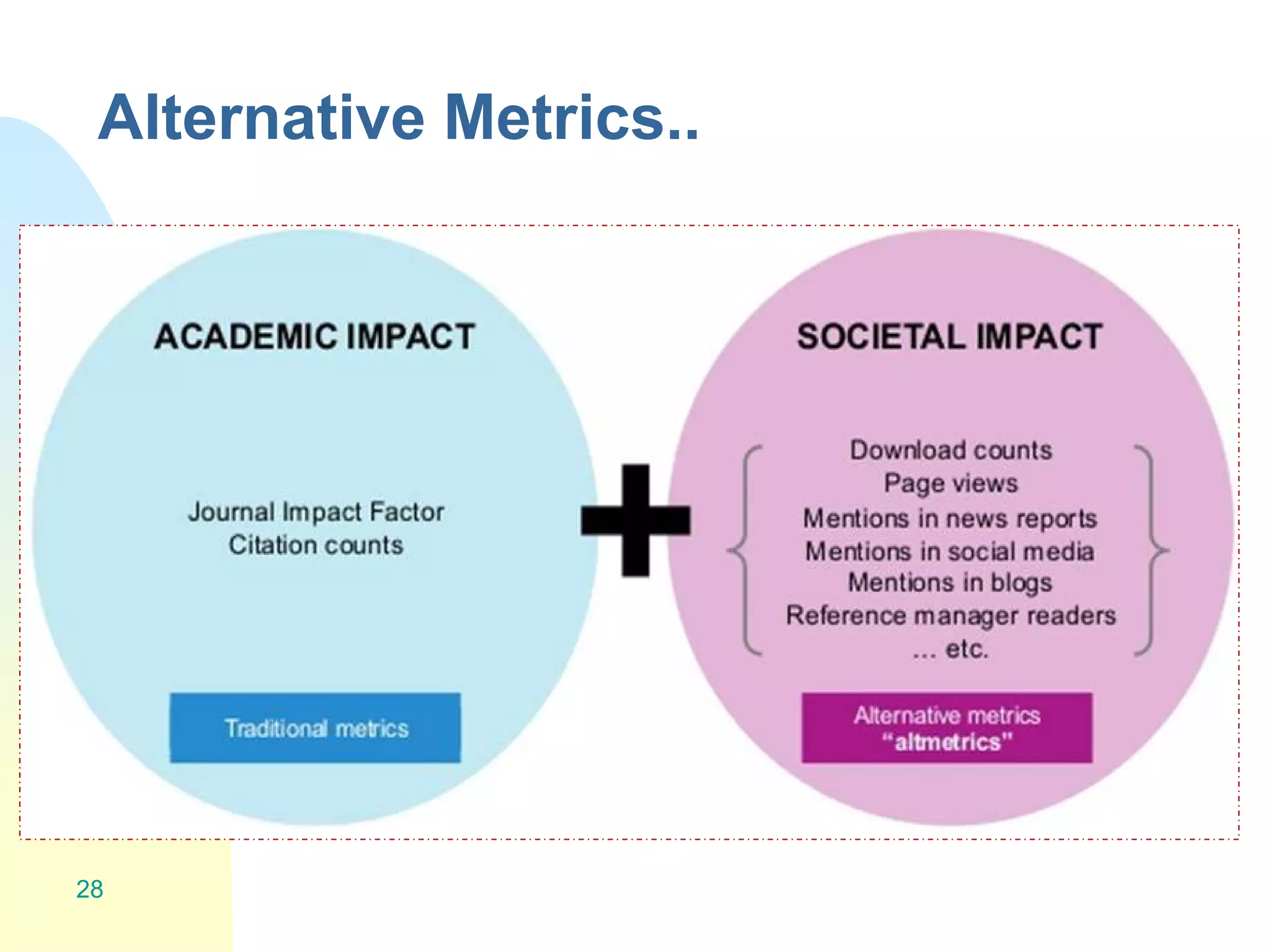
Alternative Metrics..
28
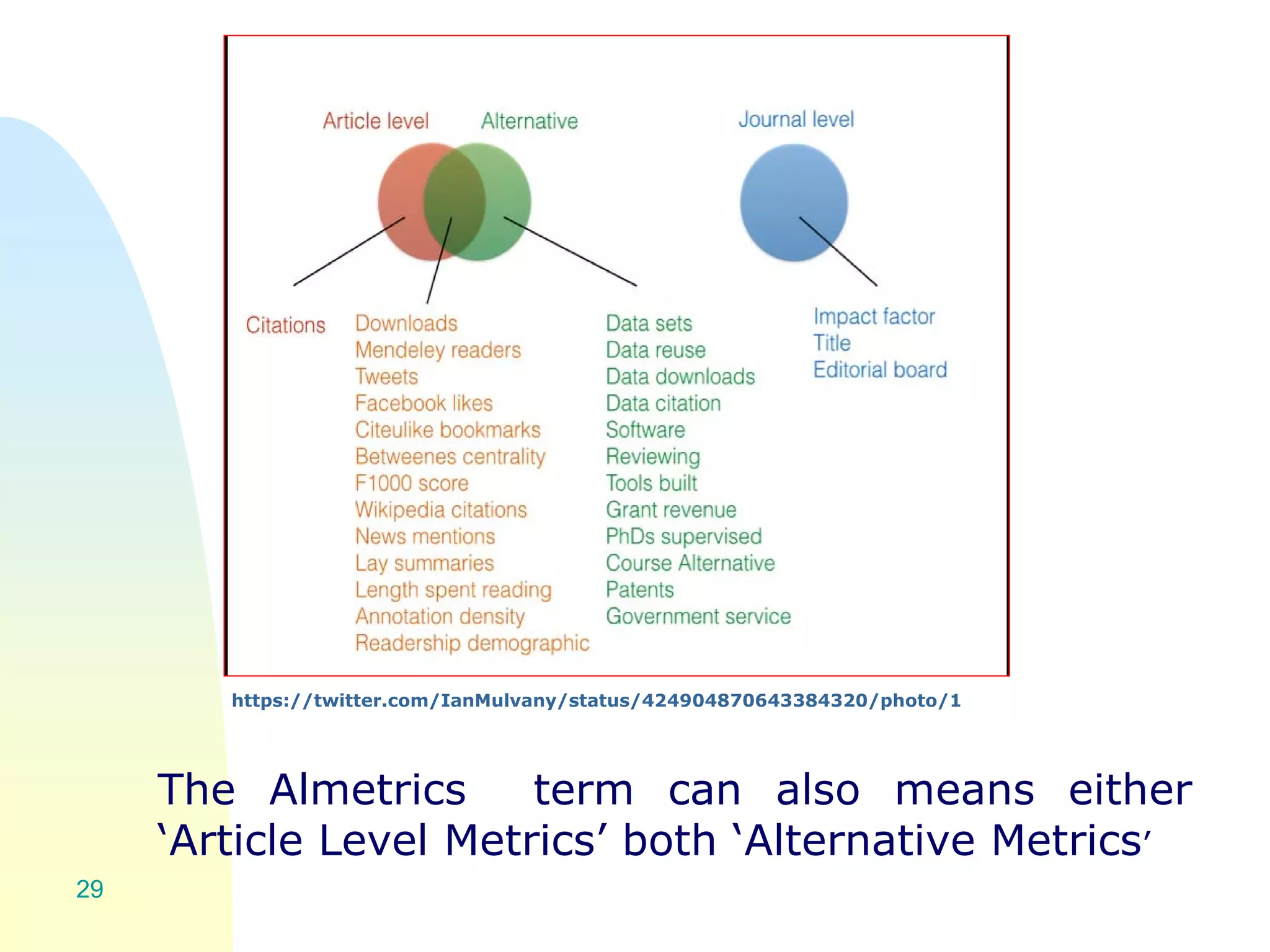
https://twitter.com/IanMulvany/status/424904870643384320/photo/1
The Almetrics term can also means either
‘Article Level Metrics’ both ‘Alternative Metrics’
29
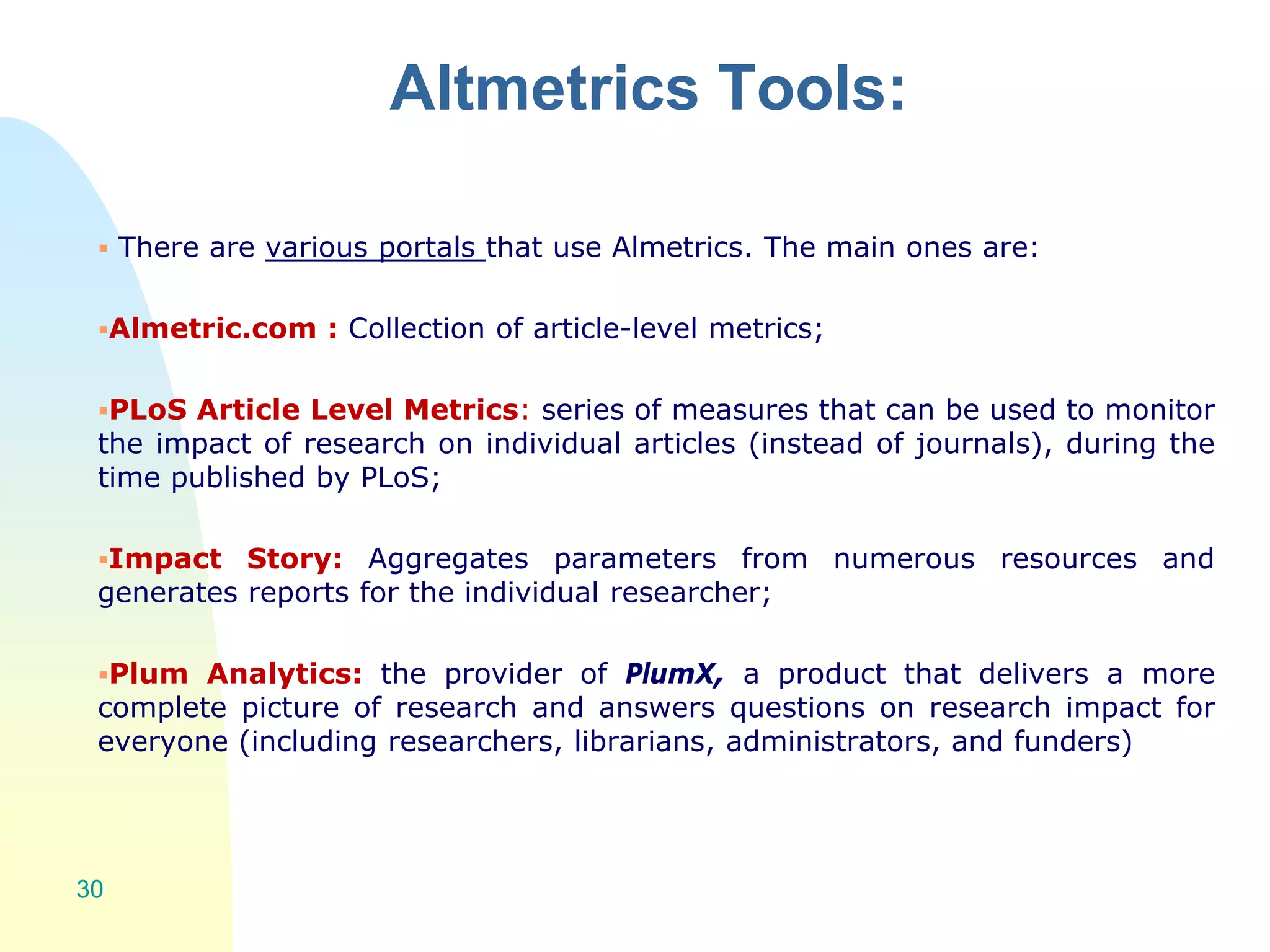
Altmetrics Tools:
 There are various portals that use Almetrics. The main ones are:
Almetric.com : Collection of article-level metrics;
PLoS Article Level Metrics: series of measures that can be used to monitor
the impact of research on individual articles (instead of journals), during the
time published by PLoS;
Impact Story: Aggregates parameters from numerous resources and
generates reports for the individual researcher;
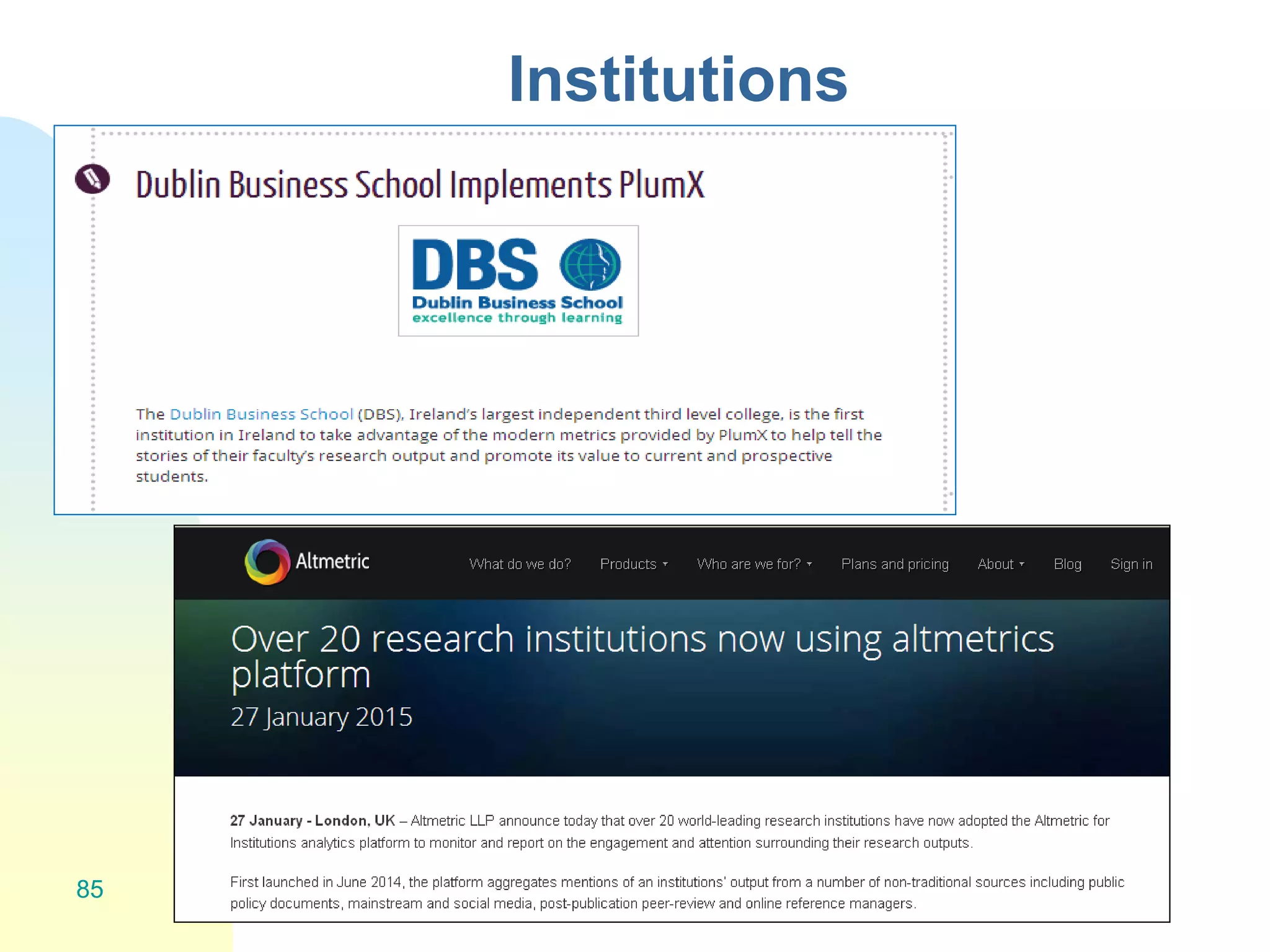
Plum Analytics: the provider of PlumX, a product that delivers a more
complete picture of research and answers questions on research impact for
everyone (including researchers, librarians, administrators, and funders)
30
Altmetric Tools:
There are other tools that aggregate Almetrics:
Mendeley
Academia.edu,
Research Gate,
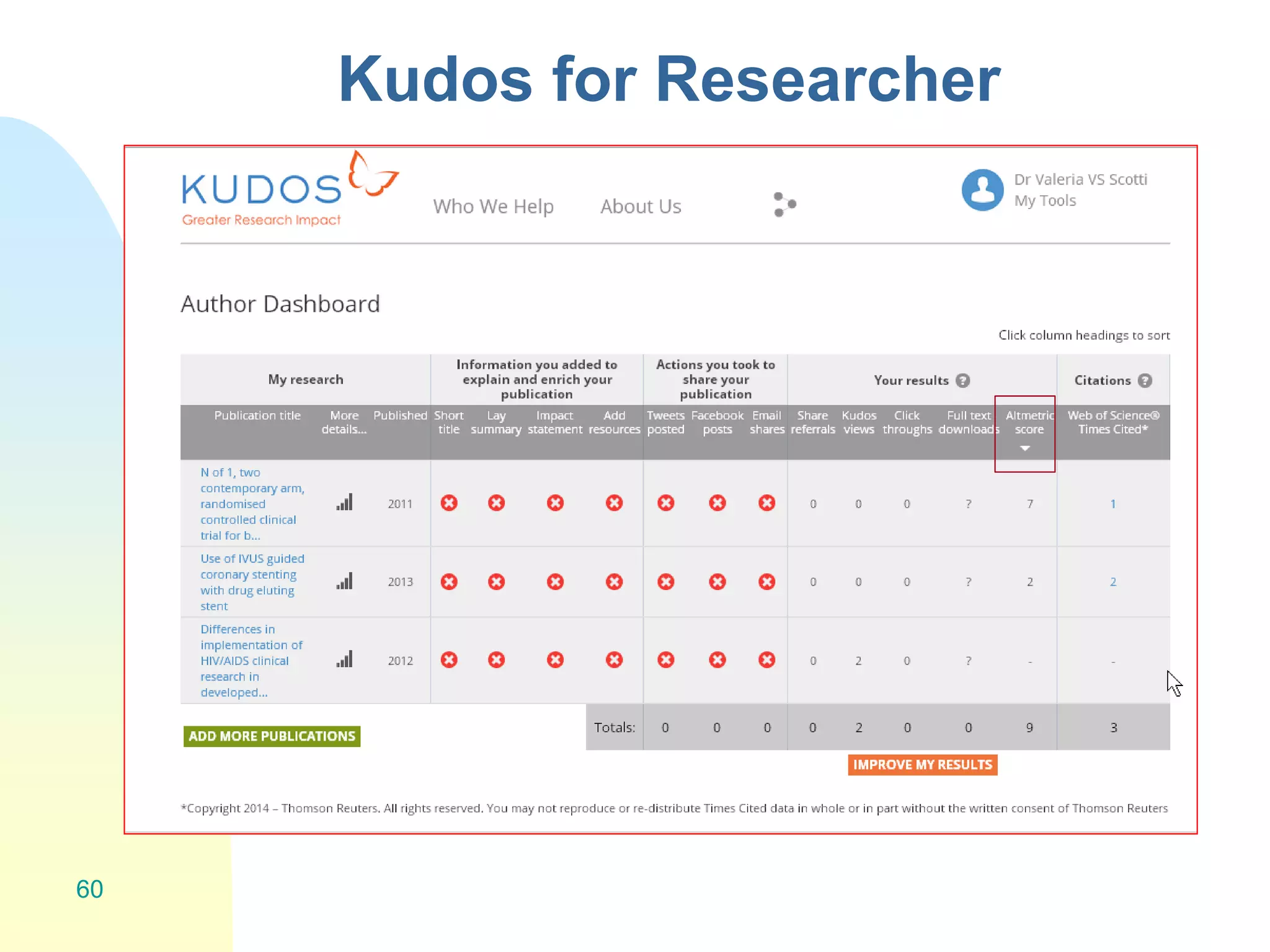
Kudos
Reader Meter etc
31
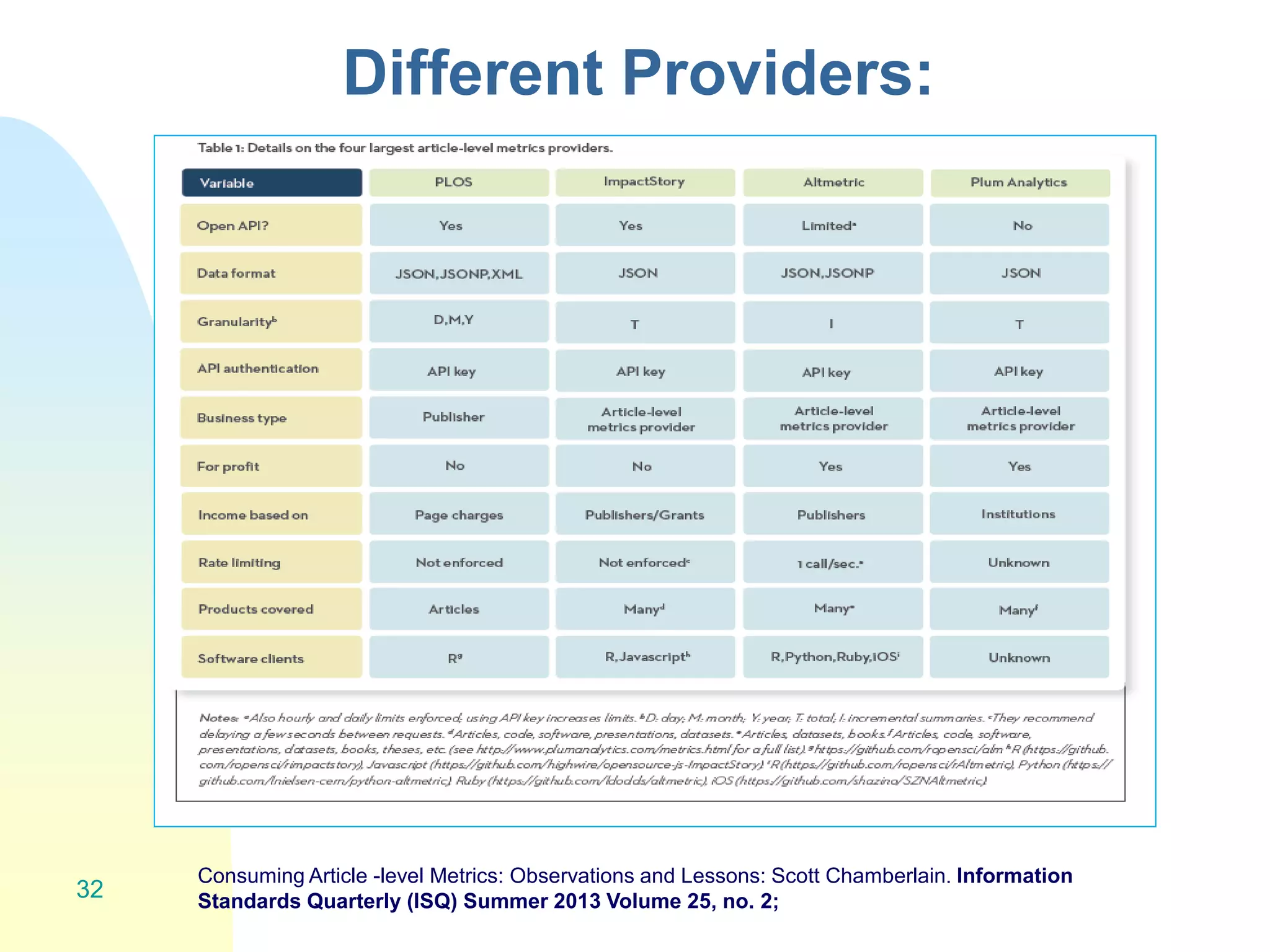
Different Providers:
32
Consuming Article -level Metrics: Observations and Lessons: Scott Chamberlain. Information
Standards Quarterly (ISQ) Summer 2013 Volume 25, no. 2;
Alternative Metrics Providers
33
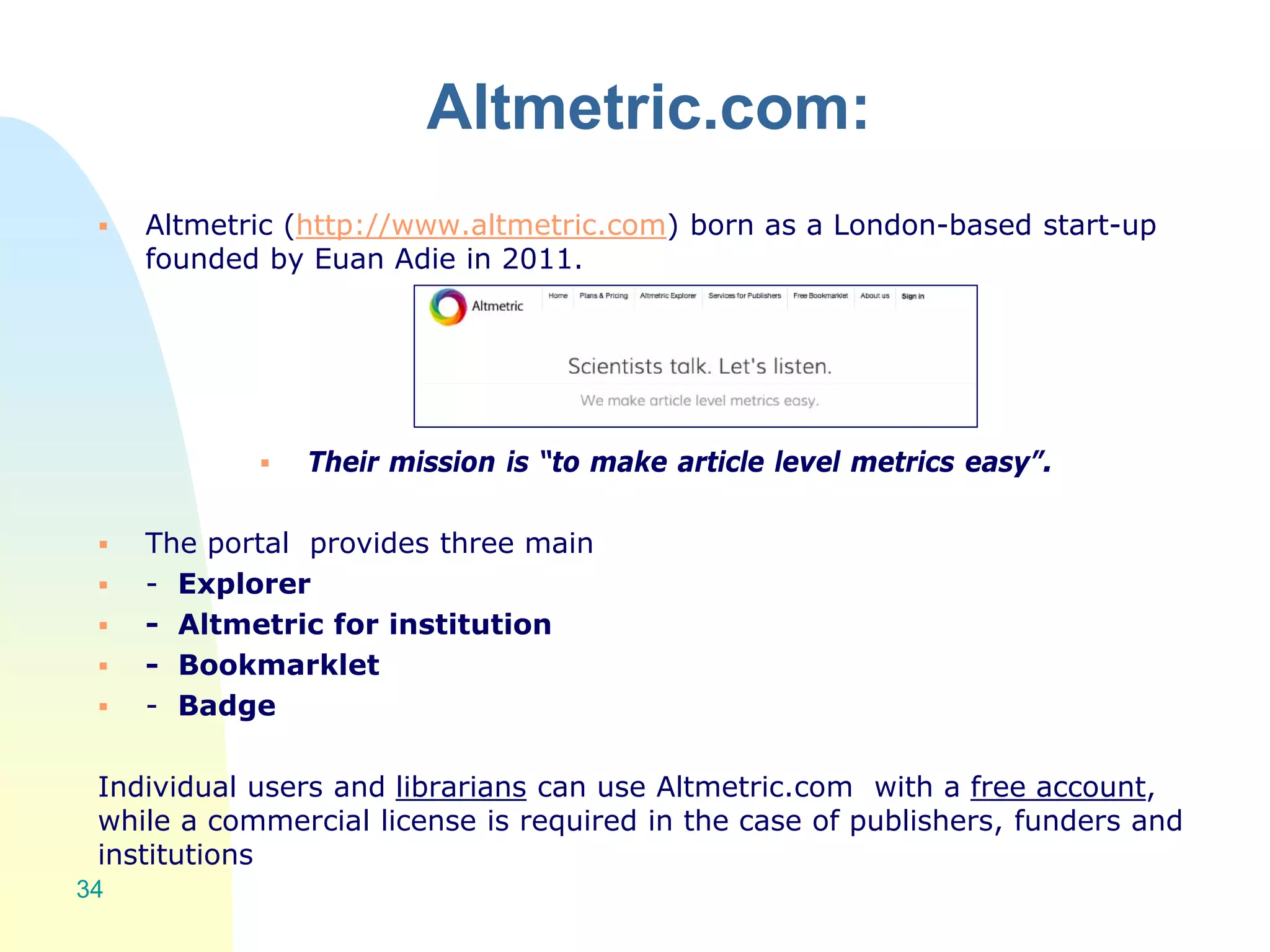
Altmetric.com:
 Altmetric (http://www.altmetric.com) born as a London-based start-up
founded by Euan Adie in 2011.
 Their mission is “to make article level metrics easy”.
 The portal provides three main
 - Explorer
 - Altmetric for institution
 - Bookmarklet
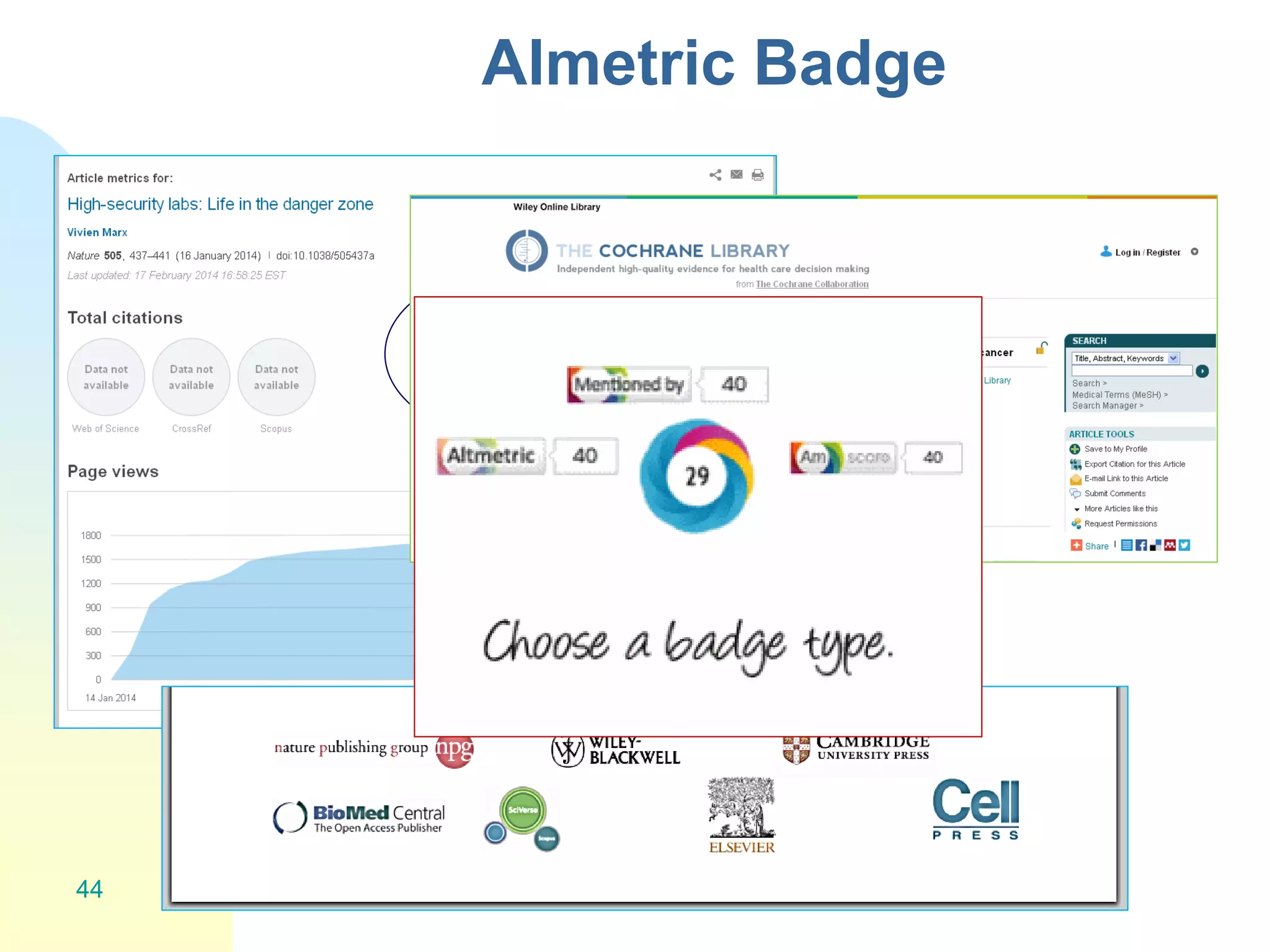
 - Badge
Individual users and librarians can use Altmetric.com with a free account,
while a commercial license is required in the case of publishers, funders and
institutions
34
35
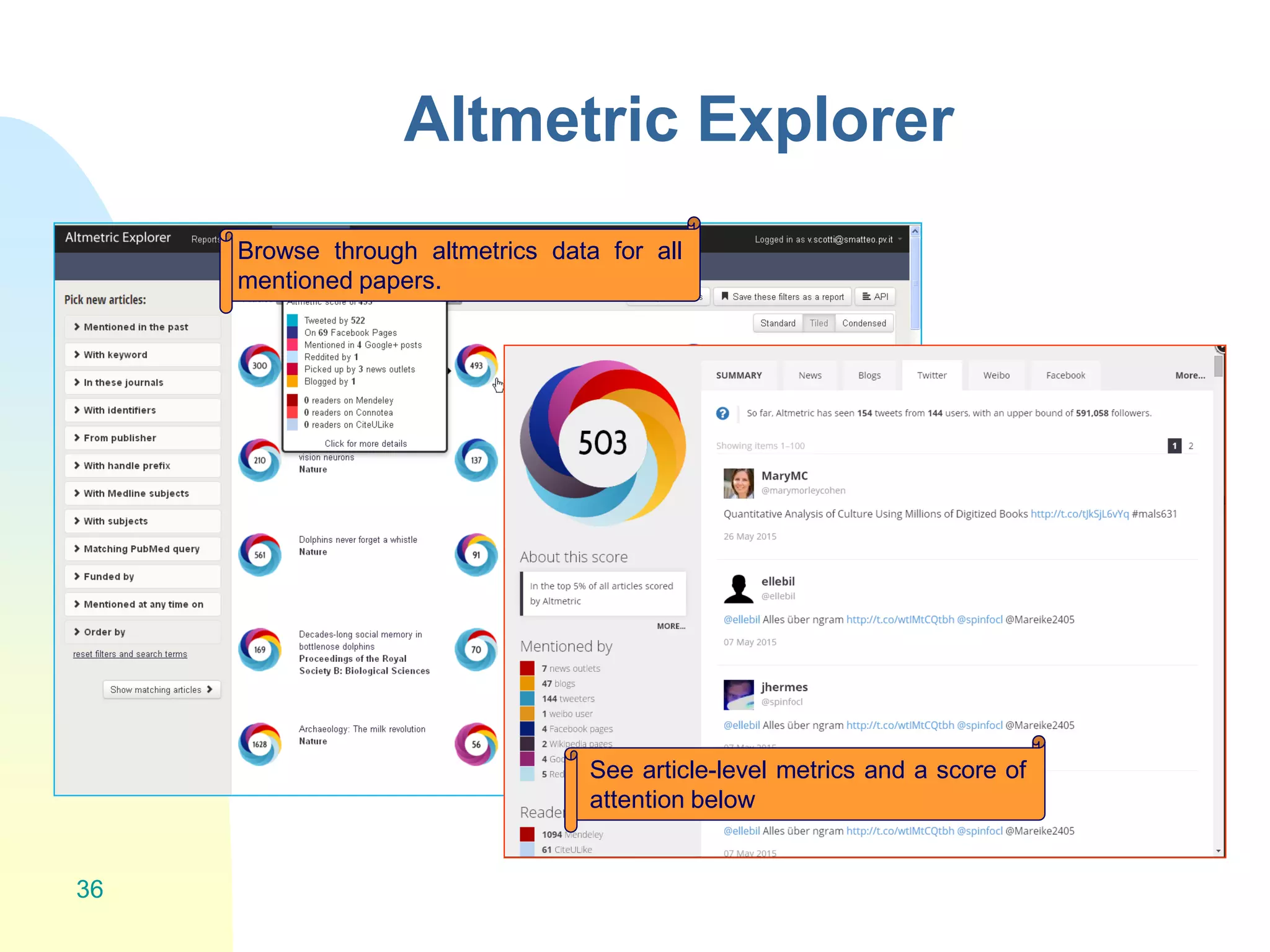
Altmetric Explorer
36
Browse through altmetrics data for all
mentioned papers.
See article-level metrics and a score of
attention below
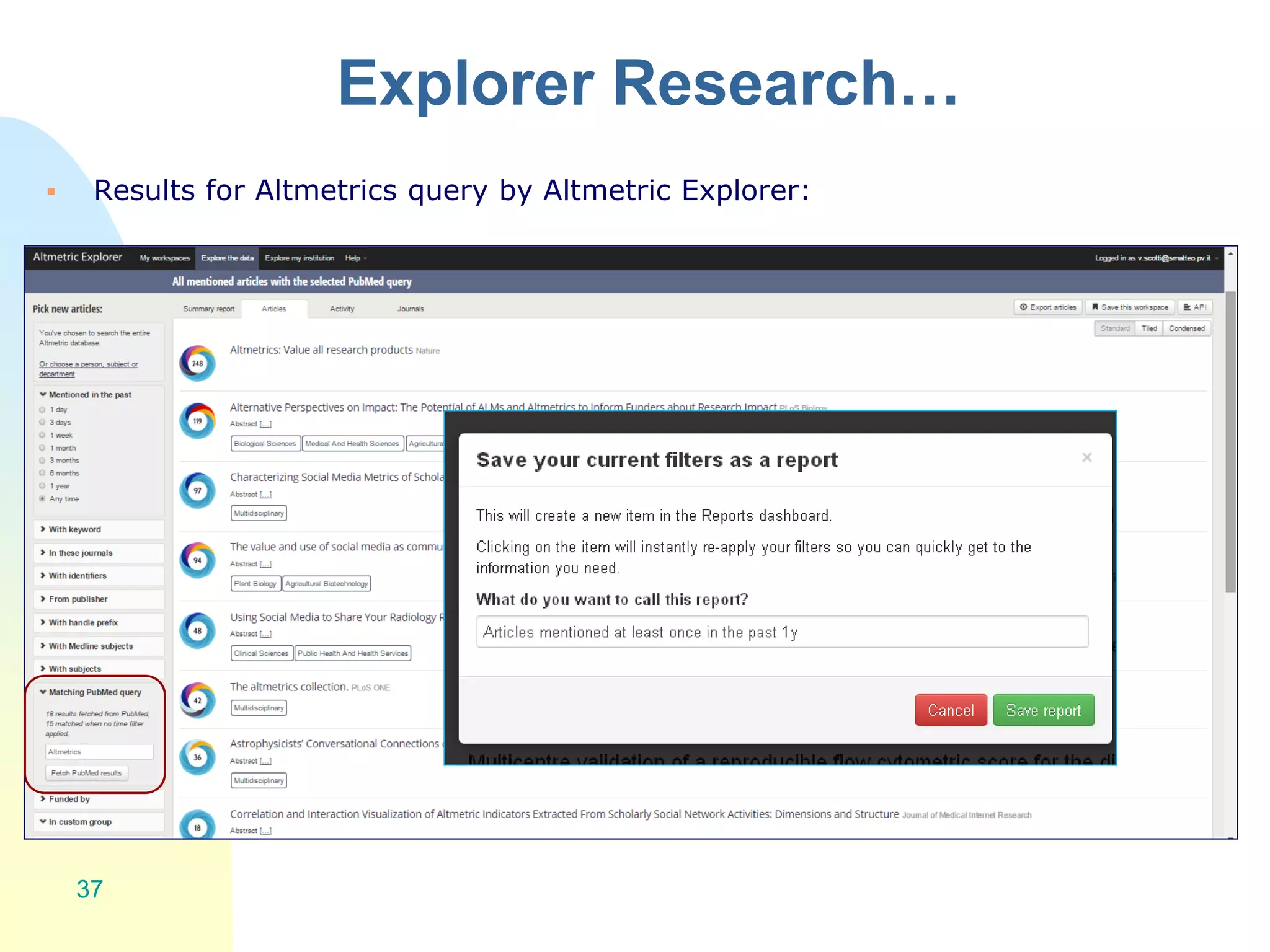
Explorer Research…
 Results for Altmetrics query by Altmetric Explorer:
37
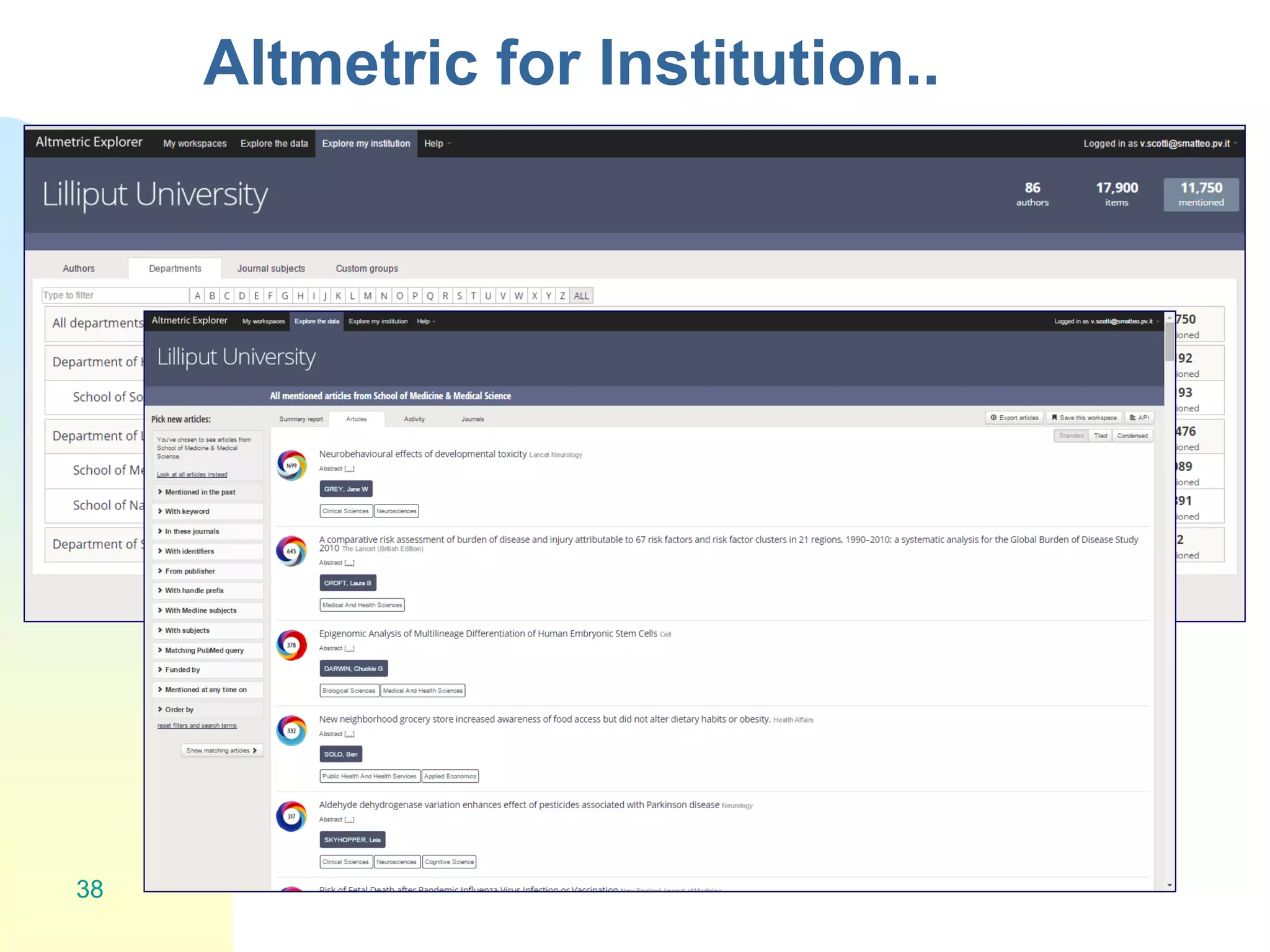
Altmetric for Institution..
38
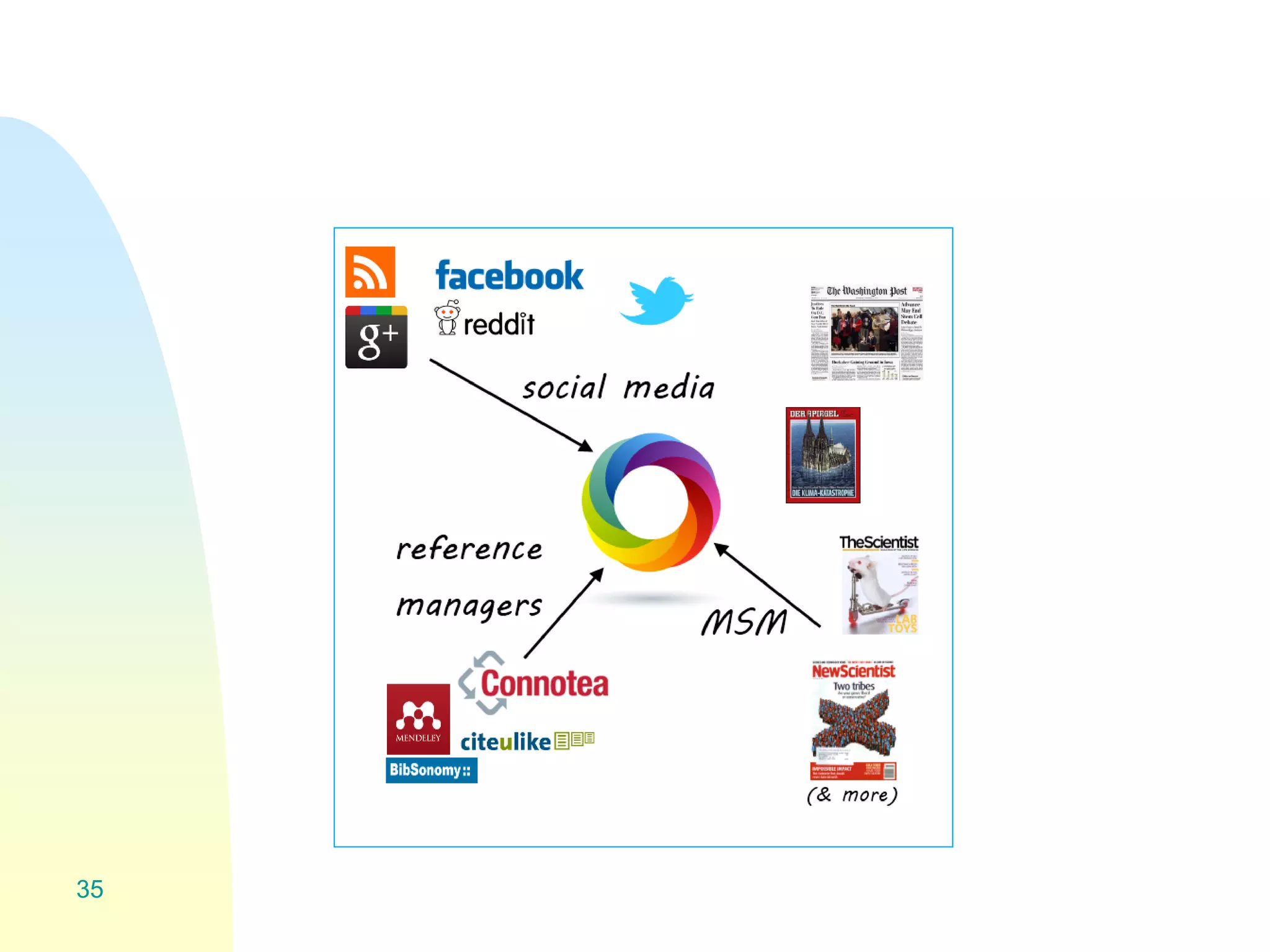
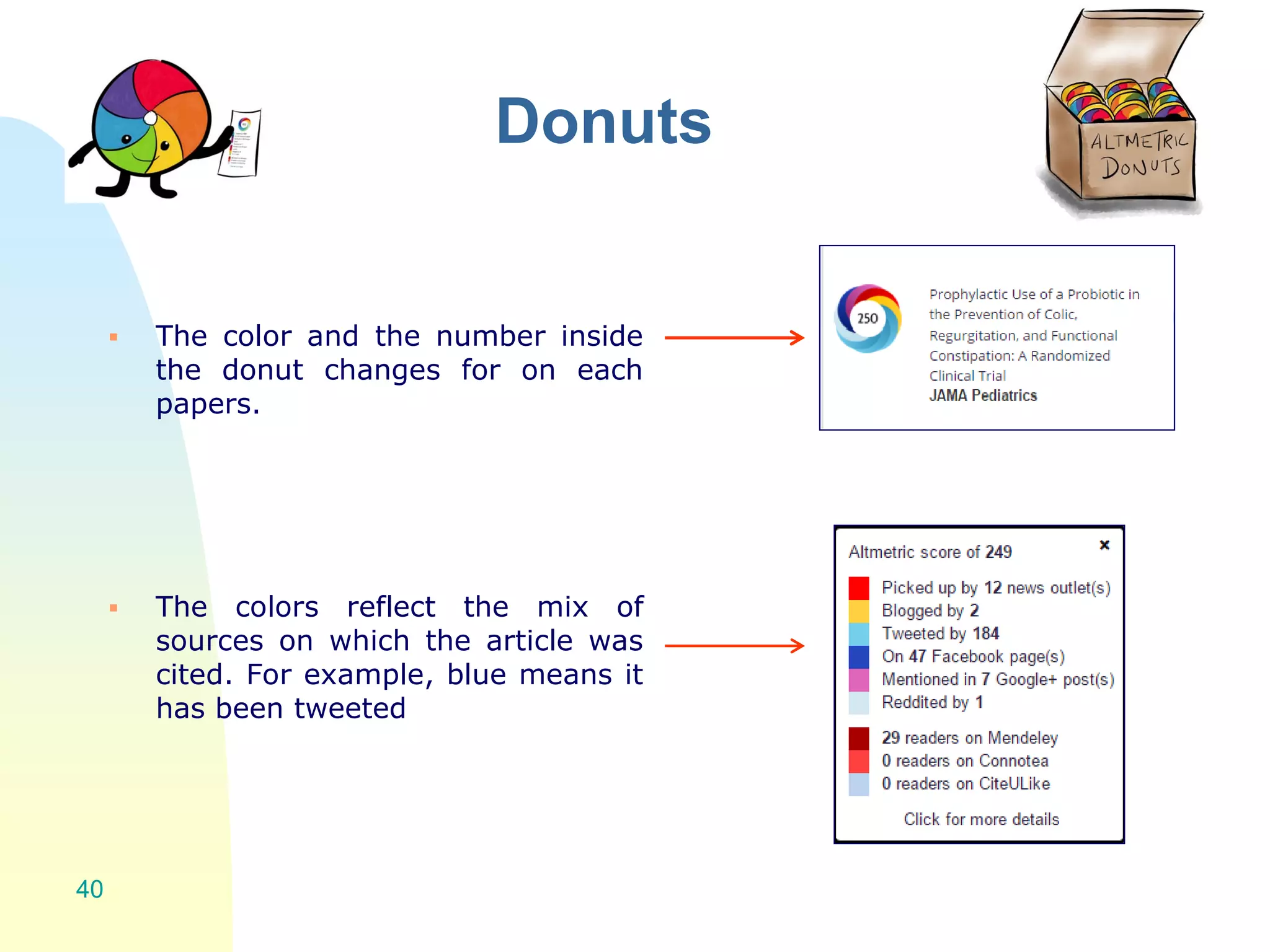
Donuts
 The color and the number inside
the donut changes for on each
papers.
 The colors reflect the mix of
sources on which the article was
cited. For example, blue means it
has been tweeted
40
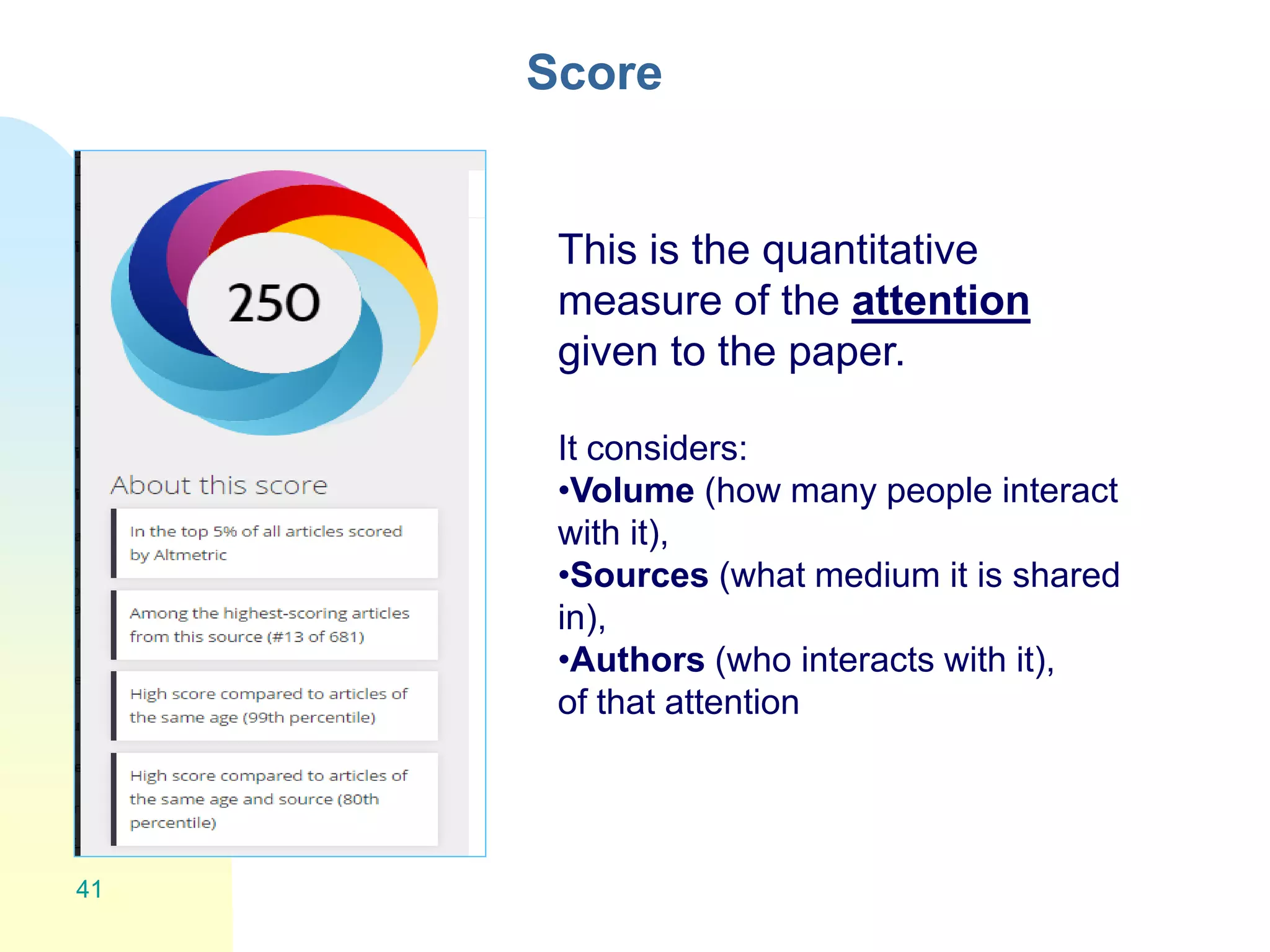
Score
41
This is the quantitative
measure of the attention
given to the paper.
It considers:
•Volume (how many people interact
with it),
•Sources (what medium it is shared
in),
•Authors (who interacts with it),
of that attention
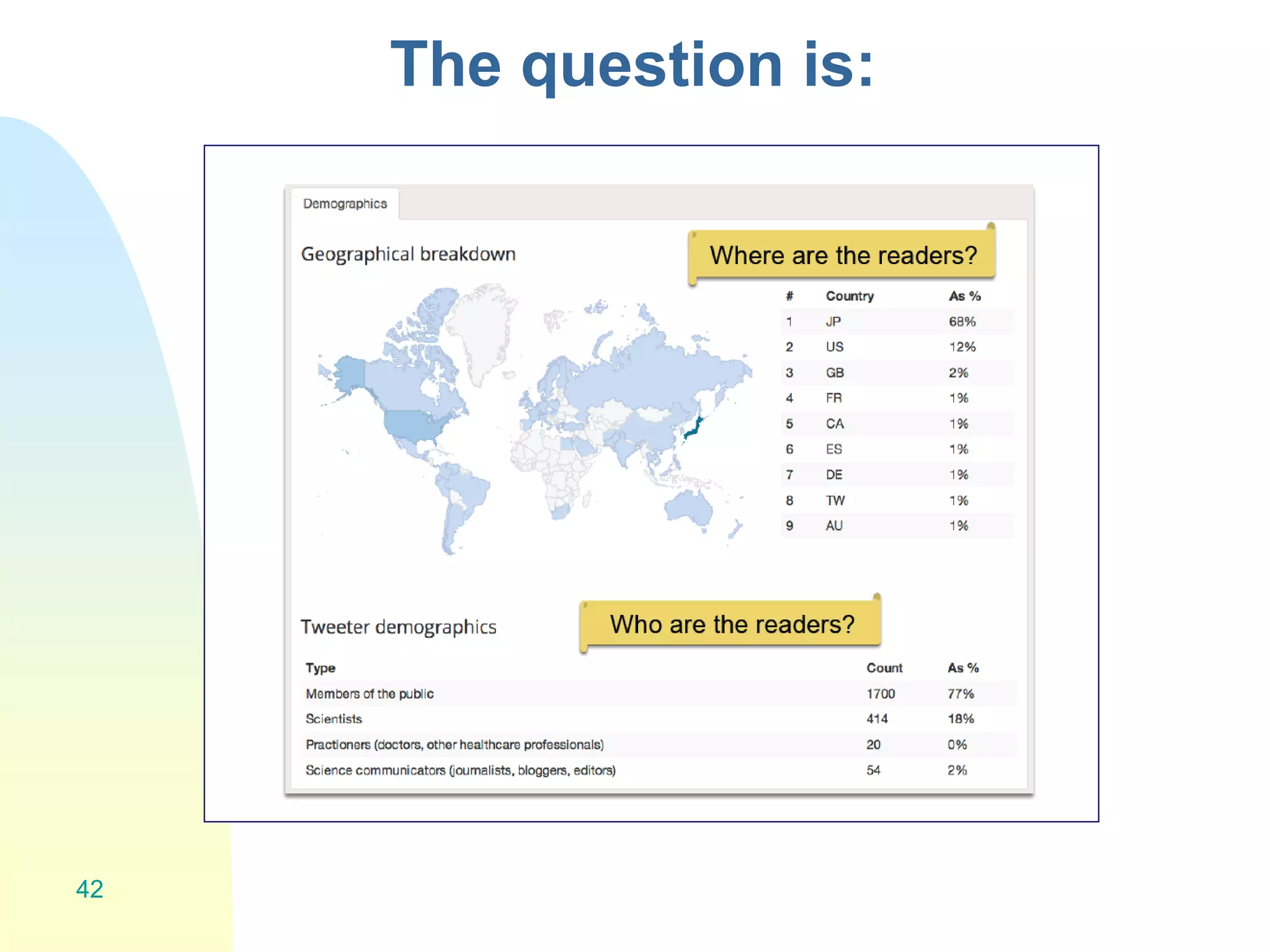
The question is:
42
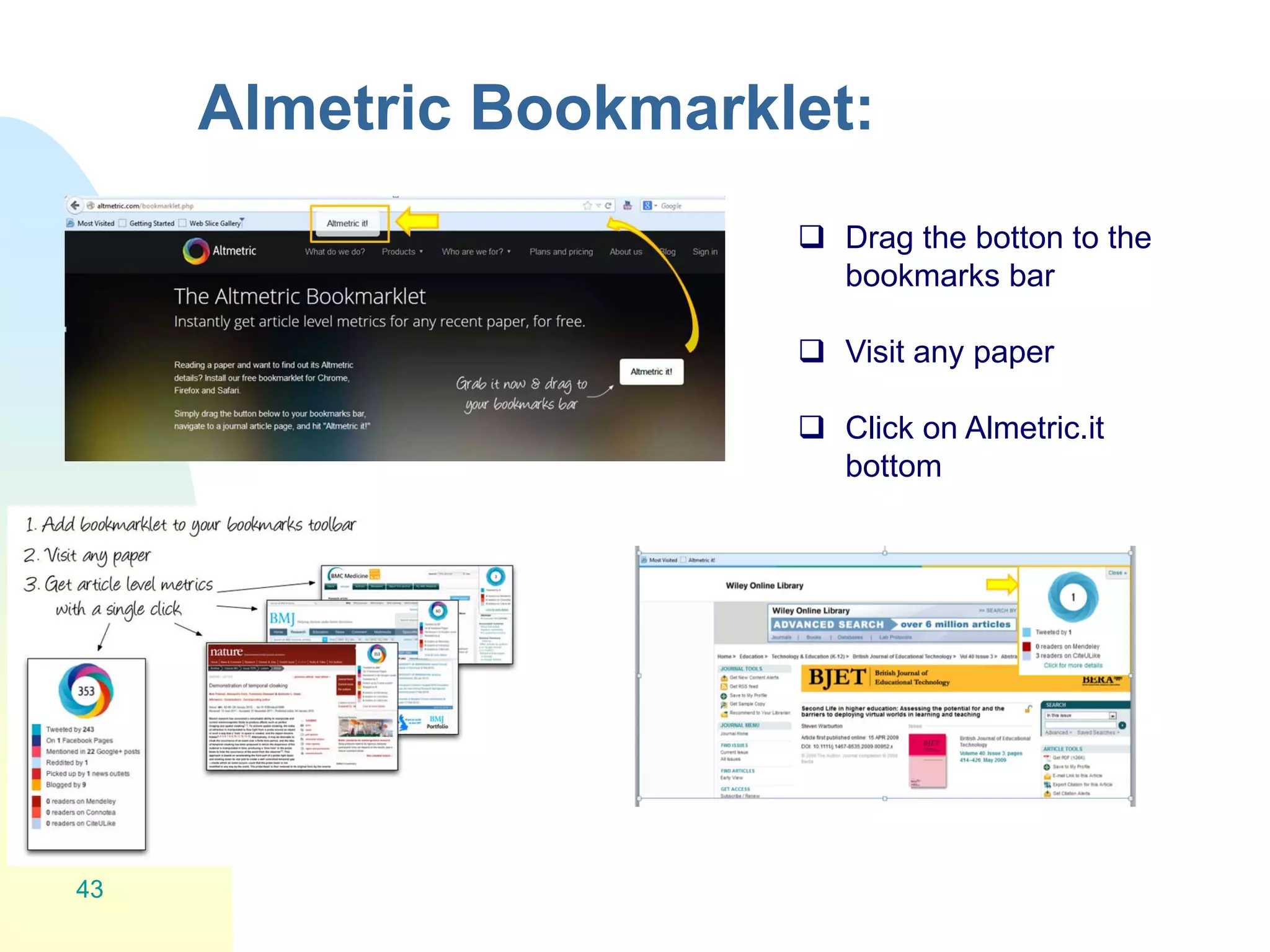
Almetric Bookmarklet:
43
 Drag the botton to the
bookmarks bar
 Visit any paper
 Click on Almetric.it
bottom
Almetric Badge
44
ImpactStory
 ImpactStory is an open source web service that helps researchers to
explore and share the different impacts of all their research products.
 The mission of ImpactStory lies in “helping the researchers tell data-
driven stories about their impact”, moving “from raw almetrics data to
impact profile” (https://impactstory.org/faq).
 ImpactStory delivers:
 Open source
 free and open data, to the extent permitted by data providers
 Radical transparency and open communication
The data are provided for each researcher and single item
45
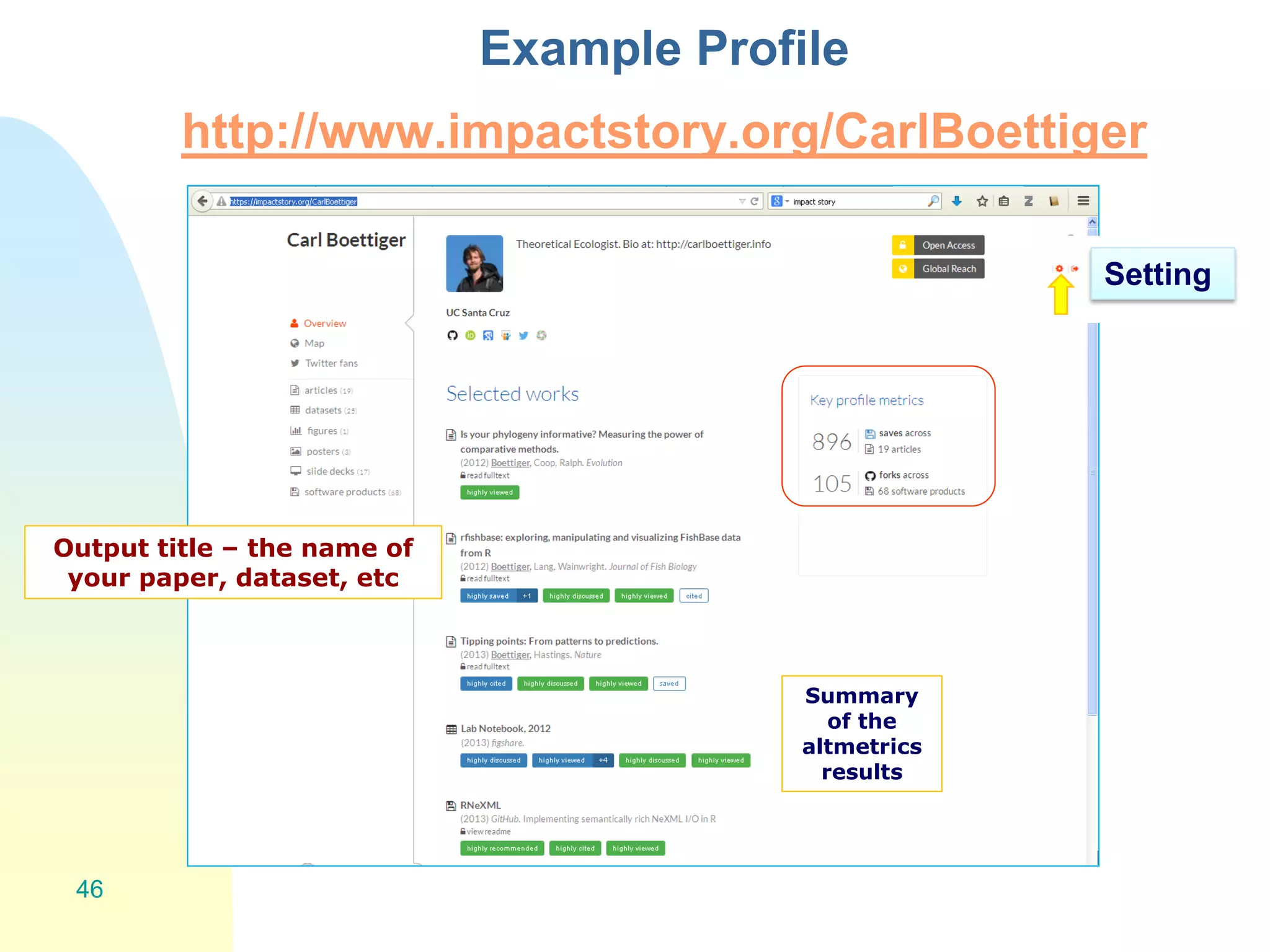
Example Profile
http://www.impactstory.org/CarlBoettiger
46
Setting
Output title – the name of
your paper, dataset, etc
Summary
of the
altmetrics
results
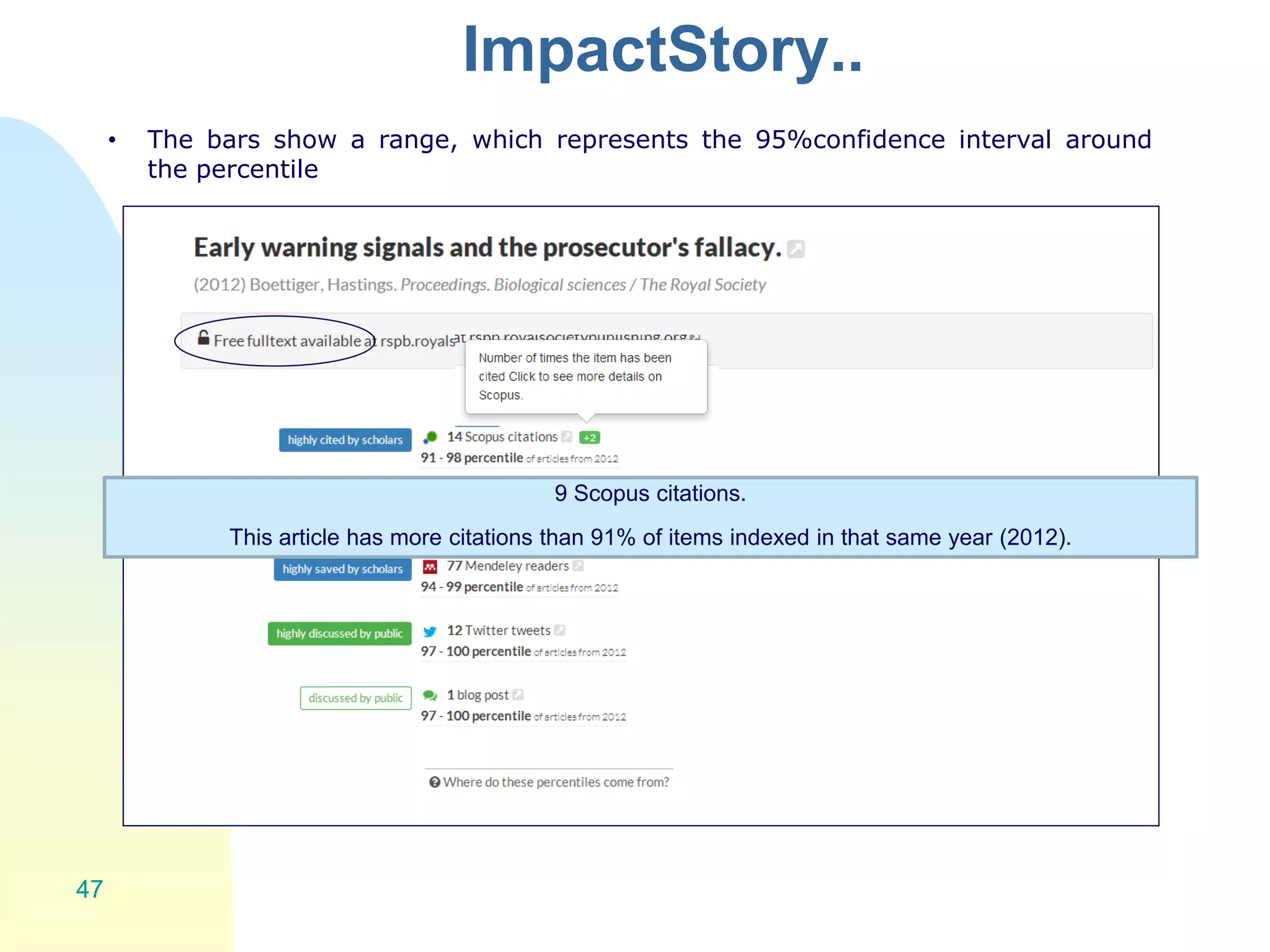
ImpactStory..
47
9 Scopus citations.
This article has more citations than 91% of items indexed in that same year (2012).
• The bars show a range, which represents the 95%confidence interval around
the percentile
48
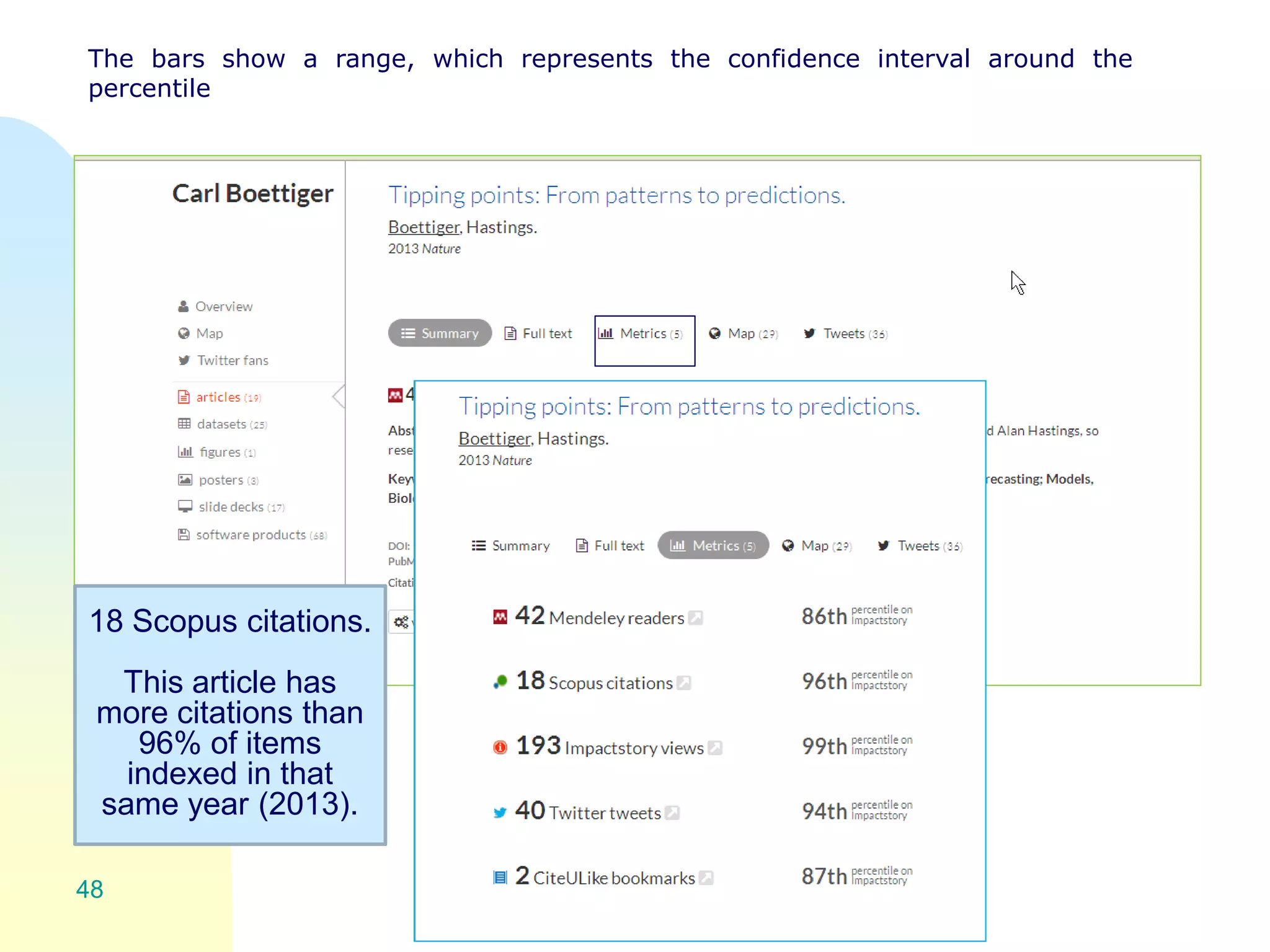
The bars show a range, which represents the confidence interval around the
percentile
18 Scopus citations.
This article has
more citations than
96% of items
indexed in that
same year (2013).
Total Impact
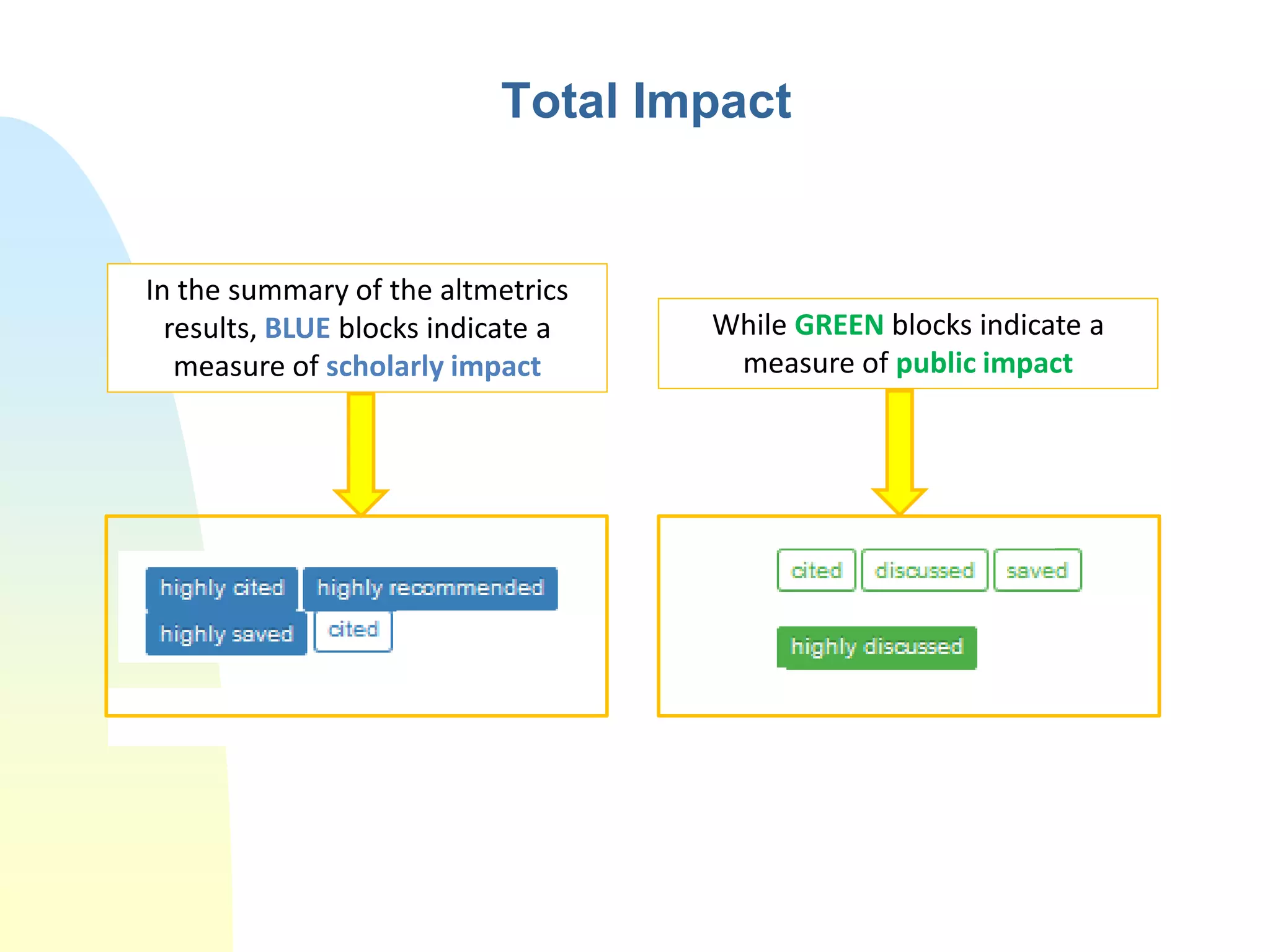
In the summary of the altmetrics
results, BLUE blocks indicate a
measure of scholarly impact
While GREEN blocks indicate a
measure of public impact
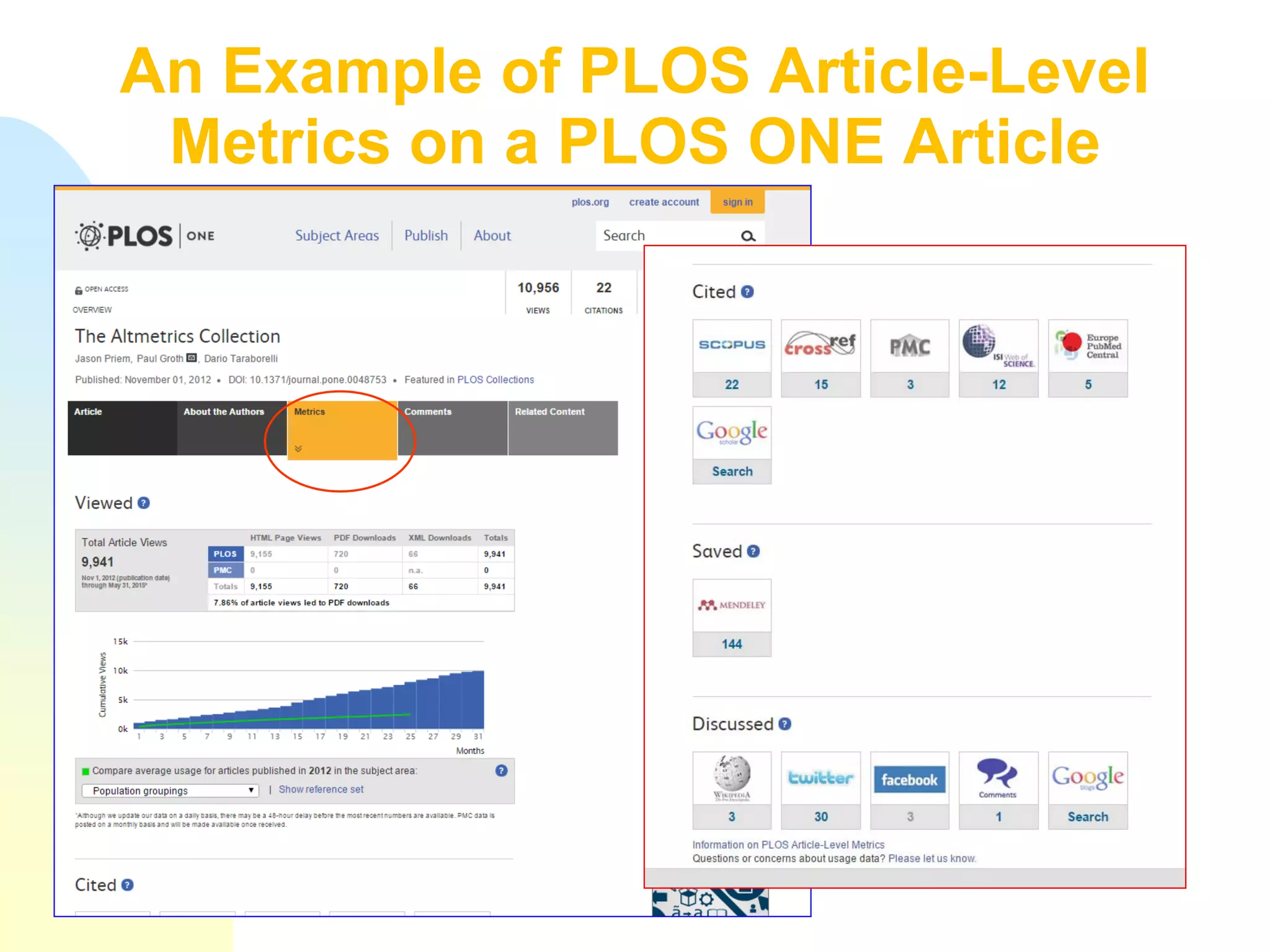
Plos- ALM
 The PLOS Article-Level Metrics (ALM) project started in 2009 and
tracks usage, citations and social web activity for all PLOS articles.
 As an ever-growing collection, it aims to continually cover a range
of subjects, including statistical analysis of altmetrics data sources
 These ALMs comprise of data points that capture the ways in
which research articles are:
 read,
 saved,
 shared with others,
 commented,
 cited
PLoS Article Level Metrics
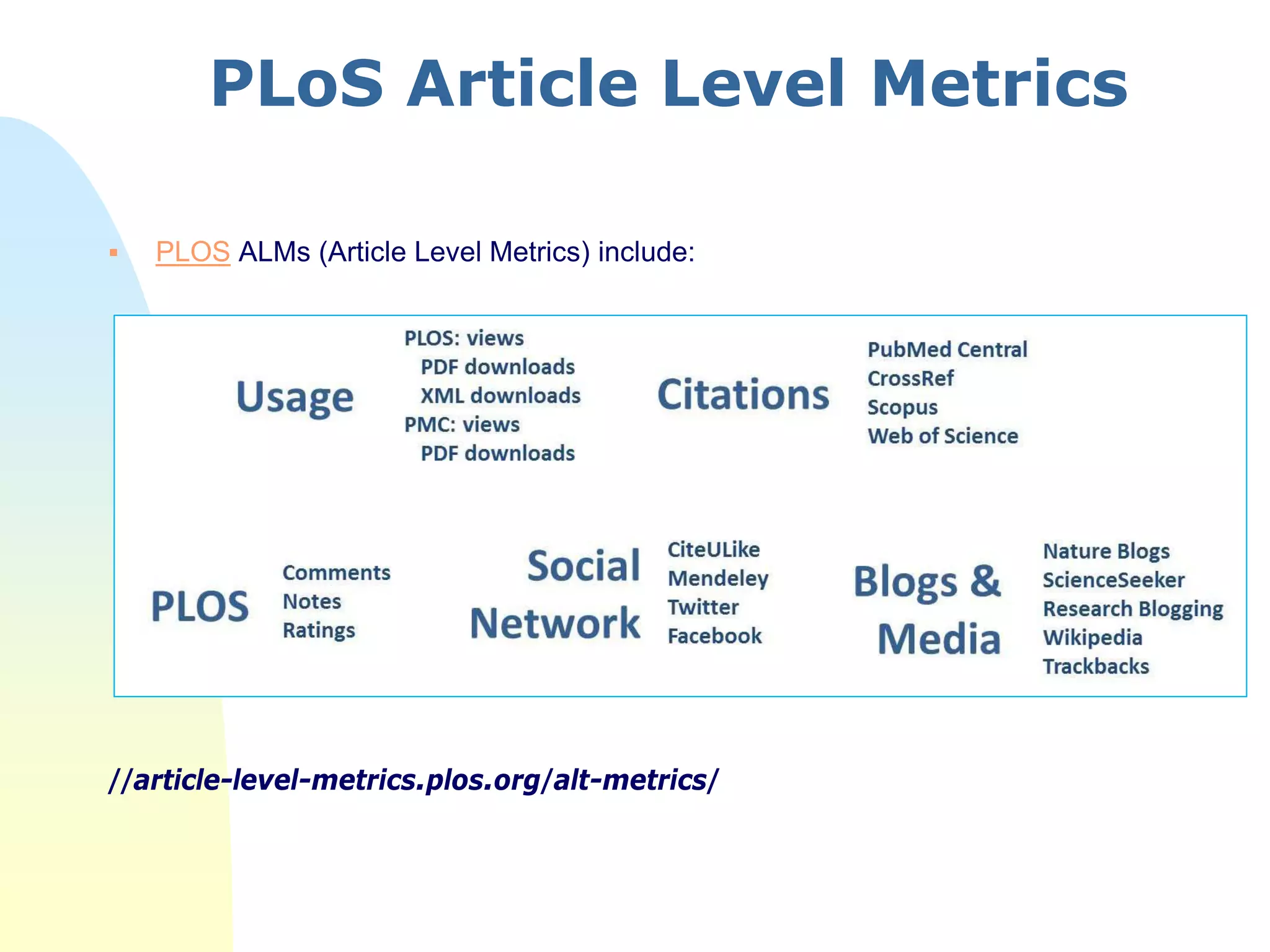
 PLOS ALMs (Article Level Metrics) include:
//article-level-metrics.plos.org/alt-metrics/
An Example of PLOS Article-Level
Metrics on a PLOS ONE Article
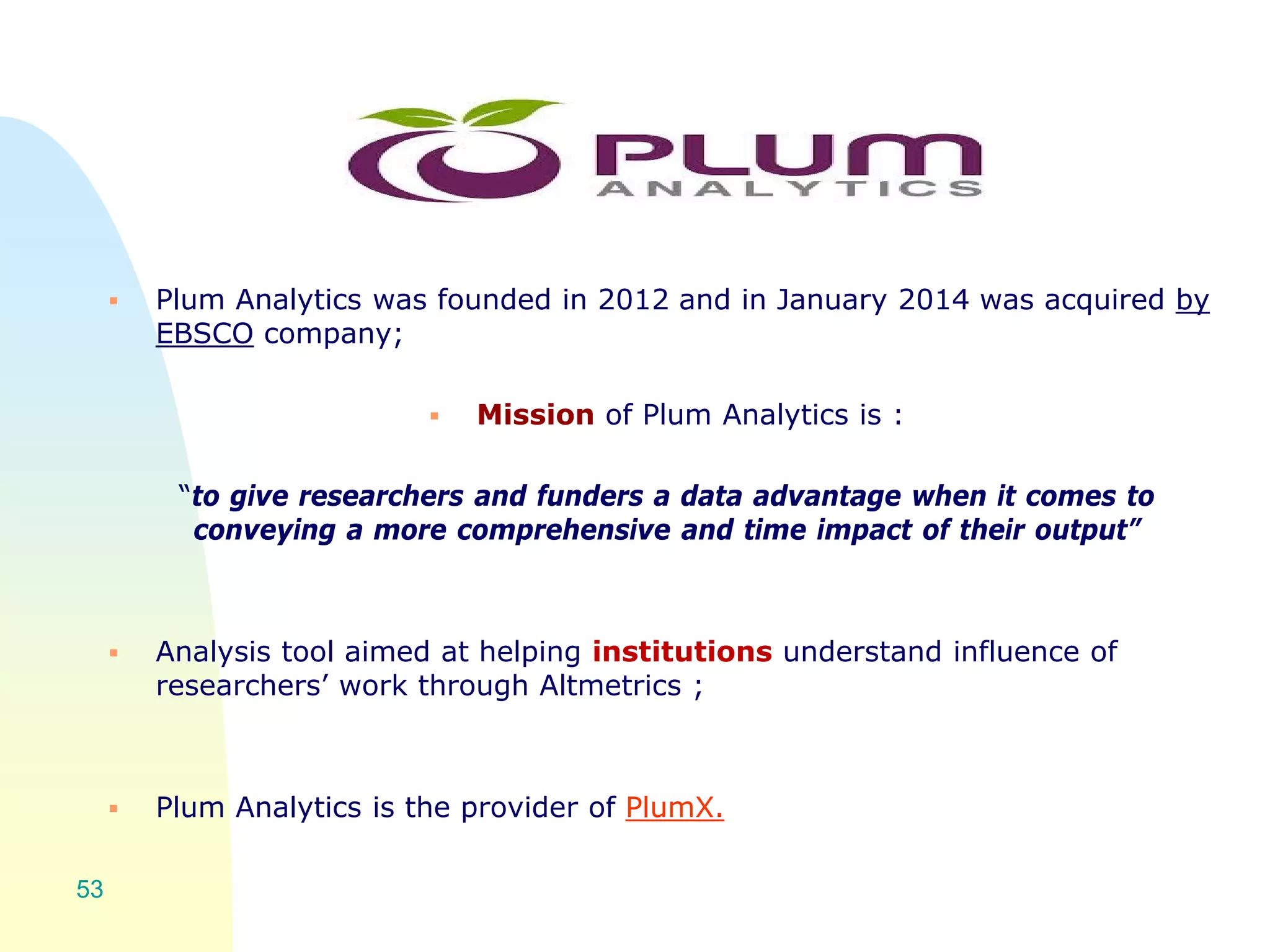
 Plum Analytics was founded in 2012 and in January 2014 was acquired by
EBSCO company;
 Mission of Plum Analytics is :
“to give researchers and funders a data advantage when it comes to
conveying a more comprehensive and time impact of their output”
 Analysis tool aimed at helping institutions understand influence of
researchers’ work through Altmetrics ;
 Plum Analytics is the provider of PlumX.
53
PlumX Metrics
54
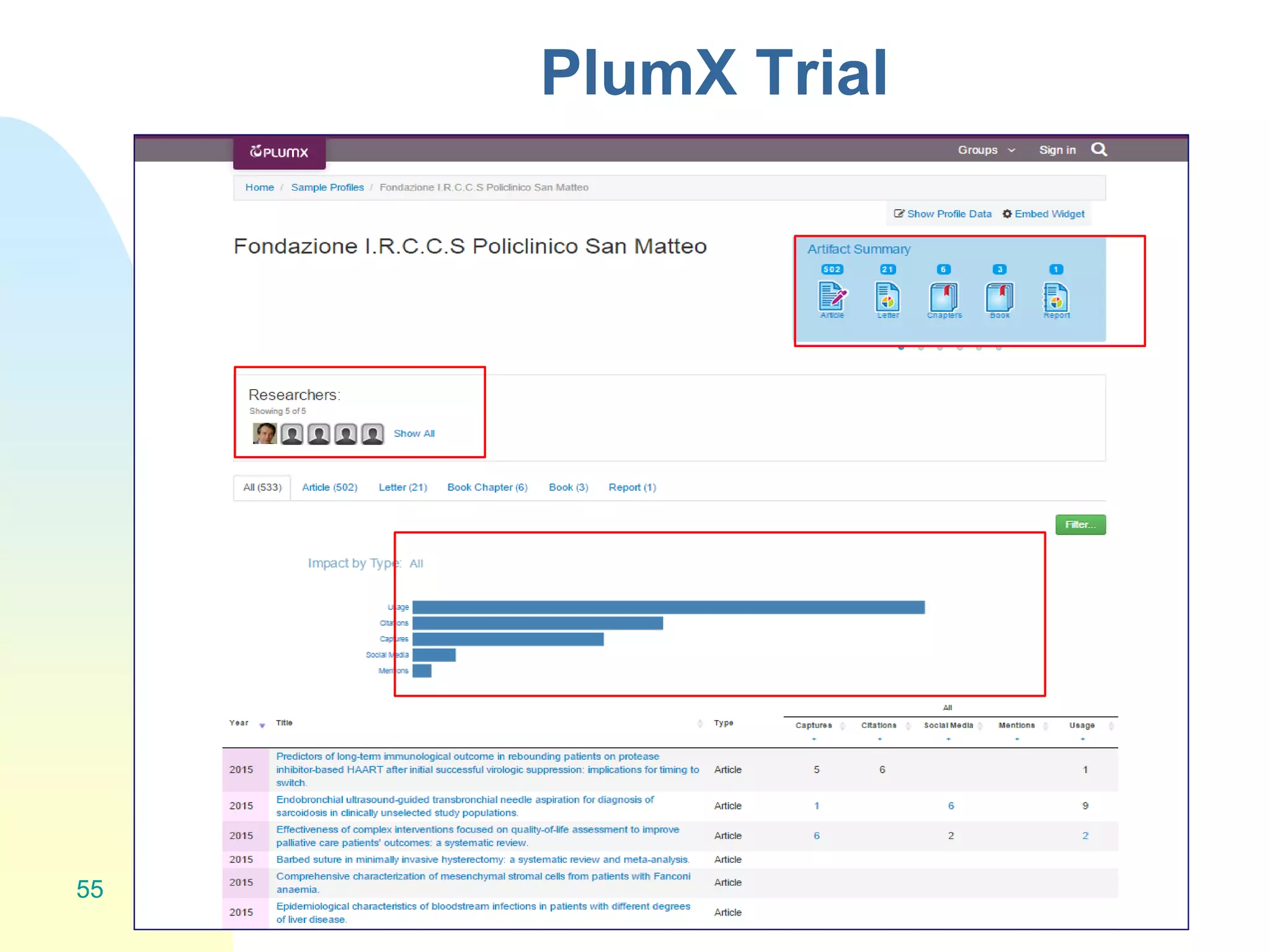
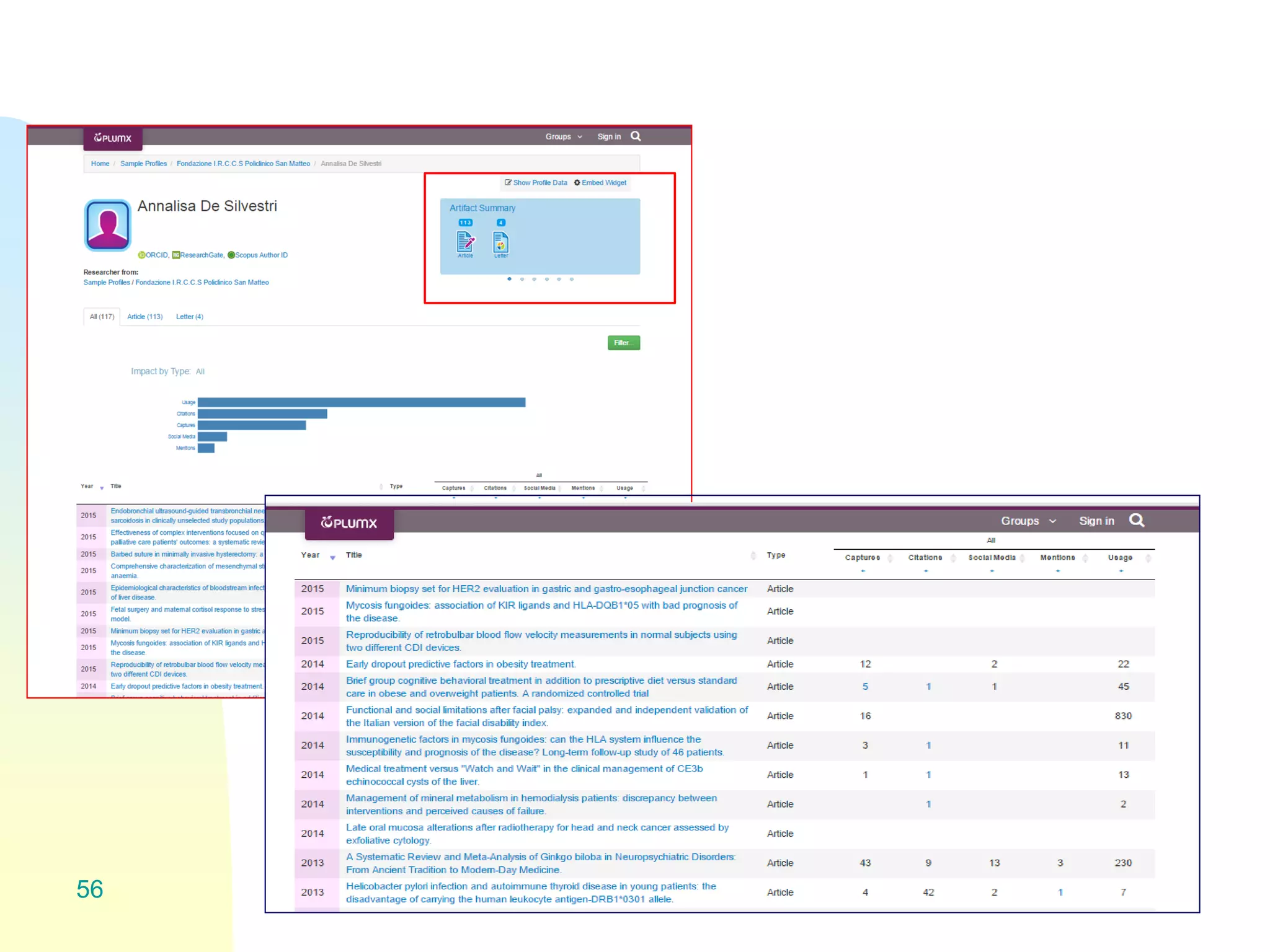
PlumX Trial
55
56
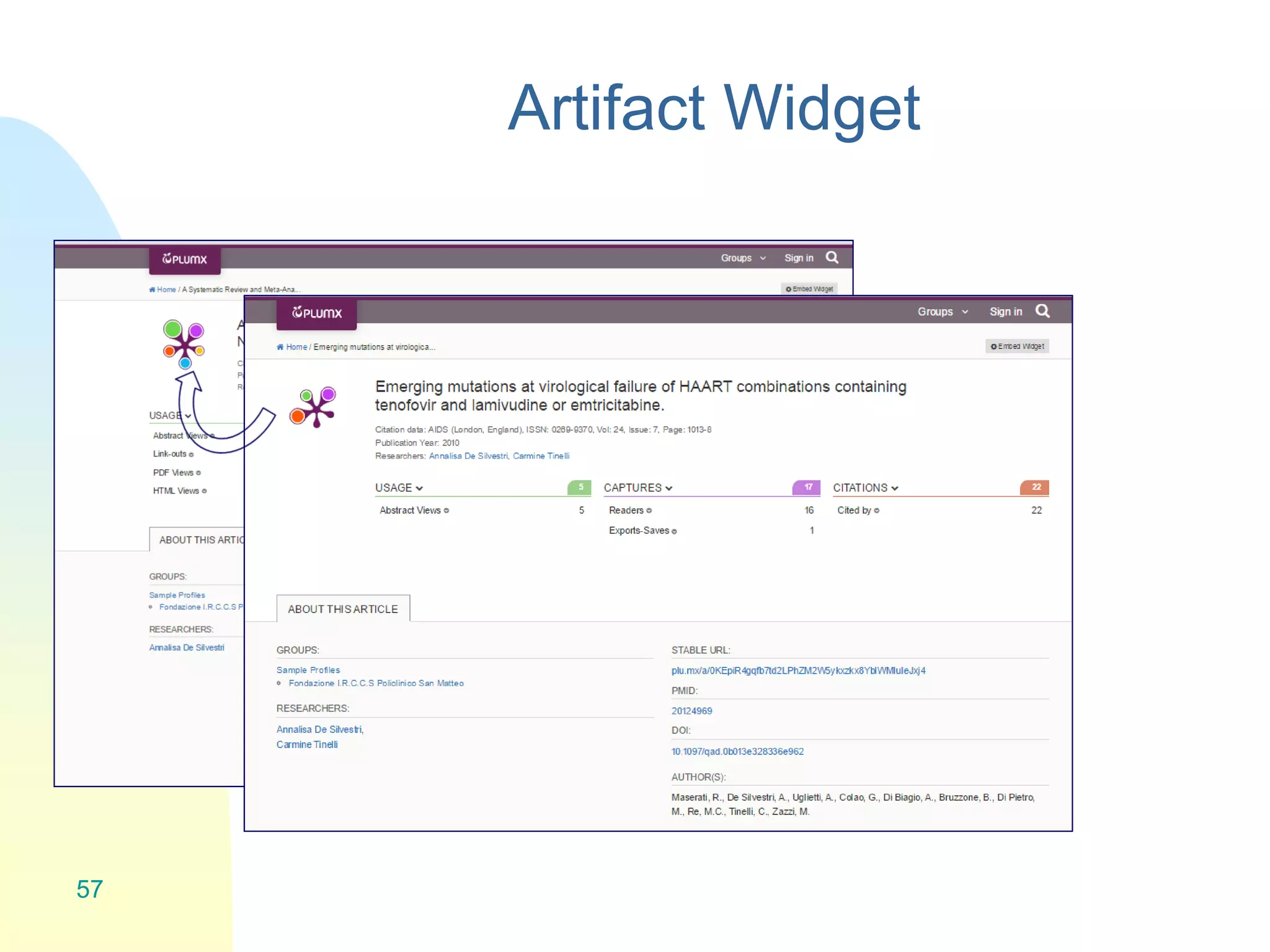
Artifact Widget
57
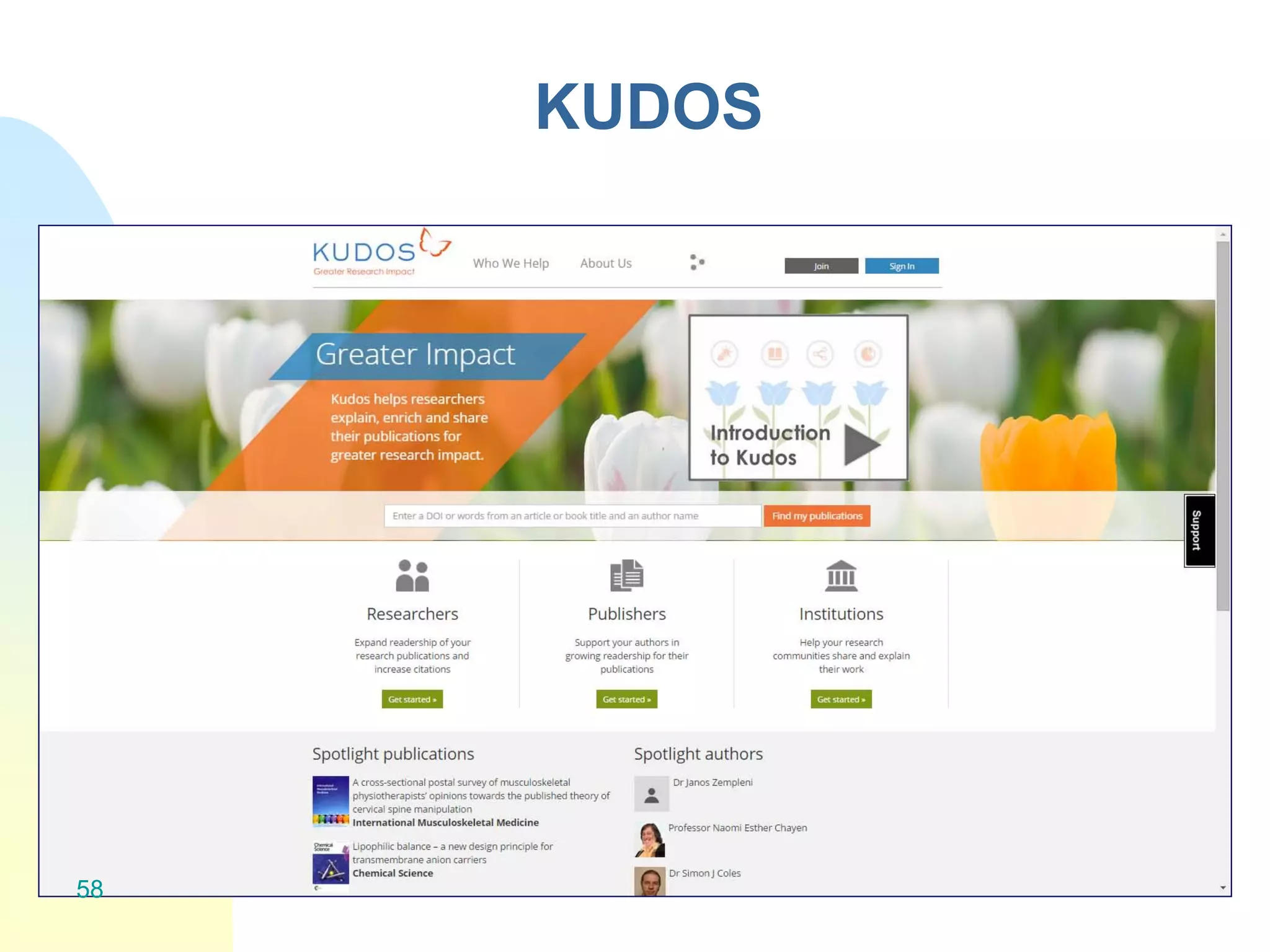
KUDOS
58
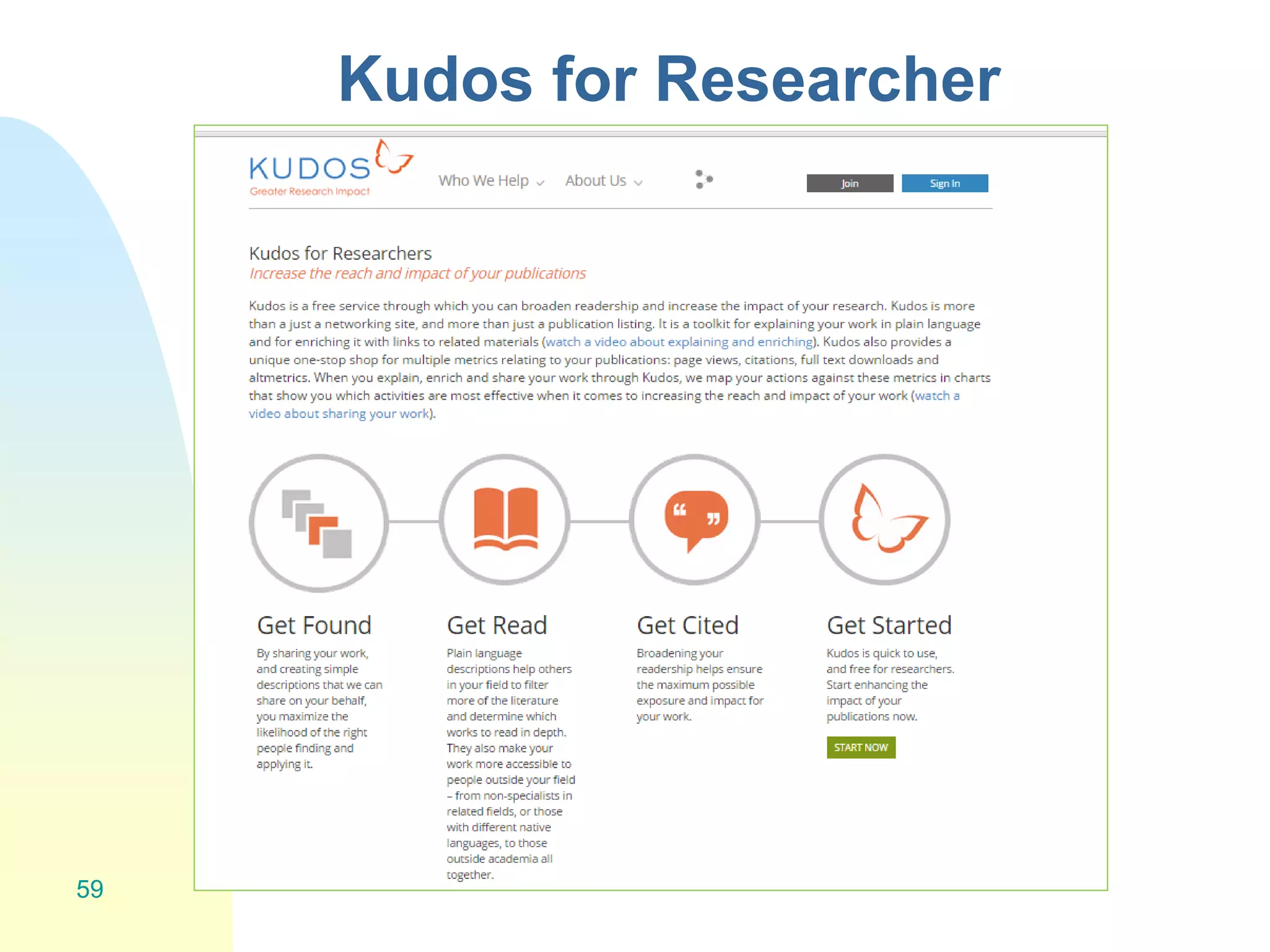
Kudos for Researcher
59
Kudos for Researcher
60
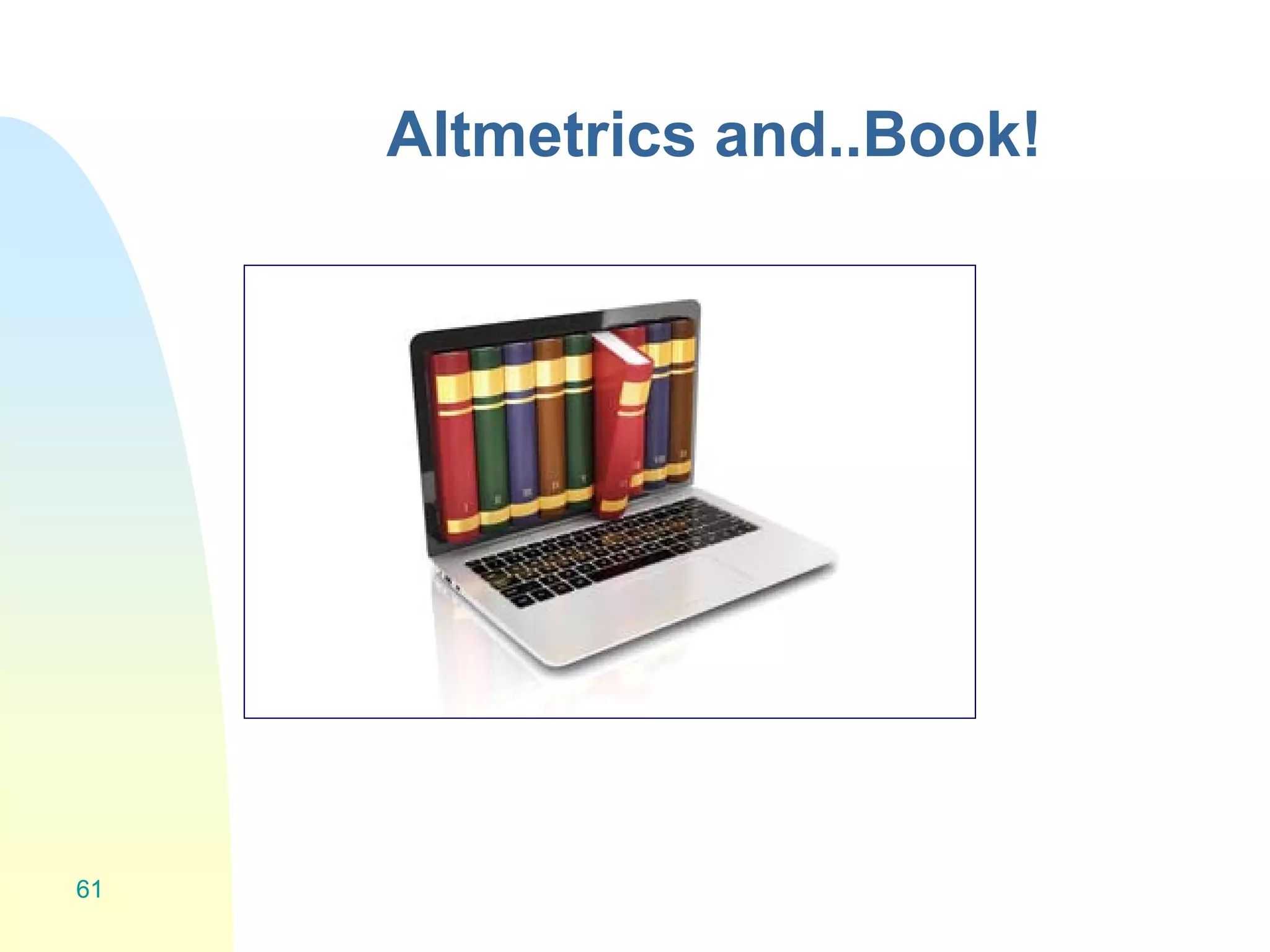
Altmetrics and..Book!
61
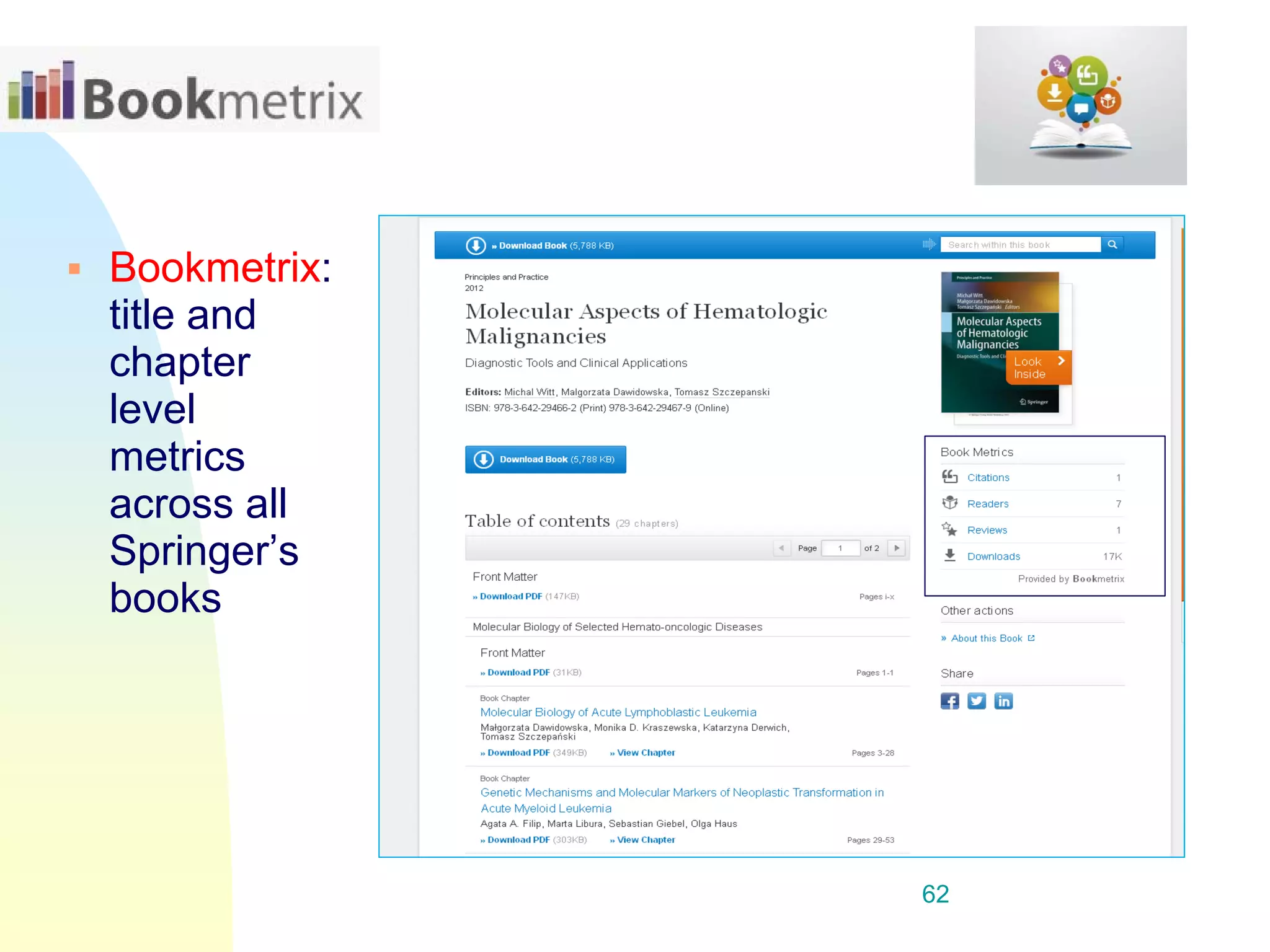
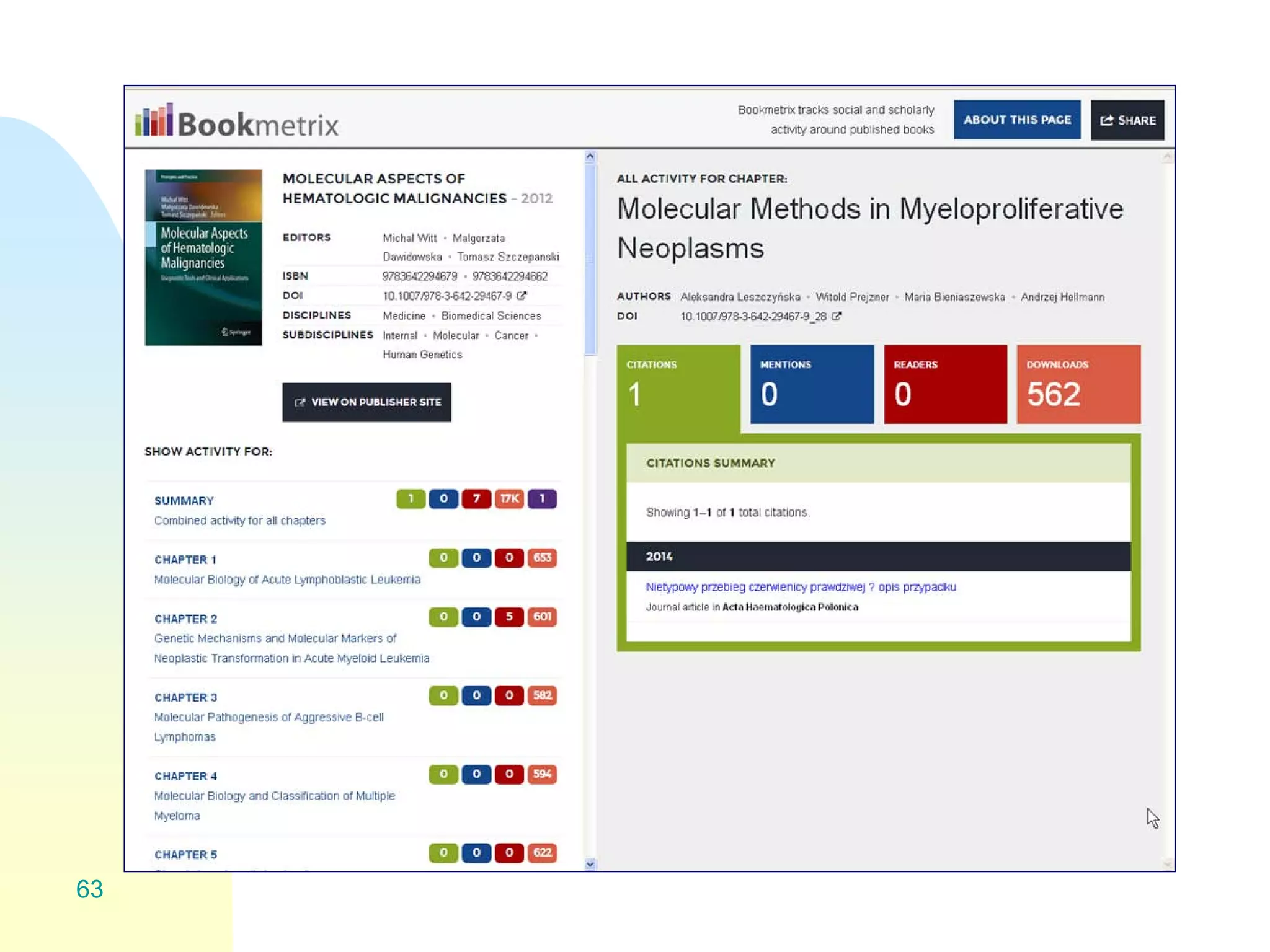
 Bookmetrix:
title and
chapter
level
metrics
across all
Springer’s
books
62
63
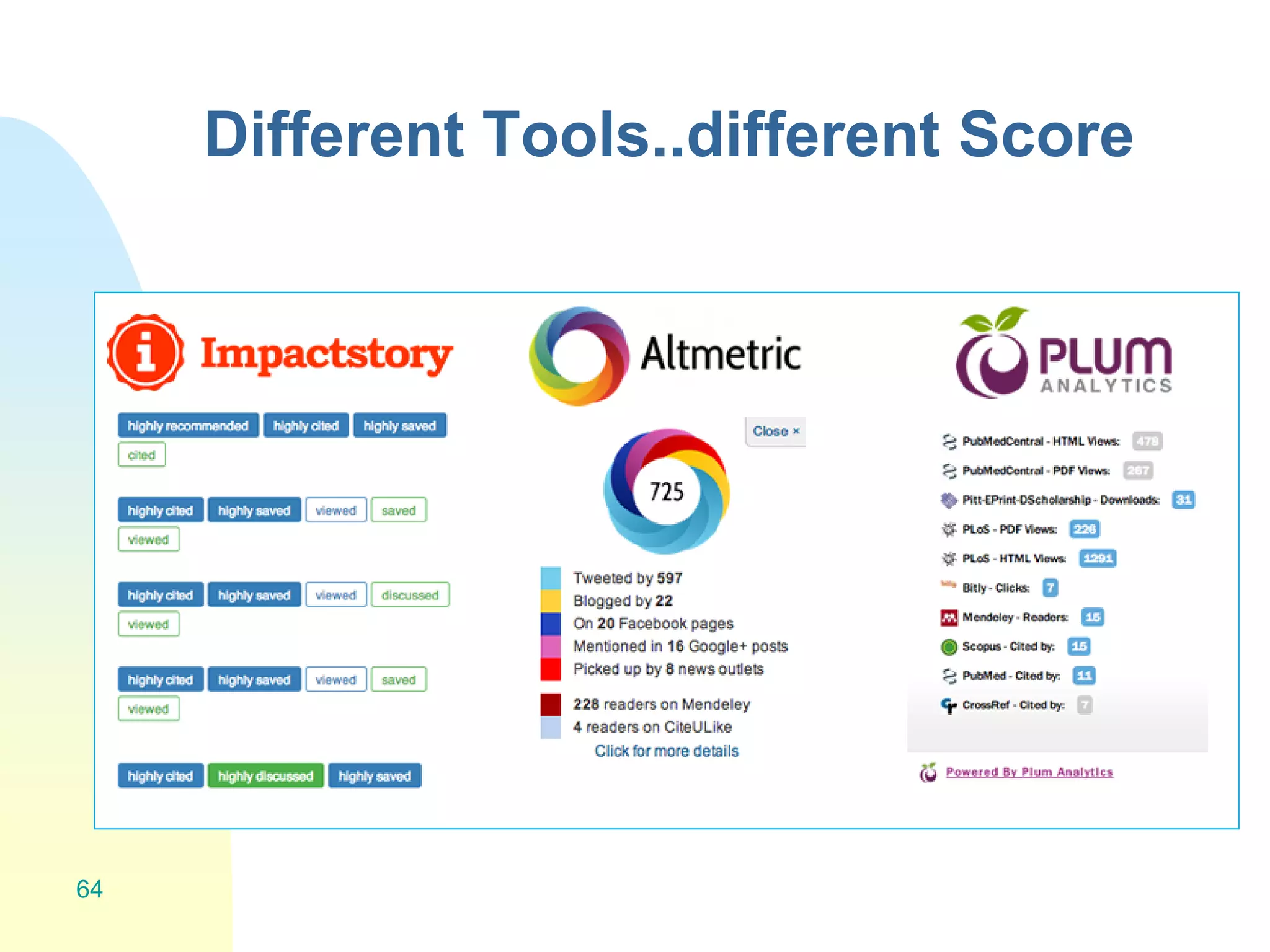
Different Tools..different Score
64
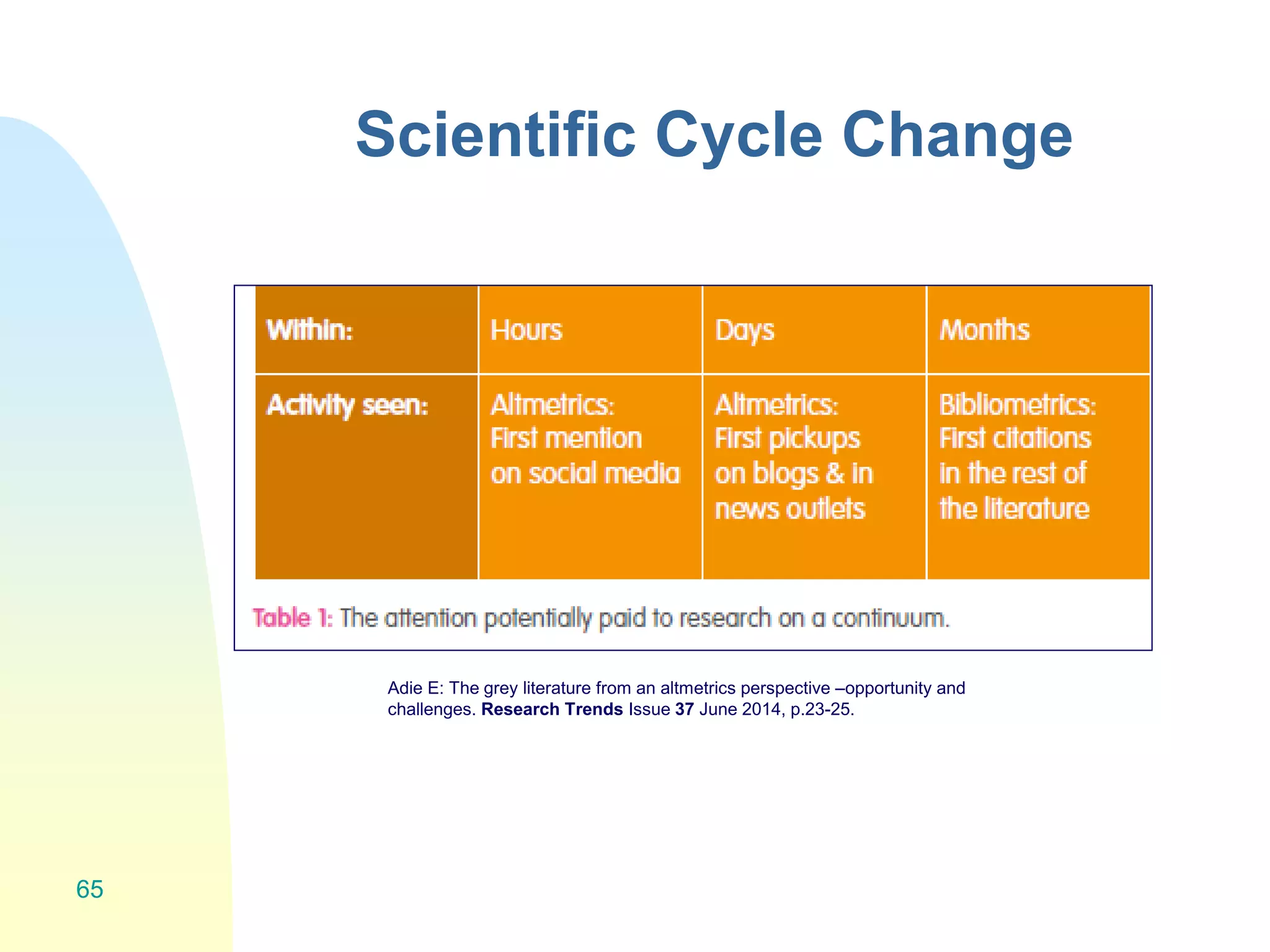
Scientific Cycle Change
65
Adie E: The grey literature from an altmetrics perspective –opportunity and
challenges. Research Trends Issue 37 June 2014, p.23-25.
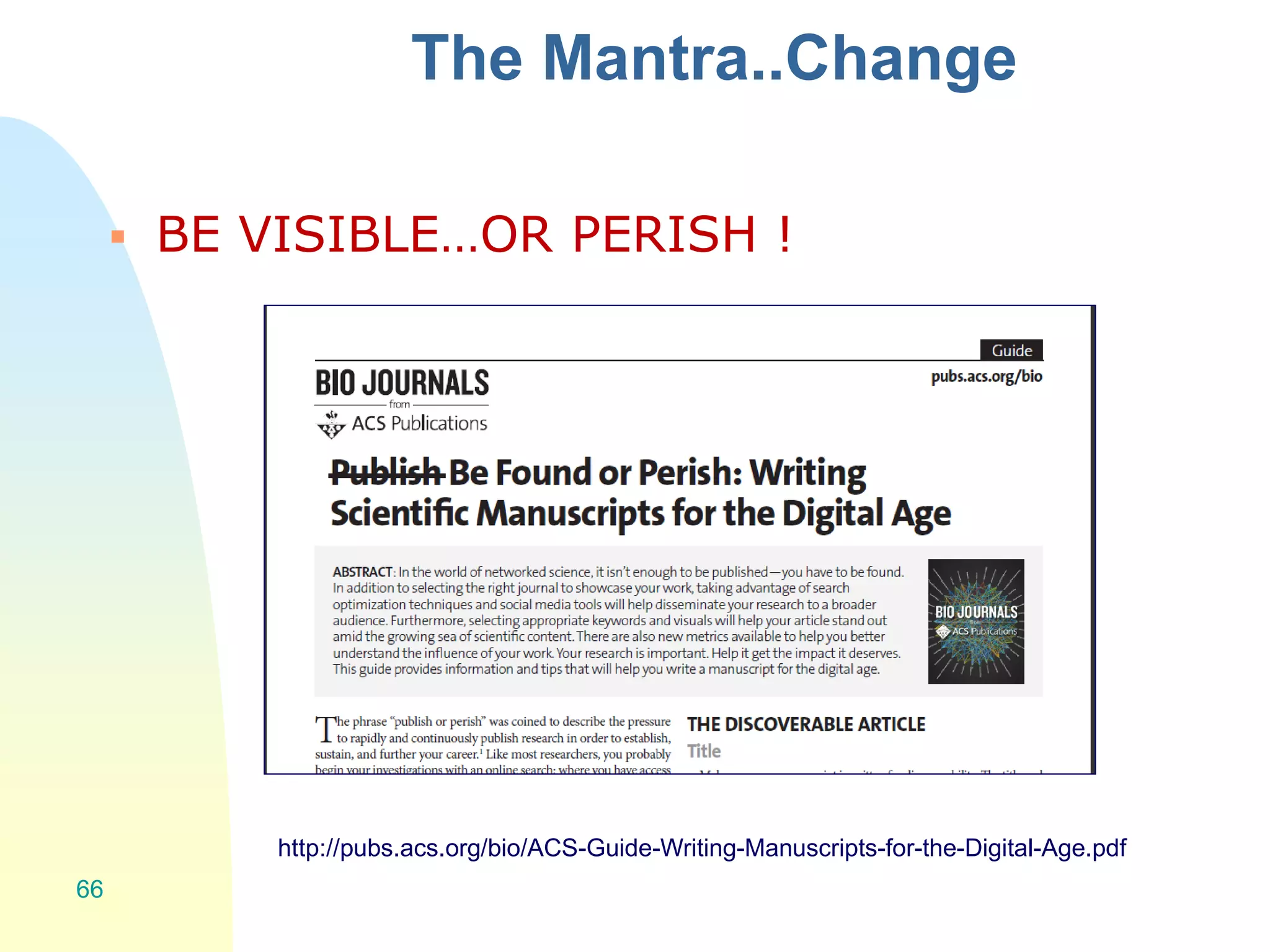
The Mantra..Change
 BE VISIBLE…OR PERISH !
66
http://pubs.acs.org/bio/ACS-Guide-Writing-Manuscripts-for-the-Digital-Age.pdf
Others tools for measuring Research
Impact
67
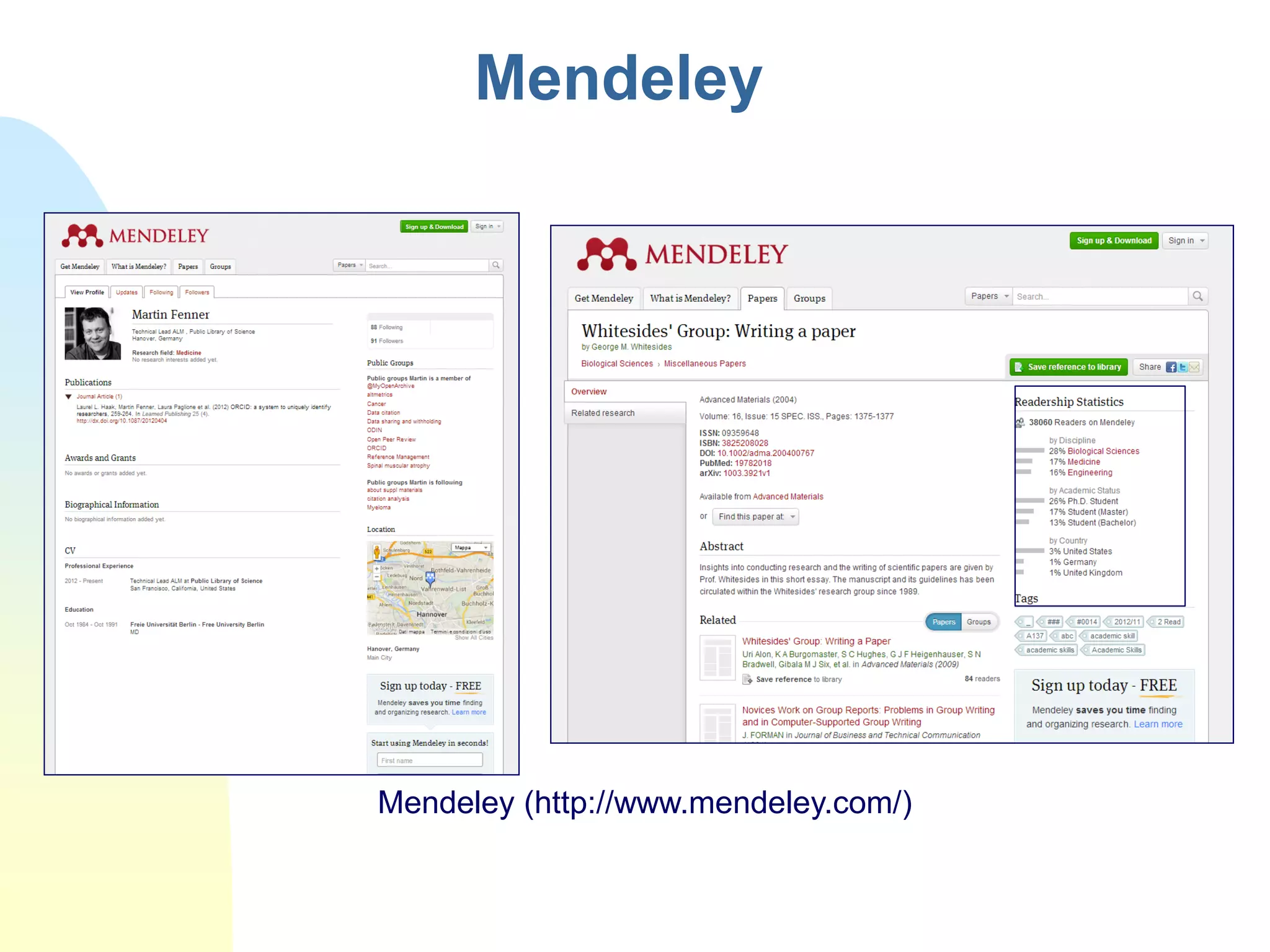
Mendeley
Mendeley (http://www.mendeley.com/)
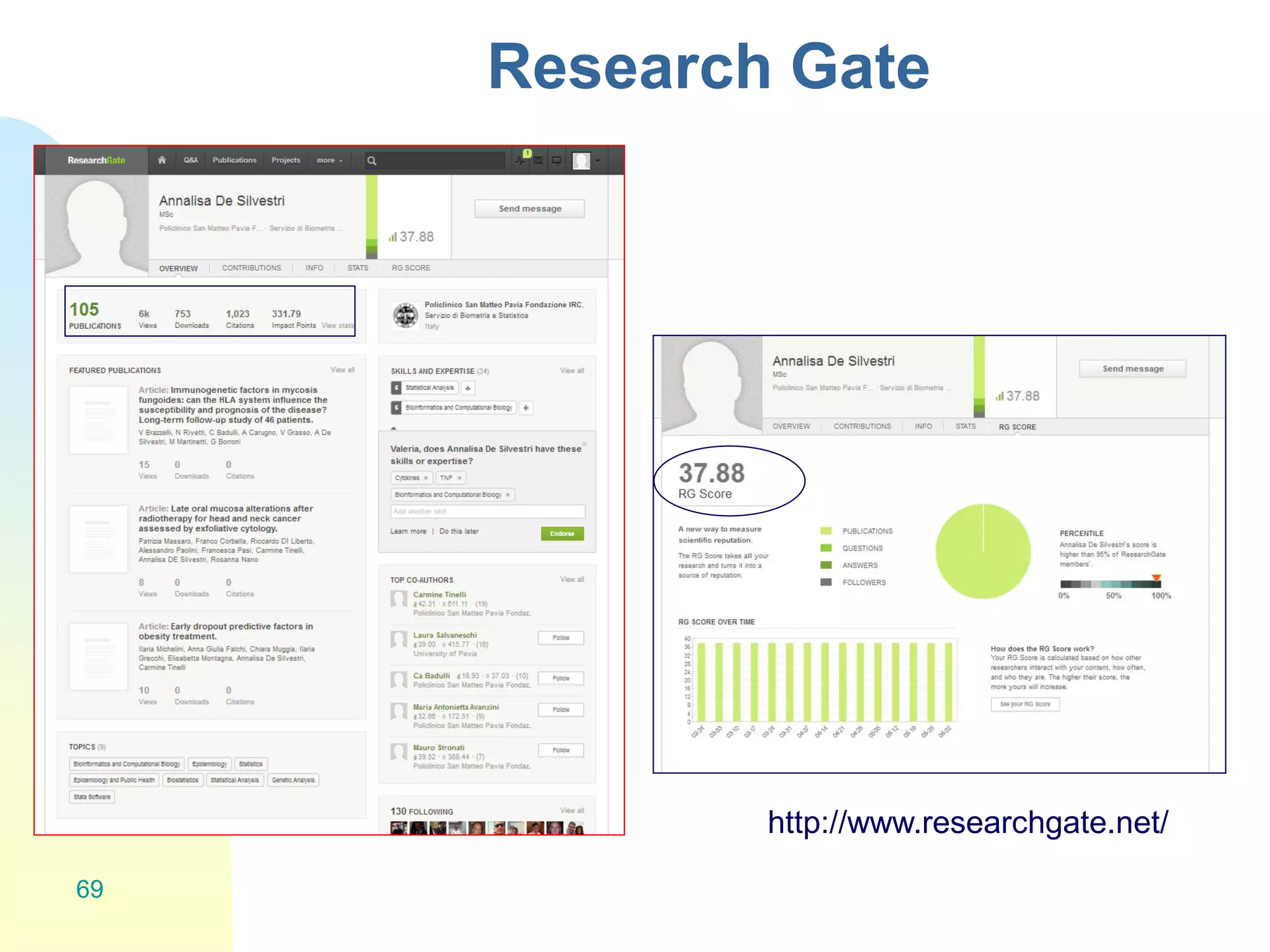
Research Gate
69
http://www.researchgate.net/
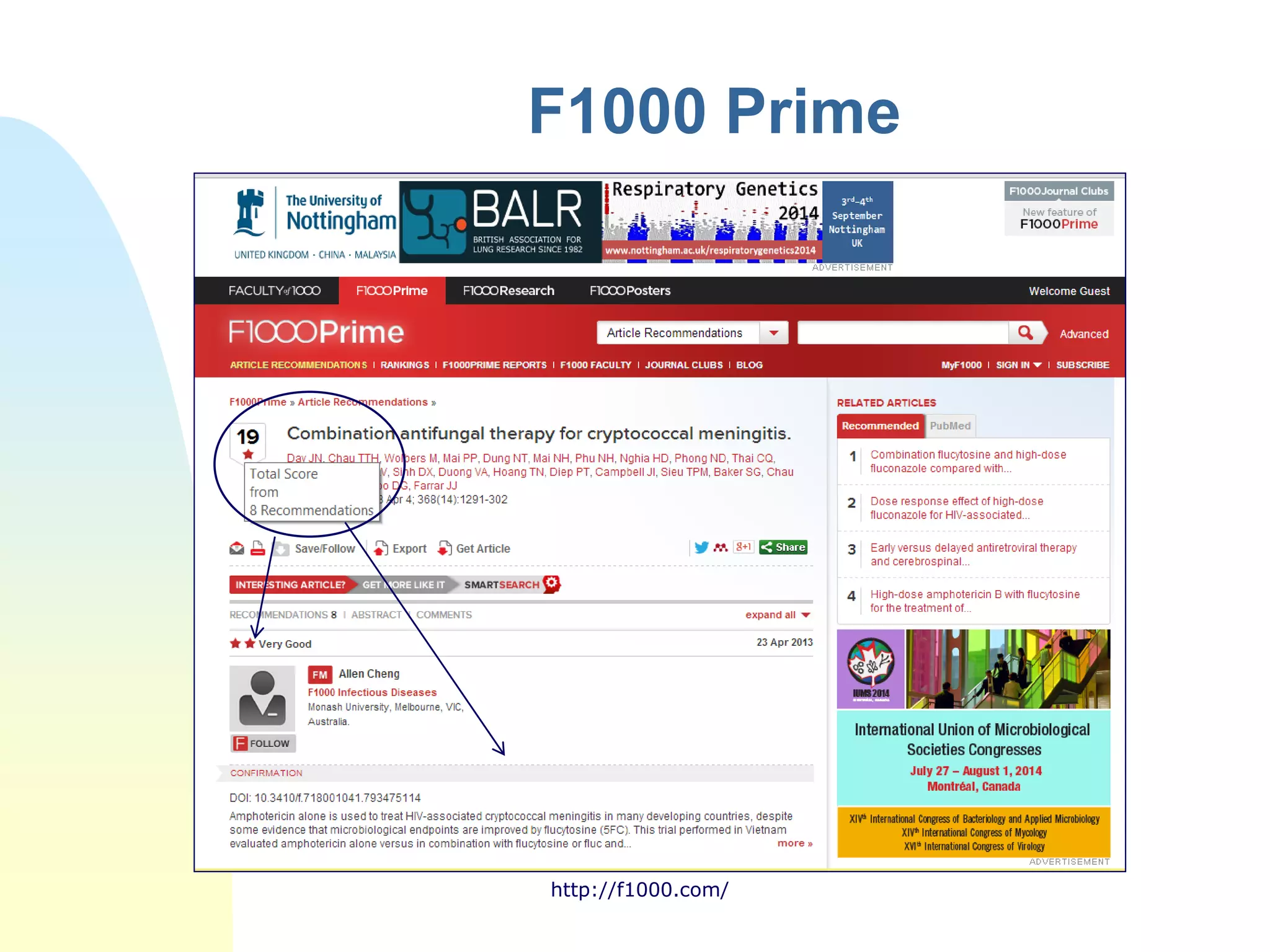
F1000 Prime
http://f1000.com/
How to use Altmetrics?
71
Do not ask what Altmetrics can do for you
But….
What you can do with Altmetrics
Your Profile as a Scientist
• If you are an active scientist – i.e. already
published, active researcher, data generator,
early, mid- or late career there is lots to do!
• If you are a junior scientist the benefits of
investing time now will provide a strong
foundation for your future!
• So what to do??
Some Ideas:
 Register to Orcid and import your work;
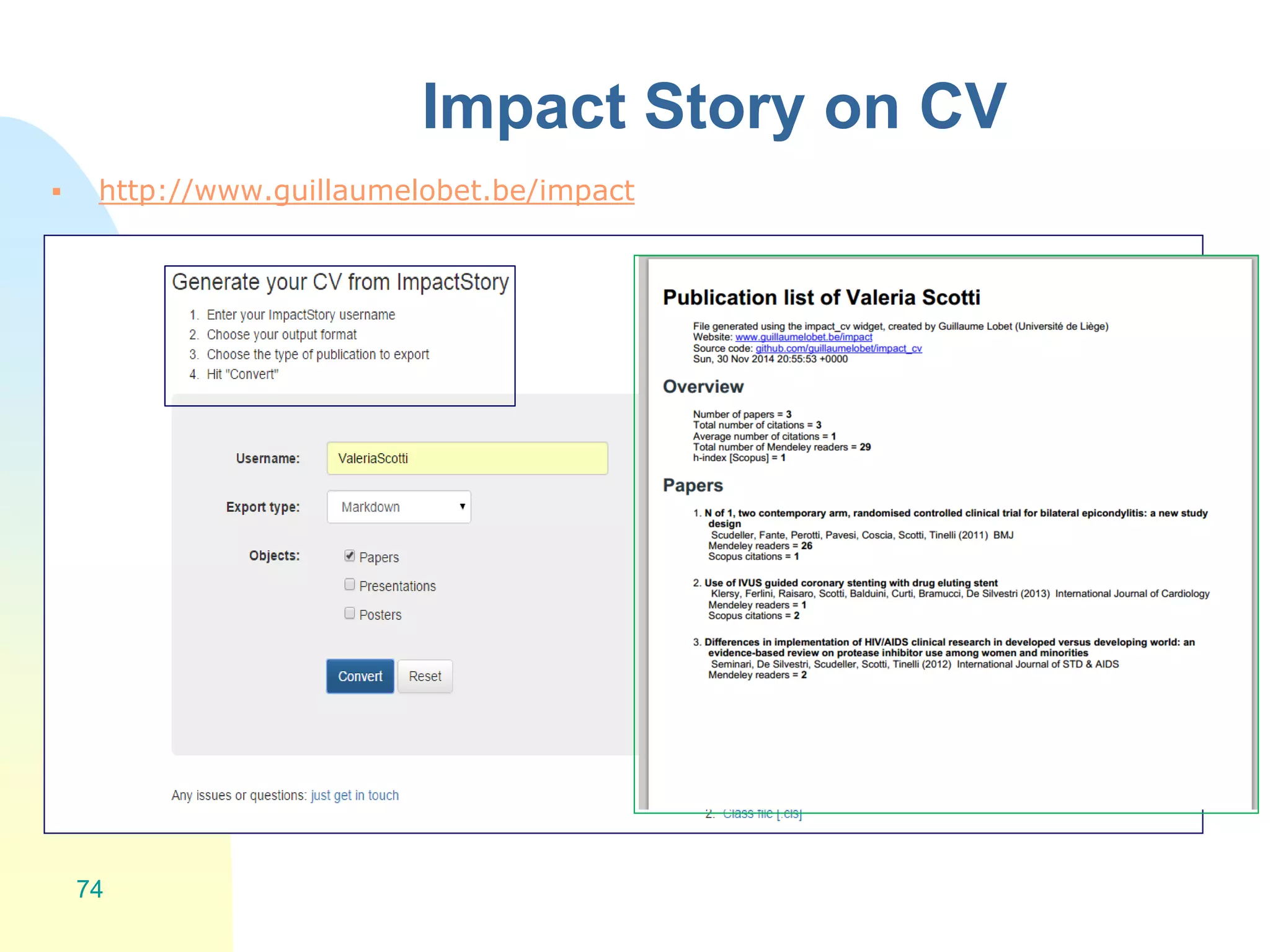
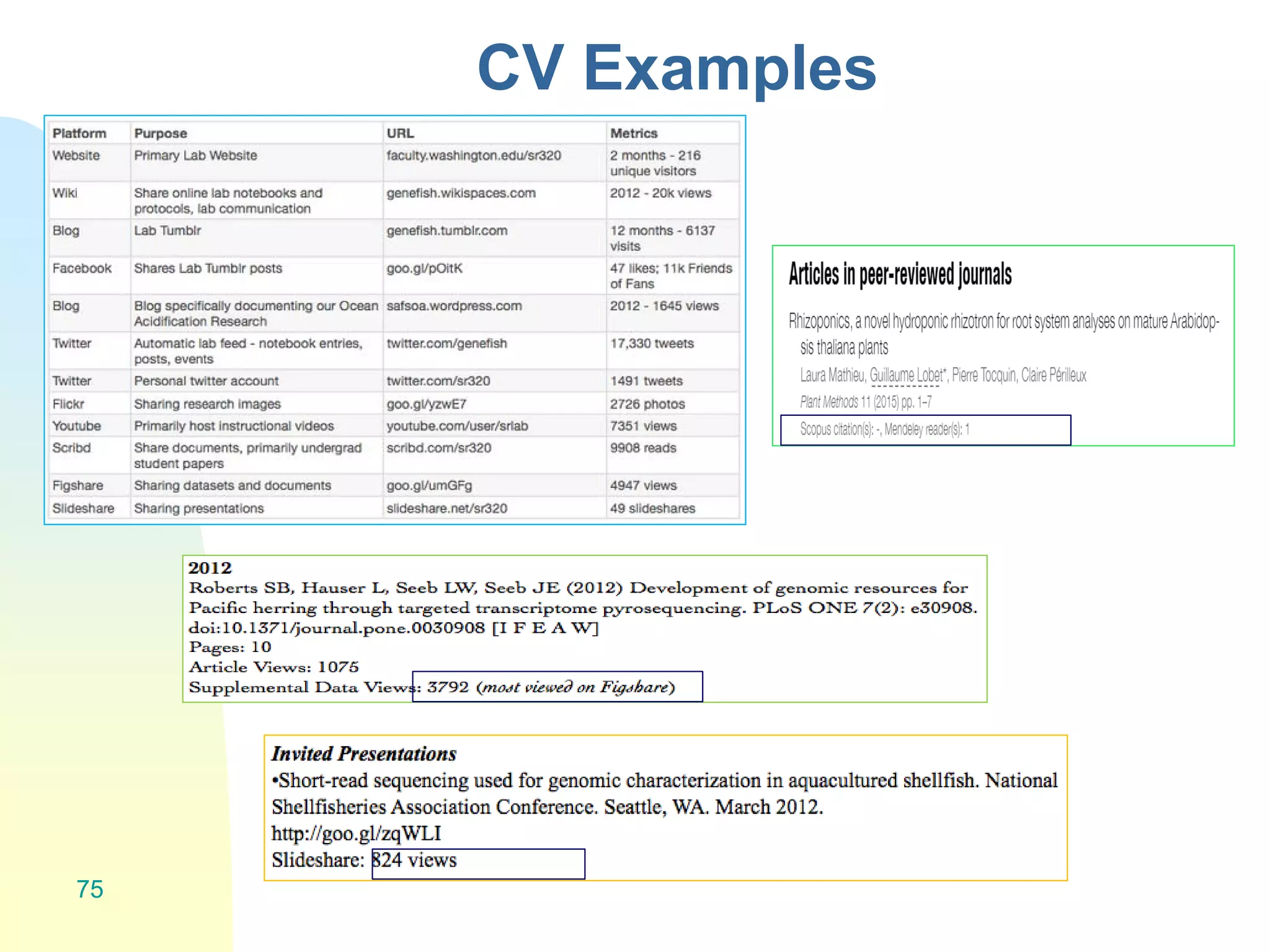
 Add your own ImpactStory links in your CV or in the signature of
your email;
 Altmetrics.com monitors the progress of your publications;
 Create an account with Mendeley, ResearchGate, Google Scholar
etc .. to share your work and to find researchers working in your
own research field;
 Create a public profile work on Twitter or Facebook, post your
work and comment on those of others;
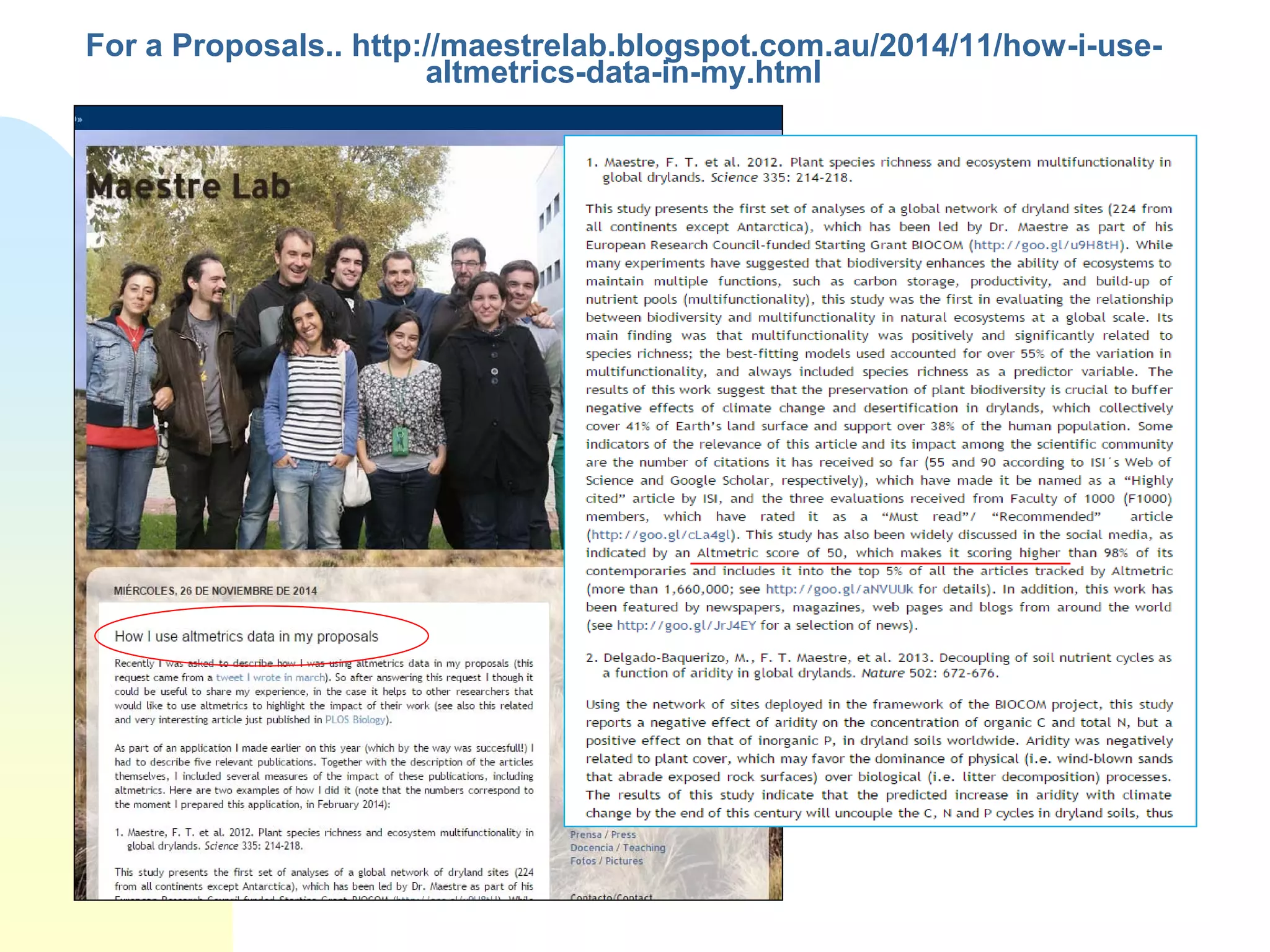
 Use Altmetrics data for proposals, grants and contests.
73
Impact Story on CV
 http://www.guillaumelobet.be/impact
74
CV Examples
75
For a Proposals.. http://maestrelab.blogspot.com.au/2014/11/how-i-use-
altmetrics-data-in-my.html
76
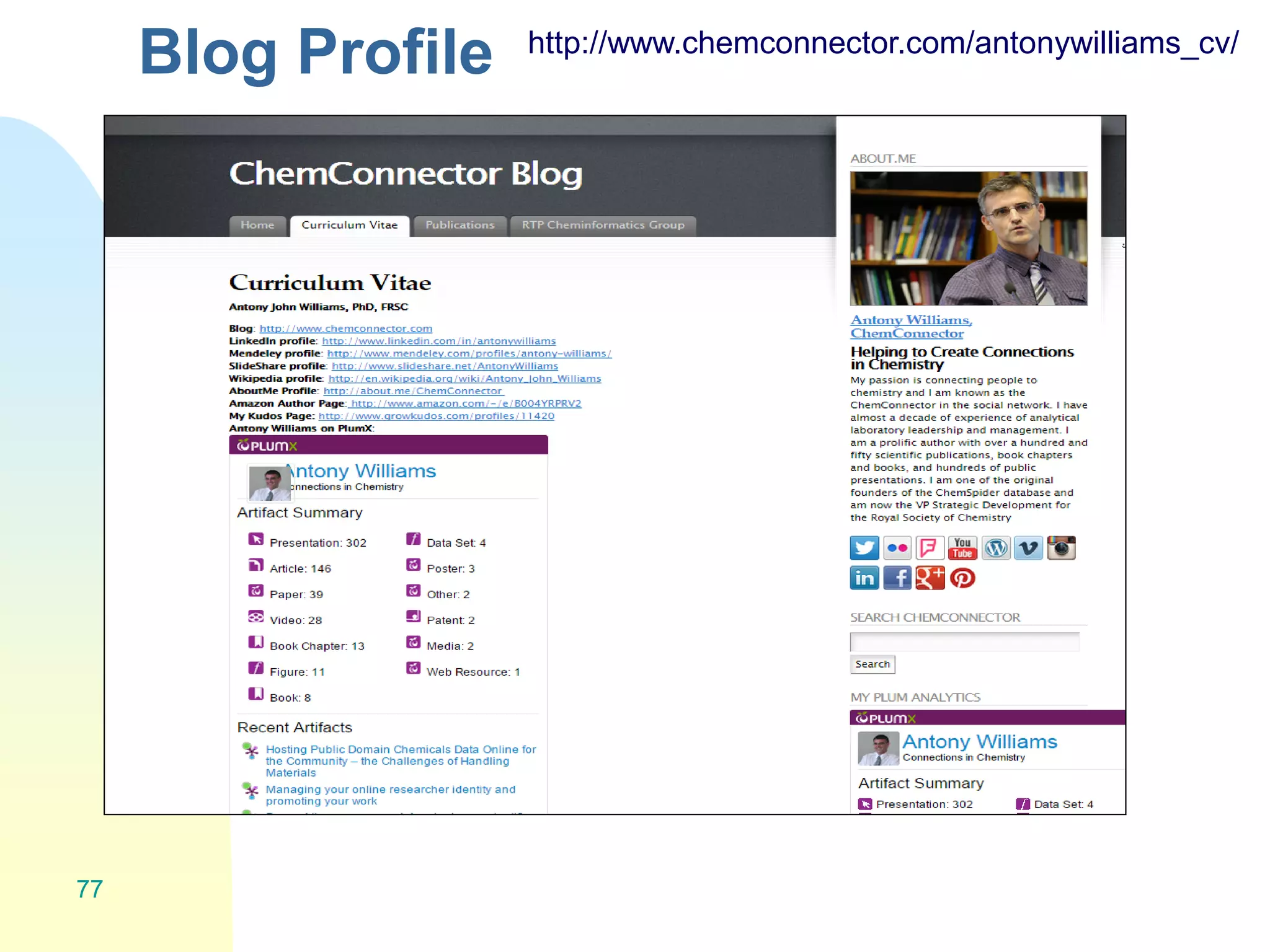
Blog Profile
77
http://www.chemconnector.com/antonywilliams_cv/
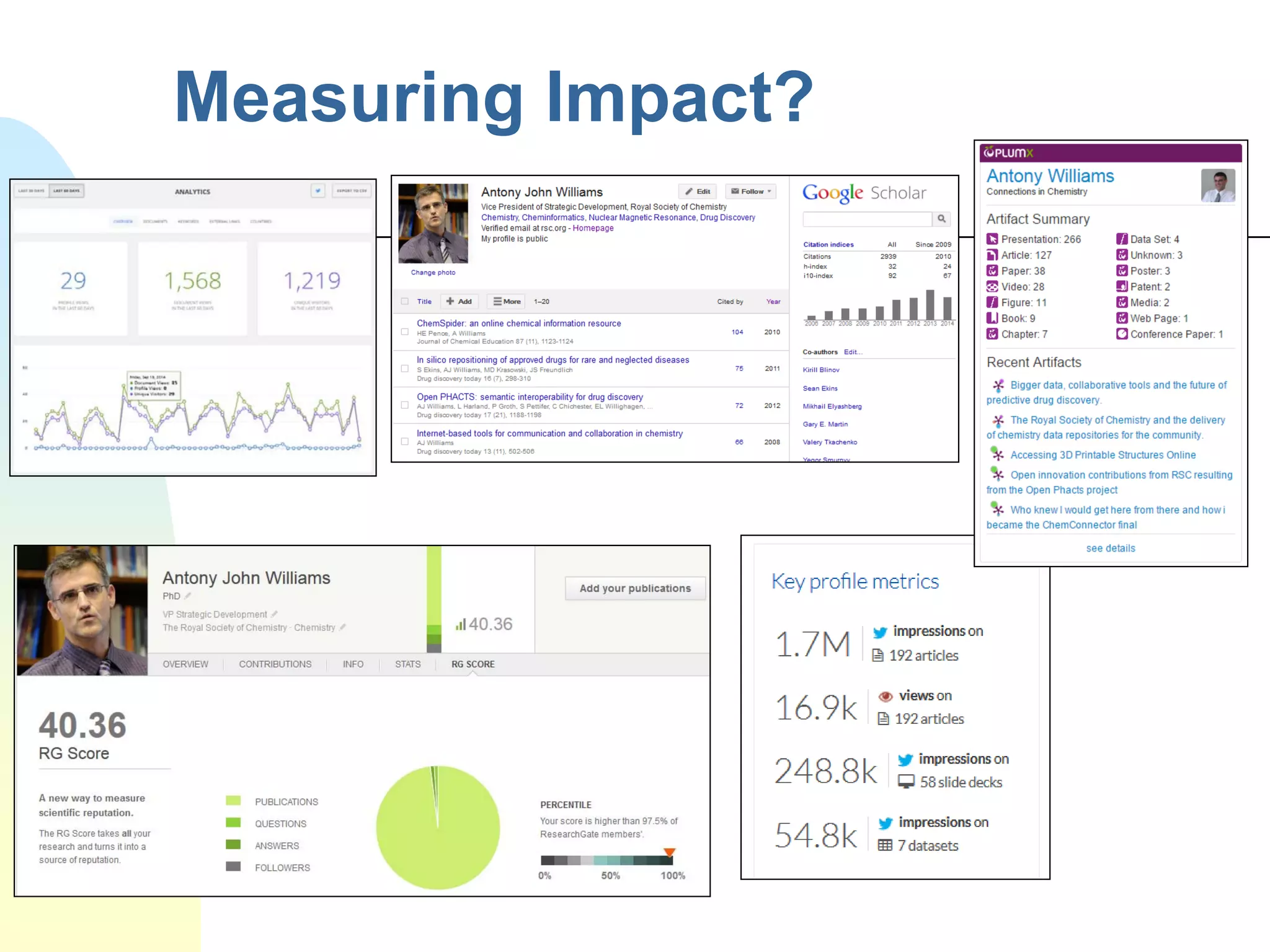
Measuring Impact?
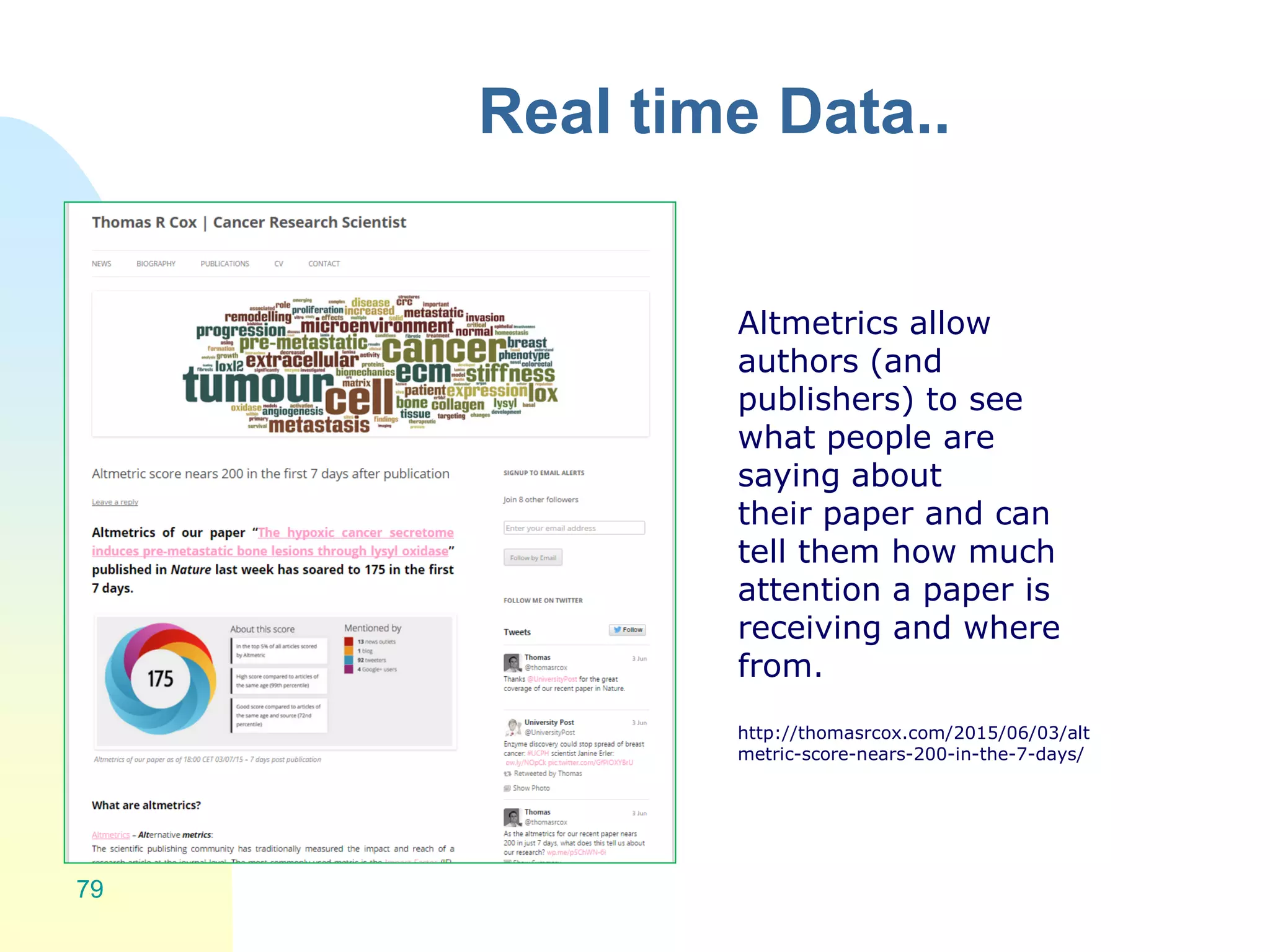
Real time Data..
79
Altmetrics allow
authors (and
publishers) to see
what people are
saying about
their paper and can
tell them how much
attention a paper is
receiving and where
from.
http://thomasrcox.com/2015/06/03/alt
metric-score-nears-200-in-the-7-days/
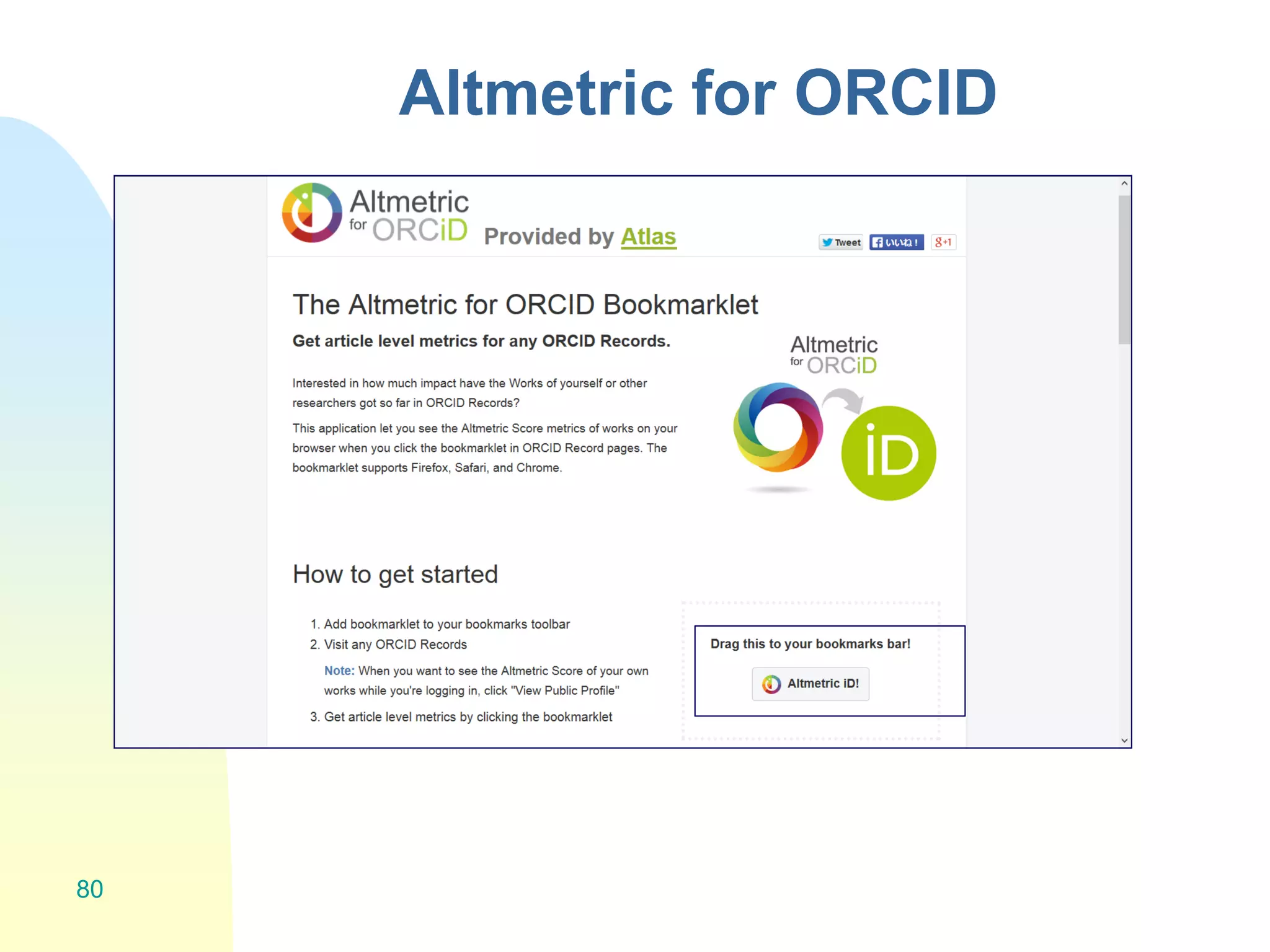
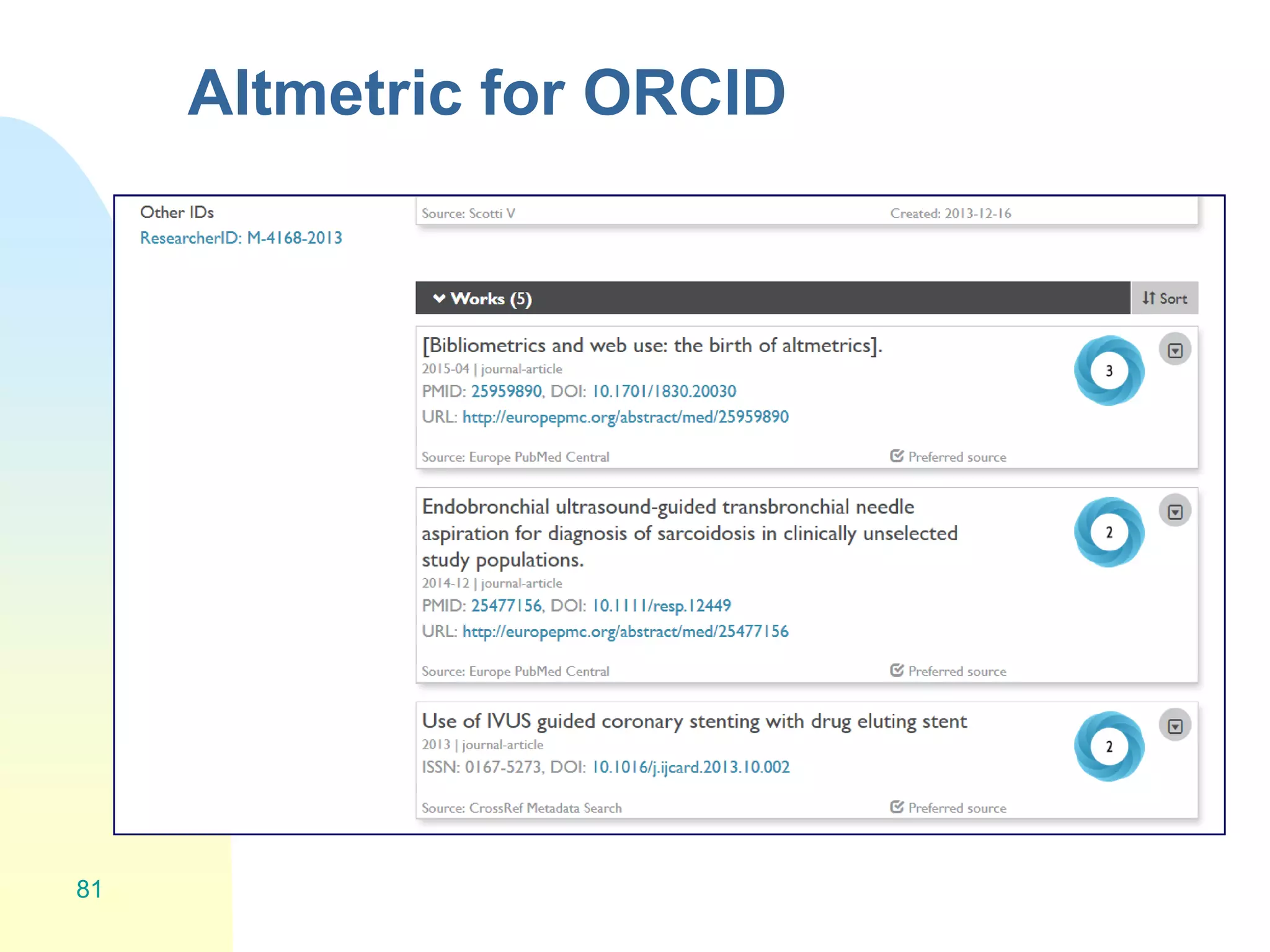
Altmetric for ORCID
80
Altmetric for ORCID
81
Altmetrics And Evaluators
82
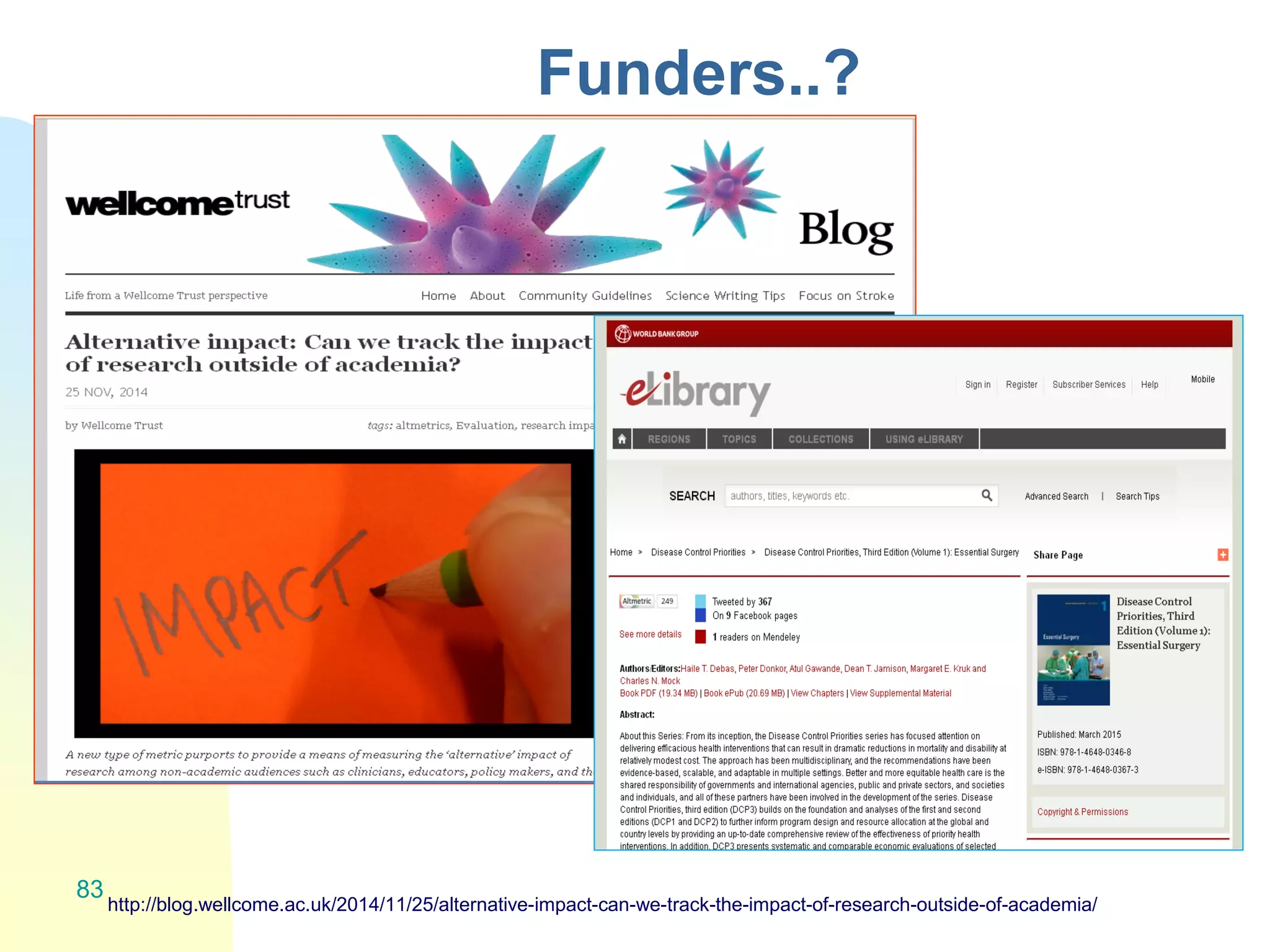
Funders..?
83
http://blog.wellcome.ac.uk/2014/11/25/alternative-impact-can-we-track-the-impact-of-research-outside-of-academia/
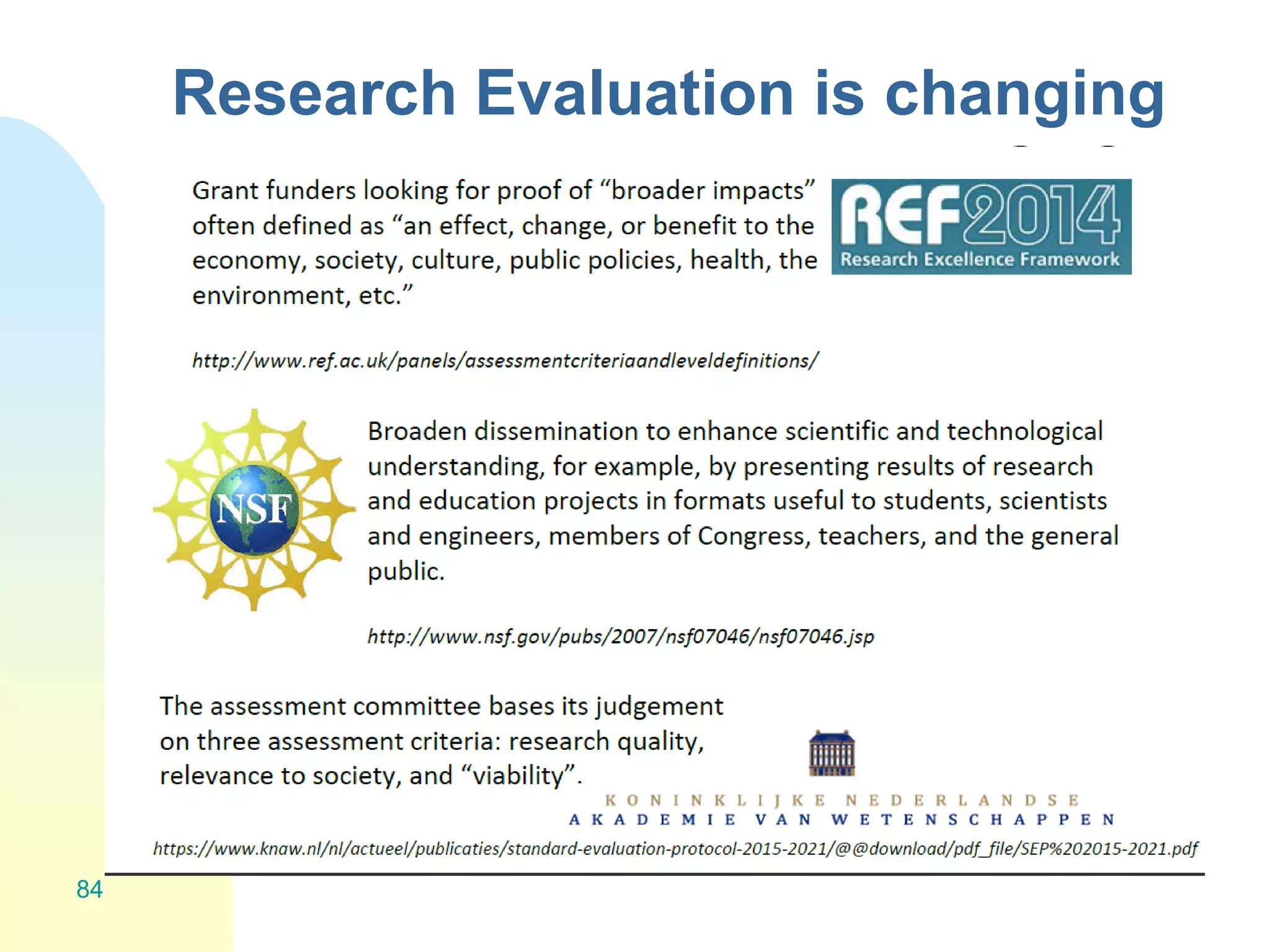
Research Evaluation is changing
84
Institutions
85
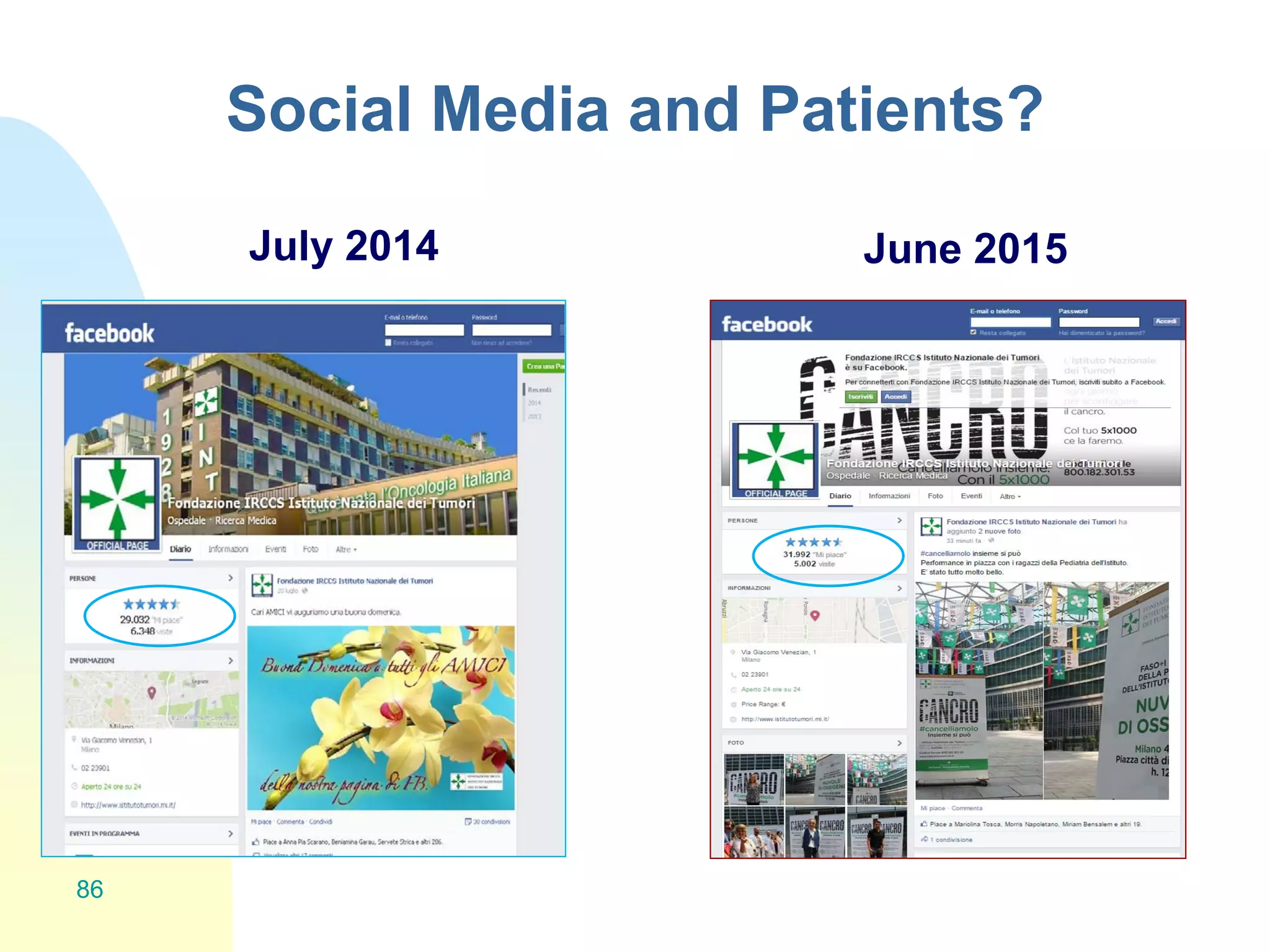
Social Media and Patients?
July 2014 June 2015
86
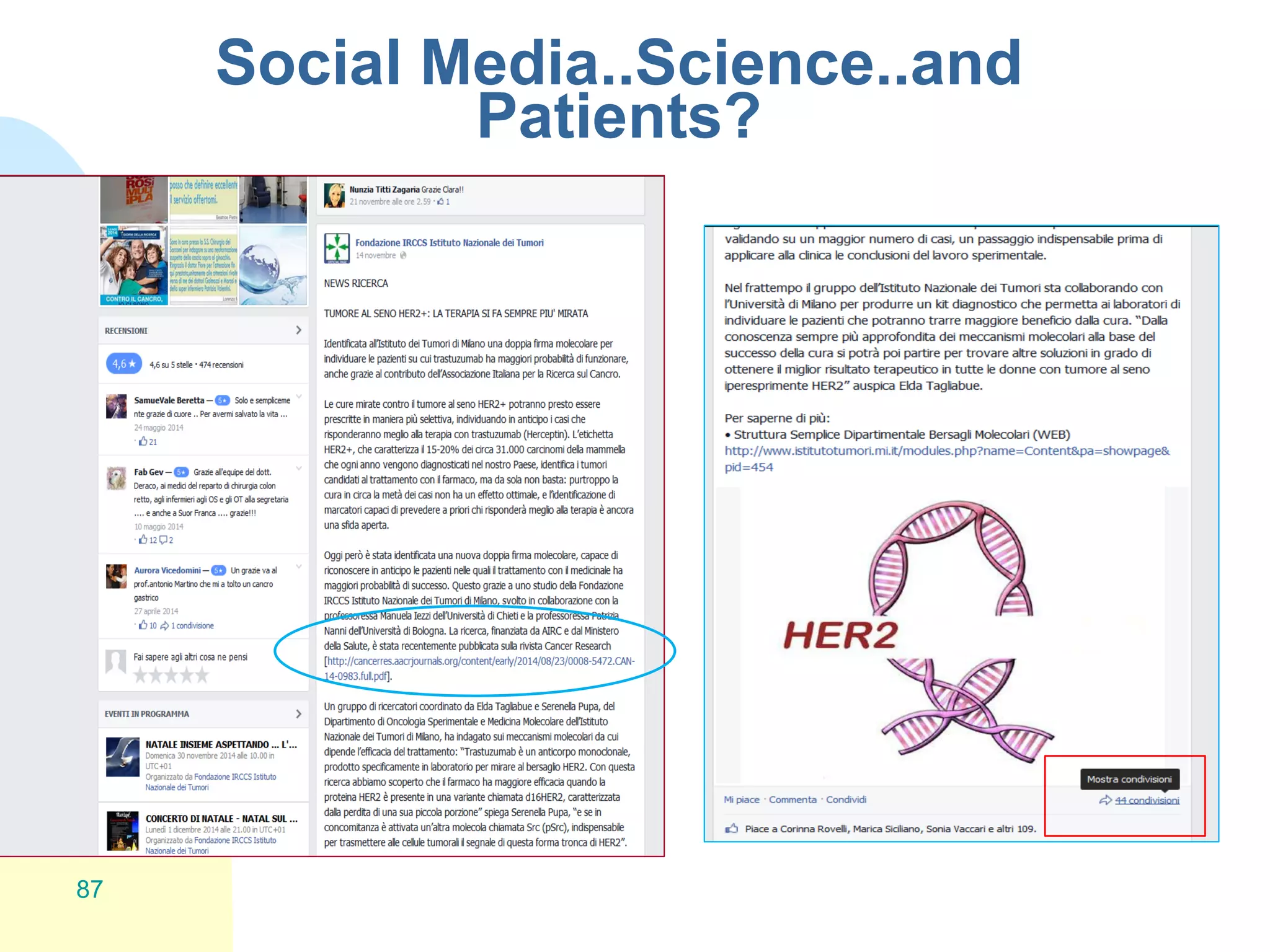
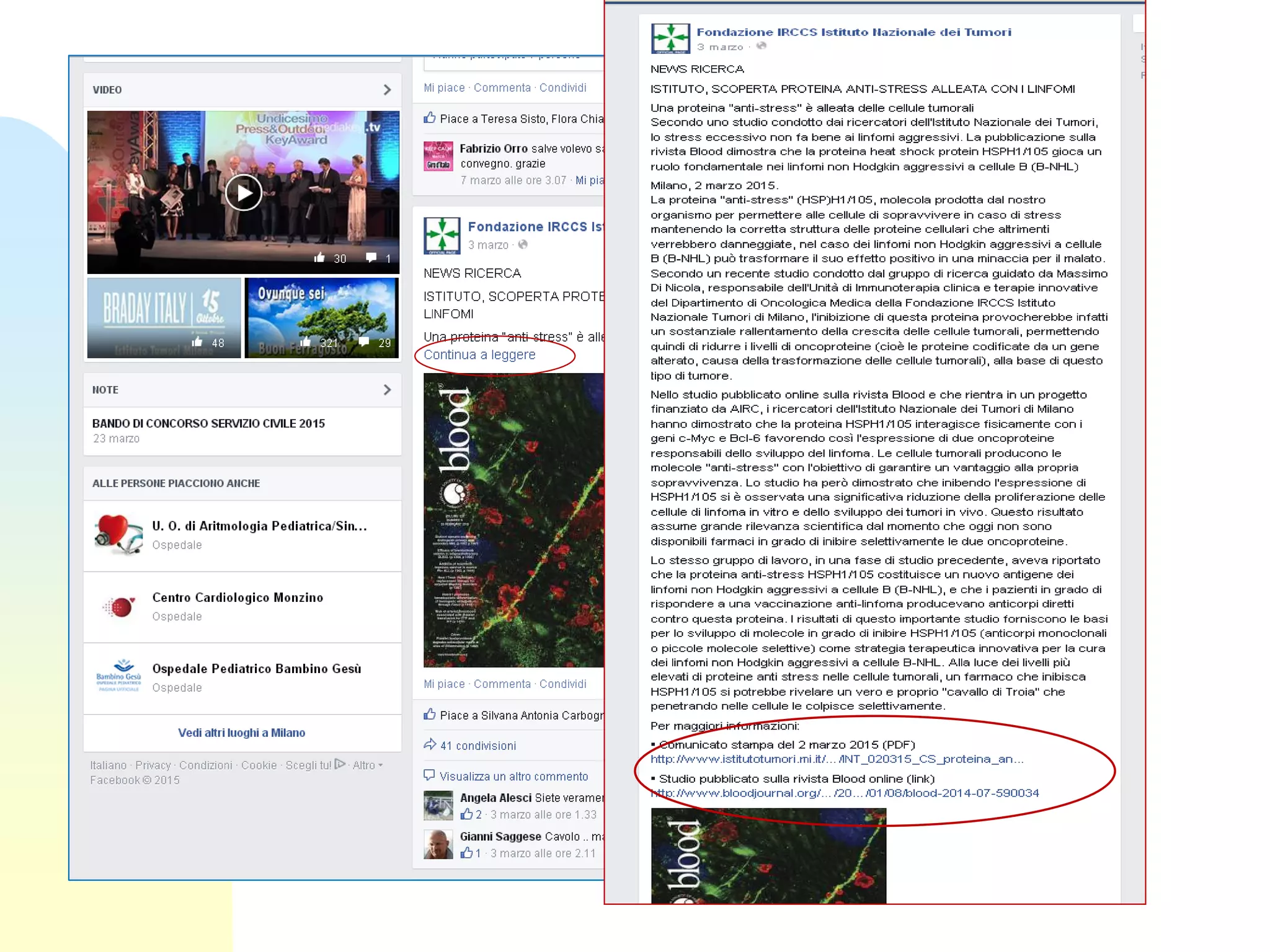
Social Media..Science..and
Patients?
87
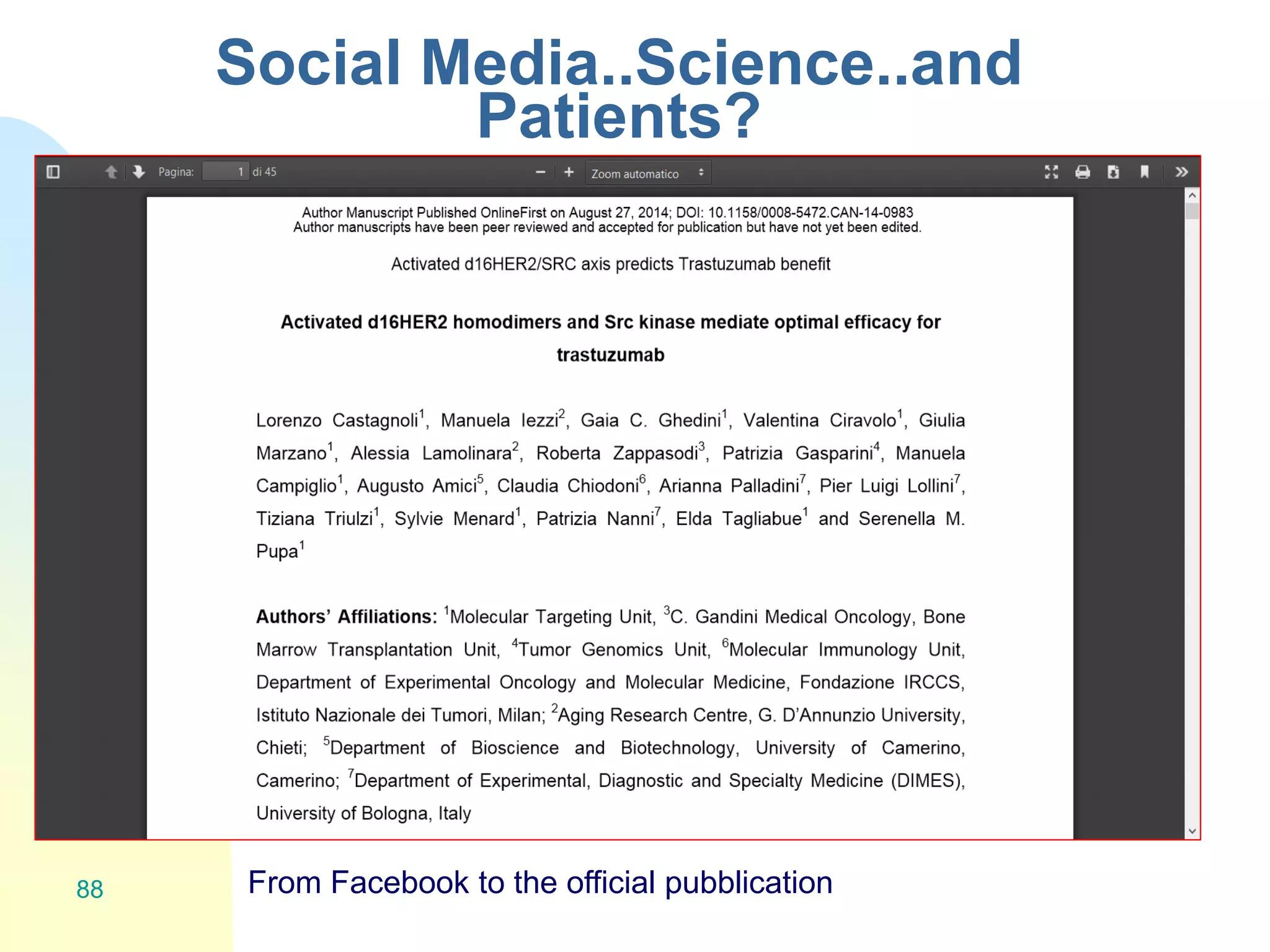
Social Media..Science..and
Patients?
88 From Facebook to the official pubblication
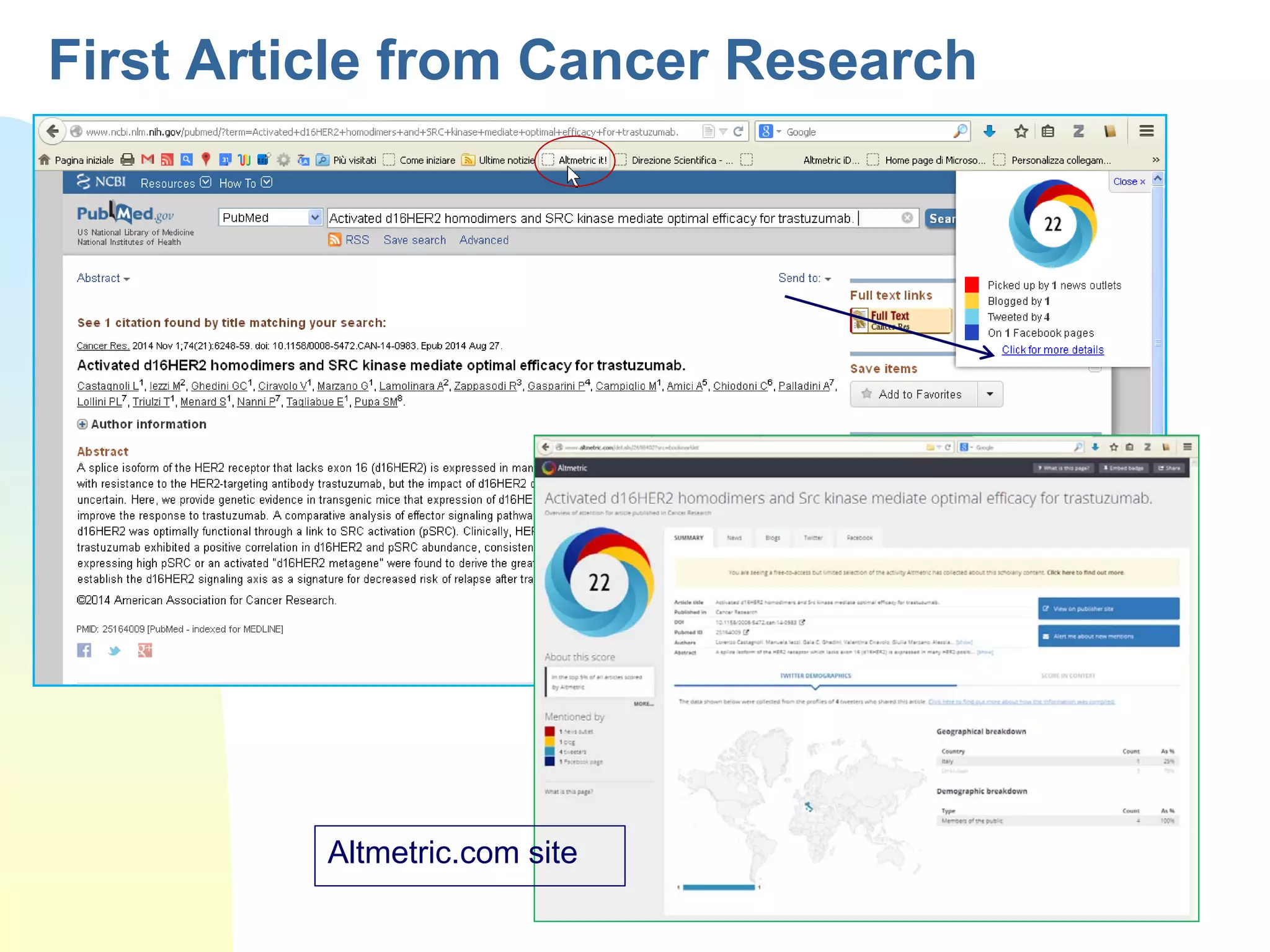
First Article from Cancer Research
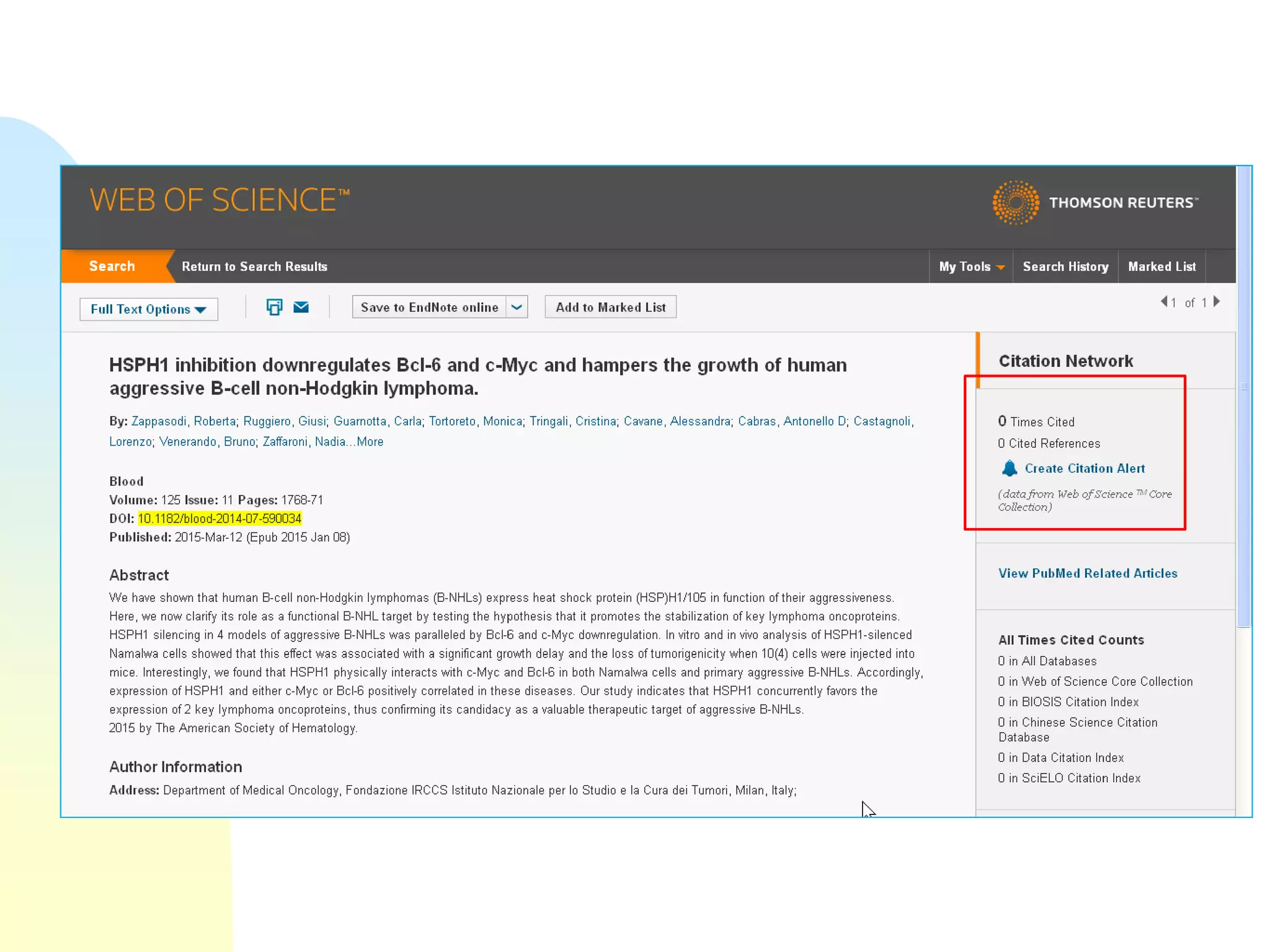
Altmetric.com site
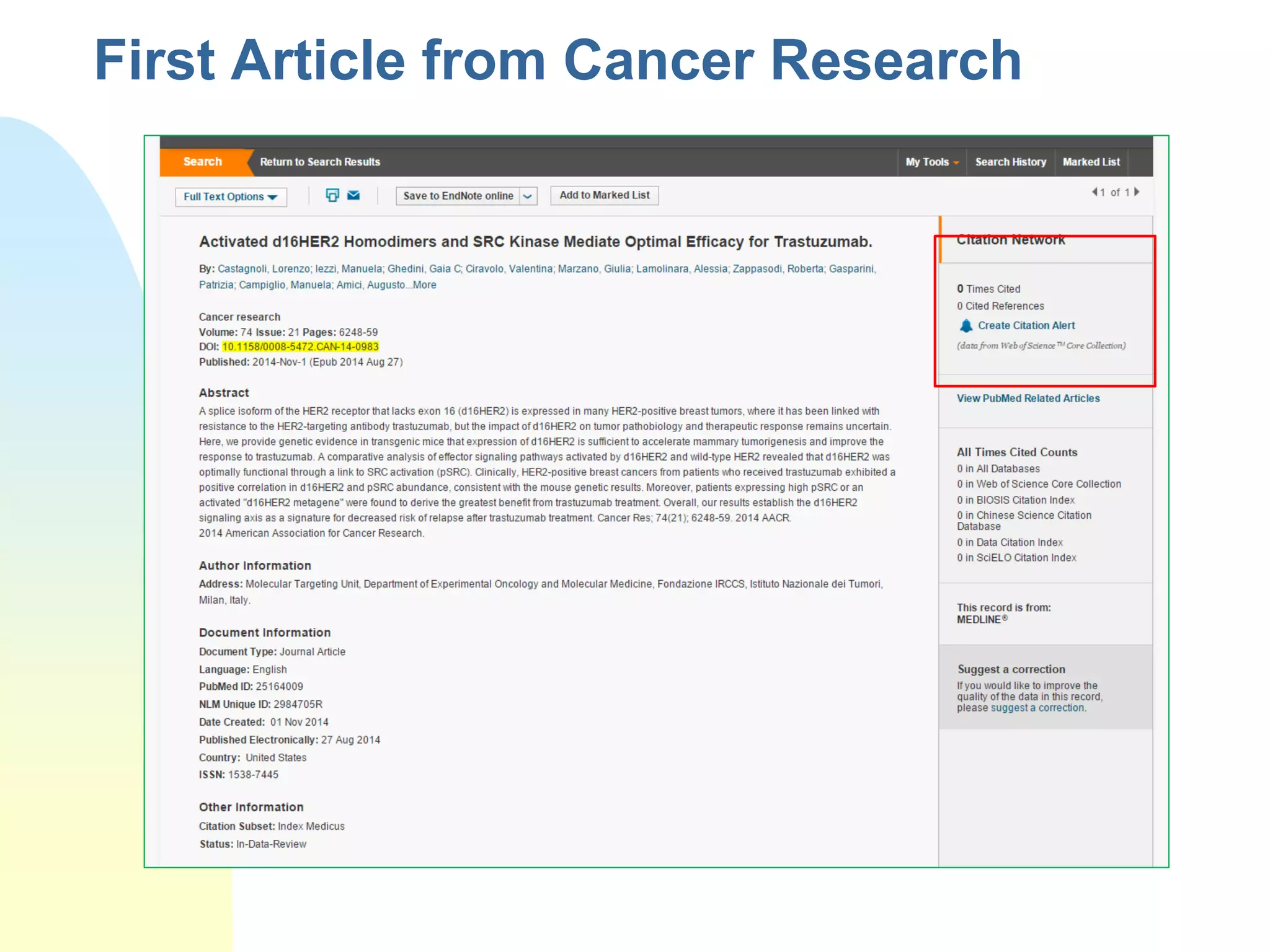
First Article from Cancer Research
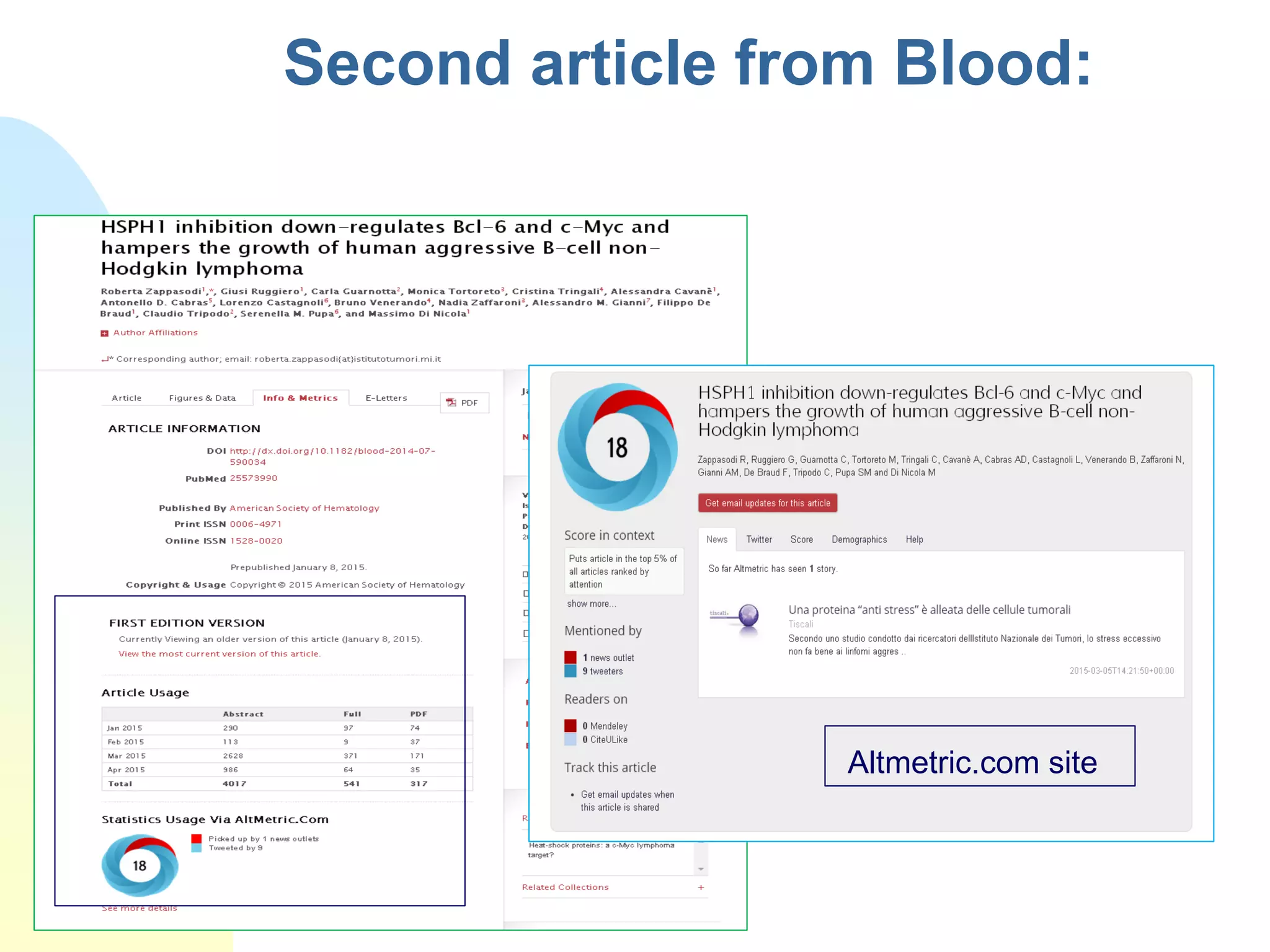
Second article from Blood:
Altmetric.com site
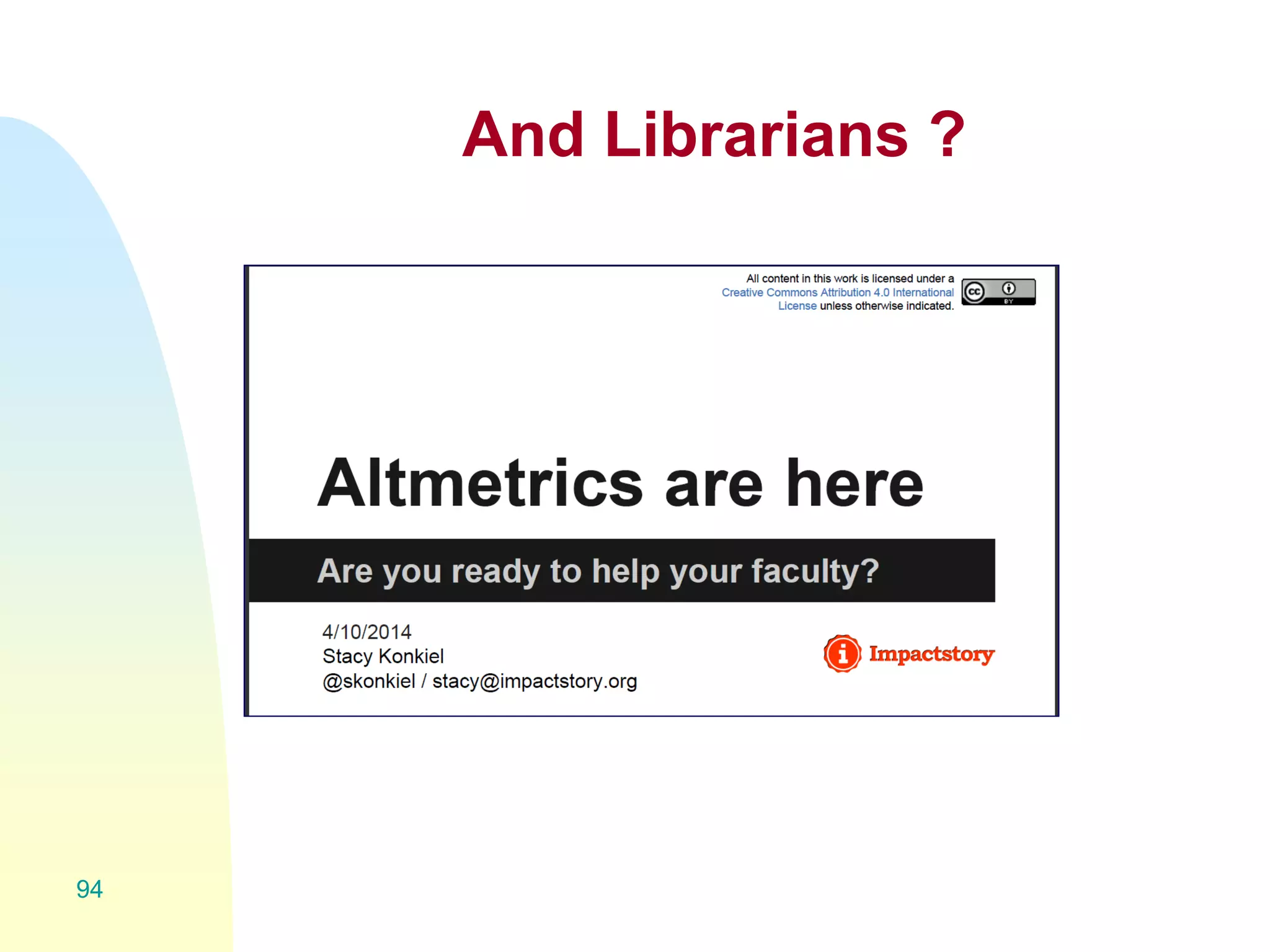
And Librarians ?
94
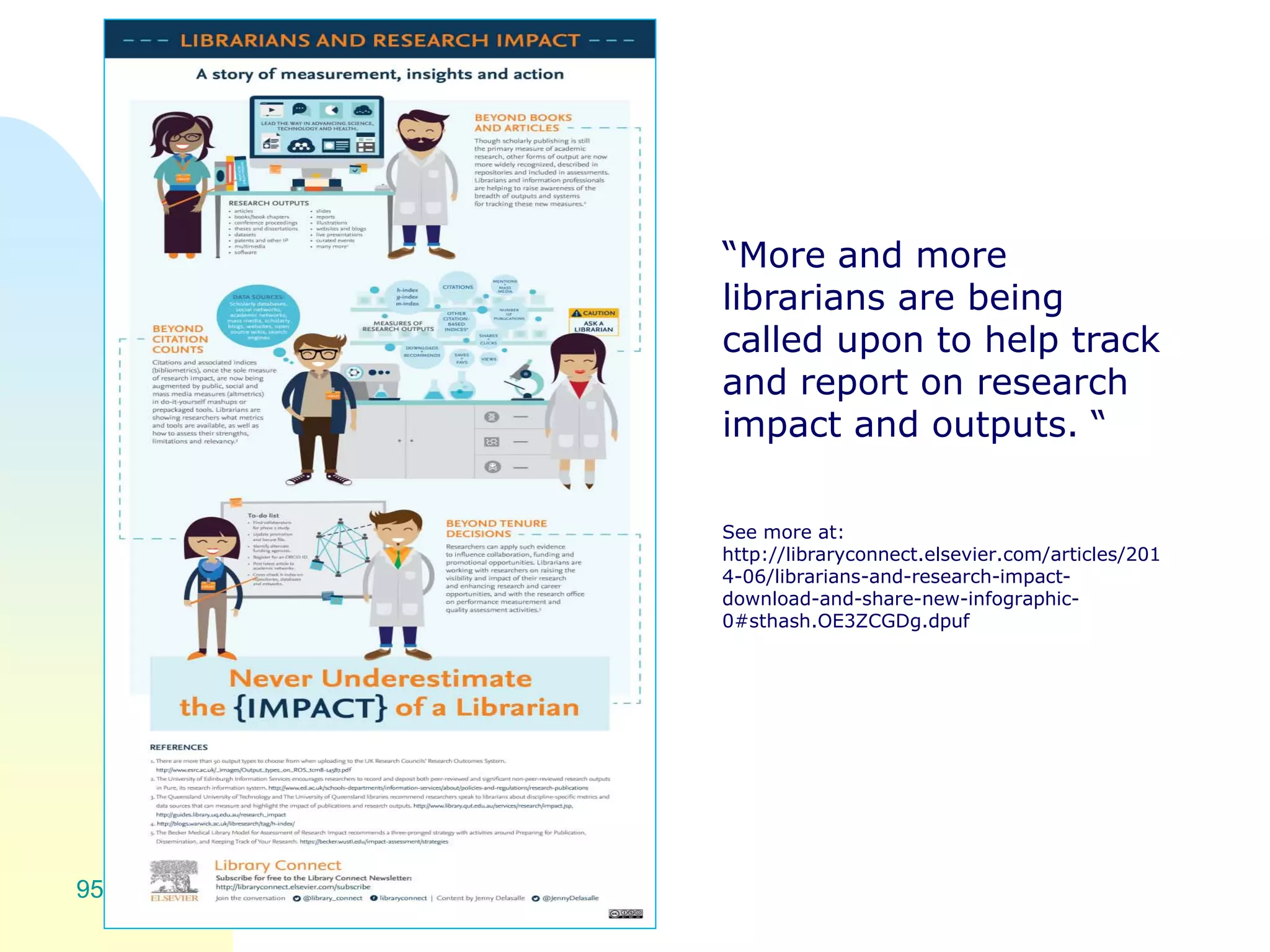
Library…
95
“More and more
librarians are being
called upon to help track
and report on research
impact and outputs. “
See more at:
http://libraryconnect.elsevier.com/articles/201
4-06/librarians-and-research-impact-
download-and-share-new-infographic-
0#sthash.OE3ZCGDg.dpuf
And What about Librarians ?
 Libraries can fruitfully support the entire research cycle;
 Librarians can also help researchers to evaluate the impact of their
publications and to better understand the needs of their patients;
 Finally, they can play an important, additional support to their users in
three important ways:
 informing about emerging conversation within the latest research,
 supporting experimentation with emerging altmetrics tools,
 and engaging in early altmetrics education and outreach
 This role change corresponds to what Priem calls “Scholarly
communication specialist”.
96
And What about Librarians ?
 Some examples of how librarians use Altmetrics include:
 Understand the usage of digital special collections and institutional
repository content;
 Collection Development;
 Faculty research support;
 Documenting their own professional staff!
 Create a study group:
“I think…If Librarians had access to article –level data, they would
use it.”
97
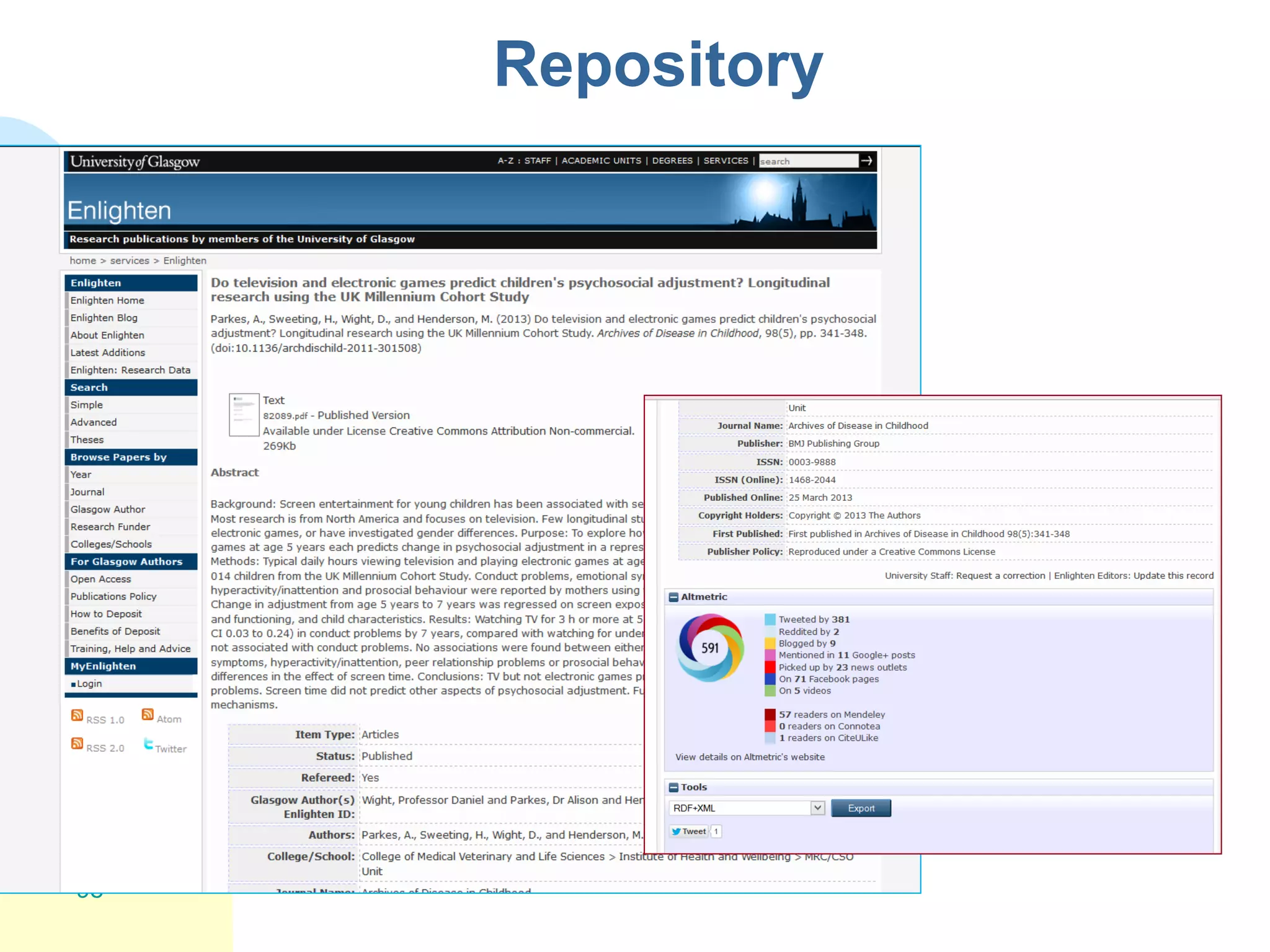
Repository
98
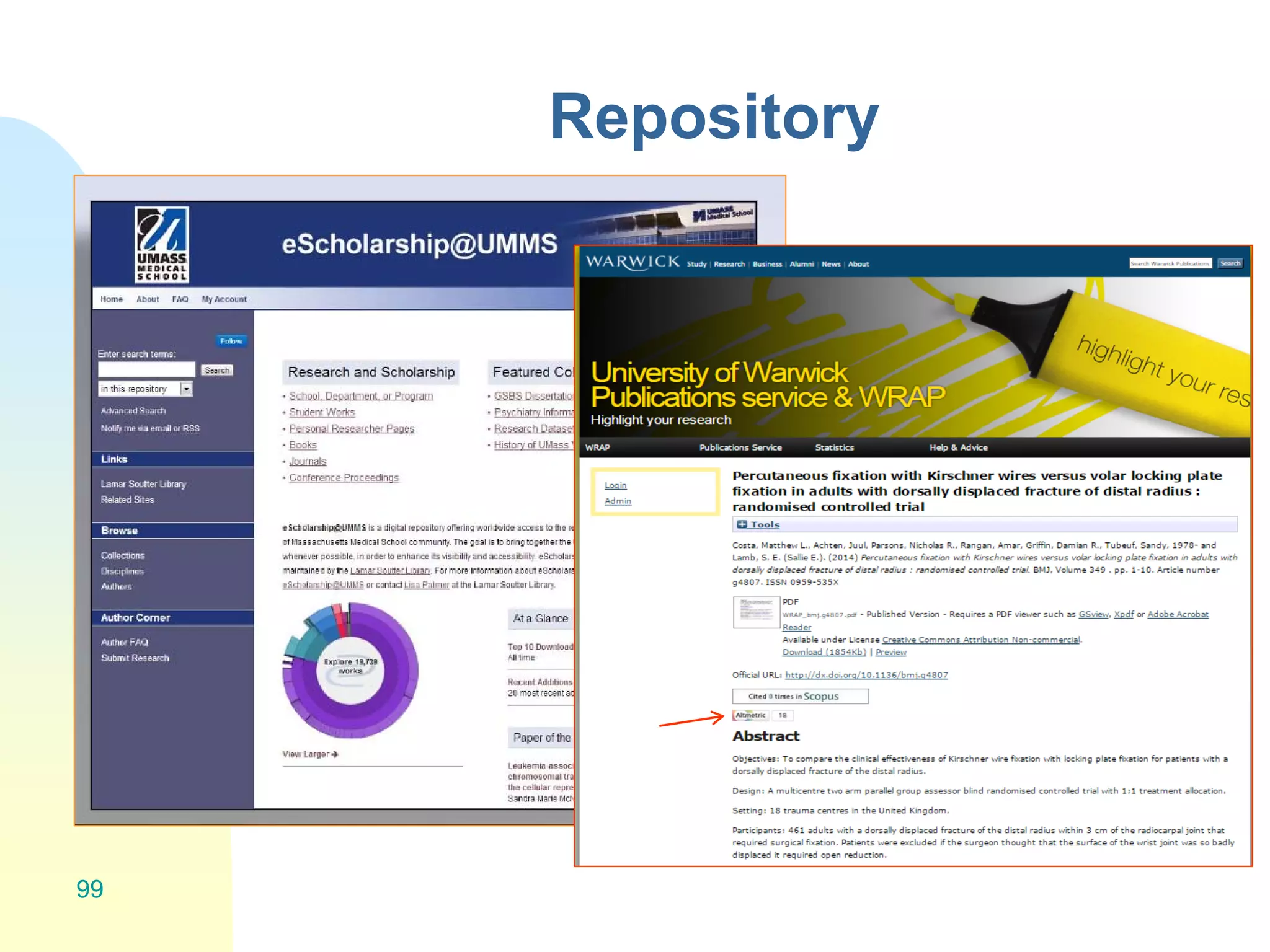
Repository
99
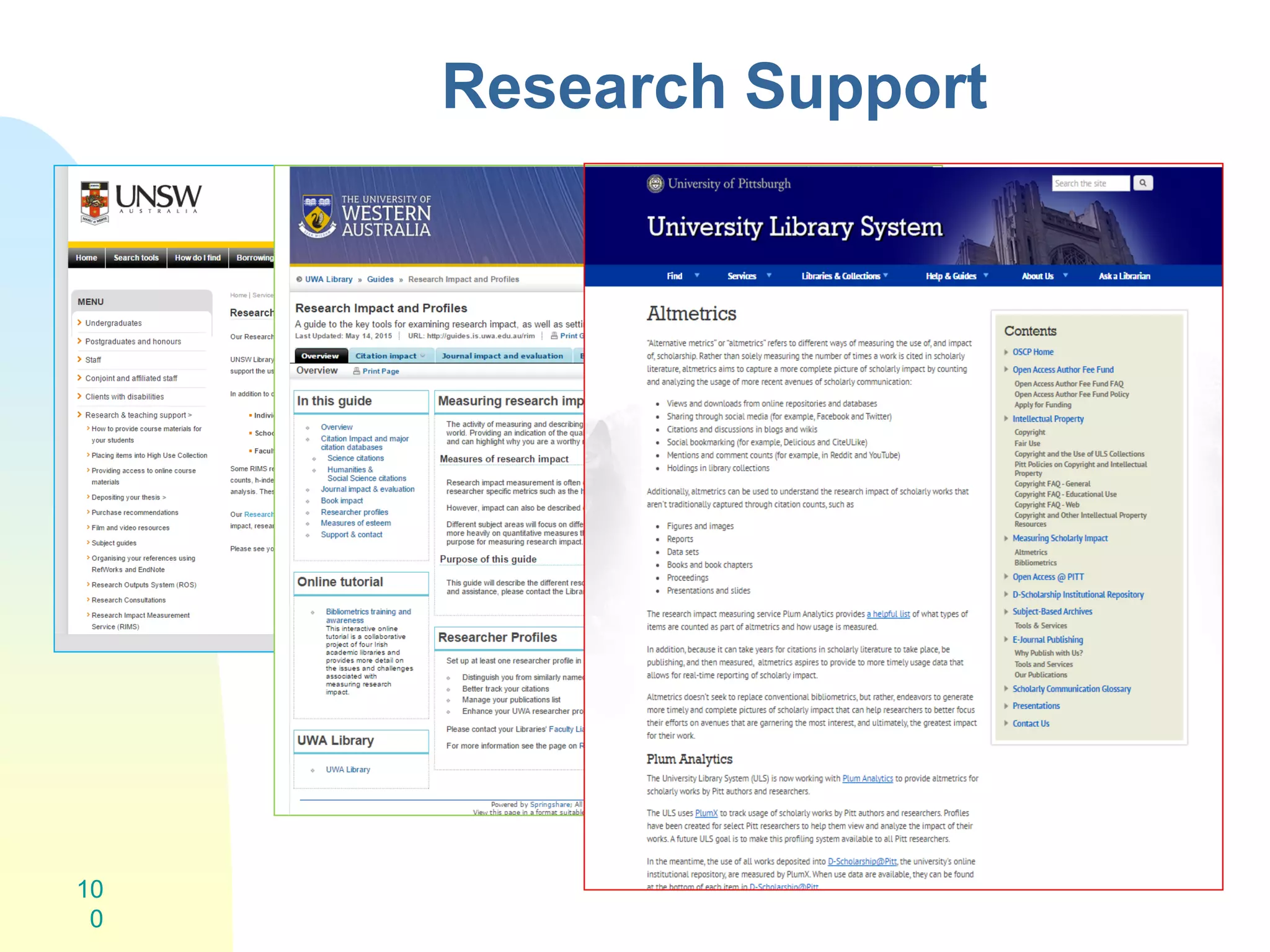
Research Support
10
0
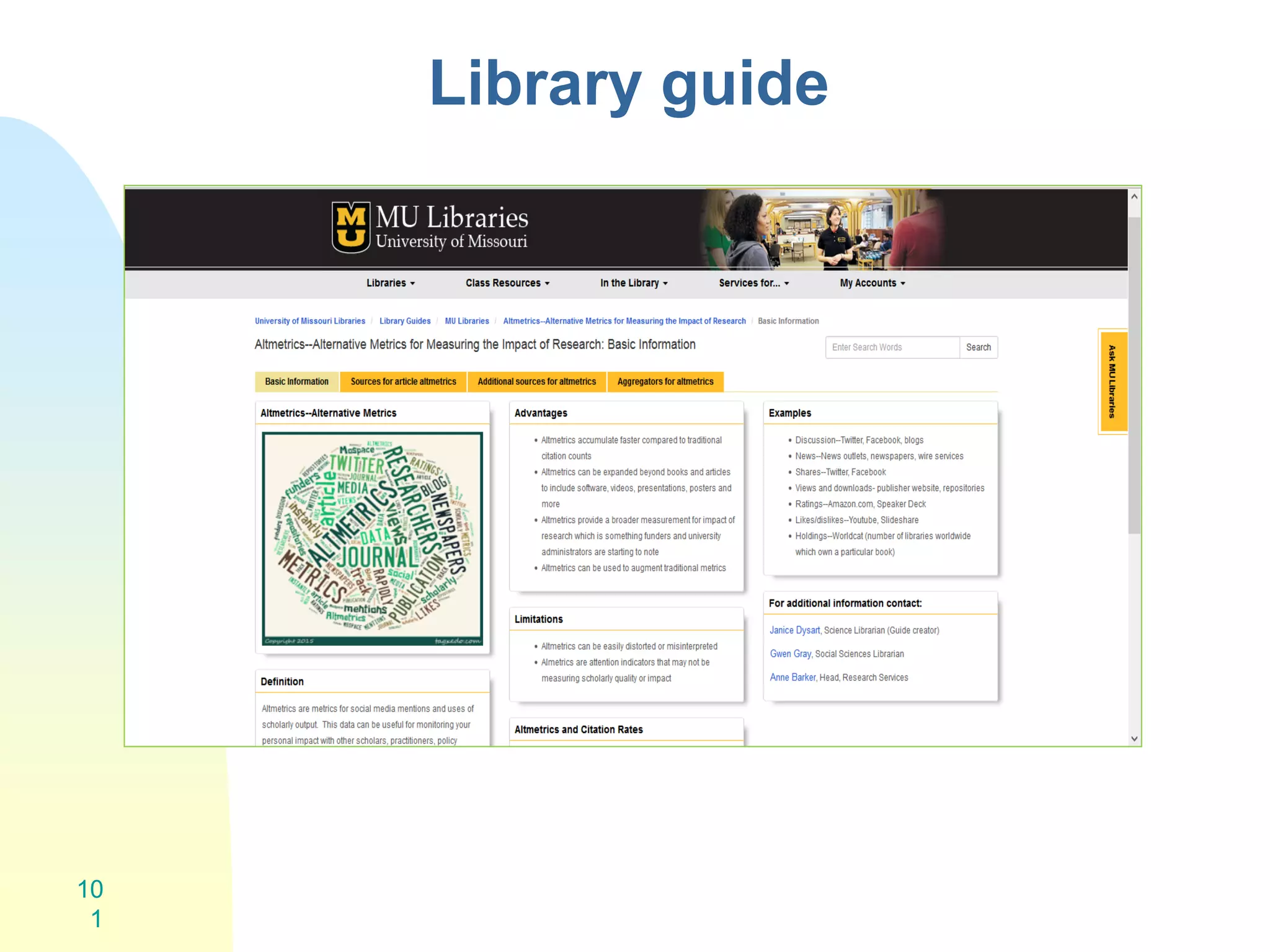
Library guide
10
1
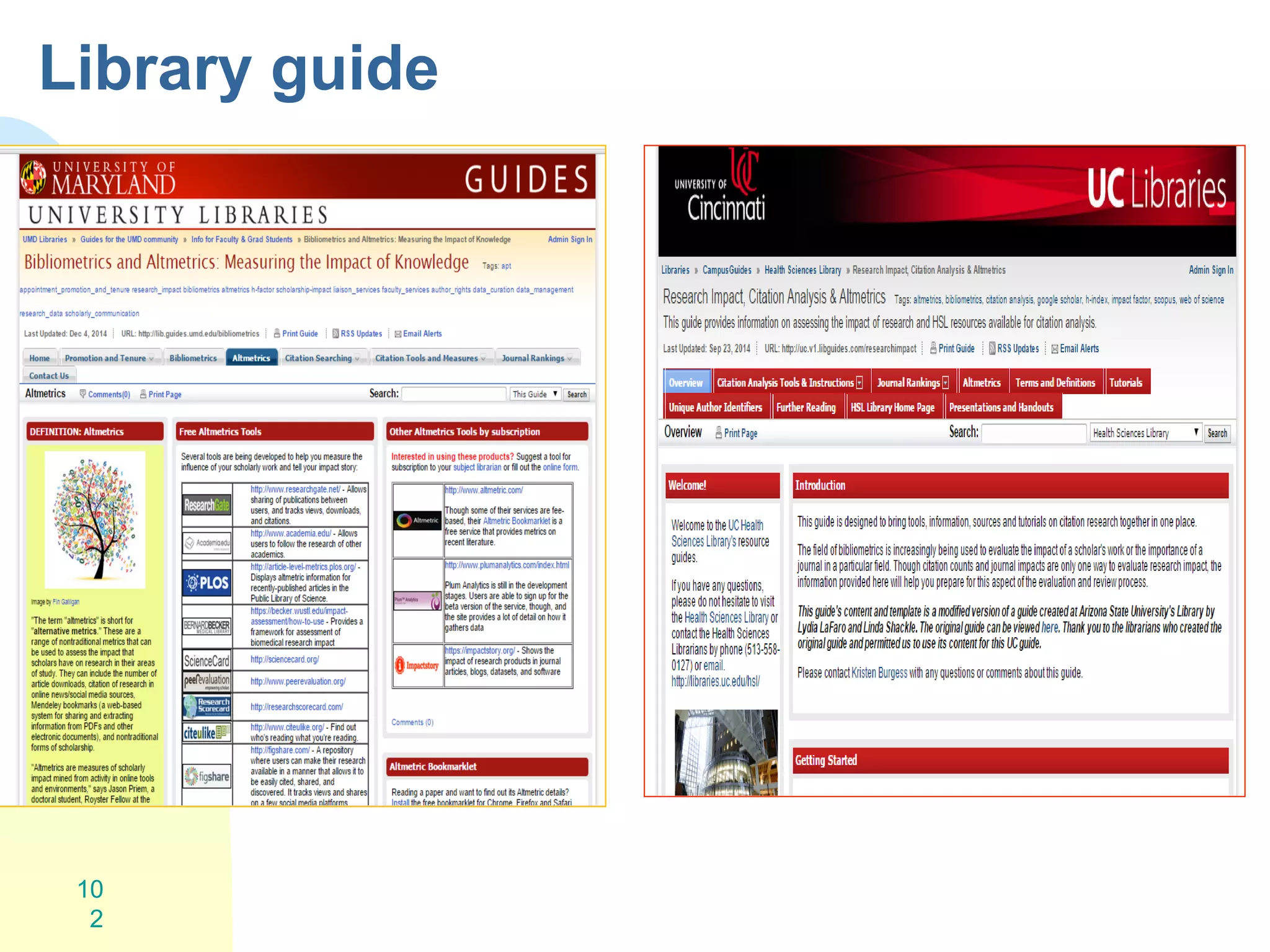
Library guide
10
2
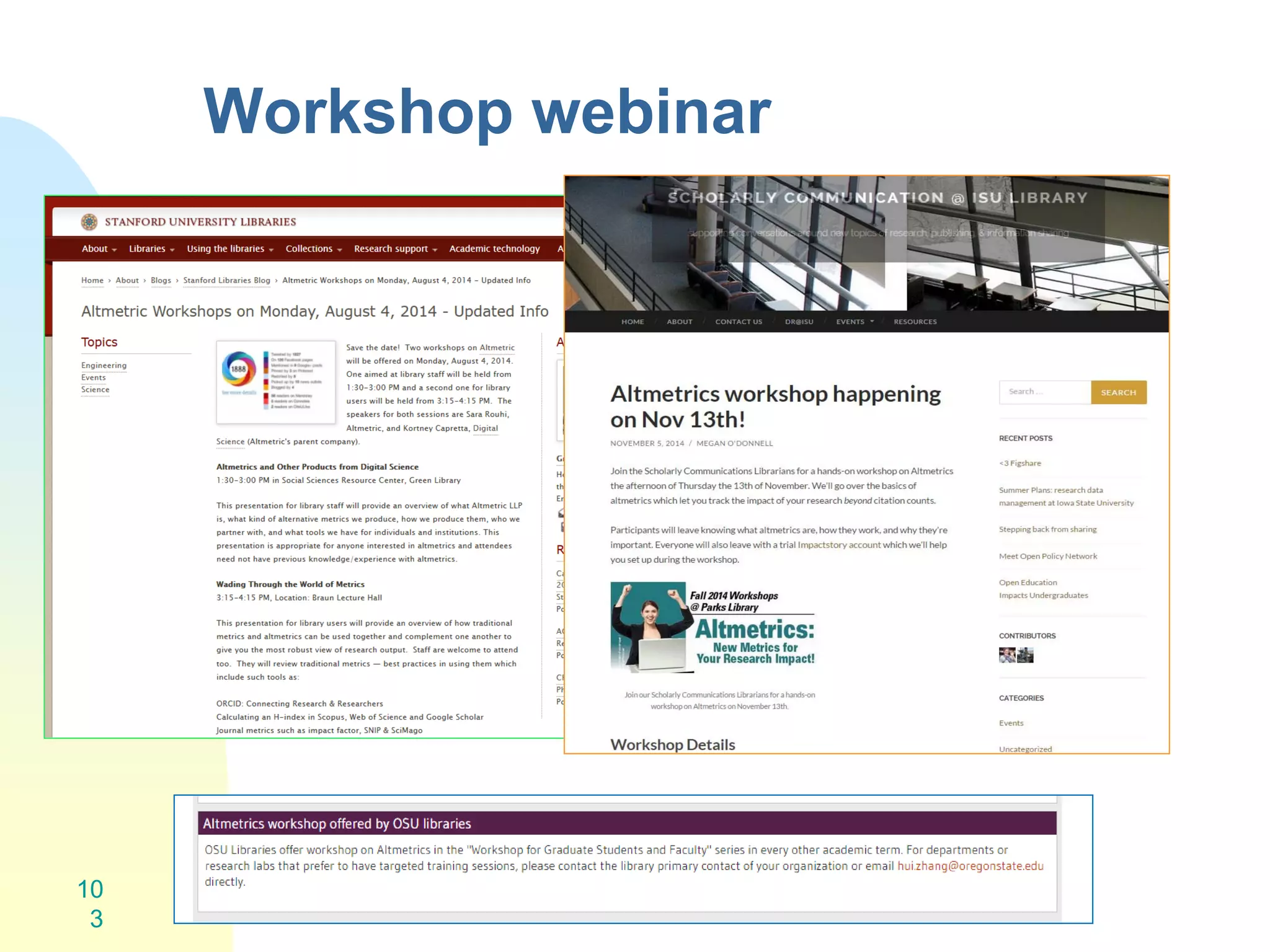
Workshop webinar
10
3
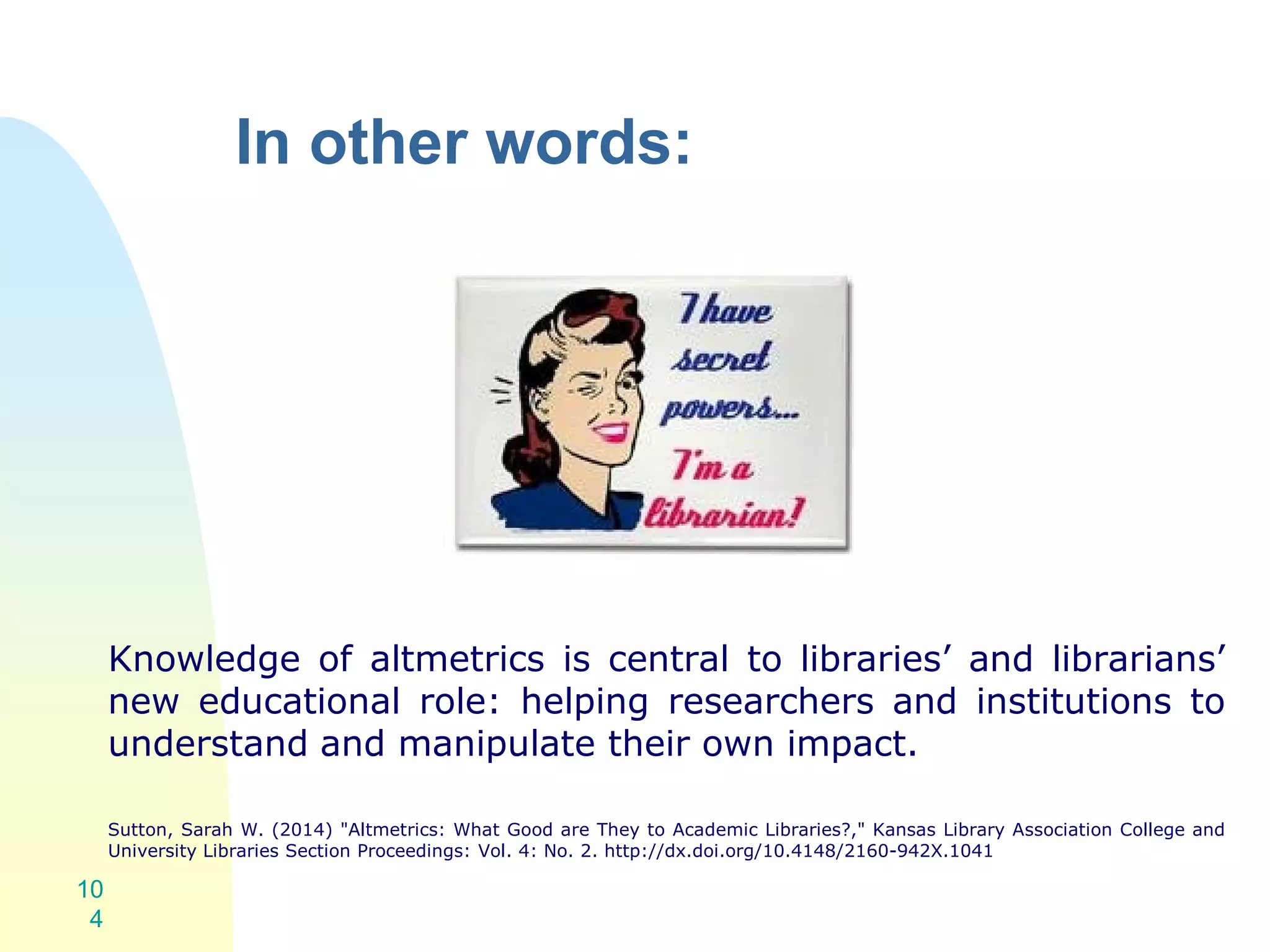
In other words:
Knowledge of altmetrics is central to libraries’ and librarians’
new educational role: helping researchers and institutions to
understand and manipulate their own impact.
Sutton, Sarah W. (2014) "Altmetrics: What Good are They to Academic Libraries?," Kansas Library Association College and
University Libraries Section Proceedings: Vol. 4: No. 2. http://dx.doi.org/10.4148/2160-942X.1041
10
4
Remember…
10
5
www.oltrediritto.it
Altmetrics: correlations..?
10
6
Do Altmetrics correlate with..?
 Altmetric counts are low (15-24%) and not very frequent in scientific
publications, although presence is increasing
 Social sciences, humanities, and medical & life sciences had the highest
presence of altmetrics
 Found positive weak correlation between altmetrics & citations – reflecting
that altmetrics do not capture the same concept of impact
 Altmetrics are valued as a complementary tool of citation analysis
Costas, R., Zahedi, Z., & Wouters, P. (2014). Do altmetrics correlate with
citations? Extensive comparison of altmetric indicators with citations from a
multidisciplinary perspective. arXiv preprint arXiv:1401.4321.
Do Altmetrics correlate with..?
 MohammadiE, ThelwallM, HausteinS and LarivièreV (2014). “Who Reads
Research Articles? An Altmetrics Analysis of Mendeley User Categories”,
Academia.edupre-print.
 http://www.academia.edu/6298635/Who_Reads_Research_Articles_An_Al
tmetrics_Analysis_of_Mendeley_User_Categories
 Suggests that “Mendeley readership can reflect usage similar to
traditional citation impact, if the data is restricted to readers who
are also authors, without the delay of impact measured by citation
counts”
10
8
Do Altmetrics correlate with..?
 Thelwall M, Haustein S, LarivièreV and Sugimoto CR (2013). “Do
Altmetrics Work? Twitter and Ten Other Social Web Services”, PLoSONE
8(5): e64841.
 http://www.plosone.org/article/info%3Adoi%2F10.1371%2Fjournal.pone.
0064841
 Provides evidence that altmetrics can provide intelligence on the
readership of academic research that traditional citation metrics
can’t: "It seems that altmetrics probably capture a broad, or at
least a different, aspect of research visibility and impact in
comparison to citation counts”.
10
9
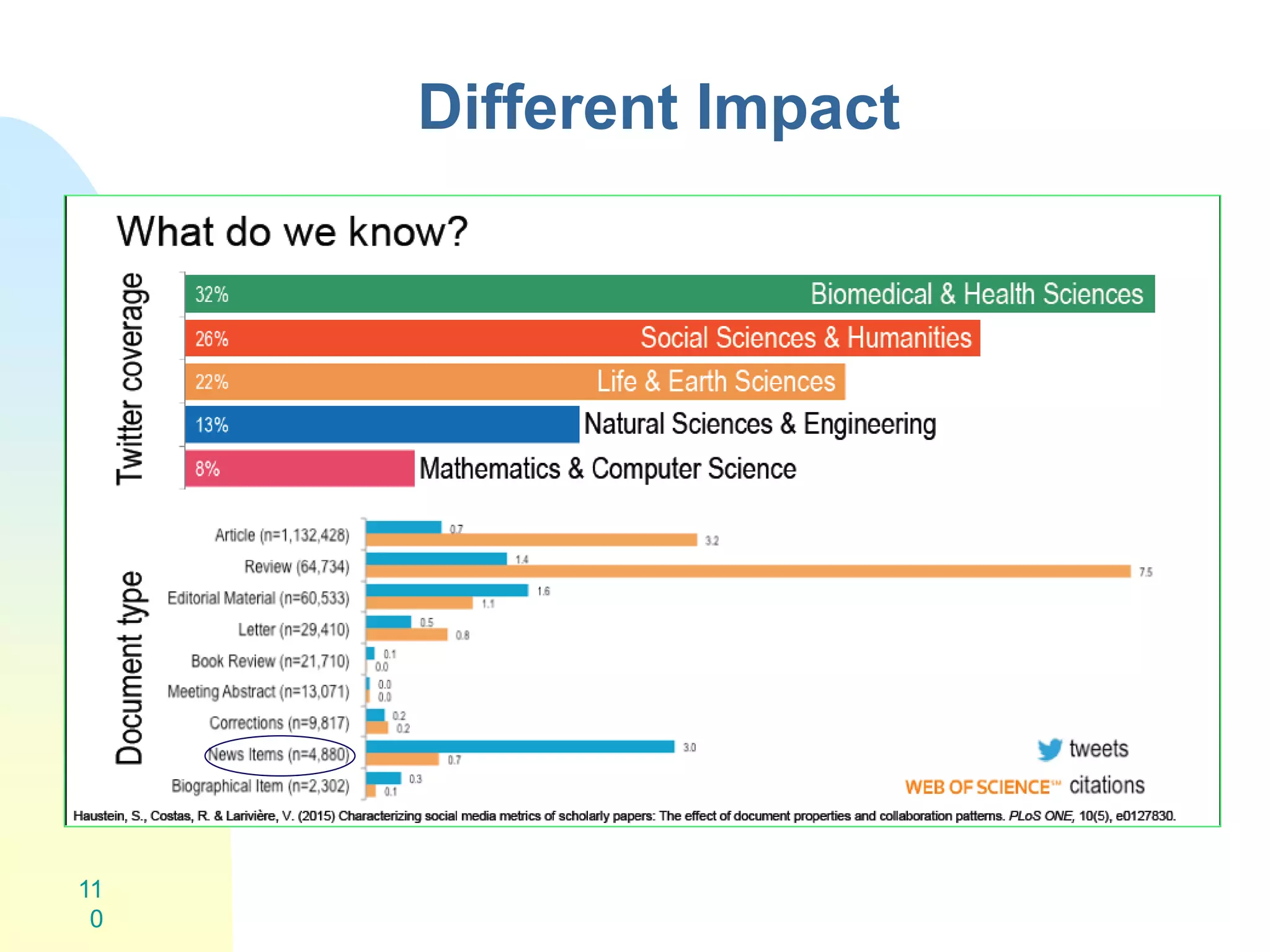
Different Impact
11
0
11
1
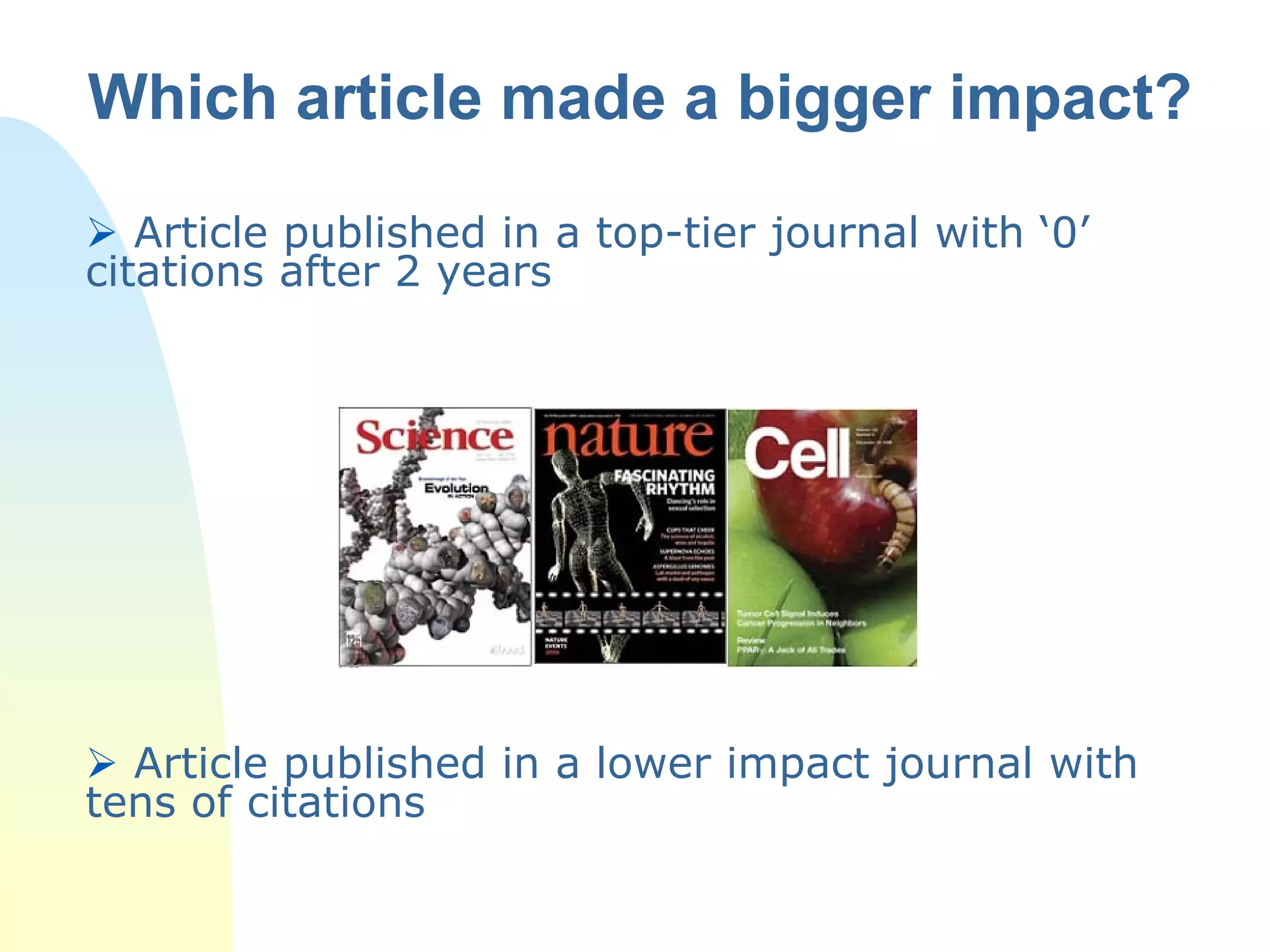
 Article published in a top-tier journal with ‘0’
citations after 2 years
 Article published in a lower impact journal with
tens of citations
Which article made a bigger impact?
 Article with many citations
 Article widely discussed in the social web
 Article with lots of downloads
 Article discussed on networks
Which article made a bigger impact?
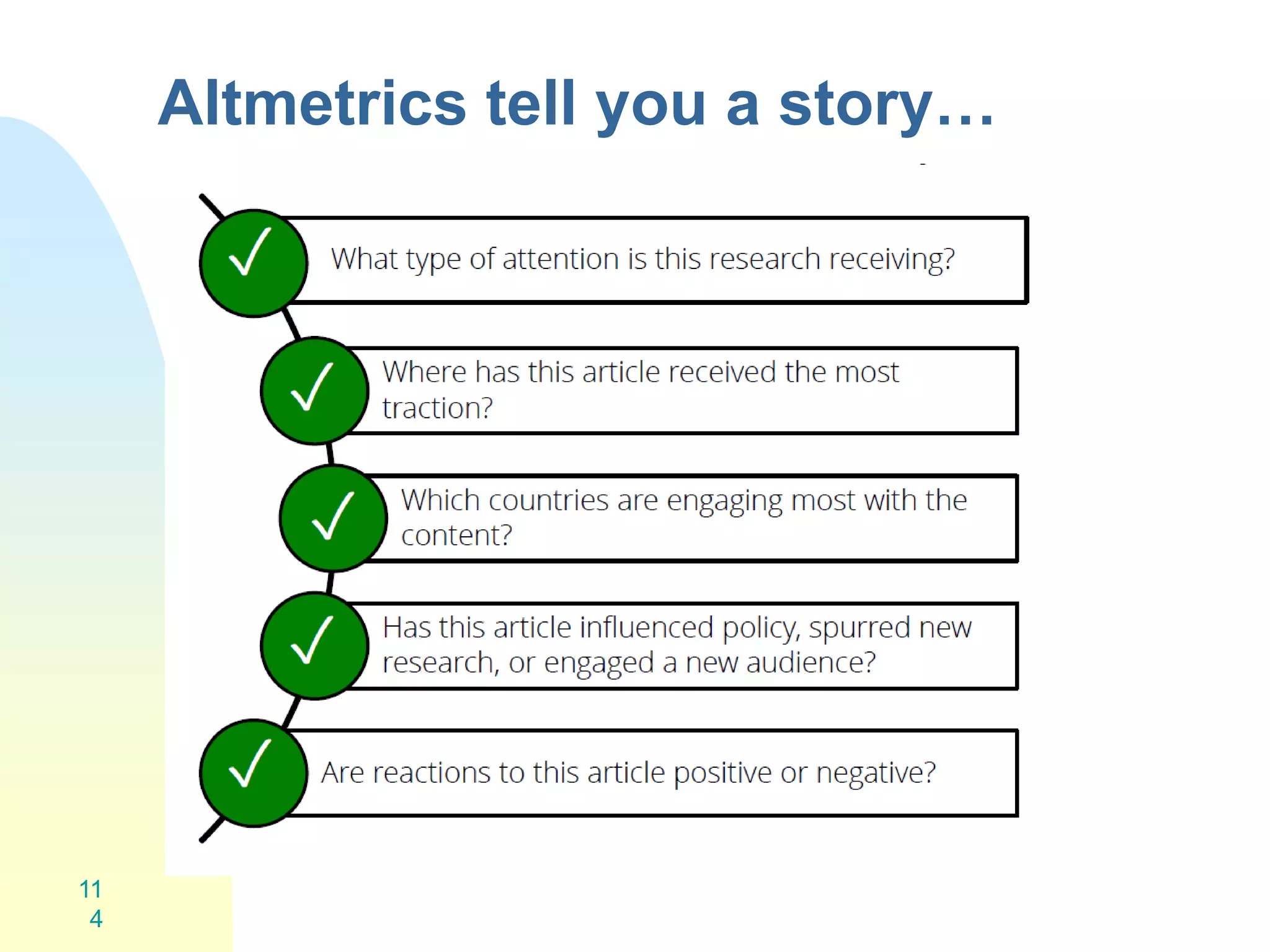
Altmetrics tell you a story…
11
4
Altmetrics Advantages…
 Altmetrics are user friendly, graphic, self-explaining (can be used
by non specialized readers), rapidly evolving and interacting (with
media and public or users);
 Altmetrics could act as a reliable tool in evaluating both
researchers and institutions;
 Altmetrics provides data in real time;
 Go beyond the citation only;
 Gives a context;
 Helps young researchers.
11
5
Limits:
 But there are some limits…
 Firstly, there is no distinction - when dealing with citations -
between positive and negative comments;
 Gaming
 No standard for reporting almetrics;
 Need time for development!
11
6
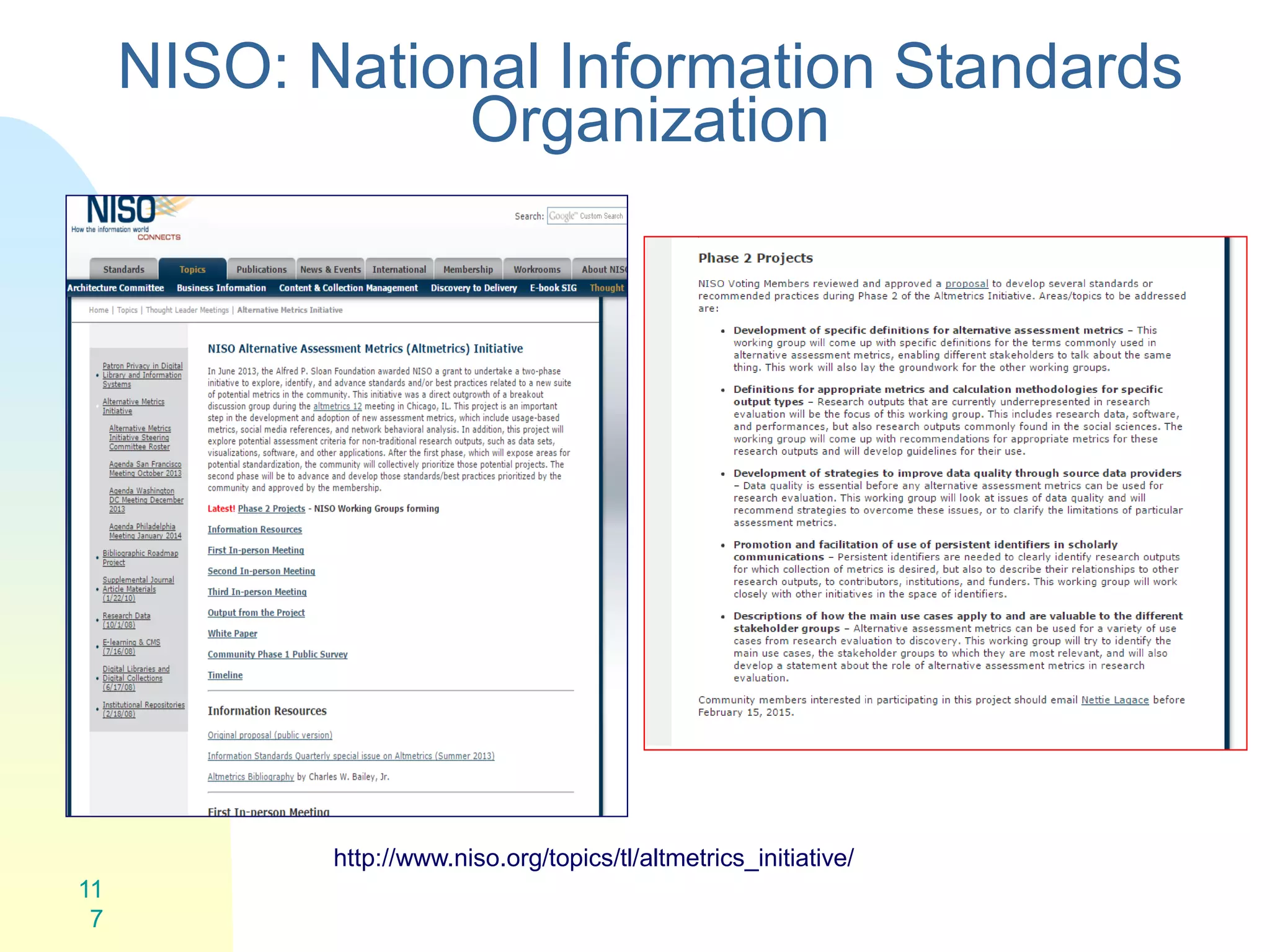
NISO: National Information Standards
Organization
11
7
http://www.niso.org/topics/tl/altmetrics_initiative/
In general , Almetric numbers:
 Don’t represent the quality of research.
 Don’t indicate the quality of individual
researchers.
 Don’t tell the whole story –always look
for qualitative data as well
11
8
In general , Almetric numbers:
• Similar to but more timely than citations
 Predicting scientific impact:
• Different, broader impact than captured by
citations
 Measuring societal impact:
• Impact of various outputs
 “Value all research products”
Piwowar (2013)
11
9
Conclusive Remarks
 Altmetrics is useful and may well be considered reliable.
 It can represent an interesting and relevant complement to citations
 Together with traditional metrics, they can be a useful tool in guiding
decision makers when funding public research.
 Nevertheless, further investigations are still needed to explore and
understand what they measure and how can they be used in research
evaluation.
 Librarians could play an active role.
12
0
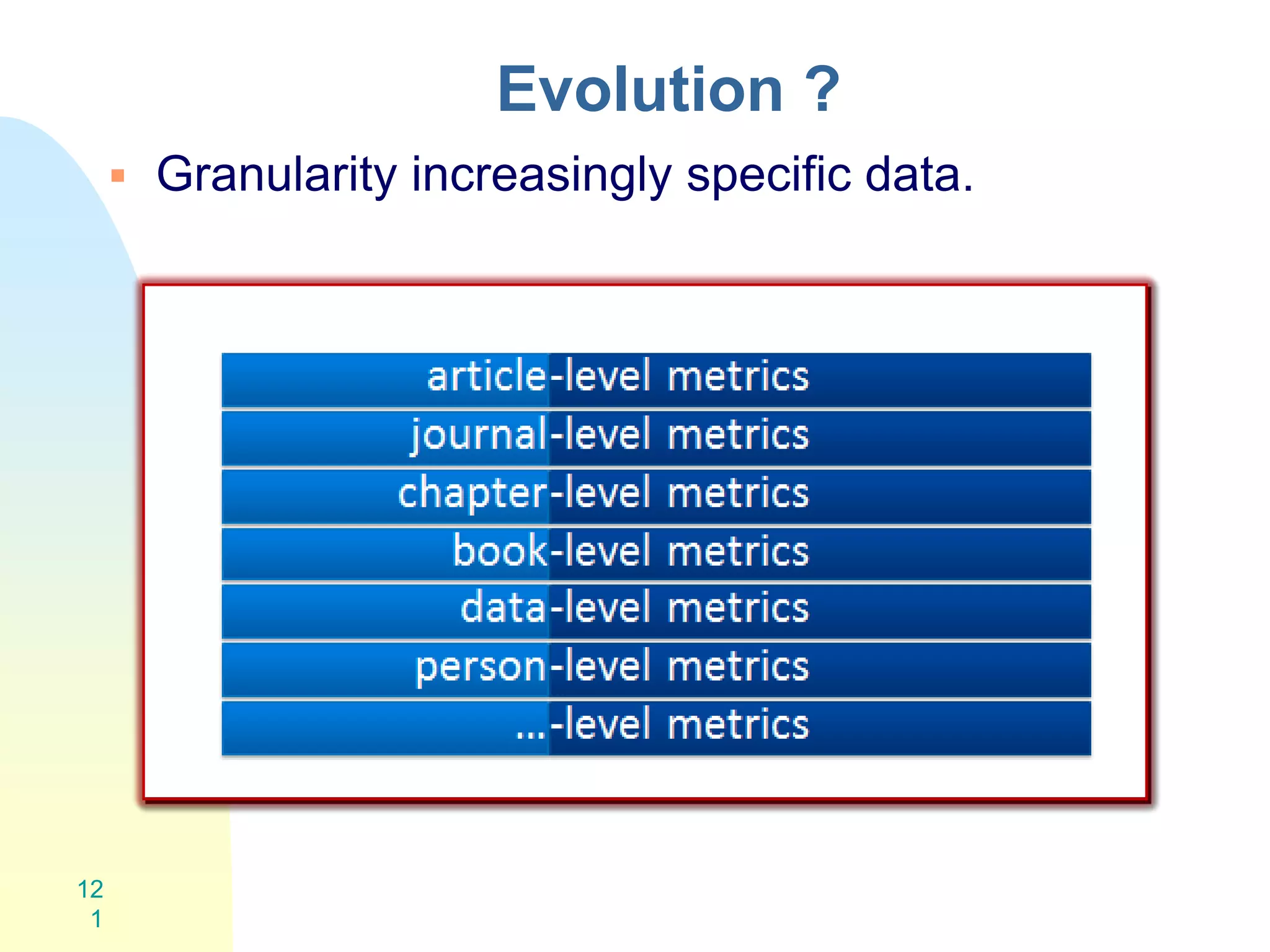
Evolution ?
 Granularity increasingly specific data.
12
1
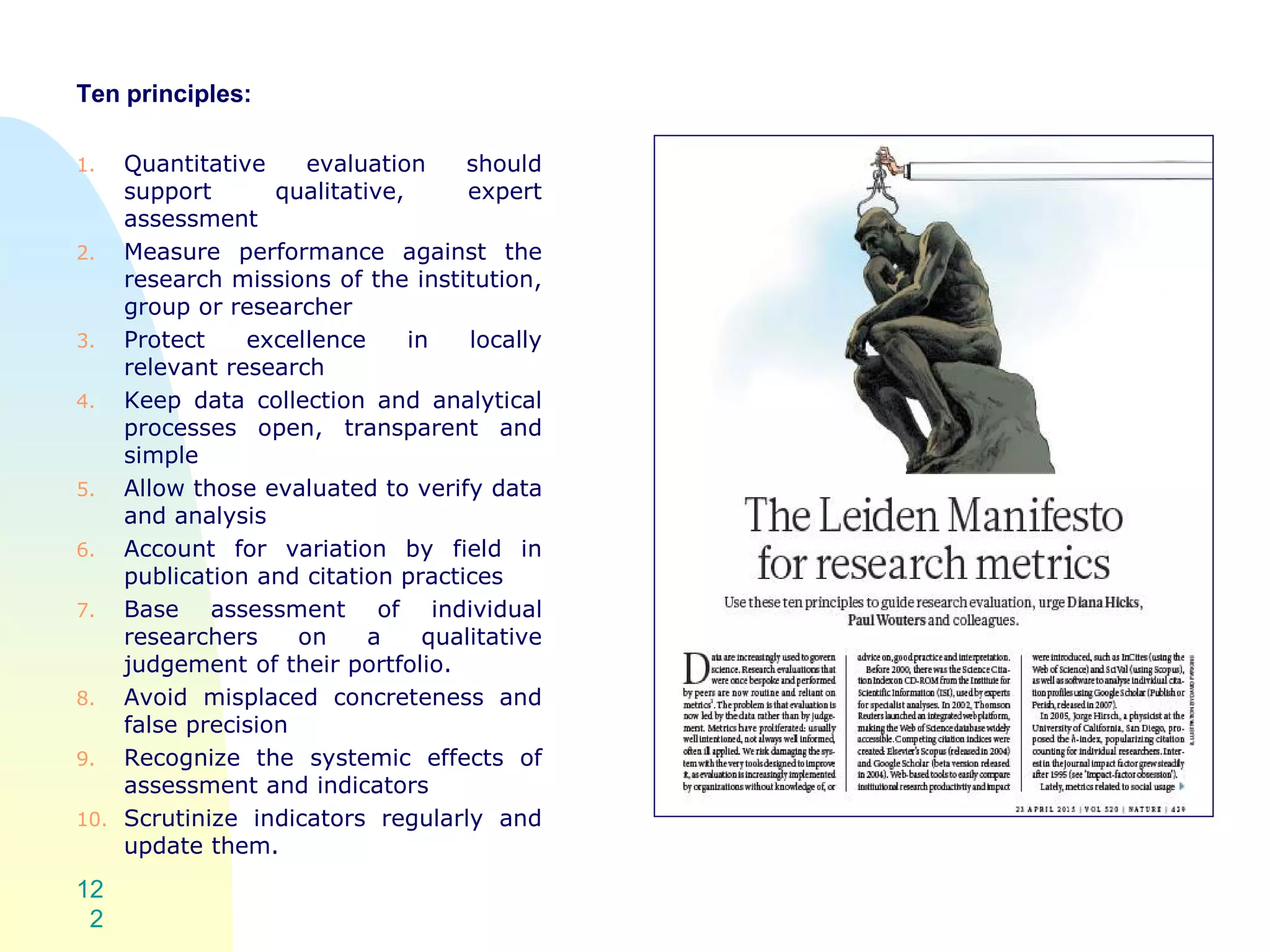
Ten principles:
1. Quantitative evaluation should
support qualitative, expert
assessment
2. Measure performance against the
research missions of the institution,
group or researcher
3. Protect excellence in locally
relevant research
4. Keep data collection and analytical
processes open, transparent and
simple
5. Allow those evaluated to verify data
and analysis
6. Account for variation by field in
publication and citation practices
7. Base assessment of individual
researchers on a qualitative
judgement of their portfolio.
8. Avoid misplaced concreteness and
false precision
9. Recognize the systemic effects of
assessment and indicators
10. Scrutinize indicators regularly and
update them.
12
2
Thank you for your attention!
Questions ?
Valeria Scotti
v.scotti@smatteo.pv.it
12
3

Altmetrics: how librarians can support researchers in improving their impact

  • 1.
    Altmetrics: How librarians can supportresearchers in improving their impact 1 Fondazione IRCCS San Matteo di Pavia Center for Scientific Documentation- Dott.ssa Valeria Scotti
  • 2.
    Today we aregoing to talk about: 2  Bibliometrics;  Alternative metrics or Altmetrics;  Altmetrics Tools;  Altmetrics application for:  Researchers  Funders and Research Evaluator  Institution  Patients  Librarians  Our trial and other correlations;  Conclusion.
  • 3.
    Introduction  The problemof measuring the scientific and social impact of research publications has been of extreme interest to scientists and scholars since the inception of modern science, but it has always been hard to answer..  Evaluating the importance of an article before reading it is crucial for researchers that lack of time to read all relevant papers. 3
  • 4.
    Methodology There are twomain methodologies for the evaluation of academic research output quality:  Qualitative: Peer review  Quantitative: Metrics  Why is measuring research quality important? 4
  • 5.
    Peer review  Agroup of expert scholars, working in the same scientific area (peers) that evaluate submitted research works and academics’ performance, and assess scientific journals in a particular field.  Peer review can be used as an objective and reliable evaluation measure and is seen by many as the “gold standard”  However: o It is (extremely) time consuming as well as expensive; o Experts can genuinely disagree (referees); o It is surrounded with mysticism and may create an elite club which can be difficult to enter. 5
  • 6.
    Bibliometrics  Bibliometrics isthe application of quantitative analysis and statistics to publications such as journal articles and their accompanying citation counts.  The main tool of bibliometrics is citation analysis:  Applies to journals (impact factor)  individuals (h-index)  and articles (citation impact) 6
  • 7.
    ..the mantra forresearchers 7
  • 8.
    Scientific Publishing Cycle A crucial limit is timeliness.. 8 http://www.napavalley.edu/Library/Pages/ScientificInformationLiteracy.aspx
  • 9.
    Traditional Indicators limits Not all journals are indexed in the Journals Citation Reports, a new edition of which is updated once a year;  The inability to compare journals belong to different subject as subject fields citations varies widely based on discipline ;  The auto-citations (an author who quotes himself) and the real "exchange of courtesies" ;  Peer Review: it is time consuming and expensive;  Young researchers are disadvantaged since they have published less articles than senior researchers; 9
  • 10.
    Web 2.0  Thedevelopment of tools even more Web 2.0 oriented has profoundly changed the scientific communication process  Web 2.0 = 2nd generation web services  And the Library became:  Library 2.0= is a real-time library 10
  • 11.
    New Tools  Themain scientific communication is conditioned by web-based tools, particularly by e-only journals.  The development of tools even more Web 2.0 oriented has profoundly changed the scientific communication process  New tools emerge 11 New tools emerge… http://en.wikipedia.org/wiki/File:Web_2.0_Map.svg
  • 12.
    From Bibliometrics ToAlmetrics.. 12
  • 13.
    Altmetrics  Altmetrics combinesthe traditional Bibliometrics tool with the use of the web  In this context, many web tools are often referred as ‘social media’ due to their role in supporting communication and building communities 13
  • 14.
  • 15.
    Altmetrics terms The termAltmetrics has been proposed for the first time in 2010 with a ‘Tweet’ posted by Jason Priem. (https://twitter.com/jasonpriem/sta tus/25844968813) 15
  • 16.
    A Manifesto.. 16 NO ONECAN READ EVERYTHING… altmetrics is the creation and study of new metrics based on the Social Web for analyzing, and informing scholarship. http://altmetrics.org/manifesto/ October 26, 2010
  • 17.
    Why new metrics? Peer review: often slow and inefficient;  Citations: only considers who write the paper;  Impact factor: easily manipulated. The work of researchers has shifted to the web where you can:  Counting downloads  Read the tweets and comments on Facebook, Google +,  Post a video on You Tube All these tracks measuring the Impact on the scientific community. 17
  • 18.
    D O RA (Declaration on Research Assessment) 18 General Recommendation: 1. Do not use journal-based metrics, such as Journal Impact Factors, as a surrogate measure of the quality of individual research articles, to assess an individual scientist’s contributions, or in hiring, promotion, or funding decisions. 7. Make available a range of article- level metrics to encourage a shift toward assessment based on the scientific content of an article rather than publication metrics of the journal in which it was published.
  • 19.
    Bibliometrics measures citation ScholarlyPublic Recommended Cited Traditional Citation Discussed Saved Scholarly engagementtype audience Jason Priem Altmetrics presentation - https://docs.google.com/presentation/d/1fV8iFINfjdy7FAOk1qenrGmblQ70hJ3tki09W14Wk4k/edit?pli=1#slide =id.i133 19
  • 20.
  • 21.
    IMPACT 21 So How DoWe Measure Impact?  More granular  More accurate Altmetrics Measure… (Altmetrics.org, 2010)  Influence of research outputs  Traditional  Digital Scholarship  Influence of a researcher
  • 22.
    altmetrics measures impact ScholarlyPublic Recommended F1000, listservs Popular press Cited Traditional Citation Wikipedia Discussed Scholarly Blogs Blogs, Twitter Saved Mendeley, CiteULike Delicious Scholarly PDF views HTML views audience engagementtype Jason Priem Altmetrics presentation - https://docs.google.com/presentation/d/1fV8iFINfjdy7FAOk1qenrGmblQ70hJ3tki09W14Wk4k/edit?pli=1#slide =id.i133 22
  • 23.
    Variety of Research The impact of a research paper has a flavour. It might be champagne: a titillating discussion piece of the week. Or maybe it is a dark chocolate mainstay of the field. Strawberry: a great methods contribution. Licorice: controversial. Bubblegum: a hit in the classrooms. Lowfat vanilla: not very creamy, but it fills a need.  Heather Piwowar “31 Flavors Of Research Impact Through #Altmetrics” 23
  • 24.
    What are “altmetrics”? “Alternative Metrics”  new ways of measuring different, non-traditional forms of impact, potentially of non-traditional outputs.  “alternative to only using citations”, not “alternative to citations”.  complementary to traditional citation-based analysis. 24 Altmetrics in Pills
  • 25.
    The data definedAltmetrics are aggregated from various online resources: 25
  • 26.
    Altmetrics sources canbe categorized  Usage  HTML views, PDF/XML downloads (various sources – journal, PubMed Central, FigShare, Dryad, etc.)  Captures  CiteULike bookmarks, Mendeley readers/groups, Delicio.us  Mentions  Blog posts, news stories, Wikipedia articles, comments, reviews  Social Media  Tweets, Google+, Facebook likes, shares, ratings  Citations  Web of Science, Scopus, CrossRef, Pubmed Central, Microsoft Academic Search 26
  • 27.
  • 28.
  • 29.
    https://twitter.com/IanMulvany/status/424904870643384320/photo/1 The Almetrics termcan also means either ‘Article Level Metrics’ both ‘Alternative Metrics’ 29
  • 30.
    Altmetrics Tools:  Thereare various portals that use Almetrics. The main ones are: Almetric.com : Collection of article-level metrics; PLoS Article Level Metrics: series of measures that can be used to monitor the impact of research on individual articles (instead of journals), during the time published by PLoS; Impact Story: Aggregates parameters from numerous resources and generates reports for the individual researcher; Plum Analytics: the provider of PlumX, a product that delivers a more complete picture of research and answers questions on research impact for everyone (including researchers, librarians, administrators, and funders) 30
  • 31.
    Altmetric Tools: There areother tools that aggregate Almetrics: Mendeley Academia.edu, Research Gate, Kudos Reader Meter etc 31
  • 32.
    Different Providers: 32 Consuming Article-level Metrics: Observations and Lessons: Scott Chamberlain. Information Standards Quarterly (ISQ) Summer 2013 Volume 25, no. 2;
  • 33.
  • 34.
    Altmetric.com:  Altmetric (http://www.altmetric.com)born as a London-based start-up founded by Euan Adie in 2011.  Their mission is “to make article level metrics easy”.  The portal provides three main  - Explorer  - Altmetric for institution  - Bookmarklet  - Badge Individual users and librarians can use Altmetric.com with a free account, while a commercial license is required in the case of publishers, funders and institutions 34
  • 35.
  • 36.
    Altmetric Explorer 36 Browse throughaltmetrics data for all mentioned papers. See article-level metrics and a score of attention below
  • 37.
    Explorer Research…  Resultsfor Altmetrics query by Altmetric Explorer: 37
  • 38.
  • 39.
    Donuts  The colorand the number inside the donut changes for on each papers.  The colors reflect the mix of sources on which the article was cited. For example, blue means it has been tweeted 40
  • 40.
    Score 41 This is thequantitative measure of the attention given to the paper. It considers: •Volume (how many people interact with it), •Sources (what medium it is shared in), •Authors (who interacts with it), of that attention
  • 41.
  • 42.
    Almetric Bookmarklet: 43  Dragthe botton to the bookmarks bar  Visit any paper  Click on Almetric.it bottom
  • 43.
  • 44.
    ImpactStory  ImpactStory isan open source web service that helps researchers to explore and share the different impacts of all their research products.  The mission of ImpactStory lies in “helping the researchers tell data- driven stories about their impact”, moving “from raw almetrics data to impact profile” (https://impactstory.org/faq).  ImpactStory delivers:  Open source  free and open data, to the extent permitted by data providers  Radical transparency and open communication The data are provided for each researcher and single item 45
  • 45.
    Example Profile http://www.impactstory.org/CarlBoettiger 46 Setting Output title– the name of your paper, dataset, etc Summary of the altmetrics results
  • 46.
    ImpactStory.. 47 9 Scopus citations. Thisarticle has more citations than 91% of items indexed in that same year (2012). • The bars show a range, which represents the 95%confidence interval around the percentile
  • 47.
    48 The bars showa range, which represents the confidence interval around the percentile 18 Scopus citations. This article has more citations than 96% of items indexed in that same year (2013).
  • 48.
    Total Impact In thesummary of the altmetrics results, BLUE blocks indicate a measure of scholarly impact While GREEN blocks indicate a measure of public impact
  • 49.
    Plos- ALM  ThePLOS Article-Level Metrics (ALM) project started in 2009 and tracks usage, citations and social web activity for all PLOS articles.  As an ever-growing collection, it aims to continually cover a range of subjects, including statistical analysis of altmetrics data sources  These ALMs comprise of data points that capture the ways in which research articles are:  read,  saved,  shared with others,  commented,  cited
  • 50.
    PLoS Article LevelMetrics  PLOS ALMs (Article Level Metrics) include: //article-level-metrics.plos.org/alt-metrics/
  • 51.
    An Example ofPLOS Article-Level Metrics on a PLOS ONE Article
  • 52.
     Plum Analyticswas founded in 2012 and in January 2014 was acquired by EBSCO company;  Mission of Plum Analytics is : “to give researchers and funders a data advantage when it comes to conveying a more comprehensive and time impact of their output”  Analysis tool aimed at helping institutions understand influence of researchers’ work through Altmetrics ;  Plum Analytics is the provider of PlumX. 53
  • 53.
  • 54.
  • 55.
  • 56.
  • 57.
  • 58.
  • 59.
  • 60.
  • 61.
  • 62.
  • 63.
  • 64.
    Scientific Cycle Change 65 AdieE: The grey literature from an altmetrics perspective –opportunity and challenges. Research Trends Issue 37 June 2014, p.23-25.
  • 65.
    The Mantra..Change  BEVISIBLE…OR PERISH ! 66 http://pubs.acs.org/bio/ACS-Guide-Writing-Manuscripts-for-the-Digital-Age.pdf
  • 66.
    Others tools formeasuring Research Impact 67
  • 67.
  • 68.
  • 69.
  • 70.
    How to useAltmetrics? 71 Do not ask what Altmetrics can do for you But…. What you can do with Altmetrics
  • 71.
    Your Profile asa Scientist • If you are an active scientist – i.e. already published, active researcher, data generator, early, mid- or late career there is lots to do! • If you are a junior scientist the benefits of investing time now will provide a strong foundation for your future! • So what to do??
  • 72.
    Some Ideas:  Registerto Orcid and import your work;  Add your own ImpactStory links in your CV or in the signature of your email;  Altmetrics.com monitors the progress of your publications;  Create an account with Mendeley, ResearchGate, Google Scholar etc .. to share your work and to find researchers working in your own research field;  Create a public profile work on Twitter or Facebook, post your work and comment on those of others;  Use Altmetrics data for proposals, grants and contests. 73
  • 73.
    Impact Story onCV  http://www.guillaumelobet.be/impact 74
  • 74.
  • 75.
    For a Proposals..http://maestrelab.blogspot.com.au/2014/11/how-i-use- altmetrics-data-in-my.html 76
  • 76.
  • 77.
  • 78.
    Real time Data.. 79 Altmetricsallow authors (and publishers) to see what people are saying about their paper and can tell them how much attention a paper is receiving and where from. http://thomasrcox.com/2015/06/03/alt metric-score-nears-200-in-the-7-days/
  • 79.
  • 80.
  • 81.
  • 82.
  • 83.
  • 84.
  • 85.
    Social Media andPatients? July 2014 June 2015 86
  • 86.
  • 87.
    Social Media..Science..and Patients? 88 FromFacebook to the official pubblication
  • 89.
    First Article fromCancer Research Altmetric.com site
  • 90.
    First Article fromCancer Research
  • 91.
    Second article fromBlood: Altmetric.com site
  • 93.
  • 94.
    Library… 95 “More and more librariansare being called upon to help track and report on research impact and outputs. “ See more at: http://libraryconnect.elsevier.com/articles/201 4-06/librarians-and-research-impact- download-and-share-new-infographic- 0#sthash.OE3ZCGDg.dpuf
  • 95.
    And What aboutLibrarians ?  Libraries can fruitfully support the entire research cycle;  Librarians can also help researchers to evaluate the impact of their publications and to better understand the needs of their patients;  Finally, they can play an important, additional support to their users in three important ways:  informing about emerging conversation within the latest research,  supporting experimentation with emerging altmetrics tools,  and engaging in early altmetrics education and outreach  This role change corresponds to what Priem calls “Scholarly communication specialist”. 96
  • 96.
    And What aboutLibrarians ?  Some examples of how librarians use Altmetrics include:  Understand the usage of digital special collections and institutional repository content;  Collection Development;  Faculty research support;  Documenting their own professional staff!  Create a study group: “I think…If Librarians had access to article –level data, they would use it.” 97
  • 97.
  • 98.
  • 99.
  • 100.
  • 101.
  • 102.
  • 103.
    In other words: Knowledgeof altmetrics is central to libraries’ and librarians’ new educational role: helping researchers and institutions to understand and manipulate their own impact. Sutton, Sarah W. (2014) "Altmetrics: What Good are They to Academic Libraries?," Kansas Library Association College and University Libraries Section Proceedings: Vol. 4: No. 2. http://dx.doi.org/10.4148/2160-942X.1041 10 4
  • 104.
  • 105.
  • 106.
    Do Altmetrics correlatewith..?  Altmetric counts are low (15-24%) and not very frequent in scientific publications, although presence is increasing  Social sciences, humanities, and medical & life sciences had the highest presence of altmetrics  Found positive weak correlation between altmetrics & citations – reflecting that altmetrics do not capture the same concept of impact  Altmetrics are valued as a complementary tool of citation analysis Costas, R., Zahedi, Z., & Wouters, P. (2014). Do altmetrics correlate with citations? Extensive comparison of altmetric indicators with citations from a multidisciplinary perspective. arXiv preprint arXiv:1401.4321.
  • 107.
    Do Altmetrics correlatewith..?  MohammadiE, ThelwallM, HausteinS and LarivièreV (2014). “Who Reads Research Articles? An Altmetrics Analysis of Mendeley User Categories”, Academia.edupre-print.  http://www.academia.edu/6298635/Who_Reads_Research_Articles_An_Al tmetrics_Analysis_of_Mendeley_User_Categories  Suggests that “Mendeley readership can reflect usage similar to traditional citation impact, if the data is restricted to readers who are also authors, without the delay of impact measured by citation counts” 10 8
  • 108.
    Do Altmetrics correlatewith..?  Thelwall M, Haustein S, LarivièreV and Sugimoto CR (2013). “Do Altmetrics Work? Twitter and Ten Other Social Web Services”, PLoSONE 8(5): e64841.  http://www.plosone.org/article/info%3Adoi%2F10.1371%2Fjournal.pone. 0064841  Provides evidence that altmetrics can provide intelligence on the readership of academic research that traditional citation metrics can’t: "It seems that altmetrics probably capture a broad, or at least a different, aspect of research visibility and impact in comparison to citation counts”. 10 9
  • 109.
  • 110.
  • 111.
     Article publishedin a top-tier journal with ‘0’ citations after 2 years  Article published in a lower impact journal with tens of citations Which article made a bigger impact?
  • 112.
     Article withmany citations  Article widely discussed in the social web  Article with lots of downloads  Article discussed on networks Which article made a bigger impact?
  • 113.
    Altmetrics tell youa story… 11 4
  • 114.
    Altmetrics Advantages…  Altmetricsare user friendly, graphic, self-explaining (can be used by non specialized readers), rapidly evolving and interacting (with media and public or users);  Altmetrics could act as a reliable tool in evaluating both researchers and institutions;  Altmetrics provides data in real time;  Go beyond the citation only;  Gives a context;  Helps young researchers. 11 5
  • 115.
    Limits:  But thereare some limits…  Firstly, there is no distinction - when dealing with citations - between positive and negative comments;  Gaming  No standard for reporting almetrics;  Need time for development! 11 6
  • 116.
    NISO: National InformationStandards Organization 11 7 http://www.niso.org/topics/tl/altmetrics_initiative/
  • 117.
    In general ,Almetric numbers:  Don’t represent the quality of research.  Don’t indicate the quality of individual researchers.  Don’t tell the whole story –always look for qualitative data as well 11 8
  • 118.
    In general ,Almetric numbers: • Similar to but more timely than citations  Predicting scientific impact: • Different, broader impact than captured by citations  Measuring societal impact: • Impact of various outputs  “Value all research products” Piwowar (2013) 11 9
  • 119.
    Conclusive Remarks  Altmetricsis useful and may well be considered reliable.  It can represent an interesting and relevant complement to citations  Together with traditional metrics, they can be a useful tool in guiding decision makers when funding public research.  Nevertheless, further investigations are still needed to explore and understand what they measure and how can they be used in research evaluation.  Librarians could play an active role. 12 0
  • 120.
    Evolution ?  Granularityincreasingly specific data. 12 1
  • 121.
    Ten principles: 1. Quantitativeevaluation should support qualitative, expert assessment 2. Measure performance against the research missions of the institution, group or researcher 3. Protect excellence in locally relevant research 4. Keep data collection and analytical processes open, transparent and simple 5. Allow those evaluated to verify data and analysis 6. Account for variation by field in publication and citation practices 7. Base assessment of individual researchers on a qualitative judgement of their portfolio. 8. Avoid misplaced concreteness and false precision 9. Recognize the systemic effects of assessment and indicators 10. Scrutinize indicators regularly and update them. 12 2
  • 122.
    Thank you foryour attention! Questions ? Valeria Scotti v.scotti@smatteo.pv.it 12 3