
The Role of Open
Access & Social
Media in Knowledge
Mobilization and
Discovery
Anatoliy Gruzd, PhD
Canada Research Chair & Associate Professor
Director of Research, Social Media Lab
Ryerson University, Toronto, Canada
Gruzd@Ryerson.ca | Twitter: @Gruzd
Obvious &
Widely Accepted
… Now
But none of these
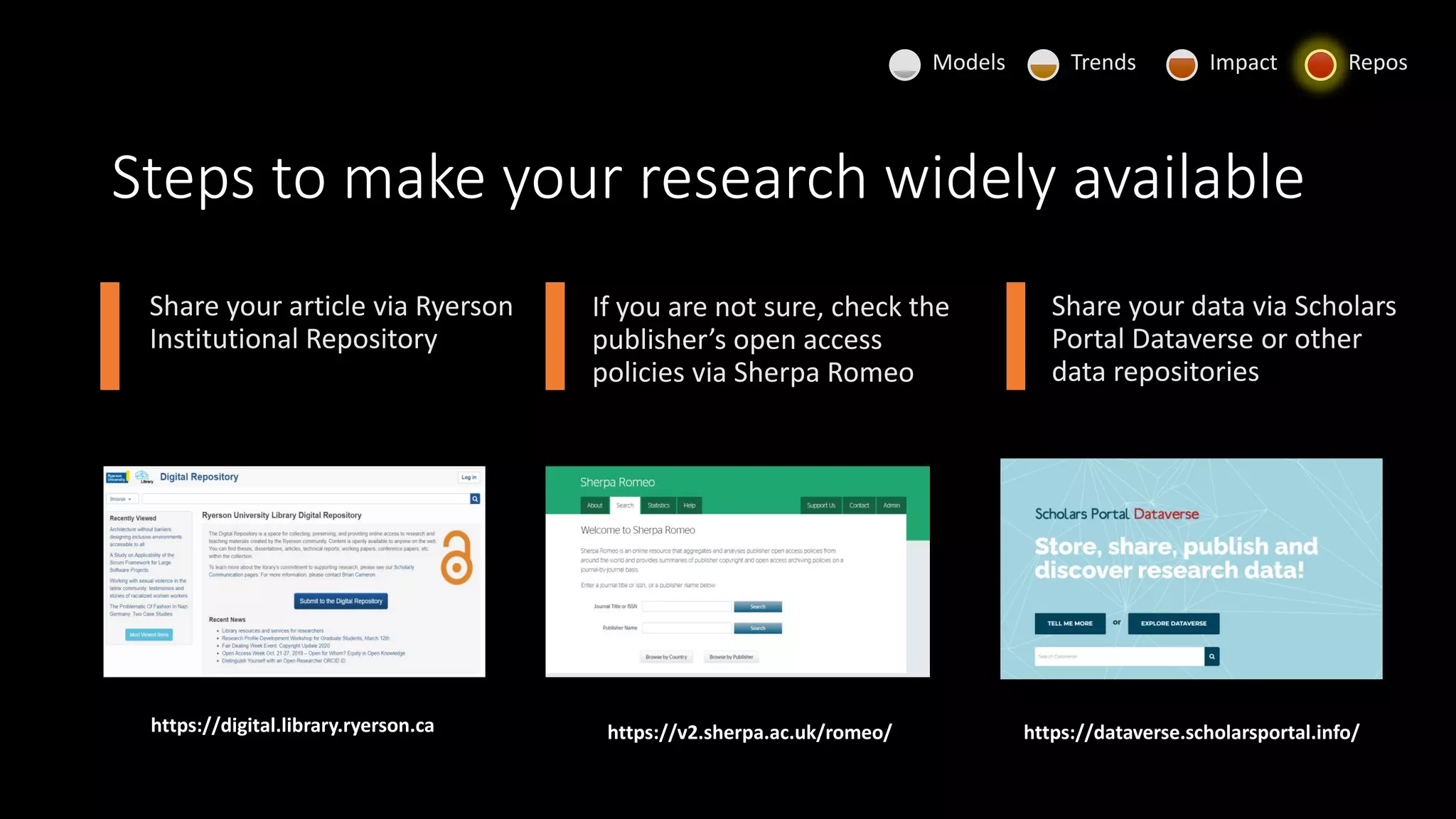
ideas and practices
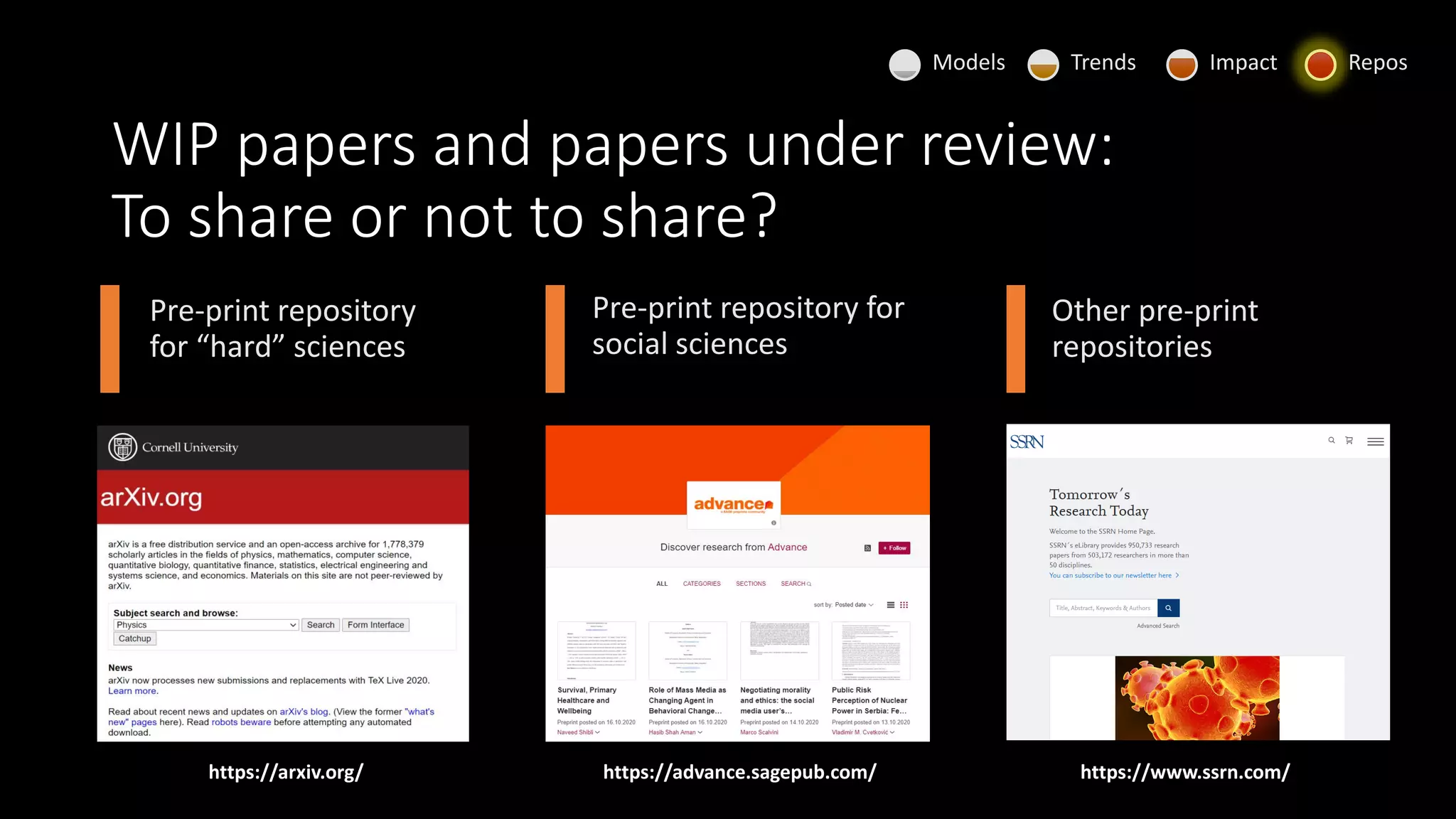
were accepted
immediately.
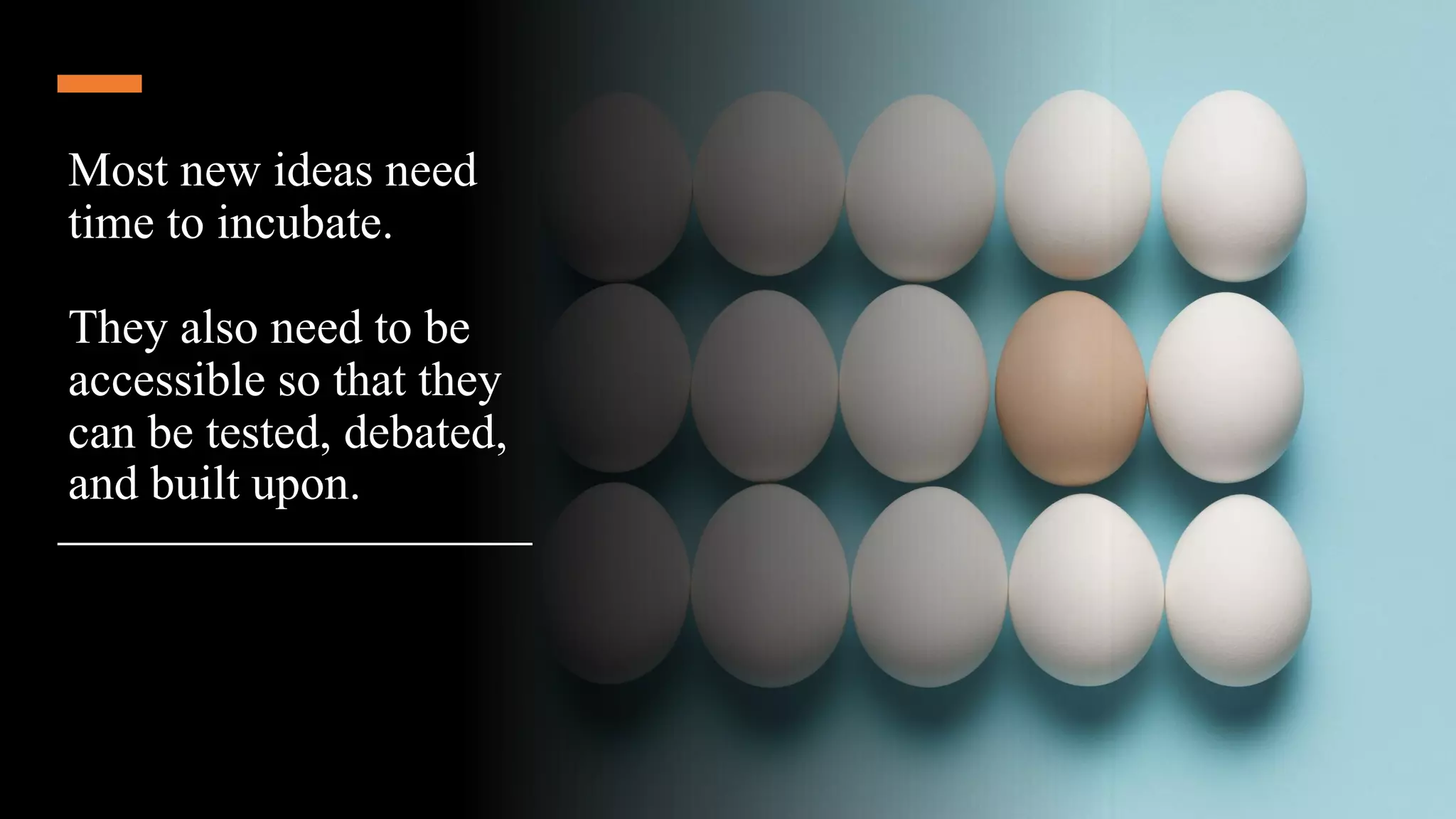
Most new ideas need
time to incubate.
They also need to be
accessible so that they
can be tested, debated,
and built upon.
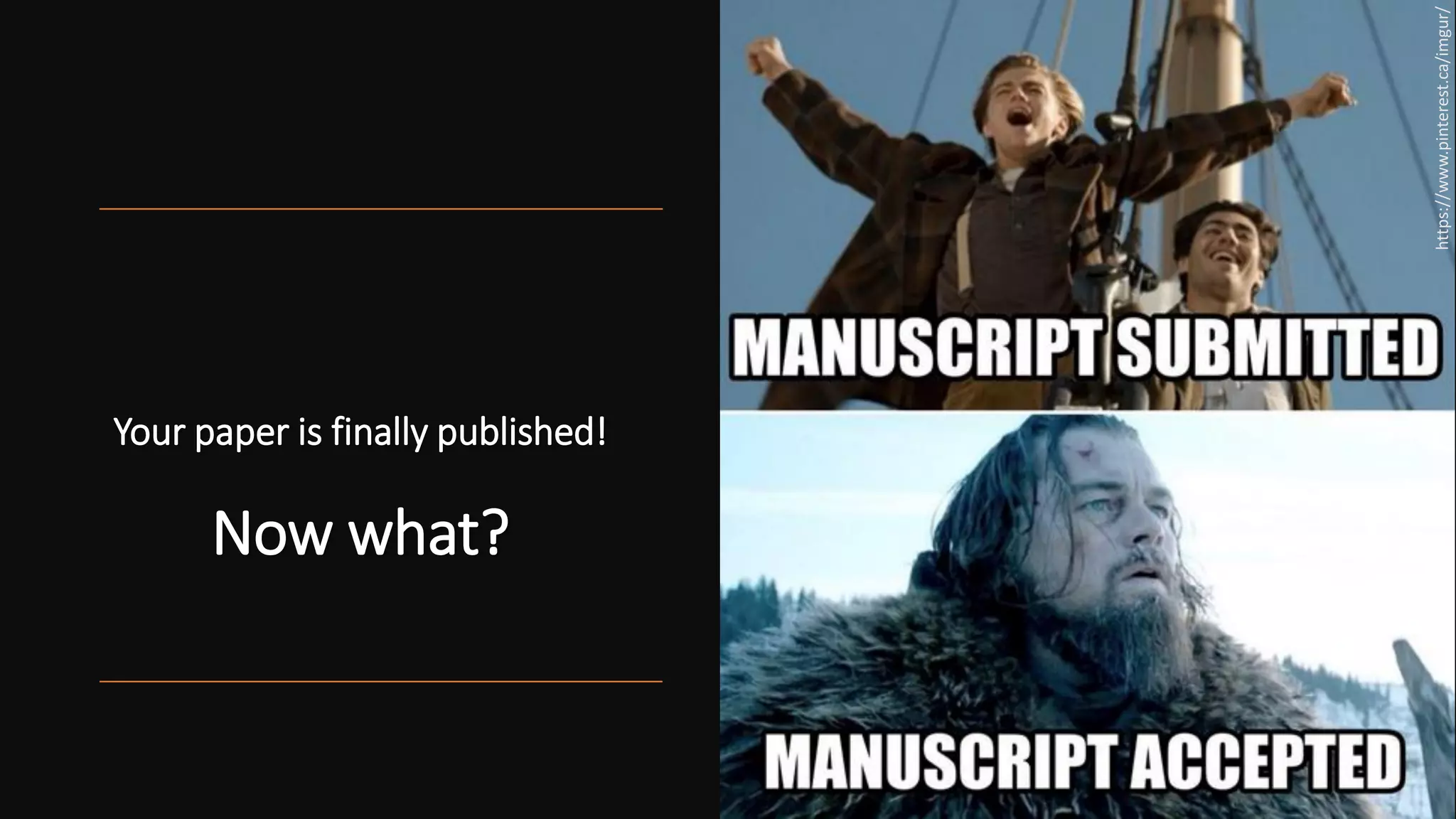
Your paper is finally published!
Now what?
https://www.pinterest.ca/imgur/
Disseminate your results
by making them as widely
available as possible
“Information does not put itself into practice.”
- @Phmai (Co-dir of Ryerson Social Media Lab)
1. Make your paper open access
2. Connect with peers & share your
paper on social media
Disseminate your results
by making them as widely
available as possible
Models Trends Impact Repositories
1. Make your paper open access
2. Connect with peers & share your
paper on social media
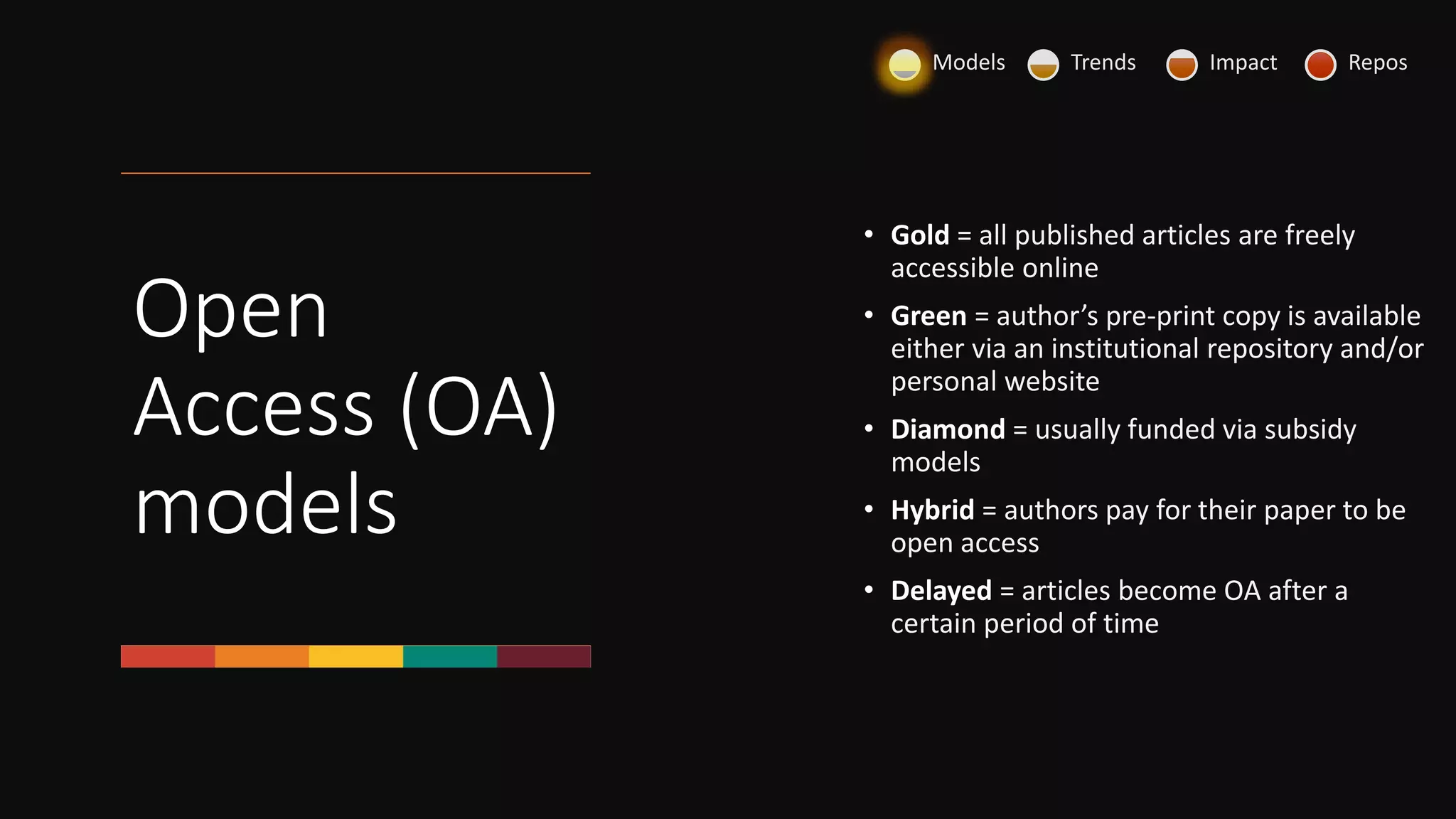
Open
Access (OA)
models
• Gold = all published articles are freely
accessible online
• Green = author’s pre-print copy is available
either via an institutional repository and/or
personal website
• Diamond = usually funded via subsidy
models
• Hybrid = authors pay for their paper to be
open access
• Delayed = articles become OA after a
certain period of time
Models Trends Impact Repos
Open
Access (OA)
models
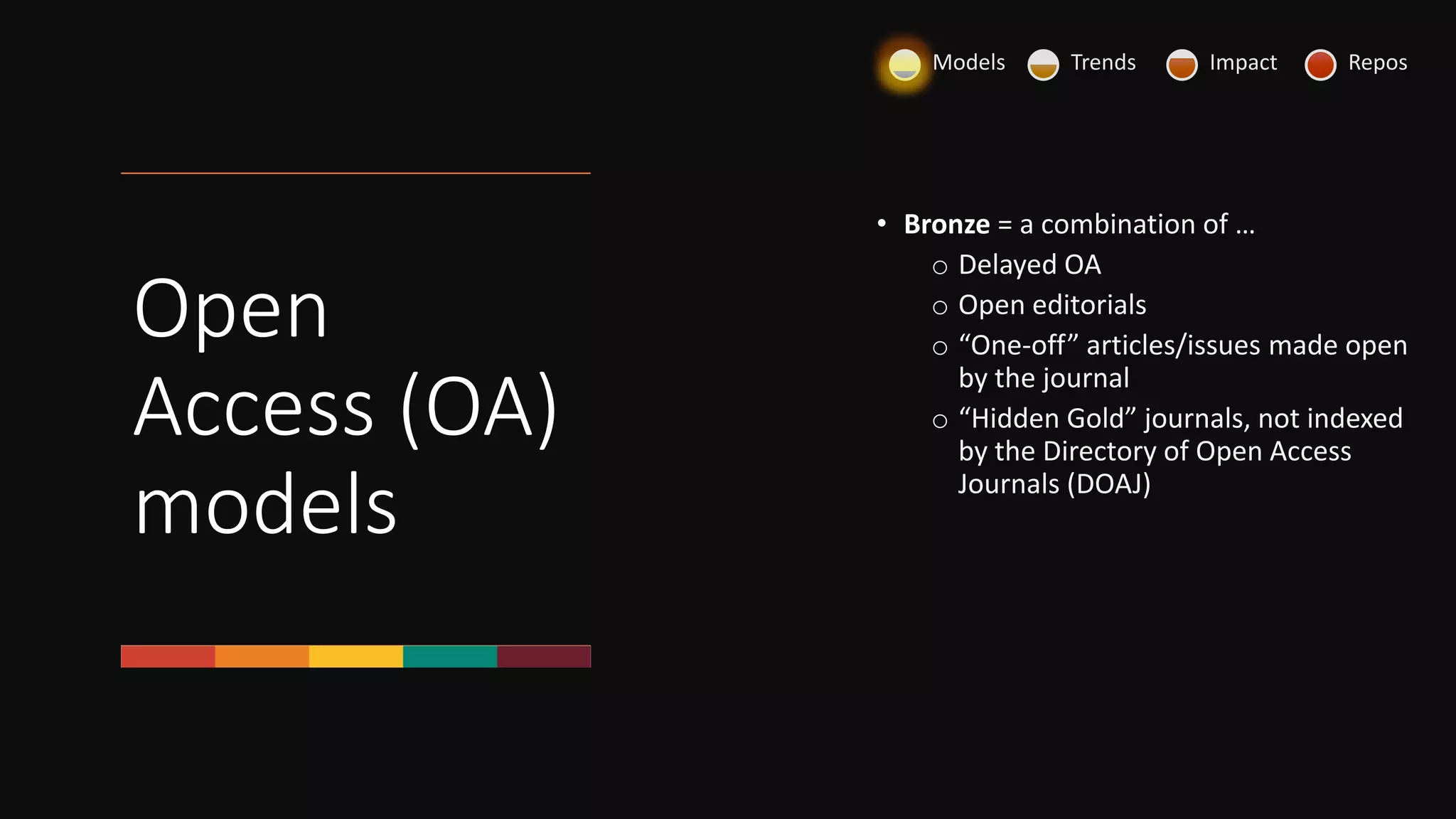
• Bronze = a combination of …
o Delayed OA
o Open editorials
o “One-off” articles/issues made open
by the journal
o “Hidden Gold” journals, not indexed
by the Directory of Open Access
Journals (DOAJ)
Models Trends Impact Repos
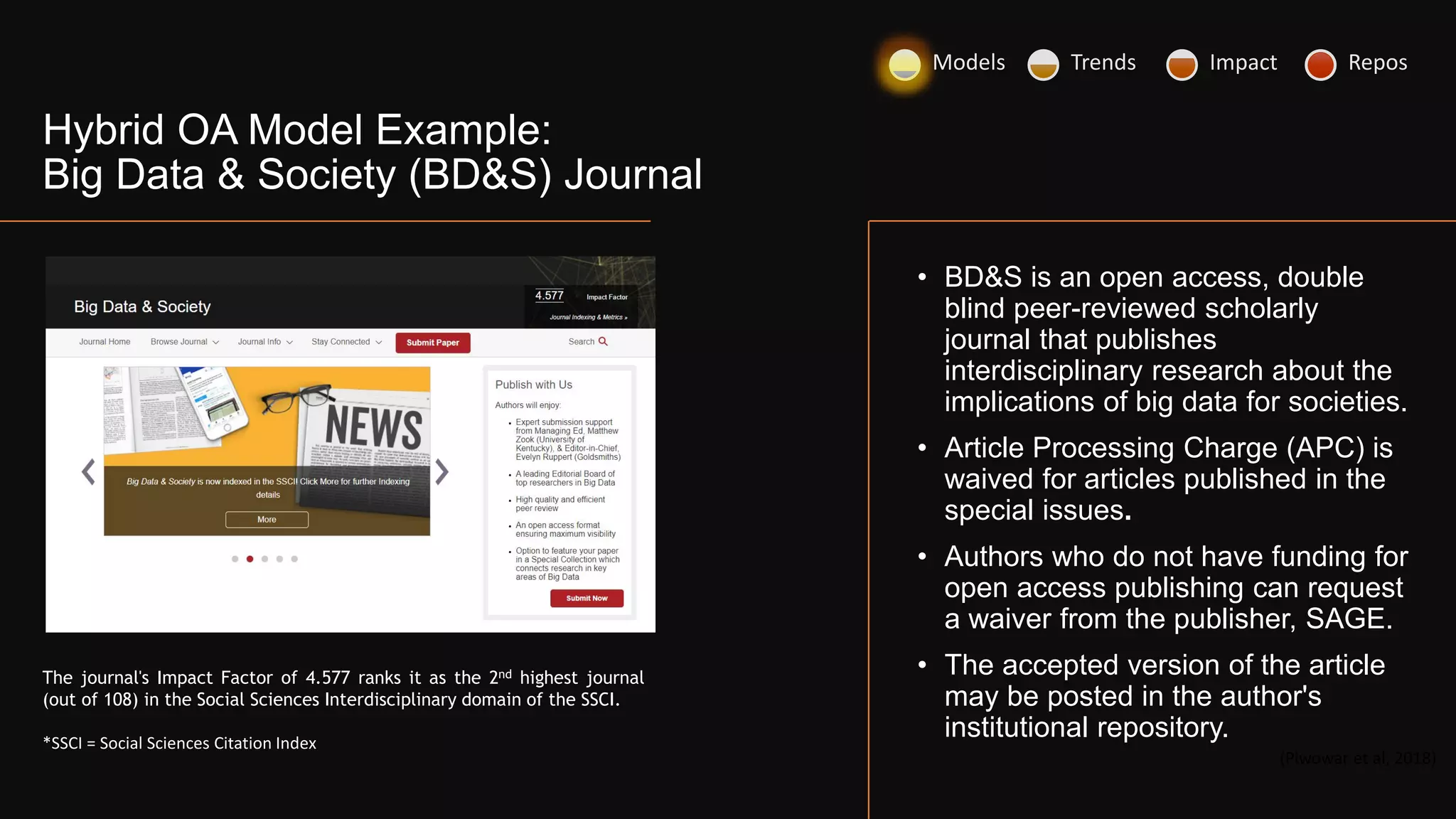
• BD&S is an open access, double
blind peer-reviewed scholarly
journal that publishes
interdisciplinary research about the
implications of big data for societies.
• Article Processing Charge (APC) is
waived for articles published in the
special issues.
• Authors who do not have funding for
open access publishing can request
a waiver from the publisher, SAGE.
• The accepted version of the article
may be posted in the author's
institutional repository.
(Piwowar et al, 2018)
The journal's Impact Factor of 4.577 ranks it as the 2nd highest journal
(out of 108) in the Social Sciences Interdisciplinary domain of the SSCI.
*SSCI = Social Sciences Citation Index
Hybrid OA Model Example:
Big Data & Society (BD&S) Journal
Models Trends Impact Repos
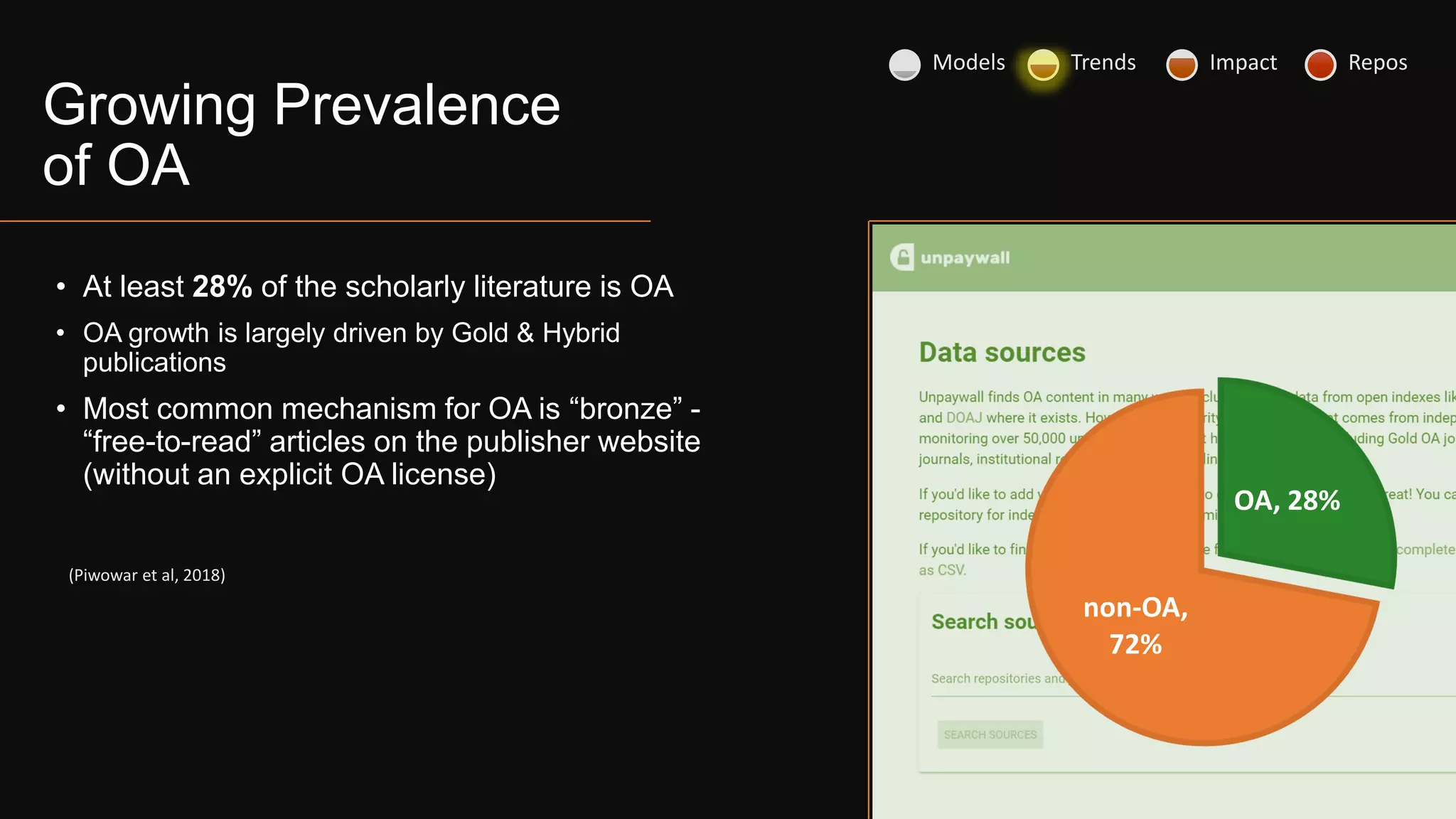
Growing Prevalence
of OA
• At least 28% of the scholarly literature is OA
• OA growth is largely driven by Gold & Hybrid
publications
• Most common mechanism for OA is “bronze” -
“free-to-read” articles on the publisher website
(without an explicit OA license)
OA, 28%
non-OA,
72%
(Piwowar et al, 2018)
Models Trends Impact Repos
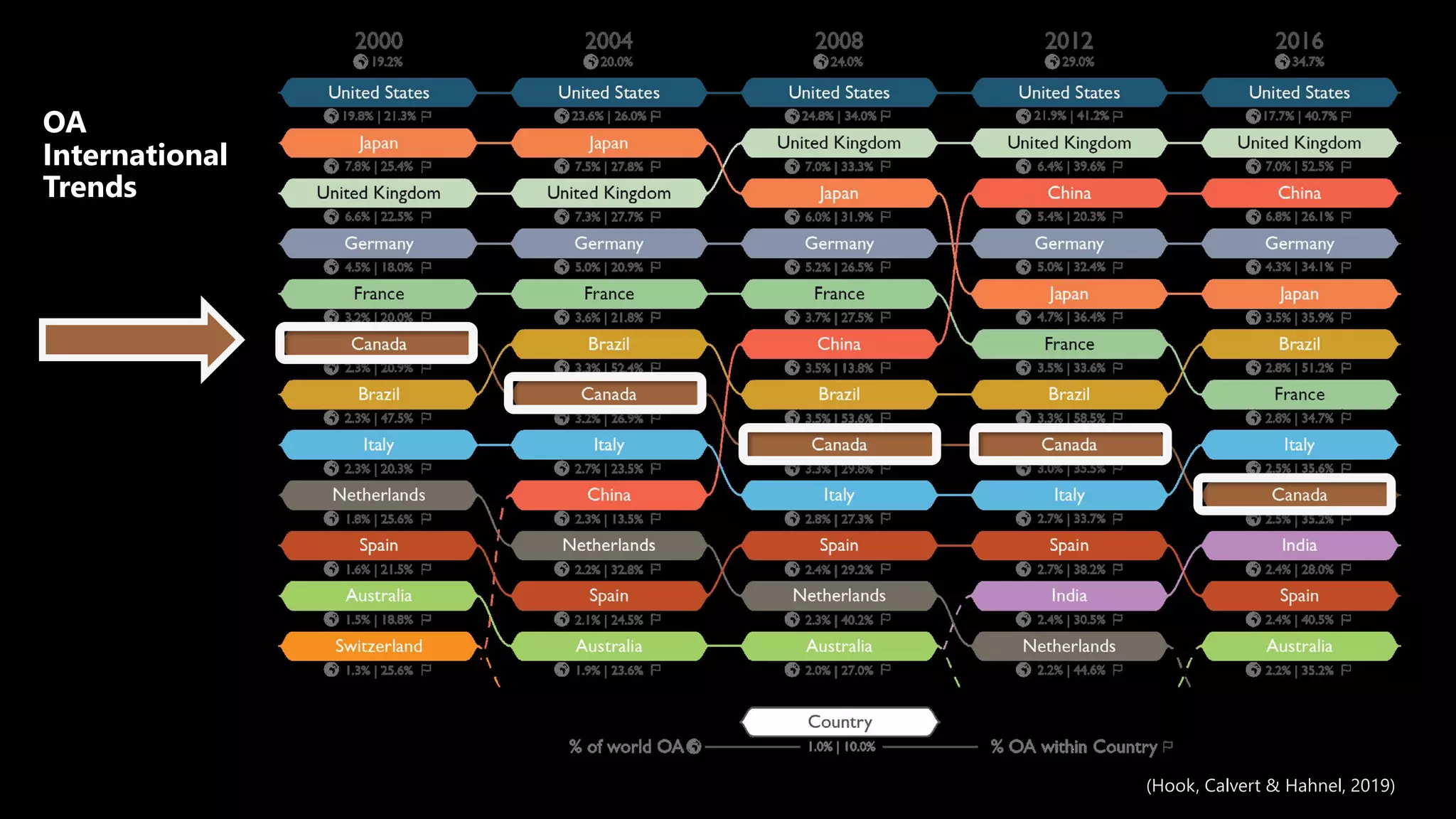
OA
International
Trends
(Hook, Calvert & Hahnel, 2019)
Scholarly Impact of
OA vs non-OA
• Overall, OA articles receive 18% more
citations than average, when accounting
for age and discipline (Piwowar et al, 2018)
• Medicine: “although non-OA journals still
have higher output in terms of articles per
year, OA journals have higher citation
metrics.” (AlRyalat, et.al., 2019)
• Civil Engineering: “On average OA
articles received 43 citations while Non-OA
articles were cited 29 times” (Koler-Povh,
Južnič, Turk, 2014)
Models Trends Impact Repos
More funding agencies
are now requiring OA
• Tri-Agency Open Access Policy on
Publications
• Grant recipients archive the final peer-
reviewed full-text manuscript in an online
repository where it will be freely
accessible within 12 months (e.g.,
institutional repository or discipline-based
repository).
• Grant recipients can publish in a journal
that offers open access or that offers
open access on its website within 12
months.
• http://www.science.gc.ca/eic/site/063.nsf/
eng/h_F6765465.html?OpenDocument
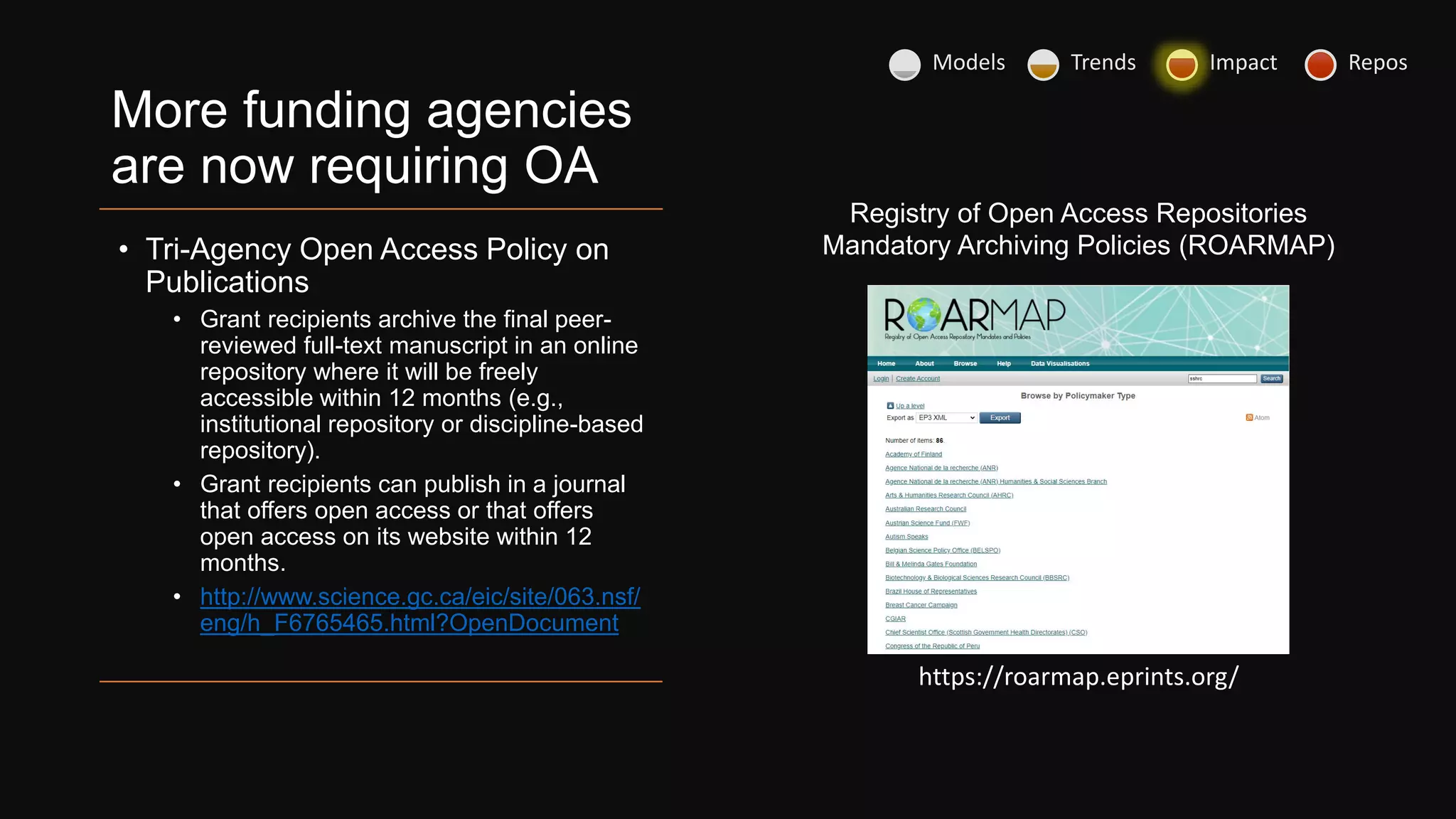
https://roarmap.eprints.org/
Registry of Open Access Repositories
Mandatory Archiving Policies (ROARMAP)
Models Trends Impact Repos
Steps to make your research widely available
Share your article via Ryerson
Institutional Repository
If you are not sure, check the
publisher’s open access
policies via Sherpa Romeo
Share your data via Scholars
Portal Dataverse or other
data repositories
https://digital.library.ryerson.ca https://v2.sherpa.ac.uk/romeo/ https://dataverse.scholarsportal.info/
Models Trends Impact Repos
WIP papers and papers under review:
To share or not to share?
Pre-print repository
for “hard” sciences
Pre-print repository for
social sciences
Other pre-print
repositories
https://arxiv.org/ https://advance.sagepub.com/ https://www.ssrn.com/
Models Trends Impact Repos
Disseminate your results
by making them as widely
available as possible
1. Make your paper open access
2. Connect with peers & share your
paper on social media
Scholarly
Communication
Social Media for
Academics Benefits Altmetrics
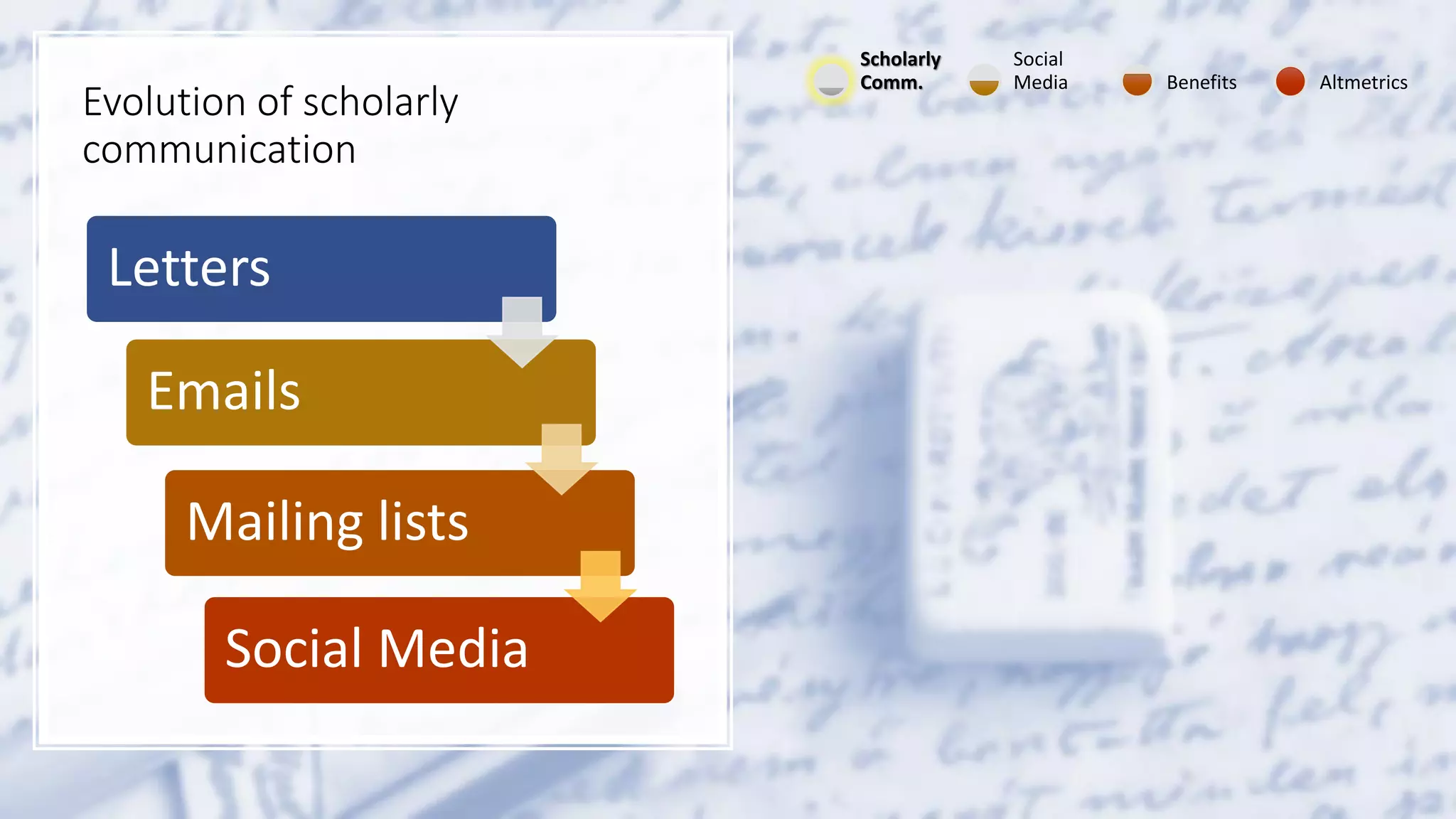
Evolution of scholarly
communication
Letters
Emails
Mailing lists
Social Media
Scholarly
Comm.
Social
Media Benefits Altmetrics
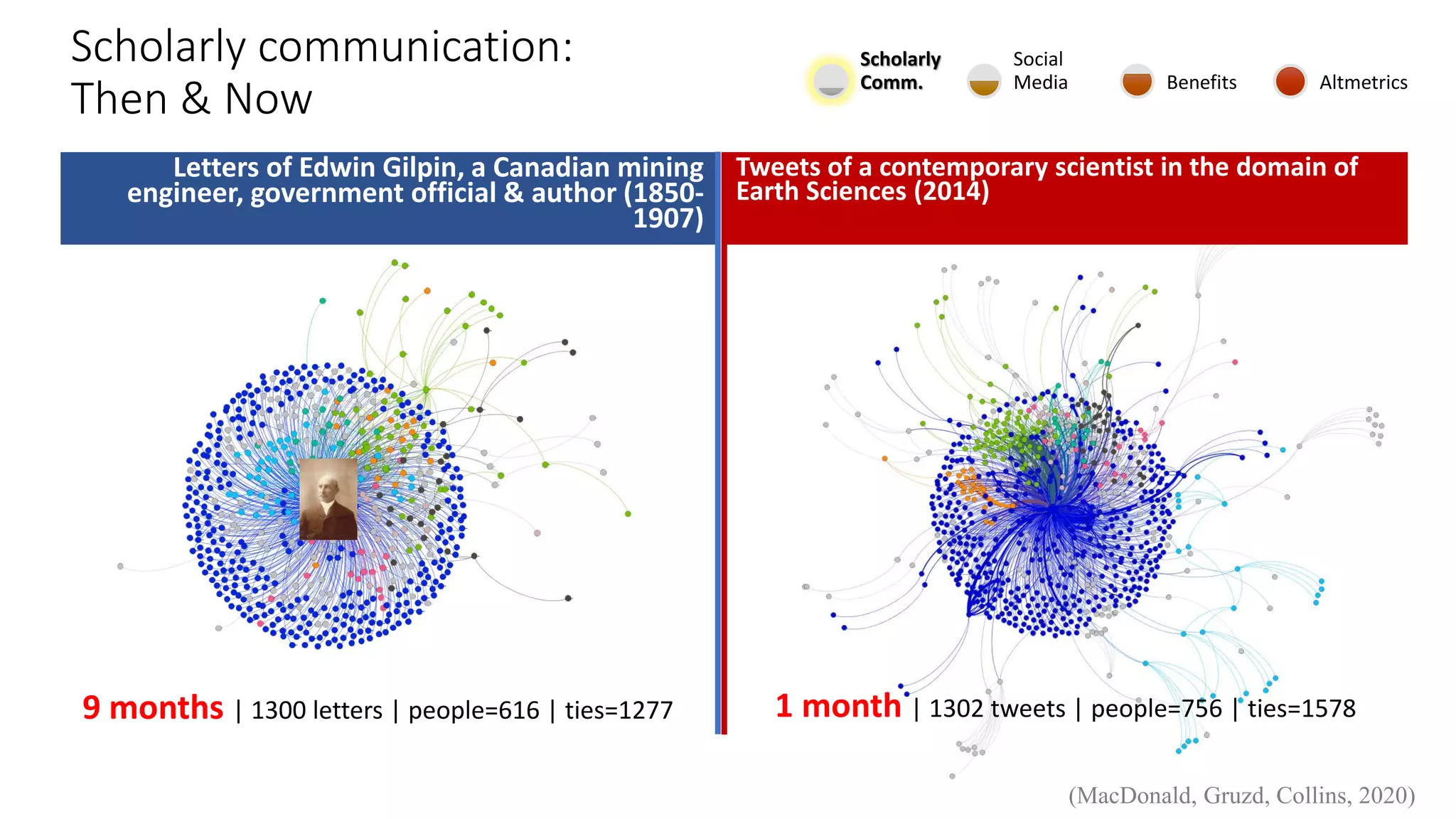
Scholarly communication:
Then & Now
Letters of Edwin Gilpin, a Canadian mining
engineer, government official & author (1850-
1907)
Tweets of a contemporary scientist in the domain of
Earth Sciences (2014)
(MacDonald, Gruzd, Collins, 2020)
9 months | 1300 letters | people=616 | ties=1277 1 month | 1302 tweets | people=756 | ties=1578
Scholarly
Comm.
Social
Media Benefits Altmetrics
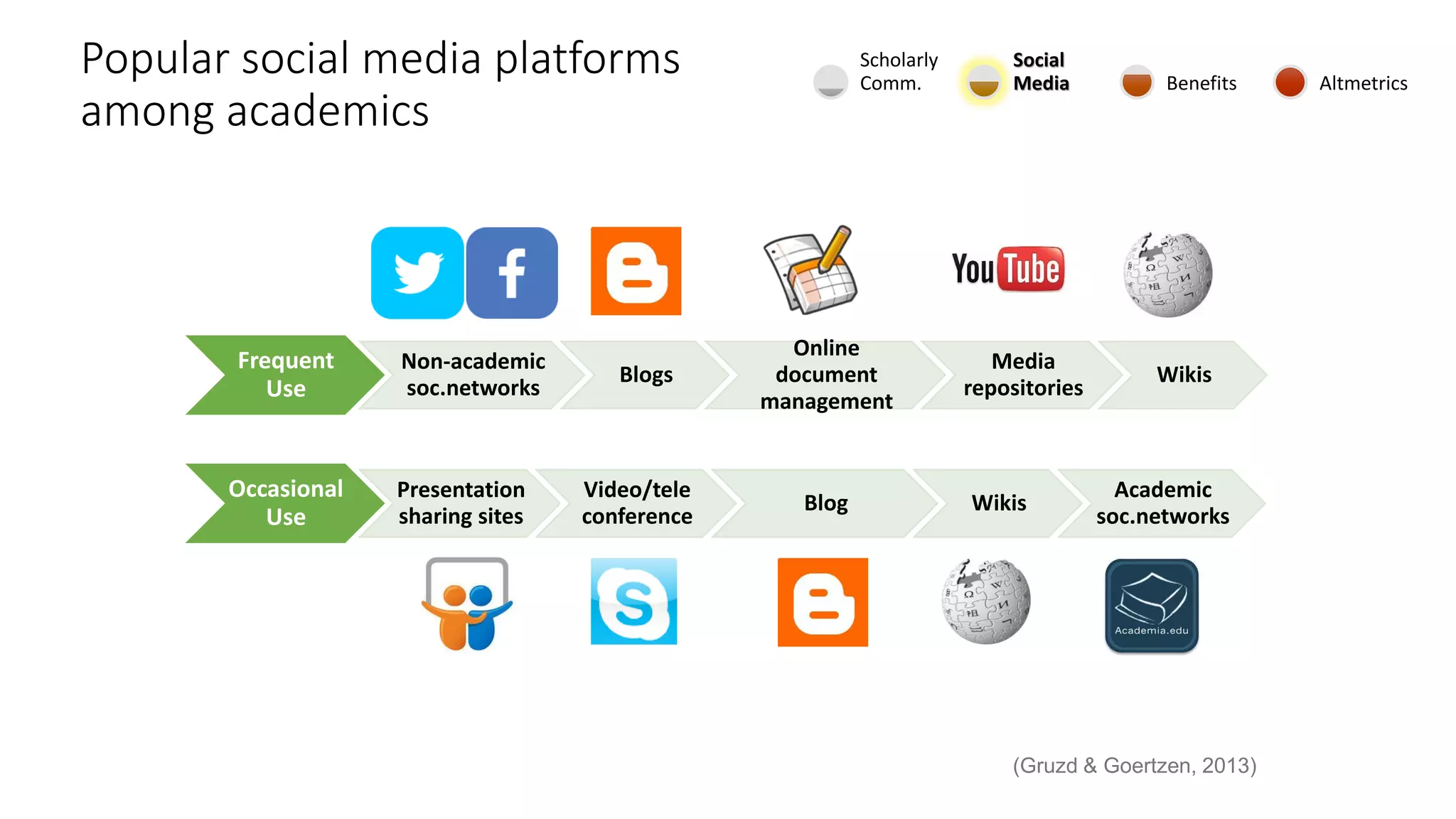
Popular social media platforms
among academics
Frequent
Use
Non-academic
soc.networks
Blogs
Online
document
management
Media
repositories
Wikis
Occasional
Use
Presentation
sharing sites
Video/tele
conference
Blog Wikis
Academic
soc.networks
(Gruzd & Goertzen, 2013)
Scholarly
Comm.
Social
Media Benefits Altmetrics
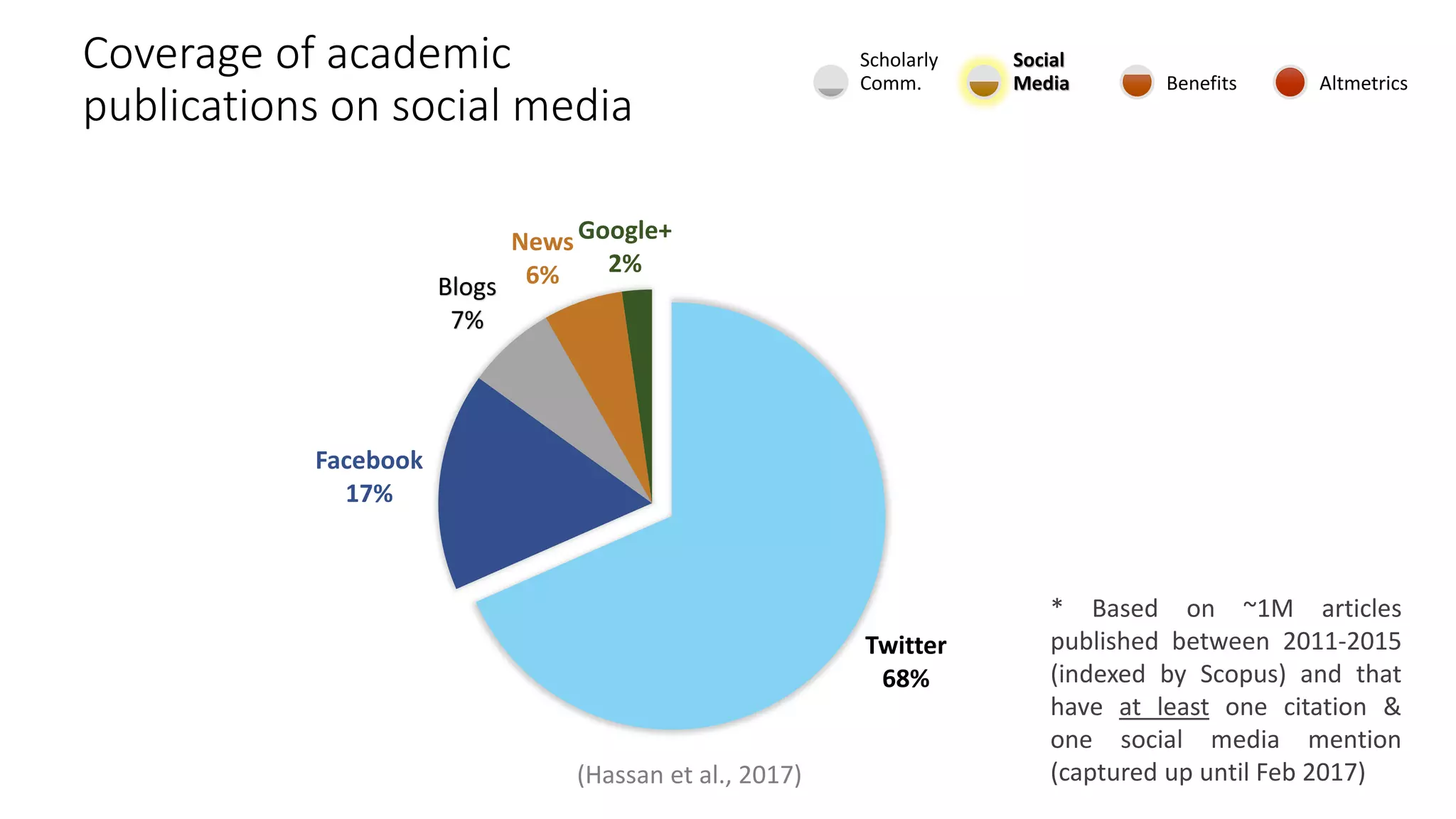
Coverage of academic
publications on social media
Twitter
68%
Facebook
17%
Blogs
7%
News
6%
Google+
2%
* Based on ~1M articles
published between 2011-2015
(indexed by Scopus) and that
have at least one citation &
one social media mention
(captured up until Feb 2017)(Hassan et al., 2017)
Scholarly
Comm.
Social
Media Benefits Altmetrics
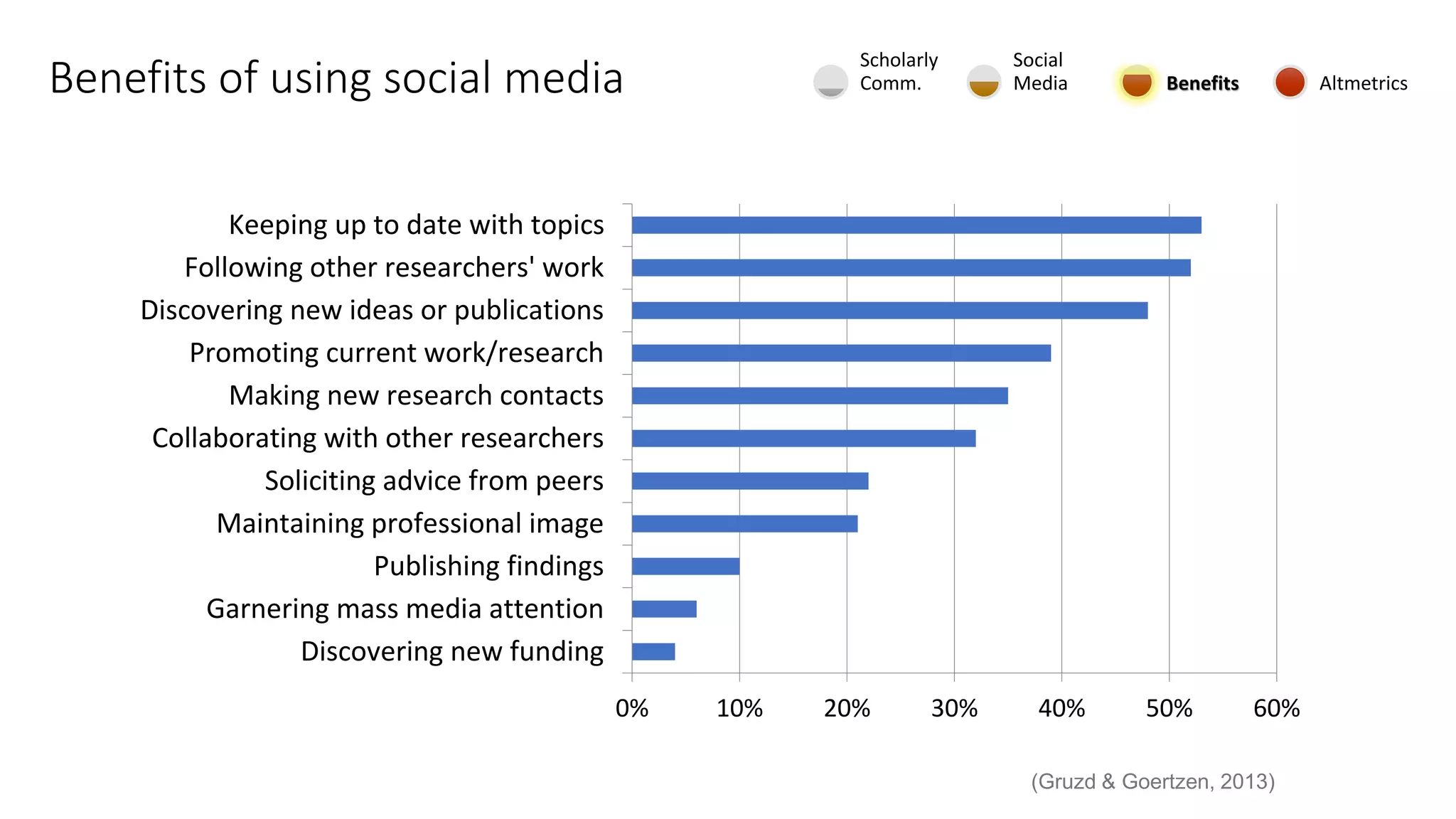
Benefits of using social media
0% 10% 20% 30% 40% 50% 60%
Discovering new funding
Garnering mass media attention
Publishing findings
Maintaining professional image
Soliciting advice from peers
Collaborating with other researchers
Making new research contacts
Promoting current work/research
Discovering new ideas or publications
Following other researchers' work
Keeping up to date with topics
Scholarly
Comm.
Social
Media Benefits Altmetrics
(Gruzd & Goertzen, 2013)
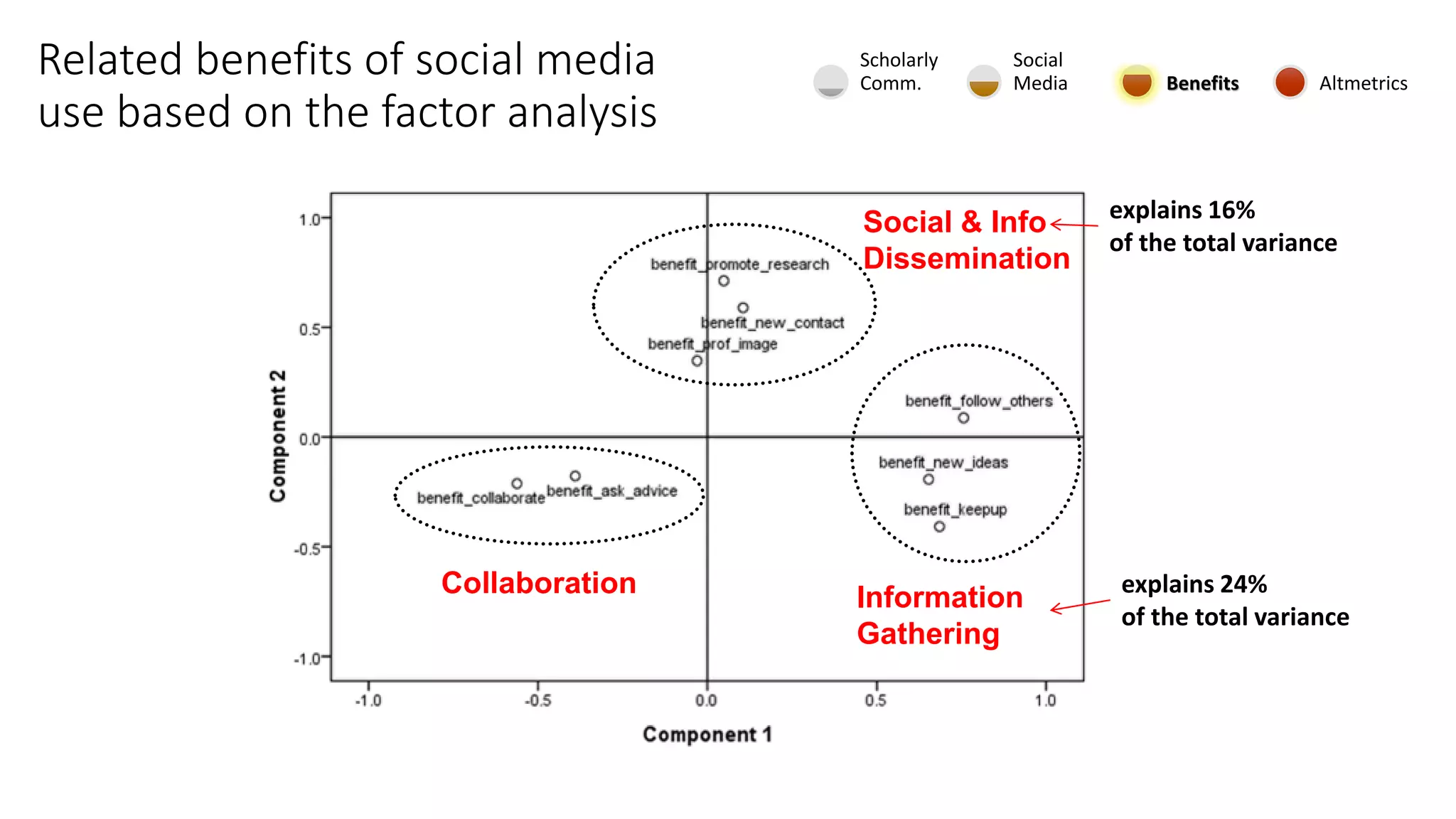
Related benefits of social media
use based on the factor analysis
Social & Info
Dissemination
Information
Gathering
Collaboration explains 24%
of the total variance
explains 16%
of the total variance
Scholarly
Comm.
Social
Media Benefits Altmetrics
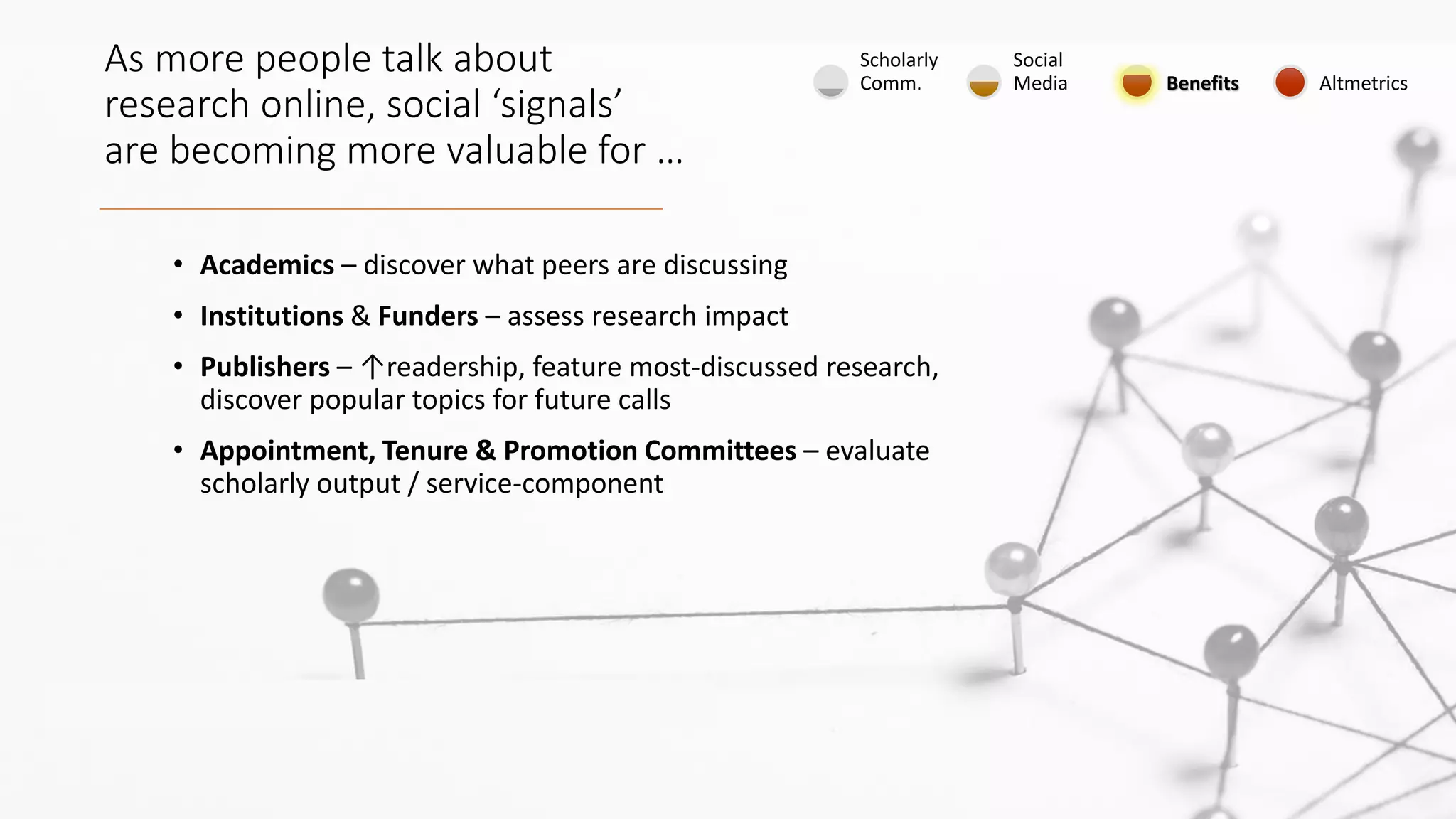
As more people talk about
research online, social ‘signals’
are becoming more valuable for …
• Academics – discover what peers are discussing
• Institutions & Funders – assess research impact
• Publishers – ↑readership, feature most-discussed research,
discover popular topics for future calls
• Appointment, Tenure & Promotion Committees – evaluate
scholarly output / service-component
Scholarly
Comm.
Social
Media Benefits Altmetrics
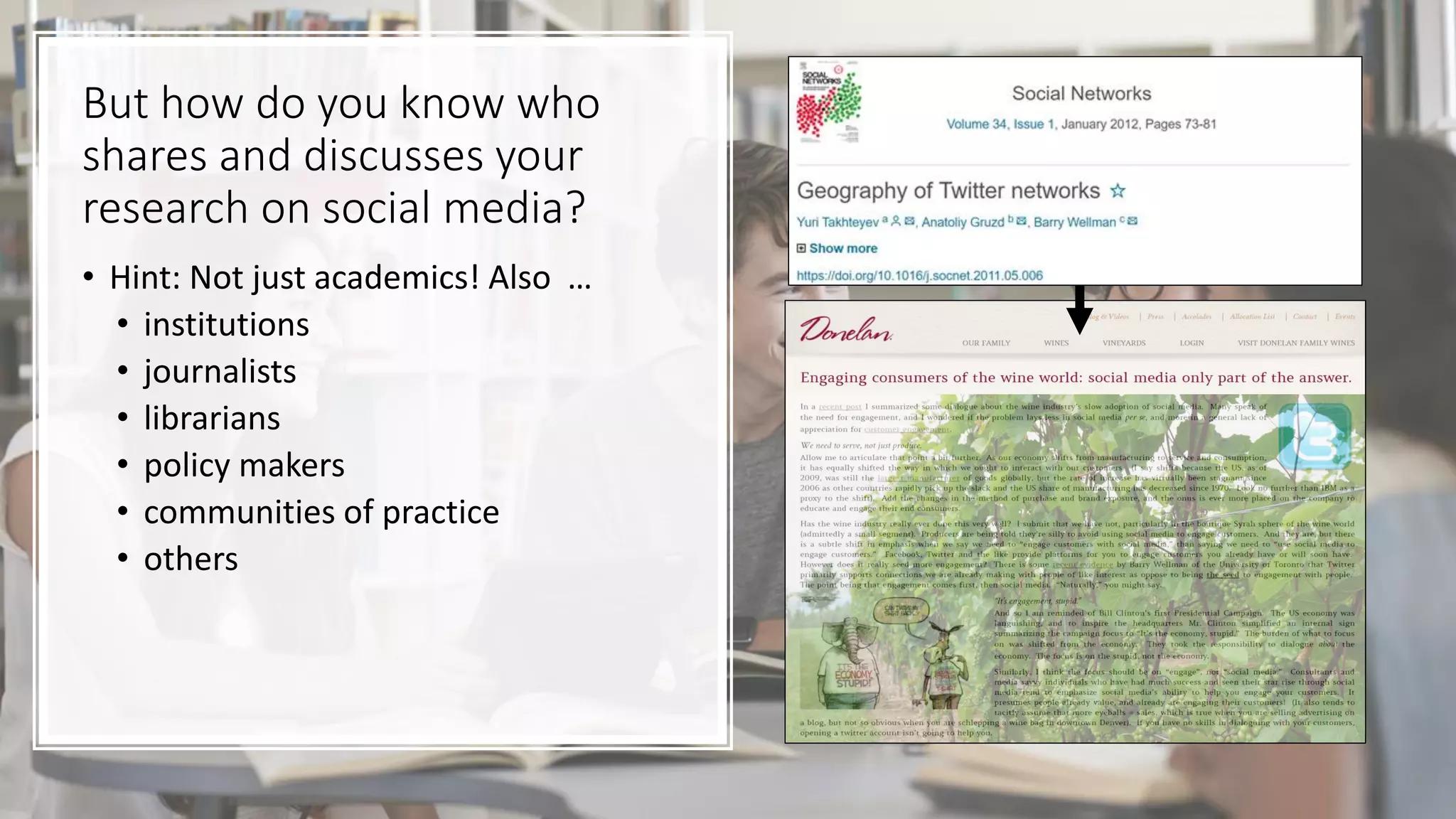
But how do you know who
shares and discusses your
research on social media?
• Hint: Not just academics! Also …
• institutions
• journalists
• librarians
• policy makers
• communities of practice
• others
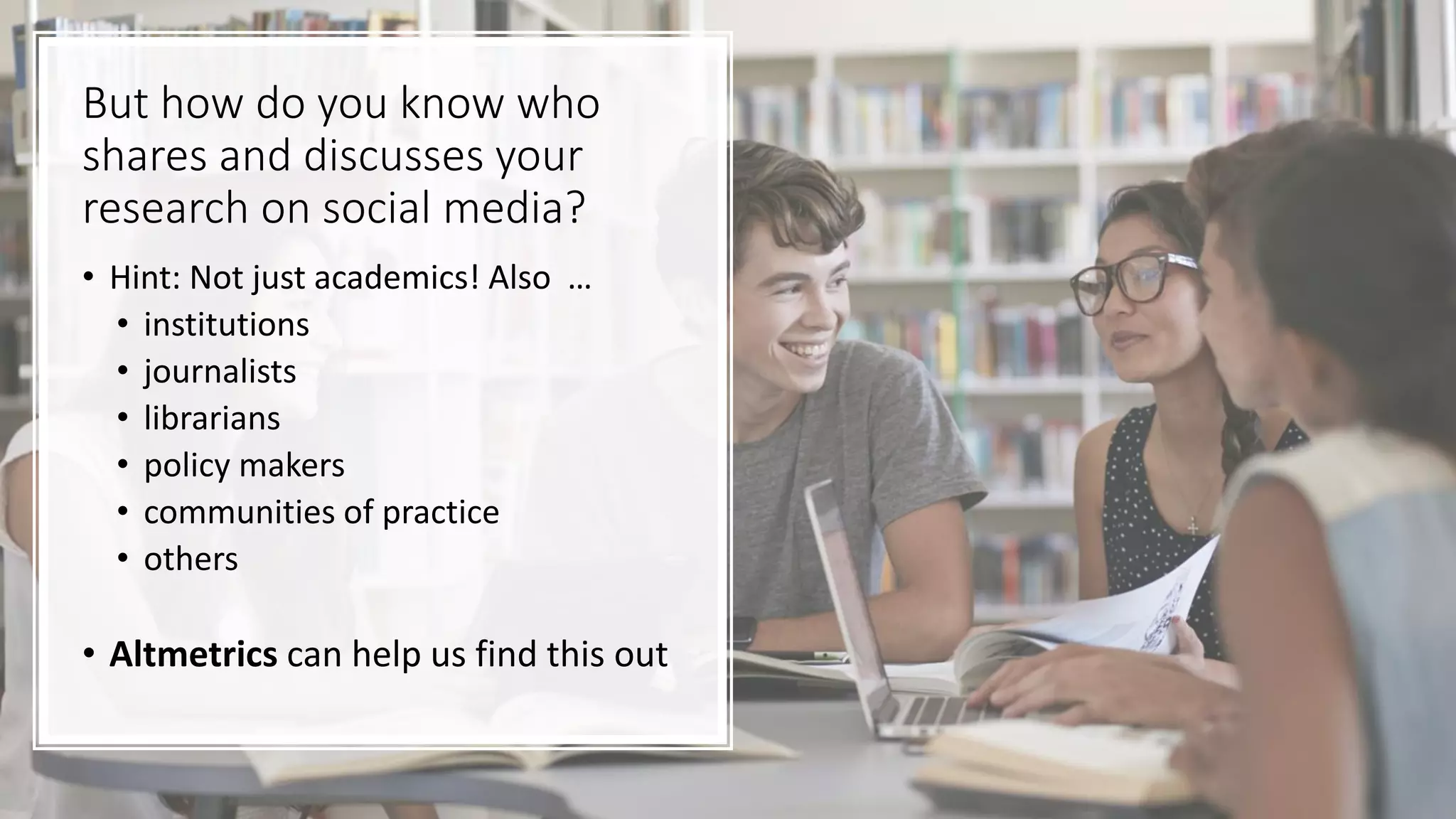
But how do you know who
shares and discusses your
research on social media?
• Hint: Not just academics! Also …
• institutions
• journalists
• librarians
• policy makers
• communities of practice
• others
• Altmetrics can help us find this out
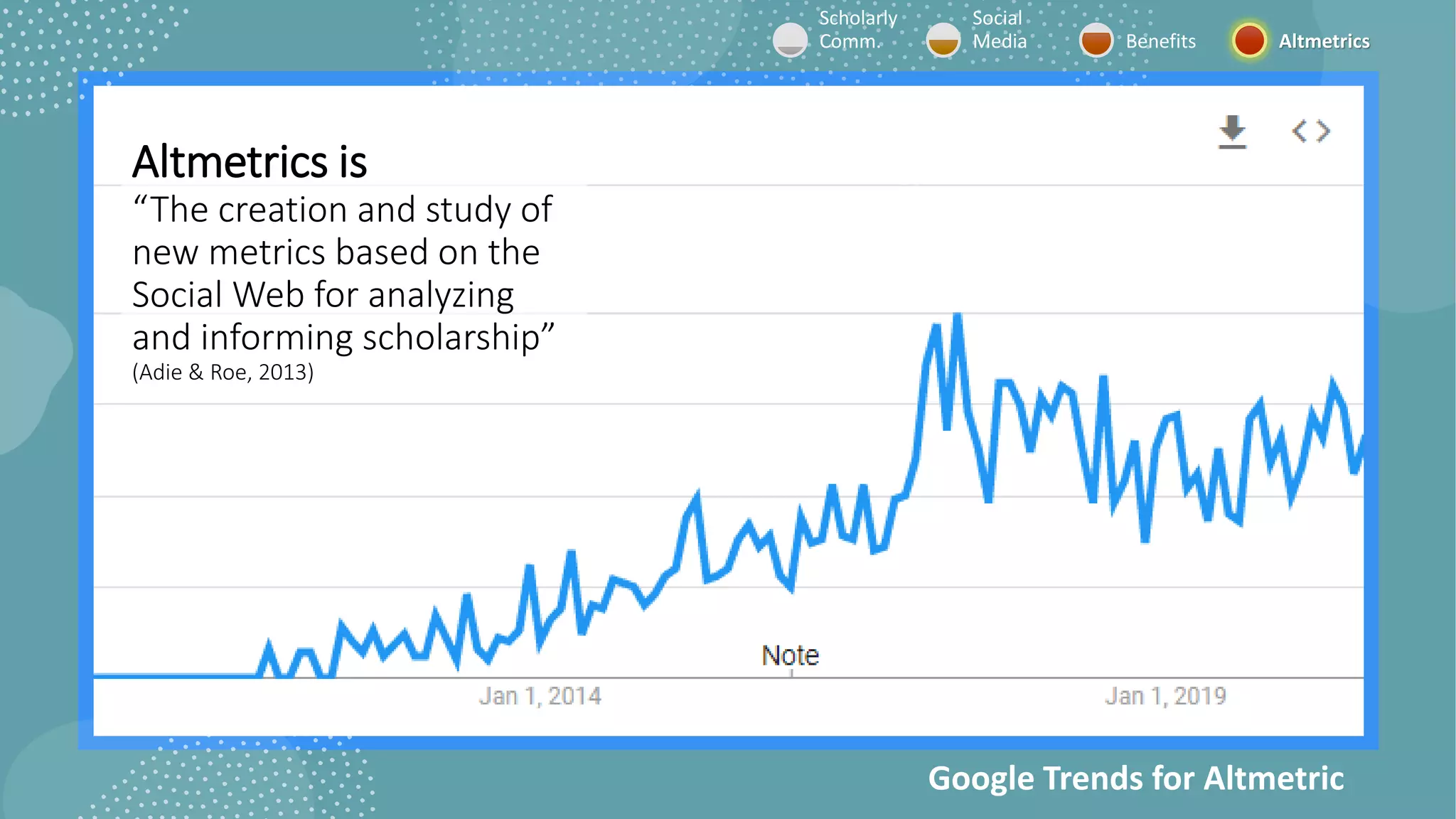
Altmetrics is
“The creation and study of
new metrics based on the
Social Web for analyzing
and informing scholarship”
(Adie & Roe, 2013)
Google Trends for Altmetric
Scholarly
Comm.
Social
Media Benefits Altmetrics
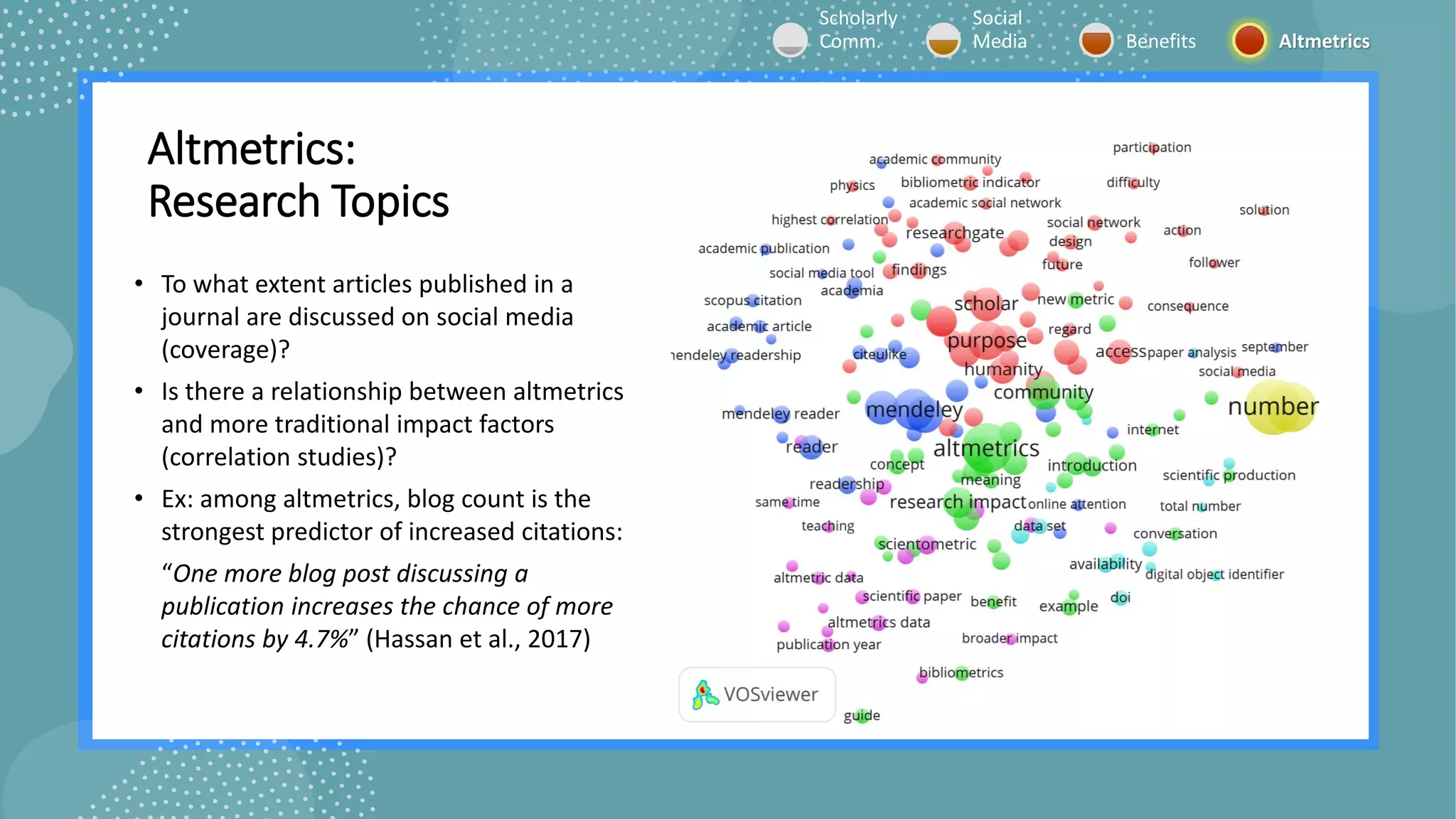
Altmetrics:
Research Topics
• To what extent articles published in a
journal are discussed on social media
(coverage)?
• Is there a relationship between altmetrics
and more traditional impact factors
(correlation studies)?
• Ex: among altmetrics, blog count is the
strongest predictor of increased citations:
“One more blog post discussing a
publication increases the chance of more
citations by 4.7%” (Hassan et al., 2017)
Scholarly
Comm.
Social
Media Benefits Altmetrics
Scholarly
Comm.
Social
Media Benefits Altmetrics
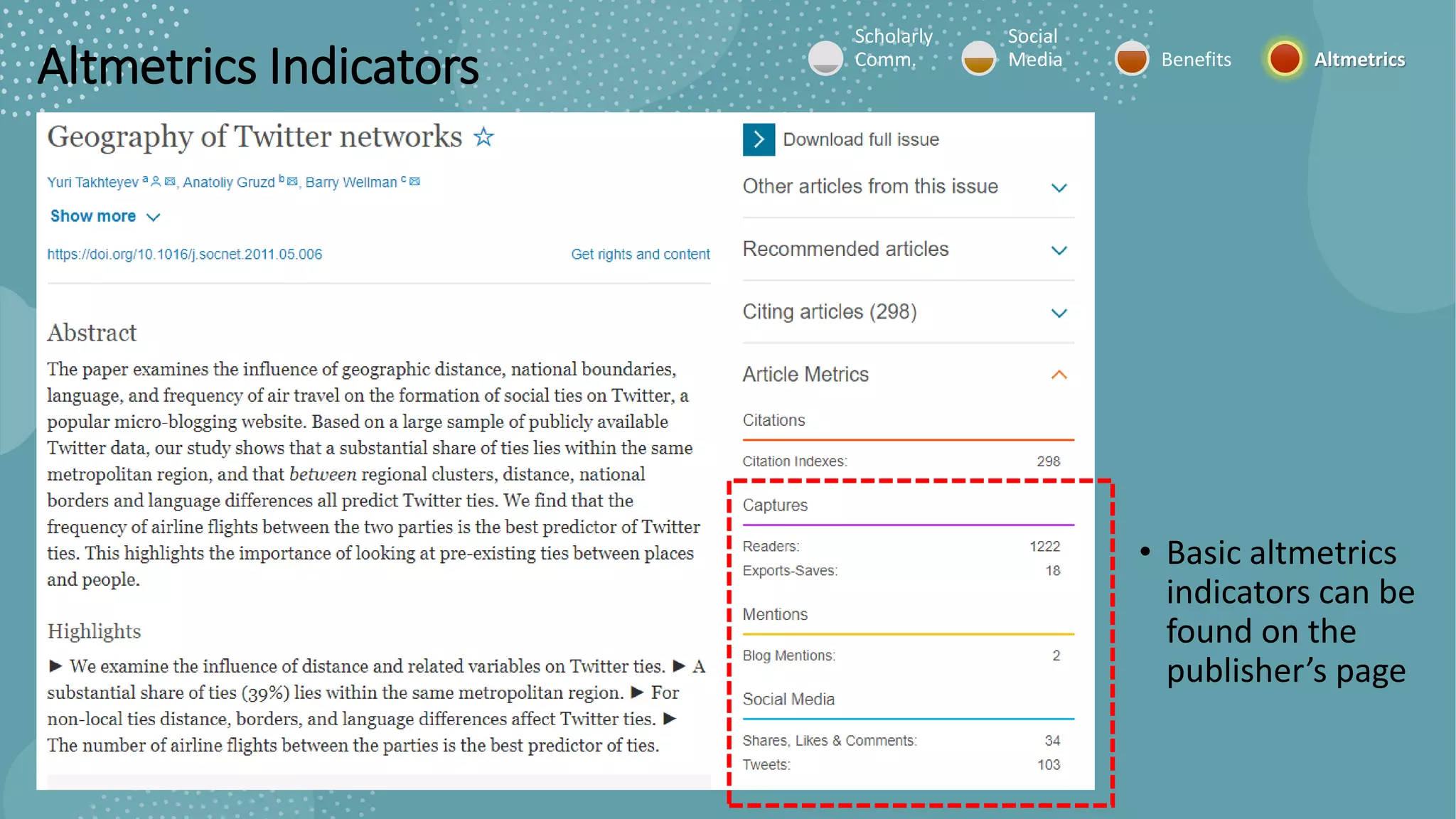
Altmetrics Indicators
• Basic altmetrics
indicators can be
found on the
publisher’s page
Scholarly
Comm.
Social
Media Benefits Altmetrics
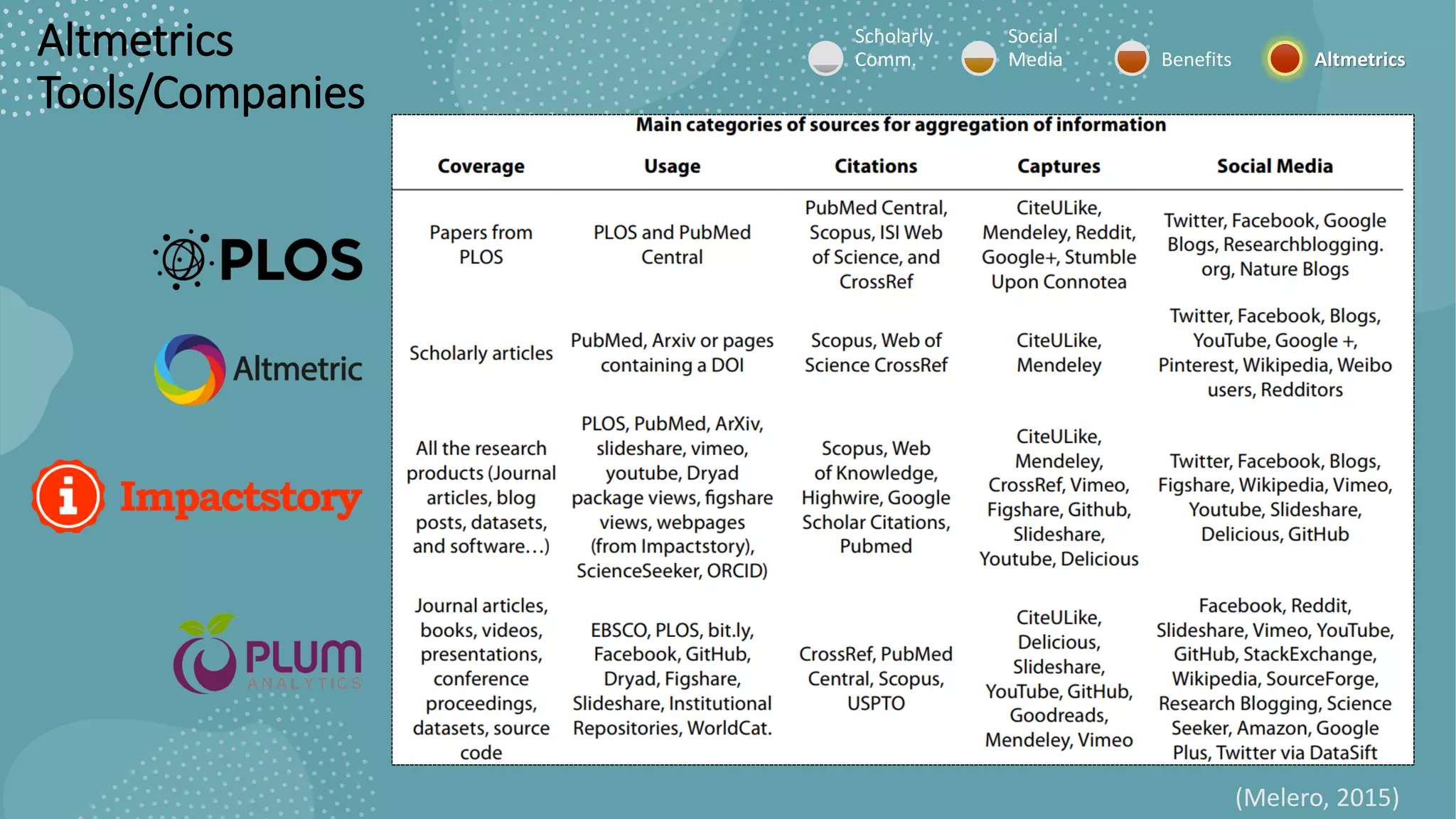
(Melero, 2015)
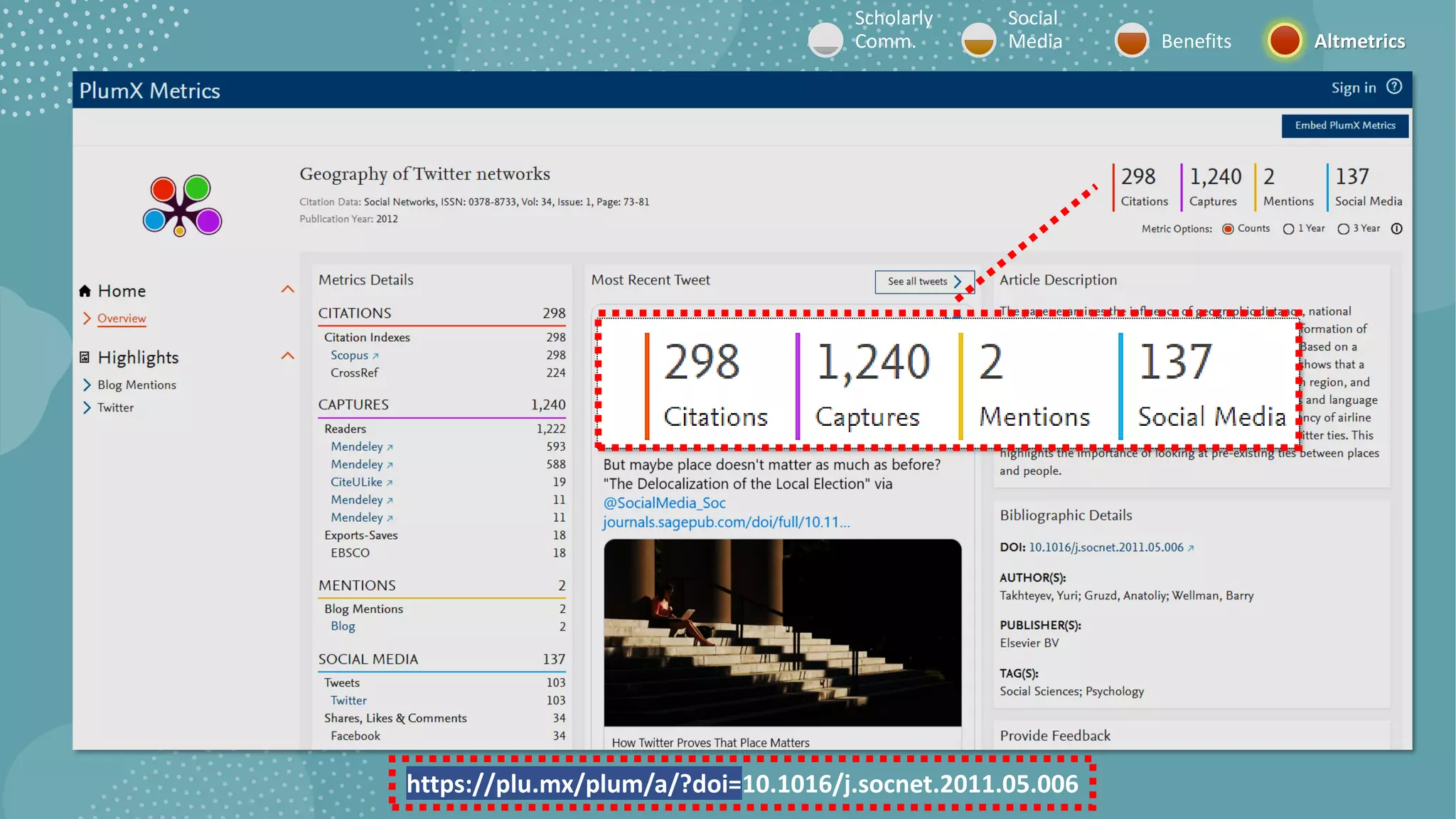
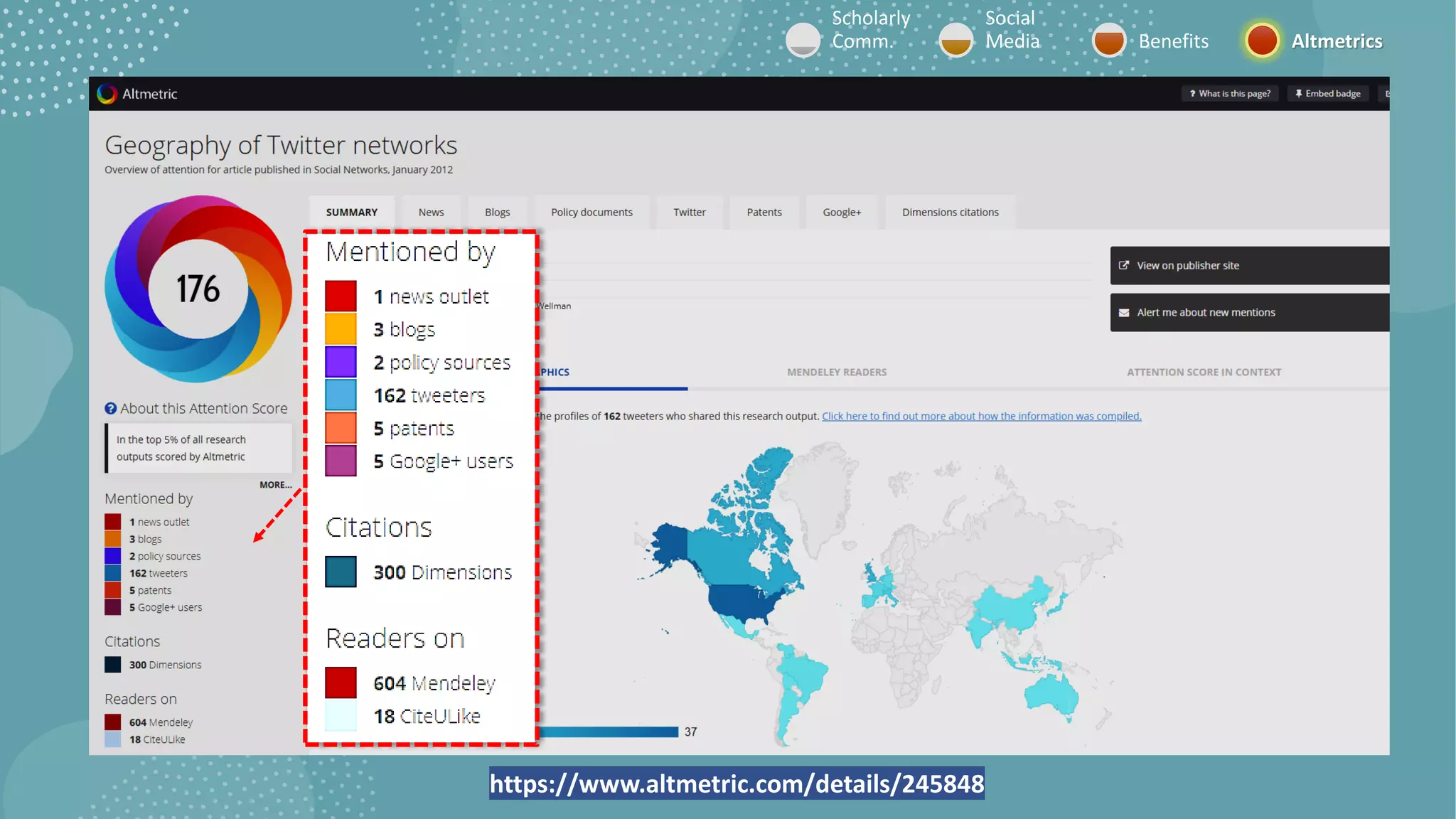
Altmetrics
Tools/Companies
https://plu.mx/plum/a/?doi=10.1016/j.socnet.2011.05.006
Scholarly
Comm.
Social
Media Benefits Altmetrics
https://www.altmetric.com/details/245848
Scholarly
Comm.
Social
Media Benefits Altmetrics
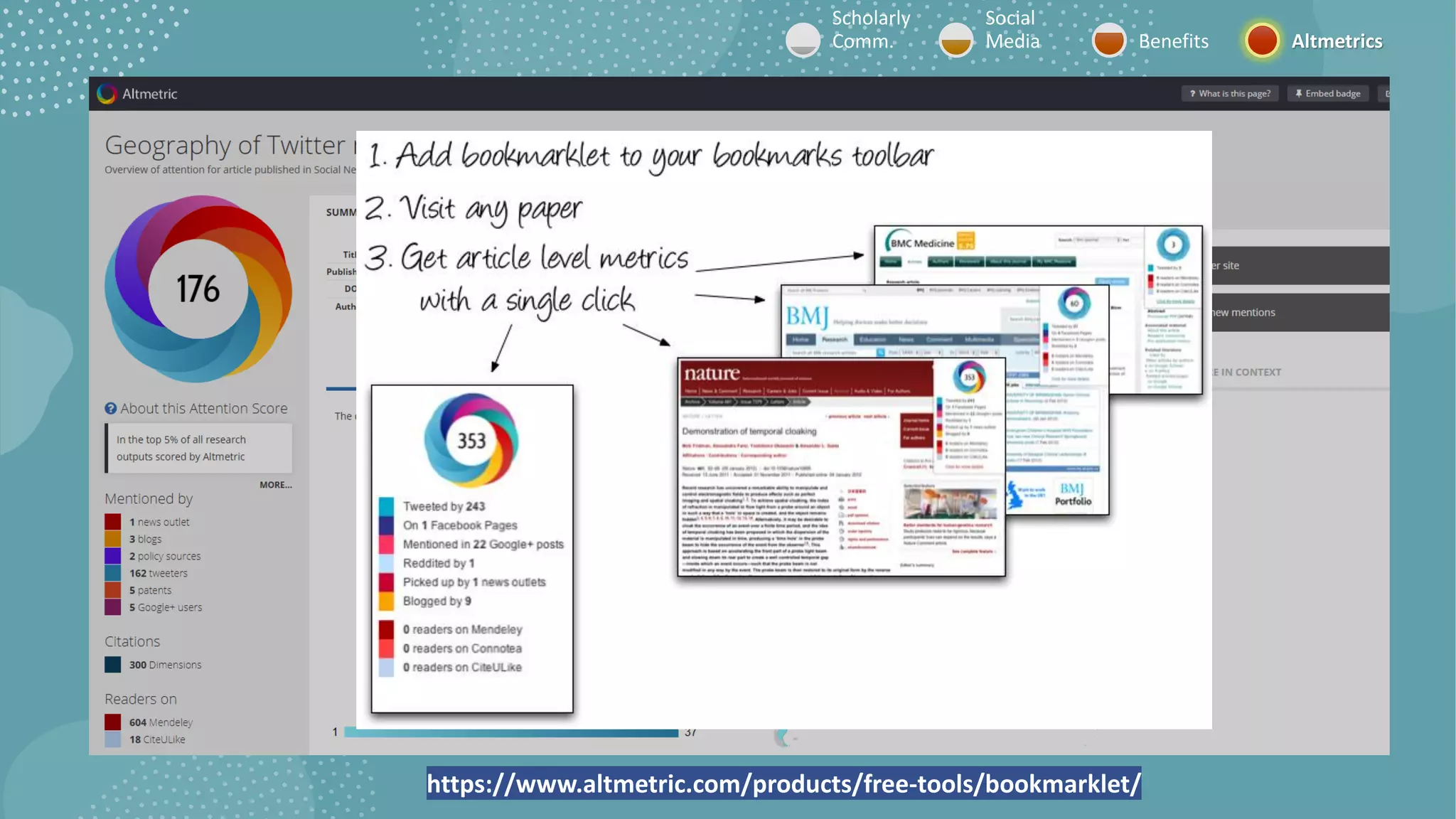
https://www.altmetric.com/products/free-tools/bookmarklet/
Access to Altmetric Data
Scholarly
Comm.
Social
Media Benefits Altmetrics
Altmetrics Limitations
Scholarly
Comm.
Social
Media Benefits Altmetrics
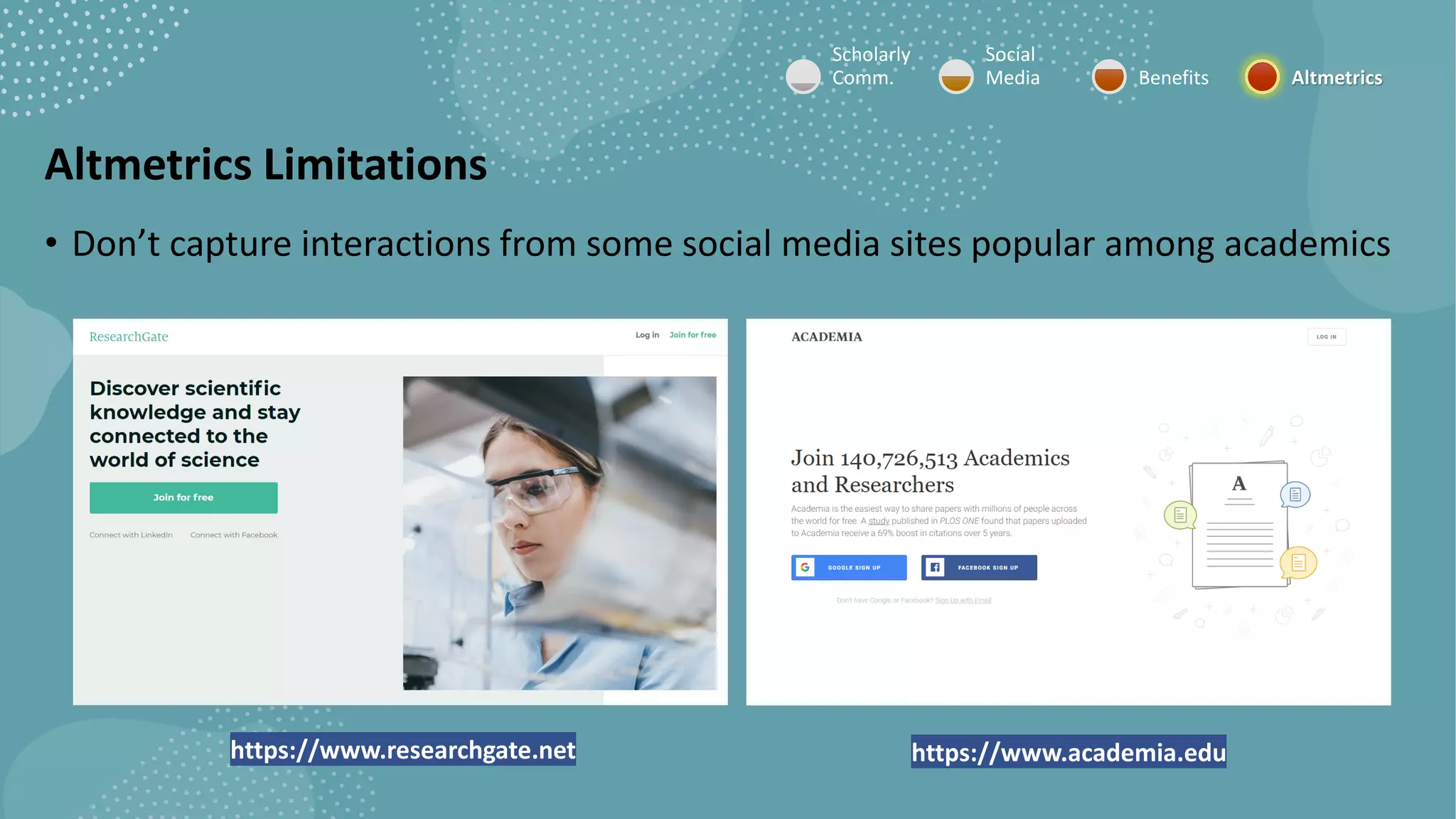
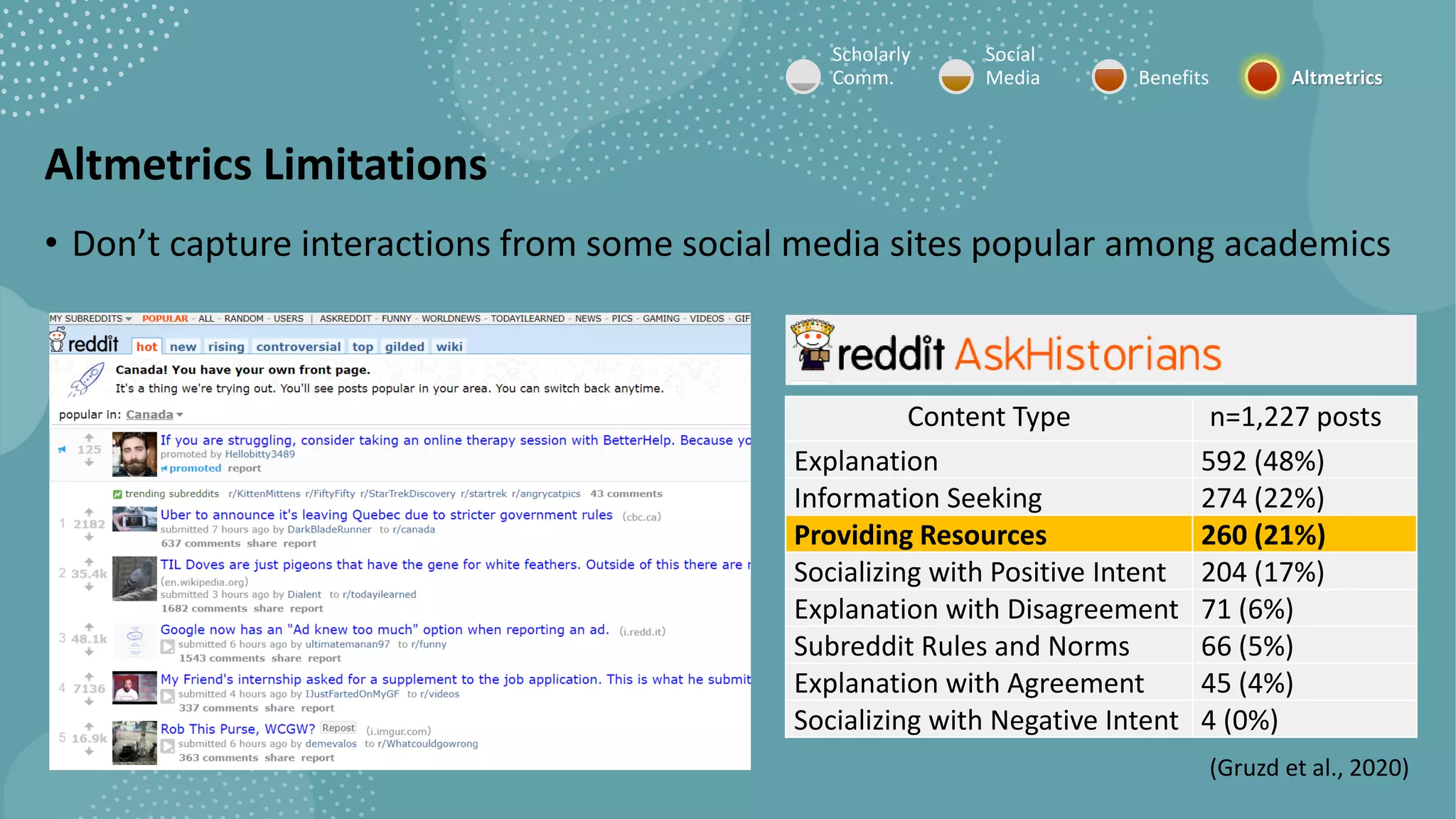
• Don’t capture interactions from some social media sites popular among academics
https://www.academia.eduhttps://www.researchgate.net
Altmetrics Limitations
Scholarly
Comm.
Social
Media Benefits Altmetrics
• Don’t capture interactions from some social media sites popular among academics
(Gruzd et al., 2020)
Content Type n=1,227 posts
Explanation 592 (48%)
Information Seeking 274 (22%)
Providing Resources 260 (21%)
Socializing with Positive Intent 204 (17%)
Explanation with Disagreement 71 (6%)
Subreddit Rules and Norms 66 (5%)
Explanation with Agreement 45 (4%)
Socializing with Negative Intent 4 (0%)
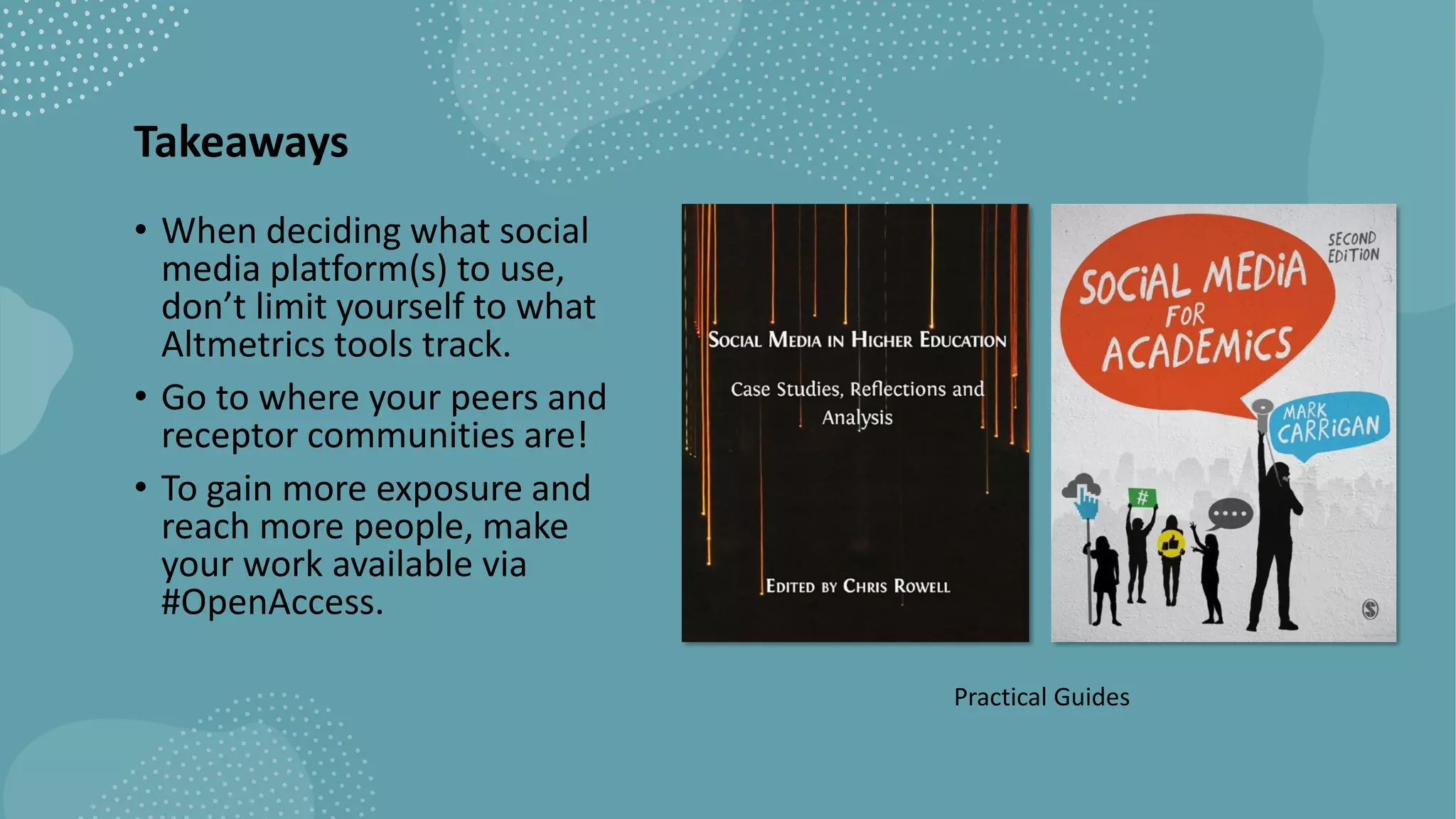
Takeaways
• When deciding what social
media platform(s) to use,
don’t limit yourself to what
Altmetrics tools track.
• Go to where your peers and
receptor communities are!
• To gain more exposure and
reach more people, make
your work available via
#OpenAccess.
Practical Guides
References
• Adie, E., & Roe, W. (2013). Altmetric: Enriching scholarly content with article-level discussion and metrics. Learned Publishing, 26(1), 11–17.
https://doi.org/10.1087/20130103
• AlRyalat, S. A., Saleh, M., Alaqraa, M., Alfukaha, A., Alkayed, Y., Abaza, M., Abu Saa, H., & Alshamiry, M. (2019). The impact of the open-access status on journal indices:
A review of medical journals. F1000Research, 8. https://doi.org/10.12688/f1000research.17979.1
• Gruzd, A., & Goertzen, M. (2013). Wired Academia: Why Social Science Scholars Are Using Social Media. The 46th Hawaii International Conference on System Sciences
(HICSS): 3332-3341, DOI: 10.1109/HICSS.2013.614
• Hassan, S.-U., Imran, M., Gillani, U., Aljohani, N. R., Bowman, T. D., & Didegah, F. (2017). Measuring social media activity of scientific literature: An exhaustive
comparison of scopus and novel altmetrics big data. Scientometrics, 113(2), 1037–1057. https://doi.org/10.1007/s11192-017-2512-x
• Hook, D. W., Calvert, I., & Hahnel, M. (2019). The ascent of open access. An Analysis of the Open Access Landscape since the Turn of the Millennium.
https://digitalscience.figshare.com/articles/The_Ascent_of_Open_Access/7618751
• Koler-Povh, T., Južnič, P., & Turk, G. (2014). Impact of open access on citation of scholarly publications in the field of civil engineering. Scientometrics, 98(2), 1033–
1045. https://doi.org/10.1007/s11192-013-1101-x
• Gruzd, A., Kumar, P., Abul-Fottouh, D., & Haythornthwaite, C. (2020). Coding and Classifying Knowledge Exchange on Social Media: A Comparative Analysis of the
#Twitterstorians and AskHistorians Communities. Computer Supported Cooperative Work (CSCW). https://doi.org/10.1007/s10606-020-09376-y
• MacDonald, B., Gruzd, A, Collins, V. (2020). Scientific Communication Networks: Tracking Victorian and Twenty-First Century Communication with Social Network
Analysis, SMSociety’20 Conference. Presentation is available at https://www.youtube.com/watch?v=B56tb_SHh_k
• Melero, R. (2015). Altmetrics–a complement to conventional metrics. Biochemia medica, 25(2), 152-160.
• Piwowar, H., Priem, J., Larivière, V., Alperin, J. P., Matthias, L., Norlander, B., Farley, A., West, J., & Haustein, S. (2018). The state of OA: A large-scale analysis of the
prevalence and impact of Open Access articles. PeerJ, 6, e4375. https://doi.org/10.7717/peerj.4375
• Salisbury, L., Chowdhury, A. R., & Smith, J. J. (2017). Faculty Publications from a Research University: The Scholarly Impact of Open Access versus Non-Open Access.
Science & Technology Libraries, 36(2), 187–199. https://doi.org/10.1080/0194262X.2016.1273815
• Resources about Open Access Models:
• https://library.carleton.ca/sites/default/files/help/writing-citing/handout-traditionalvsopenaccess.pdf
• http://legacy.earlham.edu/~peters/fos/overview.htm
• https://researchguides.library.vanderbilt.edu/c.php?g=144567&p=946137
• https://awayofhappening.wordpress.com/2017/08/18/bronze-and-delayed-open-access-what-can-we-do-about-these

The Role of Open Access & Social Media in Knowledge Mobilization and Discovery

  • 1.
    The Role ofOpen Access & Social Media in Knowledge Mobilization and Discovery Anatoliy Gruzd, PhD Canada Research Chair & Associate Professor Director of Research, Social Media Lab Ryerson University, Toronto, Canada Gruzd@Ryerson.ca | Twitter: @Gruzd
  • 2.
    Obvious & Widely Accepted …Now But none of these ideas and practices were accepted immediately.
  • 3.
    Most new ideasneed time to incubate. They also need to be accessible so that they can be tested, debated, and built upon.
  • 4.
    Your paper isfinally published! Now what? https://www.pinterest.ca/imgur/
  • 5.
    Disseminate your results bymaking them as widely available as possible “Information does not put itself into practice.” - @Phmai (Co-dir of Ryerson Social Media Lab) 1. Make your paper open access 2. Connect with peers & share your paper on social media
  • 6.
    Disseminate your results bymaking them as widely available as possible Models Trends Impact Repositories 1. Make your paper open access 2. Connect with peers & share your paper on social media
  • 7.
    Open Access (OA) models • Gold= all published articles are freely accessible online • Green = author’s pre-print copy is available either via an institutional repository and/or personal website • Diamond = usually funded via subsidy models • Hybrid = authors pay for their paper to be open access • Delayed = articles become OA after a certain period of time Models Trends Impact Repos
  • 8.
    Open Access (OA) models • Bronze= a combination of … o Delayed OA o Open editorials o “One-off” articles/issues made open by the journal o “Hidden Gold” journals, not indexed by the Directory of Open Access Journals (DOAJ) Models Trends Impact Repos
  • 9.
    • BD&S isan open access, double blind peer-reviewed scholarly journal that publishes interdisciplinary research about the implications of big data for societies. • Article Processing Charge (APC) is waived for articles published in the special issues. • Authors who do not have funding for open access publishing can request a waiver from the publisher, SAGE. • The accepted version of the article may be posted in the author's institutional repository. (Piwowar et al, 2018) The journal's Impact Factor of 4.577 ranks it as the 2nd highest journal (out of 108) in the Social Sciences Interdisciplinary domain of the SSCI. *SSCI = Social Sciences Citation Index Hybrid OA Model Example: Big Data & Society (BD&S) Journal Models Trends Impact Repos
  • 10.
    Growing Prevalence of OA •At least 28% of the scholarly literature is OA • OA growth is largely driven by Gold & Hybrid publications • Most common mechanism for OA is “bronze” - “free-to-read” articles on the publisher website (without an explicit OA license) OA, 28% non-OA, 72% (Piwowar et al, 2018) Models Trends Impact Repos
  • 11.
  • 12.
    Scholarly Impact of OAvs non-OA • Overall, OA articles receive 18% more citations than average, when accounting for age and discipline (Piwowar et al, 2018) • Medicine: “although non-OA journals still have higher output in terms of articles per year, OA journals have higher citation metrics.” (AlRyalat, et.al., 2019) • Civil Engineering: “On average OA articles received 43 citations while Non-OA articles were cited 29 times” (Koler-Povh, Južnič, Turk, 2014) Models Trends Impact Repos
  • 13.
    More funding agencies arenow requiring OA • Tri-Agency Open Access Policy on Publications • Grant recipients archive the final peer- reviewed full-text manuscript in an online repository where it will be freely accessible within 12 months (e.g., institutional repository or discipline-based repository). • Grant recipients can publish in a journal that offers open access or that offers open access on its website within 12 months. • http://www.science.gc.ca/eic/site/063.nsf/ eng/h_F6765465.html?OpenDocument https://roarmap.eprints.org/ Registry of Open Access Repositories Mandatory Archiving Policies (ROARMAP) Models Trends Impact Repos
  • 14.
    Steps to makeyour research widely available Share your article via Ryerson Institutional Repository If you are not sure, check the publisher’s open access policies via Sherpa Romeo Share your data via Scholars Portal Dataverse or other data repositories https://digital.library.ryerson.ca https://v2.sherpa.ac.uk/romeo/ https://dataverse.scholarsportal.info/ Models Trends Impact Repos
  • 15.
    WIP papers andpapers under review: To share or not to share? Pre-print repository for “hard” sciences Pre-print repository for social sciences Other pre-print repositories https://arxiv.org/ https://advance.sagepub.com/ https://www.ssrn.com/ Models Trends Impact Repos
  • 16.
    Disseminate your results bymaking them as widely available as possible 1. Make your paper open access 2. Connect with peers & share your paper on social media Scholarly Communication Social Media for Academics Benefits Altmetrics
  • 17.
    Evolution of scholarly communication Letters Emails Mailinglists Social Media Scholarly Comm. Social Media Benefits Altmetrics
  • 18.
    Scholarly communication: Then &Now Letters of Edwin Gilpin, a Canadian mining engineer, government official & author (1850- 1907) Tweets of a contemporary scientist in the domain of Earth Sciences (2014) (MacDonald, Gruzd, Collins, 2020) 9 months | 1300 letters | people=616 | ties=1277 1 month | 1302 tweets | people=756 | ties=1578 Scholarly Comm. Social Media Benefits Altmetrics
  • 19.
    Popular social mediaplatforms among academics Frequent Use Non-academic soc.networks Blogs Online document management Media repositories Wikis Occasional Use Presentation sharing sites Video/tele conference Blog Wikis Academic soc.networks (Gruzd & Goertzen, 2013) Scholarly Comm. Social Media Benefits Altmetrics
  • 20.
    Coverage of academic publicationson social media Twitter 68% Facebook 17% Blogs 7% News 6% Google+ 2% * Based on ~1M articles published between 2011-2015 (indexed by Scopus) and that have at least one citation & one social media mention (captured up until Feb 2017)(Hassan et al., 2017) Scholarly Comm. Social Media Benefits Altmetrics
  • 21.
    Benefits of usingsocial media 0% 10% 20% 30% 40% 50% 60% Discovering new funding Garnering mass media attention Publishing findings Maintaining professional image Soliciting advice from peers Collaborating with other researchers Making new research contacts Promoting current work/research Discovering new ideas or publications Following other researchers' work Keeping up to date with topics Scholarly Comm. Social Media Benefits Altmetrics (Gruzd & Goertzen, 2013)
  • 22.
    Related benefits ofsocial media use based on the factor analysis Social & Info Dissemination Information Gathering Collaboration explains 24% of the total variance explains 16% of the total variance Scholarly Comm. Social Media Benefits Altmetrics
  • 23.
    As more peopletalk about research online, social ‘signals’ are becoming more valuable for … • Academics – discover what peers are discussing • Institutions & Funders – assess research impact • Publishers – ↑readership, feature most-discussed research, discover popular topics for future calls • Appointment, Tenure & Promotion Committees – evaluate scholarly output / service-component Scholarly Comm. Social Media Benefits Altmetrics
  • 24.
    But how doyou know who shares and discusses your research on social media? • Hint: Not just academics! Also … • institutions • journalists • librarians • policy makers • communities of practice • others
  • 25.
    But how doyou know who shares and discusses your research on social media? • Hint: Not just academics! Also … • institutions • journalists • librarians • policy makers • communities of practice • others • Altmetrics can help us find this out
  • 26.
    Altmetrics is “The creationand study of new metrics based on the Social Web for analyzing and informing scholarship” (Adie & Roe, 2013) Google Trends for Altmetric Scholarly Comm. Social Media Benefits Altmetrics
  • 27.
    Altmetrics: Research Topics • Towhat extent articles published in a journal are discussed on social media (coverage)? • Is there a relationship between altmetrics and more traditional impact factors (correlation studies)? • Ex: among altmetrics, blog count is the strongest predictor of increased citations: “One more blog post discussing a publication increases the chance of more citations by 4.7%” (Hassan et al., 2017) Scholarly Comm. Social Media Benefits Altmetrics
  • 28.
    Scholarly Comm. Social Media Benefits Altmetrics AltmetricsIndicators • Basic altmetrics indicators can be found on the publisher’s page
  • 29.
  • 30.
  • 31.
  • 32.
    https://www.altmetric.com/products/free-tools/bookmarklet/ Access to AltmetricData Scholarly Comm. Social Media Benefits Altmetrics
  • 33.
    Altmetrics Limitations Scholarly Comm. Social Media BenefitsAltmetrics • Don’t capture interactions from some social media sites popular among academics https://www.academia.eduhttps://www.researchgate.net
  • 34.
    Altmetrics Limitations Scholarly Comm. Social Media BenefitsAltmetrics • Don’t capture interactions from some social media sites popular among academics (Gruzd et al., 2020) Content Type n=1,227 posts Explanation 592 (48%) Information Seeking 274 (22%) Providing Resources 260 (21%) Socializing with Positive Intent 204 (17%) Explanation with Disagreement 71 (6%) Subreddit Rules and Norms 66 (5%) Explanation with Agreement 45 (4%) Socializing with Negative Intent 4 (0%)
  • 35.
    Takeaways • When decidingwhat social media platform(s) to use, don’t limit yourself to what Altmetrics tools track. • Go to where your peers and receptor communities are! • To gain more exposure and reach more people, make your work available via #OpenAccess. Practical Guides
  • 36.
    References • Adie, E.,& Roe, W. (2013). Altmetric: Enriching scholarly content with article-level discussion and metrics. Learned Publishing, 26(1), 11–17. https://doi.org/10.1087/20130103 • AlRyalat, S. A., Saleh, M., Alaqraa, M., Alfukaha, A., Alkayed, Y., Abaza, M., Abu Saa, H., & Alshamiry, M. (2019). The impact of the open-access status on journal indices: A review of medical journals. F1000Research, 8. https://doi.org/10.12688/f1000research.17979.1 • Gruzd, A., & Goertzen, M. (2013). Wired Academia: Why Social Science Scholars Are Using Social Media. The 46th Hawaii International Conference on System Sciences (HICSS): 3332-3341, DOI: 10.1109/HICSS.2013.614 • Hassan, S.-U., Imran, M., Gillani, U., Aljohani, N. R., Bowman, T. D., & Didegah, F. (2017). Measuring social media activity of scientific literature: An exhaustive comparison of scopus and novel altmetrics big data. Scientometrics, 113(2), 1037–1057. https://doi.org/10.1007/s11192-017-2512-x • Hook, D. W., Calvert, I., & Hahnel, M. (2019). The ascent of open access. An Analysis of the Open Access Landscape since the Turn of the Millennium. https://digitalscience.figshare.com/articles/The_Ascent_of_Open_Access/7618751 • Koler-Povh, T., Južnič, P., & Turk, G. (2014). Impact of open access on citation of scholarly publications in the field of civil engineering. Scientometrics, 98(2), 1033– 1045. https://doi.org/10.1007/s11192-013-1101-x • Gruzd, A., Kumar, P., Abul-Fottouh, D., & Haythornthwaite, C. (2020). Coding and Classifying Knowledge Exchange on Social Media: A Comparative Analysis of the #Twitterstorians and AskHistorians Communities. Computer Supported Cooperative Work (CSCW). https://doi.org/10.1007/s10606-020-09376-y • MacDonald, B., Gruzd, A, Collins, V. (2020). Scientific Communication Networks: Tracking Victorian and Twenty-First Century Communication with Social Network Analysis, SMSociety’20 Conference. Presentation is available at https://www.youtube.com/watch?v=B56tb_SHh_k • Melero, R. (2015). Altmetrics–a complement to conventional metrics. Biochemia medica, 25(2), 152-160. • Piwowar, H., Priem, J., Larivière, V., Alperin, J. P., Matthias, L., Norlander, B., Farley, A., West, J., & Haustein, S. (2018). The state of OA: A large-scale analysis of the prevalence and impact of Open Access articles. PeerJ, 6, e4375. https://doi.org/10.7717/peerj.4375 • Salisbury, L., Chowdhury, A. R., & Smith, J. J. (2017). Faculty Publications from a Research University: The Scholarly Impact of Open Access versus Non-Open Access. Science & Technology Libraries, 36(2), 187–199. https://doi.org/10.1080/0194262X.2016.1273815 • Resources about Open Access Models: • https://library.carleton.ca/sites/default/files/help/writing-citing/handout-traditionalvsopenaccess.pdf • http://legacy.earlham.edu/~peters/fos/overview.htm • https://researchguides.library.vanderbilt.edu/c.php?g=144567&p=946137 • https://awayofhappening.wordpress.com/2017/08/18/bronze-and-delayed-open-access-what-can-we-do-about-these