




From social to scholarly and back again
Jill Emery & Charlie Rapple • ER&L 2015
@jillemery @charlierapple #erl15
2
Research is breaking free
Image credit: Bourrasque, by Paul Cocksedge Studio, photographed by Mark Cocksedge
3
Image credit: Bourrasque, by Paul Cocksedge Studio, photographed by Mark Cocksedge
Research is breaking free
• Articles that keep
evolving into new
versions
There may never
be a final paper in
F1000 Research, only
temporal versions
Kent Anderson
AAAS / Scholarly Kitchen
“ “
4
Image credit: Bourrasque, by Paul Cocksedge Studio, photographed by Mark Cocksedge
Research is breaking free
• Rising popularity
of alternative
communications
formats
More people look
at my stuff on
Slideshare than my
published articles
Antony Williams,
Chemistry Professor
“ “
5
Image credit: Bourrasque, by Paul Cocksedge Studio, photographed by Mark Cocksedge
Research is breaking free
• Changes in how
academics
collaborate,
manage data,
share, teach …
Research groups
have become more
interdisciplinary and
international; sharing
has increased
STM Draft Principles
for Article Sharing
“
“
6
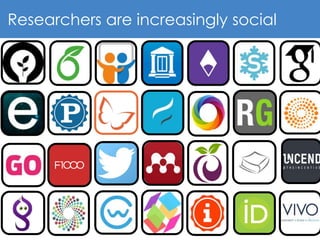
Researchers are increasingly social
7
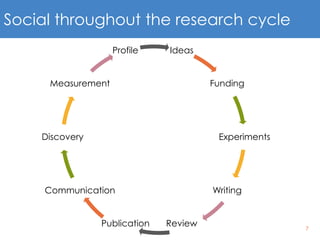
Social throughout the research cycle
Ideas
Funding
Experiments
Writing
ReviewPublication
Communication
Discovery
Measurement
Profile
8
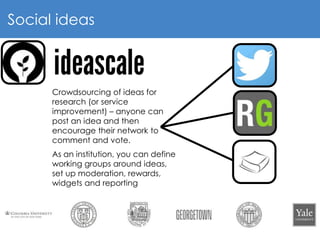
Social ideas
Crowdsourcing of ideas for
research (or service
improvement) – anyone can
post an idea and then
encourage their network to
comment and vote.
As an institution, you can define
working groups around ideas,
set up moderation, rewards,
widgets and reporting
9
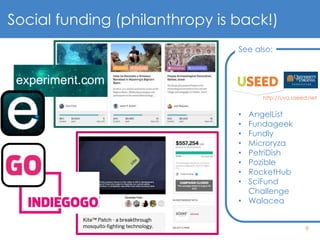
Social funding (philanthropy is back!)
experiment.com
• AngelList
• Fundageek
• Fundly
• Microryza
• PetriDish
• Pozible
• RocketHub
• SciFund
Challenge
• Walacea
http://uva.useed.net
See also:
10
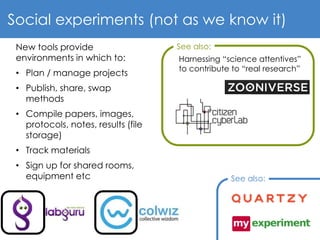
Social experiments (not as we know it)
New tools provide
environments in which to:
• Plan / manage projects
• Publish, share, swap
methods
• Compile papers, images,
protocols, notes, results (file
storage)
• Track materials
• Sign up for shared rooms,
equipment etc
Harnessing “science attentives”
to contribute to “real research”
See also:
See also:
11
See also:
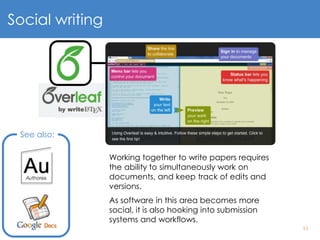
Social writing
Working together to write papers requires
the ability to simultaneously work on
documents, and keep track of edits and
versions.
As software in this area becomes more
social, it is also hooking into submission
systems and workflows.
12
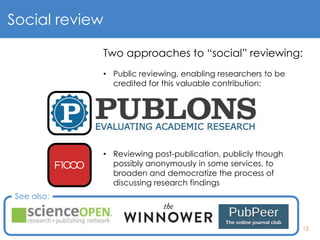
Social review
Two approaches to “social” reviewing:
• Public reviewing, enabling researchers to be
credited for this valuable contribution:
• Reviewing post-publication, publicly though
possibly anonymously in some services, to
broaden and democratize the process of
discussing research findings
See also:
13
Social publication
It’s not just about the text!
Researchers need to be able to discover, re-use, cite
– and be credited for – a wider range of outputs
• Datasets
• Figures
• Posters
• Slides
• Audio
• Video See also:
14
Social communication
See also:
Talking about your research is proven to
increase the impact of your research
It’s helpful to do so in
a way that enables
you to track the effect
of social
communication on
key metrics such as
views, downloads,
mentions, citations
15
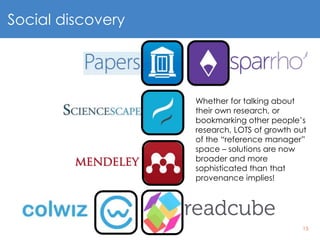
Social discovery
Whether for talking about
their own research, or
bookmarking other people’s
research, LOTS of growth out
of the “reference manager”
space – solutions are now
broader and more
sophisticated than that
provenance implies!
16
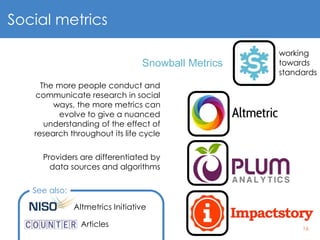
Social metrics
See also:
The more people conduct and
communicate research in social
ways, the more metrics can
evolve to give a nuanced
understanding of the effect of
research throughout its life cycle
Providers are differentiated by
data sources and algorithms
Snowball Metrics
working
towards
standards
Altmetrics Initiative
Articles
17
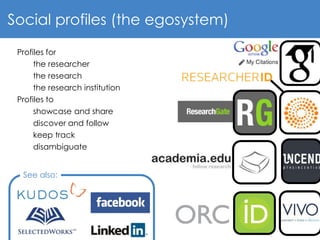
Social profiles (the egosystem)
Profiles for
the researcher
the research
the research institution
Profiles to
showcase and share
discover and follow
keep track
disambiguate
See also:
18
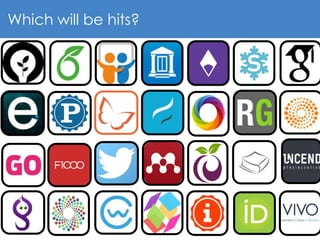
Which will be hits?
19
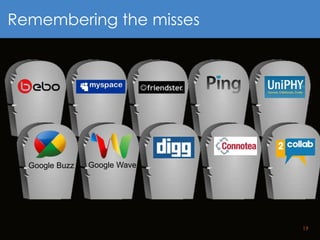
Remembering the misses
Google Buzz Google Wave
20
Where the Librarians come in
21
Where the Librarians come in
• Reference &
resource
assistance within
social media
platforms
• Collection
development
• Library services for
research
management
Librarian Services
to offer:
22
Where the Librarians come in
• Knowing where
article sharing
outside the library is
occurring
• Help with the
management of
other scholarly
objects
• Offering instruction
& learning objects
23
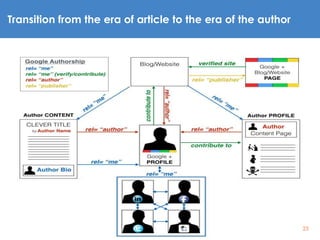
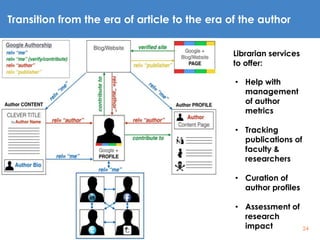
Transition from the era of article to the era of the author
24
Transition from the era of article to the era of the author
Librarian services
to offer:
• Help with
management
of author
metrics
• Tracking
publications of
faculty &
researchers
• Curation of
author profiles
• Assessment of
research
impact
25
Where are faculty in social media?
26
Where are faculty in social media?
Librarian services to offer:
• Data management planning
• Understanding best portal to
capture data
• Finding ways to measure
impact of data
27
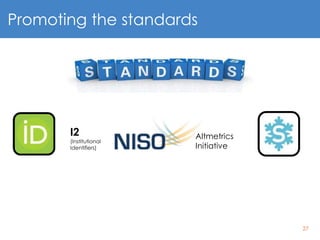
Promoting the standards
Altmetrics
Initiative
I2
(Institutional
Identifiers)
28
Developing new tools
29
Let’s discuss!
Jill Emery Charlie Rapple
@jillemery @charlierapple

From socially to scholarly and back again

  • 1.
    From social toscholarly and back again Jill Emery & Charlie Rapple • ER&L 2015 @jillemery @charlierapple #erl15
  • 2.
    2 Research is breakingfree Image credit: Bourrasque, by Paul Cocksedge Studio, photographed by Mark Cocksedge
  • 3.
    3 Image credit: Bourrasque,by Paul Cocksedge Studio, photographed by Mark Cocksedge Research is breaking free • Articles that keep evolving into new versions There may never be a final paper in F1000 Research, only temporal versions Kent Anderson AAAS / Scholarly Kitchen “ “
  • 4.
    4 Image credit: Bourrasque,by Paul Cocksedge Studio, photographed by Mark Cocksedge Research is breaking free • Rising popularity of alternative communications formats More people look at my stuff on Slideshare than my published articles Antony Williams, Chemistry Professor “ “
  • 5.
    5 Image credit: Bourrasque,by Paul Cocksedge Studio, photographed by Mark Cocksedge Research is breaking free • Changes in how academics collaborate, manage data, share, teach … Research groups have become more interdisciplinary and international; sharing has increased STM Draft Principles for Article Sharing “ “
  • 6.
  • 7.
    7 Social throughout theresearch cycle Ideas Funding Experiments Writing ReviewPublication Communication Discovery Measurement Profile
  • 8.
    8 Social ideas Crowdsourcing ofideas for research (or service improvement) – anyone can post an idea and then encourage their network to comment and vote. As an institution, you can define working groups around ideas, set up moderation, rewards, widgets and reporting
  • 9.
    9 Social funding (philanthropyis back!) experiment.com • AngelList • Fundageek • Fundly • Microryza • PetriDish • Pozible • RocketHub • SciFund Challenge • Walacea http://uva.useed.net See also:
  • 10.
    10 Social experiments (notas we know it) New tools provide environments in which to: • Plan / manage projects • Publish, share, swap methods • Compile papers, images, protocols, notes, results (file storage) • Track materials • Sign up for shared rooms, equipment etc Harnessing “science attentives” to contribute to “real research” See also: See also:
  • 11.
    11 See also: Social writing Workingtogether to write papers requires the ability to simultaneously work on documents, and keep track of edits and versions. As software in this area becomes more social, it is also hooking into submission systems and workflows.
  • 12.
    12 Social review Two approachesto “social” reviewing: • Public reviewing, enabling researchers to be credited for this valuable contribution: • Reviewing post-publication, publicly though possibly anonymously in some services, to broaden and democratize the process of discussing research findings See also:
  • 13.
    13 Social publication It’s notjust about the text! Researchers need to be able to discover, re-use, cite – and be credited for – a wider range of outputs • Datasets • Figures • Posters • Slides • Audio • Video See also:
  • 14.
    14 Social communication See also: Talkingabout your research is proven to increase the impact of your research It’s helpful to do so in a way that enables you to track the effect of social communication on key metrics such as views, downloads, mentions, citations
  • 15.
    15 Social discovery Whether fortalking about their own research, or bookmarking other people’s research, LOTS of growth out of the “reference manager” space – solutions are now broader and more sophisticated than that provenance implies!
  • 16.
    16 Social metrics See also: Themore people conduct and communicate research in social ways, the more metrics can evolve to give a nuanced understanding of the effect of research throughout its life cycle Providers are differentiated by data sources and algorithms Snowball Metrics working towards standards Altmetrics Initiative Articles
  • 17.
    17 Social profiles (theegosystem) Profiles for the researcher the research the research institution Profiles to showcase and share discover and follow keep track disambiguate See also:
  • 18.
  • 19.
  • 20.
  • 21.
    21 Where the Librarianscome in • Reference & resource assistance within social media platforms • Collection development • Library services for research management Librarian Services to offer:
  • 22.
    22 Where the Librarianscome in • Knowing where article sharing outside the library is occurring • Help with the management of other scholarly objects • Offering instruction & learning objects
  • 23.
    23 Transition from theera of article to the era of the author
  • 24.
    24 Transition from theera of article to the era of the author Librarian services to offer: • Help with management of author metrics • Tracking publications of faculty & researchers • Curation of author profiles • Assessment of research impact
  • 25.
    25 Where are facultyin social media?
  • 26.
    26 Where are facultyin social media? Librarian services to offer: • Data management planning • Understanding best portal to capture data • Finding ways to measure impact of data
  • 27.
  • 28.
  • 29.
    29 Let’s discuss! Jill EmeryCharlie Rapple @jillemery @charlierapple

Editor's Notes

  • #2 I’ll kick off – 15 minute overview of social tools being used in scholarly workflows. Jill will then follow up with 15 mins on “where the librarians come in”! Abstract: Researchers are increasingly connecting and  working together across institutional and global boundaries, thanks to networks like Academia.eduand ResearchGate, and networked tools like Mendeley. As research itself (not just the resulting publications) begins to break free of traditional containers, what kinds of support can information professionals provide? How can we extend actions we are already taking in virtual reference and virtual help, and expand them into these venues? What challenges are we likely to encounter? What existing services might we be able to draw on to help researchers maximize the reach and impact of their work, wherever it takes place? What metrics will we need to familiarize ourselves with, and how are these likely to evolve? Jill Emery (Collection Development Librarian at Portland State University) and Charlie Rapple (Marketing Director and Co-founder, Kudos) will help delegates explore this evolving landscape, and share experiences and ideas for how librarians and others in the “information community” might interact in future.
  • #3 Research– not just publications, but the processes of research itself - is beginning to exist outside of traditional containers
  • #4 The nature of an “article” is evolving
  • #5 Other forms of communication are becoming more common and beginning to be validated as an output of research
  • #6 That includes data, with the big funding agencies now often requiring a data plan, and faculty realizing as a consequence that there’s value in data, separately to the value in the article Similarly, teaching resources are beginning to be recognised as a scholarly output, driven in part by the open educational resources “movement” And publishers are recognising changing behaviors around how academics share papers, and are attempting to codify more flexible terms in this respect. STM Collaboration on article sharing - seeking feedback from authors & librarians
  • #7 These changes have happened in tandem with – or been driven by – the explosion of the social software space, and these are the many tools that I’ve cherry picked to cover today. May be through the rest of the conference we should all play some kind of bingo with this slide and mark it up every time one of these services is mentioned. CONCEPT • Ideascale FUNDING • Indiegogo • Fundly EXPERIMENT • Labguru • Zooniverse • Citizen Cyberlab REPORTING • Overleaf – free online platform for collaborative scientific writing and publishing SUBMISSION / REVIEW • Publons PUBLICATION • F1000 • Figshare - store, share, discover research. manage your research in the cloud and control who you share it with or make it publicly available and citable • Slideshare - upload and share publicly or privately PowerPoint presentations, Word documents and Adobe PDF Portfolios COMMUNICATION • Twitter • Kudos DISCOVERY • Mendeley - a free reference manager and academic social network • Readcube - Free reference & citation manager for article PDFs • Papers - helps you collect, curate and share the research material that you're passionate about • ScienceScape – for discovering and organising the research you care about • Colwiz - lets you create citations & bibliography in 6500+ styles and allows you to set up your research groups on the cloud to easily share files and references • Sparrho – personalised recommendations MEASUREMENT • Altmetric • Plum Analytics • ImpactStory • Snowball Metrics PROFILE • Facebook • LinkedIn • ResearchGate - a network dedicated to science and research. Connect, collaborate and discover scientific publications, jobs and conferences • Academia.edu – a place to share and follow research • ORCID - a persistent digital identifier that distinguishes you from every other researcher ensures that your work is recognized. • ResearcherID – a solution to the author ambiguity problem • Scholar Citations Profile - a simple way for authors to keep track of citations to their articles • Incend.net – beautiful and easy knowledge profiles – share the knowledge you are passionate about (“the first social network for your knowledge”) • VIVO – cross-institution discovery of research
  • #8 There is social software to support researchers at every stage of the research cycle.
  • #9 UKSG – organization responsible for COUNTER, KBARt and Transfer – now using Ideascale to get ideas for what other areas we should work on. Institutions using this – more for service improvement than research ideas? Researchers discussing ideas on Twitter, ResearchGate, Academia.edu, in blogs etc
  • #10 Fantastic that the web has brought philanthropy back! Ref RNLI Crowdfunding as “getting rid of the gatekeepers” (IndieGogo’s founder Liz Wald) and “taking scientists out of their ivory towers” (Rockefeller University’s Director of Science Outreach – Dr Jeanne Garbarino) – wouldn’t want this to replace all funding (what happens to unpopular things, and, what value is added by the more robust processes associated with traditional funding) But exciting to see the kinds of amounts being raised – over half a million dollars for a patch to fight mosquitoes Different models – “all or nothing” vs “keep it all” (however much is raised) Not every site supports scientific research (e.g. Kickstarter) You do have to pay around 10% commission Institutions are getting in on the act – University of Virginia has set up a crowdfunding platform via USeed; Deakin University in Australia used Pozible http://www.elsevier.com/connect/how-to-use-crowdfunding-to-support-your-research http://www.theguardian.com/science/2015/jan/02/crowdfunded-science-scientists-fund-research
  • #11 Networked approach to managing projects MyExperiment.org - Publish, share and swap workflows – a pool of scientific methods Labguru – run a research group – compile papers, images, protocols, notes, experiment workflows & results, material inventory etc – project planning (Basecamp style) – shared equipment sign up – etc Colwiz – basically reference management? But has tasks, calendaring, file storage, and all can be set up as groups as well as individuals Meanwhile – there are also interesting platforms for enabling “citizen scientists” or “science attentives” to participate in research Ref SETI, penguins
  • #12 Simultaneous, collaborative document writing, editing Version / edit tracking Supporting more complex typefaces such as LaTeX (for math formulae) Better options for managing layout, citations etc Some hook directly into the submission workflow http://www.nature.com/news/scientific-writing-the-online-cooperative-1.16039 http://blogs.lse.ac.uk/impactofsocialsciences/2014/04/04/five-collaborative-writing-tools-for-academics/
  • #13 On the one hand: it’s about doing review publicly, in order to be credited for it On the other hand: it’s about doing review post publication, possibly anonymously Not necessarily replacing peer review – PubPeer provides a forum for anonymous discussion of anything with a DOI On the other hand – F1000 research only publishes unreviewed papers, which are then reviewed publicly, by invitation And some people consider (and I quote) “that journal publishing – and its vast associated expense – could be dispensed with if there is no longer a need for editors to organise peer review.” Not to be confused with portable peer review, such as Peerage of Science (not inherently social? But still an interesting innovation!) – get reviewed before you submit! PubPeer – helped expose two papers in Nature that had to be retracted .. But has also been subpoenaed by a scientist who claimed “that anonymous comments questioning his science cost him a lucrative job offer” – he wants to sue the people who made the comments “Proponents of post-publication review say scrutiny by the whole community increases the chances of errors being spotted and significance being accurately identified. Some even hope that journal publishing – and its vast associated expense – could be dispensed with if there is no longer a need for editors to organise peer review.” http://www.timeshighereducation.co.uk/news/can-post-publication-peer-review-endure/2016895.article http://blog.f1000research.com/2014/07/08/what-is-post-publication-peer-review/
  • #15 Obviously the explosion in social media has created many more ways for people to communicate about their research. And studies show that talking about your research, even in non-scientific forums, can increase its impact. So you can do that in generic places like Facebook, Twitter and Linked In You can do it in researcher-oriented networks like ResearchGate and Academia.edu In the middle there, Kudos, is my start-up that thinks it’s helpful for academics to be able to use any communication channels they want But to track all that activity in one place and map it against metrics such as views, downloads, mentions and citations To help researchers and their institutions learn which channels are most effective for talking about their work.
  • #16 Also been an explosion in social discovery. There was a time we might have called this social bookmarking or reference management but these services have become so much more than that. They’re providing toolkits for annotating research and sharing notes with others They’re even encouraging publishers to experiment with new business models, like Readcube’s article rentals recently adopted by Wiley And which is the technology behind Nature’s announcements that all of their content would be free to read (just not to download or print) Sparrho is a “one to watch” in the contnet recommendations space which is a direction I think we’ll see lots of these bookmarking and reference manager services moving in. DISCOVERY • Mendeley - a free reference manager and academic social network • Readcube - Free reference & citation manager for article PDFs • Papers - helps you collect, curate and share the research material that you're passionate about • ScienceScape – for discovering and organising the research you care about • Colwiz - lets you create citations & bibliography in 6500+ styles and allows you to set up your research groups on the cloud to easily share files and references • Sparrho – personalised recommendations
  • #17 Then of course you want to measure the “social” aspects of how people are engaging with content, and all of these initiatives are working in this space http://www.projectcounter.org/counterarticles.html Snowball project partners: University of Oxford University College London University of Cambridge Imperial College London University of Bristol University of Leeds Queen’s University Belfast University of St Andrews Elsevier US working group University of Michigan University of Minnesota Northwestern University University of Illinois at Urbana-Champaign Arizona State University MD Anderson Cancer Center Kansas State University ANZ working group University of Queensland University of Western Australia University of Auckland University of Wollongong University of Tasmania Massey University University of Canberra Charles Darwin University
  • #18 And finally, people want to collate all the information about their work and show it off! Lots of different services enabling you to do this, either pivoting around the researcher in the case of things like ORCID, ResearcherID, Academia, ResearchGate Or around the research itself, in the case of Incend (and of Kudos) Or around the institution, in the case of Vivo (again, or Kudos) PROFILE • Facebook • LinkedIn • ResearchGate - a network dedicated to science and research. Connect, collaborate and discover scientific publications, jobs and conferences • Academia.edu – a place to share and follow research • ORCID - a persistent digital identifier that distinguishes you from every other researcher ensures that your work is recognized. • ResearcherID – a solution to the author ambiguity problem • Scholar Citations Profile - a simple way for authors to keep track of citations to their articles • Incend.net – beautiful and easy knowledge profiles – share the knowledge you are passionate about (“the first social network for your knowledge”) • VIVO – cross-institution discovery of research • Selectedworks from BE Press - many US libraries use this platform to highlight local scholarship
  • #19 So that’s a really quick journey through LOTS of tools. A big challenge for librarians (and others) in trying to incorporate social platforms into their services is knowing which horses to back! Which of these will be hits?
  • #20 Which will enter the graveyard of misses?
  • #21 Given the changing landscape of scholarship and scholarly creation, academic librarians need to be attuned to where their faculty are participating in social networks and which networks they may be using to both obtain content as well as provide content. Librarians need to be aware of new tools & services faculty may be using and become familiar with them.
  • #24 As Charlie has pointed out, there has been a definite shift from the era of the article to the era of the author in scholarly publishing. The focus is now on the impact of the individual over the impact of a journal. To this end, faculty, in particular are looking for ways measure their worth over the worth of their publications as a way to gain and retain tenure positions. Librarians are in the unique position of understanding how gather statistics and compile them in contextual ways that make sense both for the institution and for the individual author. Librarians are working more closely with research offices to help get at the metrics that work best for funded projects to show the impact that funders need.
  • #25 Becker model: http://www.researchtrends.com/issue-34-september-2013/the-becker-medical-library-model/
  • #26 Different faculty in different disciplines end up on different platforms, so it may take some time for librarians to learn which platform they use most consistently and it is likely that even in a given discipline, different research focuses will use different tools. The best way for librarians to learn, is to work with faculty in-person to learn what tools they find the most useful for research discovery and management. With mandates from most of the major funders in the US & Europe, data management is becoming a key service area for librarians. Librarians are helping to develop data management plans that split data sharing between subject data portals like APA, SSRN, FigShare and locally hosted data management systems. Understanding where the best portal for data to reside is becoming increasingly important to both librarians and researchers so that mandates can be met for the sustainability of funding.
  • #27 With mandates from most of the major funders in the US & Europe, data management is becoming a key service area for librarians. Librarians are helping to develop data management plans that split data sharing between subject data portals like APA, SSRN, FigShare and locally hosted data management systems. Understanding where the best portal for data to reside is becoming increasingly important to both librarians and researchers so that mandates can be met for the sustainability of funding.
  • #28 One thing librarians can do readily is work with research offices and faculty to insure that standard mechanisms for tracking faculty and faculty research outputs are utilized. Knowing what your institutional identifier is and how to utilize it within publication systems goes a long way to being able to track faculty publication along with getting faculty registered for ORCIDs. Following the standard initiatives that help to develop new assessment metrics for data sets, visualizations and develop best practices for these assessments. Then utilizing tools like snowball metrics to benchmark institutional research outputs.
  • #29 Lastly, librarians should be thinking of new tools that can be created to help facilitate a faculty/researcher’s experience either within a social media platform or outside of it? What API tool would be most appreciated within a site like Mendeley that helps connect the researcher back to the content their institution licenses or has available for use? Can librarians help facilitate mash-ups between funding bodies and currently published research? What if you could readily deliver a data management template to a researcher when they are submitting their grant proposal? Librarians have the incredible insight of understanding the intersection between scholarly content and the members of their institution who are creating much of this content. How can we best capitalise upon this position and improve the mechanisms currently in place?
  • #30 Services come and go – how do you make judgments as to which will survive? Are there disciplinary differences in how people are using these tools, where they are gathering?