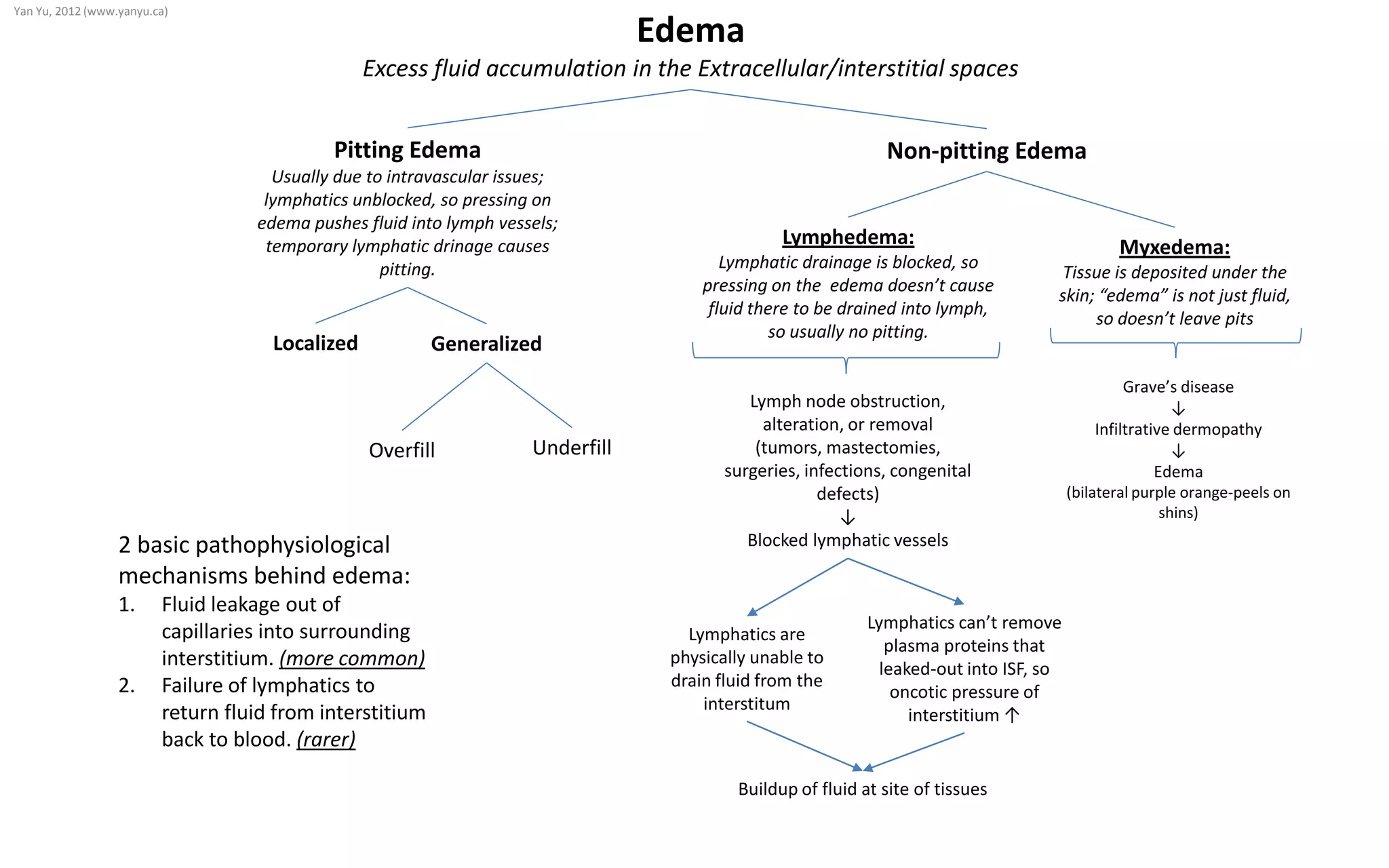
Lymphedema:
Lymphatic drainage is blocked, so
pressing on the edema doesn’t cause
fluid there to be drained into lymph,
so usually no pitting.
Edema
Excess fluid accumulation in the Extracellular/interstitial spaces
Pitting Edema
Usually due to intravascular issues;
lymphatics unblocked, so pressing on
edema pushes fluid into lymph vessels;
temporary lymphatic drinage causes
pitting.
Non-pitting Edema
Localized
Myxedema:
Tissue is deposited under the
skin; “edema” is not just fluid,
so doesn’t leave pits
2 basic pathophysiological
mechanisms behind edema:
1. Fluid leakage out of
capillaries into surrounding
interstitium. (more common)
2. Failure of lymphatics to
return fluid from interstitium
back to blood. (rarer)
Lymph node obstruction,
alteration, or removal
(tumors, mastectomies,
surgeries, infections, congenital
defects)
↓
Blocked lymphatic vessels
Lymphatics can’t remove
plasma proteins that
leaked-out into ISF, so
oncotic pressure of
interstitium ↑
Lymphatics are
physically unable to
drain fluid from the
interstitum
Buildup of fluid at site of tissues
Grave’s disease
↓
Infiltrative dermopathy
↓
Edema
(bilateral purple orange-peels on
shins)
Generalized
Overfill Underfill
Yan Yu, 2012 (www.yanyu.ca)
Lymphedema
Edema: Excess fluid accumulation in the Extracellular/interstitial spaces
Pitting
Increased venous blood pressure
Non-pitting
Myxedema
Localized
Usually limited to
lower extremities
May be unilateral
Generalized
Overfill Underfill
Mass DVT
Central Venous
stenosis
Abbreviations:
EABV = effective arterial blood volume
RAAS = renin-angiotensin-aldosterone system
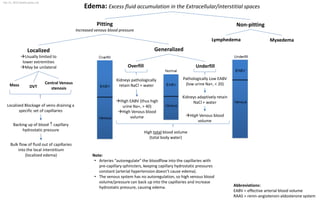
Localized Blockage of veins draining a
specific set of capillaries
Backing up of blood  capillary
hydrostatic pressure
Bulk flow of fluid out of capillaries
into the local interstitium
(localized edema)
High EABV (thus high
urine Na+, > 40)
High Venous blood
volume High Venous blood
volume
High total blood volume
(total body water)
Kidneys pathologically
retain NaCl + water
Pathologically Low EABV
(low urine Na+, < 20)
Kidneys adaptively retain
NaCl + water
Note:
• Arteries “autoregulate” the bloodflow into the capillaries with
pre-capillary sphincters, keeping capillary hydrostatic pressures
constant (arterial hypertension doesn’t cause edema).
• The venous system has no autoregulation, so high venous blood
volume/pressure can back up into the capillaries and increase
hydrostatic pressure, causing edema.
Yan Yu, 2012 (www.yanyu.ca)
Lymphedema
Edema: Excess fluid accumulation in the Extracellular/interstitial spaces
Pitting
Increased venous blood pressure
Non-pitting
Myxedema
Localized Generalized
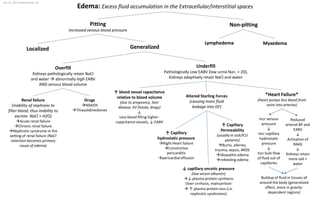
Overfill
Kidneys pathologically retain NaCl
and water  abnormally high EABV
AND venous blood volume
Underfill
Pathologically Low EABV (low urine Na+, < 20),
Kidneys adaptively retain NaCl and water
*Heart Failure*
(Heart pumps less blood from
veins into arteries)
Reduced
arterial BP and
EABV
↓
Activation of
RAAS
↓
Kidneys retain
more salt +
water
Incr venous
pressure
↓
Incr capillary
hydrostatic
pressure
↓
Incr bulk flow
of fluid out of
capillaries
Buildup of fluid in tissues all
around the body (generalized
effect, more in gravity-
dependent regions)
↑ blood vessel capacitance
relative to blood volume
(due to pregnancy, liver
disease, AV fistula, drugs)
↓
Less blood filling higher-
capacitance vessels, ↓ EABV
Altered Starling Forces
(causing more fluid
leakage into ISF)
↑ Capillary
hydrostatic pressure
Right Heart failure
Constrictive
pericarditis
pericardial effusion
↓ capillary oncotic pressure
(low serum albumin)
↓ plasma protein synthesis
(liver cirrhosis, malnutrition
 ↑ plasma protein loss (i.e.
nephrotic syndromes)
↑ Capillary
Permeability
(usually in sick/ICU
patients)
Burns, alleries,
trauma, sepsis, ARDS
Idiopathic edema
refeeding edema
Renal failure
(inability of nephrons to
filter blood, thus inability to
excrete NaCl + H2O)
Acute renal failure
Chronic renal failure
Nephrotic syndrome in the
setting of renal failure (NaCl
retention becomes primary
cause of edema)
Drugs
NSAIDS
Thiazolidinediones
Yan Yu, 2012 (www.yanyu.ca)

Edema

  • 1.
    Lymphedema: Lymphatic drainage isblocked, so pressing on the edema doesn’t cause fluid there to be drained into lymph, so usually no pitting. Edema Excess fluid accumulation in the Extracellular/interstitial spaces Pitting Edema Usually due to intravascular issues; lymphatics unblocked, so pressing on edema pushes fluid into lymph vessels; temporary lymphatic drinage causes pitting. Non-pitting Edema Localized Myxedema: Tissue is deposited under the skin; “edema” is not just fluid, so doesn’t leave pits 2 basic pathophysiological mechanisms behind edema: 1. Fluid leakage out of capillaries into surrounding interstitium. (more common) 2. Failure of lymphatics to return fluid from interstitium back to blood. (rarer) Lymph node obstruction, alteration, or removal (tumors, mastectomies, surgeries, infections, congenital defects) ↓ Blocked lymphatic vessels Lymphatics can’t remove plasma proteins that leaked-out into ISF, so oncotic pressure of interstitium ↑ Lymphatics are physically unable to drain fluid from the interstitum Buildup of fluid at site of tissues Grave’s disease ↓ Infiltrative dermopathy ↓ Edema (bilateral purple orange-peels on shins) Generalized Overfill Underfill Yan Yu, 2012 (www.yanyu.ca)
  • 2.
    Lymphedema Edema: Excess fluidaccumulation in the Extracellular/interstitial spaces Pitting Increased venous blood pressure Non-pitting Myxedema Localized Usually limited to lower extremities May be unilateral Generalized Overfill Underfill Mass DVT Central Venous stenosis Abbreviations: EABV = effective arterial blood volume RAAS = renin-angiotensin-aldosterone system Localized Blockage of veins draining a specific set of capillaries Backing up of blood  capillary hydrostatic pressure Bulk flow of fluid out of capillaries into the local interstitium (localized edema) High EABV (thus high urine Na+, > 40) High Venous blood volume High Venous blood volume High total blood volume (total body water) Kidneys pathologically retain NaCl + water Pathologically Low EABV (low urine Na+, < 20) Kidneys adaptively retain NaCl + water Note: • Arteries “autoregulate” the bloodflow into the capillaries with pre-capillary sphincters, keeping capillary hydrostatic pressures constant (arterial hypertension doesn’t cause edema). • The venous system has no autoregulation, so high venous blood volume/pressure can back up into the capillaries and increase hydrostatic pressure, causing edema. Yan Yu, 2012 (www.yanyu.ca)
  • 3.
    Lymphedema Edema: Excess fluidaccumulation in the Extracellular/interstitial spaces Pitting Increased venous blood pressure Non-pitting Myxedema Localized Generalized Overfill Kidneys pathologically retain NaCl and water  abnormally high EABV AND venous blood volume Underfill Pathologically Low EABV (low urine Na+, < 20), Kidneys adaptively retain NaCl and water *Heart Failure* (Heart pumps less blood from veins into arteries) Reduced arterial BP and EABV ↓ Activation of RAAS ↓ Kidneys retain more salt + water Incr venous pressure ↓ Incr capillary hydrostatic pressure ↓ Incr bulk flow of fluid out of capillaries Buildup of fluid in tissues all around the body (generalized effect, more in gravity- dependent regions) ↑ blood vessel capacitance relative to blood volume (due to pregnancy, liver disease, AV fistula, drugs) ↓ Less blood filling higher- capacitance vessels, ↓ EABV Altered Starling Forces (causing more fluid leakage into ISF) ↑ Capillary hydrostatic pressure Right Heart failure Constrictive pericarditis pericardial effusion ↓ capillary oncotic pressure (low serum albumin) ↓ plasma protein synthesis (liver cirrhosis, malnutrition  ↑ plasma protein loss (i.e. nephrotic syndromes) ↑ Capillary Permeability (usually in sick/ICU patients) Burns, alleries, trauma, sepsis, ARDS Idiopathic edema refeeding edema Renal failure (inability of nephrons to filter blood, thus inability to excrete NaCl + H2O) Acute renal failure Chronic renal failure Nephrotic syndrome in the setting of renal failure (NaCl retention becomes primary cause of edema) Drugs NSAIDS Thiazolidinediones Yan Yu, 2012 (www.yanyu.ca)