Towards a Future Internet Interrelation between Technological, Social and Economic Trends A study for DG Information Society and Media  Oxford Internet Institute : Dr Ian Brown,  Malte Ziewitz  SCF Associates: Simon Forge  Individual Experts: Dr Lara Srivastava, Dr Colin Blackman, Dr Karmen Guevara, Dr  Motohiro Tsuchiya, Dr Jonathan Cave
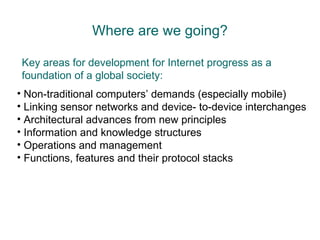
Where are we going? Key areas for development for Internet progress as a foundation of a global society:   Non-traditional computers’ demands (especially mobile) Linking sensor networks and device- to-device interchanges Architectural advances from new principles Information and knowledge structures Operations and management Functions, features and their protocol stacks
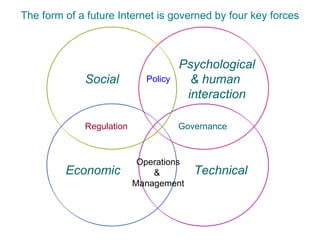
The form of a future Internet is governed by four key forces Regulation Economic Policy Operations &  Management Governance Social Psychological & human  interaction Technical
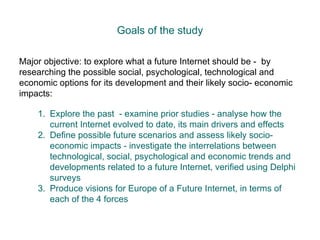
Goals of the study Major objective: to explore what a future Internet should be -  by researching the possible social, psychological, technological and economic options for its development and their likely socio- economic impacts: Explore the past  - examine prior studies - analyse how the current Internet evolved to date, its main drivers and effects Define possible future scenarios and assess likely socio-economic impacts - investigate the interrelations between technological, social, psychological and economic trends and developments related to a future Internet, verified using Delphi surveys Produce visions for Europe of a Future Internet, in terms of each of the 4 forces
The key work actions and packages WP1  Internet History and Evolution Original architecture & design criteria Socio-economic trends Main historical drivers Regulation Causal links etc WP2  Building Future Internet Scenarios Scenarios built with Delphi survey to explore:- Needs analysis for a future Internet  –  the Main Drivers   Future Social and Economic trends   Future psychological and interface needs Future Internet development directions Architectural and technical evolution Services evolution Disruptive developments Economic   impacts Regulation needs and their impacts WP3  Towards an EC Internet Policy Risks and rewards Design for living - the socio-economic  dimensions Regulation and governance Management and operations
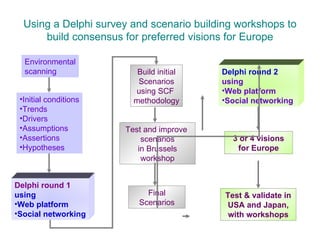
Using a Delphi survey and scenario building workshops to build consensus for preferred visions for Europe Delphi round 1  using Web platform Social networking Build initial Scenarios using SCF  methodology Test and improve  scenarios in Brussels workshop Final Scenarios Test & validate in USA and Japan, with workshops Environmental scanning Initial conditions Trends Drivers Assumptions Assertions Hypotheses 3 or 4 visions for Europe Delphi round 2 using Web platform Social networking

Towards a Future Internet

  • 1.
    Towards a FutureInternet Interrelation between Technological, Social and Economic Trends A study for DG Information Society and Media Oxford Internet Institute : Dr Ian Brown, Malte Ziewitz SCF Associates: Simon Forge Individual Experts: Dr Lara Srivastava, Dr Colin Blackman, Dr Karmen Guevara, Dr Motohiro Tsuchiya, Dr Jonathan Cave
  • 2.
    Where are wegoing? Key areas for development for Internet progress as a foundation of a global society: Non-traditional computers’ demands (especially mobile) Linking sensor networks and device- to-device interchanges Architectural advances from new principles Information and knowledge structures Operations and management Functions, features and their protocol stacks
  • 3.
    The form ofa future Internet is governed by four key forces Regulation Economic Policy Operations & Management Governance Social Psychological & human interaction Technical
  • 4.
    Goals of thestudy Major objective: to explore what a future Internet should be - by researching the possible social, psychological, technological and economic options for its development and their likely socio- economic impacts: Explore the past - examine prior studies - analyse how the current Internet evolved to date, its main drivers and effects Define possible future scenarios and assess likely socio-economic impacts - investigate the interrelations between technological, social, psychological and economic trends and developments related to a future Internet, verified using Delphi surveys Produce visions for Europe of a Future Internet, in terms of each of the 4 forces
  • 5.
    The key workactions and packages WP1 Internet History and Evolution Original architecture & design criteria Socio-economic trends Main historical drivers Regulation Causal links etc WP2 Building Future Internet Scenarios Scenarios built with Delphi survey to explore:- Needs analysis for a future Internet – the Main Drivers Future Social and Economic trends Future psychological and interface needs Future Internet development directions Architectural and technical evolution Services evolution Disruptive developments Economic impacts Regulation needs and their impacts WP3 Towards an EC Internet Policy Risks and rewards Design for living - the socio-economic dimensions Regulation and governance Management and operations
  • 6.
    Using a Delphisurvey and scenario building workshops to build consensus for preferred visions for Europe Delphi round 1 using Web platform Social networking Build initial Scenarios using SCF methodology Test and improve scenarios in Brussels workshop Final Scenarios Test & validate in USA and Japan, with workshops Environmental scanning Initial conditions Trends Drivers Assumptions Assertions Hypotheses 3 or 4 visions for Europe Delphi round 2 using Web platform Social networking

Editor's Notes

  • #3 Mobile handsets – roaming, vulnerable links, small screen, immediacy, temporary contexts Adapt to current technology trends - GPS modules, PDAs and hand-held organizers Wearable computing; smart clothing; body area networks The Internet of Things – consumer durables, cars, machine tools, logistics equipment including RFID-type tracking, Industrial, utility, health and security networks with multiple radio protocols (WiMax, WiFi, LTE, BANs, Bluetooth, etc) Packet switching : IPv6 (Internet Protocol Version 6) Higher data rates and overall throughput, via better packet and packet handling protocols Media handling protocols including isochronous and priority protocol structures and streaming Revised routing, gateway and transmission architectures Revised naming, addressing and identity architecture - eg traceable addressing; or guaranteed delivery, not best-effort Semantic impacts on structure and addressing Support for Advanced human interfaces to reassure and give confidence – needed to prevent exclusion of the naïve user and also those with disabilities, and to protect users. Complete advanced trust architecture with a responsibility framework; authentication, authorisation and audit layers with multiple proofs; real time precision tracking/audit of source addresses for all Internet transactions and communications; spoofing, proxies and alias counter measures; malware prevention Privacy architecture(s) Rethinking resilience – fault tolerance, including self–reconfiguration, disaster recovery, spanning and caching Rethinking architectures for energy conservation Stronger information typing with ontologies and meta-information frameworks for use in formats and protocols Media formats for performance – efficiency and latency, heterogeneity and minimal energy consumption Information structures for the naïve user to interface easily, to search, publish and navigate intuitively Network management architecture upgrade (telco levels) Traffic management for QoS, resilience, energy economy and security