VIVEKANANDHA
ARTS AND SCIENCE COLLEGE FOR WOMEN
Veerachipalayam-637 303, Sankagiri, Salem Dt., Tamil Nadu India
Affiliated to Periyar University, Salem: Recognised Under Section 2(1) & 12(B) of the UGC Act, 1956)
DEPARTMENT OF MICROBIOLOGY
SUBJECT: SOIL & ENVIRONMENTAL MICROBIOLOGY
SUBJECT INCHARGE:
Dr. R.DINESHKUMAR, ASSISTANT
PROFESSOR, DEPARTMENT OF
MICROBIOLOGY, VIVEKANANDHA
ARTS AND SCIENCE COLLEGE FOR
WOMEN, SANKAGIRI, SALEM,
TAMILNADU.
SUBMITTED BY:
ABIRAMI, II-M.SC MICROBIOLOGY,
VIVEKANANDHA ARTS AND SCIENCE
COLLEGE FOR WOMEN, SANKAGIRI,
SALEM, TAMILNADU
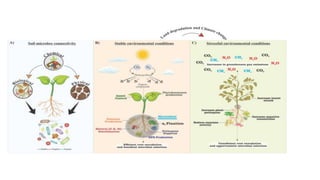
Soil microbiology
Soil as microbial habits,soil profile and
properties,soil formation diversity,
distribution of major group of
microorganisms in soil
Soil Microbiology
❖ It is branch of science dealing with study of soil
microorganisms and their activities in the soil, their
functions, and how they affect soil properties.
❖ form a very small fraction of soil mass less than 1%)
❖ In the upper layer of soil (top soil up to 10-30 cm depth
i.e. Horizon A), the microbial population is very high
which decreases with depth of soil
Importance Of Microorganisms:
❖ Caffect the structure and fertility of different soils.
❖ Contribute to nutrient availability in soil(OM
decomposition, humus formation, N-fixation, seed
germination)
❖ Manage soil stability by different biochemical processes
❖ Degrade pesticides and chemicals in soil
❖ Contribute the growth and success of the plants and
overall ecosystem of a soil environment.
Types of microorganisms
Bacteria
Actinomycetes
Fungi
Algae
Protozoa
Bacteria:
Most abundant soil microbes
Functions:
Nitrogen fixation (e.g., Rhizobium), decomposition, and
organic matter transformation.
Fungi:
Decomposers of complex organic compounds (e.g.,
cellulose, lignin)
Mycorrhizal fungi form symbiotic relationships with
plants, helping them absorb water and nutrients.
Actinomycetes:
Filamentous bacteria-like organisms.
Important for breaking down tough plant materials and
producing antibiotics.
Algae:
Present in the upper layers of moist soils.
Contribute to photosynthesis and organic matter
formation.
Protozoa and Nematodes:
Feed on bacteria and other small organisms.
Help regulate microbial populations and nutrient cycling.
Functions of Soil Microorganisms:
❖ Decomposition of organic matter.
❖ Nutrient cycling (N, P, K, S).
❖ Nitrogen fixation (converting atmospheric N₂ to
plant-usable forms).
❖ Soil structure formation (by producing polysaccharides
that bind soil particles).
❖ Disease suppression (some microbes outcompete or
inhibit pathogens).
Factors Affecting Soil Microbial Activity:
❖ Soil pH (neutral to slightly acidic is optimal for many
microbes).
❖ Moisture and temperature
❖ Organic matter content
❖ Oxygen availability (aerobic vs anaerobic conditions)
❖ Fertilizers and pesticides (can both stimulate and harm
microbial communities)
Soil as microbial habitat
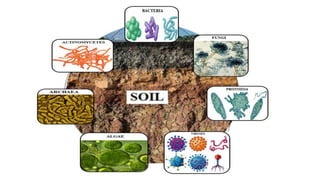
Soil is one of the most diverse and dynamic microbial
habitats on Earth. It hosts an incredible array of
microorganisms-including bacteria, archaea, fungi,
protozoa, algae, and viruses-that play critical roles in
ecosystem functioning. Here's an overview of the
characteristics that make soil a unique microbial habitat
and the roles of soil microbes:
Diversity of Microorganisms in Soil
Bacteria: The most abundant microbes in soil; include
nitrogen fixers (e.g., Rhizobium), decomposers, and
pathogens.
Fungi: Important decomposers and symbionts (e.g..
mycorrhizal fungi help plants absorb nutrients).
Actinomycetes: A group of filamentous bacteria that
decompose complex organic materials and produce
antibiotics.
Archaea: Often involved in nitrogen and carbon cycling,
especially in extreme environments.
Soil Microhabitats
Soil is a heterogeneous environment composed of
Soil aggregates: Microbes often live in and around soil
particles, where water and nutrients accumulate.
Rhizosphere: The narrow region of soil influenced by root
secretions, rich in microbial life.
Pores: Provide spaces for air, water, and microbial
movement.
Factors Influencing Microbial Life in Soil:
Moisture: Essential for microbial metabolism and
movement.
Temperature: Affects enzyme activity and microbial growth
rates.
PH: Influences microbial community composition; fungi
dominate in acidic soils, bacteria in neutral to alkaline.
Nutrient availability: Determines microbial abundance and
activity.
Oxygen levels: Influence aerobic vs. anaerobic microbial
populations.
Functions of Soil Microorganisms:
Decomposition: Breakdown of organic matter, releasing
nutrients back into the soil.
Nutrient cycling: Involvement in nitrogen, phosphorus, sulfur,
and carbon cycles.
Soil structure formation: Production of biofilms and organic
compounds that bind soil particles.
Plant growth promotion: Through nitrogen fixation,
phosphate solubilization, and production of growth
hormones.
Importance of Soil Microbial Diversity
• Enhances soil fertility and plant productivity.
• Improves soil resilience against environmental stress.
• Supports ecological balance and biodiversity.
Disease suppression: Competition and production of
antimicrobial compounds help control pathogens.
Soil profile and properties
A soil profile is a vertical section of soil that
shows its different layers or horizons, each with
distinct physical, chemical, and biological
characteristics. Understanding the soil profile is
essential for agriculture, construction, and
environmental management.
O Horizon (Organic)
Composed of organic matter like decomposed leaves,
plants, and animals. Dark in color. Found mostly in forests
A Horizon (Topsoil)
Contains a mix of organic matter and minerals. Rich in
nutrients and importan for plant growth.
B Horizon (Subsoil)
Accumulates leached materials like clay, iron, and aluminum
Less organic matter. Denser ar harder.
C Horizon (Parent Material
Consists of weathered ro and minerals from which he
upper layers form.
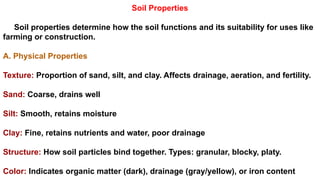
Soil Properties
Soil properties determine how the soil functions and its suitability for uses like
farming or construction.
A. Physical Properties
Texture: Proportion of sand, silt, and clay. Affects drainage, aeration, and fertility.
Sand: Coarse, drains well
Silt: Smooth, retains moisture
Clay: Fine, retains nutrients and water, poor drainage
Structure: How soil particles bind together. Types: granular, blocky, platy.
Color: Indicates organic matter (dark), drainage (gray/yellow), or iron content
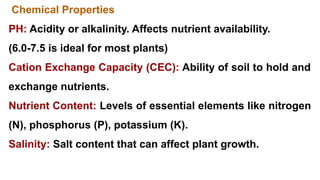
Chemical Properties
PH: Acidity or alkalinity. Affects nutrient availability.
(6.0-7.5 is ideal for most plants)
Cation Exchange Capacity (CEC): Ability of soil to hold and
exchange nutrients.
Nutrient Content: Levels of essential elements like nitrogen
(N), phosphorus (P), potassium (K).
Salinity: Salt content that can affect plant growth.
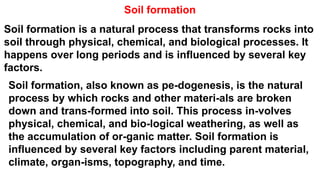
Soil formation
Soil formation is a natural process that transforms rocks into
soil through physical, chemical, and biological processes. It
happens over long periods and is influenced by several key
factors.
Soil formation, also known as pe-dogenesis, is the natural
process by which rocks and other materi-als are broken
down and trans-formed into soil. This process in-volves
physical, chemical, and bio-logical weathering, as well as
the accumulation of or-ganic matter. Soil formation is
influenced by several key factors including parent material,
climate, organ-isms, topography, and time.
Five Main Factors of Soil Formation (CLORPT)
1. Climate Temperature and precipitation influence
weathering rates.
2. Organisms (Biota) Plants, animals, microorganisms
decompose organic material and mix the soil.
3. Relief (Topography) - Slope and elevation affect drainage
and erosion.
4. Parent Material - The original rock or sediment from which
the soil forms.
Processes Involved in Soil Formation:
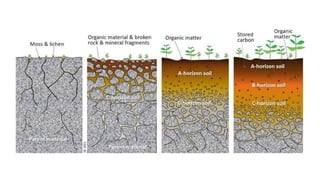
1. Weathering of Parent Material
Physical weathering: Breakdown of rocks into smaller pieces (e.g., freeze-thaw cycles).
Chemical weathering: Alters rock minerals (e.g., oxidation, hydrolysis).
Biological weathering: Roots and organisms break down material.
2. Organic Matter Accumulation
Dead plants and animals decompose, enriching the soil with humus.
3. Leaching and Translocation
Water percolates down, moving minerals and nutrients (eluviation and illuviation).
4. Soil Horizon Development
Distinct layers form over time: 0 (organic), A (topsoil), E (leached), B (subsoil), C (parent material),
R (bed
Humus Accumulation:
The decomposition of plant and animal remains by
microorganisms, resulting in the formation of humus, a
stable organic material that improves soil fertility.
Soil Profile Development:
The layering of soil into distinct horizons (layers) with
different characteristics, influenced by the factors mentioned
above.
Soil formation is a complex and dynamic process that results
in the diverse range of soils found on Earth.
Soil diversity
Soil biodiversity refers to the variety of life in the soil,
encompassing a vast array of organisms, from microscopic
bacteria and fungi to larger creatures like insects and
earthworms. This diversity is crucial for healthy ecosystems
and plays a vital role in nutrient cycling, water filtration,
carbon storage, and other essential processes. Soil
biodiversity is not just about the number of species but also
their abundance and the way they interact within the soil
ecosystem.
Key Aspects of Soil Diversity:
1. Physical Diversity
Texture: Variation in the proportion of sand, silt, and clay
(e.g., sandy vs. clayey soils).
Structure: How soil particles aggregate, affecting water and
air flow.
Color: Indicates organic matter, mineral content, and
drainage conditions.
2. Chemical Diversity
pH Levels: Ranges from acidic to alkaline soils,
influencing nutrient availability.
Nutrient Content: Varies based on mineral composition
and organic matter.
3. Biological Diversity:
Microbial Life: Soils host diverse bacteria, fungi, and
archaea.
Fauna: Includes earthworms, insects, and other
organisms that aerate and enrich soil.
Root Interactions: Different plant species interact
uniquely with soil life.
Salinity: Some soils are naturally saline, affecting what plants
can grow there.
4. Functional Diversity
Refers to the different roles soils play, such as:
Supporting plant growth
Filtering water
Storing carbon
Hosting biodiversity
5. Geographic and Climatic Influence
Soils differ significantly depending on climate, topography, parent material, and
land use.
Importance of Soil Diversity:
Agriculture: Different crops thrive in different soil types.
Ecology: Supports diverse plant and animal life.
Conservation: Essential for maintaining ecosystem services.
Climate Regulation: Soils store large amounts of carbon.
Threats to Soil Diversity:
Monoculture farming
Overgrazing
Deforestation
Distribution of major group of microorganisms in
soil
The distribution of major groups of microorganisms in
soil depends on several environmental factors such as
moisture, temperature, pH, organic matter content, and
soil type. Here's an overview of the major groups of
microorganisms found in soil and their typical distribution
patterns:
Bacteria
Abundance: Most numerous group (108-109 cells/gram of soil).
Distribution:
Concentrated in the rhizosphere (soil region near plant roots).
Abundant in surface soil layers due to higher organic matter.
Thrive in neutral to slightly alkaline pH.
Types:
Heterotrophic (e.g., Pseudomonas, Bacillus)
Autotrophic (e.g., nitrifying bacteria like Nitrosomonas, Nitrobacter)
❖ Fungi
Abundance: Second most abundant (105-106 colony forming units/g).
Distribution:
Prefer acidic and low-nitrogen soils.
Found in both surface and deeper soil layers.
Thrive in soils with high cellulose/lignin content (e.g., forest soils).
Types:
Saprophytic fungi (e.g., Aspergillus, Penicillium)
Mycorrhizal fungi (e.g., Glomus, Rhizophagus)
❖ Actinomycetes
Abundance: Intermediate between bacteria and fungi (106-107
cells/g).
Distribution:
Prefer neutral to alkaline pH.
Abundant in dry, well-aerated soils.
Common in decaying plant material.
Role: Decompose complex organic matter; produce antibiotics
❖ Algae
Abundance: Less abundant than bacteria and fungi.
Distribution:
Mostly in surface soil exposed to light.
Favor moist, nutrient-rich soils.
Types:
Cyanobacteria (blue-green algae)
Green algae (e.g., Chlorella, Chlamydomonas)
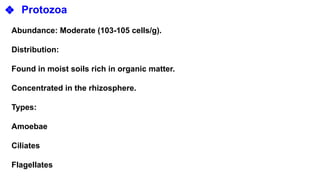
❖ Protozoa
Abundance: Moderate (103-105 cells/g).
Distribution:
Found in moist soils rich in organic matter.
Concentrated in the rhizosphere.
Types:
Amoebae
Ciliates
Flagellates
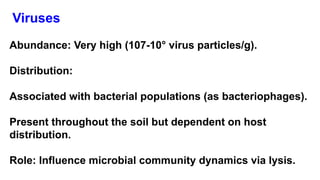
Viruses
Abundance: Very high (107-10° virus particles/g).
Distribution:
Associated with bacterial populations (as bacteriophages).
Present throughout the soil but dependent on host
distribution.
Role: Influence microbial community dynamics via lysis.
Soil microbiology & Environment Microbiology .pdf

Soil microbiology & Environment Microbiology .pdf

  • 1.
    VIVEKANANDHA ARTS AND SCIENCECOLLEGE FOR WOMEN Veerachipalayam-637 303, Sankagiri, Salem Dt., Tamil Nadu India Affiliated to Periyar University, Salem: Recognised Under Section 2(1) & 12(B) of the UGC Act, 1956) DEPARTMENT OF MICROBIOLOGY SUBJECT: SOIL & ENVIRONMENTAL MICROBIOLOGY SUBJECT INCHARGE: Dr. R.DINESHKUMAR, ASSISTANT PROFESSOR, DEPARTMENT OF MICROBIOLOGY, VIVEKANANDHA ARTS AND SCIENCE COLLEGE FOR WOMEN, SANKAGIRI, SALEM, TAMILNADU. SUBMITTED BY: ABIRAMI, II-M.SC MICROBIOLOGY, VIVEKANANDHA ARTS AND SCIENCE COLLEGE FOR WOMEN, SANKAGIRI, SALEM, TAMILNADU
  • 2.
    Soil microbiology Soil asmicrobial habits,soil profile and properties,soil formation diversity, distribution of major group of microorganisms in soil
  • 3.
    Soil Microbiology ❖ Itis branch of science dealing with study of soil microorganisms and their activities in the soil, their functions, and how they affect soil properties. ❖ form a very small fraction of soil mass less than 1%) ❖ In the upper layer of soil (top soil up to 10-30 cm depth i.e. Horizon A), the microbial population is very high which decreases with depth of soil
  • 4.
    Importance Of Microorganisms: ❖Caffect the structure and fertility of different soils. ❖ Contribute to nutrient availability in soil(OM decomposition, humus formation, N-fixation, seed germination) ❖ Manage soil stability by different biochemical processes ❖ Degrade pesticides and chemicals in soil ❖ Contribute the growth and success of the plants and overall ecosystem of a soil environment.
  • 6.
  • 7.
    Bacteria: Most abundant soilmicrobes Functions: Nitrogen fixation (e.g., Rhizobium), decomposition, and organic matter transformation. Fungi: Decomposers of complex organic compounds (e.g., cellulose, lignin) Mycorrhizal fungi form symbiotic relationships with plants, helping them absorb water and nutrients.
  • 8.
    Actinomycetes: Filamentous bacteria-like organisms. Importantfor breaking down tough plant materials and producing antibiotics. Algae: Present in the upper layers of moist soils. Contribute to photosynthesis and organic matter formation. Protozoa and Nematodes: Feed on bacteria and other small organisms. Help regulate microbial populations and nutrient cycling.
  • 9.
    Functions of SoilMicroorganisms: ❖ Decomposition of organic matter. ❖ Nutrient cycling (N, P, K, S). ❖ Nitrogen fixation (converting atmospheric N₂ to plant-usable forms). ❖ Soil structure formation (by producing polysaccharides that bind soil particles). ❖ Disease suppression (some microbes outcompete or inhibit pathogens).
  • 10.
    Factors Affecting SoilMicrobial Activity: ❖ Soil pH (neutral to slightly acidic is optimal for many microbes). ❖ Moisture and temperature ❖ Organic matter content ❖ Oxygen availability (aerobic vs anaerobic conditions) ❖ Fertilizers and pesticides (can both stimulate and harm microbial communities)
  • 11.
    Soil as microbialhabitat Soil is one of the most diverse and dynamic microbial habitats on Earth. It hosts an incredible array of microorganisms-including bacteria, archaea, fungi, protozoa, algae, and viruses-that play critical roles in ecosystem functioning. Here's an overview of the characteristics that make soil a unique microbial habitat and the roles of soil microbes:
  • 12.
    Diversity of Microorganismsin Soil Bacteria: The most abundant microbes in soil; include nitrogen fixers (e.g., Rhizobium), decomposers, and pathogens. Fungi: Important decomposers and symbionts (e.g.. mycorrhizal fungi help plants absorb nutrients). Actinomycetes: A group of filamentous bacteria that decompose complex organic materials and produce antibiotics. Archaea: Often involved in nitrogen and carbon cycling, especially in extreme environments.
  • 13.
    Soil Microhabitats Soil isa heterogeneous environment composed of Soil aggregates: Microbes often live in and around soil particles, where water and nutrients accumulate. Rhizosphere: The narrow region of soil influenced by root secretions, rich in microbial life. Pores: Provide spaces for air, water, and microbial movement.
  • 14.
    Factors Influencing MicrobialLife in Soil: Moisture: Essential for microbial metabolism and movement. Temperature: Affects enzyme activity and microbial growth rates. PH: Influences microbial community composition; fungi dominate in acidic soils, bacteria in neutral to alkaline. Nutrient availability: Determines microbial abundance and activity. Oxygen levels: Influence aerobic vs. anaerobic microbial populations.
  • 15.
    Functions of SoilMicroorganisms: Decomposition: Breakdown of organic matter, releasing nutrients back into the soil. Nutrient cycling: Involvement in nitrogen, phosphorus, sulfur, and carbon cycles. Soil structure formation: Production of biofilms and organic compounds that bind soil particles. Plant growth promotion: Through nitrogen fixation, phosphate solubilization, and production of growth hormones.
  • 16.
    Importance of SoilMicrobial Diversity • Enhances soil fertility and plant productivity. • Improves soil resilience against environmental stress. • Supports ecological balance and biodiversity. Disease suppression: Competition and production of antimicrobial compounds help control pathogens.
  • 17.
    Soil profile andproperties A soil profile is a vertical section of soil that shows its different layers or horizons, each with distinct physical, chemical, and biological characteristics. Understanding the soil profile is essential for agriculture, construction, and environmental management.
  • 18.
    O Horizon (Organic) Composedof organic matter like decomposed leaves, plants, and animals. Dark in color. Found mostly in forests A Horizon (Topsoil) Contains a mix of organic matter and minerals. Rich in nutrients and importan for plant growth. B Horizon (Subsoil) Accumulates leached materials like clay, iron, and aluminum Less organic matter. Denser ar harder. C Horizon (Parent Material Consists of weathered ro and minerals from which he upper layers form.
  • 19.
    Soil Properties Soil propertiesdetermine how the soil functions and its suitability for uses like farming or construction. A. Physical Properties Texture: Proportion of sand, silt, and clay. Affects drainage, aeration, and fertility. Sand: Coarse, drains well Silt: Smooth, retains moisture Clay: Fine, retains nutrients and water, poor drainage Structure: How soil particles bind together. Types: granular, blocky, platy. Color: Indicates organic matter (dark), drainage (gray/yellow), or iron content
  • 20.
    Chemical Properties PH: Acidityor alkalinity. Affects nutrient availability. (6.0-7.5 is ideal for most plants) Cation Exchange Capacity (CEC): Ability of soil to hold and exchange nutrients. Nutrient Content: Levels of essential elements like nitrogen (N), phosphorus (P), potassium (K). Salinity: Salt content that can affect plant growth.
  • 21.
    Soil formation Soil formationis a natural process that transforms rocks into soil through physical, chemical, and biological processes. It happens over long periods and is influenced by several key factors. Soil formation, also known as pe-dogenesis, is the natural process by which rocks and other materi-als are broken down and trans-formed into soil. This process in-volves physical, chemical, and bio-logical weathering, as well as the accumulation of or-ganic matter. Soil formation is influenced by several key factors including parent material, climate, organ-isms, topography, and time.
  • 23.
    Five Main Factorsof Soil Formation (CLORPT) 1. Climate Temperature and precipitation influence weathering rates. 2. Organisms (Biota) Plants, animals, microorganisms decompose organic material and mix the soil. 3. Relief (Topography) - Slope and elevation affect drainage and erosion. 4. Parent Material - The original rock or sediment from which the soil forms.
  • 24.
    Processes Involved inSoil Formation: 1. Weathering of Parent Material Physical weathering: Breakdown of rocks into smaller pieces (e.g., freeze-thaw cycles). Chemical weathering: Alters rock minerals (e.g., oxidation, hydrolysis). Biological weathering: Roots and organisms break down material. 2. Organic Matter Accumulation Dead plants and animals decompose, enriching the soil with humus. 3. Leaching and Translocation Water percolates down, moving minerals and nutrients (eluviation and illuviation). 4. Soil Horizon Development Distinct layers form over time: 0 (organic), A (topsoil), E (leached), B (subsoil), C (parent material), R (bed
  • 25.
    Humus Accumulation: The decompositionof plant and animal remains by microorganisms, resulting in the formation of humus, a stable organic material that improves soil fertility. Soil Profile Development: The layering of soil into distinct horizons (layers) with different characteristics, influenced by the factors mentioned above. Soil formation is a complex and dynamic process that results in the diverse range of soils found on Earth.
  • 26.
    Soil diversity Soil biodiversityrefers to the variety of life in the soil, encompassing a vast array of organisms, from microscopic bacteria and fungi to larger creatures like insects and earthworms. This diversity is crucial for healthy ecosystems and plays a vital role in nutrient cycling, water filtration, carbon storage, and other essential processes. Soil biodiversity is not just about the number of species but also their abundance and the way they interact within the soil ecosystem.
  • 28.
    Key Aspects ofSoil Diversity: 1. Physical Diversity Texture: Variation in the proportion of sand, silt, and clay (e.g., sandy vs. clayey soils). Structure: How soil particles aggregate, affecting water and air flow. Color: Indicates organic matter, mineral content, and drainage conditions. 2. Chemical Diversity pH Levels: Ranges from acidic to alkaline soils, influencing nutrient availability. Nutrient Content: Varies based on mineral composition and organic matter.
  • 29.
    3. Biological Diversity: MicrobialLife: Soils host diverse bacteria, fungi, and archaea. Fauna: Includes earthworms, insects, and other organisms that aerate and enrich soil. Root Interactions: Different plant species interact uniquely with soil life. Salinity: Some soils are naturally saline, affecting what plants can grow there.
  • 30.
    4. Functional Diversity Refersto the different roles soils play, such as: Supporting plant growth Filtering water Storing carbon Hosting biodiversity 5. Geographic and Climatic Influence Soils differ significantly depending on climate, topography, parent material, and land use.
  • 31.
    Importance of SoilDiversity: Agriculture: Different crops thrive in different soil types. Ecology: Supports diverse plant and animal life. Conservation: Essential for maintaining ecosystem services. Climate Regulation: Soils store large amounts of carbon. Threats to Soil Diversity: Monoculture farming Overgrazing Deforestation
  • 32.
    Distribution of majorgroup of microorganisms in soil The distribution of major groups of microorganisms in soil depends on several environmental factors such as moisture, temperature, pH, organic matter content, and soil type. Here's an overview of the major groups of microorganisms found in soil and their typical distribution patterns:
  • 33.
    Bacteria Abundance: Most numerousgroup (108-109 cells/gram of soil). Distribution: Concentrated in the rhizosphere (soil region near plant roots). Abundant in surface soil layers due to higher organic matter. Thrive in neutral to slightly alkaline pH. Types: Heterotrophic (e.g., Pseudomonas, Bacillus) Autotrophic (e.g., nitrifying bacteria like Nitrosomonas, Nitrobacter)
  • 34.
    ❖ Fungi Abundance: Secondmost abundant (105-106 colony forming units/g). Distribution: Prefer acidic and low-nitrogen soils. Found in both surface and deeper soil layers. Thrive in soils with high cellulose/lignin content (e.g., forest soils). Types: Saprophytic fungi (e.g., Aspergillus, Penicillium) Mycorrhizal fungi (e.g., Glomus, Rhizophagus)
  • 35.
    ❖ Actinomycetes Abundance: Intermediatebetween bacteria and fungi (106-107 cells/g). Distribution: Prefer neutral to alkaline pH. Abundant in dry, well-aerated soils. Common in decaying plant material. Role: Decompose complex organic matter; produce antibiotics
  • 36.
    ❖ Algae Abundance: Lessabundant than bacteria and fungi. Distribution: Mostly in surface soil exposed to light. Favor moist, nutrient-rich soils. Types: Cyanobacteria (blue-green algae) Green algae (e.g., Chlorella, Chlamydomonas)
  • 37.
    ❖ Protozoa Abundance: Moderate(103-105 cells/g). Distribution: Found in moist soils rich in organic matter. Concentrated in the rhizosphere. Types: Amoebae Ciliates Flagellates
  • 38.
    Viruses Abundance: Very high(107-10° virus particles/g). Distribution: Associated with bacterial populations (as bacteriophages). Present throughout the soil but dependent on host distribution. Role: Influence microbial community dynamics via lysis.