
Engineering Education:
Imperatives & Issues
Dr S G Deshmukh
ABV-Indian Institute of Information Technology & Management
www.iiitm.ac.in
Session at RJIT Tekanpur, 1 Sep 2012
Opening quote….
 “Quality in higher education has been a matter of
importance,concern and priority at regional,
national and international levels especially in the
recent past”.
 Cathamparampil et al.(2005)
Speaking points
 Imperatives
 Engineering Challenges
 Critical Success Factors
 Issues :
 Faculty development
 Laboratory development
 Role of faculty in administration
 Industry-Institute linkages
 Employability
 Concluding remarks
Typical comments on curriculum
 Too much theoretical content
 Compartmentalized approach
 Lacks preparing student for problem solving skills
 Gap between what is taught and what is required
 Gap between knowledge and skills
 Not industrially relevant
Digital Divide
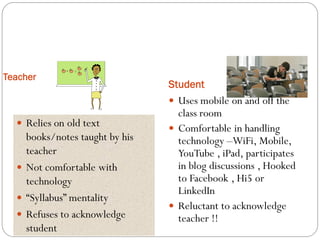
Teacher
Student
 Relies on old text
books/notes taught by his
teacher
 Not comfortable with
technology
 “Syllabus” mentality
 Refuses to acknowledge
student
 Uses mobile on and off the
class room
 Comfortable in handling
technology –WiFi, Mobile,
YouTube , iPad, participates
in blog discussions , Hooked
to Facebook , Hi5 or
LinkedIn
 Reluctant to acknowledge
teacher !!
IImperatives ..
 Globalization : BorderlessWorld of accelerating multi-
dimensional change
 Quality of services(WTO,Washington accord), and Shift
to knowledge economy
 Role of private universities
 Expectations of student community, and industry
 Changing face of technology : Revolutions in Information
Technology (IT)
Engineering Education System MUST
translate these challenges through a Quality
response
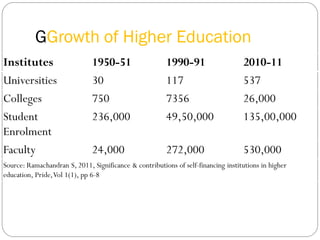
GGrowth of Higher Education
Institutes 1950-51 1990-91 2010-11
Universities 30 117 537
Colleges 750 7356 26,000
Student
Enrolment
236,000 49,50,000 135,00,000
Faculty 24,000 272,000 530,000
Source: Ramachandran S, 2011, Significance & contributions of self-financing institutions in higher
education, Pride,Vol 1(1), pp 6-8
Imperative 1: Globalization of
Education
 Globalization refers to the increasing flow of technology, finance,
trade, knowledge, values and ideas across the borders(Knight &Wit,
1997)
 It has multidimensional impact on the system of
education.
 It has underlined the need for reforms in the educational
system with particular reference to wider utilization of IT
giving productivity and quality dimension and emphasis
on its R&D activities.
Imperative 2 : Expectations of Student
community and Industry
 Bombarded with technological gadgets (Mobile, web,
laptop etc.)
 Low retention span
 Teacher as a facilitator/coach
 Dynamic requirements of industry
 Gap between what is taught and what is required
Features of Traditional Engineering
Education
 More focused on abstract themes
 Instructor centered learning
 Depth in specialized fields
 Very little use of computers, Multimedia, Internet
 More focused on individual efforts
The Reality!: Current Weaknesses in
Today’s Eng. Graduates
 Weakness in understanding manufacturing processes
 Mostly analysts in specific areas
 Myopic view of engineering
 No understanding of quality process
 Weak communication skills
 Lack of design capabilities
 Weak teamwork & project management skills
Essentials for Competitive Graduates
 Strong technical capability
 Skills in communication and persuasion
 Ability to lead and work effectively as a member of a team
 Understanding of the non-technical forces that profoundly
influence engineering decisions
 Commitment to lifelong learning
 Skills in design and project management
 Multidisciplinary
Forces Pushing for Change
 Companies employing engineering graduates
 Accreditation efforts (such as NBA/ABET)
 Globalization of economy
 Engineering professional societies
Technological Challenges
 Information: Proliferation
 Tech. development: Multidisciplinary
 Markets: Globalized
 Environment: Endangered
 Social responsibility: Engineering
 Corporate structure: Participatory
 Change: Rapid!
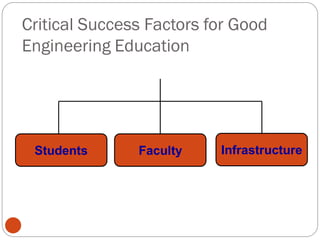
Critical Success Factors for Good
Engineering Education
InfrastructureStudents Faculty
 Attract the best students with leadership potential
 Develop and nurture students for a wholesome personality
 Educate & motivate engineering students to be ready:
to implement new technology
to focus on innovation
to understand global trends
to make an impact on society
Students
 Faculty with good engineering/science background
 Faculty with excellent potential in carrying innovative research
 Faculty committed to a dynamic teaching environment
 Provide faculty with opportunities for self development
 Motivate faculty for doing high impact research
 Facilitate cooperation with industry & the society at large
Faculty
 Provide enabling environment that encourages high levels of academic
productivity
 Up to date facilities (Computers, Library, Laboratory, sports etc.)
 Adopt flexible and clear rules and regulations
 Create sense of ownership
Infrastructure & Support
Strengths of RJIT
 First of its kind institute
 Young and dynamic faculty
 Disciplined student community
 Learning culture
 Good infrastructure
 Adequate space for expansion
 Good academic programme: Both UG & PG
 Niche Programme :Automobile Engg
Implications for RJIT
 Move to next orbit
 Enhance quality teaching
 Emphasis on laboratory development
 Give space to experiment & innovate
 Network with other institutes
 Use of National Knowledge Network
 Stress on Research
 Provide ecosystem
 Faculty Incentive to motivate
Issue 1: Faculty development
 Encourage faculty to do Ph d
 Motivate them to conduct seminars/workhops/conferences
etc.
 Lab development – a priority item
 Empower them to take decisions and be
responsive/responsible
 Encourage team work
 Incentive scheme for quality research
Issue 2: How to create interest
amongst students in Lab
 Open ended assignments
 Hardware based projects
 Industry assignments
 More emphasis on “ Hands-on” experience
 Increase Laboratory weightage in evaluation
 Participate in competitions such as Robocon, Baja etc.
Issue 3: Industry Institute Linkage
 Invite industry people for guest lectures
 Make industry visits compulsory
 Allow faculty to spend time in industry (during vacation
/break etc.)
 Collaborative projects : Research/consultancy/problem
solving assignments
Issue 4: How to groom students for
placement
 Understand issues in employabilty
 Enhance soft skills
 Make students aware of the industry requirements
 Conduct regular industry meets
Issue : Employability skills
 Cognitive skills - higher level intellectual or academic skills (e.g.
interpreting, analysing, researching)
 Key skills – personal skills and qualities which are generic to a range of both
academic and employment settings (e.g. enterprise, criticality, teamwork,
communication, planning and organising)
 Career Management skills – skills required to manage career development
(e.g. self analysis, networking, self reliance and reflection)
 Enterprising Attitudes – personal qualities to spot opportunities and have
the skills to act on them.
Issue: Skills Expected
 Technical skills : Subject matter
 Ability to ask questions
 Ability to work independently
 Ability to identify with the community
 Soft skills: Leadership, Communication, team work, perseverance ,
tenacity
Issue 5: Role of Faculty in Administration
/Academic development
 Faculty have to shoulder responsibility in
admn(Procurement/Recruitment/Construction )
 Evolve SOPs for various activities
 Individual development vis-à-vis institutional development
 Emphasis on high quality research and the supporting infrastructure that
is needed
 Sense of ownership/involvement
Concluding remarks..
 Providing good quality engineering education – a challenge
for an institute like RJIT
 Faculty , students and staff work in a synergistic manner to
meet this challenge
 Providing good ecosystem and environment: a must
Thank you very much !
I would appreciate your comments at
deshmukh.sg@gmail.com

Engineering education-rjit-2012

  • 1.
    Engineering Education: Imperatives &Issues Dr S G Deshmukh ABV-Indian Institute of Information Technology & Management www.iiitm.ac.in Session at RJIT Tekanpur, 1 Sep 2012
  • 2.
    Opening quote….  “Qualityin higher education has been a matter of importance,concern and priority at regional, national and international levels especially in the recent past”.  Cathamparampil et al.(2005)
  • 3.
    Speaking points  Imperatives Engineering Challenges  Critical Success Factors  Issues :  Faculty development  Laboratory development  Role of faculty in administration  Industry-Institute linkages  Employability  Concluding remarks
  • 4.
    Typical comments oncurriculum  Too much theoretical content  Compartmentalized approach  Lacks preparing student for problem solving skills  Gap between what is taught and what is required  Gap between knowledge and skills  Not industrially relevant
  • 5.
    Digital Divide Teacher Student  Relieson old text books/notes taught by his teacher  Not comfortable with technology  “Syllabus” mentality  Refuses to acknowledge student  Uses mobile on and off the class room  Comfortable in handling technology –WiFi, Mobile, YouTube , iPad, participates in blog discussions , Hooked to Facebook , Hi5 or LinkedIn  Reluctant to acknowledge teacher !!
  • 6.
    IImperatives ..  Globalization: BorderlessWorld of accelerating multi- dimensional change  Quality of services(WTO,Washington accord), and Shift to knowledge economy  Role of private universities  Expectations of student community, and industry  Changing face of technology : Revolutions in Information Technology (IT) Engineering Education System MUST translate these challenges through a Quality response
  • 7.
    GGrowth of HigherEducation Institutes 1950-51 1990-91 2010-11 Universities 30 117 537 Colleges 750 7356 26,000 Student Enrolment 236,000 49,50,000 135,00,000 Faculty 24,000 272,000 530,000 Source: Ramachandran S, 2011, Significance & contributions of self-financing institutions in higher education, Pride,Vol 1(1), pp 6-8
  • 8.
    Imperative 1: Globalizationof Education  Globalization refers to the increasing flow of technology, finance, trade, knowledge, values and ideas across the borders(Knight &Wit, 1997)  It has multidimensional impact on the system of education.  It has underlined the need for reforms in the educational system with particular reference to wider utilization of IT giving productivity and quality dimension and emphasis on its R&D activities.
  • 9.
    Imperative 2 :Expectations of Student community and Industry  Bombarded with technological gadgets (Mobile, web, laptop etc.)  Low retention span  Teacher as a facilitator/coach  Dynamic requirements of industry  Gap between what is taught and what is required
  • 10.
    Features of TraditionalEngineering Education  More focused on abstract themes  Instructor centered learning  Depth in specialized fields  Very little use of computers, Multimedia, Internet  More focused on individual efforts
  • 11.
    The Reality!: CurrentWeaknesses in Today’s Eng. Graduates  Weakness in understanding manufacturing processes  Mostly analysts in specific areas  Myopic view of engineering  No understanding of quality process  Weak communication skills  Lack of design capabilities  Weak teamwork & project management skills
  • 12.
    Essentials for CompetitiveGraduates  Strong technical capability  Skills in communication and persuasion  Ability to lead and work effectively as a member of a team  Understanding of the non-technical forces that profoundly influence engineering decisions  Commitment to lifelong learning  Skills in design and project management  Multidisciplinary
  • 13.
    Forces Pushing forChange  Companies employing engineering graduates  Accreditation efforts (such as NBA/ABET)  Globalization of economy  Engineering professional societies
  • 14.
    Technological Challenges  Information:Proliferation  Tech. development: Multidisciplinary  Markets: Globalized  Environment: Endangered  Social responsibility: Engineering  Corporate structure: Participatory  Change: Rapid!
  • 15.
    Critical Success Factorsfor Good Engineering Education InfrastructureStudents Faculty
  • 16.
     Attract thebest students with leadership potential  Develop and nurture students for a wholesome personality  Educate & motivate engineering students to be ready: to implement new technology to focus on innovation to understand global trends to make an impact on society Students
  • 17.
     Faculty withgood engineering/science background  Faculty with excellent potential in carrying innovative research  Faculty committed to a dynamic teaching environment  Provide faculty with opportunities for self development  Motivate faculty for doing high impact research  Facilitate cooperation with industry & the society at large Faculty
  • 18.
     Provide enablingenvironment that encourages high levels of academic productivity  Up to date facilities (Computers, Library, Laboratory, sports etc.)  Adopt flexible and clear rules and regulations  Create sense of ownership Infrastructure & Support
  • 19.
    Strengths of RJIT First of its kind institute  Young and dynamic faculty  Disciplined student community  Learning culture  Good infrastructure  Adequate space for expansion  Good academic programme: Both UG & PG  Niche Programme :Automobile Engg
  • 20.
    Implications for RJIT Move to next orbit  Enhance quality teaching  Emphasis on laboratory development  Give space to experiment & innovate  Network with other institutes  Use of National Knowledge Network  Stress on Research  Provide ecosystem  Faculty Incentive to motivate
  • 21.
    Issue 1: Facultydevelopment  Encourage faculty to do Ph d  Motivate them to conduct seminars/workhops/conferences etc.  Lab development – a priority item  Empower them to take decisions and be responsive/responsible  Encourage team work  Incentive scheme for quality research
  • 22.
    Issue 2: Howto create interest amongst students in Lab  Open ended assignments  Hardware based projects  Industry assignments  More emphasis on “ Hands-on” experience  Increase Laboratory weightage in evaluation  Participate in competitions such as Robocon, Baja etc.
  • 23.
    Issue 3: IndustryInstitute Linkage  Invite industry people for guest lectures  Make industry visits compulsory  Allow faculty to spend time in industry (during vacation /break etc.)  Collaborative projects : Research/consultancy/problem solving assignments
  • 24.
    Issue 4: Howto groom students for placement  Understand issues in employabilty  Enhance soft skills  Make students aware of the industry requirements  Conduct regular industry meets
  • 25.
    Issue : Employabilityskills  Cognitive skills - higher level intellectual or academic skills (e.g. interpreting, analysing, researching)  Key skills – personal skills and qualities which are generic to a range of both academic and employment settings (e.g. enterprise, criticality, teamwork, communication, planning and organising)  Career Management skills – skills required to manage career development (e.g. self analysis, networking, self reliance and reflection)  Enterprising Attitudes – personal qualities to spot opportunities and have the skills to act on them.
  • 26.
    Issue: Skills Expected Technical skills : Subject matter  Ability to ask questions  Ability to work independently  Ability to identify with the community  Soft skills: Leadership, Communication, team work, perseverance , tenacity
  • 27.
    Issue 5: Roleof Faculty in Administration /Academic development  Faculty have to shoulder responsibility in admn(Procurement/Recruitment/Construction )  Evolve SOPs for various activities  Individual development vis-à-vis institutional development  Emphasis on high quality research and the supporting infrastructure that is needed  Sense of ownership/involvement
  • 28.
    Concluding remarks..  Providinggood quality engineering education – a challenge for an institute like RJIT  Faculty , students and staff work in a synergistic manner to meet this challenge  Providing good ecosystem and environment: a must
  • 29.
    Thank you verymuch ! I would appreciate your comments at deshmukh.sg@gmail.com