








DESIGN AT LARGE
Scaling the Studio

and the Lab

to the Globe
Scott Klemmer
from the Lab to the Wild
The successes
are tremendously
exciting
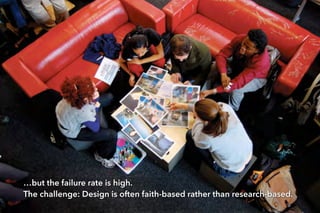
…but the failure rate is high.

The challenge: Design is often faith-based rather than research-based.
“Nothing is as
practical as a
good theory”
–Kurt Lewin
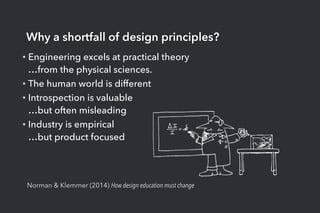
Norman & Klemmer (2014) How design education must change
Why a shortfall of design principles?
• Engineering excels at practical theory

…from the physical sciences.
• The human world is different
• Introspection is valuable

…but often misleading
• Industry is empirical

…but product focused
www.solveforx.com
• Build practical theory with
real-world experiments
• Bake that theory into
software that transforms
<X>
DESIGN AT LARGE
Is this possible?
Klemmer & Carroll (2014) HCI Special Issue: Understanding Design Thinking
“There are no rules of
composition in photography,
there are only good
photographs”
-Ansel Adams
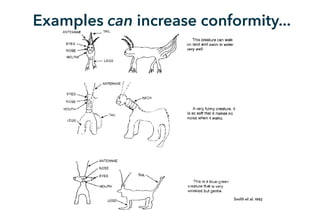
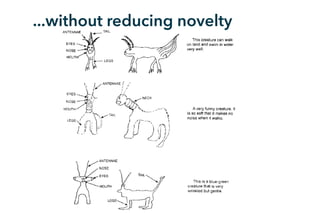
Smith et al. 1993

Examples can increase conformity...
Will nothing new
ever be created?
...without reducing novelty
—E.W. Dijkstra, On the Cruelty of Really Teaching
Computer Science
Just for Small Innovations?
“By ... metaphors and analogies we try to link the new to the old,
the novel to the familiar. Under sufficiently slow and gradual
change, it works reasonably well;
in the case of a sharp discontinuity, however, the method breaks
down ... our past experience is no longer relevant, the analogies
become too shallow, and the metaphors become more
misleading than illuminating. This is the situation ... for radical
novelty.”
Les Demoiselles d'Avignon
John Richardson, A Life of Picasso:The Cubist Rebel, 1907-1916
“Good artists borrow, great artists steal”
—Pablo Picasso
19th century Fang sculptureLes Demoiselles d'Avignon
John Richardson, A Life of Picasso:The Cubist Rebel, 1907-1916
The Power of Studio Learning
Design Learning at Large
Chinmay Kulkarni et al.
Peer and Self Assessment in Massive Online Classes, Chinmay
Kulkarni, Koh Pang Wei, Huy Le, Daniel Chia, Kathryn Papadopoulos,
Justin Cheng, Daphne Koller, Scott R. Klemmer. TOCHI: ACM
Transactions on Computer-Human Interaction, 2013
The identify-verify pattern scales short-answer grading by combining
peer assessment with algorithmic scoring, Chinmay Kulkarni, Richard
Socher, Michael S. Bernstein, Scott R. Klemmer. Learning at Scale, 2014
Talkabout: Making distance matter with small groups in massive
classes, Chinmay Kulkarni, Julia Cambre, Yasmine Kotturi, Michael S.
Bernstein, Scott Klemmer, CSCW: ACM Conference on Computer
Supported Cooperative Work, 2015
Structure and messaging techniques for online peer learning systems
that increase stickiness, Yasmine Kotturi, Chinmay Kulkarni, Michael
Bernstein, Scott Klemmer, ACM Learning at Scale, 2015
PeerStudio: Rapid Peer Feedback Emphasizes Revision and Improves
Performance, Chinmay Kulkarni, Michael S Bernstein, Scott R Klemmer,
ACM Learning at Scale, 2015
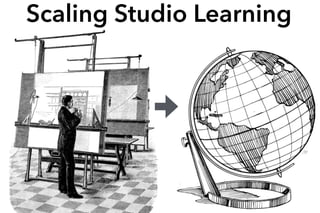
Scaling Studio Learning
Beyond Being There
Hollan, Jim, and Scott Stornetta. "Beyond being there.”ACM, 1992.
3 ingredients central to
learning,
but hard to scale
22
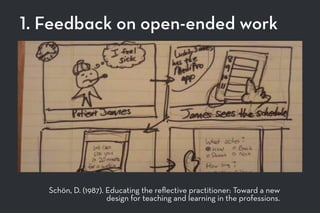
1. Feedback on open-ended work
Schön, D. (1987). Educating the reflective practitioner: Toward a new
design for teaching and learning in the professions.
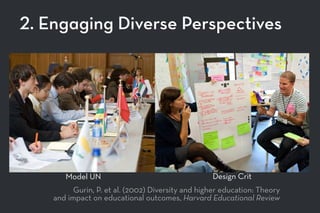
2. Engaging Diverse Perspectives
Model UN Design Crit
Gurin, P. et al. (2002) Diversity and higher education: Theory
and impact on educational outcomes, Harvard Educational Review
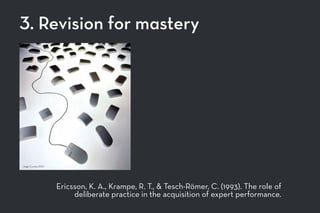
3. Revision for mastery
Ericsson, K. A., Krampe, R. T., & Tesch-Römer, C. (1993). The role of
deliberate practice in the acquisition of expert performance.
Image Courtesy IDEO
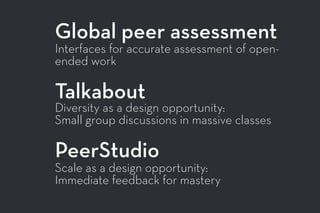
Global peer assessment
Interfaces for accurate assessment of open-
ended work
Talkabout
Diversity as a design opportunity:
Small group discussions in massive classes
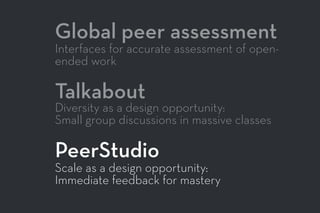
PeerStudio
Scale as a design opportunity:
Immediate feedback for mastery
The paradox of peer
processes
Non-experts performing expert work
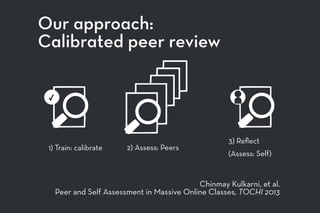
Our approach:
Calibrated peer review
Chinmay Kulkarni, et al.
Peer and Self Assessment in Massive Online Classes, TOCHI 2013
3) Reflect
(Assess: Self)
2) Assess: Peers1) Train: calibrate
✓
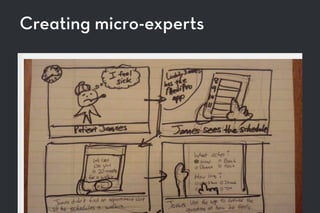
Creating micro-experts
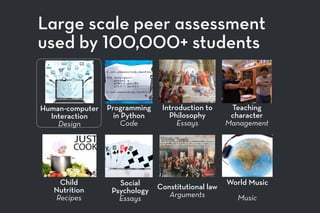
Large scale peer assessment

Human-computer
Interaction
Design
Teaching
character
Management
Constitutional law
Arguments
Introduction to
Philosophy
Essays
Social
Psychology
Essays
Programming
in Python
Code
Child
Nutrition
Recipes
World Music
Music
used by 100,000+ students
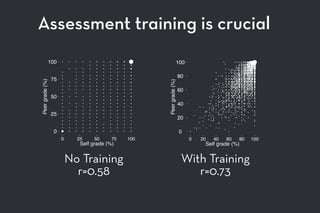
Assessment training is crucial
0
25
50
75
100
0 25 50 75 100
Self grade (%)
Peergrade(%)
No Training
r=0.58
0
20
40
60
80
100
0 20 40 60 80 100
Self grade (%)
Peergrade(%)
With Training
r=0.73
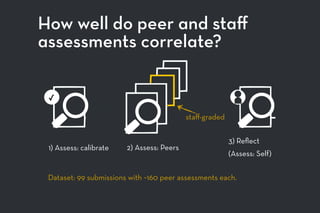
How well do peer and staff
assessments correlate?
3) Reflect
(Assess: Self)
2) Assess: Peers
staff-graded
1) Assess: calibrate
✓
Dataset: 99 submissions with ~160 peer assessments each.
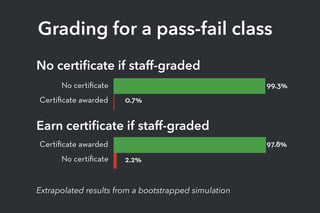
Grading for a pass-fail class
Extrapolated results from a bootstrapped simulation
Earn certificate if staff-graded
Certificate awarded
No certificate
97.8%
2.2%
No certificate
Certificate awarded
99.3%
0.7%
No certificate if staff-graded
Students with novel answers
sometimes penalized unfairly
“damn peer review - it was a bunch of
[students] just making things fit into a rubric -
checking off a check sheet - like talking about
dog poop. what is this world coming to?”
-A student in a peer-assessed class
“I've never seen something like that!”
Introduction to Art
“Treasure Cage” from Canada“Magical lights” from Norway
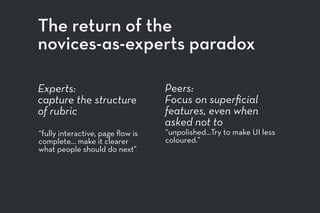
The return of the
novices-as-experts paradox
“fully interactive, page flow is
complete… make it clearer
what people should do next”
Experts:
capture the structure
of rubric
Peers:
Focus on superficial
features, even when
asked not to
“unpolished…Try to make UI less
coloured.”
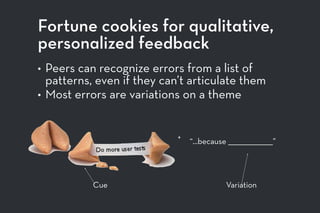
Fortune cookies for qualitative,
personalized feedback
• Peers can recognize errors from a list of
patterns, even if they can’t articulate them
• Most errors are variations on a theme
+
“...because _____________________”
Cue Variation
Students Made it Theirs
• Sharing cool interfaces, resources,
articles
• Collating reading lists, creating
assignment aids
• Doing really creative work
• Helping other students
• heuristic evaluation feedback
• answering forum questions
• extra peer assessment
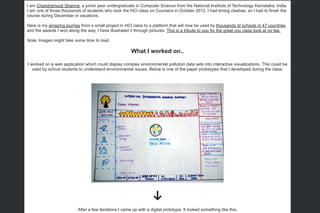
​I am Chandramouli Sharma, a junior year undergraduate in Computer Science from the National Institute of Technology Karnataka, India.
I am one of those thousands of students who took the HCI class on Coursera in October 2012. I had timing clashes, so I had to finish the
course during December in vacations.
Here is my amazing journey from a small project in HCI class to a platform that will now be used by thousands of schools in 47 countries
and the awards I won along the way. I have illustrated it through pictures. This is a tribute to you for the great you class took at no fee.
Note: Images might take some time to load.
What I worked on..
I worked on a web application which could display complex environmental pollution data sets into interactive visualizations. This could be
used by school students to understand environmental issues. Below is one of the paper prototypes that I developed during the class.
After a few iterations I came up with a digital prototype. It looked something like this.
Global peer assessment
Interfaces for accurate assessment of open-
ended work
Talkabout
Diversity as a design opportunity:
Small group discussions in massive classes
PeerStudio
Scale as a design opportunity:
Immediate feedback for mastery
Why diversity?
Different professional
knowledge, educational
systems, and cultural
values
Information
[Tudge ’08]
Cognition
[Gurin et al. ’02]
[Nemeth ’86]
[Schwartz et al ’04]
From passivity to active,
effortful, conscious
thinking
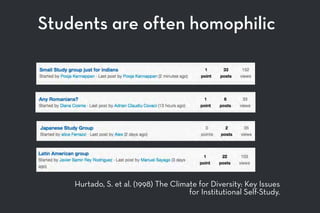
Students are often homophilic
Hurtado, S. et al. (1998) The Climate for Diversity: Key Issues
for Institutional Self-Study.
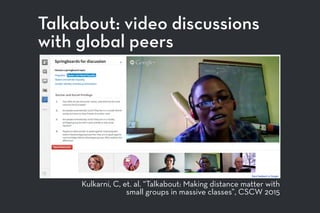
Talkabout: video discussions
with global peers
Kulkarni, C, et. al. “Talkabout: Making distance matter with
small groups in massive classes”, CSCW 2015
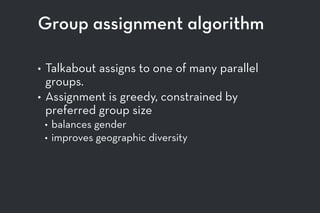
Group assignment algorithm
• Talkabout assigns to one of many parallel
groups.
• Assignment is greedy, constrained by
preferred group size
• balances gender
• improves geographic diversity
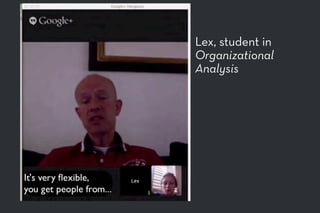
Lex, student in
Organizational
Analysis
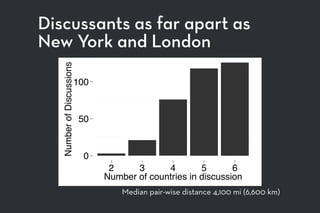
Discussants as far apart as
New York and London
Median pair-wise distance 4,100 mi (6,600 km)
0
50
100
2 3 4 5 6
Number of countries in discussion
NumberofDiscussions
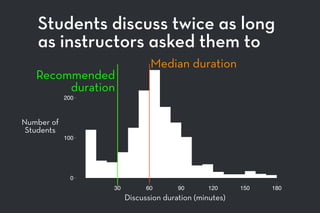
Students discuss twice as long
as instructors asked them to
Discussion duration (minutes)
Number of
Students
Median duration
0
100
200
30 60 90 120 150 180
Recommended
duration
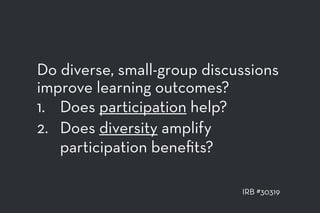
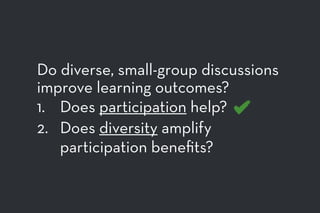
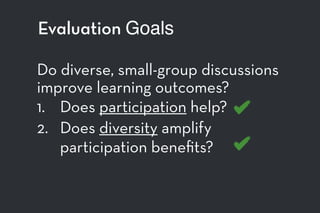
Do diverse, small-group discussions
improve learning outcomes?
1. Does participation help?
2. Does diversity amplify
participation benefits?
IRB #30319
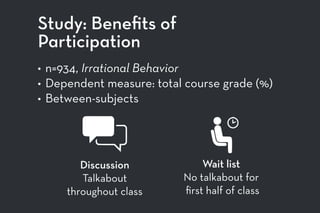
Study: Benefits of
Participation
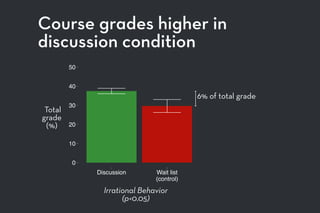
• n=934, Irrational Behavior
• Dependent measure: total course grade (%)
• Between-subjects
Wait list
No talkabout for
first half of class
Discussion
Talkabout
throughout class
Course grades higher in
discussion condition
Irrational Behavior 

(p<0.05)
Total
grade
(%)
0
10
20
30
40
50
Discussion Wait list
(control)
6% of total grade
Do diverse, small-group discussions
improve learning outcomes?
1. Does participation help?
2. Does diversity amplify
participation benefits?
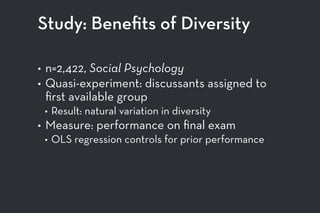
Study: Benefits of Diversity
• n=2,422, Social Psychology
• Quasi-experiment: discussants assigned to
first available group
• Result: natural variation in diversity
• Measure: performance on final exam
• OLS regression controls for prior performance
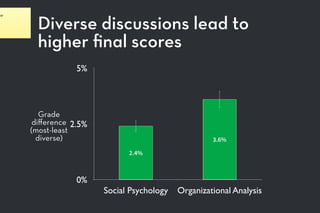
Diverse discussions lead to
higher final scores
0%
2.5%
5%
Social Psychology Organizational Analysis
3.6%
2.4%
Grade
difference
(most-least
diverse)
ior
Evaluation Goals
Do diverse, small-group discussions
improve learning outcomes?
1. Does participation help?
2. Does diversity amplify
participation benefits?
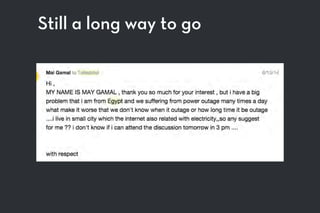
Still a long way to go
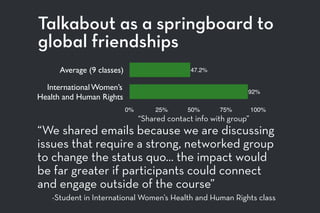
Talkabout as a springboard to
global friendships
“We shared emails because we are discussing
issues that require a strong, networked group
to change the status quo… the impact would
be far greater if participants could connect
and engage outside of the course”
-Student in International Women’s Health and Human Rights class
Average (9 classes)
International Women’s 

Health and Human Rights
0% 25% 50% 75% 100%
92%
47.2%
“Shared contact info with group”
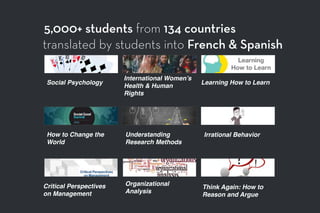
5,000+ students from 134 countries
Social Psychology
International Women’s
Health & Human
Rights
Learning How to Learn
How to Change the
World
Understanding
Research Methods
Irrational Behavior
Critical Perspectives
on Management
Organizational
Analysis
Think Again: How to
Reason and Argue
translated by students into French & Spanish
Global peer assessment
Interfaces for accurate assessment of open-
ended work
Talkabout
Diversity as a design opportunity:
Small group discussions in massive classes
PeerStudio
Scale as a design opportunity:
Immediate feedback for mastery
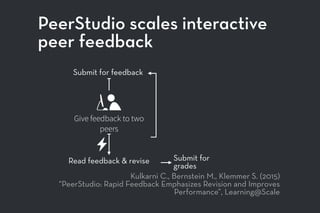
PeerStudio scales interactive
peer feedback
Kulkarni C., Bernstein M., Klemmer S. (2015)
“PeerStudio: Rapid Feedback Emphasizes Revision and Improves
Performance”, Learning@Scale
Submit for feedback
Give feedback to two
peers
Submit for
grades
Read feedback & revise
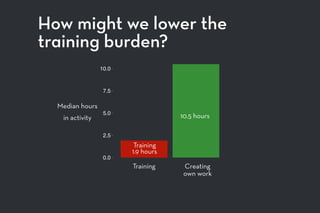
How might we lower the
training burden?
0.0
2.5
5.0
7.5
10.0
Evaluation Submission
10.5 hours
1.9 hours
Training Creating 

own work
Median hours
in activity
Training 

1.9 hours
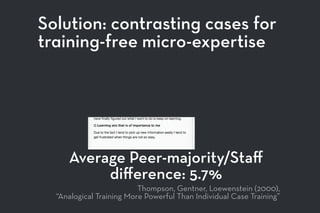
Solution: contrasting cases for
training-free micro-expertise
Thompson, Gentner, Loewenstein (2000),
“Analogical Training More Powerful Than Individual Case Training”
Average Peer-majority/Staff
difference: 5.7%
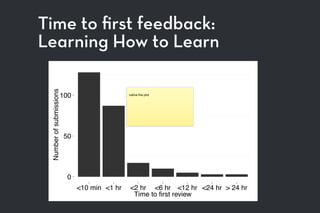
Time to first feedback:
Learning How to Learn
0
50
100
<10 min <1 hr <2 hr <6 hr <12 hr <24 hr > 24 hr
Time to first review
Numberofsubmissions
native the plot
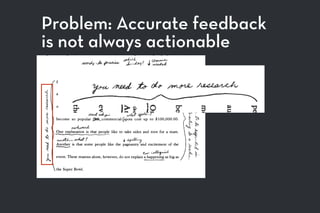
Problem: Accurate feedback
is not always actionable
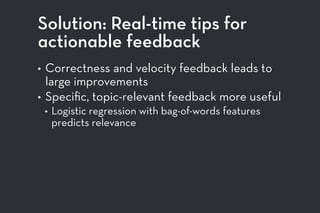
Solution: Real-time tips for
actionable feedback
• Correctness and velocity feedback leads to
large improvements
• Specific, topic-relevant feedback more useful
• Logistic regression with bag-of-words features
predicts relevance
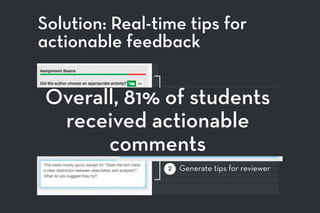
Solution: Real-time tips for
actionable feedback
1 Calculate an internal score
for each rubric dimension
2 Generate tips for reviewer
Overall, 81% of students
received actionable
comments
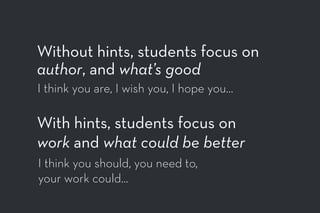
Without hints, students focus on
author, and what’s good
I think you are, I wish you, I hope you…
With hints, students focus on
work and what could be better
I think you should, you need to,
your work could…
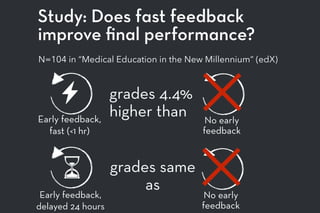
N=104 in “Medical Education in the New Millennium” (edX)
Study: Does fast feedback
improve final performance?
Early feedback,
fast (<1 hr)
grades 4.4%
higher than No early
feedback
Early feedback,
delayed 24 hours
No early
feedback
grades same
as
Global peer assessment
Interfaces for accurate assessment of open-
ended work
Talkabout
Diversity as a design opportunity:
Small group discussions in massive classes
PeerStudio
Scale as a design opportunity:
Immediate feedback for mastery
• Build practical theory with
real-world experiments
• Bake pedagogy into
software that transforms
learning
SCALING THE STUDIO
http://d.ucsd.edu/peer
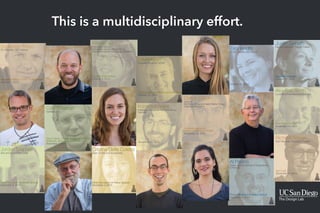
This is a multidisciplinary effort.
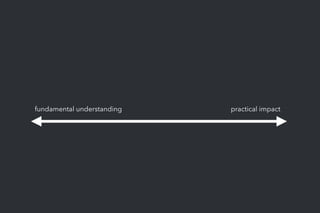
fundamental understanding practical impact
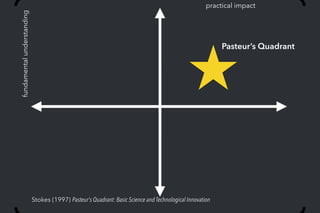
Pasteur’s Quadrant
fundamentalunderstanding
practical impact
Stokes (1997) Pasteur's Quadrant: Basic Science and Technological Innovation
The Design Lab creates postcards from the future
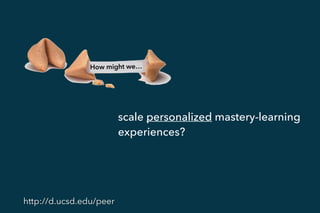
scale personalized mastery-learning
experiences?
How might we…
http://d.ucsd.edu/peer
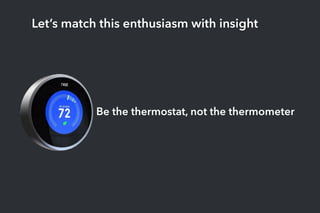
Let’s match this enthusiasm with insight
Be the thermostat, not the thermometer
http://designlab.ucsd.edu
Scott Klemmer
@DesignAtLarge
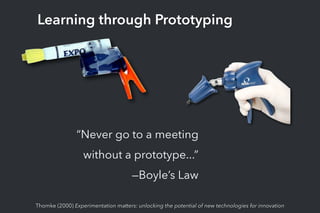
Thomke (2000) Experimentation matters: unlocking the potential of new technologies for innovation
Learning through Prototyping
“Never go to a meeting
without a prototype...”

—Boyle’s Law
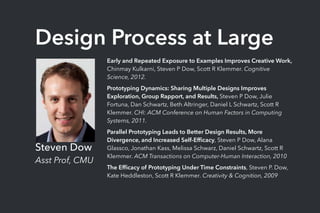
Design Process at Large
Steven Dow
Asst Prof, CMU
Early and Repeated Exposure to Examples Improves Creative Work,
Chinmay Kulkarni, Steven P Dow, Scott R Klemmer. Cognitive
Science, 2012.
Prototyping Dynamics: Sharing Multiple Designs Improves
Exploration, Group Rapport, and Results, Steven P Dow, Julie
Fortuna, Dan Schwartz, Beth Altringer, Daniel L Schwartz, Scott R
Klemmer. CHI: ACM Conference on Human Factors in Computing
Systems, 2011.
Parallel Prototyping Leads to Better Design Results, More
Divergence, and Increased Self-Efficacy, Steven P Dow, Alana
Glassco, Jonathan Kass, Melissa Schwarz, Daniel Schwartz, Scott R
Klemmer. ACM Transactions on Computer-Human Interaction, 2010
The Efficacy of Prototyping Under Time Constraints, Steven P. Dow,
Kate Heddleston, Scott R Klemmer. Creativity & Cognition, 2009
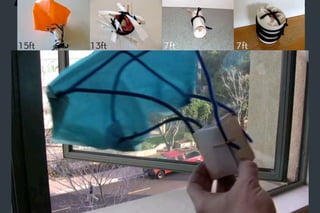
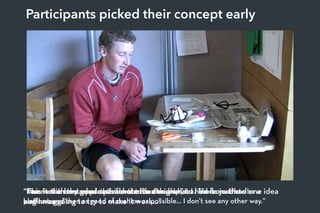
“I went with the whole parachute idea and what I had from the
beginning...”

“This is the best approach for such a design...”
“I am not a very good outside-the-box thinker, so I kinda just had one idea
and I was going to try to make it work...”
“No... for some reason... this seems to be the only idea. There needs to be a
platform and then as good of cushion as possible... I don’t see any other way.”
Participants picked their concept early
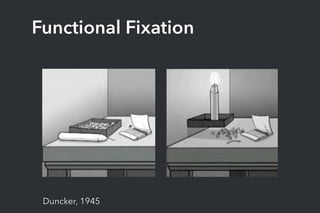
Duncker, 1945
Functional Fixation
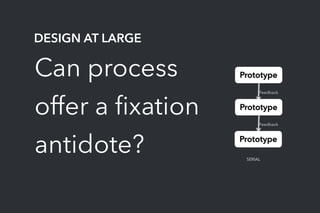
Can process
offer a fixation
antidote? Prototype
Prototype
Prototype
SERIAL
DESIGN AT LARGE
Feedback
Feedback
Web-scale
experiments as a
research platform
DESIGN AT LARGE
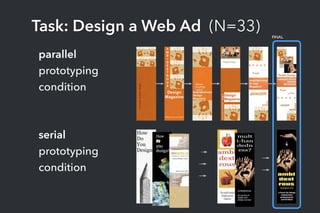
Task: Design a Web Ad (N=33)
parallel
prototyping
condition
FINAL
serial
prototyping
condition
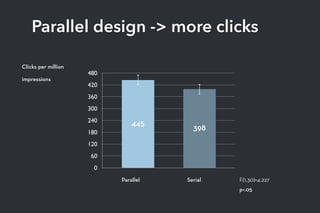
Parallel design -> more clicks
Parallel
Clicks per million
impressions
Serial F(1,30)=4.227 

p<.05
0
60
120
180
240
300
360
420
480
398
445
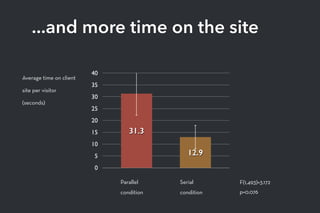
...and more time on the site
Parallel
condition
Average time on client
site per visitor
(seconds)
Serial
condition
F(1,493)=3.172 

p=0.076
0
5
10
15
20
25
30
35
40
12.9
31.3
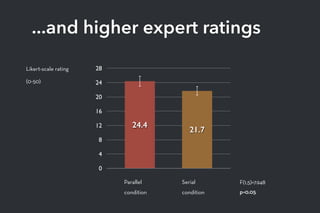
...and higher expert ratings
Parallel
condition
Likert-scale rating
(0-50)
Serial
condition
F(1,5)=7.948 

p<0.05
0
4
8
12
16
20
24
28
21.7
24.4
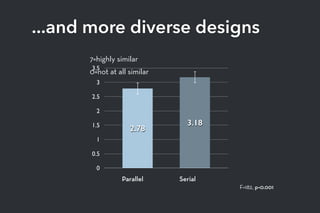
...and more diverse designs
Parallel Serial
F=182, p<0.001
0
0.5
1
1.5
2
2.5
3
3.5
3.18
2.78
7=highly similar
0=not at all similar
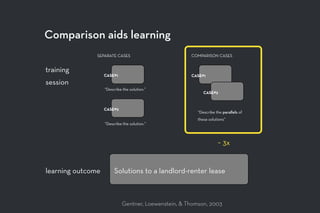
Gentner, Loewenstein, & Thomson, 2003
learning outcome
Comparison aids learning
training
session
“Describe the solution.”
CASE#1
CASE#2
CASE#1
CASE#2
“Describe the parallels of
these solutions”
“Describe the solution.”
SEPARATE CASES COMPARISON CASES
Solutions to a landlord-renter lease
~ 3x
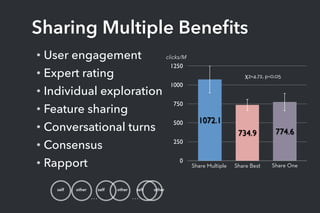
Sharing Multiple Benefits
• User engagement
• Expert rating
• Individual exploration
• Feature sharing
• Conversational turns
• Consensus
• Rapport Share Multiple
clicks/M
0
250
500
750
1000
1250
774.6734.9
1072.1
Share Best Share One
χ2=4.72, p<0.05
self other self other
… …
self other

Design at Large: Integrating Teaching and Experiments Online featuring Scott Klemmer

  • 1.
    DESIGN AT LARGE Scalingthe Studio
 and the Lab
 to the Globe Scott Klemmer
  • 2.
    from the Labto the Wild
  • 3.
  • 4.
    …but the failurerate is high.
 The challenge: Design is often faith-based rather than research-based.
  • 5.
    “Nothing is as practicalas a good theory” –Kurt Lewin
  • 6.
    Norman & Klemmer(2014) How design education must change Why a shortfall of design principles? • Engineering excels at practical theory
 …from the physical sciences. • The human world is different • Introspection is valuable
 …but often misleading • Industry is empirical
 …but product focused
  • 7.
    www.solveforx.com • Build practicaltheory with real-world experiments • Bake that theory into software that transforms <X> DESIGN AT LARGE
  • 8.
    Is this possible? Klemmer& Carroll (2014) HCI Special Issue: Understanding Design Thinking
  • 9.
    “There are norules of composition in photography, there are only good photographs” -Ansel Adams
  • 11.
    Smith et al.1993
 Examples can increase conformity...
  • 12.
  • 13.
  • 14.
    —E.W. Dijkstra, Onthe Cruelty of Really Teaching Computer Science Just for Small Innovations? “By ... metaphors and analogies we try to link the new to the old, the novel to the familiar. Under sufficiently slow and gradual change, it works reasonably well; in the case of a sharp discontinuity, however, the method breaks down ... our past experience is no longer relevant, the analogies become too shallow, and the metaphors become more misleading than illuminating. This is the situation ... for radical novelty.”
  • 15.
    Les Demoiselles d'Avignon JohnRichardson, A Life of Picasso:The Cubist Rebel, 1907-1916
  • 17.
    “Good artists borrow,great artists steal” —Pablo Picasso 19th century Fang sculptureLes Demoiselles d'Avignon John Richardson, A Life of Picasso:The Cubist Rebel, 1907-1916
  • 18.
    The Power ofStudio Learning
  • 19.
    Design Learning atLarge Chinmay Kulkarni et al. Peer and Self Assessment in Massive Online Classes, Chinmay Kulkarni, Koh Pang Wei, Huy Le, Daniel Chia, Kathryn Papadopoulos, Justin Cheng, Daphne Koller, Scott R. Klemmer. TOCHI: ACM Transactions on Computer-Human Interaction, 2013 The identify-verify pattern scales short-answer grading by combining peer assessment with algorithmic scoring, Chinmay Kulkarni, Richard Socher, Michael S. Bernstein, Scott R. Klemmer. Learning at Scale, 2014 Talkabout: Making distance matter with small groups in massive classes, Chinmay Kulkarni, Julia Cambre, Yasmine Kotturi, Michael S. Bernstein, Scott Klemmer, CSCW: ACM Conference on Computer Supported Cooperative Work, 2015 Structure and messaging techniques for online peer learning systems that increase stickiness, Yasmine Kotturi, Chinmay Kulkarni, Michael Bernstein, Scott Klemmer, ACM Learning at Scale, 2015 PeerStudio: Rapid Peer Feedback Emphasizes Revision and Improves Performance, Chinmay Kulkarni, Michael S Bernstein, Scott R Klemmer, ACM Learning at Scale, 2015
  • 20.
  • 21.
    Beyond Being There Hollan,Jim, and Scott Stornetta. "Beyond being there.”ACM, 1992.
  • 22.
    3 ingredients centralto learning, but hard to scale 22
  • 23.
    1. Feedback onopen-ended work Schön, D. (1987). Educating the reflective practitioner: Toward a new design for teaching and learning in the professions.
  • 24.
    2. Engaging DiversePerspectives Model UN Design Crit Gurin, P. et al. (2002) Diversity and higher education: Theory and impact on educational outcomes, Harvard Educational Review
  • 25.
    3. Revision formastery Ericsson, K. A., Krampe, R. T., & Tesch-Römer, C. (1993). The role of deliberate practice in the acquisition of expert performance. Image Courtesy IDEO
  • 26.
    Global peer assessment Interfacesfor accurate assessment of open- ended work Talkabout Diversity as a design opportunity: Small group discussions in massive classes PeerStudio Scale as a design opportunity: Immediate feedback for mastery
  • 27.
    The paradox ofpeer processes Non-experts performing expert work
  • 28.
    Our approach: Calibrated peerreview Chinmay Kulkarni, et al. Peer and Self Assessment in Massive Online Classes, TOCHI 2013 3) Reflect (Assess: Self) 2) Assess: Peers1) Train: calibrate ✓
  • 29.
  • 30.
    Large scale peerassessment
 Human-computer Interaction Design Teaching character Management Constitutional law Arguments Introduction to Philosophy Essays Social Psychology Essays Programming in Python Code Child Nutrition Recipes World Music Music used by 100,000+ students
  • 31.
    Assessment training iscrucial 0 25 50 75 100 0 25 50 75 100 Self grade (%) Peergrade(%) No Training r=0.58 0 20 40 60 80 100 0 20 40 60 80 100 Self grade (%) Peergrade(%) With Training r=0.73
  • 32.
    How well dopeer and staff assessments correlate? 3) Reflect (Assess: Self) 2) Assess: Peers staff-graded 1) Assess: calibrate ✓ Dataset: 99 submissions with ~160 peer assessments each.
  • 33.
    Grading for apass-fail class Extrapolated results from a bootstrapped simulation Earn certificate if staff-graded Certificate awarded No certificate 97.8% 2.2% No certificate Certificate awarded 99.3% 0.7% No certificate if staff-graded
  • 34.
    Students with novelanswers sometimes penalized unfairly “damn peer review - it was a bunch of [students] just making things fit into a rubric - checking off a check sheet - like talking about dog poop. what is this world coming to?” -A student in a peer-assessed class
  • 35.
    “I've never seensomething like that!” Introduction to Art “Treasure Cage” from Canada“Magical lights” from Norway
  • 36.
    The return ofthe novices-as-experts paradox “fully interactive, page flow is complete… make it clearer what people should do next” Experts: capture the structure of rubric Peers: Focus on superficial features, even when asked not to “unpolished…Try to make UI less coloured.”
  • 37.
    Fortune cookies forqualitative, personalized feedback • Peers can recognize errors from a list of patterns, even if they can’t articulate them • Most errors are variations on a theme + “...because _____________________” Cue Variation
  • 38.
    Students Made itTheirs • Sharing cool interfaces, resources, articles • Collating reading lists, creating assignment aids • Doing really creative work • Helping other students • heuristic evaluation feedback • answering forum questions • extra peer assessment
  • 43.
    ​I am ChandramouliSharma, a junior year undergraduate in Computer Science from the National Institute of Technology Karnataka, India. I am one of those thousands of students who took the HCI class on Coursera in October 2012. I had timing clashes, so I had to finish the course during December in vacations. Here is my amazing journey from a small project in HCI class to a platform that will now be used by thousands of schools in 47 countries and the awards I won along the way. I have illustrated it through pictures. This is a tribute to you for the great you class took at no fee. Note: Images might take some time to load. What I worked on.. I worked on a web application which could display complex environmental pollution data sets into interactive visualizations. This could be used by school students to understand environmental issues. Below is one of the paper prototypes that I developed during the class. After a few iterations I came up with a digital prototype. It looked something like this.
  • 44.
    Global peer assessment Interfacesfor accurate assessment of open- ended work Talkabout Diversity as a design opportunity: Small group discussions in massive classes PeerStudio Scale as a design opportunity: Immediate feedback for mastery
  • 45.
    Why diversity? Different professional knowledge,educational systems, and cultural values Information [Tudge ’08] Cognition [Gurin et al. ’02] [Nemeth ’86] [Schwartz et al ’04] From passivity to active, effortful, conscious thinking
  • 46.
    Students are oftenhomophilic Hurtado, S. et al. (1998) The Climate for Diversity: Key Issues for Institutional Self-Study.
  • 47.
    Talkabout: video discussions withglobal peers Kulkarni, C, et. al. “Talkabout: Making distance matter with small groups in massive classes”, CSCW 2015
  • 48.
    Group assignment algorithm •Talkabout assigns to one of many parallel groups. • Assignment is greedy, constrained by preferred group size • balances gender • improves geographic diversity
  • 49.
  • 50.
    Discussants as farapart as New York and London Median pair-wise distance 4,100 mi (6,600 km) 0 50 100 2 3 4 5 6 Number of countries in discussion NumberofDiscussions
  • 51.
    Students discuss twiceas long as instructors asked them to Discussion duration (minutes) Number of Students Median duration 0 100 200 30 60 90 120 150 180 Recommended duration
  • 52.
    Do diverse, small-groupdiscussions improve learning outcomes? 1. Does participation help? 2. Does diversity amplify participation benefits? IRB #30319
  • 53.
    Study: Benefits of Participation •n=934, Irrational Behavior • Dependent measure: total course grade (%) • Between-subjects Wait list No talkabout for first half of class Discussion Talkabout throughout class
  • 54.
    Course grades higherin discussion condition Irrational Behavior 
 (p<0.05) Total grade (%) 0 10 20 30 40 50 Discussion Wait list (control) 6% of total grade
  • 55.
    Do diverse, small-groupdiscussions improve learning outcomes? 1. Does participation help? 2. Does diversity amplify participation benefits?
  • 56.
    Study: Benefits ofDiversity • n=2,422, Social Psychology • Quasi-experiment: discussants assigned to first available group • Result: natural variation in diversity • Measure: performance on final exam • OLS regression controls for prior performance
  • 57.
    Diverse discussions leadto higher final scores 0% 2.5% 5% Social Psychology Organizational Analysis 3.6% 2.4% Grade difference (most-least diverse) ior
  • 58.
    Evaluation Goals Do diverse,small-group discussions improve learning outcomes? 1. Does participation help? 2. Does diversity amplify participation benefits?
  • 59.
    Still a longway to go
  • 60.
    Talkabout as aspringboard to global friendships “We shared emails because we are discussing issues that require a strong, networked group to change the status quo… the impact would be far greater if participants could connect and engage outside of the course” -Student in International Women’s Health and Human Rights class Average (9 classes) International Women’s 
 Health and Human Rights 0% 25% 50% 75% 100% 92% 47.2% “Shared contact info with group”
  • 61.
    5,000+ students from134 countries Social Psychology International Women’s Health & Human Rights Learning How to Learn How to Change the World Understanding Research Methods Irrational Behavior Critical Perspectives on Management Organizational Analysis Think Again: How to Reason and Argue translated by students into French & Spanish
  • 62.
    Global peer assessment Interfacesfor accurate assessment of open- ended work Talkabout Diversity as a design opportunity: Small group discussions in massive classes PeerStudio Scale as a design opportunity: Immediate feedback for mastery
  • 63.
    PeerStudio scales interactive peerfeedback Kulkarni C., Bernstein M., Klemmer S. (2015) “PeerStudio: Rapid Feedback Emphasizes Revision and Improves Performance”, Learning@Scale Submit for feedback Give feedback to two peers Submit for grades Read feedback & revise
  • 64.
    How might welower the training burden? 0.0 2.5 5.0 7.5 10.0 Evaluation Submission 10.5 hours 1.9 hours Training Creating 
 own work Median hours in activity Training 
 1.9 hours
  • 65.
    Solution: contrasting casesfor training-free micro-expertise Thompson, Gentner, Loewenstein (2000), “Analogical Training More Powerful Than Individual Case Training” Average Peer-majority/Staff difference: 5.7%
  • 66.
    Time to firstfeedback: Learning How to Learn 0 50 100 <10 min <1 hr <2 hr <6 hr <12 hr <24 hr > 24 hr Time to first review Numberofsubmissions native the plot
  • 67.
    Problem: Accurate feedback isnot always actionable
  • 68.
    Solution: Real-time tipsfor actionable feedback • Correctness and velocity feedback leads to large improvements • Specific, topic-relevant feedback more useful • Logistic regression with bag-of-words features predicts relevance
  • 69.
    Solution: Real-time tipsfor actionable feedback 1 Calculate an internal score for each rubric dimension 2 Generate tips for reviewer Overall, 81% of students received actionable comments
  • 70.
    Without hints, studentsfocus on author, and what’s good I think you are, I wish you, I hope you… With hints, students focus on work and what could be better I think you should, you need to, your work could…
  • 71.
    N=104 in “MedicalEducation in the New Millennium” (edX) Study: Does fast feedback improve final performance? Early feedback, fast (<1 hr) grades 4.4% higher than No early feedback Early feedback, delayed 24 hours No early feedback grades same as
  • 72.
    Global peer assessment Interfacesfor accurate assessment of open- ended work Talkabout Diversity as a design opportunity: Small group discussions in massive classes PeerStudio Scale as a design opportunity: Immediate feedback for mastery
  • 73.
    • Build practicaltheory with real-world experiments • Bake pedagogy into software that transforms learning SCALING THE STUDIO http://d.ucsd.edu/peer
  • 74.
    This is amultidisciplinary effort.
  • 75.
  • 76.
    Pasteur’s Quadrant fundamentalunderstanding practical impact Stokes(1997) Pasteur's Quadrant: Basic Science and Technological Innovation
  • 77.
    The Design Labcreates postcards from the future
  • 78.
    scale personalized mastery-learning experiences? Howmight we… http://d.ucsd.edu/peer
  • 79.
    Let’s match thisenthusiasm with insight Be the thermostat, not the thermometer
  • 80.
  • 81.
    Thomke (2000) Experimentationmatters: unlocking the potential of new technologies for innovation Learning through Prototyping “Never go to a meeting without a prototype...”
 —Boyle’s Law
  • 82.
    Design Process atLarge Steven Dow Asst Prof, CMU Early and Repeated Exposure to Examples Improves Creative Work, Chinmay Kulkarni, Steven P Dow, Scott R Klemmer. Cognitive Science, 2012. Prototyping Dynamics: Sharing Multiple Designs Improves Exploration, Group Rapport, and Results, Steven P Dow, Julie Fortuna, Dan Schwartz, Beth Altringer, Daniel L Schwartz, Scott R Klemmer. CHI: ACM Conference on Human Factors in Computing Systems, 2011. Parallel Prototyping Leads to Better Design Results, More Divergence, and Increased Self-Efficacy, Steven P Dow, Alana Glassco, Jonathan Kass, Melissa Schwarz, Daniel Schwartz, Scott R Klemmer. ACM Transactions on Computer-Human Interaction, 2010 The Efficacy of Prototyping Under Time Constraints, Steven P. Dow, Kate Heddleston, Scott R Klemmer. Creativity & Cognition, 2009
  • 84.
    “I went withthe whole parachute idea and what I had from the beginning...”
 “This is the best approach for such a design...”
“I am not a very good outside-the-box thinker, so I kinda just had one idea and I was going to try to make it work...” “No... for some reason... this seems to be the only idea. There needs to be a platform and then as good of cushion as possible... I don’t see any other way.” Participants picked their concept early
  • 85.
  • 86.
    Can process offer afixation antidote? Prototype Prototype Prototype SERIAL DESIGN AT LARGE Feedback Feedback
  • 87.
    Web-scale experiments as a researchplatform DESIGN AT LARGE
  • 88.
    Task: Design aWeb Ad (N=33) parallel prototyping condition FINAL serial prototyping condition
  • 90.
    Parallel design ->more clicks Parallel Clicks per million impressions Serial F(1,30)=4.227 
 p<.05 0 60 120 180 240 300 360 420 480 398 445
  • 91.
    ...and more timeon the site Parallel condition Average time on client site per visitor (seconds) Serial condition F(1,493)=3.172 
 p=0.076 0 5 10 15 20 25 30 35 40 12.9 31.3
  • 92.
    ...and higher expertratings Parallel condition Likert-scale rating (0-50) Serial condition F(1,5)=7.948 
 p<0.05 0 4 8 12 16 20 24 28 21.7 24.4
  • 93.
    ...and more diversedesigns Parallel Serial F=182, p<0.001 0 0.5 1 1.5 2 2.5 3 3.5 3.18 2.78 7=highly similar 0=not at all similar
  • 94.
    Gentner, Loewenstein, &Thomson, 2003 learning outcome Comparison aids learning training session “Describe the solution.” CASE#1 CASE#2 CASE#1 CASE#2 “Describe the parallels of these solutions” “Describe the solution.” SEPARATE CASES COMPARISON CASES Solutions to a landlord-renter lease ~ 3x
  • 95.
    Sharing Multiple Benefits •User engagement • Expert rating • Individual exploration • Feature sharing • Conversational turns • Consensus • Rapport Share Multiple clicks/M 0 250 500 750 1000 1250 774.6734.9 1072.1 Share Best Share One χ2=4.72, p<0.05 self other self other … … self other