Practical Coaching Skills for Managers
  (DA1067 )
9 Traits of Effective Teams (dvd- 41042DVD or
  cd 10292CD)
New Relationship Strategies (14321CD )
Assertive Communication (dvd 41104DVD or
  cd 10173CD )
Strength Finder 2.0 (Amazon)
Use Discount Code 2316 www.Pryor.com
What is Difference Between
  Managing & Coaching?
Managing has to do with things
— Projects, materials, time and money

Coaching has to do with people
— People respond enthusiastically to
 coaching
What is Coaching?
Technical definition
A coach is a person responsible for guiding
 people to winning results through a
 continuing process of discovering each
 individual’s strengths and weaknesses, and
 then matching information, resources,
 advice and understanding to those strengths
 and weaknesses.
What is Coaching?
Real-world definition
A coach needs to know who you are,
 what you can and cannot do, what your
 goals are and how to help you achieve
 them.
What is Coaching?
The coach brings real objectivity

Emotional distance can provide
 clarity
What is Coaching?
All performance can be enhanced
Bad, good, even great performance
Your role as coach is to identify areas for
 improvement as measured against
 predetermined performance standards
Guide and encourage desired change
What is Coaching?
The coach keeps the individual and team
 focused on the goals
You give people a clear answer to “Why
 am I doing this?”
— Goals must be properly constructed
— Work must center on reaching goals
Benefits to the Coach
More productive
Less stress
Improves leadership skills
Department/team working more
 effectively
Increase loyalty and commitment
More satisfying relationships
Benefits to Others
More productive
Better leverage of strengths
Coaching assists individual with
 minimizing impact of weaknesses
Opportunity to grow, develop and
 advance
Keys to Coaching
By asking the right questions, the coach
 can utilize the experiences and insights
 of all the team players
Draw people in
Let them participate in the process
Keys to Coaching
Leave some of the decision making up
 to them
They’re much more likely to buy into the
 goals that the team is trying to achieve
 than if they’re just continuously told
 the what, how and when
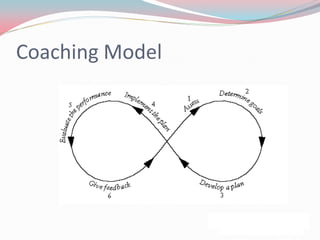
Coaching Model
Steps for Effective Coaching
1. Assess where the person is now
2. Determine the individual’s goals and
  expectations
3. Develop a plan to achieve the goals
4. Implement the plan
5. Evaluate the performance
6. Give feedback
Assess Where the Person is Now
Skills
Job knowledge
Attitude and satisfaction
Determine the individual’s goals
and expectations
Are the goals and expectations
 reasonable?
Is there a realistic timeline?
Are the goals measurable,
 quantifiable and attainable?
Develop a plan to achieve the
goals
Training — What kind?
• Technical skills
• Team skills
• Personal skills
Develop a plan to achieve the
goals
Training — How can it be taught?
Modeling/mentoring
Classroom/seminar on site
Outside training
Audio/video
Colleges/universities/adult ed.
Develop a plan to achieve the
goals
Training — When should it be
 taught?
Closely related to implementation
 of new skills
On the job
Regularly and continuously
Implement the plan
Taking action
Taking chances
Evaluate the performance

Measured against the standard
Give feedback

Keep it focused on achieving the
 goal of continuous improvement
More Aspects of Good Listening
 Listen “between the lines”
 Focus on the speaker – entirely
 Use silence effectively
 Look at it from their standpoint, addressing feelings
  before facts
 Ask open-ended questions for clarification and
  elaboration
Resource for Your ACTion Plan:
Active Listening
www.MindTools.com
Unmotivated Employee
Does the employee just not want to
 work?
— People get excited about work
 they enjoy
— People can find enjoyment
 through being challenged
Unmotivated Employee
— Focus on group and personal
 goals to see if there’s any overlap or
 alignment that the person hasn’t
 recognized
— Ask enough questions
Know-it-All Employee
In order to redirect the person, focus
  on the goals of the whole group as
  well as on individual goals
If the know-it-all is wrong, ask
  enough questions that it becomes
  apparent
Know-it-All Employee
Increase the employee’s
 responsibility to prevent meddling
Confront the behavior before it
 causes problems with others
“BALTY” (Been Around Longer
Than You )
Communicate often how you
 appreciate the person’s
 contribution to the team
Let the person know that he or she
 makes a difference, that his or her
 talents are welcomed
“BALTY” (Been Around Longer
Than You )
Ask what the person would like to do
 differently
Seek the person’s advice and use it
 whenever you can
Make the person a resident expert
“BALTY” (Been Around Longer
Than You )
Encourage other team members to go to
 the person and look to him or her for
 experience and expertise
— The person will feel more valued by
 the team
— Make the person a mentor or trainer
 for the group

Slide share notes

  • 1.
    Practical Coaching Skillsfor Managers (DA1067 ) 9 Traits of Effective Teams (dvd- 41042DVD or cd 10292CD) New Relationship Strategies (14321CD ) Assertive Communication (dvd 41104DVD or cd 10173CD ) Strength Finder 2.0 (Amazon) Use Discount Code 2316 www.Pryor.com
  • 2.
    What is DifferenceBetween Managing & Coaching? Managing has to do with things — Projects, materials, time and money Coaching has to do with people — People respond enthusiastically to coaching
  • 3.
    What is Coaching? Technicaldefinition A coach is a person responsible for guiding people to winning results through a continuing process of discovering each individual’s strengths and weaknesses, and then matching information, resources, advice and understanding to those strengths and weaknesses.
  • 4.
    What is Coaching? Real-worlddefinition A coach needs to know who you are, what you can and cannot do, what your goals are and how to help you achieve them.
  • 5.
    What is Coaching? Thecoach brings real objectivity Emotional distance can provide clarity
  • 6.
    What is Coaching? Allperformance can be enhanced Bad, good, even great performance Your role as coach is to identify areas for improvement as measured against predetermined performance standards Guide and encourage desired change
  • 7.
    What is Coaching? Thecoach keeps the individual and team focused on the goals You give people a clear answer to “Why am I doing this?” — Goals must be properly constructed — Work must center on reaching goals
  • 8.
    Benefits to theCoach More productive Less stress Improves leadership skills Department/team working more effectively Increase loyalty and commitment More satisfying relationships
  • 9.
    Benefits to Others Moreproductive Better leverage of strengths Coaching assists individual with minimizing impact of weaknesses Opportunity to grow, develop and advance
  • 10.
    Keys to Coaching Byasking the right questions, the coach can utilize the experiences and insights of all the team players Draw people in Let them participate in the process
  • 11.
    Keys to Coaching Leavesome of the decision making up to them They’re much more likely to buy into the goals that the team is trying to achieve than if they’re just continuously told the what, how and when
  • 12.
  • 13.
    Steps for EffectiveCoaching 1. Assess where the person is now 2. Determine the individual’s goals and expectations 3. Develop a plan to achieve the goals 4. Implement the plan 5. Evaluate the performance 6. Give feedback
  • 14.
    Assess Where thePerson is Now Skills Job knowledge Attitude and satisfaction
  • 15.
    Determine the individual’sgoals and expectations Are the goals and expectations reasonable? Is there a realistic timeline? Are the goals measurable, quantifiable and attainable?
  • 16.
    Develop a planto achieve the goals Training — What kind? • Technical skills • Team skills • Personal skills
  • 17.
    Develop a planto achieve the goals Training — How can it be taught? Modeling/mentoring Classroom/seminar on site Outside training Audio/video Colleges/universities/adult ed.
  • 18.
    Develop a planto achieve the goals Training — When should it be taught? Closely related to implementation of new skills On the job Regularly and continuously
  • 19.
    Implement the plan Takingaction Taking chances
  • 20.
  • 21.
    Give feedback Keep itfocused on achieving the goal of continuous improvement
  • 22.
    More Aspects ofGood Listening  Listen “between the lines”  Focus on the speaker – entirely  Use silence effectively  Look at it from their standpoint, addressing feelings before facts  Ask open-ended questions for clarification and elaboration Resource for Your ACTion Plan: Active Listening www.MindTools.com
  • 23.
    Unmotivated Employee Does theemployee just not want to work? — People get excited about work they enjoy — People can find enjoyment through being challenged
  • 24.
    Unmotivated Employee — Focuson group and personal goals to see if there’s any overlap or alignment that the person hasn’t recognized — Ask enough questions
  • 25.
    Know-it-All Employee In orderto redirect the person, focus on the goals of the whole group as well as on individual goals If the know-it-all is wrong, ask enough questions that it becomes apparent
  • 26.
    Know-it-All Employee Increase theemployee’s responsibility to prevent meddling Confront the behavior before it causes problems with others
  • 27.
    “BALTY” (Been AroundLonger Than You ) Communicate often how you appreciate the person’s contribution to the team Let the person know that he or she makes a difference, that his or her talents are welcomed
  • 28.
    “BALTY” (Been AroundLonger Than You ) Ask what the person would like to do differently Seek the person’s advice and use it whenever you can Make the person a resident expert
  • 29.
    “BALTY” (Been AroundLonger Than You ) Encourage other team members to go to the person and look to him or her for experience and expertise — The person will feel more valued by the team — Make the person a mentor or trainer for the group