The Coaching Conundrum
Fraser Marlow
Head of Research
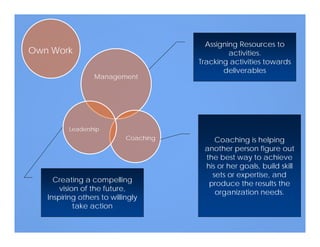
Management
Coaching
Leadership
Assigning Resources to
activities.
Tracking activities towards
deliverables
Creating a compelling
vision of the future,
Inspiring others to willingly
take action
Coaching is helping
another person figure out
the best way to achieve
his or her goals, build skill
sets or expertise, and
produce the results the
organization needs.
Own Work
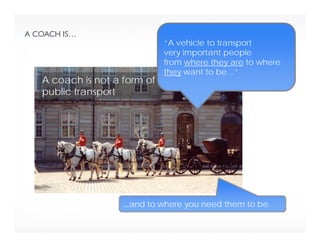
A coach is not a form of
public transport
A COACH IS…
“A vehicle to transport
…and to where you need them to be.
“A vehicle to transport
very important people
“A vehicle to transport
very important people
from where they are to where
they want to be…”
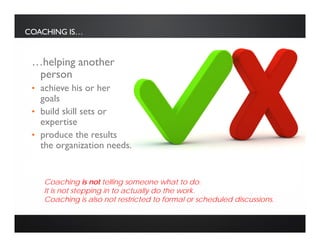
COACHING IS…
…helping another
person
• achieve his or her
goals
• build skill sets or
expertise
• produce the results
the organization needs.
Coaching is not telling someone what to do.
It is not stepping in to actually do the work.
Coaching is also not restricted to formal or scheduled discussions.
• In our organization, we expect managers to
also coach [Yes or No]
• There is an established organizational belief
that coaching by managers leads to greater
business results [Yes or No]
• A portion of each managers' compensation
is tied to coaching activities [Yes or No]
5
MANAGER’S
VIEW
6
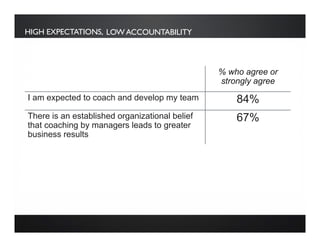
HIGH EXPECTATIONS,
% who agree or
strongly agree
I am expected to coach and develop my team 84%
There is an established organizational belief
that coaching by managers leads to greater
business results
67%
A portion of my compensation is tied to my
coaching activities
24%
LOW ACCOUNTABILITY
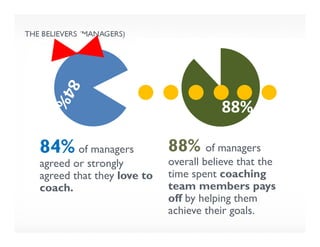
THE BELIEVERS (MANAGERS)
84% of managers
agreed or strongly
agreed that they love to
coach.
88% of managers
overall believe that the
time spent coaching
team members pays
off by helping them
achieve their goals.
TRUE BELIEVERS (MANAGERS)
• “a time where I have the opportunity to coach […] pays
more dividends then any other activity I do.”
• “If you coach your team members they are more
efficient and effective. It’s a more cost-effective way of
working in the long run. On a personal level, you also get to
see your team develop and blossom.”
• “It is fun and one of my favorite parts of the job. It’s also
important. It makes the difference between a good
team and a great team.”
DIRECT
REPORT’S
VIEW
10
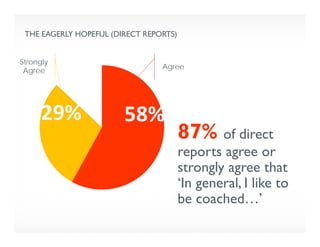
THE EAGERLY HOPEFUL (DIRECT REPORTS)
87% of direct
reports agree or
strongly agree that
‘In general, I like to
be coached…’
AgreeAgree
Strongly
Agree
Strongly
Agree
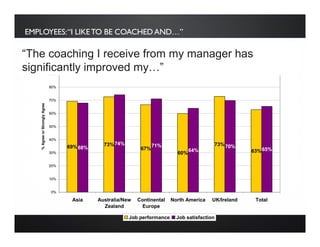
EMPLOYEES:“I LIKETO BE COACHED AND…”
69% 73%
67%
60%
73%
63%
68%
74% 71%
64%
70%
65%
0%
10%
20%
30%
40%
50%
60%
70%
80%
90%
100%
Asia Australia/New
Zealand
Continental
Europe
North America UK/Ireland Total
%AgreeorStronglyAgree
Job performance Job satisfaction
“The coaching I receive from my manager has
significantly improved my…”
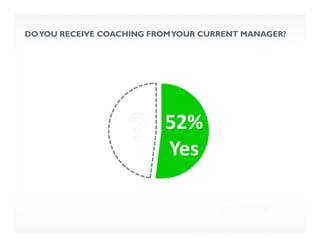
Are coached
DOYOU RECEIVE COACHING FROMYOUR CURRENT MANAGER?
CO·NUN·DRUM
KƏ-‘NƏNDRƏM NOUN.
A confusing and difficult problem or question.
A question asked for amusement, typically one
with a pun in its answer; a riddle.
- The Oxford Pocket Dictionary of Current English
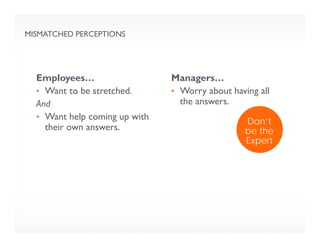
MISMATCHED PERCEPTIONS
Employees…
• Want to be stretched.
And
• Want help coming up with
their own answers.
Managers…
• Worry about having all
the answers.
Don’t
be the
Expert
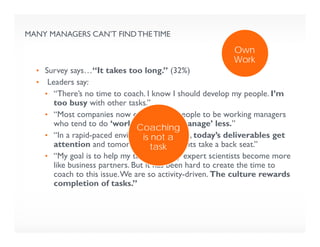
MANY MANAGERS CAN’T FINDTHETIME
• Survey says…“It takes too long.” (32%)
• Leaders say:
• “There’s no time to coach. I know I should develop my people. I’m
too busy with other tasks.”
• “Most companies now expect their people to be working managers
who tend to do ‘work’ more and ‘manage’ less.”
• “In a rapid-paced environment like ours, today’s deliverables get
attention and tomorrow’s requirements take a back seat.”
• “My goal is to help my team of highly expert scientists become more
like business partners. But it has been hard to create the time to
coach to this issue.We are so activity-driven. The culture rewards
completion of tasks.”
Own
Work
Coaching
is not a
task
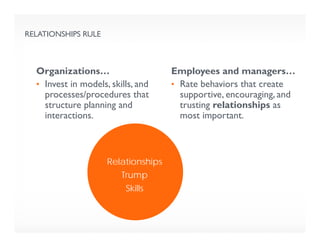
RELATIONSHIPS RULE
Organizations…
• Invest in models, skills, and
processes/procedures that
structure planning and
interactions.
Employees and managers…
• Rate behaviors that create
supportive, encouraging, and
trusting relationships as
most important.
Relationships
Trump
Skills
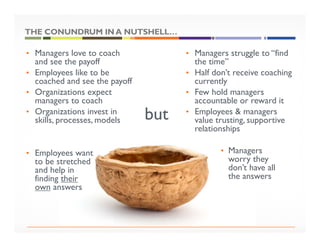
• Managers love to coach
and see the payoff
• Employees like to be
coached and see the payoff
• Organizations expect
managers to coach
• Organizations invest in
skills, processes, models
• Employees want
to be stretched
and help in
finding their
own answers
• Managers struggle to “find
the time”
• Half don’t receive coaching
currently
• Few hold managers
accountable or reward it
• Employees & managers
value trusting, supportive
relationships
• Managers
worry they
don’t have all
the answers
but
THE CONUNDRUM IN A NUTSHELL…
19
We know it’s good for us
We should do a little of it every day
It’s really not that hard, takes little skill
It doesn’t take much in terms of resources
The benefits are tremendous
… yet few people do
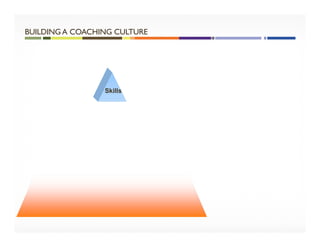
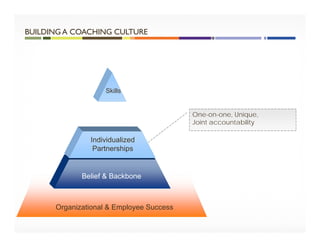
BUILDING A COACHING CULTURE
Skills
BUILDING A COACHING CULTURE
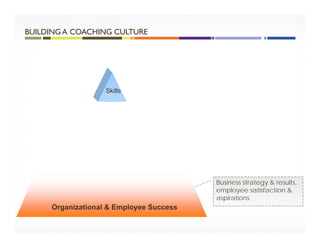
Organizational & Employee Success
Skills
Business strategy & results,
employee satisfaction &
aspirations
BUILDING A COACHING CULTURE
Organizational & Employee Success
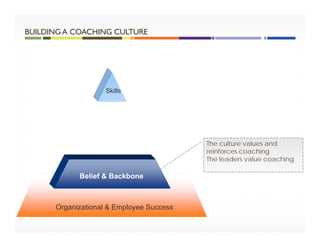
Belief & Backbone
Skills
The culture values and
reinforces coaching
The leaders value coaching
BUILDING A COACHING CULTURE
Organizational & Employee Success
Belief & Backbone
Individualized
Partnerships
Skills
One-on-one, Unique,
Joint accountability
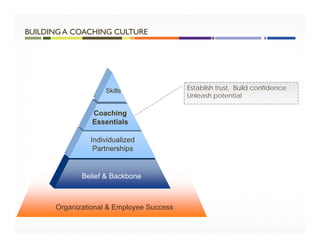
BUILDING A COACHING CULTURE
Organizational & Employee Success
Belief & Backbone
Individualized
Partnerships
Coaching
Essentials
Skills Establish trust, Build confidence
Unleash potential
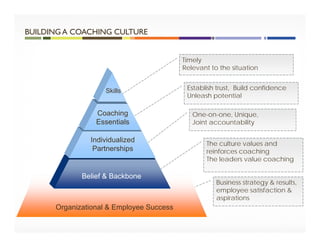
BUILDING A COACHING CULTURE
Organizational & Employee Success
Belief & Backbone
Individualized
Partnerships
Coaching
Essentials
Skills
Timely
Relevant to the situation
Establish trust, Build confidence
Unleash potential
One-on-one, Unique,
Joint accountability
The culture values and
reinforces coaching
The leaders value coaching
Business strategy & results,
employee satisfaction &
aspirations
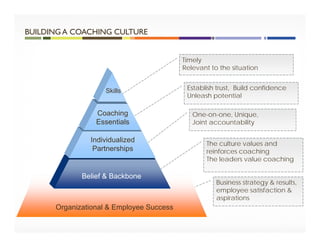
BUILDING A COACHING CULTURE
Organizational & Employee Success
Belief & Backbone
Individualized
Partnerships
Coaching
Essentials
Skills
Timely
Relevant to the situation
Establish trust, Build confidence
Unleash potential
One-on-one, Unique,
Joint accountability
The culture values and
reinforces coaching
The leaders value coaching
Business strategy & results,
employee satisfaction &
aspirations
BUILDING A COACHING CULTURE
WHERE DOWE START?
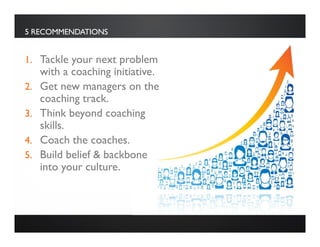
5 RECOMMENDATIONS
1. Tackle your next problem
with a coaching initiative.
2. Get new managers on the
coaching track.
3. Think beyond coaching
skills.
4. Coach the coaches.
5. Build belief & backbone
into your culture.
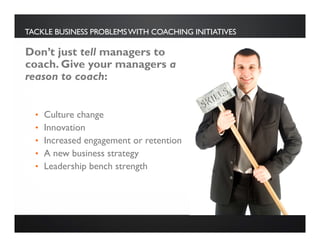
TACKLE BUSINESS PROBLEMSWITH COACHING INITIATIVES
Don’t just tell managers to
coach. Give your managers a
reason to coach:
• Culture change
• Innovation
• Increased engagement or retention
• A new business strategy
• Leadership bench strength
SET NEW MANAGERS ONTHE COACHINGTRACK
Define coaching.
• Dispel myths. Coaching is not:
• An event
• A discrete tactic for
performance problems
• A one-size-fits-all approach
• Something you do to employees
• Advice
THINK BEYOND COACHING SKILLS
• Encourage manager-employee dialogue.
• Stress authentic leadership.
• Emphasize relationships when on-
boarding.
• Address trust issues.
“We had an assistant store manager who
transferred to a new location. She never took the
time to build relationships and just told people what
to do. Then she went to a coaching workshop, came
back, and started “coaching” – but things didn’t go
well. She did it ‘to’ her team. She eventually left the
company.”
THE IMPACT OFTRUST
Coaching Actions [Actual or Perceived]
With Trust Without Trust
Conversation Interrogation
Feedback Reprimand
Check-in Micromanaging
Concern “Spying”
Interest Meddling
Goal-Setting Orders
Delegating Dumping
Partnership Boss-Subordinate
COACHTHE COACHES
• Set the tone.
• Cascade from above
down through the ranks.
• Model it.
• Provide support.
• Help identify issues
specific to your
organization.
BUILD BELIEF & BACKBONE INTOYOUR CULTURE
• Change your talk.
• Set expectations.
• Build accountability and rewards.
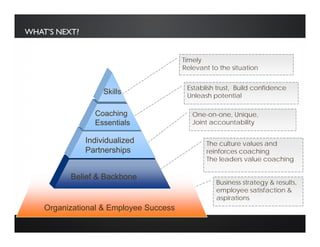
WHAT’S NEXT?
Organizational & Employee Success
Belief & Backbone
Individualized
Partnerships
Coaching
Essentials
Skills
Timely
Relevant to the situation
Establish trust, Build confidence
Unleash potential
One-on-one, Unique,
Joint accountability
The culture values and
reinforces coaching
The leaders value coaching
Business strategy & results,
employee satisfaction &
aspirations
gpstrategies.com
Fraser Marlow
Fraser.marlow@gpstrategies.com
Twitter: @BlessingWhite / @frasermarlow
www.BlessingWhite.com/research
© 2013 GP Strategies Corporation. All rights reserved. GP Strategies, GP Strategies and logo design, BlessingWhite, Rovsing Dynamics, Asentus, Information Horizons, PMC, Sandy, Bath Consultancy Group,
Academy of Training, Martonhouse, Via Training, Beneast Training, Ultra, RWD, Communication Consulting, Option Six, Milsom, Clutterbuck Associates, PerformTech, Future Perfect, Smallpeice Enterprises,
Prospero Learning Solutions, Lorien Engineering Solutions, GPiLEARN, GPCALCS, GPSteam, EtaPRO, and VirtualPlant are trademarks or registered trademarks of GP Strategies Corporation in the U.S. and
other countries. All other trademarks are trademarks or registered trademarks of their respective owners.
Proprietary to GP Strategies Corporation

BlessingWhite Coaching Conundrum webinar with Fraser Marlow

  • 1.
    The Coaching Conundrum FraserMarlow Head of Research
  • 2.
    Management Coaching Leadership Assigning Resources to activities. Trackingactivities towards deliverables Creating a compelling vision of the future, Inspiring others to willingly take action Coaching is helping another person figure out the best way to achieve his or her goals, build skill sets or expertise, and produce the results the organization needs. Own Work
  • 3.
    A coach isnot a form of public transport A COACH IS… “A vehicle to transport …and to where you need them to be. “A vehicle to transport very important people “A vehicle to transport very important people from where they are to where they want to be…”
  • 4.
    COACHING IS… …helping another person •achieve his or her goals • build skill sets or expertise • produce the results the organization needs. Coaching is not telling someone what to do. It is not stepping in to actually do the work. Coaching is also not restricted to formal or scheduled discussions.
  • 5.
    • In ourorganization, we expect managers to also coach [Yes or No] • There is an established organizational belief that coaching by managers leads to greater business results [Yes or No] • A portion of each managers' compensation is tied to coaching activities [Yes or No] 5
  • 6.
  • 7.
    HIGH EXPECTATIONS, % whoagree or strongly agree I am expected to coach and develop my team 84% There is an established organizational belief that coaching by managers leads to greater business results 67% A portion of my compensation is tied to my coaching activities 24% LOW ACCOUNTABILITY
  • 8.
    THE BELIEVERS (MANAGERS) 84%of managers agreed or strongly agreed that they love to coach. 88% of managers overall believe that the time spent coaching team members pays off by helping them achieve their goals.
  • 9.
    TRUE BELIEVERS (MANAGERS) •“a time where I have the opportunity to coach […] pays more dividends then any other activity I do.” • “If you coach your team members they are more efficient and effective. It’s a more cost-effective way of working in the long run. On a personal level, you also get to see your team develop and blossom.” • “It is fun and one of my favorite parts of the job. It’s also important. It makes the difference between a good team and a great team.”
  • 10.
  • 11.
    THE EAGERLY HOPEFUL(DIRECT REPORTS) 87% of direct reports agree or strongly agree that ‘In general, I like to be coached…’ AgreeAgree Strongly Agree Strongly Agree
  • 12.
    EMPLOYEES:“I LIKETO BECOACHED AND…” 69% 73% 67% 60% 73% 63% 68% 74% 71% 64% 70% 65% 0% 10% 20% 30% 40% 50% 60% 70% 80% 90% 100% Asia Australia/New Zealand Continental Europe North America UK/Ireland Total %AgreeorStronglyAgree Job performance Job satisfaction “The coaching I receive from my manager has significantly improved my…”
  • 13.
    Are coached DOYOU RECEIVECOACHING FROMYOUR CURRENT MANAGER?
  • 14.
    CO·NUN·DRUM KƏ-‘NƏNDRƏM NOUN. A confusingand difficult problem or question. A question asked for amusement, typically one with a pun in its answer; a riddle. - The Oxford Pocket Dictionary of Current English
  • 15.
    MISMATCHED PERCEPTIONS Employees… • Wantto be stretched. And • Want help coming up with their own answers. Managers… • Worry about having all the answers. Don’t be the Expert
  • 16.
    MANY MANAGERS CAN’TFINDTHETIME • Survey says…“It takes too long.” (32%) • Leaders say: • “There’s no time to coach. I know I should develop my people. I’m too busy with other tasks.” • “Most companies now expect their people to be working managers who tend to do ‘work’ more and ‘manage’ less.” • “In a rapid-paced environment like ours, today’s deliverables get attention and tomorrow’s requirements take a back seat.” • “My goal is to help my team of highly expert scientists become more like business partners. But it has been hard to create the time to coach to this issue.We are so activity-driven. The culture rewards completion of tasks.” Own Work Coaching is not a task
  • 17.
    RELATIONSHIPS RULE Organizations… • Investin models, skills, and processes/procedures that structure planning and interactions. Employees and managers… • Rate behaviors that create supportive, encouraging, and trusting relationships as most important. Relationships Trump Skills
  • 18.
    • Managers loveto coach and see the payoff • Employees like to be coached and see the payoff • Organizations expect managers to coach • Organizations invest in skills, processes, models • Employees want to be stretched and help in finding their own answers • Managers struggle to “find the time” • Half don’t receive coaching currently • Few hold managers accountable or reward it • Employees & managers value trusting, supportive relationships • Managers worry they don’t have all the answers but THE CONUNDRUM IN A NUTSHELL…
  • 19.
    19 We know it’sgood for us We should do a little of it every day It’s really not that hard, takes little skill It doesn’t take much in terms of resources The benefits are tremendous … yet few people do
  • 21.
  • 22.
  • 23.
    Organizational & EmployeeSuccess Skills Business strategy & results, employee satisfaction & aspirations BUILDING A COACHING CULTURE
  • 24.
    Organizational & EmployeeSuccess Belief & Backbone Skills The culture values and reinforces coaching The leaders value coaching BUILDING A COACHING CULTURE
  • 25.
    Organizational & EmployeeSuccess Belief & Backbone Individualized Partnerships Skills One-on-one, Unique, Joint accountability BUILDING A COACHING CULTURE
  • 26.
    Organizational & EmployeeSuccess Belief & Backbone Individualized Partnerships Coaching Essentials Skills Establish trust, Build confidence Unleash potential BUILDING A COACHING CULTURE
  • 27.
    Organizational & EmployeeSuccess Belief & Backbone Individualized Partnerships Coaching Essentials Skills Timely Relevant to the situation Establish trust, Build confidence Unleash potential One-on-one, Unique, Joint accountability The culture values and reinforces coaching The leaders value coaching Business strategy & results, employee satisfaction & aspirations BUILDING A COACHING CULTURE
  • 28.
    Organizational & EmployeeSuccess Belief & Backbone Individualized Partnerships Coaching Essentials Skills Timely Relevant to the situation Establish trust, Build confidence Unleash potential One-on-one, Unique, Joint accountability The culture values and reinforces coaching The leaders value coaching Business strategy & results, employee satisfaction & aspirations BUILDING A COACHING CULTURE
  • 29.
  • 30.
    5 RECOMMENDATIONS 1. Tackleyour next problem with a coaching initiative. 2. Get new managers on the coaching track. 3. Think beyond coaching skills. 4. Coach the coaches. 5. Build belief & backbone into your culture.
  • 31.
    TACKLE BUSINESS PROBLEMSWITHCOACHING INITIATIVES Don’t just tell managers to coach. Give your managers a reason to coach: • Culture change • Innovation • Increased engagement or retention • A new business strategy • Leadership bench strength
  • 32.
    SET NEW MANAGERSONTHE COACHINGTRACK Define coaching. • Dispel myths. Coaching is not: • An event • A discrete tactic for performance problems • A one-size-fits-all approach • Something you do to employees • Advice
  • 33.
    THINK BEYOND COACHINGSKILLS • Encourage manager-employee dialogue. • Stress authentic leadership. • Emphasize relationships when on- boarding. • Address trust issues. “We had an assistant store manager who transferred to a new location. She never took the time to build relationships and just told people what to do. Then she went to a coaching workshop, came back, and started “coaching” – but things didn’t go well. She did it ‘to’ her team. She eventually left the company.”
  • 34.
    THE IMPACT OFTRUST CoachingActions [Actual or Perceived] With Trust Without Trust Conversation Interrogation Feedback Reprimand Check-in Micromanaging Concern “Spying” Interest Meddling Goal-Setting Orders Delegating Dumping Partnership Boss-Subordinate
  • 35.
    COACHTHE COACHES • Setthe tone. • Cascade from above down through the ranks. • Model it. • Provide support. • Help identify issues specific to your organization.
  • 36.
    BUILD BELIEF &BACKBONE INTOYOUR CULTURE • Change your talk. • Set expectations. • Build accountability and rewards.
  • 37.
    WHAT’S NEXT? Organizational &Employee Success Belief & Backbone Individualized Partnerships Coaching Essentials Skills Timely Relevant to the situation Establish trust, Build confidence Unleash potential One-on-one, Unique, Joint accountability The culture values and reinforces coaching The leaders value coaching Business strategy & results, employee satisfaction & aspirations
  • 38.
    gpstrategies.com Fraser Marlow Fraser.marlow@gpstrategies.com Twitter: @BlessingWhite/ @frasermarlow www.BlessingWhite.com/research © 2013 GP Strategies Corporation. All rights reserved. GP Strategies, GP Strategies and logo design, BlessingWhite, Rovsing Dynamics, Asentus, Information Horizons, PMC, Sandy, Bath Consultancy Group, Academy of Training, Martonhouse, Via Training, Beneast Training, Ultra, RWD, Communication Consulting, Option Six, Milsom, Clutterbuck Associates, PerformTech, Future Perfect, Smallpeice Enterprises, Prospero Learning Solutions, Lorien Engineering Solutions, GPiLEARN, GPCALCS, GPSteam, EtaPRO, and VirtualPlant are trademarks or registered trademarks of GP Strategies Corporation in the U.S. and other countries. All other trademarks are trademarks or registered trademarks of their respective owners. Proprietary to GP Strategies Corporation