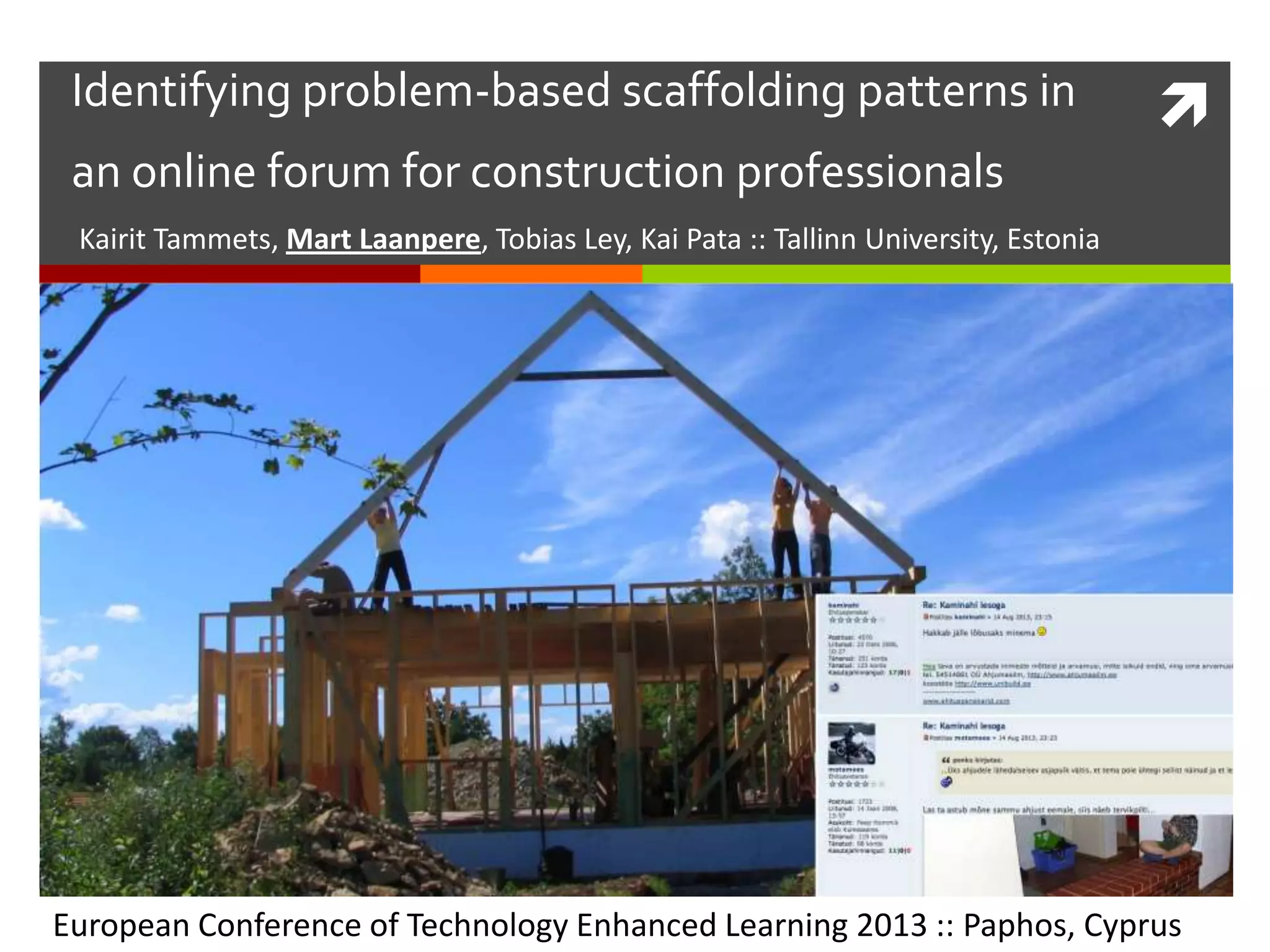
Identifying problem-based scaffolding patterns in
an online forum for construction professionals
Kairit Tammets, Mart Laanpere, Tobias Ley, Kai Pata :: Tallinn University, Estonia
European Conference of Technology Enhanced Learning 2013 :: Paphos, Cyprus
Context of the study
 FP7 IP Learning Layers: online scaffolding in construction sector
 Help-seeking and scaffolding at the workplace in construction
sector: current practices do not scale
 Emerging practice: online forums as networked scaffolding tools
 Construction forum Ehitusfoorum.com:
 Launched in 2003 by a construction company, most popular
among professional and amateur construction workers in Estonia
 More than 10 000 registered users, nearly 200 000 posts in 30
000 threads, annotated with 34 different category labels
Scaffolding in communities of practice
 Scaffolding: means to bridge the gap between what students
can do on their own and what they can do with the help of a
more capable other (Woods, Bruner & Ross, 1976)
 Traditional view on scaffolding: communication between tutor
and tutee; different in online forums
 Computer-based scaffolds (Azevedo & Hadwin, 2005); lacking
the social aspect
 Networked scaffolding: members of the online CoP support
each other in the problem-solving process; accumulation of
knowledge; dynamics of reputation and trust
Research problem & questions
 What form of scaffolding emerges within an online Community of
Practice (CoP) of construction specialists?
 Research questions:
 How do the members of the construction forum provide scaffolding to
the help-seekers and how it is being acknowledged?
 What is a suitable typology of learning problems identified in the help-
seeking process in the online forum of construction specialists?
 Expected outcome: initial set of networked scaffolding patterns that
can be used to inform design decisions when building next-generation
socio-technical systems that support workplace learning in
construction field (e.g. digital tools in Learning Layers project)
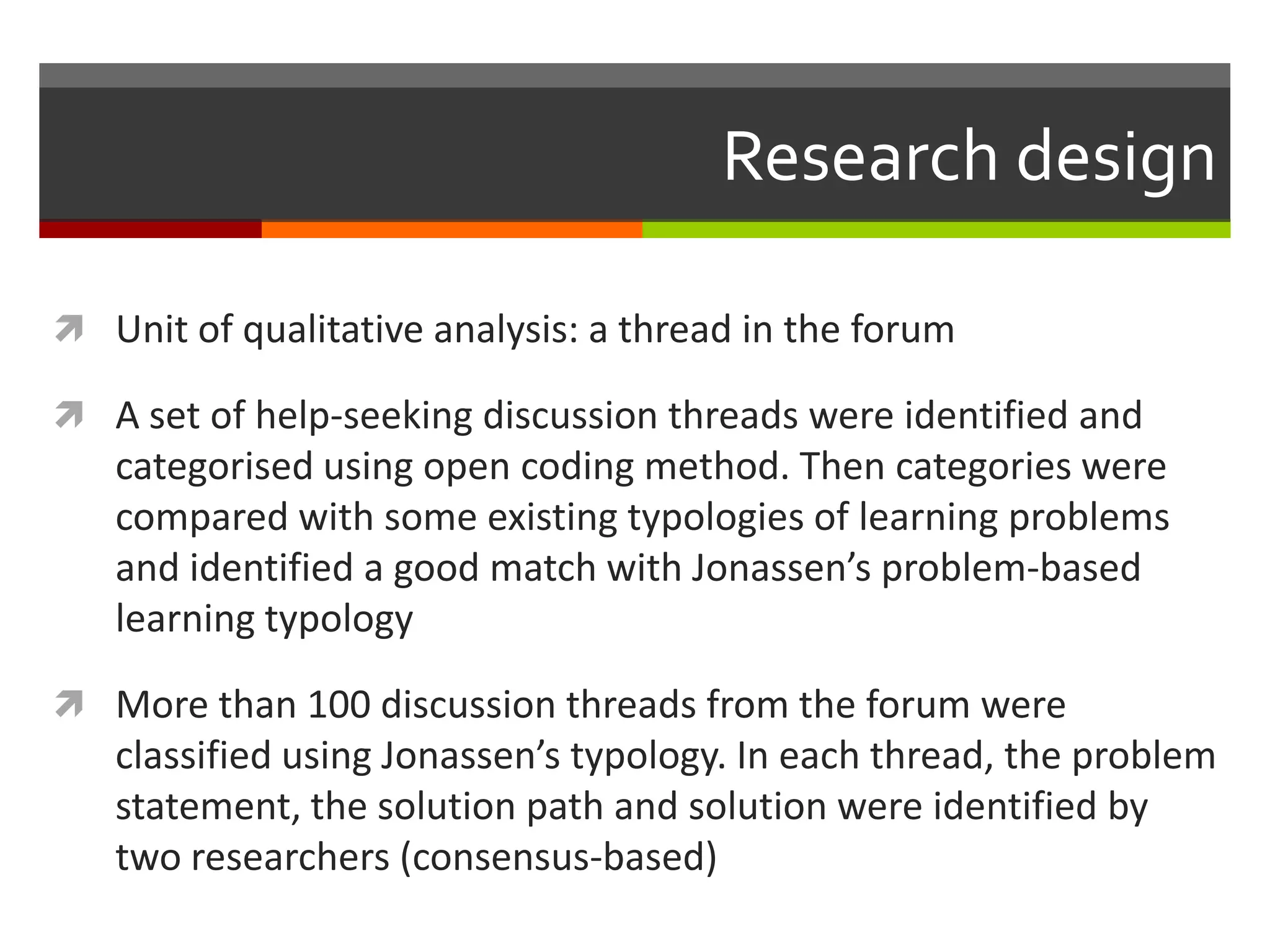
Research design
 Unit of qualitative analysis: a thread in the forum
 A set of help-seeking discussion threads were identified and
categorised using open coding method. Then categories were
compared with some existing typologies of learning problems
and identified a good match with Jonassen’s problem-based
learning typology
 More than 100 discussion threads from the forum were
classified using Jonassen’s typology. In each thread, the problem
statement, the solution path and solution were identified by
two researchers (consensus-based)
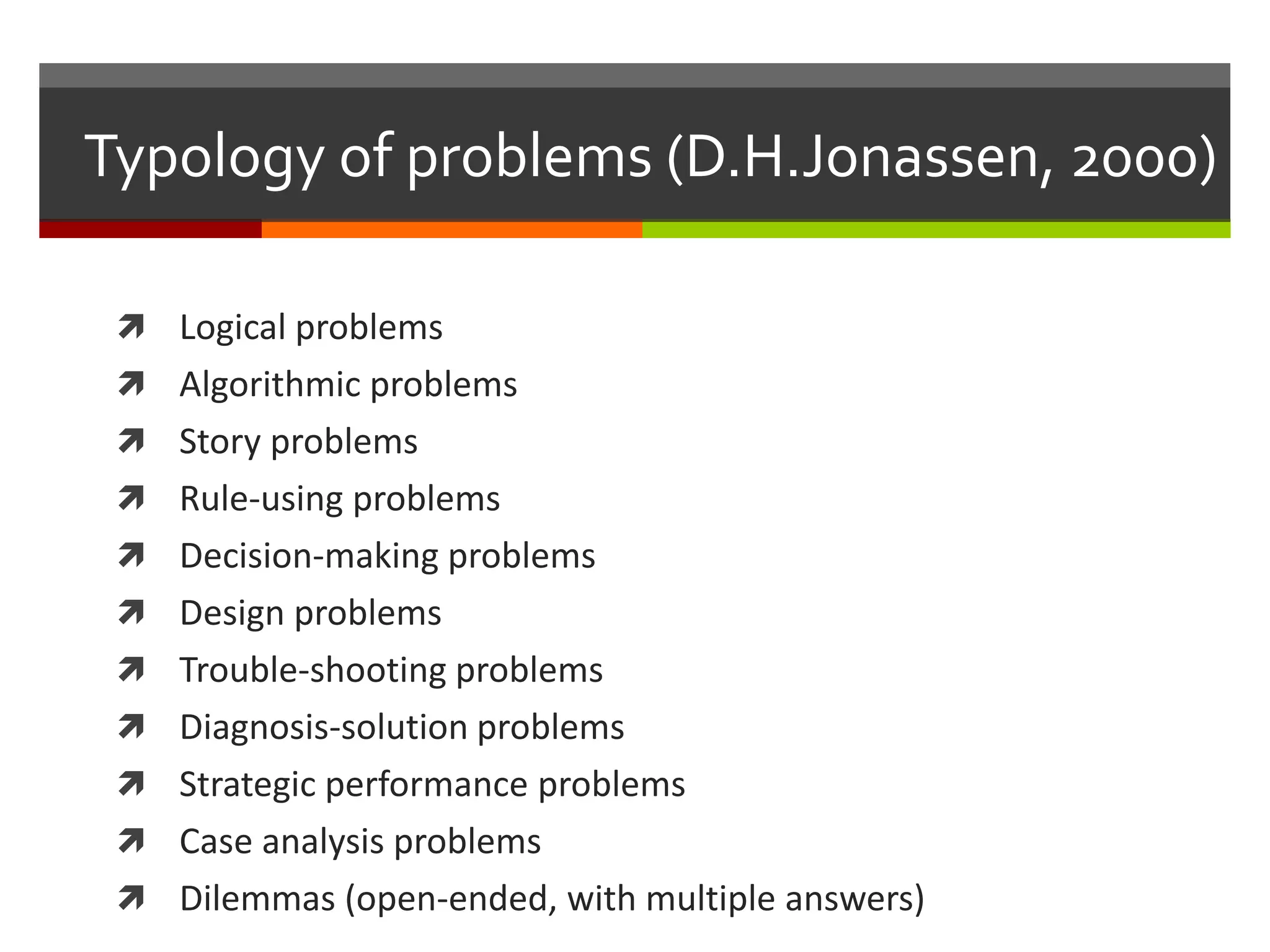
Typology of problems (D.H.Jonassen, 2000)
 Logical problems
 Algorithmic problems
 Story problems
 Rule-using problems
 Decision-making problems
 Design problems
 Trouble-shooting problems
 Diagnosis-solution problems
 Strategic performance problems
 Case analysis problems
 Dilemmas (open-ended, with multiple answers)
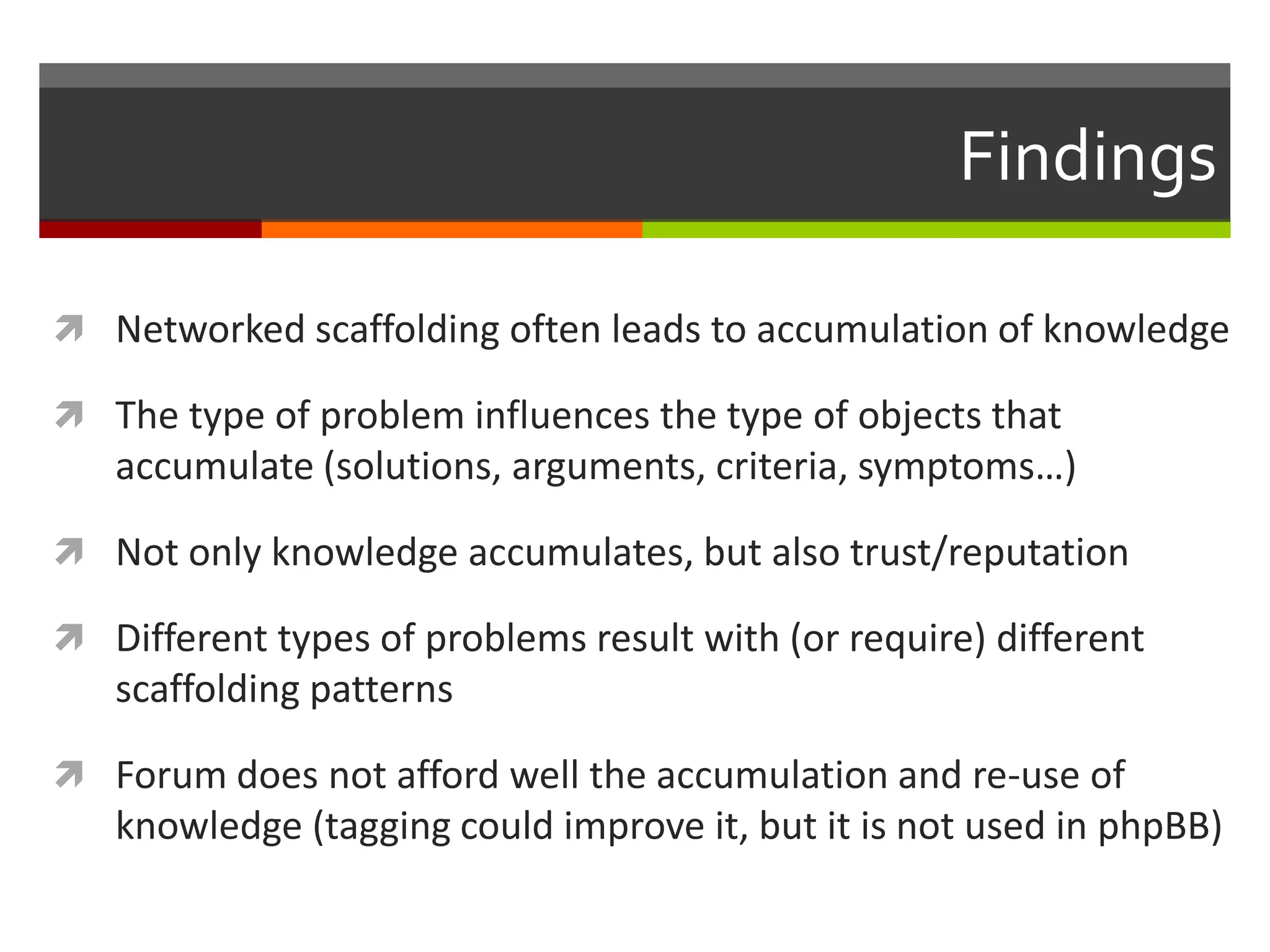
Findings
 Networked scaffolding often leads to accumulation of knowledge
 The type of problem influences the type of objects that
accumulate (solutions, arguments, criteria, symptoms…)
 Not only knowledge accumulates, but also trust/reputation
 Different types of problems result with (or require) different
scaffolding patterns
 Forum does not afford well the accumulation and re-use of
knowledge (tagging could improve it, but it is not used in phpBB)
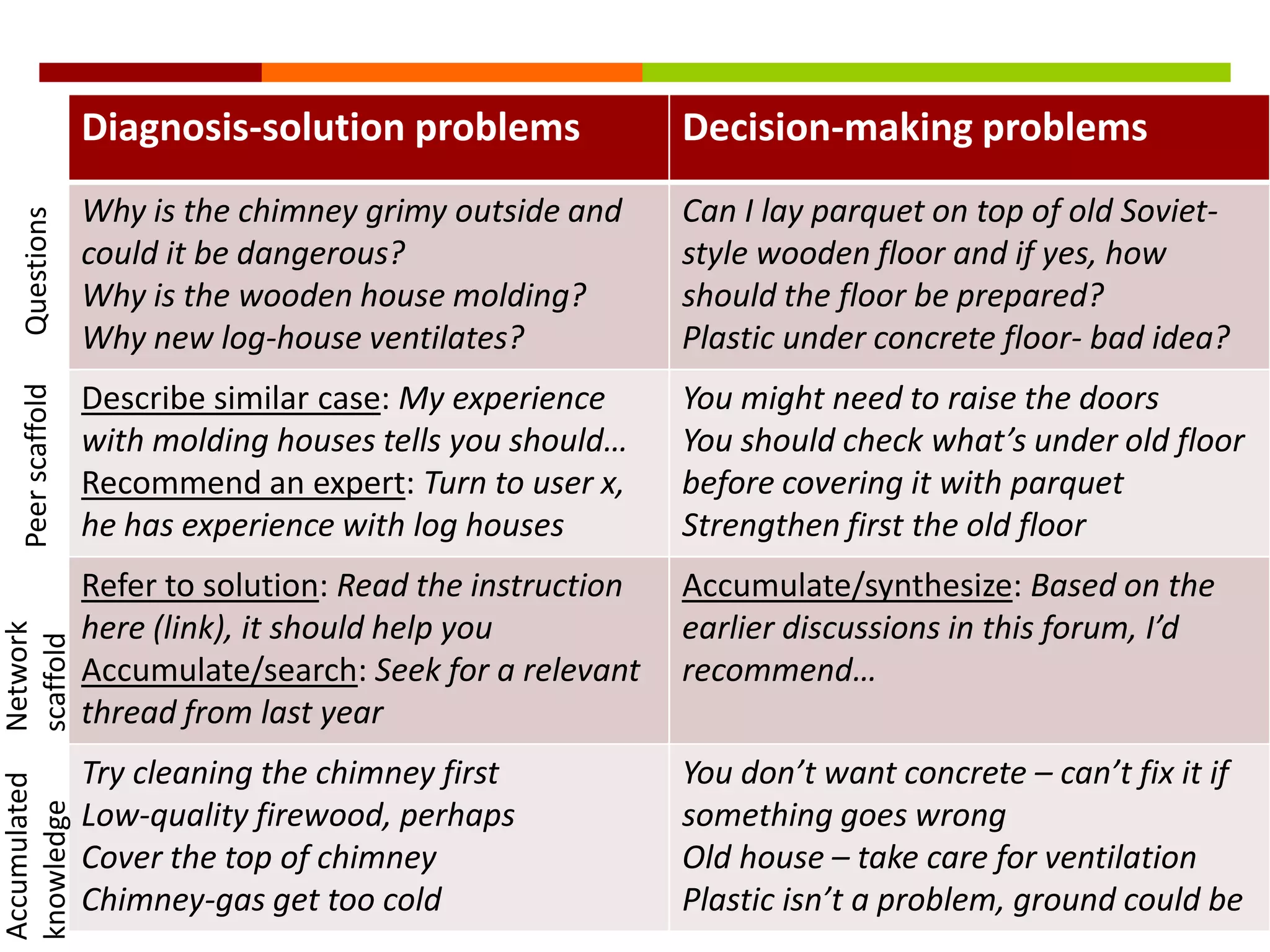
Diagnosis-solution problems Decision-making problems
Why is the chimney grimy outside and
could it be dangerous?
Why is the wooden house molding?
Why new log-house ventilates?
Can I lay parquet on top of old Soviet-
style wooden floor and if yes, how
should the floor be prepared?
Plastic under concrete floor- bad idea?
Describe similar case: My experience
with molding houses tells you should…
Recommend an expert: Turn to user x,
he has experience with log houses
You might need to raise the doors
You should check what’s under old floor
before covering it with parquet
Strengthen first the old floor
Refer to solution: Read the instruction
here (link), it should help you
Accumulate/search: Seek for a relevant
thread from last year
Accumulate/synthesize: Based on the
earlier discussions in this forum, I’d
recommend…
Try cleaning the chimney first
Low-quality firewood, perhaps
Cover the top of chimney
Chimney-gas get too cold
You don’t want concrete – can’t fix it if
something goes wrong
Old house – take care for ventilation
Plastic isn’t a problem, ground could be
PeerscaffoldQuestions
Network
scaffold
Accumulated
knowledge
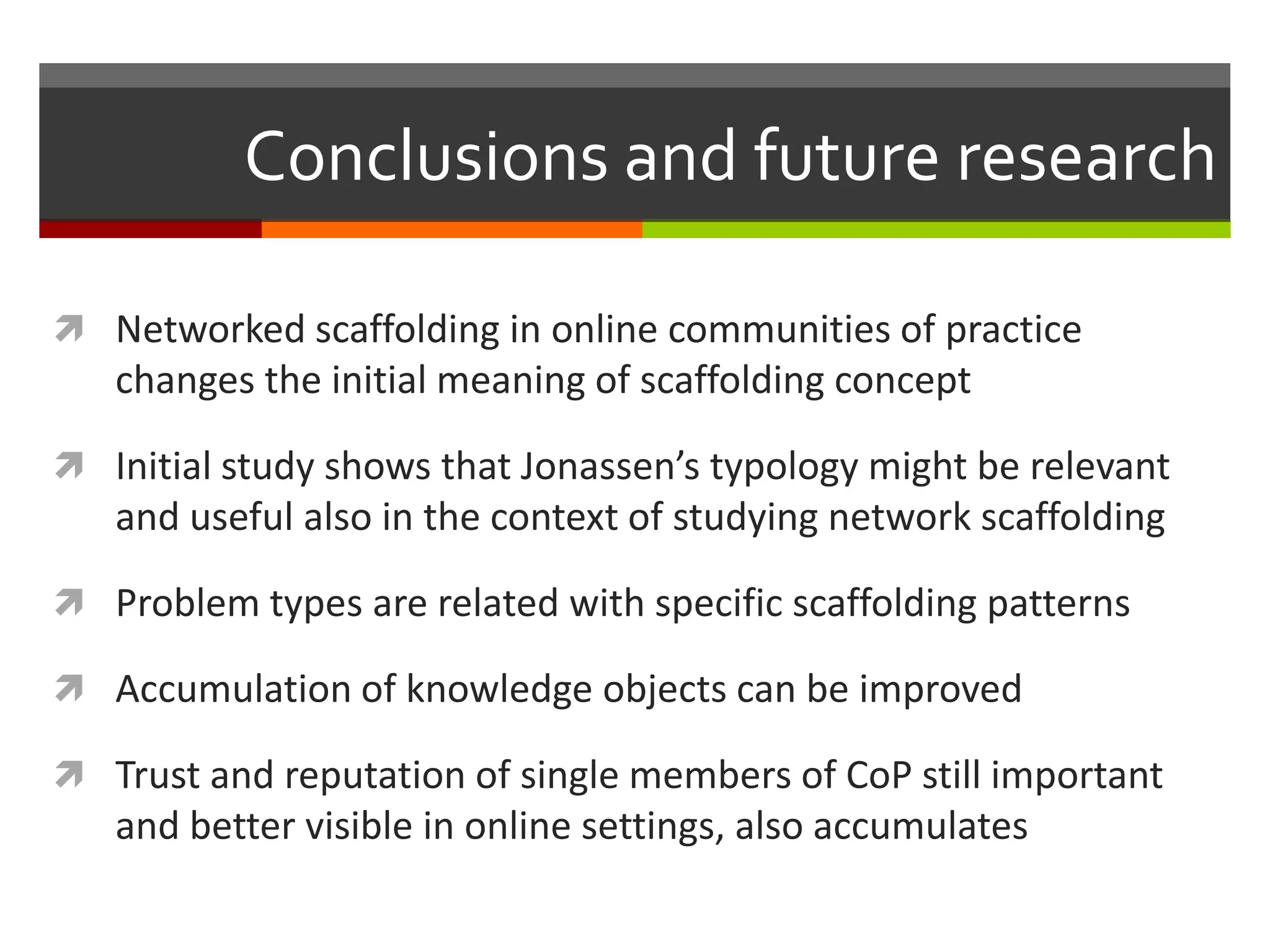
Conclusions and future research
 Networked scaffolding in online communities of practice
changes the initial meaning of scaffolding concept
 Initial study shows that Jonassen’s typology might be relevant
and useful also in the context of studying network scaffolding
 Problem types are related with specific scaffolding patterns
 Accumulation of knowledge objects can be improved
 Trust and reputation of single members of CoP still important
and better visible in online settings, also accumulates

Identifying problem-based scaffolding patterns in an online forum for construction professionals

  • 1.
    Identifying problem-based scaffoldingpatterns in an online forum for construction professionals Kairit Tammets, Mart Laanpere, Tobias Ley, Kai Pata :: Tallinn University, Estonia European Conference of Technology Enhanced Learning 2013 :: Paphos, Cyprus
  • 2.
    Context of thestudy  FP7 IP Learning Layers: online scaffolding in construction sector  Help-seeking and scaffolding at the workplace in construction sector: current practices do not scale  Emerging practice: online forums as networked scaffolding tools  Construction forum Ehitusfoorum.com:  Launched in 2003 by a construction company, most popular among professional and amateur construction workers in Estonia  More than 10 000 registered users, nearly 200 000 posts in 30 000 threads, annotated with 34 different category labels
  • 3.
    Scaffolding in communitiesof practice  Scaffolding: means to bridge the gap between what students can do on their own and what they can do with the help of a more capable other (Woods, Bruner & Ross, 1976)  Traditional view on scaffolding: communication between tutor and tutee; different in online forums  Computer-based scaffolds (Azevedo & Hadwin, 2005); lacking the social aspect  Networked scaffolding: members of the online CoP support each other in the problem-solving process; accumulation of knowledge; dynamics of reputation and trust
  • 4.
    Research problem &questions  What form of scaffolding emerges within an online Community of Practice (CoP) of construction specialists?  Research questions:  How do the members of the construction forum provide scaffolding to the help-seekers and how it is being acknowledged?  What is a suitable typology of learning problems identified in the help- seeking process in the online forum of construction specialists?  Expected outcome: initial set of networked scaffolding patterns that can be used to inform design decisions when building next-generation socio-technical systems that support workplace learning in construction field (e.g. digital tools in Learning Layers project)
  • 5.
    Research design  Unitof qualitative analysis: a thread in the forum  A set of help-seeking discussion threads were identified and categorised using open coding method. Then categories were compared with some existing typologies of learning problems and identified a good match with Jonassen’s problem-based learning typology  More than 100 discussion threads from the forum were classified using Jonassen’s typology. In each thread, the problem statement, the solution path and solution were identified by two researchers (consensus-based)
  • 6.
    Typology of problems(D.H.Jonassen, 2000)  Logical problems  Algorithmic problems  Story problems  Rule-using problems  Decision-making problems  Design problems  Trouble-shooting problems  Diagnosis-solution problems  Strategic performance problems  Case analysis problems  Dilemmas (open-ended, with multiple answers)
  • 7.
    Findings  Networked scaffoldingoften leads to accumulation of knowledge  The type of problem influences the type of objects that accumulate (solutions, arguments, criteria, symptoms…)  Not only knowledge accumulates, but also trust/reputation  Different types of problems result with (or require) different scaffolding patterns  Forum does not afford well the accumulation and re-use of knowledge (tagging could improve it, but it is not used in phpBB)
  • 8.
    Diagnosis-solution problems Decision-makingproblems Why is the chimney grimy outside and could it be dangerous? Why is the wooden house molding? Why new log-house ventilates? Can I lay parquet on top of old Soviet- style wooden floor and if yes, how should the floor be prepared? Plastic under concrete floor- bad idea? Describe similar case: My experience with molding houses tells you should… Recommend an expert: Turn to user x, he has experience with log houses You might need to raise the doors You should check what’s under old floor before covering it with parquet Strengthen first the old floor Refer to solution: Read the instruction here (link), it should help you Accumulate/search: Seek for a relevant thread from last year Accumulate/synthesize: Based on the earlier discussions in this forum, I’d recommend… Try cleaning the chimney first Low-quality firewood, perhaps Cover the top of chimney Chimney-gas get too cold You don’t want concrete – can’t fix it if something goes wrong Old house – take care for ventilation Plastic isn’t a problem, ground could be PeerscaffoldQuestions Network scaffold Accumulated knowledge
  • 9.
    Conclusions and futureresearch  Networked scaffolding in online communities of practice changes the initial meaning of scaffolding concept  Initial study shows that Jonassen’s typology might be relevant and useful also in the context of studying network scaffolding  Problem types are related with specific scaffolding patterns  Accumulation of knowledge objects can be improved  Trust and reputation of single members of CoP still important and better visible in online settings, also accumulates