Living and Learning in a Global CommunityInnovative Schools Virtual University
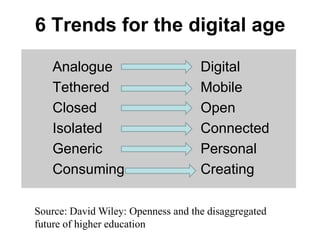
6 Trends for the digital age	Analogue                     	Digital	Tethered 	               	Mobile	Closed 				Open	Isolated 			Connected	Generic				Personal 	Consuming  			CreatingSource: David Wiley: Openness and the disaggregated future of higher education
Define CommunityDefine Networks
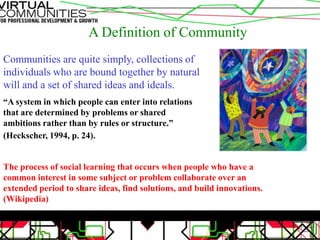
A Definition of CommunityCommunities are quite simply, collections of individuals who are bound together by natural will and a set of shared ideas and ideals.“A system in which people can enter into relations that are determined by problems or shared ambitions rather than by rules or structure.” (Heckscher, 1994, p. 24).The process of social learning that occurs when people who have a common interest in some subject or problem collaborate over an extended period to share ideas, find solutions, and build innovations. (Wikipedia)
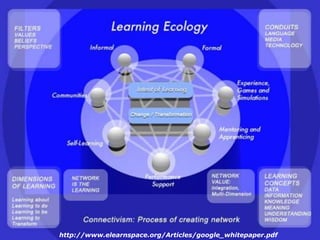
A Definition of NetworksFrom Wikipedia, the free encyclopediaNetworks are created through publishing and sharing ideas and connecting with others who share passions around those ideas who learn from each other.Networked learning is a process of developing and maintaining connections with people and information, and communicating in such a way so as to support one another's learning.Connectivism (theory of learning in networks) is the use of a network with nodes and connections as a central metaphor for learning.  In this metaphor, a node is anything that can be connected to another node: information, data, feelings, images. Learning is the process of creating connections and developing a network.
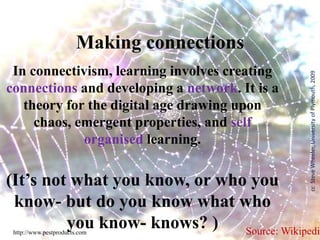
Making connectionsIn connectivism, learning involves creating connections and developing a network. It is a theory for the digital age drawing upon chaos, emergent properties, and self organised learning.(It’s not what you know, or who you know- but do you know what who you know- knows? )cc  Steve Wheeler, University of Plymouth, 2009Source: Wikipediahttp://www.pestproducts.com
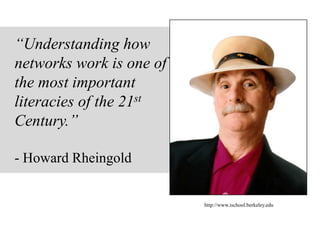
“Understanding how networks work is one of the most important literacies of the 21st Century.”- Howard Rheingoldhttp://www.ischool.berkeley.edu
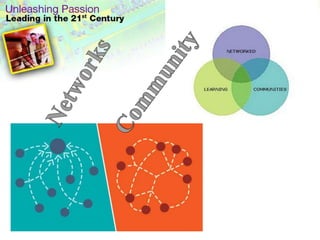
NetworksCommunity
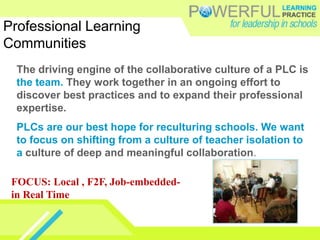
Professional Learning CommunitiesThe driving engine of the collaborative culture of a PLC is the team. They work together in an ongoing effort to discover best practices and to expand their professional expertise. PLCs are our best hope for reculturing schools. We want to focus on shifting from a culture of teacher isolation to a culture of deep and meaningful collaboration.FOCUS: Local , F2F, Job-embedded- in Real Time
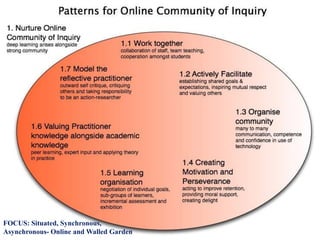
Communities of PracticeFOCUS: Situated, Synchronous, Asynchronous- Online and Walled Garden
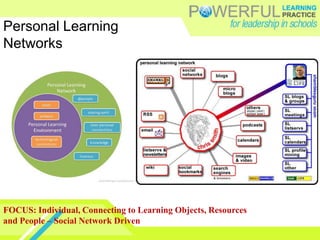
Personal Learning NetworksFOCUS: Individual, Connecting to Learning Objects, Resources and People – Social Network Driven
pd on fast forward
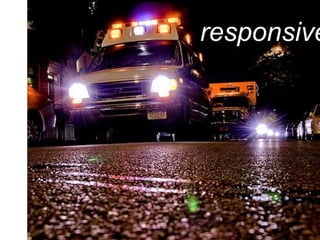
responsiveresponsive
personalized
interconnected
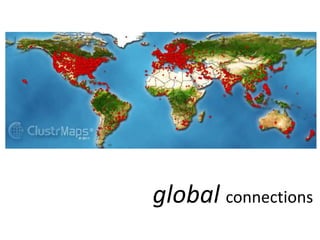
global connections
need to bebuilt
who’s in your network?
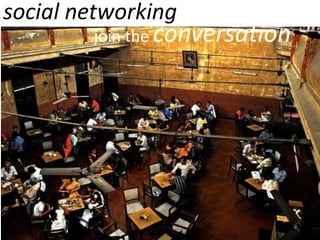
social networkingjoin the conversation
Reading Blogs
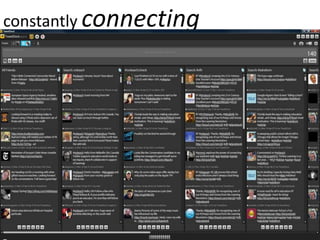
constantly connecting
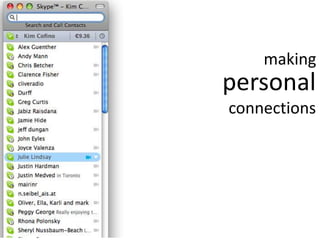
makingpersonalconnections
Too Many Blogs?!?!
But how do you read them all?http://www.flickr.com/photos/10244704@N05/2484112082
RSS to save the day!http://www.flickr.com/photos/videoplacebo/2476230102/
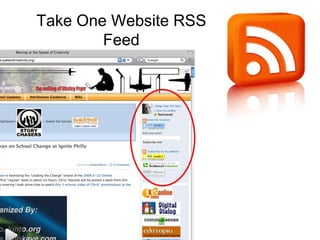
Take One Website RSS Feed
+ One Feed Reader
21st Century Pedagogy
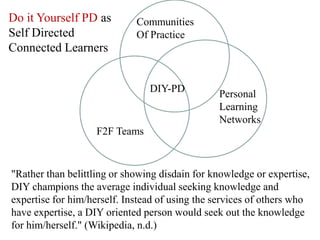
Do it Yourself PD as Self Directed Connected LearnersCommunitiesOf PracticeDIY-PDPersonalLearningNetworksF2F Teams"Rather than belittling or showing disdain for knowledge or expertise, DIY champions the average individual seeking knowledge and expertise for him/herself. Instead of using the services of others who have expertise, a DIY oriented person would seek out the knowledge for him/herself." (Wikipedia, n.d.)
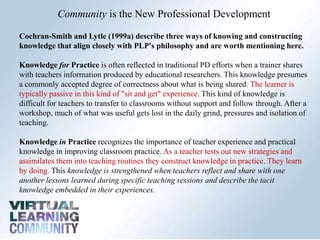
Community is the New Professional Development Cochran-Smith and Lytle (1999a) describe three ways of knowing and constructing knowledge that align closely with PLP's philosophy and are worth mentioning here. Knowledge for Practice is often reflected in traditional PD efforts when a trainer shares with teachers information produced by educational researchers. This knowledge presumes a commonly accepted degree of correctness about what is being shared. The learner is typically passive in this kind of "sit and get" experience. This kind of knowledge is difficult for teachers to transfer to classrooms without support and follow through. After a workshop, much of what was useful gets lost in the daily grind, pressures and isolation of teaching. Knowledge in Practice recognizes the importance of teacher experience and practical knowledge in improving classroom practice. As a teacher tests out new strategies and assimilates them into teaching routines they construct knowledge in practice. They learn by doing. This knowledge is strengthened when teachers reflect and share with one another lessons learned during specific teaching sessions and describe the tacit knowledge embedded in their experiences. 
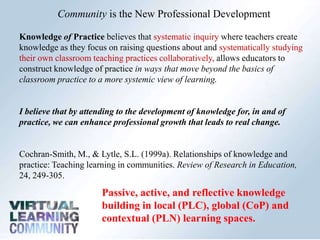
Community is the New Professional Development Knowledge of Practice believes that systematic inquiry where teachers create knowledge as they focus on raising questions about and systematically studying their own classroom teaching practices collaboratively, allows educators to construct knowledge of practice in ways that move beyond the basics of classroom practice to a more systemic view of learning.I believe that by attending to the development of knowledge for, in and of practice, we can enhance professional growth that leads to real change. Cochran-Smith, M., & Lytle, S.L. (1999a). Relationships of knowledge and practice: Teaching learning in communities. Review of Research in Education, 24, 249-305. Passive, active, and reflective knowledge building in local (PLC), global (CoP) and contextual (PLN) learning spaces.
http://www.elearnspace.org/Articles/google_whitepaper.pdf
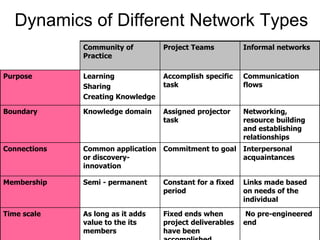
Dynamics of Different Network Types
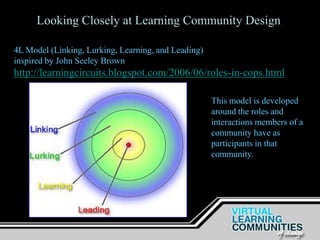
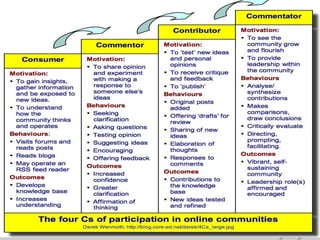
Looking Closely at Learning Community Design4L Model (Linking, Lurking, Learning, and Leading) inspired by John Seeley Brown http://learningcircuits.blogspot.com/2006/06/roles-in-cops.htmlThis model is developed around the roles and interactions members of a community have as participants in that community.
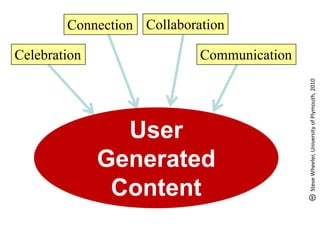
CollaborationConnectionCelebrationCommunicationUser Generated ContentSteve Wheeler, University of Plymouth, 2010
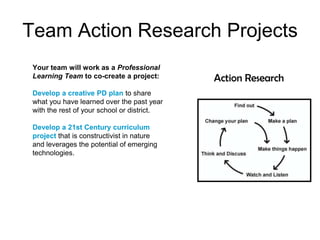
Team Action Research ProjectsYour team will work as a Professional Learning Team to co-create a project:Develop a creative PD plan to share what you have learned over the past year with the rest of your school or district.Develop a 21st Century curriculum project that is constructivist in nature and leverages the potential of emerging technologies. Action Research
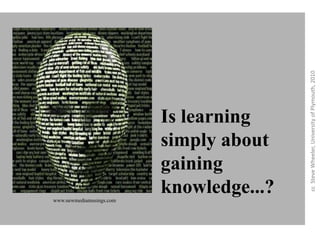
Is learning simply about gaining knowledge...?cc  Steve Wheeler, University of Plymouth, 2010www.newmediamusings.com
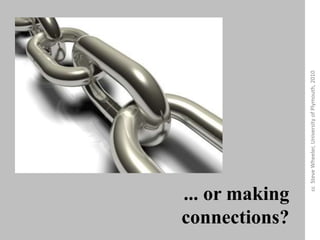
cc  Steve Wheeler, University of Plymouth, 2010... or making connections?
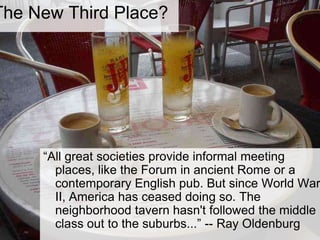
The New Third Place?“All great societies provide informal meeting places, like the Forum in ancient Rome or a contemporary English pub. But since World War II, America has ceased doing so. The neighborhood tavern hasn't followed the middle class out to the suburbs...” -- Ray Oldenburg
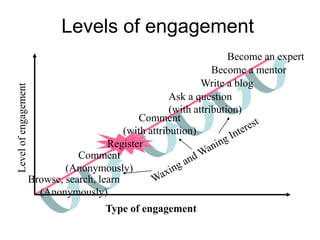
Levels of engagementBecome an expertBecome a mentorWrite a blogAsk a question(with attribution)Comment(with attribution)Level of engagementRegisterComment(Anonymously)Waxing and Waning InterestBrowse, search, learn(Anonymously)Type of engagement
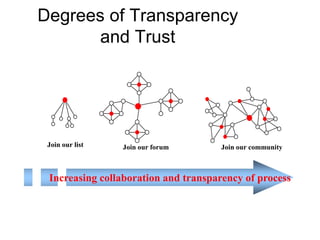
Join our listJoin our forumJoin our communityDegrees of Transparency and TrustIncreasing collaboration and transparency of process
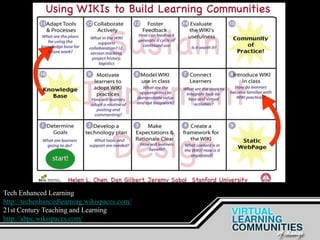
Tech Enhanced Learninghttp://techenhancedlearning.wikispaces.com/21st Century Teaching and Learninghttp://abpc.wikispaces.com/
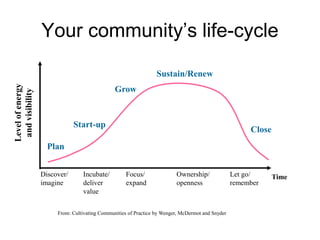
Your community’s life-cycleSustain/RenewGrowLevel of energy and visibilityStart-upClosePlanDiscover/imagineIncubate/ deliver valueFocus/ expandOwnership/ opennessLet go/ rememberTimeFrom: Cultivating Communities of Practice by Wenger, McDermot and Snyder
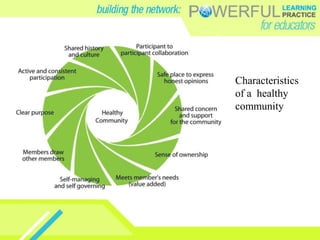
Characteristics of a  healthy community
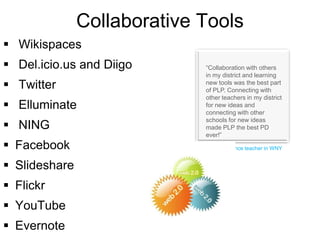
Collaborative Tools Wikispaces
 Del.icio.us and Diigo

Westmoreland iu21 clc

  • 1.
    Living and Learningin a Global CommunityInnovative Schools Virtual University
  • 2.
    6 Trends forthe digital age Analogue Digital Tethered Mobile Closed Open Isolated Connected Generic Personal Consuming CreatingSource: David Wiley: Openness and the disaggregated future of higher education
  • 3.
  • 4.
    A Definition ofCommunityCommunities are quite simply, collections of individuals who are bound together by natural will and a set of shared ideas and ideals.“A system in which people can enter into relations that are determined by problems or shared ambitions rather than by rules or structure.” (Heckscher, 1994, p. 24).The process of social learning that occurs when people who have a common interest in some subject or problem collaborate over an extended period to share ideas, find solutions, and build innovations. (Wikipedia)
  • 5.
    A Definition ofNetworksFrom Wikipedia, the free encyclopediaNetworks are created through publishing and sharing ideas and connecting with others who share passions around those ideas who learn from each other.Networked learning is a process of developing and maintaining connections with people and information, and communicating in such a way so as to support one another's learning.Connectivism (theory of learning in networks) is the use of a network with nodes and connections as a central metaphor for learning. In this metaphor, a node is anything that can be connected to another node: information, data, feelings, images. Learning is the process of creating connections and developing a network.
  • 6.
    Making connectionsIn connectivism,learning involves creating connections and developing a network. It is a theory for the digital age drawing upon chaos, emergent properties, and self organised learning.(It’s not what you know, or who you know- but do you know what who you know- knows? )cc Steve Wheeler, University of Plymouth, 2009Source: Wikipediahttp://www.pestproducts.com
  • 7.
    “Understanding how networkswork is one of the most important literacies of the 21st Century.”- Howard Rheingoldhttp://www.ischool.berkeley.edu
  • 8.
  • 9.
    Professional Learning CommunitiesThedriving engine of the collaborative culture of a PLC is the team. They work together in an ongoing effort to discover best practices and to expand their professional expertise. PLCs are our best hope for reculturing schools. We want to focus on shifting from a culture of teacher isolation to a culture of deep and meaningful collaboration.FOCUS: Local , F2F, Job-embedded- in Real Time
  • 10.
    Communities of PracticeFOCUS:Situated, Synchronous, Asynchronous- Online and Walled Garden
  • 11.
    Personal Learning NetworksFOCUS:Individual, Connecting to Learning Objects, Resources and People – Social Network Driven
  • 13.
    pd on fastforward
  • 14.
  • 15.
  • 16.
  • 17.
  • 18.
  • 19.
  • 20.
  • 21.
  • 22.
  • 23.
  • 24.
  • 25.
    But how doyou read them all?http://www.flickr.com/photos/10244704@N05/2484112082
  • 26.
    RSS to savethe day!http://www.flickr.com/photos/videoplacebo/2476230102/
  • 27.
  • 28.
  • 29.
  • 30.
    Do it YourselfPD as Self Directed Connected LearnersCommunitiesOf PracticeDIY-PDPersonalLearningNetworksF2F Teams"Rather than belittling or showing disdain for knowledge or expertise, DIY champions the average individual seeking knowledge and expertise for him/herself. Instead of using the services of others who have expertise, a DIY oriented person would seek out the knowledge for him/herself." (Wikipedia, n.d.)
  • 31.
    Community is theNew Professional Development Cochran-Smith and Lytle (1999a) describe three ways of knowing and constructing knowledge that align closely with PLP's philosophy and are worth mentioning here. Knowledge for Practice is often reflected in traditional PD efforts when a trainer shares with teachers information produced by educational researchers. This knowledge presumes a commonly accepted degree of correctness about what is being shared. The learner is typically passive in this kind of "sit and get" experience. This kind of knowledge is difficult for teachers to transfer to classrooms without support and follow through. After a workshop, much of what was useful gets lost in the daily grind, pressures and isolation of teaching. Knowledge in Practice recognizes the importance of teacher experience and practical knowledge in improving classroom practice. As a teacher tests out new strategies and assimilates them into teaching routines they construct knowledge in practice. They learn by doing. This knowledge is strengthened when teachers reflect and share with one another lessons learned during specific teaching sessions and describe the tacit knowledge embedded in their experiences. 
  • 32.
    Community is theNew Professional Development Knowledge of Practice believes that systematic inquiry where teachers create knowledge as they focus on raising questions about and systematically studying their own classroom teaching practices collaboratively, allows educators to construct knowledge of practice in ways that move beyond the basics of classroom practice to a more systemic view of learning.I believe that by attending to the development of knowledge for, in and of practice, we can enhance professional growth that leads to real change. Cochran-Smith, M., & Lytle, S.L. (1999a). Relationships of knowledge and practice: Teaching learning in communities. Review of Research in Education, 24, 249-305. Passive, active, and reflective knowledge building in local (PLC), global (CoP) and contextual (PLN) learning spaces.
  • 33.
  • 34.
  • 35.
    Looking Closely atLearning Community Design4L Model (Linking, Lurking, Learning, and Leading) inspired by John Seeley Brown http://learningcircuits.blogspot.com/2006/06/roles-in-cops.htmlThis model is developed around the roles and interactions members of a community have as participants in that community.
  • 37.
  • 38.
    Team Action ResearchProjectsYour team will work as a Professional Learning Team to co-create a project:Develop a creative PD plan to share what you have learned over the past year with the rest of your school or district.Develop a 21st Century curriculum project that is constructivist in nature and leverages the potential of emerging technologies. Action Research
  • 39.
    Is learning simplyabout gaining knowledge...?cc Steve Wheeler, University of Plymouth, 2010www.newmediamusings.com
  • 40.
    cc SteveWheeler, University of Plymouth, 2010... or making connections?
  • 41.
    The New ThirdPlace?“All great societies provide informal meeting places, like the Forum in ancient Rome or a contemporary English pub. But since World War II, America has ceased doing so. The neighborhood tavern hasn't followed the middle class out to the suburbs...” -- Ray Oldenburg
  • 42.
    Levels of engagementBecomean expertBecome a mentorWrite a blogAsk a question(with attribution)Comment(with attribution)Level of engagementRegisterComment(Anonymously)Waxing and Waning InterestBrowse, search, learn(Anonymously)Type of engagement
  • 44.
    Join our listJoinour forumJoin our communityDegrees of Transparency and TrustIncreasing collaboration and transparency of process
  • 45.
    Tech Enhanced Learninghttp://techenhancedlearning.wikispaces.com/21stCentury Teaching and Learninghttp://abpc.wikispaces.com/
  • 47.
    Your community’s life-cycleSustain/RenewGrowLevelof energy and visibilityStart-upClosePlanDiscover/imagineIncubate/ deliver valueFocus/ expandOwnership/ opennessLet go/ rememberTimeFrom: Cultivating Communities of Practice by Wenger, McDermot and Snyder
  • 48.
    Characteristics of a healthy community
  • 49.
  • 50.