ECONOMIC
S PROJECT
Concept of revenue in types of market
Presentedby:Riya Mehra
Class:11th C
Rollno.:40
Submittedto:DineshYadav
LIST OF CONTENT :
• Definition of Revenue
• Definition of Market
• Types/Forms of Market
•Perfect competition & it’s features
Revenue concept under Perfect
competition.
•Monopolistic Competition & it’s features
Revenue concept under Monopolistic
Competition.
• Monopoly & it’s features
Revenue concept under monopolist
Competition.
WHAT IS REVENUE?
Revenue is the earning that an enterprise has from its normal business
pursuits, usually from the sale of commodities, and services to consumers.
Revenue is also mentioned and referred to as turnover or sales.
• Total revenue - Total revenue is the total amount of money a company
brings in from selling its goods and services.
• Marginal revenue - Marginal revenue is the increase in revenue that
results from the sale of one additional unit of output.
•Average revenue - Average revenue is referred to as the revenue that is
earned per unit of output.
WHAT IS MARKET?
• An area or arena in which commercial dealings are
conducted.
• According to economists:
The term Market, not any particular market
place in which things are bought and sold,
but the whole of any region in which buyers
and sellers are in such free intercourse with
one another that the prices of the same
goods tend to equality easily and quickly.
FORMS OR STRUCTURES OF MARKETS:
Forms of Market
Perfect
Competition
Imperfect
Competition
Monopolistic
Competition
Monopoly
competition
TYPES OF MARKET: PERFECT COMPETITION
PERFECT COMPETITION:
• In economic theory, perfect competition occurs
when all companies sell identical products, market
share does not influence price, companies are able
to enter or exit without barriers, buyers have perfect
or full information, and companies cannot
determine prices.
• It is a hypothetical situation , it cannot exist in real
case scenario.
• In this no one can influence the prices , including
the seller and buyer.
• It is also believed that everyone has equal access to
information.
FEATURES OF PERFECT COMPETITION
• Large number of buyers and sellers.
• Homogenous product is produced by every firm.
• Free entry and exit of firms.
• Zero advertising cost.
• Perfect mobility of the products and goods.
• The sellers and buyers must have relevant information to make rational decisions
• Each firm earns normal profits and no firms can earn super-normal profits.
• Every firm is a price taker.
REVENUE CONCEPT IN PERFECT COMPETITION
In the perfect market competition, there are a large number of small buyers and sellers. Thus,
the firm is the price taker. Also, in this situation, all the firms sell homogeneous goods.
Thus, the price remains constant but the revenue changes.
Here, Average revenue curve is a straight line parallel to X-
axis. Also, in this situation AR = MR.
Under perfect competition, the average revenue curve of a
firm is parallel to the X-axis.
IMPERFECT COMPETITION: MONOPOLISTIC
MONOPOLISTIC COMPETITION :
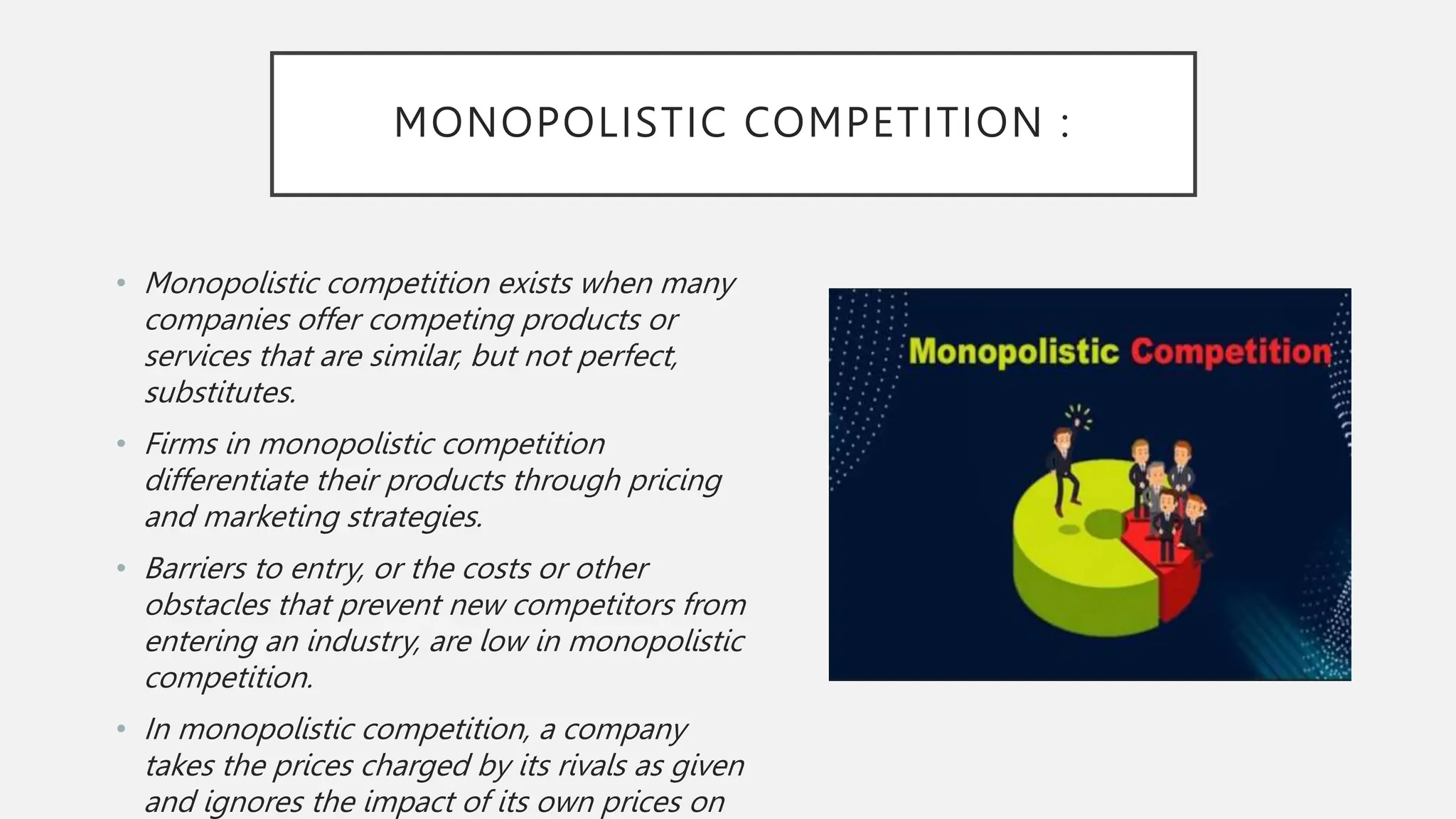
• Monopolistic competition exists when many
companies offer competing products or
services that are similar, but not perfect,
substitutes.
• Firms in monopolistic competition
differentiate their products through pricing
and marketing strategies.
• Barriers to entry, or the costs or other
obstacles that prevent new competitors from
entering an industry, are low in monopolistic
competition.
• In monopolistic competition, a company
takes the prices charged by its rivals as given
and ignores the impact of its own prices on
FEATURES OF MONOPOLISTIC COMPETITION:
• Large Number of Buyers and Sellers.
• Free Entry and Exit of Firms.
• Product Differentiation.
• Selling Costs.
• Imperfect consumer knowledge.
• Less Mobility.
• More Elastic Demand.
REVENUE CONCEPT IN MONOPOLISTIC
COMPETITION
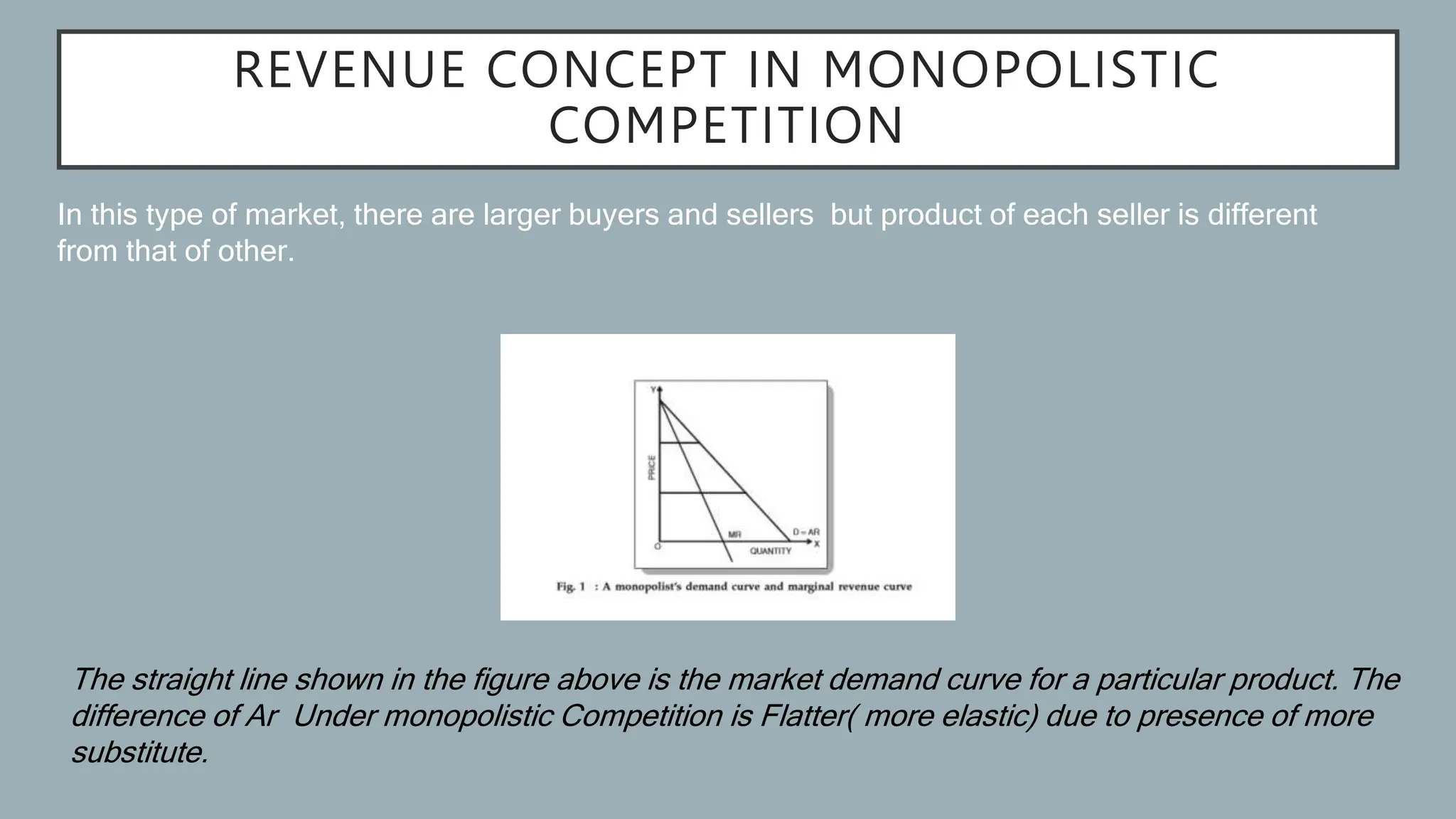
In this type of market, there are larger buyers and sellers but product of each seller is different
from that of other.
The straight line shown in the figure above is the market demand curve for a particular product. The
difference of Ar Under monopolistic Competition is Flatter( more elastic) due to presence of more
substitute.
IMPERFECT COMPETITION: MONOPOLY
MONOPOLY COMPETITION:
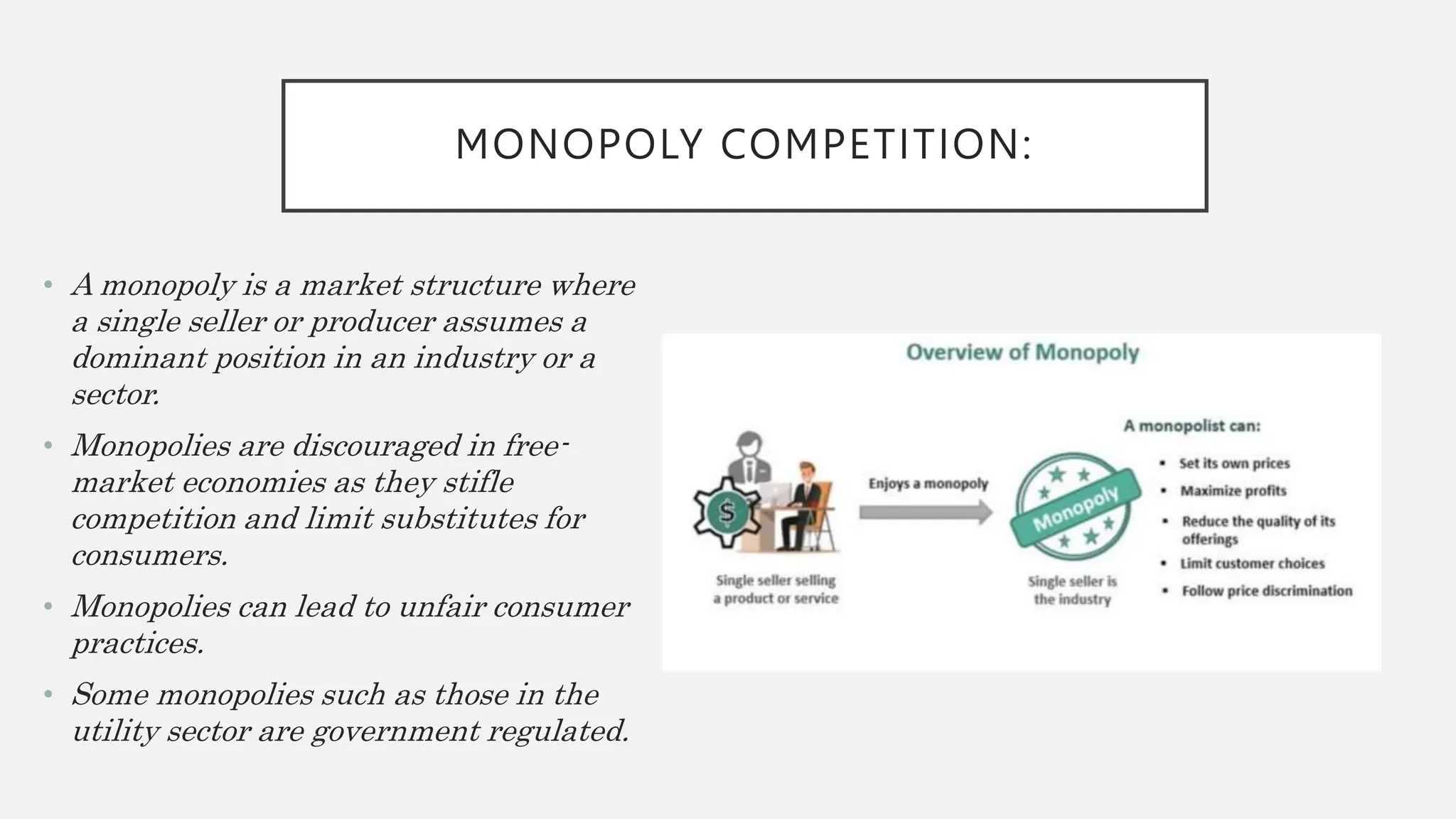
• A monopoly is a market structure where
a single seller or producer assumes a
dominant position in an industry or a
sector.
• Monopolies are discouraged in free-
market economies as they stifle
competition and limit substitutes for
consumers.
• Monopolies can lead to unfair consumer
practices.
• Some monopolies such as those in the
utility sector are government regulated.
FEATURES OF MONOPOLY
• Only One Seller and Various Buyers.
• Barriers to entry and exit.
• No Close Substitutes.
• There are profit maximization and price discrimination associated with
monopolistic markets.
• The monopolist does not discriminate among customers and charges them
all alike for the same product.
• The monopolist is the price maker, i.e., it decides the price, which
maximizes its profit. The price is determined by evaluating the demand for
the product.
REVENUE CONCEPT IN MONOPOLY
In Monopoly , A monopolist can charge any price for its product, nonetheless the demand for the firm’s
product constrains the price.
The Relationship between the marginal and average
revenue of a monopoly firm is stated as follows:
AR and MR are both negative sloped (downward sloping)
curves.
MR curve lies half-way between the AR curve and the Y-
axis. i.e. it cuts the horizontal line between the Y-axis and
AR into two equal parts.
THE END
Thank you ;)

Economics project on concept on revenue on markets

  • 1.
    ECONOMIC S PROJECT Concept ofrevenue in types of market Presentedby:Riya Mehra Class:11th C Rollno.:40 Submittedto:DineshYadav
  • 2.
    LIST OF CONTENT: • Definition of Revenue • Definition of Market • Types/Forms of Market •Perfect competition & it’s features Revenue concept under Perfect competition. •Monopolistic Competition & it’s features Revenue concept under Monopolistic Competition. • Monopoly & it’s features Revenue concept under monopolist Competition.
  • 3.
    WHAT IS REVENUE? Revenueis the earning that an enterprise has from its normal business pursuits, usually from the sale of commodities, and services to consumers. Revenue is also mentioned and referred to as turnover or sales. • Total revenue - Total revenue is the total amount of money a company brings in from selling its goods and services. • Marginal revenue - Marginal revenue is the increase in revenue that results from the sale of one additional unit of output. •Average revenue - Average revenue is referred to as the revenue that is earned per unit of output.
  • 4.
    WHAT IS MARKET? •An area or arena in which commercial dealings are conducted. • According to economists: The term Market, not any particular market place in which things are bought and sold, but the whole of any region in which buyers and sellers are in such free intercourse with one another that the prices of the same goods tend to equality easily and quickly.
  • 5.
    FORMS OR STRUCTURESOF MARKETS: Forms of Market Perfect Competition Imperfect Competition Monopolistic Competition Monopoly competition
  • 6.
    TYPES OF MARKET:PERFECT COMPETITION
  • 7.
    PERFECT COMPETITION: • Ineconomic theory, perfect competition occurs when all companies sell identical products, market share does not influence price, companies are able to enter or exit without barriers, buyers have perfect or full information, and companies cannot determine prices. • It is a hypothetical situation , it cannot exist in real case scenario. • In this no one can influence the prices , including the seller and buyer. • It is also believed that everyone has equal access to information.
  • 8.
    FEATURES OF PERFECTCOMPETITION • Large number of buyers and sellers. • Homogenous product is produced by every firm. • Free entry and exit of firms. • Zero advertising cost. • Perfect mobility of the products and goods. • The sellers and buyers must have relevant information to make rational decisions • Each firm earns normal profits and no firms can earn super-normal profits. • Every firm is a price taker.
  • 9.
    REVENUE CONCEPT INPERFECT COMPETITION In the perfect market competition, there are a large number of small buyers and sellers. Thus, the firm is the price taker. Also, in this situation, all the firms sell homogeneous goods. Thus, the price remains constant but the revenue changes. Here, Average revenue curve is a straight line parallel to X- axis. Also, in this situation AR = MR. Under perfect competition, the average revenue curve of a firm is parallel to the X-axis.
  • 10.
  • 11.
    MONOPOLISTIC COMPETITION : •Monopolistic competition exists when many companies offer competing products or services that are similar, but not perfect, substitutes. • Firms in monopolistic competition differentiate their products through pricing and marketing strategies. • Barriers to entry, or the costs or other obstacles that prevent new competitors from entering an industry, are low in monopolistic competition. • In monopolistic competition, a company takes the prices charged by its rivals as given and ignores the impact of its own prices on
  • 12.
    FEATURES OF MONOPOLISTICCOMPETITION: • Large Number of Buyers and Sellers. • Free Entry and Exit of Firms. • Product Differentiation. • Selling Costs. • Imperfect consumer knowledge. • Less Mobility. • More Elastic Demand.
  • 13.
    REVENUE CONCEPT INMONOPOLISTIC COMPETITION In this type of market, there are larger buyers and sellers but product of each seller is different from that of other. The straight line shown in the figure above is the market demand curve for a particular product. The difference of Ar Under monopolistic Competition is Flatter( more elastic) due to presence of more substitute.
  • 14.
  • 15.
    MONOPOLY COMPETITION: • Amonopoly is a market structure where a single seller or producer assumes a dominant position in an industry or a sector. • Monopolies are discouraged in free- market economies as they stifle competition and limit substitutes for consumers. • Monopolies can lead to unfair consumer practices. • Some monopolies such as those in the utility sector are government regulated.
  • 16.
    FEATURES OF MONOPOLY •Only One Seller and Various Buyers. • Barriers to entry and exit. • No Close Substitutes. • There are profit maximization and price discrimination associated with monopolistic markets. • The monopolist does not discriminate among customers and charges them all alike for the same product. • The monopolist is the price maker, i.e., it decides the price, which maximizes its profit. The price is determined by evaluating the demand for the product.
  • 17.
    REVENUE CONCEPT INMONOPOLY In Monopoly , A monopolist can charge any price for its product, nonetheless the demand for the firm’s product constrains the price. The Relationship between the marginal and average revenue of a monopoly firm is stated as follows: AR and MR are both negative sloped (downward sloping) curves. MR curve lies half-way between the AR curve and the Y- axis. i.e. it cuts the horizontal line between the Y-axis and AR into two equal parts.
  • 18.