APPLIED
ECONOMICS
IVY B. BUNCARAS
ECONOMICS
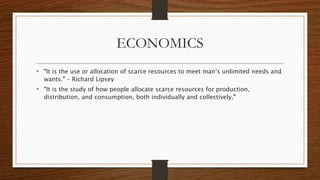
• “It is the use or allocation of scarce resources to meet man’s unlimited needs and
wants.” – Richard Lipsey
• “It is the study of how people allocate scarce resources for production,
distribution, and consumption, both individually and collectively.”
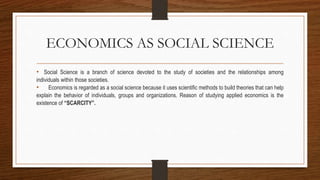
ECONOMICS AS SOCIAL SCIENCE
• Social Science is a branch of science devoted to the study of societies and the relationships among
individuals within those societies.
• Economics is regarded as a social science because it uses scientific methods to build theories that can help
explain the behavior of individuals, groups and organizations. Reason of studying applied economics is the
existence of “SCARCITY”.
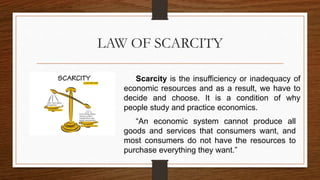
LAW OF SCARCITY
Scarcity is the insufficiency or inadequacy of
economic resources and as a result, we have to
decide and choose. It is a condition of why
people study and practice economics.
“An economic system cannot produce all
goods and services that consumers want, and
most consumers do not have the resources to
purchase everything they want.”
Since there is scarcity, we have to choose…
• Trade-off - the exchange or choosing between alternatives. It is a reality of life
that getting one thing would mean giving up another thing.
• Opportunity Cost - is the value or cost of the next best forgone
choice/alternative. In other words, opportunity cost represents that could have
different decision.
POSITIVE AND NORMATIVE
ECONOMICS
A. Positive Economics describes and explains various economic phenomena or the
“what is” scenario. Positive economics is based on facts. Example: “Public
expenditures.”
•
A. Normative Economics focuses on the value of economic fairness, or what the
economy “should be”. In other words, normative economics is based on value
healthcare must be free to all citizens.”
MAJOR DIVISION OF ECONOMICS
1. Microeconomics: It is the close-up view of the economy, studying individual and
business decisions. It is also called the bottom-up approach that focuses on
forces that determine price levels.
 Studies individual income
 Analyze demand and supply of labor
 Deals with households and firms’ decision
 Studies individual prices
 Analyzes demand and supply of goods
MAJOR DIVISION OF ECONOMICS
1. Macroeconomics: It is the overall view of the economy looking at the decisions of
countries and governments. It takes a top-down approach that tries to determine
as a whole. It focuses on the aggregates of supply and demand.
 Studies national income
 Analyzes total employment in the economy
 Deals with aggregate decisions
 Studies overall price level
 Analyzes aggregate demand and aggregate
FACTORS OF PRODUCTION
• In economics, the factors of production (sometimes called economic resources or inputs are essential to produce
goods and services. There are the following:
1. Land. Includes all the natural resources such as fertile soil, trees, minerals, and water which can be sources of raw
which can be sources of raw materials to produce goods or products.
2. Labor. Refers to the physical and mental talents of individuals used to produce goods/services.
goods/services.
3. Capital. Refers to anything that people produce and later used in the production of other goods and services such
other goods and services such as manufactured aids, tools, machines, equipment, and factories.
4. Entrepreneurship. It is the ability to organize the other resources (land, labor, and capital) to produce goods and
capital) to produce goods and services. It is the ability to establish and operate a business and establish
relationships with suppliers, customers, lenders, investors, and others.
ECONOMICS AS APPLIED SCIENCE
• Applied Science: Is a discipline that applies existing scientific knowledge to
develop more practical applications, like technology and invention. It can also
statistics and probability theory.
• Economics is an applied science because it deals with analysis on how members
other on the creation and utilization of wealth. What makes it an applied science
theories through testing, mainly using data from the past.
THREE BASIC ECONOMIC QUESTION
1. What to produce?
Since resources are limited, societies must decide and prioritize what goods and
and later followed by determining the quantity (how many / how much).
a. Primitive Economics (e.g., Basic necessities)
b. Modern Economics (e.g., Leisure and Education)
Given limited resources of labor, raw materials and time, economic agents have to
THREE BASIC ECONOMIC QUESTION
2. How to produce?
This method of production that has the highest efficiency and yield the highest
output shall be employed/ used.
This should be the right combination of resources and technology to be applied.
THREE BASIC ECONOMIC QUESTION
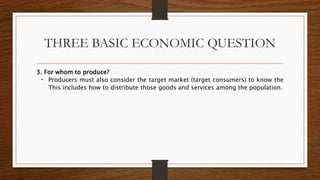
3. For whom to produce?
• Producers must also consider the target market (target consumers) to know the
This includes how to distribute those goods and services among the population.
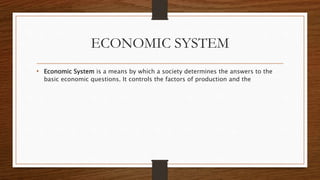
ECONOMIC SYSTEM
• Economic System is a means by which a society determines the answers to the
basic economic questions. It controls the factors of production and the
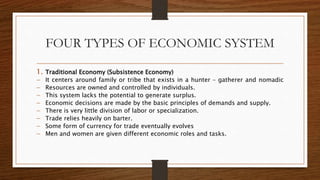
FOUR TYPES OF ECONOMIC SYSTEM
1. Traditional Economy (Subsistence Economy)
 It centers around family or tribe that exists in a hunter – gatherer and nomadic
 Resources are owned and controlled by individuals.
 This system lacks the potential to generate surplus.
 Economic decisions are made by the basic principles of demands and supply.
 There is very little division of labor or specialization.
 Trade relies heavily on barter.
 Some form of currency for trade eventually evolves
 Men and women are given different economic roles and tasks.
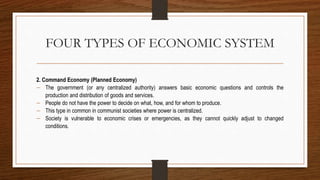
FOUR TYPES OF ECONOMIC SYSTEM
2. Command Economy (Planned Economy)
 The government (or any centralized authority) answers basic economic questions and controls the
production and distribution of goods and services.
 People do not have the power to decide on what, how, and for whom to produce.
 This type in common in communist societies where power is centralized.
 Society is vulnerable to economic crises or emergencies, as they cannot quickly adjust to changed
conditions.
FOUR TYPES OF ECONOMIC SYSTEM
3. Market Economy (Free – Market Economy)
 There is a very little government interference on economic activities.
 People have the freedom to produce and / or consume in any way and in any amount they want.
 Most economic decision making is done through voluntary transactions according to the laws of supply and
demands.
 Arguably, growth is highest under this economic system.
•
FOUR TYPES OF ECONOMIC SYSTEM
3. Mixed Economy (combination of command & market economy)
 Applied economic system is a system that combines aspects of both capitalism (market) and socialism (command)
 It protects private property and allows a level of economic freedom in the use of capital, but also allows for
governments to interfere in economic activities.
 Most industries are privately-owned but still under regulation, however, industries that provide essential services are
under the control of the government.
 The economic questions are partly determined and answered by the government and the producers and
consumers. The challenge is finding the right balance between free markets and government controls.
 Governments tend to exert much more control than is necessary
ECONOMIC THEORIES
 Are ideas and principles that aims to describe how economies work.
 Are statements of a presumed relationship between two or more variables, such as the relationship of price
to demand, price to supply, and so on.
THE GREAT ECONOMIST & THEIR
THEORIST
1. Adam Smith and the “Invisible Hand”.
 Scottish philosopher and economist who was born in 1723
 The Father of Economics or the Father of Capitalism
 The wealth of Nation published in 1776 – “the invisible hand” (self-regulation of
idea of free market economy or capitalism. He believed that all individuals act in
produce and purchase by themselves.
 Smith also emphasized that new machinery, division of labor, and specialization
production and greater wealth to a nation.
 Later during the 1900’s the doctrine of laissez faire, anchored with Smith’s idea,
THE GREAT ECONOMIST & THEIR
THEORIST
2. Karl Marx and “Class Struggle”
 A German philosopher born in 1818
 Contrary to the ideas of Smith, Marx saw instability, struggle, and the decline of a free
 “Das Kapital” (1867) – He explained that the capitalists (the bourgeoisie/ the rich/ the
exploiting the labor of the workers (the proletariat/ the poor/ the ruled class). He said
exploited/ underpaid for the value that they worked for.
 Marx believed that this struggle eventually intensifies and would lead to the fall of
 To him, this situation later leads to the movement of society toward communism
government intervention, owns the means of production.
THE GREAT ECONOMIST & THEIR
THEORIST
3. John Maynard Keynes and Government Intervention
 A British economist born in 1883
 In 1936, he published his work General Theory of Employment, Interest, and
 His most significant work is about the role of the government in a capitalist
 His works were written during the Great Depression (1930s) in the US which
applicability of Smith’s invisible hand (no government intervention).
 Keynes strongly believed that the only solution is government intervention
creating massive public works program to employ the idle workforce
put back to the economy and into private sector pockets, ignite demand for
the economy again.
APPLIED ECONOMICS TO SOLVE
ECONOMIC ISSUES AND PROBLEMS
MICROECONOMIC ISSUES
1. Poverty
 Is pronounced deprivation in well-being. Poverty is the lack of monetary resources to
of specific goods like food, asset, shelter, health, and the like.
•
• SOLUTION:
 Create jobs (e.g., government projects, encourage investment)
 Raise the minimum wage
 Promote pay equity
 Property allocates time and resources (e.g., social programs)
 Provide access to healthcare
 Create micro-financing programs
 Provide an adequate social safety net
 Increase access to education
APPLIED ECONOMICS TO SOLVE
ECONOMIC ISSUES AND PROBLEMS
MICROECONOMIC ISSUES
● 2. Social Inequality
 Refers to disparities and discrepancies in areas such as income, wealth,
politics, and social identity.
•
• SOLUTION:
 Implement progressive income tax
 Spend more on public / social services and infrastructure
 Increase government ownership of basic utilities
APPLIED ECONOMICS TO SOLVE
ECONOMIC ISSUES AND PROBLEMS
MICROECONOMIC ISSUES
3. Monopoly - Is a market structure characterized by a sole seller in a particular
market wherein the business entity may control the supply, compromise the quality
manipulate the price.
4. Environmental Issues
 Are harmful effects of human activities (usually economic activities) on the
APPLIED ECONOMICS TO SOLVE
ECONOMIC ISSUES AND PROBLEMS
MACROECONOMIC ISSUES
1. Recession
 Is a period of temporary economic decline during which industrial and trade activities
in GDP in two consecutive quarter (6 to 18 months)
2. Unemployment
 Happens when a lot of people are jobless/ cannot find work or are losing jobs.
3. Inflation
 is the consistent increase in the average price level of goods and services. The
declines and it lowers living standards. According to experts, 2-3% of inflation is
be cause by the increase in the cost of production (cost-push inflation), a high rise in
inflation), or too much money supply in the economy.
APPLIED ECONOMICS TO SOLVE
ECONOMIC ISSUES AND PROBLEMS
MACROECONOMIC ISSUES
4. Trade deficit
 Occurs when a countries imports exceed its exports during a given time period.
balance of trade (BOT). A country may rely heavily on imports due to lacking the
its own products due to lack of technology, resources, or skills.
LAW OF SUPPLY AND DEMAND
• It was developed by British economist Alfred Marshall. The most basic economic law and the foundation of
other economic theories which may be applied to markets final goods and services or to markets for labor,
capital, etc.
• The theory defines the relationship between the price of a given good or product and the willingness of people
to either buy or sell it.
 Generally, if the demand is higher than the supply, price will increase and vice versa. In a free market, supply
and demand will pull against each other until the equilibrium price is settled.
 Other than the price however, there are other factors affecting both supply and demand.
LAW OF SUPPLY
• the economic law that explains the relationship between price and quantity supplied which is directly
proportional. It states that “as the price of a good or service increases, the quantity supplied increases, and
vice versa”, ceteris paribus. If the price of a product increases, the producers would be willing to supply more
of that product, and vice versa.
FACTORS AFFECTING SUPPLY
1. Cost of production / cost of inputs
• There are four factors/ inputs of production which are land, labor, capital, and entrepreneurship.
• “When production costs go up, supply goes down. When production costs go down, supply goes up”.
•
1. Changes in productivity / Technological Progress
• Technology has a big role in affecting productivity. Using automated machines definitely speeds up production.
• “When productivity goes up, supply goes up. When productivity goes down, supply goes down”.
•
1. Changes in the number of Sellers
• “More sellers in the market increase supply. Fewer sellers in the market decreases supply.
FACTORS AFFECTING SUPPLY
1. Fiscal policy / taxes
• Both local and imported products are subjected to different taxes and
of these products.
• “Higher duty and tariff will restrict supply. Lower duty and tariff will
•
1. Future / Price Expectation
• “When producers expect the prices to go up, they increase supply. When
prices to go down, they decrease supply”
LAW OF DEMAND
• The law that explains the relationship between price and quantity demanded which is inversely proportional. It
states that “as the price of a good or service increases, the quantity demanded decreases, and vice versa”,
ceteris paribus. If the price of a product increases, less costumers would want to buy that product, and vice
versa.
FACTORS AFFECTING DEMAND
1. Changes in income (Income effect)
• “When income goes up, consumers buy more. When income goes down, consumers buy less”.
•
1. Availability and prices of substitutes (Substitution Effect)
• “If the price of Product A increases significantly, consumers switch to its cheaper substitute/ alternative, thus
decreasing the demand for A. If the price of product A decreases significantly, consumers of its substitute switch
to it, thus increasing the demand for A.”
•
1. Availability and prices of complementary goods
• “If the price of complementary good for product A falls, then the demand for both increases. If the price of
the demand for both decreases.
1. Changes in the number of consumers
• “The more buyers there are, the higher the demand. The fewer buyers there are, the lower the demand”.
•
1. Changes in tastes and preferences
• “If a product is on trend or becomes popular, the demand for it increases. If a product is outdated or if an
alternative becomes more popular, its demand decreases”.
•
1. Future / price expectations
• “When consumer expect the price of commodities to rise, then they demand/ buy more. When people expect the
price to fall, then they are discouraged to buy now. Instead they wait till that time comes”.
FACTORS AFFECTING DEMAND
APPLIED ECONOMICS.pptx

APPLIED ECONOMICS.pptx

  • 1.
  • 2.
    ECONOMICS • “It isthe use or allocation of scarce resources to meet man’s unlimited needs and wants.” – Richard Lipsey • “It is the study of how people allocate scarce resources for production, distribution, and consumption, both individually and collectively.”
  • 3.
    ECONOMICS AS SOCIALSCIENCE • Social Science is a branch of science devoted to the study of societies and the relationships among individuals within those societies. • Economics is regarded as a social science because it uses scientific methods to build theories that can help explain the behavior of individuals, groups and organizations. Reason of studying applied economics is the existence of “SCARCITY”.
  • 4.
    LAW OF SCARCITY Scarcityis the insufficiency or inadequacy of economic resources and as a result, we have to decide and choose. It is a condition of why people study and practice economics. “An economic system cannot produce all goods and services that consumers want, and most consumers do not have the resources to purchase everything they want.”
  • 5.
    Since there isscarcity, we have to choose… • Trade-off - the exchange or choosing between alternatives. It is a reality of life that getting one thing would mean giving up another thing. • Opportunity Cost - is the value or cost of the next best forgone choice/alternative. In other words, opportunity cost represents that could have different decision.
  • 6.
    POSITIVE AND NORMATIVE ECONOMICS A.Positive Economics describes and explains various economic phenomena or the “what is” scenario. Positive economics is based on facts. Example: “Public expenditures.” • A. Normative Economics focuses on the value of economic fairness, or what the economy “should be”. In other words, normative economics is based on value healthcare must be free to all citizens.”
  • 7.
    MAJOR DIVISION OFECONOMICS 1. Microeconomics: It is the close-up view of the economy, studying individual and business decisions. It is also called the bottom-up approach that focuses on forces that determine price levels.  Studies individual income  Analyze demand and supply of labor  Deals with households and firms’ decision  Studies individual prices  Analyzes demand and supply of goods
  • 8.
    MAJOR DIVISION OFECONOMICS 1. Macroeconomics: It is the overall view of the economy looking at the decisions of countries and governments. It takes a top-down approach that tries to determine as a whole. It focuses on the aggregates of supply and demand.  Studies national income  Analyzes total employment in the economy  Deals with aggregate decisions  Studies overall price level  Analyzes aggregate demand and aggregate
  • 9.
    FACTORS OF PRODUCTION •In economics, the factors of production (sometimes called economic resources or inputs are essential to produce goods and services. There are the following: 1. Land. Includes all the natural resources such as fertile soil, trees, minerals, and water which can be sources of raw which can be sources of raw materials to produce goods or products. 2. Labor. Refers to the physical and mental talents of individuals used to produce goods/services. goods/services. 3. Capital. Refers to anything that people produce and later used in the production of other goods and services such other goods and services such as manufactured aids, tools, machines, equipment, and factories. 4. Entrepreneurship. It is the ability to organize the other resources (land, labor, and capital) to produce goods and capital) to produce goods and services. It is the ability to establish and operate a business and establish relationships with suppliers, customers, lenders, investors, and others.
  • 10.
    ECONOMICS AS APPLIEDSCIENCE • Applied Science: Is a discipline that applies existing scientific knowledge to develop more practical applications, like technology and invention. It can also statistics and probability theory. • Economics is an applied science because it deals with analysis on how members other on the creation and utilization of wealth. What makes it an applied science theories through testing, mainly using data from the past.
  • 11.
    THREE BASIC ECONOMICQUESTION 1. What to produce? Since resources are limited, societies must decide and prioritize what goods and and later followed by determining the quantity (how many / how much). a. Primitive Economics (e.g., Basic necessities) b. Modern Economics (e.g., Leisure and Education) Given limited resources of labor, raw materials and time, economic agents have to
  • 12.
    THREE BASIC ECONOMICQUESTION 2. How to produce? This method of production that has the highest efficiency and yield the highest output shall be employed/ used. This should be the right combination of resources and technology to be applied.
  • 13.
    THREE BASIC ECONOMICQUESTION 3. For whom to produce? • Producers must also consider the target market (target consumers) to know the This includes how to distribute those goods and services among the population.
  • 14.
    ECONOMIC SYSTEM • EconomicSystem is a means by which a society determines the answers to the basic economic questions. It controls the factors of production and the
  • 15.
    FOUR TYPES OFECONOMIC SYSTEM 1. Traditional Economy (Subsistence Economy)  It centers around family or tribe that exists in a hunter – gatherer and nomadic  Resources are owned and controlled by individuals.  This system lacks the potential to generate surplus.  Economic decisions are made by the basic principles of demands and supply.  There is very little division of labor or specialization.  Trade relies heavily on barter.  Some form of currency for trade eventually evolves  Men and women are given different economic roles and tasks.
  • 16.
    FOUR TYPES OFECONOMIC SYSTEM 2. Command Economy (Planned Economy)  The government (or any centralized authority) answers basic economic questions and controls the production and distribution of goods and services.  People do not have the power to decide on what, how, and for whom to produce.  This type in common in communist societies where power is centralized.  Society is vulnerable to economic crises or emergencies, as they cannot quickly adjust to changed conditions.
  • 17.
    FOUR TYPES OFECONOMIC SYSTEM 3. Market Economy (Free – Market Economy)  There is a very little government interference on economic activities.  People have the freedom to produce and / or consume in any way and in any amount they want.  Most economic decision making is done through voluntary transactions according to the laws of supply and demands.  Arguably, growth is highest under this economic system. •
  • 18.
    FOUR TYPES OFECONOMIC SYSTEM 3. Mixed Economy (combination of command & market economy)  Applied economic system is a system that combines aspects of both capitalism (market) and socialism (command)  It protects private property and allows a level of economic freedom in the use of capital, but also allows for governments to interfere in economic activities.  Most industries are privately-owned but still under regulation, however, industries that provide essential services are under the control of the government.  The economic questions are partly determined and answered by the government and the producers and consumers. The challenge is finding the right balance between free markets and government controls.  Governments tend to exert much more control than is necessary
  • 19.
    ECONOMIC THEORIES  Areideas and principles that aims to describe how economies work.  Are statements of a presumed relationship between two or more variables, such as the relationship of price to demand, price to supply, and so on.
  • 20.
    THE GREAT ECONOMIST& THEIR THEORIST 1. Adam Smith and the “Invisible Hand”.  Scottish philosopher and economist who was born in 1723  The Father of Economics or the Father of Capitalism  The wealth of Nation published in 1776 – “the invisible hand” (self-regulation of idea of free market economy or capitalism. He believed that all individuals act in produce and purchase by themselves.  Smith also emphasized that new machinery, division of labor, and specialization production and greater wealth to a nation.  Later during the 1900’s the doctrine of laissez faire, anchored with Smith’s idea,

  • 21.
    THE GREAT ECONOMIST& THEIR THEORIST 2. Karl Marx and “Class Struggle”  A German philosopher born in 1818  Contrary to the ideas of Smith, Marx saw instability, struggle, and the decline of a free  “Das Kapital” (1867) – He explained that the capitalists (the bourgeoisie/ the rich/ the exploiting the labor of the workers (the proletariat/ the poor/ the ruled class). He said exploited/ underpaid for the value that they worked for.  Marx believed that this struggle eventually intensifies and would lead to the fall of  To him, this situation later leads to the movement of society toward communism government intervention, owns the means of production.
  • 22.
    THE GREAT ECONOMIST& THEIR THEORIST 3. John Maynard Keynes and Government Intervention  A British economist born in 1883  In 1936, he published his work General Theory of Employment, Interest, and  His most significant work is about the role of the government in a capitalist  His works were written during the Great Depression (1930s) in the US which applicability of Smith’s invisible hand (no government intervention).  Keynes strongly believed that the only solution is government intervention creating massive public works program to employ the idle workforce put back to the economy and into private sector pockets, ignite demand for the economy again.
  • 23.
    APPLIED ECONOMICS TOSOLVE ECONOMIC ISSUES AND PROBLEMS MICROECONOMIC ISSUES 1. Poverty  Is pronounced deprivation in well-being. Poverty is the lack of monetary resources to of specific goods like food, asset, shelter, health, and the like. • • SOLUTION:  Create jobs (e.g., government projects, encourage investment)  Raise the minimum wage  Promote pay equity  Property allocates time and resources (e.g., social programs)  Provide access to healthcare  Create micro-financing programs  Provide an adequate social safety net  Increase access to education
  • 24.
    APPLIED ECONOMICS TOSOLVE ECONOMIC ISSUES AND PROBLEMS MICROECONOMIC ISSUES ● 2. Social Inequality  Refers to disparities and discrepancies in areas such as income, wealth, politics, and social identity. • • SOLUTION:  Implement progressive income tax  Spend more on public / social services and infrastructure  Increase government ownership of basic utilities
  • 25.
    APPLIED ECONOMICS TOSOLVE ECONOMIC ISSUES AND PROBLEMS MICROECONOMIC ISSUES 3. Monopoly - Is a market structure characterized by a sole seller in a particular market wherein the business entity may control the supply, compromise the quality manipulate the price. 4. Environmental Issues  Are harmful effects of human activities (usually economic activities) on the
  • 26.
    APPLIED ECONOMICS TOSOLVE ECONOMIC ISSUES AND PROBLEMS MACROECONOMIC ISSUES 1. Recession  Is a period of temporary economic decline during which industrial and trade activities in GDP in two consecutive quarter (6 to 18 months) 2. Unemployment  Happens when a lot of people are jobless/ cannot find work or are losing jobs. 3. Inflation  is the consistent increase in the average price level of goods and services. The declines and it lowers living standards. According to experts, 2-3% of inflation is be cause by the increase in the cost of production (cost-push inflation), a high rise in inflation), or too much money supply in the economy.
  • 27.
    APPLIED ECONOMICS TOSOLVE ECONOMIC ISSUES AND PROBLEMS MACROECONOMIC ISSUES 4. Trade deficit  Occurs when a countries imports exceed its exports during a given time period. balance of trade (BOT). A country may rely heavily on imports due to lacking the its own products due to lack of technology, resources, or skills.
  • 28.
    LAW OF SUPPLYAND DEMAND • It was developed by British economist Alfred Marshall. The most basic economic law and the foundation of other economic theories which may be applied to markets final goods and services or to markets for labor, capital, etc. • The theory defines the relationship between the price of a given good or product and the willingness of people to either buy or sell it.  Generally, if the demand is higher than the supply, price will increase and vice versa. In a free market, supply and demand will pull against each other until the equilibrium price is settled.  Other than the price however, there are other factors affecting both supply and demand.
  • 29.
    LAW OF SUPPLY •the economic law that explains the relationship between price and quantity supplied which is directly proportional. It states that “as the price of a good or service increases, the quantity supplied increases, and vice versa”, ceteris paribus. If the price of a product increases, the producers would be willing to supply more of that product, and vice versa.
  • 30.
    FACTORS AFFECTING SUPPLY 1.Cost of production / cost of inputs • There are four factors/ inputs of production which are land, labor, capital, and entrepreneurship. • “When production costs go up, supply goes down. When production costs go down, supply goes up”. • 1. Changes in productivity / Technological Progress • Technology has a big role in affecting productivity. Using automated machines definitely speeds up production. • “When productivity goes up, supply goes up. When productivity goes down, supply goes down”. • 1. Changes in the number of Sellers • “More sellers in the market increase supply. Fewer sellers in the market decreases supply.
  • 31.
    FACTORS AFFECTING SUPPLY 1.Fiscal policy / taxes • Both local and imported products are subjected to different taxes and of these products. • “Higher duty and tariff will restrict supply. Lower duty and tariff will • 1. Future / Price Expectation • “When producers expect the prices to go up, they increase supply. When prices to go down, they decrease supply”
  • 32.
    LAW OF DEMAND •The law that explains the relationship between price and quantity demanded which is inversely proportional. It states that “as the price of a good or service increases, the quantity demanded decreases, and vice versa”, ceteris paribus. If the price of a product increases, less costumers would want to buy that product, and vice versa.
  • 33.
    FACTORS AFFECTING DEMAND 1.Changes in income (Income effect) • “When income goes up, consumers buy more. When income goes down, consumers buy less”. • 1. Availability and prices of substitutes (Substitution Effect) • “If the price of Product A increases significantly, consumers switch to its cheaper substitute/ alternative, thus decreasing the demand for A. If the price of product A decreases significantly, consumers of its substitute switch to it, thus increasing the demand for A.” • 1. Availability and prices of complementary goods • “If the price of complementary good for product A falls, then the demand for both increases. If the price of the demand for both decreases.
  • 34.
    1. Changes inthe number of consumers • “The more buyers there are, the higher the demand. The fewer buyers there are, the lower the demand”. • 1. Changes in tastes and preferences • “If a product is on trend or becomes popular, the demand for it increases. If a product is outdated or if an alternative becomes more popular, its demand decreases”. • 1. Future / price expectations • “When consumer expect the price of commodities to rise, then they demand/ buy more. When people expect the price to fall, then they are discouraged to buy now. Instead they wait till that time comes”. FACTORS AFFECTING DEMAND