BASIC ECONOMIC
IDEAS & RESOURCE
ALLOCATION
UNIT-1
CH-1 SCARCITY, CHOICE &
OPPORTUNITY COST
THE FUNDAMENTAL ECONOMIC PROBLEM
• AKA the basic economic problem.
• Problem of scarce resources relative to unlimited
human wants.
• It’s a problem of ‘scarcity & choice’.
• Task: ☺ copy the key terms: page 3
• It causes economic agents to make choices of what to
consume and to sacrifice/forego
Top tip: ☺
• The economic problem refers to scarce resources in
relation to unlimited wants.
• It forms the basis of other economic problems facing
individuals and governments e.g. unemployment
CHOICE & OPPORTUNITY COST
• Opportunity cost is the cost/benefit foregone in order to
consume the next best alternative.
• Since resources are scarce compared to the unlimited
wants, choices must be of which wants to satisfy before
the others
• E.g. A student decides to stay in her room and study
instead of going to the cinema.
How do economic agents react to this
problem?
• They seek to answer the three basic economic questions:
• 3 economic questions video
1. What to produce:
• since resources are never enough producers must decide the
quantity of goods and services to produce from the bulk of
scarce resources available
2. How to produce;
• Refers to a choice on the best method of production in
order get maximum benefit from the resources.
• Method used could be labour intensive (man power) or
capital intensive(machinery).
3.For whom to produce;
• It’s the determination of consumers since its not possible to
satisfy the wants of all the people in the economy.
• Firms will invest in R&D to determine consumer preferences.
• Target market could be a niche or mass
STUDENTS TASK
• Draw fig 1.2 pg 4
• Prep task: Self assessment task 1.3_China: the
challenges of an ageing population: pg 5-6
• Due on Monday
CH-2: ECONOMIC
METHODOLOGY
INTRO: WHAT IS ECONOMICS?
• Discussion point:
• It’s a social science that deals with the study of how to allocate
scarce resources in the most efficient way.
• Task: ☺ Give examples to illustrate that resources e.g. money are
never enough!! ☺
• Human needs & wants are always unlimited while the means of
providing them (resources) are scarce.
• Thus choices must be in order of priority of how to satisfy them
• Task: ☺ draw the illustration..☺
ECONOMIC ANALYSIS
• It follows a scientific framework in studying the behaviour of
economic agents.
• Task ☺ Draw the diagram on page 3.
• Give examples of how economists study unemployment….☺
• There are 3 main economic agents/players in a market/economy
✔ Firms- producers
✔ Households- consumers
✔ Government- regulator.
TOP TIP ☺
• The complex structure within which these agents lie is called the Economy
• The road to economic explanation follows 2 main approaches
• 1. positive statements (Objective)
• These are factual statements that can be verified and/or falsified by looking at the known
facts
• Such statements are acceptable to all economists eg the rate of inflation in 2009 in
Kenya was 4.23 %
• 2. Normative statements (Subjective)
• They are personal opinions that reflect value judgements which can not be verified by
looking at the facts.
• They are personal views about what ought to happen.
• Eg the government should cut fuel tax to reduce the rate of inflation.
PRACTISE:
Q 4. 9708/11/M/J/11
Q3 9708/01/M/J/09
CLASSIFICATION OF ECONOMICS
1. Microeconomics;
• It deals with the study of individual economic agents e.g.
person, household, firm, or industry)
• Eg how a consumer allocates his income among various
uses.
2. Macroeconomics:
• It involves the study of aggregate economic principles which affects
the whole economy.
• Eg unemployment, inflation, national income etc.
• Macro economics vs microeconomics video
THE MEANING OF CETERIS PARIBUS
• This is Latin phrase for: other things being equal or
holding other factors constant:
• Assumption that economic agents will consider one
variable when making economic decisions
• E.g. A consumer may consider price only when
buying an iPod ceteris paribus!
THE MARGIN AND DECISION MAKING
• Economics involves making decisions of what to consume and what
to sacrifice.
• The margin refers to the utility or value of one additional unit
of an item.
• Decision making “at the margin”
• It means making economic choices based on the value of the
additional amount of costs & benefits
https://youtu.be/HB-8HySmjc4
EXAMPLE
• Give practical examples of the cost & benefits of oil
exploration in ‘Ngamia 2 well’ in Turkana .
• The decision maker looks at the additional or
marginal cost(MC) of an action, & the additional or
marginal benefit(MB) of the decision.
• If the incremental benefit/MB is greater than the
incremental cost/MC, the action is taken
THE IMPORTANCE OF TIME PERIOD
• Production occurs in 3 distinct periods.
• 1. short run (SR)
• Time period during which a firm can only change some and not all factor inputs.
• E.g. in the SR a firm can increase production by hiring more workers ceteris paribus.
• 2. Long run (LR)
• Time period during which all factor inputs can be varied.
• E.g. in the LR a firm can hire more capital
• 3.Very long run
• Time period during which all key inputs in to production are variable
• E.g. govt regulations, tech etc
CH-3: FACTORS OF
PRODUCTION
ECONOMIC RESOURCES
• These are the factors of production or the factor inputs necessary to create goods and services.
• They are always limited/scarce in supply since human wants are insatiable and recurrent in nature.
Categories of resources
1. Land;
• It’s a natural resource, free gift of nature.
• It includes the earth's surface, water bodies, forests, atmosphere and mineral deposits.
2. Labour;
• It’s the human effort used in production.
• No production can occur without labour.
3. Capital
• These are man made aids to production.
• Capital goods assist land and labour to produce more output e.g. machinery,
4. Enterprise/entrepreneurship- business skills
• The entrepreneur, business person, organizes other factors of production for maximum productivity.
• The enterprise involves risk taking in undertaking various production activities especially in a free enterprise economy.
• Top tip: ☺
• Economies with abundant resources are said to have good factor endowment
SPECIALIZATION & EXCHANGE
• Specialization refers to the process whereby economic agents concentrate on one
economic activity
• e.g…Japan specializes in the production of technology & cars
• It leads to creation of surplus/excess output which can be exported abroad.
• This allows world living standards to rise
• It also contributes to unemployment since specialized workers lack flexibility to
work elsewhere
• .
DIVISION OF LABOUR
• Breaking down of a production process into a sequence of individual tasks where different
workers concentrate according to their levels of skills and experience
• It was introduced by Adam smith in his book an inquiry into the nature and causes of wealth of
nations (1776)
• He suggested that production of pins could be split in to 18 operations so as to increase output.
• Apart from raising factory output, this process leads to monotony due to constant repetition of
similar tasks.
• Merits & demerits handout
Examples
• Henry Ford's use of the conveyor belt in car manufacture in the US.
CH-4: RESOURCE
ALLOCATION IN DIFFERENT
ECONOMIC SYSTEMS
DIFFERENT ALLOCATIVE MECHANISMS
• The basic economic problem leads to different economic systems.
• An economic system describes the means through which economic
agents make choices of resource allocation
• Types of economic systems:
• They are 3 main types
1. The market economy
• AKA free market economy, free enterprise economy or capitalism.
• It was advocated by Adam smith(1776) & can be represented by
the USA
• The system is an ideal case not present in today’s modern
economies.
Features
• No government regulation in a pure market economy
• Profit maximization is the main goal of buyers & sellers.
• All resources are privately owned by the firms and the households.(private
sector) who make decisions on how to allocate resources.
• Many buyers & sellers who interact freely.
• Prices are determined by the market forces of demand and supply.
• i.e. invisible hands of the market/market mechanism
• Consumer sovereignty- freedom of what to consume
ADVANTAGES
• Consumers are free to choose what they want to buy.
• No taxes charged. This is a motivation as workers can keep all the
profits
• Businesses compete with each other freely and this could keep prices
low.
• Freedom of enterprise- New businesses are encouraged to set up.
• Efficient allocation of scarce resources according to market forces.
DISADVANTAGES
• Public services e.g. health and education are not adequately provided
• Production of harmful goods due to absence of govt regulation
• Monopolies can develop and hence lead to consumer exploitation
• Possibility of high inflation as market demand rises
• There lacks fair play in the market since there is no govt regulation
RESEARCH TASK
• Read and make short notes on functions of price mechanism in
a free market economy [10]
COMMAND/PLANNED ECONOMY
• AKA socialist or communist economy.
• It was advocated by Karl Marx (1818)
• A pure planned economy does not occur in practice.
• Examples: former USSR, Cuba, North Korea etc
FEATURES:
• All resources are owned and controlled by the government
• Public sector dominates the economy.
• Resource allocation decisions are made centrally by the govt or some state agency on behalf
of the govt.
• The government determines collective market preferences in a planned economy.
• Central govt is responsible for
– The allocation of resources
– The determination of production targets for all the sectors of the economy
– The distribution of income and the determination of wages
– The ownership of most productive resources and property
– Planning the long term growth of the economy
ADVANTAGES
• Government decides what should be produced, how much and for
whom
• Decreases inequalities between the rich & poor.
• Both public & merit goods are adequately provided
• Enhances balanced regional development
DISADVANTAGES
• It's expensive to run a government structure
• Centralised decision making may conflict the market forces of
dd & ss.
• Government systems may have excess red tape
• Govt controls may reduce innovations & inventions
THE MIXED ECONOMY
• It’s a combination of both the market & command economy as in present
day countries.
• Features
• The private sector & public sector are actively involved in resource
allocation thru PPP’s
• Some resources are owned by the State and some by private individuals
• Businesses make decisions & the Government tries to influence and
control some areas such as Taxes & Laws.
• Degree of govt control varies from country to country
• However some public sector business may be inefficient leading to
privatisation.
ADVANTAGES
• Government control eliminates unhealthy business competition.
• It may lead to high economic growth due to freedom of enterprise thru
PPP
• Govt ensures uniform resource distribution to benefit all.
• It controls production of harmful products eg narcotics
• Disadvantages;
• There is less incentive to work as the government fixes wages and taxes
The government may not produce goods which people want to buy.
• The lack of absolute freedom of enterprise may discourage
production.
The transition economy
• It is one that is changing from central planning to
free market
• i.e. moving from command to free enterprise
economy.
• The problems of transition economies
• Q1/9708/11/M/J/2012
1. Rising Unemployment-
• A command economy employs more people due to active
govt regulation in the public sector.
• Under a free market, private sector may adopt capital
intensive prodn at the expense of labour intensive prodn
2. Rising inflation
• This is due to the removal of price controls imposed by
governments.
• Private firms charge high prices, due to pursuit of profit
motive, leading to inflation
3. Corruption
� It's possible that under free market corrupt business
activities may thrive.
� This leads to production of harmful products eg
narcotics
4. Lack of a sophisticated legal system
• Market-driven economies will only develop when citizens are
granted extensive property rights, and can protect these rights
through the legal process.
• This was large absent in the former communist transition
economies.
5. Lack of infrastructure
• The transition economies also suffered from a lack of real capital
and technology.
• This was partly because of the limited development of financial
markets and the little foreign direct investment
CH-5: PRODUCTION
POSSIBILITY CURVES
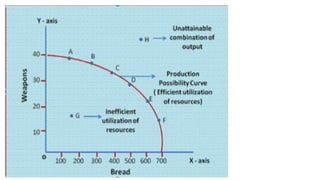
Production possibility curve (PPC)
• AKA production possibility frontier (PPF).
• It’s a graphical representation of the basic economic problem &
opportunity cost
• It represents the maximum level of output an economy can achieve
when using its existing resources in full.
• It can be a straight line or a curve
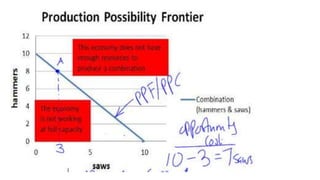
• Production within the ppf shows underutilization/unemployment of
resources.
• On the boundary: …….efficient resource
• Above the curve….
OBSERVATIONS
• All points on the PPF represents combinations of two goods an economy
can produce at a given technology when all resources are fully engaged.
• Production within the PPF shows inefficient utilization of resources
(underutilization)
• Prodn above the PPF is not possible with the present bulk of resources
☺ Top tip: ☺
• 1. The PPF is concave to the origin because of increasing
opportunity costs as resources are switched to produce the
alternative product.
• 2. A linear (straight line) PPF implies constant opportunity cost in
the prodn of the two products & its hypothetical.
• 3. The resources available together with the technical know-how
determines an economies production possibility.
• i.e. how many goods & services to be produced
• 4.The PPF is also called product transformation curve since along the
curve different combinations are produced due to increasing
opportunity cost.
Shifts in the PPF:
• The PPF assumes that technology and resource levels of an
economy are constant but they may change overtime
• It can either shift upwards or downwards.
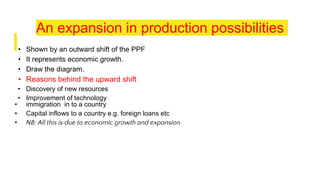
An expansion in production possibilities
• Shown by an outward shift of the PPF
• It represents economic growth.
• Draw the diagram.
• Reasons behind the upward shift
• Discovery of new resources
• Improvement of technology
• immigration in to a country
• Capital inflows to a country e.g. foreign loans etc
• NB: All this is due to economic growth and expansion
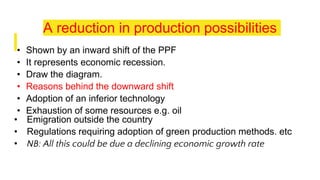
A reduction in production possibilities
• Shown by an inward shift of the PPF
• It represents economic recession.
• Draw the diagram.
• Reasons behind the downward shift
• Adoption of an inferior technology
• Exhaustion of some resources e.g. oil
• Emigration outside the country
• Regulations requiring adoption of green production methods. etc
• NB: All this could be due a declining economic growth rate
PRACTISE
2Q.9708/1 Jun03
1Q. 9708/01/M/J/07
2Q. 9708/01/M/J/09
Q2.9708/13/O/N/2012
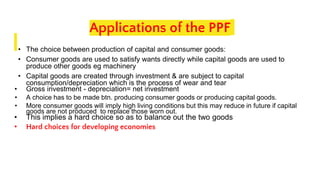
Applications of the PPF
• The choice between production of capital and consumer goods:
• Consumer goods are used to satisfy wants directly while capital goods are used to
produce other goods eg machinery
• Capital goods are created through investment & are subject to capital
consumption/depreciation which is the process of wear and tear
• Gross investment - depreciation= net investment
• A choice has to be made btn. producing consumer goods or producing capital goods.
• More consumer goods will imply high living conditions but this may reduce in future if capital
goods are not produced to replace those worn out.
• This implies a hard choice so as to balance out the two goods
• Hard choices for developing economies
• They are faced with low living standards hence they must increase their capital stock investment
• They must devote more resources from current consumption to investment so as to grow while
producing enough consumer goods to feed their high populace.
• The issue of high population causes lots of resources to be committed for subsistence at the expense
of capital investment.
• This problem is referred to as ‘jam today or more jam tomorrow’.
• Observations:
• o-a is the capital consumption/depreciation
• O-b is the quantity of consumer goods
• Producing o-b units of consumer goods will improve welfare today only.
• This is because depreciation rate will be higher than the quantity of capital goods produced.
CH-6 : CLASSIFICATION OF
GOODS AND SERVICES
CLASSIFICATION OF GOODS
• There are four categories of goods;
✔Capital/producer versus Consumer
✔Free versus economic
✔Private versus public
✔Merit versus demerit
Capital/producer goods
• They are used to produce consumer goods eg plant machinery in a factory
• Consumer goods
• They are produced for immediate consumption by end users. Eg TV’s, food etc
• Free goods
• They are abundant in supply and have no opportunity cost.
• They have no prices e.g. air
• Economic goods
• They are scarce in supply and have an opportunity cost and a price attached to
them.
Private goods.
• This is one where consumption by one person results in the good not being available for
consumption by another.
• Give an example…
• Characteristics
• 1.Excludable-
• Consumers are excluded from using the product if they are not willing or able to pay for it. E.g.
A movie ticket.
• 2.Rivalry
• One person's’ consumption reduces the amount left for others to consume.
• Scarce resources are used in producing and supplying the good or service.
• 3.Rejectability-
• One can chose to buy/use it or not. Eg you can choose the type of ice cream flavour to buy
Public goods
• Goods that are non rival and non excludable and
difficult to charge a price.
• E.g. defence, fishing light house & street lighting.
• Characteristics
• Non excludable:
• Once provided, no person can be stopped from
benefiting from it
2. Non rival:
• Consumption of the good by one person does not reduce
the benefit to others.
• i.e. as more consume, the benefit to those already
consuming is not diminished.
3. Non-rejectable
• There is no choice as whether to use it or not e.g. defence
• Note: ☺
• Quasi public goods have some but not all the characteristics of
public goods.
• E.g. seaside beach & roads.
• Task: explain how a beach can be made exclude and rival….
The problem of public goods
• In a free market, they will not be provided at all!
• This is because of the ‘free rider problem’: consumers will wait
for others to purchase them and then use them for free!
• In the lighthouse case, the fishermen will wait for one ‘foolish’
fisherman’ to provide it then enjoy the benefit
• Copy the definition of the free rider.
• Solution
• Public goods need to be provided by the government and force
everyone to its cost through taxation.
PRACTISE
Q16/9708/11/M/J/2013
Merit goods
• Goods that have positive side effects associated with
them.
• i.e. they provide more benefits than the consumer
perceives.
• They are under produced & under consumed due to info
failure hence they are provided by governments e.g.
education and health.
• E.g. inoculation against Polio. It not only protects the
individual but the whole community!
• https:// free Rotavirus vaccine
Demerit goods:
• Goods that have adverse side effects associated with
them when consumed. E.g. junk foods & cigarettes.
• They are worse for the individual than he /she
realises.
• They are overproduced and over consumed due to
info failure
• E.g. smoking cigs is not only harmful to active but also
to passive smokers.
• Information failure
• Occurs where people lack full info about the benefits and harmful
effects of certain goods.
Discussion point; ☺
• Why do people consume demerit goods yet they
are knowledgeable about their side effects?
• Addiction, value judgment etc
Moral Hazard
• Why do you go to see a doctor when unwell?
• Occurs when people misallocate resources due to lack of info
• A doctor may prescribe some expensive drugs for a trivial case so as to extort a patient who has no option but to pay.
• This causes misallocation of resources & market failure since the Dr. has more info than the patient!
• NB: seller has more info than the buyer.
• Adverse Selection
• Refers to a market process in which bad results occur due to information asymmetries between buyers and sellers
• NB: Buyer has more info than the seller
• The buyers have information that sellers don't about some aspect of product quality.
• Eg when buying medical insurance, one may provide inaccurate medical info so as to avoid high premiums.
• When the risk occurs, the premiums for healthy people will have to be raised so as to compensate many claimants.
Many ‘bad risk’ customers will cause the insurer to allocate lots of resources for compensation which is market failure.

UNIT1-BASIC ECONOMIC IDEAS AND RESOURCE ALLOCATION-AS.pptx

  • 1.
    BASIC ECONOMIC IDEAS &RESOURCE ALLOCATION UNIT-1
  • 2.
    CH-1 SCARCITY, CHOICE& OPPORTUNITY COST
  • 3.
    THE FUNDAMENTAL ECONOMICPROBLEM • AKA the basic economic problem. • Problem of scarce resources relative to unlimited human wants. • It’s a problem of ‘scarcity & choice’. • Task: ☺ copy the key terms: page 3 • It causes economic agents to make choices of what to consume and to sacrifice/forego
  • 4.
    Top tip: ☺ •The economic problem refers to scarce resources in relation to unlimited wants. • It forms the basis of other economic problems facing individuals and governments e.g. unemployment
  • 5.
    CHOICE & OPPORTUNITYCOST • Opportunity cost is the cost/benefit foregone in order to consume the next best alternative. • Since resources are scarce compared to the unlimited wants, choices must be of which wants to satisfy before the others • E.g. A student decides to stay in her room and study instead of going to the cinema.
  • 6.
    How do economicagents react to this problem? • They seek to answer the three basic economic questions: • 3 economic questions video 1. What to produce: • since resources are never enough producers must decide the quantity of goods and services to produce from the bulk of scarce resources available
  • 7.
    2. How toproduce; • Refers to a choice on the best method of production in order get maximum benefit from the resources. • Method used could be labour intensive (man power) or capital intensive(machinery).
  • 8.
    3.For whom toproduce; • It’s the determination of consumers since its not possible to satisfy the wants of all the people in the economy. • Firms will invest in R&D to determine consumer preferences. • Target market could be a niche or mass
  • 9.
    STUDENTS TASK • Drawfig 1.2 pg 4 • Prep task: Self assessment task 1.3_China: the challenges of an ageing population: pg 5-6 • Due on Monday
  • 10.
  • 11.
    INTRO: WHAT ISECONOMICS? • Discussion point: • It’s a social science that deals with the study of how to allocate scarce resources in the most efficient way. • Task: ☺ Give examples to illustrate that resources e.g. money are never enough!! ☺ • Human needs & wants are always unlimited while the means of providing them (resources) are scarce. • Thus choices must be in order of priority of how to satisfy them • Task: ☺ draw the illustration..☺
  • 12.
    ECONOMIC ANALYSIS • Itfollows a scientific framework in studying the behaviour of economic agents. • Task ☺ Draw the diagram on page 3. • Give examples of how economists study unemployment….☺ • There are 3 main economic agents/players in a market/economy ✔ Firms- producers ✔ Households- consumers ✔ Government- regulator.
  • 13.
    TOP TIP ☺ •The complex structure within which these agents lie is called the Economy • The road to economic explanation follows 2 main approaches • 1. positive statements (Objective) • These are factual statements that can be verified and/or falsified by looking at the known facts • Such statements are acceptable to all economists eg the rate of inflation in 2009 in Kenya was 4.23 % • 2. Normative statements (Subjective) • They are personal opinions that reflect value judgements which can not be verified by looking at the facts. • They are personal views about what ought to happen. • Eg the government should cut fuel tax to reduce the rate of inflation.
  • 14.
  • 15.
    CLASSIFICATION OF ECONOMICS 1.Microeconomics; • It deals with the study of individual economic agents e.g. person, household, firm, or industry) • Eg how a consumer allocates his income among various uses. 2. Macroeconomics: • It involves the study of aggregate economic principles which affects the whole economy. • Eg unemployment, inflation, national income etc. • Macro economics vs microeconomics video
  • 16.
    THE MEANING OFCETERIS PARIBUS • This is Latin phrase for: other things being equal or holding other factors constant: • Assumption that economic agents will consider one variable when making economic decisions • E.g. A consumer may consider price only when buying an iPod ceteris paribus!
  • 17.
    THE MARGIN ANDDECISION MAKING • Economics involves making decisions of what to consume and what to sacrifice. • The margin refers to the utility or value of one additional unit of an item. • Decision making “at the margin” • It means making economic choices based on the value of the additional amount of costs & benefits
  • 18.
  • 19.
    EXAMPLE • Give practicalexamples of the cost & benefits of oil exploration in ‘Ngamia 2 well’ in Turkana . • The decision maker looks at the additional or marginal cost(MC) of an action, & the additional or marginal benefit(MB) of the decision. • If the incremental benefit/MB is greater than the incremental cost/MC, the action is taken
  • 20.
    THE IMPORTANCE OFTIME PERIOD • Production occurs in 3 distinct periods. • 1. short run (SR) • Time period during which a firm can only change some and not all factor inputs. • E.g. in the SR a firm can increase production by hiring more workers ceteris paribus. • 2. Long run (LR) • Time period during which all factor inputs can be varied. • E.g. in the LR a firm can hire more capital • 3.Very long run • Time period during which all key inputs in to production are variable • E.g. govt regulations, tech etc
  • 21.
  • 22.
    ECONOMIC RESOURCES • Theseare the factors of production or the factor inputs necessary to create goods and services. • They are always limited/scarce in supply since human wants are insatiable and recurrent in nature. Categories of resources 1. Land; • It’s a natural resource, free gift of nature. • It includes the earth's surface, water bodies, forests, atmosphere and mineral deposits. 2. Labour; • It’s the human effort used in production. • No production can occur without labour. 3. Capital • These are man made aids to production. • Capital goods assist land and labour to produce more output e.g. machinery, 4. Enterprise/entrepreneurship- business skills • The entrepreneur, business person, organizes other factors of production for maximum productivity. • The enterprise involves risk taking in undertaking various production activities especially in a free enterprise economy. • Top tip: ☺ • Economies with abundant resources are said to have good factor endowment
  • 23.
    SPECIALIZATION & EXCHANGE •Specialization refers to the process whereby economic agents concentrate on one economic activity • e.g…Japan specializes in the production of technology & cars • It leads to creation of surplus/excess output which can be exported abroad. • This allows world living standards to rise • It also contributes to unemployment since specialized workers lack flexibility to work elsewhere • .
  • 24.
    DIVISION OF LABOUR •Breaking down of a production process into a sequence of individual tasks where different workers concentrate according to their levels of skills and experience • It was introduced by Adam smith in his book an inquiry into the nature and causes of wealth of nations (1776) • He suggested that production of pins could be split in to 18 operations so as to increase output. • Apart from raising factory output, this process leads to monotony due to constant repetition of similar tasks. • Merits & demerits handout Examples • Henry Ford's use of the conveyor belt in car manufacture in the US.
  • 25.
    CH-4: RESOURCE ALLOCATION INDIFFERENT ECONOMIC SYSTEMS
  • 26.
    DIFFERENT ALLOCATIVE MECHANISMS •The basic economic problem leads to different economic systems. • An economic system describes the means through which economic agents make choices of resource allocation • Types of economic systems: • They are 3 main types
  • 27.
    1. The marketeconomy • AKA free market economy, free enterprise economy or capitalism. • It was advocated by Adam smith(1776) & can be represented by the USA • The system is an ideal case not present in today’s modern economies.
  • 28.
    Features • No governmentregulation in a pure market economy • Profit maximization is the main goal of buyers & sellers. • All resources are privately owned by the firms and the households.(private sector) who make decisions on how to allocate resources. • Many buyers & sellers who interact freely. • Prices are determined by the market forces of demand and supply. • i.e. invisible hands of the market/market mechanism • Consumer sovereignty- freedom of what to consume
  • 29.
    ADVANTAGES • Consumers arefree to choose what they want to buy. • No taxes charged. This is a motivation as workers can keep all the profits • Businesses compete with each other freely and this could keep prices low. • Freedom of enterprise- New businesses are encouraged to set up. • Efficient allocation of scarce resources according to market forces.
  • 30.
    DISADVANTAGES • Public servicese.g. health and education are not adequately provided • Production of harmful goods due to absence of govt regulation • Monopolies can develop and hence lead to consumer exploitation • Possibility of high inflation as market demand rises • There lacks fair play in the market since there is no govt regulation
  • 31.
    RESEARCH TASK • Readand make short notes on functions of price mechanism in a free market economy [10]
  • 32.
    COMMAND/PLANNED ECONOMY • AKAsocialist or communist economy. • It was advocated by Karl Marx (1818) • A pure planned economy does not occur in practice. • Examples: former USSR, Cuba, North Korea etc
  • 33.
    FEATURES: • All resourcesare owned and controlled by the government • Public sector dominates the economy. • Resource allocation decisions are made centrally by the govt or some state agency on behalf of the govt. • The government determines collective market preferences in a planned economy. • Central govt is responsible for – The allocation of resources – The determination of production targets for all the sectors of the economy – The distribution of income and the determination of wages – The ownership of most productive resources and property – Planning the long term growth of the economy
  • 34.
    ADVANTAGES • Government decideswhat should be produced, how much and for whom • Decreases inequalities between the rich & poor. • Both public & merit goods are adequately provided • Enhances balanced regional development
  • 35.
    DISADVANTAGES • It's expensiveto run a government structure • Centralised decision making may conflict the market forces of dd & ss. • Government systems may have excess red tape • Govt controls may reduce innovations & inventions
  • 36.
    THE MIXED ECONOMY •It’s a combination of both the market & command economy as in present day countries. • Features • The private sector & public sector are actively involved in resource allocation thru PPP’s • Some resources are owned by the State and some by private individuals • Businesses make decisions & the Government tries to influence and control some areas such as Taxes & Laws. • Degree of govt control varies from country to country • However some public sector business may be inefficient leading to privatisation.
  • 37.
    ADVANTAGES • Government controleliminates unhealthy business competition. • It may lead to high economic growth due to freedom of enterprise thru PPP • Govt ensures uniform resource distribution to benefit all. • It controls production of harmful products eg narcotics • Disadvantages; • There is less incentive to work as the government fixes wages and taxes The government may not produce goods which people want to buy. • The lack of absolute freedom of enterprise may discourage production.
  • 38.
    The transition economy •It is one that is changing from central planning to free market • i.e. moving from command to free enterprise economy. • The problems of transition economies • Q1/9708/11/M/J/2012
  • 39.
    1. Rising Unemployment- •A command economy employs more people due to active govt regulation in the public sector. • Under a free market, private sector may adopt capital intensive prodn at the expense of labour intensive prodn
  • 40.
    2. Rising inflation •This is due to the removal of price controls imposed by governments. • Private firms charge high prices, due to pursuit of profit motive, leading to inflation
  • 41.
    3. Corruption � It'spossible that under free market corrupt business activities may thrive. � This leads to production of harmful products eg narcotics
  • 42.
    4. Lack ofa sophisticated legal system • Market-driven economies will only develop when citizens are granted extensive property rights, and can protect these rights through the legal process. • This was large absent in the former communist transition economies.
  • 43.
    5. Lack ofinfrastructure • The transition economies also suffered from a lack of real capital and technology. • This was partly because of the limited development of financial markets and the little foreign direct investment
  • 44.
  • 45.
    Production possibility curve(PPC) • AKA production possibility frontier (PPF). • It’s a graphical representation of the basic economic problem & opportunity cost • It represents the maximum level of output an economy can achieve when using its existing resources in full. • It can be a straight line or a curve
  • 47.
    • Production withinthe ppf shows underutilization/unemployment of resources. • On the boundary: …….efficient resource • Above the curve….
  • 49.
    OBSERVATIONS • All pointson the PPF represents combinations of two goods an economy can produce at a given technology when all resources are fully engaged. • Production within the PPF shows inefficient utilization of resources (underutilization) • Prodn above the PPF is not possible with the present bulk of resources
  • 50.
    ☺ Top tip:☺ • 1. The PPF is concave to the origin because of increasing opportunity costs as resources are switched to produce the alternative product. • 2. A linear (straight line) PPF implies constant opportunity cost in the prodn of the two products & its hypothetical. • 3. The resources available together with the technical know-how determines an economies production possibility. • i.e. how many goods & services to be produced • 4.The PPF is also called product transformation curve since along the curve different combinations are produced due to increasing opportunity cost.
  • 51.
    Shifts in thePPF: • The PPF assumes that technology and resource levels of an economy are constant but they may change overtime • It can either shift upwards or downwards.
  • 52.
    An expansion inproduction possibilities • Shown by an outward shift of the PPF • It represents economic growth. • Draw the diagram. • Reasons behind the upward shift • Discovery of new resources • Improvement of technology • immigration in to a country • Capital inflows to a country e.g. foreign loans etc • NB: All this is due to economic growth and expansion
  • 53.
    A reduction inproduction possibilities • Shown by an inward shift of the PPF • It represents economic recession. • Draw the diagram. • Reasons behind the downward shift • Adoption of an inferior technology • Exhaustion of some resources e.g. oil • Emigration outside the country • Regulations requiring adoption of green production methods. etc • NB: All this could be due a declining economic growth rate
  • 54.
    PRACTISE 2Q.9708/1 Jun03 1Q. 9708/01/M/J/07 2Q.9708/01/M/J/09 Q2.9708/13/O/N/2012
  • 55.
    Applications of thePPF • The choice between production of capital and consumer goods: • Consumer goods are used to satisfy wants directly while capital goods are used to produce other goods eg machinery • Capital goods are created through investment & are subject to capital consumption/depreciation which is the process of wear and tear • Gross investment - depreciation= net investment • A choice has to be made btn. producing consumer goods or producing capital goods. • More consumer goods will imply high living conditions but this may reduce in future if capital goods are not produced to replace those worn out. • This implies a hard choice so as to balance out the two goods • Hard choices for developing economies
  • 56.
    • They arefaced with low living standards hence they must increase their capital stock investment • They must devote more resources from current consumption to investment so as to grow while producing enough consumer goods to feed their high populace. • The issue of high population causes lots of resources to be committed for subsistence at the expense of capital investment. • This problem is referred to as ‘jam today or more jam tomorrow’. • Observations: • o-a is the capital consumption/depreciation • O-b is the quantity of consumer goods • Producing o-b units of consumer goods will improve welfare today only. • This is because depreciation rate will be higher than the quantity of capital goods produced.
  • 57.
    CH-6 : CLASSIFICATIONOF GOODS AND SERVICES
  • 58.
    CLASSIFICATION OF GOODS •There are four categories of goods; ✔Capital/producer versus Consumer ✔Free versus economic ✔Private versus public ✔Merit versus demerit
  • 59.
    Capital/producer goods • Theyare used to produce consumer goods eg plant machinery in a factory • Consumer goods • They are produced for immediate consumption by end users. Eg TV’s, food etc • Free goods • They are abundant in supply and have no opportunity cost. • They have no prices e.g. air • Economic goods • They are scarce in supply and have an opportunity cost and a price attached to them.
  • 60.
    Private goods. • Thisis one where consumption by one person results in the good not being available for consumption by another. • Give an example… • Characteristics • 1.Excludable- • Consumers are excluded from using the product if they are not willing or able to pay for it. E.g. A movie ticket. • 2.Rivalry • One person's’ consumption reduces the amount left for others to consume. • Scarce resources are used in producing and supplying the good or service. • 3.Rejectability- • One can chose to buy/use it or not. Eg you can choose the type of ice cream flavour to buy
  • 61.
    Public goods • Goodsthat are non rival and non excludable and difficult to charge a price. • E.g. defence, fishing light house & street lighting. • Characteristics • Non excludable: • Once provided, no person can be stopped from benefiting from it
  • 62.
    2. Non rival: •Consumption of the good by one person does not reduce the benefit to others. • i.e. as more consume, the benefit to those already consuming is not diminished.
  • 63.
    3. Non-rejectable • Thereis no choice as whether to use it or not e.g. defence • Note: ☺ • Quasi public goods have some but not all the characteristics of public goods. • E.g. seaside beach & roads. • Task: explain how a beach can be made exclude and rival….
  • 64.
    The problem ofpublic goods • In a free market, they will not be provided at all! • This is because of the ‘free rider problem’: consumers will wait for others to purchase them and then use them for free! • In the lighthouse case, the fishermen will wait for one ‘foolish’ fisherman’ to provide it then enjoy the benefit • Copy the definition of the free rider. • Solution • Public goods need to be provided by the government and force everyone to its cost through taxation.
  • 65.
  • 66.
    Merit goods • Goodsthat have positive side effects associated with them. • i.e. they provide more benefits than the consumer perceives. • They are under produced & under consumed due to info failure hence they are provided by governments e.g. education and health. • E.g. inoculation against Polio. It not only protects the individual but the whole community! • https:// free Rotavirus vaccine
  • 67.
    Demerit goods: • Goodsthat have adverse side effects associated with them when consumed. E.g. junk foods & cigarettes. • They are worse for the individual than he /she realises. • They are overproduced and over consumed due to info failure • E.g. smoking cigs is not only harmful to active but also to passive smokers.
  • 68.
    • Information failure •Occurs where people lack full info about the benefits and harmful effects of certain goods.
  • 69.
    Discussion point; ☺ •Why do people consume demerit goods yet they are knowledgeable about their side effects? • Addiction, value judgment etc
  • 70.
    Moral Hazard • Whydo you go to see a doctor when unwell? • Occurs when people misallocate resources due to lack of info • A doctor may prescribe some expensive drugs for a trivial case so as to extort a patient who has no option but to pay. • This causes misallocation of resources & market failure since the Dr. has more info than the patient! • NB: seller has more info than the buyer. • Adverse Selection • Refers to a market process in which bad results occur due to information asymmetries between buyers and sellers • NB: Buyer has more info than the seller • The buyers have information that sellers don't about some aspect of product quality. • Eg when buying medical insurance, one may provide inaccurate medical info so as to avoid high premiums. • When the risk occurs, the premiums for healthy people will have to be raised so as to compensate many claimants. Many ‘bad risk’ customers will cause the insurer to allocate lots of resources for compensation which is market failure.