APPLIED ECONOMICS Grade 11
LEARNING OBJECTIVES:
-Define Economics
-Identify economics as an applied and social
science
-Answer basic economic questions
-Identify the factors of production
-Understand the importance of the production
possibilities frontier
ECONOMICS
- Allocation of the scare
means of production
toward the satisfaction of
human needs and wants.
ECONOMICS
- Comes from the Greek words:
OIKOS which means “household”
and NOMUS, means “ system or
management”.
OIKONOMIA OR OIKONOMUS,
therefore, means the “ management
ECONOMICS
- It is a considered the
queen of all social sciences.
Because it covers almost
every activity of an individual
in relation to society.
RELATIONSHIP OF
ECONOMICS TO OTHER
SCIENCES
1. Business management
2. History
3. Finance
4. Physics
5. Sociology
6. Psychology
BUSINESS MANAGEMENT
- Provides employment
opportunities to member of
the society.
- Balance of economic
activity.
HISTORY
- Provides information
regarding theories that can
be revisited in order to
evaluate present and future
economics issues.
FINANCE
- Defined as the management of
money, credit, banking, and
investment.
- It is the system that includes the
circulation of money, credit and
investment decisions and provision
PHYSICS
- Innovations and
output brought about
by physics greatly affect
the study of economics.
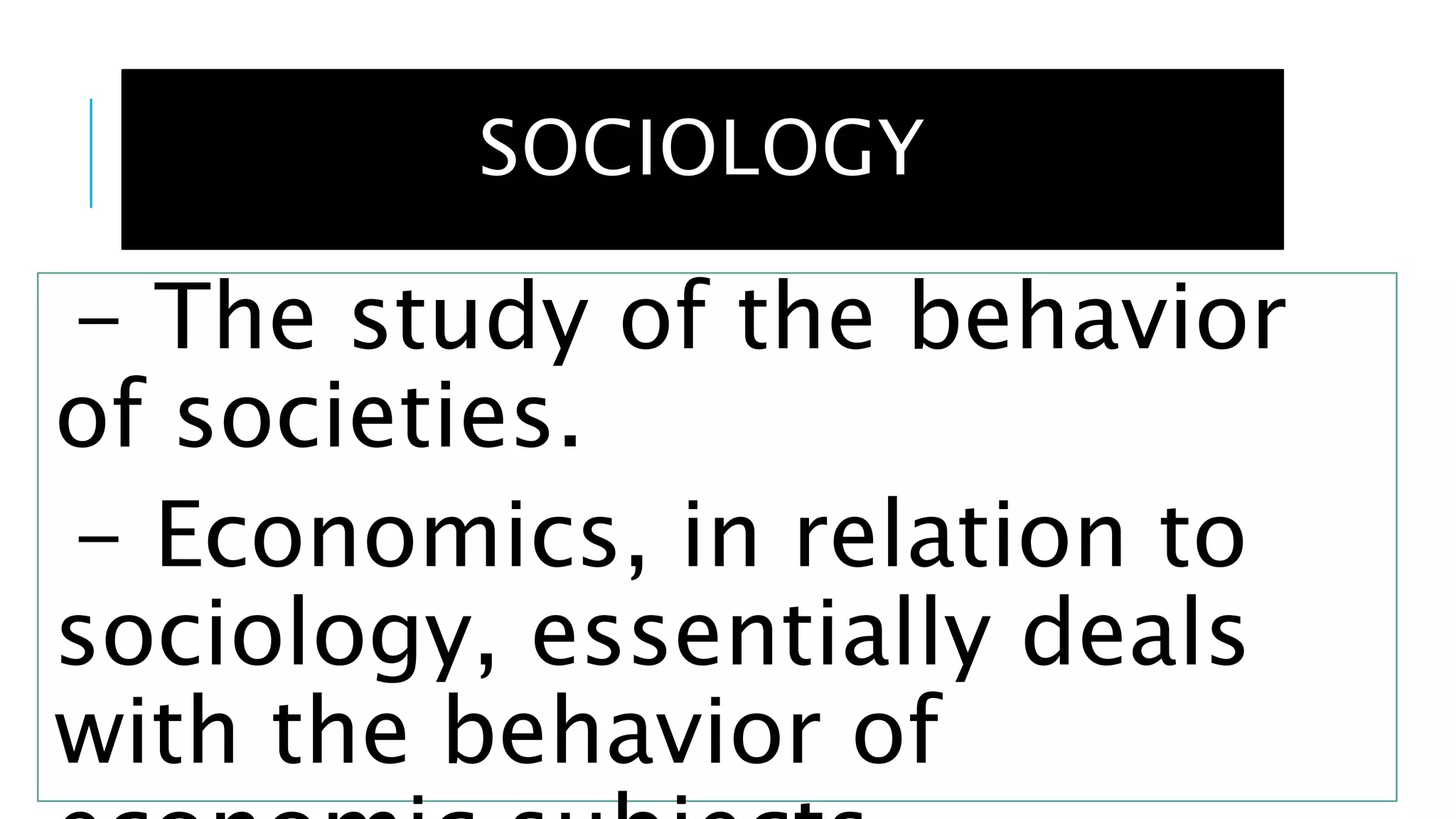
SOCIOLOGY
- The study of the behavior
of societies.
- Economics, in relation to
sociology, essentially deals
with the behavior of
PSYCHOLOGY
- Is the study of human
behavior.
- It is primarily useful in the
study of MICROECONOMICS
focuses in the smallest unit of
the economy.
END
SCARCITY: The Central Problem
of Economics
SCARCITY
- Is the basic and central
economic problem
confronting every person
and society.
SCARCITY
- It is at the heart of the
study of economics and
the reason why you are
studying it now.
SCARCITY
- Dictionary of Economics
defines scarcity as a
commodity or service being in
short supply, relative to its
demand.
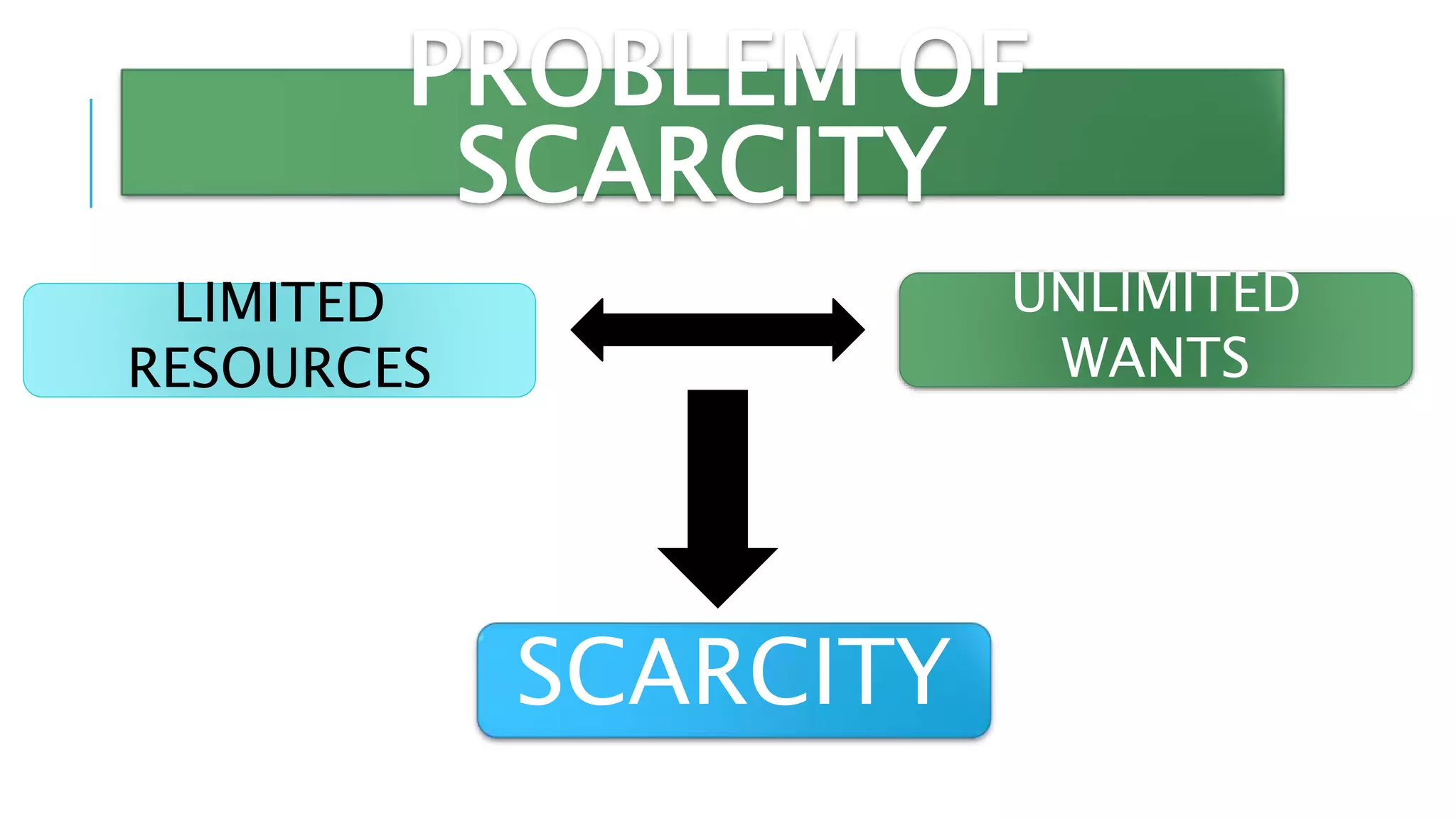
PROBLEM OF
SCARCITY
LIMITED
RESOURCES
UNLIMITED
WANTS
SCARCITY
NOTE!!!
- If the scarcity does not exist, there is no
need for us to economize.
- But since we know that our resources are
limited and we cannot produce all the goods
and services we want to have, then there is a
need for us to properly allocate resources so
that we can produce goods and services that
will maximize our satisfaction.
END
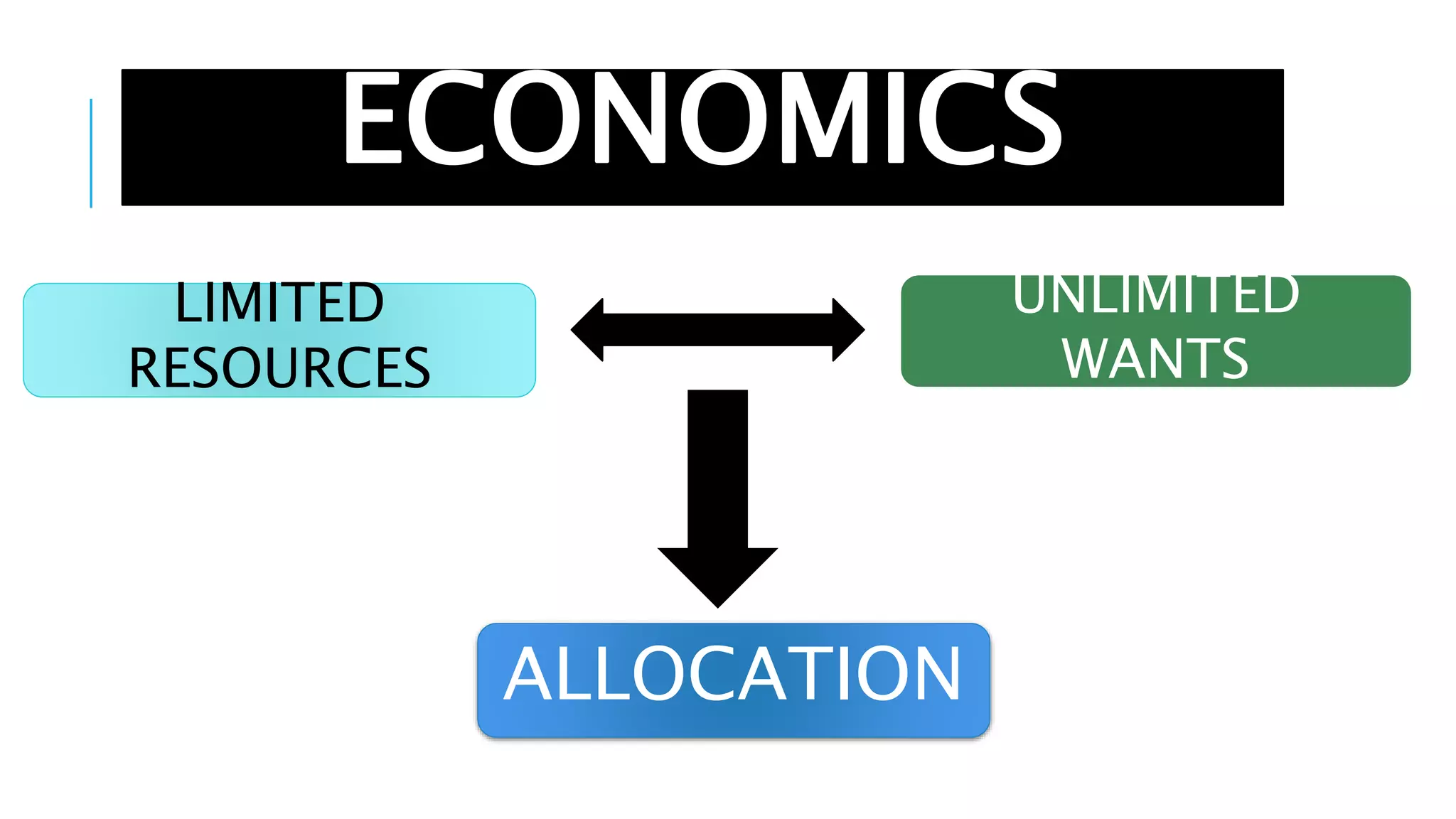
ECONOMICS
LIMITED
RESOURCES
UNLIMITED
WANTS
ALLOCATION
ECONOMICS
MICROECONOMICS
- is the branch of
economics that
deals with
individual decisions
of the units of the
economy
MACROECONOMICS
- Is the branch of
economics that studies
the relationship among
broad economic
aggregates like national
income, national
output, money supply,
bank deposits, total
volume of savings,
investments,
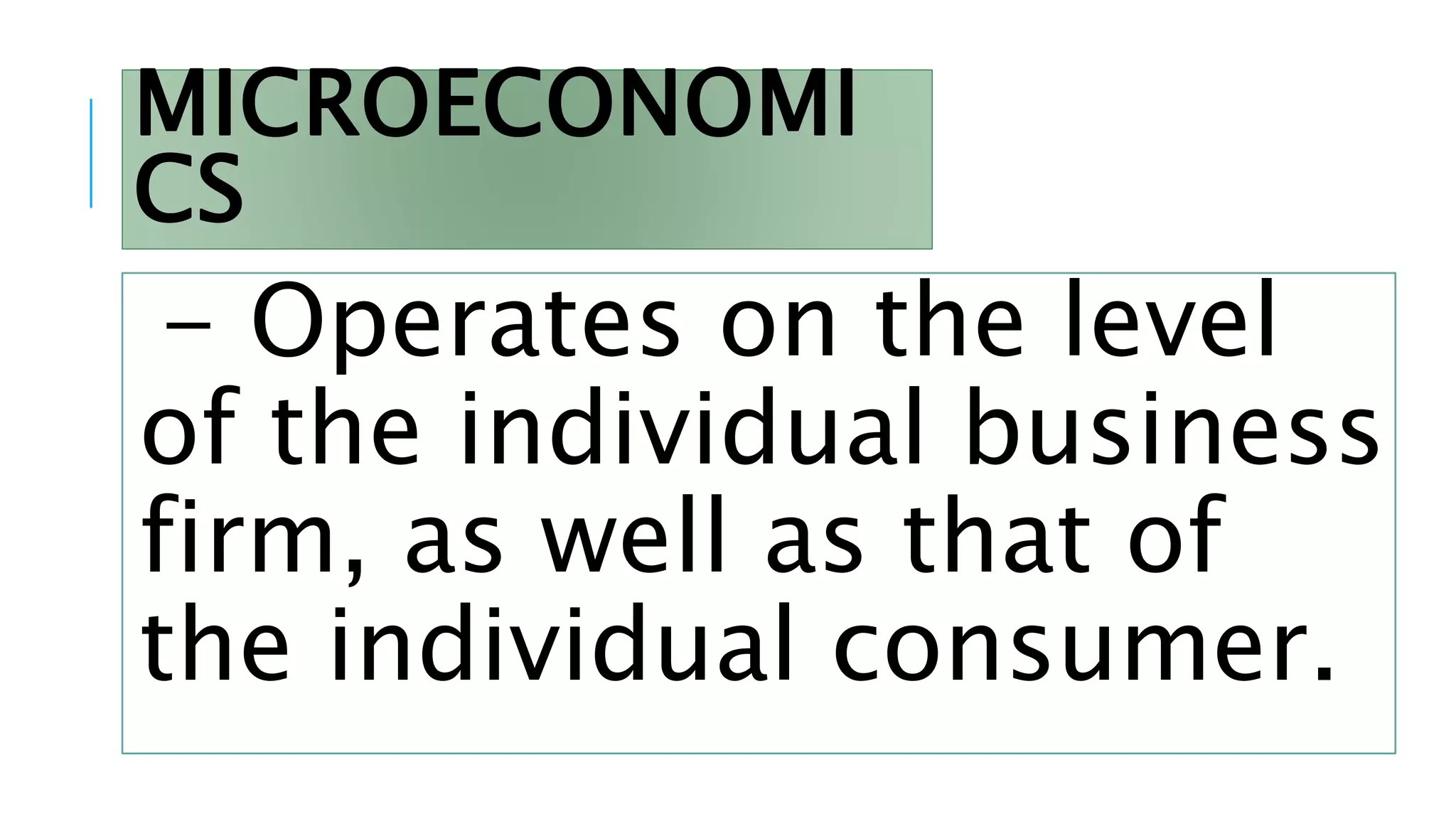
MICROECONOMI
CS
- Operates on the level
of the individual business
firm, as well as that of
the individual consumer.
MACROECONOMI
CS
- It is focuses on the four sectors of the economy.
- The behavior of the aggregate household
(consumption)
- The decision-making of the aggregate business
( investment)
- The policies and projects of the government
(government spending)
- The behavior of external/foreign economic
MACROECONOMI
CS
- discusses the measurement
of the Gross National Product
– NGP and Gross Domestic
Product – GDP
- the business cycle
THE FIVE (5) MACROECONOMIC
GOALS
General Price Level
Economic Growth and
Development
Money and Financial
Markets
Monetary and Fiscal
Policies
Employment
BASIC ECONOMIC
QUESTIONS
What to Produce?
How to Produce?
How Much to
Produce?
For Whom to
Produce?
FACTORS OF
PRODUCTION
Four Economic
resources serve
as input in the
production
process.
FACTORS OF PRODUCTION
LAND
CAPITAL ENTREPRENEURS
HIP
LABOR
THE CIRCULAR FLOW
MODEL

Applied-Economics-11 (1).pptx