Ecology and Environment
INTRODUCTION
INTRODUCTION
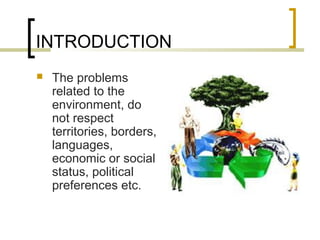
 The problems
related to the
environment, do
not respect
territories, borders,
languages,
economic or social
status, political
preferences etc.
Introduction
 Ecology, environment and sustainable
development, are designed to ensure the
present and future generations, a quality of
life that responds to the legitimate
aspirations of the population (employment,
housing, education, justice, power, freedom
and means suitable for development)
environment.
Ecology
 Ecology deals with the scientific study of the
interrelationships between organisms and
their environments, and therefore the
physical and biological factors that influence
these relations and are influenced by them.
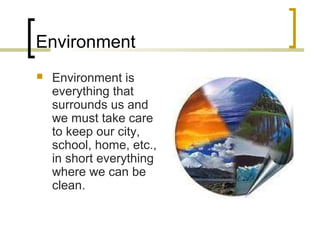
Environment
 Environment is
everything that
surrounds us and
we must take care
to keep our city,
school, home, etc.,
in short everything
where we can be
clean.
Sustainable development
 Concept created in 1987 by the report
"Our Common Future" and is defined
as development that meets the needs
of the present population without it
impossible to meet the needs of the
future population.
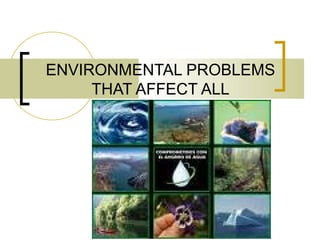
ENVIRONMENTAL PROBLEMS
THAT AFFECT ALL
The source of the problems
 In the recent past the misconception
that nature could automatically
cleaned had of everything the man to
(pollution of air, water and soil) and if
the trees were cut and animal species
were removed, they would return To
appear.
Man and Nature
 The man from appearing on the face of the
Earth, has always made use of nature to
meet their needs (eating, dressing and
protect different climates). In its aim of
achieving economic growth, however it has
damaged large tracts of land and has
generated multiple ecological imbalances.
Serious Environmental
Problems
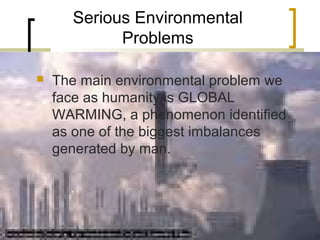
 The main environmental problem we
face as humanity is GLOBAL
WARMING, a phenomenon identified
as one of the biggest imbalances
generated by man.
Global warming effects
 Global warming causes an increase in
the temperature of the planet, which
has a direct impact on all ecosystems
in the world, causing the melting
icecaps, alter the habitat of many
aquatic species and generates serious
alterations to the climate.
As global warming causes
 Terrestrial and marine plants remove from
the atmosphere large amounts of carbon
dioxide. This is produced by several
sources: the respiration of living beings,
destruction and fermentation of organic
substances, burning oil, coal, wood or other
fuels containing carbon in its composition.
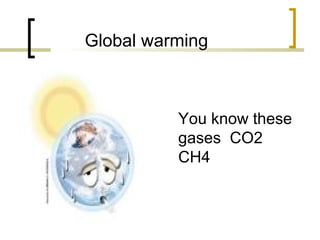
Global warming
You know these
gases CO2
CH4
The problem
 The proportion of CO2 in the air must
be constant, although in the last 15
years have shown that human activity
has increased the proportion (ppmv to
380 ppmv 270 = 40%). If the trend
continues it is estimated that by 2020
the amount of CO2 will have doubled.
That affect us?
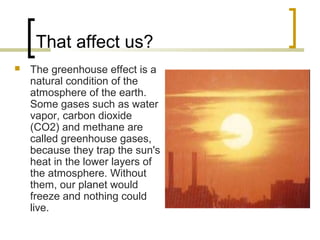
 The greenhouse effect is a
natural condition of the
atmosphere of the earth.
Some gases such as water
vapor, carbon dioxide
(CO2) and methane are
called greenhouse gases,
because they trap the sun's
heat in the lower layers of
the atmosphere. Without
them, our planet would
freeze and nothing could
live.
That affect us?
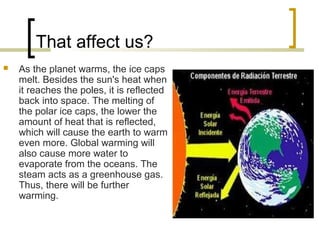
 As the planet warms, the ice caps
melt. Besides the sun's heat when
it reaches the poles, it is reflected
back into space. The melting of
the polar ice caps, the lower the
amount of heat that is reflected,
which will cause the earth to warm
even more. Global warming will
also cause more water to
evaporate from the oceans. The
steam acts as a greenhouse gas.
Thus, there will be further
warming.
Acid rain
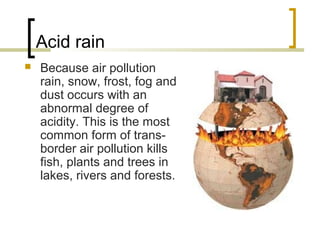
 Because air pollution
rain, snow, frost, fog and
dust occurs with an
abnormal degree of
acidity. This is the most
common form of trans-
border air pollution kills
fish, plants and trees in
lakes, rivers and forests.
Response to Environmental Problems
 Given all these
problems, the United
Nations Organization
has made several
international efforts.
HOW TO CONTRIBUTE IN OUR
SOCIETY ROLE
Activities we can make
 Use less our car and public
transportation, bicycle or just walking
our walk;
 Do not waste any energy, that is, turn off
the lights, radio and tv you're not using;
take shorter showers and not leave the
hot water running;
 Recycle glass, plastic and paper.
THANK YOU.

Ecology and environment

  • 1.
  • 2.
  • 3.
    INTRODUCTION  The problems relatedto the environment, do not respect territories, borders, languages, economic or social status, political preferences etc.
  • 4.
    Introduction  Ecology, environmentand sustainable development, are designed to ensure the present and future generations, a quality of life that responds to the legitimate aspirations of the population (employment, housing, education, justice, power, freedom and means suitable for development) environment.
  • 5.
    Ecology  Ecology dealswith the scientific study of the interrelationships between organisms and their environments, and therefore the physical and biological factors that influence these relations and are influenced by them.
  • 6.
    Environment  Environment is everythingthat surrounds us and we must take care to keep our city, school, home, etc., in short everything where we can be clean.
  • 7.
    Sustainable development  Conceptcreated in 1987 by the report "Our Common Future" and is defined as development that meets the needs of the present population without it impossible to meet the needs of the future population.
  • 8.
  • 9.
    The source ofthe problems  In the recent past the misconception that nature could automatically cleaned had of everything the man to (pollution of air, water and soil) and if the trees were cut and animal species were removed, they would return To appear.
  • 10.
    Man and Nature The man from appearing on the face of the Earth, has always made use of nature to meet their needs (eating, dressing and protect different climates). In its aim of achieving economic growth, however it has damaged large tracts of land and has generated multiple ecological imbalances.
  • 11.
    Serious Environmental Problems  Themain environmental problem we face as humanity is GLOBAL WARMING, a phenomenon identified as one of the biggest imbalances generated by man.
  • 12.
    Global warming effects Global warming causes an increase in the temperature of the planet, which has a direct impact on all ecosystems in the world, causing the melting icecaps, alter the habitat of many aquatic species and generates serious alterations to the climate.
  • 13.
    As global warmingcauses  Terrestrial and marine plants remove from the atmosphere large amounts of carbon dioxide. This is produced by several sources: the respiration of living beings, destruction and fermentation of organic substances, burning oil, coal, wood or other fuels containing carbon in its composition.
  • 14.
    Global warming You knowthese gases CO2 CH4
  • 15.
    The problem  Theproportion of CO2 in the air must be constant, although in the last 15 years have shown that human activity has increased the proportion (ppmv to 380 ppmv 270 = 40%). If the trend continues it is estimated that by 2020 the amount of CO2 will have doubled.
  • 16.
    That affect us? The greenhouse effect is a natural condition of the atmosphere of the earth. Some gases such as water vapor, carbon dioxide (CO2) and methane are called greenhouse gases, because they trap the sun's heat in the lower layers of the atmosphere. Without them, our planet would freeze and nothing could live.
  • 17.
    That affect us? As the planet warms, the ice caps melt. Besides the sun's heat when it reaches the poles, it is reflected back into space. The melting of the polar ice caps, the lower the amount of heat that is reflected, which will cause the earth to warm even more. Global warming will also cause more water to evaporate from the oceans. The steam acts as a greenhouse gas. Thus, there will be further warming.
  • 18.
    Acid rain  Becauseair pollution rain, snow, frost, fog and dust occurs with an abnormal degree of acidity. This is the most common form of trans- border air pollution kills fish, plants and trees in lakes, rivers and forests.
  • 20.
    Response to EnvironmentalProblems  Given all these problems, the United Nations Organization has made several international efforts.
  • 21.
    HOW TO CONTRIBUTEIN OUR SOCIETY ROLE
  • 22.
    Activities we canmake  Use less our car and public transportation, bicycle or just walking our walk;  Do not waste any energy, that is, turn off the lights, radio and tv you're not using; take shorter showers and not leave the hot water running;  Recycle glass, plastic and paper.
  • 23.