Bronfenbrenner’s
Ecological
Systems Theory
URIE BRONFENBRENNER
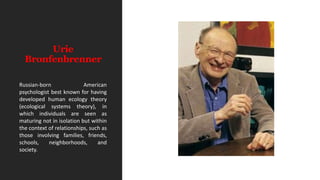
Urie
Bronfenbrenner
Russian-born American
psychologist best known for having
developed human ecology theory
(ecological systems theory), in
which individuals are seen as
maturing not in isolation but within
the context of relationships, such as
those involving families, friends,
schools, neighborhoods, and
society.
Bronfenbrenner’s Ecological Systems
Theory
This theory looks at a child’s development within the context of the system of relationships that
form his or her environment. Bronfenbrenner’s theory defines complex “layers” of environment,
each having an effect on a child’s development.
This theory has recently been renamed “bioecological systems theory” to emphasize that a
child’s own biology is a primary environment fueling her development. The interaction between
factors in the child’s maturing biology, his immediate family/community environment, and the
societal landscape fuels and steers his development.
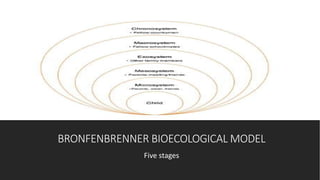
BRONFENBRENNER BIOECOLOGICAL MODEL
Five stages
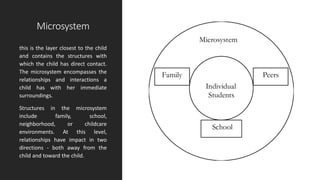
Microsystem
this is the layer closest to the child
and contains the structures with
which the child has direct contact.
The microsystem encompasses the
relationships and interactions a
child has with her immediate
surroundings.
Structures in the microsystem
include family, school,
neighborhood, or childcare
environments. At this level,
relationships have impact in two
directions - both away from the
child and toward the child.
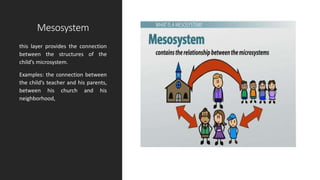
Mesosystem
this layer provides the connection
between the structures of the
child’s microsystem.
Examples: the connection between
the child’s teacher and his parents,
between his church and his
neighborhood,
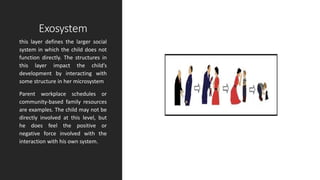
Exosystem
this layer defines the larger social
system in which the child does not
function directly. The structures in
this layer impact the child’s
development by interacting with
some structure in her microsystem
Parent workplace schedules or
community-based family resources
are examples. The child may not be
directly involved at this level, but
he does feel the positive or
negative force involved with the
interaction with his own system.
Macrosystem
For example:
Cultural patterns and Values
Dominant Beliefs and Ideas
Political and Economic Systems
this layer may be considered the
outermost layer in the child’s
environment. While not being a
specific framework, this layer is
comprised of cultural values,
customs, and laws
The effects of larger principles
defined by the macrosystem have a
cascading influence throughout the
interactions of all other layers.
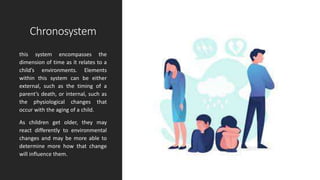
Chronosystem
this system encompasses the
dimension of time as it relates to a
child’s environments. Elements
within this system can be either
external, such as the timing of a
parent’s death, or internal, such as
the physiological changes that
occur with the aging of a child.
As children get older, they may
react differently to environmental
changes and may be more able to
determine more how that change
will influence them.
End!
THANKYOU!

Bronfenbrenner’s ecological systems theory

  • 1.
  • 2.
    Urie Bronfenbrenner Russian-born American psychologist bestknown for having developed human ecology theory (ecological systems theory), in which individuals are seen as maturing not in isolation but within the context of relationships, such as those involving families, friends, schools, neighborhoods, and society.
  • 3.
    Bronfenbrenner’s Ecological Systems Theory Thistheory looks at a child’s development within the context of the system of relationships that form his or her environment. Bronfenbrenner’s theory defines complex “layers” of environment, each having an effect on a child’s development. This theory has recently been renamed “bioecological systems theory” to emphasize that a child’s own biology is a primary environment fueling her development. The interaction between factors in the child’s maturing biology, his immediate family/community environment, and the societal landscape fuels and steers his development.
  • 4.
  • 5.
    Microsystem this is thelayer closest to the child and contains the structures with which the child has direct contact. The microsystem encompasses the relationships and interactions a child has with her immediate surroundings. Structures in the microsystem include family, school, neighborhood, or childcare environments. At this level, relationships have impact in two directions - both away from the child and toward the child.
  • 6.
    Mesosystem this layer providesthe connection between the structures of the child’s microsystem. Examples: the connection between the child’s teacher and his parents, between his church and his neighborhood,
  • 7.
    Exosystem this layer definesthe larger social system in which the child does not function directly. The structures in this layer impact the child’s development by interacting with some structure in her microsystem Parent workplace schedules or community-based family resources are examples. The child may not be directly involved at this level, but he does feel the positive or negative force involved with the interaction with his own system.
  • 8.
    Macrosystem For example: Cultural patternsand Values Dominant Beliefs and Ideas Political and Economic Systems this layer may be considered the outermost layer in the child’s environment. While not being a specific framework, this layer is comprised of cultural values, customs, and laws The effects of larger principles defined by the macrosystem have a cascading influence throughout the interactions of all other layers.
  • 9.
    Chronosystem this system encompassesthe dimension of time as it relates to a child’s environments. Elements within this system can be either external, such as the timing of a parent’s death, or internal, such as the physiological changes that occur with the aging of a child. As children get older, they may react differently to environmental changes and may be more able to determine more how that change will influence them.
  • 10.