
Autoethnography:
PROPOSING A NEW METHOD FOR IS RESEARCH
Niamh (‘Neve’) O Riordan,
National University of Ireland Galway, Ireland
niamh.oriordan@nuigalway.ie
www.niamhoriordan.com
ie.linkedin.com/in/niamhoriordan/
European Conference on Information Systems, TEL AVIV 2014
1
AGENDA
1. Motivation
2. About… ethnographies
3. Doing autoethnography
4. Writing autoethnography
5. Evaluating autoethnography
6. Summary and conclusions
2European Conference on Information Systems TEL AVIV 2014
1. Motivation
• The social and the technical are inextricably entangled in everyday, digitally mediated practice
– How do emerging technologies facilitate the production of revised and novel forms of “digital
being”?
– IS research must make sense of the relationship between technology and what it means to be
human…
• New research on the emergence of new forms of embodied (digital) identity is emerging
– IS researchers don’t have a a significant arsenal of methods to draw on
– IS papers are limited in terms of genre variety
– The challenge: to evoke the discursive, embodied, material and immersive aspects of digital
identity
• Autoethnographic methods can help:
– To research digitally mediated experiences in everyday, digitally mediated practice
– To provide new opportunities to communicate the findings of this research, and
– To facilitate the development of new theories of digital being
• This paper presents a practical introduction to autoethnography for IS researchers and proposes a set
of criteria that IS researchers can use to evaluate future autoethnographic research in IS
3European Conference on Information Systems TEL AVIV 2014
2. About…
ethnography
• Ethnography relies on first-hand observations made by a researcher
immersed over an extended period of time in a culture in which
s/he is unfamiliar (Atkinson and Hammersley, 1994).
• It is one of the most in-depth research methods available and is
well suited to obtaining a deep understanding of people and the
broader context within which they are embedded
• The particular strength of ethnographic methods for IS research is
that they provide rich insights into the human, social and
organisational aspects of IS phenomena
4European Conference on Information Systems TEL AVIV 2014
Factoid: Paré et al.(2008) found that
only 2.6% of the IS papers they
sampled use ethnography
2. About…
ethnography in IS
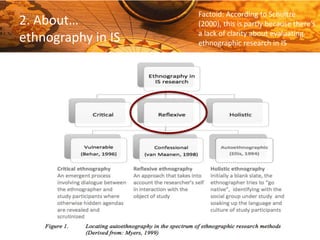
Factoid: According to Schultze
(2000), this is partly because there’s
a lack of clarity about evaluating
ethnographic research in IS
2. About…
autoethnography
• Autoethnography is “an autobiographical genre of writing and research that displays multiple
layers of consciousness, connecting the personal to the cultural”
• It is a form of reflexive ethnography, designed to take into account the researcher’s self in
interaction with the object of study (Davies, 2008).
• In autoethnography,
– The author’s gaze turns and bends back upon themselves
– The self becomes an ethnographic exemplar
– The self is viewed as “a multiple, constructed self that is always becoming and never quite
fixed”
• Ethnographic productions of such a self and the ‘cultural other’ are seen to be historically
and culturally contingent
• It is used to describe and systematically analyse (graphy) personal experience (auto) in order to
understand cultural experience (ethno)
• Not without its difficulties: “it is difficult to write about the self and to be an escape artist from
the self at the same time”… but is useful because it challenges accepted views about (silent)
authorship 6European Conference on Information Systems TEL AVIV 2014
“The self both is and is not a fiction; is unified
and transcendent and fragmented and always in
process of being constituted, can be spoken of
in realist ways and cannot; its voice can be
claimed as authentic and there is no guarantee
of authenticity” (Gannon, 2006).
3. Doing
autoethnography
• Approach: participant observation and field texts
• Analysis:
– An informed analysis of personal experience is used to illustrate facets of
cultural experience
– Reflections on the author’s own behaviours and thoughts used to reveal
phenomena that might otherwise remain concealed
• “introspective self-observation”
• “interactive introspection”
• IS specific issues:
– No texts available on online autoethnography: being, there, with…
– How to distinguish observation, participant observation and self observation?
• Self observation of an avatar?
– Ethical issues to do with information disclosure
– Methodological issues to do with multimedia
7European Conference on Information Systems TEL AVIV 2014
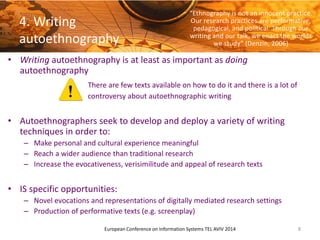
• Writing autoethnography is at least as important as doing
autoethnography
There are few texts available on how to do it and there is a lot of
controversy about autoethnographic writing
• Autoethnographers seek to develop and deploy a variety of writing
techniques in order to:
– Make personal and cultural experience meaningful
– Reach a wider audience than traditional research
– Increase the evocativeness, verisimilitude and appeal of research texts
• IS specific opportunities:
– Novel evocations and representations of digitally mediated research settings
– Production of performative texts (e.g. screenplay)
4. Writing
autoethnography
8European Conference on Information Systems TEL AVIV 2014
“Ethnography is not an innocent practice.
Our research practices are performative,
pedagogical, and political. Through our
writing and our talk, we enact the worlds
we study” (Denzin, 2006)
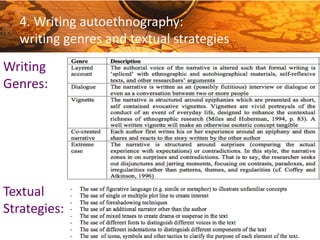
Writing
Genres:
Textual
Strategies:
European Conference on Information
Systems TEL AVIV 2014
4. Writing autoethnography:
writing genres and textual strategies
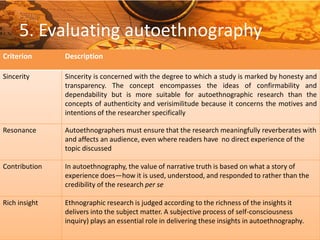
5. Evaluating autoethnography
10European Conference on Information Systems TEL AVIV 2014
Criterion Description
Sincerity Sincerity is concerned with the degree to which a study is marked by honesty and
transparency. The concept encompasses the ideas of confirmability and
dependability but is more suitable for autoethnographic research than the
concepts of authenticity and verisimilitude because it concerns the motives and
intentions of the researcher specifically
Resonance Autoethnographers must ensure that the research meaningfully reverberates with
and affects an audience, even where readers have no direct experience of the
topic discussed
Contribution In autoethnography, the value of narrative truth is based on what a story of
experience does—how it is used, understood, and responded to rather than the
credibility of the research per se
Rich insight Ethnographic research is judged according to the richness of the insights it
delivers into the subject matter. A subjective process of self-consciousness
inquiry) plays an essential role in delivering these insights in autoethnography.
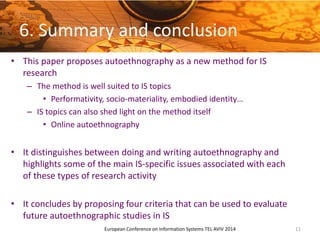
6. Summary and conclusion
• This paper proposes autoethnography as a new method for IS
research
– The method is well suited to IS topics
• Performativity, socio-materiality, embodied identity…
– IS topics can also shed light on the method itself
• Online autoethnography
• It distinguishes between doing and writing autoethnography and
highlights some of the main IS-specific issues associated with each
of these types of research activity
• It concludes by proposing four criteria that can be used to evaluate
future autoethnographic studies in IS
11European Conference on Information Systems TEL AVIV 2014
12
Full paper available at http://aisel.aisnet.org/ecis2014/proceedings/track03/6/ or from
Niamh O Riordan, National University of Ireland Galway, Ireland
niamh.oriordan@nuigalway.ie
www.niamhoriordan.com
ie.linkedin.com/in/niamhoriordan/
Thank You
European Conference on Information Systems TEL AVIV 2014

Autoethnography: proposing a new method for Information Systems research

  • 1.
    Autoethnography: PROPOSING A NEWMETHOD FOR IS RESEARCH Niamh (‘Neve’) O Riordan, National University of Ireland Galway, Ireland niamh.oriordan@nuigalway.ie www.niamhoriordan.com ie.linkedin.com/in/niamhoriordan/ European Conference on Information Systems, TEL AVIV 2014 1
  • 2.
    AGENDA 1. Motivation 2. About…ethnographies 3. Doing autoethnography 4. Writing autoethnography 5. Evaluating autoethnography 6. Summary and conclusions 2European Conference on Information Systems TEL AVIV 2014
  • 3.
    1. Motivation • Thesocial and the technical are inextricably entangled in everyday, digitally mediated practice – How do emerging technologies facilitate the production of revised and novel forms of “digital being”? – IS research must make sense of the relationship between technology and what it means to be human… • New research on the emergence of new forms of embodied (digital) identity is emerging – IS researchers don’t have a a significant arsenal of methods to draw on – IS papers are limited in terms of genre variety – The challenge: to evoke the discursive, embodied, material and immersive aspects of digital identity • Autoethnographic methods can help: – To research digitally mediated experiences in everyday, digitally mediated practice – To provide new opportunities to communicate the findings of this research, and – To facilitate the development of new theories of digital being • This paper presents a practical introduction to autoethnography for IS researchers and proposes a set of criteria that IS researchers can use to evaluate future autoethnographic research in IS 3European Conference on Information Systems TEL AVIV 2014
  • 4.
    2. About… ethnography • Ethnographyrelies on first-hand observations made by a researcher immersed over an extended period of time in a culture in which s/he is unfamiliar (Atkinson and Hammersley, 1994). • It is one of the most in-depth research methods available and is well suited to obtaining a deep understanding of people and the broader context within which they are embedded • The particular strength of ethnographic methods for IS research is that they provide rich insights into the human, social and organisational aspects of IS phenomena 4European Conference on Information Systems TEL AVIV 2014 Factoid: Paré et al.(2008) found that only 2.6% of the IS papers they sampled use ethnography
  • 5.
    2. About… ethnography inIS Factoid: According to Schultze (2000), this is partly because there’s a lack of clarity about evaluating ethnographic research in IS
  • 6.
    2. About… autoethnography • Autoethnographyis “an autobiographical genre of writing and research that displays multiple layers of consciousness, connecting the personal to the cultural” • It is a form of reflexive ethnography, designed to take into account the researcher’s self in interaction with the object of study (Davies, 2008). • In autoethnography, – The author’s gaze turns and bends back upon themselves – The self becomes an ethnographic exemplar – The self is viewed as “a multiple, constructed self that is always becoming and never quite fixed” • Ethnographic productions of such a self and the ‘cultural other’ are seen to be historically and culturally contingent • It is used to describe and systematically analyse (graphy) personal experience (auto) in order to understand cultural experience (ethno) • Not without its difficulties: “it is difficult to write about the self and to be an escape artist from the self at the same time”… but is useful because it challenges accepted views about (silent) authorship 6European Conference on Information Systems TEL AVIV 2014 “The self both is and is not a fiction; is unified and transcendent and fragmented and always in process of being constituted, can be spoken of in realist ways and cannot; its voice can be claimed as authentic and there is no guarantee of authenticity” (Gannon, 2006).
  • 7.
    3. Doing autoethnography • Approach:participant observation and field texts • Analysis: – An informed analysis of personal experience is used to illustrate facets of cultural experience – Reflections on the author’s own behaviours and thoughts used to reveal phenomena that might otherwise remain concealed • “introspective self-observation” • “interactive introspection” • IS specific issues: – No texts available on online autoethnography: being, there, with… – How to distinguish observation, participant observation and self observation? • Self observation of an avatar? – Ethical issues to do with information disclosure – Methodological issues to do with multimedia 7European Conference on Information Systems TEL AVIV 2014
  • 8.
    • Writing autoethnographyis at least as important as doing autoethnography There are few texts available on how to do it and there is a lot of controversy about autoethnographic writing • Autoethnographers seek to develop and deploy a variety of writing techniques in order to: – Make personal and cultural experience meaningful – Reach a wider audience than traditional research – Increase the evocativeness, verisimilitude and appeal of research texts • IS specific opportunities: – Novel evocations and representations of digitally mediated research settings – Production of performative texts (e.g. screenplay) 4. Writing autoethnography 8European Conference on Information Systems TEL AVIV 2014 “Ethnography is not an innocent practice. Our research practices are performative, pedagogical, and political. Through our writing and our talk, we enact the worlds we study” (Denzin, 2006)
  • 9.
    Writing Genres: Textual Strategies: European Conference onInformation Systems TEL AVIV 2014 4. Writing autoethnography: writing genres and textual strategies
  • 10.
    5. Evaluating autoethnography 10EuropeanConference on Information Systems TEL AVIV 2014 Criterion Description Sincerity Sincerity is concerned with the degree to which a study is marked by honesty and transparency. The concept encompasses the ideas of confirmability and dependability but is more suitable for autoethnographic research than the concepts of authenticity and verisimilitude because it concerns the motives and intentions of the researcher specifically Resonance Autoethnographers must ensure that the research meaningfully reverberates with and affects an audience, even where readers have no direct experience of the topic discussed Contribution In autoethnography, the value of narrative truth is based on what a story of experience does—how it is used, understood, and responded to rather than the credibility of the research per se Rich insight Ethnographic research is judged according to the richness of the insights it delivers into the subject matter. A subjective process of self-consciousness inquiry) plays an essential role in delivering these insights in autoethnography.
  • 11.
    6. Summary andconclusion • This paper proposes autoethnography as a new method for IS research – The method is well suited to IS topics • Performativity, socio-materiality, embodied identity… – IS topics can also shed light on the method itself • Online autoethnography • It distinguishes between doing and writing autoethnography and highlights some of the main IS-specific issues associated with each of these types of research activity • It concludes by proposing four criteria that can be used to evaluate future autoethnographic studies in IS 11European Conference on Information Systems TEL AVIV 2014
  • 12.
    12 Full paper availableat http://aisel.aisnet.org/ecis2014/proceedings/track03/6/ or from Niamh O Riordan, National University of Ireland Galway, Ireland niamh.oriordan@nuigalway.ie www.niamhoriordan.com ie.linkedin.com/in/niamhoriordan/ Thank You European Conference on Information Systems TEL AVIV 2014

Editor's Notes

  • #2 Cover image: http://martianchronicles.files.wordpress.com/2010/05/explore.jpg
  • #4 This is true for individuals – in the extreme we have avatars – but it is also true for organisations. Yesterday we had a paper on Yahoo’s decision to ban telework and one of the questions posed was: how is organisational culture and identity constructed in an era of telework
  • #9 Autoethnographers are described as self-absorbed narcissists who fail to fulfil scholarly obligations of hypothesizing, analysing, and theorizing (Sparkes, 2000). Similarly, autoethnographic texts are described as self-indulgent, introspective, and individualized stories (ibid.), that fictionalise life and romanticise the self (Atkinson 1997), and have greater therapeutic than analytic merit (Gannon, 2006).
  • #10 Exemplars in the paper