ISSN
• Serials Defined
• Serials are print or non-print publications issued in parts, usually bearing issue numbers
and/or dates. A serial is expected to continue indefinitely.
• Serials include magazines, newspapers, annuals (such as reports, yearbooks, and
directories), journals, memoirs, proceedings, transactions of societies, and monographic
series.
• International Standard Serial Numbering
• The various and constant changes to which serials are subject, combined with the large
growth in the world's publishing output, prompted the development of a standard (ISO
3297-1975; ANSI Z39.9-1979) for the identification of serials: the International Standard
Serial Number (ISSN).
• A single ISSN uniquely identifies a title regardless of language or country in which
published, without the burden of a complex bibliographic description. The ISSN itself has
no significance other than the unique identification of a serial.
• An ISSN is eight digits long. Always displayed this way: ISSN 1234-5679, the first seven
digits serve as the title number and the eighth is a check digit which provides an efficient
means for discovering transcription errors.
• The system used for calculating the check digit sometimes requires a check number of 10,
in which case, to prevent a nine-digit ISSN, the roman numeral "X" is substituted.
• For each serial with an ISSN there is a corresponding "key title"--a commonly acceptable
form of the title established at the time of ISSN assignment.
• The title provides a benchmark which serves to regulate the assignment of ISSN: if the
title of a serial changes, a new ISSN must be assigned.
Administration of ISSN
• The coordination of the ISSN is international,
with registration initiated at the national level
where serials are published.
• The ISSN International Centre located in Paris
coordinates the network.
Advantages of Use
• ISSN provides a useful and economical method of communication between
publishers and suppliers, making trade distribution systems faster and more
efficient.
• The ISSN results in accurate citing of serials by scholars, researchers, abstracters,
and librarians.
• As a standard numeric identification code, the ISSN is eminently suitable for
computer use in fulfilling the need for file update and linkage, retrieval, and
transmittal of data.
• ISSN is used in libraries for identifying titles, ordering and checking in, and claiming
serials.
• ISSN simplifies interlibrary loan systems and union catalog reporting and listing.
• The ISSN is an integral component of the journal article citation used to monitor
payments to the Copyright Clearance Center Inc.
• All ISSN registrations are maintained in an international data base and are made
available in the ISSN Register online.
What is a DOI and how to use them in
citations?
• A DOI, or Digital Object Identifier, is a string of
numbers, letters and symbols used to uniquely
identify an article or document, and to provide it
with a permanent web address (URL).
• A DOI will help your reader easily locate a
document from your citation.
• Think of it like a Social Security number for the
article you're citing —
– It will always refer to that article, and only that one.
While a web address (URL) might change, the DOI will
never change.
Where can I find a DOI?
In most scholarly journal articles,
The DOI will be printed with the article itself,
usually on the first page somewhere: below the
title or in the header or footer.
If the DOI isn't included in the article, look it
up on the website CrossRef.org (use the "Search
Metadata" option) to check for an assigned DOI.
How can I use a DOI to find the article
it refers to?
• If your DOI starts with http:// or https://, simply paste it into
your web browser. This will usually lead you to a journal
publisher's page for the article.
• You can turn any DOI starting with 10 into a URL by
adding http://doi.org/ before the DOI.
• For
example, 10.3352/jeehp.2013.10.3 becomes https://doi.org/10.
3352/jeehp.2013.10.3
• If you're off campus when you do this, you'll need to use this
URL prefix in front of the DOI to gain access to UIC's full text
journalsubscriptions: https://proxy.cc.uic.edu/login?url=https://
doi.org/ .
• Forexample: https://proxy.cc.uic.edu/login?url=http://doi.org/1
0.3352/jeehp.2013.10.3
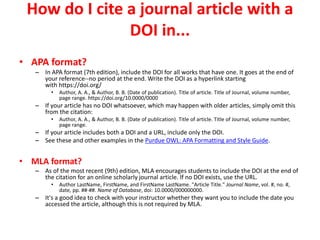
How do I cite a journal article with a
DOI in...
• APA format?
– In APA format (7th edition), include the DOI for all works that have one. It goes at the end of
your reference--no period at the end. Write the DOI as a hyperlink starting
with https://doi.org/
• Author, A. A., & Author, B. B. (Date of publication). Title of article. Title of Journal, volume number,
page range. https://doi.org/10.0000/0000
– If your article has no DOI whatsoever, which may happen with older articles, simply omit this
from the citation:
• Author, A. A., & Author, B. B. (Date of publication). Title of article. Title of Journal, volume number,
page range.
– If your article includes both a DOI and a URL, include only the DOI.
– See these and other examples in the Purdue OWL: APA Formatting and Style Guide.
• MLA format?
– As of the most recent (9th) edition, MLA encourages students to include the DOI at the end of
the citation for an online scholarly journal article. If no DOI exists, use the URL.
• Author LastName, FirstName, and FirstName LastName. "Article Title." Journal Name, vol. #, no. #,
date, pp. ##-##. Name of Database, doi: 10.0000/000000000.
– It's a good idea to check with your instructor whether they want you to include the date you
accessed the article, although this is not required by MLA.
Journal Impact Factor: Its Use,
Significance and Limitations
• The impact factor (IF) is frequently used as an indicator of the
importance of a journal to its field.
• It was first introduced by Eugene Garfield, the founder of the Institute
for Scientific Information.
• Although IF is widely used by institutions and clinicians, people have
widespread misconception regarding the method for calculating the
journal IF, its significance and how it can be utilized.
• The IF of a journal is not associated to the factors like quality of peer
review process and quality of content of the journal, but is a measure
that reflects the average number of citations to articles published in -
– journals, books, thesis, project reports, newspapers,
conference/seminar proceedings, documents published in internet,
notes, and any other approved documents (by Indian Council of
Medical Research or similar body).
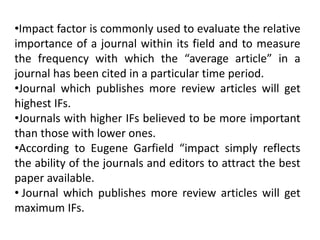
•Impact factor is commonly used to evaluate the relative
importance of a journal within its field and to measure
the frequency with which the “average article” in a
journal has been cited in a particular time period.
•Journal which publishes more review articles will get
highest IFs.
•Journals with higher IFs believed to be more important
than those with lower ones.
•According to Eugene Garfield “impact simply reflects
the ability of the journals and editors to attract the best
paper available.
• Journal which publishes more review articles will get
maximum IFs.
• Impact factor can be calculated after completing the minimum of 3 years
of publication; for that reason journal IF cannot be calculated for new
journals.
• The journal with the highest IF is the one that published the most
commonly cited articles over a 2-year period.
• In a given year, the IF of a journal is the average number of citations
received per article published in that journal during the 2 preceding years.
• IFs are calculated each year by Thomson scientific for those journals that it
indexes, and are published in Journal Citation Reports -
(http://www.thomsonreuters.com/products_services/science/science_
products/a-z/journal_citation_reports/).
• For example, if a journal has an IF of 3 in 2008, then its papers published in 2006
and 2007 received three citations each on average in 2008.
• The 2008 IFs are actually published in 2009.
• The IF for the biomedical journals may range up to 5-8%.
• The IF of any journal may be calculated by the formula;
2012 impact factor =A/B
Where A is the number of times articles published in 2010 and 2011 were
cited by indexed journals during 2012.
B is the total number of citable items like articles and reviews published by
that journal in 2010 and 2011.
What is Citation?
• A “citation” is the way you tell your readers that
certain material in your work came from another
source. It also gives your readers the information
necessary to find the location details of that
source on the reference or Works Cited page.
• A citation must include a set of parentheses.
Without a set of parenthesis, one does not have a
proper in-text citation and can risk being charged
with plagiarism.
• Here is what an in-text citation looks like below in
red font:
– Due to needed upgrades to the Indianapolis Zoo
exhibits, their only polar bear will relocate to Detroit.
(Ryckahert & Lange, 2016).
Why should you cite sources?
• To give credit to the source authors
• To help your audience/reader find out more
about your research/arguments/ideas/topic
• To strengthen your work be providing outside
support to your ideas
• To keep you from failing a paper, a course or
being sued in the real world
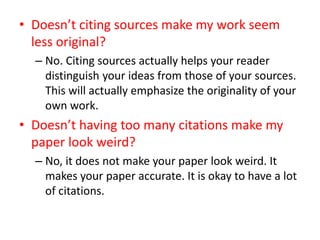
• Doesn’t citing sources make my work seem
less original?
– No. Citing sources actually helps your reader
distinguish your ideas from those of your sources.
This will actually emphasize the originality of your
own work.
• Doesn’t having too many citations make my
paper look weird?
– No, it does not make your paper look weird. It
makes your paper accurate. It is okay to have a lot
of citations.
When do I need to cite?
• When you use words, thoughts, ideas, etc. of someone else
• When you direct quote
• When you paraphrase
• When you use or reference an idea or thought that has already
been expressed
• When you make any reference to another source
• When another’s ideas, words or thoughts have influenced your
writing and research
When in doubt, cite! It is better to cite too much than not enough
or not at all. The only thing you do not need to cite is your
opinion; however, be sure that it is, indeed, truly your opinion.

ISSN, DOI ,IMPACT FACTOR ,CITATIONS.pptx

  • 1.
    ISSN • Serials Defined •Serials are print or non-print publications issued in parts, usually bearing issue numbers and/or dates. A serial is expected to continue indefinitely. • Serials include magazines, newspapers, annuals (such as reports, yearbooks, and directories), journals, memoirs, proceedings, transactions of societies, and monographic series. • International Standard Serial Numbering • The various and constant changes to which serials are subject, combined with the large growth in the world's publishing output, prompted the development of a standard (ISO 3297-1975; ANSI Z39.9-1979) for the identification of serials: the International Standard Serial Number (ISSN). • A single ISSN uniquely identifies a title regardless of language or country in which published, without the burden of a complex bibliographic description. The ISSN itself has no significance other than the unique identification of a serial. • An ISSN is eight digits long. Always displayed this way: ISSN 1234-5679, the first seven digits serve as the title number and the eighth is a check digit which provides an efficient means for discovering transcription errors. • The system used for calculating the check digit sometimes requires a check number of 10, in which case, to prevent a nine-digit ISSN, the roman numeral "X" is substituted. • For each serial with an ISSN there is a corresponding "key title"--a commonly acceptable form of the title established at the time of ISSN assignment. • The title provides a benchmark which serves to regulate the assignment of ISSN: if the title of a serial changes, a new ISSN must be assigned.
  • 2.
    Administration of ISSN •The coordination of the ISSN is international, with registration initiated at the national level where serials are published. • The ISSN International Centre located in Paris coordinates the network.
  • 3.
    Advantages of Use •ISSN provides a useful and economical method of communication between publishers and suppliers, making trade distribution systems faster and more efficient. • The ISSN results in accurate citing of serials by scholars, researchers, abstracters, and librarians. • As a standard numeric identification code, the ISSN is eminently suitable for computer use in fulfilling the need for file update and linkage, retrieval, and transmittal of data. • ISSN is used in libraries for identifying titles, ordering and checking in, and claiming serials. • ISSN simplifies interlibrary loan systems and union catalog reporting and listing. • The ISSN is an integral component of the journal article citation used to monitor payments to the Copyright Clearance Center Inc. • All ISSN registrations are maintained in an international data base and are made available in the ISSN Register online.
  • 4.
    What is aDOI and how to use them in citations? • A DOI, or Digital Object Identifier, is a string of numbers, letters and symbols used to uniquely identify an article or document, and to provide it with a permanent web address (URL). • A DOI will help your reader easily locate a document from your citation. • Think of it like a Social Security number for the article you're citing — – It will always refer to that article, and only that one. While a web address (URL) might change, the DOI will never change.
  • 5.
    Where can Ifind a DOI? In most scholarly journal articles, The DOI will be printed with the article itself, usually on the first page somewhere: below the title or in the header or footer. If the DOI isn't included in the article, look it up on the website CrossRef.org (use the "Search Metadata" option) to check for an assigned DOI.
  • 6.
    How can Iuse a DOI to find the article it refers to? • If your DOI starts with http:// or https://, simply paste it into your web browser. This will usually lead you to a journal publisher's page for the article. • You can turn any DOI starting with 10 into a URL by adding http://doi.org/ before the DOI. • For example, 10.3352/jeehp.2013.10.3 becomes https://doi.org/10. 3352/jeehp.2013.10.3 • If you're off campus when you do this, you'll need to use this URL prefix in front of the DOI to gain access to UIC's full text journalsubscriptions: https://proxy.cc.uic.edu/login?url=https:// doi.org/ . • Forexample: https://proxy.cc.uic.edu/login?url=http://doi.org/1 0.3352/jeehp.2013.10.3
  • 7.
    How do Icite a journal article with a DOI in... • APA format? – In APA format (7th edition), include the DOI for all works that have one. It goes at the end of your reference--no period at the end. Write the DOI as a hyperlink starting with https://doi.org/ • Author, A. A., & Author, B. B. (Date of publication). Title of article. Title of Journal, volume number, page range. https://doi.org/10.0000/0000 – If your article has no DOI whatsoever, which may happen with older articles, simply omit this from the citation: • Author, A. A., & Author, B. B. (Date of publication). Title of article. Title of Journal, volume number, page range. – If your article includes both a DOI and a URL, include only the DOI. – See these and other examples in the Purdue OWL: APA Formatting and Style Guide. • MLA format? – As of the most recent (9th) edition, MLA encourages students to include the DOI at the end of the citation for an online scholarly journal article. If no DOI exists, use the URL. • Author LastName, FirstName, and FirstName LastName. "Article Title." Journal Name, vol. #, no. #, date, pp. ##-##. Name of Database, doi: 10.0000/000000000. – It's a good idea to check with your instructor whether they want you to include the date you accessed the article, although this is not required by MLA.
  • 8.
    Journal Impact Factor:Its Use, Significance and Limitations • The impact factor (IF) is frequently used as an indicator of the importance of a journal to its field. • It was first introduced by Eugene Garfield, the founder of the Institute for Scientific Information. • Although IF is widely used by institutions and clinicians, people have widespread misconception regarding the method for calculating the journal IF, its significance and how it can be utilized. • The IF of a journal is not associated to the factors like quality of peer review process and quality of content of the journal, but is a measure that reflects the average number of citations to articles published in - – journals, books, thesis, project reports, newspapers, conference/seminar proceedings, documents published in internet, notes, and any other approved documents (by Indian Council of Medical Research or similar body).
  • 9.
    •Impact factor iscommonly used to evaluate the relative importance of a journal within its field and to measure the frequency with which the “average article” in a journal has been cited in a particular time period. •Journal which publishes more review articles will get highest IFs. •Journals with higher IFs believed to be more important than those with lower ones. •According to Eugene Garfield “impact simply reflects the ability of the journals and editors to attract the best paper available. • Journal which publishes more review articles will get maximum IFs.
  • 10.
    • Impact factorcan be calculated after completing the minimum of 3 years of publication; for that reason journal IF cannot be calculated for new journals. • The journal with the highest IF is the one that published the most commonly cited articles over a 2-year period. • In a given year, the IF of a journal is the average number of citations received per article published in that journal during the 2 preceding years. • IFs are calculated each year by Thomson scientific for those journals that it indexes, and are published in Journal Citation Reports - (http://www.thomsonreuters.com/products_services/science/science_ products/a-z/journal_citation_reports/). • For example, if a journal has an IF of 3 in 2008, then its papers published in 2006 and 2007 received three citations each on average in 2008. • The 2008 IFs are actually published in 2009. • The IF for the biomedical journals may range up to 5-8%. • The IF of any journal may be calculated by the formula; 2012 impact factor =A/B Where A is the number of times articles published in 2010 and 2011 were cited by indexed journals during 2012. B is the total number of citable items like articles and reviews published by that journal in 2010 and 2011.
  • 11.
    What is Citation? •A “citation” is the way you tell your readers that certain material in your work came from another source. It also gives your readers the information necessary to find the location details of that source on the reference or Works Cited page. • A citation must include a set of parentheses. Without a set of parenthesis, one does not have a proper in-text citation and can risk being charged with plagiarism. • Here is what an in-text citation looks like below in red font: – Due to needed upgrades to the Indianapolis Zoo exhibits, their only polar bear will relocate to Detroit. (Ryckahert & Lange, 2016).
  • 12.
    Why should youcite sources? • To give credit to the source authors • To help your audience/reader find out more about your research/arguments/ideas/topic • To strengthen your work be providing outside support to your ideas • To keep you from failing a paper, a course or being sued in the real world
  • 13.
    • Doesn’t citingsources make my work seem less original? – No. Citing sources actually helps your reader distinguish your ideas from those of your sources. This will actually emphasize the originality of your own work. • Doesn’t having too many citations make my paper look weird? – No, it does not make your paper look weird. It makes your paper accurate. It is okay to have a lot of citations.
  • 14.
    When do Ineed to cite? • When you use words, thoughts, ideas, etc. of someone else • When you direct quote • When you paraphrase • When you use or reference an idea or thought that has already been expressed • When you make any reference to another source • When another’s ideas, words or thoughts have influenced your writing and research When in doubt, cite! It is better to cite too much than not enough or not at all. The only thing you do not need to cite is your opinion; however, be sure that it is, indeed, truly your opinion.