
Business model innovation: a 
temporal perspectives 
Niamh O Riordan University College Dublin, Ireland 
Philip O’Reilly University College Cork, Ireland 
Aidan Duane Waterford Institute of Technology, Ireland 
Pavel Andreev University of Ottawa, Canada
Agenda 
1. Motivation 
2. Definitions 
3. Research gap 
4. The business model innovation process 
5. Discussion and future directions
1. Motivation 
• The same idea or technology taken to market through two 
different business models can actually yield two different 
economic outcomes depending on the business model being 
used (Chesbrough, 2010) 
• A well-formulated and innovative business model can be used 
to help your company gain competitive advantages that result 
in higher profits than competitors (Afuah and Tucci, 2001) 
• Legendary firms that shape their industry structures are in fact 
business-model innovators (Gambardella and McGahan, 2010) 
• More and more companies are re-evaluating their business 
models on an on-going basis, taking a transformational 
approach bringing about innovation within the organization 
itself (Demil and Lecocq, 2010).
2. Definitions 
• There is a lot of ambiguity about the concept of a business model: 
– an approach to generating revenue at a reasonable cost that is based on 
assumptions about what customers want and how they want it, and on 
how the enterprise can best meet those needs, and get paid for doing so” 
(Teece, 2010) 
– “a conceptual tool that contains a set of elements and their relationships 
and allows expressing the business logic of a specific firm. It is a 
description of the value a company offers to one or several segments of 
customers and of the architecture of the firm and its network of partners 
for creating, marketing, and delivering this value and relationship capital, to 
generate profitable and sustainable revenue streams” (Osterwalder, 2005) 
– as a system of interconnected and interdependent activities that 
determines the way the company “does business” with its customers, 
partners and vendors (Amit and Zott, 2012)
3. Research Gap 
• Managers struggle to understand the potential value of a new 
business model (Bouchikhi and Kimberly, 2003; Chesbrough, 2010) and 
companies struggle to innovate the business models through which 
commercialisable new ideas and technologies will pass (Chesbrough, 
2010) 
• But the literature is skewed toward product and process innovation 
(O Riordan, 2011) rather than business model innovation (Crossan and 
Apaydin, 2010). The business model literature itself focuses on defining 
(Timmers 1999; Osterwalder et al., 2005) or visualising (Osterwalder and Pigneur, 
2010) business models 
• These tools have explanatory powers, particularly when used 
retrospectively but they overlook the temporal dynamics of the 
business model innovation process itself don’t provide a useful 
process map for organizations wishing to engage in business model 
innovation (O Riordan et al., 2013; O Riordan et al., 2012; O Reilly et al., 2014).
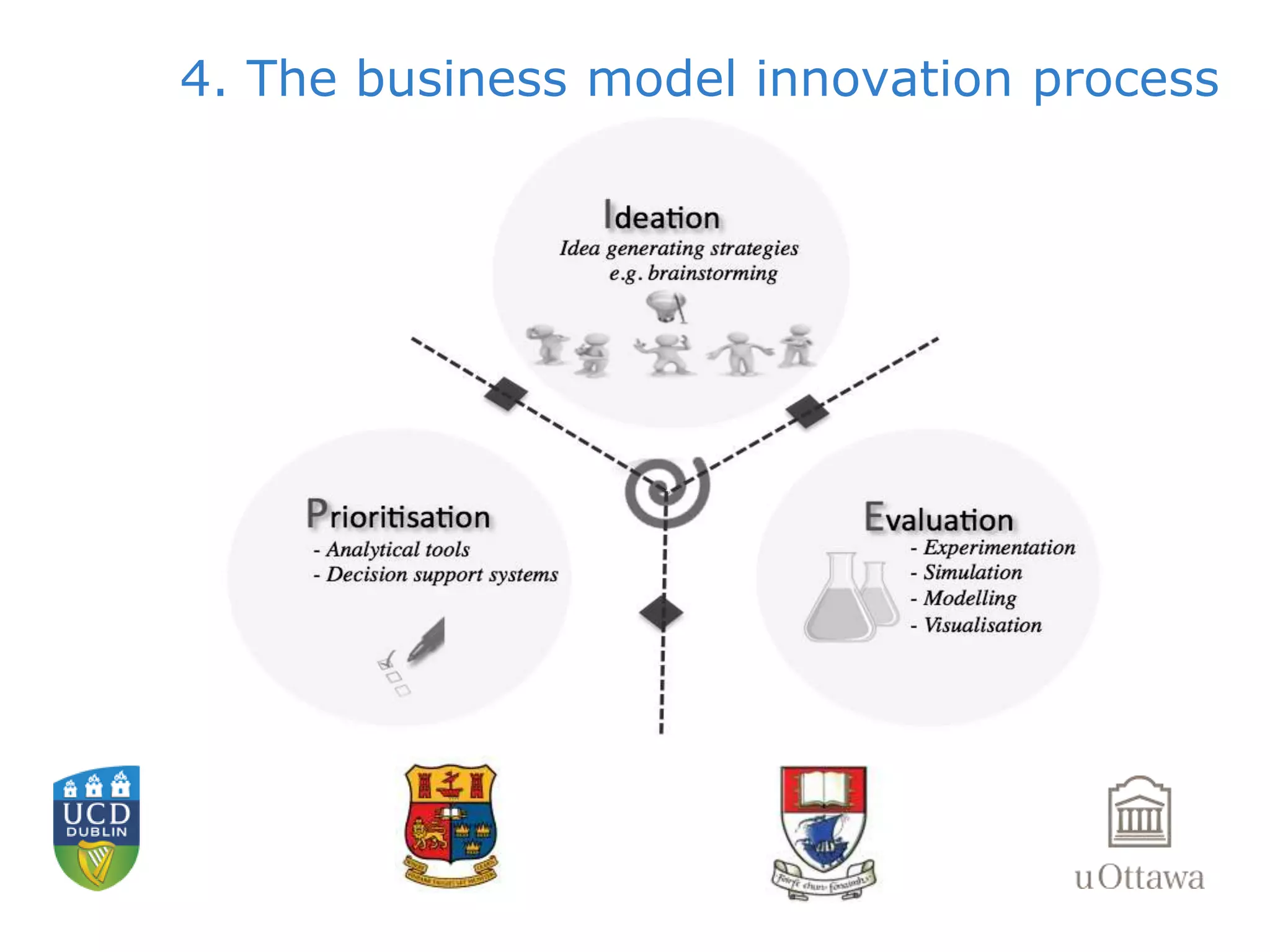
4. The business model innovation process
Ideation 
• Focuses on the identification of potential value 
activities pertaining to the delivery of the 
company’s products and services 
– Novel activities 
– Novel combinations of activities 
– Novel allocations of activities amongst parties 
• Opportunities for business model innovation are 
greatest during this phase so tools and 
techniques are proposed to stimulate ideation
Evaluation 
• Focuses on evaluating each individual proposal on 
its own merits, taking into account its 
appropriateness for the focal firm in terms of its 
– organisational knowledge 
– organisational capacity 
– organisational network 
• A number of approaches can be used: 
– Visualisation 
– Experimentation 
– Systematic analysis
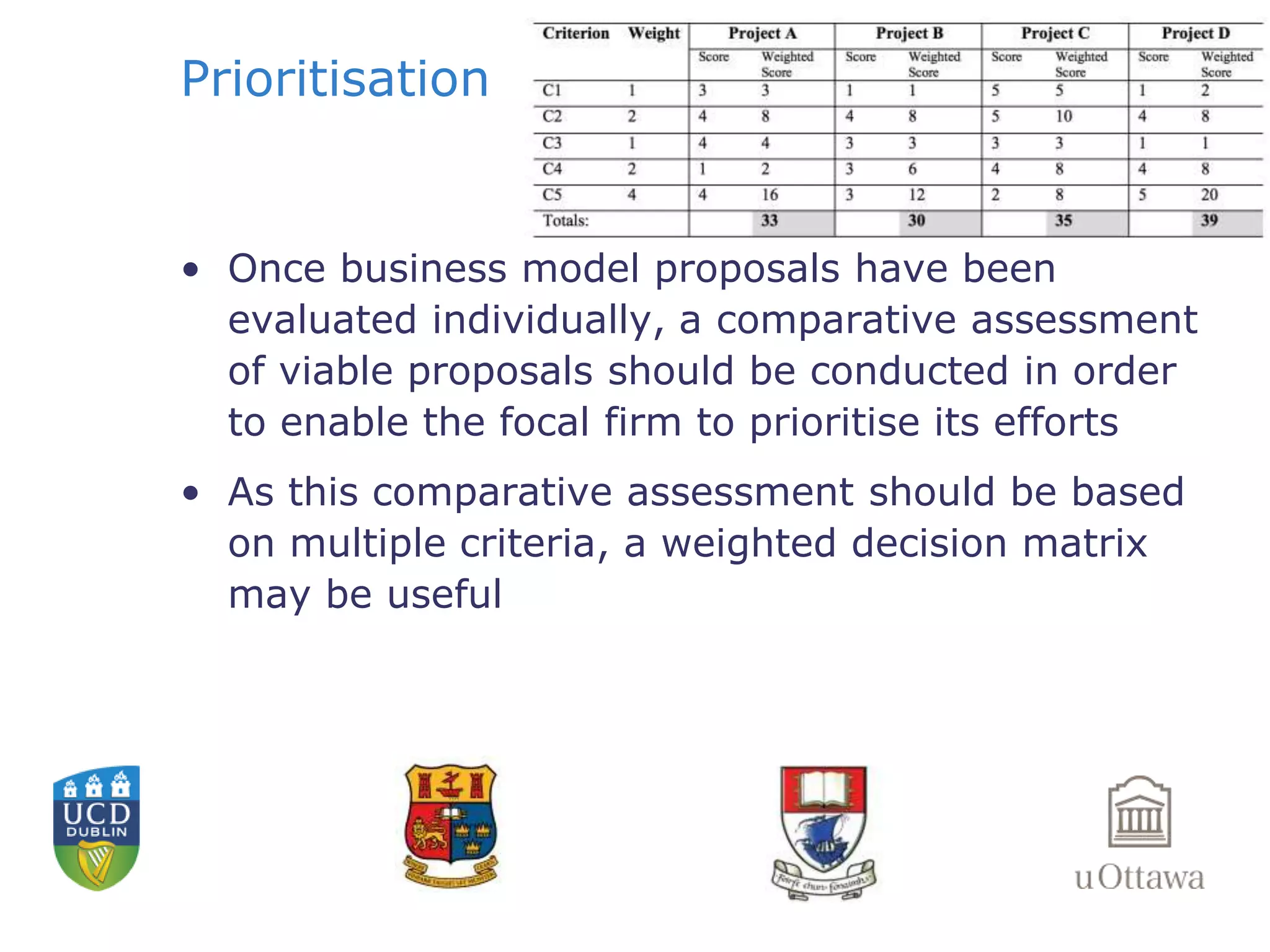
Prioritisation 
• Once business model proposals have been 
evaluated individually, a comparative assessment 
of viable proposals should be conducted in order 
to enable the focal firm to prioritise its efforts 
• As this comparative assessment should be based 
on multiple criteria, a weighted decision matrix 
may be useful
5. Discussion and future directions 
• This research highlights the need for a more temporal view 
of the business model innovation process and proposes a 
three phase innovation process framework that is amenable 
to IS support 
• Future industry-based research is needed to test and refine 
this process model
THANK YOU 
Dr Niamh ‘Neve’ O Riordan 
University College Dublin, Ireland. 
niamh.oriordan@ucd.ie 
www.niamhoriordan.com 
ie.linkedin.com/in/niamhoriordan/

The business model innovation process: a temporal perspective

  • 1.
    Business model innovation:a temporal perspectives Niamh O Riordan University College Dublin, Ireland Philip O’Reilly University College Cork, Ireland Aidan Duane Waterford Institute of Technology, Ireland Pavel Andreev University of Ottawa, Canada
  • 2.
    Agenda 1. Motivation 2. Definitions 3. Research gap 4. The business model innovation process 5. Discussion and future directions
  • 3.
    1. Motivation •The same idea or technology taken to market through two different business models can actually yield two different economic outcomes depending on the business model being used (Chesbrough, 2010) • A well-formulated and innovative business model can be used to help your company gain competitive advantages that result in higher profits than competitors (Afuah and Tucci, 2001) • Legendary firms that shape their industry structures are in fact business-model innovators (Gambardella and McGahan, 2010) • More and more companies are re-evaluating their business models on an on-going basis, taking a transformational approach bringing about innovation within the organization itself (Demil and Lecocq, 2010).
  • 4.
    2. Definitions •There is a lot of ambiguity about the concept of a business model: – an approach to generating revenue at a reasonable cost that is based on assumptions about what customers want and how they want it, and on how the enterprise can best meet those needs, and get paid for doing so” (Teece, 2010) – “a conceptual tool that contains a set of elements and their relationships and allows expressing the business logic of a specific firm. It is a description of the value a company offers to one or several segments of customers and of the architecture of the firm and its network of partners for creating, marketing, and delivering this value and relationship capital, to generate profitable and sustainable revenue streams” (Osterwalder, 2005) – as a system of interconnected and interdependent activities that determines the way the company “does business” with its customers, partners and vendors (Amit and Zott, 2012)
  • 5.
    3. Research Gap • Managers struggle to understand the potential value of a new business model (Bouchikhi and Kimberly, 2003; Chesbrough, 2010) and companies struggle to innovate the business models through which commercialisable new ideas and technologies will pass (Chesbrough, 2010) • But the literature is skewed toward product and process innovation (O Riordan, 2011) rather than business model innovation (Crossan and Apaydin, 2010). The business model literature itself focuses on defining (Timmers 1999; Osterwalder et al., 2005) or visualising (Osterwalder and Pigneur, 2010) business models • These tools have explanatory powers, particularly when used retrospectively but they overlook the temporal dynamics of the business model innovation process itself don’t provide a useful process map for organizations wishing to engage in business model innovation (O Riordan et al., 2013; O Riordan et al., 2012; O Reilly et al., 2014).
  • 6.
    4. The businessmodel innovation process
  • 7.
    Ideation • Focuseson the identification of potential value activities pertaining to the delivery of the company’s products and services – Novel activities – Novel combinations of activities – Novel allocations of activities amongst parties • Opportunities for business model innovation are greatest during this phase so tools and techniques are proposed to stimulate ideation
  • 8.
    Evaluation • Focuseson evaluating each individual proposal on its own merits, taking into account its appropriateness for the focal firm in terms of its – organisational knowledge – organisational capacity – organisational network • A number of approaches can be used: – Visualisation – Experimentation – Systematic analysis
  • 9.
    Prioritisation • Oncebusiness model proposals have been evaluated individually, a comparative assessment of viable proposals should be conducted in order to enable the focal firm to prioritise its efforts • As this comparative assessment should be based on multiple criteria, a weighted decision matrix may be useful
  • 10.
    5. Discussion andfuture directions • This research highlights the need for a more temporal view of the business model innovation process and proposes a three phase innovation process framework that is amenable to IS support • Future industry-based research is needed to test and refine this process model
  • 11.
    THANK YOU DrNiamh ‘Neve’ O Riordan University College Dublin, Ireland. niamh.oriordan@ucd.ie www.niamhoriordan.com ie.linkedin.com/in/niamhoriordan/

Editor's Notes

  • #7 A type of innovation… the model maps to existing innovation process models… three phases, each associated with particular activites and deliverables and a go-no go decision making process based on selection criteria… informed by Cooper’s stage gate model and organisational innovation process management literature… suggests strategies, tactics and tools that will help… amenable to tool support