Where the streets have no name:
EXPLORATION AND EXPLOITATION IN NOVEL DIGITAL SETTINGS
Niamh O Riordan, National University of Ireland Galway, Ireland
Frédéric Adam, University College Cork, Ireland
Philip O’Reilly, University College Cork, Ireland
niamh.oriordan@nuigalway.ie
www.niamhoriordan.com
ie.linkedin.com/in/niamhoriordan/
European Conference on Information Systems, TEL AVIV 2014
2
AGENDA
1. Background
2. Some overlooked questions
3. Research approach
4. Findings
5. Summary
3European Conference on Information Systems TEL AVIV 2014
1. BACKGROUND
• Organisations are goal-directed social entities that are designed as deliberately
structured and coordinated activity systems (Daft, 2009, p. 10). Organisational
design is therefore a question of pooling resources and coordinating activities
– Exploitation is
• the use and development of things already known
• the refinement and extension of existing competencies, technologies and
paradigms
• captured by terms like refinement, choice, production, efficiency, selection,
implementation, and execution
– Exploration is
• the pursuit of new knowledge, of things that might come to be known
• experimentation with new alternatives
• captured by terms like search, variation, risk taking, experimentation, play,
flexibility, discovery, innovation
4European Conference on Information Systems TEL AVIV 2014
Factoid:
The number of leading management journal
publications on this topic increased eight fold
between 2004 and 2009 (Raisch, et al., 2009)
5
• Firms typically overemphasise exploitation (more immediate and certain returns;
reduced the risk that effort will result in dead ends)
• But as a result, they are likely to “suffer the costs of experimentation without
gaining many of the benefits and to exhibit too many undeveloped new ideas and
too little distinctive competence” (March, 1991)
• Whilst firms that engage in exploitation to the exclusion of exploration are “likely
to find themselves trapped in suboptimal stable equilibria” (March, 1991)
1. BACKGROUND
European Conference on Information Systems TEL AVIV 2014
6
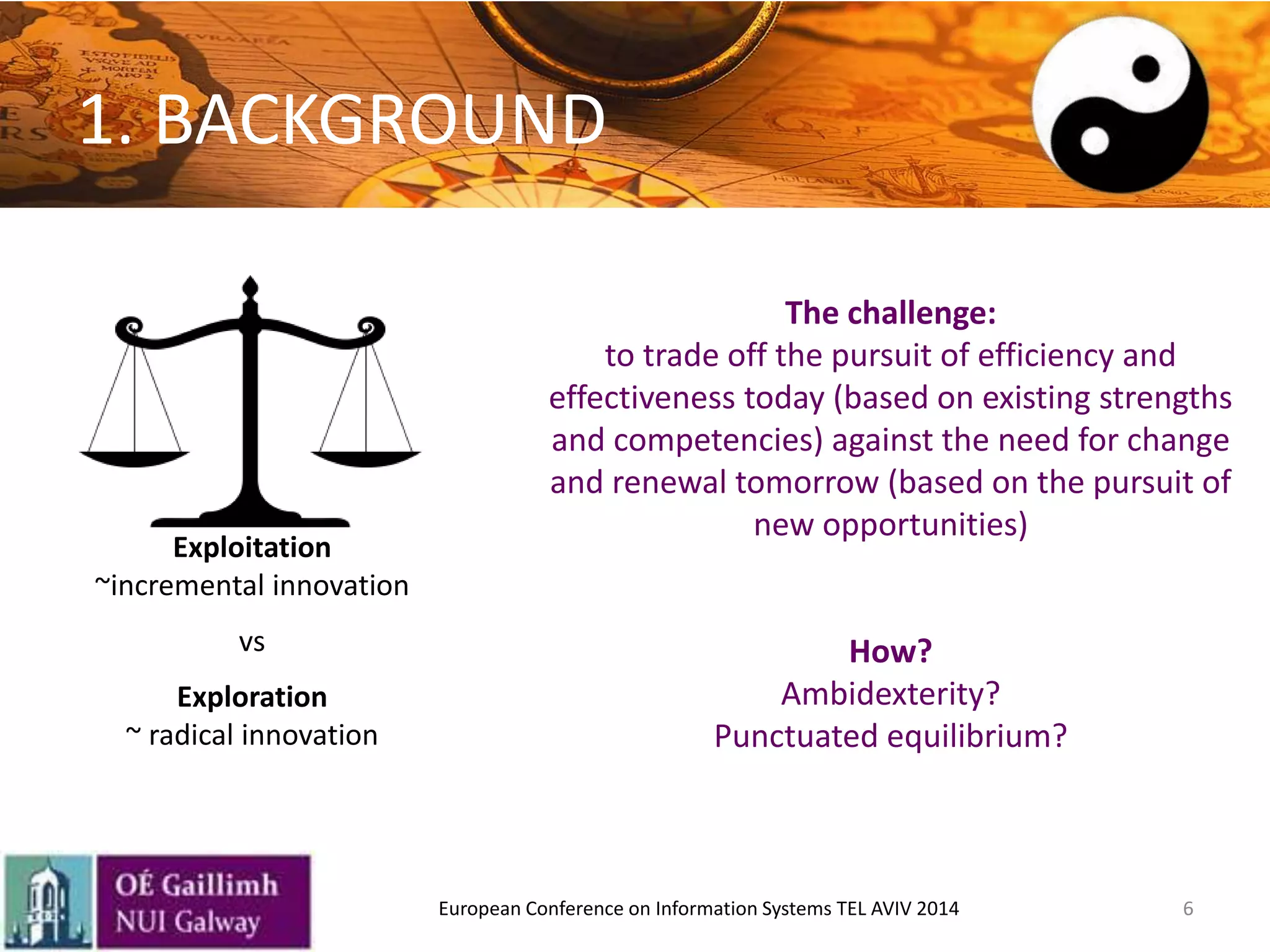
The challenge:
to trade off the pursuit of efficiency and
effectiveness today (based on existing strengths
and competencies) against the need for change
and renewal tomorrow (based on the pursuit of
new opportunities)
How?
Ambidexterity?
Punctuated equilibrium?
1. BACKGROUND
Exploitation
~incremental innovation
vs
Exploration
~ radical innovation
European Conference on Information Systems TEL AVIV 2014
2. SOME OVERLOOKED QUESTIONS
• What of organisations operating in novel settings? [novelty]
– Afterall, firms are, by definition, linked to the external environment (cf. Daft, 2009, p.
10) so organisational design must also be seen as a question of adapting to changes in
the external environment
• Must all firms achieve this balance?
• If yes, then we must increase our understanding of ambidexterity and punctuated
equilibrium approaches [process]
• If no, then we must ask about alternate strategie. For instance, might firms successfully
pursue a deliberate strategy of specialisation? [ICTs]
• Are these two concepts continuous (complementary) or orthogonal (mutually
exclusive)? [micro]
7European Conference on Information Systems TEL AVIV 2014
3. RESEARCH APPROACH
• We carried out 6 case studies in Second Life
over a 12 month period
– Novely
– Digitally mediated environments
– Significant opportunities for data collection
8European Conference on Information Systems TEL AVIV 2014
4. FINDINGS
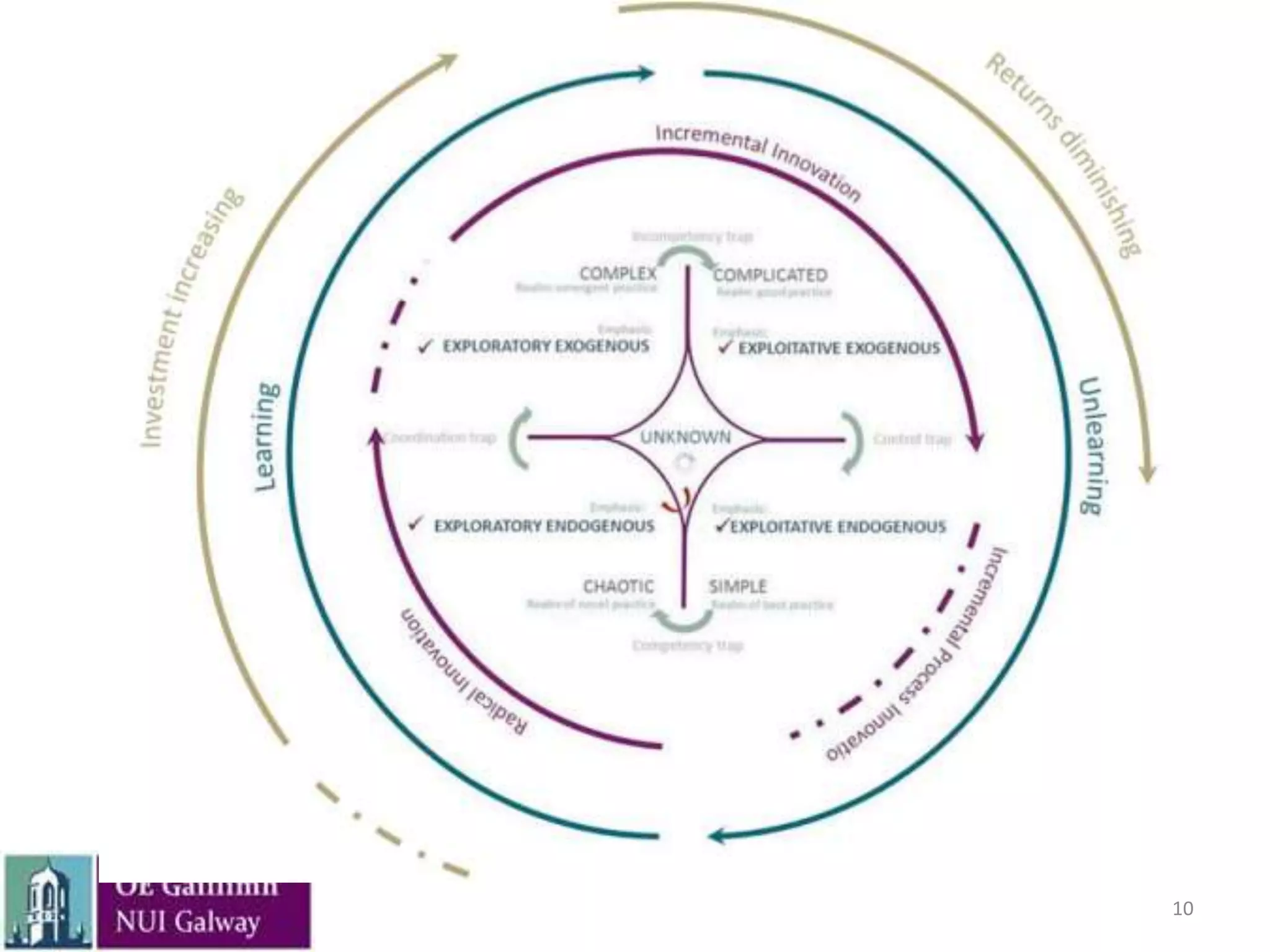
• Study participants in the six cases engaged in 15 distinct types of activity that
could be classified as
– exploratory and endogenous
– exploratory and exogenous
– exploitative and endogenous
• At the individual and group level, transitions from exploration to exploitation are
triggered by changes in perceived environmental complexity over time (which are
a function of prior knowledge)
– We used Snowden’s Cynefin framework to distinguish between
• the chaotic (where practices are novel)
• the complex (where practices are emergent)
• the complicated (where good practice begins to emerge)
• the simple (where best practice begins to emerge)
• This process can be accelerated if individuals and teams can successfully utilise
ICTs to work ‘outside’ traditional organisational boundaries and thereby leverage
interorganizational networks
9European Conference on Information Systems TEL AVIV 2014
10
5. SUMMARY
• This paper identifies and sheds light on a number of key gaps in the existing literature on
balancing exploratory and exploitative activities in firms.
• It also investigates the impact of perceived environmental uncertainty on exploratory and
exploitative activities at a micro level in the specific context of virtual worlds
• It reveals that in practice, transitions between exploration and exploitation take place over
time and are primarily triggered by changes in perceived environmental complexity over
time
• For immersed at least, ICTs do have the capacity to either facilitate or prevent particular
types of transition but in virtual worlds (and somewhat counterintuitively) individuals
continue to struggle to engage effectively with others outside the boundaries of the firm
11European Conference on Information Systems TEL AVIV 2014
12
Full paper available at http://aisel.aisnet.org/ecis2014/proceedings/track01/11/ or from
Niamh O Riordan, National University of Ireland Galway, Ireland
Frédéric Adam, University College Cork, Ireland
Philip O’Reilly, University College Cork, Ireland
niamh.oriordan@nuigalway.ie
www.niamhoriordan.com
ie.linkedin.com/in/niamhoriordan/
Thank You
European Conference on Information Systems TEL AVIV 2014

Exploration and exploitation in novel digital settings (ECIS2014)

  • 1.
    Where the streetshave no name: EXPLORATION AND EXPLOITATION IN NOVEL DIGITAL SETTINGS Niamh O Riordan, National University of Ireland Galway, Ireland Frédéric Adam, University College Cork, Ireland Philip O’Reilly, University College Cork, Ireland niamh.oriordan@nuigalway.ie www.niamhoriordan.com ie.linkedin.com/in/niamhoriordan/ European Conference on Information Systems, TEL AVIV 2014 2
  • 2.
    AGENDA 1. Background 2. Someoverlooked questions 3. Research approach 4. Findings 5. Summary 3European Conference on Information Systems TEL AVIV 2014
  • 3.
    1. BACKGROUND • Organisationsare goal-directed social entities that are designed as deliberately structured and coordinated activity systems (Daft, 2009, p. 10). Organisational design is therefore a question of pooling resources and coordinating activities – Exploitation is • the use and development of things already known • the refinement and extension of existing competencies, technologies and paradigms • captured by terms like refinement, choice, production, efficiency, selection, implementation, and execution – Exploration is • the pursuit of new knowledge, of things that might come to be known • experimentation with new alternatives • captured by terms like search, variation, risk taking, experimentation, play, flexibility, discovery, innovation 4European Conference on Information Systems TEL AVIV 2014 Factoid: The number of leading management journal publications on this topic increased eight fold between 2004 and 2009 (Raisch, et al., 2009)
  • 4.
    5 • Firms typicallyoveremphasise exploitation (more immediate and certain returns; reduced the risk that effort will result in dead ends) • But as a result, they are likely to “suffer the costs of experimentation without gaining many of the benefits and to exhibit too many undeveloped new ideas and too little distinctive competence” (March, 1991) • Whilst firms that engage in exploitation to the exclusion of exploration are “likely to find themselves trapped in suboptimal stable equilibria” (March, 1991) 1. BACKGROUND European Conference on Information Systems TEL AVIV 2014
  • 5.
    6 The challenge: to tradeoff the pursuit of efficiency and effectiveness today (based on existing strengths and competencies) against the need for change and renewal tomorrow (based on the pursuit of new opportunities) How? Ambidexterity? Punctuated equilibrium? 1. BACKGROUND Exploitation ~incremental innovation vs Exploration ~ radical innovation European Conference on Information Systems TEL AVIV 2014
  • 6.
    2. SOME OVERLOOKEDQUESTIONS • What of organisations operating in novel settings? [novelty] – Afterall, firms are, by definition, linked to the external environment (cf. Daft, 2009, p. 10) so organisational design must also be seen as a question of adapting to changes in the external environment • Must all firms achieve this balance? • If yes, then we must increase our understanding of ambidexterity and punctuated equilibrium approaches [process] • If no, then we must ask about alternate strategie. For instance, might firms successfully pursue a deliberate strategy of specialisation? [ICTs] • Are these two concepts continuous (complementary) or orthogonal (mutually exclusive)? [micro] 7European Conference on Information Systems TEL AVIV 2014
  • 7.
    3. RESEARCH APPROACH •We carried out 6 case studies in Second Life over a 12 month period – Novely – Digitally mediated environments – Significant opportunities for data collection 8European Conference on Information Systems TEL AVIV 2014
  • 8.
    4. FINDINGS • Studyparticipants in the six cases engaged in 15 distinct types of activity that could be classified as – exploratory and endogenous – exploratory and exogenous – exploitative and endogenous – exploitative and endogenous • At the individual and group level, transitions from exploration to exploitation are triggered by changes in perceived environmental complexity over time (which are a function of prior knowledge) – We used Snowden’s Cynefin framework to distinguish between • the chaotic (where practices are novel) • the complex (where practices are emergent) • the complicated (where good practice begins to emerge) • the simple (where best practice begins to emerge) • This process can be accelerated if individuals and teams can successfully utilise ICTs to work ‘outside’ traditional organisational boundaries and thereby leverage interorganizational networks 9European Conference on Information Systems TEL AVIV 2014
  • 9.
  • 10.
    5. SUMMARY • Thispaper identifies and sheds light on a number of key gaps in the existing literature on balancing exploratory and exploitative activities in firms. • It also investigates the impact of perceived environmental uncertainty on exploratory and exploitative activities at a micro level in the specific context of virtual worlds • It reveals that in practice, transitions between exploration and exploitation take place over time and are primarily triggered by changes in perceived environmental complexity over time • For immersed at least, ICTs do have the capacity to either facilitate or prevent particular types of transition but in virtual worlds (and somewhat counterintuitively) individuals continue to struggle to engage effectively with others outside the boundaries of the firm 11European Conference on Information Systems TEL AVIV 2014
  • 11.
    12 Full paper availableat http://aisel.aisnet.org/ecis2014/proceedings/track01/11/ or from Niamh O Riordan, National University of Ireland Galway, Ireland Frédéric Adam, University College Cork, Ireland Philip O’Reilly, University College Cork, Ireland niamh.oriordan@nuigalway.ie www.niamhoriordan.com ie.linkedin.com/in/niamhoriordan/ Thank You European Conference on Information Systems TEL AVIV 2014

Editor's Notes

  • #2 Cover image: http://martianchronicles.files.wordpress.com/2010/05/explore.jpg
  • #3 http://trimslimhypnosis.com/wp-content/uploads/2012/08/Stopwatch.jpg
  • #4 http://www.bushywood.com/crown_prosecution_service/judge_cedric_joseph.htm
  • #7 Source: http://blogs-images.forbes.com/paulhsieh/files/2014/04/1000px-balanced_scale_of_justice-svg.png
  • #8 http://trimslimhypnosis.com/wp-content/uploads/2012/08/Stopwatch.jpg
  • #9 http://trimslimhypnosis.com/wp-content/uploads/2012/08/Stopwatch.jpg
  • #11 http://trimslimhypnosis.com/wp-content/uploads/2012/08/Stopwatch.jpg