International Conference on Information Systems, MILAN 2013

KNOWLEDGE CREATION:
HIDDEN DRIVER OF INNOVATION IN THE DIGITAL ERA

Niamh O Riordan
National University of Ireland Galway, Ireland
niamh.oriordan@nuigalway.ie
www.niamhoriordan.com
ie.linkedin.com/in/niamhoriordan/

2
International Conference on Information Systems MILAN 2013

Agenda
•
•
•
•
•
•

Research motivation
Theoretical underpinnings
Conceptual framework
Research methodology
Findings
Conclusions

3
International Conference on Information Systems MILAN 2013

Motivation
• Organizational innovation
– (Is a) core topic
– (Generally seen as a) Weasel word

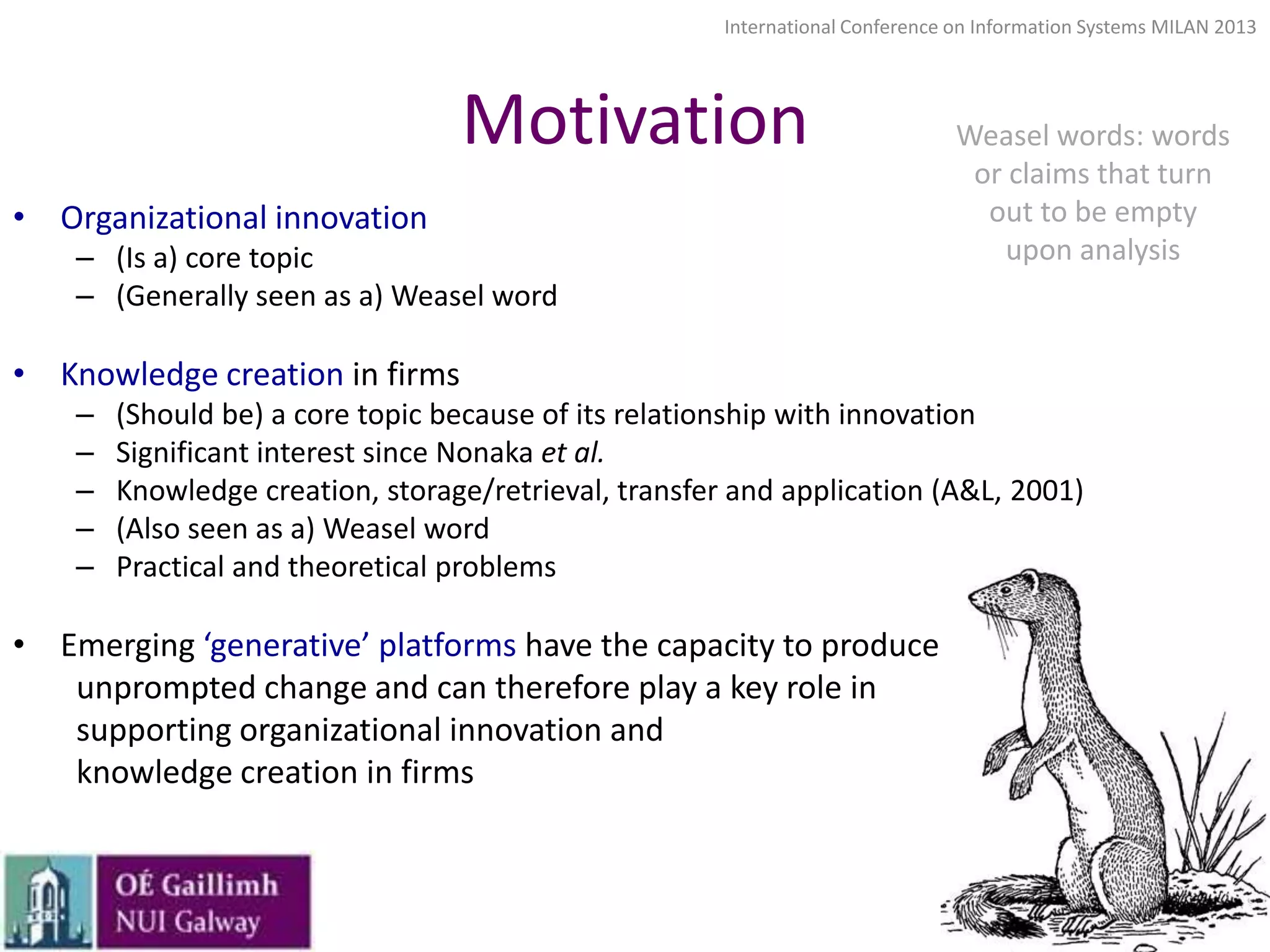
Weasel words: words
or claims that turn
out to be empty
upon analysis

• Knowledge creation in firms
–
–
–
–
–

(Should be) a core topic because of its relationship with innovation
Significant interest since Nonaka et al.
Knowledge creation, storage/retrieval, transfer and application (A&L, 2001)
(Also seen as a) Weasel word
Practical and theoretical problems

• Emerging ‘generative’ platforms have the capacity to produce unprompted
unprompted change and can therefore play a key role in
supporting organizational innovation and
knowledge creation in firms

4
International Conference on Information Systems MILAN 2013

Theoretical Underpinnings #1
At its core, innovation is a process of creating
and using new ideas and concepts
–
–
–
–

Newness
Creativity
Utility
Value

incremental v. radical
product v. process
administrative v. technical

– Versus invention
– As a process

5
International Conference on Information Systems MILAN 2013

Theoretical Underpinnings #2
As such, it is useful to look at innovation from
[some sort of] a knowledge-based view
Innovation ≡ knowledge
= knowledge
= f(knowledge)
⊂ knowledge
≈ knowledge

* Though we don’t much like this view in IS…
6
International Conference on Information Systems MILAN 2013

When organizations innovate,
they “do not simply process information...
they actually create new knowledge and information
from the inside out,
in order to redefine both problems and solutions
and, in the process, to re-create the environment”

- Nonaka and Takeuchi 1995, p.56

7
International Conference on Information Systems MILAN 2013

Conceptual Framework i
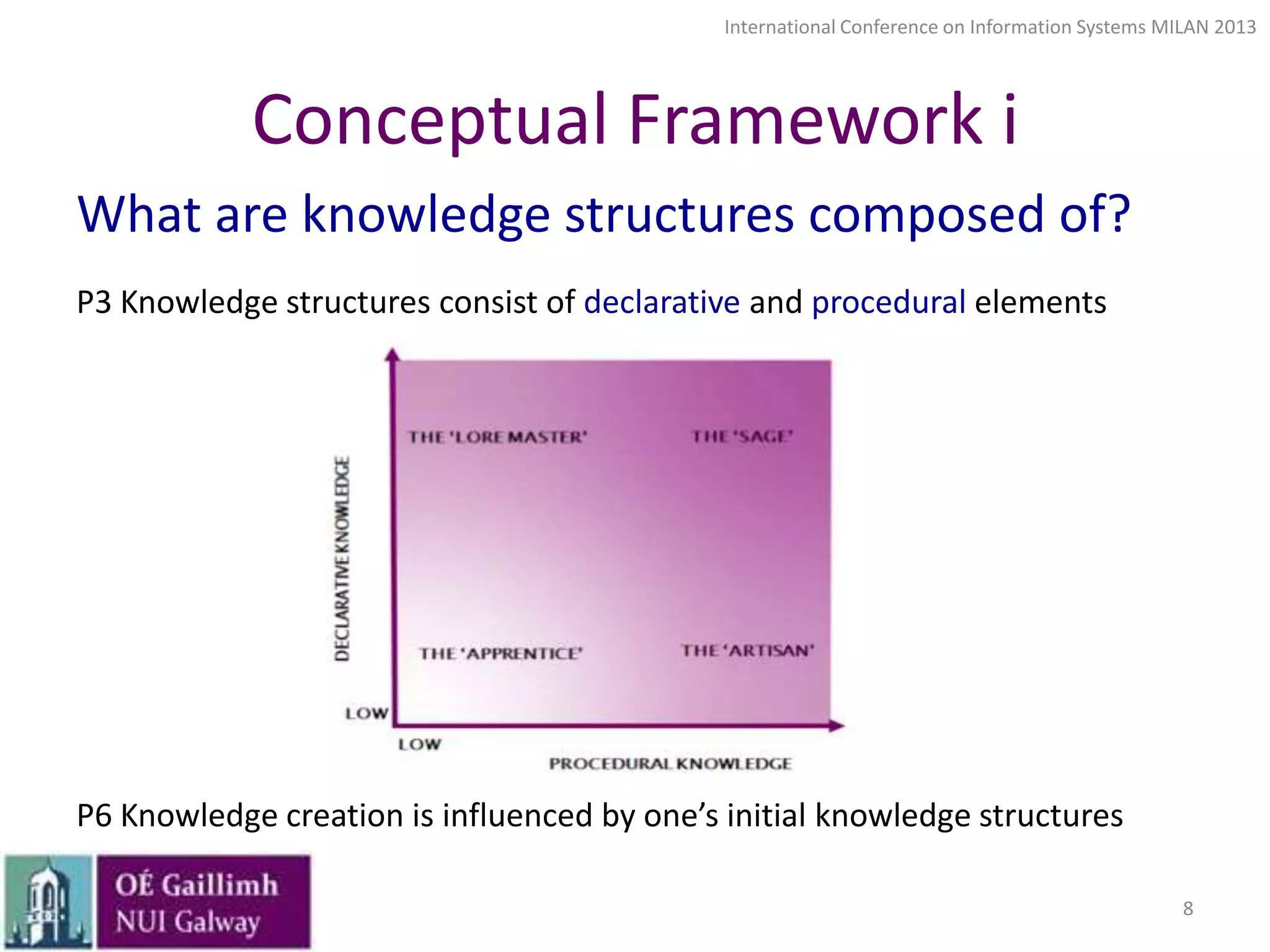
What are knowledge structures composed of?
P3 Knowledge structures consist of declarative and procedural elements

P6 Knowledge creation is influenced by one’s initial knowledge structures
8
International Conference on Information Systems MILAN 2013

Conceptual Framework ii
How is knowledge created?
P1 Knowledge is created when existing knowledge structures, mental
templates that individuals impose on the environment to give it form and
meaning, are changed

P2 The process of innovation is fundamentally intertwined with the
process of knowledge creation such that innovations have the potential to be
conceived at that point in the knowledge creation process where existing
knowledge structures are changed

9
International Conference on Information Systems MILAN 2013

Research Methodology
•
•
•
•

Six case studies of digitally enacted innovation in virtual worlds
Criterion sampling technique
12 month period
Data collection*
– Participant observation
– Semi-structured interviews
– Documentary analysis

• Data analysis as per Miles and Huberman (1994)
– Field and case notes
– Memos and pattern codes
– Within and cross case displays
10
International Conference on Information Systems MILAN 2013

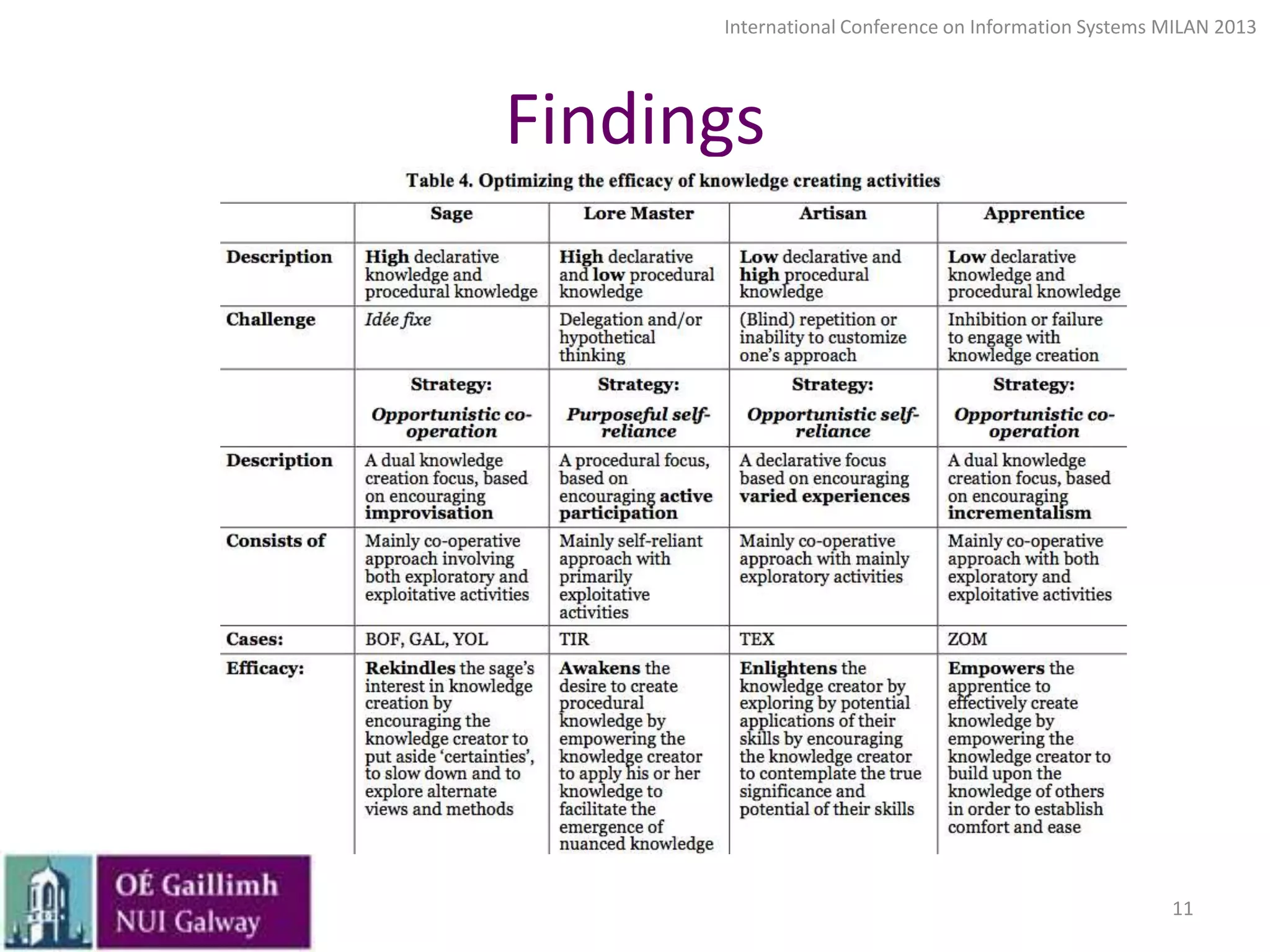
Findings

11
International Conference on Information Systems MILAN 2013

Conclusion
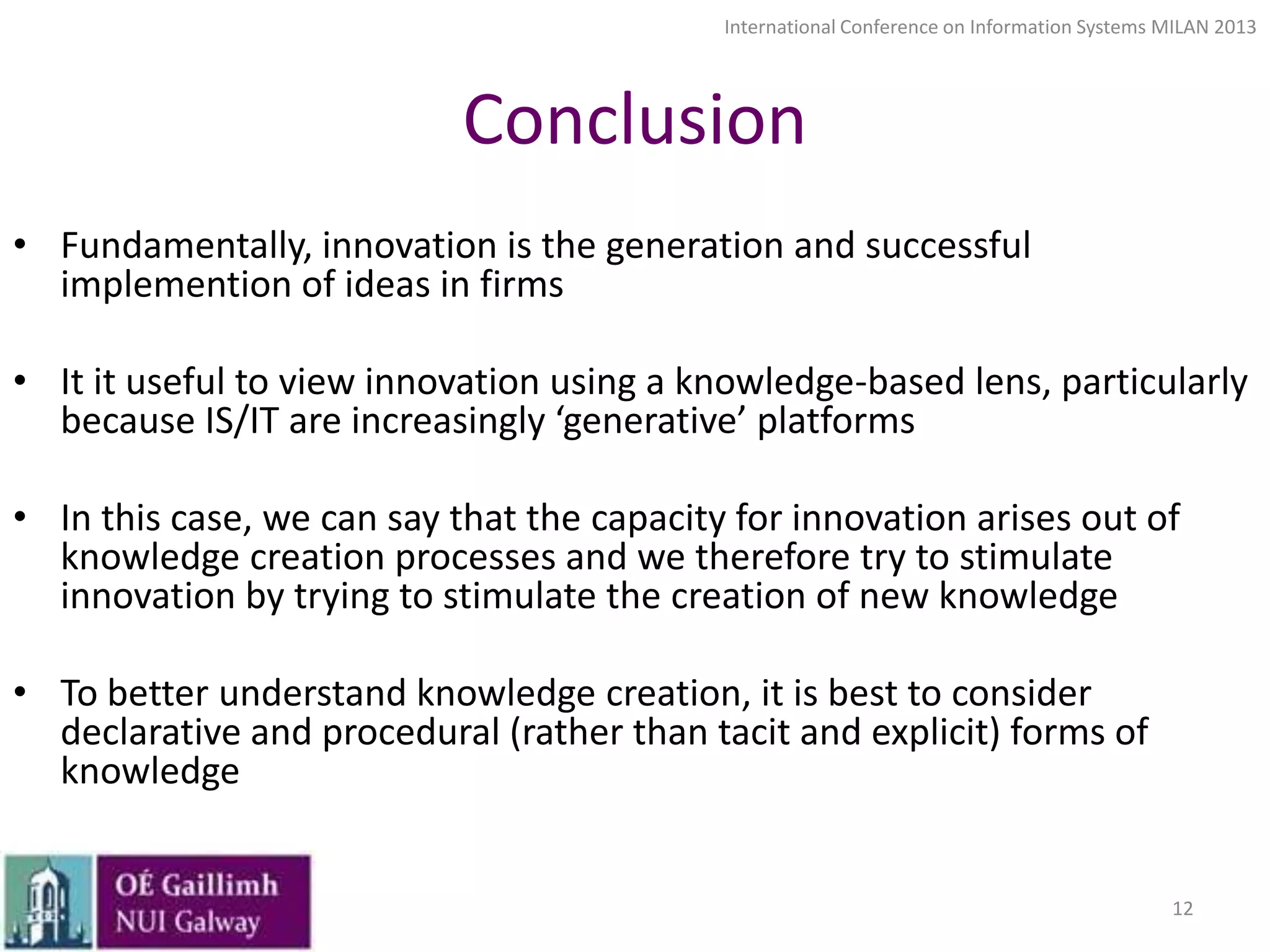
• Fundamentally, innovation is the generation and successful
implemention of ideas in firms
• It it useful to view innovation using a knowledge-based lens, particularly
because IS/IT are increasingly ‘generative’ platforms
• In this case, we can say that the capacity for innovation arises out of
knowledge creation processes and we therefore try to stimulate
innovation by trying to stimulate the creation of new knowledge
• To better understand knowledge creation, it is best to consider
declarative and procedural (rather than tacit and explicit) forms of
knowledge

12
International Conference on Information Systems MILAN 2013

Thank You
Niamh O Riordan
National University of Ireland Galway, Ireland
niamh.oriordan@nuigalway.ie
www.niamhoriordan.com
ie.linkedin.com/in/niamhoriordan/
13

Knowledge creation: hidden driver of innovation in the digital age

  • 1.
    International Conference onInformation Systems, MILAN 2013 KNOWLEDGE CREATION: HIDDEN DRIVER OF INNOVATION IN THE DIGITAL ERA Niamh O Riordan National University of Ireland Galway, Ireland niamh.oriordan@nuigalway.ie www.niamhoriordan.com ie.linkedin.com/in/niamhoriordan/ 2
  • 2.
    International Conference onInformation Systems MILAN 2013 Agenda • • • • • • Research motivation Theoretical underpinnings Conceptual framework Research methodology Findings Conclusions 3
  • 3.
    International Conference onInformation Systems MILAN 2013 Motivation • Organizational innovation – (Is a) core topic – (Generally seen as a) Weasel word Weasel words: words or claims that turn out to be empty upon analysis • Knowledge creation in firms – – – – – (Should be) a core topic because of its relationship with innovation Significant interest since Nonaka et al. Knowledge creation, storage/retrieval, transfer and application (A&L, 2001) (Also seen as a) Weasel word Practical and theoretical problems • Emerging ‘generative’ platforms have the capacity to produce unprompted unprompted change and can therefore play a key role in supporting organizational innovation and knowledge creation in firms 4
  • 4.
    International Conference onInformation Systems MILAN 2013 Theoretical Underpinnings #1 At its core, innovation is a process of creating and using new ideas and concepts – – – – Newness Creativity Utility Value incremental v. radical product v. process administrative v. technical – Versus invention – As a process 5
  • 5.
    International Conference onInformation Systems MILAN 2013 Theoretical Underpinnings #2 As such, it is useful to look at innovation from [some sort of] a knowledge-based view Innovation ≡ knowledge = knowledge = f(knowledge) ⊂ knowledge ≈ knowledge * Though we don’t much like this view in IS… 6
  • 6.
    International Conference onInformation Systems MILAN 2013 When organizations innovate, they “do not simply process information... they actually create new knowledge and information from the inside out, in order to redefine both problems and solutions and, in the process, to re-create the environment” - Nonaka and Takeuchi 1995, p.56 7
  • 7.
    International Conference onInformation Systems MILAN 2013 Conceptual Framework i What are knowledge structures composed of? P3 Knowledge structures consist of declarative and procedural elements P6 Knowledge creation is influenced by one’s initial knowledge structures 8
  • 8.
    International Conference onInformation Systems MILAN 2013 Conceptual Framework ii How is knowledge created? P1 Knowledge is created when existing knowledge structures, mental templates that individuals impose on the environment to give it form and meaning, are changed P2 The process of innovation is fundamentally intertwined with the process of knowledge creation such that innovations have the potential to be conceived at that point in the knowledge creation process where existing knowledge structures are changed 9
  • 9.
    International Conference onInformation Systems MILAN 2013 Research Methodology • • • • Six case studies of digitally enacted innovation in virtual worlds Criterion sampling technique 12 month period Data collection* – Participant observation – Semi-structured interviews – Documentary analysis • Data analysis as per Miles and Huberman (1994) – Field and case notes – Memos and pattern codes – Within and cross case displays 10
  • 10.
    International Conference onInformation Systems MILAN 2013 Findings 11
  • 11.
    International Conference onInformation Systems MILAN 2013 Conclusion • Fundamentally, innovation is the generation and successful implemention of ideas in firms • It it useful to view innovation using a knowledge-based lens, particularly because IS/IT are increasingly ‘generative’ platforms • In this case, we can say that the capacity for innovation arises out of knowledge creation processes and we therefore try to stimulate innovation by trying to stimulate the creation of new knowledge • To better understand knowledge creation, it is best to consider declarative and procedural (rather than tacit and explicit) forms of knowledge 12
  • 12.
    International Conference onInformation Systems MILAN 2013 Thank You Niamh O Riordan National University of Ireland Galway, Ireland niamh.oriordan@nuigalway.ie www.niamhoriordan.com ie.linkedin.com/in/niamhoriordan/ 13

Editor's Notes

  • #3 http://techpinions.com/wp-content/uploads/2012/01/chapter_innovation_bob.jpg
  • #5 As it was in the beginning, is now and ever shall be words or claims that turn out to be empty upon analysis are known as "weasel words”Image source: http://www.learnersdictionary.com/art/ld/weasel.gif
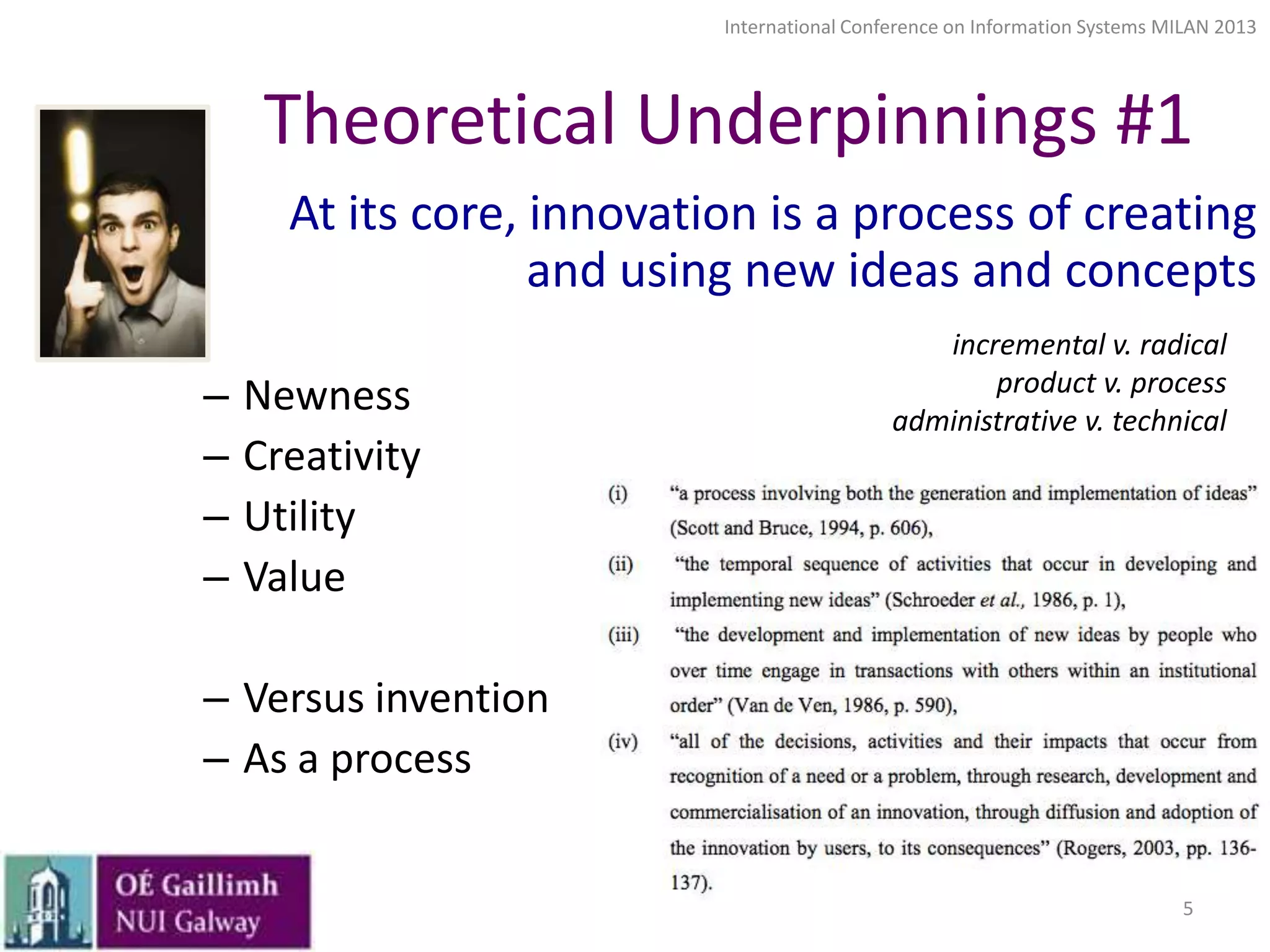
  • #6 Innovation as newness; Schumpeter: innovation “combines factors in a new way”; Van de Ven: “an innovation is a new idea”; Zaltman: “perceived as new”; incremental v. radical innovation also implies a continuum of novelty Innovation as creativity: Amabile define innovation as the “successful implementation of creative ideas within an organisation” (p. 25) where creative ideas are (i) novel or (ii) useful or (iii) valuable http://info.xfactorllc.com/Portals/69322/images/AHA%20moment%20FP-resized-600.jpg
  • #7 Identical Equal to A function of A subset of Approximately the same as Revolutionary, regular, architectural and niche innovationhttp://www.ninoricci.com/Phrenology.JPG
  • #8 Recombinant innovation; imitation; synthesis; evolution of ideashttp://www.mojopages.com/images/user/223432/desiree1954626589.jpg
  • #9 1. It’s best to look at declarative and procedural instead of tacit and explicit because prior research hasn’t worked; new techs prefer decl.proc
  • #10 http://insanedev.co.uk/wp-content/uploads/2013/04/neuralNetwork.jpg
  • #11 Illustrate the utility of the frameworks; virtual worlds because of interest in generativity and novelty and access to behavioural data