Autoethnography
IIQM Webinar Series
Dr. Sarah Wall
July 24, 2014
Presentation Overview
This is an introductory overview of autoethnography
 Origins and definitions
 Methodological approaches
 Examples
 Controversies and the future of autoethnography
 Questions from participants
My Autoethnographic Work
 Adoptive motherhood
 Transdisciplinary education
 Learning theory
 Methodological papers
 Also, as editor of IJQM – see a lot of
submissions about autoethnography
An Increasingly Popular Method
 Simple literature search using keyword
“autoethnography”
 1990-2002 – about 5-10/year
 2003 on – about 35/year (Muncey, 2010)
 My own search this week:
 Sociological Abstracts (scholarly journals, English)
 2000-2009 – 110
 2010-2014 – 114
 Topics: Gender, sexuality, race, discrimination,
sport, illness, death, pregnancy, family, getting a
PhD, work processes…
Origins of Autoethnography
Term “autoethnography” in use for 35 years –
introduced by Hayano but…
“I also acknowledge but disregard 
studies...which analyze one's own life through 
the procedures of ethnography. These studies 
are not only autoethnographic, they are self‐
ethnographic, but it is not immediately shown 
how they are applicable to other cultural 
members” (Hayano, 1979, p. 103)
What is Autoethnography?
 Nevertheless, Ellis & Bochner use the term to describe 
exactly such “self‐ethnographic” work 
 Autoethnographies “are highly personalized accounts 
that draw upon the experience of the 
author/researcher for the purposes of extending 
sociological understanding” (Sparkes, 2000, p. 21)
 An autoethnography “lets you use yourself to get to 
culture” (Pelias, 2003, p. 372)
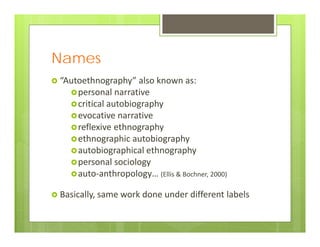
Names
 “Autoethnography” also known as:
personal narrative
critical autobiography
evocative narrative
reflexive ethnography
ethnographic autobiography
autobiographical ethnography
personal sociology
auto‐anthropology… (Ellis & Bochner, 2000)
 Basically, same work done under different labels 
Underlying Values
 Many ways of knowing and inquiring are
legitimate and no one way should be
privileged
 Supports normative, emancipatory,
transformative knowledge production
 Gives voice to vulnerable, marginalized,
those with unique experiences –
challenges “author-evacuated texts”
How does one do it?
 Much of what has been written on autoethnography 
is abstract, philosophical, and lacking in specificity
 Some good methodological articles and some recent 
books are helpful (list at end) 
Data Sources
 Photographs, video, artwork
 Artifacts
 Writing – journals, poetry, scribblings
 Self-observational data
 Social maps
 Official documents – e.g. school or medical
records, policies, meeting minutes
 Memory
 Interviews – actors in your story or
participants with similar experience
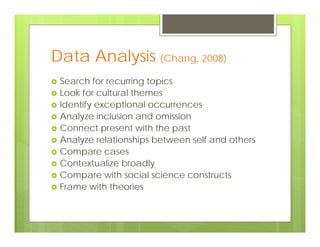
Data Analysis (Chang, 2008)
 Search for recurring topics
 Look for cultural themes
 Identify exceptional occurrences
 Analyze inclusion and omission
 Connect present with the past
 Analyze relationships between self and others
 Compare cases
 Contextualize broadly
 Compare with social science constructs
 Frame with theories
Products of Autoethnography
 Can include:
 short stories
 poetry
 fiction/novels 
 photographic essays 
 personal essays 
 fragmented and layered writing
 social science prose
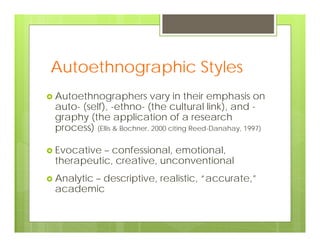
Autoethnographic Styles
 Autoethnographers vary in their emphasis on
auto- (self), -ethno- (the cultural link), and -
graphy (the application of a research
process) (Ellis & Bochner, 2000 citing Reed-Danahay, 1997)
 Evocative – confessional, emotional,
therapeutic, creative, unconventional
 Analytic – descriptive, realistic, “accurate,”
academic
Learning by Example: Analytic
 Sparkes, 1996, The fatal flaw: A narrative of the fragile body-
self
 Personal journey – elite athlete to man with chronic disease
 Conventional data sources, incorporates theory, reads like academic paper
 Wall, 2012a, Ethics and the Socio-political Context of
International Adoption; Wall, 2012b, Re-Thinking Motherhood
and Kinship in International Adoption
 Unique perspective on international adoption
 “Dispassionate,” theoretical, social science prose
 Mischenko, 2005, Exhausting management work: Conflicting
identities
 Critical exploration of healthcare managers’ work experience
 Some unconventional aspects – e.g. poetry – but is very theoretical
Learning by Example:
Evocative; Creative
 Pelias, 2003, The academic tourist: An
autoethnography
 A short, funny piece about academic life
 Long run-on sentences, half-hearted citations
 Larrison, 2010, Gratitude
 Poem; abstract is almost as long as the poem itself
(which is 148 words)
 Reflection on experience in graduate qualitative
methods course
Controversies:
Criticisms
 Self‐indulgent, narcissistic, 
introspective, 
individualized and 
removed from context
 Substitutes psychotherapy 
for social science
 Lack of systematicity and 
methodological rigour
 More authentic, voice of 
insider more “true” than 
voice of outsider
 Meanings of events and 
relationships more likely 
to be told than inferred
 Should not be judged 
using traditional criteria 
but should be judged 
using literary criteria; 
reader determines value
Defences
Ethical Questions
 Teller of story has power
 One person’s story includes other people – central,
peripheral, oppositional characters
 Protecting privacy of others (and self) is difficult
 Society has “perverse curiosity about the private,
peeking in on damaged selves” (Ellis & Bochner, 2000, p. 749)
 Not just telling story but respecting it (Frank, 2002)
 Respect readers and their responses
 Respect academic community
Controversies
Journal of Contemporary Ethnography, 35(4), August, 
2006
Question:  Analytic Autoethnography – Dead or Alive? 
Analytic Autoethnography is
Alive
Leon Anderson:
“Autoethnography loses its sociological promise 
when it devolves into self‐absorption” (p. 385)
Paul Atkinson: 
“…the goals of analysis and theorizing are too often 
lost to sight in contemporary fashions for subjective 
and evocative ethnographic work” (p. 400)
Analytic Autoethnography is
Dead
Carolyn Ellis & Art Bochner:
“Leon wants to take autoethnography which, as a 
mode of inquiry, was designed to be unruly, 
dangerous, vulnerable, rebellious, and creative and 
bring it under  the control of reason, logic, and 
analysis” (p. 433)
“Autoethnography shows struggle, passion, embodied 
life, and the collaborative creation of sense‐making in 
situations in which people have to copy with dire 
circumstances and loss of meaning” (p. 433)
As an Editor and Reviewer: Issues
and Future Directions
 High potential approach to knowledge development
 Appropriate applications
 Therapy vs. sociological contribution
 Narrative vs. analysis
 Ethics – representation of others, limits to self‐disclosure
 Defensive ranting vs. well‐considered advocacy for 
method
 In general, why is there such an explosion of popularity 
with this method?
Methodological Resources
 Books:
 Heewon Chang (2008), Autoethnography as Method
 Tessa Muncey (2010), Creating Autoethnographies
 Carolyn Ellis (2004), The Ethnographic I
 Chapters in Denzin & Lincoln’s Handbook of Qualitative Research 2000, 2005
 Holman-Jones et al. (2013), Handbook of Autoethnography
 Sage series, Autoethnography, edited by Pat Sikes
 Methodological articles:
 Muncey, T. (2005). Doing autoethnography. International Journal of Qualitative Methods, 4(3),
Article 5.
 Duncan, M. (2004). Autoethnography: Critical appreciation of an emerging art. International
Journal of Qualitative Methods, 3(4), Article 3.
 Sparkes, A. C. (2000). Autoethnography and narratives of self: Reflections on criteria in action.
Sociology of Sport Journal, 17, 21-43.
 Wall, S. (2006). An autoethnography on learning about autoethnography. International Journal of
Qualitative Methods, 5(2), Article 9.
 Wall, S. (2008). Easier said than done: Writing an autoethnography. International Journal of
Qualitative Methods, 7(1), 38-53.
 Holt, N. (2005). Representation, legitimation, and autoethnography: An autoethnographic writing
story. International Journal of Qualitative Methods, 2(1), Article 2.
 Johnston, D. & Strong, T. (2008). Reconciling voices in an autoethnographic thesis. International
Journal of Qualitative Methods, 7(3), 47-61.

Sarah wall autoethnography_webinar