Yemen – Sana’a Governorate .
2021
Copyright © 2021, 2022 by Dr. Eba’a Gamil .
This eBook also can be obtained by sending request to
Dr.eba’a’s official email at rudus.azeer@yahoo.com
ECG interpretation is a vital skill for all medical students and doctors as ECGs are
the most commonly used and widely available investigation used to diagnose
heart disease.
 The ability to interpret ECGs correctly means that the correct management can
be chosen for the patient and avoids otherwise preventable adverse events.
 Training in ECG interpretation often varies a lot between medical students so I
felt that it, for these reasons, was important to produce a guide.
 To produce a short guide to the interpretation of ECGs (electrocardiograms)
aimed at medical students enabling them to:
A. determine features of a normal ECG
B. assess rate and rhythm
C. Identify a clear myocardial infarction
 To reflect upon what I have learnt from producing this educational material.
Both when interpreting ECGs and presenting your findings, it is important to do so
in logical and structured manner to avoid misinterpretation. When presenting an
ECG, one should first say the patients name, age and the date the recording was
done.
This book contents mainly aimed to out reached the ultimate
educational propose and improves the ECG interpolation skills along
with avoiding some common misperceptions and mistakes during
interacting with ECG reports .
I intended to write this book in manner that all health care providers
will be able to interact and understand the general concept of this
book , The introductory chapters are of mandatory propose to
understand the further more details of each chapter , the headlines
are intended to be printed on each page along with the sub-headline
to simplified the coordination sequence of the topics .
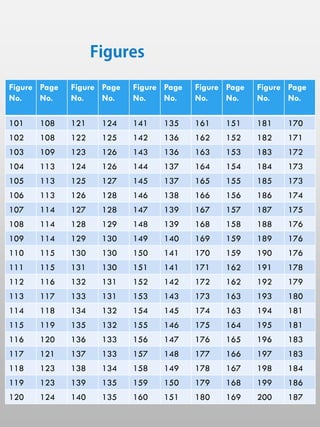
Page
No.
Figure
No.
Page
No.
Figure
No.
Page
No.
Figure
No.
Page
No.
Figure
No.
Page
No.
Figure
No.
94
81
73
61
48
41
21
21
1
1
94
82
83
62
54
42
24
22
2
2
95
83
83
63
55
43
27
23
3
3
97
84
84
64
55
44
28
24
3
4
97
85
84
65
56
45
29
25
3
5
98
86
85
66
57
46
30
26
4
6
98
87
85
67
58
47
34
27
5
7
99
88
86
68
59
48
35
28
6
8
100
89
87
69
59
49
36
29
6
9
100
90
88
70
60
50
36
30
8
10
101
91
89
71
61
51
37
31
9
11
102
92
89
72
62
52
38
32
10
12
102
93
89
73
63
53
39
33
11
13
102
94
90
74
66
54
41
34
13
14
103
95
91
75
67
55
42
35
14
15
104
96
91
76
68
56
44
36
16
16
104
97
92
77
69
57
47
37
17
17
105
98
93
78
69
58
47
38
18
18
105
99
93
79
70
59
47
39
19
19
106
100
94
80
72
60
48
40
19
20
Page
No.
Figure
No.
Page
No.
Figure
No.
Page
No.
Figure
No.
Page
No.
Figure
No.
Page
No.
Figure
No.
170
181
151
161
135
141
124
121
108
101
171
182
152
162
136
142
125
122
108
102
172
183
153
163
136
143
126
123
109
103
173
184
154
164
137
144
126
124
113
104
173
185
155
165
137
145
127
125
113
105
174
186
156
166
138
146
128
126
113
106
175
187
157
167
139
147
128
127
114
107
176
188
158
168
139
148
129
128
114
108
176
189
159
169
140
149
130
129
114
109
176
190
159
170
141
150
130
130
115
110
178
191
162
171
141
151
130
131
115
111
179
192
162
172
142
152
131
132
116
112
180
193
163
173
143
153
131
133
117
113
181
194
163
174
145
154
132
134
118
114
181
195
164
175
146
155
132
135
119
115
183
196
165
176
147
156
133
136
120
116
183
197
166
177
148
157
133
137
121
117
184
198
167
178
149
158
134
138
123
118
186
199
168
179
150
159
135
139
123
119
187
200
169
180
151
160
135
140
124
120
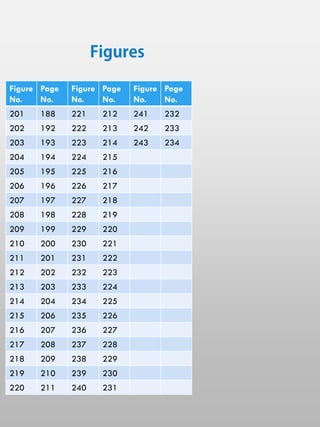
Page
No.
Figure
No.
Page
No.
Figure
No.
Page
No.
Figure
No.
232
241
212
221
188
201
233
242
213
222
192
202
234
243
214
223
193
203
215
224
194
204
216
225
195
205
217
226
196
206
218
227
197
207
219
228
198
208
220
229
199
209
221
230
200
210
222
231
201
211
223
232
202
212
224
233
203
213
225
234
204
214
226
235
206
215
227
236
207
216
228
237
208
217
229
238
209
218
230
239
210
219
231
240
211
220
Page No.
Table No.
7
1
31
2
76
3-1
77
3-2
78
3-3
80
4
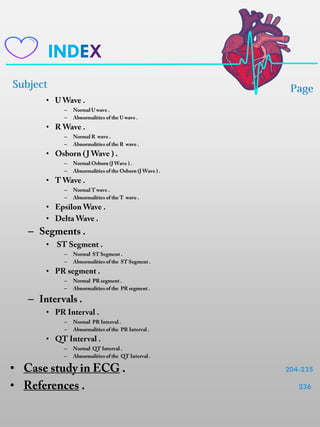
INDEX
•
– 1-9
•
•
•
•
•
– 10-13
•
– 14
– 15-21
•
–
–
–
•
– 22-23
•
– 24-31
•
•
•
•
•
•
•
INDEX
•
•
•
•
• 32-65
–
•
–
–
–
–
• 66-86
–
–
–
–
•
•
–
• 86-203
–
•
–
–
•
–
–
INDEX
•
–
–
•
–
–
•
–
–
•
–
–
•
•
–
•
–
–
•
–
–
–
•
–
–
•
–
–
• 204-235
• 236
This page intentionally left blank
A hollow muscular organ, pyramidal in shape , somewhat larger than a
closed fist , consists of four chambers (right and left atria, right and left
ventricles)
Structure of the Heart
The heart is enclosed in a pericardial sac that is lined with the parietal
layers of a serous membrane. The visceral layer of the serous membrane
forms the pericardium.
Layers of the Heart Wall
Three layers of tissue form the heart wall:
 The outer layer of the heart wall is the epicardium .
 the middle layer is the myocardium .
 the inner layer is the endocardium .
Principles
Of Cardiac Anatomy .
Figure No ( 1 )
Chambers of the Heart The internal cavity of the
heart is divided into four chambers:
 The Two Atria:
are thin-walled chambers that receive blood from the veins.
 The Two Ventricles :
are thick-walled chambers that forcefully pump blood out of the heart.
• Differences in thickness of the heart chamber walls are due to variations in
the amount of myocardium present, which reflects the amount of force each
chamber is required to generate.
 The Right Atrium :
receives deoxygenated blood from systemic veins .
 The Left Atrium:
receives oxygenated blood from the pulmonary veins.
The Heart
Principles
Of Cardiac Anatomy .
Structure of the Heart .
Figure No ( 2 )
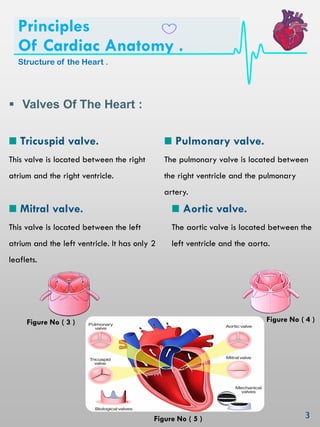
 Valves Of The Heart :
Aortic valve.
The aortic valve is located between the
left ventricle and the aorta.
Mitral valve.
This valve is located between the left
atrium and the left ventricle. It has only 2
leaflets.
Pulmonary valve.
The pulmonary valve is located between
the right ventricle and the pulmonary
artery.
Tricuspid valve.
This valve is located between the right
atrium and the right ventricle.
Principles
Of Cardiac Anatomy .
Structure of the Heart .
Figure No ( 3 ) Figure No ( 4 )
Figure No ( 5 )
Principles
Of Cardiac Anatomy .
Structure of the Heart .
Circulation of blood through the heart .
Figure No ( 6 )
PATHWAY OF BLOOD THROUGH THE HEART
Principles
Of Cardiac Anatomy .
Structure of the Heart .
Figure No ( 7 )
 Blood Supply To The Myocardium :
The major vessels of the coronary circulation are the
 Left Main Coronary : that divides into
 left anterior descending .
 circumflex branches .
 Right Main Coronary Artery :
The left and right coronary arteries originate at the base of the
aorta from openings called the coronary ostia located behind the
aortic valve leaflets
Principles
Of Cardiac Anatomy .
Structure of the Heart .
Figure No ( 8 ) Figure No ( 9 )
Nerves To The Heart Include:
Vagus nerve
Function: reducing the heart rate,
reducing the force of contraction of
the heart, vasoconstriction of the
coronary arteries
Parasympathetic Efferent
Fibers
Cardiac nerves from the lower
cervical and upper thoracic ganglia
Function: increasing heart rate,
increasing the force of contraction of
the myocardium
Sympathetic Efferent Fibers
Vagal cardiac nerves
Function: feedback on blood
pressure
Afferent Parasympathetic
Fibers
Afferents to upper thoracic and
lower cervical ganglia
Function: feedback on blood
pressure, pain sensation
Afferent Sympathetic Fibers
Cardiac plexus injury, referred pain
Clinical Relations
Principles
Of Cardiac Anatomy .
Structure of the Heart .
Innervation Of The Heart :
Table No. ( 1 )
Principles
Of Cardiac Anatomy .
Structure of the Heart .
Innervation Of The Heart :
Figure No ( 10 )
Principles
Of Cardiac Anatomy .
Structure of the Heart .
Figure No ( 11 )
Conducting System of the Heart :
The Cardiac Conduction System Is A Group Of Specialized Cardiac Muscle
Cells In The Walls Of The Heart That Send Signals To The Heart Muscle
Causing It To Contract
 Cardiac Muscle Tissue Has Intrinsic Ability To:
• Generate and conduct impulses
• Signal these cells to contract rhythmically
 Conducting system :
• A series of specialized cardiac muscle cells .
• Sino-atrial (SA) node sets the inherent rate of contraction .
Conduction System: [ SA AV Bundle Branch / Purkinje fibers.]
Anatomy
Of Conducting System .
Figure No ( 12 )
Anatomy
Of Conducting System .
Conducting System of the Heart.
Figure No ( 13 )

 Called the pacemaker cell (P cell)
 Located at the junction of right atrium and superior vena cava,
upper part of the sulcus terminalis, under the epicardium .

 Located in the lower part of inter-atrial septum just above the
orifice of coronary sinus, under the endocardium
 Lower part related to membranous part of inter-ventricular septum

 Passes forward through right fibrous trigon to reach inferior border
of membranous part .
 Divides into right and left branches at upper border of muscular
part of inter-ventricular septum

 are located in the inner ventricular walls of the heart, just beneath
the endocardium in a space called the subendocardium.
Anatomy
Of Conducting System .
Conducting System of the Heart.
Anatomy
Of Conducting System .
Conducting System of the Heart.
Figure No ( 14 )
Electrocardiography.
 Introduction to ECG :
An electrocardiogram also termed an ECG or EKG (K means kardia for heart in
Greek) or a 12 lead ECG. is a simple non-invasive test that records the heart's
electrical activity and the electrical signals that control heart rhythm. The test
measures how electrical impulses move through the heart muscle as it contracts and
relaxes.
 Electrocardiogram translates the heart's electrical activity into line tracings on
paper. The spikes and dips in the line tracings are called waves.
 It provides information about the function of the intra-cardiac conducting tissue
of the heart and reflects the presence of cardiac disease through its electrical
properties.
 Understanding ECG helps to understand how the heart works.
 With each heartbeat, an electrical impulse starts from the superior part of the
heart to the bottom. The impulse prompts the heart to contract and pumps blood.
 It was invented by a Dutch physician, William Einthoven in 1902.
Figure No ( 15 )
Parts of an ECG
 Electrodes and Leads
 ECG Paper
 Electrodes and Leads :
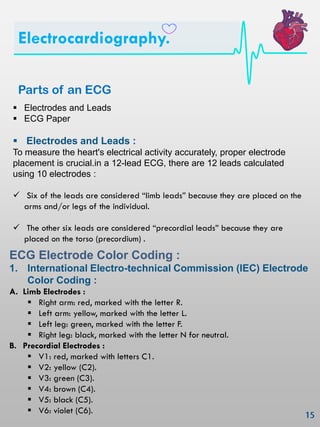
To measure the heart's electrical activity accurately, proper electrode
placement is crucial.in a 12-lead ECG, there are 12 leads calculated
using 10 electrodes :
 Six of the leads are considered ―limb leads‖ because they are placed on the
arms and/or legs of the individual.
 The other six leads are considered ―precordial leads‖ because they are
placed on the torso (precordium) .
Electrocardiography.
ECG Electrode Color Coding :
1. International Electro-technical Commission (IEC) Electrode
Color Coding :
A. Limb Electrodes :
 Right arm: red, marked with the letter R.
 Left arm: yellow, marked with the letter L.
 Left leg: green, marked with the letter F.
 Right leg: black, marked with the letter N for neutral.
B. Precordial Electrodes :
 V1: red, marked with letters C1.
 V2: yellow (C2).
 V3: green (C3).
 V4: brown (C4).
 V5: black (C5).
 V6: violet (C6).
Electrocardiography.
Parts of an ECG .
2. American Heart Association (AHA) Electrode Color Coding :
A. Limb Electrodes:
 Right arm: white, marked with letters RA.
 Left arm: black, marked with letters LA.
 Left leg: red, marked with the letter LL.
 Right leg: green, marked with the letter RL
B. Precordial Electrodes :
 V1: red, marked with letters V1.
 V2: yellow (V2).
 V3: green (V3).
 V4: blue (V4).
 V5: orang (V5).
 V6: purple (V6).
Figure No ( 16 )
 Chest (Precordial) Electrodes And Placement :
» V1 - Fourth intercostal space on the right sternum .
» V2 - Fourth intercostal space at the left sternum .
» V3 - Midway between placement of V2 and V4 .
» V4 - Fifth intercostal space at the mid-clavicular line .
» V5 - Anterior axillary line on the same horizontal level as V4 .
» V6 - Mid-axillary line on the same horizontal level as V4 and V5 .
Mid-clavicular line
Anterior axillary line
Mid-axillary line
Sternum
Manubrium
Sternal angel
Costal cartilage
Costal margin
Electrocardiography.
Parts of an ECG .
Figure No ( 17 )
 Limb (Extremity) Electrodes and Placement :
» RA (Right Arm) - Anywhere between the right shoulder and right elbow
» RL (Right Leg) - Anywhere below the right torso and above the right ankle
» LA(Left Arm) - Anywhere between the left shoulder and the left elbow
» LL (Left Leg) - Anywhere below the left torso and above the left ankle
Electrocardiography.
Parts of an ECG .
Figure No ( 18 )
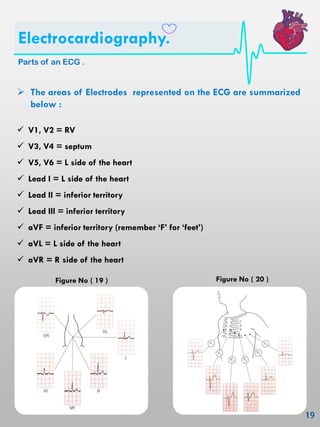
Figure No ( 19 )
Electrocardiography.
Parts of an ECG .
 The areas of Electrodes represented on the ECG are summarized
below :
 V1, V2 = RV
 V3, V4 = septum
 V5, V6 = L side of the heart
 Lead I = L side of the heart
 Lead II = inferior territory
 Lead III = inferior territory
 aVF = inferior territory (remember ‘F’ for ‘feet’)
 aVL = L side of the heart
 aVR = R side of the heart
Figure No ( 20 )
 Additional notes on 12-lead ECG Placement:
o The limb leads can also be placed on the upper arms and thighs.
However, there should be uniformity in your placement. For instance, do
not attach an electrode on the right wrist and one on the left upper arm.
o For female patients, place leads V3-V6 under the left breast.
o Do not use nipples as reference points in placing electrodes for both men
and women as nipple locations vary from one person to another.
o Always protect the patient‘s privacy and dignity by draping with a sheet
to minimize exposure.
o Lead placement and patient positioning should be the same for
subsequent ECGs on any individual patient.
o During the procedure, record any clinical signs (e.g. chest pain) in the
notes or on the ECG tracing itself.
Electrocardiography.
Parts of an ECG .
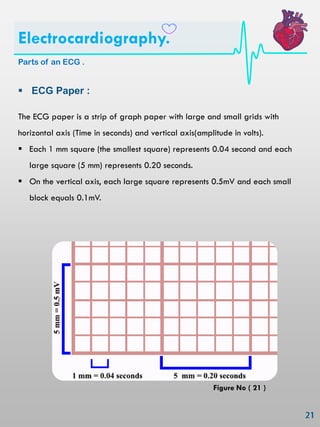
 ECG Paper :
The ECG paper is a strip of graph paper with large and small grids with
horizontal axis (Time in seconds) and vertical axis(amplitude in volts).
 Each 1 mm square (the smallest square) represents 0.04 second and each
large square (5 mm) represents 0.20 seconds.
 On the vertical axis, each large square represents 0.5mV and each small
block equals 0.1mV.
Electrocardiography.
Parts of an ECG .
Figure No ( 21 )
 Medical Uses :
The overall goal of performing an ECG is to obtain information about the
electrical function of the heart.
Electrocardiography.
Medical uses .
Electrocardiography.
Normal
Components of the ECG .
 P wave
 QRS complex
 T wave
 ST segment
 PR interval
 QT interval
 U wave
Normal Components of the ECG Waveform :
Figure No ( 22 )
 The first wave P wave :
represents atrial depolarization (ventricular filling)
 Q wave :
representing septal depolarization
 R wave:
representing ventricular depolarization
 S wave:
representing depolarization of the Purkinje fibers
 QRS complex :
is ventricular depolarization
 T wave :
is ventricular repolarization
 ST segment :
is a flat line any change shows myocardial infarction
 P wave, QRS complex, and T wave show the 3 phase of cardiac cycle in
one heart beat.
 after the PQRST complex a U wave, seen in electrolyte
imbalance(potassium)
Normal Components of the ECG Waveform .
Normal Components of the ECG .
 P wave :
• Indicates atrial depolarization, or contraction of the atrium.
• Normal duration is not longer than 0.11 seconds (less than 3 small
squares)
• Amplitude (height) is no more than 3 mm
• No notching or peaking
 QRS complex
• Indicates ventricular depolarization, or contraction of the ventricles.
• Normally not longer than .10 seconds in duration
• Amplitude is not less than 5 mm in lead II or 9 mm in V3 and V4
• R waves are deflected positively and the Q and S waves are
negative
 T wave
• Indicates ventricular repolarization
• Not more that 5 mm in amplitude in standard leads and 10 mm in
precordial leads
• Rounded and asymmetrical
Normal Components of the ECG Waveform .
Normal Components of the ECG .
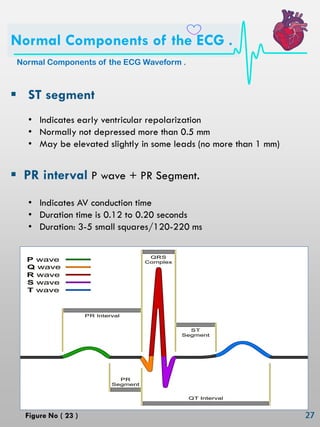
 ST segment
• Indicates early ventricular repolarization
• Normally not depressed more than 0.5 mm
• May be elevated slightly in some leads (no more than 1 mm)
 PR interval P wave + PR Segment.
• Indicates AV conduction time
• Duration time is 0.12 to 0.20 seconds
• Duration: 3-5 small squares/120-220 ms
Normal Components of the ECG Waveform .
Normal Components of the ECG .
Figure No ( 23 )
 QT interval
• Measured from the Q wave to the end of the T wave .
• Represents ventricular depolarization and repolarization (sodium influx
and potassium efflux)
• V3, V4 or lead II optimize the T-wave.
• QT usually less than half the R-R interval
• (0.32-0.40 seconds when rate is 65-90/minute)
• QT varies with rate. Correct for rate by dividing QT by the square root
of the RR interval.
o Normal corrected is < 0.46 for women and < 0.45 for men.
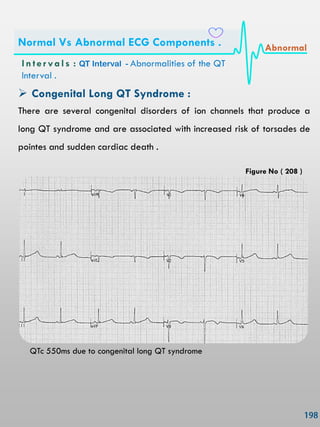
• Prolonged QT may be inherited or acquired (predisposes to long QT
syndrome and torsades de pointe)
• Inherited - defective sodium or potassium channels
• Acquired - drugs, electrolyte imbalance or MI
o Atleast, 50 drugs known to affect QT (including: quinidine,
amiodarone and dofetilide)
Normal Components of the ECG Waveform .
Normal Components of the ECG .
Figure No ( 24 )
Normal Components of the ECG Waveform .
Normal Components of the ECG .
Figure No ( 25 )
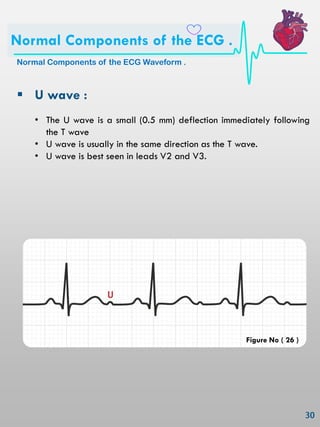
 U wave :
• The U wave is a small (0.5 mm) deflection immediately following
the T wave
• U wave is usually in the same direction as the T wave.
• U wave is best seen in leads V2 and V3.
Normal Components of the ECG Waveform .
Normal Components of the ECG .
Figure No ( 26 )
ST Segment
QRS
Complex
PR Interval
P Wave
Interval between
ventricular
depolarization
and
repolarization
Ventricular
depolarizatio
n
atrial
depolarization
and
delay at the AV
Node
(AV conduction
time)
Atrial
depolarization
Represents
Measure from
end of
QRS (J-point) to
beginning of T
wave
0.06 - 0.11
seconds
0.11 - 0.20
seconds
< 0.12
seconds
Duration
Q- First
negative
deflection
R- First
positive
deflection
S- Negative
deflection
after R wave
Measure start
of P wave
to start of QRS
< 2.5 mm
Height
In relation to
isoelectric line:
Depression/Neg
ative
indicates
ischemia
Elevation/Positiv
e
indicates injury
Prolonged
indicates a
conduction block
Shortened
indicates
accelerated
conduction or
junctional in
origin
Smooth
Shape
Positive in
Leads
I, II, aVF, V4
Negative in
aVR
Orientation
SUMMARY
Normal Components of the ECG Waveform .
Normal Components of the ECG .
Table No. ( 2 )
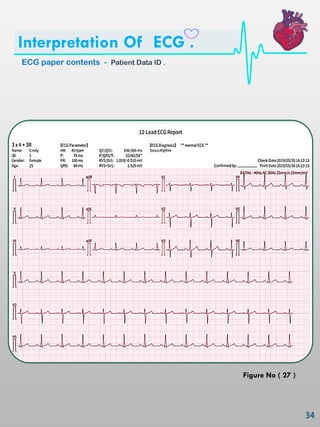
1. Patient Data ID :
A. Name
B. Age
C. Gender
D. Date
E. Time
F. Machine Diagnosis ( not all modalities )
2. Blood Pressure ( not all modalities )
3. Parameters Values :
A. Standard Calibration And Speed Of Paper
B. Heart Rate
C. Heart Rhythm
D. Electrical Heart Axis
4. 12 lead Waveform Data :
• I . II. III
• aVR, aVL, and aVF
• V1. V2 . V3 . V4 . V5 . V6
Interpretation Of
ECG .
ECG Paper Data Content
Patient Data ID :
• Patient‘s name, date of birth and hospital number .
• Location .
• This becomes important as in the ED or acute medical setting doctors are often
shown multiple ECGs. You need to know where your patient is in order to
ensure that they can be moved to a higher dependency area if appropriate.
• When was the ECG done?
• The time
• The number of the ECG if it is one of a series
• If you are concerned that there are dynamic changes in an ECG it is helpful to
ask for serial ECGs (usually three ECGs recorded 10 minutes apart) so they
can be compared. These should always be labelled 1, 2 and 3.
• Did the patient have chest pain at the time?
• Or other relevant clinical details. For example, if you are wanted an ECG to
look for changes of hyperkalemia, note the patient‘s potassium level on the
ECG.
ECG paper contents - Patient Data ID .
Interpretation Of ECG .
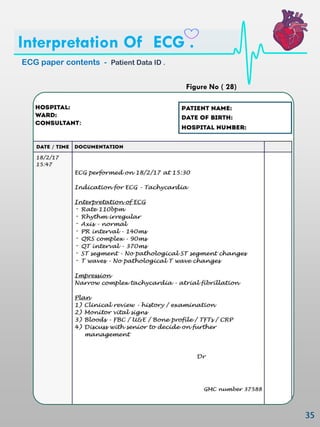
Figure No ( 27 )
ECG paper contents - Patient Data ID .
Interpretation Of ECG .
ECG paper contents - Patient Data ID .
Interpretation Of ECG .
Figure No ( 28)
A. Standard Calibration And Speed Of Paper
 Standardization: full standard is two large squares (1 mV, 10 mm)
and half standard is one large square (0.5mV, 5 mm)
 Paper speed: The standard paper speed is 25 mm (5 large
squares)/sec. This means that if the interval between two beats (R-R)
is 5 large squares, the HR is 60 beat/min.
Figure No ( 29 ) Figure No ( 30 )
Parameters Values :
ECG paper contents - Parameters Values - Standard
Calibration And Speed Of Paper .
Interpretation Of ECG .
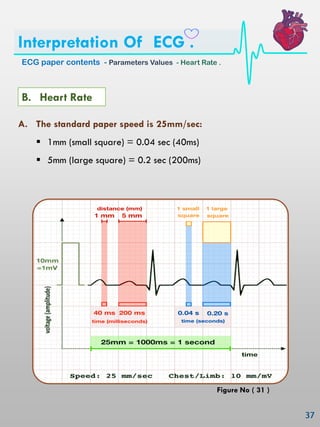
A. The standard paper speed is 25mm/sec:
 1mm (small square) = 0.04 sec (40ms)
 5mm (large square) = 0.2 sec (200ms)
B. Heart Rate
Figure No ( 31 )
ECG paper contents - Parameters Values - Heart Rate .
Interpretation Of ECG .
B. Paper speed: 50mm/sec :
 1mm (small square) = 0.02 sec (20ms)
 5mm (large square) = 0.1 sec (100ms)
ECG paper contents - Parameters Values - Heart Rate .
Interpretation Of ECG .
Figure No ( 32 )
 HR ( Heart Rate )
• Number of P‘s (atrial) R‘s (ventricular) per minute (6 second [30
squares] X 10 = minute rate).
• 1500/No of small squares (or)
• 300/No of large squares:
 The HR may be counted by simply dividing 300 by the number of
the large squares between two heart beats (R-R).
 If the interval between two beats is one large square, the HR is 300
beat/min, 2 squares →150, 3 squares →100, 4 squares → 75, 5
squares → 60, 6 squares → 50 beat/min.
ECG paper contents - Parameters Values - Heart Rate .
Interpretation Of ECG .
Figure No ( 33 )
Estimate the rate :
 REGULAR rhythms :
 Rate = 300 / number of LARGE squares between consecutive R waves.
 Very FAST rhythms:
 Rate = 1500 / number of SMALL squares between consecutive R waves.
 SLOW or IRREGULAR rhythms:
 Rate = Number of R waves X 6
 The number of complexes (count R waves) on the rhythm strip gives the
average rate over a ten-second period. This is multiplied by 6 (10
seconds x 6 = 1 minute) to give the average Beats per minute (bpm)
ECG paper contents - Parameters Values - Heart Rate .
Interpretation Of ECG .
Estimate the rate :
 Example of 1500 (small squares) versus 300 (large square) method
ECG paper contents - Parameters Values - Heart Rate .
Interpretation Of ECG .
Figure No ( 34 )
Estimate the rate :
 Now adding the R wave (10 second rhythm strip)
Note:
Calculate atrial and ventricular rates separately if they are different (e.g. complete
heart block) .
Atrial Rate By ( P ) Wave Ventricular Rate By ( R ) Wave
ECG paper contents - Parameters Values - Heart Rate .
Interpretation Of ECG .
Figure No ( 35 )
 Interpretation (adults) :
 Normal: 60–100 beats/min
 Tachycardia: >100 beats/min
 Bradycardia: <60 beats/min
 Interpretation ( Children ) :
 Newborn: 110 – 150 bpm
 2 years: 85 – 125 bpm
 4 years: 75 – 115 bpm
 6 years+: 60 – 100 bpm
ECG paper contents - Parameters Values - Heart Rate .
Interpretation Of ECG .
 Between R-R ( Must Compare Between 3-4 Cycles) (Big Square)
 Rhythm = Regular Or Irregular. Map P-P And R-R Intervals.
C. Heart Rhythm
Rhythm:
 The cardiac myocytes have an inherent automaticity and can generate
an electric impulse.
 The SA nodal cells have the fastest automaticity (pacemaker) and
hence control the heart rate and rhythm.
 There are 4 levels of conductions and potential pacemakers in the
heart from fastest to slowest: SA node → atria → AV node →
ventricles.
 If the rhythm is not sinus, we have to determine the origin of the
pacemaker and where the impulse is initiated.
ECG paper contents - Parameters Values - Heart Rhythm .
Interpretation Of ECG .
Figure No ( 36 )
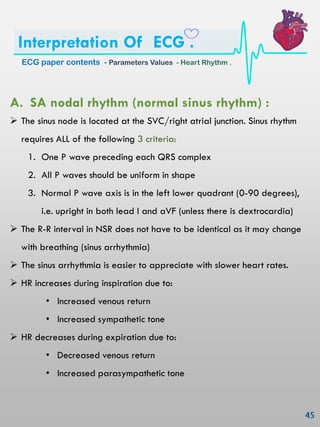
A. SA nodal rhythm (normal sinus rhythm) :
 The sinus node is located at the SVC/right atrial junction. Sinus rhythm
requires ALL of the following 3 criteria:
1. One P wave preceding each QRS complex
2. All P waves should be uniform in shape
3. Normal P wave axis is in the left lower quadrant (0-90 degrees),
i.e. upright in both lead I and aVF (unless there is dextrocardia)
 The R-R interval in NSR does not have to be identical as it may change
with breathing (sinus arrhythmia)
 The sinus arrhythmia is easier to appreciate with slower heart rates.
 HR increases during inspiration due to:
• Increased venous return
• Increased sympathetic tone
 HR decreases during expiration due to:
• Decreased venous return
• Increased parasympathetic tone
ECG paper contents - Parameters Values - Heart Rhythm .
Interpretation Of ECG .
B. Atrial Rhythm :
 Characterized by narrow QRS complexes preceded by P waves that do
not fulfill one or more of the normal sinus rhythm (NSR) criteria mentioned
earlier.
 If the P wave morphology changes, this may indicate a multifocal origin
which is called "wandering pacemaker―
C. AV Nodal Or Junctional Rhythm :
 Characterized by narrow QRS complexes that are not preceded by P
waves.
 An inverted P wave may be seen following the QRS due to retrograde
conduction
D. Ventricular rhythm :
 Characterized by wide QRS complexes that are not preceded by P
waves.
If the sinus node fails to initiate the impulse, an atrial focus will take over as
the pacemaker, which is usually slower than the NSR. When the atrial focus
fails, the AV node will take over. Subsequently, if the AV node fails, the
ventricular focus, which is the slowest, will take over as a pacemaker. Each
time the focus is downgraded, the heart rate becomes slower based on the
inherent automaticity of the pacemaker.
ECG paper contents - Parameters Values - Heart Rhythm .
Interpretation Of ECG .
ECG paper contents - Parameters Values - Heart Rhythm .
Interpretation Of ECG .
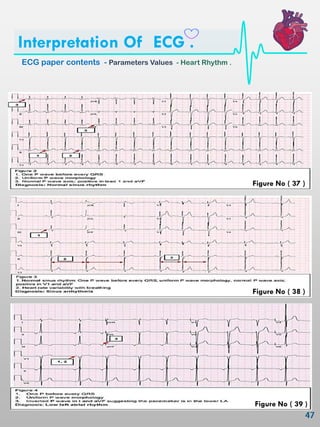
Figure No ( 37 )
Figure No ( 38 )
Figure No ( 39 )
ECG paper contents - Parameters Values - Heart Rhythm .
Interpretation Of ECG .
Figure No ( 40 )
Figure No ( 41 )
ECG Rhythm Evaluation
The rhythm is best analyzed by looking at a rhythm strip. On a 12 lead ECG this is
usually a 10 second recording from Lead II.
 7 step approach to ECG rhythm analysis :
1. Rate
• Tachycardia or bradycardia?
• Normal rate is 60-100/min.
2. Pattern of QRS complexes
• Regular or irregular?
• If irregular is it regularly irregular or irregularly irregular?
3. QRS morphology
• Narrow complex: sinus, atrial or junctional origin.
• Wide complex: ventricular origin, or supraventricular with aberrant
conduction.
4. P waves
• Absent: sinus arrest, atrial fibrillation
• Present: morphology and PR interval may suggest sinus, atrial, junctional or
even retrograde from the ventricles.
ECG paper contents - Parameters Values - Heart Rhythm .
Interpretation Of ECG .
5. Relationship between P waves and QRS complexes
• AV association (may be difficult to distinguish from isorhythmic dissociation)
• complete: atrial and ventricular activity is always independent.
• incomplete: intermittent capture.
6. Onset and termination
• Abrupt: suggests re-entrant process.
• Gradual: suggests increased automaticity.
7. Response to vagal manoeuvres
• Sinus tachycardia, ectopic atrial tachydysrhythmia: gradual slowing during
the vagal manoeuvre, but resumes on cessation.
• AVNRT or AVRT: abrupt termination or no response.
• Atrial fibrillation and atrial flutter: gradual slowing during the manoeuvre.
• VT: no response.
ECG paper contents - Parameters Values - Heart Rhythm .
Interpretation Of ECG .
Differential Diagnosis:
Narrow Complex (Supraventricular) Tachycardia .
1. ATRIAL – REGULAR
• Sinus tachycardia
• Atrial tachycardia
• Atrial flutter
• Inappropriate sinus tachycardia
• Sinus node re-entrant tachycardia
2. ATRIAL – IRREGULAR
• Atrial fibrillation
• Atrial flutter with variable block
• Multifocal atrial tachycardia
3. ATRIOVENTRICULAR
• Atrioventricular re-entry tachycardia (AVRT)
• AV nodal re-entry tachycardia (AVNRT)
• Automatic junctional tachycardia
ECG paper contents - Parameters Values - Heart Rhythm .
Interpretation Of ECG .
Broad Complex Tachycardia (BCT)
1. REGULAR BCT
• Ventricular tachycardia
• Antidromic atrioventricular re-entry tachycardia (AVRT).
• Any regular supraventricular tachycardia with aberrant conduction
— e.g. due to bundle branch block, rate-related aberrancy.
2. IRREGULAR
• Ventricular fibrillation
• Polymorphic VT
• Torsades de Pointes
• AF with Wolff-Parkinson-White syndrome
• Any irregular supraventricular tachycardia with aberrant conduction
— e.g. due to bundle branch block, rate-related aberrancy.
ECG paper contents - Parameters Values - Heart Rhythm .
Interpretation Of ECG .
2. IRREGULAR :
• Bradycardia
 P Waves Present :
I. Every P wave is followed by a QRS complex (= sinus node
dysfunction)
 Sinus bradycardia
 Sinus node exit block
 Sinus pause / arrest
II. Not every P wave is followed by a QRS complex (= AV node
dysfunction)
 AV block: 2nd degree, Mobitz I (Wenckebach)
 AV block: 2nd degree, Mobitz II (Hay)
 AV block: 2nd degree, ―fixed ratio blocks‖ (2:1, 3:1)
 AV block: 2nd degree, ―high grade AV block‖
 AV block: 3rd degree (complete heart block)
 P Waves Absent :
 Narrow complex: Junctional escape rhythm
 Broad complex: Ventricular escape rhythm
For escape rhythms to occur there must be a failure of sinus node impulse
generation or transmission by the AV node.
ECG paper contents - Parameters Values - Heart Rhythm .
Interpretation Of ECG .
Axis Of ECG
• Determine both P wave and QRS axes. The net summation of
positive and negative deflection is used to determine the axis. Look
for two perpendicular leads (usually lead I and aVF) to determine in
which quadrant the axis is located.
• The axis of the ECG is the major direction of the overall electrical
activity of the heart.
 It can be :
 Normal (normal axis deviation)
 leftward (left axis deviation, or LAD)
 rightward (right axis deviation, or RAD)
 indeterminate (northwest axis).
D. Electrical Heart Axis
ECG paper contents - Parameters Values - Heart Axis .
Interpretation Of ECG .
Figure No ( 42 )
Method 1 – The Quadrant Method
The most efficient way to estimate axis is to look at LEAD I and LEAD aVF.
Examine the QRS complex in each lead and determine if it is:
 Positive
 Isoelectric (Equiphasic)
 Negative:
As Explained In The Figure
ECG paper contents - Parameters Values - Heart Axis .
Interpretation Of ECG .
Figure No ( 43 )
Figure No ( 45 )
 A positive QRS in Lead I puts the axis in roughly the same direction as
lead I.
 A positive QRS in Lead aVF similarly aligns the axis with lead aVF.
 Combining both coloured areas – the quadrant of overlap determines the
axis. So If Lead I and aVF are both positive, the axis is between 0° and
+90° (i.e. normal axis).
ECG paper contents - Parameters Values - Heart Axis .
Interpretation Of ECG .
Figure No ( 46 )
Method 2: Three Lead Analysis (Lead I, Lead II And Avf)
Next we add in Lead II to the analysis of Lead I and aVF
 A positive QRS in Lead I puts the axis in roughly the same direction as
lead I.
 A positive QRS in Lead II similarly aligns the axis with lead II.
 We can then combine both coloured areas and the area of overlap
determines the axis. So If Lead I and II are both positive, the axis is
between -30° and +90° (i.e. normal axis).
ECG paper contents - Parameters Values - Heart Axis .
Interpretation Of ECG .
Figure No ( 47 )
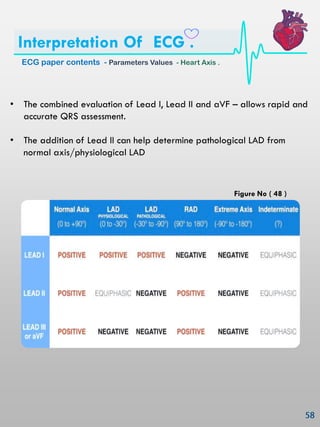
• The combined evaluation of Lead I, Lead II and aVF – allows rapid and
accurate QRS assessment.
• The addition of Lead II can help determine pathological LAD from
normal axis/physiological LAD
ECG paper contents - Parameters Values - Heart Axis .
Interpretation Of ECG .
Figure No ( 48 )
Method 3 – The Isoelectric Lead
This method allows a more precise estimation of QRS axis, using the
axis diagram below.
 Key Principles :
 If the QRS is POSITIVE in any given lead, the axis points in roughly the
same direction as this lead.
 If the QRS is NEGATIVE in any given lead, the axis points in roughly the
opposite direction to this lead.
 If the QRS is ISOELECTRIC (equiphasic) in
any given lead (positive deflection = negative
deflection), the axis is at 90° to this lead
ECG paper contents - Parameters Values - Heart Axis .
Interpretation Of ECG .
Figure No ( 49 )
Example 1
Answer – Lead I, II, aVF (Three Lead method )
• Lead I = POSITIVE
• Lead II = POSITIVE
• aVF = POSITIVE
• This puts the axis in the quadrant between 0° and +90° – i.e. normal
axis
Answer – Isoelectric Lead Method
• From the diagram above, we can see that aVL is located at -30°.
• The QRS axis must be ± 90° from lead aVL, either at +60° or -120°
• With leads I (0), II (+60) and aVF (+90) all being positive, we know that
the axis must lie somewhere between 0 and +90°.
• This puts the QRS axis at +60° – i.e. normal axis
ECG paper contents - Parameters Values - Heart Axis .
Interpretation Of ECG .
Figure No ( 50 )
Answer – Quadrant Method
 Lead I = NEGATIVE
 Lead II = Equiphasic
 Lead aVF = POSITIVE
 This puts the axis in the quadrant, between +90° and +180°, i.e. RAD.
Answer – Isoelectric Lead Method
 Lead II (+60°) is the isoelectric lead.
 The QRS axis must be ± 90° from lead II, at either +150° or -30°.
 The more rightward-facing leads III (+120°) and aVF (+90°) are positive,
while aVL (-30°) is negative.
 This puts the QRS axis at +150°
Example 2
ECG paper contents - Parameters Values - Heart Axis .
Interpretation Of ECG .
Figure No ( 51 )
Answer – Quadrant Method
• Lead I = POSITIVE
• Lead II = Equiphasic
• Lead aVF = NEGATIVE
• This puts the axis in the quadrant between 0° and -90°, i.e. normal or LAD.
• Lead II is neither positive nor negative (isoelectric), indicating physiological
LAD
Answer – Isoelectric Lead Method
• Lead II (+60°) is isoelectric.
• The QRS axis must be ± 90° from lead II, at either +150° or -30°.
• The more leftward-facing leads I (0°) and aVL (-30°) are positive, while
lead III (+120°) is negative.
• This confirms that the axis is at -30°.
Example 3
ECG paper contents - Parameters Values - Heart Axis .
Interpretation Of ECG .
Figure No ( 52 )
Answer – Quadrant Method
• Lead I = NEGATIVE
• Lead II = NEGATIVE
• Lead aVF = NEGATIVE
• This puts the axis in the upper right quadrant, between -90° and 180°,
i.e. extreme axis deviation.
Answer – Isoelectric Lead Method
• The most isoelectric lead is aVL (-30°).
• The QRS axis must be at ± 90° from aVL at either +60° or -120°.
• Lead aVR (-150°) is positive, with lead II (+60°) negative.
• This puts the axis at -120°.
Example 4
ECG paper contents - Parameters Values - Heart Axis .
Interpretation Of ECG .
Figure No ( 53 )
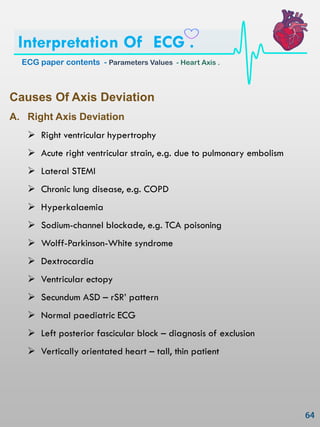
Causes Of Axis Deviation
A. Right Axis Deviation
 Right ventricular hypertrophy
 Acute right ventricular strain, e.g. due to pulmonary embolism
 Lateral STEMI
 Chronic lung disease, e.g. COPD
 Hyperkalaemia
 Sodium-channel blockade, e.g. TCA poisoning
 Wolff-Parkinson-White syndrome
 Dextrocardia
 Ventricular ectopy
 Secundum ASD – rSR‘ pattern
 Normal paediatric ECG
 Left posterior fascicular block – diagnosis of exclusion
 Vertically orientated heart – tall, thin patient
ECG paper contents - Parameters Values - Heart Axis .
Interpretation Of ECG .
B. Left Axis Deviation
 Left ventricular hypertrophy
 Left bundle branch block
 Inferior MI
 Ventricular pacing /ectopy
 Wolff-Parkinson-White Syndrome
 Primum ASD – rSR‘ pattern
 Left anterior fascicular block – diagnosis of exclusion
 Horizontally orientated heart – short, squat patient
C. Extreme Axis Deviation
 Ventricular rhythms – e.g.VT, AIVR, ventricular ectopy
 Hyperkalaemia
 Severe right ventricular hypertrophy
ECG paper contents - Parameters Values - Heart Axis .
Interpretation Of ECG .
The ECG is one of the most useful investigations in medicine. Electrodes
attached to the chest and/or limbs record small voltage changes as
potential difference, which is transposed into a visual tracing
 Basic landmarks
ECG Lead Positioning
ECG Lead Positioning.
Figure No ( 54 )
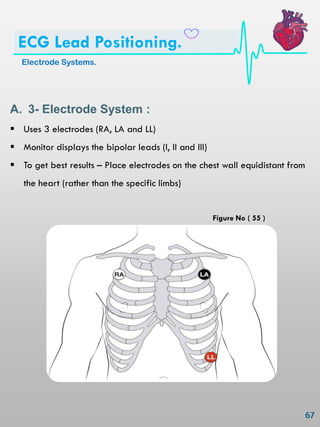
A. 3- Electrode System :
 Uses 3 electrodes (RA, LA and LL)
 Monitor displays the bipolar leads (I, II and III)
 To get best results – Place electrodes on the chest wall equidistant from
the heart (rather than the specific limbs)
Electrode Systems.
ECG Lead Positioning.
Figure No ( 55 )
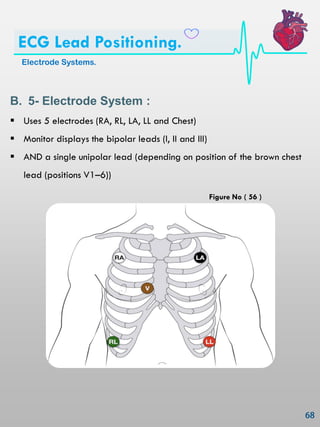
B. 5- Electrode System :
 Uses 5 electrodes (RA, RL, LA, LL and Chest)
 Monitor displays the bipolar leads (I, II and III)
 AND a single unipolar lead (depending on position of the brown chest
lead (positions V1–6))
Electrode Systems.
ECG Lead Positioning.
Figure No ( 56 )
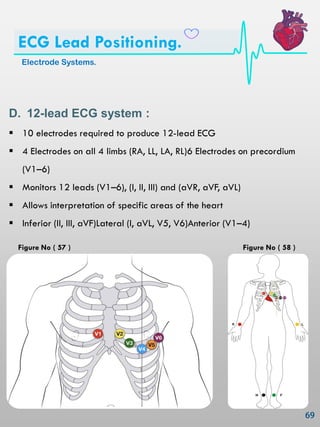
D. 12-lead ECG system :
 10 electrodes required to produce 12-lead ECG
 4 Electrodes on all 4 limbs (RA, LL, LA, RL)6 Electrodes on precordium
(V1–6)
 Monitors 12 leads (V1–6), (I, II, III) and (aVR, aVF, aVL)
 Allows interpretation of specific areas of the heart
 Inferior (II, III, aVF)Lateral (I, aVL, V5, V6)Anterior (V1–4)
Electrode Systems.
ECG Lead Positioning.
Figure No ( 57 ) Figure No ( 58 )
12-lead Precordial lead placement : as mentioned previously
 V1: 4th intercostal space (ICS), RIGHT margin of the sternum
 V2: 4th ICS along the LEFT margin of the sternum
 V4: 5th ICS, mid-clavicular line
 V3: midway between V2 and V4
 V5: 5th ICS, anterior axillary line (same level as V4)
 V6: 5th ICS, mid-axillary line (same level as V4)
Electrode Systems.
ECG Lead Positioning.
Figure No ( 59 )
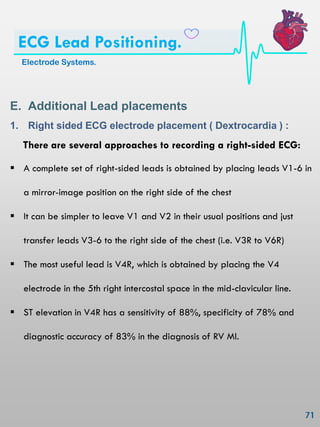
E. Additional Lead placements
1. Right sided ECG electrode placement ( Dextrocardia ) :
There are several approaches to recording a right-sided ECG:
 A complete set of right-sided leads is obtained by placing leads V1-6 in
a mirror-image position on the right side of the chest
 It can be simpler to leave V1 and V2 in their usual positions and just
transfer leads V3-6 to the right side of the chest (i.e. V3R to V6R)
 The most useful lead is V4R, which is obtained by placing the V4
electrode in the 5th right intercostal space in the mid-clavicular line.
 ST elevation in V4R has a sensitivity of 88%, specificity of 78% and
diagnostic accuracy of 83% in the diagnosis of RV MI.
Electrode Systems.
ECG Lead Positioning.
Electrode Systems.
ECG Lead Positioning.
Figure No ( 60 )
2. Posterior leads :
Leads V7-9 are placed on the posterior chest wall in the following
positions:
 V7 – Left posterior axillary line, in the same horizontal plane as V6.
 V8 – Tip of the left scapula, in the same horizontal plane as V6.
 V9 – Left paraspinal region, in the same horizontal plane as V6.
Electrode Systems.
ECG Lead Positioning.
Figure No ( 61 )
ECG Artifact:
Electrocardiograph (ECG) artifacts are defined as ECG abnormalities, which are a
measurement of cardiac potentials on the body surface and are not related to
electrical activity of the heart.
 As a result of artifacts, normal components of the ECG can be distorted.
 It is very important to recognize these artifacts, otherwise they can lead to
unnecessary testing and therapeutic interventions. In this chapter, we will present
the common causes and ways to characterize ECG artifacts.
Causes of ECG artifact :
ECG artifacts can be generated by internal and external causes
A. Internal
These are physiological causes that could be due to:
 Patient's motion: Does not allow electronic filtration (large swings, usually by
epidermal stretching).
• Tremors and shivering cause motion artifacts.
• Simple movements such as brushing and combing the hair can produce ECG
disturbances during ambulatory ECG monitoring.
 Muscular activity: Allows electronic filtration (small spikes)
ECG Artifact .
ECG Lead Positioning.
B. External
These are non-physiological causes associated with other electrical devices
attached to or implanted (e.g. deep brain stimulator) in the body and includes the
following :
 Electromagnetic interference:
• Power line electrical disturbances/ Light fixtures
• Electro-cautery
• Electrical devices in the room
• Radiofrequency based commercial (e.g. mobile phones) products
 Cable and electrode malfunction:
• Insufficient electrode gel
• Misplaced leads
• Inappropriate filter settings
• Broken wires
• Loose connections
• Accumulation of static energy
 Medical equipment's:
In operation theatres and intensive care unit various equipment's can affect ECG
monitoring system (e.g. electrodes, leads, amplifier, filters)
ECG Artifact .
ECG Lead Positioning.
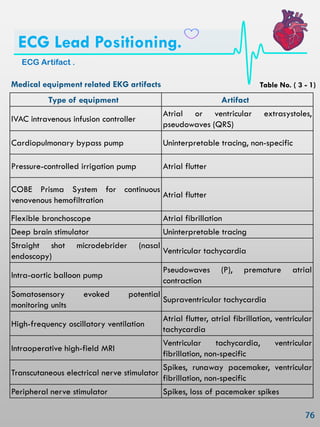
Type of equipment Artifact
IVAC intravenous infusion controller
Atrial or ventricular extrasystoles,
pseudowaves (QRS)
Cardiopulmonary bypass pump Uninterpretable tracing, non-specific
Pressure-controlled irrigation pump Atrial flutter
COBE Prisma System for continuous
venovenous hemofiltration
Atrial flutter
Flexible bronchoscope Atrial fibrillation
Deep brain stimulator Uninterpretable tracing
Straight shot microdebrider (nasal
endoscopy)
Ventricular tachycardia
Intra-aortic balloon pump
Pseudowaves (P), premature atrial
contraction
Somatosensory evoked potential
monitoring units
Supraventricular tachycardia
High-frequency oscillatory ventilation
Atrial flutter, atrial fibrillation, ventricular
tachycardia
Intraoperative high-field MRI
Ventricular tachycardia, ventricular
fibrillation, non-specific
Transcutaneous electrical nerve stimulator
Spikes, runaway pacemaker, ventricular
fibrillation, non-specific
Peripheral nerve stimulator Spikes, loss of pacemaker spikes
Medical equipment related EKG artifacts
ECG Artifact .
ECG Lead Positioning.
Table No. ( 3 - 1)
Type of equipment Artifact
Cardiopulmonary bypass pump Uninterpretable tracing, non-specific
COBE Prisma System for continuous
venovenous hemofiltration
Atrial flutter
Deep brain stimulator Uninterpretable tracing
Flexible bronchoscope Atrial fibrillation
High-frequency oscillatory ventilation
Atrial flutter, atrial fibrillation, ventricular
tachycardia
Intra-aortic balloon pump
Pseudowaves (P), premature atrial
contraction
Intraoperative high-field MRI
Ventricular tachycardia, ventricular
fibrillation, non-specific
IVAC intravenous infusion controller
Atrial or ventricular extrasystoles,
pseudowaves (QRS)
Peripheral nerve stimulator Spikes, loss of pacemaker spikes
Pressure-controlled irrigation pump Atrial flutter
Somatosensory evoked potential
monitoring units
Supraventricular tachycardia
Straight shot microdebrider (nasal
endoscopy)
Ventricular tachycardia
Transcutaneous electrical nerve stimulator
Spikes, runaway pacemaker, ventricular
fibrillation, non-specific
ECG Artifact .
ECG Lead Positioning.
Table No. ( 3 – 2 )
Type of equipment Artifact
Straight shot micro-debrider (nasal
endoscopy)
Ventricular tachycardia
Somatosensory evoked potential
monitoring units
Supraventricular tachycardia
Pressure-controlled irrigation pump Atrial flutter
Peripheral nerve stimulator Spikes, loss of pacemaker spikes
IVAC intravenous infusion controller
Atrial or ventricular extrasystoles,
pseudowaves (QRS)
Intraoperative high-field MRI
Ventricular tachycardia, ventricular
fibrillation, non-specific
Intra-aortic balloon pump
Pseudowaves (P), premature atrial
contraction
High-frequency oscillatory ventilation
Atrial flutter, atrial fibrillation, ventricular
tachycardia
Flexible bronchoscope Atrial fibrillation
Deep brain stimulator Uninterpretable tracing
ECG Artifact .
ECG Lead Positioning.
Table No. ( 3 – 3 )
Differentiating an Artifact from Ventricular tachycardia :
Sometimes, ECG changes may mimic specific arrhythmias like ventricular
tachycardia and atrial flutter or fibrillation. It is important to differentiate these, as
misdiagnosis can lead to inadvertent use of medications and procedures in such a
patient .
Characteristics that can help in differentiate an artifact from ventricular
tachycardia include :
 Absence of hemodynamic deterioration during the event.
 Normal QRS complexes within the artifact.
 An unstable baseline on the ECG before the event, after the event, or both.
 Association with bodily movement.
Presence of any of these signs is suggestive of pseudo-ventricular tachycardia:
o "Sinus" sign: One of the frontal leads (I, II and III) may present with sinus
rhythm showing normal P, QRS, and T waves. The reason is that one of the
upper limbs may be free off tremor.
o "Spike" sign: Presence of regular or irregular tiny spikes among wide-QRS
complexes.
o "Notch" sign: Notches superimposed in the wide-QRS-like complex
artifact, coinciding with the cycle length when sinus rhythm was recorded.
ECG Artifact .
ECG Lead Positioning.
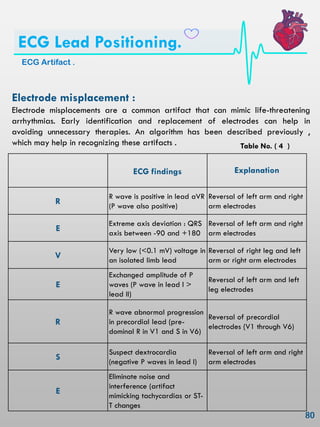
Electrode misplacement :
Electrode misplacements are a common artifact that can mimic life-threatening
arrhythmias. Early identification and replacement of electrodes can help in
avoiding unnecessary therapies. An algorithm has been described previously ,
which may help in recognizing these artifacts .
ECG findings Explanation
R
R wave is positive in lead aVR
(P wave also positive)
Reversal of left arm and right
arm electrodes
E
Extreme axis deviation : QRS
axis between -90 and +180
Reversal of left arm and right
arm electrodes
V
Very low (<0.1 mV) voltage in
an isolated limb lead
Reversal of right leg and left
arm or right arm electrodes
E
Exchanged amplitude of P
waves (P wave in lead I >
lead II)
Reversal of left arm and left
leg electrodes
R
R wave abnormal progression
in precordial lead (pre-
dominal R in V1 and S in V6)
Reversal of precordial
electrodes (V1 through V6)
S
Suspect dextrocardia
(negative P waves in lead I)
Reversal of left arm and right
arm electrodes
E
Eliminate noise and
interference (artifact
mimicking tachycardias or ST-
T changes
ECG Artifact .
ECG Lead Positioning.
Table No. ( 4 )
Other Common Artifacts :
 Electrodes on the torso: Placement of the electrodes on torso may lead to a
change in vectors and produce pseudo-Q waves and pseudo-ST segment
elevation, mimicking myocardial infarction.
 Telemetry interference: Superimposition of telemetry electrodes over the ECG
electrodes or vice versa may cause ST segment deviation due to
electromagnetic interference.
 Loose wire: Straight line may resemble systole and a wavy line may resemble
fibrillation. However, it will be limited to one or two leads only.
 Tall T wave: A tall T wave may be mistaken for an R wave and the digital
heart rate would be higher than the actual pulse rate.
 Lead placement: Obscuring of P waves may resemble a heart block.
 Motion artifact: Chest percussions or physiotherapy may mimic ventricular
fibrillation.
ECG Artifact .
ECG Lead Positioning.
Correction OF ECG Artifact :
• Attention to basic principles such as proper electrodes placement and lead
connections (as mentioned above) is required during ECG monitoring.
• Well designed and maintained ECG measurement devices can withstand routine
internal or external electrical and motion-related disturbances. However, it is not
always possible to eliminate artifacts completely.
• It is essential that physicians keep high vigilance and interpret EKG keeping
artifacts in their differential diagnosis list.
A slight ECG artifact is not uncommon. However, you can reduce further
interference through the following steps:
 Switch off non-essential electrical devices and equipment within the vicinity if
possible.
 Check for cable loops and avoid running cables adjacent to metallic objects as
they can affect the signal.
 Inspect wires and cables for cracks or breaks. Replace as needed.
 If possible, use surge suppressors with the power supply.
 Ensure that filters and preamplifiers are appropriately adjusted.
 Ensure securely connection between patient cable and the ECG device. Double
check for gaps between connectors
ECG Artifact .
ECG Lead Positioning.
Examples of Artifacts :
Movement artifacts
Increasing movement artifacts in a Parkinson patient.
ECG Artifact .
ECG Lead Positioning.
Figure No ( 62 )
Figure No ( 63 )
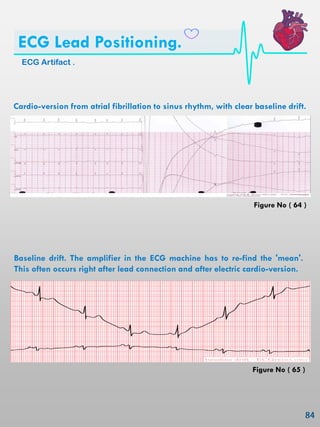
Cardio-version from atrial fibrillation to sinus rhythm, with clear baseline drift.
Baseline drift. The amplifier in the ECG machine has to re-find the 'mean'.
This often occurs right after lead connection and after electric cardio-version.
ECG Artifact .
ECG Lead Positioning.
Figure No ( 64 )
Figure No ( 65 )
Another example of an artifact caused by an electrical appliance. The
patients rhythm is regular. This strip shows 10 QRS complexes.
Electrical interference from a nearby electrical appliance. A typical example
is a 100 Hz background distortion from fluorescent lights. Not to be confused
with atrial fibrillation.
ECG Artifact .
ECG Lead Positioning.
Figure No ( 66 )
Figure No ( 67 )
A. Waves:
1. P Wave
• The P wave is the first positive deflection on the ECG and represents
atrial depolarisation
• The P wave is the first positive deflection on the ECG
• It represents atrial depolarisation-Atrium Depolarization
Duration: < 0.12 s (<120ms or 3 small squares) less than 2.5 mm high
Normal Vs Abnormal
ECG Components .
Normal Vs Abnormal ECG
Components .
Figure No ( 68 )
 Characteristics of the Normal Sinus P Wave :
 Morphology :
 Smooth contour
 Monophasic in lead II
 Biphasic in V1
 Axis :
 Normal P wave axis is between 0 and +75
 P waves should be upright in leads I and II, inverted in aVR
 Duration :
 < 0.12 s (<120ms or 3 small squares)
 Amplitude :
 < 2.5 mm (0.25mV) in the limb leads
 < 1.5 mm (0.15mV) in the precordial leads
 Atrial abnormalities are most easily seen in the inferior leads (II, III and
aVF) and lead V1, as the P waves are most prominent in these leads
Waves : P
Normal Vs Abnormal ECG Components . Normal
Figure No ( 69 )
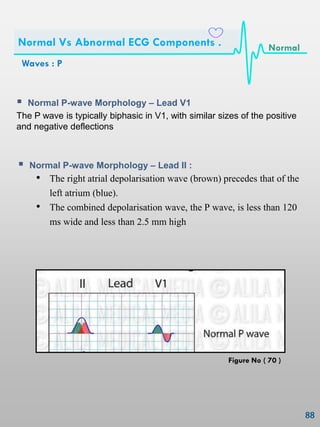
 Normal P-wave Morphology – Lead II :
• The right atrial depolarisation wave (brown) precedes that of the
left atrium (blue).
• The combined depolarisation wave, the P wave, is less than 120
ms wide and less than 2.5 mm high
 Normal P-wave Morphology – Lead V1
The P wave is typically biphasic in V1, with similar sizes of the positive
and negative deflections
Waves : P
Normal Vs Abnormal ECG Components . Normal
Figure No ( 70 )
 Right Atrial Enlargement – Lead V1
Right atrial enlargement causes increased height (> 1.5mm) in V1 of the initial
positive deflection of the P wave.
 Left Atrial Enlargement – Lead V1
Left atrial enlargement causes widening (> 40ms wide) and deepening (> 1mm
deep) in V1 of the terminal negative portion of the P wave.
Waves : P - Abnormalities of the P wave .
Normal Vs Abnormal ECG Components . Abnormal
Figure No ( 71 )
Figure No ( 72 ) Figure No ( 73 )
 Right Atrial Enlargement – Lead II
 In right atrial enlargement, right atrial depolarisation lasts longer than
normal and its waveform extends to the end of left atrial depolarisation.
 Although the amplitude of the right atrial depolarisation current remains
unchanged, its peak now falls on top of that of the left atrial
depolarisation wave.
 The combination of these two waveforms produces a P waves that is
taller than normal (> 2.5 mm), although the width remains unchanged (<
120 ms).
Lead II Lead V1
Waves : P - Abnormalities of the P wave .
Normal Vs Abnormal ECG Components . Abnormal
Figure No ( 74 )
 Left Atrial Enlargement – Lead II
 In left atrial enlargement, left atrial depolarisation lasts longer than normal
but its amplitude remains unchanged.
 Therefore, the height of the resultant P wave remains within normal limits
but its duration is longer than 120 ms.
 A notch (broken line) near its peak may or may not be present (‗P mitrale‘)
Lead II Lead V1
Waves : P - Abnormalities of the P wave .
Normal Vs Abnormal ECG Components . Abnormal
Figure No ( 75 )
Figure No ( 76 )
 Biatrial Enlargement
Biatrial enlargement is diagnosed when criteria for both right and left atrial
enlargement are present on the same ECG. The spectrum of P-wave
changes in leads II and V1 with right, left and bi-atrial enlargement is
summarised in the following diagram:
Waves : P - Abnormalities of the P wave .
Normal Vs Abnormal ECG Components . Abnormal
Figure No ( 77 )
 Common P Wave Abnormalities
P mitrale (bifid P waves), seen with left atrial enlargement.
P pulmonale (peaked P waves), seen with right atrial enlargement.
P wave inversion, seen with ectopic atrial and junctional rhythms.
Variable P wave morphology, seen in multifocal atrial rhythms.
1. P Mitrale
The presence of broad, notched (bifid) P waves in lead II is a sign of left
atrial enlargement, classically due to mitral stenosis.
2. P Pulmonale
The presence of tall, peaked P waves in lead II is a sign of right atrial
enlargement, usually due to pulmonary hypertension (e.g. cor pulmonale
from chronic respiratory disease).
Waves : P - Abnormalities of the P wave .
Normal Vs Abnormal ECG Components . Abnormal
Figure No ( 78 )
Figure No ( 79 )
3. Inverted P Waves
P-wave inversion in the inferior leads indicates a non-sinus origin of the P
waves. When the PR interval is < 120 ms, the origin is in the AV junction
(e.g. accelerated junctional rhythm):
4. Variable P-Wave Morphology
The presence of multiple P wave morphologies indicates multiple ectopic
pacemakers within the atria and/or AV junction. If ≥ 3 different P wave
morphologies are seen, then multifocal atrial rhythm is diagnosed:
If ≥ 3 different P wave morphologies are seen and the rate is ≥ 100, then
multifocal atrial tachycardia (MAT) is diagnosed:
Waves : P - Abnormalities of the P wave .
Normal Vs Abnormal ECG Components . Abnormal
Figure No ( 80 )
Figure No ( 81 )
Figure No ( 82 )
Q Wave
A Q wave is any negative deflection that precedes an R wave
 The Q wave represents the normal left-to-right depolarisation of the inter-
ventricular septum.
 Small ―septal‖ Q waves are typically seen in the left-sided leads (I, aVL, V5
and V6) .
 Q waves in different leads :
• Small Q waves are normal in most leads .
• Deeper Q waves (>2 mm) may be seen in leads III and aVR as a
normal variant
• Under normal circumstances, Q waves are not seen in the right-sided
leads (V1-3)
A. Waves:
2. Q Wave
Waves : Q
Normal Vs Abnormal ECG Components . Normal
Figure No ( 83 )
Pathological Q Waves :
Q waves are considered pathological if:
 > 40 ms (1 mm) wide
 > 2 mm deep
 > 25% of depth of QRS complex
 Seen in leads V1-3
 Pathological Q waves usually indicate current or prior myocardial
infarction.
Loss Of Normal Q Waves :
 The absence of small septal Q waves in leads V5-6 should be
considered abnormal.
 Absent Q waves in V5-6 is most commonly due to LBBB.
 Differential Diagnosis :
 Myocardial infarction
 Cardiomyopathies — Hypertrophic (HCM), infiltrative myocardial
disease
 Rotation of the heart — Extreme clockwise or counter-clockwise
rotation
 Lead placement errors — e.g. upper limb leads placed on lower limbs
Waves : Q - Abnormalities of the Q wave .
Normal Vs Abnormal ECG Components . Abnormal
Inferior Q waves (II, III, aVF) with ST elevation due to acute MI
Inferior Q waves (II, III, aVF) with T-wave inversion due to previous MI
Example 1
Example 2
Waves : Q - Abnormalities of the Q wave .
Normal Vs Abnormal ECG Components . Abnormal
Figure No ( 84 )
Figure No ( 85 )
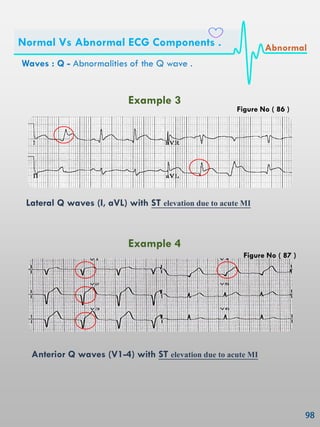
Lateral Q waves (I, aVL) with ST elevation due to acute MI
Anterior Q waves (V1-4) with ST elevation due to acute MI
Example 3
Example 4
Waves : Q - Abnormalities of the Q wave .
Normal Vs Abnormal ECG Components . Abnormal
Figure No ( 87 )
Figure No ( 86 )
Anterior Q waves (V1-4) with T-wave inversion due to recent MI
Example 5
Waves : Q - Abnormalities of the Q wave .
Normal Vs Abnormal ECG Components . Abnormal
Figure No ( 88 )
U Wave
 The U wave is a small (0.5 mm) deflection immediately following the T
wave .
 It comes after the T wave of ventricular repolarization and may not always
be observed as a result of its small size.
 U wave is usually in the same direction as the T wave.
 U wave is best seen in leads V2 and V3 .
 The normal U wave is best seen at rest in the precordial leads and is more
commonly seen during sinus bradycardia.
A. Waves:
3. U Wave
Waves : U
Normal Vs Abnormal ECG Components . Normal
Figure No ( 89 )
Figure No ( 90 )
 Source of the U wave :
The source of the U wave is unknown. Three common theories regarding its
origin are:
1. Delayed repolarisation of Purkinje fibres
2. Prolonged repolarisation of mid-myocardial ‗M-cells‘
3. After-potentials resulting from mechanical forces in the ventricular wall
 Features of Normal U waves :
 The U wave normally goes in the same direction as the T wave
 U -wave size is inversely proportional to heart rate: the U wave grows
bigger as the heart rate slows down
 U waves generally become visible when the heart rate falls below 65
bpm
 The voltage of the U wave is normally < 25% of the T-wave voltage:
disproportionally large U waves are abnormal
 Maximum normal amplitude of the U wave is 1-2 mm
Waves : U
Normal Vs Abnormal ECG Components . Normal
Figure No ( 91 )
 Abnormalities of the U wave :
A. Prominent U waves
B. Inverted U waves
Prominent U waves Inverted U waves
Normal physiological U waves
Waves : U - Abnormalities of the U wave .
Normal Vs Abnormal ECG Components . Abnormal
Figure No ( 92 )
Figure No ( 93 ) Figure No ( 94 )
A. Prominent U waves
U waves are described as prominent if they are >1-2mm or 25% of the
height of the T wave.
 Prominent U waves may be present with:
 Hypocalcaemia
 Hypomagnesaemia
 Hypothermia
 Raised intracranial pressure
 Left ventricular hypertrophy
 Hypertrophic cardiomyopathy
 Drugs associated with prominent U waves:
• Digoxin
• Phenothiazines (thioridazine)
• Class Ia antiarrhythmics (quinidine, procainamide)
• Class III antiarrhythmics (sotalol, amiodarone)
**Note :
many of the conditions causing prominent U waves will also cause a long
QT.
Waves : U - Abnormalities of the U wave .
Normal Vs Abnormal ECG Components . Abnormal
Figure No ( 95 )
Prominent U waves due to sinus bradycardia
U waves associated with hypokalemia
A. Prominent U waves ( Examples )
Example 1
Example 2
Waves : U - Abnormalities of the U wave .
Normal Vs Abnormal ECG Components . Abnormal
Figure No ( 96 )
Figure No ( 97 )
U waves associated with left ventricular hypertrophy
U waves associated with digoxin use
Example 3
Example 4
Waves : U - Abnormalities of the U wave .
Normal Vs Abnormal ECG Components . Abnormal
Figure No ( 98 )
Figure No ( 99 )
U waves associated with quinidine use
Example 5
Waves : U - Abnormalities of the U wave .
Normal Vs Abnormal ECG Components . Abnormal
Figure No ( 100 )
B. Inverted U waves
• U-wave inversion is abnormal (in leads with upright T waves)
• A negative U wave is highly specific for the presence of heart disease
 Common causes of inverted U waves :
 Coronary artery disease
 Hypertension
 Valvular heart disease
 Congenital heart disease
 Cardiomyopathy
 Hyperthyroidism
Waves : U - Abnormalities of the U wave .
Normal Vs Abnormal ECG Components . Abnormal
Unstable Angina
Inverted U Waves In Prinzmetal Angina
B. Inverted U waves ( Examples )
Example 1
Example 2
Waves : U - Abnormalities of the U wave .
Normal Vs Abnormal ECG Components . Abnormal
Figure No ( 101 )
Figure No ( 102 )
R Wave
A. Waves:
4. R Wave
 The R wave is the first upward deflection after the P wave.
 The R wave represents early ventricular depolarisation .
 R-wave amplitude in V6 + S-wave amplitude in V1 should be <35 mm.
 R-wave amplitude in aVL should be ≤ 12 mm. R-wave amplitude in
leads I, II and III should all be ≤ 20 mm.
 If R-wave in V1 is larger than S-wave in V1, the R-wave should be <5
mm
Waves : R
Normal Vs Abnormal ECG Components . Normal
Figure No ( 103 )
 Abnormalities of the R wave
There are three key R wave abnormalities:
A. Dominant R wave in V1
B. Dominant R wave in aVR
C. Poor R wave progression
Waves : R - Abnormalities of the R wave .
Normal Vs Abnormal ECG Components . Abnormal
A. Dominant R wave in V1 :
Causes of Dominant R wave in V1
 Normal in children and young adults
 Right Ventricular Hypertrophy (RVH)
 Pulmonary Embolus
 Persistence of infantile pattern
 Left to right shunt
 Right Bundle Branch Block (RBBB)
 Posterior Myocardial Infarction (ST elevation in Leads V7, V8, V9)
 Wolff-Parkinson-White (WPW) Type A
 Incorrect lead placement (e.g. V1 and V3 reversed)
 Dextrocardia
 Hypertrophic cardiomyopathy
 Dystrophies :
• Myotonic dystrophy
• Duchenne Muscular dystrophy
Waves : R - Abnormalities of the R wave .
Normal Vs Abnormal ECG Components . Abnormal
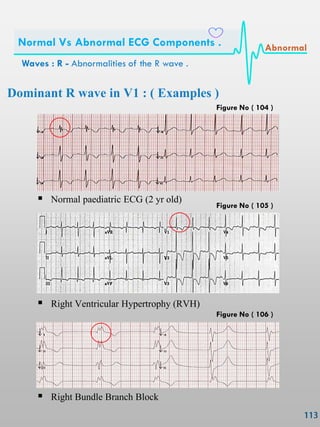
Dominant R wave in V1 : ( Examples )
 Normal paediatric ECG (2 yr old)
 Right Bundle Branch Block
 Right Ventricular Hypertrophy (RVH)
Waves : R - Abnormalities of the R wave .
Normal Vs Abnormal ECG Components . Abnormal
Figure No ( 104 )
Figure No ( 105 )
Figure No ( 106 )
 Right Bundle Branch Block MoRRoW
 Posterior MI
 Wolff-Parkinson-White (WPW) Type A
Waves : R - Abnormalities of the R wave .
Normal Vs Abnormal ECG Components . Abnormal
Figure No ( 107 )
Figure No ( 108 )
Figure No ( 109 )
 Leads V1 and V3 reversed
**Note :
biphasic P wave (typically seen in only in V1) in lead ―V3‖
 Muscular dystrophy
Waves : R - Abnormalities of the R wave .
Normal Vs Abnormal ECG Components . Abnormal
Figure No ( 110 )
Figure No ( 111 )
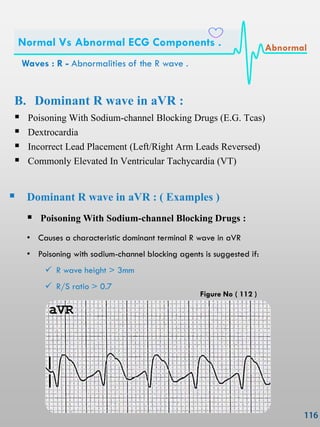
B. Dominant R wave in aVR :
 Poisoning With Sodium-channel Blocking Drugs (E.G. Tcas)
 Dextrocardia
 Incorrect Lead Placement (Left/Right Arm Leads Reversed)
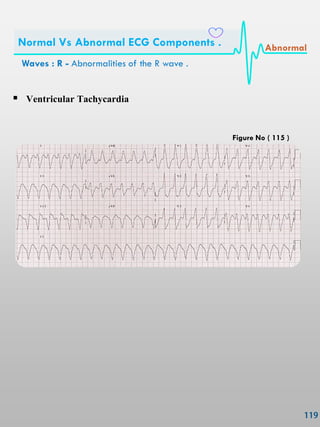
 Commonly Elevated In Ventricular Tachycardia (VT)
 Dominant R wave in aVR : ( Examples )
 Poisoning With Sodium-channel Blocking Drugs :
• Causes a characteristic dominant terminal R wave in aVR
• Poisoning with sodium-channel blocking agents is suggested if:
 R wave height > 3mm
 R/S ratio > 0.7
Waves : R - Abnormalities of the R wave .
Normal Vs Abnormal ECG Components . Abnormal
Figure No ( 112 )
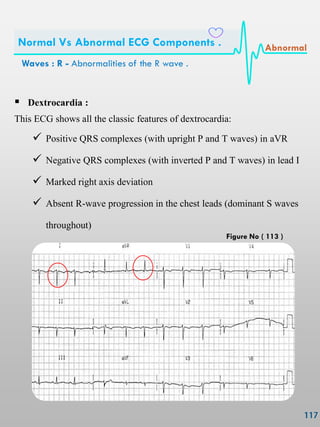
 Dextrocardia :
This ECG shows all the classic features of dextrocardia:
 Positive QRS complexes (with upright P and T waves) in aVR
 Negative QRS complexes (with inverted P and T waves) in lead I
 Marked right axis deviation
 Absent R-wave progression in the chest leads (dominant S waves
throughout)
Waves : R - Abnormalities of the R wave .
Normal Vs Abnormal ECG Components . Abnormal
Figure No ( 113 )
 Left Arm/Right Arm Lead Reversal
The most common cause of a dominant R wave in aVR is incorrect limb
lead placement, with reversal of the left and right arm electrodes. This
produces a similar pattern to dextrocardia in the limb leads but with normal
R-wave progression in the chest leads. With LA/RA lead reversal:
 Lead I becomes inverted
 Leads aVR and aVL switch places
 Leads II and III switch places
Waves : R - Abnormalities of the R wave .
Normal Vs Abnormal ECG Components . Abnormal
Figure No ( 114 )
 Ventricular Tachycardia
Waves : R - Abnormalities of the R wave .
Normal Vs Abnormal ECG Components . Abnormal
Figure No ( 115 )
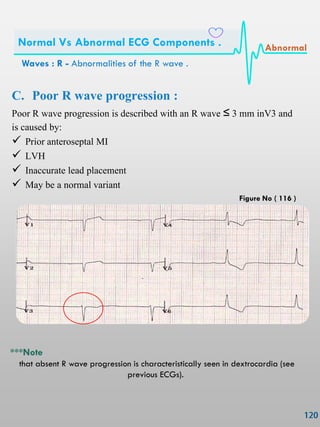
C. Poor R wave progression :
Poor R wave progression is described with an R wave ≤ 3 mm inV3 and
is caused by:
 Prior anteroseptal MI
 LVH
 Inaccurate lead placement
 May be a normal variant
***Note
that absent R wave progression is characteristically seen in dextrocardia (see
previous ECGs).
Waves : R - Abnormalities of the R wave .
Normal Vs Abnormal ECG Components . Abnormal
Figure No ( 116 )
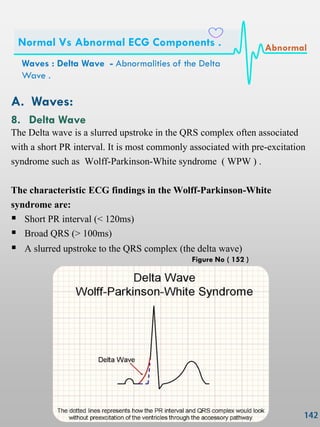
Osborn (J Wave )
 J Point In :
a normal .
b – c J point elevation.
d J point depression.
e with J wave (Osborn wave)
A. Waves:
5. Osborn (J Wave ) :
The Osborn wave (J wave) is a positive deflection at the J point (negative in
aVR and V1). It is usually most prominent in the precordial leads.
Waves : Osborn (J Wave ) .
Normal Vs Abnormal ECG Components . Normal
Figure No ( 117 )
 Osborn Wave Causes :
 Characteristically seen in hypothermia (typically T<30C), but they are not
pathognomonic.
 J waves may be seen in a number of other conditions:
 Normal variant
 Hypercalcaemia
 Medications
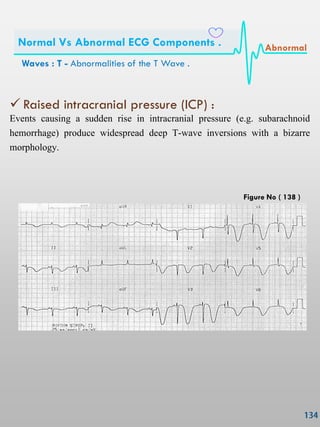
 Neurological insults such as intracranial hypertension, severe head
injury and subarachnoid haemorrhage
 Le syndrome d‖Haïssaguerre (idiopathic VF)
Waves : Osborn ( J ) Wave - Abnormalities of the
Osborn (J) Wave .
Normal Vs Abnormal ECG Components . Abnormal
Osborn Wave ECG : ( examples )
Example 1
 Subtle J waves in mild hypothermia [Temp: 32.5°C (90.5°F)]
 The height of the J wave is roughly proportional to the degree of
hypothermia
Example 2
 J waves in moderate hypothermia. [Temp: 30°C (86°F)
Waves : Osborn ( J ) Wave - Abnormalities of the
Osborn (J) Wave .
Normal Vs Abnormal ECG Components . Abnormal
Figure No ( 118 )
Figure No ( 119 )
Example 3
 J waves in moderate hypothermia. [Temp: 28°C (82.4°F)]
Example 4
 Marked J waves in severe hypothermia [Temp: 26°C (78.8°F)]
Waves : Osborn ( J ) Wave - Abnormalities of the
Osborn (J) Wave .
Normal Vs Abnormal ECG Components . Abnormal
Figure No ( 120 )
Figure No ( 121 )
T Wave
A. Waves:
6. T Wave
The T wave is the positive deflection after each QRS complex.It represents
ventricular repolarisation.
 Characteristics of the normal T wave :
Upright in all leads except aVR and V1
Amplitude < 5mm in limb leads, < 10mm in precordial leads (10mm in
men, 8mm in women)
Duration 0.10 to 0.25 seconds
 T wave abnormalities :
1. Peaked T waves
2. Hyperacute T waves
3. Inverted T waves
4. Biphasic T waves
5. ―Camel Hump‖ T waves
6. Flattened T waves
Waves : T .
Normal Vs Abnormal ECG Components . Normal
Figure No ( 122 )
1. Peaked T waves
Tall, narrow, symmetrically peaked T-waves are characteristically seen
in hyperkalemia.
2. Hyper-acute T waves
Broad, asymmetrically peaked or ―hyper-acute‖ T-waves are seen in the
early stages of ST-elevation MI (STEMI) and often precede the
appearance of ST elevation and Q waves.
They are also seen with Prinzmetal angina.
T Wave Abnormalities :
Waves : T - Abnormalities of the T Wave .
Normal Vs Abnormal ECG Components . Abnormal
Figure No ( 123 )
Figure No ( 124 )
3. Inverted T waves
P-wave inversion in the inferior leads indicates a non-sinus origin of the P
waves. When the PR interval is < 120 ms, the origin is in the AV junction
(e.g. accelerated junctional rhythm).
Inverted T waves are seen in the following conditions:
 Normal finding in children
 Persistent juvenile T wave pattern
 Myocardial ischaemia and infarction
 Bundle branch block
 Ventricular hypertrophy (―strain‖ patterns)
 Pulmonary embolism
 Hypertrophic cardiomyopathy
 Raised intracranial pressure
**Note :
T wave inversion in lead III is a normal variant.
New T-wave inversion (compared with prior ECGs) is always abnormal.
Pathological T wave inversion is usually symmetrical and deep (>3mm).
Waves : T - Abnormalities of the T Wave .
Normal Vs Abnormal ECG Components . Abnormal
Figure No ( 125 )
 Pediatric T Waves :
Inverted T-waves in the right precordial leads (V1-3) are a normal finding
in children, representing the dominance of right ventricular forces.
Pediatric T Waves Normal T Waves 2 Year Old Boy
 Persistent Juvenile T-wave Pattern :
 T-wave inversions in the right precordial leads may persist into
adulthood and are most commonly seen in young Afro-Caribbean
women.
 Persistent juvenile T-waves are asymmetric, shallow (<3mm) and
usually limited to leads V1-3.
Inverted T Waves Conditions :
Waves : T - Abnormalities of the T Wave .
Normal Vs Abnormal ECG Components . Abnormal
Figure No ( 126 )
Figure No ( 127 )
 Myocardial Ischemia and Infarction :
T-wave inversions due to myocardial ischemia or infarction occur in
contiguous leads based on the anatomical location of the area of ischemia
/infarction:
 Inferior = II, III, aVF
 Lateral = I, aVL, V5-6
 Anterior = V2-6
Inferior T Wave Inversion Due To Acute Ischaemia
**NOTE :
• Dynamic T-wave inversions are seen with acute myocardial ischemia.
• Fixed T-wave inversions are seen following infarction, usually in
association with pathological Q waves.
Waves : T - Abnormalities of the T Wave .
Normal Vs Abnormal ECG Components . Abnormal
Figure No ( 128 )
Inferior T Wave Inversion With Q Waves – Prior Myocardial Infarction
T Wave Inversion In The Lateral Leads Due To Acute Ischemia
Anterior T Wave Inversion With Q Waves Due To Recent MI
Waves : T - Abnormalities of the T Wave .
Normal Vs Abnormal ECG Components . Abnormal
Figure No ( 129 )
Figure No ( 130 )
Figure No ( 131 )
 Bundle Branch Block :
A. Left Bundle Branch Block (with T-wave inversion )
Left bundle branch block produces T-wave inversion in the lateral leads I,
aVL and V5-6.
B. Right Bundle Branch Block (with T-wave inversion )
Right bundle branch block produces T-wave inversion in the right precordial
leads V1-3.
Waves : T - Abnormalities of the T Wave .
Normal Vs Abnormal ECG Components . Abnormal
Figure No ( 132 )
Figure No ( 133 )
 Ventricular Hypertrophy :
A. Left Ventricular Hypertrophy (With T-wave Inversion )
Left ventricular hypertrophy (LVH) produces T-wave inversion in the
lateral leads I, aVL, V5-6 (left ventricular ―strain‖ pattern), with a similar
morphology to that seen in LBBB.
B. Right Ventricular Hypertrophy (With T-wave Inversion )
Right ventricular hypertrophy produces T-wave inversion in the right
precordial leads V1-3 (right ventricular ―strain‖ pattern) and also the inferior
leads (II, III, aVF).
Waves : T - Abnormalities of the T Wave .
Normal Vs Abnormal ECG Components . Abnormal
Figure No ( 134 )
Figure No ( 135 )
 Pulmonary Embolism :
T-wave inversions in the right precordial (V1-3) and inferior (II, III, aVF)
leads.
 Hypertrophic Cardiomyopathy (HCM) :
Hypertrophic Cardiomyopathy is associated with deep T wave inversions in
all the precordial leads.
Waves : T - Abnormalities of the T Wave .
Normal Vs Abnormal ECG Components . Abnormal
Figure No ( 136 )
Figure No ( 137 )
 Raised intracranial pressure (ICP) :
Events causing a sudden rise in intracranial pressure (e.g. subarachnoid
hemorrhage) produce widespread deep T-wave inversions with a bizarre
morphology.
Waves : T - Abnormalities of the T Wave .
Normal Vs Abnormal ECG Components . Abnormal
Figure No ( 138 )
4. Biphasic T waves
There are two main causes of biphasic T waves:
 Myocardial ischemia
T waves go UP then DOWN
 Hypokalemia
The two waves go in opposite directions:
T waves go DOWN then UP
Waves : T - Abnormalities of the T Wave .
Normal Vs Abnormal ECG Components . Abnormal
Figure No ( 139 )
Figure No ( 140 )
Figure No ( 141 )
5. ‘Camel hump’ T waves
‗Camel hump‖ T waves is a term used by Amal Mattu to describe T-waves
that have a double peak.
There are two causes for camel hump T waves:
 Prominent U waves:
Fused To The End Of The T Wave, As Seen In Severe Hypokalemia .
 Hidden P waves :
Embedded In The T Wave, As Seen In Sinus Tachycardia And Various
Types Of Heart Block .
Waves : T - Abnormalities of the T Wave .
Normal Vs Abnormal ECG Components . Abnormal
Figure No ( 142 )
Figure No ( 143 )
6. Flattened T waves
Flattened T waves are a non-specific finding, but may represent :
 Ischemia (If Dynamic Or In Contiguous Leads) Or
 Electrolyte Abnormality, E.G. Hypokalemia (If Generalized).
 Ischemia :
Dynamic T-wave flattening due to anterior ischemia .
T waves return to normal once the ischemia resolves .
Dynamic T wave flattening due to
anterior ischemia
T waves return to normal as
ischemia resolves
Waves : T - Abnormalities of the T Wave .
Normal Vs Abnormal ECG Components . Abnormal
Figure No ( 144 ) Figure No ( 145 )
 Hypokalemia :
Note generalized T-wave flattening in hypokalemia associated with
prominent U waves in the anterior leads (V2 and V3).
Waves : T - Abnormalities of the T Wave .
Normal Vs Abnormal ECG Components . Abnormal
Figure No ( 146 )
Epsilon Wave
A. Waves:
7. Epsilon Wave
• The epsilon wave is a small positive deflection (―blip‖ or ―wiggle‖) buried
in the end of the QRS complex. Epsilon waves are caused by
postexcitation of the myocytes in the right ventricle.
Waves : Epsilon Wave - Abnormalities of the Epsilon
Wave .
Normal Vs Abnormal ECG Components . Abnormal
Figure No ( 147 ) Figure No ( 148 )
Epsilon waves are the most characteristic finding in :
 Arrhythmo-genic Right Ventricular Dysplasia (ARVD/C).
Here myocytes are replaced with fat, producing islands of viable myocytes
in a sea of fat. This causes a delay in excitation of some of the myocytes of
the right ventricle and causes the little wiggles seen during the ST segment
of the ECG.
The ECG changes in Arrhythmo-genic Right Ventricular Dysplasia include:
• Epsilon wave (most specific finding, seen in 30% of patients)
• T wave inversions in V1-3 (85% of patients)
• Prolonged S-wave upstroke of 55ms in V1-3 (95% of patients)
• Localized QRS widening of 110ms in V1-3
• Paroxysmal episodes of ventricular tachycardia with a LBBB
morphology.
Waves : Epsilon Wave - Abnormalities of the Epsilon
Wave .
Normal Vs Abnormal ECG Components . Abnormal
Figure No ( 149 )
Example 1 12-lead ECG is a typical example of ARVD.
Arrhythmo-genic Right Ventricular Dysplasia (ARVD) : Examples
Example 2 VT with LBBB morphology due to ARVD
Waves : Epsilon Wave - Abnormalities of the Epsilon
Wave .
Normal Vs Abnormal ECG Components . Abnormal
Figure No ( 150 )
Figure No ( 151 )
Delta Wave
A. Waves:
8. Delta Wave
The Delta wave is a slurred upstroke in the QRS complex often associated
with a short PR interval. It is most commonly associated with pre-excitation
syndrome such as Wolff-Parkinson-White syndrome ( WPW ) .
The characteristic ECG findings in the Wolff-Parkinson-White
syndrome are:
 Short PR interval (< 120ms)
 Broad QRS (> 100ms)
 A slurred upstroke to the QRS complex (the delta wave)
Waves : Delta Wave - Abnormalities of the Delta
Wave .
Normal Vs Abnormal ECG Components . Abnormal
Figure No ( 152 )
S-T Segment
B. Segments :
1. ST Segment
 The ST segment is the flat, isoelectric section of the ECG between
the end of the S wave (the J point) and the beginning of the T wave.
 The ST Segment represents the interval between ventricular
depolarization and repolarization.
 The most important cause of ST segment abnormality (elevation or
depression) is myocardial ischemia or infarction.
S e gmen ts : ST Segment .
Normal Vs Abnormal ECG Components . Normal
Figure No ( 153 )
 Causes of ST Segment Elevation :
 Acute myocardial infarction
 Coronary vasospasm (Printzmetal‖s angina)
 Pericarditis
 Benign early repolarization
 Left bundle branch block
 Left ventricular hypertrophy
 Ventricular aneurysm
 Brugada syndrome
 Ventricular paced rhythm
 Raised intracranial pressure
 Takotsubo Cardiomyopathy
S e gmen ts : ST Segment - Abnormalities of the ST
Segment - ST Elevation .
Normal Vs Abnormal ECG Components . Abnormal
 Acute ST Elevation Myocardial Infarction (STEMI) :
ST segment elevation and Q-wave formation in contiguous leads
• Septal (V1-2)
• Anterior (V3-4)
• Lateral (I + aVL, V5-6)
• Inferior (II, III, aVF)
• Right ventricular (V1, V4R)
• Posterior (V7-9)
S e gmen ts : ST Segment - Abnormalities of the ST
Segment - ST Elevation .
Normal Vs Abnormal ECG Components . Abnormal
Figure No ( 154 )
 Pericarditis :
Acute Pericarditis causes widespread concave (‗saddleback‘) ST segment
elevation with PR segment depression in multiple leads, typically
involving I, II, III, aVF, aVL, and V2-6.
 Concave ‗saddleback‘ ST elevation in leads I, II, III, aVF, V5-6 with
depressed PR segments.
 There is reciprocal ST depression and PR elevation in leads aVR and
V1.
 Spodick‖s sign was first described by David H. Spodick in 1974 as a
downward sloping TP segment with specificity for acute pericarditis
S e gmen ts : ST Segment - Abnormalities of the ST
Segment - ST Elevation .
Normal Vs Abnormal ECG Components . Abnormal
Figure No ( 155 )
 Benign Early Repolarization :
Benign Early Repolarization (BER) causes mild ST elevation with tall T-
waves mainly in the precordial leads. BER is a normal variant commonly seen
in young, healthy patients. There is often notching of the J-point — the ‗fish-
hook‘ pattern.
The ST changes may be more prominent at slower heart rates and disappear in
the presence of tachycardia.
There is slight concave ST elevation in the precordial and inferior
leads with notching of the J-point (the ―fish-hook‖ pattern)
S e gmen ts : ST Segment - Abnormalities of the ST
Segment - ST Elevation .
Normal Vs Abnormal ECG Components . Abnormal
Figure No ( 156 )
 Left Bundle Branch Block (LBBB) :
In Left bundle branch block (LBBB), the ST segments and T waves show
‗appropriate discordance‘ — i.e. they are directed opposite to the main
vector of the QRS complex.
This produces ST elevation and upright T waves in leads with a negative
QRS complex (dominant S wave), while producing ST depression and T
wave inversion in leads with a positive QRS complex (dominant R wave).
Note :
 the ST elevation in leads with deep S waves — most apparent in V1-3.
 Also note the ST depression in leads with tall R waves — most apparent
in I and aVL
S e gmen ts : ST Segment - Abnormalities of the ST
Segment - ST Elevation .
Normal Vs Abnormal ECG Components . Abnormal
Figure No ( 157 )
 Left Ventricular Hypertrophy (LVH) :
Left Ventricular Hypertrophy (LVH) causes a similar pattern of repolarization
abnormalities as LBBB, with ST elevation in the leads with deep S-waves
(usually V1-3) and ST depression/T-wave inversion in the leads with tall R
waves (I, aVL, V5-6).
• Deep S waves with ST elevation in V1-3
• ST depression and T-wave inversion in the lateral leads V5-6
• Note in this this case there is also right axis deviation, which is
unusual for LVH and may be due to associated left posterior fascicular
block.
S e gmen ts : ST Segment - Abnormalities of the ST
Segment - ST Elevation .
Normal Vs Abnormal ECG Components . Abnormal
Figure No ( 158 )
 Ventricular Aneurysm :
This is an ECG pattern of Ventricular Aneurysm – residual ST elevation and
deep Q waves seen in patients with previous myocardial infarction. It is
associated with extensive myocardial damage and paradoxical movement of
the left ventricular wall during systole.
• There is ST elevation with deep Q waves and inverted T waves in V1-3.
• This pattern suggests the presence of a left ventricular aneurysm due to a
prior anteroseptal MI.
S e gmen ts : ST Segment - Abnormalities of the ST
Segment - ST Elevation .
Normal Vs Abnormal ECG Components . Abnormal
Figure No ( 159 )
 Brugada Syndrome :
Brugada Syndrome is an inherited channelo-pathy (a disease of myocardial
sodium channels) that leads to paroxysmal ventricular arrhythmias and
sudden cardiac death in young patients.
The tell-tale sign on the resting ECG is the ‗Brugada sign‘ — ST elevation
and partial RBBB in V1-2 with a ‗coved‘ morphology.
S e gmen ts : ST Segment - Abnormalities of the ST
Segment - ST Elevation .
Normal Vs Abnormal ECG Components . Abnormal
Figure No ( 160 ) Figure No ( 161 )
There is ST elevation and partial RBBB in V1-2 with a coved morphology - the
‚Brugada sign‛.
S e gmen ts : ST Segment - Abnormalities of the ST
Segment - ST Elevation .
Normal Vs Abnormal ECG Components . Abnormal
Figure No ( 162 )
 Brugada Syndrome :
 Type 1 :
• Coved ST segment elevation >2mm in >1 of V1-V3 followed by a
negative T wave.
• This is the only ECG abnormality that is potentially diagnostic.
• It is often referred to as Brugada sign.
This ECG abnormality must be associated with one of the following clinical criteria
to make the diagnosis:
o Documented ventricular fibrillation (VF) or polymorphic ventricular
tachycardia (VT).
o Family history of sudden cardiac death at <45 years old .
o Coved-type ECGs in family members.
o Inducibility of VT with programmed electrical stimulation .
o Syncope.
o Nocturnal agonal respiration
S e gmen ts : ST Segment - Abnormalities of the ST
Segment - ST Elevation .
Normal Vs Abnormal ECG Components . Abnormal
Figure No ( 163 )
 Type2:
• Brugada Type 2 has >2mm of saddleback shaped ST elevation.
S e gmen ts : ST Segment - Abnormalities of the ST
Segment - ST Elevation .
Normal Vs Abnormal ECG Components . Abnormal
Figure No ( 164 )
 Type3:
• Brugada type 3: can be the morphology of either type 1 or type
2, but with <2mm of ST segment elevation.
S e gmen ts : ST Segment - Abnormalities of the ST
Segment - ST Elevation .
Normal Vs Abnormal ECG Components . Abnormal
Figure No ( 165 )
 Ventricular Paced Rhythm :
Ventricular pacing (with a pacing wire in the right ventricle) causes ST
segment abnormalities identical to that seen in LBBB. There is appropriate
discordance, with the ST segment and T wave directed opposite to the main
vector of the QRS complex.
S e gmen ts : ST Segment - Abnormalities of the ST
Segment - ST Elevation .
Normal Vs Abnormal ECG Components . Abnormal
Figure No ( 166 )
 Raised Intracranial Pressure :
Raised Intracranial Pressure (ICP) (e.g. due to intracranial haemorrhage,
traumatic brain injury) may cause ST elevation or depression that simulates
myocardial ischaemia or pericarditis.
More commonly, raised ICP is associated with widespread, deep T-wave
inversions (‗cerebral T waves‗).
Widespread ST elevation with concave (pericarditis-like) morphology in a patient with
severe traumatic brain injury.
S e gmen ts : ST Segment - Abnormalities of the ST
Segment - ST Elevation .
Normal Vs Abnormal ECG Components . Abnormal
Figure No ( 167 )
 Takotsubo Cardiomyopathy :
Takotsubo Cardiomyopathy: A STEMI mimic producing ischaemic chest
pain, ECG changes +/- elevated cardiac enzymes with characteristic regional
wall motion abnormalities on echocardiography.
• Typically occurs in the context of severe emotional distress (‗broken
heart syndrome‗).
• Commonly associated with new ECG changes (ST elevation or T
wave inversion) or moderate troponin rise.
S e gmen ts : ST Segment - Abnormalities of the ST
Segment - ST Elevation .
Normal Vs Abnormal ECG Components . Abnormal
Figure No ( 168 )
 Less Common Causes of ST segment Elevation :
o Pulmonary embolism and acute cor pulmonale (usually in lead III)
o Acute aortic dissection (classically causes inferior STEMI due to
RCA dissection)
o Hyperkalaemia
o Sodium-channel blocking drugs (secondary to QRS widening)
o J-waves (hypothermia, hypercalcaemia)
o Following electrical cardioversion
o Others: Cardiac tumour, myocarditis, pancreas or gallbladder disease
Transient ST elevation after DC cardioversion from VF .
J waves in hypothermia simulating ST elevation
S e gmen ts : ST Segment - Abnormalities of the ST
Segment - ST Elevation .
Normal Vs Abnormal ECG Components . Abnormal
Figure No ( 169 )
Figure No ( 170 )
 Causes of ST Depression :
 Myocardial ischemia / NSTEMI
 Reciprocal change in STEMI Posterior MI
 Digoxin effect
 Hypokalemia
 Supraventricular tachycardia
 Right bundle branch block
 Right ventricular hypertrophy
 Left bundle branch block
 Left ventricular hypertrophy
 Ventricular paced rhythm
S e gmen ts : ST Segment - Abnormalities of the ST
Segment - ST Depression .
Normal Vs Abnormal ECG Components . Abnormal
Morphology of ST Depression
• ST depression can be either up-sloping, down-sloping, or horizontal.
• Horizontal or down-sloping ST depression ≥ 0.5 mm at the J-point in ≥
2 contiguous leads indicates myocardial ischemia (according to the
2007 Task Force Criteria).
• Up-sloping ST depression in the precordial leads with prominent De
Winter T waves is highly specific for occlusion of the LAD.
• Reciprocal change has a morphology that resembles ‗upside down‘ ST
elevation and is seen in leads electrically opposite to the site of
infarction.
• Posterior MI manifests as horizontal ST depression in V1-3 and is
associated with upright T waves and tall R waves.
S e gmen ts : ST Segment - Abnormalities of the ST
Segment - ST Depression .
Normal Vs Abnormal ECG Components . Abnormal
ST segment morphology in myocardial ischemia
S e gmen ts : ST Segment - Abnormalities of the ST
Segment - ST Depression .
Normal Vs Abnormal ECG Components . Abnormal
Figure No ( 171)
Figure No ( 172 )
Reciprocal change
ST segment morphology in posterior MI
S e gmen ts : ST Segment - Abnormalities of the ST
Segment - ST Depression .
Normal Vs Abnormal ECG Components . Abnormal
Figure No ( 173 )
Figure No ( 174 )
 Myocardial Ischemia :
ST depression due to sub-endocardial ischemia may be present in a variable
number of leads and with variable morphology. It is often most prominent
in the left precordial leads V4-6 plus leads I, II and aVL.
Widespread ST depression with ST elevation in aVR is seen in left main
coronary artery occlusion and severe triple vessel disease.
**NOTE :
ST depression localized to the inferior or high lateral leads is more likely to
represent reciprocal change than sub-endocardial ischemia. The corresponding
ST elevation may be subtle and difficult to see, but should be sought.
S e gmen ts : ST Segment - Abnormalities of the ST
Segment - ST Depression .
Normal Vs Abnormal ECG Components . Abnormal
Figure No ( 175 )
 Reciprocal Change :
ST elevation during acute STEMI is associated with simultaneous ST
depression in the electrically opposite leads:
• Inferior STEMI produces reciprocal ST depression in aVL (± lead I).
• Lateral or anterolateral STEMI produces reciprocal ST depression in III
and aVF (± lead II).
• Reciprocal ST depression in V1-3 occurs with posterior infarction (see
below).
Reciprocal ST depression in aVL with inferior STEMI
S e gmen ts : ST Segment - Abnormalities of the ST
Segment - ST Depression .
Normal Vs Abnormal ECG Components . Abnormal
Figure No ( 176 )
Reciprocal ST depression in III and aVF with high lateral STEMI
S e gmen ts : ST Segment - Abnormalities of the ST
Segment - ST Depression .
Normal Vs Abnormal ECG Components . Abnormal
Figure No ( 177 )
 Posterior Myocardial Infarction :
 Acute posterior STEMI causes ST depression in the anterior leads V1-3,
 along with dominant R waves (‗Q-wave equivalent‘) and upright T
waves.
 There is ST elevation in the posterior leads V7-9.
S e gmen ts : ST Segment - Abnormalities of the ST
Segment - ST Depression .
Normal Vs Abnormal ECG Components . Abnormal
Figure No ( 178 )
 De Winter T Waves :
De Winter T waves: a pattern of up-sloping ST depression with
symmetrically peaked T waves in the precordial leads is considered to be a
STEMI equivalent, and is highly specific for an acute occlusion of the
LAD.
S e gmen ts : ST Segment - Abnormalities of the ST
Segment - ST Depression .
Normal Vs Abnormal ECG Components . Abnormal
Figure No ( 179 )
 Digoxin Effect :
Digoxin Effect: Treatment with digoxin causes downsloping ST depression
with a ‗sagging‘ morphology, reminiscent of Salvador Dali‖s moustache.
S e gmen ts : ST Segment - Abnormalities of the ST
Segment - ST Depression .
Normal Vs Abnormal ECG Components . Abnormal
Figure No ( 180 )
 Hypokalemia :
Hypokalemia causes widespread down-sloping ST depression with T-wave
flattening/inversion, prominent U waves and a prolonged QU interval.
S e gmen ts : ST Segment - Abnormalities of the ST
Segment - ST Depression .
Normal Vs Abnormal ECG Components . Abnormal
Figure No ( 181 )
 Right ventricular hypertrophy (RVH) :
Right ventricular hypertrophy (RVH) causes ST depression and T-wave
inversion in the right precordial leads V1-3.
S e gmen ts : ST Segment - Abnormalities of the ST
Segment - ST Depression .
Normal Vs Abnormal ECG Components . Abnormal
Figure No ( 182 )
 Right Bundle Branch Block (RBBB) :
Right Bundle Branch Block (RBBB) may produce a similar pattern of
repolarization abnormalities to RVH, with ST depression and T wave
inversion in V1-3.
S e gmen ts : ST Segment - Abnormalities of the ST
Segment - ST Depression .
Normal Vs Abnormal ECG Components . Abnormal
Figure No ( 183 )
 Supraventricular Tachycardia (SVT) :
Supraventricular tachycardia (e.g. AVNRT) typically causes widespread
horizontal ST depression, most prominent in the left precordial leads (V4-6).
This rate-related ST depression does not necessarily indicate the presence of
myocardial ischemia, provided that it resolves with treatment.
S e gmen ts : ST Segment - Abnormalities of the ST
Segment - ST Depression .
Normal Vs Abnormal ECG Components . Abnormal
Figure No ( 184 )
Figure No ( 185 )
PR segment
B. Segments :
2. PR segment
The PR segment is the flat, usually isoelectric segment between the end of
the P wave and the start of the QRS complex.
 PR segment abnormalities :
These occur in two main conditions:
 Pericarditis
 Atrial Ischemia
S e gmen ts : PR Segment .
Normal Vs Abnormal ECG Components . Normal
Figure No ( 186 )
 Pericarditis :
The characteristic changes of acute pericarditis are:
 PR segment depression.
 Widespread concave (―saddle-shaped‖) ST elevation.
 Reciprocal ST depression and PR elevation in aVR and V1
 Absence of reciprocal ST depression elsewhere.
.
**Note :
PR segment changes are relative to the baseline formed by the T-P segment
S e gmen ts : PR Segment - Abnormalities of the PR
Segment .
Normal Vs Abnormal ECG Components . Abnormal
Figure No ( 187 )
PR elevation in aVR due to
acute pericarditis (note the
reciprocal ST depression)
PR segment depression in V5 due
to acute pericarditis (note also
some concave ST elevation)
Typical ECG of acute pericarditis.
S e gmen ts : PR Segment - Abnormalities of the PR
Segment .
Normal Vs Abnormal ECG Components . Abnormal
Figure No ( 188 )
Figure No ( 189 ) Figure No ( 190 )
 Atrial ischemia :
 PR segment elevation or depression in patients with myocardial
infarction indicates concomitant atrial ischemia or infarction.
 This finding has been associated with poor outcomes following MI,
increased risk for the development of atrio-ventricular block,
supraventricular arrhythmias and cardiac free-wall rupture.
Liu‖s criteria for diagnosing atrial ischemia / infarction include:
 PR elevation >0.5 mm in V5 & V6 with reciprocal PR depression in V1 & V2
 PR elevation >0.5 mm in lead I with reciprocal PR depression in leads II & III
 PR depression >1.5 mm in the precordial leads
 PR depression >1.2 mm in leads I, II, & III
 Abnormal P wave morphology: M- shaped, W-shaped ,irregular ,or notched
(minor criteria)
S e gmen ts : PR Segment - Abnormalities of the PR
Segment .
Normal Vs Abnormal ECG Components . Abnormal
PR depression in inferior STEMI indicating concomitant atrial infarction
 Profound PR-segment depression in inferior leads:
(A) with clear-cut TP segment;
(B) without clear-cut TP segment; in acute inferior myocardial infarction.
(A) (B)
**Note :
Also St-segment Elevation In Inferior Leads. (Reproduced From Jim Et Al.)
S e gmen ts : PR Segment - Abnormalities of the PR
Segment .
Normal Vs Abnormal ECG Components . Abnormal
Figure No ( 191 )
Measurement of PR-segment depression:
(A) with clear-cut TP segment;
(B) without clear-cut TP segment. (Reproduced from Jim et al.)
S e gmen ts : PR Segment - Abnormalities of the PR
Segment .
Normal Vs Abnormal ECG Components . Abnormal
Figure No ( 192 )
PR Interval
C. Intervals :
1. PR Interval
The PR interval is the time from the onset of the P wave to the start of the
QRS complex. It reflects conduction through the AV node.
• The normal PR interval is between 120 – 200 ms (0.12-0.20s) in
duration (three to five small squares).
• If the PR interval is > 200 ms, first degree heart block is said to be
present.
• PR interval < 120 ms suggests pre-excitation (the presence of an
accessory pathway between the atria and ventricles) or AV nodal
(junctional) rhythm.
In ter vals : PR Interval .
Normal Vs Abnormal ECG Components . Normal
Figure No ( 193 )
A. Prolonged PR Interval – AV block (PR >200ms) :
Delayed conduction through the AV node
May occur in isolation or co-exist with other blocks (e.g., second-degree AV block,
trifascicular block)
 First degree AV block :
Sinus rhythm with marked 1st degree heart block (PR interval 340ms)
 Second degree AV block (Mobitz I) with prolonged PR interval :
• Second degree heart block, Mobitz type I (Wenckebach
phenomenon).
• Note how the baseline PR interval is prolonged, and then further
prolongs with each successive beat, until a QRS complex is dropped.
• The PR interval before the dropped beat is the longest (340ms),
while the PR interval after the dropped beat is the shortest (280ms).
In ter vals : PR Interval -Abnormalities of the PR
Interval .
Normal Vs Abnormal ECG Components . Abnormal
Figure No ( 194 )
Figure No ( 195 )
A. Short PR interval (<120ms) :
A short PR interval is seen with:
1. Pre-excitation syndromes .
2. AV nodal (junctional) rhythm .
.
1. Pre-excitation syndromes :
• Wolff-Parkinson-White (WPW)
• Lown-Ganong-Levine (LGL) syndromes.
 These involve the presence of an accessory pathway connecting the atria and
ventricles.
 The accessory pathway conducts impulses faster than normal, producing a short
PR interval.
 The accessory pathway also acts as an anatomical re-entry circuit, making
patients susceptible to re-entry tachyarrhythmias.
 Patients present with episodes of paroxsymal supraventricular tachycardia
(SVT), specifically atrioventricular re-entry tachycardia (AVRT), and
characteristic features on the resting 12-lead ECG
In ter vals : PR Interval -Abnormalities of the PR
Interval .
Normal Vs Abnormal ECG Components . Abnormal
• Wolff-Parkinson-White syndrome :
The characteristic features of Wolff-Parkinson-White syndrome are a short PR
interval (<120ms), broad QRS and a slurred upstroke to the QRS complex, the
delta wave.
• Lown-Ganong-Levine syndrome :
The features of Lown-Ganong-Levine syndrome LGL syndrome are a very short
PR interval with normal P waves and QRS complexes and absent delta waves.
In ter vals : PR Interval -Abnormalities of the PR
Interval .
Normal Vs Abnormal ECG Components . Abnormal
Figure No ( 196 )
Figure No ( 197 )
2. AV nodal (junctional) rhythm :
 Junctional rhythms are narrow complex, regular rhythms arising from
the AV node.
 P waves are either absent or abnormal (e.g. inverted) with a short PR
interval (=retrograde P waves).
 ECG: Accelerated junctional rhythm demonstrating inverted P waves
with a short PR interval (retrograde P waves)
In ter vals : PR Interval -Abnormalities of the PR
Interval .
Normal Vs Abnormal ECG Components . Abnormal
Figure No ( 198 )
QT Interval
C. Intervals :
2. QT Interval
• Time from the start of the Q wave to the end of the T wave
• Represents time taken for ventricular depolarization and repolarization,
effectively the period of ventricular systole from ventricular iso-
volumetric contraction to iso-volumetric relaxation
 The QT Interval Is Inversely Proportional To Heart Rate:
 The QT interval shortens at faster heart rates
 The QT interval lengthens at slower heart rates
 An abnormally prolonged QT is associated with an increased risk of
ventricular arrhythmias, especially Torsades de Pointes
 Congenital short QT syndrome has been found to be associated with
an increased risk of paroxysmal atrial and ventricular fibrillation and
sudden cardiac death
In ter vals : QT Interval .
Normal Vs Abnormal ECG Components . Normal
In ter vals : QT Interval .
Normal Vs Abnormal ECG Components . Normal
Figure No ( 199 )
 How to measure the QT interval :
 The QT interval should be measured in either lead II or V5-6
 Several successive beats should be measured, with the maximum interval
taken .
 Large U waves (> 1mm) that are fused to the T wave should be included
in the measurement .
 Smaller U waves and those that are separate from the T wave should be
excluded .
 The maximum slope intercept method is used to define the end of the T
wave.
 Left, middle: Smaller U waves and those that are separate from the T wave
should be excluded from measurements
 Right: Large U waves that are fused to the T wave should be included in
measurements
In ter vals : QT Interval .
Normal Vs Abnormal ECG Components . Normal
Figure No ( 200 )
 The QT interval is defined from the beginning of the QRS complex to
the end of the T wave. The maximum slope intercept method defines
the end of the T wave as the intercept between the isoelectric line with
the tangent drawn through the maximum down slope of the T wave
(left).
 When notched T waves are present (right), the QT interval is
measured from the beginning of the QRS complex to the intersection
point between the isoelectric line and the tangent drawn from the
maximum down slope of the second notch.
In ter vals : QT Interval .
Normal Vs Abnormal ECG Components . Normal
Figure No ( 201 )
 Corrected QT interval (QTc) :
 The corrected QT interval (QTc) estimates the QT interval at a
standard heart rate of 60 bpm .
 This allows comparison of QT values over time at different heart rates
and improves detection of patients at increased risk of arrhythmias .
There are multiple formulas used to estimate QTc. It is not clear which
formula is the most useful:
 Bazett formula: QTC = QT / √ RR
 Fridericia formula: QTC = QT / RR 1/3
 Framingham formula: QTC = QT + 0.154 (1 – RR)
 Hodges formula: QTC = QT + 1.75 (heart rate – 60)
**Note:
The RR interval is given in seconds (RR interval = 60 / heart rate).
In ter vals : QT Interval .
Normal Vs Abnormal ECG Components . Normal
 Normal QTc values :
 QTc is prolonged if > 440ms in men or > 460ms in women
 QTc > 500 is associated with an increased risk of torsades de pointes
 QTc is abnormally short if < 350ms
 A useful rule of thumb is that a normal QT is less than half the
preceding RR interval
In ter vals : QT Interval .
Normal Vs Abnormal ECG Components . Normal
 Causes of a prolonged QTc (>440ms):
 Hypokalemia
 Hypomagnesaemia
 Hypocalcaemia
 Hypothermia
 Myocardial ischemia
 ROSC Post-cardiac arrest
 Raised intracranial pressure
 Congenital long QT syndrome
 Medications/Drugs
In ter vals : QT Interval - Abnormalities of the QT
Interval .
Normal Vs Abnormal ECG Components . Abnormal
 Hypokalemia :
 Apparent QTc 500ms
 There are prominent U waves in precordial leads
 This patient had a K of 1.9
 Hypokalaemia causes apparent QTc prolongation in the limb leads (due
to T-U fusion) with prominent U waves in the precordial leads.
In ter vals : QT Interval - Abnormalities of the QT
Interval .
Normal Vs Abnormal ECG Components . Abnormal
Figure No ( 202)
 Hypomagnesaemia :
QTc 510 ms secondary to hypomagnesaemia
In ter vals : QT Interval - Abnormalities of the QT
Interval .
Normal Vs Abnormal ECG Components . Abnormal
Figure No ( 203 )
 Hypocalcaemia :
Hypocalcaemia typically prolongs the ST segment, leaving the T wave
unchanged
QTc 510ms due to hypocalcaemia
In ter vals : QT Interval - Abnormalities of the QT
Interval .
Normal Vs Abnormal ECG Components . Abnormal
Figure No ( 204 )
 Hypothermia :
Severe hypothermia can cause marked QTc prolongation, often in
association with Brady arrhythmias (especially slow AF), Osborn waves
and shivering artifact
QTc 620 ms due to severe hypothermia
In ter vals : QT Interval - Abnormalities of the QT
Interval .
Normal Vs Abnormal ECG Components . Abnormal
Figure No ( 205 )
 Myocardial Ischemia :
Myocardial ischemia tends to produce a modest increase in the QTc, in
the 450-500 ms range .
This may be useful in distinguishing hyperacute MI from benign early
repolarization (both may produce similar hyperacute T waves, but benign
early repolarisation (BER) will usually have a normal QTc)
QTc 495 ms due to hyperacute MI
In ter vals : QT Interval - Abnormalities of the QT
Interval .
Normal Vs Abnormal ECG Components . Abnormal
Figure No ( 206 )
 Raised ICP :
A sudden rise in intracranial pressure (e.g. due to subarachnoid
haemorrhage) may produce characteristic T wave changes (‗cerebral T
waves‘): widespread, deep T wave inversions with a prolonged QTc
QTc 630ms with widespread T wave inversion due to subarachnoid
haemorrhage
In ter vals : QT Interval - Abnormalities of the QT
Interval .
Normal Vs Abnormal ECG Components . Abnormal
Figure No ( 207 )
 Congenital Long QT Syndrome :
There are several congenital disorders of ion channels that produce a
long QT syndrome and are associated with increased risk of torsades de
pointes and sudden cardiac death .
QTc 550ms due to congenital long QT syndrome
In ter vals : QT Interval - Abnormalities of the QT
Interval .
Normal Vs Abnormal ECG Components . Abnormal
Figure No ( 208 )
 Causes of a short QTc (<350ms) :
 Hypocalcaemia
 Congenital short QT syndrome
 Digoxin effect
 Hypocalcaemia :
Hypocalcaemia leads to shortening of the ST segment and may be associated with
the appearance of Osborne waves .
Marked shortening of the QTc (260ms) due to hypocalcaemia
In ter vals : QT Interval - Abnormalities of the QT
Interval .
Normal Vs Abnormal ECG Components . Abnormal
Figure No ( 209 )
 Congenital Long QT Syndrome :
Congenital short QT syndrome (SQTS) is an autosomal dominant inherited
disorder of potassium channels associated with an increased risk of paroxysmal
atrial and ventricular fibrillation and sudden cardiac death .
The main ECG changes are very short QTc (<300-350ms) with tall, peaked T
waves
Very short QTc (280ms) with tall, peaked T waves due to congenital short QT
syndrome
In ter vals : QT Interval - Abnormalities of the QT
Interval .
Normal Vs Abnormal ECG Components . Abnormal
Figure No ( 210 )
Short QT syndrome may be suggested by the presence of:
 Lone atrial fibrillation in young adults
 Family member with a short QT interval
 Family history of sudden cardiac death
 ECG showing QTc < 350 ms with tall, peaked T waves
 Failure of the QT interval to increase as the heart rate slows
Very short QT (< 300ms) with peaked T waves in two patients with SQTS
In ter vals : QT Interval - Abnormalities of the QT
Interval .
Normal Vs Abnormal ECG Components . Abnormal
Figure No ( 211 )
 Digoxin :
Digoxin produces a relative shortening of the QT interval, along with downward
sloping ST segment depression in the lateral leads (‗reverse tick‘ appearance),
widespread T-wave flattening and inversion, and a multitude of arrhythmias
(ventricular ectopy, atrial tachycardia with block, sinus bradycardia, regularized
AF, any type of AV block)
Short QT interval due to digoxin (QT 260 ms, QTc 320ms approx)
In ter vals : QT Interval - Abnormalities of the QT
Interval .
Normal Vs Abnormal ECG Components . Abnormal
Figure No ( 212)
 Drug-induced QT-Prolongation and Torsades :
In the context of acute poisoning with QT-prolonging agents, the risk of TdP is
better described by the absolute rather than corrected QT.
• More precisely, the risk of TdP is determined by considering both the absolute
QT interval and the simultaneous heart rate (i.e. on the same ECG tracing).
• These values are then plotted on the QT nomogram (developed by Chan et al)
to determine whether the patient is at risk of TdP.
• The QT nomogram is a clinically relevant risk assessment tool that predicts
arrhythmogenic risk for drug-induced QT prolongation can be used for risk
stratification
• A QT interval-heart rate pair that plots above the line indicates the patient is at
risk of TdP .
In ter vals : QT Interval - Abnormalities of the QT
Interval .
Normal Vs Abnormal ECG Components . Abnormal
Figure No ( 213 )
Case study in ECG .
ECG Case #1 :
• Question #1
A 55-year-old male with a history of hypertension, dyslipidemia and diabetes
presents to the emergency department with substernal chest pain radiating to
his left arm. He has diaphoresis and shortness of breath. He has vomited twice
and now is intermittently feeling lightheaded.
His temperature is 37.4°C, heart rate is 70 bpm, blood pressure is 110/70 mm
Hg and respiratory rate is 24 breaths per minute. His physical exam reveals no
jugular venous distention (JVD), mild bibasilar rales on lung exam, his heart
sounds are regularly irregular, and an S4 heart sound is present. His ECG is
below.
What are the main findings according to the ECG tracing?
Figure No ( 214 )
Case study in ECG .
 Question #1 Answer
1. Sinus rhythm with 2nd degree type I AV block (Wenkebach)
2. Inferior ST segment elevation MI (leads II, III, and aVF) with reciprocal ST
depression (leads I and aVL)
• Question #2
Based on the Previous ECG , which coronary artery is most likely involved in this
myocardial infarction ?
 Question #2 Answer
Right coronary artery
In the ECG, ST elevation is noted in leads (leads II, III, and aVF). These leads
represent the inferior portion of the heart. Recalling the coronary anatomy, the
right coronary artery (RCA) supplies the inferior wall of the myocardium as well as
the right ventricle and posterior wall.
Case study in ECG .
ECG Case #2 :
A 45 year old business man presents with a feeling that his heart is racing. He
also has some shortness of breath. This is his ECG.
Present your findings and give a diagnosis.?
 Case #2 Answer :
Presentation:
• Rate 150
• Rhythm Regular
• Axis Normal
• PR/P-wave No p-waves. Seesaw
baseline
• QRS Narrow
• QTc/other Normal
Diagnosis:
This is atrial flutter. The atria contract at
300 beats per minute causing a ‗seesaw‘
baseline. Beats are transmitted with a 2:1,
3:1 or 4:1 block, leading to ventricular
rates of 150, 100 and 75 BPM
respectively.
Figure No ( 215 )
Case study in ECG .
ECG Case #3 :
A 75 year old man with a history of COPD presents with fever and increased
sputum production. An ECG is taken in the emergency department.
What does it show?
 Case #3 Answer :
Presentation:
• Rate 100 – 150
• Rhythm Irregularly irregular
• Axis Normal
• PR/P wave Polymorphic p-waves (see
arrows)
• QRS Narrow
• ST/T wave Normal
• QTc/other Normal
Diagnosis:
This is polymorphic atrial tachycardia.
It occurs in respiratory disease and
reflects an aberrant foci of atrial
excitation. The morphology of the p-
waves is therefore variable but all p-
waves are transmitted via the bundle
of His and therefore the QRS
complexes are all the same.
Figure No ( 216 )
Case study in ECG .
ECG Case #4 :
A fit and well 31 year old man presents for a routine insurance medical. This is
his ECG.
Present your findings and give the diagnosis ?
 Case #4Answer :
Presentation:
• Rate 85
• Rhythm Regular
• Axis Normal
• PR/P-wave Normal
• QRS Narrow
• ST/T-wave Normal
• QTc/other Normal
Diagnosis:
This is a normal ECG. There are many
variants of normal and it is worth looking at
as many ECGs as possible to get exposed
to the common variants. It is crucial to
remember that a very sick patient can have
a normal ECG so always use all the
information available to you and don‘t rely
on the ECG alone
Figure No ( 217 )
Case study in ECG .
ECG Case #5 :
A 65 year old man with a history of ischemic heart disease is found
unresponsive. He has no central pulse and is making no respiratory effort. This is
his ECG.
What is the diagnosis and what will you do ?
 Case #5Answer :
Presentation:
• Rate 150
• Rhythm Regular
• Axis Left axis deviation
• PR/P wave Not visible
• QRS Wide
• ST/T wave Unable to assess
• QTc/other Unable to assess
Diagnosis:
This is ventricular tachycardia (VT) and in this
case the patient is in cardiac arrest as they
have no central pulse. He should be treated as
per ALS guidelines with chest compressions
beginning immediately. This is a shockable
rhythm and should be treated using the ALS
algorithm with DC cardioversion and
adrenaline.
Figure No ( 218 )
Case study in ECG .
ECG Case #6 :
A 40 year old lady comes to the emergency department from her husband‘s
funeral with a sensation of ‗fluttering‘ in her chest. She is feeling very anxious.
An ECG is performed.
What is the diagnosis?
 Case #6 Answer :
Presentation:
• Rate 160
• Rhythm Regular
• Axis Normal
• PR/P wave Not visible
• QRS Narrow
• ST/T wave Slight lateral ST
depression
• QTc/other Normal
Diagnosis:
The history makes a sinus tachycardia
secondary to anxiety seem likely.
However, sinus rhythm rarely goes above
120 BPM and in this case there are no p-
waves visible. This is therefore a junctional
supraventricular tachycardia (SVT): a
narrow-complex tachycardia originating
from the AV node. Treatment includes
vagal manoeuvres followed by adenosine.
Figure No ( 219 )
Case study in ECG .
ECG Case #7 :
A 58 year old man who attends the emergency department with chest pain
loses consciousness whilst he is having his initial ECG. He has no central pulse and
is taking occasional deep breaths.
What is happening on this ECG ?
 Case #7 Answer :
Presentation:
• Rate Initially 100, then 300
• Rhythm Initially regular, then irregular
• PR/P wave Initially present, then unable
to visualise
• QRS Initially narrow, then wide
• ST/T wave Initially massive ST elevation
in II III and aVF with reciprocal depression
in I and aVL. Then unable to visualise
• QTc/other Unable to assess
Diagnosis:
This is ECG initially shows an inferior
STEMI, which then deteriorates into
ventricular fibrillation (VF). The breaths
described are agonal breaths – this
does not represent normal respiratory
effort and resuscitation for cardiac
arrest with CPR should be started
immediately.
Remember: in collapse with abnormal
breathing and no central pulse always
start CPR.
Figure No ( 220 )
Case study in ECG .
ECG Case #8 :
A 72 year old lady presents with collapse. This is her ECG.
Present your findings. How would you proceed?
 Case #8 Answer :
Presentation:
• Rate 50 bpm
• Rhythm Regular
• Axis Normal
• PR/P wave Normal
• QRS Narrow
• ST/T wave Normal
• QTc/other Normal
Diagnosis:
This is sinus bradycardia. In a young fit
person this rate may be normal. However, in
the context of a more elderly person and
presenting with collapse it should be further
investigated. A medication review, blood
tests including thyroid function, repeat ECGs,
chest x-ray, echocardiogram and 24-hour
tape would be reasonable first-line
investigations.
Figure No ( 221 )
Case study in ECG .
ECG Case #9 :
A 60 year old man presents with tight central chest pain radiating to his left
shoulder. This is his initial ECG.
Present your findings and give a diagnosis ?
 Case #9 Answer :
Presentation:
• Rate 90
• Rhythm Regular
• Axis Normal
• PR/P wave Normal
• QRS Narrow
• ST/T wave Grossly elevated
in V2, V3, V4, V5 and V6.
Reciprocal depression in II, III
and aVF.
• QTc/other Normal
Diagnosis:
This patient has ST elevation in the
anterior and lateral leads. This is
therefore an anterolateral ST elevation MI
(STEMI). This dramatic ST elevation is also
referred to as ‗tombstone‘ ST elevation,
both for its resemblance to a tombstone
and as a reflection on the poor prognosis
without rapid intervention.
Figure No ( 222 )
Case study in ECG .
ECG Case #10 :
A 55 year old renal dialysis patient presents to the emergency department
having missed his last session of dialysis due to feeling dizzy and unwell. This is
his ECG.
Present your findings and give a diagnosis ?
 Case #10 Answer :
Presentation:
• Rate 100 – 150
• Rhythm Irregular
• Axis Unable to establish
• PR/P wave Not visible
• QRS Widened
• ST/T wave Merged with
QRS
• QTc/other Unable to assess
Diagnosis:
This is the classic sine wave ECG pattern of
severe hyperkalaemia. It can quickly deteriorate
into ventricular fibrillation (VF). There are three
main ECG changes in hyperkalaemia:
1. In the early stages of you may only see tenting or
peaking of the t-waves.
2. Later changes involve a decrease in height of the p-
wave and increase in length of the PR interval as
conduction is slowed through the atrial myocardium.
3. This is later accompanied by widening of the QRS
and merging of the QRS complex and the t-wave. This
pattern eventually deteriorates to the sine wave
pattern seen above.
Figure No ( 223 )
Case study in ECG .
ECG Case #11 :
A 65 year old woman presents with chest pain radiating to her jaw and down
her left arm. It feels like her ‗normal‘ angina but on this occasion it has not eased
with GTN spray. This is her ECG.
Present your findings and give the diagnosis ?
 Case #11 Answer :
Presentation:
• Rate 60
• Rhythm Normal
• Axis Normal
• PR/P wave Normal
• QRS Normal
• ST/T wave T wave inverted
in II III and aVF , V4 – V5. ST
elevation in aVR>1mm
• QTc/other Normal
Diagnosis:
On initial inspection this looks like an
inferolateral NSTEMI. There is (we assume
new) t-wave inversion in consecutive leads
which fit with an anatomical territory
(inferolateral) and most importantly there is
ongoing ischaemic sounding chest pain not
eased by GTN. However, note the ST
elevation in aVR. As such, this is more
suggestive of critical left main stem occlusion.
This ECG should therefore be discussed with
cardiology with a view to urgent PCI.
Figure No ( 224 )
Case study in ECG .
ECG Case #12 :
A 25 year old man presents with a collapse which occurred as he was playing in
a football match. He has suffered episodes of fainting in the past. This is his
ECG.
What is the diagnosis?
 Case #12 Answer :
Presentation:
• Rate 60
• Rhythm Regular
• Axis Normal
• PR/P wave Shortened PR
interval
• QRS ‗Slurred‘ upstroke on
QRS
• ST/T wave Normal
• QTc/other Normal
Diagnosis:
This picture of shortened PR interval and
slurred QRS upstroke – also know as a ‗delta
wave‘ – are typical of Wolff-Parkinson White
(WPW) syndrome. These changes represent
transmission through an accessory pathway.
The history of collapse in this case is
concerning as these episodes could be due to
re-entrant tachycardias which can be fatal.
Other features not seen here which may be
present in WPW include a dominant R wave in
V1 and T wave inversion in the anterior chest
leads.
Figure No ( 225 )
Case study in ECG .
ECG Case #13 :
An 18 year old man signs up to join the army. He is fit and well. This is his ECG
taken at his medical examination.
Is it normal?
 Case #13 Answer :
Presentation:
• Rate 60
• Rhythm Regular
• Axis Normal
• PR/P wave Prolonged PR
interval
• QRS Wide in the inferior
lateral leads
• ST/T wave Abnormal in V1,
V2 and V3 with unusually-
shaped ‗coved‘ ST elevation
• QTc/other Normal
Diagnosis:
No it is certainly not normal. This ECG is
characteristic of Brugada Syndrome (Type
1). In leads V1 – V3 there is >2mm ST
elevation, the T waves are inverted and
the ST segment has a characteristic ‗coved‘
shape. This condition has a high risk of
sudden death from ventricular fibrillation
(VF). Treatment is with an implantable
cardioverter-defibillator (ICD).
Figure No ( 226 )
Case study in ECG .
ECG Case #14 :
A 58 year old smoker presents with tight epigastric pain. He looks sweaty and
unwell. One of the nurses shows you his routine ECG.
What is the diagnosis?
 Case #14 Answer :
Presentation:
• Rate 45
• Rhythm Regular
• Axis Normal
• QRS Narrow
• ST/T wave Dramatic ST
depression in V1 – V3
Diagnosis:
This is acute posterior MI. What we see in the
anterior leads is the equivalent of ‗upside down‘ ST
elevation. Imagine flipping the ECG paper over and
looking at it from behind or looking at the ECG in a
mirror held along the inferior border. You would see
ST elevation (the deep ST depression reversed), t-
wave inversion (upright t-waves seen upside down)
and this represents what is going on in the posterior
region of the heart. Another clue is the bradycardia
seen in this case: the vessels supplying the posterior of
the heart also supply the ‗pacemaker‘ region of the
SA node.
Figure No ( 227 )
Case study in ECG .
ECG Case #15 :
A 29 year old presents with central chest pain. She has a history of recent flu-
like illness but no significant past medical history. This is her ECG.
What is the diagnosis?
 Case #15 Answer :
Presentation:
• Rate 60
• Rhythm Regular
• Axis Normal
• PR/P wave PR segment
depression
• QRS Narrow
• ST/T wave Widespread ST
elevation (saddle shaped)
• QTc/other Normal
Diagnosis:
The diagnosis is pericarditis. Pericarditis
often presents in young people after a
history of viral illness. He you can see the
characteristic widespread saddle-shaped
ST elevation and PR depression
Figure No ( 228 )
Case study in ECG .
ECG Case #16 :
A 70 year old woman presents with sudden onset of chest pain. The pain is
crushing in nature and radiates up to her jaw. This is her ECG.
Present your findings and give the diagnosis ?
 Case #16 Answer :
Presentation:
• Rate 100
• Rhythm Regular
• Axis Normal
• PR/P wave Every p-wave
followed by a QRS
• QRS Narrow
• ST/T wave ST elevation in II
III and aVF
• QTc/other Normal
Diagnosis:
This ECG shows ST elevation in the inferior
region of the heart. This patient should be
assessed and treated urgently for a
STEMI, ideally with primary angioplasty.
Immediate management also includes
aspirin, clopidogrel, heparin, nitrites,
morphine and controlled oxygen.
Figure No ( 229 )
Case study in ECG .
ECG Case #17 :
A 45 woman has just stepped off a flight from Japan when she develops severe
pleuritic chest pain and shortness of breath. On examination her chest is clear.
Present your findings.
What is the most likely diagnosis?
 Case #17 Answer :
Presentation:
• Rate 100
• Rhythm Regular
• Axis Right axis deviation
• PR/P wave Normal
• QRS Wide – right bundle
branch block (RBBB)
• ST/T wave T wave inversion
in lead III
• QTc/other Normal
Diagnosis:
Given the history, examination and ECG
findings, pulmonary embolism (PE) is the
most likely diagnosis. In PE the constellation
of ECG findings of ‗S1Q3T3‘ is classically
described. It refers to a deep S wave in
lead I, pathological Q wave in lead III and
inverted T in V3 (and other anterior leads).
However, though it may be classical it is
extremely rare in clinical practice! The most
commonly observed ECG abnormality in PE
is a sinus tachycardia. There may also be
RBBB or a RV strain pattern with T wave
inversion in V1 to V4.
Figure No ( 230 )
Case study in ECG .
ECG Case #18 :
It is early January and a middle-aged man is found lying in a park. He is
surrounded by bottles of Buckfast and has a GCS of 9. An ECG is performed in
the ambulance.
What is going on?
 Case #18 Answer :
Presentation:
• Rate 50
• Rhythm Regular
• Axis Normal
• PR/P wave Normal
• QRS Narrow
• ST/T wave Normal
• QTc/other J wave visible
after the QRS
Diagnosis:
This patient is hypothermic. The positive
deflection after the QRS but before the t-
wave is an Osbourne J-wave; these can
also be seen in subarachnoid
haemorrhage (SAH) and hypercalcaemia.
Classically a hypothermic patient is
bradycardic and their ECG will show J-
waves. Treatment in this case would be
with gentle rewarming provided there was
no immediate risk to life from an
arrhythmia.
Figure No ( 231 )
Case study in ECG .
ECG Case #19 :
A 61 year old woman presents to the emergency department with diarrhoea
and vomiting. She has recently been started on furosemide by her GP for
hypertension.
What has happened?
 Case #19 Answer :
Presentation:
• Rate 85
• Rhythm Regular
• Axis Left axis (may be
normal)
• PR/P wave Normal
• QRS Narrow
• ST/T wave Normal
• QTc/other Prolonged QTc
Diagnosis:
This ECG shows changes consistent with
hypokalaemia. This has likely be precipitated
by the new loop diuretic. Note also that
furosemide is not a first-line treatment for
hypertension.
Classically hypokalaemia causes t-wave
flattening with ST depression. In severe cases
you may see a U-wave. This is a positive
deflection following the t-wave but preceding
the p-wave. These are found in hypokalaemia
but also in hypercalcaemia and thyrotoxicosis
Figure No ( 232 )
Case study in ECG .
ECG Case #20 :
An 18 year old lady is found collapsed at home. When you see her she has a
GCS of 10 and you notice that her pupils are dilated. This is her ECG.
Present your findings and give the diagnosis ?
 Case #20 Answer :
Presentation:
• Rate 85
• Rhythm Regular
• PR/P wave Unable to assess
• QRS Wide
• ST/T wave Wide
• QTc/other Prolonged
Diagnosis:
The diagnosis is tricyclic antidepressant
overdose. This causes widening of the QRS
complex and lengthening of the QT
interval due to blockade of sodium
channels.
Figure No ( 233 )
Case study in ECG .
ECG Case #21 :
A 45 year old man is found collapsed at home. There is no history available.
This is his ECG.
What is the diagnosis?
 Case #21 Answer :
Presentation:
• Rate Highly variable – up
to 300 bpm
• Rhythm Irregular
• Axis Unable to assess
• PR/P wave Absent during
episodes of extreme
tachycardia
• QRS Wide
• ST/T wave Unable to assess
• QTc/other Unable to assess
Diagnosis:
This is a difficult case and shows runs of
polymorphic VT or Torsades de pointes
(literally translated as twisting of the points).
It has a number of causes including
medications (especially psychotropics) and
electrolyte imbalance. Essentially any cause
of long QT can precipitate polymorphic VT.
Management in the first instance is
magnesium 2g IV, independent of serum
magnesium concentration before treating any
other cause of long QT.
Figure No ( 234 )
Case study in ECG .
ECG Case #22 :
A 50 year old man presents with collapse. He has been unwell recently with a
chest infection for which he has been prescribed clarithromycin from his GP. He
also takes medication for his hayfever at this time of year.
What is most concerning here?
 Case #22 Answer :
Presentation:
• Rate Highly variable – up
to 300 bpm
• Rhythm Irregular
• Axis Unable to assess
• PR/P wave Absent during
episodes of extreme
tachycardia
• QRS Wide
• ST/T wave Unable to assess
• QTc/other Unable to assess
Diagnosis:
This patient has a prolonged QT interval and a
cause for this should be sought. Medications are
the likely culprits in this case: both clarithromycin
and the antihistamine diphenhydramine can
cause prolonged QT interval.
The normal length of the QT varies with heart
rate and there is a formula that is applied to
correct for this. ECG machines automatically
provide you with this ‗corrected QT‘ (QTc).
Normal QTc is generally under 480ms. As a
rule of thumb, if the end of the QT interval is
over over half way to the next QRS then
consider long QT.
Figure No ( 235 )
Case study in ECG .
ECG Case #23 :
A 35 year old man presents with palpitations. He has been drinking heavily with
friends over the weekend. This is his ECG.
Present your findings and give a diagnosis ?
 Case #23 Answer :
Presentation:
• Rate 100 – 150
• Rhythm Irregularly
irregular
• Axis Normal
• PR/P-wave No p-wave seen.
Fibrillating base line
• QRS Narrow
• ST/T-wave Normal
• QTc/other Normal
Diagnosis:
This ECG shows atrial fibrillation (AF) with
a fast ventricular response. With this
history the underlying diagnosis would fit
with a ‗holiday heart‘ syndrome.
Figure No ( 236 )
Case study in ECG .
ECG Case #24 :
A 65 year old man is found unresponsive. He has no central pulse and is making
no respiratory effort. Surprisingly someone has done an ECG.
What would you do?
 Case #24 Answer :
Presentation:
• We will not go through the ECG as the most important information is in the clinical
history .
• This is pulseless electrical activity (PEA). It is the most extreme example of why you
should look at the patient in conjunction with the ECG! There are no specific ECG
changes in PEA – the most important thing is to recognize that this patient is in
cardiac arrest and to start chest compressions and Advanced Life Support (ALS)
immediately.
• However, the ECG may help you ascertain the underlying pathology. In this case
there are low voltage QRS complexes which may simply due to large body habitus
or could indicate pathology ‗interrupting‘ the signal between the heart and the
electrode. This can include pericardial fluid or pneumothorax. This is worth thinking
about as tamponade and tension pneumothorax are both reversible causes of PEA.
Figure No ( 237 )
Case study in ECG .
ECG Case #25 :
A 75-year-old woman with a background of stage 3 CKD, Type 2 diabetes and
hypertension presents to the emergency department with a 12-hour history of
diarrhoea and vomiting. She suffers a PEA arrest shortly after arrival and
receives 2 minutes of CPR.
Present your findings and give a diagnosis ? Her post-ROSC ECG is below:
 Case #25 Answer :
Presentation:
• Sinus bradycardia, rate 44
• Normal axis
• PR interval is significantly
prolonged at 330ms
• Normal width QRS
• There are non-specific ST segment
abnormalities, most prominent in
inferolateral leads
• QTC is normal at approximately
420ms
Diagnosis:
This patient was suffering from BRASH
syndrome:
• Bradycardia
• Renal failure
• AV-nodal blockade
• Shock
• Hyperkalaemia
Due to synergism from AV-nodal blocking
medications, these patients may have
significant hyperkalaemia without other
typical associated ECG features such as
QRS prolongation and T-wave abnormalities.
Figure No ( 238 )
Case study in ECG .
ECG Case #26 :
You receive a pre-hospital notification regarding a 74-year-old man presenting
with one hour of central chest pain.
His vital signs on arrival: HR 58, BP 133/75, SpO2 99% RA. He has no past
medical history or cardiovascular risk factors .
Present your findings and give a diagnosis ?
 Case #26 Answer :
Presentation:
• Normal sinus rhythm
• ST elevation in lead I, aVL and V1-2
• ST depression and T-wave inversion in
lead III
• Hyper-acute T-waves and
pathological Q waves in V1-2
• Trace ST elevation in V5-6
Diagnosis:
This ECG pattern, also known as the South
Africa Flag Sign, is typically seen in ―high
lateral‖ Occlusion Myocardial Infarction,
usually due to complete occlusion of the
first diagonal branch of the LAD. Trace ST
elevation seen here in leads V5-6 may be
due to lateral wall involvement or early
repolarization.
Figure No ( 239 )
Case study in ECG .
ECG Case #27 :
A 72-year-old man with a history of hypertension and T2DM is brought in by
ambulance with 3 hours of central chest pain.
On arrival, his pain has resolved following the administration of fentanyl and
GTN en route.
Present your findings and give a diagnosis ?
 Case #27 Answer :
Presentation:
• Sinus tachycardia, rate ~100 bpm
• QRS is widened at ~120ms, and on first glance this may appear to be left
bundle branch block. However, given the lack of notched R waves in lateral
leads, this is more likely intraventricular conduction delay (IVCD) due to left
anterior fascicular block (LAFB)
• QS complexes in leads V1-4, with hyperacute T waves in leads V2-4
• ST elevation in V2-4 appears appropriately discordant, with ST elevation
measuring < 25% of the depth of the preceding S wave in V3
 Concordant ST elevation ~1mm in V5
DIAGNOSIS IN THE FOLLOWING PAGE :
Figure No ( 240)
Case study in ECG .
Diagnosis:
This ECG is diagnostic for anterior occlusion myocardial infarction (OMI), likely
secondary to a lesion of the left anterior descending artery (LAD), regardless of
whether QS complexes seen in anterior leads are interpreted as due to old anterior
MI or LBBB.
In the context of old anterior MI with formation of QS complexes, the ratio of T-
wave to QRS complex amplitude can assist with differentiating LV aneurysm versus
anterior OMI:
• T-wave/QRS ratio < 0.36 in leads V1-4 favours LV aneurysm
• T-wave/QRS ratio > 0.36 in any of leads V1-4 favours anterior OMI, which is
the case here
ECG Case #27 :
Figure No ( 240)
Case study in ECG .
ECG Case #28 :
A 78-year-old man presents following an episode of right axillary pain. Past
history includes hypertension, T2DM and smoking. HR 66, BP 137/75, SpO2
95%. He is pain-free when the below ECG is taken:
Present your findings and give a diagnosis ?
 Case #28 Answer :
Presentation:
• Normal sinus rhythm, rate 66 bpm
• Borderline left axis deviation
• 1st degree AV block
• Non-specific intra-ventricular
conduction delay, with QRS >
100ms (not fulfilling criteria for
left anterior fascicular block)
• No significant ST segment changes
• Symmetrical T-wave inversion in
leads V1-V4
Diagnosis:
In the context of self-resolved chest pain
and cardiac risk factors, T-wave inversion
seen here in V2-V3 may raise immediate
suspicion for Wellens syndrome. The T-
wave morphology however is not entirely
characteristic of a type B Wellens pattern,
which usually presents with deeper T-wave
inversion.
Differentials for right precordial T-wave
inversion in patients with symptoms of
acute coronary syndrome (ACS) include:
• Ischemia (including Wellens syndrome)
• Posterior myocardial infarction
• Right ventricular strain
Figure No ( 241 )
Case study in ECG .
ECG Case #29 :
Middle-aged patient presenting with chest pain and diaphoresis. BP dropped to
80/50 following sublingual nitrates.
Present your findings and give a diagnosis ?
 Case #29 Answer :
Presentation:
• General:
 Sinus rhythm, rate 84bpm
 Normal axis
 1st degree AV block (PR 220ms)
• Signs of inferior STEMI:
 STE in inferior leads II, III, aVF
 Reciprocal STD in lateral leads I, aVL,
V6
• Signs of associated right ventricular
infarction:
 STE in III > II
 STE in V1-2
Diagnosis:
• RV infarction complicates 40% of
inferior STEMIs
• Suggestive features include:
o ST elevation in V1, the only lead
that looks directly at the RV
o ST elevation in III > II, as lead III
is more rightward facing
• Diagnosis can be confirmed with
right-sided leads
• These patients are preload sensitive
and may have an exaggerated
hypotensive response to nitrates
Figure No ( 242 )
Case study in ECG .
ECG Case #30 :
20-year old female presenting with palpitations and presyncope, BP 75/50
Present your findings and give a diagnosis ?
 Case #30 Answer :
Presentation:
• Main Abnormalities:
Irregularly irregular broad complex tachycardia.
Extremely rapid ventricular rates — up to 300 bpm in places (RR intervals as short
as 200ms or 1 large square).
Beat-to-beat variability in the QRS morphology, with subtle variation in QRS width.
• Explanation of ECG Findings:
Irregularly irregular rhythm is consistent with atrial fibrillation.
There is a left bundle branch block morphology to the QRS complexes.
However, the ventricular rate is far too rapid for this to be simply AF with LBBB.
The rates of 250-300 bpm and the variability in QRS complex morphology indicate
the existence of an accessory pathway between the atria and ventricles.
Diagnosis:
These findings indicate atrial fibrillation in the context of Wolff-Parkinson-White
syndrome.
Figure No ( 243 )
References .
1. https://www.cablesandsensors.com/pages/12-lead-ecg-placement-guide-with-illustrations
2. http://www.medicine.mcgill.ca/physio/vlab/cardio/exp.htm
3. https://www.rnceus.com
4. https://www.bc.edu/content/dam/files/schools/son_sites/npconference/pdf/W-2-Sevigny-Basic%20ECG.pdf
5. https://www.utmb.edu/pedi_ed/CoreV2/Cardiology/Cardiology4.html
6. https://www.lecturio.com/magazine/how-to-interpret-an-ecg/#step-2-heart-rhythm
7. https://en.wikipedia.org/wiki/Electrocardiography#:~:text=There%20are%20three%20main%20components,the%
20repolarization%20of%20the%20ventricles.
8. https://www.wikidoc.org/index.php/EKG_artifacts
9. https://aclsmedicaltraining.com/blog/guide-to-understanding-ecg-artifact/
10. https://www.google.com/url?sa=i&url=https%3A%2F%2Fwww.heartrhythmjournal.com%2Farticle%2FS1547-
5271(15)00814-0%2Fabstract&psig=AOvVaw1Qy9o0BW1N4Afx9z6WZk-
x&ust=1619039004370000&source=images&cd=vfe&ved=0CAIQjRxqFwoTCKi6-trcjfACFQAAAAAdAAAAABAj
11. https://www.google.com/imgres?imgurl=https%3A%2F%2Fwww.researchgate.net%2Fpublication%2F334667421
%2Ffigure%2Ffig3%2FAS%3A784361465061378%401564017754418%2FPulse-of-STEMI-ECG-with-12-lead-
Each-channel-has-the-same-form-as-shown-in-Fig-
4.ppm&imgrefurl=https%3A%2F%2Fwww.researchgate.net%2Ffigure%2FPulse-of-STEMI-ECG-with-12-lead-Each-
channel-has-the-same-form-as-shown-in-Fig-
4_fig3_334667421&tbnid=hYXz_h4zFcR8jM&vet=12ahUKEwimuryeoZDwAhXYx7sIHQX4A0UQMygFegUIARDdA
Q..i&docid=SDGN5Z0RjgXXwM&w=850&h=850&q=stemi%20ecg%20location&hl=en-
US&client=opera&ved=2ahUKEwimuryeoZDwAhXYx7sIHQX4A0UQMygFegUIARDdAQ#imgrc=4cHrolaS9v6rDM&i
mgdii=b4CvUWfhoBEGIM
12. https://twitter.com/srrezaie/status/1195379185704939520
13. https://www.oxfordmedicaleducation.com/ecgs/ecg-interpretation/
14. https://litfl.com/
Ecg interpretation

Ecg interpretation

  • 1.
    Yemen – Sana’aGovernorate . 2021
  • 2.
    Copyright © 2021,2022 by Dr. Eba’a Gamil . This eBook also can be obtained by sending request to Dr.eba’a’s official email at rudus.azeer@yahoo.com
  • 4.
    ECG interpretation isa vital skill for all medical students and doctors as ECGs are the most commonly used and widely available investigation used to diagnose heart disease.  The ability to interpret ECGs correctly means that the correct management can be chosen for the patient and avoids otherwise preventable adverse events.  Training in ECG interpretation often varies a lot between medical students so I felt that it, for these reasons, was important to produce a guide.  To produce a short guide to the interpretation of ECGs (electrocardiograms) aimed at medical students enabling them to: A. determine features of a normal ECG B. assess rate and rhythm C. Identify a clear myocardial infarction  To reflect upon what I have learnt from producing this educational material. Both when interpreting ECGs and presenting your findings, it is important to do so in logical and structured manner to avoid misinterpretation. When presenting an ECG, one should first say the patients name, age and the date the recording was done.
  • 5.
    This book contentsmainly aimed to out reached the ultimate educational propose and improves the ECG interpolation skills along with avoiding some common misperceptions and mistakes during interacting with ECG reports . I intended to write this book in manner that all health care providers will be able to interact and understand the general concept of this book , The introductory chapters are of mandatory propose to understand the further more details of each chapter , the headlines are intended to be printed on each page along with the sub-headline to simplified the coordination sequence of the topics .
  • 6.
  • 7.
    Page No. Figure No. Page No. Figure No. Page No. Figure No. Page No. Figure No. Page No. Figure No. 170 181 151 161 135 141 124 121 108 101 171 182 152 162 136 142 125 122 108 102 172 183 153 163 136 143 126 123 109 103 173 184 154 164 137 144 126 124 113 104 173 185 155 165 137 145 127 125 113 105 174 186 156 166 138 146 128 126 113 106 175 187 157 167 139 147 128 127 114 107 176 188 158 168 139 148 129 128 114 108 176 189 159 169 140 149 130 129 114 109 176 190 159 170 141 150 130 130 115 110 178 191 162 171 141 151 130 131 115 111 179 192 162 172 142 152 131 132 116 112 180 193 163 173 143 153 131 133 117 113 181 194 163 174 145 154 132 134 118 114 181 195 164 175 146 155 132 135 119 115 183 196 165 176 147 156 133 136 120 116 183 197 166 177 148 157 133 137 121 117 184 198 167 178 149 158 134 138 123 118 186 199 168 179 150 159 135 139 123 119 187 200 169 180 151 160 135 140 124 120
  • 8.
  • 9.
  • 10.
    INDEX • – 1-9 • • • • • – 10-13 • –14 – 15-21 • – – – • – 22-23 • – 24-31 • • • • • • •
  • 11.
  • 12.
  • 13.
  • 15.
    A hollow muscularorgan, pyramidal in shape , somewhat larger than a closed fist , consists of four chambers (right and left atria, right and left ventricles) Structure of the Heart The heart is enclosed in a pericardial sac that is lined with the parietal layers of a serous membrane. The visceral layer of the serous membrane forms the pericardium. Layers of the Heart Wall Three layers of tissue form the heart wall:  The outer layer of the heart wall is the epicardium .  the middle layer is the myocardium .  the inner layer is the endocardium . Principles Of Cardiac Anatomy . Figure No ( 1 )
  • 16.
    Chambers of theHeart The internal cavity of the heart is divided into four chambers:  The Two Atria: are thin-walled chambers that receive blood from the veins.  The Two Ventricles : are thick-walled chambers that forcefully pump blood out of the heart. • Differences in thickness of the heart chamber walls are due to variations in the amount of myocardium present, which reflects the amount of force each chamber is required to generate.  The Right Atrium : receives deoxygenated blood from systemic veins .  The Left Atrium: receives oxygenated blood from the pulmonary veins. The Heart Principles Of Cardiac Anatomy . Structure of the Heart . Figure No ( 2 )
  • 17.
     Valves OfThe Heart : Aortic valve. The aortic valve is located between the left ventricle and the aorta. Mitral valve. This valve is located between the left atrium and the left ventricle. It has only 2 leaflets. Pulmonary valve. The pulmonary valve is located between the right ventricle and the pulmonary artery. Tricuspid valve. This valve is located between the right atrium and the right ventricle. Principles Of Cardiac Anatomy . Structure of the Heart . Figure No ( 3 ) Figure No ( 4 ) Figure No ( 5 )
  • 18.
    Principles Of Cardiac Anatomy. Structure of the Heart . Circulation of blood through the heart . Figure No ( 6 )
  • 19.
    PATHWAY OF BLOODTHROUGH THE HEART Principles Of Cardiac Anatomy . Structure of the Heart . Figure No ( 7 )
  • 20.
     Blood SupplyTo The Myocardium : The major vessels of the coronary circulation are the  Left Main Coronary : that divides into  left anterior descending .  circumflex branches .  Right Main Coronary Artery : The left and right coronary arteries originate at the base of the aorta from openings called the coronary ostia located behind the aortic valve leaflets Principles Of Cardiac Anatomy . Structure of the Heart . Figure No ( 8 ) Figure No ( 9 )
  • 21.
    Nerves To TheHeart Include: Vagus nerve Function: reducing the heart rate, reducing the force of contraction of the heart, vasoconstriction of the coronary arteries Parasympathetic Efferent Fibers Cardiac nerves from the lower cervical and upper thoracic ganglia Function: increasing heart rate, increasing the force of contraction of the myocardium Sympathetic Efferent Fibers Vagal cardiac nerves Function: feedback on blood pressure Afferent Parasympathetic Fibers Afferents to upper thoracic and lower cervical ganglia Function: feedback on blood pressure, pain sensation Afferent Sympathetic Fibers Cardiac plexus injury, referred pain Clinical Relations Principles Of Cardiac Anatomy . Structure of the Heart . Innervation Of The Heart : Table No. ( 1 )
  • 22.
    Principles Of Cardiac Anatomy. Structure of the Heart . Innervation Of The Heart : Figure No ( 10 )
  • 23.
    Principles Of Cardiac Anatomy. Structure of the Heart . Figure No ( 11 )
  • 24.
    Conducting System ofthe Heart : The Cardiac Conduction System Is A Group Of Specialized Cardiac Muscle Cells In The Walls Of The Heart That Send Signals To The Heart Muscle Causing It To Contract  Cardiac Muscle Tissue Has Intrinsic Ability To: • Generate and conduct impulses • Signal these cells to contract rhythmically  Conducting system : • A series of specialized cardiac muscle cells . • Sino-atrial (SA) node sets the inherent rate of contraction . Conduction System: [ SA AV Bundle Branch / Purkinje fibers.] Anatomy Of Conducting System . Figure No ( 12 )
  • 25.
    Anatomy Of Conducting System. Conducting System of the Heart. Figure No ( 13 )
  • 26.
      Called thepacemaker cell (P cell)  Located at the junction of right atrium and superior vena cava, upper part of the sulcus terminalis, under the epicardium .   Located in the lower part of inter-atrial septum just above the orifice of coronary sinus, under the endocardium  Lower part related to membranous part of inter-ventricular septum   Passes forward through right fibrous trigon to reach inferior border of membranous part .  Divides into right and left branches at upper border of muscular part of inter-ventricular septum   are located in the inner ventricular walls of the heart, just beneath the endocardium in a space called the subendocardium. Anatomy Of Conducting System . Conducting System of the Heart.
  • 27.
    Anatomy Of Conducting System. Conducting System of the Heart. Figure No ( 14 )
  • 29.
    Electrocardiography.  Introduction toECG : An electrocardiogram also termed an ECG or EKG (K means kardia for heart in Greek) or a 12 lead ECG. is a simple non-invasive test that records the heart's electrical activity and the electrical signals that control heart rhythm. The test measures how electrical impulses move through the heart muscle as it contracts and relaxes.  Electrocardiogram translates the heart's electrical activity into line tracings on paper. The spikes and dips in the line tracings are called waves.  It provides information about the function of the intra-cardiac conducting tissue of the heart and reflects the presence of cardiac disease through its electrical properties.  Understanding ECG helps to understand how the heart works.  With each heartbeat, an electrical impulse starts from the superior part of the heart to the bottom. The impulse prompts the heart to contract and pumps blood.  It was invented by a Dutch physician, William Einthoven in 1902. Figure No ( 15 )
  • 30.
    Parts of anECG  Electrodes and Leads  ECG Paper  Electrodes and Leads : To measure the heart's electrical activity accurately, proper electrode placement is crucial.in a 12-lead ECG, there are 12 leads calculated using 10 electrodes :  Six of the leads are considered ―limb leads‖ because they are placed on the arms and/or legs of the individual.  The other six leads are considered ―precordial leads‖ because they are placed on the torso (precordium) . Electrocardiography. ECG Electrode Color Coding : 1. International Electro-technical Commission (IEC) Electrode Color Coding : A. Limb Electrodes :  Right arm: red, marked with the letter R.  Left arm: yellow, marked with the letter L.  Left leg: green, marked with the letter F.  Right leg: black, marked with the letter N for neutral. B. Precordial Electrodes :  V1: red, marked with letters C1.  V2: yellow (C2).  V3: green (C3).  V4: brown (C4).  V5: black (C5).  V6: violet (C6).
  • 31.
    Electrocardiography. Parts of anECG . 2. American Heart Association (AHA) Electrode Color Coding : A. Limb Electrodes:  Right arm: white, marked with letters RA.  Left arm: black, marked with letters LA.  Left leg: red, marked with the letter LL.  Right leg: green, marked with the letter RL B. Precordial Electrodes :  V1: red, marked with letters V1.  V2: yellow (V2).  V3: green (V3).  V4: blue (V4).  V5: orang (V5).  V6: purple (V6). Figure No ( 16 )
  • 32.
     Chest (Precordial)Electrodes And Placement : » V1 - Fourth intercostal space on the right sternum . » V2 - Fourth intercostal space at the left sternum . » V3 - Midway between placement of V2 and V4 . » V4 - Fifth intercostal space at the mid-clavicular line . » V5 - Anterior axillary line on the same horizontal level as V4 . » V6 - Mid-axillary line on the same horizontal level as V4 and V5 . Mid-clavicular line Anterior axillary line Mid-axillary line Sternum Manubrium Sternal angel Costal cartilage Costal margin Electrocardiography. Parts of an ECG . Figure No ( 17 )
  • 33.
     Limb (Extremity)Electrodes and Placement : » RA (Right Arm) - Anywhere between the right shoulder and right elbow » RL (Right Leg) - Anywhere below the right torso and above the right ankle » LA(Left Arm) - Anywhere between the left shoulder and the left elbow » LL (Left Leg) - Anywhere below the left torso and above the left ankle Electrocardiography. Parts of an ECG . Figure No ( 18 )
  • 34.
    Figure No (19 ) Electrocardiography. Parts of an ECG .  The areas of Electrodes represented on the ECG are summarized below :  V1, V2 = RV  V3, V4 = septum  V5, V6 = L side of the heart  Lead I = L side of the heart  Lead II = inferior territory  Lead III = inferior territory  aVF = inferior territory (remember ‘F’ for ‘feet’)  aVL = L side of the heart  aVR = R side of the heart Figure No ( 20 )
  • 35.
     Additional noteson 12-lead ECG Placement: o The limb leads can also be placed on the upper arms and thighs. However, there should be uniformity in your placement. For instance, do not attach an electrode on the right wrist and one on the left upper arm. o For female patients, place leads V3-V6 under the left breast. o Do not use nipples as reference points in placing electrodes for both men and women as nipple locations vary from one person to another. o Always protect the patient‘s privacy and dignity by draping with a sheet to minimize exposure. o Lead placement and patient positioning should be the same for subsequent ECGs on any individual patient. o During the procedure, record any clinical signs (e.g. chest pain) in the notes or on the ECG tracing itself. Electrocardiography. Parts of an ECG .
  • 36.
     ECG Paper: The ECG paper is a strip of graph paper with large and small grids with horizontal axis (Time in seconds) and vertical axis(amplitude in volts).  Each 1 mm square (the smallest square) represents 0.04 second and each large square (5 mm) represents 0.20 seconds.  On the vertical axis, each large square represents 0.5mV and each small block equals 0.1mV. Electrocardiography. Parts of an ECG . Figure No ( 21 )
  • 37.
     Medical Uses: The overall goal of performing an ECG is to obtain information about the electrical function of the heart. Electrocardiography.
  • 38.
  • 40.
    Normal Components of theECG .  P wave  QRS complex  T wave  ST segment  PR interval  QT interval  U wave Normal Components of the ECG Waveform : Figure No ( 22 )
  • 41.
     The firstwave P wave : represents atrial depolarization (ventricular filling)  Q wave : representing septal depolarization  R wave: representing ventricular depolarization  S wave: representing depolarization of the Purkinje fibers  QRS complex : is ventricular depolarization  T wave : is ventricular repolarization  ST segment : is a flat line any change shows myocardial infarction  P wave, QRS complex, and T wave show the 3 phase of cardiac cycle in one heart beat.  after the PQRST complex a U wave, seen in electrolyte imbalance(potassium) Normal Components of the ECG Waveform . Normal Components of the ECG .
  • 42.
     P wave: • Indicates atrial depolarization, or contraction of the atrium. • Normal duration is not longer than 0.11 seconds (less than 3 small squares) • Amplitude (height) is no more than 3 mm • No notching or peaking  QRS complex • Indicates ventricular depolarization, or contraction of the ventricles. • Normally not longer than .10 seconds in duration • Amplitude is not less than 5 mm in lead II or 9 mm in V3 and V4 • R waves are deflected positively and the Q and S waves are negative  T wave • Indicates ventricular repolarization • Not more that 5 mm in amplitude in standard leads and 10 mm in precordial leads • Rounded and asymmetrical Normal Components of the ECG Waveform . Normal Components of the ECG .
  • 43.
     ST segment •Indicates early ventricular repolarization • Normally not depressed more than 0.5 mm • May be elevated slightly in some leads (no more than 1 mm)  PR interval P wave + PR Segment. • Indicates AV conduction time • Duration time is 0.12 to 0.20 seconds • Duration: 3-5 small squares/120-220 ms Normal Components of the ECG Waveform . Normal Components of the ECG . Figure No ( 23 )
  • 44.
     QT interval •Measured from the Q wave to the end of the T wave . • Represents ventricular depolarization and repolarization (sodium influx and potassium efflux) • V3, V4 or lead II optimize the T-wave. • QT usually less than half the R-R interval • (0.32-0.40 seconds when rate is 65-90/minute) • QT varies with rate. Correct for rate by dividing QT by the square root of the RR interval. o Normal corrected is < 0.46 for women and < 0.45 for men. • Prolonged QT may be inherited or acquired (predisposes to long QT syndrome and torsades de pointe) • Inherited - defective sodium or potassium channels • Acquired - drugs, electrolyte imbalance or MI o Atleast, 50 drugs known to affect QT (including: quinidine, amiodarone and dofetilide) Normal Components of the ECG Waveform . Normal Components of the ECG . Figure No ( 24 )
  • 45.
    Normal Components ofthe ECG Waveform . Normal Components of the ECG . Figure No ( 25 )
  • 46.
     U wave: • The U wave is a small (0.5 mm) deflection immediately following the T wave • U wave is usually in the same direction as the T wave. • U wave is best seen in leads V2 and V3. Normal Components of the ECG Waveform . Normal Components of the ECG . Figure No ( 26 )
  • 47.
    ST Segment QRS Complex PR Interval PWave Interval between ventricular depolarization and repolarization Ventricular depolarizatio n atrial depolarization and delay at the AV Node (AV conduction time) Atrial depolarization Represents Measure from end of QRS (J-point) to beginning of T wave 0.06 - 0.11 seconds 0.11 - 0.20 seconds < 0.12 seconds Duration Q- First negative deflection R- First positive deflection S- Negative deflection after R wave Measure start of P wave to start of QRS < 2.5 mm Height In relation to isoelectric line: Depression/Neg ative indicates ischemia Elevation/Positiv e indicates injury Prolonged indicates a conduction block Shortened indicates accelerated conduction or junctional in origin Smooth Shape Positive in Leads I, II, aVF, V4 Negative in aVR Orientation SUMMARY Normal Components of the ECG Waveform . Normal Components of the ECG . Table No. ( 2 )
  • 49.
    1. Patient DataID : A. Name B. Age C. Gender D. Date E. Time F. Machine Diagnosis ( not all modalities ) 2. Blood Pressure ( not all modalities ) 3. Parameters Values : A. Standard Calibration And Speed Of Paper B. Heart Rate C. Heart Rhythm D. Electrical Heart Axis 4. 12 lead Waveform Data : • I . II. III • aVR, aVL, and aVF • V1. V2 . V3 . V4 . V5 . V6 Interpretation Of ECG . ECG Paper Data Content
  • 50.
    Patient Data ID: • Patient‘s name, date of birth and hospital number . • Location . • This becomes important as in the ED or acute medical setting doctors are often shown multiple ECGs. You need to know where your patient is in order to ensure that they can be moved to a higher dependency area if appropriate. • When was the ECG done? • The time • The number of the ECG if it is one of a series • If you are concerned that there are dynamic changes in an ECG it is helpful to ask for serial ECGs (usually three ECGs recorded 10 minutes apart) so they can be compared. These should always be labelled 1, 2 and 3. • Did the patient have chest pain at the time? • Or other relevant clinical details. For example, if you are wanted an ECG to look for changes of hyperkalemia, note the patient‘s potassium level on the ECG. ECG paper contents - Patient Data ID . Interpretation Of ECG .
  • 51.
    Figure No (27 ) ECG paper contents - Patient Data ID . Interpretation Of ECG .
  • 52.
    ECG paper contents- Patient Data ID . Interpretation Of ECG . Figure No ( 28)
  • 53.
    A. Standard CalibrationAnd Speed Of Paper  Standardization: full standard is two large squares (1 mV, 10 mm) and half standard is one large square (0.5mV, 5 mm)  Paper speed: The standard paper speed is 25 mm (5 large squares)/sec. This means that if the interval between two beats (R-R) is 5 large squares, the HR is 60 beat/min. Figure No ( 29 ) Figure No ( 30 ) Parameters Values : ECG paper contents - Parameters Values - Standard Calibration And Speed Of Paper . Interpretation Of ECG .
  • 54.
    A. The standardpaper speed is 25mm/sec:  1mm (small square) = 0.04 sec (40ms)  5mm (large square) = 0.2 sec (200ms) B. Heart Rate Figure No ( 31 ) ECG paper contents - Parameters Values - Heart Rate . Interpretation Of ECG .
  • 55.
    B. Paper speed:50mm/sec :  1mm (small square) = 0.02 sec (20ms)  5mm (large square) = 0.1 sec (100ms) ECG paper contents - Parameters Values - Heart Rate . Interpretation Of ECG . Figure No ( 32 )
  • 56.
     HR (Heart Rate ) • Number of P‘s (atrial) R‘s (ventricular) per minute (6 second [30 squares] X 10 = minute rate). • 1500/No of small squares (or) • 300/No of large squares:  The HR may be counted by simply dividing 300 by the number of the large squares between two heart beats (R-R).  If the interval between two beats is one large square, the HR is 300 beat/min, 2 squares →150, 3 squares →100, 4 squares → 75, 5 squares → 60, 6 squares → 50 beat/min. ECG paper contents - Parameters Values - Heart Rate . Interpretation Of ECG . Figure No ( 33 )
  • 57.
    Estimate the rate:  REGULAR rhythms :  Rate = 300 / number of LARGE squares between consecutive R waves.  Very FAST rhythms:  Rate = 1500 / number of SMALL squares between consecutive R waves.  SLOW or IRREGULAR rhythms:  Rate = Number of R waves X 6  The number of complexes (count R waves) on the rhythm strip gives the average rate over a ten-second period. This is multiplied by 6 (10 seconds x 6 = 1 minute) to give the average Beats per minute (bpm) ECG paper contents - Parameters Values - Heart Rate . Interpretation Of ECG .
  • 58.
    Estimate the rate:  Example of 1500 (small squares) versus 300 (large square) method ECG paper contents - Parameters Values - Heart Rate . Interpretation Of ECG . Figure No ( 34 )
  • 59.
    Estimate the rate:  Now adding the R wave (10 second rhythm strip) Note: Calculate atrial and ventricular rates separately if they are different (e.g. complete heart block) . Atrial Rate By ( P ) Wave Ventricular Rate By ( R ) Wave ECG paper contents - Parameters Values - Heart Rate . Interpretation Of ECG . Figure No ( 35 )
  • 60.
     Interpretation (adults):  Normal: 60–100 beats/min  Tachycardia: >100 beats/min  Bradycardia: <60 beats/min  Interpretation ( Children ) :  Newborn: 110 – 150 bpm  2 years: 85 – 125 bpm  4 years: 75 – 115 bpm  6 years+: 60 – 100 bpm ECG paper contents - Parameters Values - Heart Rate . Interpretation Of ECG .
  • 61.
     Between R-R( Must Compare Between 3-4 Cycles) (Big Square)  Rhythm = Regular Or Irregular. Map P-P And R-R Intervals. C. Heart Rhythm Rhythm:  The cardiac myocytes have an inherent automaticity and can generate an electric impulse.  The SA nodal cells have the fastest automaticity (pacemaker) and hence control the heart rate and rhythm.  There are 4 levels of conductions and potential pacemakers in the heart from fastest to slowest: SA node → atria → AV node → ventricles.  If the rhythm is not sinus, we have to determine the origin of the pacemaker and where the impulse is initiated. ECG paper contents - Parameters Values - Heart Rhythm . Interpretation Of ECG . Figure No ( 36 )
  • 62.
    A. SA nodalrhythm (normal sinus rhythm) :  The sinus node is located at the SVC/right atrial junction. Sinus rhythm requires ALL of the following 3 criteria: 1. One P wave preceding each QRS complex 2. All P waves should be uniform in shape 3. Normal P wave axis is in the left lower quadrant (0-90 degrees), i.e. upright in both lead I and aVF (unless there is dextrocardia)  The R-R interval in NSR does not have to be identical as it may change with breathing (sinus arrhythmia)  The sinus arrhythmia is easier to appreciate with slower heart rates.  HR increases during inspiration due to: • Increased venous return • Increased sympathetic tone  HR decreases during expiration due to: • Decreased venous return • Increased parasympathetic tone ECG paper contents - Parameters Values - Heart Rhythm . Interpretation Of ECG .
  • 63.
    B. Atrial Rhythm:  Characterized by narrow QRS complexes preceded by P waves that do not fulfill one or more of the normal sinus rhythm (NSR) criteria mentioned earlier.  If the P wave morphology changes, this may indicate a multifocal origin which is called "wandering pacemaker― C. AV Nodal Or Junctional Rhythm :  Characterized by narrow QRS complexes that are not preceded by P waves.  An inverted P wave may be seen following the QRS due to retrograde conduction D. Ventricular rhythm :  Characterized by wide QRS complexes that are not preceded by P waves. If the sinus node fails to initiate the impulse, an atrial focus will take over as the pacemaker, which is usually slower than the NSR. When the atrial focus fails, the AV node will take over. Subsequently, if the AV node fails, the ventricular focus, which is the slowest, will take over as a pacemaker. Each time the focus is downgraded, the heart rate becomes slower based on the inherent automaticity of the pacemaker. ECG paper contents - Parameters Values - Heart Rhythm . Interpretation Of ECG .
  • 64.
    ECG paper contents- Parameters Values - Heart Rhythm . Interpretation Of ECG . Figure No ( 37 ) Figure No ( 38 ) Figure No ( 39 )
  • 65.
    ECG paper contents- Parameters Values - Heart Rhythm . Interpretation Of ECG . Figure No ( 40 ) Figure No ( 41 )
  • 66.
    ECG Rhythm Evaluation Therhythm is best analyzed by looking at a rhythm strip. On a 12 lead ECG this is usually a 10 second recording from Lead II.  7 step approach to ECG rhythm analysis : 1. Rate • Tachycardia or bradycardia? • Normal rate is 60-100/min. 2. Pattern of QRS complexes • Regular or irregular? • If irregular is it regularly irregular or irregularly irregular? 3. QRS morphology • Narrow complex: sinus, atrial or junctional origin. • Wide complex: ventricular origin, or supraventricular with aberrant conduction. 4. P waves • Absent: sinus arrest, atrial fibrillation • Present: morphology and PR interval may suggest sinus, atrial, junctional or even retrograde from the ventricles. ECG paper contents - Parameters Values - Heart Rhythm . Interpretation Of ECG .
  • 67.
    5. Relationship betweenP waves and QRS complexes • AV association (may be difficult to distinguish from isorhythmic dissociation) • complete: atrial and ventricular activity is always independent. • incomplete: intermittent capture. 6. Onset and termination • Abrupt: suggests re-entrant process. • Gradual: suggests increased automaticity. 7. Response to vagal manoeuvres • Sinus tachycardia, ectopic atrial tachydysrhythmia: gradual slowing during the vagal manoeuvre, but resumes on cessation. • AVNRT or AVRT: abrupt termination or no response. • Atrial fibrillation and atrial flutter: gradual slowing during the manoeuvre. • VT: no response. ECG paper contents - Parameters Values - Heart Rhythm . Interpretation Of ECG .
  • 68.
    Differential Diagnosis: Narrow Complex(Supraventricular) Tachycardia . 1. ATRIAL – REGULAR • Sinus tachycardia • Atrial tachycardia • Atrial flutter • Inappropriate sinus tachycardia • Sinus node re-entrant tachycardia 2. ATRIAL – IRREGULAR • Atrial fibrillation • Atrial flutter with variable block • Multifocal atrial tachycardia 3. ATRIOVENTRICULAR • Atrioventricular re-entry tachycardia (AVRT) • AV nodal re-entry tachycardia (AVNRT) • Automatic junctional tachycardia ECG paper contents - Parameters Values - Heart Rhythm . Interpretation Of ECG .
  • 69.
    Broad Complex Tachycardia(BCT) 1. REGULAR BCT • Ventricular tachycardia • Antidromic atrioventricular re-entry tachycardia (AVRT). • Any regular supraventricular tachycardia with aberrant conduction — e.g. due to bundle branch block, rate-related aberrancy. 2. IRREGULAR • Ventricular fibrillation • Polymorphic VT • Torsades de Pointes • AF with Wolff-Parkinson-White syndrome • Any irregular supraventricular tachycardia with aberrant conduction — e.g. due to bundle branch block, rate-related aberrancy. ECG paper contents - Parameters Values - Heart Rhythm . Interpretation Of ECG .
  • 70.
    2. IRREGULAR : •Bradycardia  P Waves Present : I. Every P wave is followed by a QRS complex (= sinus node dysfunction)  Sinus bradycardia  Sinus node exit block  Sinus pause / arrest II. Not every P wave is followed by a QRS complex (= AV node dysfunction)  AV block: 2nd degree, Mobitz I (Wenckebach)  AV block: 2nd degree, Mobitz II (Hay)  AV block: 2nd degree, ―fixed ratio blocks‖ (2:1, 3:1)  AV block: 2nd degree, ―high grade AV block‖  AV block: 3rd degree (complete heart block)  P Waves Absent :  Narrow complex: Junctional escape rhythm  Broad complex: Ventricular escape rhythm For escape rhythms to occur there must be a failure of sinus node impulse generation or transmission by the AV node. ECG paper contents - Parameters Values - Heart Rhythm . Interpretation Of ECG .
  • 71.
    Axis Of ECG •Determine both P wave and QRS axes. The net summation of positive and negative deflection is used to determine the axis. Look for two perpendicular leads (usually lead I and aVF) to determine in which quadrant the axis is located. • The axis of the ECG is the major direction of the overall electrical activity of the heart.  It can be :  Normal (normal axis deviation)  leftward (left axis deviation, or LAD)  rightward (right axis deviation, or RAD)  indeterminate (northwest axis). D. Electrical Heart Axis ECG paper contents - Parameters Values - Heart Axis . Interpretation Of ECG . Figure No ( 42 )
  • 72.
    Method 1 –The Quadrant Method The most efficient way to estimate axis is to look at LEAD I and LEAD aVF. Examine the QRS complex in each lead and determine if it is:  Positive  Isoelectric (Equiphasic)  Negative: As Explained In The Figure ECG paper contents - Parameters Values - Heart Axis . Interpretation Of ECG . Figure No ( 43 ) Figure No ( 45 )
  • 73.
     A positiveQRS in Lead I puts the axis in roughly the same direction as lead I.  A positive QRS in Lead aVF similarly aligns the axis with lead aVF.  Combining both coloured areas – the quadrant of overlap determines the axis. So If Lead I and aVF are both positive, the axis is between 0° and +90° (i.e. normal axis). ECG paper contents - Parameters Values - Heart Axis . Interpretation Of ECG . Figure No ( 46 )
  • 74.
    Method 2: ThreeLead Analysis (Lead I, Lead II And Avf) Next we add in Lead II to the analysis of Lead I and aVF  A positive QRS in Lead I puts the axis in roughly the same direction as lead I.  A positive QRS in Lead II similarly aligns the axis with lead II.  We can then combine both coloured areas and the area of overlap determines the axis. So If Lead I and II are both positive, the axis is between -30° and +90° (i.e. normal axis). ECG paper contents - Parameters Values - Heart Axis . Interpretation Of ECG . Figure No ( 47 )
  • 75.
    • The combinedevaluation of Lead I, Lead II and aVF – allows rapid and accurate QRS assessment. • The addition of Lead II can help determine pathological LAD from normal axis/physiological LAD ECG paper contents - Parameters Values - Heart Axis . Interpretation Of ECG . Figure No ( 48 )
  • 76.
    Method 3 –The Isoelectric Lead This method allows a more precise estimation of QRS axis, using the axis diagram below.  Key Principles :  If the QRS is POSITIVE in any given lead, the axis points in roughly the same direction as this lead.  If the QRS is NEGATIVE in any given lead, the axis points in roughly the opposite direction to this lead.  If the QRS is ISOELECTRIC (equiphasic) in any given lead (positive deflection = negative deflection), the axis is at 90° to this lead ECG paper contents - Parameters Values - Heart Axis . Interpretation Of ECG . Figure No ( 49 )
  • 77.
    Example 1 Answer –Lead I, II, aVF (Three Lead method ) • Lead I = POSITIVE • Lead II = POSITIVE • aVF = POSITIVE • This puts the axis in the quadrant between 0° and +90° – i.e. normal axis Answer – Isoelectric Lead Method • From the diagram above, we can see that aVL is located at -30°. • The QRS axis must be ± 90° from lead aVL, either at +60° or -120° • With leads I (0), II (+60) and aVF (+90) all being positive, we know that the axis must lie somewhere between 0 and +90°. • This puts the QRS axis at +60° – i.e. normal axis ECG paper contents - Parameters Values - Heart Axis . Interpretation Of ECG . Figure No ( 50 )
  • 78.
    Answer – QuadrantMethod  Lead I = NEGATIVE  Lead II = Equiphasic  Lead aVF = POSITIVE  This puts the axis in the quadrant, between +90° and +180°, i.e. RAD. Answer – Isoelectric Lead Method  Lead II (+60°) is the isoelectric lead.  The QRS axis must be ± 90° from lead II, at either +150° or -30°.  The more rightward-facing leads III (+120°) and aVF (+90°) are positive, while aVL (-30°) is negative.  This puts the QRS axis at +150° Example 2 ECG paper contents - Parameters Values - Heart Axis . Interpretation Of ECG . Figure No ( 51 )
  • 79.
    Answer – QuadrantMethod • Lead I = POSITIVE • Lead II = Equiphasic • Lead aVF = NEGATIVE • This puts the axis in the quadrant between 0° and -90°, i.e. normal or LAD. • Lead II is neither positive nor negative (isoelectric), indicating physiological LAD Answer – Isoelectric Lead Method • Lead II (+60°) is isoelectric. • The QRS axis must be ± 90° from lead II, at either +150° or -30°. • The more leftward-facing leads I (0°) and aVL (-30°) are positive, while lead III (+120°) is negative. • This confirms that the axis is at -30°. Example 3 ECG paper contents - Parameters Values - Heart Axis . Interpretation Of ECG . Figure No ( 52 )
  • 80.
    Answer – QuadrantMethod • Lead I = NEGATIVE • Lead II = NEGATIVE • Lead aVF = NEGATIVE • This puts the axis in the upper right quadrant, between -90° and 180°, i.e. extreme axis deviation. Answer – Isoelectric Lead Method • The most isoelectric lead is aVL (-30°). • The QRS axis must be at ± 90° from aVL at either +60° or -120°. • Lead aVR (-150°) is positive, with lead II (+60°) negative. • This puts the axis at -120°. Example 4 ECG paper contents - Parameters Values - Heart Axis . Interpretation Of ECG . Figure No ( 53 )
  • 81.
    Causes Of AxisDeviation A. Right Axis Deviation  Right ventricular hypertrophy  Acute right ventricular strain, e.g. due to pulmonary embolism  Lateral STEMI  Chronic lung disease, e.g. COPD  Hyperkalaemia  Sodium-channel blockade, e.g. TCA poisoning  Wolff-Parkinson-White syndrome  Dextrocardia  Ventricular ectopy  Secundum ASD – rSR‘ pattern  Normal paediatric ECG  Left posterior fascicular block – diagnosis of exclusion  Vertically orientated heart – tall, thin patient ECG paper contents - Parameters Values - Heart Axis . Interpretation Of ECG .
  • 82.
    B. Left AxisDeviation  Left ventricular hypertrophy  Left bundle branch block  Inferior MI  Ventricular pacing /ectopy  Wolff-Parkinson-White Syndrome  Primum ASD – rSR‘ pattern  Left anterior fascicular block – diagnosis of exclusion  Horizontally orientated heart – short, squat patient C. Extreme Axis Deviation  Ventricular rhythms – e.g.VT, AIVR, ventricular ectopy  Hyperkalaemia  Severe right ventricular hypertrophy ECG paper contents - Parameters Values - Heart Axis . Interpretation Of ECG .
  • 84.
    The ECG isone of the most useful investigations in medicine. Electrodes attached to the chest and/or limbs record small voltage changes as potential difference, which is transposed into a visual tracing  Basic landmarks ECG Lead Positioning ECG Lead Positioning. Figure No ( 54 )
  • 85.
    A. 3- ElectrodeSystem :  Uses 3 electrodes (RA, LA and LL)  Monitor displays the bipolar leads (I, II and III)  To get best results – Place electrodes on the chest wall equidistant from the heart (rather than the specific limbs) Electrode Systems. ECG Lead Positioning. Figure No ( 55 )
  • 86.
    B. 5- ElectrodeSystem :  Uses 5 electrodes (RA, RL, LA, LL and Chest)  Monitor displays the bipolar leads (I, II and III)  AND a single unipolar lead (depending on position of the brown chest lead (positions V1–6)) Electrode Systems. ECG Lead Positioning. Figure No ( 56 )
  • 87.
    D. 12-lead ECGsystem :  10 electrodes required to produce 12-lead ECG  4 Electrodes on all 4 limbs (RA, LL, LA, RL)6 Electrodes on precordium (V1–6)  Monitors 12 leads (V1–6), (I, II, III) and (aVR, aVF, aVL)  Allows interpretation of specific areas of the heart  Inferior (II, III, aVF)Lateral (I, aVL, V5, V6)Anterior (V1–4) Electrode Systems. ECG Lead Positioning. Figure No ( 57 ) Figure No ( 58 )
  • 88.
    12-lead Precordial leadplacement : as mentioned previously  V1: 4th intercostal space (ICS), RIGHT margin of the sternum  V2: 4th ICS along the LEFT margin of the sternum  V4: 5th ICS, mid-clavicular line  V3: midway between V2 and V4  V5: 5th ICS, anterior axillary line (same level as V4)  V6: 5th ICS, mid-axillary line (same level as V4) Electrode Systems. ECG Lead Positioning. Figure No ( 59 )
  • 89.
    E. Additional Leadplacements 1. Right sided ECG electrode placement ( Dextrocardia ) : There are several approaches to recording a right-sided ECG:  A complete set of right-sided leads is obtained by placing leads V1-6 in a mirror-image position on the right side of the chest  It can be simpler to leave V1 and V2 in their usual positions and just transfer leads V3-6 to the right side of the chest (i.e. V3R to V6R)  The most useful lead is V4R, which is obtained by placing the V4 electrode in the 5th right intercostal space in the mid-clavicular line.  ST elevation in V4R has a sensitivity of 88%, specificity of 78% and diagnostic accuracy of 83% in the diagnosis of RV MI. Electrode Systems. ECG Lead Positioning.
  • 90.
    Electrode Systems. ECG LeadPositioning. Figure No ( 60 )
  • 91.
    2. Posterior leads: Leads V7-9 are placed on the posterior chest wall in the following positions:  V7 – Left posterior axillary line, in the same horizontal plane as V6.  V8 – Tip of the left scapula, in the same horizontal plane as V6.  V9 – Left paraspinal region, in the same horizontal plane as V6. Electrode Systems. ECG Lead Positioning. Figure No ( 61 )
  • 92.
    ECG Artifact: Electrocardiograph (ECG)artifacts are defined as ECG abnormalities, which are a measurement of cardiac potentials on the body surface and are not related to electrical activity of the heart.  As a result of artifacts, normal components of the ECG can be distorted.  It is very important to recognize these artifacts, otherwise they can lead to unnecessary testing and therapeutic interventions. In this chapter, we will present the common causes and ways to characterize ECG artifacts. Causes of ECG artifact : ECG artifacts can be generated by internal and external causes A. Internal These are physiological causes that could be due to:  Patient's motion: Does not allow electronic filtration (large swings, usually by epidermal stretching). • Tremors and shivering cause motion artifacts. • Simple movements such as brushing and combing the hair can produce ECG disturbances during ambulatory ECG monitoring.  Muscular activity: Allows electronic filtration (small spikes) ECG Artifact . ECG Lead Positioning.
  • 93.
    B. External These arenon-physiological causes associated with other electrical devices attached to or implanted (e.g. deep brain stimulator) in the body and includes the following :  Electromagnetic interference: • Power line electrical disturbances/ Light fixtures • Electro-cautery • Electrical devices in the room • Radiofrequency based commercial (e.g. mobile phones) products  Cable and electrode malfunction: • Insufficient electrode gel • Misplaced leads • Inappropriate filter settings • Broken wires • Loose connections • Accumulation of static energy  Medical equipment's: In operation theatres and intensive care unit various equipment's can affect ECG monitoring system (e.g. electrodes, leads, amplifier, filters) ECG Artifact . ECG Lead Positioning.
  • 94.
    Type of equipmentArtifact IVAC intravenous infusion controller Atrial or ventricular extrasystoles, pseudowaves (QRS) Cardiopulmonary bypass pump Uninterpretable tracing, non-specific Pressure-controlled irrigation pump Atrial flutter COBE Prisma System for continuous venovenous hemofiltration Atrial flutter Flexible bronchoscope Atrial fibrillation Deep brain stimulator Uninterpretable tracing Straight shot microdebrider (nasal endoscopy) Ventricular tachycardia Intra-aortic balloon pump Pseudowaves (P), premature atrial contraction Somatosensory evoked potential monitoring units Supraventricular tachycardia High-frequency oscillatory ventilation Atrial flutter, atrial fibrillation, ventricular tachycardia Intraoperative high-field MRI Ventricular tachycardia, ventricular fibrillation, non-specific Transcutaneous electrical nerve stimulator Spikes, runaway pacemaker, ventricular fibrillation, non-specific Peripheral nerve stimulator Spikes, loss of pacemaker spikes Medical equipment related EKG artifacts ECG Artifact . ECG Lead Positioning. Table No. ( 3 - 1)
  • 95.
    Type of equipmentArtifact Cardiopulmonary bypass pump Uninterpretable tracing, non-specific COBE Prisma System for continuous venovenous hemofiltration Atrial flutter Deep brain stimulator Uninterpretable tracing Flexible bronchoscope Atrial fibrillation High-frequency oscillatory ventilation Atrial flutter, atrial fibrillation, ventricular tachycardia Intra-aortic balloon pump Pseudowaves (P), premature atrial contraction Intraoperative high-field MRI Ventricular tachycardia, ventricular fibrillation, non-specific IVAC intravenous infusion controller Atrial or ventricular extrasystoles, pseudowaves (QRS) Peripheral nerve stimulator Spikes, loss of pacemaker spikes Pressure-controlled irrigation pump Atrial flutter Somatosensory evoked potential monitoring units Supraventricular tachycardia Straight shot microdebrider (nasal endoscopy) Ventricular tachycardia Transcutaneous electrical nerve stimulator Spikes, runaway pacemaker, ventricular fibrillation, non-specific ECG Artifact . ECG Lead Positioning. Table No. ( 3 – 2 )
  • 96.
    Type of equipmentArtifact Straight shot micro-debrider (nasal endoscopy) Ventricular tachycardia Somatosensory evoked potential monitoring units Supraventricular tachycardia Pressure-controlled irrigation pump Atrial flutter Peripheral nerve stimulator Spikes, loss of pacemaker spikes IVAC intravenous infusion controller Atrial or ventricular extrasystoles, pseudowaves (QRS) Intraoperative high-field MRI Ventricular tachycardia, ventricular fibrillation, non-specific Intra-aortic balloon pump Pseudowaves (P), premature atrial contraction High-frequency oscillatory ventilation Atrial flutter, atrial fibrillation, ventricular tachycardia Flexible bronchoscope Atrial fibrillation Deep brain stimulator Uninterpretable tracing ECG Artifact . ECG Lead Positioning. Table No. ( 3 – 3 )
  • 97.
    Differentiating an Artifactfrom Ventricular tachycardia : Sometimes, ECG changes may mimic specific arrhythmias like ventricular tachycardia and atrial flutter or fibrillation. It is important to differentiate these, as misdiagnosis can lead to inadvertent use of medications and procedures in such a patient . Characteristics that can help in differentiate an artifact from ventricular tachycardia include :  Absence of hemodynamic deterioration during the event.  Normal QRS complexes within the artifact.  An unstable baseline on the ECG before the event, after the event, or both.  Association with bodily movement. Presence of any of these signs is suggestive of pseudo-ventricular tachycardia: o "Sinus" sign: One of the frontal leads (I, II and III) may present with sinus rhythm showing normal P, QRS, and T waves. The reason is that one of the upper limbs may be free off tremor. o "Spike" sign: Presence of regular or irregular tiny spikes among wide-QRS complexes. o "Notch" sign: Notches superimposed in the wide-QRS-like complex artifact, coinciding with the cycle length when sinus rhythm was recorded. ECG Artifact . ECG Lead Positioning.
  • 98.
    Electrode misplacement : Electrodemisplacements are a common artifact that can mimic life-threatening arrhythmias. Early identification and replacement of electrodes can help in avoiding unnecessary therapies. An algorithm has been described previously , which may help in recognizing these artifacts . ECG findings Explanation R R wave is positive in lead aVR (P wave also positive) Reversal of left arm and right arm electrodes E Extreme axis deviation : QRS axis between -90 and +180 Reversal of left arm and right arm electrodes V Very low (<0.1 mV) voltage in an isolated limb lead Reversal of right leg and left arm or right arm electrodes E Exchanged amplitude of P waves (P wave in lead I > lead II) Reversal of left arm and left leg electrodes R R wave abnormal progression in precordial lead (pre- dominal R in V1 and S in V6) Reversal of precordial electrodes (V1 through V6) S Suspect dextrocardia (negative P waves in lead I) Reversal of left arm and right arm electrodes E Eliminate noise and interference (artifact mimicking tachycardias or ST- T changes ECG Artifact . ECG Lead Positioning. Table No. ( 4 )
  • 99.
    Other Common Artifacts:  Electrodes on the torso: Placement of the electrodes on torso may lead to a change in vectors and produce pseudo-Q waves and pseudo-ST segment elevation, mimicking myocardial infarction.  Telemetry interference: Superimposition of telemetry electrodes over the ECG electrodes or vice versa may cause ST segment deviation due to electromagnetic interference.  Loose wire: Straight line may resemble systole and a wavy line may resemble fibrillation. However, it will be limited to one or two leads only.  Tall T wave: A tall T wave may be mistaken for an R wave and the digital heart rate would be higher than the actual pulse rate.  Lead placement: Obscuring of P waves may resemble a heart block.  Motion artifact: Chest percussions or physiotherapy may mimic ventricular fibrillation. ECG Artifact . ECG Lead Positioning.
  • 100.
    Correction OF ECGArtifact : • Attention to basic principles such as proper electrodes placement and lead connections (as mentioned above) is required during ECG monitoring. • Well designed and maintained ECG measurement devices can withstand routine internal or external electrical and motion-related disturbances. However, it is not always possible to eliminate artifacts completely. • It is essential that physicians keep high vigilance and interpret EKG keeping artifacts in their differential diagnosis list. A slight ECG artifact is not uncommon. However, you can reduce further interference through the following steps:  Switch off non-essential electrical devices and equipment within the vicinity if possible.  Check for cable loops and avoid running cables adjacent to metallic objects as they can affect the signal.  Inspect wires and cables for cracks or breaks. Replace as needed.  If possible, use surge suppressors with the power supply.  Ensure that filters and preamplifiers are appropriately adjusted.  Ensure securely connection between patient cable and the ECG device. Double check for gaps between connectors ECG Artifact . ECG Lead Positioning.
  • 101.
    Examples of Artifacts: Movement artifacts Increasing movement artifacts in a Parkinson patient. ECG Artifact . ECG Lead Positioning. Figure No ( 62 ) Figure No ( 63 )
  • 102.
    Cardio-version from atrialfibrillation to sinus rhythm, with clear baseline drift. Baseline drift. The amplifier in the ECG machine has to re-find the 'mean'. This often occurs right after lead connection and after electric cardio-version. ECG Artifact . ECG Lead Positioning. Figure No ( 64 ) Figure No ( 65 )
  • 103.
    Another example ofan artifact caused by an electrical appliance. The patients rhythm is regular. This strip shows 10 QRS complexes. Electrical interference from a nearby electrical appliance. A typical example is a 100 Hz background distortion from fluorescent lights. Not to be confused with atrial fibrillation. ECG Artifact . ECG Lead Positioning. Figure No ( 66 ) Figure No ( 67 )
  • 105.
    A. Waves: 1. PWave • The P wave is the first positive deflection on the ECG and represents atrial depolarisation • The P wave is the first positive deflection on the ECG • It represents atrial depolarisation-Atrium Depolarization Duration: < 0.12 s (<120ms or 3 small squares) less than 2.5 mm high Normal Vs Abnormal ECG Components . Normal Vs Abnormal ECG Components . Figure No ( 68 )
  • 106.
     Characteristics ofthe Normal Sinus P Wave :  Morphology :  Smooth contour  Monophasic in lead II  Biphasic in V1  Axis :  Normal P wave axis is between 0 and +75  P waves should be upright in leads I and II, inverted in aVR  Duration :  < 0.12 s (<120ms or 3 small squares)  Amplitude :  < 2.5 mm (0.25mV) in the limb leads  < 1.5 mm (0.15mV) in the precordial leads  Atrial abnormalities are most easily seen in the inferior leads (II, III and aVF) and lead V1, as the P waves are most prominent in these leads Waves : P Normal Vs Abnormal ECG Components . Normal Figure No ( 69 )
  • 107.
     Normal P-waveMorphology – Lead II : • The right atrial depolarisation wave (brown) precedes that of the left atrium (blue). • The combined depolarisation wave, the P wave, is less than 120 ms wide and less than 2.5 mm high  Normal P-wave Morphology – Lead V1 The P wave is typically biphasic in V1, with similar sizes of the positive and negative deflections Waves : P Normal Vs Abnormal ECG Components . Normal Figure No ( 70 )
  • 108.
     Right AtrialEnlargement – Lead V1 Right atrial enlargement causes increased height (> 1.5mm) in V1 of the initial positive deflection of the P wave.  Left Atrial Enlargement – Lead V1 Left atrial enlargement causes widening (> 40ms wide) and deepening (> 1mm deep) in V1 of the terminal negative portion of the P wave. Waves : P - Abnormalities of the P wave . Normal Vs Abnormal ECG Components . Abnormal Figure No ( 71 ) Figure No ( 72 ) Figure No ( 73 )
  • 109.
     Right AtrialEnlargement – Lead II  In right atrial enlargement, right atrial depolarisation lasts longer than normal and its waveform extends to the end of left atrial depolarisation.  Although the amplitude of the right atrial depolarisation current remains unchanged, its peak now falls on top of that of the left atrial depolarisation wave.  The combination of these two waveforms produces a P waves that is taller than normal (> 2.5 mm), although the width remains unchanged (< 120 ms). Lead II Lead V1 Waves : P - Abnormalities of the P wave . Normal Vs Abnormal ECG Components . Abnormal Figure No ( 74 )
  • 110.
     Left AtrialEnlargement – Lead II  In left atrial enlargement, left atrial depolarisation lasts longer than normal but its amplitude remains unchanged.  Therefore, the height of the resultant P wave remains within normal limits but its duration is longer than 120 ms.  A notch (broken line) near its peak may or may not be present (‗P mitrale‘) Lead II Lead V1 Waves : P - Abnormalities of the P wave . Normal Vs Abnormal ECG Components . Abnormal Figure No ( 75 ) Figure No ( 76 )
  • 111.
     Biatrial Enlargement Biatrialenlargement is diagnosed when criteria for both right and left atrial enlargement are present on the same ECG. The spectrum of P-wave changes in leads II and V1 with right, left and bi-atrial enlargement is summarised in the following diagram: Waves : P - Abnormalities of the P wave . Normal Vs Abnormal ECG Components . Abnormal Figure No ( 77 )
  • 112.
     Common PWave Abnormalities P mitrale (bifid P waves), seen with left atrial enlargement. P pulmonale (peaked P waves), seen with right atrial enlargement. P wave inversion, seen with ectopic atrial and junctional rhythms. Variable P wave morphology, seen in multifocal atrial rhythms. 1. P Mitrale The presence of broad, notched (bifid) P waves in lead II is a sign of left atrial enlargement, classically due to mitral stenosis. 2. P Pulmonale The presence of tall, peaked P waves in lead II is a sign of right atrial enlargement, usually due to pulmonary hypertension (e.g. cor pulmonale from chronic respiratory disease). Waves : P - Abnormalities of the P wave . Normal Vs Abnormal ECG Components . Abnormal Figure No ( 78 ) Figure No ( 79 )
  • 113.
    3. Inverted PWaves P-wave inversion in the inferior leads indicates a non-sinus origin of the P waves. When the PR interval is < 120 ms, the origin is in the AV junction (e.g. accelerated junctional rhythm): 4. Variable P-Wave Morphology The presence of multiple P wave morphologies indicates multiple ectopic pacemakers within the atria and/or AV junction. If ≥ 3 different P wave morphologies are seen, then multifocal atrial rhythm is diagnosed: If ≥ 3 different P wave morphologies are seen and the rate is ≥ 100, then multifocal atrial tachycardia (MAT) is diagnosed: Waves : P - Abnormalities of the P wave . Normal Vs Abnormal ECG Components . Abnormal Figure No ( 80 ) Figure No ( 81 ) Figure No ( 82 )
  • 114.
  • 115.
    A Q waveis any negative deflection that precedes an R wave  The Q wave represents the normal left-to-right depolarisation of the inter- ventricular septum.  Small ―septal‖ Q waves are typically seen in the left-sided leads (I, aVL, V5 and V6) .  Q waves in different leads : • Small Q waves are normal in most leads . • Deeper Q waves (>2 mm) may be seen in leads III and aVR as a normal variant • Under normal circumstances, Q waves are not seen in the right-sided leads (V1-3) A. Waves: 2. Q Wave Waves : Q Normal Vs Abnormal ECG Components . Normal Figure No ( 83 )
  • 116.
    Pathological Q Waves: Q waves are considered pathological if:  > 40 ms (1 mm) wide  > 2 mm deep  > 25% of depth of QRS complex  Seen in leads V1-3  Pathological Q waves usually indicate current or prior myocardial infarction. Loss Of Normal Q Waves :  The absence of small septal Q waves in leads V5-6 should be considered abnormal.  Absent Q waves in V5-6 is most commonly due to LBBB.  Differential Diagnosis :  Myocardial infarction  Cardiomyopathies — Hypertrophic (HCM), infiltrative myocardial disease  Rotation of the heart — Extreme clockwise or counter-clockwise rotation  Lead placement errors — e.g. upper limb leads placed on lower limbs Waves : Q - Abnormalities of the Q wave . Normal Vs Abnormal ECG Components . Abnormal
  • 117.
    Inferior Q waves(II, III, aVF) with ST elevation due to acute MI Inferior Q waves (II, III, aVF) with T-wave inversion due to previous MI Example 1 Example 2 Waves : Q - Abnormalities of the Q wave . Normal Vs Abnormal ECG Components . Abnormal Figure No ( 84 ) Figure No ( 85 )
  • 118.
    Lateral Q waves(I, aVL) with ST elevation due to acute MI Anterior Q waves (V1-4) with ST elevation due to acute MI Example 3 Example 4 Waves : Q - Abnormalities of the Q wave . Normal Vs Abnormal ECG Components . Abnormal Figure No ( 87 ) Figure No ( 86 )
  • 119.
    Anterior Q waves(V1-4) with T-wave inversion due to recent MI Example 5 Waves : Q - Abnormalities of the Q wave . Normal Vs Abnormal ECG Components . Abnormal Figure No ( 88 )
  • 120.
  • 121.
     The Uwave is a small (0.5 mm) deflection immediately following the T wave .  It comes after the T wave of ventricular repolarization and may not always be observed as a result of its small size.  U wave is usually in the same direction as the T wave.  U wave is best seen in leads V2 and V3 .  The normal U wave is best seen at rest in the precordial leads and is more commonly seen during sinus bradycardia. A. Waves: 3. U Wave Waves : U Normal Vs Abnormal ECG Components . Normal Figure No ( 89 ) Figure No ( 90 )
  • 122.
     Source ofthe U wave : The source of the U wave is unknown. Three common theories regarding its origin are: 1. Delayed repolarisation of Purkinje fibres 2. Prolonged repolarisation of mid-myocardial ‗M-cells‘ 3. After-potentials resulting from mechanical forces in the ventricular wall  Features of Normal U waves :  The U wave normally goes in the same direction as the T wave  U -wave size is inversely proportional to heart rate: the U wave grows bigger as the heart rate slows down  U waves generally become visible when the heart rate falls below 65 bpm  The voltage of the U wave is normally < 25% of the T-wave voltage: disproportionally large U waves are abnormal  Maximum normal amplitude of the U wave is 1-2 mm Waves : U Normal Vs Abnormal ECG Components . Normal Figure No ( 91 )
  • 123.
     Abnormalities ofthe U wave : A. Prominent U waves B. Inverted U waves Prominent U waves Inverted U waves Normal physiological U waves Waves : U - Abnormalities of the U wave . Normal Vs Abnormal ECG Components . Abnormal Figure No ( 92 ) Figure No ( 93 ) Figure No ( 94 )
  • 124.
    A. Prominent Uwaves U waves are described as prominent if they are >1-2mm or 25% of the height of the T wave.  Prominent U waves may be present with:  Hypocalcaemia  Hypomagnesaemia  Hypothermia  Raised intracranial pressure  Left ventricular hypertrophy  Hypertrophic cardiomyopathy  Drugs associated with prominent U waves: • Digoxin • Phenothiazines (thioridazine) • Class Ia antiarrhythmics (quinidine, procainamide) • Class III antiarrhythmics (sotalol, amiodarone) **Note : many of the conditions causing prominent U waves will also cause a long QT. Waves : U - Abnormalities of the U wave . Normal Vs Abnormal ECG Components . Abnormal Figure No ( 95 )
  • 125.
    Prominent U wavesdue to sinus bradycardia U waves associated with hypokalemia A. Prominent U waves ( Examples ) Example 1 Example 2 Waves : U - Abnormalities of the U wave . Normal Vs Abnormal ECG Components . Abnormal Figure No ( 96 ) Figure No ( 97 )
  • 126.
    U waves associatedwith left ventricular hypertrophy U waves associated with digoxin use Example 3 Example 4 Waves : U - Abnormalities of the U wave . Normal Vs Abnormal ECG Components . Abnormal Figure No ( 98 ) Figure No ( 99 )
  • 127.
    U waves associatedwith quinidine use Example 5 Waves : U - Abnormalities of the U wave . Normal Vs Abnormal ECG Components . Abnormal Figure No ( 100 )
  • 128.
    B. Inverted Uwaves • U-wave inversion is abnormal (in leads with upright T waves) • A negative U wave is highly specific for the presence of heart disease  Common causes of inverted U waves :  Coronary artery disease  Hypertension  Valvular heart disease  Congenital heart disease  Cardiomyopathy  Hyperthyroidism Waves : U - Abnormalities of the U wave . Normal Vs Abnormal ECG Components . Abnormal
  • 129.
    Unstable Angina Inverted UWaves In Prinzmetal Angina B. Inverted U waves ( Examples ) Example 1 Example 2 Waves : U - Abnormalities of the U wave . Normal Vs Abnormal ECG Components . Abnormal Figure No ( 101 ) Figure No ( 102 )
  • 130.
  • 131.
    A. Waves: 4. RWave  The R wave is the first upward deflection after the P wave.  The R wave represents early ventricular depolarisation .  R-wave amplitude in V6 + S-wave amplitude in V1 should be <35 mm.  R-wave amplitude in aVL should be ≤ 12 mm. R-wave amplitude in leads I, II and III should all be ≤ 20 mm.  If R-wave in V1 is larger than S-wave in V1, the R-wave should be <5 mm Waves : R Normal Vs Abnormal ECG Components . Normal Figure No ( 103 )
  • 132.
     Abnormalities ofthe R wave There are three key R wave abnormalities: A. Dominant R wave in V1 B. Dominant R wave in aVR C. Poor R wave progression Waves : R - Abnormalities of the R wave . Normal Vs Abnormal ECG Components . Abnormal
  • 133.
    A. Dominant Rwave in V1 : Causes of Dominant R wave in V1  Normal in children and young adults  Right Ventricular Hypertrophy (RVH)  Pulmonary Embolus  Persistence of infantile pattern  Left to right shunt  Right Bundle Branch Block (RBBB)  Posterior Myocardial Infarction (ST elevation in Leads V7, V8, V9)  Wolff-Parkinson-White (WPW) Type A  Incorrect lead placement (e.g. V1 and V3 reversed)  Dextrocardia  Hypertrophic cardiomyopathy  Dystrophies : • Myotonic dystrophy • Duchenne Muscular dystrophy Waves : R - Abnormalities of the R wave . Normal Vs Abnormal ECG Components . Abnormal
  • 134.
    Dominant R wavein V1 : ( Examples )  Normal paediatric ECG (2 yr old)  Right Bundle Branch Block  Right Ventricular Hypertrophy (RVH) Waves : R - Abnormalities of the R wave . Normal Vs Abnormal ECG Components . Abnormal Figure No ( 104 ) Figure No ( 105 ) Figure No ( 106 )
  • 135.
     Right BundleBranch Block MoRRoW  Posterior MI  Wolff-Parkinson-White (WPW) Type A Waves : R - Abnormalities of the R wave . Normal Vs Abnormal ECG Components . Abnormal Figure No ( 107 ) Figure No ( 108 ) Figure No ( 109 )
  • 136.
     Leads V1and V3 reversed **Note : biphasic P wave (typically seen in only in V1) in lead ―V3‖  Muscular dystrophy Waves : R - Abnormalities of the R wave . Normal Vs Abnormal ECG Components . Abnormal Figure No ( 110 ) Figure No ( 111 )
  • 137.
    B. Dominant Rwave in aVR :  Poisoning With Sodium-channel Blocking Drugs (E.G. Tcas)  Dextrocardia  Incorrect Lead Placement (Left/Right Arm Leads Reversed)  Commonly Elevated In Ventricular Tachycardia (VT)  Dominant R wave in aVR : ( Examples )  Poisoning With Sodium-channel Blocking Drugs : • Causes a characteristic dominant terminal R wave in aVR • Poisoning with sodium-channel blocking agents is suggested if:  R wave height > 3mm  R/S ratio > 0.7 Waves : R - Abnormalities of the R wave . Normal Vs Abnormal ECG Components . Abnormal Figure No ( 112 )
  • 138.
     Dextrocardia : ThisECG shows all the classic features of dextrocardia:  Positive QRS complexes (with upright P and T waves) in aVR  Negative QRS complexes (with inverted P and T waves) in lead I  Marked right axis deviation  Absent R-wave progression in the chest leads (dominant S waves throughout) Waves : R - Abnormalities of the R wave . Normal Vs Abnormal ECG Components . Abnormal Figure No ( 113 )
  • 139.
     Left Arm/RightArm Lead Reversal The most common cause of a dominant R wave in aVR is incorrect limb lead placement, with reversal of the left and right arm electrodes. This produces a similar pattern to dextrocardia in the limb leads but with normal R-wave progression in the chest leads. With LA/RA lead reversal:  Lead I becomes inverted  Leads aVR and aVL switch places  Leads II and III switch places Waves : R - Abnormalities of the R wave . Normal Vs Abnormal ECG Components . Abnormal Figure No ( 114 )
  • 140.
     Ventricular Tachycardia Waves: R - Abnormalities of the R wave . Normal Vs Abnormal ECG Components . Abnormal Figure No ( 115 )
  • 141.
    C. Poor Rwave progression : Poor R wave progression is described with an R wave ≤ 3 mm inV3 and is caused by:  Prior anteroseptal MI  LVH  Inaccurate lead placement  May be a normal variant ***Note that absent R wave progression is characteristically seen in dextrocardia (see previous ECGs). Waves : R - Abnormalities of the R wave . Normal Vs Abnormal ECG Components . Abnormal Figure No ( 116 )
  • 142.
  • 143.
     J PointIn : a normal . b – c J point elevation. d J point depression. e with J wave (Osborn wave) A. Waves: 5. Osborn (J Wave ) : The Osborn wave (J wave) is a positive deflection at the J point (negative in aVR and V1). It is usually most prominent in the precordial leads. Waves : Osborn (J Wave ) . Normal Vs Abnormal ECG Components . Normal Figure No ( 117 )
  • 144.
     Osborn WaveCauses :  Characteristically seen in hypothermia (typically T<30C), but they are not pathognomonic.  J waves may be seen in a number of other conditions:  Normal variant  Hypercalcaemia  Medications  Neurological insults such as intracranial hypertension, severe head injury and subarachnoid haemorrhage  Le syndrome d‖Haïssaguerre (idiopathic VF) Waves : Osborn ( J ) Wave - Abnormalities of the Osborn (J) Wave . Normal Vs Abnormal ECG Components . Abnormal
  • 145.
    Osborn Wave ECG: ( examples ) Example 1  Subtle J waves in mild hypothermia [Temp: 32.5°C (90.5°F)]  The height of the J wave is roughly proportional to the degree of hypothermia Example 2  J waves in moderate hypothermia. [Temp: 30°C (86°F) Waves : Osborn ( J ) Wave - Abnormalities of the Osborn (J) Wave . Normal Vs Abnormal ECG Components . Abnormal Figure No ( 118 ) Figure No ( 119 )
  • 146.
    Example 3  Jwaves in moderate hypothermia. [Temp: 28°C (82.4°F)] Example 4  Marked J waves in severe hypothermia [Temp: 26°C (78.8°F)] Waves : Osborn ( J ) Wave - Abnormalities of the Osborn (J) Wave . Normal Vs Abnormal ECG Components . Abnormal Figure No ( 120 ) Figure No ( 121 )
  • 147.
  • 148.
    A. Waves: 6. TWave The T wave is the positive deflection after each QRS complex.It represents ventricular repolarisation.  Characteristics of the normal T wave : Upright in all leads except aVR and V1 Amplitude < 5mm in limb leads, < 10mm in precordial leads (10mm in men, 8mm in women) Duration 0.10 to 0.25 seconds  T wave abnormalities : 1. Peaked T waves 2. Hyperacute T waves 3. Inverted T waves 4. Biphasic T waves 5. ―Camel Hump‖ T waves 6. Flattened T waves Waves : T . Normal Vs Abnormal ECG Components . Normal Figure No ( 122 )
  • 149.
    1. Peaked Twaves Tall, narrow, symmetrically peaked T-waves are characteristically seen in hyperkalemia. 2. Hyper-acute T waves Broad, asymmetrically peaked or ―hyper-acute‖ T-waves are seen in the early stages of ST-elevation MI (STEMI) and often precede the appearance of ST elevation and Q waves. They are also seen with Prinzmetal angina. T Wave Abnormalities : Waves : T - Abnormalities of the T Wave . Normal Vs Abnormal ECG Components . Abnormal Figure No ( 123 ) Figure No ( 124 )
  • 150.
    3. Inverted Twaves P-wave inversion in the inferior leads indicates a non-sinus origin of the P waves. When the PR interval is < 120 ms, the origin is in the AV junction (e.g. accelerated junctional rhythm). Inverted T waves are seen in the following conditions:  Normal finding in children  Persistent juvenile T wave pattern  Myocardial ischaemia and infarction  Bundle branch block  Ventricular hypertrophy (―strain‖ patterns)  Pulmonary embolism  Hypertrophic cardiomyopathy  Raised intracranial pressure **Note : T wave inversion in lead III is a normal variant. New T-wave inversion (compared with prior ECGs) is always abnormal. Pathological T wave inversion is usually symmetrical and deep (>3mm). Waves : T - Abnormalities of the T Wave . Normal Vs Abnormal ECG Components . Abnormal Figure No ( 125 )
  • 151.
     Pediatric TWaves : Inverted T-waves in the right precordial leads (V1-3) are a normal finding in children, representing the dominance of right ventricular forces. Pediatric T Waves Normal T Waves 2 Year Old Boy  Persistent Juvenile T-wave Pattern :  T-wave inversions in the right precordial leads may persist into adulthood and are most commonly seen in young Afro-Caribbean women.  Persistent juvenile T-waves are asymmetric, shallow (<3mm) and usually limited to leads V1-3. Inverted T Waves Conditions : Waves : T - Abnormalities of the T Wave . Normal Vs Abnormal ECG Components . Abnormal Figure No ( 126 ) Figure No ( 127 )
  • 152.
     Myocardial Ischemiaand Infarction : T-wave inversions due to myocardial ischemia or infarction occur in contiguous leads based on the anatomical location of the area of ischemia /infarction:  Inferior = II, III, aVF  Lateral = I, aVL, V5-6  Anterior = V2-6 Inferior T Wave Inversion Due To Acute Ischaemia **NOTE : • Dynamic T-wave inversions are seen with acute myocardial ischemia. • Fixed T-wave inversions are seen following infarction, usually in association with pathological Q waves. Waves : T - Abnormalities of the T Wave . Normal Vs Abnormal ECG Components . Abnormal Figure No ( 128 )
  • 153.
    Inferior T WaveInversion With Q Waves – Prior Myocardial Infarction T Wave Inversion In The Lateral Leads Due To Acute Ischemia Anterior T Wave Inversion With Q Waves Due To Recent MI Waves : T - Abnormalities of the T Wave . Normal Vs Abnormal ECG Components . Abnormal Figure No ( 129 ) Figure No ( 130 ) Figure No ( 131 )
  • 154.
     Bundle BranchBlock : A. Left Bundle Branch Block (with T-wave inversion ) Left bundle branch block produces T-wave inversion in the lateral leads I, aVL and V5-6. B. Right Bundle Branch Block (with T-wave inversion ) Right bundle branch block produces T-wave inversion in the right precordial leads V1-3. Waves : T - Abnormalities of the T Wave . Normal Vs Abnormal ECG Components . Abnormal Figure No ( 132 ) Figure No ( 133 )
  • 155.
     Ventricular Hypertrophy: A. Left Ventricular Hypertrophy (With T-wave Inversion ) Left ventricular hypertrophy (LVH) produces T-wave inversion in the lateral leads I, aVL, V5-6 (left ventricular ―strain‖ pattern), with a similar morphology to that seen in LBBB. B. Right Ventricular Hypertrophy (With T-wave Inversion ) Right ventricular hypertrophy produces T-wave inversion in the right precordial leads V1-3 (right ventricular ―strain‖ pattern) and also the inferior leads (II, III, aVF). Waves : T - Abnormalities of the T Wave . Normal Vs Abnormal ECG Components . Abnormal Figure No ( 134 ) Figure No ( 135 )
  • 156.
     Pulmonary Embolism: T-wave inversions in the right precordial (V1-3) and inferior (II, III, aVF) leads.  Hypertrophic Cardiomyopathy (HCM) : Hypertrophic Cardiomyopathy is associated with deep T wave inversions in all the precordial leads. Waves : T - Abnormalities of the T Wave . Normal Vs Abnormal ECG Components . Abnormal Figure No ( 136 ) Figure No ( 137 )
  • 157.
     Raised intracranialpressure (ICP) : Events causing a sudden rise in intracranial pressure (e.g. subarachnoid hemorrhage) produce widespread deep T-wave inversions with a bizarre morphology. Waves : T - Abnormalities of the T Wave . Normal Vs Abnormal ECG Components . Abnormal Figure No ( 138 )
  • 158.
    4. Biphasic Twaves There are two main causes of biphasic T waves:  Myocardial ischemia T waves go UP then DOWN  Hypokalemia The two waves go in opposite directions: T waves go DOWN then UP Waves : T - Abnormalities of the T Wave . Normal Vs Abnormal ECG Components . Abnormal Figure No ( 139 ) Figure No ( 140 ) Figure No ( 141 )
  • 159.
    5. ‘Camel hump’T waves ‗Camel hump‖ T waves is a term used by Amal Mattu to describe T-waves that have a double peak. There are two causes for camel hump T waves:  Prominent U waves: Fused To The End Of The T Wave, As Seen In Severe Hypokalemia .  Hidden P waves : Embedded In The T Wave, As Seen In Sinus Tachycardia And Various Types Of Heart Block . Waves : T - Abnormalities of the T Wave . Normal Vs Abnormal ECG Components . Abnormal Figure No ( 142 ) Figure No ( 143 )
  • 160.
    6. Flattened Twaves Flattened T waves are a non-specific finding, but may represent :  Ischemia (If Dynamic Or In Contiguous Leads) Or  Electrolyte Abnormality, E.G. Hypokalemia (If Generalized).  Ischemia : Dynamic T-wave flattening due to anterior ischemia . T waves return to normal once the ischemia resolves . Dynamic T wave flattening due to anterior ischemia T waves return to normal as ischemia resolves Waves : T - Abnormalities of the T Wave . Normal Vs Abnormal ECG Components . Abnormal Figure No ( 144 ) Figure No ( 145 )
  • 161.
     Hypokalemia : Notegeneralized T-wave flattening in hypokalemia associated with prominent U waves in the anterior leads (V2 and V3). Waves : T - Abnormalities of the T Wave . Normal Vs Abnormal ECG Components . Abnormal Figure No ( 146 )
  • 162.
  • 163.
    A. Waves: 7. EpsilonWave • The epsilon wave is a small positive deflection (―blip‖ or ―wiggle‖) buried in the end of the QRS complex. Epsilon waves are caused by postexcitation of the myocytes in the right ventricle. Waves : Epsilon Wave - Abnormalities of the Epsilon Wave . Normal Vs Abnormal ECG Components . Abnormal Figure No ( 147 ) Figure No ( 148 )
  • 164.
    Epsilon waves arethe most characteristic finding in :  Arrhythmo-genic Right Ventricular Dysplasia (ARVD/C). Here myocytes are replaced with fat, producing islands of viable myocytes in a sea of fat. This causes a delay in excitation of some of the myocytes of the right ventricle and causes the little wiggles seen during the ST segment of the ECG. The ECG changes in Arrhythmo-genic Right Ventricular Dysplasia include: • Epsilon wave (most specific finding, seen in 30% of patients) • T wave inversions in V1-3 (85% of patients) • Prolonged S-wave upstroke of 55ms in V1-3 (95% of patients) • Localized QRS widening of 110ms in V1-3 • Paroxysmal episodes of ventricular tachycardia with a LBBB morphology. Waves : Epsilon Wave - Abnormalities of the Epsilon Wave . Normal Vs Abnormal ECG Components . Abnormal Figure No ( 149 )
  • 165.
    Example 1 12-leadECG is a typical example of ARVD. Arrhythmo-genic Right Ventricular Dysplasia (ARVD) : Examples Example 2 VT with LBBB morphology due to ARVD Waves : Epsilon Wave - Abnormalities of the Epsilon Wave . Normal Vs Abnormal ECG Components . Abnormal Figure No ( 150 ) Figure No ( 151 )
  • 166.
  • 167.
    A. Waves: 8. DeltaWave The Delta wave is a slurred upstroke in the QRS complex often associated with a short PR interval. It is most commonly associated with pre-excitation syndrome such as Wolff-Parkinson-White syndrome ( WPW ) . The characteristic ECG findings in the Wolff-Parkinson-White syndrome are:  Short PR interval (< 120ms)  Broad QRS (> 100ms)  A slurred upstroke to the QRS complex (the delta wave) Waves : Delta Wave - Abnormalities of the Delta Wave . Normal Vs Abnormal ECG Components . Abnormal Figure No ( 152 )
  • 168.
  • 169.
    B. Segments : 1.ST Segment  The ST segment is the flat, isoelectric section of the ECG between the end of the S wave (the J point) and the beginning of the T wave.  The ST Segment represents the interval between ventricular depolarization and repolarization.  The most important cause of ST segment abnormality (elevation or depression) is myocardial ischemia or infarction. S e gmen ts : ST Segment . Normal Vs Abnormal ECG Components . Normal Figure No ( 153 )
  • 170.
     Causes ofST Segment Elevation :  Acute myocardial infarction  Coronary vasospasm (Printzmetal‖s angina)  Pericarditis  Benign early repolarization  Left bundle branch block  Left ventricular hypertrophy  Ventricular aneurysm  Brugada syndrome  Ventricular paced rhythm  Raised intracranial pressure  Takotsubo Cardiomyopathy S e gmen ts : ST Segment - Abnormalities of the ST Segment - ST Elevation . Normal Vs Abnormal ECG Components . Abnormal
  • 171.
     Acute STElevation Myocardial Infarction (STEMI) : ST segment elevation and Q-wave formation in contiguous leads • Septal (V1-2) • Anterior (V3-4) • Lateral (I + aVL, V5-6) • Inferior (II, III, aVF) • Right ventricular (V1, V4R) • Posterior (V7-9) S e gmen ts : ST Segment - Abnormalities of the ST Segment - ST Elevation . Normal Vs Abnormal ECG Components . Abnormal Figure No ( 154 )
  • 172.
     Pericarditis : AcutePericarditis causes widespread concave (‗saddleback‘) ST segment elevation with PR segment depression in multiple leads, typically involving I, II, III, aVF, aVL, and V2-6.  Concave ‗saddleback‘ ST elevation in leads I, II, III, aVF, V5-6 with depressed PR segments.  There is reciprocal ST depression and PR elevation in leads aVR and V1.  Spodick‖s sign was first described by David H. Spodick in 1974 as a downward sloping TP segment with specificity for acute pericarditis S e gmen ts : ST Segment - Abnormalities of the ST Segment - ST Elevation . Normal Vs Abnormal ECG Components . Abnormal Figure No ( 155 )
  • 173.
     Benign EarlyRepolarization : Benign Early Repolarization (BER) causes mild ST elevation with tall T- waves mainly in the precordial leads. BER is a normal variant commonly seen in young, healthy patients. There is often notching of the J-point — the ‗fish- hook‘ pattern. The ST changes may be more prominent at slower heart rates and disappear in the presence of tachycardia. There is slight concave ST elevation in the precordial and inferior leads with notching of the J-point (the ―fish-hook‖ pattern) S e gmen ts : ST Segment - Abnormalities of the ST Segment - ST Elevation . Normal Vs Abnormal ECG Components . Abnormal Figure No ( 156 )
  • 174.
     Left BundleBranch Block (LBBB) : In Left bundle branch block (LBBB), the ST segments and T waves show ‗appropriate discordance‘ — i.e. they are directed opposite to the main vector of the QRS complex. This produces ST elevation and upright T waves in leads with a negative QRS complex (dominant S wave), while producing ST depression and T wave inversion in leads with a positive QRS complex (dominant R wave). Note :  the ST elevation in leads with deep S waves — most apparent in V1-3.  Also note the ST depression in leads with tall R waves — most apparent in I and aVL S e gmen ts : ST Segment - Abnormalities of the ST Segment - ST Elevation . Normal Vs Abnormal ECG Components . Abnormal Figure No ( 157 )
  • 175.
     Left VentricularHypertrophy (LVH) : Left Ventricular Hypertrophy (LVH) causes a similar pattern of repolarization abnormalities as LBBB, with ST elevation in the leads with deep S-waves (usually V1-3) and ST depression/T-wave inversion in the leads with tall R waves (I, aVL, V5-6). • Deep S waves with ST elevation in V1-3 • ST depression and T-wave inversion in the lateral leads V5-6 • Note in this this case there is also right axis deviation, which is unusual for LVH and may be due to associated left posterior fascicular block. S e gmen ts : ST Segment - Abnormalities of the ST Segment - ST Elevation . Normal Vs Abnormal ECG Components . Abnormal Figure No ( 158 )
  • 176.
     Ventricular Aneurysm: This is an ECG pattern of Ventricular Aneurysm – residual ST elevation and deep Q waves seen in patients with previous myocardial infarction. It is associated with extensive myocardial damage and paradoxical movement of the left ventricular wall during systole. • There is ST elevation with deep Q waves and inverted T waves in V1-3. • This pattern suggests the presence of a left ventricular aneurysm due to a prior anteroseptal MI. S e gmen ts : ST Segment - Abnormalities of the ST Segment - ST Elevation . Normal Vs Abnormal ECG Components . Abnormal Figure No ( 159 )
  • 177.
     Brugada Syndrome: Brugada Syndrome is an inherited channelo-pathy (a disease of myocardial sodium channels) that leads to paroxysmal ventricular arrhythmias and sudden cardiac death in young patients. The tell-tale sign on the resting ECG is the ‗Brugada sign‘ — ST elevation and partial RBBB in V1-2 with a ‗coved‘ morphology. S e gmen ts : ST Segment - Abnormalities of the ST Segment - ST Elevation . Normal Vs Abnormal ECG Components . Abnormal Figure No ( 160 ) Figure No ( 161 )
  • 178.
    There is STelevation and partial RBBB in V1-2 with a coved morphology - the ‚Brugada sign‛. S e gmen ts : ST Segment - Abnormalities of the ST Segment - ST Elevation . Normal Vs Abnormal ECG Components . Abnormal Figure No ( 162 )
  • 179.
     Brugada Syndrome:  Type 1 : • Coved ST segment elevation >2mm in >1 of V1-V3 followed by a negative T wave. • This is the only ECG abnormality that is potentially diagnostic. • It is often referred to as Brugada sign. This ECG abnormality must be associated with one of the following clinical criteria to make the diagnosis: o Documented ventricular fibrillation (VF) or polymorphic ventricular tachycardia (VT). o Family history of sudden cardiac death at <45 years old . o Coved-type ECGs in family members. o Inducibility of VT with programmed electrical stimulation . o Syncope. o Nocturnal agonal respiration S e gmen ts : ST Segment - Abnormalities of the ST Segment - ST Elevation . Normal Vs Abnormal ECG Components . Abnormal Figure No ( 163 )
  • 180.
     Type2: • BrugadaType 2 has >2mm of saddleback shaped ST elevation. S e gmen ts : ST Segment - Abnormalities of the ST Segment - ST Elevation . Normal Vs Abnormal ECG Components . Abnormal Figure No ( 164 )
  • 181.
     Type3: • Brugadatype 3: can be the morphology of either type 1 or type 2, but with <2mm of ST segment elevation. S e gmen ts : ST Segment - Abnormalities of the ST Segment - ST Elevation . Normal Vs Abnormal ECG Components . Abnormal Figure No ( 165 )
  • 182.
     Ventricular PacedRhythm : Ventricular pacing (with a pacing wire in the right ventricle) causes ST segment abnormalities identical to that seen in LBBB. There is appropriate discordance, with the ST segment and T wave directed opposite to the main vector of the QRS complex. S e gmen ts : ST Segment - Abnormalities of the ST Segment - ST Elevation . Normal Vs Abnormal ECG Components . Abnormal Figure No ( 166 )
  • 183.
     Raised IntracranialPressure : Raised Intracranial Pressure (ICP) (e.g. due to intracranial haemorrhage, traumatic brain injury) may cause ST elevation or depression that simulates myocardial ischaemia or pericarditis. More commonly, raised ICP is associated with widespread, deep T-wave inversions (‗cerebral T waves‗). Widespread ST elevation with concave (pericarditis-like) morphology in a patient with severe traumatic brain injury. S e gmen ts : ST Segment - Abnormalities of the ST Segment - ST Elevation . Normal Vs Abnormal ECG Components . Abnormal Figure No ( 167 )
  • 184.
     Takotsubo Cardiomyopathy: Takotsubo Cardiomyopathy: A STEMI mimic producing ischaemic chest pain, ECG changes +/- elevated cardiac enzymes with characteristic regional wall motion abnormalities on echocardiography. • Typically occurs in the context of severe emotional distress (‗broken heart syndrome‗). • Commonly associated with new ECG changes (ST elevation or T wave inversion) or moderate troponin rise. S e gmen ts : ST Segment - Abnormalities of the ST Segment - ST Elevation . Normal Vs Abnormal ECG Components . Abnormal Figure No ( 168 )
  • 185.
     Less CommonCauses of ST segment Elevation : o Pulmonary embolism and acute cor pulmonale (usually in lead III) o Acute aortic dissection (classically causes inferior STEMI due to RCA dissection) o Hyperkalaemia o Sodium-channel blocking drugs (secondary to QRS widening) o J-waves (hypothermia, hypercalcaemia) o Following electrical cardioversion o Others: Cardiac tumour, myocarditis, pancreas or gallbladder disease Transient ST elevation after DC cardioversion from VF . J waves in hypothermia simulating ST elevation S e gmen ts : ST Segment - Abnormalities of the ST Segment - ST Elevation . Normal Vs Abnormal ECG Components . Abnormal Figure No ( 169 ) Figure No ( 170 )
  • 186.
     Causes ofST Depression :  Myocardial ischemia / NSTEMI  Reciprocal change in STEMI Posterior MI  Digoxin effect  Hypokalemia  Supraventricular tachycardia  Right bundle branch block  Right ventricular hypertrophy  Left bundle branch block  Left ventricular hypertrophy  Ventricular paced rhythm S e gmen ts : ST Segment - Abnormalities of the ST Segment - ST Depression . Normal Vs Abnormal ECG Components . Abnormal
  • 187.
    Morphology of STDepression • ST depression can be either up-sloping, down-sloping, or horizontal. • Horizontal or down-sloping ST depression ≥ 0.5 mm at the J-point in ≥ 2 contiguous leads indicates myocardial ischemia (according to the 2007 Task Force Criteria). • Up-sloping ST depression in the precordial leads with prominent De Winter T waves is highly specific for occlusion of the LAD. • Reciprocal change has a morphology that resembles ‗upside down‘ ST elevation and is seen in leads electrically opposite to the site of infarction. • Posterior MI manifests as horizontal ST depression in V1-3 and is associated with upright T waves and tall R waves. S e gmen ts : ST Segment - Abnormalities of the ST Segment - ST Depression . Normal Vs Abnormal ECG Components . Abnormal
  • 188.
    ST segment morphologyin myocardial ischemia S e gmen ts : ST Segment - Abnormalities of the ST Segment - ST Depression . Normal Vs Abnormal ECG Components . Abnormal Figure No ( 171) Figure No ( 172 )
  • 189.
    Reciprocal change ST segmentmorphology in posterior MI S e gmen ts : ST Segment - Abnormalities of the ST Segment - ST Depression . Normal Vs Abnormal ECG Components . Abnormal Figure No ( 173 ) Figure No ( 174 )
  • 190.
     Myocardial Ischemia: ST depression due to sub-endocardial ischemia may be present in a variable number of leads and with variable morphology. It is often most prominent in the left precordial leads V4-6 plus leads I, II and aVL. Widespread ST depression with ST elevation in aVR is seen in left main coronary artery occlusion and severe triple vessel disease. **NOTE : ST depression localized to the inferior or high lateral leads is more likely to represent reciprocal change than sub-endocardial ischemia. The corresponding ST elevation may be subtle and difficult to see, but should be sought. S e gmen ts : ST Segment - Abnormalities of the ST Segment - ST Depression . Normal Vs Abnormal ECG Components . Abnormal Figure No ( 175 )
  • 191.
     Reciprocal Change: ST elevation during acute STEMI is associated with simultaneous ST depression in the electrically opposite leads: • Inferior STEMI produces reciprocal ST depression in aVL (± lead I). • Lateral or anterolateral STEMI produces reciprocal ST depression in III and aVF (± lead II). • Reciprocal ST depression in V1-3 occurs with posterior infarction (see below). Reciprocal ST depression in aVL with inferior STEMI S e gmen ts : ST Segment - Abnormalities of the ST Segment - ST Depression . Normal Vs Abnormal ECG Components . Abnormal Figure No ( 176 )
  • 192.
    Reciprocal ST depressionin III and aVF with high lateral STEMI S e gmen ts : ST Segment - Abnormalities of the ST Segment - ST Depression . Normal Vs Abnormal ECG Components . Abnormal Figure No ( 177 )
  • 193.
     Posterior MyocardialInfarction :  Acute posterior STEMI causes ST depression in the anterior leads V1-3,  along with dominant R waves (‗Q-wave equivalent‘) and upright T waves.  There is ST elevation in the posterior leads V7-9. S e gmen ts : ST Segment - Abnormalities of the ST Segment - ST Depression . Normal Vs Abnormal ECG Components . Abnormal Figure No ( 178 )
  • 194.
     De WinterT Waves : De Winter T waves: a pattern of up-sloping ST depression with symmetrically peaked T waves in the precordial leads is considered to be a STEMI equivalent, and is highly specific for an acute occlusion of the LAD. S e gmen ts : ST Segment - Abnormalities of the ST Segment - ST Depression . Normal Vs Abnormal ECG Components . Abnormal Figure No ( 179 )
  • 195.
     Digoxin Effect: Digoxin Effect: Treatment with digoxin causes downsloping ST depression with a ‗sagging‘ morphology, reminiscent of Salvador Dali‖s moustache. S e gmen ts : ST Segment - Abnormalities of the ST Segment - ST Depression . Normal Vs Abnormal ECG Components . Abnormal Figure No ( 180 )
  • 196.
     Hypokalemia : Hypokalemiacauses widespread down-sloping ST depression with T-wave flattening/inversion, prominent U waves and a prolonged QU interval. S e gmen ts : ST Segment - Abnormalities of the ST Segment - ST Depression . Normal Vs Abnormal ECG Components . Abnormal Figure No ( 181 )
  • 197.
     Right ventricularhypertrophy (RVH) : Right ventricular hypertrophy (RVH) causes ST depression and T-wave inversion in the right precordial leads V1-3. S e gmen ts : ST Segment - Abnormalities of the ST Segment - ST Depression . Normal Vs Abnormal ECG Components . Abnormal Figure No ( 182 )
  • 198.
     Right BundleBranch Block (RBBB) : Right Bundle Branch Block (RBBB) may produce a similar pattern of repolarization abnormalities to RVH, with ST depression and T wave inversion in V1-3. S e gmen ts : ST Segment - Abnormalities of the ST Segment - ST Depression . Normal Vs Abnormal ECG Components . Abnormal Figure No ( 183 )
  • 199.
     Supraventricular Tachycardia(SVT) : Supraventricular tachycardia (e.g. AVNRT) typically causes widespread horizontal ST depression, most prominent in the left precordial leads (V4-6). This rate-related ST depression does not necessarily indicate the presence of myocardial ischemia, provided that it resolves with treatment. S e gmen ts : ST Segment - Abnormalities of the ST Segment - ST Depression . Normal Vs Abnormal ECG Components . Abnormal Figure No ( 184 ) Figure No ( 185 )
  • 200.
  • 201.
    B. Segments : 2.PR segment The PR segment is the flat, usually isoelectric segment between the end of the P wave and the start of the QRS complex.  PR segment abnormalities : These occur in two main conditions:  Pericarditis  Atrial Ischemia S e gmen ts : PR Segment . Normal Vs Abnormal ECG Components . Normal Figure No ( 186 )
  • 202.
     Pericarditis : Thecharacteristic changes of acute pericarditis are:  PR segment depression.  Widespread concave (―saddle-shaped‖) ST elevation.  Reciprocal ST depression and PR elevation in aVR and V1  Absence of reciprocal ST depression elsewhere. . **Note : PR segment changes are relative to the baseline formed by the T-P segment S e gmen ts : PR Segment - Abnormalities of the PR Segment . Normal Vs Abnormal ECG Components . Abnormal Figure No ( 187 )
  • 203.
    PR elevation inaVR due to acute pericarditis (note the reciprocal ST depression) PR segment depression in V5 due to acute pericarditis (note also some concave ST elevation) Typical ECG of acute pericarditis. S e gmen ts : PR Segment - Abnormalities of the PR Segment . Normal Vs Abnormal ECG Components . Abnormal Figure No ( 188 ) Figure No ( 189 ) Figure No ( 190 )
  • 204.
     Atrial ischemia:  PR segment elevation or depression in patients with myocardial infarction indicates concomitant atrial ischemia or infarction.  This finding has been associated with poor outcomes following MI, increased risk for the development of atrio-ventricular block, supraventricular arrhythmias and cardiac free-wall rupture. Liu‖s criteria for diagnosing atrial ischemia / infarction include:  PR elevation >0.5 mm in V5 & V6 with reciprocal PR depression in V1 & V2  PR elevation >0.5 mm in lead I with reciprocal PR depression in leads II & III  PR depression >1.5 mm in the precordial leads  PR depression >1.2 mm in leads I, II, & III  Abnormal P wave morphology: M- shaped, W-shaped ,irregular ,or notched (minor criteria) S e gmen ts : PR Segment - Abnormalities of the PR Segment . Normal Vs Abnormal ECG Components . Abnormal
  • 205.
    PR depression ininferior STEMI indicating concomitant atrial infarction  Profound PR-segment depression in inferior leads: (A) with clear-cut TP segment; (B) without clear-cut TP segment; in acute inferior myocardial infarction. (A) (B) **Note : Also St-segment Elevation In Inferior Leads. (Reproduced From Jim Et Al.) S e gmen ts : PR Segment - Abnormalities of the PR Segment . Normal Vs Abnormal ECG Components . Abnormal Figure No ( 191 )
  • 206.
    Measurement of PR-segmentdepression: (A) with clear-cut TP segment; (B) without clear-cut TP segment. (Reproduced from Jim et al.) S e gmen ts : PR Segment - Abnormalities of the PR Segment . Normal Vs Abnormal ECG Components . Abnormal Figure No ( 192 )
  • 207.
  • 208.
    C. Intervals : 1.PR Interval The PR interval is the time from the onset of the P wave to the start of the QRS complex. It reflects conduction through the AV node. • The normal PR interval is between 120 – 200 ms (0.12-0.20s) in duration (three to five small squares). • If the PR interval is > 200 ms, first degree heart block is said to be present. • PR interval < 120 ms suggests pre-excitation (the presence of an accessory pathway between the atria and ventricles) or AV nodal (junctional) rhythm. In ter vals : PR Interval . Normal Vs Abnormal ECG Components . Normal Figure No ( 193 )
  • 209.
    A. Prolonged PRInterval – AV block (PR >200ms) : Delayed conduction through the AV node May occur in isolation or co-exist with other blocks (e.g., second-degree AV block, trifascicular block)  First degree AV block : Sinus rhythm with marked 1st degree heart block (PR interval 340ms)  Second degree AV block (Mobitz I) with prolonged PR interval : • Second degree heart block, Mobitz type I (Wenckebach phenomenon). • Note how the baseline PR interval is prolonged, and then further prolongs with each successive beat, until a QRS complex is dropped. • The PR interval before the dropped beat is the longest (340ms), while the PR interval after the dropped beat is the shortest (280ms). In ter vals : PR Interval -Abnormalities of the PR Interval . Normal Vs Abnormal ECG Components . Abnormal Figure No ( 194 ) Figure No ( 195 )
  • 210.
    A. Short PRinterval (<120ms) : A short PR interval is seen with: 1. Pre-excitation syndromes . 2. AV nodal (junctional) rhythm . . 1. Pre-excitation syndromes : • Wolff-Parkinson-White (WPW) • Lown-Ganong-Levine (LGL) syndromes.  These involve the presence of an accessory pathway connecting the atria and ventricles.  The accessory pathway conducts impulses faster than normal, producing a short PR interval.  The accessory pathway also acts as an anatomical re-entry circuit, making patients susceptible to re-entry tachyarrhythmias.  Patients present with episodes of paroxsymal supraventricular tachycardia (SVT), specifically atrioventricular re-entry tachycardia (AVRT), and characteristic features on the resting 12-lead ECG In ter vals : PR Interval -Abnormalities of the PR Interval . Normal Vs Abnormal ECG Components . Abnormal
  • 211.
    • Wolff-Parkinson-White syndrome: The characteristic features of Wolff-Parkinson-White syndrome are a short PR interval (<120ms), broad QRS and a slurred upstroke to the QRS complex, the delta wave. • Lown-Ganong-Levine syndrome : The features of Lown-Ganong-Levine syndrome LGL syndrome are a very short PR interval with normal P waves and QRS complexes and absent delta waves. In ter vals : PR Interval -Abnormalities of the PR Interval . Normal Vs Abnormal ECG Components . Abnormal Figure No ( 196 ) Figure No ( 197 )
  • 212.
    2. AV nodal(junctional) rhythm :  Junctional rhythms are narrow complex, regular rhythms arising from the AV node.  P waves are either absent or abnormal (e.g. inverted) with a short PR interval (=retrograde P waves).  ECG: Accelerated junctional rhythm demonstrating inverted P waves with a short PR interval (retrograde P waves) In ter vals : PR Interval -Abnormalities of the PR Interval . Normal Vs Abnormal ECG Components . Abnormal Figure No ( 198 )
  • 213.
  • 214.
    C. Intervals : 2.QT Interval • Time from the start of the Q wave to the end of the T wave • Represents time taken for ventricular depolarization and repolarization, effectively the period of ventricular systole from ventricular iso- volumetric contraction to iso-volumetric relaxation  The QT Interval Is Inversely Proportional To Heart Rate:  The QT interval shortens at faster heart rates  The QT interval lengthens at slower heart rates  An abnormally prolonged QT is associated with an increased risk of ventricular arrhythmias, especially Torsades de Pointes  Congenital short QT syndrome has been found to be associated with an increased risk of paroxysmal atrial and ventricular fibrillation and sudden cardiac death In ter vals : QT Interval . Normal Vs Abnormal ECG Components . Normal
  • 215.
    In ter vals: QT Interval . Normal Vs Abnormal ECG Components . Normal Figure No ( 199 )
  • 216.
     How tomeasure the QT interval :  The QT interval should be measured in either lead II or V5-6  Several successive beats should be measured, with the maximum interval taken .  Large U waves (> 1mm) that are fused to the T wave should be included in the measurement .  Smaller U waves and those that are separate from the T wave should be excluded .  The maximum slope intercept method is used to define the end of the T wave.  Left, middle: Smaller U waves and those that are separate from the T wave should be excluded from measurements  Right: Large U waves that are fused to the T wave should be included in measurements In ter vals : QT Interval . Normal Vs Abnormal ECG Components . Normal Figure No ( 200 )
  • 217.
     The QTinterval is defined from the beginning of the QRS complex to the end of the T wave. The maximum slope intercept method defines the end of the T wave as the intercept between the isoelectric line with the tangent drawn through the maximum down slope of the T wave (left).  When notched T waves are present (right), the QT interval is measured from the beginning of the QRS complex to the intersection point between the isoelectric line and the tangent drawn from the maximum down slope of the second notch. In ter vals : QT Interval . Normal Vs Abnormal ECG Components . Normal Figure No ( 201 )
  • 218.
     Corrected QTinterval (QTc) :  The corrected QT interval (QTc) estimates the QT interval at a standard heart rate of 60 bpm .  This allows comparison of QT values over time at different heart rates and improves detection of patients at increased risk of arrhythmias . There are multiple formulas used to estimate QTc. It is not clear which formula is the most useful:  Bazett formula: QTC = QT / √ RR  Fridericia formula: QTC = QT / RR 1/3  Framingham formula: QTC = QT + 0.154 (1 – RR)  Hodges formula: QTC = QT + 1.75 (heart rate – 60) **Note: The RR interval is given in seconds (RR interval = 60 / heart rate). In ter vals : QT Interval . Normal Vs Abnormal ECG Components . Normal
  • 219.
     Normal QTcvalues :  QTc is prolonged if > 440ms in men or > 460ms in women  QTc > 500 is associated with an increased risk of torsades de pointes  QTc is abnormally short if < 350ms  A useful rule of thumb is that a normal QT is less than half the preceding RR interval In ter vals : QT Interval . Normal Vs Abnormal ECG Components . Normal
  • 220.
     Causes ofa prolonged QTc (>440ms):  Hypokalemia  Hypomagnesaemia  Hypocalcaemia  Hypothermia  Myocardial ischemia  ROSC Post-cardiac arrest  Raised intracranial pressure  Congenital long QT syndrome  Medications/Drugs In ter vals : QT Interval - Abnormalities of the QT Interval . Normal Vs Abnormal ECG Components . Abnormal
  • 221.
     Hypokalemia : Apparent QTc 500ms  There are prominent U waves in precordial leads  This patient had a K of 1.9  Hypokalaemia causes apparent QTc prolongation in the limb leads (due to T-U fusion) with prominent U waves in the precordial leads. In ter vals : QT Interval - Abnormalities of the QT Interval . Normal Vs Abnormal ECG Components . Abnormal Figure No ( 202)
  • 222.
     Hypomagnesaemia : QTc510 ms secondary to hypomagnesaemia In ter vals : QT Interval - Abnormalities of the QT Interval . Normal Vs Abnormal ECG Components . Abnormal Figure No ( 203 )
  • 223.
     Hypocalcaemia : Hypocalcaemiatypically prolongs the ST segment, leaving the T wave unchanged QTc 510ms due to hypocalcaemia In ter vals : QT Interval - Abnormalities of the QT Interval . Normal Vs Abnormal ECG Components . Abnormal Figure No ( 204 )
  • 224.
     Hypothermia : Severehypothermia can cause marked QTc prolongation, often in association with Brady arrhythmias (especially slow AF), Osborn waves and shivering artifact QTc 620 ms due to severe hypothermia In ter vals : QT Interval - Abnormalities of the QT Interval . Normal Vs Abnormal ECG Components . Abnormal Figure No ( 205 )
  • 225.
     Myocardial Ischemia: Myocardial ischemia tends to produce a modest increase in the QTc, in the 450-500 ms range . This may be useful in distinguishing hyperacute MI from benign early repolarization (both may produce similar hyperacute T waves, but benign early repolarisation (BER) will usually have a normal QTc) QTc 495 ms due to hyperacute MI In ter vals : QT Interval - Abnormalities of the QT Interval . Normal Vs Abnormal ECG Components . Abnormal Figure No ( 206 )
  • 226.
     Raised ICP: A sudden rise in intracranial pressure (e.g. due to subarachnoid haemorrhage) may produce characteristic T wave changes (‗cerebral T waves‘): widespread, deep T wave inversions with a prolonged QTc QTc 630ms with widespread T wave inversion due to subarachnoid haemorrhage In ter vals : QT Interval - Abnormalities of the QT Interval . Normal Vs Abnormal ECG Components . Abnormal Figure No ( 207 )
  • 227.
     Congenital LongQT Syndrome : There are several congenital disorders of ion channels that produce a long QT syndrome and are associated with increased risk of torsades de pointes and sudden cardiac death . QTc 550ms due to congenital long QT syndrome In ter vals : QT Interval - Abnormalities of the QT Interval . Normal Vs Abnormal ECG Components . Abnormal Figure No ( 208 )
  • 228.
     Causes ofa short QTc (<350ms) :  Hypocalcaemia  Congenital short QT syndrome  Digoxin effect  Hypocalcaemia : Hypocalcaemia leads to shortening of the ST segment and may be associated with the appearance of Osborne waves . Marked shortening of the QTc (260ms) due to hypocalcaemia In ter vals : QT Interval - Abnormalities of the QT Interval . Normal Vs Abnormal ECG Components . Abnormal Figure No ( 209 )
  • 229.
     Congenital LongQT Syndrome : Congenital short QT syndrome (SQTS) is an autosomal dominant inherited disorder of potassium channels associated with an increased risk of paroxysmal atrial and ventricular fibrillation and sudden cardiac death . The main ECG changes are very short QTc (<300-350ms) with tall, peaked T waves Very short QTc (280ms) with tall, peaked T waves due to congenital short QT syndrome In ter vals : QT Interval - Abnormalities of the QT Interval . Normal Vs Abnormal ECG Components . Abnormal Figure No ( 210 )
  • 230.
    Short QT syndromemay be suggested by the presence of:  Lone atrial fibrillation in young adults  Family member with a short QT interval  Family history of sudden cardiac death  ECG showing QTc < 350 ms with tall, peaked T waves  Failure of the QT interval to increase as the heart rate slows Very short QT (< 300ms) with peaked T waves in two patients with SQTS In ter vals : QT Interval - Abnormalities of the QT Interval . Normal Vs Abnormal ECG Components . Abnormal Figure No ( 211 )
  • 231.
     Digoxin : Digoxinproduces a relative shortening of the QT interval, along with downward sloping ST segment depression in the lateral leads (‗reverse tick‘ appearance), widespread T-wave flattening and inversion, and a multitude of arrhythmias (ventricular ectopy, atrial tachycardia with block, sinus bradycardia, regularized AF, any type of AV block) Short QT interval due to digoxin (QT 260 ms, QTc 320ms approx) In ter vals : QT Interval - Abnormalities of the QT Interval . Normal Vs Abnormal ECG Components . Abnormal Figure No ( 212)
  • 232.
     Drug-induced QT-Prolongationand Torsades : In the context of acute poisoning with QT-prolonging agents, the risk of TdP is better described by the absolute rather than corrected QT. • More precisely, the risk of TdP is determined by considering both the absolute QT interval and the simultaneous heart rate (i.e. on the same ECG tracing). • These values are then plotted on the QT nomogram (developed by Chan et al) to determine whether the patient is at risk of TdP. • The QT nomogram is a clinically relevant risk assessment tool that predicts arrhythmogenic risk for drug-induced QT prolongation can be used for risk stratification • A QT interval-heart rate pair that plots above the line indicates the patient is at risk of TdP . In ter vals : QT Interval - Abnormalities of the QT Interval . Normal Vs Abnormal ECG Components . Abnormal Figure No ( 213 )
  • 234.
    Case study inECG . ECG Case #1 : • Question #1 A 55-year-old male with a history of hypertension, dyslipidemia and diabetes presents to the emergency department with substernal chest pain radiating to his left arm. He has diaphoresis and shortness of breath. He has vomited twice and now is intermittently feeling lightheaded. His temperature is 37.4°C, heart rate is 70 bpm, blood pressure is 110/70 mm Hg and respiratory rate is 24 breaths per minute. His physical exam reveals no jugular venous distention (JVD), mild bibasilar rales on lung exam, his heart sounds are regularly irregular, and an S4 heart sound is present. His ECG is below. What are the main findings according to the ECG tracing? Figure No ( 214 )
  • 235.
    Case study inECG .  Question #1 Answer 1. Sinus rhythm with 2nd degree type I AV block (Wenkebach) 2. Inferior ST segment elevation MI (leads II, III, and aVF) with reciprocal ST depression (leads I and aVL) • Question #2 Based on the Previous ECG , which coronary artery is most likely involved in this myocardial infarction ?  Question #2 Answer Right coronary artery In the ECG, ST elevation is noted in leads (leads II, III, and aVF). These leads represent the inferior portion of the heart. Recalling the coronary anatomy, the right coronary artery (RCA) supplies the inferior wall of the myocardium as well as the right ventricle and posterior wall.
  • 236.
    Case study inECG . ECG Case #2 : A 45 year old business man presents with a feeling that his heart is racing. He also has some shortness of breath. This is his ECG. Present your findings and give a diagnosis.?  Case #2 Answer : Presentation: • Rate 150 • Rhythm Regular • Axis Normal • PR/P-wave No p-waves. Seesaw baseline • QRS Narrow • QTc/other Normal Diagnosis: This is atrial flutter. The atria contract at 300 beats per minute causing a ‗seesaw‘ baseline. Beats are transmitted with a 2:1, 3:1 or 4:1 block, leading to ventricular rates of 150, 100 and 75 BPM respectively. Figure No ( 215 )
  • 237.
    Case study inECG . ECG Case #3 : A 75 year old man with a history of COPD presents with fever and increased sputum production. An ECG is taken in the emergency department. What does it show?  Case #3 Answer : Presentation: • Rate 100 – 150 • Rhythm Irregularly irregular • Axis Normal • PR/P wave Polymorphic p-waves (see arrows) • QRS Narrow • ST/T wave Normal • QTc/other Normal Diagnosis: This is polymorphic atrial tachycardia. It occurs in respiratory disease and reflects an aberrant foci of atrial excitation. The morphology of the p- waves is therefore variable but all p- waves are transmitted via the bundle of His and therefore the QRS complexes are all the same. Figure No ( 216 )
  • 238.
    Case study inECG . ECG Case #4 : A fit and well 31 year old man presents for a routine insurance medical. This is his ECG. Present your findings and give the diagnosis ?  Case #4Answer : Presentation: • Rate 85 • Rhythm Regular • Axis Normal • PR/P-wave Normal • QRS Narrow • ST/T-wave Normal • QTc/other Normal Diagnosis: This is a normal ECG. There are many variants of normal and it is worth looking at as many ECGs as possible to get exposed to the common variants. It is crucial to remember that a very sick patient can have a normal ECG so always use all the information available to you and don‘t rely on the ECG alone Figure No ( 217 )
  • 239.
    Case study inECG . ECG Case #5 : A 65 year old man with a history of ischemic heart disease is found unresponsive. He has no central pulse and is making no respiratory effort. This is his ECG. What is the diagnosis and what will you do ?  Case #5Answer : Presentation: • Rate 150 • Rhythm Regular • Axis Left axis deviation • PR/P wave Not visible • QRS Wide • ST/T wave Unable to assess • QTc/other Unable to assess Diagnosis: This is ventricular tachycardia (VT) and in this case the patient is in cardiac arrest as they have no central pulse. He should be treated as per ALS guidelines with chest compressions beginning immediately. This is a shockable rhythm and should be treated using the ALS algorithm with DC cardioversion and adrenaline. Figure No ( 218 )
  • 240.
    Case study inECG . ECG Case #6 : A 40 year old lady comes to the emergency department from her husband‘s funeral with a sensation of ‗fluttering‘ in her chest. She is feeling very anxious. An ECG is performed. What is the diagnosis?  Case #6 Answer : Presentation: • Rate 160 • Rhythm Regular • Axis Normal • PR/P wave Not visible • QRS Narrow • ST/T wave Slight lateral ST depression • QTc/other Normal Diagnosis: The history makes a sinus tachycardia secondary to anxiety seem likely. However, sinus rhythm rarely goes above 120 BPM and in this case there are no p- waves visible. This is therefore a junctional supraventricular tachycardia (SVT): a narrow-complex tachycardia originating from the AV node. Treatment includes vagal manoeuvres followed by adenosine. Figure No ( 219 )
  • 241.
    Case study inECG . ECG Case #7 : A 58 year old man who attends the emergency department with chest pain loses consciousness whilst he is having his initial ECG. He has no central pulse and is taking occasional deep breaths. What is happening on this ECG ?  Case #7 Answer : Presentation: • Rate Initially 100, then 300 • Rhythm Initially regular, then irregular • PR/P wave Initially present, then unable to visualise • QRS Initially narrow, then wide • ST/T wave Initially massive ST elevation in II III and aVF with reciprocal depression in I and aVL. Then unable to visualise • QTc/other Unable to assess Diagnosis: This is ECG initially shows an inferior STEMI, which then deteriorates into ventricular fibrillation (VF). The breaths described are agonal breaths – this does not represent normal respiratory effort and resuscitation for cardiac arrest with CPR should be started immediately. Remember: in collapse with abnormal breathing and no central pulse always start CPR. Figure No ( 220 )
  • 242.
    Case study inECG . ECG Case #8 : A 72 year old lady presents with collapse. This is her ECG. Present your findings. How would you proceed?  Case #8 Answer : Presentation: • Rate 50 bpm • Rhythm Regular • Axis Normal • PR/P wave Normal • QRS Narrow • ST/T wave Normal • QTc/other Normal Diagnosis: This is sinus bradycardia. In a young fit person this rate may be normal. However, in the context of a more elderly person and presenting with collapse it should be further investigated. A medication review, blood tests including thyroid function, repeat ECGs, chest x-ray, echocardiogram and 24-hour tape would be reasonable first-line investigations. Figure No ( 221 )
  • 243.
    Case study inECG . ECG Case #9 : A 60 year old man presents with tight central chest pain radiating to his left shoulder. This is his initial ECG. Present your findings and give a diagnosis ?  Case #9 Answer : Presentation: • Rate 90 • Rhythm Regular • Axis Normal • PR/P wave Normal • QRS Narrow • ST/T wave Grossly elevated in V2, V3, V4, V5 and V6. Reciprocal depression in II, III and aVF. • QTc/other Normal Diagnosis: This patient has ST elevation in the anterior and lateral leads. This is therefore an anterolateral ST elevation MI (STEMI). This dramatic ST elevation is also referred to as ‗tombstone‘ ST elevation, both for its resemblance to a tombstone and as a reflection on the poor prognosis without rapid intervention. Figure No ( 222 )
  • 244.
    Case study inECG . ECG Case #10 : A 55 year old renal dialysis patient presents to the emergency department having missed his last session of dialysis due to feeling dizzy and unwell. This is his ECG. Present your findings and give a diagnosis ?  Case #10 Answer : Presentation: • Rate 100 – 150 • Rhythm Irregular • Axis Unable to establish • PR/P wave Not visible • QRS Widened • ST/T wave Merged with QRS • QTc/other Unable to assess Diagnosis: This is the classic sine wave ECG pattern of severe hyperkalaemia. It can quickly deteriorate into ventricular fibrillation (VF). There are three main ECG changes in hyperkalaemia: 1. In the early stages of you may only see tenting or peaking of the t-waves. 2. Later changes involve a decrease in height of the p- wave and increase in length of the PR interval as conduction is slowed through the atrial myocardium. 3. This is later accompanied by widening of the QRS and merging of the QRS complex and the t-wave. This pattern eventually deteriorates to the sine wave pattern seen above. Figure No ( 223 )
  • 245.
    Case study inECG . ECG Case #11 : A 65 year old woman presents with chest pain radiating to her jaw and down her left arm. It feels like her ‗normal‘ angina but on this occasion it has not eased with GTN spray. This is her ECG. Present your findings and give the diagnosis ?  Case #11 Answer : Presentation: • Rate 60 • Rhythm Normal • Axis Normal • PR/P wave Normal • QRS Normal • ST/T wave T wave inverted in II III and aVF , V4 – V5. ST elevation in aVR>1mm • QTc/other Normal Diagnosis: On initial inspection this looks like an inferolateral NSTEMI. There is (we assume new) t-wave inversion in consecutive leads which fit with an anatomical territory (inferolateral) and most importantly there is ongoing ischaemic sounding chest pain not eased by GTN. However, note the ST elevation in aVR. As such, this is more suggestive of critical left main stem occlusion. This ECG should therefore be discussed with cardiology with a view to urgent PCI. Figure No ( 224 )
  • 246.
    Case study inECG . ECG Case #12 : A 25 year old man presents with a collapse which occurred as he was playing in a football match. He has suffered episodes of fainting in the past. This is his ECG. What is the diagnosis?  Case #12 Answer : Presentation: • Rate 60 • Rhythm Regular • Axis Normal • PR/P wave Shortened PR interval • QRS ‗Slurred‘ upstroke on QRS • ST/T wave Normal • QTc/other Normal Diagnosis: This picture of shortened PR interval and slurred QRS upstroke – also know as a ‗delta wave‘ – are typical of Wolff-Parkinson White (WPW) syndrome. These changes represent transmission through an accessory pathway. The history of collapse in this case is concerning as these episodes could be due to re-entrant tachycardias which can be fatal. Other features not seen here which may be present in WPW include a dominant R wave in V1 and T wave inversion in the anterior chest leads. Figure No ( 225 )
  • 247.
    Case study inECG . ECG Case #13 : An 18 year old man signs up to join the army. He is fit and well. This is his ECG taken at his medical examination. Is it normal?  Case #13 Answer : Presentation: • Rate 60 • Rhythm Regular • Axis Normal • PR/P wave Prolonged PR interval • QRS Wide in the inferior lateral leads • ST/T wave Abnormal in V1, V2 and V3 with unusually- shaped ‗coved‘ ST elevation • QTc/other Normal Diagnosis: No it is certainly not normal. This ECG is characteristic of Brugada Syndrome (Type 1). In leads V1 – V3 there is >2mm ST elevation, the T waves are inverted and the ST segment has a characteristic ‗coved‘ shape. This condition has a high risk of sudden death from ventricular fibrillation (VF). Treatment is with an implantable cardioverter-defibillator (ICD). Figure No ( 226 )
  • 248.
    Case study inECG . ECG Case #14 : A 58 year old smoker presents with tight epigastric pain. He looks sweaty and unwell. One of the nurses shows you his routine ECG. What is the diagnosis?  Case #14 Answer : Presentation: • Rate 45 • Rhythm Regular • Axis Normal • QRS Narrow • ST/T wave Dramatic ST depression in V1 – V3 Diagnosis: This is acute posterior MI. What we see in the anterior leads is the equivalent of ‗upside down‘ ST elevation. Imagine flipping the ECG paper over and looking at it from behind or looking at the ECG in a mirror held along the inferior border. You would see ST elevation (the deep ST depression reversed), t- wave inversion (upright t-waves seen upside down) and this represents what is going on in the posterior region of the heart. Another clue is the bradycardia seen in this case: the vessels supplying the posterior of the heart also supply the ‗pacemaker‘ region of the SA node. Figure No ( 227 )
  • 249.
    Case study inECG . ECG Case #15 : A 29 year old presents with central chest pain. She has a history of recent flu- like illness but no significant past medical history. This is her ECG. What is the diagnosis?  Case #15 Answer : Presentation: • Rate 60 • Rhythm Regular • Axis Normal • PR/P wave PR segment depression • QRS Narrow • ST/T wave Widespread ST elevation (saddle shaped) • QTc/other Normal Diagnosis: The diagnosis is pericarditis. Pericarditis often presents in young people after a history of viral illness. He you can see the characteristic widespread saddle-shaped ST elevation and PR depression Figure No ( 228 )
  • 250.
    Case study inECG . ECG Case #16 : A 70 year old woman presents with sudden onset of chest pain. The pain is crushing in nature and radiates up to her jaw. This is her ECG. Present your findings and give the diagnosis ?  Case #16 Answer : Presentation: • Rate 100 • Rhythm Regular • Axis Normal • PR/P wave Every p-wave followed by a QRS • QRS Narrow • ST/T wave ST elevation in II III and aVF • QTc/other Normal Diagnosis: This ECG shows ST elevation in the inferior region of the heart. This patient should be assessed and treated urgently for a STEMI, ideally with primary angioplasty. Immediate management also includes aspirin, clopidogrel, heparin, nitrites, morphine and controlled oxygen. Figure No ( 229 )
  • 251.
    Case study inECG . ECG Case #17 : A 45 woman has just stepped off a flight from Japan when she develops severe pleuritic chest pain and shortness of breath. On examination her chest is clear. Present your findings. What is the most likely diagnosis?  Case #17 Answer : Presentation: • Rate 100 • Rhythm Regular • Axis Right axis deviation • PR/P wave Normal • QRS Wide – right bundle branch block (RBBB) • ST/T wave T wave inversion in lead III • QTc/other Normal Diagnosis: Given the history, examination and ECG findings, pulmonary embolism (PE) is the most likely diagnosis. In PE the constellation of ECG findings of ‗S1Q3T3‘ is classically described. It refers to a deep S wave in lead I, pathological Q wave in lead III and inverted T in V3 (and other anterior leads). However, though it may be classical it is extremely rare in clinical practice! The most commonly observed ECG abnormality in PE is a sinus tachycardia. There may also be RBBB or a RV strain pattern with T wave inversion in V1 to V4. Figure No ( 230 )
  • 252.
    Case study inECG . ECG Case #18 : It is early January and a middle-aged man is found lying in a park. He is surrounded by bottles of Buckfast and has a GCS of 9. An ECG is performed in the ambulance. What is going on?  Case #18 Answer : Presentation: • Rate 50 • Rhythm Regular • Axis Normal • PR/P wave Normal • QRS Narrow • ST/T wave Normal • QTc/other J wave visible after the QRS Diagnosis: This patient is hypothermic. The positive deflection after the QRS but before the t- wave is an Osbourne J-wave; these can also be seen in subarachnoid haemorrhage (SAH) and hypercalcaemia. Classically a hypothermic patient is bradycardic and their ECG will show J- waves. Treatment in this case would be with gentle rewarming provided there was no immediate risk to life from an arrhythmia. Figure No ( 231 )
  • 253.
    Case study inECG . ECG Case #19 : A 61 year old woman presents to the emergency department with diarrhoea and vomiting. She has recently been started on furosemide by her GP for hypertension. What has happened?  Case #19 Answer : Presentation: • Rate 85 • Rhythm Regular • Axis Left axis (may be normal) • PR/P wave Normal • QRS Narrow • ST/T wave Normal • QTc/other Prolonged QTc Diagnosis: This ECG shows changes consistent with hypokalaemia. This has likely be precipitated by the new loop diuretic. Note also that furosemide is not a first-line treatment for hypertension. Classically hypokalaemia causes t-wave flattening with ST depression. In severe cases you may see a U-wave. This is a positive deflection following the t-wave but preceding the p-wave. These are found in hypokalaemia but also in hypercalcaemia and thyrotoxicosis Figure No ( 232 )
  • 254.
    Case study inECG . ECG Case #20 : An 18 year old lady is found collapsed at home. When you see her she has a GCS of 10 and you notice that her pupils are dilated. This is her ECG. Present your findings and give the diagnosis ?  Case #20 Answer : Presentation: • Rate 85 • Rhythm Regular • PR/P wave Unable to assess • QRS Wide • ST/T wave Wide • QTc/other Prolonged Diagnosis: The diagnosis is tricyclic antidepressant overdose. This causes widening of the QRS complex and lengthening of the QT interval due to blockade of sodium channels. Figure No ( 233 )
  • 255.
    Case study inECG . ECG Case #21 : A 45 year old man is found collapsed at home. There is no history available. This is his ECG. What is the diagnosis?  Case #21 Answer : Presentation: • Rate Highly variable – up to 300 bpm • Rhythm Irregular • Axis Unable to assess • PR/P wave Absent during episodes of extreme tachycardia • QRS Wide • ST/T wave Unable to assess • QTc/other Unable to assess Diagnosis: This is a difficult case and shows runs of polymorphic VT or Torsades de pointes (literally translated as twisting of the points). It has a number of causes including medications (especially psychotropics) and electrolyte imbalance. Essentially any cause of long QT can precipitate polymorphic VT. Management in the first instance is magnesium 2g IV, independent of serum magnesium concentration before treating any other cause of long QT. Figure No ( 234 )
  • 256.
    Case study inECG . ECG Case #22 : A 50 year old man presents with collapse. He has been unwell recently with a chest infection for which he has been prescribed clarithromycin from his GP. He also takes medication for his hayfever at this time of year. What is most concerning here?  Case #22 Answer : Presentation: • Rate Highly variable – up to 300 bpm • Rhythm Irregular • Axis Unable to assess • PR/P wave Absent during episodes of extreme tachycardia • QRS Wide • ST/T wave Unable to assess • QTc/other Unable to assess Diagnosis: This patient has a prolonged QT interval and a cause for this should be sought. Medications are the likely culprits in this case: both clarithromycin and the antihistamine diphenhydramine can cause prolonged QT interval. The normal length of the QT varies with heart rate and there is a formula that is applied to correct for this. ECG machines automatically provide you with this ‗corrected QT‘ (QTc). Normal QTc is generally under 480ms. As a rule of thumb, if the end of the QT interval is over over half way to the next QRS then consider long QT. Figure No ( 235 )
  • 257.
    Case study inECG . ECG Case #23 : A 35 year old man presents with palpitations. He has been drinking heavily with friends over the weekend. This is his ECG. Present your findings and give a diagnosis ?  Case #23 Answer : Presentation: • Rate 100 – 150 • Rhythm Irregularly irregular • Axis Normal • PR/P-wave No p-wave seen. Fibrillating base line • QRS Narrow • ST/T-wave Normal • QTc/other Normal Diagnosis: This ECG shows atrial fibrillation (AF) with a fast ventricular response. With this history the underlying diagnosis would fit with a ‗holiday heart‘ syndrome. Figure No ( 236 )
  • 258.
    Case study inECG . ECG Case #24 : A 65 year old man is found unresponsive. He has no central pulse and is making no respiratory effort. Surprisingly someone has done an ECG. What would you do?  Case #24 Answer : Presentation: • We will not go through the ECG as the most important information is in the clinical history . • This is pulseless electrical activity (PEA). It is the most extreme example of why you should look at the patient in conjunction with the ECG! There are no specific ECG changes in PEA – the most important thing is to recognize that this patient is in cardiac arrest and to start chest compressions and Advanced Life Support (ALS) immediately. • However, the ECG may help you ascertain the underlying pathology. In this case there are low voltage QRS complexes which may simply due to large body habitus or could indicate pathology ‗interrupting‘ the signal between the heart and the electrode. This can include pericardial fluid or pneumothorax. This is worth thinking about as tamponade and tension pneumothorax are both reversible causes of PEA. Figure No ( 237 )
  • 259.
    Case study inECG . ECG Case #25 : A 75-year-old woman with a background of stage 3 CKD, Type 2 diabetes and hypertension presents to the emergency department with a 12-hour history of diarrhoea and vomiting. She suffers a PEA arrest shortly after arrival and receives 2 minutes of CPR. Present your findings and give a diagnosis ? Her post-ROSC ECG is below:  Case #25 Answer : Presentation: • Sinus bradycardia, rate 44 • Normal axis • PR interval is significantly prolonged at 330ms • Normal width QRS • There are non-specific ST segment abnormalities, most prominent in inferolateral leads • QTC is normal at approximately 420ms Diagnosis: This patient was suffering from BRASH syndrome: • Bradycardia • Renal failure • AV-nodal blockade • Shock • Hyperkalaemia Due to synergism from AV-nodal blocking medications, these patients may have significant hyperkalaemia without other typical associated ECG features such as QRS prolongation and T-wave abnormalities. Figure No ( 238 )
  • 260.
    Case study inECG . ECG Case #26 : You receive a pre-hospital notification regarding a 74-year-old man presenting with one hour of central chest pain. His vital signs on arrival: HR 58, BP 133/75, SpO2 99% RA. He has no past medical history or cardiovascular risk factors . Present your findings and give a diagnosis ?  Case #26 Answer : Presentation: • Normal sinus rhythm • ST elevation in lead I, aVL and V1-2 • ST depression and T-wave inversion in lead III • Hyper-acute T-waves and pathological Q waves in V1-2 • Trace ST elevation in V5-6 Diagnosis: This ECG pattern, also known as the South Africa Flag Sign, is typically seen in ―high lateral‖ Occlusion Myocardial Infarction, usually due to complete occlusion of the first diagonal branch of the LAD. Trace ST elevation seen here in leads V5-6 may be due to lateral wall involvement or early repolarization. Figure No ( 239 )
  • 261.
    Case study inECG . ECG Case #27 : A 72-year-old man with a history of hypertension and T2DM is brought in by ambulance with 3 hours of central chest pain. On arrival, his pain has resolved following the administration of fentanyl and GTN en route. Present your findings and give a diagnosis ?  Case #27 Answer : Presentation: • Sinus tachycardia, rate ~100 bpm • QRS is widened at ~120ms, and on first glance this may appear to be left bundle branch block. However, given the lack of notched R waves in lateral leads, this is more likely intraventricular conduction delay (IVCD) due to left anterior fascicular block (LAFB) • QS complexes in leads V1-4, with hyperacute T waves in leads V2-4 • ST elevation in V2-4 appears appropriately discordant, with ST elevation measuring < 25% of the depth of the preceding S wave in V3  Concordant ST elevation ~1mm in V5 DIAGNOSIS IN THE FOLLOWING PAGE : Figure No ( 240)
  • 262.
    Case study inECG . Diagnosis: This ECG is diagnostic for anterior occlusion myocardial infarction (OMI), likely secondary to a lesion of the left anterior descending artery (LAD), regardless of whether QS complexes seen in anterior leads are interpreted as due to old anterior MI or LBBB. In the context of old anterior MI with formation of QS complexes, the ratio of T- wave to QRS complex amplitude can assist with differentiating LV aneurysm versus anterior OMI: • T-wave/QRS ratio < 0.36 in leads V1-4 favours LV aneurysm • T-wave/QRS ratio > 0.36 in any of leads V1-4 favours anterior OMI, which is the case here ECG Case #27 : Figure No ( 240)
  • 263.
    Case study inECG . ECG Case #28 : A 78-year-old man presents following an episode of right axillary pain. Past history includes hypertension, T2DM and smoking. HR 66, BP 137/75, SpO2 95%. He is pain-free when the below ECG is taken: Present your findings and give a diagnosis ?  Case #28 Answer : Presentation: • Normal sinus rhythm, rate 66 bpm • Borderline left axis deviation • 1st degree AV block • Non-specific intra-ventricular conduction delay, with QRS > 100ms (not fulfilling criteria for left anterior fascicular block) • No significant ST segment changes • Symmetrical T-wave inversion in leads V1-V4 Diagnosis: In the context of self-resolved chest pain and cardiac risk factors, T-wave inversion seen here in V2-V3 may raise immediate suspicion for Wellens syndrome. The T- wave morphology however is not entirely characteristic of a type B Wellens pattern, which usually presents with deeper T-wave inversion. Differentials for right precordial T-wave inversion in patients with symptoms of acute coronary syndrome (ACS) include: • Ischemia (including Wellens syndrome) • Posterior myocardial infarction • Right ventricular strain Figure No ( 241 )
  • 264.
    Case study inECG . ECG Case #29 : Middle-aged patient presenting with chest pain and diaphoresis. BP dropped to 80/50 following sublingual nitrates. Present your findings and give a diagnosis ?  Case #29 Answer : Presentation: • General:  Sinus rhythm, rate 84bpm  Normal axis  1st degree AV block (PR 220ms) • Signs of inferior STEMI:  STE in inferior leads II, III, aVF  Reciprocal STD in lateral leads I, aVL, V6 • Signs of associated right ventricular infarction:  STE in III > II  STE in V1-2 Diagnosis: • RV infarction complicates 40% of inferior STEMIs • Suggestive features include: o ST elevation in V1, the only lead that looks directly at the RV o ST elevation in III > II, as lead III is more rightward facing • Diagnosis can be confirmed with right-sided leads • These patients are preload sensitive and may have an exaggerated hypotensive response to nitrates Figure No ( 242 )
  • 265.
    Case study inECG . ECG Case #30 : 20-year old female presenting with palpitations and presyncope, BP 75/50 Present your findings and give a diagnosis ?  Case #30 Answer : Presentation: • Main Abnormalities: Irregularly irregular broad complex tachycardia. Extremely rapid ventricular rates — up to 300 bpm in places (RR intervals as short as 200ms or 1 large square). Beat-to-beat variability in the QRS morphology, with subtle variation in QRS width. • Explanation of ECG Findings: Irregularly irregular rhythm is consistent with atrial fibrillation. There is a left bundle branch block morphology to the QRS complexes. However, the ventricular rate is far too rapid for this to be simply AF with LBBB. The rates of 250-300 bpm and the variability in QRS complex morphology indicate the existence of an accessory pathway between the atria and ventricles. Diagnosis: These findings indicate atrial fibrillation in the context of Wolff-Parkinson-White syndrome. Figure No ( 243 )
  • 267.
    References . 1. https://www.cablesandsensors.com/pages/12-lead-ecg-placement-guide-with-illustrations 2.http://www.medicine.mcgill.ca/physio/vlab/cardio/exp.htm 3. https://www.rnceus.com 4. https://www.bc.edu/content/dam/files/schools/son_sites/npconference/pdf/W-2-Sevigny-Basic%20ECG.pdf 5. https://www.utmb.edu/pedi_ed/CoreV2/Cardiology/Cardiology4.html 6. https://www.lecturio.com/magazine/how-to-interpret-an-ecg/#step-2-heart-rhythm 7. https://en.wikipedia.org/wiki/Electrocardiography#:~:text=There%20are%20three%20main%20components,the% 20repolarization%20of%20the%20ventricles. 8. https://www.wikidoc.org/index.php/EKG_artifacts 9. https://aclsmedicaltraining.com/blog/guide-to-understanding-ecg-artifact/ 10. https://www.google.com/url?sa=i&url=https%3A%2F%2Fwww.heartrhythmjournal.com%2Farticle%2FS1547- 5271(15)00814-0%2Fabstract&psig=AOvVaw1Qy9o0BW1N4Afx9z6WZk- x&ust=1619039004370000&source=images&cd=vfe&ved=0CAIQjRxqFwoTCKi6-trcjfACFQAAAAAdAAAAABAj 11. https://www.google.com/imgres?imgurl=https%3A%2F%2Fwww.researchgate.net%2Fpublication%2F334667421 %2Ffigure%2Ffig3%2FAS%3A784361465061378%401564017754418%2FPulse-of-STEMI-ECG-with-12-lead- Each-channel-has-the-same-form-as-shown-in-Fig- 4.ppm&imgrefurl=https%3A%2F%2Fwww.researchgate.net%2Ffigure%2FPulse-of-STEMI-ECG-with-12-lead-Each- channel-has-the-same-form-as-shown-in-Fig- 4_fig3_334667421&tbnid=hYXz_h4zFcR8jM&vet=12ahUKEwimuryeoZDwAhXYx7sIHQX4A0UQMygFegUIARDdA Q..i&docid=SDGN5Z0RjgXXwM&w=850&h=850&q=stemi%20ecg%20location&hl=en- US&client=opera&ved=2ahUKEwimuryeoZDwAhXYx7sIHQX4A0UQMygFegUIARDdAQ#imgrc=4cHrolaS9v6rDM&i mgdii=b4CvUWfhoBEGIM 12. https://twitter.com/srrezaie/status/1195379185704939520 13. https://www.oxfordmedicaleducation.com/ecgs/ecg-interpretation/ 14. https://litfl.com/