Dr.K.Baranidharan
Present by…
Engineering
Economics &
Financial
Accountingment
Ee&fa
218 August 2013
INDEX
•Isocosts
•Least-cost Combination Of
Inputs
•Cobb-Douglas production
function
•Law of Return to Scale
ISOCOSTS
 Isocosts refer to the cost curve that
represents the combination of inputs
that will cost a producer the same
amount of money.
 Isocosts denotes IQ2a particular level of
total cost for a given level of
production.
 The level of production changes, the total
cost changes and, thus the isocosts
curve moves upwards
4
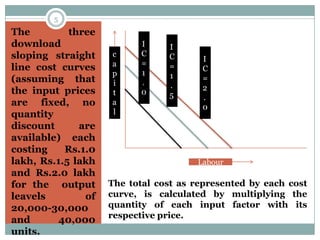
The total cost as represented by each cost
curve, is calculated by multiplying the
quantity of each input factor with its
respective price.
The three
download
sloping straight
line cost curves
(assuming that
the input prices
are fixed, no
quantity
discount are
available) each
costing Rs.1.0
lakh, Rs.1.5 lakh
and Rs.2.0 lakh
for the output
leavels of
20,000-30,000
and 40,000
units.
c
a
p
i
t
a
l
Labour
I
C
=
1
.
0
I
C
=
1
.
5
I
C
=
2
.
0
5
Least-Cost Combination
A manufacturer has to
“produce at a lower cost to
attain a higher profit”
Isocosts and isoquants can
be used to determine the
input usage that minimizes
the cost of production
6
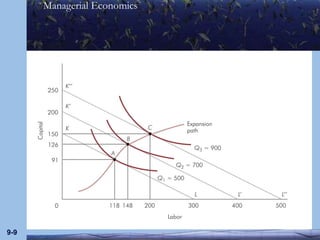
 The slope of an isoquant is equal to that of an
isocost is the place of the point of cost of
production.
 This can observed by superimposing the
isocosts on isoproduct curve
7
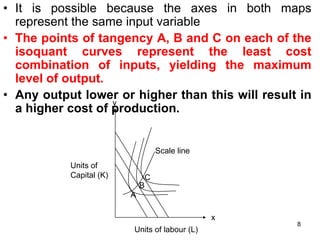
• It is possible because the axes in both maps
represent the same input variable
• The points of tangency A, B and C on each of the
isoquant curves represent the least cost
combination of inputs, yielding the maximum
level of output.
• Any output lower or higher than this will result in
a higher cost of production.
Units of
Capital (K)
x
y
Units of labour (L)
A
B
C
Scale line
8
Managerial EconomicsManagerial Economics
9-9
Dr.K.Baranidharan
THANK YOU
Dr.K.Baranidharan
Present by…
Engineering
Economics &
Financial
Accountingment
Ee&fa
1218 August 2013
RETURNS TO SCALE
 Return to scale refer to the return
enjoyed by a firm as a result of
change in all inputs.
 It explains the behavior of the
returns when inputs are changed
simultaneously.
13
Returns to Scale
 Returns to scale is the rate at
which output increases in
response to proportional
increases in all inputs.
 In the eighteenth century Adam
Smith became aware of this concept
when he studied the production of
pins.14
Returns to Scale
 Adam Smith identified two forces that
come into play when all inputs are
increased.
– A doubling of inputs permits a greater
“division of labor” allowing persons to
specialize in the production of specific pin
parts.
– This specialization may increase efficiency
enough to more than double output.
15
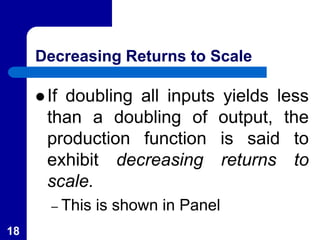
Constant Returns to Scale
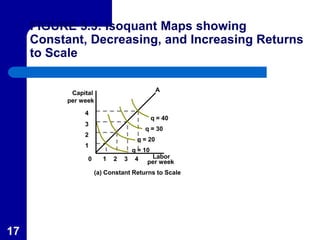
 A production function is said to
exhibit constant returns to scale
if a doubling of all inputs results
in a precise doubling of output.
– This situation is shown in Panel .
16
Capital
per week
4
A
3
2
1
Labor
per week1 2 3
(a) Constant Returns to Scale
40
FIGURE 5.3: Isoquant Maps showing
Constant, Decreasing, and Increasing Returns
to Scale
q = 10
q = 20
q = 30
q = 40
17
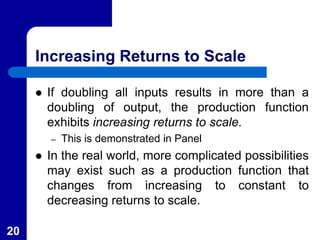
Decreasing Returns to Scale
 If doubling all inputs yields less
than a doubling of output, the
production function is said to
exhibit decreasing returns to
scale.
– This is shown in Panel
18
Capital
per week
4
A
3
2
1
Labor
per week1 2 3
(a) Constant Returns to Scale
40
Capital
per week
4
A
3
2
1
Labor
per week1 2 3
(b) Decreasing Returns to Scale
40
FIGURE 5.3: Isoquant Maps showing
Constant, Decreasing, and Increasing Returns
to Scale
q = 10 q = 10
q = 20q = 20
q = 30
q = 30
q = 40
19
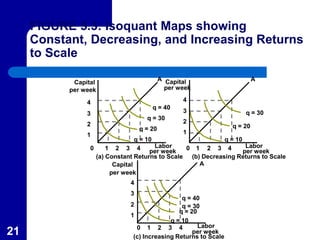
Increasing Returns to Scale
 If doubling all inputs results in more than a
doubling of output, the production function
exhibits increasing returns to scale.
– This is demonstrated in Panel
 In the real world, more complicated possibilities
may exist such as a production function that
changes from increasing to constant to
decreasing returns to scale.
20
Capital
per week
4
A
q = 10
3
2
1
Labor
per week1 2 3
(a) Constant Returns to Scale
40
Capital
per week
4
A
3
2
1
Labor
per week
1 2 3
(c) Increasing Returns to Scale
40
Capital
per week
4
A
3
2
1
Labor
per week1 2 3
(b) Decreasing Returns to Scale
40
FIGURE 5.3: Isoquant Maps showing
Constant, Decreasing, and Increasing Returns
to Scale
q = 10 q = 10
q = 20
q = 20q = 20
q = 30
q = 30
q = 30
q = 40
q = 40
21
Dr.K.Baranidharan
THANK YOU

Isocost.2

  • 1.
  • 2.
  • 3.
    INDEX •Isocosts •Least-cost Combination Of Inputs •Cobb-Douglasproduction function •Law of Return to Scale
  • 4.
    ISOCOSTS  Isocosts referto the cost curve that represents the combination of inputs that will cost a producer the same amount of money.  Isocosts denotes IQ2a particular level of total cost for a given level of production.  The level of production changes, the total cost changes and, thus the isocosts curve moves upwards 4
  • 5.
    The total costas represented by each cost curve, is calculated by multiplying the quantity of each input factor with its respective price. The three download sloping straight line cost curves (assuming that the input prices are fixed, no quantity discount are available) each costing Rs.1.0 lakh, Rs.1.5 lakh and Rs.2.0 lakh for the output leavels of 20,000-30,000 and 40,000 units. c a p i t a l Labour I C = 1 . 0 I C = 1 . 5 I C = 2 . 0 5
  • 6.
    Least-Cost Combination A manufacturerhas to “produce at a lower cost to attain a higher profit” Isocosts and isoquants can be used to determine the input usage that minimizes the cost of production 6
  • 7.
     The slopeof an isoquant is equal to that of an isocost is the place of the point of cost of production.  This can observed by superimposing the isocosts on isoproduct curve 7
  • 8.
    • It ispossible because the axes in both maps represent the same input variable • The points of tangency A, B and C on each of the isoquant curves represent the least cost combination of inputs, yielding the maximum level of output. • Any output lower or higher than this will result in a higher cost of production. Units of Capital (K) x y Units of labour (L) A B C Scale line 8
  • 9.
  • 10.
  • 11.
  • 12.
  • 13.
    RETURNS TO SCALE Return to scale refer to the return enjoyed by a firm as a result of change in all inputs.  It explains the behavior of the returns when inputs are changed simultaneously. 13
  • 14.
    Returns to Scale Returns to scale is the rate at which output increases in response to proportional increases in all inputs.  In the eighteenth century Adam Smith became aware of this concept when he studied the production of pins.14
  • 15.
    Returns to Scale Adam Smith identified two forces that come into play when all inputs are increased. – A doubling of inputs permits a greater “division of labor” allowing persons to specialize in the production of specific pin parts. – This specialization may increase efficiency enough to more than double output. 15
  • 16.
    Constant Returns toScale  A production function is said to exhibit constant returns to scale if a doubling of all inputs results in a precise doubling of output. – This situation is shown in Panel . 16
  • 17.
    Capital per week 4 A 3 2 1 Labor per week12 3 (a) Constant Returns to Scale 40 FIGURE 5.3: Isoquant Maps showing Constant, Decreasing, and Increasing Returns to Scale q = 10 q = 20 q = 30 q = 40 17
  • 18.
    Decreasing Returns toScale  If doubling all inputs yields less than a doubling of output, the production function is said to exhibit decreasing returns to scale. – This is shown in Panel 18
  • 19.
    Capital per week 4 A 3 2 1 Labor per week12 3 (a) Constant Returns to Scale 40 Capital per week 4 A 3 2 1 Labor per week1 2 3 (b) Decreasing Returns to Scale 40 FIGURE 5.3: Isoquant Maps showing Constant, Decreasing, and Increasing Returns to Scale q = 10 q = 10 q = 20q = 20 q = 30 q = 30 q = 40 19
  • 20.
    Increasing Returns toScale  If doubling all inputs results in more than a doubling of output, the production function exhibits increasing returns to scale. – This is demonstrated in Panel  In the real world, more complicated possibilities may exist such as a production function that changes from increasing to constant to decreasing returns to scale. 20
  • 21.
    Capital per week 4 A q =10 3 2 1 Labor per week1 2 3 (a) Constant Returns to Scale 40 Capital per week 4 A 3 2 1 Labor per week 1 2 3 (c) Increasing Returns to Scale 40 Capital per week 4 A 3 2 1 Labor per week1 2 3 (b) Decreasing Returns to Scale 40 FIGURE 5.3: Isoquant Maps showing Constant, Decreasing, and Increasing Returns to Scale q = 10 q = 10 q = 20 q = 20q = 20 q = 30 q = 30 q = 30 q = 40 q = 40 21
  • 22.