EBS/ ETHYLENE BIS-STEARAMIDE
By Michael Thang
085894436642
michael@sanminglobe.com
www.sanminglobe.com
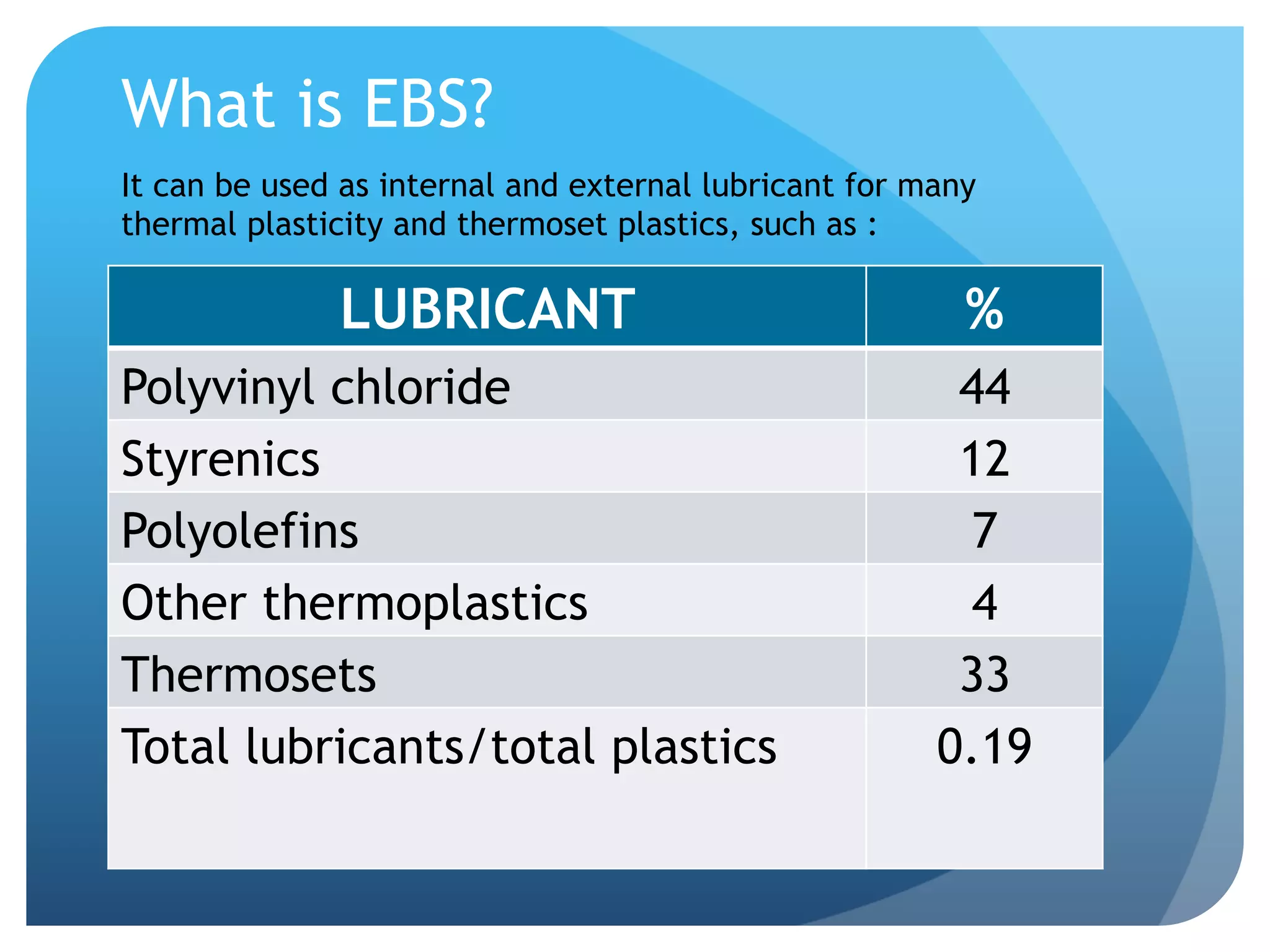
What is EBS?
It can be used as internal and external lubricant for many
thermal plasticity and thermoset plastics, such as :
LUBRICANT %
Polyvinyl chloride 44
Styrenics 12
Polyolefins 7
Other thermoplastics 4
Thermosets 33
Total lubricants/total plastics 0.19
Lubricant Chemistry
—  It is common to distinguish between “internal” and “external”
lubricants. The worst definition is based on who adds the lubricant: if
the supplier added it, it comes to the processor as an “internal”
lubricant; if the processor must add it himself, it is an “external”
lubricant. A semimeaningful distinction: an internal lubricant is
compounded into the polymer; an external lubricant is applied to the
surface of the mold. The proper distinction is based on miscibility/
immiscibility of the additive in the polymer: an internal lubricant is
miscible with the polymer and acts like a small amount of plasticizer
to increase molecular flexibility and mobility, and to help the
disentanglement and flow of the polymer molecules in the melt. An
external lubricant is immiscible in the polymer and tends to exude to
the surface of the plastic and form an abhesive (nonstick) interface
between the polymer and the steel process equipment, or it tends to
come to the surface of the finished plastic product and give it
continual lubricity in the use of the product.
—  Some lubricants are purely internal; some are purely
external. Many exhibit a balance of internal/external
activity, which depends both on the lubricant and on
the polymer in which it is used. This depends on the
relative polarity of the polymer and the lubricant. If
they have very similar polarity, the lubricant is
completely soluble in the polymer and acts as an
internal lubricant. If they have very different polarity,
the lubricant is insoluble in the polymer and exudes to
the surface, where it acts as an external lubricant. If
the lubricant molecule contains a nonpolar segment,
-----, and a polar segment, *****, the relative length or
strength of these segments ……..***, ….******, ….******
can be adjusted to balance the miscibility of the
lubricant in the polymer and thus adjust its relative
internal versus external performance.
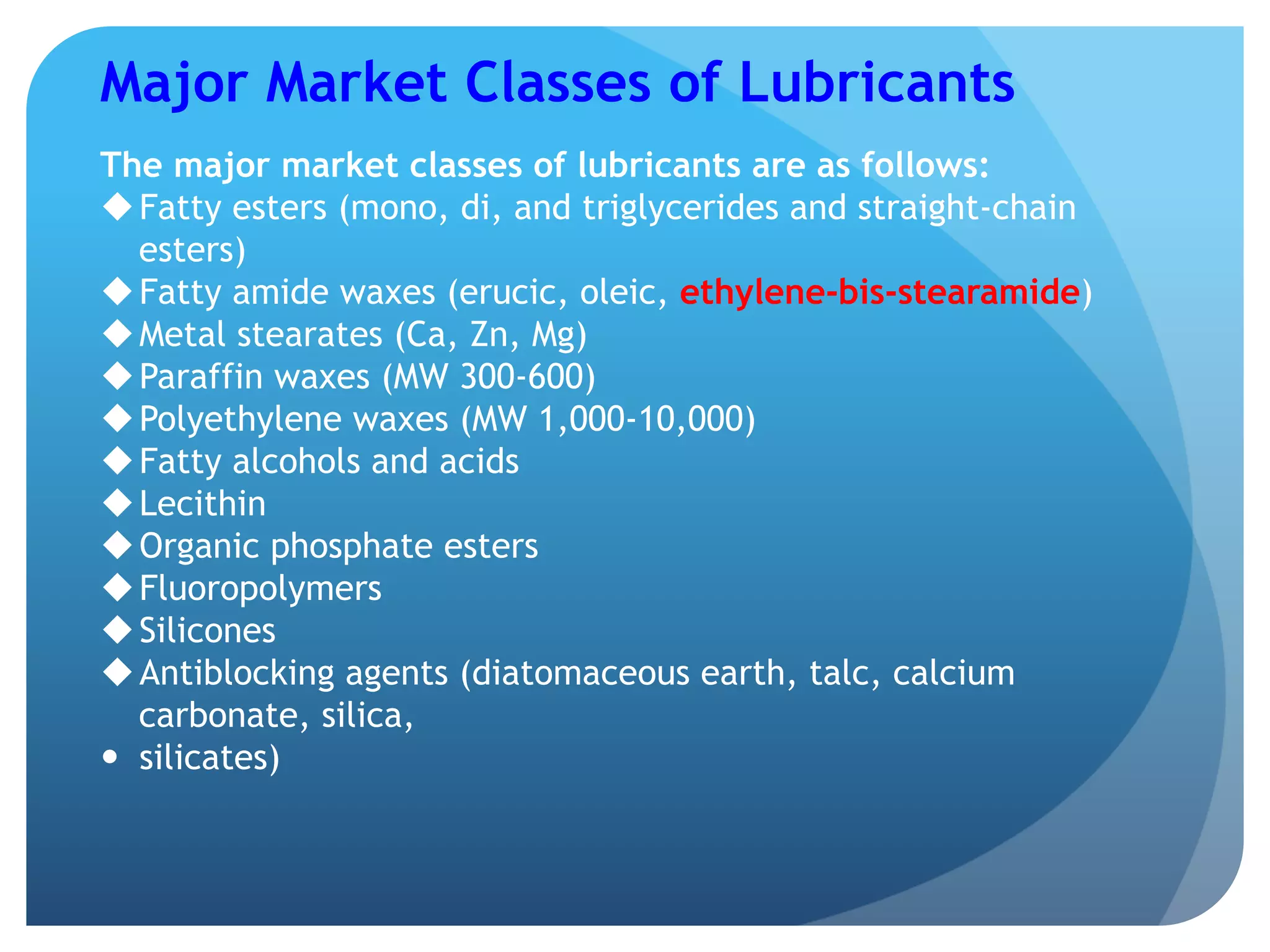
Major Market Classes of Lubricants
The major market classes of lubricants are as follows:
u Fatty esters (mono, di, and triglycerides and straight-chain
esters)
u Fatty amide waxes (erucic, oleic, ethylene-bis-stearamide)
u Metal stearates (Ca, Zn, Mg)
u Paraffin waxes (MW 300-600)
u Polyethylene waxes (MW 1,000-10,000)
u Fatty alcohols and acids
u Lecithin
u Organic phosphate esters
u Fluoropolymers
u Silicones
u Antiblocking agents (diatomaceous earth, talc, calcium
carbonate, silica,
—  silicates)
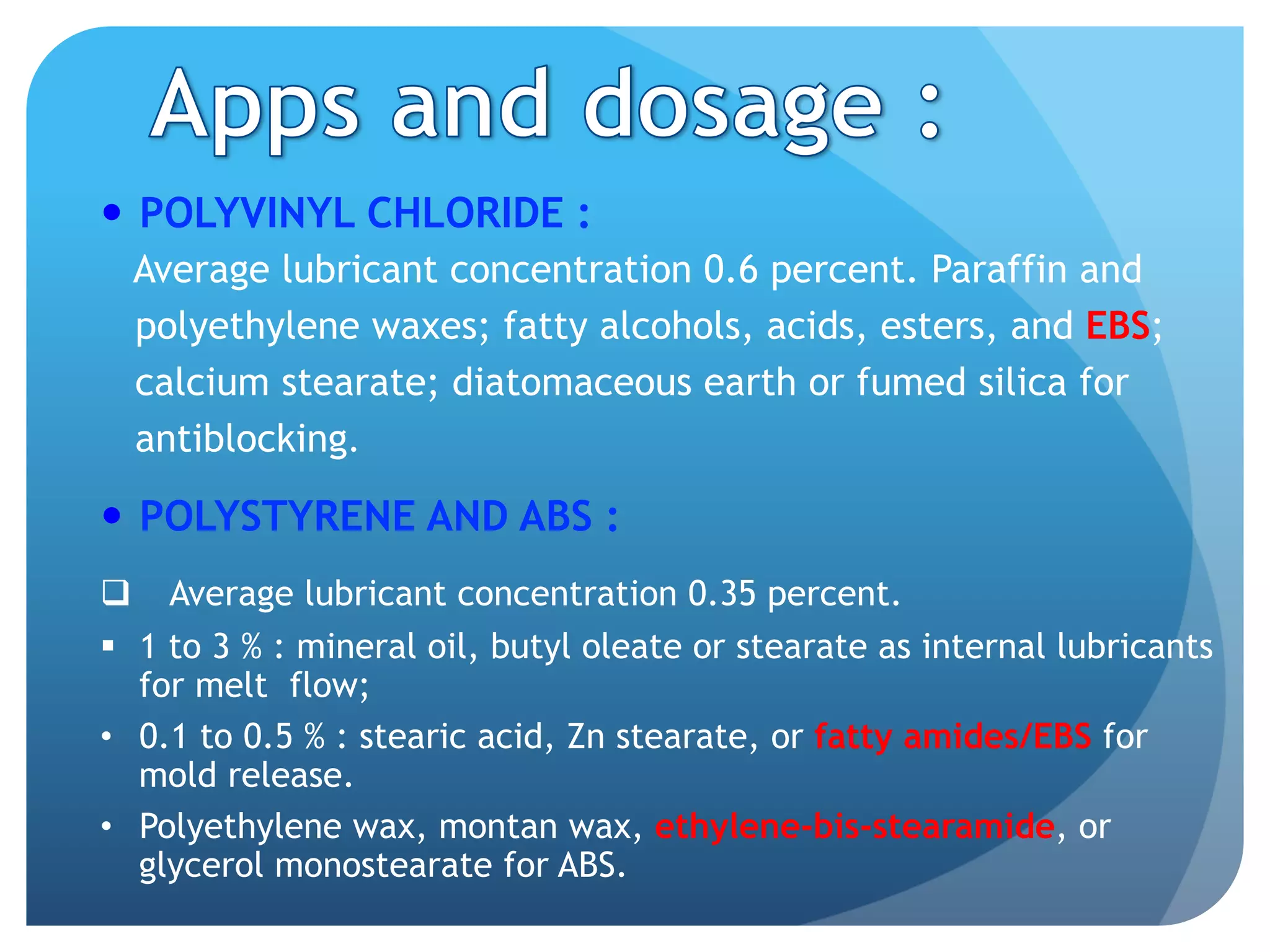
—  POLYVINYL CHLORIDE :
Average lubricant concentration 0.6 percent. Paraffin and
polyethylene waxes; fatty alcohols, acids, esters, and EBS;
calcium stearate; diatomaceous earth or fumed silica for
antiblocking.
—  POLYSTYRENE AND ABS :
q  Average lubricant concentration 0.35 percent.
§  1 to 3 % : mineral oil, butyl oleate or stearate as internal lubricants
for melt flow;
•  0.1 to 0.5 % : stearic acid, Zn stearate, or fatty amides/EBS for
mold release.
•  Polyethylene wax, montan wax, ethylene-bis-stearamide, or
glycerol monostearate for ABS.
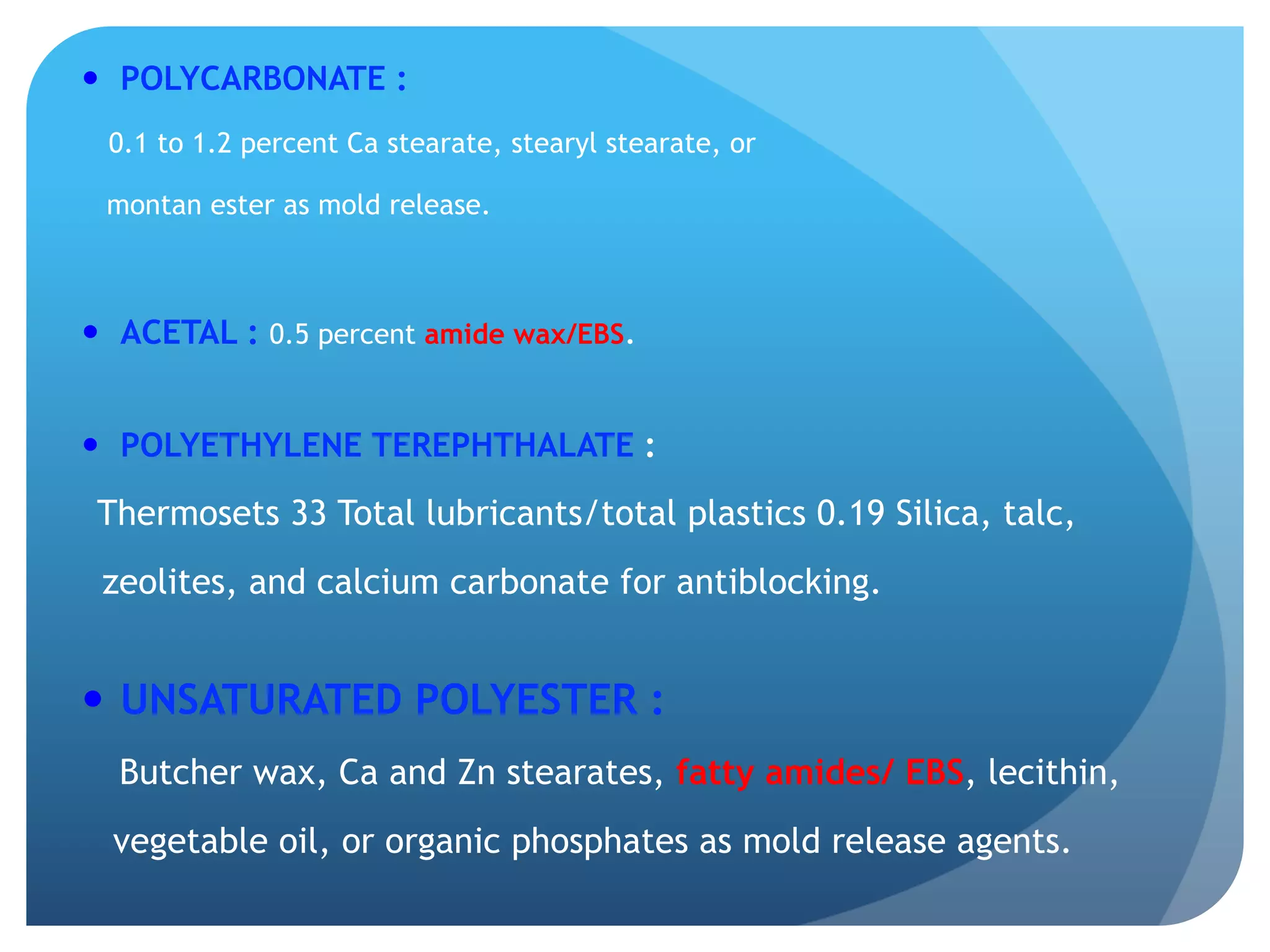
—  POLYCARBONATE :
0.1 to 1.2 percent Ca stearate, stearyl stearate, or
montan ester as mold release.
—  ACETAL : 0.5 percent amide wax/EBS.
—  POLYETHYLENE TEREPHTHALATE :
Thermosets 33 Total lubricants/total plastics 0.19 Silica, talc,
zeolites, and calcium carbonate for antiblocking.
—  UNSATURATED POLYESTER :
Butcher wax, Ca and Zn stearates, fatty amides/ EBS, lecithin,
vegetable oil, or organic phosphates as mold release agents.
Further more please call us
Michael Thang
085894436642
michael@sanminglobe.com
www.sanminglobe.com

Ebs as internl external lubricant

  • 1.
    EBS/ ETHYLENE BIS-STEARAMIDE ByMichael Thang 085894436642 michael@sanminglobe.com www.sanminglobe.com
  • 2.
    What is EBS? Itcan be used as internal and external lubricant for many thermal plasticity and thermoset plastics, such as : LUBRICANT % Polyvinyl chloride 44 Styrenics 12 Polyolefins 7 Other thermoplastics 4 Thermosets 33 Total lubricants/total plastics 0.19
  • 3.
    Lubricant Chemistry —  Itis common to distinguish between “internal” and “external” lubricants. The worst definition is based on who adds the lubricant: if the supplier added it, it comes to the processor as an “internal” lubricant; if the processor must add it himself, it is an “external” lubricant. A semimeaningful distinction: an internal lubricant is compounded into the polymer; an external lubricant is applied to the surface of the mold. The proper distinction is based on miscibility/ immiscibility of the additive in the polymer: an internal lubricant is miscible with the polymer and acts like a small amount of plasticizer to increase molecular flexibility and mobility, and to help the disentanglement and flow of the polymer molecules in the melt. An external lubricant is immiscible in the polymer and tends to exude to the surface of the plastic and form an abhesive (nonstick) interface between the polymer and the steel process equipment, or it tends to come to the surface of the finished plastic product and give it continual lubricity in the use of the product.
  • 4.
    —  Some lubricantsare purely internal; some are purely external. Many exhibit a balance of internal/external activity, which depends both on the lubricant and on the polymer in which it is used. This depends on the relative polarity of the polymer and the lubricant. If they have very similar polarity, the lubricant is completely soluble in the polymer and acts as an internal lubricant. If they have very different polarity, the lubricant is insoluble in the polymer and exudes to the surface, where it acts as an external lubricant. If the lubricant molecule contains a nonpolar segment, -----, and a polar segment, *****, the relative length or strength of these segments ……..***, ….******, ….****** can be adjusted to balance the miscibility of the lubricant in the polymer and thus adjust its relative internal versus external performance.
  • 5.
    Major Market Classesof Lubricants The major market classes of lubricants are as follows: u Fatty esters (mono, di, and triglycerides and straight-chain esters) u Fatty amide waxes (erucic, oleic, ethylene-bis-stearamide) u Metal stearates (Ca, Zn, Mg) u Paraffin waxes (MW 300-600) u Polyethylene waxes (MW 1,000-10,000) u Fatty alcohols and acids u Lecithin u Organic phosphate esters u Fluoropolymers u Silicones u Antiblocking agents (diatomaceous earth, talc, calcium carbonate, silica, —  silicates)
  • 6.
    —  POLYVINYL CHLORIDE: Average lubricant concentration 0.6 percent. Paraffin and polyethylene waxes; fatty alcohols, acids, esters, and EBS; calcium stearate; diatomaceous earth or fumed silica for antiblocking. —  POLYSTYRENE AND ABS : q  Average lubricant concentration 0.35 percent. §  1 to 3 % : mineral oil, butyl oleate or stearate as internal lubricants for melt flow; •  0.1 to 0.5 % : stearic acid, Zn stearate, or fatty amides/EBS for mold release. •  Polyethylene wax, montan wax, ethylene-bis-stearamide, or glycerol monostearate for ABS.
  • 7.
    —  POLYCARBONATE : 0.1to 1.2 percent Ca stearate, stearyl stearate, or montan ester as mold release. —  ACETAL : 0.5 percent amide wax/EBS. —  POLYETHYLENE TEREPHTHALATE : Thermosets 33 Total lubricants/total plastics 0.19 Silica, talc, zeolites, and calcium carbonate for antiblocking. —  UNSATURATED POLYESTER : Butcher wax, Ca and Zn stearates, fatty amides/ EBS, lecithin, vegetable oil, or organic phosphates as mold release agents.
  • 8.
    Further more pleasecall us Michael Thang 085894436642 michael@sanminglobe.com www.sanminglobe.com