
Adhesives
• a substance used for sticking objects or materials together; glue.
• any substance applied to one surface, or both surfaces, of two separate
items that binds them together and resists their separation
• Adjectives may be used in conjunction with the word "adhesive" to
describe properties based on the substance's physical or chemical form,
the type of materials joined, or conditions under which it is applied
Coatings
• A coating is a covering that is applied to the surface of an object, usually referred to
as the substrate.
• The purpose of applying the coating may be decorative, functional, or both.
• The coating itself may be an all-over coating, completely covering the substrate, or it
may only cover parts of the substrate.
• Paints and lacquers are coatings that mostly have dual uses of protecting the
substrate and being decorative, although some artists paints are only for decoration,
and the paint on large industrial pipes is presumably only for the function of
preventing corrosion.
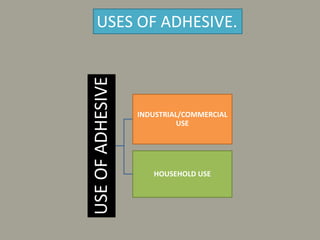
USES OF ADHESIVE.
USEOFADHESIVE
INDUSTRIAL/COMMERCIAL
USE
HOUSEHOLD USE
INDUSTRIAL/ COMMERCIAL USE
• adhesive usage in all kinds of industries, small or heavy.
• In small industries like those of food products, toys or stationary items,
adhesives play an integral role in processing to packaging
• In heavy industries, adhesives play a central role, right from assembling spare
parts of any machine, car paint or branding them with labels.
• In the construction industry too, for uniform distribution of stress, woods are
bonded with strong adhesives. Apart from that, for painting and furnishing or
home décor, adhesives are very essential.
Household Use
• Right from sticking envelopes to rejoining broken toys, we use adhesives
very frequently
• In form of glue sticks, cello tapes or gums, we use adhesives everyday to
mend shoes, to glue postage stamps, repair something or attaching tags to
gifts.
• The car industry typically uses polyurethane adhesives for vehicle interiors
and to bond windshields
• Wood chips or sawdust can be mixed with polyurethane adhesives to
make fiberboard.
• Conveyor belts are closed with the help of polyurethane adhesives.
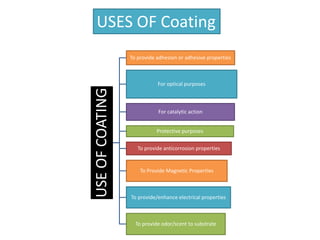
USES OF Coating
USEOFCOATING
To provide adhesion or adhesive properties
For optical purposes
For catalytic action
Protective purposes
To provide anticorrosion properties
To Provide Magnetic Properties
To provide/enhance electrical properties
To provide odor/scent to substrate
To provide adhesion or adhesive
properties
• Non-stick PTFE coated- cooking pans
• Release coatings e.g. silicone-coated release liners for many self-
adhesive products
• primers encourage subsequent coatings to adhere well (also
sometimes have anti-corrosive properties)
For optical purposes
• Reflective coatings for mirrors
• Anti-reflective coatings e.g. on spectacles
• UV- absorbent coatings for protection of eyes or increasing the life of the substrate
• Tinted as used in some coloured lighting, tinted glazing, or sunglasses
Protective purposes
• Most surface coatings or paints are to some extent protecting the substrate
• Sealing and waterproofing wood
• Sealing the surface of concrete
• Waterproofing and damp proofing of concrete walls
• Roof coating
• Concrete bridge deck membranes
• Sealing and waterproofing of masonry
• Preserving machinery, equipment and structures
• Wear Resistance
• Anticorrosion
• Hard anti-scratch coating on plastics and other materials
e.g. of titanium nitride to reduce scratching and abrasion
loss
• Barrier coatings on concrete, metals and alloys subject to
erosion/abrasive attack
To provide/enhance electrical
properties
•Conformal Antenna, e.g., metal coatings on plastic airframes
•Conductive coatings e.g. to manufacture some types of resistors
•Insulating coatings e.g. on magnet wires used in transformers
For catalytic action
To Provide Magnetic Properties
To provide odor/scent to substrate
Coatings for self cleaning glass
Magnetic properties such as for magnetic media like cassette tapes, floppy disks, and
some mass transit tickets
Scent properties such as scratch and sniff stickers and labels uses special coatings
THANK YOU FOR
YOUR ATTENTION

Adhesives and coatings

  • 1.
    Adhesives • a substanceused for sticking objects or materials together; glue. • any substance applied to one surface, or both surfaces, of two separate items that binds them together and resists their separation • Adjectives may be used in conjunction with the word "adhesive" to describe properties based on the substance's physical or chemical form, the type of materials joined, or conditions under which it is applied
  • 2.
    Coatings • A coatingis a covering that is applied to the surface of an object, usually referred to as the substrate. • The purpose of applying the coating may be decorative, functional, or both. • The coating itself may be an all-over coating, completely covering the substrate, or it may only cover parts of the substrate. • Paints and lacquers are coatings that mostly have dual uses of protecting the substrate and being decorative, although some artists paints are only for decoration, and the paint on large industrial pipes is presumably only for the function of preventing corrosion.
  • 3.
  • 4.
    INDUSTRIAL/ COMMERCIAL USE •adhesive usage in all kinds of industries, small or heavy. • In small industries like those of food products, toys or stationary items, adhesives play an integral role in processing to packaging • In heavy industries, adhesives play a central role, right from assembling spare parts of any machine, car paint or branding them with labels. • In the construction industry too, for uniform distribution of stress, woods are bonded with strong adhesives. Apart from that, for painting and furnishing or home décor, adhesives are very essential.
  • 5.
    Household Use • Rightfrom sticking envelopes to rejoining broken toys, we use adhesives very frequently • In form of glue sticks, cello tapes or gums, we use adhesives everyday to mend shoes, to glue postage stamps, repair something or attaching tags to gifts. • The car industry typically uses polyurethane adhesives for vehicle interiors and to bond windshields • Wood chips or sawdust can be mixed with polyurethane adhesives to make fiberboard. • Conveyor belts are closed with the help of polyurethane adhesives.
  • 6.
    USES OF Coating USEOFCOATING Toprovide adhesion or adhesive properties For optical purposes For catalytic action Protective purposes To provide anticorrosion properties To Provide Magnetic Properties To provide/enhance electrical properties To provide odor/scent to substrate
  • 7.
    To provide adhesionor adhesive properties • Non-stick PTFE coated- cooking pans • Release coatings e.g. silicone-coated release liners for many self- adhesive products • primers encourage subsequent coatings to adhere well (also sometimes have anti-corrosive properties)
  • 8.
    For optical purposes •Reflective coatings for mirrors • Anti-reflective coatings e.g. on spectacles • UV- absorbent coatings for protection of eyes or increasing the life of the substrate • Tinted as used in some coloured lighting, tinted glazing, or sunglasses
  • 9.
    Protective purposes • Mostsurface coatings or paints are to some extent protecting the substrate • Sealing and waterproofing wood • Sealing the surface of concrete • Waterproofing and damp proofing of concrete walls • Roof coating • Concrete bridge deck membranes • Sealing and waterproofing of masonry • Preserving machinery, equipment and structures • Wear Resistance • Anticorrosion • Hard anti-scratch coating on plastics and other materials e.g. of titanium nitride to reduce scratching and abrasion loss • Barrier coatings on concrete, metals and alloys subject to erosion/abrasive attack
  • 10.
    To provide/enhance electrical properties •ConformalAntenna, e.g., metal coatings on plastic airframes •Conductive coatings e.g. to manufacture some types of resistors •Insulating coatings e.g. on magnet wires used in transformers
  • 11.
    For catalytic action ToProvide Magnetic Properties To provide odor/scent to substrate Coatings for self cleaning glass Magnetic properties such as for magnetic media like cassette tapes, floppy disks, and some mass transit tickets Scent properties such as scratch and sniff stickers and labels uses special coatings
  • 12.