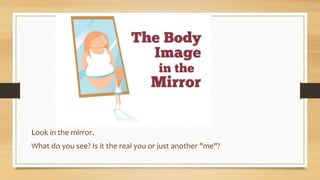
Look in the mirror.
What do you see? Is it the real you or just another "me"?
EATING DISORDERS
Presented by
Miss Samruddhi Awasare
KNC Sewagram
What is are eating disorders
• Eating disorders are mental illnesses that cause serious
disturbances in a person’s everyday diet.
• It can manifest as eating extremely small amounts of food or
severely overeating.
• The condition may begin as just eating too little or too much but
obsession with eating and food over takes over the life of a
person leading to severe changes.
CLASSIFICATION
• F.50- Eating Disorders.
• F.50.0- Anorexia nervosa.
• F.50.1- Atypical anorexia nervosa.
• F.50.2- Bulimia nervosa.
• F. 50.3- Atypical bulimia nervosa.
• F.50.4- Overeating associated with other psychological disturbances.
• F.50.5- Vomiting associated with other psychological disturbances.
• F.50.8- Other eating disorders.
• F.50.9- Eating disorder, unspecified.
TYPES OF EATING DISORDERS
• Anorexia Nervosa
• Bulimia Nervosa
• Binge Eating Disorder
• Not Otherwise Specified (NOS)
5ANOREXIA NERVOSA: WHAT IS IT? .
• ANOREXIA NERVOSA:
Anorexia nervosa happens when
one is obsessed with becoming
thin that they reach extreme
measures and this leads to
extreme weight loss.
Sign and symptoms
• Dramatic weight loss
• Refusal to eat certain foods or food categories.
• Consistent excuses to avoid situations involving food
• Excessive and rigid exercise routine
• Withdrawal from usual friends/relatives Involves extreme weight
loss at least 15 per cent below the individual’s body weight.
• Look emaciated.
• There is intense fear of becoming obese
• There is body image disturbance. The patient is unable to perceive
the body size accurately.
• Hormonal abnormalities may also be seen.
• Thin appearance, thin hair, falling of hair, or break in hair.
HEALTH RISKS WITH ANOREXIA
• Heart failure
• Kidney failure
• Low protein stores
• Digestive problems
DIAGNOSTIC INVESTIGATIONS
Physical examination:
• Measurement of height and weight.
Body weight will be maintained at least 15 percent below the expected.
Quitelet’s body mass index estimation for 16 years and above
QBMI= WEIGHT(kg)/ HEIGHT(m2 )
• Check vital signs
• Check the skin for dryness or other problems
• Abdominal examination
Laboratory investigations
ECG
Psychological evaluation
Family history
Socio developmental history
• Team approach
• Medical care:
it causes many complications, so frequent monitoring of vital signs,
hydration levels, electrolyte levels and other physical conditions are needed.
Nursing managment
• Maintain a strict intake and output chart.
• Monitor status of skin and oral mucus membranes.
• Encourage the patient to verbalize feelings of fear and anxiety
• Related to achievement, family relationships and intense need for independence.
• Encourage family to participate in education regarding connection between family
process and the patient’s disorder.
• Avoid discussions that focus on food and weight.
BULIMIA NERVOSA: WHAT IS IT?
BULIMIA NERVOSA
Bulimia Nervosa is an eating disorder in which one starts to consume large amounts of food at once and then is followed by purging, using
laxatives, or over exercising to rid themselves of the food they ate.
BULIMIA NERVOSA: WARNING SIGNS
• Wrappers/containers indicating consumption of large amounts of food
• Frequent trips to bathroom after meals
• Signs of vomiting e.g. staining of teeth, calluses on hands
• Excessive and rigid exercise routine
• Withdrawal from usual friends/relatives
BULIMIA NERVOSA: WARNING SIGNS
• Dental problems
• Stomach rupture
• Menstruation irregularities
BINGE EATING DISORDER: WHAT IS IT?
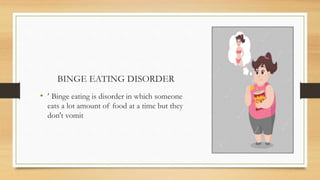
BINGE EATING DISORDER
•  Binge eating is disorder in which someone
eats a lot amount of food at a time but they
don't vomit
BINGE EATING DISORDER: WARNING
SIGNS
• Wrappers/containers indicating consumption of large
amounts of food
• MAY be overweight for age and height
• MAY have a long history of repeated efforts to diet-feel
desperate about their difficulty to control food intake
• MAY eat throughout the day with no planned mealtimes
HEALTH RISKS WITH BINGE EATING
DISORDER
• High blood pressure
• High cholesterol
• Gall bladder disease
• Diabetes
• Heart disease
• Certain types of cancer
Diagnostic evaluation
• chart
Psychotherapy
• flashcards
WHY DO PEOPLE DEVELOP EATING
DISORDERS?
• Psychological factors
• Interpersonal factors
• Social/Cultural factors
• Biological factors
PSYCHOLOGICAL FACTORS
• Low self-esteem
• Feelings of inadequacy or failure
• Feeling out of control
• Response to change (puberty)
• Response to stress (sports, dance)
• Personal illness
CULTURAL FACTORS
Cultural pressures that glorify thinness and place value on obtaining
the perfect body
Narrow definitions of beauty that include only women and men of
specific body weights and shapes
Cultural norms that value people on the basis of physical
appearance and not inner qualities and strengths
INTERPERSONAL FACTORS
• Troubled family and personal relationships
• Difficulty expressing emotions and feelings
• History of being teased or ridiculed based on size or weight
• History of physical or sexual abuse
BIOLOGICAL FACTORS
Eating disorders often run in families (learn coping skills and attitudes in
family)
• Genetic component—research about brain and eating in taking place
(certain chemicals in the brain control hunger, appetite and digestion have
been found unbalanced).
SUMMARY
Assignment
• Write down the difference between anorexia nervosa and bulimia nervosa.
BIBLIOGRAPHY:
• Townsend M C, Psychiatric mental health nursing-concepts of care, 6th edition, F A Dias
Company Philadelphia,2007.
• Sreevani R, A Guide to Mental Health & Psychiatric Nursing, 3rd edition, Jaypee Brothers
Medical publishers, New Delhi 2010.
• Lalitha K. Mental Health & Psychiatric Nursing,1st edition, Gajanana book publishers and
distributors, Bangalore 2006.
• Basavanthappa B T, Psychiatric Mental Health Nursing, 1st edition, Jaypee Brothers Medical
Publishers Medical Publishers, New Delhi2007.
• Ahuja N. A Short Textbook of Psychiatric , 5th edition Jaypee Brothers Medical Publishers,
New Delhi 2002
• Stuart W. Gail, Lalaia T. Michele, Principles And Practice of Psychiatric Nursing, 8th edition,
Mosby Elsevier, Missouri, 2007.
•
•
THANK YOU
Thank you

eating disorder.pptx

  • 1.
    Look in themirror. What do you see? Is it the real you or just another "me"?
  • 2.
    EATING DISORDERS Presented by MissSamruddhi Awasare KNC Sewagram
  • 3.
    What is areeating disorders • Eating disorders are mental illnesses that cause serious disturbances in a person’s everyday diet. • It can manifest as eating extremely small amounts of food or severely overeating. • The condition may begin as just eating too little or too much but obsession with eating and food over takes over the life of a person leading to severe changes.
  • 4.
    CLASSIFICATION • F.50- EatingDisorders. • F.50.0- Anorexia nervosa. • F.50.1- Atypical anorexia nervosa. • F.50.2- Bulimia nervosa. • F. 50.3- Atypical bulimia nervosa. • F.50.4- Overeating associated with other psychological disturbances. • F.50.5- Vomiting associated with other psychological disturbances. • F.50.8- Other eating disorders. • F.50.9- Eating disorder, unspecified.
  • 5.
    TYPES OF EATINGDISORDERS • Anorexia Nervosa • Bulimia Nervosa • Binge Eating Disorder • Not Otherwise Specified (NOS)
  • 6.
  • 7.
    • ANOREXIA NERVOSA: Anorexianervosa happens when one is obsessed with becoming thin that they reach extreme measures and this leads to extreme weight loss.
  • 8.
    Sign and symptoms •Dramatic weight loss • Refusal to eat certain foods or food categories. • Consistent excuses to avoid situations involving food • Excessive and rigid exercise routine • Withdrawal from usual friends/relatives Involves extreme weight loss at least 15 per cent below the individual’s body weight.
  • 10.
    • Look emaciated. •There is intense fear of becoming obese • There is body image disturbance. The patient is unable to perceive the body size accurately. • Hormonal abnormalities may also be seen. • Thin appearance, thin hair, falling of hair, or break in hair.
  • 11.
    HEALTH RISKS WITHANOREXIA • Heart failure • Kidney failure • Low protein stores • Digestive problems
  • 12.
    DIAGNOSTIC INVESTIGATIONS Physical examination: •Measurement of height and weight. Body weight will be maintained at least 15 percent below the expected. Quitelet’s body mass index estimation for 16 years and above QBMI= WEIGHT(kg)/ HEIGHT(m2 ) • Check vital signs • Check the skin for dryness or other problems • Abdominal examination
  • 13.
  • 14.
    • Team approach •Medical care: it causes many complications, so frequent monitoring of vital signs, hydration levels, electrolyte levels and other physical conditions are needed.
  • 15.
    Nursing managment • Maintaina strict intake and output chart. • Monitor status of skin and oral mucus membranes. • Encourage the patient to verbalize feelings of fear and anxiety • Related to achievement, family relationships and intense need for independence. • Encourage family to participate in education regarding connection between family process and the patient’s disorder. • Avoid discussions that focus on food and weight.
  • 16.
  • 17.
    BULIMIA NERVOSA Bulimia Nervosais an eating disorder in which one starts to consume large amounts of food at once and then is followed by purging, using laxatives, or over exercising to rid themselves of the food they ate.
  • 18.
    BULIMIA NERVOSA: WARNINGSIGNS • Wrappers/containers indicating consumption of large amounts of food • Frequent trips to bathroom after meals • Signs of vomiting e.g. staining of teeth, calluses on hands • Excessive and rigid exercise routine • Withdrawal from usual friends/relatives
  • 19.
    BULIMIA NERVOSA: WARNINGSIGNS • Dental problems • Stomach rupture • Menstruation irregularities
  • 20.
  • 21.
    BINGE EATING DISORDER • Binge eating is disorder in which someone eats a lot amount of food at a time but they don't vomit
  • 22.
    BINGE EATING DISORDER:WARNING SIGNS • Wrappers/containers indicating consumption of large amounts of food • MAY be overweight for age and height • MAY have a long history of repeated efforts to diet-feel desperate about their difficulty to control food intake • MAY eat throughout the day with no planned mealtimes
  • 23.
    HEALTH RISKS WITHBINGE EATING DISORDER • High blood pressure • High cholesterol • Gall bladder disease • Diabetes • Heart disease • Certain types of cancer
  • 24.
  • 25.
  • 26.
    WHY DO PEOPLEDEVELOP EATING DISORDERS? • Psychological factors • Interpersonal factors • Social/Cultural factors • Biological factors
  • 27.
    PSYCHOLOGICAL FACTORS • Lowself-esteem • Feelings of inadequacy or failure • Feeling out of control • Response to change (puberty) • Response to stress (sports, dance) • Personal illness
  • 28.
    CULTURAL FACTORS Cultural pressuresthat glorify thinness and place value on obtaining the perfect body Narrow definitions of beauty that include only women and men of specific body weights and shapes Cultural norms that value people on the basis of physical appearance and not inner qualities and strengths
  • 29.
    INTERPERSONAL FACTORS • Troubledfamily and personal relationships • Difficulty expressing emotions and feelings • History of being teased or ridiculed based on size or weight • History of physical or sexual abuse
  • 30.
    BIOLOGICAL FACTORS Eating disordersoften run in families (learn coping skills and attitudes in family) • Genetic component—research about brain and eating in taking place (certain chemicals in the brain control hunger, appetite and digestion have been found unbalanced).
  • 31.
  • 32.
    Assignment • Write downthe difference between anorexia nervosa and bulimia nervosa.
  • 33.
    BIBLIOGRAPHY: • Townsend MC, Psychiatric mental health nursing-concepts of care, 6th edition, F A Dias Company Philadelphia,2007. • Sreevani R, A Guide to Mental Health & Psychiatric Nursing, 3rd edition, Jaypee Brothers Medical publishers, New Delhi 2010. • Lalitha K. Mental Health & Psychiatric Nursing,1st edition, Gajanana book publishers and distributors, Bangalore 2006. • Basavanthappa B T, Psychiatric Mental Health Nursing, 1st edition, Jaypee Brothers Medical Publishers Medical Publishers, New Delhi2007. • Ahuja N. A Short Textbook of Psychiatric , 5th edition Jaypee Brothers Medical Publishers, New Delhi 2002 • Stuart W. Gail, Lalaia T. Michele, Principles And Practice of Psychiatric Nursing, 8th edition, Mosby Elsevier, Missouri, 2007. • •
  • 34.