Residential Electrical
Equipment and
Services
Ensuring Safe and Reliable Electrical systems
Introduction
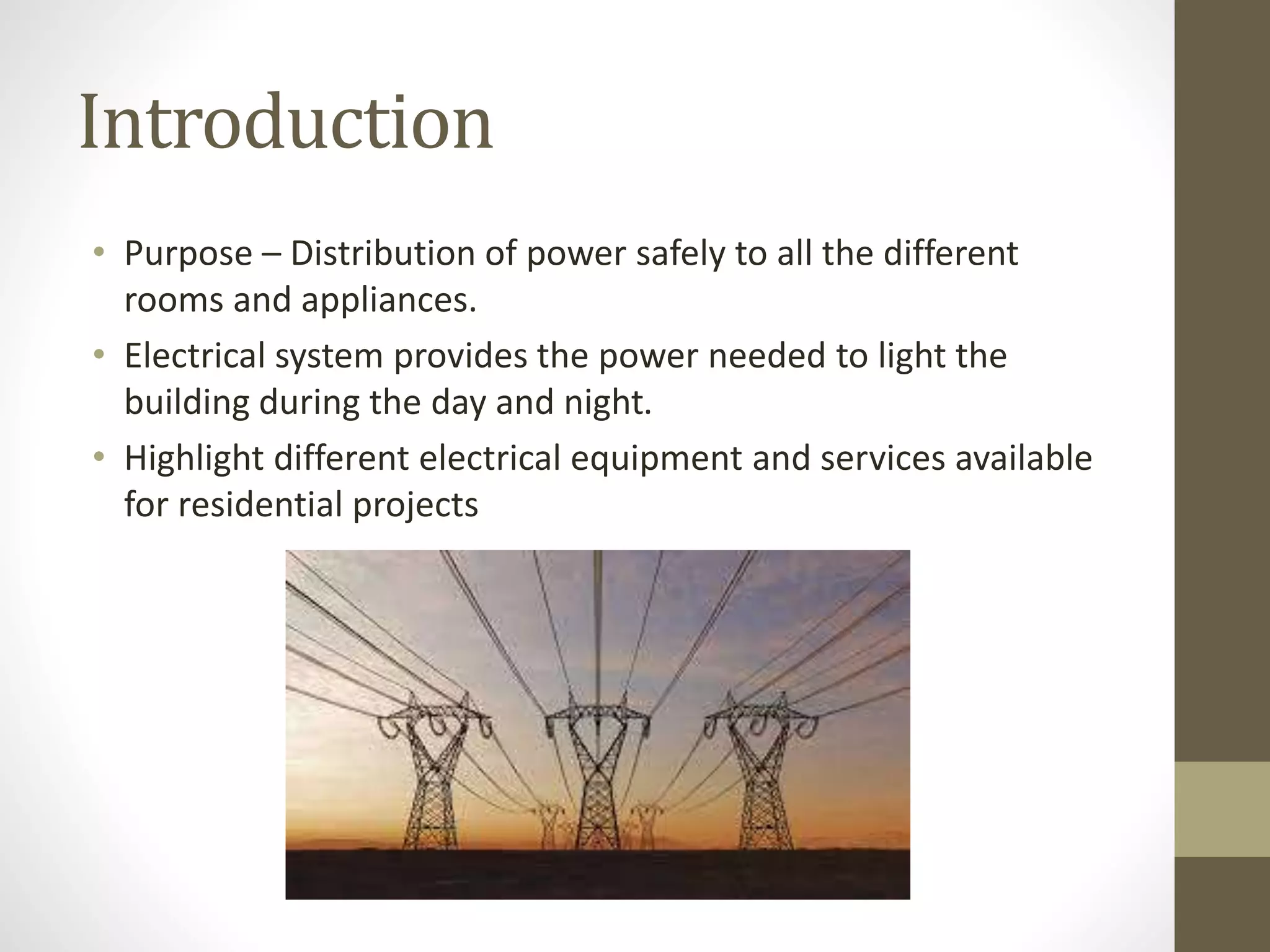
• Purpose – Distribution of power safely to all the different
rooms and appliances.
• Electrical system provides the power needed to light the
building during the day and night.
• Highlight different electrical equipment and services available
for residential projects
Introduction
• The first use of electric
supply were established
in 1882 by Thomas
Edison, Thereafter there
have been constant
effort throughout the
world to set-up power
stations for more than
one purposes.
• The power generation in
India in 1947-48 was
only 1,300 MW and
today we generate more
than 4,00,000 MW.
Electricity Generation
• Electricity is generated from the stored energy of water that
makes turbine run and generate electricity.
• The other method includes fuels (Coal, diesel or gas) to fire
boilers and pass stream and generate electricity through
generators.
• Transformer step up several thousands of volts before it is
supplied to the transmission lines or cable.
• By transmitting electricity at high voltages less power is lost in
the cables.
• At the receiving end of voltage is stepped down by transforms
in local sub-stations to consumers at 240 volts.
Understanding Residential
Electrical systems
• Main service panel and subpanels
• Service entrance cable and meter
• Branch circuit and circuit breakers
• Earthing system
Main service panel
Main Panel - The main
breaker panel is the mother
of all the panels in your
house. It regulates the circuit
breakers and the electricity
consumption within the
home.
It divides an electrical power
feed into subsidiary circuits,
while providing a protective
fuse or circuit breaker for
each circuit in a common
enclosure.
Subpanel
A sub-panel is a smaller
electrical panel that
services a specific area
of the home.
It holds separate circuit
breakers from the main
breaker panel.
This can prevent
overloading the
electrical system and
tripping circuit breakers
or melting fuses.
Service entrance cable and
meter
• In Urban areas electrical cables are Usually underground and are
brought up to entry point at ground level or into basement.
• Service cable cannot be bent to small radii and this should be borne
in mind when considering point of entry.
• In small buildings the cable run is kept as short as possible,
terminating in a distribution board at the first convenient position.
• In these buildings the distribution board will be fitted with a seal box
to prevent moisture from entering the insulation of the service
cable.
• The position chosen for the distribution board should be readily
accessible both for meter reading and for replacing fuses.
• In some cases special glasses are provided so that meter can be read
without entering the premises.
Domestic Supply
• Domestic electricity supply usually effected through
distribution system and describe as single and three phases.
• Normally small buildings are supplied with electricity by two
wires, one phase wire and the other neutral. This is known as
single phase supply and gives a voltage for the premises of
240 volts.
• The loading of the supply wiring is balanced between the
phases by using the phases in rotation so that each one
services every third building.
• In three phases, four wire bring 420/ 240 volts. The balancing
of load is then achieved by serving different areas of the
building by different phases. Electric motor are usually
designed for three phase operation.
Domestic Supply
Branch Circuit systems
• In most of the buildings electricity supply is divided into two
types of sub circuit: Lighting Load sub-circuit and power load
Sub Circuit.
• For operational purpose it is divided into three phases circuit-
lighting, socket outlets and fixed apparatus.
• The sub circuit which gives supply to lighting load points is
called lighting load sub circuit. This circuit includes lamps, fans,
tubes etc. As per Indian Electricity Rules. The following rating
should be assumed
Filament lamp 60W
Ceiling fan 60W
Socket for radio, table fan 60W
Fluorescent tube 40W
Mercury Vapor lamp 80W
Circuit Breaker
• A circuit breaker is defined as, switching device which
interrupts the faulty current and performs the function of a
switch thus protecting the electrical system from damage.
• Circuit breakers "trip", shut off, current flow after protective
relays detect a fault.
• Unlike fuses that were used previously, circuit breakers are not
usually damaged so they can be reset as opposed to being
replaced.
Earthing system
In electricity supply systems, an earthing system or grounding
system is circuitry which connects parts of the electric circuit
with the ground, thus defining the electric potential of the
conductors relative to the Earth's conductive surface.
Applications of Earthing
system
• Protect human against lightning and earth fault condition
• Protect the premises against lightning and earth fault
condition
• Provide low resistance and safe path for lightning and fault
current
• All metallic enclosure and extraneous conductive parts are at
• equipotential
• LV System Earth
Basic Wiring System
• Wiring in buildings is run either on the surface or canceled in
the construction.
• Surface wiring is cheaper but its appearance limits its use.
• 2 types of wiring system available for use in buildings are
sheathed and conduit.
• Two or more wires consisting of metal conductors each having
its own insulation is enclosed in a protective sheath known as
TRSC tough rubber sheathed.
• Use of PVC for insulation and sheathing is preferred as it gives
smoother and neater cables. This type of wire are well suited
to surface use.
• For use in concealed wiring, conduit or metal channels should
provide to protect wiring.
Basic Wiring System
Conduit Wiring
• In this type of wiring system VIR or PVC are carried through
steel or PVC tubes as conduit.
• In case of surface conduit wiring, the conduit is fitted on the
surface of the walls by means of saddles
• In case of concealed conduit wiring the conduit facilitates the
drawing of wires.
Common Residential
Equipment
Electric Installations
Electric Installations require necessary design, planning taking
into consideration the whole requirement of the activities to be
carried out in the building.
The following steps are suggested for the same..
- Planning & Designing
- Layout of working drawings
- Application to electric supply company for granting estimated low
supply and requirement of sub-stations/ transformers
- Laying conduit for underground supply lines before concreting and
completing the plinth work.
- Laying conduits in slabs and beam reinforcement, fixing of fan
hooks/ boxes in slabs reinforcement for main supply to consumer
units/ rooms
Electric Installations
- Physical marking of layout of wiring in all units/ rooms.
- Providing & laying complete wiring
- Fixing all fittings and fixtures and complete electrical
installations
- Testing of Installations
- Providing consumer meters.
- Submission of test reports to electric supply company for
supply connection after obtaining NOC from PWD in cases of
building exceeds 15m height.
- Checking of electrical installation by authorized officer of
electrical supply company before passing & sealing of meters.
- Permanent electric supply connection to buildings and
consumer thereof
Design of Electric System
• Total load requirement i.e. lights, fans, power etc.
• Anticipated future increase in power consumption.
• Layout of wiring installation, whether open conduit or
concealed
• Provision of sub-station, meter room, switch room, services
cable duct, rising mains and cables, opening and chases
required in floors and walls for intending electrical
installations.
Execution
• The execution of entire electrical Installation should be carried out
under the guidance and supervision of competent electrical
engineer/through licensed electrical contractor; in accordance to the
design and specification provided in the tender and strictly as per rules
and regulations of electrical supply.
• The electrical contractor should decide his sequence of work in
consultation with the architect in such a manner that it will not
affect/conflict with working of other agencies and it will allow other
service agencies to work smoothly and simultaneously without any
interruption.
Execution
• The electrical contractor should get approval for all materials
including fitting and fixtures to be used from the architect before
commencement of work.
• The contractor should arrange temporary electrical supply for
construction purpose; before proper work is commenced.
• At the end of work the electrical contractor should check and test
the entire electrical installation work and get it approved from the
electrical supply company.
• The electrical contractor should submit his test report and
completion certificate in required forms for consumer meter and
permanent electric supply connections to the buildings.
Staircase & Corridor lighting
The following provisions have been recommended under the
development control regulations.
• The staircase and corridor lighting should be on separate
circuit and should be independently connected so that they
could be operated by one switch installations.
• Stair case and corridor lighting should also be connected to
alternate supply as defined in sub regulation.
• Emergency lights should be provided in the staircase/Corridor
for multi-storied buildings.

Residential Electrical Equipments and Services.pptx

  • 1.
    Residential Electrical Equipment and Services EnsuringSafe and Reliable Electrical systems
  • 2.
    Introduction • Purpose –Distribution of power safely to all the different rooms and appliances. • Electrical system provides the power needed to light the building during the day and night. • Highlight different electrical equipment and services available for residential projects
  • 3.
    Introduction • The firstuse of electric supply were established in 1882 by Thomas Edison, Thereafter there have been constant effort throughout the world to set-up power stations for more than one purposes. • The power generation in India in 1947-48 was only 1,300 MW and today we generate more than 4,00,000 MW.
  • 4.
  • 5.
    Electricity Generation • Electricityis generated from the stored energy of water that makes turbine run and generate electricity. • The other method includes fuels (Coal, diesel or gas) to fire boilers and pass stream and generate electricity through generators. • Transformer step up several thousands of volts before it is supplied to the transmission lines or cable. • By transmitting electricity at high voltages less power is lost in the cables. • At the receiving end of voltage is stepped down by transforms in local sub-stations to consumers at 240 volts.
  • 6.
    Understanding Residential Electrical systems •Main service panel and subpanels • Service entrance cable and meter • Branch circuit and circuit breakers • Earthing system
  • 7.
    Main service panel MainPanel - The main breaker panel is the mother of all the panels in your house. It regulates the circuit breakers and the electricity consumption within the home. It divides an electrical power feed into subsidiary circuits, while providing a protective fuse or circuit breaker for each circuit in a common enclosure.
  • 8.
    Subpanel A sub-panel isa smaller electrical panel that services a specific area of the home. It holds separate circuit breakers from the main breaker panel. This can prevent overloading the electrical system and tripping circuit breakers or melting fuses.
  • 9.
    Service entrance cableand meter • In Urban areas electrical cables are Usually underground and are brought up to entry point at ground level or into basement. • Service cable cannot be bent to small radii and this should be borne in mind when considering point of entry. • In small buildings the cable run is kept as short as possible, terminating in a distribution board at the first convenient position. • In these buildings the distribution board will be fitted with a seal box to prevent moisture from entering the insulation of the service cable. • The position chosen for the distribution board should be readily accessible both for meter reading and for replacing fuses. • In some cases special glasses are provided so that meter can be read without entering the premises.
  • 10.
    Domestic Supply • Domesticelectricity supply usually effected through distribution system and describe as single and three phases. • Normally small buildings are supplied with electricity by two wires, one phase wire and the other neutral. This is known as single phase supply and gives a voltage for the premises of 240 volts. • The loading of the supply wiring is balanced between the phases by using the phases in rotation so that each one services every third building. • In three phases, four wire bring 420/ 240 volts. The balancing of load is then achieved by serving different areas of the building by different phases. Electric motor are usually designed for three phase operation.
  • 11.
  • 13.
    Branch Circuit systems •In most of the buildings electricity supply is divided into two types of sub circuit: Lighting Load sub-circuit and power load Sub Circuit. • For operational purpose it is divided into three phases circuit- lighting, socket outlets and fixed apparatus. • The sub circuit which gives supply to lighting load points is called lighting load sub circuit. This circuit includes lamps, fans, tubes etc. As per Indian Electricity Rules. The following rating should be assumed Filament lamp 60W Ceiling fan 60W Socket for radio, table fan 60W Fluorescent tube 40W Mercury Vapor lamp 80W
  • 14.
    Circuit Breaker • Acircuit breaker is defined as, switching device which interrupts the faulty current and performs the function of a switch thus protecting the electrical system from damage. • Circuit breakers "trip", shut off, current flow after protective relays detect a fault. • Unlike fuses that were used previously, circuit breakers are not usually damaged so they can be reset as opposed to being replaced.
  • 15.
    Earthing system In electricitysupply systems, an earthing system or grounding system is circuitry which connects parts of the electric circuit with the ground, thus defining the electric potential of the conductors relative to the Earth's conductive surface.
  • 16.
    Applications of Earthing system •Protect human against lightning and earth fault condition • Protect the premises against lightning and earth fault condition • Provide low resistance and safe path for lightning and fault current • All metallic enclosure and extraneous conductive parts are at • equipotential • LV System Earth
  • 17.
    Basic Wiring System •Wiring in buildings is run either on the surface or canceled in the construction. • Surface wiring is cheaper but its appearance limits its use. • 2 types of wiring system available for use in buildings are sheathed and conduit. • Two or more wires consisting of metal conductors each having its own insulation is enclosed in a protective sheath known as TRSC tough rubber sheathed. • Use of PVC for insulation and sheathing is preferred as it gives smoother and neater cables. This type of wire are well suited to surface use. • For use in concealed wiring, conduit or metal channels should provide to protect wiring.
  • 18.
  • 19.
    Conduit Wiring • Inthis type of wiring system VIR or PVC are carried through steel or PVC tubes as conduit. • In case of surface conduit wiring, the conduit is fitted on the surface of the walls by means of saddles • In case of concealed conduit wiring the conduit facilitates the drawing of wires.
  • 20.
  • 21.
    Electric Installations Electric Installations ElectricInstallations require necessary design, planning taking into consideration the whole requirement of the activities to be carried out in the building. The following steps are suggested for the same.. - Planning & Designing - Layout of working drawings - Application to electric supply company for granting estimated low supply and requirement of sub-stations/ transformers - Laying conduit for underground supply lines before concreting and completing the plinth work. - Laying conduits in slabs and beam reinforcement, fixing of fan hooks/ boxes in slabs reinforcement for main supply to consumer units/ rooms
  • 22.
    Electric Installations - Physicalmarking of layout of wiring in all units/ rooms. - Providing & laying complete wiring - Fixing all fittings and fixtures and complete electrical installations - Testing of Installations - Providing consumer meters. - Submission of test reports to electric supply company for supply connection after obtaining NOC from PWD in cases of building exceeds 15m height. - Checking of electrical installation by authorized officer of electrical supply company before passing & sealing of meters. - Permanent electric supply connection to buildings and consumer thereof
  • 23.
    Design of ElectricSystem • Total load requirement i.e. lights, fans, power etc. • Anticipated future increase in power consumption. • Layout of wiring installation, whether open conduit or concealed • Provision of sub-station, meter room, switch room, services cable duct, rising mains and cables, opening and chases required in floors and walls for intending electrical installations.
  • 24.
    Execution • The executionof entire electrical Installation should be carried out under the guidance and supervision of competent electrical engineer/through licensed electrical contractor; in accordance to the design and specification provided in the tender and strictly as per rules and regulations of electrical supply. • The electrical contractor should decide his sequence of work in consultation with the architect in such a manner that it will not affect/conflict with working of other agencies and it will allow other service agencies to work smoothly and simultaneously without any interruption.
  • 25.
    Execution • The electricalcontractor should get approval for all materials including fitting and fixtures to be used from the architect before commencement of work. • The contractor should arrange temporary electrical supply for construction purpose; before proper work is commenced. • At the end of work the electrical contractor should check and test the entire electrical installation work and get it approved from the electrical supply company. • The electrical contractor should submit his test report and completion certificate in required forms for consumer meter and permanent electric supply connections to the buildings.
  • 26.
    Staircase & Corridorlighting The following provisions have been recommended under the development control regulations. • The staircase and corridor lighting should be on separate circuit and should be independently connected so that they could be operated by one switch installations. • Stair case and corridor lighting should also be connected to alternate supply as defined in sub regulation. • Emergency lights should be provided in the staircase/Corridor for multi-storied buildings.