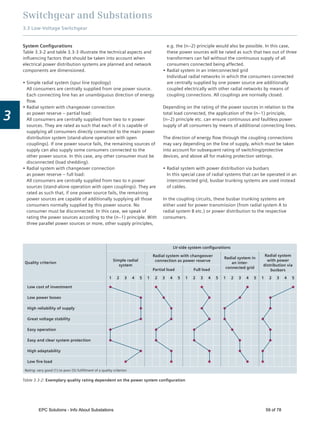
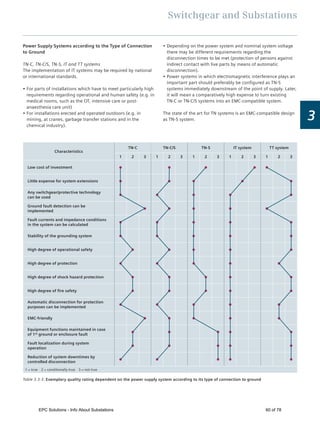
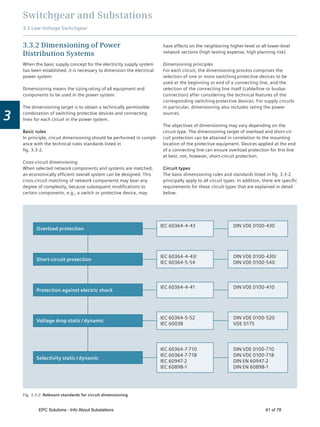
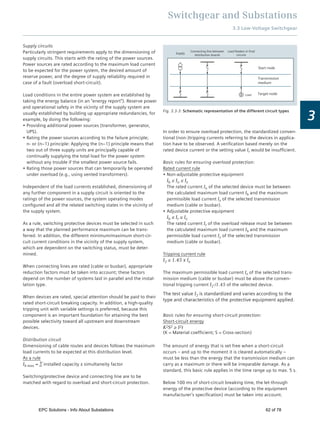
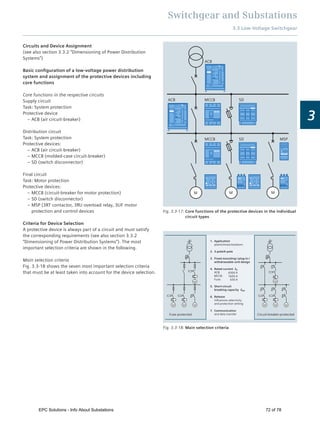
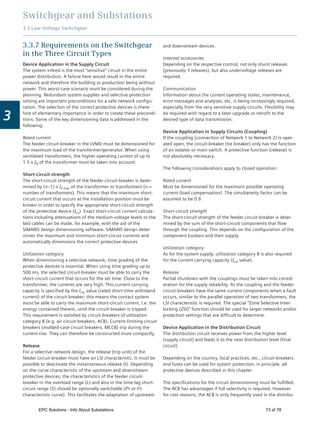
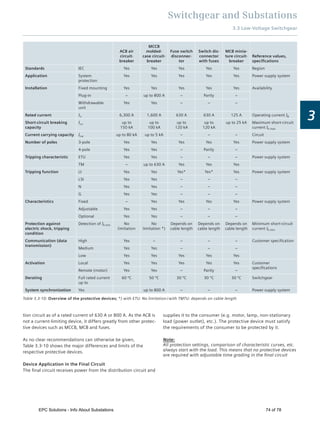
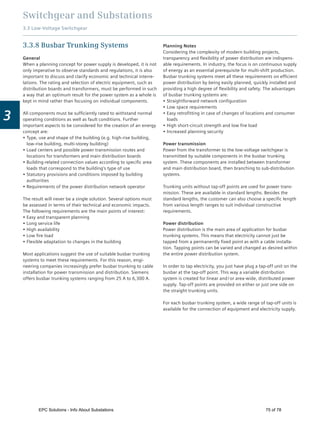
EPC Solutions - Info About Substations 1 of 78
3
Switchgear and Substations
3.1 High-Voltage Substations 66
3.1.1 Turnkey Substations 66
3.1.2 High-Voltage Switchgear – Overview 67
3.1.3 Circuit Configuration 68
3.1.4 Air-Insulated Substations 71
3.1.5 Mixed Technology (Compact/Hybrid Solutions) 79
3.1.6 Gas-Insulated Switchgear for Substations 83
3.2 Medium-Voltage Switchgear 94
3.2.1 Introduction 94
3.2.2 Basics of Switching Devices 95
3.2.3 Requirements of Medium-Voltage Switchgear 98
3.2.4 Medium-Voltage Switchgear 100
3.2.5 High-Current and Generator Switchgear 115
3.2.6 Industrial Load Center Substation 117
3.3 Low-Voltage Switchgear 121
3.3.1 Requirements to Electrical Power
Systems in Buildings 121
3.3.2 Dimensioning of Power Distribution Systems 124
3.3.3 Low-Voltage Switchgear 127
3.3.4 Planning Notes for Low-Voltage Switchgear 130
3.3.5 Low-Voltage Switchgear – Example 133
3.3.6 Protective and Switching Devices
for the Low-Voltage Switchgear 134
3.3.7 Requirements on the Switchgear
in the Three Circuit Types 136
3.3.8 Busbar Trunking Systems 138
EPC Solutions - Info About Substations 2 of 78
3
3.1 High-Voltage Substations
3.1.1 Turnkey Substations
Introduction
High-voltage substations are interconnection points within the
power transmission and distribution systems between regions
and countries. Different applications of substations lead to
high-voltage substations with and without power transformers:
Step up from a generator-voltage level to a high-voltage
system (MV/HV)
– Power plants (in load centers)
– Renewable power plants (e.g., windfarms)
Transform voltage levels within the high-voltage system
(HV/HV)
Step down to a medium-voltage level of a distribution system
(HV/MV)
Interconnection in the same voltage level.
Scope
High-voltage substations comprise not only the high-voltage
equipment which is relevant for the functionality in the power
supply system. Siemens plans and constructs high-voltage
substations comprising high-voltage switchgear, medium-
voltage switchgear, major components such as high-voltage
equipment and transformers, as well as all ancillary equipment
such as auxiliaries, control systems, protective equipment and so
on, on a turnkey basis or even as general contractor. The instal-
lations supplied worldwide range from basic substations with a
single busbar to interconnection substations with multiple
busbars, or a breaker-and-a-half arrangement for rated voltages
up to 800 kV, rated currents up to 8,000 A and short-circuit
currents up to 100 kA. The services offered range from system
planning to commissioning and after-sales service, including
training of customer personnel.
Project management
The process of handling such a turnkey installation starts with
preparation of a quotation, and proceeds through clarification of
the order, design, manufacture, supply and cost-accounting until
the project is finally billed. Processing such an order hinges on
methodical data processing that in turn contributes to system-
atic project handling.
Engineering
All these high-voltage installations have in common their high
standard of engineering which covers all system aspects such as
power systems, steel structures, civil engineering, fire precau-
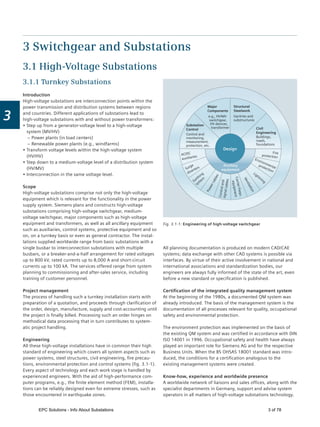
tions, environmental protection and control systems (fig. 3.1-1).
Every aspect of technology and each work stage is handled by
experienced engineers. With the aid of high-performance com-
puter programs, e.g., the finite element method (FEM), installa-
tions can be reliably designed even for extreme stresses, such as
those encountered in earthquake zones.
3 Switchgear and Substations
All planning documentation is produced on modern CAD/CAE
systems; data exchange with other CAD systems is possible via
interfaces. By virtue of their active involvement in national and
international associations and standardization bodies, our
engineers are always fully informed of the state of the art, even
before a new standard or specification is published.
Certification of the integrated quality management system
At the beginning of the 1980s, a documented QM system was
already introduced. The basis of the management system is the
documentation of all processes relevant for quality, occupational
safety and environmental protection.
The environment protection was implemented on the basis of
the existing QM system and was certified in accordance with DIN
ISO 14001 in 1996. Occupational safety and health have always
played an important role for Siemens AG and for the respective
Business Units. When the BS OHSAS 18001 standard was intro-
duced, the conditions for a certification analogous to the
existing management systems were created.
Know-how, experience and worldwide presence
A worldwide network of liaisons and sales offices, along with the
specialist departments in Germany, support and advise system
operators in all matters of high-voltage substations technology.
Fig. 3.1-1: Engineering of high-voltage switchgear
Ancillary
equipment
Civil
Engineering
Buildings,
roads,
foundations
Structural
Steelwork
Gantries and
substructures
Major
Components
e.g., HV/MV
switchgear,
HV devices,
transformer
Substation
Control
Control and
monitoring,
measurement,
protection, etc.
AC/DC
auxiliaries
Surge
diverters
Earthing
system
Powercables
Controlandsignalcables
Carrier-frequ.
equipment
Ventilation
Lightning
Environmental
protection
Fire
protection
Design
EPC Solutions - Info About Substations 3 of 78
Switchgear and Substations
3.1 High-Voltage Substations
3
3.1.2 High-Voltage Switchgear –
Overview
High-voltage substations comprising high-voltage switchgear
and devices with different insulating systems, air or gas (SF6).
When planning high-voltage substations, some basic questions
have to be answered to define the type of high-voltage switch-
gear:
What is the function and location within the power supply system?
What are the climatic and environmental conditions?
Are there specific requirements regarding locations?
Are there space/cost restrictions?
Depending on the answers, either AIS or GIS can be the right
choice, or even a compact or hybrid solution.
Air-insulated switchgear (AIS)
AIS are favorably priced high-voltage substations for rated
voltages up to 800 kV, which are popular wherever space restric-
tions and environmental circumstances are not severe. The
individual electrical and mechanical components of an AIS instal-
lation are assembled on site. Air-insulated outdoor substations
of open design are not completely safe to touch, and are directly
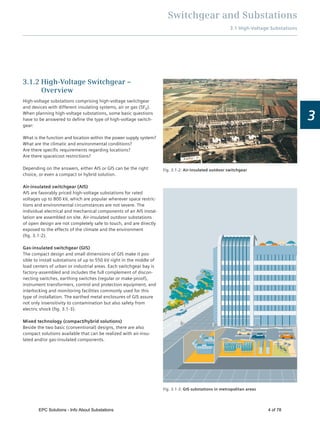
exposed to the effects of the climate and the environment
(fig. 3.1-2).
Gas-insulated switchgear (GIS)
The compact design and small dimensions of GIS make it pos-
sible to install substations of up to 550 kV right in the middle of
load centers of urban or industrial areas. Each switchgear bay is
factory-assembled and includes the full complement of discon-
necting switches, earthing switches (regular or make-proof),
instrument transformers, control and protection equipment, and
interlocking and monitoring facilities commonly used for this
type of installation. The earthed metal enclosures of GIS assure
not only insensitivity to contamination but also safety from
electric shock (fig. 3.1-3).
Mixed technology (compact/hybrid solutions)
Beside the two basic (conventional) designs, there are also
compact solutions available that can be realized with air-insu-
lated and/or gas-insulated components.
Fig. 3.1-3: GIS substations in metropolitan areas
Fig. 3.1-2: Air-insulated outdoor switchgear
EPC Solutions - Info About Substations 4 of 78
Switchgear and Substations
3.1 High-Voltage Substations
3
3.1.3 Circuit Configuration
High-voltage substations are points in the power system where
power can be pooled from generating sources, distributed and
transformed, and delivered to the load points. Substations are
interconnected with each other, so that the power system
becomes a meshed network. This increases reliability of the
power supply system by providing alternate paths for flow of
power to take care of any contingency, so that power delivery to
the loads is maintained and the generators do not face any
outage. The high-voltage substation is a critical component in
the power system, and the reliability of the power system
depends upon the substation. Therefore, the circuit configura-
tion of the high-voltage substation has to be selected carefully.
Busbars are the part of the substation where all the power is
concentrated from the incoming feeders, and distributed to the
outgoing feeders. That means that the reliability of any high-
voltage substation depends on the reliability of the busbars
present in the power system. An outage of any busbar can have
dramatic effects on the power system. An outage of a busbar
leads to the outage of the transmission lines connected to it. As
a result, the power flow shifts to the surviving healthy lines that
are now carrying more power than they are capable of. This
leads to tripping of these lines, and the cascading effect goes on
until there is a blackout or similar situation. The importance of
busbar reliability should be kept in mind when taking a look at
the different busbar systems that are prevalent.
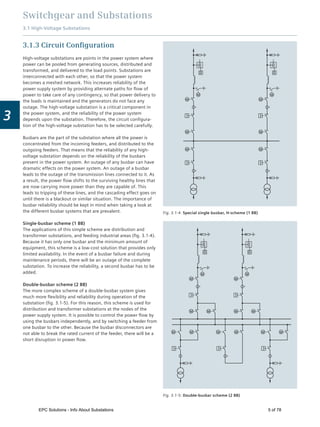
Single-busbar scheme (1 BB)
The applications of this simple scheme are distribution and
transformer substations, and feeding industrial areas (fig. 3.1-4).
Because it has only one busbar and the minimum amount of
equipment, this scheme is a low-cost solution that provides only
limited availability. In the event of a busbar failure and during
maintenance periods, there will be an outage of the complete
substation. To increase the reliability, a second busbar has to be
added.
Double-busbar scheme (2 BB)
The more complex scheme of a double-busbar system gives
much more flexibility and reliability during operation of the
substation (fig. 3.1-5). For this reason, this scheme is used for
distribution and transformer substations at the nodes of the
power supply system. It is possible to control the power flow by
using the busbars independently, and by switching a feeder from
one busbar to the other. Because the busbar disconnectors are
not able to break the rated current of the feeder, there will be a
short disruption in power flow.
Fig. 3.1-4: Special single busbar, H-scheme (1 BB)
Fig. 3.1-5: Double-busbar scheme (2 BB)
EPC Solutions - Info About Substations 5 of 78
Switchgear and Substations
3.1 High-Voltage Substations
3
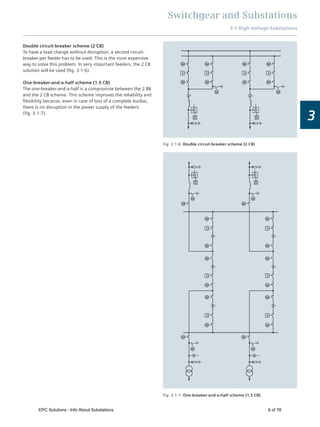
Fig. 3.1-6: Double circuit-breaker scheme (2 CB)
Fig. 3.1-7: One-breaker-and-a-half scheme (1.5 CB)
Double circuit-breaker scheme (2 CB)
To have a load change without disruption, a second circuit-
breaker per feeder has to be used. This is the most expensive
way to solve this problem. In very important feeders, the 2 CB
solution will be used (fig. 3.1-6).
One-breaker-and-a-half scheme (1.5 CB)
The one-breaker-and-a-half is a compromise between the 2 BB
and the 2 CB scheme. This scheme improves the reliability and
flexibility because, even in case of loss of a complete busbar,
there is no disruption in the power supply of the feeders
(fig. 3.1-7).
EPC Solutions - Info About Substations 6 of 78
Switchgear and Substations
3.1 High-Voltage Substations
3
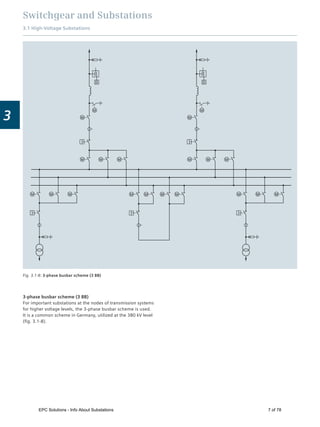
Fig. 3.1-8: 3-phase busbar scheme (3 BB)
3-phase busbar scheme (3 BB)
For important substations at the nodes of transmission systems
for higher voltage levels, the 3-phase busbar scheme is used.
It is a common scheme in Germany, utilized at the 380 kV level
(fig. 3.1-8).
EPC Solutions - Info About Substations 7 of 78
Switchgear and Substations
3.1 High-Voltage Substations
3
Variables affecting switchgear installation
The switchyard design is significantly influenced by:
Minimum clearances (depending on rated voltages) between
various active parts and between active parts and earth
Rated and short-circuit currents
Clarity for operating staff
Availability during maintenance work; redundancy
Availability of land and topography
Type and arrangement of the busbar disconnectors.
The design of a substation determines its accessibility, availability
and clarity. It must therefore be coordinated in close cooperation
with the system operator. The following basic principles apply:
Accessibility and availability increase with the number of busbars.
At the same time, however, clarity decreases. Installations
involving single busbars require minimum investment, but they
offer only limited flexibility for operation management and
maintenance. Designs involving one-breaker-and-a-half and
double-circuit-breaker arrangements ensure a high redundancy,
but they also entail the highest costs.
Systems with auxiliary or bypass busbars have proved to be
economical. The circuit-breaker of the coupling feeder for the
auxiliary bus allows uninterrupted replacement of each feeder
circuit-breaker. For busbars and feeder lines, mostly standard
aluminum conductors are used. Bundle conductors are required
where currents are high. Because of the additional short-circuit
forces between the subconductors (the pinch effect), however,
bundle conductors cause higher mechanical stresses at the
terminal points. When conductors (particularly standard bundle
conductors) are used, higher short-circuit currents cause a rise
not only in the aforementioned pinch effect, also in further
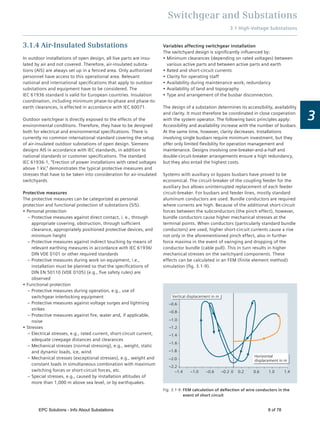
force maxima in the event of swinging and dropping of the
conductor bundle (cable pull). This in turn results in higher
mechanical stresses on the switchyard components. These
effects can be calculated in an FEM (finite element method)
simulation (fig. 3.1-9).
3.1.4 Air-Insulated Substations
In outdoor installations of open design, all live parts are insu-
lated by air and not covered. Therefore, air-insulated substa-
tions (AIS) are always set up in a fenced area. Only authorized
personnel have access to this operational area. Relevant
national and international specifications that apply to outdoor
substations and equipment have to be considered. The
IEC 61936 standard is valid for European countries. Insulation
coordination, including minimum phase-to-phase and phase-to-
earth clearances, is effected in accordance with IEC 60071.
Outdoor switchgear is directly exposed to the effects of the
environmental conditions. Therefore, they have to be designed
both for electrical and environmental specifications. There is
currently no common international standard covering the setup
of air-insulated outdoor substations of open design. Siemens
designs AIS in accordance with IEC standards, in addition to
national standards or customer specifications. The standard
IEC 61936-1, “Erection of power installations with rated voltages
above 1 kV,” demonstrates the typical protective measures and
stresses that have to be taken into consideration for air-insulated
switchyards.
Protective measures
The protective measures can be categorized as personal
protection and functional protection of substations (S/S).
Personal protection
– Protective measures against direct contact, i. e., through
appropriate covering, obstruction, through sufficient
clearance, appropriately positioned protective devices, and
minimum height
– Protective measures against indirect touching by means of
relevant earthing measures in accordance with IEC 61936/
DIN VDE 0101 or other required standards
– Protective measures during work on equipment, i.e.,
installation must be planned so that the specifications of
DIN EN 50110 (VDE 0105) (e.g., five safety rules) are
observed
Functional protection
– Protective measures during operation, e.g., use of
switchgear interlocking equipment
– Protective measures against voltage surges and lightning
strikes
– Protective measures against fire, water and, if applicable,
noise
Stresses
– Electrical stresses, e.g., rated current, short-circuit current,
adequate creepage distances and clearances
– Mechanical stresses (normal stressing), e.g., weight, static
and dynamic loads, ice, wind
– Mechanical stresses (exceptional stresses), e.g., weight and
constant loads in simultaneous combination with maximum
switching forces or short-circuit forces, etc.
– Special stresses, e.g., caused by installation altitudes of
more than 1,000 m above sea level, or by earthquakes.
–1.4 –1.0 –0.6 –0.2 0.2 0.6 1.0 1.4
–1.4
–1.2
–1.0
–0.8
–0.6
–1.6
–1.8
–2.0
–2.2
0
Vertical displacement in m
Horizontal
displacement in m
Fig. 3.1-9: FEM calculation of deflection of wire conductors in the
event of short circuit
EPC Solutions - Info About Substations 8 of 78
Switchgear and Substations
3.1 High-Voltage Substations
3
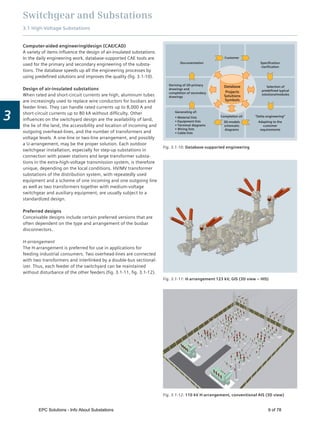
Computer-aided engineering/design (CAE/CAD)
A variety of items influence the design of air-insulated substations.
In the daily engineering work, database-supported CAE tools are
used for the primary and secondary engineering of the substa-
tions. The database speeds up all the engineering processes by
using predefined solutions and improves the quality (fig. 3.1-10).
Design of air-insulated substations
When rated and short-circuit currents are high, aluminum tubes
are increasingly used to replace wire conductors for busbars and
feeder lines. They can handle rated currents up to 8,000 A and
short-circuit currents up to 80 kA without difficulty. Other
influences on the switchyard design are the availability of land,
the lie of the land, the accessibility and location of incoming and
outgoing overhead-lines, and the number of transformers and
voltage levels. A one-line or two-line arrangement, and possibly
a U-arrangement, may be the proper solution. Each outdoor
switchgear installation, especially for step-up substations in
connection with power stations and large transformer substa-
tions in the extra-high-voltage transmission system, is therefore
unique, depending on the local conditions. HV/MV transformer
substations of the distribution system, with repeatedly used
equipment and a scheme of one incoming and one outgoing line
as well as two transformers together with medium-voltage
switchgear and auxiliary equipment, are usually subject to a
standardized design.
Preferred designs
Conceivable designs include certain preferred versions that are
often dependent on the type and arrangement of the busbar
disconnectors.
H-arrangement
The H-arrangement is preferred for use in applications for
feeding industrial consumers. Two overhead-lines are connected
with two transformers and interlinked by a double-bus sectional-
izer. Thus, each feeder of the switchyard can be maintained
without disturbance of the other feeders (fig. 3.1-11, fig. 3.1-12).
Fig. 3.1-11: H-arrangement 123 kV, GIS (3D view – HIS)
Fig. 3.1-12: 110 kV H-arrangement, conventional AIS (3D view)
Documentation
Customer
Specification
clarification
Generating of:
Material lists
Equipment lists
Terminal diagrams
Wiring lists
Cable lists
Completion of:
3D-models
schematic
diagrams
“Delta engineering“
Adapting to the
customer
requirements
Selection of
predefined typical
solutions/modules
Database
Projects
Solutions
Symbols
Deriving of 2D-primary
drawings and
completion of secondary
drawings
Fig. 3.1-10: Database-supported engineering
EPC Solutions - Info About Substations 9 of 78
Switchgear and Substations
3.1 High-Voltage Substations
3
Fig. 3.1-14: H-arrangement, 110 kV, Germany
Fig. 3.1-13: H-arrangement 110 kV
H-arrangement
The H-arrangement is preferred for use in applications for feeding
industrial consumers. Two overhead-lines are connected with two
transformers and interlinked by a double-bus sectionalizer. Thus,
each feeder of the switchyard can be maintained without distur-
bance of the other feeders (fig. 3.1-13, fig. 3.1-14).
EPC Solutions - Info About Substations 10 of 78
Switchgear and Substations
3.1 High-Voltage Substations
3
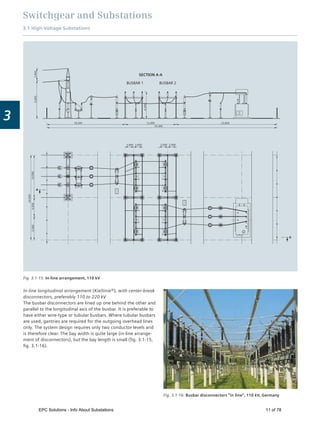
Fig. 3.1-16: Busbar disconnectors “in line”, 110 kV, Germany
9,0002,800
18,500 12,000
2,000
SECTION A-A
BUSBAR 1 BUSBAR 2
54,300
23,800
2,000
20,000
10,0004,500
A
5,500
A
2,000 2,0006,300
Fig. 3.1-15: In-line arrangement, 110 kV
In-line longitudinal arrangement (Kiellinie®), with center-break
disconnectors, preferably 110 to 220 kV
The busbar disconnectors are lined up one behind the other and
parallel to the longitudinal axis of the busbar. It is preferable to
have either wire-type or tubular busbars. Where tubular busbars
are used, gantries are required for the outgoing overhead lines
only. The system design requires only two conductor levels and
is therefore clear. The bay width is quite large (in-line arrange-
ment of disconnectors), but the bay length is small (fig. 3.1-15,
fig. 3.1-16).
EPC Solutions - Info About Substations 11 of 78
Switchgear and Substations
3.1 High-Voltage Substations
3
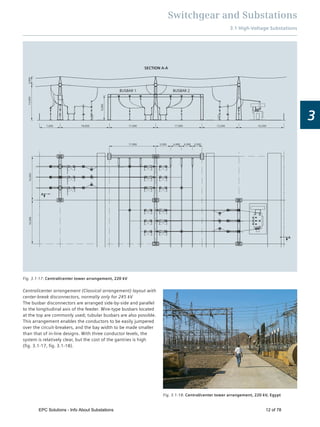
Central/center arrangement (Classical arrangement) layout with
center-break disconnectors, normally only for 245 kV
The busbar disconnectors are arranged side-by-side and parallel
to the longitudinal axis of the feeder. Wire-type busbars located
at the top are commonly used; tubular busbars are also possible.
This arrangement enables the conductors to be easily jumpered
over the circuit-breakers, and the bay width to be made smaller
than that of in-line designs. With three conductor levels, the
system is relatively clear, but the cost of the gantries is high
(fig. 3.1-17, fig. 3.1-18).
Fig. 3.1-18: Central/center tower arrangement, 220 kV, Egypt
A
A
7,600
13,000
9,000
3,000
18,000 17,000
17,000 5,500 4,000 4,000 3,500
17,000 13,500 16,500
SECTION A-A
BUSBAR 1 BUSBAR 2
16,00016,000
Fig. 3.1-17: Central/center tower arrangement, 220 kV
EPC Solutions - Info About Substations 12 of 78
Switchgear and Substations
3.1 High-Voltage Substations
3
Diagonal layout with pantograph disconnectors, preferably
110 to 420 kV
The pantograph disconnectors are placed diagonally to the axis
of the busbars and feeder. This results in a very clear and most
space-saving arrangement. Wire and tubular conductors are
customary. The busbars can be located above or below the
feeder conductors (fig. 3.1-19, fig. 3.1-20).
Fig. 3.1-20: Busbar disconnectors in diagonal arrangement,
380 kV, Germany
4,5004,5004,5004,50018,000
4,5006,0004,5004,500 4,500 4,5006,000 4,500
A
A
18,0004,000
9,000 32,000 15,000 15,000 21,000 27,000 5,000
SECTION A-A
BUSBAR SYSTEM
Fig. 3.1-19: Diagonal arrangement, 380 kV
EPC Solutions - Info About Substations 13 of 78
Switchgear and Substations
3.1 High-Voltage Substations
3
One-breaker-and-a-half layout, preferably up to 220 to 800 kV
The one-breaker-and-a-half arrangement ensures high supply
reliability; however, the expenditure for equipment is high as
well. The busbar disconnectors are of the pantograph, rotary or
vertical-break type. Vertical-break disconnectors are preferred
for the feeders. The busbars located at the top can be either
the wire or tubular type. Two arrangements are customary:
Internal busbar, feeders in H-arrangement with two conductor
levels
External busbar, feeders in-line with three conductor levels
(fig. 3.1-21, fig. 3.1-22)
Fig. 3.1-22: One-breaker-and-a-half arrangement, 500 kV, Pakistan
A
32,000
A
SECTION A-A
BUSBAR 1 BUSBAR 2
31,000 20,250 19,000 33,000 27,000
268,750
32,500 27,000 33,000 29,300 16,700
7,00027,000
Fig. 3.1-21: One-breaker-and-a-half arrangement, 500 kV
EPC Solutions - Info About Substations 14 of 78
Switchgear and Substations
3.1 High-Voltage Substations
3
54,000
12,00012,00015,00015,000
15,000 15,000 15,000 15,000
A A
SECTION A-ABUSBAR 1 BUSBAR 2
24,000 21,500 15,000 58,500 53,000 58,500 15,000 21,500 22,000
289,000
38,5506,750
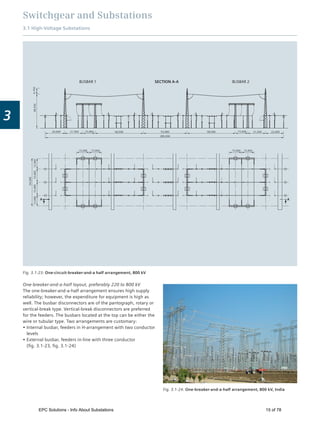
Fig. 3.1-23: One-circuit-breaker-and-a half arrangement, 800 kV
Fig. 3.1-24: One-breaker-and-a-half arrangement, 800 kV, India
One-breaker-and-a-half layout, preferably 220 to 800 kV
The one-breaker-and-a-half arrangement ensures high supply
reliability; however, the expenditure for equipment is high as
well. The busbar disconnectors are of the pantograph, rotary or
vertical-break type. Vertical-break disconnectors are preferred
for the feeders. The busbars located at the top can be either the
wire or tubular type. Two arrangements are customary:
Internal busbar, feeders in H-arrangement with two conductor
levels
External busbar, feeders in-line with three conductor
(fig. 3.1-23, fig. 3.1-24)
EPC Solutions - Info About Substations 15 of 78
Switchgear and Substations
3.1 High-Voltage Substations
3
3.1.5 Mixed Technology
(Compact/Hybrid Solutions)
Wherever there is a lack of space, system operators have to rely on
space-saving outdoor switchgear, especially in regions where
smaller-scale transformer substations prevail and in industrial
plants. For rated voltages from 72.5 to 170 kV, Siemens Energy
offers two different conventional switchgear versions for a
reliable and cost-effective power supply:
SIMOBREAKER, outdoor switchyard featuring a side-break
disconnector
SIMOVER, outdoor switchyard featuring a pivoting circuit-
breaker
HIS, highly integrated switchgear
DTC, dead-tank compact
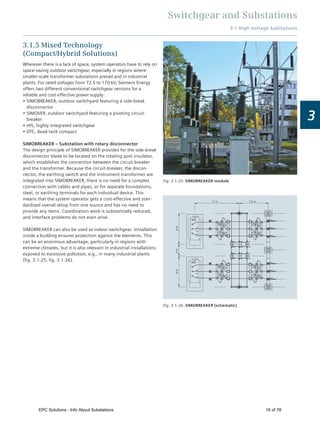
SIMOBREAKER – Substation with rotary disconnector
The design principle of SIMOBREAKER provides for the side-break
disconnector blade to be located on the rotating post insulator,
which establishes the connection between the circuit-breaker
and the transformer. Because the circuit-breaker, the discon-
nector, the earthing switch and the instrument transformer are
integrated into SIMOBREAKER, there is no need for a complex
connection with cables and pipes, or for separate foundations,
steel, or earthing terminals for each individual device. This
means that the system operator gets a cost-effective and stan-
dardized overall setup from one source and has no need to
provide any items. Coordination work is substantially reduced,
and interface problems do not even arise.
SIMOBREAKER can also be used as indoor switchgear. Installation
inside a building ensures protection against the elements. This
can be an enormous advantage, particularly in regions with
extreme climates, but it is also relevant in industrial installations
exposed to excessive pollution, e.g., in many industrial plants
(fig. 3.1-25, fig. 3.1-26).
Fig. 3.1-25: SIMOBREAKER module
11 m 7.5 m
3m8m8m
Fig. 3.1-26: SIMOBREAKER (schematic)
EPC Solutions - Info About Substations 16 of 78
Switchgear and Substations
3.1 High-Voltage Substations
3
25m
31 m
8.3m
2m2m
2m2m
1.7
m
1.7
m
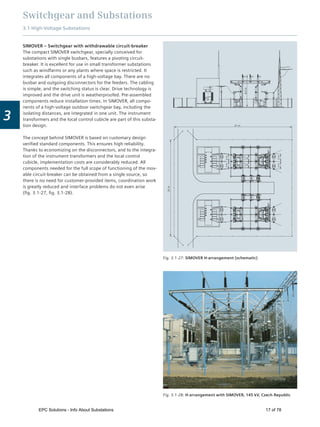
Fig. 3.1-27: SIMOVER H-arrangement (schematic)
Fig. 3.1-28: H-arrangement with SIMOVER, 145 kV, Czech Republic
SIMOVER – Switchgear with withdrawable circuit-breaker
The compact SIMOVER switchgear, specially conceived for
substations with single busbars, features a pivoting circuit-
breaker. It is excellent for use in small transformer substations
such as windfarms or any plants where space is restricted. It
integrates all components of a high-voltage bay. There are no
busbar and outgoing disconnectors for the feeders. The cabling
is simple, and the switching status is clear. Drive technology is
improved and the drive unit is weatherproofed. Pre-assembled
components reduce installation times. In SIMOVER, all compo-
nents of a high-voltage outdoor switchgear bay, including the
isolating distances, are integrated in one unit. The instrument
transformers and the local control cubicle are part of this substa-
tion design.
The concept behind SIMOVER is based on customary design
verified standard components. This ensures high reliability.
Thanks to economizing on the disconnectors, and to the integra-
tion of the instrument transformers and the local control
cubicle, implementation costs are considerably reduced. All
components needed for the full scope of functioning of the mov-
able circuit-breaker can be obtained from a single source, so
there is no need for customer-provided items, coordination work
is greatly reduced and interface problems do not even arise
(fig. 3.1-27, fig. 3.1-28).
EPC Solutions - Info About Substations 17 of 78
Switchgear and Substations
3.1 High-Voltage Substations
3
Dead-tank compact (DTC)
The dead-tank compact is another compact solution for the
145 kV voltage level: a dead-tank circuit-breaker together with
GIS modules for disconnectors (fig 3.1-29, fig. 3.1-30). For more
information, please refer to section 4.1.4.
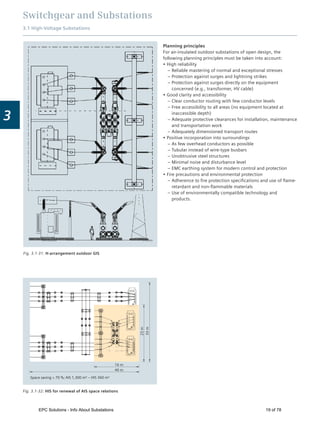
Highly integrated switchgear (HIS)
Highly integrated switchgear (HIS), fig. 3.1-31 and fig. 3.1-32
combines the advantages of air-insulated installations with
those of gas-insulated switchgear technology. HIS switchgear is
available up to 550 kV. The compact HIS switchgear is especially
suited
for new substations in a limited space
where real estate prices are high
where environmental conditions are extreme
where the costs of maintenance are high.
HIS arrangements are compact solutions used mainly for
renewal or expansion of air-insulated outdoor and indoor substa-
tions, particularly if the operator wants to carry out modifica-
tions while the switchgear is in service. In new construction
projects, high site prices and increasingly complex approval
procedures mean that the space requirement is the prime factor
in costing. With the HIS solution, the circuit-breakers, disconnec-
tors, earthing switches and transformers are accommodated in
compressed gastight enclosures, thus rendering the switchgear
extremely compact.
Fig 3.1-29: Dead Tank Compact (DTC)
Fig. 3.1-30: DTC solution (schematic)
EPC Solutions - Info About Substations 18 of 78
Switchgear and Substations
3.1 High-Voltage Substations
3
Planning principles
For air-insulated outdoor substations of open design, the
following planning principles must be taken into account:
High reliability
– Reliable mastering of normal and exceptional stresses
– Protection against surges and lightning strikes
– Protection against surges directly on the equipment
concerned (e.g., transformer, HV cable)
Good clarity and accessibility
– Clear conductor routing with few conductor levels
– Free accessibility to all areas (no equipment located at
inaccessible depth)
– Adequate protective clearances for installation, maintenance
and transportation work
– Adequately dimensioned transport routes
Positive incorporation into surroundings
– As few overhead conductors as possible
– Tubular instead of wire-type busbars
– Unobtrusive steel structures
– Minimal noise and disturbance level
– EMC earthing system for modern control and protection
Fire precautions and environmental protection
– Adherence to fire protection specifications and use of flame-
retardant and non-flammable materials
– Use of environmentally compatible technology and
products.
Fig. 3.1-31: H-arrangement outdoor GIS
Fig. 3.1-32: HIS for renewal of AIS space relations
23m
16 m
33m
40 m
Space saving > 70 %; AIS 1,300 m² – HIS 360 m²
EPC Solutions - Info About Substations 19 of 78
Switchgear and Substations
3.1 High-Voltage Substations
3
3.1.6 Gas-Insulated Switchgear for
Substations
Characteristic features of switchgear installations
Since 1968, the concept of Siemens gas-insulated metal-en-
closed high-voltage switchgear has proved itself in more than
28,000 bay installations in all regions of the world (table 3.1-1).
Gas-insulated metal-enclosed high-voltage switchgear (GIS) is
constantly gaining on other types of switchgear because it offers
the following outstanding advantages
Minimum space requirements:
Where the availability of land is low and/or prices are high,
e.g., in urban centers, industrial conurbations, mountainous
regions with narrow valleys or in underground power stations,
gas-insulated switchgear is replacing conventional switchgear
because of its very small space requirements.
Full protection against contact with live parts:
The surrounding metal enclosure affords maximum safety
for personnel under all operating and fault conditions.
Protection against pollution:
Its metal enclosure fully protects the switchgear interior
against environmental effects such as salt deposits in coastal
regions, industrial vapors and precipitates, and sandstorms.
The compact switchgear can be installed as an indoor as well
as an outdoor solution.
Free choice of installation site:
The small site area required for gas-insulated switchgear saves
expensive grading and foundation work, e.g., in permafrost
zones. Another advantage is the short erection time because
of the use of prefabricated and factory tested bay units.
Protection of the environment:
The necessity to protect the environment often makes it
difficult to erect outdoor switchgear of conventional design.
Gas-insulated switchgear, however, can almost always be
designed to blend well with the surroundings. Gas-insulated
metal-enclosed switchgear is, because of the modular design,
very flexible and meets all requirements for configuration that
exist in the network design and operating conditions.
Each circuit-breaker bay includes the full complement of discon-
necting and earthing switches (regular or make-proof), instru-
ment transformers, control and protection equipment, and
interlocking and monitoring facilities commonly used for this
type of installation.
Besides the traditional circuit-breaker bay, other circuits, such
as single busbar, single-busbar arrangement with bypass busbar,
coupler and bay for double and triple busbar, can be supplied.
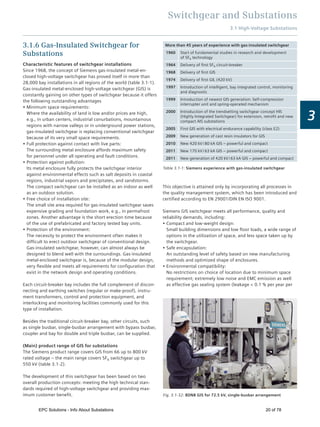
(Main) product range of GIS for substations
The Siemens product range covers GIS from 66 up to 800 kV
rated voltage – the main range covers SF6 switchgear up to
550 kV (table 3.1-2).
The development of this switchgear has been based on two
overall production concepts: meeting the high technical stan-
dards required of high-voltage switchgear and providing max-
imum customer benefit.
This objective is attained only by incorporating all processes in
the quality management system, which has been introduced and
certified according to EN 29001/DIN EN ISO 9001.
Siemens GIS switchgear meets all performance, quality and
reliability demands, including:
Compact and low-weight design:
Small building dimensions and low floor loads, a wide range of
options in the utilization of space, and less space taken up by
the switchgear.
Safe encapsulation:
An outstanding level of safety based on new manufacturing
methods and optimized shape of enclosures.
Environmental compatibility:
No restrictions on choice of location due to minimum space
requirement; extremely low noise and EMC emission as well
as effective gas sealing system (leakage < 0.1 % per year per
Table 3.1-1: Siemens experience with gas-insulated switchgear
More than 45 years of experience with gas-insulated switchgear
1960 Start of fundamental studies in research and development
of SF6 technology
1964 Delivery of first SF6 circuit-breaker
1968 Delivery of first GIS
1974 Delivery of first GIL (420 kV)
1997 Introduction of intelligent, bay integrated control, monitoring
and diagnostic
1999 Introduction of newest GIS generation: Self-compression
interrupter unit and spring-operated mechanism
2000 Introduction of the trendsetting switchgear concept HIS
(Highly Integrated Switchgear) for extension, retrofit and new
compact AIS substations
2005 First GIS with electrical endurance capability (class E2)
2009 New generation of cast resin insulators for GIS
2010 New 420 kV / 80 kA GIS – powerful and compact
2011 New 170 kV / 63 kA GIS – powerful and compact
2011 New generation of 420 kV / 63 kA GIS – powerful and compact
Fig. 3.1-32: 8DN8 GIS for 72.5 kV, single-busbar arrangement
EPC Solutions - Info About Substations 20 of 78
Switchgear and Substations
3.1 High-Voltage Substations
3
gas compartment). Modern spring mechanisms that are
currently available for the whole GIS 8D product spectrum
eliminates the need for hydraulic oil.
Economical transport:
Simplified fast transport and reduced costs, because of a
minimum of shipping units.
Low operating costs:
The switchgear is practically maintenance-free, e.g., contacts of
circuit-breakers and disconnectors are designed for extremely
long endurance, motor operating mechanisms are lubricated for
life, the enclosure is corrosion-free. This ensures that the first
inspection is required only after 25 years of operation.
High reliability:
The longstanding experience of Siemens in design, production
and commissioning – more than 330,000 bay operating years
in over 28,000 bay installations worldwide – is testament to the
fact that the Siemens products are highly reliable. The mean
time between failures (MTBF) amounts to > 900 bay years for
major faults. A quality management system certified according
to ISO 9001, which is supported by highly qualified employees,
ensures high quality throughout the whole process chain from
the offer/order process to the on-site commissioning of the GIS.
Smooth and efficient installation and commissioning:
Transport units are fully assembled, tested at the factory and
filled with SF6 gas at reduced pressure. Coded plug connectors
are used to cut installation time and minimize the risk of
cabling failures.
Routine tests:
All measurements are automatically documented and stored in
the electronic information system, which provides quick access
to measured data for years.
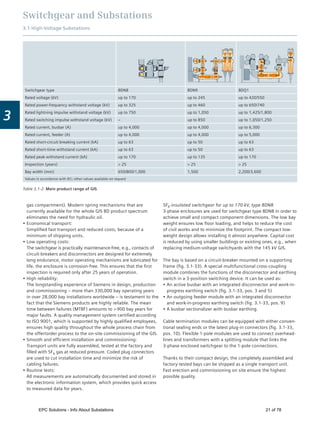
SF6-insulated switchgear for up to 170 kV, type 8DN8
3-phase enclosures are used for switchgear type 8DN8 in order to
achieve small and compact component dimensions. The low bay
weight ensures low floor loading, and helps to reduce the cost
of civil works and to minimize the footprint. The compact low-
weight design allows installing it almost anywhere. Capital cost
is reduced by using smaller buildings or existing ones, e.g., when
replacing medium-voltage switchyards with the 145 kV GIS.
The bay is based on a circuit-breaker mounted on a supporting
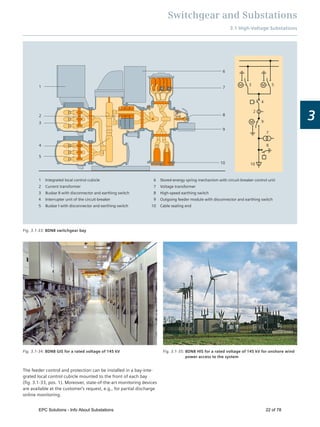
frame (fig. 3.1-33). A special multifunctional cross-coupling
module combines the functions of the disconnector and earthing
switch in a 3-position switching device. It can be used as:
An active busbar with an integrated disconnector and work-in-
progress earthing switch (fig. 3.1-33, pos. 3 and 5)
An outgoing feeder module with an integrated disconnector
and work-in-progress earthing switch (fig. 3.1-33, pos. 9)
A busbar sectionalizer with busbar earthing.
Cable termination modules can be equipped with either conven-
tional sealing ends or the latest plug-in connectors (fig. 3.1-33,
pos. 10). Flexible 1-pole modules are used to connect overhead-
lines and transformers with a splitting module that links the
3-phase enclosed switchgear to the 1-pole connections.
Thanks to their compact design, the completely assembled and
factory-tested bays can be shipped as a single transport unit.
Fast erection and commissioning on site ensure the highest
possible quality.
Table 3.1-2: Main product range of GIS
Switchgear type 8DN8 8DN9 8DQ1
Rated voltage (kV) up to 170 up to 245 up to 420/550
Rated power-frequency withstand voltage (kV) up to 325 up to 460 up to 650/740
Rated lightning impulse withstand voltage (kV) up to 750 up to 1,050 up to 1,425/1,800
Rated switching impulse withstand voltage (kV) – up to 850 up to 1,050/1,250
Rated current, busbar (A) up to 4,000 up to 4,000 up to 6,300
Rated current, feeder (A) up to 4,000 up to 4,000 up to 5,000
Rated short-circuit breaking current (kA) up to 63 up to 50 up to 63
Rated short-time withstand current (kA) up to 63 up to 50 up to 63
Rated peak withstand current (kA) up to 170 up to 135 up to 170
Inspection (years) > 25 > 25 > 25
Bay width (mm) 650/800/1,000 1,500 2,200/3,600
Values in accordance with IEC; other values available on request
EPC Solutions - Info About Substations 21 of 78
Switchgear and Substations
3.1 High-Voltage Substations
3
3 5
4
2
9
7
8
10
1
5
6
7
8
9
10
2
3
4
1
2
3
4
5
Integrated local control cubicle
Current transformer
Busbar II with disconnector and earthing switch
Interrupter unit of the circuit-breaker
Busbar I with disconnector and earthing switch
6
7
8
9
10
Stored-energy spring mechanism with circuit-breaker control unit
Voltage transformer
High-speed earthing switch
Outgoing feeder module with disconnector and earthing switch
Cable sealing end
Fig. 3.1-33: 8DN8 switchgear bay
The feeder control and protection can be installed in a bay-inte-
grated local control cubicle mounted to the front of each bay
(fig. 3.1-33, pos. 1). Moreover, state-of-the-art monitoring devices
are available at the customer‘s request, e.g., for partial discharge
online monitoring.
Fig. 3.1-35: 8DN8 HIS for a rated voltage of 145 kV for onshore wind
power access to the system
Fig. 3.1-34: 8DN8 GIS for a rated voltage of 145 kV
EPC Solutions - Info About Substations 22 of 78
Switchgear and Substations
3.1 High-Voltage Substations
3
Fig. 3.1-37: 8DN9 switchgear for a rated voltage of 245 kV,
with a 3-phase encapsulated passive busbar
1
11
M
M
M
M
M
9
8
35
4
6
7
12 10
13
4 68 710
911
15 2
13
14 32
1
gas-tight bushings
gas-permeable bushings
1. Circuit-breaker interrupter unit
2. Stored-energy spring mechanism
with circuit-breaker control unit
3. Busbar disconnector I
4. Busbar I
5. Busbar disconnector II
6. Busbar II
7. Outgoing feeder disconnector
8. Work-in-progress earthing switch
9. Work-in-progress earthing switch
10. Make-proof earthing switch (high-speed)
11. Current transformer
12. Voltage transformer
13. Cable sealing end
14. Integrated local control cubicle
Fig. 3.1-36: 8DN9 switchgear bay
SF6-insulated switchgear for up to 245 kV, type 8DN9
The clear bay configuration of the lightweight and compact
8DN9 switchgear is evident at first glance. Control and moni-
toring facilities are easily accessible despite the switchgear‘s
compact design.
The horizontally arranged circuit-breaker forms the basis of
every bay configuration. The operating mechanism is easily
accessible from the operator area. The other bay modules –
of 1-phase enclosed switchgear design, like the circuit-breaker
module – are located on top of the circuit-breaker. The 1-phase
encapsulated passive busbar is partitioned off from the active
equipment (fig. 3.1-36).
Thanks to “single-function” assemblies (assignment of just one
task to each module) and the versatile modular structure, even
unconventional arrangements can be set up from a pool of only
20 different modules. The modules are connected to each other
with a standard interface that allows implementing an extensive
range of bay structures. Switchgear design with standardized
modules and the scope of services ensure that all types of bay
structures can be set up in a small area. The compact design
allows supplying of complete bays that are fully assembled and
tested at the factory, which makes for smooth and efficient
installation and commissioning.
EPC Solutions - Info About Substations 23 of 78
Switchgear and Substations
3.1 High-Voltage Substations
3
114 653 107
12
14
9
13
1 2
8
9
M
M
M
M
M
10
6
3
4 5
7
11
13 12
14
8
gas-tight bushings
gas-permeable bushings
1
2
3
4
Integrated local control cubicle
Stored-energy spring mechanism
with circuit-breaker control unit
Busbar I
Busbar disconnector I
5
6
7
8
9
Busbar disconnector II
Work-in-progress earthing switch
Busbar II
Circuit-breaker interrupter unit
Current transformer
10
11
12
13
14
Work-in-progress earthing switch
Outgoing feeder
Make-proof earthing switch (high-speed)
Voltage transformer
Cable sealing end
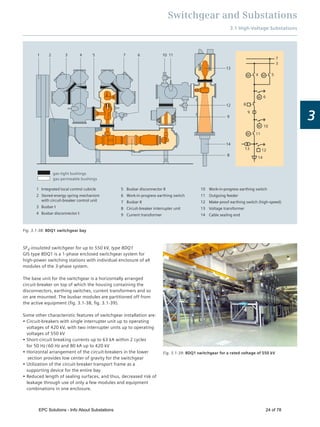
Fig. 3.1-38: 8DQ1 switchgear bay
Fig. 3.1-39: 8DQ1 switchgear for a rated voltage of 550 kV
SF6-insulated switchgear for up to 550 kV, type 8DQ1
GIS type 8DQ1 is a 1-phase enclosed switchgear system for
high-power switching stations with individual enclosure of all
modules of the 3-phase system.
The base unit for the switchgear is a horizontally arranged
circuit-breaker on top of which the housing containing the
disconnectors, earthing switches, current transformers and so
on are mounted. The busbar modules are partitioned off from
the active equipment (fig. 3.1-38, fig. 3.1-39).
Some other characteristic features of switchgear installation are:
Circuit-breakers with single interrupter unit up to operating
voltages of 420 kV, with two interrupter units up to operating
voltages of 550 kV
Short-circuit breaking currents up to 63 kA within 2 cycles
for 50 Hz / 60 Hz and 80 kA up to 420 kV
Horizontal arrangement of the circuit-breakers in the lower
section provides low center of gravity for the switchgear
Utilization of the circuit-breaker transport frame as a
supporting device for the entire bay
Reduced length of sealing surfaces, and thus, decreased risk of
leakage through use of only a few modules and equipment
combinations in one enclosure.
EPC Solutions - Info About Substations 24 of 78
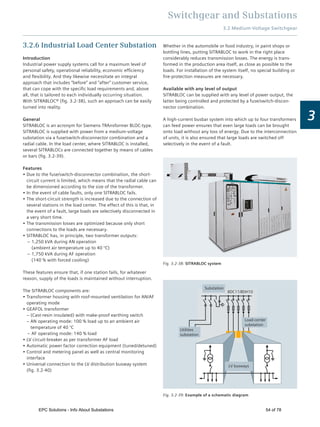
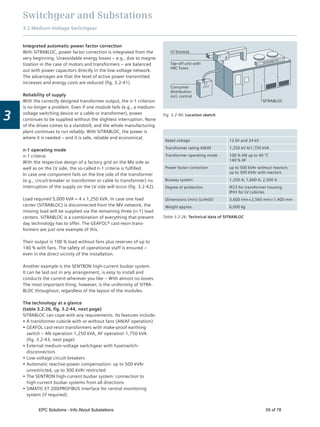
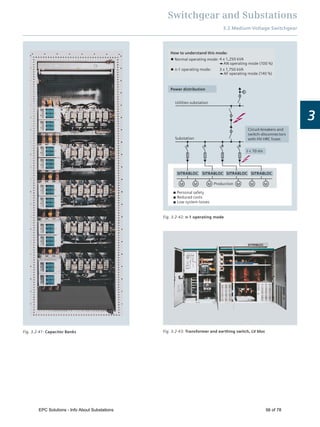
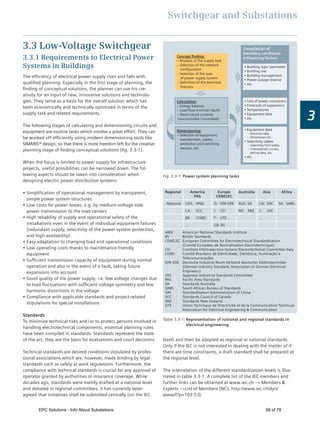
Switchgear and Substations
3.1 High-Voltage Substations
3
1
11
10
9
8
7
6
5
4
3
2
1
2
3
4
5
6
Cable termination
Make-proof earthing switch
Outgoing feeder disconnector
Earthing switch
Circuit breaker
Earthing switch
7
8
9
10
11
Current transformer
Outgoing feeder disconnector
Make-proof earthing switch
Voltage transformer
Outdoor termination
M
M
M
M
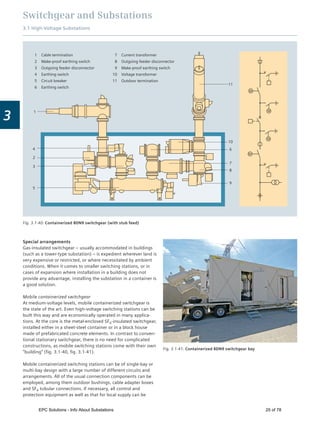
Fig. 3.1-40: Containerized 8DN9 switchgear (with stub feed)
Fig. 3.1-41: Containerized 8DN9 switchgear bay
Special arrangements
Gas-insulated switchgear – usually accommodated in buildings
(such as a tower-type substation) – is expedient wherever land is
very expensive or restricted, or where necessitated by ambient
conditions. When it comes to smaller switching stations, or in
cases of expansion where installation in a building does not
provide any advantage, installing the substation in a container is
a good solution.
Mobile containerized switchgear
At medium-voltage levels, mobile containerized switchgear is
the state of the art. Even high-voltage switching stations can be
built this way and are economically operated in many applica-
tions. At the core is the metal-enclosed SF6-insulated switchgear,
installed either in a sheet-steel container or in a block house
made of prefabricated concrete elements. In contrast to conven-
tional stationary switchgear, there is no need for complicated
constructions, as mobile switching stations come with their own
”building“ (fig. 3.1-40, fig. 3.1-41).
Mobile containerized switching stations can be of single-bay or
multi-bay design with a large number of different circuits and
arrangements. All of the usual connection components can be
employed, among them outdoor bushings, cable adapter boxes
and SF6 tubular connections. If necessary, all control and
protection equipment as well as that for local supply can be
EPC Solutions - Info About Substations 25 of 78
Switchgear and Substations
3.1 High-Voltage Substations
3
accommodated in the container. This allows largely independent
operation of the installation on site. Containerized switchgear is
pre-assembled at the factory and ready for operation. The only
on-site work required is setting up the containers, fitting the
exterior system parts and making the external connections.
Shifting the switchgear assembly work to the factory enhances
quality and operational reliability. Mobile containerized
switchgear has a small footprint, and usually fits well within the
environment. For operators, prompt availability and short
commissioning times are a further significant advantage.
Considerable cost reductions are achieved in planning,
construction work and assembly.
Approvals from building authorities are either not required or
required in a simplified form. The installation can also be
operated at various locations in succession. Adaptation to local
circumstances is not a problem. The following are the possible
applications for containerized stations:
Interim solutions during the modernization of switching
stations
Low-cost transitional solutions where new construction of
transformer substations involves tedious formalities, such as
the procurement of land or the establishment of cable routes
Quick erection as an emergency station in the event of
malfunctioning of the existing switchgear
Switching stations for movable geothermal power plants.
GIS for up to 245 kV in a standard container
The dimensions of the 8DN9 switchgear make it possible to
accommodate all active components of the switchgear (circuit-
breaker, disconnector, earthing switch) and the local control
cubicle in a standard container. The floor area of 6.1 m x 2.44 m
complies with the ISO 668 standard. Although the container
exceeds the standard dimension of 2.44 m, this will not cause
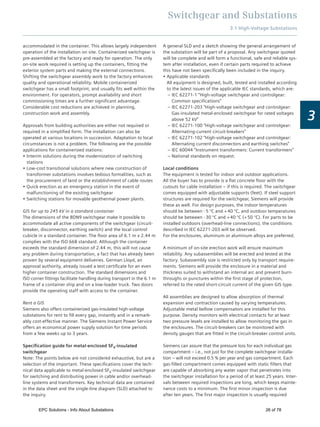
any problem during transportation, a fact that has already been
proven by several equipment deliveries. German Lloyd, an
approval authority, already issued a test certificate for an even
higher container construction. The standard dimensions and
ISO corner fittings facilitate handling during transport in the 6.1 m
frame of a container ship and on a low-loader truck. Two doors
provide the operating staff with access to the container.
Rent a GIS
Siemens also offers containerized gas-insulated high-voltage
substations for rent to fill every gap, instantly and in a remark-
ably cost-effective manner. The Siemens Instant Power Service
offers an economical power supply solution for time periods
from a few weeks up to 3 years.
Specification guide for metal-enclosed SF6-insulated
switchgear
Note: The points below are not considered exhaustive, but are a
selection of the important. These specifications cover the tech-
nical data applicable to metal-enclosed SF6-insulated switchgear
for switching and distributing power in cable and/or overhead-
line systems and transformers. Key technical data are contained
in the data sheet and the single-line diagram (SLD) attached to
the inquiry.
A general SLD and a sketch showing the general arrangement of
the substation will be part of a proposal. Any switchgear quoted
will be complete and will form a functional, safe and reliable sys-
tem after installation, even if certain parts required to achieve
this have not been specifically been included in the inquiry.
Applicable standards
All equipment is designed, built, tested and installed according
to the latest issues of the applicable IEC standards, which are:
– IEC 62271-1 “High-voltage switchgear and controlgear:
Common specifications”
– IEC 62271-203 “High-voltage switchgear and controlgear:
Gas-insulated metal-enclosed switchgear for rated voltages
above 52 kV”
– IEC 62271-100 “High-voltage switchgear and controlgear:
Alternating-current circuit-breakers”
– IEC 62271-102 “High-voltage switchgear and controlgear:
Alternating current disconnectors and earthing switches”
– IEC 60044 “Instrument transformers: Current transformers”
– National standards on request.
Local conditions
The equipment is tested for indoor and outdoor applications.
All the buyer has to provide is a flat concrete floor with the
cutouts for cable installation – if this is required. The switchgear
comes equipped with adjustable supports (feet). If steel support
structures are required for the switchgear, Siemens will provide
these as well. For design purposes, the indoor temperatures
should be between - 5 °C and + 40 °C, and outdoor temperatures
should be between - 30 °C and + 40 °C (+ 50 °C). For parts to be
installed outdoors (overhead-line connections), the conditions
described in IEC 62271-203 will be observed.
For the enclosures, aluminum or aluminum alloys are preferred.
A minimum of on-site erection work will ensure maximum
reliability. Any subassemblies will be erected and tested at the
factory. Subassembly size is restricted only by transport require-
ments. Siemens will provide the enclosure in a material and
thickness suited to withstand an internal arc and prevent burn-
throughs or punctures within the first stage of protection,
referred to the rated short-circuit current of the given GIS type.
All assemblies are designed to allow absorption of thermal
expansion and contraction caused by varying temperatures.
Adjustable metal bellow compensators are installed for this
purpose. Density monitors with electrical contacts for at least
two pressure levels are installed to allow monitoring the gas in
the enclosures. The circuit-breakers can be monitored with
density gauges that are fitted in the circuit-breaker control units.
Siemens can assure that the pressure loss for each individual gas
compartment – i.e., not just for the complete switchgear installa-
tion – will not exceed 0.5 % per year and gas compartment. Each
gas-filled compartment comes equipped with static filters that
are capable of absorbing any water vapor that penetrates into
the switchgear installation for a period of at least 25 years. Inter-
vals between required inspections are long, which keeps mainte-
nance costs to a minimum. The first minor inspection is due
after ten years. The first major inspection is usually required
EPC Solutions - Info About Substations 26 of 78
Switchgear and Substations
3.1 High-Voltage Substations
3
Air con-
ditioning
system
26.90m23.20m
Relay room
Earthing
resistor
Shunt
reactor
13.8 kV
switchgear
15.95m11.50m8.90m
Cable duct
40 MVA transformer
Radiators
Compensator
2.20m–1.50m
Gas-insulated
switchgear type
8DN9
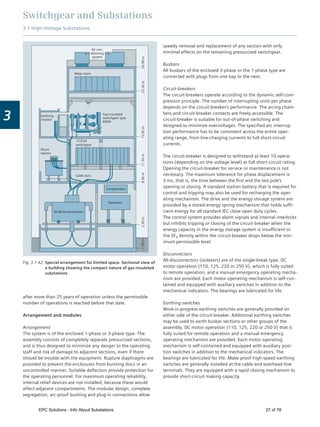
Fig. 3.1-42: Special arrangement for limited space. Sectional view of
a building showing the compact nature of gas-insulated
substations
after more than 25 years of operation unless the permissible
number of operations is reached before that date.
Arrangement and modules
Arrangement
The system is of the enclosed 1-phase or 3-phase type. The
assembly consists of completely separate pressurized sections,
and is thus designed to minimize any danger to the operating
staff and risk of damage to adjacent sections, even if there
should be trouble with the equipment. Rupture diaphragms are
provided to prevent the enclosures from bursting discs in an
uncontrolled manner. Suitable deflectors provide protection for
the operating personnel. For maximum operating reliability,
internal relief devices are not installed, because these would
affect adjacent compartments. The modular design, complete
segregation, arc-proof bushing and plug-in connections allow
speedy removal and replacement of any section with only
minimal effects on the remaining pressurized switchgear.
Busbars
All busbars of the enclosed 3-phase or the 1-phase type are
connected with plugs from one bay to the next.
Circuit-breakers
The circuit-breakers operate according to the dynamic self-com-
pression principle. The number of interrupting units per phase
depends on the circuit-breaker‘s performance. The arcing cham-
bers and circuit-breaker contacts are freely accessible. The
circuit-breaker is suitable for out-of-phase switching and
designed to minimize overvoltages. The specified arc interrup-
tion performance has to be consistent across the entire oper-
ating range, from line-charging currents to full short-circuit
currents.
The circuit-breaker is designed to withstand at least 10 opera-
tions (depending on the voltage level) at full short-circuit rating.
Opening the circuit-breaker for service or maintenance is not
necessary. The maximum tolerance for phase displacement is
3 ms, that is, the time between the first and the last pole‘s
opening or closing. A standard station battery that is required for
control and tripping may also be used for recharging the oper-
ating mechanism. The drive and the energy storage system are
provided by a stored-energy spring mechanism that holds suffi-
cient energy for all standard IEC close-open duty cycles.
The control system provides alarm signals and internal interlocks
but inhibits tripping or closing of the circuit-breaker when the
energy capacity in the energy storage system is insufficient or
the SF6 density within the circuit-breaker drops below the min-
imum permissible level.
Disconnectors
All disconnectors (isolators) are of the single-break type. DC
motor operation (110, 125, 220 or 250 V), which is fully suited
to remote operation, and a manual emergency operating mecha-
nism are provided. Each motor operating mechanism is self-con-
tained and equipped with auxiliary switches in addition to the
mechanical indicators. The bearings are lubricated for life.
Earthing switches
Work-in-progress earthing switches are generally provided on
either side of the circuit-breaker. Additional earthing switches
may be used to earth busbar sections or other groups of the
assembly. DC motor operation (110, 125, 220 or 250 V) that is
fully suited for remote operation and a manual emergency
operating mechanism are provided. Each motor operating
mechanism is self-contained and equipped with auxiliary posi-
tion switches in addition to the mechanical indicators. The
bearings are lubricated for life. Make-proof high-speed earthing
switches are generally installed at the cable and overhead-line
terminals. They are equipped with a rapid closing mechanism to
provide short-circuit making capacity.
EPC Solutions - Info About Substations 27 of 78
Switchgear and Substations
3.1 High-Voltage Substations
3
Instrument transformers
Current transformers (CTs) are of the dry-type design. Epoxy
resin is not used for insulation purposes. The cores have the accu-
racies and burdens that are shown on the SLD. Voltage trans-
formers are of the inductive type, with ratings of up to 200 VA.
Cable terminations
1-phase or 3-phase, SF6 gas-insulated, metal-enclosed cable end
housings are provided. The cable manufacturer has to supply the
stress cone and suitable sealings to prevent oil or gas from
leaking into the SF6 switchgear. Siemens will supply a mating
connection piece to be fitted to the cable end. The cable end
housing is suitable for oil-type, gas-pressure-type cables with
plastic insulation (PE, PVC, etc.) as specified on the SLD or the
data sheets. Additionally, devices for safely isolating a feeder
cable and connecting a high-voltage test cable to the switchgear
or cable will be provided (fig. 3.1-44, fig. 3.1-45).
Overhead-line terminations
The terminations for connecting overhead-lines come complete
with SF6-to-air bushings but without line clamps (fig. 3.1-46).
Control and monitoring
As a standard, an electromechanical or solid-state interlocking
control board is supplied for each switchgear bay. This fault-tol-
erant interlocking system prevents all operating malfunctions.
Mimic diagrams and position indicators provide the operating
personnel with clear operating instructions. Provisions for
remote control are included. Gas compartments are constantly
monitored by density monitors that provide alarm and blocking
signals via contacts.
Required tests
Partial discharge tests
All solid insulators fitted in the switchgear are subjected to a rou-
tine partial discharge test prior to installation. At 1.2 times the
line-to-line voltage, no measurable discharge is allowed. This
test ensures maximum safety with regard to insulator failure,
good long-term performance and thus a very high degree of
reliability.
Pressure tests
Each cast-aluminum enclosure of the switchgear is pressure-
tested for at least twice the service pressure.
Leakage tests
Leakage tests performed on the subassemblies ensure that the
flanges and cover faces are clean, and that the guaranteed
leakage rate is not be exceeded.
Power frequency tests
Each assembly is subjected to power-frequency withstand tests,
including sensitive partial discharge detection, to verify correct
installation of the conductors, and to make sure that the insulator
surfaces are clean and the switchgear as a whole is not subject
to internal faults.
Additional technical data
Siemens will point out any dimensions, weights or other switch-
gear data that may affect local conditions and handling of the
equipment. Any quotation includes drawings showing the
switchgear assembly.
Fig. 3.1-43: GIS in special building
EPC Solutions - Info About Substations 28 of 78
Switchgear and Substations
3.1 High-Voltage Substations
3
Fig. 3.1-44: 3-phase cable termination module:
Example for plug-in cables
Fig. 3.1-45: Cable termination module: Cable termination modules
conforming to IEC are available for connecting the
switchgear to high-voltage cables. The standardized
construction of these modules allows connection of
various cross-sections and insulation types. Parallel cable
connections for higher rated currents are also possible
with the same module.
Instructions
Detailed instruction manuals on the installation, operation and
maintenance of the equipment are supplied with all equipment
delivered by Siemens.
Scope of supply
Siemens supplies the following items for all GIS types and
interfaces as specified:
The switchgear bay, including circuit-breakers, disconnectors
and earthing switches, instrument transformers and busbar
housings, as specified. For the different feeder types, the
following limits apply:
– Overhead-line feeder:
The connecting stud at the SF6-to-air bushing is supplied
without the line clamp.
– Cable feeder:
According to IEC 60859, the termination housing, conductor
coupling and connecting plate are part of the GIS delivery,
while the cable stress cone with the matching flange is part
of the cable supply (fig. 3.1-45).
– Transformer feeder:
Siemens supplies the connecting flange at the switchgear
bay and the connecting bus ducts to the transformer,
including any expansion joints. The SF6-to-oil bushings plus
terminal enclosures are part of the transformer delivery
unless otherwise agreed (fig. 3.1-47, fig. 3.1-48).
Note: This point always requires close coordination between
the switchgear manufacturer and the transformer supplier.
Each feeder bay is equipped with earthing pads. The local
earthing network and the connections to the switchgear are
included in the installation contractor‘s scope.
Initial SF6 gas filling for the entire switchgear supplied by
Siemens is included. Siemens will also supply all gas
interconnections from the switchgear bay to the integral gas
service and monitoring panel.
Terminals and circuit protection for auxiliary drives and control
power are provided with the equipment. Feeder circuits and
cables as well as the pertaining installation material will be
supplied by the installation contractor.
The local control, monitoring and interlocking panels are
supplied for each circuit-breaker bay to form completely
operational systems. Terminals for remote monitoring and
control are also provided.
Siemens will supply the above-ground mechanical support
structures; embedded steel and foundation work are part of
the installation contractor’s scope.
EPC Solutions - Info About Substations 29 of 78
Switchgear and Substations
3.1 High-Voltage Substations
3
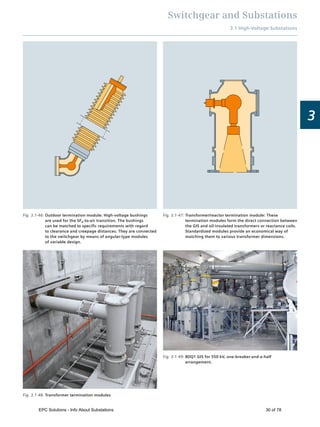
Fig. 3.1-48: Transformer termination modules
Fig. 3.1-46: Outdoor termination module: High-voltage bushings
are used for the SF6-to-air transition. The bushings
can be matched to specific requirements with regard
to clearance and creepage distances. They are connected
to the switchgear by means of angular-type modules
of variable design.
Fig. 3.1-47: Transformer/reactor termination module: These
termination modules form the direct connection between
the GIS and oil-insulated transformers or reactance coils.
Standardized modules provide an economical way of
matching them to various transformer dimensions.
Fig. 3.1-49: 8DQ1 GIS for 550 kV, one-breaker-and-a-half
arrangement.
EPC Solutions - Info About Substations 30 of 78
Switchgear and Substations
3
Medium voltage
1
1 High voltage2 Low voltage3
2 1 3
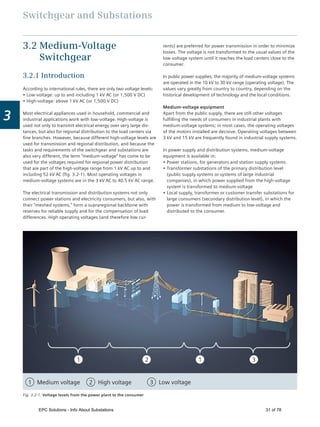
Fig. 3.2-1: Voltage levels from the power plant to the consumer
rents) are preferred for power transmission in order to minimize
losses. The voltage is not transformed to the usual values of the
low-voltage system until it reaches the load centers close to the
consumer.
In public power supplies, the majority of medium-voltage systems
are operated in the 10 kV to 30 kV range (operating voltage). The
values vary greatly from country to country, depending on the
historical development of technology and the local conditions.
Medium-voltage equipment
Apart from the public supply, there are still other voltages
fulfilling the needs of consumers in industrial plants with
medium-voltage systems; in most cases, the operating voltages
of the motors installed are decisive. Operating voltages between
3 kV and 15 kV are frequently found in industrial supply systems.
In power supply and distribution systems, medium-voltage
equipment is available in:
Power stations, for generators and station supply systems
Transformer substations of the primary distribution level
(public supply systems or systems of large industrial
companies), in which power supplied from the high-voltage
system is transformed to medium-voltage
Local supply, transformer or customer transfer substations for
large consumers (secondary distribution level), in which the
power is transformed from medium to low-voltage and
distributed to the consumer.
3.2 Medium-Voltage
Switchgear
3.2.1 Introduction
According to international rules, there are only two voltage levels:
Low-voltage: up to and including 1 kV AC (or 1,500 V DC)
High-voltage: above 1 kV AC (or 1,500 V DC)
Most electrical appliances used in household, commercial and
industrial applications work with low-voltage. High-voltage is
used not only to transmit electrical energy over very large dis-
tances, but also for regional distribution to the load centers via
fine branches. However, because different high-voltage levels are
used for transmission and regional distribution, and because the
tasks and requirements of the switchgear and substations are
also very different, the term “medium-voltage” has come to be
used for the voltages required for regional power distribution
that are part of the high-voltage range from 1 kV AC up to and
including 52 kV AC (fig. 3.2-1). Most operating voltages in
medium-voltage systems are in the 3 kV AC to 40.5 kV AC range.
The electrical transmission and distribution systems not only
connect power stations and electricity consumers, but also, with
their “meshed systems,” form a supraregional backbone with
reserves for reliable supply and for the compensation of load
differences. High operating voltages (and therefore low cur-
EPC Solutions - Info About Substations 31 of 78
Switchgear and Substations
3
3.2.2 Basics of Switching Devices
What are switching devices?
Switching devices are devices used to close (make) or open
(break) electrical circuits. The following stress can occur during
making and breaking:
No-load switching
Breaking of operating currents
Breaking of short-circuit currents
What can the different switching devices do?
Circuit-breakers: Make and break all currents within the scope
of their ratings, from small inductive and capacitive load
currents up to the full short-circuit current, and this under all
fault conditions in the power supply system, such as earth
faults, phase opposition, and so on.
Switches: Switch currents up to their rated normal current and
make on existing short-circuits (up to their rated short-circuit
making current).
Disconnectors (isolators): Used for no-load closing and
opening operations. Their function is to “isolate” downstream
devices so they can be worked on.
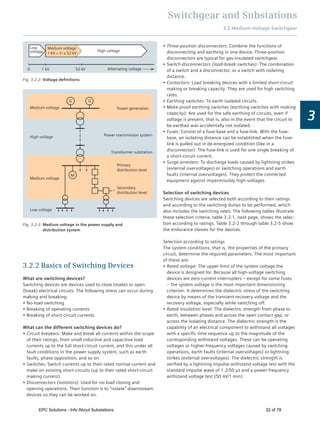
0 1 kV 52 kV
High voltage
Alternating voltage
Low
voltage
Medium voltage
1 kV < U ≤ 52 kV
Fig. 3.2-2: Voltage definitions
Fig. 3.2-3: Medium voltage in the power supply and
distribution system
M
G G
Low voltage
Secondary
distribution level
Primary
distribution level
Transformer substation
Power transmission system
Power generationMedium voltage
High voltage
Medium voltage
Three-position disconnectors: Combine the functions of
disconnecting and earthing in one device. Three-position
disconnectors are typical for gas-insulated switchgear.
Switch-disconnectors (load-break switches): The combination
of a switch and a disconnector, or a switch with isolating
distance.
Contactors: Load breaking devices with a limited short-circuit
making or breaking capacity. They are used for high switching
rates.
Earthing switches: To earth isolated circuits.
Make-proof earthing switches (earthing switches with making
capacity): Are used for the safe earthing of circuits, even if
voltage is present, that is, also in the event that the circuit to
be earthed was accidentally not isolated.
Fuses: Consist of a fuse-base and a fuse-link. With the fuse-
base, an isolating distance can be established when the fuse-
link is pulled out in de-energized condition (like in a
disconnector). The fuse-link is used for one single breaking of
a short-circuit current.
Surge arresters: To discharge loads caused by lightning strikes
(external overvoltages) or switching operations and earth
faults (internal overvoltages). They protect the connected
equipment against impermissibly high-voltages.
Selection of switching devices
Switching devices are selected both according to their ratings
and according to the switching duties to be performed, which
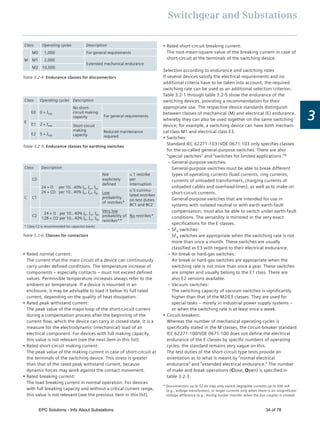
also includes the switching rates. The following tables illustrate
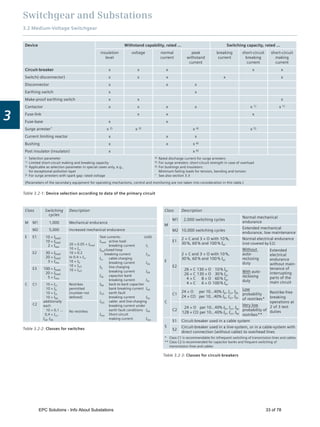
these selection criteria: table 3.2-1, next page, shows the selec-
tion according to ratings. Table 3.2-2 through table 3.2-5 show
the endurance classes for the devices.
Selection according to ratings
The system conditions, that is, the properties of the primary
circuit, determine the required parameters. The most important
of these are:
Rated voltage: The upper limit of the system voltage the
device is designed for. Because all high-voltage switching
devices are zero-current interrupters – except for some fuses
– the system voltage is the most important dimensioning
criterion. It determines the dielectric stress of the switching
device by means of the transient recovery voltage and the
recovery voltage, especially while switching off.
Rated insulation level: The dielectric strength from phase to
earth, between phases and across the open contact gap, or
across the isolating distance. The dielectric strength is the
capability of an electrical component to withstand all voltages
with a specific time sequence up to the magnitude of the
corresponding withstand voltages. These can be operating
voltages or higher-frequency voltages caused by switching
operations, earth faults (internal overvoltages) or lightning
strikes (external overvoltages). The dielectric strength is
verified by a lightning impulse withstand voltage test with the
standard impulse wave of 1.2/50 µs and a power-frequency
withstand voltage test (50 Hz/1 min).
3.2 Medium-Voltage Switchgear
EPC Solutions - Info About Substations 32 of 78
Switchgear and Substations
3.2 Medium-Voltage Switchgear
3
Table 3.2-1: Device selection according to data of the primary circuit
Device Withstand capability, rated … Switching capacity, rated …
insulation
level
voltage normal
current
peak
withstand
current
breaking
current
short-circuit
breaking
current
short-circuit
making
current
Circuit-breaker x x x x x
Switch(-disconnector) x x x x x
Disconnector x x x
Earthing switch x x
Make-proof earthing switch x x x
Contactor x x x x x 1) x 1)
Fuse-link x x x
Fuse-base x x
Surge arrester* x 2) x 3) x 4) x 5)
Current limiting reactor x x x
Bushing x x x 6)
Post insulator (insulator) x x 6)
x Selection parameter
1) Limited short-circuit making and breaking capacity
2) Applicable as selection parameter in special cases only, e.g.,
for exceptional pollution layer
3) For surge arresters with spark gap: rated voltage
4) Rated discharge current for surge arresters
5) For surge arresters: short-circuit strength in case of overload
6) For bushings and insulators:
Minimum failing loads for tension, bending and torsion
* See also section 3.3
(Parameters of the secondary equipment for operating mechanisms, control and monitoring are not taken into consideration in this table.)
Table 3.2-3: Classes for circuit-breakers
Class Description
M
M1 2,000 switching cycles
Normal mechanical
endurance
M2 10,000 switching cycles
Extended mechanical
endurance, low maintenance
E
E1
2 × C and 3 × O with 10 %,
30 %, 60 % and 100 % Isc
Normal electrical endurance
(not covered by E2)
E2
2 × C and 3 × O with 10 %,
30 %, 60 % and 100 % Isc
Without
auto-
reclosing
duty
Extended
electrical
endurance
without main-
tenance of
interrupting
parts of the
main circuit
26 × C 130 × O 10% Isc
26 × C 130 × O 30% Isc
4 × C 8 × O 60% Isc
4 × C 6 × O 100% Isc
With auto-
reclosing
duty
C
C1
24 × O per 10…40% Ilc, Icc, Ibc
24 × CO per 10…40% Ilc, Icc, Ibc
Low
probability
of restrikes*
Restrike-free
breaking
operations at
2 of 3 test
dutiesC2
24 × O per 10…40% Ilc, Icc, Ibc
128 × CO per 10…40% Ilc, Icc, Ibc
Very low
probability of
restrikes**
S
S1 Circuit-breaker used in a cable system
S2
Circuit-breaker used in a line-system, or in a cable-system with
direct connection (without cable) to overhead lines
* Class C1 is recommendable for infrequent switching of transmission lines and cables
** Class C2 is recommended for capacitor banks and frequent switching of
transmission lines and cables
Table 3.2-2: Classes for switches
Class Switching
cycles
Description
M M1 1,000 Mechanical endurance
M2 5,000 Increased mechanical endurance
E E1 10 × Iload
10 × Iload
2 × Ima
20 × 0.05 × Iload
10 × Icc
10 × 0.2
to 0.4 × Icc
10 × Ilc
10 × Ief1
10 × Ief2
Test currents: (old)
Iload active load-
breaking current I1
Ilooclosed-loop
breaking current I2a
Icc cable-charging
breaking current I4a
Ilc line-charging
breaking current I4b
Isb capacitor bank
breaking current I4c
Ibb back-to-back capacitor
bank breaking current I4d
Ief1 earth fault
breaking current I6a
Ief2 cable- and line-charging
breaking current under
earth fault conditions I6b
Ima Short-circuit
making current Ima
E2 30 × Iload
20 × Iload
3 × Ima
E3 100 × Iload
20 × Iload
5 × Ima
C C1 10 × Icc
10 × Ilc
10 × Isc
10 × Ibb
additionally
each
10 × 0,1 …
0,4 × Icc,
Isb, Ibb
Restrikes
permitted
(number not
defined)
C2
No restrikes
EPC Solutions - Info About Substations 33 of 78
Switchgear and Substations
3
Rated normal current:
The current that the main circuit of a device can continuously
carry under defined conditions. The temperature increase of
components – especially contacts – must not exceed defined
values. Permissible temperature increases always refer to the
ambient air temperature. If a device is mounted in an
enclosure, it may be advisable to load it below its full rated
current, depending on the quality of heat dissipation.
Rated peak withstand current:
The peak value of the major loop of the short-circuit current
during a compensation process after the beginning of the
current flow, which the device can carry in closed state. It is a
measure for the electrodynamic (mechanical) load of an
electrical component. For devices with full making capacity,
this value is not relevant (see the next item in this list).
Rated short-circuit making current:
The peak value of the making current in case of short-circuit at
the terminals of the switching device. This stress is greater
than that of the rated peak withstand current, because
dynamic forces may work against the contact movement.
Rated breaking current:
The load breaking current in normal operation. For devices
with full breaking capacity and without a critical current range,
this value is not relevant (see the previous item in this list).
Table 3.2-4: Endurance classes for disconnectors
Class Operating cycles Description
M
M0 1,000 For general requirements
M1 2,000
Extended mechanical endurance
M2 10,000
Table 3.2-5: Endurance classes for earthing switches
Class Operating cycles Description
E
E0 0 × Ima
No short-
circuit making
capacity For general requirements
E1 2 × Ima Short-circuit
making
capacityE2 5 × Ima
Reduced maintenance
required
* Disconnectors up to 52 kV may only switch negligible currents up to 500 mA
(e.g., voltage transformer), or larger currents only when there is an insignificant
voltage difference (e.g., during busbar transfer when the bus coupler is closed).
Table 3.2-6: Classes for contactors
Class Description
C
C0
24 × O per 10…40% Ilc, Icc, Ibc
24 × CO per 10…40% Ilc, Icc, Ibc
Not
explicitely
defined
≤ 1 restrike
per
interruption
C1
Low
probability
of restrikes*
≤ 5 cummu-
lated restrikes
on test duties
BC1 and BC2
C2
24 × O per 10…40% Ilc, Icc, Ibc
128 × CO per 10…40% Ilc, Icc, Ibc
Very low
probability of
restrikes**
No restrikes*
* Class C2 is recommended for capacitor banks
Rated short-circuit breaking current:
The root-mean-square value of the breaking current in case of
short-circuit at the terminals of the switching device.
Selection according to endurance and switching rates
If several devices satisfy the electrical requirements and no
additional criteria have to be taken into account, the required
switching rate can be used as an additional selection criterion.
Table 3.2-1 through table 3.2-5 show the endurance of the
switching devices, providing a recommendation for their
appropriate use. The respective device standards distinguish
between classes of mechanical (M) and electrical (E) endurance,
whereby they can also be used together on the same switching
device; for example, a switching device can have both mechani-
cal class M1 and electrical class E3.
Switches:
Standard IEC 62271-103 / VDE 0671-103 only specifies classes
for the so-called general-purpose switches. There are also
“special switches” and “switches for limited applications.”*
– General-purpose switches:
General-purpose switches must be able to break different
types of operating currents (load currents, ring currents,
currents of unloaded transformers, charging currents of
unloaded cables and overhead-lines), as well as to make on
short-circuit currents.
General-purpose switches that are intended for use in
systems with isolated neutral or with earth earth-fault
compensation, must also be able to switch under earth-fault
conditions. The versatility is mirrored in the very exact
specifications for the E classes.
– SF6 switches:
SF6 switches are appropriate when the switching rate is not
more than once a month. These switches are usually
classified as E3 with regard to their electrical endurance.
– Air-break or hard-gas switches:
Air-break or hard-gas switches are appropriate when the
switching rate is not more than once a year. These switches
are simpler and usually belong to the E1 class. There are
also E2 versions available.
– Vacuum switches:
The switching capacity of vacuum switches is significantly
higher than that of the M2/E3 classes. They are used for
special tasks – mostly in industrial power supply systems –
or when the switching rate is at least once a week.
Circuit-breakers:
Whereas the number of mechanical operating cycles is
specifically stated in the M classes, the circuit-breaker standard
IEC 62271-100/VDE 0671-100 does not define the electrical
endurance of the E classes by specific numbers of operating
cycles; the standard remains very vague on this.
The test duties of the short-circuit type tests provide an
orientation as to what is meant by “normal electrical
endurance” and “extended electrical endurance.” The number
of make and break operations (Close, Open) is specified in
table 3.2-3.
EPC Solutions - Info About Substations 34 of 78
Switchgear and Substations
3.2 Medium-Voltage Switchgear
3
3.2.3 Requirements of Medium-Voltage
Switchgear
The major influences and stress values that a switchgear assembly
is subjected to result from the task and its rank in the distribution
system. These influencing factors and stresses determine the
selection parameters and ratings of the switchgear (fig. 3.2-4).
Influences and stress values
System voltage
The system voltage determines the rated voltage of the
switchgear, switching devices and other installed compo-
nents. The maximum system voltage at the upper tolerance
limit is the deciding factor.
Assigned configuration criteria for switchgear
Rated voltage Ur
Rated insulation level Ud; Up
Rated primary voltage of voltage transformers Upr
Short-circuit current
The short-circuit current is characterized by the electrical values
of peak withstand current Ip (peak value of the initial symmet-
rical short-circuit current) and sustained short-circuit current Ik.
The required short-circuit current level in the system is predeter-
mined by the dynamic response of the loads and the power
quality to be maintained, and determines the making and
breaking capacity and the withstand capability of the switching
devices and the switchgear (table 3.2-7).
Important note: The ratio of peak current to sustained short-cir-
cuit current in the system can be significantly larger than the
standardized factor Ip/Ik = 2.5 (50 Hz) used for the construction
of the switching devices and the switchgear. A possible cause,
for example, are motors that feed power back to the system
when a short circuit occurs, thus increasing the peak current
significantly.
Normal current and load flow
The normal current refers to current paths of the incoming
feeders, busbar(s) and outgoing consumer feeders. Because of
the spatial arrangement of the panels, the current is also distrib-
uted, and therefore there may be different rated current values
next to one another along a conducting path; different values
for busbars and feeders are typical.
Reserves must be planned when dimensioning the switchgear:
In accordance with the ambient air temperature
For planned overload
For temporary overload during faults
Modern vacuum circuit-breakers can generally make and break
the rated normal current up to the number of mechanical
operating cycles.
The switching rate is not a determining selection criterion,
because circuit-breakers are always used where short-circuit
breaking capacity is required to protect equipment.
Disconnectors:
Disconnectors do not have any switching capacity (switches for
limited applications must only control some of the switching
duties of a general-purpose switch). Switches for special
applications are provided for switching duties such as
switching of single capacitor banks, paralleling of capacitor
banks, switching of ring circuits formed by transformers
connected in parallel, or switching of motors in normal and
locked condition. Therefore, classes are only specified for the
number of mechanical operating cycles.
Earthing switches:
With earthing switches, the E classes designate the short-
circuit making capacity (earthing on applied voltage). E0
corresponds to a normal earthing switch; switches of the E1
and E2 classes are also-called make-proof or high-speed
earthing switches.
The standard does not specify how often an earthing switch
can be actuated purely mechanically; there are no M classes
for these switches.
Contactors:
The standard has not specified any endurance classes for
contactors yet. Commonly used contactors today have a
mechanical and electrical endurance in the range of 250,000
to 1,000,000 operating cycles. They are used wherever
switching operations are performed very frequently, e.g., more
than once per hour.
Regarding capacitor applications IEC 62271-106 introduced
classes for capacitice current breaking. If contactors are used for
capacitor banks it is recommended to only install class C2 con-
tactors.
EPC Solutions - Info About Substations 35 of 78
Switchgear and Substations
3.2 Medium-Voltage Switchgear
3Ambient conditions
System parameters
Rated voltage Neutral earthing
Short-circuit current
Load flow
Selectivity
Protection functions
Normal current
System protection and measuring
Supplies
Service location
Sector-specific application
Sector-specific operating procedures
Regulations
Measuring
Public power systems
In-plant power generation
Place of installation
Utilities room
Transport
Room climate
Temperature
Switching duties
Busbar transfer
Operation
Working
Inspection
Standards
Association guidelines
Cable/overhead line
Overvoltage protection
Power quality
Redundancy
Tripping times
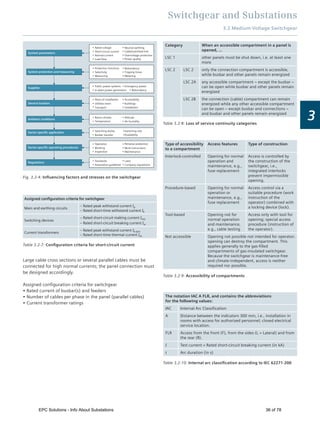
Metering
Emergency power
Redundancy
Accessibility
Buildings
Installation
Altitude
Air humidity
Switching rate
Availability
Personal protection
Work instructions
Maintenance
Laws
Company regulations
Fig. 3.2-4: Influencing factors and stresses on the switchgear
Table 3.2-7: Configuration criteria for short-circuit current
Assigned configuration criteria for switchgear
Main and earthing circuits
– Rated peak withstand current Ip
– Rated short-time withstand current Ik
Switching devices
– Rated short-circuit making current Ima
– Rated short-circuit breaking current Isc
Current transformers
– Rated peak withstand current Ik-dyn
– Rated short-time thermal current Ith
Large cable cross sections or several parallel cables must be
connected for high normal currents; the panel connection must
be designed accordingly.
Assigned configuration criteria for switchgear
Rated current of busbar(s) and feeders
Number of cables per phase in the panel (parallel cables)
Current transformer ratings
Table 3.2-8: Loss of service continuity categories
Category When an accessible compartment in a panel is
opened, …
LSC 1 other panels must be shut down, i.e. at least one
more
LSC 2 LSC 2 only the connection compartment is accessible,
while busbar and other panels remain energized
LSC 2A any accessible compartment – except the busbar –
can be open while busbar and other panels remain
energized
LSC 2B the connection (cable) compartment can remain
energized while any other accessible compartment
can be open – except busbar and connections –
and busbar and other panels remain energized
Table 3.2-9: Accessibility of compartments
Type of accessibility
to a compartment
Access features Type of construction
Interlock-controlled Opening for normal
operation and
maintenance, e.g.,
fuse replacement
Access is controlled by
the construction of the
switchgear, i.e.,
integrated interlocks
prevent impermissible
opening.
Procedure-based Opening for normal
operation or
maintenance, e.g.,
fuse replacement
Access control via a
suitable procedure (work
instruction of the
operator) combined with
a locking device (lock).
Tool-based Opening not for
normal operation
and maintenance,
e.g., cable testing
Access only with tool for
opening; special access
procedure (instruction of
the operator).
Not accessible Opening not possible not intended for operator;
opening can destroy the compartment. This
applies generally to the gas-filled
compartments of gas-insulated switchgear.
Because the switchgear is maintenance-free
and climate-independent, access is neither
required nor possible.
Table 3.2-10: Internal arc classification according to IEC 62271-200
The notation IAC A FLR, and contains the abbreviations
for the following values:
IAC Internal Arc Classification
A Distance between the indicators 300 mm, i.e., installation in
rooms with access for authorized personnel; closed electrical
service location.
FLR Access from the front (F), from the sides (L = Lateral) and from
the rear (R).
I Test current = Rated short-circuit breaking current (in kA)
t Arc duration (in s)
EPC Solutions - Info About Substations 36 of 78
Switchgear and Substations
3.2 Medium-Voltage Switchgear
3
Table 3.2-11: Overview of Siemens medium-voltage switchgear
Distribution
level
Insulation Type
of construction
Loss
of service continuity
Partition
class
Internal
arc classification*
Primary Gas-insulated Extendable LSC 2 PM IAC A FLR 31.5 kA, 1 s
LSC 2 PM IAC A FLR 25 kA, 1 s
LSC 2 PM IAC A FL 25 kA, 1 s **
IAC A FLR 25 kA, 1 s ***
LSC 2 PM IAC A FLR 31.5 kA, 1 s
LSC 2 PM IAC A FLR 40 kA, 1 s
Air-insulated Extendable LSC 2B PM IAC A FLR 40 kA, 1 s
IAC A FLR 25 kA, 1 s
LSC 2B PM IAC A FLR 50 kA, 1 s
LSC 2A PM IAC A FLR 25 kA, 1 s
LSC 2B PM IAC A FLR 31.5 kA, 1 s
LSC 1 PM IAC A FL 16 kA, 1 s
Secondary Gas-insulated Non-extendable LSC 2 PM IAC A FL 21 kA, 1 s **
IAC A FLR 21 kA, 1 s ***
Extendable LSC 2 PM IAC A FL 21 kA, 1 s **
IAC A FLR 21 kA, 1 s ***
Air-insulated Extendable LSC 2 PM IAC A FLR 21 kA, 1 s
* Maximum possible IAC classification ** Wall-standig arrangement *** Free-standig arrangement **** Depending on HV HRC fuse-link
3.2.4 Medium-Voltage Switchgear
EPC Solutions - Info About Substations 37 of 78
Switchgear and Substations
3.2 Medium-Voltage Switchgear
3
Switchgear
type
Busbar
system
Rated
voltage (kV)
Rated short-time
withstand current (kA)
1 s 3 s
Rated current,
busbar (A)
Rated current,
feeder (A)
NXPLUS C Single 15
24.0
31.5
25
31.5
25
2,500
2,500
2,500
2,000
NXPLUS C Double 24 25 25 2,500 1,250
NXPLUS C Wind Single 36 25 20 1,000 630/1,000
NXPLUS Single 40.5 31.5 31.5 2,500 2,500
NXPLUS Double 36 31.5 31.5 2,500 2,500
8DA10 Single 40.5 40 40 5,000 2,500
8DB10 Double 40.5 40 40 5,000 2,500
NXAIR Single 17.5 40 40 4,000 4,000
Double 17.5 40 40 4,000 4,000
Single 24 25 25 2,500 2,500
Double 24 25 25 2,500 2,500
NXAIR P Single 17.5 50 50 4,000 4,000
NXAIR P Double 17.5 50 50 4,000 4,000
8BT1 Single 24 25 25 2,000 2,000
8BT2 Single 36 31.5 31.5 3,150 3,150
8BT3 Single 36 16 1,250 1,250
8DJH
Block Type
Single 17.5
24
25
20
20
20
630
630
200 **** /
250 / 400 / 630
200 **** /
250 / 400 / 630
8DJH
Single Panel
Single 17.5
24
25
20
20
20
630
630
200 **** /
250 / 400 / 630
200 **** /
250 / 400 / 630
SIMOSEC Single 17.5
24
25
20
21
20
1,250
1,250
1,250
1,250
EPC Solutions - Info About Substations 38 of 78
Switchgear and Substations
3.2 Medium-Voltage Switchgear
3
Performance features
The air-insulated, metal-clad switchgear type NXAIR is an
innovation in the switchgear field for the distribution and
process level up to 17.5 kV, 40 kA, 4,000 A.
Design verified, IEC 62271-200, metal-clad, loss of service
continuity category: LSC 2B; partition class: PM;
internal arc classification: IAC A FLR ≤ 40 kA 1 s
Evidence of the making and breaking capacity for the circuit-
breakers and the make-proof earthing switches inside the
panel
Table 3.2-12: Technical data of NXAIR
W D
Fig. 3.2-6: Dimensions of NXAIR
Fig. 3.2-5: NXAIR panel
NXAIR ≤17.5kV
Insulating medium air is always available
Single busbar, double busbar (back-to-back,face-to-face)
Withdrawable vacuum circuit-breaker
Withdrawable vacuum contactor
Platform concept worldwide, local manufacturing presence
Use of standardized devices
Maximum security of operation by self-explaining
operating logic
Maintenance interval ≥ 10 years
Dimensions in mm
Width W Circuit-breaker panel ≤ 1,000 A
1,250 A
2,500 A / 3,150 A / 4,000 A
600*
800
1,000
Contactor panel ≤ 400 A 435
Disconnecting panel 1,250 A
2,500 A / 3,150 A / 4,000 A
800
1,000
Bus sectionalizer 1,250 A
2,500 A / 3,150 A / 4,000 A
2 × 800
2 × 1,000
Metering panel 800
Busbar connection panel ≤ 4,000 A 800/1,000
Height H1 With standard low-voltage
compartment, natural ventilation
2,300
Height H2 With high low-voltage compartment or
additional compartment for busbar
components
2,350
Height H3 With forced ventilation for 4,000 A 2,450
Height H4 With optional internal arc absorber 2,500
Depth D Single busbar, all panel types ≤ 31.5 kA
(except contactor panel) 40 kA
1,350
1,500
Contactor panel ≤ 40 kA 1,400*/1,500
* ≤ 31.5 kA
Rated
Voltage kV 7.2 12 17.5
Frequency Hz 50/60 50/60 50/60
Short-duration power-frequency withstand voltage
(phase/phase, phase/earth)
kV 20* 28* 38
Lightning impulse withstand voltage
(phase/phase, phase/earth)
kV 60 75 95
Short-circuit breaking current max. kA 40 40 40
Short-time withstand current, 3 s max. kA 40 40 40
Short-circuit making current max. kA 100/104** 100/104** 100/104**
Peak withstand current max. kA 100/104** 100/104** 100/104**
Normal current of the busbar max. A 4,000 4,000 4,000
Normal current of the feeders:
Circuit-breaker panel
Contactor panel
Disconnecting panel
Bus sectionalizer
Busbar connection panel
max. A
max. A
max. A
max. A
max. A
4,000
400***
4,000
4,000
4,000
4,000
400***
4,000
4,000
4,000
4,000
–
4,000
4,000
4,000
* 32 kV at 7.2 kV and 42 kV at 12 kV optional for GOST standard.
** Values for 50 Hz: 100 kA; for 60 Hz: 104 kA.
*** Current values dependent on HV HRC fuses. Lightning impulse withstand voltage across open contact gap of contactor:
40 kV at 7.2 kV, 60 kV at 12 kV.
EPC Solutions - Info About Substations 39 of 78
Switchgear and Substations
3.2 Medium-Voltage Switchgear
3
Fig. 3.2-8: Dimensions of NXAIR, 24 kV
Performance features
The air-insulated, metal-clad switchgear type NXAIR, 24 kV is the
resulting further development of the NXAIR family for use in the
distribution and process level up to 24 kV, 25 kA, 2,500 A.
Design verified, IEC 62271-200, metal-clad, loss of service
continuity category: LSC 2B; partition class: PM;
internal arc classification: IAC A FLR ≤ 25 kA 1s
Evidence of the making and breaking capacity for the circuit-
breakers and the make-proof earthing switches inside the
panel
Table 3.2-13: Technical data of NXAIR, 24 kV
W D
Fig. 3.2-7: NXAIR, 24 kV panel
NXAIR, 24kV
Single busbar, double busbar (back-to-back, face-to-face)
Insulating medium air is always available
Withdrawable vacuum circuit-breaker
Platform concept worldwide, local manufacturing presence
Use of standardized devices
Maximum security of operation by self-explaining
operating logic
Maintenance interval ≥ 10 years
Rated
Voltage kV 24
Frequency Hz 50/60
Short-duration power-frequency withstand voltage
(phase/phase, phase/earth)
kV 50 *
Lightning impulse withstand voltage
(phase/phase, phase/earth)
kV 125
Short-circuit breaking current max. kA 25
Short-time withstand current, 3 s max. kA 25
Short-circuit making current max. kA 63/65 **
Peak withstand current max. kA 63/65 **
Normal current of busbar max. A 2,500
Normal current of feeders:
Circuit-breaker panel
Disconnecting panel
Bus sectionalizer
max. A
max. A
max. A
2,500
2,500
2,500
* 65 kV optional for GOST standard ** Values for 50 Hz: 63 kA; for 60 Hz: 65 kA.
Dimensions in mm
Width W Circuit-breaker panel ≤ 1,250 A
2,500 A
800
1,000
Disconnecting panel ≤ 1,250 A
2,500 A
800
1,000
Bus sectionalizer ≤ 1,250 A
1,600 A / 2,000 A / 2,500 A
2 × 800
2 × 1,000
Metering panel 800
Height H1 With standard low-voltage
compartment
2,510
Height H2 With high low-voltage compartment 2,550
Height H3 With natural ventilation 2,680
Height H4 With optional internal arc absorber 2,750
Height H5 With additional compartment for busbar
components
2,770
Depth D Single busbar 1,600
EPC Solutions - Info About Substations 40 of 78
Switchgear and Substations
3.2 Medium-Voltage Switchgear
3
Performance features
The air-insulated, metal-clad switchgear type NXAIR P is based
on the construction principles of the NXAIR family and designed
for use in the distribution and process level up to 17.5 kV, 50 kA,
4,000 A.
Design verified, IEC 62271-200, metal-clad, loss of service
continuity category: LSC 2B; partition class: PM; internal arc
classification: IAC A FLR ≤ 50 kA 1 s
Insulating medium air is always available
Single busbar, double busbar (back-to-back, face-to-face)
Table 3.2-14: Technical data of NXAIR P
Rated
Voltage kV 7.2 12 17.5
Frequency Hz 50/60 50/60 50/60
Short-duration power-frequency withstand voltage
(phase/phase, phase/earth)
kV 20* 28* 38
Lightning impulse withstand voltage
(phase/phase, phase/earth)
kV 60 75 95
Short-circuit breaking current max. kA 50 50 50
Short-time withstand current, 3 s max. kA 50 50 50
Short-circuit making current max. kA 125/130** 125/130** 125/130**
Peak withstand current max. kA 125/130** 125/130** 125/130**
Normal current of busbar max. A 4,000 4,000 4,000
Normal current of feeders:
Circuit-breaker panel
Contactor panel
Disconnecting panel
Bus sectionalizer
max. A 4,000
400***
4,000
4,000
4,000
400***
4,000
4,000
4,000
–
4,000
4,000
* 32 kV at 7.2 kV and 42 kV at 12 kV optional for GOST standard.
** Values for 50 Hz: 125 kA; for 60 Hz: 130 kA, make-proof earthing switch for 17.5 kV up to 100 kA.
*** Dependent on rated current of HV HRC fuses used; dielectric strength of contactor panel: 20 kV short-duration power-
frequency withstand voltage phase-to-phase, phase-to-earth, open contact gap, or 60 kV lightning impulse withstand
voltage phase-to-phase, phase-to-earth, 40 kV open contact gap of the contactor.
Fig. 3.2-10: Dimensions of NXAIR P
Dimensions in mm
Width W Circuit-breaker panel ≤ 2,000 A
> 2,000 A
800
1,000
Contactor panel ≤ 400 A 400
Disconnecting panel ≤ 2,000 A
> 2,000 A
800
1,000
Bus sectionalizer ≤ 2,000 A
> 2,000 A
2 × 800
2 × 1,000
Metering panel 800
Height H1 With standard low-voltage
compartment (≤ 3150 A)
2,225
Height H2 With high low-voltage compartment 2,485
Height H3 With top-mounted pressure relief duct
as standard
2,550
Height H4 With forced ventilation (4000 A) 2,710
Depth D Single busbar (except contactor panel) 1,635
Contactor panel 1,650
Double busbar in back-to-back
arrangement (except contactor panel)
3,320
Fig. 3.2-9: NXAIR P panel
NXAIR P
Evidence of the making and breaking capacity for the circuit-
breakers and the make-proof earthing switches inside the
panel
Withdrawable vacuum circuit-breaker
Withdrawable vacuum contactor
Maximum availability due to modular design
Maximum security of operation by self-explaining
operating logic
Maintenance interval ≥ 10 years
EPC Solutions - Info About Substations 41 of 78
Switchgear and Substations
3.2 Medium-Voltage Switchgear
3
W D1
H1
H2
D2
Performance features
The air-insulated, cubicle-type
switchgear type 8BT1 is a
factory-assembled, design
verified indoor switchgear for
lower ratings in the distribu-
tion and process level up to
24 kV, 25 kA, 2,000 A.
Design verified, IEC 62271-
200, cubicle-type, loss of
service continuity category:
LSC 2A; partition class: PM;
internal arc classification:
IAC A FLR ≤ 25 kA 1 s
Insulating medium air is
always available
Evidence of the making and
breaking capacity for the
circuit-breakers and the
make-proof earthing
switches inside the panel
Single busbar
Withdrawable vacuum
circuit-breaker
All switching operations with
door closed
Fig. 3.2-13: 8BT1 panel
Table 3.2-16: Technical data of 8BT1
Rated
Voltage kV 12 24
Frequency Hz 50 50
Short-duration power-frequency withstand voltage
(phase/phase, phase/earth)
kV 28 50
Lightning impulse withstand voltage
(phase/phase, phase/earth)
kV 75 125
Short-circuit breaking current max. kA 25 25
Short-time withstand current, 3 s max. kA 25 25
Short-circuit making current max. kA 63 63
Peak withstand current max. kA 63 63
Normal current of the busbar max. A 2,000 2,000
Normal current of the feeders
with circuit-breaker
with switch-disconnector
with switch-disconnector and fuses
max. A
max. A
max. A
2,000
630
200 A*
2,000
630
200 A*
* Depending on rated current of the HV HRC fuses used.
Fig. 3.2-14: Dimensions of 8BT1
All panel types Dimensions in mm
7.2/12 kV
Width W For circuit-breaker max. 1,250 A
For circuit-breaker 2,000 A
For switch-disconnector
600
800
600
Height H1
H2
H2
With standard low-voltage compartment
With pressure relief system
With lead-off duct
2,050
2,300*
2,350*
Depth D1
D2
Without low-voltage compartment
With low-voltage compartment
1,200
1,410
24 kV
Width W For circuit-breaker max. 1,250 A
For circuit-breaker 2,000 A
For switch-disconnector
800
1,000
800
Height H1
H2
H2
With standard low-voltage compartment
With pressure relief system
With lead-off duct
2,050
2,300*
2,350*
Depth D1
D2
Without low-voltage compartment
With low-voltage compartment
1,200
1,410
* For 1 s arc duration.
8BT1
EPC Solutions - Info About Substations 42 of 78
Switchgear and Substations
3.2 Medium-Voltage Switchgear
3
D
H1
W
H2
H3
Performance features
The air-insulated, metal-clad switchgear type 8BT2 is a factory-
assembled, design verified indoor switchgear for use in the
distribution and process level up to 36 kV, 31.5 kA, 3,150 A.
Design verified, IEC 62271-200, metal-clad, loss of service
continuity category: LSC 2B; partition class: PM; internal arc
classification: IAC A FLR ≤ 31.5 kA 1 s
Insulating medium air is always available
Table 3.2-17: Technical data of 8BT2
Rated
Voltage kV 36
Frequency Hz 50/60
Short-duration power-frequency withstand voltage
(phase/phase, phase/earth)
kV 70
Lightning impulse withstand voltage
(phase/phase, phase/earth)
kV 170
Short-circuit breaking current max. kA 31.5
Short-time withstand current, 3 s max. kA 31.5
Short-circuit making current max. kA 80/82*
Peak withstand current max. kA 80/82*
Normal current of the busbar max. A 3,150
Normal current of the feeders
with circuit-breaker max. A 3,150
* Values for 50 Hz: 80 kA; for 60 Hz: 82 kA.
Fig. 3.2-15: 8BT2 switchgear
8BT2
Fig. 3.2-16: Dimensions of 8BT2
Evidence of the making and breaking capacity for the circuit-
breakers and the make-proof earthing switches inside the
panel
Single busbar
Withdrawable vacuum circuit-breaker
All switching operations with door closed
Dimensions in mm
Width W ≤ 3,150 A feeder current 1,200
Height H1 Intermediate panel 2,400
Height H2 End panel with side baffles 2,750 / 2,775*
Height H3 Panel with closed duct 2,900**
Depth D Wall-standing, IAC A FL 2,450
Free-standing, IAC A FLR 2,700
* H2 indicates side baffles for internal arc protection
** Closed duct for IAC-classification A FLR
EPC Solutions - Info About Substations 43 of 78
Switchgear and Substations
3.2 Medium-Voltage Switchgear
3
Performance features
The air-insulated, cubicle-type
switchgear type 8BT3 is a
factory-assembled, design
verified indoor switchgear for
lower ratings in the distribu-
tion and process level up to
36 kV, 16 kA, 1,250 A.
Design verified, IEC 62271-
200, cubicle-type, loss of
service continuity category:
LSC 1; internal arc
classification: IAC A FL
≤ 16 kA 1 s
Insulating medium air is
always available
Make-proof earthing switch
Single busbar
Withdrawable vacuum
circuit-breaker
All switching operations with
door closed
DW
H
Fig. 3.2-17: 8BT3 switchgear
Table 3.2-18: Technical data of 8BT3
Rated
Voltage kV 36
Frequency Hz 50/60
Short-duration power-frequency withstand voltage
(phase/phase, phase/earth)
kV 70
Lightning impulse withstand voltage
(phase/phase, phase/earth)
kV 170
Short-circuit breaking current max. kA 16
Short-time withstand current, 1 s max. kA 16
Short-circuit making current max. kA 40/42*
Peak withstand current max. kA 40/42*
Normal current of the busbar max. A 1,250
Normal current of the feeders
with circuit-breaker
with switch-disconnector
with switch-disconnector and fuses
max. A
max. A
max. A
1,250
630
100**
* Values for 50 Hz: 40 kA; for 60 Hz: 42 kA.
** Depending on the rated current of the HV HRC fuses used.
Fig. 3.2-18: Dimensions of 8BT3
Dimensions in mm
Width W 1,000
Height H 2,400
Depth D 1,450
8BT3
EPC Solutions - Info About Substations 44 of 78
Switchgear and Substations
3.2 Medium-Voltage Switchgear
3
Fig. 3.2-19: 8DA switchgear
for single-busbar
applications (on the
left), 8DB switchgear
for double-busbar
applications (on the
right)
H
W D2
8DB switchgear
Table 3.2-19: Technical data of 8DA/8DB
Rated
Voltage kV 12 24 36 40.5
Frequency Hz 50/60 50/60 50/60 50/60
Short-duration power-frequency withstand voltage kV 28 50 70 85
Lightning impulse withstand voltage kV 75 125 170 185
Short-circuit breaking current max. kA 40 40 40 40
Short-time withstand current, 3 s max. kA 40 40 40 40
Short-circuit making current max. kA 100 100 100 100
Peak withstand current max. kA 100 100 100 100
Normal current of the busbar max. A 5,000 5,000 5,000 5,000
Normal current of the feeders max. A 2,500 2,500 2,500 2,500
Fig. 3.2-20: Dimensions of 8DA/8DB
Dimensions Dimensions in mm
Width (spacing) W 600
Height H Standard design
Design with higher low-voltage compartment
2,350
2,700
Depth D1
D2
Single-busbar switchgear
Double-busbar switchgear
1,625
2,665
Advantages
Independent of the
environment and climate
Compact
Maintenance-free
Personal safety
Operational reliability
Environmentally compatible
Cost-efficient
8DA/8DB are gas-insulated
medium-voltage circuit-
breaker switchgear assemblies
up to 40.5 kV with the advan-
tages of the vacuum switching
technology – for a high degree
of independence in all applica-
tions. 8DA/8DB are suitable for
primary distribution systems
up to 40.5 kV, 40 kA, up to
5,000 A.
Performance features
Design verified according to
IEC 62271-200
Enclosure with modular
standardized housings made
from corrosion-resistant
aluminum alloy
Safe-to-touch enclosure and
standardized connections for
plug-in cable terminations
Operating mechanisms and
transformers are easily
accessible outside the
enclosure
Metal-enclosed, partition
class PM
Loss of service continuity
category for switchgear:
LSC 2
Internal arc classification:
IAC A FLR 40 kA 1 s
8DA/8DB
H
W D1
8DA switchgear
EPC Solutions - Info About Substations 45 of 78
Switchgear and Substations
3.2 Medium-Voltage Switchgear
3
The gas-insulated medium-
voltage switchgear type 8DJH is
used for power distribution in
secondary distribution systems
up to 24 kV. Ring-main feeders,
circuit-breaker feeders and
transformer feeders are all part
of a comprehensive product
range to satisfy all require-
ments with the highest level of
operational reliability –
also for extreme ambient
conditions.
Performance features
Design verified according to
IEC 62271-200
Sealed pressure system with
SF6 filling for the entire
service life
Safe-to-touch enclosure and
standardized connections for
plug-in cable terminations
3-pole, gas-insulated
switchgear vessel for
switching devices and
busbar
Panel blocks and single
panels available
Switching devices: three-
position load-break switch
(ON–OFF–EARTH), switch-
fuse combination for
distribution transformer
protection, vacuum circuit-
breaker with three-position
disconnector, earthing switch
Earthing function of
switching devices generally
make-proof
Fig. 3.2-21: 8DJH block type
Fig. 3.2-22: Dimensions of 8DJH block types
Dimensions Dimensions in mm
Width W Number of feeders (in extracts)
2 feeders (e.g., RR)
3 feeders (e.g., RRT)
4 feeders (e.g., 3R + 1T)
620
1,050
1,360
Height H Panels without low-voltage compartment
Panels with low-voltage compartment (option)
Switchgear with pressure absorber (option)
1,200/1,400/1,700
1,400–2,600
1,800–2,600
Depth D Standard switchgear
Switchgear with pressure absorber (option)
775
890
8DJH
W
H
D
Table 3.2-20: Technical data of 8DJH
Rated
Voltage kV 7.2 12 15 17.5 24
Frequency Hz 50/60 50/60 50/60 50/60 50/60
Short-duration power-frequency
withstand voltage
kV 20 28* 36 38 50
Lightning impulse withstand voltage kV 60 75 95 95 125
Normal current for ring-main feeders A 400 or 630
Normal current for busbar max. A 630
Normal current for circuit-breaker feeders A 250 or 630
Normal current for transformer feeders A 200**
Short-time withstand current, 1 s
50Hz
max. kA 25 25 25 25 20
Short-time withstand current, 3 s max. kA 20 20 20 20 20
Peak withstand current max. kA 63 63 63 63 50
Short-circuit making current
for ring-main feeders
for circuit-breaker feeders
for transformer feeders
max. kA
max. kA
max. kA
63
63
63
63
63
63
63
63
63
63
63
63
50
50
50
Short-time withstand current, 1 s
60Hz
max. kA 21 21 21 21 20
Short-time withstand current, 3 s max. kA 21 21 21 21 20
Peak withstand current max. kA 55 55 55 55 52
Short-circuit making current
for ring-main feeders
for circuit-breaker feeders
for transformer feeders
max. kA
max. kA
max. kA
55
55
55
55
55
55
55
55
55
55
55
55
52
52
52
* 42 kV according to some national requirements ** Depending on HV HRC fuse-link
EPC Solutions - Info About Substations 46 of 78
Switchgear and Substations
3.2 Medium-Voltage Switchgear
3
Metal-enclosed, partition
class PM
Loss of service continuity
category for switchgear:
LSC 2
Internal arc classification
(option):
– IAC A FL 21 kA, 1 s
– IAC A FLR 21 kA, 1 s
Advantages
No gas work during
installation
Compact
Independent of the
environment and climate
Maintenance-free
High operating and personal
safety
Switchgear interlocking
system with logical
mechanical interlocks
Operational reliability and
security of investment
Environmentally compatible
Cost-efficient
Typical uses
8DJH switchgear is used for
power distribution in sec-
ondary distribution systems,
such as
Public energy distribution
– Transformer substations
– Customer transfer
substations
– High-rise buildings
Infrastructure facilities
– Airports & ports
– Railway & underground
railway stations
– Water & wastewater
treatment
Industrial plants
– Automotive industry
– Chemical industry
– Open-cast mines
Renewable power generation
– Wind power stations
– Solar power plants
– Biomass power stations
Fig. 3.2-23: 8DJH single panel
8DJH
Fig. 3.2-24: Dimensions of 8DJH single panels
Dimensions Dimensions in mm
Width W Ring-main feeders
Transformer feeders
Circuit-breaker feeders
Bus sectionalizer panels
310/500
430
430/500
430/500/620
Busbar metering panels 430/500
Billing metering panels 840
Height H1
H2
Panels without low-voltage compartment
Panels with low-voltage compartment
Switchgear with pressure absorber (option)
1,200/1,400/1,700
1,400–2,600
1,800–2,600
Depth D Standard switchgear
Switchgear with pressure absorber (option)
775
890
H1
W
H2
H1
W
H2
D
EPC Solutions - Info About Substations 47 of 78
Switchgear and Substations
3.2 Medium-Voltage Switchgear
3
NXPLUS is a gas-insulated
medium-voltage circuit-breaker
switchgear up to 40.5 kV with
the advantages of the vacuum
switching technology – for a
high degree of independence
in all applications. NXPLUS can
be used for primary distribu-
tion systems up to 40.5 kV, up
to 31.5 kA, up to 2,000 A (for
double-busbar switchgear up
to 2,500 A).
Performance features
Design verified according to
IEC 62271-200
Sealed pressure system with
SF6 filling for the entire
service life
Safe-to-touch enclosure and
standardized connections for
plug-in cable terminations
Separate 3-pole gas-
insulated modules for busbar
with three-position
disconnector, and for circuit-
breaker
Interconnection of modules
with 1-pole insulated and
screened module couplings
Operating mechanisms and
transformers are arranged
H1
W D1
Fig. 3.2-25: NXPLUS switchgear
for single-busbar
applications (on
the left), NXPLUS
switchgear for double-
busbar applications
(on the right)
NXPLUS switchgear with single busbar NXPLUS switchgear with double-busbar
H2
W D2
outside the switchgear
vessels and are easily
accessible
Metal-enclosed, partition
class PM
Loss of service continuity
category for switchgear:
LSC 2
Internal arc classification:
IAC A FLR 31.5 kA, 1 s
No gas work during
installation or extension
Advantages
Independent of the
environment and climate
Fig. 3.2-26: Dimensions of NXPLUS
Dimensions Dimensions in mm
Width (spacing) W Feeders up to 2,000 A 600
Height H1
H2
Single-busbar switchgear
Double-busbar switchgear
2,450
2,600
Depth D1
D2
Single-busbar switchgear
Double-busbar switchgear
1,600
1,840
Table 3.2-22: Technical data of NXPLUS
Rated
Voltage kV 12 24 36 40.5
Frequency Hz 50/60 50/60 50/60 50/60
Short-duration power-frequency withstand
voltage
kV 28 50 70 85
Lightning impulse withstand voltage kV 75 125 170 185
Short-circuit breaking current max. kA 31.5 31.5 31.5 31.5
Short-time withstand current, 3 s max. kA 31.5 31.5 31.5 31.5
Short-circuit making current max. kA 80 80 80 80
Peak withstand current max. kA 80 80 80 80
Normal current of the busbar max. A 2,500 2,500 2,500 2,000
Normal current of the feeders max. A 2,500 2,500 2,500 2,000
Compact
Maintenance-free
Personal safety
Operational reliability
Environmentally compatible
Cost-efficient
NXPLUS
EPC Solutions - Info About Substations 48 of 78
Switchgear and Substations
3.2 Medium-Voltage Switchgear
3
H1
H2
DW
H3
With horizontal pressure
relief duct
Extended number of
operating cycles (up to 15 kV,
up to 31.5 kV, up to 1,250 A)
– function DISCONNECT:
5,000 ×, 10,000 ×
– function READY-TO-EARTH:
5,000 ×, 10,000 ×
– function CIRCUIT-
BREAKER: 30,000 ×
Type-Approved by LR, DNV,
GL, ABS, RMR
Internal arc classification for:
– Wall-standing
arrangement:
IAC A FL 31.5 kA, 1 s
– Free-standing
arrangement:
IAC A FLR 31.5 kA, 1 s
Table 3.2-23: Technical data of NXPLUS C
Rated
Voltage kV 7.2 12 15 17.5 24
Frequency Hz 50/60 50/60 50/60 50/60 50/60
Short-duration power-frequency
withstand voltage
kV 20 28* 36 38 50
Lightning impulse withstand voltage kV 60 75 95 95 125
Short-circuit breaking current max. kA 31.5 31.5 31.5 25 25
Short-time withstand current, 3 s max. kA 31.5 31.5 31.5 25 25
Short-circuit making current max. kA 80 80 80 63 63
Peak withstand current max. kA 80 80 80 63 63
Normal current of the busbar max. A 2,500 2,500 2,500 2,500 2,500
Normal current of the feeders max. A 2,500 2,500 2,500 2,000 2,000
* 42 kV according to some national requirements
Fig. 3.2-28: Dimensions of NXPLUS C
Dimensions Dimensions in mm
Width W 630 A/1,000 A/1,250 A 600
2,000 A/2,500 A 900
Height H1
H2
H3
Standard design
With horizontal pressure relief duct
For higher low-voltage compartment
2,250 (W = 600);
2,550 (W = 900)
2,640 (W = 600);
2,640 (W = 900)
2,650
Depth D Wall-standing arrangement
Free-standing arrangement
1,250
1,250
Fig. 3.2-27: NXPLUS C panel
Advantages
No gas work during
installation or extension
Compact
Independent of the
environment and climate
Maintenance-free
Personal safety
Operational reliability
Environmentally compatible
Cost-efficient
NXPLUS C
The compact NXPLUS C is the
medium-voltage circuit-
breaker switchgear that made
gas insulation with the proven
vacuum switching technology
economical in its class. The
NXPLUS C is used for sec-
ondary and primary distribu-
tion systems up to 24 kV, up to
31.5 kA and up to 2,500 A. It
can also be supplied as
double-busbar switchgear in a
back-to-back arrangement (see
catalog HA35.41).
Performance features
Design verified according to
IEC 62271-200
Sealed pressure system with
SF6 filling for the entire
service life
Safe-to-touch enclosure and
standardized connections for
plug-in cable terminations
Loss of service continuity
category for switchgear:
– Without HV HRC fuses:
LSC 2
1-pole insulated and
screened busbar
3-pole gas-insulated
switchgear vessels with
three-position switch and
circuit-breaker
Operating mechanisms and
transformers are located
outside the switchgear vessel
and are easily accessible
Metal-enclosed, partition
class PM
EPC Solutions - Info About Substations 49 of 78
Switchgear and Substations
3.2 Medium-Voltage Switchgear
3
Operating mechanism and
transformers are located
outside the vessel and are
easily accessible
Metal-enclosed, partition
class PM
Loss of service continuity
category LSC 2B
Internal arc classification for:
– Wall-standing
arrangement:
IAC FL A 25 kA, 1 s
– Free-standing
arrangement:
IAC FLR A 25 kA, 1 s
Fig. 3.2-29: NXPLUS C Wind
The compact medium voltage
circuit-breaker switchgear
NXPLUS C Wind is especially
designed for wind turbines.
Due to the small dimensions it
fits into wind turbines where
limited space is available. The
NXPLUS C Wind is available for
36 kV, up to 25 kA and busbar
currents up to 1,000 A.
NXPLUS C Wind offers a
circuit-breaker, a disconnector
and a switch-disconnector
(ring-main) panel.
Performance features
Design verified according to
IEC 62271-200
Sealed pressure system with
SF6 filling for the entire
service life
Safe-to-touch enclosure and
standardized connections for
plug-in cable terminations
1-pole insulated and
screened busbar
3-pole gas-insulated
switchgear vessels with
three-position switch and
circuit-breaker
Table 3.2-24: Technical data of NXPLUS C Wind
Rated
Voltage kV 36
Frequency Hz 50/60
Short-time power-frequency withstand voltage kV 70
Lightning impulse withstand voltage kV 170
Short-circuit breaking current max. kA 25
Short-time withstand current, 1 s max. kA 25
Short-time withstand current, 3 s max. kA 20
Short-circuit making current max. kA 63
Peak withstand current max. kA 63
Normal current of the busbar max. A 1,000
Normal current of the circuit-breaker panel max. A 630
Normal current of the disconnector panel max. A 1,000
Fig. 3.2-30: Dimensions of NXPLUS C Wind
Dimensions Dimensions in mm
Width W Circuit-breaker panel
Disconnector, switch-disconnector panel
600
450
Height H 1,900
Depth D 1,000
Advantages
No gas work during
installation or extension
Compact
Independent of the
enviroment and climate
Maintenance-free
Personal Safety
Operational reliabilty
Enviromentally compatible
Cost efficent
NXPLUS C Wind
H
W D
EPC Solutions - Info About Substations 50 of 78
Switchgear and Substations
3.2 Medium-Voltage Switchgear
3
The air-insulated medium-
voltage switchgear type
SIMOSEC is used for power
distribution in secondary and
primary distribution systems
up to 24 kV and up to 1,250 A.
The modular product range
includes individual panels such
as ring-main, transformer and
circuit-breaker panels or
metering panels to fully satisfy
all requirements for power
supply companies and indus-
trial applications.
Performance features
Design verified according to
IEC 62271-200
Phases for busbar and cable
connection are arranged one
behind the other
3-pole gas-insulated
switchgear vessel with
three-position disconnector,
circuit-breaker and earthing
switch as a sealed pressure
system with SF6 filling for
the entire service life
Air-insulated busbar system
Air-insulated cable
connection system, for
conventional cable sealing
ends
Metal-enclosed, partition
class PM
Loss of service continuity
category for switchgear:
LSC 2
Internal arc classification for:
– Wall-standing
arrangement:
IAC A FL 21 kA, 1 s
– Free-standing
arrangement:
IAC A FLR 21 kA, 1 s
Can be mounted
side-by-side and extended as
desired
D
Fig. 3.2-31: SIMOSEC switchgear
Fig. 3.2-32: Dimensions of SIMOSEC
Dimensions Dimensions in mm
Width (spacing) W Ring-main feeders, transformer feeders 375 or 500
Circuit-breaker feeders, bus sectionalizer 750 or 875
Metering panels 500 / 750 / 875
Height H1
H2
Panels without low-voltage compartment
1,760
2,100 or 2,300
Depth D Standard 1,170 and 1,230
Table 3.2-25: Technical data of SIMOSEC
Rated
Voltage 7.2 kV 12 kV 15 kV o.r. 17.5 kV 24 kV
Frequency Hz 50/60 50/60 50/60 50/60 50/60
Short-duration power-frequency withstand
voltage
kV 20 28* 36 38 50
Lightning impulse withstand voltage kV 60 75 95 95 125
Short-circuit breaking current max. kA 25 25 25 25 20
Short-time withstand current, 1 s max. kA 25 25 25 25 20
Short-time withstand current, 3 s max. kA – 21 21 21 20
Short-circuit making current max. kA 25 25 25 25 20
Peak withstand current max. kA 63 63 63 63 50
Normal current of the busbar A 630 or 1,250
Normal current of the feeders max. A 1,250 1,250 1,250 1,250 1,250
* 42 kV/75 kV, according to some national requirements
Advantages
Compact modular design
High operating and personal
safety
Environmentally compatible
Cost-efficient
SIMOSEC
EPC Solutions - Info About Substations 51 of 78
Switchgear and Substations
3.2 Medium-Voltage Switchgear
3
Table 3.2-26: Technical data of HIGS and generator switchgear
Type HIGS 8BK40 HB1 HB1 Outdoor HB3
Installation IR, FL IR IR FL IR, FL
Dimensions L x W x H mm 3,430 x 1,200 x
2,500
2,300 x 1,100 x
2,500
4,000 x 1,900 x
2,500*
6,300 x 1,900 x
2,600*
2,900 x 4,040 x
2,400*
Rated voltage kV 13.8 max. 17.5 17.5 17.5 17.5
Rated lightning impulse withstand voltage kV 110 95 110 110 110
Rated short-duration power-frequency
withstand voltage
kV 50 38 50 50 50
Rated short-circuit-breaking current kA 31.5 – 63 50/63 50/63/72 50/63/72 50/63/72
Rated normal current: A 2,000 – 3,150 max. 6,100 max. 5,400 max 10,000
of the busbar 5,000
of the feeder 5,000
* Measurements may vary according to type
3.2.5 High-Current and Generator
Switchgear
As central components, high-current and generator switchgear
provides the link between the generator and the transformer
(feeding into the transmission and distribution networks).
Siemens offers various generator switchgear types with rated
voltages up to 17.5 kV, rated currents up to 10,000 A and rated
short-circuit breaking currents up to 72 kA for indoor and out-
door installations.
The heart of the generator switchgear is the circuit-breaker. Its
primary function is to withstand very high currents and to switch
off extremely high short-circuit currents. Siemens generator
circuit-breakers, designed using environmentally friendly
vacuum switching technology, are designed to withstand
maximum normal currents and meet the demanding
requirements of the generator circuit-breaker standard
IEEE C37.013-1997.
Performance features
High mechanical stability
Low fire load
High operational safety
HIGS (highly integrated generator switchgear)
HIGS is an air-insulated, metal-enclosed generator switchgear for
voltages and currents up to 13.8 kV, 63 kA, 3,150 A for indoor
and outdoor installation. For the first time, the neutral treat-
ment of the generator as well as the auxiliary feeder are inte-
grated in a single generator switchgear (fig. 3.2-33).
Performance features
Generator circuit-breaker according to IEEE C37.013 in the
main transformer feeder
Earthing switch on generator and transformer side
Current and voltage transformers
Surge arresters
Surge capacitors
Integrated auxiliary feeder with disconnector and generator
circuit-breaker or with switch-disconnector and fuses
The technical data of HIGS and generator switchgear is shown
in the table 3.2-26.
Fig. 3.2-33: HIGS
EPC Solutions - Info About Substations 52 of 78
Switchgear and Substations
3.2 Medium-Voltage Switchgear
3
Fig. 3.2-36: HB1 Outdoor
8BK40
8BK40 is an air-insulated, metal-enclosed generator switchgear
with truck-type circuit-breaker for indoor installation up to
17.5 kV; 63 kA; 5,000 A (fig. 3.2-34).
Performance features
Generator circuit-breaker according to IEEE C37.013, or circuit-
breaker according to IEC 62271-100
Disconnecting function by means of truck-type circuit-breaker
Earthing switch on generator and transformer side
Current and voltage transformers
Surge arresters
Surge capacitors
HB1, HB1 Outdoor and HB3
This is an air-insulated, metal-enclosed horizontal busbar switch-
gear, not phase-segregated (HB1, HB1 Outdoor, fig. 3.2-35,
fig. 3.2-36) or phase-segregated (HB3, fig. 3.2-37).
Performance features
Generator circuit-breaker according to IEEE C37.013
Disconnector
Earthing switch on generator and transformer side
Current and voltage transformers
Surge arresters
Surge capacitors
Further options
– Integrated SFC starter
– Integrated auxiliary feeder, with generator circuit-breaker or
with switch-disconnector and fuses
– Integrated excitation feeder
– Brake switch
Fig. 3.2-34: 8BK40 Fig. 3.2-37: HB3
Fig. 3.2-35: HB1
EPC Solutions - Info About Substations 53 of 78
Switchgear and Substations
3.2 Medium-Voltage Switchgear
3
3.2.6 Industrial Load Center Substation
Introduction
Industrial power supply systems call for a maximum level of
personal safety, operational reliability, economic efficiency
and flexibility. And they likewise necessitate an integral
approach that includes “before” and “after” customer service,
that can cope with the specific load requirements and, above
all, that is tailored to each individually occurring situation.
With SITRABLOC® (fig. 3.2-38), such an approach can be easily
turned into reality.
General
SITRABLOC is an acronym for Siemens TRAnsformer BLOC-type.
SITRABLOC is supplied with power from a medium-voltage
substation via a fuse/switch-disconnector combination and a
radial cable. In the load center, where SITRABLOC is installed,
several SITRABLOCs are connected together by means of cables
or bars (fig. 3.2-39).
Features
Due to the fuse/switch-disconnector combination, the short-
circuit current is limited, which means that the radial cable can
be dimensioned according to the size of the transformer.
In the event of cable faults, only one SITRABLOC fails.
The short-circuit strength is increased due to the connection of
several stations in the load center. The effect of this is that, in
the event of a fault, large loads are selectively disconnected in
a very short time.
The transmission losses are optimized because only short
connections to the loads are necessary.
SITRABLOC has, in principle, two transformer outputs:
– 1,250 kVA during AN operation
(ambient air temperature up to 40 °C)
– 1,750 kVA during AF operation
(140 % with forced cooling)
These features ensure that, if one station fails, for whatever
reason, supply of the loads is maintained without interruption.
The SITRABLOC components are:
Transformer housing with roof-mounted ventilation for AN/AF
operating mode
GEAFOL transformer
– (Cast-resin insulated) with make-proof earthing switch
– AN operating mode: 100 % load up to an ambient air
temperature of 40 °C
– AF operating mode: 140 % load
LV circuit-breaker as per transformer AF load
Automatic power factor correction equipment (tuned/detuned)
Control and metering panel as well as central monitoring
interface
Universal connection to the LV distribution busway system
(fig. 3.2-40)
Fig. 3.2-38: SITRABLOC system
8DC11/8DH10
Load-center
substation
Utilities
substation
Substation
LV busways
Fig. 3.2-39: Example of a schematic diagram
Whether in the automobile or food industry, in paint shops or
bottling lines, putting SITRABLOC to work in the right place
considerably reduces transmission losses. The energy is trans-
formed in the production area itself, as close as possible to the
loads. For installation of the system itself, no special building or
fire-protection measures are necessary.
Available with any level of output
SITRABLOC can be supplied with any level of power output, the
latter being controlled and protected by a fuse/switch-discon-
nector combination.
A high-current busbar system into which up to four transformers
can feed power ensures that even large loads can be brought
onto load without any loss of energy. Due to the interconnection
of units, it is also ensured that large loads are switched off
selectively in the event of a fault.
EPC Solutions - Info About Substations 54 of 78
Switchgear and Substations
3.2 Medium-Voltage Switchgear
3
Integrated automatic power factor correction
With SITRABLOC, power factor correction is integrated from the
very beginning. Unavoidable energy losses – e.g., due to magne-
tization in the case of motors and transformers – are balanced
out with power capacitors directly in the low-voltage network.
The advantages are that the level of active power transmitted
increases and energy costs are reduced (fig. 3.2-41).
Reliability of supply
With the correctly designed transformer output, the n-1 criterion
is no longer a problem. Even if one module fails (e.g., a medium-
voltage switching device or a cable or transformer), power
continues to be supplied without the slightest interruption. None
of the drives comes to a standstill, and the whole manufacturing
plant continues to run reliably. With SITRABLOC, the power is
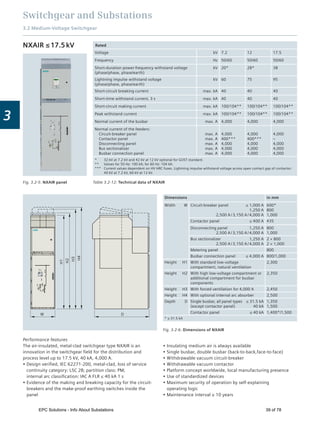
where it is needed – and it is safe, reliable and economical.
n-1 operating mode
n-1 criteria
With the respective design of a factory grid on the MV side as
well as on the LV side, the so-called n-1 criteria is fulfilled.
In case one component fails on the line side of the transformer
(e.g., circuit-breaker or transformer or cable to transformer) no
interruption of the supply on the LV side will occur (fig. 3.2-42).
Load required 5,000 kVA = 4 x 1,250 kVA. In case one load
center (SITRABLOC) is disconnected from the MV network, the
missing load will be supplied via the remaining three (n-1) load
centers. SITRABLOC is a combination of everything that present-
day technology has to offer. The GEAFOL® cast-resin trans-
formers are just one example of this.
Their output is 100 % load without fans plus reserves of up to
140 % with fans. The safety of operational staff is ensured –
even in the direct vicinity of the installation.
Another example is the SENTRON high-current busbar system.
It can be laid out in any arrangement, is easy to install and
conducts the current wherever you like – With almost no losses.
The most important thing, however, is the uniformity of SITRA-
BLOC throughout, regardless of the layout of the modules.
The technology at a glance
(table 3.2-26, fig. 3.2-44, next page)
SITRABLOC can cope with any requirements. Its features include:
A transformer cubicle with or without fans (AN/AF operation)
GEAFOL cast-resin transformers with make-proof earthing
switch – AN operation 1,250 kVA, AF operation 1,750 kVA
(fig. 3.2-43, next page)
External medium-voltage switchgear with fuse/switch-
disconnectors
Low-voltage circuit-breakers
Automatic reactive-power compensation: up to 500 kVAr
unrestricted, up to 300 kVAr restricted
The SENTRON high-current busbar system: connection to
high-current busbar systems from all directions
SIMATIC ET 200/PROFIBUS interface for central monitoring
system (if required).
LV busway
Tap-off unit with
HRC fuses
Consumer
distribution
incl. control
SITRABLOC
Fig. 3.2-40: Location sketch
Table 3.2-26: Technical data of SITRABLOC
Rated voltage 12 kV and 24 kV
Transformer rating AN/AF 1,250 kV A/1,750 kVA
Transformer operating mode 100 % AN up to 40 °C
140 % AF
Power factor correction up to 500 kVAr without reactors
up to 300 kVAr with reactors
Busway system 1,250 A; 1,600 A; 2,500 A
Degree of protection IP23 for transformer housing
IP43 for LV cubicles
Dimensions (min) (LxHxD) 3,600 mm x 2,560 mm x 1,400 mm
Weight approx. 6,000 kg
EPC Solutions - Info About Substations 55 of 78
Switchgear and Substations
3.2 Medium-Voltage Switchgear
3
Fig. 3.2-41: Capacitor Banks Fig. 3.2-43: Transformer and earthing switch, LV bloc
Personal safety
Reduced costs
Low system losses
Production
Circuit-breakers and
switch-disconnectors
with HV HRC fuses
t < 10 ms
Substation
Utilities substation
MMMMM
SITRABLOCSITRABLOCSITRABLOCSITRABLOC
M
How to understand this mode:
4 x 1,250 kVA
AN operating mode (100 %)
n-1 operating mode:
Normal operating mode:
3 x 1,750 kVA
AF operating mode (140 %)
Power distribution
Fig. 3.2-42: n-1 operating mode
EPC Solutions - Info About Substations 56 of 78
Switchgear and Substations
3.2 Medium-Voltage Switchgear
3
P P
12/24 kV
0.4 kV
Option
ET 200M
S7-400 S7-300 S5-155U
PROFIBUS DP
COROS OP
ET 200C Field devicesET 200B
PG/PC
PROFIBUS
SITRABLOC
Information distribution
Communications interface
GEAFOL transformer
with built-in
make-proof earthing switch
LV installation with circuit-
breakers and automatic
reactive-power compensation
LV busbar system
with sliding link
(e.g., SENTRON busways)
Fig. 3.2-44: SIMATIC ET 200/PROFIBUS interface for control monitoring system
EPC Solutions - Info About Substations 57 of 78
Switchgear and Substations
3
3.3 Low-Voltage Switchgear
3.3.1 Requirements to Electrical Power
Systems in Buildings
The efficiency of electrical power supply rises and falls with
qualified planning. Especially in the first stage of planning, the
finding of conceptual solutions, the planner can use his cre-
ativity for an input of new, innovative solutions and technolo-
gies. They serve as a basis for the overall solution which has
been economically and technically optimized in terms of the
supply task and related requirements.
The following stages of calculating and dimensioning circuits and
equipment are routine tasks which involve a great effort. They can
be worked off efficiently using modern dimensioning tools like
SIMARIS® design, so that there is more freedom left for the creative
planning stage of finding conceptual solutions (fig. 3.3-1).
When the focus is limited to power supply for infrastructure
projects, useful possibilities can be narrowed down. The fol-
lowing aspects should be taken into consideration when
designing electric power distribution systems:
Simplification of operational management by transparent,
simple power system structures
Low costs for power losses, e.g. by medium-voltage-side
power transmission to the load centers
High reliability of supply and operational safety of the
installations even in the event of individual equipment failures
(redundant supply, selectivity of the power system protection,
and high availability)
Easy adaptation to changing load and operational conditions
Low operating costs thanks to maintenance-friendly
equipment
Sufficient transmission capacity of equipment during normal
operation and also in the event of a fault, taking future
expansions into account
Good quality of the power supply, i.e. few voltage changes due
to load fluctuations with sufficient voltage symmetry and few
harmonic distortions in the voltage
Compliance with applicable standards and project-related
stipulations for special installations
Standards
To minimize technical risks and / or to protect persons involved in
handling electrotechnical components, essential planning rules
have been compiled in standards. Standards represent the state
of the art; they are the basis for evaluations and court decisions.
Technical standards are desired conditions stipulated by profes-
sional associations which are, however, made binding by legal
standards such as safety at work regulations. Furthermore, the
compliance with technical standards is crucial for any approval of
operator granted by authorities or insurance coverage. While
decades ago, standards were mainly drafted at a national level
and debated in regional committees, it has currently been
agreed that initiatives shall be submitted centrally (on the IEC
Fig. 3.3-1: Power system planning tasks
Concept finding:
– Analysis of the supply task
– Selection of the network
configuration
– Selection of the type
of power supply system
– Definition of the technical
features
Calculation:
– Energy balance
– Load flow (normal / fault)
– Short-circuit currents
(uncontrolled / controlled)
Dimensioning:
– Selection of equipment,
transformers, cables,
– Electrical data
– Dimensions etc.
setting data, etc.
Compilation of
boundary conditions
Influencing factors
level) and then be adopted as regional or national standards.
Only if the IEC is not interested in dealing with the matter of if
there are time constraints, a draft standard shall be prepared at
the regional level.
The interrelation of the different standardization levels is illus-
trated in table 3.3-1. A complete list of the IEC members and
further links can be obtained at www.iec.ch –> Members &
Experts –>List of Members (NC); http://www.iec.ch/dyn/
www/f?p=103:5:0.
Table 3.3-1: Representation of national and regional standards in
electrical engineering
Regional America
PAS
Europe
CENELEC
Australia Asia Africa
National USA: ANSI D: DIN VDE AUS: SA CN: SAC SA: SABS
CA: SCC I: CEI NZ: SNZ J: JISC
BR: COBEI F: UTE …
… GB: BS
ANSI American National Standards Institute
BS British Standards
CENELEC European Committee for Electrotechnical Standardization
(Comité Européen de Normalisation Electrotechnique)
CEI Comitato Ellettrotecnico Italiano Electrotechnical Committee Italy
COBEI Comitê Brasileiro de Eletricidade, Eletrônica, Iluminação e
Telecomunicações
DIN VDE Deutsche Industrie Norm Verband deutscher Elektrotechniker
(German Industry Standard, Association of German Electrical
Engineers)
JISC Japanese Industrial Standards Committee
PAS Pacific Area Standards
SA Standards Australia
SABS South African Bureau of Standards
SAC Standardisation Administration of China
SCC Standards Council of Canada
SNZ Standards New Zealand
UTE Union Technique de l’Electricité et de la Communication Technical
Association for Electrical Engineering & Communication
EPC Solutions - Info About Substations 58 of 78
Switchgear and Substations
3.3 Low-Voltage Switchgear
3
System Configurations
Table 3.3-2 and table 3.3-3 illustrate the technical aspects and
influencing factors that should be taken into account when
electrical power distribution systems are planned and network
components are dimensioned.
Simple radial system (spur line topology)
All consumers are centrally supplied from one power source.
Each connecting line has an unambiguous direction of energy
flow.
Radial system with changeover connection
as power reserve – partial load:
All consumers are centrally supplied from two to n power
sources. They are rated as such that each of it is capable of
supplying all consumers directly connected to the main power
distribution system (stand-alone operation with open
couplings). If one power source fails, the remaining sources of
supply can also supply some consumers connected to the
other power source. In this case, any other consumer must be
disconnected (load shedding).
Radial system with changeover connection
as power reserve – full load:
All consumers are centrally supplied from two to n power
sources (stand-alone operation with open couplings). They are
rated as such that, if one power source fails, the remaining
power sources are capable of additionally supplying all those
consumers normally supplied by this power source. No
consumer must be disconnected. In this case, we speak of
rating the power sources according to the (n–1) principle. With
three parallel power sources or more, other supply principles,
e.g. the (n–2) principle would also be possible. In this case,
these power sources will be rated as such that two out of three
transformers can fail without the continuous supply of all
consumers connected being affected.
Radial system in an interconnected grid
Individual radial networks in which the consumers connected
are centrally supplied by one power source are additionally
coupled electrically with other radial networks by means of
coupling connections. All couplings are normally closed.
Depending on the rating of the power sources in relation to the
total load connected, the application of the (n–1) principle,
(n–2) principle etc. can ensure continuous and faultless power
supply of all consumers by means of additional connecting lines.
The direction of energy flow through the coupling connections
may vary depending on the line of supply, which must be taken
into account for subsequent rating of switching/protective
devices, and above all for making protection settings.
Radial system with power distribution via busbars
In this special case of radial systems that can be operated in an
interconnected grid, busbar trunking systems are used instead
of cables.
In the coupling circuits, these busbar trunking systems are
either used for power transmission (from radial system A to
radial system B etc.) or power distribution to the respective
consumers.
Table 3.3-2: Exemplary quality rating dependent on the power system configuration
Quality criterion
LV-side system configurations
Simple radial
system
Radial system with changeover
connection as power reserve
Radial system in
an inter-
connected grid
Radial system
with power
distribution via
busbarsPartial load Full load
1 2 3 4 5 1 2 3 4 5 1 2 3 4 5 1 2 3 4 5 1 2 3 4 5
Low cost of investment
Low power losses
High reliability of supply
Great voltage stability
Easy operation
Easy and clear system protection
High adaptability
Low fire load
Rating: very good (1) to poor (5) fulfillment of a quality criterion
EPC Solutions - Info About Substations 59 of 78
Switchgear and Substations
3
Table 3.3-3: Exemplary quality rating dependent on the power supply system according to its type of connection to ground
Characteristics
TN-C TN-C/S TN-S IT system TT system
1 2 3 1 2 3 1 2 3 1 2 3 1 2 3
Low cost of investment
Little expense for system extensions
Any switchgear/protective technology
can be used
Ground fault detection can be
implemented
Fault currents and impedance conditions
in the system can be calculated
Stability of the grounding system
High degree of operational safety
High degree of protection
High degree of shock hazard protection
High degree of fire safety
Automatic disconnection for protection
purposes can be implemented
EMC-friendly
Equipment functions maintained in case
of 1st ground or enclosure fault
Fault localization during system
operation
Reduction of system downtimes by
controlled disconnection
1 = true 2 = conditionally true 3 = not true
Power Supply Systems according to the Type of Connection
to Ground
TN-C, TN-C/S, TN-S, IT and TT systems
The implementation of IT systems may be required by national
or international standards.
For parts of installations which have to meet particularly high
requirements regarding operational and human safety (e.g. in
medical rooms, such as the OT, intensive care or post-
anaesthesia care unit)
For installations erected and operated outdoors (e.g. in
mining, at cranes, garbage transfer stations and in the
chemical industry).
Depending on the power system and nominal system voltage
there may be different requirements regarding the
disconnection times to be met (protection of persons against
indirect contact with live parts by means of automatic
disconnection).
Power systems in which electromagnetic interference plays an
important part should preferably be configured as TN-S
systems immediately downstream of the point of supply. Later,
it will mean a comparatively high expense to turn existing
TN-C or TN-C/S systems into an EMC-compatible system.
The state of the art for TN systems is an EMC-compatible design
as TN-S system.
EPC Solutions - Info About Substations 60 of 78
Switchgear and Substations
3.3 Low-Voltage Switchgear
3
have effects on the neighboring higher-level or all lower-level
network sections (high testing expense, high planning risk).
Dimensioning principles
For each circuit, the dimensioning process comprises the
selection of one or more switching protective devices to be
used at the beginning or end of a connecting line, and the
selection of the connecting line itself (cable/line or busbar
connection) after considering the technical features of the
corresponding switching protective devices. For supply circuits
in particular, dimensioning also includes rating the power
sources.
The objectives of dimensioning may vary depending on the
circuit type. The dimensioning target of overload and short-cir-
cuit protection can be attained in correlation to the mounting
location of the protective equipment. Devices applied at the end
of a connecting line can ensure overload protection for this line
at best, not, however, short-circuit protection.
Circuit types
The basic dimensioning rules and standards listed in fig. 3.3-2
principally apply to all circuit types. In addition, there are specific
requirements for these circuit types that are explained in detail
below.
3.3.2 Dimensioning of Power
Distribution Systems
When the basic supply concept for the electricity supply system
has been established, it is necessary to dimension the electrical
power system.
Dimensioning means the sizing rating of all equipment and
components to be used in the power system.
The dimensioning target is to obtain a technically permissible
combination of switching protective devices and connecting
lines for each circuit in the power system.
Basic rules
In principle, circuit dimensioning should be performed in compli-
ance with the technical rules standards listed in
fig. 3.3-2.
Cross-circuit dimensioning
When selected network components and systems are matched,
an economically efficient overall system can be designed. This
cross-circuit matching of network components may bear any
degree of complexity, because subsequent modifications to
certain components, e.g., a switch or protective device, may
Selectivity static / dynamic
Overload protection
Short-circuit protection
Protection against electric shock
Voltage drop static / dynamic
IEC 60364-4-43 DIN VDE 0100-430
IEC 60364-4-43/
IEC 60364-5-54
IEC 60364-5-52
IEC 60038
IEC 60364-7-710
IEC 60364-7-718
IEC 60947-2
IEC 60898-1
DIN VDE 0100-430/
DIN VDE 0100-540
IEC 60364-4-41 DIN VDE 0100-410
DIN VDE 0100-520
VDE 0175
DIN VDE 0100-710
DIN VDE 0100-718
DIN EN 60947-2
DIN EN 60898-1
Fig. 3.3-2: Relevant standards for circuit dimensioning
EPC Solutions - Info About Substations 61 of 78
Switchgear and Substations
3.3 Low-Voltage Switchgear
3
Supply circuits
Particularly stringent requirements apply to the dimensioning of
supply circuits. This starts with the rating of the power sources.
Power sources are rated according to the maximum load current
to be expected for the power system, the desired amount of
reserve power, and the degree of supply reliability required in
case of a fault (overload short-circuit).
Load conditions in the entire power system are established by
taking the energy balance (in an “energy report”). Reserve power
and operational safety in the vicinity of the supply system are
usually established by building up appropriate redundancies, for
example, by doing the following:
Providing additional power sources (transformer, generator,
UPS).
Rating the power sources according to the failure principle;
n- or (n–1) principle: Applying the (n–1) principle means that
two out of three supply units are principally capable of
continually supplying the total load for the power system
without any trouble if the smallest power source fails.
Rating those power sources that can temporarily be operated
under overload (e.g., using vented transformers).
Independent of the load currents established, dimensioning of
any further component in a supply circuit is oriented to the
ratings of the power sources, the system operating modes
configured and all the related switching states in the vicinity of
the supply system.
As a rule, switching protective devices must be selected in such
a way that the planned performance maximum can be trans-
ferred. In addition, the different minimum/maximum short-cir-
cuit current conditions in the vicinity of the supply system,
which are dependent on the switching status, must be deter-
mined.
When connecting lines are rated (cable or busbar), appropriate
reduction factors must be taken into account; these factors
depend on the number of systems laid in parallel and the instal-
lation type.
When devices are rated, special attention should be paid to their
rated short-circuit breaking capacity. In addition, a high-quality
tripping unit with variable settings is preferred, because this
component is an important foundation for attaining the best
possible selectivity toward all upstream and downstream
devices.
Distribution circuit
Dimensioning of cable routes and devices follows the maximum
load currents to be expected at this distribution level.
As a rule
Ib max = ∑ installed capacity x simultaneity factor
Switching/protective device and connecting line are to be
matched with regard to overload and short-circuit protection.
In order to ensure overload protection, the standardized conven-
tional (non-)tripping currents referring to the devices in applica-
tion have to be observed. A verification based merely on the
rated device current or the setting value Ir would be insufficient.
Basic rules for ensuring overload protection:
Rated current rule
Non-adjustable protective equipment
Ib ≤ In ≤ Iz
The rated current In of the selected device must be between
the calculated maximum load current Ib and the maximum
permissible load current Iz of the selected transmission
medium (cable or busbar).
Adjustable protective equipment
Ib ≤ Ir ≤ Iz
The rated current Ir of the overload release must be between
the calculated maximum load current Ib and the maximum
permissible load current Iz of the selected transmission
medium (cable or busbar).
Tripping current rule
I2 ≤ 1.45 x Iz
The maximum permissible load current Iz of the selected trans-
mission medium (cable or busbar) must be above the conven-
tional tripping current I2-/1.45 of the selected device.
The test value I2 is standardized and varies according to the
type and characteristics of the protective equipment applied.
Basic rules for ensuring short-circuit protection:
Short-circuit energy
K2S2 ≥ I2t
(K = Material coefficient; S = Cross-section)
The amount of energy that is set free when a short-circuit
occurs – and up to the moment it is cleared automatically –
must be less than the energy that the transmission medium can
carry as a maximum or there will be irreparable damage. As a
standard, this basic rule applies in the time range up to max. 5 s.
Below 100 ms of short-circuit breaking time, the let-through
energy of the protective device (according to the equipment
manufacturer’s specification) must be taken into account.
Load
Start node
Transmission
medium
Target node
Supply
Connecting line between
distribution boards
Load feeders in final
circuits
Fig. 3.3-3: Schematic representation of the different circuit types
EPC Solutions - Info About Substations 62 of 78
Switchgear and Substations
3.3 Low-Voltage Switchgear
3
When devices with a tripping unit are used, observance of this
rule across the entire characteristic device curve must be verified.
A mere verification in the range of the maximum short-circuit
current applied (Ik max) is not always sufficient, in particular
when time-delayed releases are used.
Short-circuit time
ta (Ik min) ≤ 5 s
The resulting current-breaking time of the selected protective
equipment must ensure that the calculated minimum short-cir-
cuit current Ik min at the end of the transmission line or protected
line is automatically cleared within 5 s at the most.
Overload and short-circuit protection need not necessarily be
provided by one and the same device. If required, these two
protection targets may be realized by a device combination. The
use of separate switching protective devices could also be
considered, i.e., at the start and end of a cable route. As a rule,
devices applied at the end of a cable route can ensure overload
protection for that line only.
Final circuits
The method for coordinating overload and short-circuit protec-
tion is practically identical for distribution and final circuits.
Besides overload and short-circuit protection, the protection of
human life is also important for all circuits.
Protection against electric shock
ta (Ik1 min) ≤ ta perm
If a 1-phase fault to earth (Ik1 min) occurs, the resulting current
breaking time ta for the selected protective equipment must be
shorter than the maximum permissible breaking time ta perm that
is required for this circuit according to IEC 60364-4-41/
DIN VDE 0100-410 to ensure the protection of persons.
Because the required maximum current breaking time varies
according to the rated system voltage and the type of load
connected (stationary and non-stationary loads), protection
requirements regarding minimum breaking times ta perm may be
transferred from one load circuit to other circuits. Alternatively,
this protection target may also be achieved by observing a
maximum touch voltage.
Because final circuits are often characterized by long supply
lines, their dimensioning is often affected by the maximum
permissible voltage drop.
As far as the choice of switching protective devices is concerned,
it is important to bear in mind that long connecting lines are
characterized by high impedances, and thus strong attenuation
of the calculated short-circuit currents.
Depending on the system operating mode (coupling open,
coupling closed) and the medium of supply (transformer or
generator), the protective equipment and its settings must be
configured for the worst-case scenario for short-circuit currents.
In contrast to supply or distribution circuits, where the choice of
a high-quality tripping unit is considered very important, there
are no special requirements on the protective equipment of final
circuits regarding the degree of selectivity to be achieved. The
use of a tripping unit with LI characteristics is normally suffi-
cient.
Summary
Basically, the dimensioning process itself is easy to understand
and can be performed using simple means.
Its complexity lies in the procurement of the technical data on
products and systems required. This data can be found in various
technical standards and regulations as well as in numerous
product catalogs.
An important aspect in this context is the cross-circuit manipula-
tion of dimensioned components owing to their technical data.
One such aspect is the above mentioned inheritance of min-
imum current breaking times of the non-stationary load circuit
to other stationary load or distribution circuits.
Another aspect is the mutual impact of dimensioning and net-
work calculation (short-circuit), e.g., for the use of short-circuit
current-limiting devices.
In addition, the complexity of the matter increases, when dif-
ferent national standards or installation practices are to be taken
into account for dimensioning.
For reasons of risk minimization and time efficiency, a number
of engineering companies generally use advanced calculation
software, such as SIMARIS design, to perform dimensioning and
verification processes in electrical power systems.
EPC Solutions - Info About Substations 63 of 78
Switchgear and Substations
3.3 Low-Voltage Switchgear
3
3.3.3 Low-Voltage Switchgear
When developing a power distribution concept including
dimensioning of the systems and devices, its requirements and
feasibility have to be matched by the end user and the
manufacturer.
When selecting a low-voltage main distribution board (LVMD),
the prerequisite for its efficient sizing is knowledge of its use,
availability and future options for extension. The demands on
power distribution are extremely diverse. They start with build-
ings that do not place such high demands on the power supply,
such as office buildings, and continue through to the high
demands, for example, made by data centers, in which smooth
operation is of prime importance.
Because no major switching functions in the LVMD have to be
considered in the planning of power distribution systems in
commercial buildings and no further extensions are to be
expected, a performance-optimized technology with high com-
ponent density can be used. In these cases, mainly fuse-pro-
tected equipment in fixed-mounted design is used. When plan-
ning a power distribution system for a production plant,
however, system availability, extendibility, control and the
visualization are important functions to keep plant downtimes as
short as possible. The use of circuit-breaker protected and
fuse-protected withdrawable design is an important principle.
Selectivity is also of great importance for reliable power supply.
Between these two extremes there is a great design variety that
is to be optimally matched to customer requirements. The
prevention of personal injury and damage to equipment must,
however, be the first priority in all cases. When selecting appro-
priate switchgear, it must be ensured that it is a design verified
switchgear assembly (in compliance with IEC 61439-2, resp.
DIN EN 61439-2, VDE 0660-600-2) with extended testing of
behavior in the event of an accidental arc (IEC 61641, VDE 0660-
500, Addendum 2), and that the selection is always made in
light of the regulations governing the entire supply system (full
selectivity, partial selectivity).
Fig. 3.3-4: SIVACON S8 switchgear
EPC Solutions - Info About Substations 64 of 78
Switchgear and Substations
3.3 Low-Voltage Switchgear
3
Overview
The SIVACON S8 low-voltage switchgear (fig. 3.3-4) is a variable,
multi-purpose and design verified low-voltage switchgear
assembly that can be used for the infrastructure supply not only
in administrative and institutional buildings, but also in industry
and commerce. SIVACON S8 consists of standardized, modular
components that can be flexibly combined to form an economi-
cal, overall solution, depending on the specific requirements.
SIVACON S8 has a high level of functionality, flexibility and
quality, and has compact dimensions and a high degree of safety
for persons and equipment. Siemens or its authorized contract-
ing party will perform the following:
The customer-specific configuration
The mechanical and electrical installation
The testing, for which design verified function modules are
used
The authorized contracting party will use the specified docu-
mentation. SIVACON S8 can be used as a design verified power
distribution board system up to 7,000 A.
Standards and regulations
SIVACON S8 is a design verified low-voltage switchgear assembly in
compliance with IEC 61439-2, VDE 0660-600-2. SIVACON S8 is
resistant to accidental arcs, in compliance with IEC 61641,
VDE 0660-500, Addendum 2. SIVACON S8 is available in several
mounting designs (fig. 3.3-5).
Circuit-breaker design
The panels for installation of 3WL and 3VL circuit-breakers are
used for the supply of the switchgear and for outgoing feeders
and bus ties (bus sectionalizer and bus coupler). The rule that
only one circuit-breaker is used for each panel applies to the
entire circuit-breaker design (fig. 3.3-6).
The device mounting space is intended for the following functions:
Incoming/outgoing feeders with 3WL circuit-breakers in fixed-
mounted and withdrawable designs up to 6,300 A
Bus sectionalizer and bus coupler with 3WL circuit-breakers in
fixed-mounted and withdrawable designs up to 6,300 A
Incoming/outgoing feeders with 3VL circuit-breakers in fixed-
mounted design up to 1,600 A
Universal installation design
The panels for cable feeders in fixed-mounted and plug-in
designs up to 630 A are intended for the installation of the
following switchgear (fig. 3.3-7):
SIRIUS 3RV/3VL circuit-breaker
3K switch-disconnector
3NP switch-disconnector
3NJ6 switch-disconnector in plug-in design
The switching devices are mounted on mounting plates and
connected to the vertical current distribution bars on the supply
side. Plug-in 3NJ6 in-line switch-disconnectors can be installed
using an adapter. The front is covered by panel doors or com-
partment doors.
Plug-in 3NJ6 in-line switch-disconnector design
The panels for cable feeders in the plug-in design up to 630 A
are intended for the installation of in-line switch-disconnectors.
The plug-in contact on the supply side is a cost-effective alterna-
tive to the withdrawable design. The modular design of the
plug-ins enables an easy and quick retrofit or replacement under
operating conditions. The device mounting space is intended for
plug-in, in-line switch-disconnectors with a distance between
pole centers of 185 mm. The vertical plug-on bus system is
arranged at the back of the panel and is covered by an optional
touch protection with pick-off openings in the IP20 degree of
protection. This enables the in-line switch-disconnectors to be
replaced without shutting down the switchgear (fig. 3.3-8).
Fixed-mounted design with front covers
The panels for cable feeders in fixed-mounted design up to
630 A are intended for the installation of the following switch-
gear (fig. 3.3-9):
SIRIUS 3RV/3VL circuit-breaker
3K switch-disconnector
3NP switch-disconnector
Modular devices
1 2 3 4 5 6
Fig. 3.3-5: The following mounting designs are available:
(1) Circuit-breaker design with 3WL up to 6,300 A or 3VL up to 1,600 A
(2) Universal installation design for cable feeders up to 630 A
in fixed-mounted and plug-in designs (3NJ6)
(3) 3NJ6 in-line switch-disconnector design (plugged in)
for cable feeders up to 630 A in plug-in design
(4) Fixed-mounted panel (front cover) for cable feeders
up to 630 A and modular devices
(5) 3NJ4 in-line switch-disconnector design (fixed-mounted)
for cable feeders up to 630 A
(6) Reactive-power compensation up to 600 kvar
EPC Solutions - Info About Substations 65 of 78
Switchgear and Substations
3.3 Low-Voltage Switchgear
3
The switching devices are mounted on infinitely adjustable device
holders and connected to the vertical current distribution bars on
the supply side. The front of the panel has either covers (with or
without hinges) or additional doors (with or without a window).
Fixed-mounted 3NJ4 in-line switch-disconnector design
The panels for cable feeders in fixed-mounted design up to
630 A are intended for the installation of 3NJ4 in-line fuse
switch-disconnectors. With their compact design and modular
structure, in-line fuse switch-disconnectors offer optimal instal-
lation conditions with regard to the achievable packing density.
The busbar system is arranged horizontally at the back of the
panel. This busbar system is connected to the main busbar
system via cross-members. The in-line fuse switch-disconnectors
are screwed directly onto the busbar system (fig. 3.3-10).
Low-voltage main distribution
When selecting a low-voltage main distribution system, the
prerequisite for its efficient sizing is knowing about its use,
availability and future options for extension. The requirements
for power distribution are extremely diverse.
Normally, frequent switching operations need not be considered
in the planning of power distribution for commercial, institu-
tional and industrial building projects, and extensions are gener-
ally not to be expected. For these reasons, a performance-opti-
mized technology with high component density can be used. In
these cases, Siemens mainly uses circuit-breaker protected
equipment in fixed-mounted design. When planning a power
distribution system for a production plant, however, system
availability, extendibility, control and the visualization of status
information and control functions are important issues related to
keeping plant downtimes as short as possible. The use of circuit-
breaker protected technology in withdrawable design is impor-
tant. Selectivity is also of great importance for reliable power
supply. Between these two extremes there is a great design
variety that should be optimally matched to customer require-
ments. The prevention of personal injury and damage to equip-
ment must, however, be the first priority in any case. When
selecting appropriate switchgear, it must be ensured that it is a
design verified switchgear assembly (in compliance with
IEC 61439-2, VDE 0660-600-2), with extended testing of
behavior in the event of an internal arc fault (IEC 61641,
VDE 0660-500, Addendum 2).
Low-voltage main distribution systems should be chosen among
those featuring a total supply power up to 3 MVA. Up to this rating,
the equipment and distribution systems are relatively inexpensive
due to the maximum short-circuit currents to be encountered.
For rated currents up to 3,200 A, power distribution via busbars
is usually sufficient if the arrangement of the incoming/outgoing
feeder panels and coupler panels has been selected in a perfor-
mance-related way. Ambient air temperatures, load on individual
feeders and the maximum power loss per panel have a decisive
impact on the devices to be integrated and the number of panels
required, as well as their component density (number of devices
per panel).
Fig. 3.3-6: Circuit-breaker design
Fig. 3.3-8: Plug-in 3NJ6 in-line
switch-disconnector
design
Fig. 3.3-10: Fixed-mounted
3NJ4 in-line switch-
disconnector design
Fig. 3.3-7: Universal installation
design
Fig. 3.3-9: Fixed-mounted design
with front covers
EPC Solutions - Info About Substations 66 of 78
Switchgear and Substations
3.3 Low-Voltage Switchgear
3
3.3.4 Planning Notes for Low-Voltage
Switchgear
Installation – clearances and corridor widths
The minimum clearances between switchgear and obstacles
specified by the manufacturer must be taken into account when
installing low-voltage switchgear (fig. 3.3-11). The minimum
dimensions for operating and servicing corridors according to
IEC 60364-7-729 (DIN VDE 0100-729) must be taken into
account when planning the space requirements (table 3.3-4,
fig. 3.3-12, fig. 3.3-13).
Caution! If a lift truck is used to insert circuit-breakers or with-
drawable units, the minimum corridor widths must be adapted
to the lift truck!
Transportation units
Depending on the access routes available in the building, one or
more panels can be combined into transportation units (TU).
The max. length of a TU should not exceed 2,400 mm.
Table 3.3-4: SIVACON S8 switchgear dimensions
Space requirements
Height: 2,000 mm and 2,200 mm
(optionally with 100 mm or 200 mm base)
Width: For data required for the addition of panels please refer
to the panel descriptions
Depth:
Busbar
position
Rated
currentof
themain
busbar
Typeof
installation
Cable/
busbarentry
600 mm Rear 4,000 A Single front Top & bottom
800 mm Rear 7,010 A Single front Top & bottom
1,000 mm Rear 4,000 A Double front Top & bottom
1,200 mm Rear 7,010 A Double front Top & bottom
500 mm Top 3,270 A Single front Bottom
800 mm Top 3,270 A Single front Top & bottom
800 mm Top 6,300 A Single front Bottom
1,200 mm Top 6,300 A Single front Top & bottom
Fig. 3.3-12: Reduced corridor widths within the area of open doors
600600
20001)
700700700700
1) Minimum height of passage under covers or enclosures
Fig. 3.3-13: Minimum corridor width according to IEC 60364-7-729
(DIN VDE 0100-729)
Min. free passage
500 mm 1)
Escape
direction
Min. corridor width
700 or 600 mm
2)
1) With switchgear fronts facing each other, the space
requirements only account for obstruction by open doors
from one side (i.e. doors that don’t close in escape direction)
2) Take door widths into account,
i.e. door can be opened at 90 ° minimum
Full door opening angle = 125 ° (Sinus 55 °)
Fig. 3.3-11: Clearances to obstacles
B
C
B
A
Front
Front
Front
A: 100 mm from the rear side of the installation
B: 100 mm from the side side panels
C: 200 mm from the rear panels with back to back installation
EPC Solutions - Info About Substations 67 of 78
Switchgear and Substations
3.3 Low-Voltage Switchgear
3
Double-front installations
In the double-front installation, the panels are positioned in a
row next to and behind one another. The main advantage of a
double-front installation is the extremely economic design
through the supply of the branch circuits on both operating
panels from one main busbar system.
The "double-front unit" system structure is required for the
assignment of certain modules.
A double-front unit (fig. 3.3-14) consists of at least 2 and a
maximum of 4 panels. The width of the double-front unit is
determined by the widest panel (1) within the double-front unit.
This panel can be placed on the front or rear side of the double-
front unit. Up to three panels (2), (3), (4) can be placed on the
opposite side. The sum of the panel widths (2) to (4) must be
equal to the width of the widest panel (1). The panel combina-
tion within the double-front unit is possible for all technical
installations with the following exceptions.
Exceptions
The following panels determine the width of the double-front
unit and may only be combined with an empty panel.
Bus sectionalizer unit
5,000 A incoming / outgoing feeder
6,300 A incoming / outgoing feeder
Weights
The panel weights as listed in table 3.3-5 should be used for the
transportation and dimensioning of building structures such as
cable basements and false floors.
Fig. 3.3-14: Panel arrangement of double-front installations
(1)
(3)(2) (4)
Double-front units
Double-front installations – top view
Double-front installations only with main busbar system at the rear
Environmental conditions for switchgear
The climate and other external conditions (natural foreign
substances, chemically active pollutants, small animals) may
affect the switchgear to a varying extent. The effect depends on
the heating / air-conditioning systems of the switchgear room. If
higher concentrations are present, pollutant-reducing measures
are required, for example:
Air-intake for operating room from a less contaminated point
Slightly pressurizing the operating room (e.g. by blowing
uncontaminated air into the switchgear)
Switchgear room air conditioning (temperature reduction,
relative humidity < 60 %, if necessary, use air filters)
Reduction of temperature rise (oversizing of switchgear or
components such as busbars and distribution bars)
Power losses
The power losses listed in table 3.3-5 are approximate values for
a panel with the main circuit of functional units to determine the
power loss to be discharged from the switchgear room.
Table 3.3-5: Average weights of the panels including busbar (without cable)
Rated current [A]
Size
Minimum panel width
[mm]
Approx. weight
[kg]
Circuit-breaker design with 3WL
(withdrawable unit)
630–1,600 Size I 400 340
2,000–3,200 Size II 600 510
4,000 Size III 800 770
4,000–6,300 Size III 1,000 915
Universal mounting design panel
(incl. withdrawable units, fixed mounting with front doors)
1,000 400
3NJ4 in-line-type switch-disconnector panel (fixed mounting) 600 360
3NJ6 in-line-type switch-disconnector design panel (plugged) 1,000 415
Reactive power compensation panel 800 860
EPC Solutions - Info About Substations 68 of 78
Switchgear and Substations
3.3 Low-Voltage Switchgear
3
Table 3.3-6: Power loss generated per panel (average values)
Circuit-breaker type
Approx. Pv [W] for % of the rated current of the switch
100 % 80 %
Circuit-breaker design
with 3WL (withdrawable unit)
3WL1106 630 A Size I 215 140
3WL1108 800 A Size I 345 215
3WL1110 1,000 A Size I 540 345
3WL1112 1,250 A Size I 730 460
3WL1116 1,600 A Size I 1,000 640
3WL1220 2,000 A Size II 1,140 740
3WL1225 2,500 A Size II 1,890 1,210
3WL1232 3,200 A Size II 3,680 2,500
3WL1340 4,000 A Size III 4,260 2,720
3WL1350 5,000 A Size III 5,670 3,630
3WL1363 6,300 A Size III 8,150 5,220
Universal mounting design panel (incl. withdrawable units, fixed mounting with front doors) 600 W
3NJ4 in-line-type switch-disconnector panel (fixed mounting) 600 W
3NJ6 in-line-type switch-disconnector design panel (plugged) 1,500 W
Fixed-mounted type panel with front covers 600 W
Reactive power compensation panel non-choked
choked
1.4 W / kvar
6.0 W / kvar
Arc resistance
Arcing faults can be caused by incorrect dimensioning and
reductions in insulation due to contamination etc., but they can
also be a result of handling errors. The effects, resulting from
high pressure and extremely high temperatures, can have fatal
consequences for the operator, the system and even the
building. SIVACON offers effidence of personal safety through
testing under arcing fault conditions with a special test in accor-
dance with IEC 61641 (DIN VDE 0660-500 Addendum 2).
Active protection measures such as the high-quality insulation
of live parts (e.g. busbars), standardized and simple operation,
prevent arcing faults and the associated personal injuries. Passive
protections increase personal and system safety many times over.
These include: hinge and locking systems with arc resistance, the
safe operation of withdrawable units or circuit breakers behind a
closed door and patented swing check valves behind venitlation
openings on the front, arcing fault barriers or arcing fault detection
system combined with the rapid disconnection of arcing faults.
Fig. 3.3-15: The arcing fault levels describe the classiication in accrdance with the characteristics under arcing fault conditions and the
restriction of the eects of the arcing fault to the system or system section
Level 1
High level of
personal safety
without major
restriction of the
effects of arcing
within the power
distribution board.
Level 2
High level of
personal safety
with restriction of
the effects of
arcing on a single
section or double
fronted section.
Level 3
High level of
personal safety
with restriction to
main busbar
compartment in
single- or double
fronted section as
well as device or
cable connection
compartments.
Level 4
High personal
safety with
restriction of the
effects of arcing to
the site of origin.
EPC Solutions - Info About Substations 69 of 78
Switchgear and Substations
3.3 Low-Voltage Switchgear
3
3.3.5 Low-Voltage Switchgear – Example
Table 3.3-7: Various mounting designs according to panel types
Panel type Circuit-breaker
design
Universal
mounting design
3NJ6 in-line switch-
disconnector
design
Fixed-
mounted
design
3NJ4 in-line switch-
disconnector
design
Reactive power
compensation
Mounting design
Fixed mounting
Withdrawable-unit
design
Fixed mounting
Plug-in design
Withdrawable-unit
design
Plug-in design
Fixed-mounted
design with
front covers
Fixed mounting Fixed mounting
Function Incoming feeder
Outgoing feeder
Coupling
Cable feeders
Motor feeders
Cable feeders Cable feeders Cable feeders
Central
compensation of
the reactive power
Current In
Up to 6,300 A
Up to 630 A /
Up to 250 kW
Up to 630 A Up to 630 A Up to 630 A Up to 600 kvar
Connection Front and rear
side
Front and rear side Front side Front side Front side Front side
Panel width [mm] 400 / 600 / 800 /
1,000 / 1,400
600 / 1,000 / 1,200 1,000 / 1,200 1,000 / 1,200 600 / 800 800
Internal compart-
mentalization
1, 2b, 3a, 4b 4a, 3b, 4b 1, 3b, 4b
1, 2b, 3b, 4a,
4b
1, 2b 1, 2b
Busbars Rear / top Rear / top Rear / top Rear / top Rear Rear / top / without
Fig. 3.3-16: SIVACON S8, busbar position at rear 2,200 × 4,800 × 600 (H × W × D in mm)
Free space in the
fastening plane for
cable and busbar
penetration
D
Panel width
Panel depth
Boring 4 x Ø 14,8 mm
Threaded hole M12
Depth 800, 1000, 1200
(depth 800 only for
main busbar at top)
Installation front
Installation front
Circuit-
breaker
design
Universal
mounting
design
Plug-in 3NJ6 in-line
switch-disconnector
design
Fixed 3NJ4 in-line
switch-discon-
nector design
Reactive power
compensation
Fixed-mounting
with front cover
Boring 4 x Ø 14,8 mm
Threaded hole M12
W
Depth 500, 600, 800
(depth 800 only for
main busbar at rear)
W–150
W–100
W–150
W–100
D
D–50
D–50
D–350
D
W W
B
A
B
A
C B
A
D B
A
E B
A
F B
A
G B
A
H B
A
J B
A
K B
A
L B
A
M B
A
N B
A
P B
A
Q B
A
R B
A
S B
A
T B
A
U B
A
V
0
200
400
600
0
200
400
600
800
1000
1200
1400
1600
1800
2000
2200
4800
75
50
25
300
50
300
75
50
25
300
50
400 1000 1000 1000 600 800
EPC Solutions - Info About Substations 70 of 78
Switchgear and Substations
3.3 Low-Voltage Switchgear
3
3.3.6 Protective and Switching Devices
for the Low-Voltage Switchgear
In the TIP planning and application manuals are the basics for
the dimensioning of low-voltage main distribution boards and
main components described. The following focuses on the
relevant characteristics and selection criteria of the respective
devices that are used in the main power distribution circuits in
commercial buildings and in industry.
Note:
All figures apply for low-voltage power systems or distribution
boards in IEC applications. Different regulations and criteria
apply for systems according to UL standards.
If you have questions on UL applications, please contact your
local Siemens representative. We provide solutions for these
applications, but they must be treated completely differently.
Depending on the country, standard specifications, local
practices, planning engineer, technical threshold values, etc.,
low voltage power distribution systems are made up of various
protective devices.
Table 3.3-8: Overview of circuit-breaker-protected switchgear
Circuit-breaker-protected switchgear (circuit-breaker)
ACB Air Circuit-Breaker
– Air circuit-breaker
– Non-current-limiting circuit-breaker
– Current-zero cut-off circuit breaker
MCCB Molded-Case Circuit-Breaker
– Molded-case circuit-breaker
– Current-limiting circuit-breaker
MCB Miniature Circuit Breaker
– Miniature circuit-breaker
MSP Motor Starter Protector
MPCB Motor Protector Circuit-Breaker
– Circuit-breaker for motor protection
Table 3.3-9: Overview of fuse-protected switchgear
Fuse-protected switchgear
(fuse switch disconnector / switch disconnector
SD Switch disconnector
Depending on the type of operation,
these devices are divided into two
main groups:
Operator-dependent
– Without breaker latching
mechanism, with protection (fuse);
with these devices, the fuse is
also moved when making and breaking
(= fuse switch disconnector)
– With breaker latching mechanism,
with protection (fuse); with these devices,
the fuse is not moved when making and
breaking (= switch disconnector with fuse
Operator-independent
– With breaker latching mechanism,
without protection (without fuse);
these devices are only used to interrupt
the circuit, similar to a main switch
(= switch disconnector without fuse)
EPC Solutions - Info About Substations 71 of 78
Switchgear and Substations
3.3 Low-Voltage Switchgear
3
Fig. 3.3-17: Core functions of the protective devices in the individual
circuit types
MSP
ACB
MCCBACB SD
SDMCCB
M M M
Fuse-protected Circuit-breaker-protected
M
M
M M M
M
M M
6300 A
1600 A
630 A
Application
plants/motor/isolators
3-pole/4-pole
Fixed mounting / plug-in /
withdrawable-unit design
Rated current
ACB:
MCCB:
Fuse:
Short-circuit
breaking capacity
Release
Influences selectivity
and protection setting
Communication
and data transfer
1.
2.
3.
4.
5.
6.
7.
Circuits and Device Assignment
(see also section 3.3.2 “Dimensioning of Power Distribution
Systems”)
Basic configuration of a low-voltage power distribution
system and assignment of the protective devices including
core functions
Core functions in the respective circuits
Supply circuit
Task: System protection
Protective device
– ACB (air circuit-breaker)
Distribution circuit
Task: System protection
Protective devices:
– ACB (air circuit-breaker)
– MCCB (molded-case circuit-breaker)
– SD (switch disconnector)
Final circuit
Task: Motor protection
Protective devices:
– MCCB (circuit-breaker for motor protection)
– SD (switch disconnector)
– MSP (3RT contactor, 3RU overload relay, 3UF motor
protection and control devices
Criteria for Device Selection
A protective device is always part of a circuit and must satisfy
the corresponding requirements (see also section 3.3.2
“Dimensioning of Power Distribution Systems”). The most
important selection criteria are shown in the following.
Main selection criteria
Fig. 3.3-18 shows the seven most important selection criteria
that must be at least taken into account for the device selection.
Fig. 3.3-18: Main selection criteria
EPC Solutions - Info About Substations 72 of 78
Switchgear and Substations
3.3 Low-Voltage Switchgear
3
3.3.7 Requirements on the Switchgear
in the Three Circuit Types
Device Application in the Supply Circuit
The system infeed is the most “sensitive” circuit in the entire
power distribution. A failure here would result in the entire
network and therefore the building or production being without
power. This worst-case scenario must be considered during the
planning. Redundant system supplies and selective protection
setting are important preconditions for a safe network configu-
ration. The selection of the correct protective devices is there-
fore of elementary importance in order to create these precondi-
tions. Some of the key dimensioning data is addressed in the
following.
Rated current
The feeder circuit-breaker in the LVMD must be dimensioned for
the maximum load of the transformer/generator. When using
ventilated transformers, the higher operating current of up to
1.5 x IN of the transformer must be taken into account.
Short-circuit strength
The short-circuit strength of the feeder circuit-breaker is deter-
mined by (n–1) x Ik max of the transformer or transformers (n =
number of transformers). This means that the maximum short-
circuit current that occurs at the installation position must be
known in order to specify the appropriate short-circuit strength
of the protective device (Icu). Exact short-circuit current calcula-
tions including attenuations of the medium-voltage levels or the
laid cables can be made, for example, with the aid of the
SIMARIS design dimensioning software. SIMARIS design deter-
mines the maximum and minimum short-circuit currents and
automatically dimensions the correct protective devices
Utilization category
When dimensioning a selective network, time grading of the
protective devices is essential. When using time grading up to
500 ms, the selected circuit-breaker must be able to carry the
short-circuit current that occurs for the set time. Close to the
transformer, the currents are very high. This current carrying
capacity is specified by the Icw value (rated short-time withstand
current) of the circuit-breaker; this means the contact system
must be able to carry the maximum short-circuit current, i.e. the
energy contained therein, until the circuit-breaker is tripped.
This requirement is satisfied by circuit-breakers of utilization
category B (e.g. air circuit-breakers, ACB). Current-limiting circuit
breakers (molded-case circuit breakers, MCCB) trip during the
current rise. They can therefore be constructed more compactly.
Release
For a selective network design, the release (trip unit) of the
feeder circuit-breaker must have an LSI characteristic. It must be
possible to deactivate the instantaneous release (I). Depending
on the curve characteristic of the upstream and downstream
protective devices, the characteristics of the feeder circuit-
breaker in the overload range (L) and also in the time-lag short-
circuit range (S) should be optionally switchable (I4t or I2t
characteristic curve). This facilitates the adaptation of upstream
and downstream devices.
Internal accessories
Depending on the respective control, not only shunt releases
(previously: f releases), but also undervoltage releases are
required.
Communication
Information about the current operating states, maintenance,
error messages and analyses, etc. is being increasingly required,
especially from the very sensitive supply circuits. Flexibility may
be required with regard to a later upgrade or retrofit to the
desired type of data transmission.
Device Application in Supply Circuits (Coupling)
If the coupling (connection of Network 1 to Network 2) is oper-
ated open, the circuit-breaker (tie breaker) only has the function
of an isolator or main switch. A protective function (release) is
not absolutely necessary.
The following considerations apply to closed operation:
Rated current
Must be dimensioned for the maximum possible operating
current (load compensation). The simultaneity factor can be
assumed to be 0.9.
Short-circuit strength
The short-circuit strength of the feeder circuit-breaker is deter-
mined by the sum of the short-circuit components that flow
through the coupling. This depends on the configuration of the
component busbars and their supply.
Utilization category
As for the system supply, utilization category B is also required
for the current carrying capacity (Icw value).
Release
Partial shutdown with the couplings must be taken into consid-
eration for the supply reliability. As the coupling and the feeder
circuit-breakers have the same current components when a fault
occurs, similar to the parallel operation of two transformers, the
LSI characteristic is required. The special “Zone Selective Inter-
locking (ZSI)” function should be used for larger networks and/or
protection settings that are difficult to determine.
Device Application in the Distribution Circuit
The distribution circuit receives power from the higher level
(supply circuit) and feeds it to the next distribution level (final
circuit).
Depending on the country, local practices, etc., circuit-breakers
and fuses can be used for system protection; in principle, all
protective devices described in this chapter.
The specifications for the circuit dimensioning must be fulfilled.
The ACB has advantages if full selectivity is required. However
for cost reasons, the ACB is only frequently used in the distribu-
EPC Solutions - Info About Substations 73 of 78
Switchgear and Substations
3.3 Low-Voltage Switchgear
3
tion circuit as of a rated current of 630 A or 800 A. As the ACB is
not a current-limiting device, it differs greatly from other protec-
tive devices such as MCCB, MCB and fuses.
As no clear recommendations can otherwise be given,
Table 3.3-10 shows the major differences and limits of the
respective protective devices.
Device Application in the Final Circuit
The final circuit receives power from the distribution circuit and
supplies it to the consumer (e.g. motor, lamp, non-stationary
load (power outlet), etc.). The protective device must satisfy
the requirements of the consumer to be protected by it.
Note:
All protection settings, comparison of characteristic curves, etc.
always start with the load. This means that no protective devices
are required with adjustable time grading in the final circuit
Table 3.3-10: Overview of the protective devices; *) with ETU: No limitation / with TMTU: depends on cable length
ACB air
circuit-
breaker
MCCB
molded-
case circuit-
breaker
Fuse switch
disconnec-
tor
Switch dis-
connector
with fuses
MCB minia-
ture circuit-
breaker
Reference values,
specifications
Standards IEC Yes Yes Yes Yes Yes Region
Application System
protection
Yes Yes Yes Yes Yes Power supply system
Installation Fixed mounting Yes Yes Yes Yes Yes Availability
Plug-in – up to 800 A – Partly –
Withdrawable
unit
Yes Yes – – –
Rated current In 6,300 A 1,600 A 630 A 630 A 125 A Operating current IB
Short-circuit breaking
capacity
Icu up to
150 kA
up to
100 kA
up to
120 kA
up to
120 kA
up to 25 kA Maximum short-circuit
current Ik max
Current carrying capacity Icw up to 80 kA up to 5 kA – – – Circuit
Number of poles 3-pole Yes Yes Yes Yes Yes Power supply system
4-pole Yes Yes – Partly –
Tripping characteristic ETU Yes Yes – – – Power supply system
TM – up to 630 A Yes Yes Yes
Tripping function LI Yes Yes Yes* Yes* Yes Power supply system
LSI Yes Yes – – –
N Yes Yes – – –
G Yes Yes – – –
Characteristics Fixed – Yes Yes Yes Yes Power supply system
Adjustable Yes Yes – – –
Optional Yes Yes – – –
Protection against
electric shock, tripping
condition
Detection of Ik min No
limitation
No
limitation *)
Depends on
cable length
Depends on
cable length
Depends on
cable length
Minimum short-circuit
current Ik min
Communication (data
transmission)
High Yes – – – – Customer specification
Medium Yes Yes – – –
Low Yes Yes Yes Yes Yes
Activation Local Yes Yes Yes Yes Yes Customer
specifications
Remote (motor) Yes Yes – Partly –
Derating Full rated current
up to
60 ºC 50 ºC 30 ºC 30 ºC 30 ºC Switchgear
System synchronization Yes up to 800 A – – – Power supply system
EPC Solutions - Info About Substations 74 of 78
Switchgear and Substations
3.3 Low-Voltage Switchgear
3
3.3.8 Busbar Trunking Systems
General
When a planning concept for power supply is developed, it is not
only imperative to observe standards and regulations, it is also
important to discuss and clarify economic and technical interre-
lations. The rating and selection of electric equipment, such as
distribution boards and transformers, must be performed in such
a way that an optimum result for the power system as a whole is
kept in mind rather than focusing on individual components.
All components must be sufficiently rated to withstand normal
operating conditions as well as fault conditions. Further
important aspects to be considered for the creation of an energy
concept are:
Type, use and shape of the building (e.g. high-rise building,
low-rise building, multi-storey building)
Load centers and possible power transmission routes and
locations for transformers and main distribution boards
Building-related connection values according to specific area
loads that correspond to the building’s type of use
Statutory provisions and conditions imposed by building
authorities
Requirements of the power distribution network operator
The result will never be a single solution. Several options must
be assessed in terms of their technical and economic impacts.
The following requirements are the main points of interest:
Easy and transparent planning
Long service life
High availability
Low fire load
Flexible adaptation to changes in the building
Most applications suggest the use of suitable busbar trunking
systems to meet these requirements. For this reason, engi-
neering companies increasingly prefer busbar trunking to cable
installation for power transmission and distribution. Siemens
offers busbar trunking systems ranging from 25 A to 6,300 A.
Planning Notes
Considering the complexity of modern building projects,
transparency and flexibility of power distribution are indispens-
able requirements. In industry, the focus is on continuous supply
of energy as an essential prerequisite for multi-shift production.
Busbar trunking systems meet all these requirements on efficient
power distribution by being easily planned, quickly installed and
providing a high degree of flexibility and safety. The advantages
of busbar trunking systems are:
Straightforward network configuration
Low space requirements
Easy retrofitting in case of changes of locations and consumer
loads
High short-circuit strength and low fire load
Increased planning security
Power transmission
Power from the transformer to the low-voltage switchgear is
transmitted by suitable components in the busbar trunking
system. These components are installed between transformer
and main distribution board, then branching to sub-distribution
systems.
Trunking units without tap-off points are used for power trans-
mission. These are available in standard lengths. Besides the
standard lengths, the customer can also choose a specific length
from various length ranges to suit individual constructive
requirements.
Power distribution
Power distribution is the main area of application for busbar
trunking systems. This means that electricity cannot just be
tapped from a permanently fixed point as with a cable installa-
tion. Tapping points can be varied and changed as desired within
the entire power distribution system.
In order to tap electricity, you just have plug a tap-off unit on the
busbar at the tap-off point. This way a variable distribution
system is created for linear and / or area-wide, distributed power
supply. Tap-off points are provided on either or just one side on
the straight trunking units.
For each busbar trunking system, a wide range of tap-off units is
available for the connection of equipment and electricity supply.
EPC Solutions - Info About Substations 75 of 78
Switchgear and Substations
3.3 Low-Voltage Switchgear
3
Table 3.3-11: Cable / busbar comparison
Characteristic Cable Busbar
Planning, calculation High determination and calculation expense, the
consumer locations must be fixed
Flexible consumer locations, only the total load is
required for the planning
Expansions, changes High expense, interruptions to operation, calculation,
risk of damage to the insulation
Low expense as the tap-off units are hot pluggable
Space requirements More space required because of bending radiuses and
the spacing required between parallel cables
Compact directional changes and fittings
Temperature responses
and derating
Limits depend on the laying method and cable
accumulation. The derating factor must be
determined / calculated
Design verified switchgear assembly, limits from
catalog
Free from halogen PVC cables are not free from halogen; halogen-free
cable is very expensive
Principally free from halogen
Fire load Fire load with PVC cable is up to 10 times greater, with
PE cable up to 30 times greater than with busbars
Very low, see catalog
Design verified switchgear assembly The operational safety depends on the version Tested system, non-interchangeable assembly
Benefits
System CD-K up to 40 A
The versatile busbar trunking system for area-wide power
distribution to lighting systems:
Versatile thanks to high degree of protection IP55
Lower planning costs through simple configuration
Quick-release plug-in connection for fast assembly
Variable changes of direction
Optimum utilization of the busbar line through tap-off points
fitted to both sides
Uniform current loading of the conductors through splitting of
the tap-off plugs among the individual phases
Tap-off plugs allow fast and flexible load relocation
Transmission of the KNX, DALI protocol for intelligent lighting
control directly via the busbar
System BD01 up to 160 A
The busbar trunking system for power distribution in trade and
commerce:
High degree of protection up to IP55
Flexible power supply
Easy and fast planning
Time-saving installation
Reliable mechanical and electrical cables and connections
High stability, low weight
Small number of basic modules
Modular system reduces stock-keeping
Variable changes of direction
Multi-purpose tap-off units
Forced opening and closing of the tap-off point
System BD2 up to 1,250 A
The busbar trunking system for power distribution in the
aggressive industrial environment:
High degree of protection up to IP55
Easy and fast planning
Time-saving and economic installation
Safe and reliable operation
Flexible, modular system providing simple solutions for every
application
Fig. 3.3-19: Comparison of temperature response and derating
120
80
60
40
10 20 30 40 50 60 65554535252515
I =100
I[%]
140
e
e
Ambient temperature [°C]
Busbar
Cable
Fig. 3.3-20: Comparison of fire load at a rated current of 2,000 A
kWh/m
10
20
30
50
40
60
70
0
Depending on
type 10 to 30
times higher
(For example
System LDC)
7 × 3 × 185/95
9 × 3 × 120/70
PE/EPR
(halogen-free)
7 × 3 × 185/95
9 × 3 × 120/70
2–4 × PVC
EPC Solutions - Info About Substations 76 of 78
Switchgear and Substations
3.3 Low-Voltage Switchgear
3
Advance power distribution planning without precise
knowledge of device locations
Ready to use in no time thanks to fast and easy installation
Innovative construction: expansion units to compensate for
expansion are eliminated.
Tap-off units and tap-off points can be coded at the factory
Uniformly sealable
System LD up to 5,000 A
The perfect busbar trunking system for power distribution in
industrial environments:
High degree of protection up to IP54
Easy and rapid installation
Safe and reliable operation
Space-saving, compact design, up to 5,000 A in one casing
Load feeders up to 1,250 A
Design verified connection to distribution board and
transformers
System LX up to 6,300 A
The busbar trunking system for power transmission and
distribution in buildings:
High degree of protection up to IP55
Easy and rapid installation
Safe and reliable operation
Load feeders up to 1,250 A
Design verified connection to distribution board and
transformers
System LR up to 6,150 A
The busbar trunking system for power transmission under
extreme ambient conditions (IP68):
Reliable and safe operation
Quick and easy installation
Cast resin system up to 6,150 A
Safe connection to distribution boards and transformers
High degree of protection IP68 for outdoor applications
Communication-capable busbar trunking system
Communication-capable functional extensions to be combined
with known tap-off units:
For use with the systems BD01, BD2, LD and LX
Applications:
– Large-scale lighting control
– Remote switching and signaling in industrial environments
– Consumption metering of distributed load feeders
Interfacing to KNX / EIB, AS-Interface and PROFIBUS bus
systems
Easy contacting of the bus line with insulation displacement
method
Easy and fast planning
Flexible for extension and modification
Modular system
Retrofitting to existing installations possible
Further information
Busbar trunking system selection guide (MobileSpice)
You can order busbar trunking systems up to 1,250 A with the
selection guide.
The following configurators are available:
SIVACON 8PS system CD-K, 25 … 40 A
SIVACON 8PS system BD01, 40 … 160 A
SIVACON 8PS system BD2, 160 … 1,250 A
This selection guide is available via the Industry Mall
(www.siemens.com/industrymall) and contained on DVD in
Catalog CA 01. This DVD is available free-of-charge from your
Siemens sales office.
Manual
Busbar trunking system SIVACON 8PS –
Planning with SIVACON 8PS
German: Order no. A5E 01541017-02
English: Order no. A5E 01541117-02
Brochure
So that energy flows safely– SIVACON 8PS busbar trunking
systems
German: Order no. E10003-E38-9B-D0010
English: Order no. E10003-E38-9B-D0010-7600
EPC Solutions - Info About Substations 77 of 78
Switchgear and Substations
3.3 Low-Voltage Switchgear
3
1
0
D
B
D
B
B
K-
1
0
-
1
0
D
B
B
K
CD-K system
BD01 system
BD2 system
LD system
LX system
LR system
Communication-capable busbar trunking systems
4
7
7
7
5
3
2
1
6
7
1
2
3
4
5
6
7
Fig. 3.3-21: Overview of busbar trunking systems
EPC Solutions - Info About Substations 78 of 78

EPC Solutions - All About Substation

  • 1.
    EPC Solutions -Info About Substations 1 of 78
  • 2.
    3 Switchgear and Substations 3.1High-Voltage Substations 66 3.1.1 Turnkey Substations 66 3.1.2 High-Voltage Switchgear – Overview 67 3.1.3 Circuit Configuration 68 3.1.4 Air-Insulated Substations 71 3.1.5 Mixed Technology (Compact/Hybrid Solutions) 79 3.1.6 Gas-Insulated Switchgear for Substations 83 3.2 Medium-Voltage Switchgear 94 3.2.1 Introduction 94 3.2.2 Basics of Switching Devices 95 3.2.3 Requirements of Medium-Voltage Switchgear 98 3.2.4 Medium-Voltage Switchgear 100 3.2.5 High-Current and Generator Switchgear 115 3.2.6 Industrial Load Center Substation 117 3.3 Low-Voltage Switchgear 121 3.3.1 Requirements to Electrical Power Systems in Buildings 121 3.3.2 Dimensioning of Power Distribution Systems 124 3.3.3 Low-Voltage Switchgear 127 3.3.4 Planning Notes for Low-Voltage Switchgear 130 3.3.5 Low-Voltage Switchgear – Example 133 3.3.6 Protective and Switching Devices for the Low-Voltage Switchgear 134 3.3.7 Requirements on the Switchgear in the Three Circuit Types 136 3.3.8 Busbar Trunking Systems 138 EPC Solutions - Info About Substations 2 of 78
  • 3.
    3 3.1 High-Voltage Substations 3.1.1Turnkey Substations Introduction High-voltage substations are interconnection points within the power transmission and distribution systems between regions and countries. Different applications of substations lead to high-voltage substations with and without power transformers: Step up from a generator-voltage level to a high-voltage system (MV/HV) – Power plants (in load centers) – Renewable power plants (e.g., windfarms) Transform voltage levels within the high-voltage system (HV/HV) Step down to a medium-voltage level of a distribution system (HV/MV) Interconnection in the same voltage level. Scope High-voltage substations comprise not only the high-voltage equipment which is relevant for the functionality in the power supply system. Siemens plans and constructs high-voltage substations comprising high-voltage switchgear, medium- voltage switchgear, major components such as high-voltage equipment and transformers, as well as all ancillary equipment such as auxiliaries, control systems, protective equipment and so on, on a turnkey basis or even as general contractor. The instal- lations supplied worldwide range from basic substations with a single busbar to interconnection substations with multiple busbars, or a breaker-and-a-half arrangement for rated voltages up to 800 kV, rated currents up to 8,000 A and short-circuit currents up to 100 kA. The services offered range from system planning to commissioning and after-sales service, including training of customer personnel. Project management The process of handling such a turnkey installation starts with preparation of a quotation, and proceeds through clarification of the order, design, manufacture, supply and cost-accounting until the project is finally billed. Processing such an order hinges on methodical data processing that in turn contributes to system- atic project handling. Engineering All these high-voltage installations have in common their high standard of engineering which covers all system aspects such as power systems, steel structures, civil engineering, fire precau- tions, environmental protection and control systems (fig. 3.1-1). Every aspect of technology and each work stage is handled by experienced engineers. With the aid of high-performance com- puter programs, e.g., the finite element method (FEM), installa- tions can be reliably designed even for extreme stresses, such as those encountered in earthquake zones. 3 Switchgear and Substations All planning documentation is produced on modern CAD/CAE systems; data exchange with other CAD systems is possible via interfaces. By virtue of their active involvement in national and international associations and standardization bodies, our engineers are always fully informed of the state of the art, even before a new standard or specification is published. Certification of the integrated quality management system At the beginning of the 1980s, a documented QM system was already introduced. The basis of the management system is the documentation of all processes relevant for quality, occupational safety and environmental protection. The environment protection was implemented on the basis of the existing QM system and was certified in accordance with DIN ISO 14001 in 1996. Occupational safety and health have always played an important role for Siemens AG and for the respective Business Units. When the BS OHSAS 18001 standard was intro- duced, the conditions for a certification analogous to the existing management systems were created. Know-how, experience and worldwide presence A worldwide network of liaisons and sales offices, along with the specialist departments in Germany, support and advise system operators in all matters of high-voltage substations technology. Fig. 3.1-1: Engineering of high-voltage switchgear Ancillary equipment Civil Engineering Buildings, roads, foundations Structural Steelwork Gantries and substructures Major Components e.g., HV/MV switchgear, HV devices, transformer Substation Control Control and monitoring, measurement, protection, etc. AC/DC auxiliaries Surge diverters Earthing system Powercables Controlandsignalcables Carrier-frequ. equipment Ventilation Lightning Environmental protection Fire protection Design EPC Solutions - Info About Substations 3 of 78
  • 4.
    Switchgear and Substations 3.1High-Voltage Substations 3 3.1.2 High-Voltage Switchgear – Overview High-voltage substations comprising high-voltage switchgear and devices with different insulating systems, air or gas (SF6). When planning high-voltage substations, some basic questions have to be answered to define the type of high-voltage switch- gear: What is the function and location within the power supply system? What are the climatic and environmental conditions? Are there specific requirements regarding locations? Are there space/cost restrictions? Depending on the answers, either AIS or GIS can be the right choice, or even a compact or hybrid solution. Air-insulated switchgear (AIS) AIS are favorably priced high-voltage substations for rated voltages up to 800 kV, which are popular wherever space restric- tions and environmental circumstances are not severe. The individual electrical and mechanical components of an AIS instal- lation are assembled on site. Air-insulated outdoor substations of open design are not completely safe to touch, and are directly exposed to the effects of the climate and the environment (fig. 3.1-2). Gas-insulated switchgear (GIS) The compact design and small dimensions of GIS make it pos- sible to install substations of up to 550 kV right in the middle of load centers of urban or industrial areas. Each switchgear bay is factory-assembled and includes the full complement of discon- necting switches, earthing switches (regular or make-proof), instrument transformers, control and protection equipment, and interlocking and monitoring facilities commonly used for this type of installation. The earthed metal enclosures of GIS assure not only insensitivity to contamination but also safety from electric shock (fig. 3.1-3). Mixed technology (compact/hybrid solutions) Beside the two basic (conventional) designs, there are also compact solutions available that can be realized with air-insu- lated and/or gas-insulated components. Fig. 3.1-3: GIS substations in metropolitan areas Fig. 3.1-2: Air-insulated outdoor switchgear EPC Solutions - Info About Substations 4 of 78
  • 5.
    Switchgear and Substations 3.1High-Voltage Substations 3 3.1.3 Circuit Configuration High-voltage substations are points in the power system where power can be pooled from generating sources, distributed and transformed, and delivered to the load points. Substations are interconnected with each other, so that the power system becomes a meshed network. This increases reliability of the power supply system by providing alternate paths for flow of power to take care of any contingency, so that power delivery to the loads is maintained and the generators do not face any outage. The high-voltage substation is a critical component in the power system, and the reliability of the power system depends upon the substation. Therefore, the circuit configura- tion of the high-voltage substation has to be selected carefully. Busbars are the part of the substation where all the power is concentrated from the incoming feeders, and distributed to the outgoing feeders. That means that the reliability of any high- voltage substation depends on the reliability of the busbars present in the power system. An outage of any busbar can have dramatic effects on the power system. An outage of a busbar leads to the outage of the transmission lines connected to it. As a result, the power flow shifts to the surviving healthy lines that are now carrying more power than they are capable of. This leads to tripping of these lines, and the cascading effect goes on until there is a blackout or similar situation. The importance of busbar reliability should be kept in mind when taking a look at the different busbar systems that are prevalent. Single-busbar scheme (1 BB) The applications of this simple scheme are distribution and transformer substations, and feeding industrial areas (fig. 3.1-4). Because it has only one busbar and the minimum amount of equipment, this scheme is a low-cost solution that provides only limited availability. In the event of a busbar failure and during maintenance periods, there will be an outage of the complete substation. To increase the reliability, a second busbar has to be added. Double-busbar scheme (2 BB) The more complex scheme of a double-busbar system gives much more flexibility and reliability during operation of the substation (fig. 3.1-5). For this reason, this scheme is used for distribution and transformer substations at the nodes of the power supply system. It is possible to control the power flow by using the busbars independently, and by switching a feeder from one busbar to the other. Because the busbar disconnectors are not able to break the rated current of the feeder, there will be a short disruption in power flow. Fig. 3.1-4: Special single busbar, H-scheme (1 BB) Fig. 3.1-5: Double-busbar scheme (2 BB) EPC Solutions - Info About Substations 5 of 78
  • 6.
    Switchgear and Substations 3.1High-Voltage Substations 3 Fig. 3.1-6: Double circuit-breaker scheme (2 CB) Fig. 3.1-7: One-breaker-and-a-half scheme (1.5 CB) Double circuit-breaker scheme (2 CB) To have a load change without disruption, a second circuit- breaker per feeder has to be used. This is the most expensive way to solve this problem. In very important feeders, the 2 CB solution will be used (fig. 3.1-6). One-breaker-and-a-half scheme (1.5 CB) The one-breaker-and-a-half is a compromise between the 2 BB and the 2 CB scheme. This scheme improves the reliability and flexibility because, even in case of loss of a complete busbar, there is no disruption in the power supply of the feeders (fig. 3.1-7). EPC Solutions - Info About Substations 6 of 78
  • 7.
    Switchgear and Substations 3.1High-Voltage Substations 3 Fig. 3.1-8: 3-phase busbar scheme (3 BB) 3-phase busbar scheme (3 BB) For important substations at the nodes of transmission systems for higher voltage levels, the 3-phase busbar scheme is used. It is a common scheme in Germany, utilized at the 380 kV level (fig. 3.1-8). EPC Solutions - Info About Substations 7 of 78
  • 8.
    Switchgear and Substations 3.1High-Voltage Substations 3 Variables affecting switchgear installation The switchyard design is significantly influenced by: Minimum clearances (depending on rated voltages) between various active parts and between active parts and earth Rated and short-circuit currents Clarity for operating staff Availability during maintenance work; redundancy Availability of land and topography Type and arrangement of the busbar disconnectors. The design of a substation determines its accessibility, availability and clarity. It must therefore be coordinated in close cooperation with the system operator. The following basic principles apply: Accessibility and availability increase with the number of busbars. At the same time, however, clarity decreases. Installations involving single busbars require minimum investment, but they offer only limited flexibility for operation management and maintenance. Designs involving one-breaker-and-a-half and double-circuit-breaker arrangements ensure a high redundancy, but they also entail the highest costs. Systems with auxiliary or bypass busbars have proved to be economical. The circuit-breaker of the coupling feeder for the auxiliary bus allows uninterrupted replacement of each feeder circuit-breaker. For busbars and feeder lines, mostly standard aluminum conductors are used. Bundle conductors are required where currents are high. Because of the additional short-circuit forces between the subconductors (the pinch effect), however, bundle conductors cause higher mechanical stresses at the terminal points. When conductors (particularly standard bundle conductors) are used, higher short-circuit currents cause a rise not only in the aforementioned pinch effect, also in further force maxima in the event of swinging and dropping of the conductor bundle (cable pull). This in turn results in higher mechanical stresses on the switchyard components. These effects can be calculated in an FEM (finite element method) simulation (fig. 3.1-9). 3.1.4 Air-Insulated Substations In outdoor installations of open design, all live parts are insu- lated by air and not covered. Therefore, air-insulated substa- tions (AIS) are always set up in a fenced area. Only authorized personnel have access to this operational area. Relevant national and international specifications that apply to outdoor substations and equipment have to be considered. The IEC 61936 standard is valid for European countries. Insulation coordination, including minimum phase-to-phase and phase-to- earth clearances, is effected in accordance with IEC 60071. Outdoor switchgear is directly exposed to the effects of the environmental conditions. Therefore, they have to be designed both for electrical and environmental specifications. There is currently no common international standard covering the setup of air-insulated outdoor substations of open design. Siemens designs AIS in accordance with IEC standards, in addition to national standards or customer specifications. The standard IEC 61936-1, “Erection of power installations with rated voltages above 1 kV,” demonstrates the typical protective measures and stresses that have to be taken into consideration for air-insulated switchyards. Protective measures The protective measures can be categorized as personal protection and functional protection of substations (S/S). Personal protection – Protective measures against direct contact, i. e., through appropriate covering, obstruction, through sufficient clearance, appropriately positioned protective devices, and minimum height – Protective measures against indirect touching by means of relevant earthing measures in accordance with IEC 61936/ DIN VDE 0101 or other required standards – Protective measures during work on equipment, i.e., installation must be planned so that the specifications of DIN EN 50110 (VDE 0105) (e.g., five safety rules) are observed Functional protection – Protective measures during operation, e.g., use of switchgear interlocking equipment – Protective measures against voltage surges and lightning strikes – Protective measures against fire, water and, if applicable, noise Stresses – Electrical stresses, e.g., rated current, short-circuit current, adequate creepage distances and clearances – Mechanical stresses (normal stressing), e.g., weight, static and dynamic loads, ice, wind – Mechanical stresses (exceptional stresses), e.g., weight and constant loads in simultaneous combination with maximum switching forces or short-circuit forces, etc. – Special stresses, e.g., caused by installation altitudes of more than 1,000 m above sea level, or by earthquakes. –1.4 –1.0 –0.6 –0.2 0.2 0.6 1.0 1.4 –1.4 –1.2 –1.0 –0.8 –0.6 –1.6 –1.8 –2.0 –2.2 0 Vertical displacement in m Horizontal displacement in m Fig. 3.1-9: FEM calculation of deflection of wire conductors in the event of short circuit EPC Solutions - Info About Substations 8 of 78
  • 9.
    Switchgear and Substations 3.1High-Voltage Substations 3 Computer-aided engineering/design (CAE/CAD) A variety of items influence the design of air-insulated substations. In the daily engineering work, database-supported CAE tools are used for the primary and secondary engineering of the substa- tions. The database speeds up all the engineering processes by using predefined solutions and improves the quality (fig. 3.1-10). Design of air-insulated substations When rated and short-circuit currents are high, aluminum tubes are increasingly used to replace wire conductors for busbars and feeder lines. They can handle rated currents up to 8,000 A and short-circuit currents up to 80 kA without difficulty. Other influences on the switchyard design are the availability of land, the lie of the land, the accessibility and location of incoming and outgoing overhead-lines, and the number of transformers and voltage levels. A one-line or two-line arrangement, and possibly a U-arrangement, may be the proper solution. Each outdoor switchgear installation, especially for step-up substations in connection with power stations and large transformer substa- tions in the extra-high-voltage transmission system, is therefore unique, depending on the local conditions. HV/MV transformer substations of the distribution system, with repeatedly used equipment and a scheme of one incoming and one outgoing line as well as two transformers together with medium-voltage switchgear and auxiliary equipment, are usually subject to a standardized design. Preferred designs Conceivable designs include certain preferred versions that are often dependent on the type and arrangement of the busbar disconnectors. H-arrangement The H-arrangement is preferred for use in applications for feeding industrial consumers. Two overhead-lines are connected with two transformers and interlinked by a double-bus sectional- izer. Thus, each feeder of the switchyard can be maintained without disturbance of the other feeders (fig. 3.1-11, fig. 3.1-12). Fig. 3.1-11: H-arrangement 123 kV, GIS (3D view – HIS) Fig. 3.1-12: 110 kV H-arrangement, conventional AIS (3D view) Documentation Customer Specification clarification Generating of: Material lists Equipment lists Terminal diagrams Wiring lists Cable lists Completion of: 3D-models schematic diagrams “Delta engineering“ Adapting to the customer requirements Selection of predefined typical solutions/modules Database Projects Solutions Symbols Deriving of 2D-primary drawings and completion of secondary drawings Fig. 3.1-10: Database-supported engineering EPC Solutions - Info About Substations 9 of 78
  • 10.
    Switchgear and Substations 3.1High-Voltage Substations 3 Fig. 3.1-14: H-arrangement, 110 kV, Germany Fig. 3.1-13: H-arrangement 110 kV H-arrangement The H-arrangement is preferred for use in applications for feeding industrial consumers. Two overhead-lines are connected with two transformers and interlinked by a double-bus sectionalizer. Thus, each feeder of the switchyard can be maintained without distur- bance of the other feeders (fig. 3.1-13, fig. 3.1-14). EPC Solutions - Info About Substations 10 of 78
  • 11.
    Switchgear and Substations 3.1High-Voltage Substations 3 Fig. 3.1-16: Busbar disconnectors “in line”, 110 kV, Germany 9,0002,800 18,500 12,000 2,000 SECTION A-A BUSBAR 1 BUSBAR 2 54,300 23,800 2,000 20,000 10,0004,500 A 5,500 A 2,000 2,0006,300 Fig. 3.1-15: In-line arrangement, 110 kV In-line longitudinal arrangement (Kiellinie®), with center-break disconnectors, preferably 110 to 220 kV The busbar disconnectors are lined up one behind the other and parallel to the longitudinal axis of the busbar. It is preferable to have either wire-type or tubular busbars. Where tubular busbars are used, gantries are required for the outgoing overhead lines only. The system design requires only two conductor levels and is therefore clear. The bay width is quite large (in-line arrange- ment of disconnectors), but the bay length is small (fig. 3.1-15, fig. 3.1-16). EPC Solutions - Info About Substations 11 of 78
  • 12.
    Switchgear and Substations 3.1High-Voltage Substations 3 Central/center arrangement (Classical arrangement) layout with center-break disconnectors, normally only for 245 kV The busbar disconnectors are arranged side-by-side and parallel to the longitudinal axis of the feeder. Wire-type busbars located at the top are commonly used; tubular busbars are also possible. This arrangement enables the conductors to be easily jumpered over the circuit-breakers, and the bay width to be made smaller than that of in-line designs. With three conductor levels, the system is relatively clear, but the cost of the gantries is high (fig. 3.1-17, fig. 3.1-18). Fig. 3.1-18: Central/center tower arrangement, 220 kV, Egypt A A 7,600 13,000 9,000 3,000 18,000 17,000 17,000 5,500 4,000 4,000 3,500 17,000 13,500 16,500 SECTION A-A BUSBAR 1 BUSBAR 2 16,00016,000 Fig. 3.1-17: Central/center tower arrangement, 220 kV EPC Solutions - Info About Substations 12 of 78
  • 13.
    Switchgear and Substations 3.1High-Voltage Substations 3 Diagonal layout with pantograph disconnectors, preferably 110 to 420 kV The pantograph disconnectors are placed diagonally to the axis of the busbars and feeder. This results in a very clear and most space-saving arrangement. Wire and tubular conductors are customary. The busbars can be located above or below the feeder conductors (fig. 3.1-19, fig. 3.1-20). Fig. 3.1-20: Busbar disconnectors in diagonal arrangement, 380 kV, Germany 4,5004,5004,5004,50018,000 4,5006,0004,5004,500 4,500 4,5006,000 4,500 A A 18,0004,000 9,000 32,000 15,000 15,000 21,000 27,000 5,000 SECTION A-A BUSBAR SYSTEM Fig. 3.1-19: Diagonal arrangement, 380 kV EPC Solutions - Info About Substations 13 of 78
  • 14.
    Switchgear and Substations 3.1High-Voltage Substations 3 One-breaker-and-a-half layout, preferably up to 220 to 800 kV The one-breaker-and-a-half arrangement ensures high supply reliability; however, the expenditure for equipment is high as well. The busbar disconnectors are of the pantograph, rotary or vertical-break type. Vertical-break disconnectors are preferred for the feeders. The busbars located at the top can be either the wire or tubular type. Two arrangements are customary: Internal busbar, feeders in H-arrangement with two conductor levels External busbar, feeders in-line with three conductor levels (fig. 3.1-21, fig. 3.1-22) Fig. 3.1-22: One-breaker-and-a-half arrangement, 500 kV, Pakistan A 32,000 A SECTION A-A BUSBAR 1 BUSBAR 2 31,000 20,250 19,000 33,000 27,000 268,750 32,500 27,000 33,000 29,300 16,700 7,00027,000 Fig. 3.1-21: One-breaker-and-a-half arrangement, 500 kV EPC Solutions - Info About Substations 14 of 78
  • 15.
    Switchgear and Substations 3.1High-Voltage Substations 3 54,000 12,00012,00015,00015,000 15,000 15,000 15,000 15,000 A A SECTION A-ABUSBAR 1 BUSBAR 2 24,000 21,500 15,000 58,500 53,000 58,500 15,000 21,500 22,000 289,000 38,5506,750 Fig. 3.1-23: One-circuit-breaker-and-a half arrangement, 800 kV Fig. 3.1-24: One-breaker-and-a-half arrangement, 800 kV, India One-breaker-and-a-half layout, preferably 220 to 800 kV The one-breaker-and-a-half arrangement ensures high supply reliability; however, the expenditure for equipment is high as well. The busbar disconnectors are of the pantograph, rotary or vertical-break type. Vertical-break disconnectors are preferred for the feeders. The busbars located at the top can be either the wire or tubular type. Two arrangements are customary: Internal busbar, feeders in H-arrangement with two conductor levels External busbar, feeders in-line with three conductor (fig. 3.1-23, fig. 3.1-24) EPC Solutions - Info About Substations 15 of 78
  • 16.
    Switchgear and Substations 3.1High-Voltage Substations 3 3.1.5 Mixed Technology (Compact/Hybrid Solutions) Wherever there is a lack of space, system operators have to rely on space-saving outdoor switchgear, especially in regions where smaller-scale transformer substations prevail and in industrial plants. For rated voltages from 72.5 to 170 kV, Siemens Energy offers two different conventional switchgear versions for a reliable and cost-effective power supply: SIMOBREAKER, outdoor switchyard featuring a side-break disconnector SIMOVER, outdoor switchyard featuring a pivoting circuit- breaker HIS, highly integrated switchgear DTC, dead-tank compact SIMOBREAKER – Substation with rotary disconnector The design principle of SIMOBREAKER provides for the side-break disconnector blade to be located on the rotating post insulator, which establishes the connection between the circuit-breaker and the transformer. Because the circuit-breaker, the discon- nector, the earthing switch and the instrument transformer are integrated into SIMOBREAKER, there is no need for a complex connection with cables and pipes, or for separate foundations, steel, or earthing terminals for each individual device. This means that the system operator gets a cost-effective and stan- dardized overall setup from one source and has no need to provide any items. Coordination work is substantially reduced, and interface problems do not even arise. SIMOBREAKER can also be used as indoor switchgear. Installation inside a building ensures protection against the elements. This can be an enormous advantage, particularly in regions with extreme climates, but it is also relevant in industrial installations exposed to excessive pollution, e.g., in many industrial plants (fig. 3.1-25, fig. 3.1-26). Fig. 3.1-25: SIMOBREAKER module 11 m 7.5 m 3m8m8m Fig. 3.1-26: SIMOBREAKER (schematic) EPC Solutions - Info About Substations 16 of 78
  • 17.
    Switchgear and Substations 3.1High-Voltage Substations 3 25m 31 m 8.3m 2m2m 2m2m 1.7 m 1.7 m Fig. 3.1-27: SIMOVER H-arrangement (schematic) Fig. 3.1-28: H-arrangement with SIMOVER, 145 kV, Czech Republic SIMOVER – Switchgear with withdrawable circuit-breaker The compact SIMOVER switchgear, specially conceived for substations with single busbars, features a pivoting circuit- breaker. It is excellent for use in small transformer substations such as windfarms or any plants where space is restricted. It integrates all components of a high-voltage bay. There are no busbar and outgoing disconnectors for the feeders. The cabling is simple, and the switching status is clear. Drive technology is improved and the drive unit is weatherproofed. Pre-assembled components reduce installation times. In SIMOVER, all compo- nents of a high-voltage outdoor switchgear bay, including the isolating distances, are integrated in one unit. The instrument transformers and the local control cubicle are part of this substa- tion design. The concept behind SIMOVER is based on customary design verified standard components. This ensures high reliability. Thanks to economizing on the disconnectors, and to the integra- tion of the instrument transformers and the local control cubicle, implementation costs are considerably reduced. All components needed for the full scope of functioning of the mov- able circuit-breaker can be obtained from a single source, so there is no need for customer-provided items, coordination work is greatly reduced and interface problems do not even arise (fig. 3.1-27, fig. 3.1-28). EPC Solutions - Info About Substations 17 of 78
  • 18.
    Switchgear and Substations 3.1High-Voltage Substations 3 Dead-tank compact (DTC) The dead-tank compact is another compact solution for the 145 kV voltage level: a dead-tank circuit-breaker together with GIS modules for disconnectors (fig 3.1-29, fig. 3.1-30). For more information, please refer to section 4.1.4. Highly integrated switchgear (HIS) Highly integrated switchgear (HIS), fig. 3.1-31 and fig. 3.1-32 combines the advantages of air-insulated installations with those of gas-insulated switchgear technology. HIS switchgear is available up to 550 kV. The compact HIS switchgear is especially suited for new substations in a limited space where real estate prices are high where environmental conditions are extreme where the costs of maintenance are high. HIS arrangements are compact solutions used mainly for renewal or expansion of air-insulated outdoor and indoor substa- tions, particularly if the operator wants to carry out modifica- tions while the switchgear is in service. In new construction projects, high site prices and increasingly complex approval procedures mean that the space requirement is the prime factor in costing. With the HIS solution, the circuit-breakers, disconnec- tors, earthing switches and transformers are accommodated in compressed gastight enclosures, thus rendering the switchgear extremely compact. Fig 3.1-29: Dead Tank Compact (DTC) Fig. 3.1-30: DTC solution (schematic) EPC Solutions - Info About Substations 18 of 78
  • 19.
    Switchgear and Substations 3.1High-Voltage Substations 3 Planning principles For air-insulated outdoor substations of open design, the following planning principles must be taken into account: High reliability – Reliable mastering of normal and exceptional stresses – Protection against surges and lightning strikes – Protection against surges directly on the equipment concerned (e.g., transformer, HV cable) Good clarity and accessibility – Clear conductor routing with few conductor levels – Free accessibility to all areas (no equipment located at inaccessible depth) – Adequate protective clearances for installation, maintenance and transportation work – Adequately dimensioned transport routes Positive incorporation into surroundings – As few overhead conductors as possible – Tubular instead of wire-type busbars – Unobtrusive steel structures – Minimal noise and disturbance level – EMC earthing system for modern control and protection Fire precautions and environmental protection – Adherence to fire protection specifications and use of flame- retardant and non-flammable materials – Use of environmentally compatible technology and products. Fig. 3.1-31: H-arrangement outdoor GIS Fig. 3.1-32: HIS for renewal of AIS space relations 23m 16 m 33m 40 m Space saving > 70 %; AIS 1,300 m² – HIS 360 m² EPC Solutions - Info About Substations 19 of 78
  • 20.
    Switchgear and Substations 3.1High-Voltage Substations 3 3.1.6 Gas-Insulated Switchgear for Substations Characteristic features of switchgear installations Since 1968, the concept of Siemens gas-insulated metal-en- closed high-voltage switchgear has proved itself in more than 28,000 bay installations in all regions of the world (table 3.1-1). Gas-insulated metal-enclosed high-voltage switchgear (GIS) is constantly gaining on other types of switchgear because it offers the following outstanding advantages Minimum space requirements: Where the availability of land is low and/or prices are high, e.g., in urban centers, industrial conurbations, mountainous regions with narrow valleys or in underground power stations, gas-insulated switchgear is replacing conventional switchgear because of its very small space requirements. Full protection against contact with live parts: The surrounding metal enclosure affords maximum safety for personnel under all operating and fault conditions. Protection against pollution: Its metal enclosure fully protects the switchgear interior against environmental effects such as salt deposits in coastal regions, industrial vapors and precipitates, and sandstorms. The compact switchgear can be installed as an indoor as well as an outdoor solution. Free choice of installation site: The small site area required for gas-insulated switchgear saves expensive grading and foundation work, e.g., in permafrost zones. Another advantage is the short erection time because of the use of prefabricated and factory tested bay units. Protection of the environment: The necessity to protect the environment often makes it difficult to erect outdoor switchgear of conventional design. Gas-insulated switchgear, however, can almost always be designed to blend well with the surroundings. Gas-insulated metal-enclosed switchgear is, because of the modular design, very flexible and meets all requirements for configuration that exist in the network design and operating conditions. Each circuit-breaker bay includes the full complement of discon- necting and earthing switches (regular or make-proof), instru- ment transformers, control and protection equipment, and interlocking and monitoring facilities commonly used for this type of installation. Besides the traditional circuit-breaker bay, other circuits, such as single busbar, single-busbar arrangement with bypass busbar, coupler and bay for double and triple busbar, can be supplied. (Main) product range of GIS for substations The Siemens product range covers GIS from 66 up to 800 kV rated voltage – the main range covers SF6 switchgear up to 550 kV (table 3.1-2). The development of this switchgear has been based on two overall production concepts: meeting the high technical stan- dards required of high-voltage switchgear and providing max- imum customer benefit. This objective is attained only by incorporating all processes in the quality management system, which has been introduced and certified according to EN 29001/DIN EN ISO 9001. Siemens GIS switchgear meets all performance, quality and reliability demands, including: Compact and low-weight design: Small building dimensions and low floor loads, a wide range of options in the utilization of space, and less space taken up by the switchgear. Safe encapsulation: An outstanding level of safety based on new manufacturing methods and optimized shape of enclosures. Environmental compatibility: No restrictions on choice of location due to minimum space requirement; extremely low noise and EMC emission as well as effective gas sealing system (leakage < 0.1 % per year per Table 3.1-1: Siemens experience with gas-insulated switchgear More than 45 years of experience with gas-insulated switchgear 1960 Start of fundamental studies in research and development of SF6 technology 1964 Delivery of first SF6 circuit-breaker 1968 Delivery of first GIS 1974 Delivery of first GIL (420 kV) 1997 Introduction of intelligent, bay integrated control, monitoring and diagnostic 1999 Introduction of newest GIS generation: Self-compression interrupter unit and spring-operated mechanism 2000 Introduction of the trendsetting switchgear concept HIS (Highly Integrated Switchgear) for extension, retrofit and new compact AIS substations 2005 First GIS with electrical endurance capability (class E2) 2009 New generation of cast resin insulators for GIS 2010 New 420 kV / 80 kA GIS – powerful and compact 2011 New 170 kV / 63 kA GIS – powerful and compact 2011 New generation of 420 kV / 63 kA GIS – powerful and compact Fig. 3.1-32: 8DN8 GIS for 72.5 kV, single-busbar arrangement EPC Solutions - Info About Substations 20 of 78
  • 21.
    Switchgear and Substations 3.1High-Voltage Substations 3 gas compartment). Modern spring mechanisms that are currently available for the whole GIS 8D product spectrum eliminates the need for hydraulic oil. Economical transport: Simplified fast transport and reduced costs, because of a minimum of shipping units. Low operating costs: The switchgear is practically maintenance-free, e.g., contacts of circuit-breakers and disconnectors are designed for extremely long endurance, motor operating mechanisms are lubricated for life, the enclosure is corrosion-free. This ensures that the first inspection is required only after 25 years of operation. High reliability: The longstanding experience of Siemens in design, production and commissioning – more than 330,000 bay operating years in over 28,000 bay installations worldwide – is testament to the fact that the Siemens products are highly reliable. The mean time between failures (MTBF) amounts to > 900 bay years for major faults. A quality management system certified according to ISO 9001, which is supported by highly qualified employees, ensures high quality throughout the whole process chain from the offer/order process to the on-site commissioning of the GIS. Smooth and efficient installation and commissioning: Transport units are fully assembled, tested at the factory and filled with SF6 gas at reduced pressure. Coded plug connectors are used to cut installation time and minimize the risk of cabling failures. Routine tests: All measurements are automatically documented and stored in the electronic information system, which provides quick access to measured data for years. SF6-insulated switchgear for up to 170 kV, type 8DN8 3-phase enclosures are used for switchgear type 8DN8 in order to achieve small and compact component dimensions. The low bay weight ensures low floor loading, and helps to reduce the cost of civil works and to minimize the footprint. The compact low- weight design allows installing it almost anywhere. Capital cost is reduced by using smaller buildings or existing ones, e.g., when replacing medium-voltage switchyards with the 145 kV GIS. The bay is based on a circuit-breaker mounted on a supporting frame (fig. 3.1-33). A special multifunctional cross-coupling module combines the functions of the disconnector and earthing switch in a 3-position switching device. It can be used as: An active busbar with an integrated disconnector and work-in- progress earthing switch (fig. 3.1-33, pos. 3 and 5) An outgoing feeder module with an integrated disconnector and work-in-progress earthing switch (fig. 3.1-33, pos. 9) A busbar sectionalizer with busbar earthing. Cable termination modules can be equipped with either conven- tional sealing ends or the latest plug-in connectors (fig. 3.1-33, pos. 10). Flexible 1-pole modules are used to connect overhead- lines and transformers with a splitting module that links the 3-phase enclosed switchgear to the 1-pole connections. Thanks to their compact design, the completely assembled and factory-tested bays can be shipped as a single transport unit. Fast erection and commissioning on site ensure the highest possible quality. Table 3.1-2: Main product range of GIS Switchgear type 8DN8 8DN9 8DQ1 Rated voltage (kV) up to 170 up to 245 up to 420/550 Rated power-frequency withstand voltage (kV) up to 325 up to 460 up to 650/740 Rated lightning impulse withstand voltage (kV) up to 750 up to 1,050 up to 1,425/1,800 Rated switching impulse withstand voltage (kV) – up to 850 up to 1,050/1,250 Rated current, busbar (A) up to 4,000 up to 4,000 up to 6,300 Rated current, feeder (A) up to 4,000 up to 4,000 up to 5,000 Rated short-circuit breaking current (kA) up to 63 up to 50 up to 63 Rated short-time withstand current (kA) up to 63 up to 50 up to 63 Rated peak withstand current (kA) up to 170 up to 135 up to 170 Inspection (years) > 25 > 25 > 25 Bay width (mm) 650/800/1,000 1,500 2,200/3,600 Values in accordance with IEC; other values available on request EPC Solutions - Info About Substations 21 of 78
  • 22.
    Switchgear and Substations 3.1High-Voltage Substations 3 3 5 4 2 9 7 8 10 1 5 6 7 8 9 10 2 3 4 1 2 3 4 5 Integrated local control cubicle Current transformer Busbar II with disconnector and earthing switch Interrupter unit of the circuit-breaker Busbar I with disconnector and earthing switch 6 7 8 9 10 Stored-energy spring mechanism with circuit-breaker control unit Voltage transformer High-speed earthing switch Outgoing feeder module with disconnector and earthing switch Cable sealing end Fig. 3.1-33: 8DN8 switchgear bay The feeder control and protection can be installed in a bay-inte- grated local control cubicle mounted to the front of each bay (fig. 3.1-33, pos. 1). Moreover, state-of-the-art monitoring devices are available at the customer‘s request, e.g., for partial discharge online monitoring. Fig. 3.1-35: 8DN8 HIS for a rated voltage of 145 kV for onshore wind power access to the system Fig. 3.1-34: 8DN8 GIS for a rated voltage of 145 kV EPC Solutions - Info About Substations 22 of 78
  • 23.
    Switchgear and Substations 3.1High-Voltage Substations 3 Fig. 3.1-37: 8DN9 switchgear for a rated voltage of 245 kV, with a 3-phase encapsulated passive busbar 1 11 M M M M M 9 8 35 4 6 7 12 10 13 4 68 710 911 15 2 13 14 32 1 gas-tight bushings gas-permeable bushings 1. Circuit-breaker interrupter unit 2. Stored-energy spring mechanism with circuit-breaker control unit 3. Busbar disconnector I 4. Busbar I 5. Busbar disconnector II 6. Busbar II 7. Outgoing feeder disconnector 8. Work-in-progress earthing switch 9. Work-in-progress earthing switch 10. Make-proof earthing switch (high-speed) 11. Current transformer 12. Voltage transformer 13. Cable sealing end 14. Integrated local control cubicle Fig. 3.1-36: 8DN9 switchgear bay SF6-insulated switchgear for up to 245 kV, type 8DN9 The clear bay configuration of the lightweight and compact 8DN9 switchgear is evident at first glance. Control and moni- toring facilities are easily accessible despite the switchgear‘s compact design. The horizontally arranged circuit-breaker forms the basis of every bay configuration. The operating mechanism is easily accessible from the operator area. The other bay modules – of 1-phase enclosed switchgear design, like the circuit-breaker module – are located on top of the circuit-breaker. The 1-phase encapsulated passive busbar is partitioned off from the active equipment (fig. 3.1-36). Thanks to “single-function” assemblies (assignment of just one task to each module) and the versatile modular structure, even unconventional arrangements can be set up from a pool of only 20 different modules. The modules are connected to each other with a standard interface that allows implementing an extensive range of bay structures. Switchgear design with standardized modules and the scope of services ensure that all types of bay structures can be set up in a small area. The compact design allows supplying of complete bays that are fully assembled and tested at the factory, which makes for smooth and efficient installation and commissioning. EPC Solutions - Info About Substations 23 of 78
  • 24.
    Switchgear and Substations 3.1High-Voltage Substations 3 114 653 107 12 14 9 13 1 2 8 9 M M M M M 10 6 3 4 5 7 11 13 12 14 8 gas-tight bushings gas-permeable bushings 1 2 3 4 Integrated local control cubicle Stored-energy spring mechanism with circuit-breaker control unit Busbar I Busbar disconnector I 5 6 7 8 9 Busbar disconnector II Work-in-progress earthing switch Busbar II Circuit-breaker interrupter unit Current transformer 10 11 12 13 14 Work-in-progress earthing switch Outgoing feeder Make-proof earthing switch (high-speed) Voltage transformer Cable sealing end Fig. 3.1-38: 8DQ1 switchgear bay Fig. 3.1-39: 8DQ1 switchgear for a rated voltage of 550 kV SF6-insulated switchgear for up to 550 kV, type 8DQ1 GIS type 8DQ1 is a 1-phase enclosed switchgear system for high-power switching stations with individual enclosure of all modules of the 3-phase system. The base unit for the switchgear is a horizontally arranged circuit-breaker on top of which the housing containing the disconnectors, earthing switches, current transformers and so on are mounted. The busbar modules are partitioned off from the active equipment (fig. 3.1-38, fig. 3.1-39). Some other characteristic features of switchgear installation are: Circuit-breakers with single interrupter unit up to operating voltages of 420 kV, with two interrupter units up to operating voltages of 550 kV Short-circuit breaking currents up to 63 kA within 2 cycles for 50 Hz / 60 Hz and 80 kA up to 420 kV Horizontal arrangement of the circuit-breakers in the lower section provides low center of gravity for the switchgear Utilization of the circuit-breaker transport frame as a supporting device for the entire bay Reduced length of sealing surfaces, and thus, decreased risk of leakage through use of only a few modules and equipment combinations in one enclosure. EPC Solutions - Info About Substations 24 of 78
  • 25.
    Switchgear and Substations 3.1High-Voltage Substations 3 1 11 10 9 8 7 6 5 4 3 2 1 2 3 4 5 6 Cable termination Make-proof earthing switch Outgoing feeder disconnector Earthing switch Circuit breaker Earthing switch 7 8 9 10 11 Current transformer Outgoing feeder disconnector Make-proof earthing switch Voltage transformer Outdoor termination M M M M Fig. 3.1-40: Containerized 8DN9 switchgear (with stub feed) Fig. 3.1-41: Containerized 8DN9 switchgear bay Special arrangements Gas-insulated switchgear – usually accommodated in buildings (such as a tower-type substation) – is expedient wherever land is very expensive or restricted, or where necessitated by ambient conditions. When it comes to smaller switching stations, or in cases of expansion where installation in a building does not provide any advantage, installing the substation in a container is a good solution. Mobile containerized switchgear At medium-voltage levels, mobile containerized switchgear is the state of the art. Even high-voltage switching stations can be built this way and are economically operated in many applica- tions. At the core is the metal-enclosed SF6-insulated switchgear, installed either in a sheet-steel container or in a block house made of prefabricated concrete elements. In contrast to conven- tional stationary switchgear, there is no need for complicated constructions, as mobile switching stations come with their own ”building“ (fig. 3.1-40, fig. 3.1-41). Mobile containerized switching stations can be of single-bay or multi-bay design with a large number of different circuits and arrangements. All of the usual connection components can be employed, among them outdoor bushings, cable adapter boxes and SF6 tubular connections. If necessary, all control and protection equipment as well as that for local supply can be EPC Solutions - Info About Substations 25 of 78
  • 26.
    Switchgear and Substations 3.1High-Voltage Substations 3 accommodated in the container. This allows largely independent operation of the installation on site. Containerized switchgear is pre-assembled at the factory and ready for operation. The only on-site work required is setting up the containers, fitting the exterior system parts and making the external connections. Shifting the switchgear assembly work to the factory enhances quality and operational reliability. Mobile containerized switchgear has a small footprint, and usually fits well within the environment. For operators, prompt availability and short commissioning times are a further significant advantage. Considerable cost reductions are achieved in planning, construction work and assembly. Approvals from building authorities are either not required or required in a simplified form. The installation can also be operated at various locations in succession. Adaptation to local circumstances is not a problem. The following are the possible applications for containerized stations: Interim solutions during the modernization of switching stations Low-cost transitional solutions where new construction of transformer substations involves tedious formalities, such as the procurement of land or the establishment of cable routes Quick erection as an emergency station in the event of malfunctioning of the existing switchgear Switching stations for movable geothermal power plants. GIS for up to 245 kV in a standard container The dimensions of the 8DN9 switchgear make it possible to accommodate all active components of the switchgear (circuit- breaker, disconnector, earthing switch) and the local control cubicle in a standard container. The floor area of 6.1 m x 2.44 m complies with the ISO 668 standard. Although the container exceeds the standard dimension of 2.44 m, this will not cause any problem during transportation, a fact that has already been proven by several equipment deliveries. German Lloyd, an approval authority, already issued a test certificate for an even higher container construction. The standard dimensions and ISO corner fittings facilitate handling during transport in the 6.1 m frame of a container ship and on a low-loader truck. Two doors provide the operating staff with access to the container. Rent a GIS Siemens also offers containerized gas-insulated high-voltage substations for rent to fill every gap, instantly and in a remark- ably cost-effective manner. The Siemens Instant Power Service offers an economical power supply solution for time periods from a few weeks up to 3 years. Specification guide for metal-enclosed SF6-insulated switchgear Note: The points below are not considered exhaustive, but are a selection of the important. These specifications cover the tech- nical data applicable to metal-enclosed SF6-insulated switchgear for switching and distributing power in cable and/or overhead- line systems and transformers. Key technical data are contained in the data sheet and the single-line diagram (SLD) attached to the inquiry. A general SLD and a sketch showing the general arrangement of the substation will be part of a proposal. Any switchgear quoted will be complete and will form a functional, safe and reliable sys- tem after installation, even if certain parts required to achieve this have not been specifically been included in the inquiry. Applicable standards All equipment is designed, built, tested and installed according to the latest issues of the applicable IEC standards, which are: – IEC 62271-1 “High-voltage switchgear and controlgear: Common specifications” – IEC 62271-203 “High-voltage switchgear and controlgear: Gas-insulated metal-enclosed switchgear for rated voltages above 52 kV” – IEC 62271-100 “High-voltage switchgear and controlgear: Alternating-current circuit-breakers” – IEC 62271-102 “High-voltage switchgear and controlgear: Alternating current disconnectors and earthing switches” – IEC 60044 “Instrument transformers: Current transformers” – National standards on request. Local conditions The equipment is tested for indoor and outdoor applications. All the buyer has to provide is a flat concrete floor with the cutouts for cable installation – if this is required. The switchgear comes equipped with adjustable supports (feet). If steel support structures are required for the switchgear, Siemens will provide these as well. For design purposes, the indoor temperatures should be between - 5 °C and + 40 °C, and outdoor temperatures should be between - 30 °C and + 40 °C (+ 50 °C). For parts to be installed outdoors (overhead-line connections), the conditions described in IEC 62271-203 will be observed. For the enclosures, aluminum or aluminum alloys are preferred. A minimum of on-site erection work will ensure maximum reliability. Any subassemblies will be erected and tested at the factory. Subassembly size is restricted only by transport require- ments. Siemens will provide the enclosure in a material and thickness suited to withstand an internal arc and prevent burn- throughs or punctures within the first stage of protection, referred to the rated short-circuit current of the given GIS type. All assemblies are designed to allow absorption of thermal expansion and contraction caused by varying temperatures. Adjustable metal bellow compensators are installed for this purpose. Density monitors with electrical contacts for at least two pressure levels are installed to allow monitoring the gas in the enclosures. The circuit-breakers can be monitored with density gauges that are fitted in the circuit-breaker control units. Siemens can assure that the pressure loss for each individual gas compartment – i.e., not just for the complete switchgear installa- tion – will not exceed 0.5 % per year and gas compartment. Each gas-filled compartment comes equipped with static filters that are capable of absorbing any water vapor that penetrates into the switchgear installation for a period of at least 25 years. Inter- vals between required inspections are long, which keeps mainte- nance costs to a minimum. The first minor inspection is due after ten years. The first major inspection is usually required EPC Solutions - Info About Substations 26 of 78
  • 27.
    Switchgear and Substations 3.1High-Voltage Substations 3 Air con- ditioning system 26.90m23.20m Relay room Earthing resistor Shunt reactor 13.8 kV switchgear 15.95m11.50m8.90m Cable duct 40 MVA transformer Radiators Compensator 2.20m–1.50m Gas-insulated switchgear type 8DN9 Fig. 3.1-42: Special arrangement for limited space. Sectional view of a building showing the compact nature of gas-insulated substations after more than 25 years of operation unless the permissible number of operations is reached before that date. Arrangement and modules Arrangement The system is of the enclosed 1-phase or 3-phase type. The assembly consists of completely separate pressurized sections, and is thus designed to minimize any danger to the operating staff and risk of damage to adjacent sections, even if there should be trouble with the equipment. Rupture diaphragms are provided to prevent the enclosures from bursting discs in an uncontrolled manner. Suitable deflectors provide protection for the operating personnel. For maximum operating reliability, internal relief devices are not installed, because these would affect adjacent compartments. The modular design, complete segregation, arc-proof bushing and plug-in connections allow speedy removal and replacement of any section with only minimal effects on the remaining pressurized switchgear. Busbars All busbars of the enclosed 3-phase or the 1-phase type are connected with plugs from one bay to the next. Circuit-breakers The circuit-breakers operate according to the dynamic self-com- pression principle. The number of interrupting units per phase depends on the circuit-breaker‘s performance. The arcing cham- bers and circuit-breaker contacts are freely accessible. The circuit-breaker is suitable for out-of-phase switching and designed to minimize overvoltages. The specified arc interrup- tion performance has to be consistent across the entire oper- ating range, from line-charging currents to full short-circuit currents. The circuit-breaker is designed to withstand at least 10 opera- tions (depending on the voltage level) at full short-circuit rating. Opening the circuit-breaker for service or maintenance is not necessary. The maximum tolerance for phase displacement is 3 ms, that is, the time between the first and the last pole‘s opening or closing. A standard station battery that is required for control and tripping may also be used for recharging the oper- ating mechanism. The drive and the energy storage system are provided by a stored-energy spring mechanism that holds suffi- cient energy for all standard IEC close-open duty cycles. The control system provides alarm signals and internal interlocks but inhibits tripping or closing of the circuit-breaker when the energy capacity in the energy storage system is insufficient or the SF6 density within the circuit-breaker drops below the min- imum permissible level. Disconnectors All disconnectors (isolators) are of the single-break type. DC motor operation (110, 125, 220 or 250 V), which is fully suited to remote operation, and a manual emergency operating mecha- nism are provided. Each motor operating mechanism is self-con- tained and equipped with auxiliary switches in addition to the mechanical indicators. The bearings are lubricated for life. Earthing switches Work-in-progress earthing switches are generally provided on either side of the circuit-breaker. Additional earthing switches may be used to earth busbar sections or other groups of the assembly. DC motor operation (110, 125, 220 or 250 V) that is fully suited for remote operation and a manual emergency operating mechanism are provided. Each motor operating mechanism is self-contained and equipped with auxiliary posi- tion switches in addition to the mechanical indicators. The bearings are lubricated for life. Make-proof high-speed earthing switches are generally installed at the cable and overhead-line terminals. They are equipped with a rapid closing mechanism to provide short-circuit making capacity. EPC Solutions - Info About Substations 27 of 78
  • 28.
    Switchgear and Substations 3.1High-Voltage Substations 3 Instrument transformers Current transformers (CTs) are of the dry-type design. Epoxy resin is not used for insulation purposes. The cores have the accu- racies and burdens that are shown on the SLD. Voltage trans- formers are of the inductive type, with ratings of up to 200 VA. Cable terminations 1-phase or 3-phase, SF6 gas-insulated, metal-enclosed cable end housings are provided. The cable manufacturer has to supply the stress cone and suitable sealings to prevent oil or gas from leaking into the SF6 switchgear. Siemens will supply a mating connection piece to be fitted to the cable end. The cable end housing is suitable for oil-type, gas-pressure-type cables with plastic insulation (PE, PVC, etc.) as specified on the SLD or the data sheets. Additionally, devices for safely isolating a feeder cable and connecting a high-voltage test cable to the switchgear or cable will be provided (fig. 3.1-44, fig. 3.1-45). Overhead-line terminations The terminations for connecting overhead-lines come complete with SF6-to-air bushings but without line clamps (fig. 3.1-46). Control and monitoring As a standard, an electromechanical or solid-state interlocking control board is supplied for each switchgear bay. This fault-tol- erant interlocking system prevents all operating malfunctions. Mimic diagrams and position indicators provide the operating personnel with clear operating instructions. Provisions for remote control are included. Gas compartments are constantly monitored by density monitors that provide alarm and blocking signals via contacts. Required tests Partial discharge tests All solid insulators fitted in the switchgear are subjected to a rou- tine partial discharge test prior to installation. At 1.2 times the line-to-line voltage, no measurable discharge is allowed. This test ensures maximum safety with regard to insulator failure, good long-term performance and thus a very high degree of reliability. Pressure tests Each cast-aluminum enclosure of the switchgear is pressure- tested for at least twice the service pressure. Leakage tests Leakage tests performed on the subassemblies ensure that the flanges and cover faces are clean, and that the guaranteed leakage rate is not be exceeded. Power frequency tests Each assembly is subjected to power-frequency withstand tests, including sensitive partial discharge detection, to verify correct installation of the conductors, and to make sure that the insulator surfaces are clean and the switchgear as a whole is not subject to internal faults. Additional technical data Siemens will point out any dimensions, weights or other switch- gear data that may affect local conditions and handling of the equipment. Any quotation includes drawings showing the switchgear assembly. Fig. 3.1-43: GIS in special building EPC Solutions - Info About Substations 28 of 78
  • 29.
    Switchgear and Substations 3.1High-Voltage Substations 3 Fig. 3.1-44: 3-phase cable termination module: Example for plug-in cables Fig. 3.1-45: Cable termination module: Cable termination modules conforming to IEC are available for connecting the switchgear to high-voltage cables. The standardized construction of these modules allows connection of various cross-sections and insulation types. Parallel cable connections for higher rated currents are also possible with the same module. Instructions Detailed instruction manuals on the installation, operation and maintenance of the equipment are supplied with all equipment delivered by Siemens. Scope of supply Siemens supplies the following items for all GIS types and interfaces as specified: The switchgear bay, including circuit-breakers, disconnectors and earthing switches, instrument transformers and busbar housings, as specified. For the different feeder types, the following limits apply: – Overhead-line feeder: The connecting stud at the SF6-to-air bushing is supplied without the line clamp. – Cable feeder: According to IEC 60859, the termination housing, conductor coupling and connecting plate are part of the GIS delivery, while the cable stress cone with the matching flange is part of the cable supply (fig. 3.1-45). – Transformer feeder: Siemens supplies the connecting flange at the switchgear bay and the connecting bus ducts to the transformer, including any expansion joints. The SF6-to-oil bushings plus terminal enclosures are part of the transformer delivery unless otherwise agreed (fig. 3.1-47, fig. 3.1-48). Note: This point always requires close coordination between the switchgear manufacturer and the transformer supplier. Each feeder bay is equipped with earthing pads. The local earthing network and the connections to the switchgear are included in the installation contractor‘s scope. Initial SF6 gas filling for the entire switchgear supplied by Siemens is included. Siemens will also supply all gas interconnections from the switchgear bay to the integral gas service and monitoring panel. Terminals and circuit protection for auxiliary drives and control power are provided with the equipment. Feeder circuits and cables as well as the pertaining installation material will be supplied by the installation contractor. The local control, monitoring and interlocking panels are supplied for each circuit-breaker bay to form completely operational systems. Terminals for remote monitoring and control are also provided. Siemens will supply the above-ground mechanical support structures; embedded steel and foundation work are part of the installation contractor’s scope. EPC Solutions - Info About Substations 29 of 78
  • 30.
    Switchgear and Substations 3.1High-Voltage Substations 3 Fig. 3.1-48: Transformer termination modules Fig. 3.1-46: Outdoor termination module: High-voltage bushings are used for the SF6-to-air transition. The bushings can be matched to specific requirements with regard to clearance and creepage distances. They are connected to the switchgear by means of angular-type modules of variable design. Fig. 3.1-47: Transformer/reactor termination module: These termination modules form the direct connection between the GIS and oil-insulated transformers or reactance coils. Standardized modules provide an economical way of matching them to various transformer dimensions. Fig. 3.1-49: 8DQ1 GIS for 550 kV, one-breaker-and-a-half arrangement. EPC Solutions - Info About Substations 30 of 78
  • 31.
    Switchgear and Substations 3 Mediumvoltage 1 1 High voltage2 Low voltage3 2 1 3 Fig. 3.2-1: Voltage levels from the power plant to the consumer rents) are preferred for power transmission in order to minimize losses. The voltage is not transformed to the usual values of the low-voltage system until it reaches the load centers close to the consumer. In public power supplies, the majority of medium-voltage systems are operated in the 10 kV to 30 kV range (operating voltage). The values vary greatly from country to country, depending on the historical development of technology and the local conditions. Medium-voltage equipment Apart from the public supply, there are still other voltages fulfilling the needs of consumers in industrial plants with medium-voltage systems; in most cases, the operating voltages of the motors installed are decisive. Operating voltages between 3 kV and 15 kV are frequently found in industrial supply systems. In power supply and distribution systems, medium-voltage equipment is available in: Power stations, for generators and station supply systems Transformer substations of the primary distribution level (public supply systems or systems of large industrial companies), in which power supplied from the high-voltage system is transformed to medium-voltage Local supply, transformer or customer transfer substations for large consumers (secondary distribution level), in which the power is transformed from medium to low-voltage and distributed to the consumer. 3.2 Medium-Voltage Switchgear 3.2.1 Introduction According to international rules, there are only two voltage levels: Low-voltage: up to and including 1 kV AC (or 1,500 V DC) High-voltage: above 1 kV AC (or 1,500 V DC) Most electrical appliances used in household, commercial and industrial applications work with low-voltage. High-voltage is used not only to transmit electrical energy over very large dis- tances, but also for regional distribution to the load centers via fine branches. However, because different high-voltage levels are used for transmission and regional distribution, and because the tasks and requirements of the switchgear and substations are also very different, the term “medium-voltage” has come to be used for the voltages required for regional power distribution that are part of the high-voltage range from 1 kV AC up to and including 52 kV AC (fig. 3.2-1). Most operating voltages in medium-voltage systems are in the 3 kV AC to 40.5 kV AC range. The electrical transmission and distribution systems not only connect power stations and electricity consumers, but also, with their “meshed systems,” form a supraregional backbone with reserves for reliable supply and for the compensation of load differences. High operating voltages (and therefore low cur- EPC Solutions - Info About Substations 31 of 78
  • 32.
    Switchgear and Substations 3 3.2.2Basics of Switching Devices What are switching devices? Switching devices are devices used to close (make) or open (break) electrical circuits. The following stress can occur during making and breaking: No-load switching Breaking of operating currents Breaking of short-circuit currents What can the different switching devices do? Circuit-breakers: Make and break all currents within the scope of their ratings, from small inductive and capacitive load currents up to the full short-circuit current, and this under all fault conditions in the power supply system, such as earth faults, phase opposition, and so on. Switches: Switch currents up to their rated normal current and make on existing short-circuits (up to their rated short-circuit making current). Disconnectors (isolators): Used for no-load closing and opening operations. Their function is to “isolate” downstream devices so they can be worked on. 0 1 kV 52 kV High voltage Alternating voltage Low voltage Medium voltage 1 kV < U ≤ 52 kV Fig. 3.2-2: Voltage definitions Fig. 3.2-3: Medium voltage in the power supply and distribution system M G G Low voltage Secondary distribution level Primary distribution level Transformer substation Power transmission system Power generationMedium voltage High voltage Medium voltage Three-position disconnectors: Combine the functions of disconnecting and earthing in one device. Three-position disconnectors are typical for gas-insulated switchgear. Switch-disconnectors (load-break switches): The combination of a switch and a disconnector, or a switch with isolating distance. Contactors: Load breaking devices with a limited short-circuit making or breaking capacity. They are used for high switching rates. Earthing switches: To earth isolated circuits. Make-proof earthing switches (earthing switches with making capacity): Are used for the safe earthing of circuits, even if voltage is present, that is, also in the event that the circuit to be earthed was accidentally not isolated. Fuses: Consist of a fuse-base and a fuse-link. With the fuse- base, an isolating distance can be established when the fuse- link is pulled out in de-energized condition (like in a disconnector). The fuse-link is used for one single breaking of a short-circuit current. Surge arresters: To discharge loads caused by lightning strikes (external overvoltages) or switching operations and earth faults (internal overvoltages). They protect the connected equipment against impermissibly high-voltages. Selection of switching devices Switching devices are selected both according to their ratings and according to the switching duties to be performed, which also includes the switching rates. The following tables illustrate these selection criteria: table 3.2-1, next page, shows the selec- tion according to ratings. Table 3.2-2 through table 3.2-5 show the endurance classes for the devices. Selection according to ratings The system conditions, that is, the properties of the primary circuit, determine the required parameters. The most important of these are: Rated voltage: The upper limit of the system voltage the device is designed for. Because all high-voltage switching devices are zero-current interrupters – except for some fuses – the system voltage is the most important dimensioning criterion. It determines the dielectric stress of the switching device by means of the transient recovery voltage and the recovery voltage, especially while switching off. Rated insulation level: The dielectric strength from phase to earth, between phases and across the open contact gap, or across the isolating distance. The dielectric strength is the capability of an electrical component to withstand all voltages with a specific time sequence up to the magnitude of the corresponding withstand voltages. These can be operating voltages or higher-frequency voltages caused by switching operations, earth faults (internal overvoltages) or lightning strikes (external overvoltages). The dielectric strength is verified by a lightning impulse withstand voltage test with the standard impulse wave of 1.2/50 µs and a power-frequency withstand voltage test (50 Hz/1 min). 3.2 Medium-Voltage Switchgear EPC Solutions - Info About Substations 32 of 78
  • 33.
    Switchgear and Substations 3.2Medium-Voltage Switchgear 3 Table 3.2-1: Device selection according to data of the primary circuit Device Withstand capability, rated … Switching capacity, rated … insulation level voltage normal current peak withstand current breaking current short-circuit breaking current short-circuit making current Circuit-breaker x x x x x Switch(-disconnector) x x x x x Disconnector x x x Earthing switch x x Make-proof earthing switch x x x Contactor x x x x x 1) x 1) Fuse-link x x x Fuse-base x x Surge arrester* x 2) x 3) x 4) x 5) Current limiting reactor x x x Bushing x x x 6) Post insulator (insulator) x x 6) x Selection parameter 1) Limited short-circuit making and breaking capacity 2) Applicable as selection parameter in special cases only, e.g., for exceptional pollution layer 3) For surge arresters with spark gap: rated voltage 4) Rated discharge current for surge arresters 5) For surge arresters: short-circuit strength in case of overload 6) For bushings and insulators: Minimum failing loads for tension, bending and torsion * See also section 3.3 (Parameters of the secondary equipment for operating mechanisms, control and monitoring are not taken into consideration in this table.) Table 3.2-3: Classes for circuit-breakers Class Description M M1 2,000 switching cycles Normal mechanical endurance M2 10,000 switching cycles Extended mechanical endurance, low maintenance E E1 2 × C and 3 × O with 10 %, 30 %, 60 % and 100 % Isc Normal electrical endurance (not covered by E2) E2 2 × C and 3 × O with 10 %, 30 %, 60 % and 100 % Isc Without auto- reclosing duty Extended electrical endurance without main- tenance of interrupting parts of the main circuit 26 × C 130 × O 10% Isc 26 × C 130 × O 30% Isc 4 × C 8 × O 60% Isc 4 × C 6 × O 100% Isc With auto- reclosing duty C C1 24 × O per 10…40% Ilc, Icc, Ibc 24 × CO per 10…40% Ilc, Icc, Ibc Low probability of restrikes* Restrike-free breaking operations at 2 of 3 test dutiesC2 24 × O per 10…40% Ilc, Icc, Ibc 128 × CO per 10…40% Ilc, Icc, Ibc Very low probability of restrikes** S S1 Circuit-breaker used in a cable system S2 Circuit-breaker used in a line-system, or in a cable-system with direct connection (without cable) to overhead lines * Class C1 is recommendable for infrequent switching of transmission lines and cables ** Class C2 is recommended for capacitor banks and frequent switching of transmission lines and cables Table 3.2-2: Classes for switches Class Switching cycles Description M M1 1,000 Mechanical endurance M2 5,000 Increased mechanical endurance E E1 10 × Iload 10 × Iload 2 × Ima 20 × 0.05 × Iload 10 × Icc 10 × 0.2 to 0.4 × Icc 10 × Ilc 10 × Ief1 10 × Ief2 Test currents: (old) Iload active load- breaking current I1 Ilooclosed-loop breaking current I2a Icc cable-charging breaking current I4a Ilc line-charging breaking current I4b Isb capacitor bank breaking current I4c Ibb back-to-back capacitor bank breaking current I4d Ief1 earth fault breaking current I6a Ief2 cable- and line-charging breaking current under earth fault conditions I6b Ima Short-circuit making current Ima E2 30 × Iload 20 × Iload 3 × Ima E3 100 × Iload 20 × Iload 5 × Ima C C1 10 × Icc 10 × Ilc 10 × Isc 10 × Ibb additionally each 10 × 0,1 … 0,4 × Icc, Isb, Ibb Restrikes permitted (number not defined) C2 No restrikes EPC Solutions - Info About Substations 33 of 78
  • 34.
    Switchgear and Substations 3 Ratednormal current: The current that the main circuit of a device can continuously carry under defined conditions. The temperature increase of components – especially contacts – must not exceed defined values. Permissible temperature increases always refer to the ambient air temperature. If a device is mounted in an enclosure, it may be advisable to load it below its full rated current, depending on the quality of heat dissipation. Rated peak withstand current: The peak value of the major loop of the short-circuit current during a compensation process after the beginning of the current flow, which the device can carry in closed state. It is a measure for the electrodynamic (mechanical) load of an electrical component. For devices with full making capacity, this value is not relevant (see the next item in this list). Rated short-circuit making current: The peak value of the making current in case of short-circuit at the terminals of the switching device. This stress is greater than that of the rated peak withstand current, because dynamic forces may work against the contact movement. Rated breaking current: The load breaking current in normal operation. For devices with full breaking capacity and without a critical current range, this value is not relevant (see the previous item in this list). Table 3.2-4: Endurance classes for disconnectors Class Operating cycles Description M M0 1,000 For general requirements M1 2,000 Extended mechanical endurance M2 10,000 Table 3.2-5: Endurance classes for earthing switches Class Operating cycles Description E E0 0 × Ima No short- circuit making capacity For general requirements E1 2 × Ima Short-circuit making capacityE2 5 × Ima Reduced maintenance required * Disconnectors up to 52 kV may only switch negligible currents up to 500 mA (e.g., voltage transformer), or larger currents only when there is an insignificant voltage difference (e.g., during busbar transfer when the bus coupler is closed). Table 3.2-6: Classes for contactors Class Description C C0 24 × O per 10…40% Ilc, Icc, Ibc 24 × CO per 10…40% Ilc, Icc, Ibc Not explicitely defined ≤ 1 restrike per interruption C1 Low probability of restrikes* ≤ 5 cummu- lated restrikes on test duties BC1 and BC2 C2 24 × O per 10…40% Ilc, Icc, Ibc 128 × CO per 10…40% Ilc, Icc, Ibc Very low probability of restrikes** No restrikes* * Class C2 is recommended for capacitor banks Rated short-circuit breaking current: The root-mean-square value of the breaking current in case of short-circuit at the terminals of the switching device. Selection according to endurance and switching rates If several devices satisfy the electrical requirements and no additional criteria have to be taken into account, the required switching rate can be used as an additional selection criterion. Table 3.2-1 through table 3.2-5 show the endurance of the switching devices, providing a recommendation for their appropriate use. The respective device standards distinguish between classes of mechanical (M) and electrical (E) endurance, whereby they can also be used together on the same switching device; for example, a switching device can have both mechani- cal class M1 and electrical class E3. Switches: Standard IEC 62271-103 / VDE 0671-103 only specifies classes for the so-called general-purpose switches. There are also “special switches” and “switches for limited applications.”* – General-purpose switches: General-purpose switches must be able to break different types of operating currents (load currents, ring currents, currents of unloaded transformers, charging currents of unloaded cables and overhead-lines), as well as to make on short-circuit currents. General-purpose switches that are intended for use in systems with isolated neutral or with earth earth-fault compensation, must also be able to switch under earth-fault conditions. The versatility is mirrored in the very exact specifications for the E classes. – SF6 switches: SF6 switches are appropriate when the switching rate is not more than once a month. These switches are usually classified as E3 with regard to their electrical endurance. – Air-break or hard-gas switches: Air-break or hard-gas switches are appropriate when the switching rate is not more than once a year. These switches are simpler and usually belong to the E1 class. There are also E2 versions available. – Vacuum switches: The switching capacity of vacuum switches is significantly higher than that of the M2/E3 classes. They are used for special tasks – mostly in industrial power supply systems – or when the switching rate is at least once a week. Circuit-breakers: Whereas the number of mechanical operating cycles is specifically stated in the M classes, the circuit-breaker standard IEC 62271-100/VDE 0671-100 does not define the electrical endurance of the E classes by specific numbers of operating cycles; the standard remains very vague on this. The test duties of the short-circuit type tests provide an orientation as to what is meant by “normal electrical endurance” and “extended electrical endurance.” The number of make and break operations (Close, Open) is specified in table 3.2-3. EPC Solutions - Info About Substations 34 of 78
  • 35.
    Switchgear and Substations 3.2Medium-Voltage Switchgear 3 3.2.3 Requirements of Medium-Voltage Switchgear The major influences and stress values that a switchgear assembly is subjected to result from the task and its rank in the distribution system. These influencing factors and stresses determine the selection parameters and ratings of the switchgear (fig. 3.2-4). Influences and stress values System voltage The system voltage determines the rated voltage of the switchgear, switching devices and other installed compo- nents. The maximum system voltage at the upper tolerance limit is the deciding factor. Assigned configuration criteria for switchgear Rated voltage Ur Rated insulation level Ud; Up Rated primary voltage of voltage transformers Upr Short-circuit current The short-circuit current is characterized by the electrical values of peak withstand current Ip (peak value of the initial symmet- rical short-circuit current) and sustained short-circuit current Ik. The required short-circuit current level in the system is predeter- mined by the dynamic response of the loads and the power quality to be maintained, and determines the making and breaking capacity and the withstand capability of the switching devices and the switchgear (table 3.2-7). Important note: The ratio of peak current to sustained short-cir- cuit current in the system can be significantly larger than the standardized factor Ip/Ik = 2.5 (50 Hz) used for the construction of the switching devices and the switchgear. A possible cause, for example, are motors that feed power back to the system when a short circuit occurs, thus increasing the peak current significantly. Normal current and load flow The normal current refers to current paths of the incoming feeders, busbar(s) and outgoing consumer feeders. Because of the spatial arrangement of the panels, the current is also distrib- uted, and therefore there may be different rated current values next to one another along a conducting path; different values for busbars and feeders are typical. Reserves must be planned when dimensioning the switchgear: In accordance with the ambient air temperature For planned overload For temporary overload during faults Modern vacuum circuit-breakers can generally make and break the rated normal current up to the number of mechanical operating cycles. The switching rate is not a determining selection criterion, because circuit-breakers are always used where short-circuit breaking capacity is required to protect equipment. Disconnectors: Disconnectors do not have any switching capacity (switches for limited applications must only control some of the switching duties of a general-purpose switch). Switches for special applications are provided for switching duties such as switching of single capacitor banks, paralleling of capacitor banks, switching of ring circuits formed by transformers connected in parallel, or switching of motors in normal and locked condition. Therefore, classes are only specified for the number of mechanical operating cycles. Earthing switches: With earthing switches, the E classes designate the short- circuit making capacity (earthing on applied voltage). E0 corresponds to a normal earthing switch; switches of the E1 and E2 classes are also-called make-proof or high-speed earthing switches. The standard does not specify how often an earthing switch can be actuated purely mechanically; there are no M classes for these switches. Contactors: The standard has not specified any endurance classes for contactors yet. Commonly used contactors today have a mechanical and electrical endurance in the range of 250,000 to 1,000,000 operating cycles. They are used wherever switching operations are performed very frequently, e.g., more than once per hour. Regarding capacitor applications IEC 62271-106 introduced classes for capacitice current breaking. If contactors are used for capacitor banks it is recommended to only install class C2 con- tactors. EPC Solutions - Info About Substations 35 of 78
  • 36.
    Switchgear and Substations 3.2Medium-Voltage Switchgear 3Ambient conditions System parameters Rated voltage Neutral earthing Short-circuit current Load flow Selectivity Protection functions Normal current System protection and measuring Supplies Service location Sector-specific application Sector-specific operating procedures Regulations Measuring Public power systems In-plant power generation Place of installation Utilities room Transport Room climate Temperature Switching duties Busbar transfer Operation Working Inspection Standards Association guidelines Cable/overhead line Overvoltage protection Power quality Redundancy Tripping times Metering Emergency power Redundancy Accessibility Buildings Installation Altitude Air humidity Switching rate Availability Personal protection Work instructions Maintenance Laws Company regulations Fig. 3.2-4: Influencing factors and stresses on the switchgear Table 3.2-7: Configuration criteria for short-circuit current Assigned configuration criteria for switchgear Main and earthing circuits – Rated peak withstand current Ip – Rated short-time withstand current Ik Switching devices – Rated short-circuit making current Ima – Rated short-circuit breaking current Isc Current transformers – Rated peak withstand current Ik-dyn – Rated short-time thermal current Ith Large cable cross sections or several parallel cables must be connected for high normal currents; the panel connection must be designed accordingly. Assigned configuration criteria for switchgear Rated current of busbar(s) and feeders Number of cables per phase in the panel (parallel cables) Current transformer ratings Table 3.2-8: Loss of service continuity categories Category When an accessible compartment in a panel is opened, … LSC 1 other panels must be shut down, i.e. at least one more LSC 2 LSC 2 only the connection compartment is accessible, while busbar and other panels remain energized LSC 2A any accessible compartment – except the busbar – can be open while busbar and other panels remain energized LSC 2B the connection (cable) compartment can remain energized while any other accessible compartment can be open – except busbar and connections – and busbar and other panels remain energized Table 3.2-9: Accessibility of compartments Type of accessibility to a compartment Access features Type of construction Interlock-controlled Opening for normal operation and maintenance, e.g., fuse replacement Access is controlled by the construction of the switchgear, i.e., integrated interlocks prevent impermissible opening. Procedure-based Opening for normal operation or maintenance, e.g., fuse replacement Access control via a suitable procedure (work instruction of the operator) combined with a locking device (lock). Tool-based Opening not for normal operation and maintenance, e.g., cable testing Access only with tool for opening; special access procedure (instruction of the operator). Not accessible Opening not possible not intended for operator; opening can destroy the compartment. This applies generally to the gas-filled compartments of gas-insulated switchgear. Because the switchgear is maintenance-free and climate-independent, access is neither required nor possible. Table 3.2-10: Internal arc classification according to IEC 62271-200 The notation IAC A FLR, and contains the abbreviations for the following values: IAC Internal Arc Classification A Distance between the indicators 300 mm, i.e., installation in rooms with access for authorized personnel; closed electrical service location. FLR Access from the front (F), from the sides (L = Lateral) and from the rear (R). I Test current = Rated short-circuit breaking current (in kA) t Arc duration (in s) EPC Solutions - Info About Substations 36 of 78
  • 37.
    Switchgear and Substations 3.2Medium-Voltage Switchgear 3 Table 3.2-11: Overview of Siemens medium-voltage switchgear Distribution level Insulation Type of construction Loss of service continuity Partition class Internal arc classification* Primary Gas-insulated Extendable LSC 2 PM IAC A FLR 31.5 kA, 1 s LSC 2 PM IAC A FLR 25 kA, 1 s LSC 2 PM IAC A FL 25 kA, 1 s ** IAC A FLR 25 kA, 1 s *** LSC 2 PM IAC A FLR 31.5 kA, 1 s LSC 2 PM IAC A FLR 31.5 kA, 1 s LSC 2 PM IAC A FLR 40 kA, 1 s LSC 2 PM IAC A FLR 40 kA, 1 s Air-insulated Extendable LSC 2B PM IAC A FLR 40 kA, 1 s IAC A FLR 25 kA, 1 s LSC 2B PM IAC A FLR 50 kA, 1 s LSC 2B PM IAC A FLR 50 kA, 1 s LSC 2A PM IAC A FLR 25 kA, 1 s LSC 2B PM IAC A FLR 31.5 kA, 1 s LSC 1 PM IAC A FL 16 kA, 1 s Secondary Gas-insulated Non-extendable LSC 2 PM IAC A FL 21 kA, 1 s ** IAC A FLR 21 kA, 1 s *** Extendable LSC 2 PM IAC A FL 21 kA, 1 s ** IAC A FLR 21 kA, 1 s *** Air-insulated Extendable LSC 2 PM IAC A FLR 21 kA, 1 s * Maximum possible IAC classification ** Wall-standig arrangement *** Free-standig arrangement **** Depending on HV HRC fuse-link 3.2.4 Medium-Voltage Switchgear EPC Solutions - Info About Substations 37 of 78
  • 38.
    Switchgear and Substations 3.2Medium-Voltage Switchgear 3 Switchgear type Busbar system Rated voltage (kV) Rated short-time withstand current (kA) 1 s 3 s Rated current, busbar (A) Rated current, feeder (A) NXPLUS C Single 15 24.0 31.5 25 31.5 25 2,500 2,500 2,500 2,000 NXPLUS C Double 24 25 25 2,500 1,250 NXPLUS C Wind Single 36 25 20 1,000 630/1,000 NXPLUS Single 40.5 31.5 31.5 2,500 2,500 NXPLUS Double 36 31.5 31.5 2,500 2,500 8DA10 Single 40.5 40 40 5,000 2,500 8DB10 Double 40.5 40 40 5,000 2,500 NXAIR Single 17.5 40 40 4,000 4,000 Double 17.5 40 40 4,000 4,000 Single 24 25 25 2,500 2,500 Double 24 25 25 2,500 2,500 NXAIR P Single 17.5 50 50 4,000 4,000 NXAIR P Double 17.5 50 50 4,000 4,000 8BT1 Single 24 25 25 2,000 2,000 8BT2 Single 36 31.5 31.5 3,150 3,150 8BT3 Single 36 16 1,250 1,250 8DJH Block Type Single 17.5 24 25 20 20 20 630 630 200 **** / 250 / 400 / 630 200 **** / 250 / 400 / 630 8DJH Single Panel Single 17.5 24 25 20 20 20 630 630 200 **** / 250 / 400 / 630 200 **** / 250 / 400 / 630 SIMOSEC Single 17.5 24 25 20 21 20 1,250 1,250 1,250 1,250 EPC Solutions - Info About Substations 38 of 78
  • 39.
    Switchgear and Substations 3.2Medium-Voltage Switchgear 3 Performance features The air-insulated, metal-clad switchgear type NXAIR is an innovation in the switchgear field for the distribution and process level up to 17.5 kV, 40 kA, 4,000 A. Design verified, IEC 62271-200, metal-clad, loss of service continuity category: LSC 2B; partition class: PM; internal arc classification: IAC A FLR ≤ 40 kA 1 s Evidence of the making and breaking capacity for the circuit- breakers and the make-proof earthing switches inside the panel Table 3.2-12: Technical data of NXAIR W D Fig. 3.2-6: Dimensions of NXAIR Fig. 3.2-5: NXAIR panel NXAIR ≤17.5kV Insulating medium air is always available Single busbar, double busbar (back-to-back,face-to-face) Withdrawable vacuum circuit-breaker Withdrawable vacuum contactor Platform concept worldwide, local manufacturing presence Use of standardized devices Maximum security of operation by self-explaining operating logic Maintenance interval ≥ 10 years Dimensions in mm Width W Circuit-breaker panel ≤ 1,000 A 1,250 A 2,500 A / 3,150 A / 4,000 A 600* 800 1,000 Contactor panel ≤ 400 A 435 Disconnecting panel 1,250 A 2,500 A / 3,150 A / 4,000 A 800 1,000 Bus sectionalizer 1,250 A 2,500 A / 3,150 A / 4,000 A 2 × 800 2 × 1,000 Metering panel 800 Busbar connection panel ≤ 4,000 A 800/1,000 Height H1 With standard low-voltage compartment, natural ventilation 2,300 Height H2 With high low-voltage compartment or additional compartment for busbar components 2,350 Height H3 With forced ventilation for 4,000 A 2,450 Height H4 With optional internal arc absorber 2,500 Depth D Single busbar, all panel types ≤ 31.5 kA (except contactor panel) 40 kA 1,350 1,500 Contactor panel ≤ 40 kA 1,400*/1,500 * ≤ 31.5 kA Rated Voltage kV 7.2 12 17.5 Frequency Hz 50/60 50/60 50/60 Short-duration power-frequency withstand voltage (phase/phase, phase/earth) kV 20* 28* 38 Lightning impulse withstand voltage (phase/phase, phase/earth) kV 60 75 95 Short-circuit breaking current max. kA 40 40 40 Short-time withstand current, 3 s max. kA 40 40 40 Short-circuit making current max. kA 100/104** 100/104** 100/104** Peak withstand current max. kA 100/104** 100/104** 100/104** Normal current of the busbar max. A 4,000 4,000 4,000 Normal current of the feeders: Circuit-breaker panel Contactor panel Disconnecting panel Bus sectionalizer Busbar connection panel max. A max. A max. A max. A max. A 4,000 400*** 4,000 4,000 4,000 4,000 400*** 4,000 4,000 4,000 4,000 – 4,000 4,000 4,000 * 32 kV at 7.2 kV and 42 kV at 12 kV optional for GOST standard. ** Values for 50 Hz: 100 kA; for 60 Hz: 104 kA. *** Current values dependent on HV HRC fuses. Lightning impulse withstand voltage across open contact gap of contactor: 40 kV at 7.2 kV, 60 kV at 12 kV. EPC Solutions - Info About Substations 39 of 78
  • 40.
    Switchgear and Substations 3.2Medium-Voltage Switchgear 3 Fig. 3.2-8: Dimensions of NXAIR, 24 kV Performance features The air-insulated, metal-clad switchgear type NXAIR, 24 kV is the resulting further development of the NXAIR family for use in the distribution and process level up to 24 kV, 25 kA, 2,500 A. Design verified, IEC 62271-200, metal-clad, loss of service continuity category: LSC 2B; partition class: PM; internal arc classification: IAC A FLR ≤ 25 kA 1s Evidence of the making and breaking capacity for the circuit- breakers and the make-proof earthing switches inside the panel Table 3.2-13: Technical data of NXAIR, 24 kV W D Fig. 3.2-7: NXAIR, 24 kV panel NXAIR, 24kV Single busbar, double busbar (back-to-back, face-to-face) Insulating medium air is always available Withdrawable vacuum circuit-breaker Platform concept worldwide, local manufacturing presence Use of standardized devices Maximum security of operation by self-explaining operating logic Maintenance interval ≥ 10 years Rated Voltage kV 24 Frequency Hz 50/60 Short-duration power-frequency withstand voltage (phase/phase, phase/earth) kV 50 * Lightning impulse withstand voltage (phase/phase, phase/earth) kV 125 Short-circuit breaking current max. kA 25 Short-time withstand current, 3 s max. kA 25 Short-circuit making current max. kA 63/65 ** Peak withstand current max. kA 63/65 ** Normal current of busbar max. A 2,500 Normal current of feeders: Circuit-breaker panel Disconnecting panel Bus sectionalizer max. A max. A max. A 2,500 2,500 2,500 * 65 kV optional for GOST standard ** Values for 50 Hz: 63 kA; for 60 Hz: 65 kA. Dimensions in mm Width W Circuit-breaker panel ≤ 1,250 A 2,500 A 800 1,000 Disconnecting panel ≤ 1,250 A 2,500 A 800 1,000 Bus sectionalizer ≤ 1,250 A 1,600 A / 2,000 A / 2,500 A 2 × 800 2 × 1,000 Metering panel 800 Height H1 With standard low-voltage compartment 2,510 Height H2 With high low-voltage compartment 2,550 Height H3 With natural ventilation 2,680 Height H4 With optional internal arc absorber 2,750 Height H5 With additional compartment for busbar components 2,770 Depth D Single busbar 1,600 EPC Solutions - Info About Substations 40 of 78
  • 41.
    Switchgear and Substations 3.2Medium-Voltage Switchgear 3 Performance features The air-insulated, metal-clad switchgear type NXAIR P is based on the construction principles of the NXAIR family and designed for use in the distribution and process level up to 17.5 kV, 50 kA, 4,000 A. Design verified, IEC 62271-200, metal-clad, loss of service continuity category: LSC 2B; partition class: PM; internal arc classification: IAC A FLR ≤ 50 kA 1 s Insulating medium air is always available Single busbar, double busbar (back-to-back, face-to-face) Table 3.2-14: Technical data of NXAIR P Rated Voltage kV 7.2 12 17.5 Frequency Hz 50/60 50/60 50/60 Short-duration power-frequency withstand voltage (phase/phase, phase/earth) kV 20* 28* 38 Lightning impulse withstand voltage (phase/phase, phase/earth) kV 60 75 95 Short-circuit breaking current max. kA 50 50 50 Short-time withstand current, 3 s max. kA 50 50 50 Short-circuit making current max. kA 125/130** 125/130** 125/130** Peak withstand current max. kA 125/130** 125/130** 125/130** Normal current of busbar max. A 4,000 4,000 4,000 Normal current of feeders: Circuit-breaker panel Contactor panel Disconnecting panel Bus sectionalizer max. A 4,000 400*** 4,000 4,000 4,000 400*** 4,000 4,000 4,000 – 4,000 4,000 * 32 kV at 7.2 kV and 42 kV at 12 kV optional for GOST standard. ** Values for 50 Hz: 125 kA; for 60 Hz: 130 kA, make-proof earthing switch for 17.5 kV up to 100 kA. *** Dependent on rated current of HV HRC fuses used; dielectric strength of contactor panel: 20 kV short-duration power- frequency withstand voltage phase-to-phase, phase-to-earth, open contact gap, or 60 kV lightning impulse withstand voltage phase-to-phase, phase-to-earth, 40 kV open contact gap of the contactor. Fig. 3.2-10: Dimensions of NXAIR P Dimensions in mm Width W Circuit-breaker panel ≤ 2,000 A > 2,000 A 800 1,000 Contactor panel ≤ 400 A 400 Disconnecting panel ≤ 2,000 A > 2,000 A 800 1,000 Bus sectionalizer ≤ 2,000 A > 2,000 A 2 × 800 2 × 1,000 Metering panel 800 Height H1 With standard low-voltage compartment (≤ 3150 A) 2,225 Height H2 With high low-voltage compartment 2,485 Height H3 With top-mounted pressure relief duct as standard 2,550 Height H4 With forced ventilation (4000 A) 2,710 Depth D Single busbar (except contactor panel) 1,635 Contactor panel 1,650 Double busbar in back-to-back arrangement (except contactor panel) 3,320 Fig. 3.2-9: NXAIR P panel NXAIR P Evidence of the making and breaking capacity for the circuit- breakers and the make-proof earthing switches inside the panel Withdrawable vacuum circuit-breaker Withdrawable vacuum contactor Maximum availability due to modular design Maximum security of operation by self-explaining operating logic Maintenance interval ≥ 10 years EPC Solutions - Info About Substations 41 of 78
  • 42.
    Switchgear and Substations 3.2Medium-Voltage Switchgear 3 W D1 H1 H2 D2 Performance features The air-insulated, cubicle-type switchgear type 8BT1 is a factory-assembled, design verified indoor switchgear for lower ratings in the distribu- tion and process level up to 24 kV, 25 kA, 2,000 A. Design verified, IEC 62271- 200, cubicle-type, loss of service continuity category: LSC 2A; partition class: PM; internal arc classification: IAC A FLR ≤ 25 kA 1 s Insulating medium air is always available Evidence of the making and breaking capacity for the circuit-breakers and the make-proof earthing switches inside the panel Single busbar Withdrawable vacuum circuit-breaker All switching operations with door closed Fig. 3.2-13: 8BT1 panel Table 3.2-16: Technical data of 8BT1 Rated Voltage kV 12 24 Frequency Hz 50 50 Short-duration power-frequency withstand voltage (phase/phase, phase/earth) kV 28 50 Lightning impulse withstand voltage (phase/phase, phase/earth) kV 75 125 Short-circuit breaking current max. kA 25 25 Short-time withstand current, 3 s max. kA 25 25 Short-circuit making current max. kA 63 63 Peak withstand current max. kA 63 63 Normal current of the busbar max. A 2,000 2,000 Normal current of the feeders with circuit-breaker with switch-disconnector with switch-disconnector and fuses max. A max. A max. A 2,000 630 200 A* 2,000 630 200 A* * Depending on rated current of the HV HRC fuses used. Fig. 3.2-14: Dimensions of 8BT1 All panel types Dimensions in mm 7.2/12 kV Width W For circuit-breaker max. 1,250 A For circuit-breaker 2,000 A For switch-disconnector 600 800 600 Height H1 H2 H2 With standard low-voltage compartment With pressure relief system With lead-off duct 2,050 2,300* 2,350* Depth D1 D2 Without low-voltage compartment With low-voltage compartment 1,200 1,410 24 kV Width W For circuit-breaker max. 1,250 A For circuit-breaker 2,000 A For switch-disconnector 800 1,000 800 Height H1 H2 H2 With standard low-voltage compartment With pressure relief system With lead-off duct 2,050 2,300* 2,350* Depth D1 D2 Without low-voltage compartment With low-voltage compartment 1,200 1,410 * For 1 s arc duration. 8BT1 EPC Solutions - Info About Substations 42 of 78
  • 43.
    Switchgear and Substations 3.2Medium-Voltage Switchgear 3 D H1 W H2 H3 Performance features The air-insulated, metal-clad switchgear type 8BT2 is a factory- assembled, design verified indoor switchgear for use in the distribution and process level up to 36 kV, 31.5 kA, 3,150 A. Design verified, IEC 62271-200, metal-clad, loss of service continuity category: LSC 2B; partition class: PM; internal arc classification: IAC A FLR ≤ 31.5 kA 1 s Insulating medium air is always available Table 3.2-17: Technical data of 8BT2 Rated Voltage kV 36 Frequency Hz 50/60 Short-duration power-frequency withstand voltage (phase/phase, phase/earth) kV 70 Lightning impulse withstand voltage (phase/phase, phase/earth) kV 170 Short-circuit breaking current max. kA 31.5 Short-time withstand current, 3 s max. kA 31.5 Short-circuit making current max. kA 80/82* Peak withstand current max. kA 80/82* Normal current of the busbar max. A 3,150 Normal current of the feeders with circuit-breaker max. A 3,150 * Values for 50 Hz: 80 kA; for 60 Hz: 82 kA. Fig. 3.2-15: 8BT2 switchgear 8BT2 Fig. 3.2-16: Dimensions of 8BT2 Evidence of the making and breaking capacity for the circuit- breakers and the make-proof earthing switches inside the panel Single busbar Withdrawable vacuum circuit-breaker All switching operations with door closed Dimensions in mm Width W ≤ 3,150 A feeder current 1,200 Height H1 Intermediate panel 2,400 Height H2 End panel with side baffles 2,750 / 2,775* Height H3 Panel with closed duct 2,900** Depth D Wall-standing, IAC A FL 2,450 Free-standing, IAC A FLR 2,700 * H2 indicates side baffles for internal arc protection ** Closed duct for IAC-classification A FLR EPC Solutions - Info About Substations 43 of 78
  • 44.
    Switchgear and Substations 3.2Medium-Voltage Switchgear 3 Performance features The air-insulated, cubicle-type switchgear type 8BT3 is a factory-assembled, design verified indoor switchgear for lower ratings in the distribu- tion and process level up to 36 kV, 16 kA, 1,250 A. Design verified, IEC 62271- 200, cubicle-type, loss of service continuity category: LSC 1; internal arc classification: IAC A FL ≤ 16 kA 1 s Insulating medium air is always available Make-proof earthing switch Single busbar Withdrawable vacuum circuit-breaker All switching operations with door closed DW H Fig. 3.2-17: 8BT3 switchgear Table 3.2-18: Technical data of 8BT3 Rated Voltage kV 36 Frequency Hz 50/60 Short-duration power-frequency withstand voltage (phase/phase, phase/earth) kV 70 Lightning impulse withstand voltage (phase/phase, phase/earth) kV 170 Short-circuit breaking current max. kA 16 Short-time withstand current, 1 s max. kA 16 Short-circuit making current max. kA 40/42* Peak withstand current max. kA 40/42* Normal current of the busbar max. A 1,250 Normal current of the feeders with circuit-breaker with switch-disconnector with switch-disconnector and fuses max. A max. A max. A 1,250 630 100** * Values for 50 Hz: 40 kA; for 60 Hz: 42 kA. ** Depending on the rated current of the HV HRC fuses used. Fig. 3.2-18: Dimensions of 8BT3 Dimensions in mm Width W 1,000 Height H 2,400 Depth D 1,450 8BT3 EPC Solutions - Info About Substations 44 of 78
  • 45.
    Switchgear and Substations 3.2Medium-Voltage Switchgear 3 Fig. 3.2-19: 8DA switchgear for single-busbar applications (on the left), 8DB switchgear for double-busbar applications (on the right) H W D2 8DB switchgear Table 3.2-19: Technical data of 8DA/8DB Rated Voltage kV 12 24 36 40.5 Frequency Hz 50/60 50/60 50/60 50/60 Short-duration power-frequency withstand voltage kV 28 50 70 85 Lightning impulse withstand voltage kV 75 125 170 185 Short-circuit breaking current max. kA 40 40 40 40 Short-time withstand current, 3 s max. kA 40 40 40 40 Short-circuit making current max. kA 100 100 100 100 Peak withstand current max. kA 100 100 100 100 Normal current of the busbar max. A 5,000 5,000 5,000 5,000 Normal current of the feeders max. A 2,500 2,500 2,500 2,500 Fig. 3.2-20: Dimensions of 8DA/8DB Dimensions Dimensions in mm Width (spacing) W 600 Height H Standard design Design with higher low-voltage compartment 2,350 2,700 Depth D1 D2 Single-busbar switchgear Double-busbar switchgear 1,625 2,665 Advantages Independent of the environment and climate Compact Maintenance-free Personal safety Operational reliability Environmentally compatible Cost-efficient 8DA/8DB are gas-insulated medium-voltage circuit- breaker switchgear assemblies up to 40.5 kV with the advan- tages of the vacuum switching technology – for a high degree of independence in all applica- tions. 8DA/8DB are suitable for primary distribution systems up to 40.5 kV, 40 kA, up to 5,000 A. Performance features Design verified according to IEC 62271-200 Enclosure with modular standardized housings made from corrosion-resistant aluminum alloy Safe-to-touch enclosure and standardized connections for plug-in cable terminations Operating mechanisms and transformers are easily accessible outside the enclosure Metal-enclosed, partition class PM Loss of service continuity category for switchgear: LSC 2 Internal arc classification: IAC A FLR 40 kA 1 s 8DA/8DB H W D1 8DA switchgear EPC Solutions - Info About Substations 45 of 78
  • 46.
    Switchgear and Substations 3.2Medium-Voltage Switchgear 3 The gas-insulated medium- voltage switchgear type 8DJH is used for power distribution in secondary distribution systems up to 24 kV. Ring-main feeders, circuit-breaker feeders and transformer feeders are all part of a comprehensive product range to satisfy all require- ments with the highest level of operational reliability – also for extreme ambient conditions. Performance features Design verified according to IEC 62271-200 Sealed pressure system with SF6 filling for the entire service life Safe-to-touch enclosure and standardized connections for plug-in cable terminations 3-pole, gas-insulated switchgear vessel for switching devices and busbar Panel blocks and single panels available Switching devices: three- position load-break switch (ON–OFF–EARTH), switch- fuse combination for distribution transformer protection, vacuum circuit- breaker with three-position disconnector, earthing switch Earthing function of switching devices generally make-proof Fig. 3.2-21: 8DJH block type Fig. 3.2-22: Dimensions of 8DJH block types Dimensions Dimensions in mm Width W Number of feeders (in extracts) 2 feeders (e.g., RR) 3 feeders (e.g., RRT) 4 feeders (e.g., 3R + 1T) 620 1,050 1,360 Height H Panels without low-voltage compartment Panels with low-voltage compartment (option) Switchgear with pressure absorber (option) 1,200/1,400/1,700 1,400–2,600 1,800–2,600 Depth D Standard switchgear Switchgear with pressure absorber (option) 775 890 8DJH W H D Table 3.2-20: Technical data of 8DJH Rated Voltage kV 7.2 12 15 17.5 24 Frequency Hz 50/60 50/60 50/60 50/60 50/60 Short-duration power-frequency withstand voltage kV 20 28* 36 38 50 Lightning impulse withstand voltage kV 60 75 95 95 125 Normal current for ring-main feeders A 400 or 630 Normal current for busbar max. A 630 Normal current for circuit-breaker feeders A 250 or 630 Normal current for transformer feeders A 200** Short-time withstand current, 1 s 50Hz max. kA 25 25 25 25 20 Short-time withstand current, 3 s max. kA 20 20 20 20 20 Peak withstand current max. kA 63 63 63 63 50 Short-circuit making current for ring-main feeders for circuit-breaker feeders for transformer feeders max. kA max. kA max. kA 63 63 63 63 63 63 63 63 63 63 63 63 50 50 50 Short-time withstand current, 1 s 60Hz max. kA 21 21 21 21 20 Short-time withstand current, 3 s max. kA 21 21 21 21 20 Peak withstand current max. kA 55 55 55 55 52 Short-circuit making current for ring-main feeders for circuit-breaker feeders for transformer feeders max. kA max. kA max. kA 55 55 55 55 55 55 55 55 55 55 55 55 52 52 52 * 42 kV according to some national requirements ** Depending on HV HRC fuse-link EPC Solutions - Info About Substations 46 of 78
  • 47.
    Switchgear and Substations 3.2Medium-Voltage Switchgear 3 Metal-enclosed, partition class PM Loss of service continuity category for switchgear: LSC 2 Internal arc classification (option): – IAC A FL 21 kA, 1 s – IAC A FLR 21 kA, 1 s Advantages No gas work during installation Compact Independent of the environment and climate Maintenance-free High operating and personal safety Switchgear interlocking system with logical mechanical interlocks Operational reliability and security of investment Environmentally compatible Cost-efficient Typical uses 8DJH switchgear is used for power distribution in sec- ondary distribution systems, such as Public energy distribution – Transformer substations – Customer transfer substations – High-rise buildings Infrastructure facilities – Airports & ports – Railway & underground railway stations – Water & wastewater treatment Industrial plants – Automotive industry – Chemical industry – Open-cast mines Renewable power generation – Wind power stations – Solar power plants – Biomass power stations Fig. 3.2-23: 8DJH single panel 8DJH Fig. 3.2-24: Dimensions of 8DJH single panels Dimensions Dimensions in mm Width W Ring-main feeders Transformer feeders Circuit-breaker feeders Bus sectionalizer panels 310/500 430 430/500 430/500/620 Busbar metering panels 430/500 Billing metering panels 840 Height H1 H2 Panels without low-voltage compartment Panels with low-voltage compartment Switchgear with pressure absorber (option) 1,200/1,400/1,700 1,400–2,600 1,800–2,600 Depth D Standard switchgear Switchgear with pressure absorber (option) 775 890 H1 W H2 H1 W H2 D EPC Solutions - Info About Substations 47 of 78
  • 48.
    Switchgear and Substations 3.2Medium-Voltage Switchgear 3 NXPLUS is a gas-insulated medium-voltage circuit-breaker switchgear up to 40.5 kV with the advantages of the vacuum switching technology – for a high degree of independence in all applications. NXPLUS can be used for primary distribu- tion systems up to 40.5 kV, up to 31.5 kA, up to 2,000 A (for double-busbar switchgear up to 2,500 A). Performance features Design verified according to IEC 62271-200 Sealed pressure system with SF6 filling for the entire service life Safe-to-touch enclosure and standardized connections for plug-in cable terminations Separate 3-pole gas- insulated modules for busbar with three-position disconnector, and for circuit- breaker Interconnection of modules with 1-pole insulated and screened module couplings Operating mechanisms and transformers are arranged H1 W D1 Fig. 3.2-25: NXPLUS switchgear for single-busbar applications (on the left), NXPLUS switchgear for double- busbar applications (on the right) NXPLUS switchgear with single busbar NXPLUS switchgear with double-busbar H2 W D2 outside the switchgear vessels and are easily accessible Metal-enclosed, partition class PM Loss of service continuity category for switchgear: LSC 2 Internal arc classification: IAC A FLR 31.5 kA, 1 s No gas work during installation or extension Advantages Independent of the environment and climate Fig. 3.2-26: Dimensions of NXPLUS Dimensions Dimensions in mm Width (spacing) W Feeders up to 2,000 A 600 Height H1 H2 Single-busbar switchgear Double-busbar switchgear 2,450 2,600 Depth D1 D2 Single-busbar switchgear Double-busbar switchgear 1,600 1,840 Table 3.2-22: Technical data of NXPLUS Rated Voltage kV 12 24 36 40.5 Frequency Hz 50/60 50/60 50/60 50/60 Short-duration power-frequency withstand voltage kV 28 50 70 85 Lightning impulse withstand voltage kV 75 125 170 185 Short-circuit breaking current max. kA 31.5 31.5 31.5 31.5 Short-time withstand current, 3 s max. kA 31.5 31.5 31.5 31.5 Short-circuit making current max. kA 80 80 80 80 Peak withstand current max. kA 80 80 80 80 Normal current of the busbar max. A 2,500 2,500 2,500 2,000 Normal current of the feeders max. A 2,500 2,500 2,500 2,000 Compact Maintenance-free Personal safety Operational reliability Environmentally compatible Cost-efficient NXPLUS EPC Solutions - Info About Substations 48 of 78
  • 49.
    Switchgear and Substations 3.2Medium-Voltage Switchgear 3 H1 H2 DW H3 With horizontal pressure relief duct Extended number of operating cycles (up to 15 kV, up to 31.5 kV, up to 1,250 A) – function DISCONNECT: 5,000 ×, 10,000 × – function READY-TO-EARTH: 5,000 ×, 10,000 × – function CIRCUIT- BREAKER: 30,000 × Type-Approved by LR, DNV, GL, ABS, RMR Internal arc classification for: – Wall-standing arrangement: IAC A FL 31.5 kA, 1 s – Free-standing arrangement: IAC A FLR 31.5 kA, 1 s Table 3.2-23: Technical data of NXPLUS C Rated Voltage kV 7.2 12 15 17.5 24 Frequency Hz 50/60 50/60 50/60 50/60 50/60 Short-duration power-frequency withstand voltage kV 20 28* 36 38 50 Lightning impulse withstand voltage kV 60 75 95 95 125 Short-circuit breaking current max. kA 31.5 31.5 31.5 25 25 Short-time withstand current, 3 s max. kA 31.5 31.5 31.5 25 25 Short-circuit making current max. kA 80 80 80 63 63 Peak withstand current max. kA 80 80 80 63 63 Normal current of the busbar max. A 2,500 2,500 2,500 2,500 2,500 Normal current of the feeders max. A 2,500 2,500 2,500 2,000 2,000 * 42 kV according to some national requirements Fig. 3.2-28: Dimensions of NXPLUS C Dimensions Dimensions in mm Width W 630 A/1,000 A/1,250 A 600 2,000 A/2,500 A 900 Height H1 H2 H3 Standard design With horizontal pressure relief duct For higher low-voltage compartment 2,250 (W = 600); 2,550 (W = 900) 2,640 (W = 600); 2,640 (W = 900) 2,650 Depth D Wall-standing arrangement Free-standing arrangement 1,250 1,250 Fig. 3.2-27: NXPLUS C panel Advantages No gas work during installation or extension Compact Independent of the environment and climate Maintenance-free Personal safety Operational reliability Environmentally compatible Cost-efficient NXPLUS C The compact NXPLUS C is the medium-voltage circuit- breaker switchgear that made gas insulation with the proven vacuum switching technology economical in its class. The NXPLUS C is used for sec- ondary and primary distribu- tion systems up to 24 kV, up to 31.5 kA and up to 2,500 A. It can also be supplied as double-busbar switchgear in a back-to-back arrangement (see catalog HA35.41). Performance features Design verified according to IEC 62271-200 Sealed pressure system with SF6 filling for the entire service life Safe-to-touch enclosure and standardized connections for plug-in cable terminations Loss of service continuity category for switchgear: – Without HV HRC fuses: LSC 2 1-pole insulated and screened busbar 3-pole gas-insulated switchgear vessels with three-position switch and circuit-breaker Operating mechanisms and transformers are located outside the switchgear vessel and are easily accessible Metal-enclosed, partition class PM EPC Solutions - Info About Substations 49 of 78
  • 50.
    Switchgear and Substations 3.2Medium-Voltage Switchgear 3 Operating mechanism and transformers are located outside the vessel and are easily accessible Metal-enclosed, partition class PM Loss of service continuity category LSC 2B Internal arc classification for: – Wall-standing arrangement: IAC FL A 25 kA, 1 s – Free-standing arrangement: IAC FLR A 25 kA, 1 s Fig. 3.2-29: NXPLUS C Wind The compact medium voltage circuit-breaker switchgear NXPLUS C Wind is especially designed for wind turbines. Due to the small dimensions it fits into wind turbines where limited space is available. The NXPLUS C Wind is available for 36 kV, up to 25 kA and busbar currents up to 1,000 A. NXPLUS C Wind offers a circuit-breaker, a disconnector and a switch-disconnector (ring-main) panel. Performance features Design verified according to IEC 62271-200 Sealed pressure system with SF6 filling for the entire service life Safe-to-touch enclosure and standardized connections for plug-in cable terminations 1-pole insulated and screened busbar 3-pole gas-insulated switchgear vessels with three-position switch and circuit-breaker Table 3.2-24: Technical data of NXPLUS C Wind Rated Voltage kV 36 Frequency Hz 50/60 Short-time power-frequency withstand voltage kV 70 Lightning impulse withstand voltage kV 170 Short-circuit breaking current max. kA 25 Short-time withstand current, 1 s max. kA 25 Short-time withstand current, 3 s max. kA 20 Short-circuit making current max. kA 63 Peak withstand current max. kA 63 Normal current of the busbar max. A 1,000 Normal current of the circuit-breaker panel max. A 630 Normal current of the disconnector panel max. A 1,000 Fig. 3.2-30: Dimensions of NXPLUS C Wind Dimensions Dimensions in mm Width W Circuit-breaker panel Disconnector, switch-disconnector panel 600 450 Height H 1,900 Depth D 1,000 Advantages No gas work during installation or extension Compact Independent of the enviroment and climate Maintenance-free Personal Safety Operational reliabilty Enviromentally compatible Cost efficent NXPLUS C Wind H W D EPC Solutions - Info About Substations 50 of 78
  • 51.
    Switchgear and Substations 3.2Medium-Voltage Switchgear 3 The air-insulated medium- voltage switchgear type SIMOSEC is used for power distribution in secondary and primary distribution systems up to 24 kV and up to 1,250 A. The modular product range includes individual panels such as ring-main, transformer and circuit-breaker panels or metering panels to fully satisfy all requirements for power supply companies and indus- trial applications. Performance features Design verified according to IEC 62271-200 Phases for busbar and cable connection are arranged one behind the other 3-pole gas-insulated switchgear vessel with three-position disconnector, circuit-breaker and earthing switch as a sealed pressure system with SF6 filling for the entire service life Air-insulated busbar system Air-insulated cable connection system, for conventional cable sealing ends Metal-enclosed, partition class PM Loss of service continuity category for switchgear: LSC 2 Internal arc classification for: – Wall-standing arrangement: IAC A FL 21 kA, 1 s – Free-standing arrangement: IAC A FLR 21 kA, 1 s Can be mounted side-by-side and extended as desired D Fig. 3.2-31: SIMOSEC switchgear Fig. 3.2-32: Dimensions of SIMOSEC Dimensions Dimensions in mm Width (spacing) W Ring-main feeders, transformer feeders 375 or 500 Circuit-breaker feeders, bus sectionalizer 750 or 875 Metering panels 500 / 750 / 875 Height H1 H2 Panels without low-voltage compartment Panels without low-voltage compartment 1,760 2,100 or 2,300 Depth D Standard 1,170 and 1,230 Table 3.2-25: Technical data of SIMOSEC Rated Voltage 7.2 kV 12 kV 15 kV o.r. 17.5 kV 24 kV Frequency Hz 50/60 50/60 50/60 50/60 50/60 Short-duration power-frequency withstand voltage kV 20 28* 36 38 50 Lightning impulse withstand voltage kV 60 75 95 95 125 Short-circuit breaking current max. kA 25 25 25 25 20 Short-time withstand current, 1 s max. kA 25 25 25 25 20 Short-time withstand current, 3 s max. kA – 21 21 21 20 Short-circuit making current max. kA 25 25 25 25 20 Peak withstand current max. kA 63 63 63 63 50 Normal current of the busbar A 630 or 1,250 Normal current of the feeders max. A 1,250 1,250 1,250 1,250 1,250 * 42 kV/75 kV, according to some national requirements Advantages Compact modular design High operating and personal safety Environmentally compatible Cost-efficient SIMOSEC EPC Solutions - Info About Substations 51 of 78
  • 52.
    Switchgear and Substations 3.2Medium-Voltage Switchgear 3 Table 3.2-26: Technical data of HIGS and generator switchgear Type HIGS 8BK40 HB1 HB1 Outdoor HB3 Installation IR, FL IR IR FL IR, FL Dimensions L x W x H mm 3,430 x 1,200 x 2,500 2,300 x 1,100 x 2,500 4,000 x 1,900 x 2,500* 6,300 x 1,900 x 2,600* 2,900 x 4,040 x 2,400* Rated voltage kV 13.8 max. 17.5 17.5 17.5 17.5 Rated lightning impulse withstand voltage kV 110 95 110 110 110 Rated short-duration power-frequency withstand voltage kV 50 38 50 50 50 Rated short-circuit-breaking current kA 31.5 – 63 50/63 50/63/72 50/63/72 50/63/72 Rated normal current: A 2,000 – 3,150 max. 6,100 max. 5,400 max 10,000 of the busbar 5,000 of the feeder 5,000 * Measurements may vary according to type 3.2.5 High-Current and Generator Switchgear As central components, high-current and generator switchgear provides the link between the generator and the transformer (feeding into the transmission and distribution networks). Siemens offers various generator switchgear types with rated voltages up to 17.5 kV, rated currents up to 10,000 A and rated short-circuit breaking currents up to 72 kA for indoor and out- door installations. The heart of the generator switchgear is the circuit-breaker. Its primary function is to withstand very high currents and to switch off extremely high short-circuit currents. Siemens generator circuit-breakers, designed using environmentally friendly vacuum switching technology, are designed to withstand maximum normal currents and meet the demanding requirements of the generator circuit-breaker standard IEEE C37.013-1997. Performance features High mechanical stability Low fire load High operational safety HIGS (highly integrated generator switchgear) HIGS is an air-insulated, metal-enclosed generator switchgear for voltages and currents up to 13.8 kV, 63 kA, 3,150 A for indoor and outdoor installation. For the first time, the neutral treat- ment of the generator as well as the auxiliary feeder are inte- grated in a single generator switchgear (fig. 3.2-33). Performance features Generator circuit-breaker according to IEEE C37.013 in the main transformer feeder Earthing switch on generator and transformer side Current and voltage transformers Surge arresters Surge capacitors Integrated auxiliary feeder with disconnector and generator circuit-breaker or with switch-disconnector and fuses The technical data of HIGS and generator switchgear is shown in the table 3.2-26. Fig. 3.2-33: HIGS EPC Solutions - Info About Substations 52 of 78
  • 53.
    Switchgear and Substations 3.2Medium-Voltage Switchgear 3 Fig. 3.2-36: HB1 Outdoor 8BK40 8BK40 is an air-insulated, metal-enclosed generator switchgear with truck-type circuit-breaker for indoor installation up to 17.5 kV; 63 kA; 5,000 A (fig. 3.2-34). Performance features Generator circuit-breaker according to IEEE C37.013, or circuit- breaker according to IEC 62271-100 Disconnecting function by means of truck-type circuit-breaker Earthing switch on generator and transformer side Current and voltage transformers Surge arresters Surge capacitors HB1, HB1 Outdoor and HB3 This is an air-insulated, metal-enclosed horizontal busbar switch- gear, not phase-segregated (HB1, HB1 Outdoor, fig. 3.2-35, fig. 3.2-36) or phase-segregated (HB3, fig. 3.2-37). Performance features Generator circuit-breaker according to IEEE C37.013 Disconnector Earthing switch on generator and transformer side Current and voltage transformers Surge arresters Surge capacitors Further options – Integrated SFC starter – Integrated auxiliary feeder, with generator circuit-breaker or with switch-disconnector and fuses – Integrated excitation feeder – Brake switch Fig. 3.2-34: 8BK40 Fig. 3.2-37: HB3 Fig. 3.2-35: HB1 EPC Solutions - Info About Substations 53 of 78
  • 54.
    Switchgear and Substations 3.2Medium-Voltage Switchgear 3 3.2.6 Industrial Load Center Substation Introduction Industrial power supply systems call for a maximum level of personal safety, operational reliability, economic efficiency and flexibility. And they likewise necessitate an integral approach that includes “before” and “after” customer service, that can cope with the specific load requirements and, above all, that is tailored to each individually occurring situation. With SITRABLOC® (fig. 3.2-38), such an approach can be easily turned into reality. General SITRABLOC is an acronym for Siemens TRAnsformer BLOC-type. SITRABLOC is supplied with power from a medium-voltage substation via a fuse/switch-disconnector combination and a radial cable. In the load center, where SITRABLOC is installed, several SITRABLOCs are connected together by means of cables or bars (fig. 3.2-39). Features Due to the fuse/switch-disconnector combination, the short- circuit current is limited, which means that the radial cable can be dimensioned according to the size of the transformer. In the event of cable faults, only one SITRABLOC fails. The short-circuit strength is increased due to the connection of several stations in the load center. The effect of this is that, in the event of a fault, large loads are selectively disconnected in a very short time. The transmission losses are optimized because only short connections to the loads are necessary. SITRABLOC has, in principle, two transformer outputs: – 1,250 kVA during AN operation (ambient air temperature up to 40 °C) – 1,750 kVA during AF operation (140 % with forced cooling) These features ensure that, if one station fails, for whatever reason, supply of the loads is maintained without interruption. The SITRABLOC components are: Transformer housing with roof-mounted ventilation for AN/AF operating mode GEAFOL transformer – (Cast-resin insulated) with make-proof earthing switch – AN operating mode: 100 % load up to an ambient air temperature of 40 °C – AF operating mode: 140 % load LV circuit-breaker as per transformer AF load Automatic power factor correction equipment (tuned/detuned) Control and metering panel as well as central monitoring interface Universal connection to the LV distribution busway system (fig. 3.2-40) Fig. 3.2-38: SITRABLOC system 8DC11/8DH10 Load-center substation Utilities substation Substation LV busways Fig. 3.2-39: Example of a schematic diagram Whether in the automobile or food industry, in paint shops or bottling lines, putting SITRABLOC to work in the right place considerably reduces transmission losses. The energy is trans- formed in the production area itself, as close as possible to the loads. For installation of the system itself, no special building or fire-protection measures are necessary. Available with any level of output SITRABLOC can be supplied with any level of power output, the latter being controlled and protected by a fuse/switch-discon- nector combination. A high-current busbar system into which up to four transformers can feed power ensures that even large loads can be brought onto load without any loss of energy. Due to the interconnection of units, it is also ensured that large loads are switched off selectively in the event of a fault. EPC Solutions - Info About Substations 54 of 78
  • 55.
    Switchgear and Substations 3.2Medium-Voltage Switchgear 3 Integrated automatic power factor correction With SITRABLOC, power factor correction is integrated from the very beginning. Unavoidable energy losses – e.g., due to magne- tization in the case of motors and transformers – are balanced out with power capacitors directly in the low-voltage network. The advantages are that the level of active power transmitted increases and energy costs are reduced (fig. 3.2-41). Reliability of supply With the correctly designed transformer output, the n-1 criterion is no longer a problem. Even if one module fails (e.g., a medium- voltage switching device or a cable or transformer), power continues to be supplied without the slightest interruption. None of the drives comes to a standstill, and the whole manufacturing plant continues to run reliably. With SITRABLOC, the power is where it is needed – and it is safe, reliable and economical. n-1 operating mode n-1 criteria With the respective design of a factory grid on the MV side as well as on the LV side, the so-called n-1 criteria is fulfilled. In case one component fails on the line side of the transformer (e.g., circuit-breaker or transformer or cable to transformer) no interruption of the supply on the LV side will occur (fig. 3.2-42). Load required 5,000 kVA = 4 x 1,250 kVA. In case one load center (SITRABLOC) is disconnected from the MV network, the missing load will be supplied via the remaining three (n-1) load centers. SITRABLOC is a combination of everything that present- day technology has to offer. The GEAFOL® cast-resin trans- formers are just one example of this. Their output is 100 % load without fans plus reserves of up to 140 % with fans. The safety of operational staff is ensured – even in the direct vicinity of the installation. Another example is the SENTRON high-current busbar system. It can be laid out in any arrangement, is easy to install and conducts the current wherever you like – With almost no losses. The most important thing, however, is the uniformity of SITRA- BLOC throughout, regardless of the layout of the modules. The technology at a glance (table 3.2-26, fig. 3.2-44, next page) SITRABLOC can cope with any requirements. Its features include: A transformer cubicle with or without fans (AN/AF operation) GEAFOL cast-resin transformers with make-proof earthing switch – AN operation 1,250 kVA, AF operation 1,750 kVA (fig. 3.2-43, next page) External medium-voltage switchgear with fuse/switch- disconnectors Low-voltage circuit-breakers Automatic reactive-power compensation: up to 500 kVAr unrestricted, up to 300 kVAr restricted The SENTRON high-current busbar system: connection to high-current busbar systems from all directions SIMATIC ET 200/PROFIBUS interface for central monitoring system (if required). LV busway Tap-off unit with HRC fuses Consumer distribution incl. control SITRABLOC Fig. 3.2-40: Location sketch Table 3.2-26: Technical data of SITRABLOC Rated voltage 12 kV and 24 kV Transformer rating AN/AF 1,250 kV A/1,750 kVA Transformer operating mode 100 % AN up to 40 °C 140 % AF Power factor correction up to 500 kVAr without reactors up to 300 kVAr with reactors Busway system 1,250 A; 1,600 A; 2,500 A Degree of protection IP23 for transformer housing IP43 for LV cubicles Dimensions (min) (LxHxD) 3,600 mm x 2,560 mm x 1,400 mm Weight approx. 6,000 kg EPC Solutions - Info About Substations 55 of 78
  • 56.
    Switchgear and Substations 3.2Medium-Voltage Switchgear 3 Fig. 3.2-41: Capacitor Banks Fig. 3.2-43: Transformer and earthing switch, LV bloc Personal safety Reduced costs Low system losses Production Circuit-breakers and switch-disconnectors with HV HRC fuses t < 10 ms Substation Utilities substation MMMMM SITRABLOCSITRABLOCSITRABLOCSITRABLOC M How to understand this mode: 4 x 1,250 kVA AN operating mode (100 %) n-1 operating mode: Normal operating mode: 3 x 1,750 kVA AF operating mode (140 %) Power distribution Fig. 3.2-42: n-1 operating mode EPC Solutions - Info About Substations 56 of 78
  • 57.
    Switchgear and Substations 3.2Medium-Voltage Switchgear 3 P P 12/24 kV 0.4 kV Option ET 200M S7-400 S7-300 S5-155U PROFIBUS DP COROS OP ET 200C Field devicesET 200B PG/PC PROFIBUS SITRABLOC Information distribution Communications interface GEAFOL transformer with built-in make-proof earthing switch LV installation with circuit- breakers and automatic reactive-power compensation LV busbar system with sliding link (e.g., SENTRON busways) Fig. 3.2-44: SIMATIC ET 200/PROFIBUS interface for control monitoring system EPC Solutions - Info About Substations 57 of 78
  • 58.
    Switchgear and Substations 3 3.3Low-Voltage Switchgear 3.3.1 Requirements to Electrical Power Systems in Buildings The efficiency of electrical power supply rises and falls with qualified planning. Especially in the first stage of planning, the finding of conceptual solutions, the planner can use his cre- ativity for an input of new, innovative solutions and technolo- gies. They serve as a basis for the overall solution which has been economically and technically optimized in terms of the supply task and related requirements. The following stages of calculating and dimensioning circuits and equipment are routine tasks which involve a great effort. They can be worked off efficiently using modern dimensioning tools like SIMARIS® design, so that there is more freedom left for the creative planning stage of finding conceptual solutions (fig. 3.3-1). When the focus is limited to power supply for infrastructure projects, useful possibilities can be narrowed down. The fol- lowing aspects should be taken into consideration when designing electric power distribution systems: Simplification of operational management by transparent, simple power system structures Low costs for power losses, e.g. by medium-voltage-side power transmission to the load centers High reliability of supply and operational safety of the installations even in the event of individual equipment failures (redundant supply, selectivity of the power system protection, and high availability) Easy adaptation to changing load and operational conditions Low operating costs thanks to maintenance-friendly equipment Sufficient transmission capacity of equipment during normal operation and also in the event of a fault, taking future expansions into account Good quality of the power supply, i.e. few voltage changes due to load fluctuations with sufficient voltage symmetry and few harmonic distortions in the voltage Compliance with applicable standards and project-related stipulations for special installations Standards To minimize technical risks and / or to protect persons involved in handling electrotechnical components, essential planning rules have been compiled in standards. Standards represent the state of the art; they are the basis for evaluations and court decisions. Technical standards are desired conditions stipulated by profes- sional associations which are, however, made binding by legal standards such as safety at work regulations. Furthermore, the compliance with technical standards is crucial for any approval of operator granted by authorities or insurance coverage. While decades ago, standards were mainly drafted at a national level and debated in regional committees, it has currently been agreed that initiatives shall be submitted centrally (on the IEC Fig. 3.3-1: Power system planning tasks Concept finding: – Analysis of the supply task – Selection of the network configuration – Selection of the type of power supply system – Definition of the technical features Calculation: – Energy balance – Load flow (normal / fault) – Short-circuit currents (uncontrolled / controlled) Dimensioning: – Selection of equipment, transformers, cables, – Electrical data – Dimensions etc. setting data, etc. Compilation of boundary conditions Influencing factors level) and then be adopted as regional or national standards. Only if the IEC is not interested in dealing with the matter of if there are time constraints, a draft standard shall be prepared at the regional level. The interrelation of the different standardization levels is illus- trated in table 3.3-1. A complete list of the IEC members and further links can be obtained at www.iec.ch –> Members & Experts –>List of Members (NC); http://www.iec.ch/dyn/ www/f?p=103:5:0. Table 3.3-1: Representation of national and regional standards in electrical engineering Regional America PAS Europe CENELEC Australia Asia Africa National USA: ANSI D: DIN VDE AUS: SA CN: SAC SA: SABS CA: SCC I: CEI NZ: SNZ J: JISC BR: COBEI F: UTE … … GB: BS ANSI American National Standards Institute BS British Standards CENELEC European Committee for Electrotechnical Standardization (Comité Européen de Normalisation Electrotechnique) CEI Comitato Ellettrotecnico Italiano Electrotechnical Committee Italy COBEI Comitê Brasileiro de Eletricidade, Eletrônica, Iluminação e Telecomunicações DIN VDE Deutsche Industrie Norm Verband deutscher Elektrotechniker (German Industry Standard, Association of German Electrical Engineers) JISC Japanese Industrial Standards Committee PAS Pacific Area Standards SA Standards Australia SABS South African Bureau of Standards SAC Standardisation Administration of China SCC Standards Council of Canada SNZ Standards New Zealand UTE Union Technique de l’Electricité et de la Communication Technical Association for Electrical Engineering & Communication EPC Solutions - Info About Substations 58 of 78
  • 59.
    Switchgear and Substations 3.3Low-Voltage Switchgear 3 System Configurations Table 3.3-2 and table 3.3-3 illustrate the technical aspects and influencing factors that should be taken into account when electrical power distribution systems are planned and network components are dimensioned. Simple radial system (spur line topology) All consumers are centrally supplied from one power source. Each connecting line has an unambiguous direction of energy flow. Radial system with changeover connection as power reserve – partial load: All consumers are centrally supplied from two to n power sources. They are rated as such that each of it is capable of supplying all consumers directly connected to the main power distribution system (stand-alone operation with open couplings). If one power source fails, the remaining sources of supply can also supply some consumers connected to the other power source. In this case, any other consumer must be disconnected (load shedding). Radial system with changeover connection as power reserve – full load: All consumers are centrally supplied from two to n power sources (stand-alone operation with open couplings). They are rated as such that, if one power source fails, the remaining power sources are capable of additionally supplying all those consumers normally supplied by this power source. No consumer must be disconnected. In this case, we speak of rating the power sources according to the (n–1) principle. With three parallel power sources or more, other supply principles, e.g. the (n–2) principle would also be possible. In this case, these power sources will be rated as such that two out of three transformers can fail without the continuous supply of all consumers connected being affected. Radial system in an interconnected grid Individual radial networks in which the consumers connected are centrally supplied by one power source are additionally coupled electrically with other radial networks by means of coupling connections. All couplings are normally closed. Depending on the rating of the power sources in relation to the total load connected, the application of the (n–1) principle, (n–2) principle etc. can ensure continuous and faultless power supply of all consumers by means of additional connecting lines. The direction of energy flow through the coupling connections may vary depending on the line of supply, which must be taken into account for subsequent rating of switching/protective devices, and above all for making protection settings. Radial system with power distribution via busbars In this special case of radial systems that can be operated in an interconnected grid, busbar trunking systems are used instead of cables. In the coupling circuits, these busbar trunking systems are either used for power transmission (from radial system A to radial system B etc.) or power distribution to the respective consumers. Table 3.3-2: Exemplary quality rating dependent on the power system configuration Quality criterion LV-side system configurations Simple radial system Radial system with changeover connection as power reserve Radial system in an inter- connected grid Radial system with power distribution via busbarsPartial load Full load 1 2 3 4 5 1 2 3 4 5 1 2 3 4 5 1 2 3 4 5 1 2 3 4 5 Low cost of investment Low power losses High reliability of supply Great voltage stability Easy operation Easy and clear system protection High adaptability Low fire load Rating: very good (1) to poor (5) fulfillment of a quality criterion EPC Solutions - Info About Substations 59 of 78
  • 60.
    Switchgear and Substations 3 Table3.3-3: Exemplary quality rating dependent on the power supply system according to its type of connection to ground Characteristics TN-C TN-C/S TN-S IT system TT system 1 2 3 1 2 3 1 2 3 1 2 3 1 2 3 Low cost of investment Little expense for system extensions Any switchgear/protective technology can be used Ground fault detection can be implemented Fault currents and impedance conditions in the system can be calculated Stability of the grounding system High degree of operational safety High degree of protection High degree of shock hazard protection High degree of fire safety Automatic disconnection for protection purposes can be implemented EMC-friendly Equipment functions maintained in case of 1st ground or enclosure fault Fault localization during system operation Reduction of system downtimes by controlled disconnection 1 = true 2 = conditionally true 3 = not true Power Supply Systems according to the Type of Connection to Ground TN-C, TN-C/S, TN-S, IT and TT systems The implementation of IT systems may be required by national or international standards. For parts of installations which have to meet particularly high requirements regarding operational and human safety (e.g. in medical rooms, such as the OT, intensive care or post- anaesthesia care unit) For installations erected and operated outdoors (e.g. in mining, at cranes, garbage transfer stations and in the chemical industry). Depending on the power system and nominal system voltage there may be different requirements regarding the disconnection times to be met (protection of persons against indirect contact with live parts by means of automatic disconnection). Power systems in which electromagnetic interference plays an important part should preferably be configured as TN-S systems immediately downstream of the point of supply. Later, it will mean a comparatively high expense to turn existing TN-C or TN-C/S systems into an EMC-compatible system. The state of the art for TN systems is an EMC-compatible design as TN-S system. EPC Solutions - Info About Substations 60 of 78
  • 61.
    Switchgear and Substations 3.3Low-Voltage Switchgear 3 have effects on the neighboring higher-level or all lower-level network sections (high testing expense, high planning risk). Dimensioning principles For each circuit, the dimensioning process comprises the selection of one or more switching protective devices to be used at the beginning or end of a connecting line, and the selection of the connecting line itself (cable/line or busbar connection) after considering the technical features of the corresponding switching protective devices. For supply circuits in particular, dimensioning also includes rating the power sources. The objectives of dimensioning may vary depending on the circuit type. The dimensioning target of overload and short-cir- cuit protection can be attained in correlation to the mounting location of the protective equipment. Devices applied at the end of a connecting line can ensure overload protection for this line at best, not, however, short-circuit protection. Circuit types The basic dimensioning rules and standards listed in fig. 3.3-2 principally apply to all circuit types. In addition, there are specific requirements for these circuit types that are explained in detail below. 3.3.2 Dimensioning of Power Distribution Systems When the basic supply concept for the electricity supply system has been established, it is necessary to dimension the electrical power system. Dimensioning means the sizing rating of all equipment and components to be used in the power system. The dimensioning target is to obtain a technically permissible combination of switching protective devices and connecting lines for each circuit in the power system. Basic rules In principle, circuit dimensioning should be performed in compli- ance with the technical rules standards listed in fig. 3.3-2. Cross-circuit dimensioning When selected network components and systems are matched, an economically efficient overall system can be designed. This cross-circuit matching of network components may bear any degree of complexity, because subsequent modifications to certain components, e.g., a switch or protective device, may Selectivity static / dynamic Overload protection Short-circuit protection Protection against electric shock Voltage drop static / dynamic IEC 60364-4-43 DIN VDE 0100-430 IEC 60364-4-43/ IEC 60364-5-54 IEC 60364-5-52 IEC 60038 IEC 60364-7-710 IEC 60364-7-718 IEC 60947-2 IEC 60898-1 DIN VDE 0100-430/ DIN VDE 0100-540 IEC 60364-4-41 DIN VDE 0100-410 DIN VDE 0100-520 VDE 0175 DIN VDE 0100-710 DIN VDE 0100-718 DIN EN 60947-2 DIN EN 60898-1 Fig. 3.3-2: Relevant standards for circuit dimensioning EPC Solutions - Info About Substations 61 of 78
  • 62.
    Switchgear and Substations 3.3Low-Voltage Switchgear 3 Supply circuits Particularly stringent requirements apply to the dimensioning of supply circuits. This starts with the rating of the power sources. Power sources are rated according to the maximum load current to be expected for the power system, the desired amount of reserve power, and the degree of supply reliability required in case of a fault (overload short-circuit). Load conditions in the entire power system are established by taking the energy balance (in an “energy report”). Reserve power and operational safety in the vicinity of the supply system are usually established by building up appropriate redundancies, for example, by doing the following: Providing additional power sources (transformer, generator, UPS). Rating the power sources according to the failure principle; n- or (n–1) principle: Applying the (n–1) principle means that two out of three supply units are principally capable of continually supplying the total load for the power system without any trouble if the smallest power source fails. Rating those power sources that can temporarily be operated under overload (e.g., using vented transformers). Independent of the load currents established, dimensioning of any further component in a supply circuit is oriented to the ratings of the power sources, the system operating modes configured and all the related switching states in the vicinity of the supply system. As a rule, switching protective devices must be selected in such a way that the planned performance maximum can be trans- ferred. In addition, the different minimum/maximum short-cir- cuit current conditions in the vicinity of the supply system, which are dependent on the switching status, must be deter- mined. When connecting lines are rated (cable or busbar), appropriate reduction factors must be taken into account; these factors depend on the number of systems laid in parallel and the instal- lation type. When devices are rated, special attention should be paid to their rated short-circuit breaking capacity. In addition, a high-quality tripping unit with variable settings is preferred, because this component is an important foundation for attaining the best possible selectivity toward all upstream and downstream devices. Distribution circuit Dimensioning of cable routes and devices follows the maximum load currents to be expected at this distribution level. As a rule Ib max = ∑ installed capacity x simultaneity factor Switching/protective device and connecting line are to be matched with regard to overload and short-circuit protection. In order to ensure overload protection, the standardized conven- tional (non-)tripping currents referring to the devices in applica- tion have to be observed. A verification based merely on the rated device current or the setting value Ir would be insufficient. Basic rules for ensuring overload protection: Rated current rule Non-adjustable protective equipment Ib ≤ In ≤ Iz The rated current In of the selected device must be between the calculated maximum load current Ib and the maximum permissible load current Iz of the selected transmission medium (cable or busbar). Adjustable protective equipment Ib ≤ Ir ≤ Iz The rated current Ir of the overload release must be between the calculated maximum load current Ib and the maximum permissible load current Iz of the selected transmission medium (cable or busbar). Tripping current rule I2 ≤ 1.45 x Iz The maximum permissible load current Iz of the selected trans- mission medium (cable or busbar) must be above the conven- tional tripping current I2-/1.45 of the selected device. The test value I2 is standardized and varies according to the type and characteristics of the protective equipment applied. Basic rules for ensuring short-circuit protection: Short-circuit energy K2S2 ≥ I2t (K = Material coefficient; S = Cross-section) The amount of energy that is set free when a short-circuit occurs – and up to the moment it is cleared automatically – must be less than the energy that the transmission medium can carry as a maximum or there will be irreparable damage. As a standard, this basic rule applies in the time range up to max. 5 s. Below 100 ms of short-circuit breaking time, the let-through energy of the protective device (according to the equipment manufacturer’s specification) must be taken into account. Load Start node Transmission medium Target node Supply Connecting line between distribution boards Load feeders in final circuits Fig. 3.3-3: Schematic representation of the different circuit types EPC Solutions - Info About Substations 62 of 78
  • 63.
    Switchgear and Substations 3.3Low-Voltage Switchgear 3 When devices with a tripping unit are used, observance of this rule across the entire characteristic device curve must be verified. A mere verification in the range of the maximum short-circuit current applied (Ik max) is not always sufficient, in particular when time-delayed releases are used. Short-circuit time ta (Ik min) ≤ 5 s The resulting current-breaking time of the selected protective equipment must ensure that the calculated minimum short-cir- cuit current Ik min at the end of the transmission line or protected line is automatically cleared within 5 s at the most. Overload and short-circuit protection need not necessarily be provided by one and the same device. If required, these two protection targets may be realized by a device combination. The use of separate switching protective devices could also be considered, i.e., at the start and end of a cable route. As a rule, devices applied at the end of a cable route can ensure overload protection for that line only. Final circuits The method for coordinating overload and short-circuit protec- tion is practically identical for distribution and final circuits. Besides overload and short-circuit protection, the protection of human life is also important for all circuits. Protection against electric shock ta (Ik1 min) ≤ ta perm If a 1-phase fault to earth (Ik1 min) occurs, the resulting current breaking time ta for the selected protective equipment must be shorter than the maximum permissible breaking time ta perm that is required for this circuit according to IEC 60364-4-41/ DIN VDE 0100-410 to ensure the protection of persons. Because the required maximum current breaking time varies according to the rated system voltage and the type of load connected (stationary and non-stationary loads), protection requirements regarding minimum breaking times ta perm may be transferred from one load circuit to other circuits. Alternatively, this protection target may also be achieved by observing a maximum touch voltage. Because final circuits are often characterized by long supply lines, their dimensioning is often affected by the maximum permissible voltage drop. As far as the choice of switching protective devices is concerned, it is important to bear in mind that long connecting lines are characterized by high impedances, and thus strong attenuation of the calculated short-circuit currents. Depending on the system operating mode (coupling open, coupling closed) and the medium of supply (transformer or generator), the protective equipment and its settings must be configured for the worst-case scenario for short-circuit currents. In contrast to supply or distribution circuits, where the choice of a high-quality tripping unit is considered very important, there are no special requirements on the protective equipment of final circuits regarding the degree of selectivity to be achieved. The use of a tripping unit with LI characteristics is normally suffi- cient. Summary Basically, the dimensioning process itself is easy to understand and can be performed using simple means. Its complexity lies in the procurement of the technical data on products and systems required. This data can be found in various technical standards and regulations as well as in numerous product catalogs. An important aspect in this context is the cross-circuit manipula- tion of dimensioned components owing to their technical data. One such aspect is the above mentioned inheritance of min- imum current breaking times of the non-stationary load circuit to other stationary load or distribution circuits. Another aspect is the mutual impact of dimensioning and net- work calculation (short-circuit), e.g., for the use of short-circuit current-limiting devices. In addition, the complexity of the matter increases, when dif- ferent national standards or installation practices are to be taken into account for dimensioning. For reasons of risk minimization and time efficiency, a number of engineering companies generally use advanced calculation software, such as SIMARIS design, to perform dimensioning and verification processes in electrical power systems. EPC Solutions - Info About Substations 63 of 78
  • 64.
    Switchgear and Substations 3.3Low-Voltage Switchgear 3 3.3.3 Low-Voltage Switchgear When developing a power distribution concept including dimensioning of the systems and devices, its requirements and feasibility have to be matched by the end user and the manufacturer. When selecting a low-voltage main distribution board (LVMD), the prerequisite for its efficient sizing is knowledge of its use, availability and future options for extension. The demands on power distribution are extremely diverse. They start with build- ings that do not place such high demands on the power supply, such as office buildings, and continue through to the high demands, for example, made by data centers, in which smooth operation is of prime importance. Because no major switching functions in the LVMD have to be considered in the planning of power distribution systems in commercial buildings and no further extensions are to be expected, a performance-optimized technology with high com- ponent density can be used. In these cases, mainly fuse-pro- tected equipment in fixed-mounted design is used. When plan- ning a power distribution system for a production plant, however, system availability, extendibility, control and the visualization are important functions to keep plant downtimes as short as possible. The use of circuit-breaker protected and fuse-protected withdrawable design is an important principle. Selectivity is also of great importance for reliable power supply. Between these two extremes there is a great design variety that is to be optimally matched to customer requirements. The prevention of personal injury and damage to equipment must, however, be the first priority in all cases. When selecting appro- priate switchgear, it must be ensured that it is a design verified switchgear assembly (in compliance with IEC 61439-2, resp. DIN EN 61439-2, VDE 0660-600-2) with extended testing of behavior in the event of an accidental arc (IEC 61641, VDE 0660- 500, Addendum 2), and that the selection is always made in light of the regulations governing the entire supply system (full selectivity, partial selectivity). Fig. 3.3-4: SIVACON S8 switchgear EPC Solutions - Info About Substations 64 of 78
  • 65.
    Switchgear and Substations 3.3Low-Voltage Switchgear 3 Overview The SIVACON S8 low-voltage switchgear (fig. 3.3-4) is a variable, multi-purpose and design verified low-voltage switchgear assembly that can be used for the infrastructure supply not only in administrative and institutional buildings, but also in industry and commerce. SIVACON S8 consists of standardized, modular components that can be flexibly combined to form an economi- cal, overall solution, depending on the specific requirements. SIVACON S8 has a high level of functionality, flexibility and quality, and has compact dimensions and a high degree of safety for persons and equipment. Siemens or its authorized contract- ing party will perform the following: The customer-specific configuration The mechanical and electrical installation The testing, for which design verified function modules are used The authorized contracting party will use the specified docu- mentation. SIVACON S8 can be used as a design verified power distribution board system up to 7,000 A. Standards and regulations SIVACON S8 is a design verified low-voltage switchgear assembly in compliance with IEC 61439-2, VDE 0660-600-2. SIVACON S8 is resistant to accidental arcs, in compliance with IEC 61641, VDE 0660-500, Addendum 2. SIVACON S8 is available in several mounting designs (fig. 3.3-5). Circuit-breaker design The panels for installation of 3WL and 3VL circuit-breakers are used for the supply of the switchgear and for outgoing feeders and bus ties (bus sectionalizer and bus coupler). The rule that only one circuit-breaker is used for each panel applies to the entire circuit-breaker design (fig. 3.3-6). The device mounting space is intended for the following functions: Incoming/outgoing feeders with 3WL circuit-breakers in fixed- mounted and withdrawable designs up to 6,300 A Bus sectionalizer and bus coupler with 3WL circuit-breakers in fixed-mounted and withdrawable designs up to 6,300 A Incoming/outgoing feeders with 3VL circuit-breakers in fixed- mounted design up to 1,600 A Universal installation design The panels for cable feeders in fixed-mounted and plug-in designs up to 630 A are intended for the installation of the following switchgear (fig. 3.3-7): SIRIUS 3RV/3VL circuit-breaker 3K switch-disconnector 3NP switch-disconnector 3NJ6 switch-disconnector in plug-in design The switching devices are mounted on mounting plates and connected to the vertical current distribution bars on the supply side. Plug-in 3NJ6 in-line switch-disconnectors can be installed using an adapter. The front is covered by panel doors or com- partment doors. Plug-in 3NJ6 in-line switch-disconnector design The panels for cable feeders in the plug-in design up to 630 A are intended for the installation of in-line switch-disconnectors. The plug-in contact on the supply side is a cost-effective alterna- tive to the withdrawable design. The modular design of the plug-ins enables an easy and quick retrofit or replacement under operating conditions. The device mounting space is intended for plug-in, in-line switch-disconnectors with a distance between pole centers of 185 mm. The vertical plug-on bus system is arranged at the back of the panel and is covered by an optional touch protection with pick-off openings in the IP20 degree of protection. This enables the in-line switch-disconnectors to be replaced without shutting down the switchgear (fig. 3.3-8). Fixed-mounted design with front covers The panels for cable feeders in fixed-mounted design up to 630 A are intended for the installation of the following switch- gear (fig. 3.3-9): SIRIUS 3RV/3VL circuit-breaker 3K switch-disconnector 3NP switch-disconnector Modular devices 1 2 3 4 5 6 Fig. 3.3-5: The following mounting designs are available: (1) Circuit-breaker design with 3WL up to 6,300 A or 3VL up to 1,600 A (2) Universal installation design for cable feeders up to 630 A in fixed-mounted and plug-in designs (3NJ6) (3) 3NJ6 in-line switch-disconnector design (plugged in) for cable feeders up to 630 A in plug-in design (4) Fixed-mounted panel (front cover) for cable feeders up to 630 A and modular devices (5) 3NJ4 in-line switch-disconnector design (fixed-mounted) for cable feeders up to 630 A (6) Reactive-power compensation up to 600 kvar EPC Solutions - Info About Substations 65 of 78
  • 66.
    Switchgear and Substations 3.3Low-Voltage Switchgear 3 The switching devices are mounted on infinitely adjustable device holders and connected to the vertical current distribution bars on the supply side. The front of the panel has either covers (with or without hinges) or additional doors (with or without a window). Fixed-mounted 3NJ4 in-line switch-disconnector design The panels for cable feeders in fixed-mounted design up to 630 A are intended for the installation of 3NJ4 in-line fuse switch-disconnectors. With their compact design and modular structure, in-line fuse switch-disconnectors offer optimal instal- lation conditions with regard to the achievable packing density. The busbar system is arranged horizontally at the back of the panel. This busbar system is connected to the main busbar system via cross-members. The in-line fuse switch-disconnectors are screwed directly onto the busbar system (fig. 3.3-10). Low-voltage main distribution When selecting a low-voltage main distribution system, the prerequisite for its efficient sizing is knowing about its use, availability and future options for extension. The requirements for power distribution are extremely diverse. Normally, frequent switching operations need not be considered in the planning of power distribution for commercial, institu- tional and industrial building projects, and extensions are gener- ally not to be expected. For these reasons, a performance-opti- mized technology with high component density can be used. In these cases, Siemens mainly uses circuit-breaker protected equipment in fixed-mounted design. When planning a power distribution system for a production plant, however, system availability, extendibility, control and the visualization of status information and control functions are important issues related to keeping plant downtimes as short as possible. The use of circuit- breaker protected technology in withdrawable design is impor- tant. Selectivity is also of great importance for reliable power supply. Between these two extremes there is a great design variety that should be optimally matched to customer require- ments. The prevention of personal injury and damage to equip- ment must, however, be the first priority in any case. When selecting appropriate switchgear, it must be ensured that it is a design verified switchgear assembly (in compliance with IEC 61439-2, VDE 0660-600-2), with extended testing of behavior in the event of an internal arc fault (IEC 61641, VDE 0660-500, Addendum 2). Low-voltage main distribution systems should be chosen among those featuring a total supply power up to 3 MVA. Up to this rating, the equipment and distribution systems are relatively inexpensive due to the maximum short-circuit currents to be encountered. For rated currents up to 3,200 A, power distribution via busbars is usually sufficient if the arrangement of the incoming/outgoing feeder panels and coupler panels has been selected in a perfor- mance-related way. Ambient air temperatures, load on individual feeders and the maximum power loss per panel have a decisive impact on the devices to be integrated and the number of panels required, as well as their component density (number of devices per panel). Fig. 3.3-6: Circuit-breaker design Fig. 3.3-8: Plug-in 3NJ6 in-line switch-disconnector design Fig. 3.3-10: Fixed-mounted 3NJ4 in-line switch- disconnector design Fig. 3.3-7: Universal installation design Fig. 3.3-9: Fixed-mounted design with front covers EPC Solutions - Info About Substations 66 of 78
  • 67.
    Switchgear and Substations 3.3Low-Voltage Switchgear 3 3.3.4 Planning Notes for Low-Voltage Switchgear Installation – clearances and corridor widths The minimum clearances between switchgear and obstacles specified by the manufacturer must be taken into account when installing low-voltage switchgear (fig. 3.3-11). The minimum dimensions for operating and servicing corridors according to IEC 60364-7-729 (DIN VDE 0100-729) must be taken into account when planning the space requirements (table 3.3-4, fig. 3.3-12, fig. 3.3-13). Caution! If a lift truck is used to insert circuit-breakers or with- drawable units, the minimum corridor widths must be adapted to the lift truck! Transportation units Depending on the access routes available in the building, one or more panels can be combined into transportation units (TU). The max. length of a TU should not exceed 2,400 mm. Table 3.3-4: SIVACON S8 switchgear dimensions Space requirements Height: 2,000 mm and 2,200 mm (optionally with 100 mm or 200 mm base) Width: For data required for the addition of panels please refer to the panel descriptions Depth: Busbar position Rated currentof themain busbar Typeof installation Cable/ busbarentry 600 mm Rear 4,000 A Single front Top & bottom 800 mm Rear 7,010 A Single front Top & bottom 1,000 mm Rear 4,000 A Double front Top & bottom 1,200 mm Rear 7,010 A Double front Top & bottom 500 mm Top 3,270 A Single front Bottom 800 mm Top 3,270 A Single front Top & bottom 800 mm Top 6,300 A Single front Bottom 1,200 mm Top 6,300 A Single front Top & bottom Fig. 3.3-12: Reduced corridor widths within the area of open doors 600600 20001) 700700700700 1) Minimum height of passage under covers or enclosures Fig. 3.3-13: Minimum corridor width according to IEC 60364-7-729 (DIN VDE 0100-729) Min. free passage 500 mm 1) Escape direction Min. corridor width 700 or 600 mm 2) 1) With switchgear fronts facing each other, the space requirements only account for obstruction by open doors from one side (i.e. doors that don’t close in escape direction) 2) Take door widths into account, i.e. door can be opened at 90 ° minimum Full door opening angle = 125 ° (Sinus 55 °) Fig. 3.3-11: Clearances to obstacles B C B A Front Front Front A: 100 mm from the rear side of the installation B: 100 mm from the side side panels C: 200 mm from the rear panels with back to back installation EPC Solutions - Info About Substations 67 of 78
  • 68.
    Switchgear and Substations 3.3Low-Voltage Switchgear 3 Double-front installations In the double-front installation, the panels are positioned in a row next to and behind one another. The main advantage of a double-front installation is the extremely economic design through the supply of the branch circuits on both operating panels from one main busbar system. The "double-front unit" system structure is required for the assignment of certain modules. A double-front unit (fig. 3.3-14) consists of at least 2 and a maximum of 4 panels. The width of the double-front unit is determined by the widest panel (1) within the double-front unit. This panel can be placed on the front or rear side of the double- front unit. Up to three panels (2), (3), (4) can be placed on the opposite side. The sum of the panel widths (2) to (4) must be equal to the width of the widest panel (1). The panel combina- tion within the double-front unit is possible for all technical installations with the following exceptions. Exceptions The following panels determine the width of the double-front unit and may only be combined with an empty panel. Bus sectionalizer unit 5,000 A incoming / outgoing feeder 6,300 A incoming / outgoing feeder Weights The panel weights as listed in table 3.3-5 should be used for the transportation and dimensioning of building structures such as cable basements and false floors. Fig. 3.3-14: Panel arrangement of double-front installations (1) (3)(2) (4) Double-front units Double-front installations – top view Double-front installations only with main busbar system at the rear Environmental conditions for switchgear The climate and other external conditions (natural foreign substances, chemically active pollutants, small animals) may affect the switchgear to a varying extent. The effect depends on the heating / air-conditioning systems of the switchgear room. If higher concentrations are present, pollutant-reducing measures are required, for example: Air-intake for operating room from a less contaminated point Slightly pressurizing the operating room (e.g. by blowing uncontaminated air into the switchgear) Switchgear room air conditioning (temperature reduction, relative humidity < 60 %, if necessary, use air filters) Reduction of temperature rise (oversizing of switchgear or components such as busbars and distribution bars) Power losses The power losses listed in table 3.3-5 are approximate values for a panel with the main circuit of functional units to determine the power loss to be discharged from the switchgear room. Table 3.3-5: Average weights of the panels including busbar (without cable) Rated current [A] Size Minimum panel width [mm] Approx. weight [kg] Circuit-breaker design with 3WL (withdrawable unit) 630–1,600 Size I 400 340 2,000–3,200 Size II 600 510 4,000 Size III 800 770 4,000–6,300 Size III 1,000 915 Universal mounting design panel (incl. withdrawable units, fixed mounting with front doors) 1,000 400 3NJ4 in-line-type switch-disconnector panel (fixed mounting) 600 360 3NJ6 in-line-type switch-disconnector design panel (plugged) 1,000 415 Reactive power compensation panel 800 860 EPC Solutions - Info About Substations 68 of 78
  • 69.
    Switchgear and Substations 3.3Low-Voltage Switchgear 3 Table 3.3-6: Power loss generated per panel (average values) Circuit-breaker type Approx. Pv [W] for % of the rated current of the switch 100 % 80 % Circuit-breaker design with 3WL (withdrawable unit) 3WL1106 630 A Size I 215 140 3WL1108 800 A Size I 345 215 3WL1110 1,000 A Size I 540 345 3WL1112 1,250 A Size I 730 460 3WL1116 1,600 A Size I 1,000 640 3WL1220 2,000 A Size II 1,140 740 3WL1225 2,500 A Size II 1,890 1,210 3WL1232 3,200 A Size II 3,680 2,500 3WL1340 4,000 A Size III 4,260 2,720 3WL1350 5,000 A Size III 5,670 3,630 3WL1363 6,300 A Size III 8,150 5,220 Universal mounting design panel (incl. withdrawable units, fixed mounting with front doors) 600 W 3NJ4 in-line-type switch-disconnector panel (fixed mounting) 600 W 3NJ6 in-line-type switch-disconnector design panel (plugged) 1,500 W Fixed-mounted type panel with front covers 600 W Reactive power compensation panel non-choked choked 1.4 W / kvar 6.0 W / kvar Arc resistance Arcing faults can be caused by incorrect dimensioning and reductions in insulation due to contamination etc., but they can also be a result of handling errors. The effects, resulting from high pressure and extremely high temperatures, can have fatal consequences for the operator, the system and even the building. SIVACON offers effidence of personal safety through testing under arcing fault conditions with a special test in accor- dance with IEC 61641 (DIN VDE 0660-500 Addendum 2). Active protection measures such as the high-quality insulation of live parts (e.g. busbars), standardized and simple operation, prevent arcing faults and the associated personal injuries. Passive protections increase personal and system safety many times over. These include: hinge and locking systems with arc resistance, the safe operation of withdrawable units or circuit breakers behind a closed door and patented swing check valves behind venitlation openings on the front, arcing fault barriers or arcing fault detection system combined with the rapid disconnection of arcing faults. Fig. 3.3-15: The arcing fault levels describe the classiication in accrdance with the characteristics under arcing fault conditions and the restriction of the eects of the arcing fault to the system or system section Level 1 High level of personal safety without major restriction of the effects of arcing within the power distribution board. Level 2 High level of personal safety with restriction of the effects of arcing on a single section or double fronted section. Level 3 High level of personal safety with restriction to main busbar compartment in single- or double fronted section as well as device or cable connection compartments. Level 4 High personal safety with restriction of the effects of arcing to the site of origin. EPC Solutions - Info About Substations 69 of 78
  • 70.
    Switchgear and Substations 3.3Low-Voltage Switchgear 3 3.3.5 Low-Voltage Switchgear – Example Table 3.3-7: Various mounting designs according to panel types Panel type Circuit-breaker design Universal mounting design 3NJ6 in-line switch- disconnector design Fixed- mounted design 3NJ4 in-line switch- disconnector design Reactive power compensation Mounting design Fixed mounting Withdrawable-unit design Fixed mounting Plug-in design Withdrawable-unit design Plug-in design Fixed-mounted design with front covers Fixed mounting Fixed mounting Function Incoming feeder Outgoing feeder Coupling Cable feeders Motor feeders Cable feeders Cable feeders Cable feeders Central compensation of the reactive power Current In Up to 6,300 A Up to 630 A / Up to 250 kW Up to 630 A Up to 630 A Up to 630 A Up to 600 kvar Connection Front and rear side Front and rear side Front side Front side Front side Front side Panel width [mm] 400 / 600 / 800 / 1,000 / 1,400 600 / 1,000 / 1,200 1,000 / 1,200 1,000 / 1,200 600 / 800 800 Internal compart- mentalization 1, 2b, 3a, 4b 4a, 3b, 4b 1, 3b, 4b 1, 2b, 3b, 4a, 4b 1, 2b 1, 2b Busbars Rear / top Rear / top Rear / top Rear / top Rear Rear / top / without Fig. 3.3-16: SIVACON S8, busbar position at rear 2,200 × 4,800 × 600 (H × W × D in mm) Free space in the fastening plane for cable and busbar penetration D Panel width Panel depth Boring 4 x Ø 14,8 mm Threaded hole M12 Depth 800, 1000, 1200 (depth 800 only for main busbar at top) Installation front Installation front Circuit- breaker design Universal mounting design Plug-in 3NJ6 in-line switch-disconnector design Fixed 3NJ4 in-line switch-discon- nector design Reactive power compensation Fixed-mounting with front cover Boring 4 x Ø 14,8 mm Threaded hole M12 W Depth 500, 600, 800 (depth 800 only for main busbar at rear) W–150 W–100 W–150 W–100 D D–50 D–50 D–350 D W W B A B A C B A D B A E B A F B A G B A H B A J B A K B A L B A M B A N B A P B A Q B A R B A S B A T B A U B A V 0 200 400 600 0 200 400 600 800 1000 1200 1400 1600 1800 2000 2200 4800 75 50 25 300 50 300 75 50 25 300 50 400 1000 1000 1000 600 800 EPC Solutions - Info About Substations 70 of 78
  • 71.
    Switchgear and Substations 3.3Low-Voltage Switchgear 3 3.3.6 Protective and Switching Devices for the Low-Voltage Switchgear In the TIP planning and application manuals are the basics for the dimensioning of low-voltage main distribution boards and main components described. The following focuses on the relevant characteristics and selection criteria of the respective devices that are used in the main power distribution circuits in commercial buildings and in industry. Note: All figures apply for low-voltage power systems or distribution boards in IEC applications. Different regulations and criteria apply for systems according to UL standards. If you have questions on UL applications, please contact your local Siemens representative. We provide solutions for these applications, but they must be treated completely differently. Depending on the country, standard specifications, local practices, planning engineer, technical threshold values, etc., low voltage power distribution systems are made up of various protective devices. Table 3.3-8: Overview of circuit-breaker-protected switchgear Circuit-breaker-protected switchgear (circuit-breaker) ACB Air Circuit-Breaker – Air circuit-breaker – Non-current-limiting circuit-breaker – Current-zero cut-off circuit breaker MCCB Molded-Case Circuit-Breaker – Molded-case circuit-breaker – Current-limiting circuit-breaker MCB Miniature Circuit Breaker – Miniature circuit-breaker MSP Motor Starter Protector MPCB Motor Protector Circuit-Breaker – Circuit-breaker for motor protection Table 3.3-9: Overview of fuse-protected switchgear Fuse-protected switchgear (fuse switch disconnector / switch disconnector SD Switch disconnector Depending on the type of operation, these devices are divided into two main groups: Operator-dependent – Without breaker latching mechanism, with protection (fuse); with these devices, the fuse is also moved when making and breaking (= fuse switch disconnector) – With breaker latching mechanism, with protection (fuse); with these devices, the fuse is not moved when making and breaking (= switch disconnector with fuse Operator-independent – With breaker latching mechanism, without protection (without fuse); these devices are only used to interrupt the circuit, similar to a main switch (= switch disconnector without fuse) EPC Solutions - Info About Substations 71 of 78
  • 72.
    Switchgear and Substations 3.3Low-Voltage Switchgear 3 Fig. 3.3-17: Core functions of the protective devices in the individual circuit types MSP ACB MCCBACB SD SDMCCB M M M Fuse-protected Circuit-breaker-protected M M M M M M M M 6300 A 1600 A 630 A Application plants/motor/isolators 3-pole/4-pole Fixed mounting / plug-in / withdrawable-unit design Rated current ACB: MCCB: Fuse: Short-circuit breaking capacity Release Influences selectivity and protection setting Communication and data transfer 1. 2. 3. 4. 5. 6. 7. Circuits and Device Assignment (see also section 3.3.2 “Dimensioning of Power Distribution Systems”) Basic configuration of a low-voltage power distribution system and assignment of the protective devices including core functions Core functions in the respective circuits Supply circuit Task: System protection Protective device – ACB (air circuit-breaker) Distribution circuit Task: System protection Protective devices: – ACB (air circuit-breaker) – MCCB (molded-case circuit-breaker) – SD (switch disconnector) Final circuit Task: Motor protection Protective devices: – MCCB (circuit-breaker for motor protection) – SD (switch disconnector) – MSP (3RT contactor, 3RU overload relay, 3UF motor protection and control devices Criteria for Device Selection A protective device is always part of a circuit and must satisfy the corresponding requirements (see also section 3.3.2 “Dimensioning of Power Distribution Systems”). The most important selection criteria are shown in the following. Main selection criteria Fig. 3.3-18 shows the seven most important selection criteria that must be at least taken into account for the device selection. Fig. 3.3-18: Main selection criteria EPC Solutions - Info About Substations 72 of 78
  • 73.
    Switchgear and Substations 3.3Low-Voltage Switchgear 3 3.3.7 Requirements on the Switchgear in the Three Circuit Types Device Application in the Supply Circuit The system infeed is the most “sensitive” circuit in the entire power distribution. A failure here would result in the entire network and therefore the building or production being without power. This worst-case scenario must be considered during the planning. Redundant system supplies and selective protection setting are important preconditions for a safe network configu- ration. The selection of the correct protective devices is there- fore of elementary importance in order to create these precondi- tions. Some of the key dimensioning data is addressed in the following. Rated current The feeder circuit-breaker in the LVMD must be dimensioned for the maximum load of the transformer/generator. When using ventilated transformers, the higher operating current of up to 1.5 x IN of the transformer must be taken into account. Short-circuit strength The short-circuit strength of the feeder circuit-breaker is deter- mined by (n–1) x Ik max of the transformer or transformers (n = number of transformers). This means that the maximum short- circuit current that occurs at the installation position must be known in order to specify the appropriate short-circuit strength of the protective device (Icu). Exact short-circuit current calcula- tions including attenuations of the medium-voltage levels or the laid cables can be made, for example, with the aid of the SIMARIS design dimensioning software. SIMARIS design deter- mines the maximum and minimum short-circuit currents and automatically dimensions the correct protective devices Utilization category When dimensioning a selective network, time grading of the protective devices is essential. When using time grading up to 500 ms, the selected circuit-breaker must be able to carry the short-circuit current that occurs for the set time. Close to the transformer, the currents are very high. This current carrying capacity is specified by the Icw value (rated short-time withstand current) of the circuit-breaker; this means the contact system must be able to carry the maximum short-circuit current, i.e. the energy contained therein, until the circuit-breaker is tripped. This requirement is satisfied by circuit-breakers of utilization category B (e.g. air circuit-breakers, ACB). Current-limiting circuit breakers (molded-case circuit breakers, MCCB) trip during the current rise. They can therefore be constructed more compactly. Release For a selective network design, the release (trip unit) of the feeder circuit-breaker must have an LSI characteristic. It must be possible to deactivate the instantaneous release (I). Depending on the curve characteristic of the upstream and downstream protective devices, the characteristics of the feeder circuit- breaker in the overload range (L) and also in the time-lag short- circuit range (S) should be optionally switchable (I4t or I2t characteristic curve). This facilitates the adaptation of upstream and downstream devices. Internal accessories Depending on the respective control, not only shunt releases (previously: f releases), but also undervoltage releases are required. Communication Information about the current operating states, maintenance, error messages and analyses, etc. is being increasingly required, especially from the very sensitive supply circuits. Flexibility may be required with regard to a later upgrade or retrofit to the desired type of data transmission. Device Application in Supply Circuits (Coupling) If the coupling (connection of Network 1 to Network 2) is oper- ated open, the circuit-breaker (tie breaker) only has the function of an isolator or main switch. A protective function (release) is not absolutely necessary. The following considerations apply to closed operation: Rated current Must be dimensioned for the maximum possible operating current (load compensation). The simultaneity factor can be assumed to be 0.9. Short-circuit strength The short-circuit strength of the feeder circuit-breaker is deter- mined by the sum of the short-circuit components that flow through the coupling. This depends on the configuration of the component busbars and their supply. Utilization category As for the system supply, utilization category B is also required for the current carrying capacity (Icw value). Release Partial shutdown with the couplings must be taken into consid- eration for the supply reliability. As the coupling and the feeder circuit-breakers have the same current components when a fault occurs, similar to the parallel operation of two transformers, the LSI characteristic is required. The special “Zone Selective Inter- locking (ZSI)” function should be used for larger networks and/or protection settings that are difficult to determine. Device Application in the Distribution Circuit The distribution circuit receives power from the higher level (supply circuit) and feeds it to the next distribution level (final circuit). Depending on the country, local practices, etc., circuit-breakers and fuses can be used for system protection; in principle, all protective devices described in this chapter. The specifications for the circuit dimensioning must be fulfilled. The ACB has advantages if full selectivity is required. However for cost reasons, the ACB is only frequently used in the distribu- EPC Solutions - Info About Substations 73 of 78
  • 74.
    Switchgear and Substations 3.3Low-Voltage Switchgear 3 tion circuit as of a rated current of 630 A or 800 A. As the ACB is not a current-limiting device, it differs greatly from other protec- tive devices such as MCCB, MCB and fuses. As no clear recommendations can otherwise be given, Table 3.3-10 shows the major differences and limits of the respective protective devices. Device Application in the Final Circuit The final circuit receives power from the distribution circuit and supplies it to the consumer (e.g. motor, lamp, non-stationary load (power outlet), etc.). The protective device must satisfy the requirements of the consumer to be protected by it. Note: All protection settings, comparison of characteristic curves, etc. always start with the load. This means that no protective devices are required with adjustable time grading in the final circuit Table 3.3-10: Overview of the protective devices; *) with ETU: No limitation / with TMTU: depends on cable length ACB air circuit- breaker MCCB molded- case circuit- breaker Fuse switch disconnec- tor Switch dis- connector with fuses MCB minia- ture circuit- breaker Reference values, specifications Standards IEC Yes Yes Yes Yes Yes Region Application System protection Yes Yes Yes Yes Yes Power supply system Installation Fixed mounting Yes Yes Yes Yes Yes Availability Plug-in – up to 800 A – Partly – Withdrawable unit Yes Yes – – – Rated current In 6,300 A 1,600 A 630 A 630 A 125 A Operating current IB Short-circuit breaking capacity Icu up to 150 kA up to 100 kA up to 120 kA up to 120 kA up to 25 kA Maximum short-circuit current Ik max Current carrying capacity Icw up to 80 kA up to 5 kA – – – Circuit Number of poles 3-pole Yes Yes Yes Yes Yes Power supply system 4-pole Yes Yes – Partly – Tripping characteristic ETU Yes Yes – – – Power supply system TM – up to 630 A Yes Yes Yes Tripping function LI Yes Yes Yes* Yes* Yes Power supply system LSI Yes Yes – – – N Yes Yes – – – G Yes Yes – – – Characteristics Fixed – Yes Yes Yes Yes Power supply system Adjustable Yes Yes – – – Optional Yes Yes – – – Protection against electric shock, tripping condition Detection of Ik min No limitation No limitation *) Depends on cable length Depends on cable length Depends on cable length Minimum short-circuit current Ik min Communication (data transmission) High Yes – – – – Customer specification Medium Yes Yes – – – Low Yes Yes Yes Yes Yes Activation Local Yes Yes Yes Yes Yes Customer specifications Remote (motor) Yes Yes – Partly – Derating Full rated current up to 60 ºC 50 ºC 30 ºC 30 ºC 30 ºC Switchgear System synchronization Yes up to 800 A – – – Power supply system EPC Solutions - Info About Substations 74 of 78
  • 75.
    Switchgear and Substations 3.3Low-Voltage Switchgear 3 3.3.8 Busbar Trunking Systems General When a planning concept for power supply is developed, it is not only imperative to observe standards and regulations, it is also important to discuss and clarify economic and technical interre- lations. The rating and selection of electric equipment, such as distribution boards and transformers, must be performed in such a way that an optimum result for the power system as a whole is kept in mind rather than focusing on individual components. All components must be sufficiently rated to withstand normal operating conditions as well as fault conditions. Further important aspects to be considered for the creation of an energy concept are: Type, use and shape of the building (e.g. high-rise building, low-rise building, multi-storey building) Load centers and possible power transmission routes and locations for transformers and main distribution boards Building-related connection values according to specific area loads that correspond to the building’s type of use Statutory provisions and conditions imposed by building authorities Requirements of the power distribution network operator The result will never be a single solution. Several options must be assessed in terms of their technical and economic impacts. The following requirements are the main points of interest: Easy and transparent planning Long service life High availability Low fire load Flexible adaptation to changes in the building Most applications suggest the use of suitable busbar trunking systems to meet these requirements. For this reason, engi- neering companies increasingly prefer busbar trunking to cable installation for power transmission and distribution. Siemens offers busbar trunking systems ranging from 25 A to 6,300 A. Planning Notes Considering the complexity of modern building projects, transparency and flexibility of power distribution are indispens- able requirements. In industry, the focus is on continuous supply of energy as an essential prerequisite for multi-shift production. Busbar trunking systems meet all these requirements on efficient power distribution by being easily planned, quickly installed and providing a high degree of flexibility and safety. The advantages of busbar trunking systems are: Straightforward network configuration Low space requirements Easy retrofitting in case of changes of locations and consumer loads High short-circuit strength and low fire load Increased planning security Power transmission Power from the transformer to the low-voltage switchgear is transmitted by suitable components in the busbar trunking system. These components are installed between transformer and main distribution board, then branching to sub-distribution systems. Trunking units without tap-off points are used for power trans- mission. These are available in standard lengths. Besides the standard lengths, the customer can also choose a specific length from various length ranges to suit individual constructive requirements. Power distribution Power distribution is the main area of application for busbar trunking systems. This means that electricity cannot just be tapped from a permanently fixed point as with a cable installa- tion. Tapping points can be varied and changed as desired within the entire power distribution system. In order to tap electricity, you just have plug a tap-off unit on the busbar at the tap-off point. This way a variable distribution system is created for linear and / or area-wide, distributed power supply. Tap-off points are provided on either or just one side on the straight trunking units. For each busbar trunking system, a wide range of tap-off units is available for the connection of equipment and electricity supply. EPC Solutions - Info About Substations 75 of 78
  • 76.
    Switchgear and Substations 3.3Low-Voltage Switchgear 3 Table 3.3-11: Cable / busbar comparison Characteristic Cable Busbar Planning, calculation High determination and calculation expense, the consumer locations must be fixed Flexible consumer locations, only the total load is required for the planning Expansions, changes High expense, interruptions to operation, calculation, risk of damage to the insulation Low expense as the tap-off units are hot pluggable Space requirements More space required because of bending radiuses and the spacing required between parallel cables Compact directional changes and fittings Temperature responses and derating Limits depend on the laying method and cable accumulation. The derating factor must be determined / calculated Design verified switchgear assembly, limits from catalog Free from halogen PVC cables are not free from halogen; halogen-free cable is very expensive Principally free from halogen Fire load Fire load with PVC cable is up to 10 times greater, with PE cable up to 30 times greater than with busbars Very low, see catalog Design verified switchgear assembly The operational safety depends on the version Tested system, non-interchangeable assembly Benefits System CD-K up to 40 A The versatile busbar trunking system for area-wide power distribution to lighting systems: Versatile thanks to high degree of protection IP55 Lower planning costs through simple configuration Quick-release plug-in connection for fast assembly Variable changes of direction Optimum utilization of the busbar line through tap-off points fitted to both sides Uniform current loading of the conductors through splitting of the tap-off plugs among the individual phases Tap-off plugs allow fast and flexible load relocation Transmission of the KNX, DALI protocol for intelligent lighting control directly via the busbar System BD01 up to 160 A The busbar trunking system for power distribution in trade and commerce: High degree of protection up to IP55 Flexible power supply Easy and fast planning Time-saving installation Reliable mechanical and electrical cables and connections High stability, low weight Small number of basic modules Modular system reduces stock-keeping Variable changes of direction Multi-purpose tap-off units Forced opening and closing of the tap-off point System BD2 up to 1,250 A The busbar trunking system for power distribution in the aggressive industrial environment: High degree of protection up to IP55 Easy and fast planning Time-saving and economic installation Safe and reliable operation Flexible, modular system providing simple solutions for every application Fig. 3.3-19: Comparison of temperature response and derating 120 80 60 40 10 20 30 40 50 60 65554535252515 I =100 I[%] 140 e e Ambient temperature [°C] Busbar Cable Fig. 3.3-20: Comparison of fire load at a rated current of 2,000 A kWh/m 10 20 30 50 40 60 70 0 Depending on type 10 to 30 times higher (For example System LDC) 7 × 3 × 185/95 9 × 3 × 120/70 PE/EPR (halogen-free) 7 × 3 × 185/95 9 × 3 × 120/70 2–4 × PVC EPC Solutions - Info About Substations 76 of 78
  • 77.
    Switchgear and Substations 3.3Low-Voltage Switchgear 3 Advance power distribution planning without precise knowledge of device locations Ready to use in no time thanks to fast and easy installation Innovative construction: expansion units to compensate for expansion are eliminated. Tap-off units and tap-off points can be coded at the factory Uniformly sealable System LD up to 5,000 A The perfect busbar trunking system for power distribution in industrial environments: High degree of protection up to IP54 Easy and rapid installation Safe and reliable operation Space-saving, compact design, up to 5,000 A in one casing Load feeders up to 1,250 A Design verified connection to distribution board and transformers System LX up to 6,300 A The busbar trunking system for power transmission and distribution in buildings: High degree of protection up to IP55 Easy and rapid installation Safe and reliable operation Load feeders up to 1,250 A Design verified connection to distribution board and transformers System LR up to 6,150 A The busbar trunking system for power transmission under extreme ambient conditions (IP68): Reliable and safe operation Quick and easy installation Cast resin system up to 6,150 A Safe connection to distribution boards and transformers High degree of protection IP68 for outdoor applications Communication-capable busbar trunking system Communication-capable functional extensions to be combined with known tap-off units: For use with the systems BD01, BD2, LD and LX Applications: – Large-scale lighting control – Remote switching and signaling in industrial environments – Consumption metering of distributed load feeders Interfacing to KNX / EIB, AS-Interface and PROFIBUS bus systems Easy contacting of the bus line with insulation displacement method Easy and fast planning Flexible for extension and modification Modular system Retrofitting to existing installations possible Further information Busbar trunking system selection guide (MobileSpice) You can order busbar trunking systems up to 1,250 A with the selection guide. The following configurators are available: SIVACON 8PS system CD-K, 25 … 40 A SIVACON 8PS system BD01, 40 … 160 A SIVACON 8PS system BD2, 160 … 1,250 A This selection guide is available via the Industry Mall (www.siemens.com/industrymall) and contained on DVD in Catalog CA 01. This DVD is available free-of-charge from your Siemens sales office. Manual Busbar trunking system SIVACON 8PS – Planning with SIVACON 8PS German: Order no. A5E 01541017-02 English: Order no. A5E 01541117-02 Brochure So that energy flows safely– SIVACON 8PS busbar trunking systems German: Order no. E10003-E38-9B-D0010 English: Order no. E10003-E38-9B-D0010-7600 EPC Solutions - Info About Substations 77 of 78
  • 78.
    Switchgear and Substations 3.3Low-Voltage Switchgear 3 1 0 D B D B B K- 1 0 - 1 0 D B B K CD-K system BD01 system BD2 system LD system LX system LR system Communication-capable busbar trunking systems 4 7 7 7 5 3 2 1 6 7 1 2 3 4 5 6 7 Fig. 3.3-21: Overview of busbar trunking systems EPC Solutions - Info About Substations 78 of 78